Advantech AMT:
Power of the Wireless
SSPI – BROADCAST DAY
Rio de Janeiro, June 5th
Claudio N. Frugis
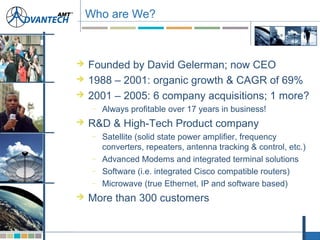
 Founded by David Gelerman; now CEO
 1988 – 2001: organic growth & CAGR of 69%
 2001 – 2005: 6 company acquisitions; 1 more?
– Always profitable over 17 years in business!
 R&D & High-Tech Product company
– Satellite (solid state power amplifier, frequency
converters, repeaters, antenna tracking & control, etc.)
– Advanced Modems and integrated terminal solutions
– Software (i.e. integrated Cisco compatible routers)
– Microwave (true Ethernet, IP and software based)
 More than 300 customers
Who are We?
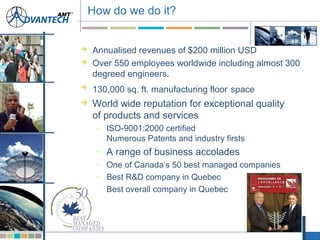
 Annualised revenues of $200 million USD
 Over 550 employees worldwide including almost 300
degreed engineers.
 130,000 sq. ft. manufacturing floor space
 World wide reputation for exceptional quality
of products and services
– ISO-9001:2000 certified
Numerous Patents and industry firsts
– A range of business accolades
– One of Canada’s 50 best managed companies
– Best R&D company in Quebec
– Best overall company in Quebec
How do we do it?
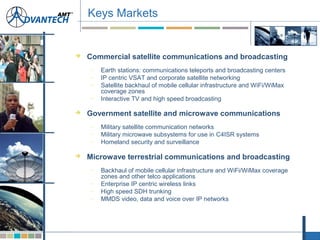
 Commercial satellite communications and broadcasting
– Earth stations: communications teleports and broadcasting centers
– IP centric VSAT and corporate satellite networking
– Satellite backhaul of mobile cellular infrastructure and WiFi/WiMax
coverage zones
– Interactive TV and high speed broadcasting
 Government satellite and microwave communications
– Military satellite communication networks
– Military microwave subsystems for use in C4ISR systems
– Homeland security and surveillance
 Microwave terrestrial communications and broadcasting
– Backhaul of mobile cellular infrastructure and WiFi/WiMax coverage
zones and other telco applications
– Enterprise IP centric wireless links
– High speed SDH trunking
– MMDS video, data and voice over IP networks
Keys Markets
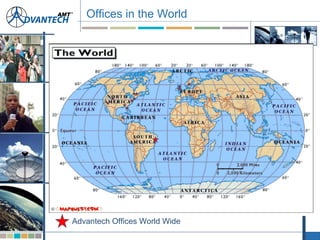
Advantech Offices World Wide
Offices in the World
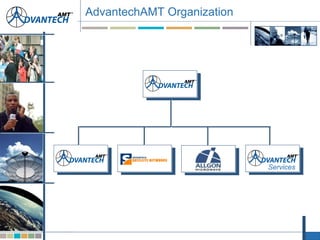
Services
AdvantechAMT Organization
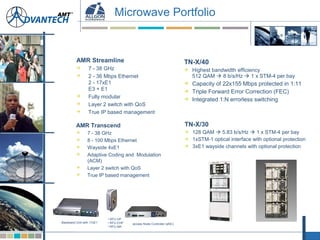
Microwave Portfolio
access Node Controller (aNC)
• RFU HP
• RFU EHP
• RFU MA
Baseband Unit with 17xE1
AMR Streamline
 7 - 38 GHz
 2 - 36 Mbps Ethernet
2 - 17xE1
E3 + E1
 Fully modular
 Layer 2 switch with QoS
 True IP based management
AMR Transcend
 7 - 38 GHz
 8 - 100 Mbps Ethernet
 Wayside 4xE1
 Adaptive Coding and Modulation
(ACM)
 Layer 2 switch with QoS
 True IP based management
TN-X/40
 Highest bandwidth efficiency
512 QAM  8 b/s/Hz  1 x STM-4 per bay
 Capacity of 22x155 Mbps protected in 1:11
 Triple Forward Error Correction (FEC)
 Integrated 1:N errorless switching
TN-X/30
 128 QAM  5.83 b/s/Hz  1 x STM-4 per bay
 1xSTM-1 optical interface with optional protection
 3xE1 wayside channels with optional protection
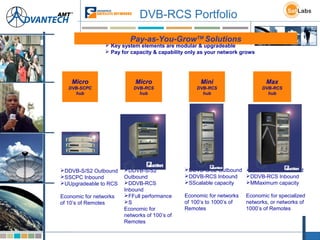
DVB-RCS Portfolio
Pay-as-You-GrowTM
Solutions
Micro
DVB-SCPC
hub
Micro
DVB-RCS
hub
Mini
DVB-RCS
hub
Max
DVB-RCS
hub
DDVB-S/S2
Outbound
DDVB-RCS
Inbound
FFull performance
S
Economic for
networks of 100’s of
Remotes
DDVB-S/S2 Outbound
DDVB-RCS Inbound
SScalable capacity
Economic for networks
of 100’s to 1000’s of
Remotes
 Key system elements are modular & upgradeable
 Pay for capacity & capability only as your network grows
DDVB-S/S2 Outbound
DDVB-RCS Inbound
MMaximum capacity
Economic for specialized
networks, or networks of
1000’s of Remotes
DDVB-S/S2 Outbound
SSCPC Inbound
UUpgradeable to RCS
Economic for networks
of 10’s of Remotes
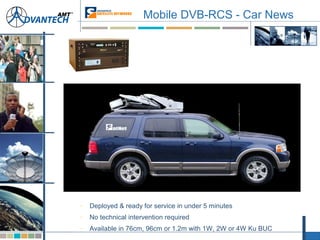
Mobile DVB-RCS - Car News
– Deployed & ready for service in under 5 minutes
– No technical intervention required
– Available in 76cm, 96cm or 1.2m with 1W, 2W or 4W Ku BUC
DVB-RCS Based ApproachDVB-RCS Based Approach
 Broadband operation in Ku and Ka FSS bands on
secondary basis to fixed satellite and terrestrial services
– Comply with FSS off-axis emission requirements using
spectrum spreading, if required, for both return and forward
links
– Comply with flux density limits of other terrestrial services by
monitoring of mobile terminal location and shutting down of
transmission in exclusion zones (defined proximity to
terrestrial facilities )
 Doppler pre-compensation in terminal
 Handover of forward and return path carriers, rerouting
of traffic and signalling and reassignment of associated
logical resources and identifiers.
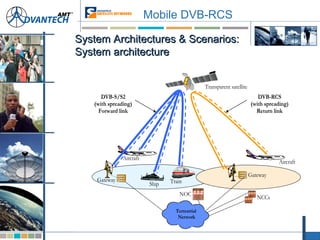
Mobile DVB-RCS
System Architectures & Scenarios:System Architectures & Scenarios:
System architectureSystem architecture
Gateway
Transparent satellite
Aircraft
Aircraft
Ship Train
DVB-RCS
(with spreading)
Return link
Terrestrial
Network
NOC
NCCs
Gateway
DVB-S/S2
(with spreading)
Forward link
Mobile DVB-RCS
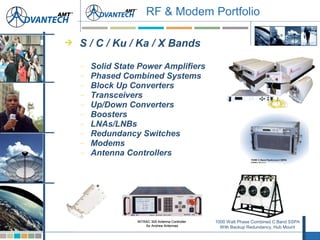
RF & Modem Portfolio
1000 Watt Phase Combined C Band SSPA
With Backup Redundancy, Hub Mount
INTRAC 305 Antenna Controller
for Andrew Antennas
INTRAC 305 Antenna Controller
for Andrew Antennas
 S / C / Ku / Ka / X Bands
– Solid State Power Amplifiers
– Phased Combined Systems
– Block Up Converters
– Transceivers
– Up/Down Converters
– Boosters
– LNAs/LNBs
– Redundancy Switches
– Modems
– Antenna Controllers
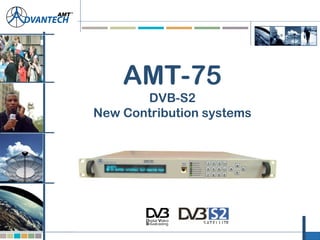
AMT-75
DVB-S2
New Contribution systems
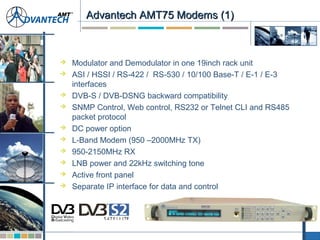
Advantech AMT75 Modems (1)Advantech AMT75 Modems (1)
 Modulator and Demodulator in one 19inch rack unit
 ASI / HSSI / RS-422 / RS-530 / 10/100 Base-T / E-1 / E-3
interfaces
 DVB-S / DVB-DSNG backward compatibility
 SNMP Control, Web control, RS232 or Telnet CLI and RS485
packet protocol
 DC power option
 L-Band Modem (950 –2000MHz TX)
 950-2150MHz RX
 LNB power and 22kHz switching tone
 Active front panel
 Separate IP interface for data and control
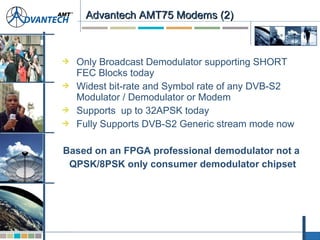
 Only Broadcast Demodulator supporting SHORT
FEC Blocks today
 Widest bit-rate and Symbol rate of any DVB-S2
Modulator / Demodulator or Modem
 Supports up to 32APSK today
 Fully Supports DVB-S2 Generic stream mode now
Based on an FPGA professional demodulator not a
QPSK/8PSK only consumer demodulator chipset
Advantech AMT75 Modems (2)Advantech AMT75 Modems (2)
 Support for both SHORT and NORMAL FEC
frame
– NORMAL FEC Block is 64Kbits
– SHORT FEC Block is 16Kbits
– Latency is between 1 and 2 blocks
– Below 1Mbps NORMAL block can introduce
significant latency!
 Bit-rates from 128Kbps to >100Mbps from one
unit!
– Store and Forward at 256kbps and HD H.264 4.2.2
at 20Mbps or even higher can be supported by the
same Modem
Advantech AMT75 Modems (3)Advantech AMT75 Modems (3)
 Simple ACM support if return link is present
– System simply adopts the highest throughput available
on the link
– If conditions deteriorate then the Modulation / Coding is
made more rugged and the bit-rate reduced
– Reduce the number of ‘live’ link failures
 Receiver auto-configures Modulation and Coding
– Users just have to enter Frequency and bit-rate
– Modulation and Coding data is carried in a well protected
header before each FEC block
– This is how ACM is signalled
Advantech AMT75 Modems (4)Advantech AMT75 Modems (4)
For Direct-to-Home BroadcastersFor Direct-to-Home Broadcasters
 Chipsets are available now
– All support a limited subset (QPSK/8PSK)
– Constant Coding Modulation only
 Likely operating mode will be
– 8PSK
– Rate 2/3
– Typically 30MSymbols/S @ 0.20 roll-off
 Giving 59Mbits/S compared to 37Mbits/S today
60% more data with little change in
operating point
Add MPEG-4 to the mix for a channel
explosion!
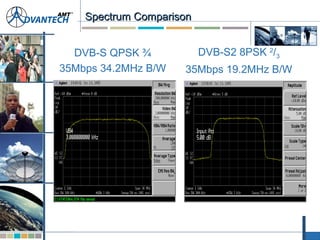
Spectrum ComparisonSpectrum Comparison
DVB-S QPSK ¾
35Mbps 34.2MHz B/W
DVB-S2 8PSK 2
/3
35Mbps 19.2MHz B/W
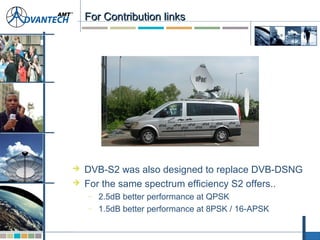
For Contribution linksFor Contribution links
 DVB-S2 was also designed to replace DVB-DSNG
 For the same spectrum efficiency S2 offers..
– 2.5dB better performance at QPSK
– 1.5dB better performance at 8PSK / 16-APSK
DVB-S2 DSNG specific featuresDVB-S2 DSNG specific features
 Next generation Contribution Links
– MPEG-4 4.2.2 HD and SD
– Store and forward functionality
– Bi-directional satellite link
– IP based H.264 option
– VOIP / Web-surfing / Intranet / FTP features
 DVB-S2 has in the tool-box
– SHORT FEC FRAME (16Kbit blocks)
– Generic Stream Mode (efficient IP transmission)
– Adaptive Coding Modulation (better link
robustness)
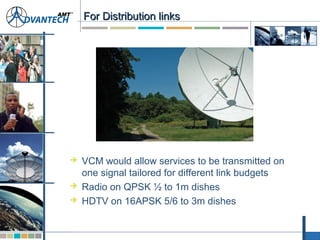
For Distribution linksFor Distribution links
 VCM would allow services to be transmitted on
one signal tailored for different link budgets
 Radio on QPSK ½ to 1m dishes
 HDTV on 16APSK 5/6 to 3m dishes
For Data providersFor Data providers
 ACM could revolutionise DVB-RCS type
systems
 Each user gets ‘tailored’ Modulation / Coding
 Service can tolerate rain fade via ‘dynamic
ACM’
 ESA predicts a 2.6 fold increase in throughput
with DVB-S2 and ACM
Brazil’s Regulatory Issues
 3G/UMTS
 WiMax
 Pay TV via Satellite
 Pay TV via Cable (MMDS)
 IPTV (internet)
 VoIP
 Fixed Telephony
 Legacy Data Com.
FULL SERVICES CONVERGENCE
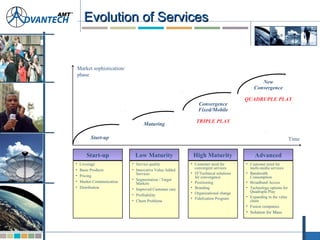
Evolution of ServicesEvolution of Services
Time
Market sophistication/
phase
Start-up
Start-up
• Coverage
• Basic Products
• Pricing
• Market Communication
• Distribution
Maturing
Low Maturity
• Service quality
• Innovative Value Added
Services
• Segmentation / Target
Markets
• Improved Customer care
• Profitability
• Churn Problems
Convergence
Fixed/Mobile
TRIPLE PLAY
High Maturity
• Customer need for
convergent services
• IT/Technical solutions
for convergence
• Positioning
• Branding
• Organizational change
• Fidelization Program
New
Convergence
QUADRUPLE PLAY
Advanced
• Customer need for
multi-media services
• Bandwidth
Consumption
• Broadband Access
• Technology options for
Quadruple Play
• Expanding in the value
chain
• Fusion companies
• Solution for Mass
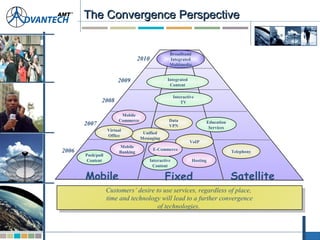
The Convergence PerspectiveThe Convergence Perspective
Customers’ desire to use services, regardless of place,
time and technology will lead to a further convergence
of technologies.
Customers’ desire to use services, regardless of place,
time and technology will lead to a further convergence
of technologies.
Mobile Fixed Satellite
2006
2007
2008
2009
2010
Mobile
Banking
Hosting
Mobile
Commerce
Unified
Messaging
Virtual
Office
VoIP
Data
VPN
Push/pull
Content Interactive
Content
E-Commerce
Education
Services
Interactive
TV
Integrated
Content
Broadband
Integrated
Multimedia
Telephony
Competitiveness x IP : a new dimension view
-2 -1 0 1 2
0
50K
100K
150K
200K
Egito
India
França
Costa Rica
Indonesia
Estados Unidos
Finlândia
Holanda
Suécia
Suíça
Alemanha
Dinamarca
Canada
Reino Unido
Áustria
Singapura
Australia
Japão
Nova Zelândia
Irlanda
Noruega
Taiwan
Israel
Hong Kong
Islândia
Espanha
Chile
Itália
África do Sul
Malásia
Coréia
Portugal
Ilhas Maurício
Turquia
Jordânia
Hungria
Mexico
Brasil
Grécia
Polônia
Thailand
Argentina
República Checa
Filipinas
Zimbabwe
Peru
El Salvador
Eslováquia
China
Vietnã
Venezuela
Colômbia
Bulgária
Russia
Ucrânia
Equador
Bolivia
Bélgica
MicroEconomy Competitiveness Factor
2002
Intl IP Bandwidht Mbps
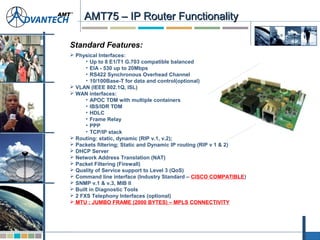
AMT75 – IP Router FunctionalityAMT75 – IP Router Functionality
Standard Features:
 Physical Interfaces:
• Up to 8 E1/T1 G.703 compatible balanced
• EIA - 530 up to 20Mbps
• RS422 Synchronous Overhead Channel
• 10/100Base-T for data and control(optional)
 VLAN (IEEE 802.1Q, ISL)
 WAN interfaces:
• APOC TDM with multiple containers
• IBS/IDR TDM
• HDLC
• Frame Relay
• PPP
• TCP/IP stack
 Routing: static, dynamic (RIP v.1, v.2);
 Packets filtering; Static and Dynamic IP routing (RIP v 1 & 2)
 DHCP Server
 Network Address Translation (NAT)
 Packet Filtering (Firewall)
 Quality of Service support to Level 3 (QoS)
 Command line interface (Industry Standard – CISCO COMPATIBLE)
 SNMP v.1 & v.3, MIB II
 Built in Diagnostic Tools
 2 FXS Telephony Interfaces (optional)
 MTU : JUMBO FRAME (2000 BYTES) – MPLS CONNECTIVITY
Office in Brazil
Claudio N. Frugis
Regional Sales Director
R. Bandeira Paulista, 477, sala 55
04532-011, Itaim, São Paulo, SP, Brazil
Mobile: +55 11 7692 8662
Email: frugis@advantechAMT.com
http://www. AdvantechAMT.com
Claudio N. Frugis
Regional Sales Director
R. Bandeira Paulista, 477, sala 55
04532-011, Itaim, São Paulo, SP, Brazil
Mobile: +55 11 7692 8662
Email: frugis@advantechAMT.com
http://www. AdvantechAMT.com

Broadcast day-2007-advantech

  • 1.
    Advantech AMT: Power ofthe Wireless SSPI – BROADCAST DAY Rio de Janeiro, June 5th Claudio N. Frugis
  • 2.
     Founded byDavid Gelerman; now CEO  1988 – 2001: organic growth & CAGR of 69%  2001 – 2005: 6 company acquisitions; 1 more? – Always profitable over 17 years in business!  R&D & High-Tech Product company – Satellite (solid state power amplifier, frequency converters, repeaters, antenna tracking & control, etc.) – Advanced Modems and integrated terminal solutions – Software (i.e. integrated Cisco compatible routers) – Microwave (true Ethernet, IP and software based)  More than 300 customers Who are We?
  • 3.
     Annualised revenuesof $200 million USD  Over 550 employees worldwide including almost 300 degreed engineers.  130,000 sq. ft. manufacturing floor space  World wide reputation for exceptional quality of products and services – ISO-9001:2000 certified Numerous Patents and industry firsts – A range of business accolades – One of Canada’s 50 best managed companies – Best R&D company in Quebec – Best overall company in Quebec How do we do it?
  • 4.
     Commercial satellitecommunications and broadcasting – Earth stations: communications teleports and broadcasting centers – IP centric VSAT and corporate satellite networking – Satellite backhaul of mobile cellular infrastructure and WiFi/WiMax coverage zones – Interactive TV and high speed broadcasting  Government satellite and microwave communications – Military satellite communication networks – Military microwave subsystems for use in C4ISR systems – Homeland security and surveillance  Microwave terrestrial communications and broadcasting – Backhaul of mobile cellular infrastructure and WiFi/WiMax coverage zones and other telco applications – Enterprise IP centric wireless links – High speed SDH trunking – MMDS video, data and voice over IP networks Keys Markets
  • 5.
    Advantech Offices WorldWide Offices in the World
  • 6.
  • 7.
    Microwave Portfolio access NodeController (aNC) • RFU HP • RFU EHP • RFU MA Baseband Unit with 17xE1 AMR Streamline  7 - 38 GHz  2 - 36 Mbps Ethernet 2 - 17xE1 E3 + E1  Fully modular  Layer 2 switch with QoS  True IP based management AMR Transcend  7 - 38 GHz  8 - 100 Mbps Ethernet  Wayside 4xE1  Adaptive Coding and Modulation (ACM)  Layer 2 switch with QoS  True IP based management TN-X/40  Highest bandwidth efficiency 512 QAM  8 b/s/Hz  1 x STM-4 per bay  Capacity of 22x155 Mbps protected in 1:11  Triple Forward Error Correction (FEC)  Integrated 1:N errorless switching TN-X/30  128 QAM  5.83 b/s/Hz  1 x STM-4 per bay  1xSTM-1 optical interface with optional protection  3xE1 wayside channels with optional protection
  • 8.
    DVB-RCS Portfolio Pay-as-You-GrowTM Solutions Micro DVB-SCPC hub Micro DVB-RCS hub Mini DVB-RCS hub Max DVB-RCS hub DDVB-S/S2 Outbound DDVB-RCS Inbound FFull performance S Economicfor networks of 100’s of Remotes DDVB-S/S2 Outbound DDVB-RCS Inbound SScalable capacity Economic for networks of 100’s to 1000’s of Remotes  Key system elements are modular & upgradeable  Pay for capacity & capability only as your network grows DDVB-S/S2 Outbound DDVB-RCS Inbound MMaximum capacity Economic for specialized networks, or networks of 1000’s of Remotes DDVB-S/S2 Outbound SSCPC Inbound UUpgradeable to RCS Economic for networks of 10’s of Remotes
  • 9.
    Mobile DVB-RCS -Car News – Deployed & ready for service in under 5 minutes – No technical intervention required – Available in 76cm, 96cm or 1.2m with 1W, 2W or 4W Ku BUC
  • 10.
    DVB-RCS Based ApproachDVB-RCSBased Approach  Broadband operation in Ku and Ka FSS bands on secondary basis to fixed satellite and terrestrial services – Comply with FSS off-axis emission requirements using spectrum spreading, if required, for both return and forward links – Comply with flux density limits of other terrestrial services by monitoring of mobile terminal location and shutting down of transmission in exclusion zones (defined proximity to terrestrial facilities )  Doppler pre-compensation in terminal  Handover of forward and return path carriers, rerouting of traffic and signalling and reassignment of associated logical resources and identifiers. Mobile DVB-RCS
  • 11.
    System Architectures &Scenarios:System Architectures & Scenarios: System architectureSystem architecture Gateway Transparent satellite Aircraft Aircraft Ship Train DVB-RCS (with spreading) Return link Terrestrial Network NOC NCCs Gateway DVB-S/S2 (with spreading) Forward link Mobile DVB-RCS
  • 12.
    RF & ModemPortfolio 1000 Watt Phase Combined C Band SSPA With Backup Redundancy, Hub Mount INTRAC 305 Antenna Controller for Andrew Antennas INTRAC 305 Antenna Controller for Andrew Antennas  S / C / Ku / Ka / X Bands – Solid State Power Amplifiers – Phased Combined Systems – Block Up Converters – Transceivers – Up/Down Converters – Boosters – LNAs/LNBs – Redundancy Switches – Modems – Antenna Controllers
  • 13.
  • 14.
    Advantech AMT75 Modems(1)Advantech AMT75 Modems (1)  Modulator and Demodulator in one 19inch rack unit  ASI / HSSI / RS-422 / RS-530 / 10/100 Base-T / E-1 / E-3 interfaces  DVB-S / DVB-DSNG backward compatibility  SNMP Control, Web control, RS232 or Telnet CLI and RS485 packet protocol  DC power option  L-Band Modem (950 –2000MHz TX)  950-2150MHz RX  LNB power and 22kHz switching tone  Active front panel  Separate IP interface for data and control
  • 15.
     Only BroadcastDemodulator supporting SHORT FEC Blocks today  Widest bit-rate and Symbol rate of any DVB-S2 Modulator / Demodulator or Modem  Supports up to 32APSK today  Fully Supports DVB-S2 Generic stream mode now Based on an FPGA professional demodulator not a QPSK/8PSK only consumer demodulator chipset Advantech AMT75 Modems (2)Advantech AMT75 Modems (2)
  • 16.
     Support forboth SHORT and NORMAL FEC frame – NORMAL FEC Block is 64Kbits – SHORT FEC Block is 16Kbits – Latency is between 1 and 2 blocks – Below 1Mbps NORMAL block can introduce significant latency!  Bit-rates from 128Kbps to >100Mbps from one unit! – Store and Forward at 256kbps and HD H.264 4.2.2 at 20Mbps or even higher can be supported by the same Modem Advantech AMT75 Modems (3)Advantech AMT75 Modems (3)
  • 17.
     Simple ACMsupport if return link is present – System simply adopts the highest throughput available on the link – If conditions deteriorate then the Modulation / Coding is made more rugged and the bit-rate reduced – Reduce the number of ‘live’ link failures  Receiver auto-configures Modulation and Coding – Users just have to enter Frequency and bit-rate – Modulation and Coding data is carried in a well protected header before each FEC block – This is how ACM is signalled Advantech AMT75 Modems (4)Advantech AMT75 Modems (4)
  • 18.
    For Direct-to-Home BroadcastersForDirect-to-Home Broadcasters  Chipsets are available now – All support a limited subset (QPSK/8PSK) – Constant Coding Modulation only  Likely operating mode will be – 8PSK – Rate 2/3 – Typically 30MSymbols/S @ 0.20 roll-off  Giving 59Mbits/S compared to 37Mbits/S today 60% more data with little change in operating point Add MPEG-4 to the mix for a channel explosion!
  • 19.
    Spectrum ComparisonSpectrum Comparison DVB-SQPSK ¾ 35Mbps 34.2MHz B/W DVB-S2 8PSK 2 /3 35Mbps 19.2MHz B/W
  • 20.
    For Contribution linksForContribution links  DVB-S2 was also designed to replace DVB-DSNG  For the same spectrum efficiency S2 offers.. – 2.5dB better performance at QPSK – 1.5dB better performance at 8PSK / 16-APSK
  • 21.
    DVB-S2 DSNG specificfeaturesDVB-S2 DSNG specific features  Next generation Contribution Links – MPEG-4 4.2.2 HD and SD – Store and forward functionality – Bi-directional satellite link – IP based H.264 option – VOIP / Web-surfing / Intranet / FTP features  DVB-S2 has in the tool-box – SHORT FEC FRAME (16Kbit blocks) – Generic Stream Mode (efficient IP transmission) – Adaptive Coding Modulation (better link robustness)
  • 22.
    For Distribution linksForDistribution links  VCM would allow services to be transmitted on one signal tailored for different link budgets  Radio on QPSK ½ to 1m dishes  HDTV on 16APSK 5/6 to 3m dishes
  • 23.
    For Data providersForData providers  ACM could revolutionise DVB-RCS type systems  Each user gets ‘tailored’ Modulation / Coding  Service can tolerate rain fade via ‘dynamic ACM’  ESA predicts a 2.6 fold increase in throughput with DVB-S2 and ACM
  • 24.
    Brazil’s Regulatory Issues 3G/UMTS  WiMax  Pay TV via Satellite  Pay TV via Cable (MMDS)  IPTV (internet)  VoIP  Fixed Telephony  Legacy Data Com. FULL SERVICES CONVERGENCE
  • 25.
    Evolution of ServicesEvolutionof Services Time Market sophistication/ phase Start-up Start-up • Coverage • Basic Products • Pricing • Market Communication • Distribution Maturing Low Maturity • Service quality • Innovative Value Added Services • Segmentation / Target Markets • Improved Customer care • Profitability • Churn Problems Convergence Fixed/Mobile TRIPLE PLAY High Maturity • Customer need for convergent services • IT/Technical solutions for convergence • Positioning • Branding • Organizational change • Fidelization Program New Convergence QUADRUPLE PLAY Advanced • Customer need for multi-media services • Bandwidth Consumption • Broadband Access • Technology options for Quadruple Play • Expanding in the value chain • Fusion companies • Solution for Mass
  • 26.
    The Convergence PerspectiveTheConvergence Perspective Customers’ desire to use services, regardless of place, time and technology will lead to a further convergence of technologies. Customers’ desire to use services, regardless of place, time and technology will lead to a further convergence of technologies. Mobile Fixed Satellite 2006 2007 2008 2009 2010 Mobile Banking Hosting Mobile Commerce Unified Messaging Virtual Office VoIP Data VPN Push/pull Content Interactive Content E-Commerce Education Services Interactive TV Integrated Content Broadband Integrated Multimedia Telephony
  • 27.
    Competitiveness x IP: a new dimension view -2 -1 0 1 2 0 50K 100K 150K 200K Egito India França Costa Rica Indonesia Estados Unidos Finlândia Holanda Suécia Suíça Alemanha Dinamarca Canada Reino Unido Áustria Singapura Australia Japão Nova Zelândia Irlanda Noruega Taiwan Israel Hong Kong Islândia Espanha Chile Itália África do Sul Malásia Coréia Portugal Ilhas Maurício Turquia Jordânia Hungria Mexico Brasil Grécia Polônia Thailand Argentina República Checa Filipinas Zimbabwe Peru El Salvador Eslováquia China Vietnã Venezuela Colômbia Bulgária Russia Ucrânia Equador Bolivia Bélgica MicroEconomy Competitiveness Factor 2002 Intl IP Bandwidht Mbps
  • 28.
    AMT75 – IPRouter FunctionalityAMT75 – IP Router Functionality Standard Features:  Physical Interfaces: • Up to 8 E1/T1 G.703 compatible balanced • EIA - 530 up to 20Mbps • RS422 Synchronous Overhead Channel • 10/100Base-T for data and control(optional)  VLAN (IEEE 802.1Q, ISL)  WAN interfaces: • APOC TDM with multiple containers • IBS/IDR TDM • HDLC • Frame Relay • PPP • TCP/IP stack  Routing: static, dynamic (RIP v.1, v.2);  Packets filtering; Static and Dynamic IP routing (RIP v 1 & 2)  DHCP Server  Network Address Translation (NAT)  Packet Filtering (Firewall)  Quality of Service support to Level 3 (QoS)  Command line interface (Industry Standard – CISCO COMPATIBLE)  SNMP v.1 & v.3, MIB II  Built in Diagnostic Tools  2 FXS Telephony Interfaces (optional)  MTU : JUMBO FRAME (2000 BYTES) – MPLS CONNECTIVITY
  • 29.
    Office in Brazil ClaudioN. Frugis Regional Sales Director R. Bandeira Paulista, 477, sala 55 04532-011, Itaim, São Paulo, SP, Brazil Mobile: +55 11 7692 8662 Email: frugis@advantechAMT.com http://www. AdvantechAMT.com Claudio N. Frugis Regional Sales Director R. Bandeira Paulista, 477, sala 55 04532-011, Itaim, São Paulo, SP, Brazil Mobile: +55 11 7692 8662 Email: frugis@advantechAMT.com http://www. AdvantechAMT.com