High Capacity Radio Links
Tobias Fröjdlund
Commercial in confidence | 2012-05-16
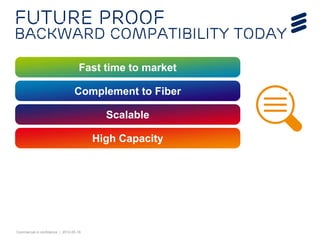
Future proof
Backward compatibility today
Fast time to market
Complement to Fiber
Scalable
High Capacity
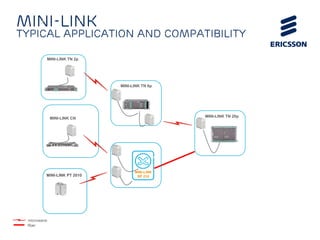
MINI-LINK
typical application and compatibility
microwave
fiber
MINI-LINK PT 2010
MINI-LINK
SP 210
MINI-LINK
SP 210
MINI-LINK TN 2p
MINI-LINK CN
MINI-LINK TN 6p
MINI-LINK TN 20p
MINI-LINK
SP 210MINI-LINK PT 2010MINI-LINK PT 2010
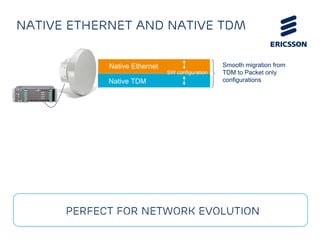
Smooth migration from
TDM to Packet only
configurations
Native Ethernet
Native TDM
Perfect for network evolution
Native Ethernet and native TDM
SW configuration
Commercial in confidence | 2012-05-16
Planning Tools
› MLPerf
– User friendly availability and hop length tool
› Microwave vs Fiber calculation tool
– Use your own values to calculate on the business case
High Capacity Radio Links
Commercial in confidence | 2012-05-16
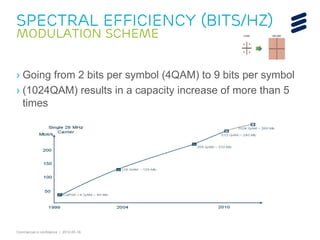
Spectral Efficiency (bits/Hz)
Modulation Scheme
› Going from 2 bits per symbol (4QAM) to 9 bits per symbol
› (1024QAM) results in a capacity increase of more than 5
times
Commercial in confidence | 2012-05-16
Microwave capacity
EVOLUTION
Spectral efficiency
Spectrum
Adaptive modulation
High order modulation
Meeting future Backhaul NEED
0,001
0,01
0,1
1
10
100
3.5 7 14 28 56 112 250 500 1000
4 QAM
1024 QAM
1024 QAM & XPIC
1024 QAM & XPIC & 2x2 LoS MIMO
CapacityLine rate [Gbps]
Channel Bandwidth [MHz]
Multi Carrier
Radio Link Bonding
One Fat Packet Pipe
Commercial in confidence | 2012-05-16
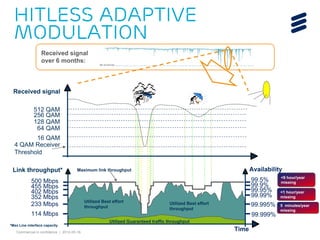
Hitless Adaptive
Modulation
Link throughput*
233 Mbps
402 Mbps
114 Mbps
500 Mbps
352 Mbps
455 Mbps
99.999%
99.995%
99.99%
99.95%
Time
Availability
99.9%
99.5%
Maximum link throughput
Utilized Best effort
throughput
Utilized Guaranteed traffic throughput
Received signal
4 QAM Receiver
Threshold
16 QAM
128 QAM
64 QAM
256 QAM
512 QAM
Received signal
over 6 months:
<9 hour/year
missing
<1 hour/year
missing
5 minutes/year
missing
Utilized Best effort
throughput
*Max Line interface capacity
Commercial in confidence | 2012-05-16
Spectral Efficiency (bits/Hz)
XPIC
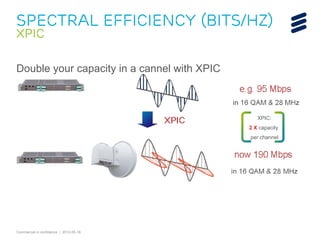
Double your capacity in a cannel with XPIC
XPIC:
2 X capacity
per channel
Commercial in confidence | 2012-05-16
Multi Carrier
Solutions
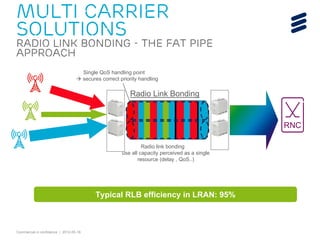
Radio Link Bonding - The Fat Pipe
approach
Radio link bonding
use all capacity perceived as a single
resource (delay , QoS..)
Single QoS handling point
secures correct priority handling
Radio Link Bonding
RNC
Typical RLB efficiency in LRAN: 95%
Commercial in confidence | 2012-05-16
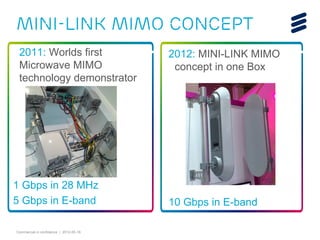
MINI-LINK MIMO CONCEPT
2011: Worlds first
Microwave MIMO
technology demonstrator
1 Gbps in 28 MHz
5 Gbps in E-band
2012: MINI-LINK MIMO
concept in one Box
10 Gbps in E-band
Commercial in confidence | 2012-05-16
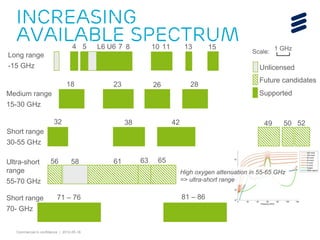
Increasing
Available Spectrum
71 ‒ 76
Long range
-15 GHz
Short range
30-55 GHz
Ultra-short
range
55-70 GHz
Short range
70- GHz
74 5 L6 8 11 13 15U6
18 23 26 28
Medium range
15-30 GHz
10
32 38 42
56 58 61 6563
Unlicensed
5049 52
81 ‒ 86
Future candidates
Supported
1 GHz
Scale:
High oxygen attenuation in 55-65 GHz
=> ultra-short range
Commercial in confidence | 2012-05-16
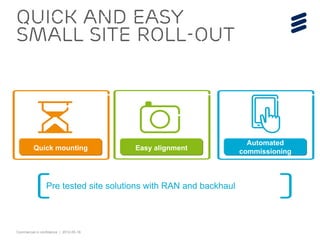
quick and easy
small site roll-out
Quick mounting Easy alignment
Automated
commissioning
Pre tested site solutions with RAN and backhaul
Commercial in confidence | 2012-05-16
TCO
An area today with very high
priority
TCO a prioritized field
ODU
Power Consumption
MTBF
IDU
Power Consumption
ECO-mode
15
17
19
21
23
25
27
29
31
33
35
0 1 2 3 4 5 6 7 8 9 10 11 12 13 14 15 16 17 18 19 20 21 22 23 24 25 26 27 28 29 30
Output power [dBm]
Powerconsumption[W]
RAU2 X 6L
RAU2 X 10
RAU2 X 11
RAU2 X 13
RAU2 X 15
RAU2 X 24
RAU2 X 26
RAU2 X 32
RAU2 X 38
RAU2 X 6L HP
RAU2 X 13 HP
RAU2 X 15 HP
Ease of
Use
COST SAVINGS Vodafone request MINI-LINK CN 510 Figures
ODU MTBF Greater than 50 y 80/100 y (depending on RAU types)
IDU MTBF 1A, 2A: 80 y 140 y
3A: 60 y 140y
1B, 2B: 70 y 70 y
3B: 50 y 70 y
IDU MTBF traffic
affecting
1+0 configuration 200 y 230 y
1+1 configuration 100 y 115 y
1+0 link MTBF (2A) Greater than 20 y 25/30 y (depending on RAU types)
1+1 link MTBF (3B) Greater than 50 y 35/40 y (depending on RAU types)
›Optimized for OPEX
–Easy configuration and ordering
›Remote upgrading of capacity
– no site visit necessary
–Easy installation and commissioning
–No fans needed – install and forget
–Several interfaces - serving several RBS’s
–High MTBF: 230 years
–Low Power consumption: 27W
–Small foot print: perfect fit in fully equipped RBS
›Easy repair: 1+0 / 1+1 / 2+0
–No Craft needed at repair
–Configurations stored on RMM card
Commercial in confidence | 2012-05-16
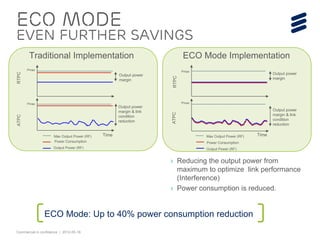
ECO Mode
even Further savingsRTPC
Output power
margin
Output power
margin & link
condition
reduction
Time
ATPC
Power Consumption
Output Power (RF)
Traditional Implementation
RTPC
Output power
margin
Output power
margin & link
condition
reduction
Time
ATPC
ECO Mode Implementation
ECO Mode: Up to 40% power consumption reduction
› Reducing the output power from
maximum to optimize link performance
(Interference)
› Power consumption is reduced.
Max Output Power (RF)
Power Consumption
Output Power (RF)
Max Output Power (RF)
Pmax
Pmax
Pmax
Pmax
MINI-LINK Small cell
concept
Commercial in confidence | 2012-05-16
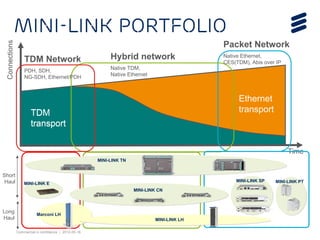
MINI-LINK PortfolioConnections
Time
Hybrid network
Native TDM,
Native Ethernet
Ethernet
transportTDM
transport
TDM
transport
TDM Network
PDH, SDH,
NG-SDH, Ethernet/PDH
Packet Network
Native Ethernet,
CES(TDM), Abis over IP
MINI-LINK TN
MINI-LINK E
Marconi LH
MINI-LINK LH
Short
Haul
Long
Haul
MINI-LINK CN
MINI-LINK SP MINI-LINK PT
Commercial in confidence | 2012-05-16
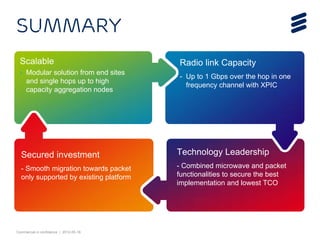
Summary
Scalable
› Modular solution from end sites
and single hops up to high
capacity aggregation nodes
Secured investment
- Smooth migration towards packet
only supported by existing platform
Technology Leadership
- Combined microwave and packet
functionalities to secure the best
implementation and lowest TCO
Radio link Capacity
- Up to 1 Gbps over the hop in one
frequency channel with XPIC
Ws14 utöka stadsnätens räckvidd - ericsson

Ws14 utöka stadsnätens räckvidd - ericsson

  • 1.
    High Capacity RadioLinks Tobias Fröjdlund
  • 2.
    Commercial in confidence| 2012-05-16 Future proof Backward compatibility today Fast time to market Complement to Fiber Scalable High Capacity
  • 3.
    MINI-LINK typical application andcompatibility microwave fiber MINI-LINK PT 2010 MINI-LINK SP 210 MINI-LINK SP 210 MINI-LINK TN 2p MINI-LINK CN MINI-LINK TN 6p MINI-LINK TN 20p MINI-LINK SP 210MINI-LINK PT 2010MINI-LINK PT 2010
  • 4.
    Smooth migration from TDMto Packet only configurations Native Ethernet Native TDM Perfect for network evolution Native Ethernet and native TDM SW configuration
  • 5.
    Commercial in confidence| 2012-05-16 Planning Tools › MLPerf – User friendly availability and hop length tool › Microwave vs Fiber calculation tool – Use your own values to calculate on the business case
  • 6.
  • 7.
    Commercial in confidence| 2012-05-16 Spectral Efficiency (bits/Hz) Modulation Scheme › Going from 2 bits per symbol (4QAM) to 9 bits per symbol › (1024QAM) results in a capacity increase of more than 5 times
  • 8.
    Commercial in confidence| 2012-05-16 Microwave capacity EVOLUTION Spectral efficiency Spectrum Adaptive modulation High order modulation Meeting future Backhaul NEED 0,001 0,01 0,1 1 10 100 3.5 7 14 28 56 112 250 500 1000 4 QAM 1024 QAM 1024 QAM & XPIC 1024 QAM & XPIC & 2x2 LoS MIMO CapacityLine rate [Gbps] Channel Bandwidth [MHz] Multi Carrier Radio Link Bonding One Fat Packet Pipe
  • 9.
    Commercial in confidence| 2012-05-16 Hitless Adaptive Modulation Link throughput* 233 Mbps 402 Mbps 114 Mbps 500 Mbps 352 Mbps 455 Mbps 99.999% 99.995% 99.99% 99.95% Time Availability 99.9% 99.5% Maximum link throughput Utilized Best effort throughput Utilized Guaranteed traffic throughput Received signal 4 QAM Receiver Threshold 16 QAM 128 QAM 64 QAM 256 QAM 512 QAM Received signal over 6 months: <9 hour/year missing <1 hour/year missing 5 minutes/year missing Utilized Best effort throughput *Max Line interface capacity
  • 10.
    Commercial in confidence| 2012-05-16 Spectral Efficiency (bits/Hz) XPIC Double your capacity in a cannel with XPIC XPIC: 2 X capacity per channel
  • 11.
    Commercial in confidence| 2012-05-16 Multi Carrier Solutions Radio Link Bonding - The Fat Pipe approach Radio link bonding use all capacity perceived as a single resource (delay , QoS..) Single QoS handling point secures correct priority handling Radio Link Bonding RNC Typical RLB efficiency in LRAN: 95%
  • 12.
    Commercial in confidence| 2012-05-16 MINI-LINK MIMO CONCEPT 2011: Worlds first Microwave MIMO technology demonstrator 1 Gbps in 28 MHz 5 Gbps in E-band 2012: MINI-LINK MIMO concept in one Box 10 Gbps in E-band
  • 13.
    Commercial in confidence| 2012-05-16 Increasing Available Spectrum 71 ‒ 76 Long range -15 GHz Short range 30-55 GHz Ultra-short range 55-70 GHz Short range 70- GHz 74 5 L6 8 11 13 15U6 18 23 26 28 Medium range 15-30 GHz 10 32 38 42 56 58 61 6563 Unlicensed 5049 52 81 ‒ 86 Future candidates Supported 1 GHz Scale: High oxygen attenuation in 55-65 GHz => ultra-short range
  • 14.
    Commercial in confidence| 2012-05-16 quick and easy small site roll-out Quick mounting Easy alignment Automated commissioning Pre tested site solutions with RAN and backhaul
  • 15.
    Commercial in confidence| 2012-05-16 TCO An area today with very high priority TCO a prioritized field ODU Power Consumption MTBF IDU Power Consumption ECO-mode 15 17 19 21 23 25 27 29 31 33 35 0 1 2 3 4 5 6 7 8 9 10 11 12 13 14 15 16 17 18 19 20 21 22 23 24 25 26 27 28 29 30 Output power [dBm] Powerconsumption[W] RAU2 X 6L RAU2 X 10 RAU2 X 11 RAU2 X 13 RAU2 X 15 RAU2 X 24 RAU2 X 26 RAU2 X 32 RAU2 X 38 RAU2 X 6L HP RAU2 X 13 HP RAU2 X 15 HP Ease of Use COST SAVINGS Vodafone request MINI-LINK CN 510 Figures ODU MTBF Greater than 50 y 80/100 y (depending on RAU types) IDU MTBF 1A, 2A: 80 y 140 y 3A: 60 y 140y 1B, 2B: 70 y 70 y 3B: 50 y 70 y IDU MTBF traffic affecting 1+0 configuration 200 y 230 y 1+1 configuration 100 y 115 y 1+0 link MTBF (2A) Greater than 20 y 25/30 y (depending on RAU types) 1+1 link MTBF (3B) Greater than 50 y 35/40 y (depending on RAU types) ›Optimized for OPEX –Easy configuration and ordering ›Remote upgrading of capacity – no site visit necessary –Easy installation and commissioning –No fans needed – install and forget –Several interfaces - serving several RBS’s –High MTBF: 230 years –Low Power consumption: 27W –Small foot print: perfect fit in fully equipped RBS ›Easy repair: 1+0 / 1+1 / 2+0 –No Craft needed at repair –Configurations stored on RMM card
  • 16.
    Commercial in confidence| 2012-05-16 ECO Mode even Further savingsRTPC Output power margin Output power margin & link condition reduction Time ATPC Power Consumption Output Power (RF) Traditional Implementation RTPC Output power margin Output power margin & link condition reduction Time ATPC ECO Mode Implementation ECO Mode: Up to 40% power consumption reduction › Reducing the output power from maximum to optimize link performance (Interference) › Power consumption is reduced. Max Output Power (RF) Power Consumption Output Power (RF) Max Output Power (RF) Pmax Pmax Pmax Pmax
  • 17.
  • 18.
    Commercial in confidence| 2012-05-16 MINI-LINK PortfolioConnections Time Hybrid network Native TDM, Native Ethernet Ethernet transportTDM transport TDM transport TDM Network PDH, SDH, NG-SDH, Ethernet/PDH Packet Network Native Ethernet, CES(TDM), Abis over IP MINI-LINK TN MINI-LINK E Marconi LH MINI-LINK LH Short Haul Long Haul MINI-LINK CN MINI-LINK SP MINI-LINK PT
  • 19.
    Commercial in confidence| 2012-05-16 Summary Scalable › Modular solution from end sites and single hops up to high capacity aggregation nodes Secured investment - Smooth migration towards packet only supported by existing platform Technology Leadership - Combined microwave and packet functionalities to secure the best implementation and lowest TCO Radio link Capacity - Up to 1 Gbps over the hop in one frequency channel with XPIC