

ERICSSON
TECHNOLOGY
C H A R T I N G T H E F U T U R E O F I N N O V A T I O N | V O L U M E 1 0 2 I 2 0 2 0 – 0 2
CTOTECHTRENDS
CREATINGINTELLIGENT
DIGITALINFRASTRUCTURE
INTEGRATEDACCESS
ANDBACKHAUL
IN5GNRNETWORKS
CRITICALIOT
CONNECTIVITY
FORINDUSTRY
#02 2020 ✱ ERICSSON TECHNOLOGY REVIEW 5
CONTENTS ✱
08	 5G BSS: EVOLVING BSS TO FIT THE 5G ECONOMY
Managing complex IOT value chains and supporting new business
models requires more sophisticated business support systems (BSS)
than those that communication service providers have used in the past.
5G-evolved BSS enable smooth collaboration between connectivity
providers, service creators, partners, suppliers and others.
20	 OPTIMIZING UICC MODULES FOR IOT APPLICATIONS
The ability to deliver low-cost Internet of Things (IoT) devices on a mass scale
is at risk of being hampered by the high cost of the universal integrated circuit cards (UICC)
currently required to provide connectivity. Until a less costly alternative becomes available,
the IoT requires workarounds that either lower device cost or justify the price of UICCs
by leveraging more of their capabilities.
40	 THE FUTURE OF CLOUD COMPUTING: HIGHLY DISTRIBUTED
WITH HETEROGENEOUS HARDWARE
Cloud computing is being shaped by the combination of the growing popularity
of distributed solutions and increased reliance on heterogeneous hardware capabilities.
As the role of distributed computing in cloud computing continues to expand, network
operators, who have large, distributed systems already in place, have a golden opportunity
to become major cloud players.
52	 CRITICAL IOT CONNECTIVITY – IDEAL FOR
TIME-CRITICAL INDUSTRIAL COMMUNICATIONS
Critical IoT connectivity is ideal for a wide range of Internet of Things
use cases across most industry verticals. Mobile network operators
are uniquely positioned to address the time-critical communication
needs of individual users, enterprises and public institutions by
leveraging their existing assets and new technologies in a
systematic fashion.
64	 INTEGRATED ACCESS AND BACKHAUL
– A NEW TYPE OF WIRELESS BACKHAUL IN 5G
Integrated access and backhaul (IAB) is an advanced concept in 5G that shows significant
promise in addressing the challenge of wireless backhaul of street sites. IAB has several
advantages compared with other backhaul technologies, and if used properly, it could
become an essential backhaul solution for 5G NR networks.
	FEATURE ARTICLE
Future network trends: Creating intelligent
digital infrastructure
Thevisionofafullydigitalized,automatedandprogrammableworldofconnected
humans, machines, things and places is well on its way to becoming a reality.
Inhisannualtechnologytrendsarticle,ourCTOErikEkuddenexplainstheseven
technology trends that are most relevant to the network platform’s evolution
to become the platform for innovation to meet any societal or industrial need.
30
30
20
Customer and partner interaction
BSS exposure layer
Order capture and fulfillmentCatalog
Charging Mediation BillingBilling
Party
management
Intelligence
management
= Decoupling and integration
08
Gaming
AR/VRB
E-MBB
Automotive
Network slices
Internet of
Things
Fixed access
Manufacturing
APP
SmartNICs
PMEM
HW capability
exposures
Access sites (edge cloud)
Central sites
Public clouds
Distributed sites
(edge/regional cloud) xNF: telco Virtual Network Function or
Cloud-native Network Function
APP: Third-party application
HW capability
control
Business
intent
Zero-touch orchestration
APP
APP
APP APP APP
APP
xNF
xNF
APP
xNF xNF
APP
xNF
xNF
xNF
xNF
xNF
40
52	
64
#02 2020 ✱ ERICSSON TECHNOLOGY REVIEW 7ERICSSON TECHNOLOGY REVIEW ✱ #02 2020
EDITORIAL ✱
Ericsson Technology Review brings you
insights into some of the key emerging
innovations that are shaping the
future of ICT. Our aim is to encourage
an open discussion about the potential,
practicalities, and benefits of a wide range
of technical developments, and provide
insight into what the future has to offer.
a d d r e s s
Ericsson
SE -164 83 Stockholm, Sweden
Phone: +46 8 719 00 00
p u b l i s h i n g
All material and articles are published on the
Ericsson Technology Review website:
www.ericsson.com/ericsson-technology-review
p u b l i s h e r
Erik Ekudden
e d i t o r
Tanis Bestland (Nordic Morning)
e d i t o r i a l b o a r d
Håkan Andersson, Magnus Buhrgard,
Dan Fahrman, John Fornehed, Kjell Gustafsson,
Jonas Högberg, Johan Lundsjö,
Mats Norin, Håkan Olofsson, Patrik Roseen,
Anders Rosengren, Robert Skog,
Gunnar Thrysin and Sara Kullman
f e at u r e a r t i c l e
Future network trends:
Creating intelligent digital infrastructure
by Erik Ekudden
a r t d i r e c t o r
Liselotte Stjernberg (Nordic Morning)
p r o j e c t m a n a g e r
Susanna O’Grady (Nordic Morning)
l ay o u t
Liselotte Stjernberg (Nordic Morning)
i l l u s t r at i o n s
Jenny Andersén (Nordic Morning)
s u b e d i t o r s
Ian Nicholson (Nordic Morning)
Paul Eade (Nordic Morning)
i s s n : 0 0 1 4 - 0 17 1
Volume: 102, 2020
■ the key role that connectivity plays in our daily
lives has never been more obvious – not only for
each of us as individuals but also for countless
enterprises around the globe. Thankfully, despite
the sudden, dramatic changes in our behavior in
early 2020, networks all around the world have
proven to be highly resilient.
At Ericsson, we’re committed to ensuring that the
network platform continues to improve its ability
to meet the full range of societal needs as well as
supporting enterprises to stay competitive in the
long term. The ability to bridge distances and make
it easier to efficiently meet needs in terms of resource
utilization, collaboration, competence transfer, status
verification, privacy protection, security and safety
is of utmost importance. Greater agility and speed
will be essential.
My 2020 technology trends article, on page 30
of this issue of the magazine, explains my view
of the ongoing evolution of the network platform
in terms of the key needs that are driving its
evolution and the emerging capabilities that
will meet both those and other needs.
The first three trends all relate to bridging the gap
between physical reality and the digital realm – that is,
delivering sensory experiences and utilizing digital
representations to make the physical world fully
programmable. The emerging capabilities that I have
highlighted this year are non-limiting connectivity,
pervasive network compute fabric, trustworthy
infrastructure and cognitive networks.
BRIDGING THE GAP
BETWEEN PHYSICAL
AND DIGITAL REALITIES
All seven of these trends serve as a cornerstone in
the development of a common Ericsson vision of
what future networks will provide, and what sort of
technology evolution will be required to get there.
This issue of the magazine also includes five
additional articles highlighting some of our
latest research in the areas of cloud computing,
the Internet of Things (IoT) and 5G advancements.
The cloud computing article is particularly
noteworthy, as it explains how we think network
operators can best manage the complexity of
future cloud deployments and overcome
technical challenges.
The first IoT article in this issue explains how critical
IoT connectivity can be used to address time-critical
needs in areas such as industrial control, mobility
automation, remote control and real-time media,
while the second one tackles the challenge that
today’s universal integrated circuit cards (UICC)
present to IoT growth.
With regard to 5G advancements, our BSS
article explores how 5G-evolved BSS can help
communication service providers transform
themselves from traditional network developers
to service enablers and ultimately service creators.
Another exciting 5G advancement that we present
in this issue is integrated access and backhaul (IAB),
an innovative concept that shows significant promise
in addressing the challenge of wireless backhaul of
street sites.
We hope you enjoy this issue of our magazine
and we’d be delighted if you share it with your
colleagues and business partners. You can find
both PDF and HTML versions of all the articles at:
www.ericsson.com/ericsson-technology-review
GREATERAGILITY
ANDSPEEDWILLBE
ESSENTIAL
✱ EDITORIAL
ERIK EKUDDEN
SENIOR VICE PRESIDENT,
CHIEF TECHNOLOGY OFFICER AND
HEAD OF GROUP FUNCTION TECHNOLOGY
8 #02 2020 ✱ ERICSSON TECHNOLOGY REVIEWERICSSON TECHNOLOGY REVIEW ✱ #02 2020 9
5G offers communication service providers an unprecedented opportunity
to enhance their position in the value chain and tap into new revenue
streams in a variety of industry verticals. A successful transition will require
business support systems (BSS) that are evolved to fit the 5G economy.
JAN FRIMAN,
MICHAEL NILSSON,
ELISABETH MUELLER
The rapidly expanding Internet of Things
(IoT) and all the new capabilities available
in 5G have opened up a wealth of opportunities
for communication service providers (CSPs)
beyond their traditional markets, particularly
in verticals such as automotive, health care,
agriculture, energy and manufacturing.
To monetize them, CSPs will need to meet
the expectations of a broader range
of stakeholders and be able to handle
complex ecosystems.
■ One of the primary roles of business support
systems (BSS) is to manage a CSP’s relationships
with its stakeholders by keeping track of
agreements, handling orders, generating reports,
sending invoices and so on. In the past, these
stakeholders were generally limited to consumers,
resellers, partners and suppliers. In the 5G/IoT
business context, though, more complex
ecosystems are arising that BSS must evolve to
support. To do so, the requirements of a larger,
more diverse group of stakeholders must be taken
into account, and mechanisms must be established
to manage the relationships between them.
Examplesofnewstakeholdergroupsthatneed
tobeconsideredinthe5G/IoTbusinesscontext
include:
❭ Enterprises and industry verticals that require
solutions beyond telecoms
❭ New types of suppliers such as IoT device
providers and suppliers of eSIM (embedded
SIM) and related technologies
❭ Platform providers that specialize in specific IoT
or edge clusters or groups of use cases such as
massive and broadband IoT platforms, industrial
IoT platforms and content data networks
❭ Integrators that specialize in specific verticals
such as asset management, mission-critical
services or automotive that combine
capabilities from multiple stakeholders to
address consumer needs.
Networkdeveloper,serviceenabler
orservicecreator?
Lookingahead,thecapabilitiesthataCSPneeds
initsBSSsolutionwilldependontheroleitplays
–oraimstoplay–intheIoTecosystem.Figure1
illustratesthethreeroletypes:networkdeveloper,
serviceenablerandservicecreator.
Inthetraditionalnetworkdeveloperrole,aCSP
actssolelyasacellularconnectivityproviderby
offeringsolutionssuchasradio,corenetworkand
communicationservices.Inthisrole,theCSP’s
businessmodelsareconsumerfocused.Itsrolein
theIoTecosystemislimited.
Intheserviceenablerrole,theCSPextendsits
servicesbyincorporatingadditionalcapabilities
suchascloud/edgeandIoTenablementandshifts
focustobusinesscustomersandindustryverticals.
TheCSPbecomesaserviceenablerfor5Gandthe
IoT,actingasasupplierofconnectivityandplatform
services.Asaserviceenabler,theCSP’sbusiness
5G BSS:
EvolvingBSS
tofitthe
5Geconomy
Figure 1 The evolving role of the CSP in the IoT ecosystem
A) Network developer
Customer Customer Customer
CSP
IoT
provider
IoT
providerCSP
SIM
manufacturer
SIM
manufacturer
Device
manufacturer
Device
manufacturer
Device
manufacturerCSP CSP
B) Service enabler C) Service creator
✱ BSS IN THE 5G ECONOMY BSS IN THE 5G ECONOMY ✱
2 3MARCH 26, 2020 ✱ ERICSSON TECHNOLOGY REVIEWERICSSON TECHNOLOGY REVIEW ✱ MARCH 26, 2020
10 #02 2020 ✱ ERICSSON TECHNOLOGY REVIEWERICSSON TECHNOLOGY REVIEW ✱ #02 2020 1110 11
modelsareextendedtobusiness-customerfocused
withrespectto5GIoT.
Intheservicecreatorrole,theCSPtransitions
frombeingaconnectivityandplatformproviderto
creatingnewdigitalservicesandcollaborating
beyondtelecomstoestablishdigitalvaluesystems.
Asaservicecreator,theCSPpartnerswithsuppliers
todelivernewservicesallthewayuptofullIoT
solutions,takingontherolesofintegrator,
distributororco-seller.
BSSforallthreeCSProles
TraditionalBSSsupporttheCSPinthenetwork
developerrole,inwhichtheCSPchargesforvoice,
textanddataservicesbasedonconsumptionor
subscriptionlevel.Themainrequirementsfor
theseBSSare:
❭ Customer management, traditional partner
business (roaming partners), charging and
billing, and finance modules
❭ Order capture and order execution for new
telco subscriptions and/or add-on offerings
❭ Charging and balance/quota management
in BSS, as well as mediation
❭ Interaction with operations support systems
(OSS) for network provisioning.
EvolvingBSStosupportaCSPinaserviceenabler
rolerequiresashiftinfocustotheneedsof
enterprisecustomersandIoTusecases.TheBSS
mustbetransformedintoasystemthatisableto
monetizeIoT/5Gplatformsandedgedeployments,
whichrequiressignificantchangesinboththe
functionalandnon-functionalspace.Inthenon-
functionalspace,thismainlyinvolvesscalability
telecoms,sothatpartnerscandeveloptailored
applicationsanddeploythemontheoperator’s
infrastructure.
Finally,thenewbusinessmodelsavailableto
CSPsasservicecreatorsrequirenewmonetization
modelsforchargingandbilling.Forexample,
multipartycharging,revenuesharingandprofit
sharingallrequireextendedbillingand
reconciliationfunctionality.
BSSsolutionlevelsandkeycapabilities
Table1organizesandsequenceskeyBSS
capabilitiesbasedontechnicaldependenciesand/or
levelofcomplexity.Onebyone,thesecapabilities
–thatis,enablingtheBSStohandletrafficand
alargenumberofdevicesatIoTscale.
Intermsoffunctionality,theBSSenhancements
requiredbyserviceenablersinclude:
❭ Automation of full life-cycle management for
devices/IoT resources supported by flexible
orchestration, including exposure of services
for managing relationships with business
customers
❭ Support for batch orchestration, flexible supply
agreements and contracts for non-telco
services with associated charging models
❭ Service exposure of network capabilities, so
that IoT providers can bundle their offerings
with connectivity and sell them on to their
customers
❭ Service exposure of BSS and OSS capabilities
to enable efficient ordering processes,
especially with regard to the management of
mass subscriptions.
SupportingaCSPintheservicecreatorrole,where
thefulllifecycleofpartnersmustbetakeninto
account,requiresBSSwithfurtherfunctional
extensions.Thestakeholderecosystemofservice
creatorsissignificantlymorecomplex,asthe
customerbasebroadenstoincludeverticalsandthe
CSPstartsofferingfullsolutionsbeyondtelecoms.
Asaresult,BSSforservicecreatorsmustinclude
extensiveandflexiblepartnerrelationship
management.Supplychainmanagementis
especiallyimportant.
Thecapacitytoexposenetworkcapabilityaswell
asBSSandOSScapabilitiesiscriticallyimportantto
aCSP’sabilitytodeliveronservicecreationbeyond
Terms and abbreviations
API – Application Programming Interface | BSS – Business Support Systems | CSP – Communication
Service Provider | IoT – Internet of Things | ODA – Open Digital Architecture | OSS – Operations Support
Systems | SBI – Service-Based Interface | SDK – Software Development Kit | SLA – Service Level Agreement
BSS solution level Capabilities
5G enabled • 5Gservice-basedinterface(SBI)support(chargingfunction)
• NetworkslicingsupportinBSSandOSS
• Classicroamingpartners
• Containerizationandmicroservices
• Commontechnologystack
IOT and edge
monetization
• IDmanagementandcorrelation
• Life-cyclemanagementforIoTdevices
• Businesscustomerand5G/IoTenterprisemanagement
• Charginginmultilevelhierarchies
• Supplyagreements
• Flexibleorchestrationoforderingprocesses
• Serviceexposurefordevicemanagement
• OpenAPIexposure
• Continuousintegration/continuousdelivery(CI/CD)forserviceexposure
• Enterpriseself-care
• Multipartychargingandbest-effortcharging
• Privatenetworks
• Platformpartnerships
• Contractfornon-telcoservices(IoT/edgeenabled)
• Chargingmodelsfornon-telcoservices
• Multi-tenancy
• Chargingandbillingonbehalfof
• Location-awareservices
• Blockchainforsmartcontracting
• ServiceLevelAgreement(SLA)management
Full 5G ecosystem • Partnerrelationshipmanagement
• Partnercatalog
• Partnerrevenuesharing
• Reconciliationandsettlement
• Flexiblebilling
• Platformasaserviceanddistributedcloud
• Edgeplatformservices
• Multi-accessedgecomputing(MEC)
• BSSasaservice
• Continuousmonitoring
• Artificialintelligenceandmachine-learningautomation
• CI/CD
Table 1 Key capabilities of the three BSS solution levels
✱ BSS IN THE 5G ECONOMY BSS IN THE 5G ECONOMY ✱
4 5MARCH 26, 2020 ✱ ERICSSON TECHNOLOGY REVIEWERICSSON TECHNOLOGY REVIEW ✱ MARCH 26, 2020
12 #02 2020 ✱ ERICSSON TECHNOLOGY REVIEWERICSSON TECHNOLOGY REVIEW ✱ #02 2020 13
addontoeachother,continuouslyincreasingBSS
maturityandtransformingtheBSSintoasystem
capableofsupportingallthenewusecasesand
businessmodelsthatcharacterizethe5G/IoT
ecosystem.
Thefirstevolutionstep–‘5Genabled’inTable1
–providessupportfornew5Gstandardsand
concepts,whichenablesadrasticincreaseindata
transmissionthroughputwhilemaintainingfocuson
traditionalconsumers.Applyingcontainerization
andacommontechnologystackwillassurethe
scalabilityoftheBSSsolutiontomeettheincreased
throughputdemandsofthenetwork.
Atthenextsolutionlevel,IoTandedgemonetization,
thefocusshiftstobusinesscustomers.Thesenew
capabilitiesenabletheCSPtoprovideextended
supportforenterpriseswhenitcomesto5GandIoT
usecasesbycoveringIoTdevicemanagement,
supportfornon-telcoservicechargingandmulti-
partychargingaswellasIoTand/oredge-platform
monetization.Inaddition,serviceexposureenables
self-serviceforenterprisesalongwithapplication
developmentfortheoptimizationofIoTdevices.
Thenumberof5G/IoTusecasesthattheCSPisable
tosupportincreasesdrasticallyatthisstage.
Theadditionofpartnercapabilitiesatthefull
5GecosystemlevelallowstheCSPtoaddresstotally
newcustomersegmentsbeyondtelecomsand
provideindustry-specificsolutionstoverticals.
ACSPcancreatenewservices(evendeliverBSS
asaservice),andoffertheseservicesonamarketplace
toreachnewsegmentsofbusinesscustomers.
Themultitudeofpartnershipsrequiresupportfor
newbusinessmodelsthatallowflexiblecharging,
revenuesharingandbilling.
5GreferencearchitectureforBSS
Fromahigh-levelarchitecturalviewpoint,BSSin
the5G/IoTecosystemcloselyresembletraditional
monitorthestateofthedevicethroughoutits
lifecycleisnotsufficient.Forexample,contracts
thatcoverlargeherdsofdevicesarelikelytobe
basedonrecurringchargesperactivedevice.
Inthesescenarios,theaggregatednumbersof
devicesperstatebecomekeyparametersinthe
calculationofcharges.
ThecalculationofchargesrelatedtoIoTdevices
isalsocomplicatedbythefactthatthestateofthe
devicecaninfluencethechargedparty.Oneexample
ofthischallengeisIoTdevicesthataremountedin
vehiclesatafactory.Thefactorypersonnelwilllikely
wanttotestthatthedeviceisworkingbefore
shippingthevehicletothereseller.Theresellermay
BSS,withsimilarinterfacestosurroundingsystems.
TheBSSarchitectureinFigure2ispresentedinthe
OpenDigitalArchitectureformat[1].Itisdivided
intopartymanagement,corecommerce
management,intelligencemanagement,production
andengagementmanagement.Productionincludes
thesouthboundapplicationprogramminginterface
(API)layertothenetworkinfrastructure,IoT
platforms,cloud/edgeandOSS,whileengagement
managementincludesthenorthboundAPIlayerto
customersandpartners.
5GandtheIoTplaceseveralchallenging
requirementsonnewcapabilitiesintheBSS
architecturethatarenotdirectlyvisibleatahigh
level.Allfunctionalareasareaffectedbythe5G
evolutionandareextendedtosupportthenew
requirementsandpossibilities,mostnotablyinthe
areasofmass-devicemanagement,deviceand
resourcelife-cyclemanagement,subscription
management,chargingmodelsfornon-telco
servicesandmultipartycharging.
IoT-scalemass-devicemanagement
Thesheernumberofconnecteddevicesinthe5G/
IoTworldisamajorchallengeforBSStomanage.
WhilecurrentBSSarchitecturesarescalable,they
willbetoocostlyforIoTusecasesduetothelarge
datafootprintandprocessingneedofeachdevice.
Scalabilityaloneisnotenoughtohandlemassive
amountsofdevices.Toaddressthis,5G-evolved
BSSmusthaveapersistenceandmanagement
modelthatislightweightenoughtoallowalarge
numberofdevicestousethesamefootprintasone
traditionaldevice.Thiscanbeaddressedusing
conceptssuchasherding,whereeachindividual
deviceonlyrequiresaminimaldatafootprint.
Thebehaviorofeachindividualdeviceis
determinedbytheherdconfiguration,whichis
asinglespecificationperherd.
Life-cyclemanagementof
IoTdevicesandresources
ManagingthelifecyclesofIoTdevicesand
resourcesisanothersignificantchallengeforBSS.In
manyemergingIoTapplications,theabilityto
Figure 2 5G reference architecture for BSS
Intelligence
management
Party management
Production
Southbound API
Core commerce management
Social
media
Mediation
= Decoupling and integration
Policies IoT
Cloud/
edge
OSS
Comm.
services
EPC/
5G Core
Customers Business
customers
Developers Apps
Engagement
management
Northbound API
SCALABILITYALONEISNOT
ENOUGHTOHANDLEMASSIVE
AMOUNTSOFDEVICES
✱ BSS IN THE 5G ECONOMY BSS IN THE 5G ECONOMY ✱
6 7MARCH 26, 2020 ✱ ERICSSON TECHNOLOGY REVIEWERICSSON TECHNOLOGY REVIEW ✱ MARCH 26, 202012 13
14 #02 2020 ✱ ERICSSON TECHNOLOGY REVIEWERICSSON TECHNOLOGY REVIEW ✱ #02 2020 15
thenwanttodemonstratetheservicethedevice
providestoprospectivebuyers,beforeaconsumer
ultimatelybuysthevehicleandstartsusingthe
service.Ateachofthesestages,thechargedparty
andchargingmodelmaybedifferentdependingon
thestateofthedevice.Overcomingsuchchallenges
requiresaBSSarchitecturethatcanprovideup-to-
datestateinformationperindividualdeviceor
resourceaswellasaggregatedinformationtothe
rating,chargingandbillingfunctions.
SubscriptionmanagementforIoTdevices
Subscriptionmanagementisanotherareathatmust
evolvetofitthenew5G/IoTbusinesscontext.
TraditionalBSSarebuilttomanageconsumer
subscriptions.Theyarenotcapableofhandlingthe
massivenumberofdevicesinIoTusecasesinacost-
efficientmanner.Subscriptionmanagementin
5G-evolvedBSSrequiresahighlevelofautomation
andsolutionsthatreducetheprocessingfootprintto
onboardandmanagedevices,servicesandproducts.
OneeffectiveapproachistoexposeAPIsandtools
thatallowpartnersorevenconsumerstoonboard
andmanagedevices.
Togainefficiencyandminimizemanagement,
poolsofservicesandproductscanbelinkedtoherds
ofdevices,insteadofapplyingindividualservicesto
devicerelationships,whichisthecommonpractice
inBSStoday.Theserviceinstanceslinkedtoherds
arekepttoaminimalfootprintandthemajorityof
theparametersneededforprocessingcanbekepton
specificationlevel.Thischangewillenablemore
efficientprocessinginBSSandreducethenumber
ofscenariosthatrequiremassprovisioning.
UnliketraditionalBSS,5G-evolvedBSSmustbe
abletocaptureandcreatethenetworkchargingdata
records(chargingfunction).Thistaskprovidesthe
Multipartycharging
WhiletraditionalBSSareabletohandleroaming
partnersandwholesaleagreements,theyarenot
equippedtohandlethedramaticincreasein
differenttypesofpartneragreementsinthe5G/IoT
ecosystem.Theabilitytohandleawidevarietyof
partneragreementsandsupporttheonboardingof
partnersandrelatedchargingmodelswillbecrucial
toCSPs’abilitytomonetizeonexpectedIoTgrowth
andavoidbecomingbit-pipewholesalers.
Inthe5G/IoTecosystem,asingleeventthatBSS
receivefromthe5Gcorenetworkcantriggera
complexvaluechainthatrequiresmultiplepartiesto
bechargedorsharerevenue.ACSPcannotrelyon
traditionaltechniquestohandlethiscomplexity–
doingsowouldmeanpostponingchargingor
revenuesharedistributionuntilthebillrun.
Todeliverup-to-dateinformationtotherelevant
partners,theCSPneedsBSSthatcanprocessthe
entirevaluechainassoonasanyactivityoccursthat
impactsthem.Thisdoesnotmeanthateverything
mustbeprocessedinrealtime,butratherthatevents
mustbehandledinanonlineasynchronousprocess.
Forexample,whenBSSgrantconsumerstherightto
accessspecificservices,theeventisfollowedupbya
post-sessionprocesstocalculateanddistributethe
charges/revenuesharefortheinvolvedpartners.
Asaresult,therelevantpartnershaveaccessto
up-to-dateinformationwithinseconds,ratherthan
attheendofthedayoratthebillrunastheywould
intraditionalBSS.
In5G-evolvedBSS,differenteventsforthesame
servicecanhavedifferentchargeorrevenueshare
distribution.One-timefees,recurringchargesor
usagefeescanallhavedifferentdistributionrules
andincludeoneormorepartners.Forexample,itis
possibleforanoperatortochargeaone-timefee
toaconsumerandkeepalloftherevenue,whilealso
chargingarecurringfeetothesameconsumerand
splittingthatrevenuewithapartnerthatprovides
theconsumerdeviceonarentalbasis.
DigitalBSSarchitecturefor5GandtheIoT
Figure3showsthekeycomponentsofEricsson’s
digitalBSSarchitecture.Thecolorschemeindicates
therelationshipbetweenthecomponentsinthis
architectureandthefunctionalODAarchitecture
showninFigure2.
BSSwithauniqueopportunitytodeterminewhich
charging,balancemanagementandaggregation
functionsmustbeperformed,andusethis
knowledgetomonetizetheusageofthe5Gnetwork.
Forinstance,theBSScanmonitorallowancesand
balancesinrealtime,ifsorequiredbyapartner
agreement,ordecidetopostponetheratingand
balancemanagementtoanearreal-time
asynchronousflow.
AllowingtheBSStodecidetheimportanceand
risklevelofeacheventbasedonagreements,Service
LevelAgreements(SLAs)andoperatorbusiness
rulesmakesitpossibletoaccommodatemultiple
chargingmodelssimultaneously.Amongother
things,thisapproachenablesreal-timemonitoring
ofindividualdeviceherds,whileatthesametime
providingpartnerratingsforoneormultiple
involvedpartnersinacontinuous,nearreal-time,
flowforindividualdevicesessions.
Chargingmodelsfornon-telcoservices
5G-evolvedBSSmustalsosupportthemanagement
andmonetizationofservicesthatarenottraditional
telcoservices,suchasthosefortheIoTplatformor
applicationhostingattheedge.Inthepast,BSS
havetraditionallyreliedonawell-definedsetof
parametersprovidedthroughstandardized
protocols,butthisapproachwillnotbesufficient
whenenteringthenon-telcoservicearena.
Tomonetizeonnon-telcoservices,the5G-evolved
BSSmusthavetheflexibilitytousepreviously
unknownidentifiersandparameters,especially
inthechargingandbillingsystems.
Theusageofanon-telcoservicecanbemonetized
usingsomethingassimpleasanetworkslice
identifiertodeterminehowtoaggregateandcharge
foraservice.Inotherinstances,amuchmore
complexmodelmustbeused,involvingmultiple
inputparametersforeacheventtodeterminewhich
partyorpartiesshouldbechargedandwhich
chargingmodelshouldbeapplied.Consequently,
thechargingandbillingsolutionin5G-evolved
BSSmustprovidetheflexibilitytomapandevaluate
non-telcoidentifiersandotherparametersat
configurationtime.
Figure 3 Ericsson’s digital BSS implementation architecture
Customer and partner interaction
BSS exposure layer
Order capture and fulfillmentCatalog
Charging Mediation BillingBilling
Party
management
Intelligence
management
= Decoupling and integration
ONE EFFECTIVE
APPROACH IS TO EXPOSE
APIs AND TOOLS THAT ALLOW
PARTNERS ... TO ONBOARD
AND MANAGE DEVICES
✱ BSS IN THE 5G ECONOMY BSS IN THE 5G ECONOMY ✱
8 9MARCH 26, 2020 ✱ ERICSSON TECHNOLOGY REVIEWERICSSON TECHNOLOGY REVIEW ✱ MARCH 26, 202014 15
16 #02 2020 ✱ ERICSSON TECHNOLOGY REVIEWERICSSON TECHNOLOGY REVIEW ✱ #02 2020 17
Thefront-endchannelsinthecustomerandpartner
interactionlayerandtheBSSexposurelayerare
deployedasamicroservicearchitecturetofacilitate
businessagility,scalingandtheintroductionof
customizedsolutionsasperoperatorneeds.
Furtherdowninthestack,thearchitectureisbased
onminiservices,primarilytooptimizefootprint,
performanceandlatency.
Table2mapsoutthe5GevolutionareasinBSS
tothemainfunctionalblocksinourdigitalBSS
BSS functional block 5G evolution areas
Customer and partner
interaction
• Catalogdriven,omnichannel
• B2CandB2Bdigitalfrontend:customer/partnerjourneys
• B2CandB2BCPQ(configure,priceandquote),framecontracts
• B2B2Xmarketplace
BSS exposure layer •OpenAPIexposure
• Looselycoupledprinciple
• SDKtosupportAPIaggregation
Catalog • Exposureforpartnerproductcreation
• Enhancedbundlingwithpartnerproducts
• Productmodelsfornetworkresources
• Productmodelsforenterpriseproducts
• Partnercatalog
• Multi-deviceofferings
Order capture
and fulfillment
• Ecosystemorchestration
• Newbusinessmodelsupport
Charging • Supportfornewchargingtriggerpoints
• ManagecommunicationservicesatIoTscale
• Charginglife-cyclemanagementasapartofmassIoTdevice
andmasssubscriptionlife-cyclemanagement
• Multipartycharging
•Charginginhierarchies
• Chargingonbehalfof
• Non-telcoservicecharge
Mediation • Calldetailrecordgenerationfor5G
• OnlinemediationSBI->diameter
Party management • ExtendedB2B(supplyagreements,non-telcocontracts)
• Digitalpartnermanagement
Intelligence management • SLAmanagement
• Datalake
Billing • Life-cyclemanagementasapartofmassIoTdeviceand
masssubscriptionlife-cyclemanagement
• Multipartybilling
• Billingonbehalfof
• Revenuesharing
• IoTpartnersettlements
Table 2 Prioritized 5G evolution areas in the main BSS functional blocks
Further reading
❭ EricssonTechnologyReview,BSSandartificialintelligence–timetogonative,January2019,availableat:
https://www.ericsson.com/en/reports-and-papers/ericsson-technology-review/articles/bss-and-artificial-
intelligence-time-to-go-native
❭ Ericsson blog, Impacts of monetizing 5G and IoT on Digital BSS, October 29, 2019, Michael Fireman,
available at: https://www.ericsson.com/en/blog/2019/10/impacts-of-monetizing-5g-and-iot-on-digital-bss
❭ Ericsson blog, Monetize 5G and IoT business models, October 7, 2019, Michael Fireman, available at:
https://www.ericsson.com/en/blog/2019/10/monetize-5g-and-iot-business-models
❭ Ericsson, Telecom BSS, available at: https://www.ericsson.com/en/portfolio/digital-services/digital-bss
❭ Ericsson, Digital BSS, available at: https://www.ericsson.com/en/digital-services/offerings/digital-bss
References
1. TMA, Open Digital Architecture Project, available at: https://www.tmforum.org/collaboration/open-digital-
architecture-oda-project/
architecture.Containerization,microservicesanda
commontechnologystackarecommontoallblocks.
Conclusion
The5Gnetworkevolutionpresentscommunication
serviceproviderswiththeopportunitytotransform
themselvesfromtraditionalnetworkdevelopersto
serviceenablersfor5GandtheInternetof Things,
andultimatelytoservicecreatorswiththeabilityto
collaboratebeyondtelecomsandestablishlucrative
digitalvaluesystems.Alongtheway,thisjourney
opensupsubstantialnewrevenuestreamsin
verticalssuchasindustrialautomation,security,
healthcareandautomotive.Tosuccessfully
capitalizeonthisopportunity,CSPsneedBSS
thatareevolvedtomanagecomplexvaluechains
andsupportnewbusinessmodels.
5G-evolvedBSSenablesmoothcollaboration
betweenconnectivityproviders,servicecreators,
partners,suppliersandothersthatresultsinthe
efficientcreationofattractiveandcost-effective
services.Optimizedinformationmodelsandahigh
degreeofautomationarerequiredtohandlehuge
numbersofdevicesthroughopeninterfaces.
Deploymentinacloud-nativearchitectureensures
flexibilityandscalability.Itisimportanttokeepthe
businesslogic,interfacesandinformationmodels
of5G-evolvedBSSflexible,sotheycanbeadjusted
tosuitthevaluechainsandbusinessmodelsofthe
differentindustryverticals.
AtEricsson,wewillcontinuetoevolveourBSS
offeringtosupportourcustomersontheirjourneys
fromnetworkdeveloperstoserviceenablers,from
serviceenablerstoservicecreatorsandbeyond.
Aspartofthiswork,wearealsofirmlycommitted
todrivingandcontributingtorelevantstandards
intheBSSareaandparticipatinginopensource
anddevelopercommunitiestopromoteopenness
andinteroperability.
CSPs NEED BSS THAT
ARE EVOLVED TO MANAGE
COMPLEX VALUE CHAINS
✱ BSS IN THE 5G ECONOMY BSS IN THE 5G ECONOMY ✱
10 11MARCH 26, 2020 ✱ ERICSSON TECHNOLOGY REVIEWERICSSON TECHNOLOGY REVIEW ✱ MARCH 26, 202016 17
18 ERICSSON TECHNOLOGY REVIEW ✱ #02 202018 ERICSSON TECHNOLOGY REVIEW ✱ #02 2020
theauthOrs
Jan Friman
◆ is an OSS/BSS expert
in the architecture and
technology team within
Business Area Digital
Services. Since joining
Ericsson in 1997, he has held
various OSS/BSS-related
positions within the
company’s R&D, system
management and strategic
product management
organizations. Friman holds
anM.Sc.incomputerscience
from Linköping University,
Sweden.
Michael Nilsson
◆ is a BSS expert in the
solution architecture team
within Business Area Digital
Services. Nilsson joined
Ericsson in 1990 and has
extensive experience from
the telecommunications
area in support and
verification, radio, core and
transmission network design
and BSS product
development. Since 2012, he
has held the position of chief
architect for next generation
BSS development.
Elisabeth Mueller
◆ is an expert in BSS
end-to-end systems whose
current work focuses on
5G/IoT BSS architecture.
She joined Ericsson in 2006
when LHS in Frankfurt was
acquired to complement the
Ericsson BSS offerings with a
billingsystem. Since then she
has taken on many different
roles within the company,
including system design,
system management and
solution architecture in all
BSS areas. Mueller holds an
M.Sc. in mathematics from
Johannes Gutenberg
University in Mainz,
Germany, along with several
patents in the BSS area.
✱ BSS IN THE 5G ECONOMY
12 ERICSSON TECHNOLOGY REVIEW ✱ MARCH 26, 2020
20 #02 2020 ✱ ERICSSON TECHNOLOGY REVIEWERICSSON TECHNOLOGY REVIEW ✱ #02 2020 21
The UICCs used in all cellular devices today are complex and powerful
minicomputers capable of much more than most Internet of Things (IoT)
applications require. Until a simpler and less costly alternative becomes
available, it makes sense to find ways to reduce the complexity of using
them and use their excess capacity for additional value generation.
BENEDEK KOVÁCS,
ZSOLT VAJTA,
ZSIGMOND PAP
UICCs are used today to facilitate network
connection in all 3GPP user equipment –
mobile phones, IoT devices and so on.
■ The most important tasks of UICC modules –
commonly referred to as SIM cards – in today’s
mobile networks are to store network credentials
and to run network security and access
applications in a secure and trusted environment.
In addition, they are also capable of storing a large
amount of extra information and running multiple
toolkit applications. A UICC’s own operating
system provides a full Java environment. It can run
dozens of Java-based applications in parallel and
support powerful remote management operations.
Backward-compatibilityisprovidedbyrunning
anetworkserviceapplicationonUICCmodules,
whichcanemulatethefilesystemforstoring
necessarycredentialsandold-schoolsmartcard
protocols,extendedwithfeaturessuchasenhanced
security,extendedtelephoneregisterandoperator
logoimage.TheinterfacebetweentheUICCmodule
andtheuserequipment(devices)isstandardized,
whichenablesoperatorstorunvalue-added
applications,suchasmobilewalletormobilelottery,
ontheUICCmodule.
WhiletheadvancedfeaturesofUICCmodules
continuetoprovideconsiderablevalueinmobile
phoneapplications,mostofthemaresuperfluous
inIoTapplications.Inlightofthis,theindustry
isworkingtofindalesssophisticatedsolution
thatismoreappropriateforapplicationsthat
requiremassivenumbersofdevicesinprice-
sensitiveenvironments.Industryalignmenton
suchasolutionisexpectedtobeachallengingand
time-consumingprocess,however,duetothefact
thattheIoTareaisfragmentedintomanydifferent
verticals,applicationareasandusecases.
Ericssonisfullycommittedtosupportingthe
long-term,industry-alignedsolution.Inthemeantime,
however,itisvitaltofindworkaroundstoensure
thatthecostofUICCsdoesnotstifleIoTgrowth.
Whilethedefinitivesolutiontothequestionof
whatshouldreplacetheUICCishardtopredict,
twomid-termworkaroundsareclear:thecomplexity
ofusingUICCsandleveragingtheirexcesscapacity
togenerateadditionalvalue.
ReducingthecomplexityofusingUICCs
There are three main approaches to reducing the
complexity of using UICCs in IoT applications:
optimization, usage of 3GPP standardized
certificate-based authentication, and
virtualization.
Optimization
A typical operator profile on a 3GPP consumer
mobile phone is up to tens of kilobytes; the average
IoT sensor only requires 200-300 bytes. And of all
the functionality that a UICC can provide, an IoT
device only really needs the Universal Subscriber
Identity Module application and the remote SIM
provisioning (RSP) application, which allows
remote provisioning of subscriber credentials
(also known as operator profiles).
Onegoodwaytosignificantlyreducethefootprint
oftheUICCistooptimizetheoperatorprofileand
thenecessarysoftwareenvironmentwithinthe
UICCmodule.Doingsonotonlysavesstorageinthe
devicebutalsoreducesenergyconsumptionduring
over-the-airdownload.Furthersizereduction
ofthedevicemaybeachievedwhentheUICCis
completelyintegratedintothebasebandmodem
orapplicationprocessor(integratedUICCor
iUICC[2]).Thissimplifiedandintegratedsolution
couldworkeffectivelyforusecasesthatrequire
low-cost,simple,secureandlow-powerIoTdevices
inhighvolumes.
TheuseofaniUICCrequiresaneffective
RSPprotocol[3,4]thatmakesitpossibleto
changesubscriptioncredentials.CurrentRSP
standardsaretoocomplexforiUICCsformany
reasons,includingtheiruseofHTTPS
OPTIMIZING
UICCmodules
forIoT
applications
Definition of key terms
Identity describes the link between the identifier of an entity and the credentials that it uses to prove
that it is the rightful owner of the identity.
First used in Finland in 1991, the original subscriber identity module (SIM) was a smart card with
a protected file system that stored cellular network parameters. It was designed to connect
expensive user equipment – mobile phones – with expensive subscriptions to the cellular network.
When it became clear that smart cards did not have the capacity to provide an adequate level of security
in next-generation cellular networks, they were replaced with universal integrated circuit cards (UICCs)
– minicomputers equipped with general microprocessors, memory and strong cryptographic
co-processors [1].
✱ UICC MODULES AND THE IoT UICC MODULES AND THE IoT ✱
2 3APRIL 14, 2020 ✱ ERICSSON TECHNOLOGY REVIEWERICSSON TECHNOLOGY REVIEW ✱ APRIL 14, 2020
22 #02 2020 ✱ ERICSSON TECHNOLOGY REVIEWERICSSON TECHNOLOGY REVIEW ✱ #02 2020 23
(HypertextTransferProtocolSecure)andreliance
onSMSsupport.HTTPSistypicallynotpartofthe
protocolstackofconstrainedlow-powerIoTdevices.
Instead,thesedevicesuseastackwithConstrained
ApplicationProtocol(CoAP),DatagramTransport
LayerSecurity(DTLS)andUserDatagram
Protocol.Insomecases,theLightweightMachine-
to-Machine(LwM2M)protocolisusedontopof
CoAPfordeviceandapplicationdatamanagement.
Theuseofonlyonestackkeepsthecostofthe
devicedown.
Ericssonproposesutilizingthesameprotocol
stackforprofiledownloadandprofilemanagement
asisusedfordeviceandapplicationdata
management.Figure1illustrateshowtoachieve
thisbyadaptingtheGSMAembedded-SIM
solutionforconsumerdevicesforusewithIoT
devices.Inthissolution,thelocalprofileassistant
(LPA)issplitintotwoparts.Toreducedevice
footprint,themainpartoftheLPA(includingthe
useofHTTPS)ismovedfromthedevicetoadevice
authentication has been performed. According to
the 3GPP, authentication in private networks
such as Industry 4.0 solutions may rely entirely
on certificate-based solutions such as Extensible
Authentication Protocol over Transport Layer
Security. Without a UICC for securely storing
and operating on secret long-term credentials
for network access authentication, another
secure environment with secure storage
solution is needed.
Forcertainapplicationsalowerlevelofsecurity
mightbeaccepted.Thevalueofthedatathatthe
IoTdeviceprovidesorhandles,inrelationtothe
costoftheIoTdevice,determinestherequired
securitylevelofthesecureenvironmentforprotecting
networkaccessauthenticationcredentials.Inthe
caseofaUICCbeingused,itdeterminesthe
realizationoftheUICCfunctionality.Forsome
low-costconstrainedIoTdevices,arealization
usingahardware-isolation-basedtrustedexecution
environmentmaybeacceptable.Asthereisno
universalandperfectsolution,operatorsmust
decidewhichsolutionismostsuitableforanygiven
application.ItislikelythattheUICCsandeUICC-
basedsolutionswillremainthetechnologyofchoice
inpublicnetworksforthenextfewyears.
Virtualization
Virtualizing the UICC is yet another alternative
that addresses the cost issue associated with
UICC technology. One way to do this is to run
a UICC environment in a virtual machine
(or at least on a separated processor core) inside
the application processor or the baseband modem.
Another approach is to store the operator profiles
in the security zone of the application processor,
then download them to empty physical UICC
hardware on demand.
Thebiggestadvantagesofthesevirtualization
solutionsisflexibilityandbetterutilizationof
existinghardwareresources,whileatthesametime
maintainingmanyoftheadvantagesofcurrent
technology.Thesemethodsareparticularlyeffective
whenanIoTdeviceneedstomanagemultiple
operatorprofiles–acircumstancethatwillbecome
increasinglycommon,accordingtoananalysis
carriedoutbytheGSMA[5].
Thedisadvantagesofvirtualizationaresimilarto
thoseofcertification-basedsolutions.Mostnotably,
certificationisharderwhenatrustedenvironment
isintegratedwiththerestofthedevicecompared
withusinganisolatedUICCoreUICC.
GeneratingadditionalvaluefromtheUICC
Experience shows that it is significantly less
expensive to limit a protected and certified
manufacturing environment to a dedicated
hardware module such as a UICC than to ensure
that all the software running in the mobile
equipmentcanbetrusted.Inlightofthis,webelieve
thatcommunicationserviceproviderswillcontinue
usingUICCmodulesforatleastthenext5-10years.
During this period, it makes sense to exploit the
potential of the UICCs to better support IoT
applications by creating value-added services
for operators and enterprises. Three examples of
this are using the UICC as cryptographic storage,
using it to run higher-layer protocolstacks,
andusingitasasupervisoryentity.
UsingtheUICCascryptographicstorage
UICC modules were designed to serve as
cryptographic storage and are used today mainly
for the storage of security credentials for 3GPP
connectivity. We propose, in accordance with
GSMA IoT SAFE [1], that the UICC itself should
also be used as a crypto-safe for the IoT platform,
providing support to establish encrypted
connection of the applications.
orconnectivitymanagementserver.Thedevice
managementprotocolstack(OpenMobileAlliance
(OMA)LwM2M[1],forexample)handlesthe
communicationbetweenthetwoLPAparts.
Profileprotectionisstillend-to-endbetween
theiUICC/embedded-UICC(eUICC)andthe
provisioningserver(SubscriptionManager-Data
Preparation–SM-DP+).
Usageof3GPPstandardized
certificate-basedauthentication
Another way to reduce the need for a UICC
is to use a network authentication mechanism
different to the classical 3GPP Authentication
and Key Agreement (AKA). The use of certificates
is a classic solution used in the internet that may
easily fit into the existing network architecture
of an enterprise/service provider. In public
5G networks, authenticating with certificates
is possible as a secondary authentication for a
service using AKA, but only after primary network
OPERATORSMUST
DECIDEWHICHSOLUTION
ISMOSTSUITABLEFOR
ANYGIVENAPPLICATION
Figure 1 Remote provisioning using IoT-optimized technology
SIM alliance profile
LPA split
IoT
platform
HTTPS
Internet
Device owner/user
LwM2M-based
secure communication
IoT device with
cellular module
Provisioning
server
(SM-DP+)
Mobile
network
operator
LPAprLPAdv
✱ UICC MODULES AND THE IoT UICC MODULES AND THE IoT ✱
4 5APRIL 14, 2020 ✱ ERICSSON TECHNOLOGY REVIEWERICSSON TECHNOLOGY REVIEW ✱ APRIL 14, 2020
24 #02 2020 ✱ ERICSSON TECHNOLOGY REVIEWERICSSON TECHNOLOGY REVIEW ✱ #02 2020 25
AgenericIoTdevicehasmultipleidentitiesforuse
inmultiplesecuritydomains.Everyidentityhasat
leastoneidentifierandcredential,allofwhichmust
bestoredsomewhere.Althoughtherearemultiple
options,ahardwareelementthatispowerfulenough
toplaytheroleoftherootoftrustisdefinitelyneeded.
TheUICCisperfectforthisrole,asitisalreadyused
asanidentityfor3GPPnetworks,storingInternational
MobileSubscriberIdentity,intensifiedcharge-
coupleddevice,Wi-FiandOMALwM2M[6]
credentialsalongwithdozensofotheridentifiers.
Thenecessarytrustedandcertifiedenvironment
andinfrastructurearealreadyavailabletomanufacture
themodule,downloadandupdateitscontentand
carryoutremotemanagementaswell.
Tocovereveryaspect,UICC-basedsolutions
requirecooperationbetweentheUICCecosystem
andtheIoTdevicesecuritysubsystem(ARMTrust
Zone[7],forexample).IDandcredentialmanagement
itselfisdevice-independent,whichsavesdevelopment
costandincreasesthesecuritylevel.Additional
advantagesofusingUICCasarootoftrustare:
❭ it has its own local processor
❭ it is usually equipped with powerful
cryptographic co-processors
❭ it comes with a powerful, standardized remote
management subsystem (RMS)
❭ it is handled through a separate logistics chain.
The UICC can generate key-pairs and store
private keys for multiple security domains
effectively and securely. Effectiveness comes
from its powerful cryptographic co-processors,
while security is provided by the combination of
the standardized RMS and the UICC’s ability to
run cryptography processes inside the module.
This means that the keys never leave the hardware
and therefore they cannot be exposed to the
application. Not only does this architecture
provide security, it can also securely tie
the 3GPP connectivity credentials and other
IoT certificates to each other.
Sincemodemfirmwareisaclosedenvironment,
itisdifficulttoupgradeandtocustomizeitsprotocol
stacks(extendingthemwithproprietaryadded
values).Inaddition,asmallsecurityholeinthe
protocolstackcanbeenoughforahackertotake
controlofthewholemodem.
Alternatively,thesehigher-layerprotocolstacks
canbemovedtotheUICC.Figure2depictsablock
diagramofadevice,wheretheOMALwM2M
clientrunsontheUICCmoduleandusesanon-IP
datadelivery(NIDD)protocolconnectiontosend
informationtothedevicemanagementsystem.
Runninghigher-levelprotocolsintheUICC
modulecanimprovesecurityinseveralways.
Forexample,itispossibletoruntheLwM2M
stackoveraNIDDconnection[9]andeventoallow
thiscodetoexecuteontheUICCmoduleinstead
ofonthedeviceprocessor.Inthisscenario,
command/controlisneverexposedonthe
IPlayerbecauseitisrunninginthesignaling
networkoftheoperator.Anadditionaladvantage
ofthisapproachisthatitincreasesinteroperability.
Thereisastandardizedwayofupgradingthe
communicationstackintheUICC–itiseven
possibletoinsertthecommunicationstackinto
theoperatorprofile.Thisdoesnotcompletely
solvecompatibilityandinterfacingproblems,
butacertifiedoperatorcanhandletheseissues
onahighersecurityleveltoprovidewider
solutionmatching.
InthesimplestIoTdevices,itmightevenbe
possibletoruntheactualIoTapplicationonthe
UICCmodule.Thiswouldopenforedge-computing
solutionsinwhichsimpletasksareexecutedonthe
device–datafilteringtoreducetheamountofdata
beingsentovertheair,forexample.Securitycanalso
beimprovedifthebinaryisstoredontheUICC
insteadofonthedeviceapplicationprocessor.
TherecentlyreleasedGSMAIoTSAFE[8]offers
asolutionwheretheUICCisutilizedasarootof
trustforIoTsecurity.Here,anappletontheUICC/
eUICCprovidescryptographicsupportandstorage
ofcredentialsforestablishingsecurecommunication
(forexample,usingDTLS)toanIoTservice.The
existingUICCmanagementsystem(UICCOTA
mechanism)isusedbytheoperatortoestablish
trustedcredentialsbetweenthedeviceandtheIoT
service.TheGSMAIoTSAFEdefinesanapplication
programminginterfaceforinteroperabilitybetween
SIMappletsfromdifferentoperators.
UsingtheUICCtorun
higher-layerprotocolstacks
In addition to providing security and encryption
functions, UICC modules could also serve as
main application processors. Today, a low-cost,
sensor-like IoT device usually has at least three
processors on board: one is on the UICC module,
another runs inside the baseband modem, and a
third – the application processor itself (sometimes
combined) – collects data and hosts higher level
communication stacks such as LwM2M, CoAP
or MQ Telemetry Transport.
Shiftingthehigher-levelcommunicationstack
fromtheapplicationprocessortotheUICC
modulecanleadtocheaperhardwareandlower
developmentcosts,aswellasprovidingaunique
approachtointeroperability.Asaresult,some
modemmanufacturershaveimplementedthese
protocolsinsidethemodem,runningacomplete
OMALwM2Mprotocolstackinthebasebandchip,
forexample.Whilethismayfreeupanexternal
applicationprocessorandspeedupdevice
development,thissolutionisratherinflexible.
Figure 2 IoT device with LwM2M client running on the UICC module, using NIDD
Application
Operator
profile
PSK
IMEI
BIP
Sensor data
IoT device
UICC
PSK
NIDD/SMS/USSD
NIDD/SMS
/USSD
Dev. ID
SCEF
Radio modem
LwM2M
client
Device and
data
management
(LwM2M
server)
SIMtoolkit
EFFECTIVENESS
COMESFROMITS POWER-
FULCRYPTOGRAPHIC
CO-PROCESSORS
✱ UICC MODULES AND THE IoT UICC MODULES AND THE IoT ✱
6 7APRIL 14, 2020 ✱ ERICSSON TECHNOLOGY REVIEWERICSSON TECHNOLOGY REVIEW ✱ APRIL 14, 2020
26 #02 2020 ✱ ERICSSON TECHNOLOGY REVIEWERICSSON TECHNOLOGY REVIEW ✱ #02 2020 27
UsingtheUICCasasupervisoryentity
Zero-touch provisioning (ZTP) is yet another
possibility for better utilization of the UICC
module. ZTP refers to the possibility of adding
an identity to a device when required, with
automatic setup of the working environment
(requiring manual intervention).
Aneffectiveautomaticprovisioningsystem
requiresremoteprovisioningmanagement,
keyandcredentialstorage,identitymappingof
UICCmodulesandapplicationsaswellasstrong
flexibilityincaseofoperatorprofiles,butallofthis
isfarfromenough.ProvisioningofIoTdevicesisa
complex,slowandcostlyprocedure.Althoughthere
isajointefforttoextendmobilenetworkstosupport
standardized,automaticdeviceandsubscription
provisioning,itisataveryearlystage.
Duringtheprovisioningprocedure,twoormore
identitiesaregiventothedevice,whichentails
thattheseidentifiersaredownloaded,anddifferent
subsystemsareconfigured(mobilenetwork,device
ThisiswhereaUICCapplicationcanhelpand
supportanOTTZTPservice.AUICCmodulecan
storesensitiveinformationfromdifferentsecurity
domains.AsitworksclosetotheIoTdevice,itcando
correctiveactionslocallyifthereisaproblemwith
theconnectivity(attempttoactivateanotherprofile
andconnecttoanotheroperator).Inaddition,itis
scalingtogetherwiththeIoTdevices.Sincethis
solutioniscompletelyunderthecontrolofthe
operator,itcanbeindependentoftheapplication,
therebyalsosavingdevelopmentcosts.
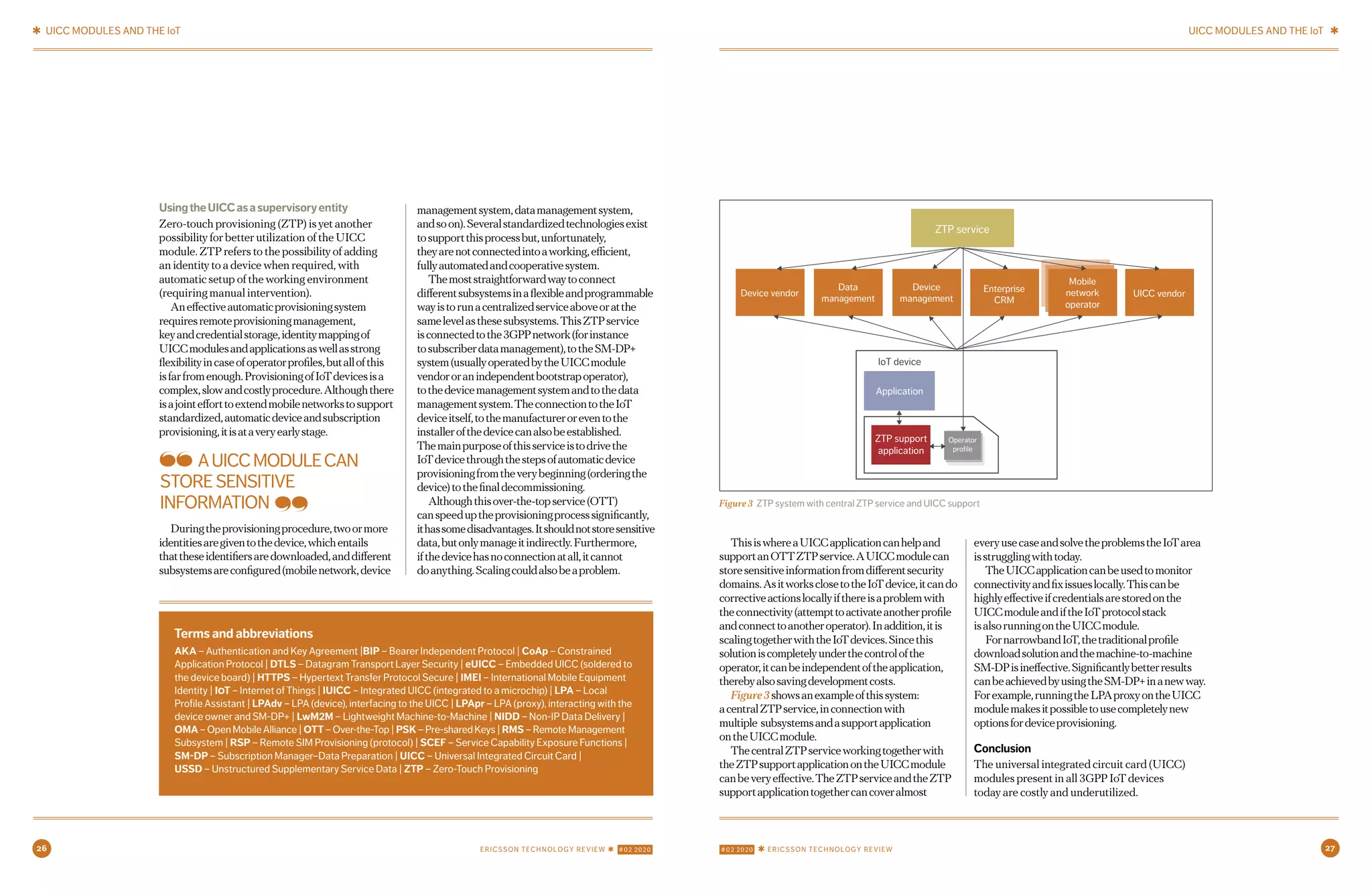
Figure3showsanexampleofthissystem:
acentralZTPservice,inconnectionwith
multiple subsystemsandasupportapplication
ontheUICCmodule.
ThecentralZTPserviceworkingtogetherwith
theZTPsupportapplicationontheUICCmodule
canbeveryeffective.TheZTPserviceandtheZTP
supportapplicationtogethercancoveralmost
everyusecaseandsolvetheproblemstheIoTarea
isstrugglingwithtoday.
TheUICCapplicationcanbeusedtomonitor
connectivityandfixissueslocally.Thiscanbe
highlyeffectiveifcredentialsarestoredonthe
UICCmoduleandiftheIoTprotocolstack
isalsorunningontheUICCmodule.
FornarrowbandIoT,thetraditionalprofile
downloadsolutionandthemachine-to-machine
SM-DPisineffective.Significantlybetterresults
canbeachievedbyusingtheSM-DP+inanewway.
Forexample,runningtheLPAproxyontheUICC
modulemakesitpossibletousecompletelynew
optionsfordeviceprovisioning.
Conclusion
The universal integrated circuit card (UICC)
modules present in all 3GPP IoT devices
today are costly and underutilized.
managementsystem,datamanagementsystem,
andsoon).Severalstandardizedtechnologiesexist
tosupportthisprocessbut,unfortunately,
theyarenotconnectedintoaworking,efficient,
fullyautomatedandcooperativesystem.
Themoststraightforwardwaytoconnect
differentsubsystemsinaflexibleandprogrammable
wayistorunacentralizedserviceaboveoratthe
samelevelasthesesubsystems.ThisZTPservice
isconnectedtothe3GPPnetwork(forinstance
tosubscriberdatamanagement),totheSM-DP+
system(usuallyoperatedbytheUICCmodule
vendororanindependentbootstrapoperator),
tothedevicemanagementsystemandtothedata
managementsystem.TheconnectiontotheIoT
deviceitself,tothemanufactureroreventothe
installerofthedevicecanalsobeestablished.
Themainpurposeofthisserviceistodrivethe
IoTdevicethroughthestepsofautomaticdevice
provisioningfromtheverybeginning(orderingthe
device)tothefinaldecommissioning.
Althoughthisover-the-topservice(OTT)
canspeeduptheprovisioningprocesssignificantly,
ithassomedisadvantages.Itshouldnotstoresensitive
data,butonlymanageitindirectly.Furthermore,
ifthedevicehasnoconnectionatall,itcannot
doanything.Scalingcouldalsobeaproblem.
Figure 3 ZTP system with central ZTP service and UICC support
Application
IoT device
ZTP support
application
Device vendor
Data
management
Device
management
Enterprise
CRM
UICC vendor
Mobile
network
operator
Operator
profile
ZTP service
AUICCMODULECAN
STORESENSITIVE
INFORMATION
Terms and abbreviations
AKA – Authentication and Key Agreement |BIP – Bearer Independent Protocol | CoAp – Constrained
Application Protocol | DTLS – Datagram Transport Layer Security | eUICC – Embedded UICC (soldered to
the device board) | HTTPS – Hypertext Transfer Protocol Secure | IMEI – International Mobile Equipment
Identity | IOT – Internet of Things | IUICC – Integrated UICC (integrated to a microchip) | LPA – Local
Profile Assistant | LPAdv – LPA (device), interfacing to the UICC | LPApr – LPA (proxy), interacting with the
device owner and SM-DP+ | LwM2M – Lightweight Machine-to-Machine | NIDD – Non-IP Data Delivery |
OMA – Open Mobile Alliance | OTT – Over-the-Top | PSK – Pre-shared Keys | RMS – Remote Management
Subsystem | RSP – Remote SIM Provisioning (protocol) | SCEF – Service Capability Exposure Functions |
SM-DP – Subscription Manager–Data Preparation | UICC – Universal Integrated Circuit Card |
USSD – Unstructured Supplementary Service Data | ZTP – Zero-Touch Provisioning
✱ UICC MODULES AND THE IoT UICC MODULES AND THE IoT ✱
8 9APRIL 14, 2020 ✱ ERICSSON TECHNOLOGY REVIEWERICSSON TECHNOLOGY REVIEW ✱ APRIL 14, 2020
28 #02 2020 ✱ ERICSSON TECHNOLOGY REVIEWERICSSON TECHNOLOGY REVIEW ✱ #02 2020 29
Further reading
❭ Ericsson Technology Review, Key technology choices for optimal massive IoT devices, January 2019,
available at: https://www.ericsson.com/en/reports-and-papers/ericsson-technology-review/articles/key-
technology-choices-for-optimal-massive-iot-devices
❭ Ericsson, eSIM – Let’s talk business, available at: https://www.ericsson.com/en/digital-services/trending/esim
❭ Ericsson blog, Secure IoT identities, available at: https://www.ericsson.com/en/blog/2017/3/secure-iot-identities
❭ Ericsson blog, Secure brokering of digital identities, available at: https://www.ericsson.com/en/blog/2017/7/
secure-brokering-of-digital-identities
References
1. Ericsson blog, Evolving SIM solutions for IoT, May 27, 2019, Smeets, B; Ståhl, P; Fornehed, J, available at:
https://www.ericsson.com/en/blog/2019/5/evolving-sim-solutions-for-iot
2. UICC card HW specification for P5Cxxxx cards, available at: http://www.e-scan.com/smart-card/nxp.pdf
3. GSMA, RSP Technical Specification Version 2.1, February 27, 2017, available at:
https://www.gsma.com/newsroom/wp-content/uploads/SGP.22_v2.1.pdf
4. GSMA, Remote Provisioning Architecture for Embedded UICC Technical Specification Version 4.0,
February 25, 2019, available at: https://www.gsma.com/newsroom/wp-content/uploads/SGP.02-v4.0.pdf
5. GSMA Intelligence: The future of the SIM: potential market and technology implications for the mobile
ecosystem, February 2017, Iacopino, P; Rogers, M, available at: https://www.gsmaintelligence.com/
research/?file=3f8f4057fdd7832b0b923cb051cb6e2c&download
6. OMA, Lightweight Machine to Machine Technical Specification: Core, July 10, 2018, available at:
http://www.openmobilealliance.org/release/LightweightM2M/V1_1-20180710-A/OMA-TS-LightweightM2M_
Core-V1_1-20180710-A.pdf
7. ARM, ARM Security Technology, available at: http://infocenter.arm.com/help/topic/com.arm.doc.prd29-
genc-009492c/PRD29-GENC-009492C_trustzone_security_whitepaper.pdf
8. GSMA, IoT SAFE, available at: https://www.gsma.com/iot/iot-safe/
9. OMA, white paper, Lightweight M2M 1.1: Managing Non-IP Devices in Cellular IoT Networks, October
2018, Slovetskiy, S; Magadevan, P; Zhang, Y; Akhouri, S, available at: https://www.omaspecworks.org/wp-
content/uploads/2018/10/Whitepaper-11.1.18.pdf
theauthOrs
Benedek Kovács
◆ joined Ericsson in 2005.
Over the years since he has
served as a system engineer,
R&D site innovation
manager (Budapest) and
characteristics,performance
management and reliability
specialist in the development
of the 4G VoLTE solution.
Today he works on 5G
networks and distributed
cloud, as well as coordinating
global engineering projects.
Kovács holds an M.Sc. in
information engineering and
a Ph.D. in mathematics from
the Budapest University of
Technology and Economics
in Hungary.
Zsigmond Pap
◆ joined Ericsson in 2012.
After working in the cloud
native and 5G packet core
areas as technical manager
and system architect
respectively, he moved into
the IoT area. He specializes
in low-level software
development and he has
participated in multiple
hardware and firmware
developments related to
custom hardware solutions.
He holds an M.Sc. in the area
of hardware and embedded
computers and a Ph.D.
in information engineering
fromtheBudapestUniversity
of Technology and
Economics in Hungary.
Zsolt Vajta
◆ joined Ericsson in 2015
as a software developer
focused on developing
and maintaining modules
to implement the link
aggregation control protocol
in the IP operating system.
In 2018, he became involved
in research on IoT device
activation and zero-touch
provisioning. As of early
2020, he has joined the
packet core area as a
product owner. He holds
an M.Sc. in informatics and
physics as well as a Ph.D.
in nuclear physics from
the University of Debrecen
in Hungary.
The authors would
like to thank the
following people
for their
contributions
to this article:
Gergely Seres,
John Fornehed,
Per Ståhl, Peter
Mattsson, Bogdan
Dragus, Robert
Khello and
Tony Uotila.
The industry is looking for ways to replace them
with a next-generation solution, but for the
foreseeable future UICC modules are here to stay.
While there are a few ways to reduce the
complexity of using UICC modules and thereby
reducing the cost of IoT devices, it is also possible
to extend the application of UICC modules well
beyond the cellular domain. For example,
members of the existing UICC ecosystem can
start exploiting UICC capabilities for storing
IoT identities, executing IoT protocols,
increasing security, providing end-to-end
connectivity as a service, and/or supporting
zero-touch provisioning.
✱ UICC MODULES AND THE IoT UICC MODULES AND THE IoT ✱
10 11APRIL 14, 2020 ✱ ERICSSON TECHNOLOGY REVIEWERICSSON TECHNOLOGY REVIEW ✱ APRIL 14, 2020
✱ CTO TECHNOLOGY TRENDS 2020 CTO TECHNOLOGY TRENDS 2020 ✱
FUTURE NETWORK
TRENDS
CREATING INTELLIGENT DIGITAL INFRASTRUCTURE
Allaroundtheworld,theunprecedented
events of 2020 have brought into focus
thecriticalrolethatdigitalinfrastructure
plays in the functioning of virtually
every aspect of contemporary society.
More than ever before, communication
technologies are providing innovative
solutions to help address social,
environmentalandeconomicchallenges
by enhancing efficiency and enabling
both intensified network usage and
more well-informed decisions.
Oneofthemostimportantfeaturesofdigital
infrastructureistheabilitytobridgedistances
andmakeiteasiertoefficientlymeetsocietal
needsintermsofresourceutilization,
collaboration,competencetransfer,status
verification,privacyprotection,securityand
safety.Thecommunicationsindustry
supportsotherindustriesbyenablingthem
todeliverdigitalproductsandservicessuch
ashealthcare,education,finance,commerce,
governanceandagriculture.Italsoplaysa
vitalroleintacklingclimatechangebyhelping
otherindustriesreduceemissionsand
improveefficiency.
Inlastyear’strendsarticle,Iintroduced
theconceptofthenetworkplatformand
explainedhowitservesasacatalystinthe
developmentofanopenmarketplace
thatisalwaysavailabletoanyconsumer
ofthedigitalinfrastructure.Thenetwork
platformformsthecoreofthedigital
infrastructure,withtheabilitytoensure
long-termcompetitivenessforenterprises
andmeetthefullrangeofsocietalneedsas
well.Itisatrustworthysolutionthat
guaranteesresilience,privacy,reliability
andsafetyforalltypesoforganizations–
public,privateandeverythinginbetween.
Italsohasthescale,costperformanceand
qualityrequiredtosupportfutureinnovations.
Asaresultofthesecharacteristics,itisthe
mostsustainablesolutiontoaddressall
futurecommunicationneeds.
Futuretechnologieswillenableafully
digitalized,automatedandprogrammable
worldofconnectedhumans,machines,
thingsandplaces.Allexperiencesand
sensationswillbetransparentacrossthe
boundariesofphysicalandvirtualrealities.
Trafficinfuturenetworkswillbegenerated
notonlybyhumancommunicationbutalso
byconnected,intelligentmachinesand
botsthatareembeddedwithartificial
intelligence(AI).Astimegoeson,the
percentageoftrafficgeneratedbyhumans
willdropasthatoftrafficgeneratedby
machinesandcomputervisionsystems–
includingautonomousvehicles,drones
andsurveillancesystems–rises.
Themachinesandother‘things’that
makeuptheInternetofThings(IoT)require
evenmoresophisticatedcommunication
thanhumansdo.Forexample,connected,
intelligentmachinesmustbeableto
interactdynamicallywiththenetwork.
Sensordatawillbeusedtosupportthe
developmentofpervasivecyber-physical
systemsconsistingofphysicalobjects
connectedtocollaborativedigitaltwins.
Futurenetworkcapabilitieswillalsoinclude
supportforthetransferofsensing
modalitiessuchassensationsandsmell.
Thenetworkplatformactsasaseamless
universalconnectivityfabriccharacterized
byitsalmostlimitlessscalabilityand
affordability.Itiscapableofexposing
capabilitiesbeyondcommunication
services,suchasembeddedcomputeand
storageaswellasadistributedintelligence
thatsupportsuserswithinsightsand
reasoning.
Inthisarticle,Iwillexplaintheongoing
evolutionofthenetworkplatforminterms
ofthekeyneedsthataredrivingits
evolution(trends1-3)andtheemerging
capabilitiesthatwillmeetboththose
andotherneeds(trends4-7).
BY: ERIK EKUDDEN, CTO
30 #02 2020 ✱ ERICSSON TECHNOLOGY REVIEWERICSSON TECHNOLOGY REVIEW ✱ #02 2020 31
✱ CTO TECHNOLOGY TRENDS 2020 CTO TECHNOLOGY TRENDS 2020 ✱
TREND#1:
ACOLLABORATIVE,AUTOMATED
PHYSICALWORLD
Asphysicalanddigitalrealitiesbecome
increasinglyinterconnected,advanced
cyber-physicalsystemshavebegunto
emerge.Thesesystemsconsistofhumans,
physicalobjects(machinesandotherthings),
processes,networkingandcomputation,
andtheinteractionsbetweenthemall.
Theirprimarypurposeistoprovideindividuals,
organizationsandenterpriseswithfull
transparencytomonitorandcontrolassets
andplaces,therebygeneratingmassive
benefitsintermsofefficiency.Oneearly
exampleofthisisthewaythatcyber-physical
systemscanhelpplannersoptimizeenergy
andmaterialsusage.
Soon,therewillbehundredsofbillionsof
connectedphysicalobjectswithembedded
sensing,actuationandcomputing
capabilities,whichcontinuouslygenerate
informativedata.Thesensordatagenerated
byphysicalobjectscanbeusedtocreate
theirdigitaltwins.Collaborativedigital
twinswillhavetheabilitytomanagethe
interactionsbetweenthephysicalobjects
theyrepresent.
Digitalizingthephysicalenvironment
inwhichthephysicalobjectsinteract
requiressensordatafusion–thatis,
usingdatafrommultiplesourcesto
createanaccuratedigitalrepresentation
ofthephysicalenvironment.Oneexample
ofsensordatafusionisachievinghigh-
precisionpositioningbycombining
network-basedpositioningdatawith
informationfromothersensorssuchas
camerasandinertialmeasurementunits.
Ultimately,thejointcommunication
andsensinginfuturesystemswillmakeit
possibletoleveragealltheinterconnected
digitaltwinsanddigitalrepresentations
oftheenvironmenttocreateacomplete
digitalrepresentationofeverything.
TREND#2:
CONNECTED,INTELLIGENT
MACHINES
Machineswillbecomeincreasingly
intelligentandautonomousastheir
cognitiveabilitiescontinuetoexpand.
Theirunderstandingoftheworldaround
themwillcontinuetogrowintandemwith
theirabilitytointeractwithothermachines
aspartofacognitivesystemofsystems.
Anintelligentmachineusessensorsto
monitortheenvironmentandadjustits
actionstoaccomplishspecifictasks
inthefaceofuncertaintyandvariability.
Thesemachinesincludethreemajor
subsystems:sensors,actuatorsandcontrol.
Examplesofintelligentmachinesinclude
industrialrobots,speechrecognition/
voicesynthesisandself-guidedvehicles.
Thecomplexityofcontrolandlogicskills
makesexpertsystemscentralintherealm
ofintelligentmachines.
Trends 1-3: The key drivers
of network platform evolution
The three key drivers that are most significant to the evolution of the network platform are
all related to bridging the gap between physical reality and the digital realm. Most notably,
this involves delivering sensory experiences over networks and utilizing digital representations
to make the physical world fully programmable.
Thenetworkplatformwillprovide
anautomatedenvironmentinwhich
interconnected,intelligentmachines
cancommunicate,includingsupportfor
AI-to-AIcommunicationandautonomous
systemssuchascommunicationamong
self-drivingvehiclesandintelligent
machinesinfactories.
Intelligentmachineshavetheirownway
ofperceivinginformation(data),whichis
differentfromhowhumansperceiveit.
Forexample,communicationamong
intelligentmachinesrequiresnewtypesof
videocompressionmechanisms,astoday’s
videocodecsareoptimizedforhuman
perception.
Anotheraspecttoconsiderishow
intelligentmachineswillinteractand
communicatewitheachother.Toimprove
thereliabilityandefficiencyofmachine-
to-machinecommunication,machineswill
needtounderstandthemeaningofthe
communicationintermsofcapabilities,
intentionsandneeds.Thiswillrequire
semantics-drivencommunication.
Cognitionisoneofthemostimportant
capabilitiesofanintelligentmachine.
Cognitivemachinesarecapableof
self-learningfromtheirinteractionsand
experienceswiththeirenvironment.
Theygeneratehypothesesandreasoned
arguments,makerecommendationsand
takeactions.Theycanadaptandmake
senseofcomplexityandhandle
unpredictability.Thefuturenetworkwill
empowercognitivemachinesbyproviding
themwithnewnetworkfeaturesandservices
suchassensing,high-precisionpositioning
anddistributedcomputingcapabilities.
TREND#3:
THEINTERNETOFSENSES
Theabilitytodelivermultisensoryexperiences
overfuturenetworkswillmakeiteasierthan
everbeforetotransferskillsovertheinternet.
Itwillultimatelyleadtotheemergenceof
theinternetofsenses,whichcombines
visual,audio,hapticandothertechnologies
toallowhumanbeingstohaveremote
sensoryexperiences.
Theinternetofsenseswillenable
seamlessinteractionwithremotethings
andmachines,makingitpossibletofully
realizeusecasessuchasremotehealth
checks,remoteoperationofmachinery,
holographiccommunicationandvirtual
reality(VR)vacations.Amongotherbenefits,
theinternetofsensesisexpectedtohavea
significantimpactintermsofsustainability,
bydramaticallyreducingtheneedfortravel.
Intheyearsahead,majorleapsforward
areexpectedinsensorandactuator
technologies,suchastheactuationof
smellandhigh-qualitytouchsensation.
Duringremoteoperations,theadvancesin
hapticdeviceswillallowvirtualobjects
tobeperceivedjustastherealobjects
themselves.Holographiccommunication
willbepossiblewithoutwearingextended
realityglasses,dueto3Dlightfielddisplay
technologies.
Bodyaugmentationcapabilitieswillenable
humanstobesmarter,strongerandmore
capable.Otherexamplesarecontactlenses
thatcandisplayaugmentedreality(AR)
content,universaltranslatorearbuds
thatallowforlanguage-independent
communicationandexoskeletonsthat
increasephysicalstrength.Eventually,
brain-computerinterfaceswillenable
communicationatthespeedofthought
where,insteadofspeakingtomachines,
humanswillmerelythinkinorderto
directthem.
Thenetworkplatformsupportsthe
internetofsenseswithnovelnetwork
enablerssuchasdistributedcompute,high-
precisionpositioning,integratedsensing
andapplicationprogramminginterfaces.
Theseareneededtosupportbandwidth
andlatencyreservation,networklatency
reportingandnetworksliceprioritization.
Ericssonhasdeployedadigitaltwin
intheItalianportofLivorno(Leghorn).
Asaresult,terminalportoperations
willincreasinglybecomeamixture
ofphysicalmachinery,robotics
systems,automatedvehicles,
human-operateddigitalplatforms
andAI-basedsoftwaresystems.
Allthosecomponents,servedby
a5Gsolution,transformtheport
environmentintoa‘playground’
inwhichtoexperiencethefuture
ofanautomatedphysicalworld.
Theport’sdigitaltwinmakesuse
ofaplethoraofreal-timedata
capturedbyconnectedobjectsat
thephysicalport,includingsensors,
camerasandvehicles.AnAIoperation
managementsystemoperatesonthe
digitalmodeltodeterminethe
sequenceoflogisticstasksand
activities.Feedbackfromthese
processesprovidesliveupdates
tothehumansupervisorsusing
VRandtothedocks/quay
operatorsthroughAR.
Resultsindicatethatthereare
about60directandindirectbenefits
ofthesolution,includingimproved
competitiveness,increasedsafety
forpersonnel,sustainablegrowthof
theportcity,improvedmanagement
oflogisticsandapositive
environmentalimpact.
USE CASE
DIGITAL TWIN
IN THE PORT
OF LIVORNO
32 #02 2020 ✱ ERICSSON TECHNOLOGY REVIEWERICSSON TECHNOLOGY REVIEW ✱ #02 2020 33
✱ CTO TECHNOLOGY TRENDS 2020 CTO TECHNOLOGY TRENDS 2020 ✱
TREND#4:
OMNIPRESENTANDNON-
LIMITINGCONNECTIVITY
Theconceptofubiquitousradioaccessis
evolvingtowardthevisionofafuturenetwork
thatwilldelivernon-limitingperformance
tosatisfytheneedsofhumans,thingsand
machinesbyenhancingmultidimensional
coverage,stellarcapacityandaugmenting
capabilities.
Accesscoverageeverywhere
Furtherdensificationofnetworksisneeded
toprovidehigh-speedcoverageeverywhere.
Connectedairbornedevices,suchasdrones,
requireaccessonaltitudesuptoseveral
kilometers,makingitnecessarytohavea
3Dpointofviewincludingtheelevation
aspecttoprovidecoverage.Thereisalso
aneedtoensurehigh-performingindoor
connectivitybyincreasingthenumberof
indoorsmallcellsandfullyintegratingthem.
Flexiblenetworktopologies
anddeployments
Networktopologiesanddeploymentswill
needtobecomeincreasinglyflexibleto
providecoverageeverywhereanddeliver
extremeperformance.Onepossibilityisa
multi-hop-basedradionetwork,wherea
multitudeofnodescollaboratetoforward
amessagetothereceiver.Thissolutionis
particularlyinterestingforsmallercells
oflimitedreach.Satellites,high-altitude
platformsandairbornecellscanbe
integratedintothenetworkasacomplement
toextendcoverage.Furthercomponentsin
aflexibletopologycanincludeconnected
devicerelayandthepossibilityforad-hoc
deploymentsofnetworks.Ultimately,
distributedmassiveMIMO(multiple-input,
multiple-output)solutionsmayleadtofully
distributedconnectivity,wheremanyradio
networknodessimultaneouslyserveauser,
withoutfixed-cellborders.
Accessforzero-energydevices
Therapidlygrowingdemandforvast
numbersofconnectedsensorsand
actuatorshasmadeitnecessarytoinvent
zero-energydevices.Thesewillbedeployed
onceandwillcontinuouslyreportandact
withouttheneedformaintenanceor
externalcharging.Thesteppingstones
alongthewayincludenarrowbandIoT
enhancementsandmassivemachine
typecommunicationfor5GNewRadio
forlocalareanetworks(LANs)aswellas
forwide-areausage.
Extremeradioperformance
Thenetworkwillutilizehigherfrequency
bandstodeliverextremeperformance.
Forexample,communicationsoverthe
terahertzfrequencyband(above100GHz)
havesomeattractiveproperties,
includingterabit-per-secondlink
capacitiesandminiaturetransceivers.
Trends 4-7: Critical enablers
of the future network platform
The network platform is designed to deliver the kind of extreme performance required by
applicationareassuchastheinternetofsensesandcommunicationamongintelligentmachines.
It will also serve new types of devices with close-to-zero-cost and close-to-zero-energy
implementations, which can be embedded into everything. Looking ahead, increasingly
advanced technologies in four areas (trends 4-7) will expand the capabilities of the digital
infrastructure through the network platform.
Thedesignofterahertzelectronicsincludes
verysmallantennaandradiofrequency
(RF)elementsaswellashigh-performance
oscillators.
Fullduplexisanothercomponentthatcan,
insomespecificscenarios,substantially
increasethelinkcapacitycomparedwith
halfduplex.Fullduplexismadepossibleby
self-interferencesuppressioncircuits.
Visiblelightwirelesscommunication,
piggybackingonthewideadoptionofLED
(light-emittingdiode)lighting,isanother
potentialstepinthefrequencydomainto
complementRFcommunications.
Networkasasensor
Higherfrequencieswillfurtherenhancethe
spatialandtemporalresolutionoftheradio
signal.Reflectionsofsuchradiosignalscan
beusedtosensethesurroundings.
Furthermore,highfrequencieshave
distinctatmosphericandmaterial
interactions,wheredifferentfrequencies
aremoreorlesssusceptibletothingslike
absorptioninwater,forexample.Thishas
beenshowntobesufficienttoforecast
weatherandairquality.
Distanceinformationtoreflecting
surfacescanbeidentifiedbyintegrating
positioningandsensingcapabilities.
Suchinformationcanbeusedtodetect
obstaclesandspeedaswellastogenerate
real-timelocalmaps.
TREND#5:
PERVASIVENETWORK
COMPUTEFABRIC
Asdistributedcomputeandstorage
continuestoevolve,thelinesbetween
thedevice,theedgeofthenetworkand
thecloudwillbecomeincreasinglyblurred.
Everythingcanbeviewedasasingle,
unified,integratedexecutionenvironment
fordistributedapplications,including
bothnetworkfunctionsandthird-party
applications.Inthenetworkcompute
fabric,connectivity,computeandstorage
willbeintegrated,interactingtoprovide
maximumperformance,reliability,
lowjitterandmillisecondlatencies
fortheapplicationstheyserve.
Ratherthanprocessingdatacentrally,
inmanycasesitismoreefficientinterms
ofbandwidthand/orlatencyconstraints
tobringtheprocessingclosertowhere
thedataisproduced,insightsareconsumed
andactionsaretaken.Insomecases,local
operationmayberequiredbyregulationsor
preferredforprivacy,securityorresilience
reasons.
Asidefromtheapplications,thenetwork
alsoprovidesacontinuousexecution
environmentforaccessandcorefunctions.
Itrunsonadistributedcloudinfrastructure
withintegratedaccelerationfordata-
intensivevirtualnetworkfunctionsand
applications.
Thefuturenetworkplatformgoes
beyondtheuseofmicroservicesto
implementnetworkfunctionsasserverless
architectures.Theservermanagementand
capacityplanningdecisionsarefully
autonomousfromthedeveloperandthe
networkoperator.Thenetworktakescare
34 #02 2020 ✱ ERICSSON TECHNOLOGY REVIEWERICSSON TECHNOLOGY REVIEW ✱ #02 2020 35
✱ CTO TECHNOLOGY TRENDS 2020
ofthedeployment,scalingandallresources
requiredtoensurethatthefunction
deployedisalwaysavailableatanyscale.
Upcomingnovelcomputingarchitectures
includememory-centriccomputing,optical
computing,nanocomputing,neuromorphic
computingandevenquantumcomputing.
Inthefuture,thesearchitectureswillenable
continuedexponentialgrowthincompute
capacityformostapplicationsrunningon
thenetworkcomputefabric–animportant
developmentastheendofMoore’slaw
approaches.
TREND#6:
TRUSTWORTHY
INFRASTRUCTURE
Governmentsandenterprisesareadopting
advancedtechnologiesforsecureassurance
ofmission-andbusiness-criticalprocesses
suchasfactoryautomation,remotecontrol
ofassetsandmore.Thehighlytrustworthy
networkplatformfulfillstherequirements
ofeventhemostmission-andbusiness-
criticalusecases.Itoffersafusionof
connectivityandcomputecharacterizedby
differentdimensionsofresilience,privacy,
security,reliabilityandsafety.Itwillalso
provideadaptableandverifiabledimensions
oftrustworthinessinascalableandcost-
efficientmanner.
Ratherthanbeingdesignedpernode
orforaparticularpartofthenetwork,the
always-oncharacteristicsofthenetwork
platformsuchasreliability,availabilityand
resilienceriseuptocoverthecomplete
network.Always-onmechanismsarebuilt
intouserplane,controlplaneanddevice
mobilitysolutions.Allpartsofthenetwork
willbeaddressedincludingtransport
nodesandtransportnetworks,network
infrastructureandsitesolutions.
Toprotectcommunicationanddata,
secureidentitiesareutilizedatevery
layerbetweenhumans,devicesand
applicationsindifferentindustrysegments.
Theseidentitiesaresecurelyanchored
todevicesandnetworknodesbyroot-
of-trustmechanisms.
Networkplatformsolutionsutilize
confidentialcomputingtoprotectidentities
andtheirdataandestablishtrustamong
networkcustomersandtheirassets,
therebyalsoofferingassurancetousers
andregulators.Thisrequiresautomated
trustassessmentofallnetworkelements,
things,machinesandapplications,aswell
ascomputeandstorageresourcesby
usingremoteattestationandAI.
ResponsibleAIwillbringtrustworthy
automatedprotectionandriskmanagement.
AI-basedautomationprovidestheability
toactonahighnumberofeventsaffecting
thenetworkinfrastructureorthenetwork
usage.
TREND#7:
COGNITIVENETWORK
Inthevisionofzero-touchnetwork
managementandoperations,networks
aredeployedandoperatedwithminimum
humanintervention,usingtrustworthy
AItechnologies.Alloperationalprocesses
andtasks,including,forexample,delivery,
deployment,configuration,assurance
andoptimization,willbeexecutedwith
100percentautomation.
Thenetworkitselfwillcontinuously
learnfromitsenvironmentobservations,
interactionswithhumansandprevious
experiences.Thecognitiveprocesses
understandthecurrentnetworksituation,
planforwantedoutcome,decideonwhat
todoandactaccordingly.Theoutcome
servesasaninputtolearnfromitsactions.
Thecognitivenetworkwillbeableto
optimizeitsexistingknowledge,buildon
experienceandreasoninordertosolve
newproblems.
Thenetworkwillutilizeintent-based
anddistributedintelligenceformultiple
functions,includingoptimizationofthe
radiointerface,automationofnetwork
managementandorchestrationsuchas
theoptimizationofparameters,handlingof
alarmsandself-healing.AIalgorithmswill
bedeployedandtrainedatdifferent
networkdomains,forexample,in
management,thecorenetworkandthe
radionetwork.Physicallayeralgorithms,
suchaslinkadaptation,handover,power
controlanddynamicschedulingof
resourcescanbeoptimizedwithAIagents.
Networkmanagementwillbecomeless
complexthroughintelligentclosed-loop
automationwithsupportforhumansto
interactwiththenetworkandmonitorits
behaviors.Thenetworkoperatorexpresses
theintentofadesirednetworkstateorgoal,
andthenetworkinternallyresolvesthe
detailedstepsnecessarytoachievethat
intent.Networkknowledge,dataand
actionsareshapedinsuchawaythatthe
operatorinteractingwiththenetworkcan
understandthem.
Thecognitivenetworkwillbebasedon
controldesign,usingbothmachine
reasoningandmachinelearningtechniques
thataredistributedandcapableofactingin
realtime.Thenetworkisahighlydistributed
systemwheremultipleAIagents,present
acrossthenetwork,needtointerworkto
optimizeoverallnetworkperformance.
Localdecisionsneedtobecoordinated
withmorecentralintent-baseddecisions.
ThecentralAIagentneedstomakedecisions
inrealtimebasedonbothlocalandglobal
information.MultipledistributedAIagents
sharedistributedinsightsthroughout
thenetworkthroughfederatedlearning.
Cognitivenetworkswillbeinherently
trustworthy–thatis,reliable,safe,
secure,fair,transparent,sustainable
andresilient–bydesign.
CTO TECHNOLOGY TRENDS 2020 ✱
36 #02 2020 ✱ ERICSSON TECHNOLOGY REVIEWERICSSON TECHNOLOGY REVIEW ✱ #02 2020 37
✱ CTO TECHNOLOGY TRENDS 2020 CTO TECHNOLOGY TRENDS 2020 ✱
Thedigitalinfrastructureoffersendless
possibilities to individuals, enterprises
and governments across the globe,
with its unique ability to bridge vast
distances and enable powerful new
solutions to a wide rangeofsocial,
environmentalandeconomic
challenges. Health care, education,
finance, commerce, governance and
agriculture are just a few of the sectors
that stand to benefit from the massive
efficiency gains that digital
infrastructure can provide.
Designedtocarryvitalmessages,
commands,reasoning,insights,intelligence
andallthesensoryinformationneededto
supportthecontinuousevolutionofindustry
andsociety,thenetworkplatformisdesigned
tobethespinalcordofdigitalinfrastructure.
Itisalsotheidealplatformforalltypesof
innovation,withtheabilitytosupport
interactionsthatempoweranintelligent,
sustainableandconnectedworld.
Themajoradvantageofthenetwork
platformisthatitwillbeaccessible
anywhere,always-onandwithguaranteed
performance.Nomadicdistributed
processingandstoragewillbeembedded
intoittosupportadvancedapplications.
Itwillbeinherentlyreliableandresilient,
fulfillingalltherequirementsforsecure
communication.Cognitiveoperations
andmaintenanceofthenetworkandits
serviceswilldeliverthemostcost-efficient
andsustainablesolutiontomeetany
andallcommunicationneeds.
Withthisinmind,itisclearthatthemost
importantfuturenetworktrendstowatchin
2020arethosethatrelatemostcloselyto
thegrowthandexpansionofintelligent
digitalinfrastructureonthenetworkplatform.
Thefirstthreeoftheseventrendsthisyear
arethekeydriversofnetworkplatform
evolution–thecreationofacollaborative
automatedphysicalworld,connected,
intelligentmachinesandtheinternetof
senses.Allthreehighlightthegrowingneed
tobridgethegapbetweenphysicaland
digitalrealities.Trends4-7areincreasingly
advancedtechnologiesinfourareas–
non-limitingconnectivity,pervasive
networkcomputefabric,trustworthy
infrastructureandcognitivenetworks.
Breakthroughsinthesefourareaswillbe
essentialtofullyenabletrends1-3and
continuouslyexpandthecapabilitiesofthe
digitalinfrastructurethroughthenetwork
platformintheyearsanddecadesahead.
◆ As Group CTO, Erik Ekudden is responsible for setting the direction of technology leadership
for the Ericsson Group. His experience of working with technology leadership globally influences
thestrategicdecisionsandinvestmentsin,forexample,mobility,distributedcloud,artificialintelligence
andtheInternetofThings.Thisbuildsonhisdecades-longcareerintechnologystrategiesandindustry
activities.EkuddenjoinedEricssonin1993andhasheldvariousmanagementpositionsinthecompany,
including Head of Technology Strategy, Chief Technology Officer Americas in Santa Clara (USA),
and Head of Standardization and Industry. He is also a member of the Royal Swedish Academy
of Engineering Sciences and the publisher of Ericsson Technology Review.
ERIK EKUDDEN
SENIOR VICE PRESIDENT, CHIEF TECHNOLOGY OFFICER
AND HEAD OF GROUP FUNCTION TECHNOLOGY
CONCLUSION
The network platform is
the spinal cord of intelligent
digital infrastructure
Furtherreading
❭ Ericsson blog, What do cyber-physical systems have in store for us?, available at: https://www.ericsson.com/en/blog/2019/12/
cyber-physical-systems-technology-trend
❭ Ericsson report, 10 Hot Consumer Trends 2030, available at: https://www.ericsson.com/en/reports-and-papers/consumerlab/
reports/10-hot-consumer-trends-2030
❭ Ericsson blog, Driving business value in an open world, available at: https://www.ericsson.com/en/blog/2020/7/cto-driving-business-
value-in-an-open-world
❭ Ericsson Technology Review, CTO Technology Trends 2019, available at: https://www.ericsson.com/en/reports-and-papers/
ericsson-technology-review/articles/technology-trends-2019
38 #02 2020 ✱ ERICSSON TECHNOLOGY REVIEWERICSSON TECHNOLOGY REVIEW ✱ #02 2020 39
40 #02 2020 ✱ ERICSSON TECHNOLOGY REVIEWERICSSON TECHNOLOGY REVIEW ✱ #02 2020 41
With a vastly distributed system (the telco network) already in place,
the telecom industry has a significant advantage in the transition
toward distributed cloud computing. To deliver best-in-class application
performance, however, operators must also have the ability to fully
leverage heterogeneous compute and storage capabilities.
WOLFGANG JOHN,
CHANDRAMOULI
SARGOR, ROBERT
SZABO, AHSAN
JAVED AWAN, CHAKRI
PADALA, EDVARD
DRAKE, MARTIN
JULIEN, MILJENKO
OPSENICA
The cloud is transforming, both in terms of
the extent of distribution and in the diversity of
compute and storage capabilities. On-premises
and edge data centers (DCs) are emerging,
and hardware (HW) accelerators are becoming
integral components of formerly software-only
services.
■ One of the main drivers into the age of
virtualization and cloud was the promise of
reducing costs by running all types of workloads
on homogeneous, generic, commercial off-the-
shelf (COTS) HW hosted in dedicated,
centralized DCs. Over the years, however, as use
cases have matured and new ones have continued
to emerge, requirements on latency, energy
efficiency, privacy and resiliency have become
more stringent, while demand for massive data
storage has increased.
Tomeetperformance,costand/orlegal
requirements,cloudresourcesaremovingtoward
theedgeofthenetworktobridgethegapbetween
resource-constraineddevicesanddistantbut
powerfulcloudDCs.Meanwhile,traditionalCOTS
HWisbeingaugmentedbyspecialized
programmableHWresourcestosatisfythestrict
performancerequirementsofcertainapplications
andlimitedenergybudgetsofremotesites.
Theresultisthatcloudcomputingresources
arebecomingincreasinglyheterogeneous,while
simultaneouslybeingwidelydistributedacross
smallerDCsatmultiplelocations.Clouddeployments
mustberethoughttoaddressthecomplexityand
technicalchallengesthatresultfromthisprofound
transformation.
Inthecontextoftelecommunicationnetworks,
thekeychallengesareinthefollowingareas:
1. Virtualization of specialized HW resources
2. Exposure of heterogeneous HW capabilities
3. HW-aware workload placement
4. Managing increased complexity.
Getting all these pieces right will enable the
future network platform to deliver optimal
application performance by leveraging emerging
HW innovation that is intelligently distributed
throughout the network, while continuing to
harvest the operational and business benefits
of cloud computing models.
Figure1positionsthefourkeychallengesin
relationtotheorchestration/operationssupport
systems(OSS)layer,theapplicationlayer,run-time
andtheoperatingsystem/hypervisor.Thelowerpart
ofthefigureprovidessomeexamplesofspecialized
HWinatelcoenvironment,whichincludesdomain-
specificaccelerators,next-generationmemoryand
storage,andnovelinterconnecttechnologies.
Computeandstoragetrends
With the inevitable end of Moore’s Law [2],
developers can no longer assume that rapidly
increasing application resource demands
will be addressed by the next generation
of faster general-purpose chips. Instead,
commodity HW is being augmented by a very
heterogeneous set of specialized chipsets,
referred to as domain-specific accelerators,
that attempt to provide both cost and
energy savings.
Forinstance,data-intensiveapplicationscantake
advantageofthemassivescopeforparallelization
HIGHLY DISTRIBUTED WITH HETEROGENEOUS HARDWARE
Thefutureof
cloudcomputing
Figure 1 Impact of the four key challenges on the stack (top) and heterogeneity of HW infrastructure (bottom)
HW-aware
workload placement
Exposure of
HW capabilities
Virtualization of
specialized HW
Orchestration/OSS
Application
Run-time
Operating system/hypervisor
Distributed compute
& storage HW
• Memory pooling
• Storage-class memories
• GPUs/TPUs
• FPGAs
• Cache-coherent interconnects
• High bandwidth interconnects
• Cache-coherent interconnects
• High bandwidth interconnects
• Near-memory computing
• PMEM
• GPUs/ASICs
• FPGAs and SmartNICs
Distributed compute
& storage HW
Next-generation
memory & storage
Domain-specific
accelerators
Novel interconnect
technologies
Operating system/hypervisor
Run-time User
device
Application
Central Edge
5G UPF 5G gNB
Managing increased
complexity
✱ THE FUTURE OF CLOUD COMPUTING THE FUTURE OF CLOUD COMPUTING ✱
2 3MAY 12, 2020 ✱ ERICSSON TECHNOLOGY REVIEWERICSSON TECHNOLOGY REVIEW ✱ MAY 12, 2020
42 #02 2020 ✱ ERICSSON TECHNOLOGY REVIEWERICSSON TECHNOLOGY REVIEW ✱ #02 2020 43
physicalacceleratorintomultiplevirtualaccelerators
mustbedonemanually.Addressingtheseissues
willrequireappropriateabstractionsandmodels
ofspecializedHW,sothattheircapabilitiescanbe
interpretedandincorporatedbyorchestration
functions.
Theneedforappropriatemodelswillbefurther
amplifiedinthecaseofdistributedcomputeand
storage.Here,theselectionoftheoptimalsite
locationwilldependontheapplicationrequirements
(boundedlatencyorthroughputconstraints,for
example)andtheavailableresourcesandHW
capabilitiesatthesites.Theprogrammingand
orchestrationmodelsmustbeabletoselect
appropriatesoftware(SW)options–SWonlyinthe
caseofmoderaterequirements,forexample,orSW
complementedwithHWaccelerationforstringent
requirements.
AsSWdeploymentoptionswithorwithoutHW
accelerationmayhavesignificantlydifferent
resourcefootprints,sitesmustexposetheirHW
capabilitiestobeabletoconstructatopologymap
ofresourcesandcapabilities.Duringexposureand
abstraction,proprietaryfeaturesandtheinterfaces
tothemmustbehiddenandmappedto(formalor
informal)industrystandardsthatarehopefully
comingsoon.Modelingandabstractionofresources
andcapabilitiesarenecessaryprerequisitestobe
abletoselecttheappropriatelocationand
applicationdeploymentoptionsandflavors.
Orchestratingheterogeneousdistributedcloud
Based on a global view of the resources and
capabilities within the distributed environment,
anorchestrationsystem(OSSintelcoterminology)
typically takes care of designing and assigning
application workloads within the compute and
storage of the distributed environment. This
means that decisions regarding optimal workload
placement also should factor in the type of HW
components available at the sites related to the
requirements of the specific application SW.
Duetothepricingofandpowerconstraints
onexistingandupcomingHWaccelerators,
ingraphicsprocessingunits(GPUs)ortensor
processingunits(TPUs),whilelatency-sensitive
applicationsorlocationswithlimitedpowerbudgets
mayutilizefield-programmablegatearrays
(FPGAs).Thesetrendspointtoarapidlyincreasing
adoptionofacceleratorsinthenearfuture.
Thegrowingdemandformemorycapacityfrom
emergingdata-intensiveapplicationsmustbemetby
upcominggenerationsofmemory.Next-generation
memoriesaimtoblurthestrictdichotomybetween
classicalvolatileandpersistentstoragetechnologies–
offeringthecapacityandpersistencefeaturesof
storage,combinedwiththebyte-addressability
andaccessspeedsclosetotoday’srandom-access
memory(RAM)technologies.Suchpersistent
memory(PMEM)technologies[3]canbeused
eitheraslargeterabytescalevolatilememory,oras
storagewithbetterlatencyandbandwidthrelative
tosolid-statedisks.
3Dsilicondie-stackinghasfacilitatedthe
embeddingofcomputeunitsdirectlyinsidememory
andstoragefabrics,openingaparadigmofnear-
memoryprocessing[1],atechnologythatreduces
datatransferbetweencomputeandstorageand
improvesperformanceandenergyconsumption.
Finally,advancementsininterconnecttechnologies
willenablefasterspeeds,highercapacityandlower
latency/jittertosupportcommunicationbetweenthe
variousmemoryandprocessingresourceswithin
nodesaswellaswithinclusters.Thecachecoherency
propertiesofmoderninterconnecttechnologies,
suchasComputeExpressLink[4]andGen-Z,can
enabledirectaccesstoconfigurationregistersand
memoryregionsacrossthecomputeinfrastructure.
Thiswillsimplifytheprogrammabilityofaccelerators
andfacilitatefine-graineddatasharingamong
heterogeneousHW.
Supportingheterogeneoushardware
indistributedcloud
WhilethecombinationofheterogeneousHW
and distributed compute resources poses unique
challenges, there are mechanisms to address
each of them.
Virtualizationofspecializedhardware
The adoption of specialized HW in the cloud
enables multiple tenants to use the same HW
under the illusion that they are the sole user,
with no data leakage between them. The tenants
can request, utilize and release accelerators at any
time using application programming interfaces
(APIs). This arrangement requires an abstraction
layer that provides a mechanism to schedule jobs
to the specialized HW, monitor their resource
usage and dynamically scale resource allocations
to meet performance requirements. It is pertinent
to keep the overhead of this virtualization to a
minimum. While virtualization techniques for
common COTS HW (x86-based central
processing units (CPUs), dynamic RAM (DRAM),
block storage and so on) have matured well during
recent decades, corresponding virtualization
techniques for domain-specific accelerators are
largely still missing for production-grade systems.
Exposureofhardwarecapabilities
Current cloud architectures are largely agnostic
to the capabilities of specialized HW. For example,
all GPUs of a certain vendor are treated as
equivalent, regardless of their exact type or make.
To differentiate them, operators typically tag the
nodes equipped with different accelerators with
unique tags and the users request resources with
a specific tag. This model is very different to
general-purpose CPUs and can therefore lead to
complications when a user requires combinations
of accelerators.
Currentdeploymentspecificationsalsodonot
havegoodsupportforrequestingpartialallocation
ofaccelerators.Foracceleratorsthatcanbe
partitionedtoday,thedecompositionofasingle
Definition of key terms
Edge computing provides distributed computing and storage resources closer to the location where they
are needed/consumed.
Distributed cloud provides an execution environment for cloud application optimization across multiple
sites, including required connectivity in between, managed as one solution and perceived as such by the
applications.
Hardware accelerators are devices that provide several orders of magnitude more efficiency/
performance compared with software running on general purpose central processing units for selected
functions. Different hardware accelerators may be needed for acceleration of different functions.
Persistent memory is an emerging memory technology offering capacity and persistence features of
block-addressable storage, combined with the byte-addressability and access speeds close to today’s
random-access memory technologies. It is also referred to as storage-class memory.
Moore's law holds that the number of transistors in a densely integrated circuit doubles about every two
years, increasing the computational performance of applications without the need for software redesign.
Since 2010, however, physical constraints have made the reduction in transistor size increasingly difficult
and expensive.
THESETRENDSPOINTTOA
RAPIDLYINCREASINGADOPTION
OFACCELERATORS...
✱ THE FUTURE OF CLOUD COMPUTING THE FUTURE OF CLOUD COMPUTING ✱
4 5MAY 12, 2020 ✱ ERICSSON TECHNOLOGY REVIEWERICSSON TECHNOLOGY REVIEW ✱ MAY 12, 2020
44 #02 2020 ✱ ERICSSON TECHNOLOGY REVIEWERICSSON TECHNOLOGY REVIEW ✱ #02 2020 45
theyareexpectedtobescarceamongedge-cloud
sites,whichinturnwillrequiremechanismsto
employprioritizationandpreemptionofworkloads.
UnlikeconventionalITcloudenvironments,
distributedcloudallowsconsiderationsofremote
resourcesandcapabilities.
Moreover,telcoapplicationsandworkloads
hostedintelcocloudsmayrequiremuchstricter
ServiceLevelAgreements(SLAs)tobefulfilled.
Prioritizationandpreemptionfornewworkloads
mayonlybeaviableoptionifcapabilitiesor
resourcesarealreadytaken.However,itisimportant
tomigrateevictedworkloadseithertoanew
location,ortoanewSWandHWdeploymentoption
tominimizeservicedisruptionduringpreemption.
Managingincreasedcomplexity
Traditional automation techniques based on
human scripting and/or rule books cannot scale to
address the complexity of the heterogeneous
distributed cloud. We can already see a shift away
Whenaservicerequestarrives,theorchestration
servicedesignstheserviceinstancetopologyand
assignsresourcestoeachservicecomponent
instance(redarrows).Theseactionsarebasedon
theactualservicerequirements,theserviceaccess
pointsandthebusinessintent.
Opportunitiesandusecases
In terms of the opportunities in support of the
ongoing cloudification of telco networks, let us
consider the case of RAN. The functional split
of higher and lower layers of the RAN protocol
makes it possible to utilize Network Functions
Virtualization (NFV) and distributed compute
infrastructure to achieve ease of deployment and
management. The asynchronous functions in the
higher layer may be able to be run on COTS HW.
However,asetofspecializedHWwillberequired
tomeetthestringentperformancecriteriaoflower-
layerRANfunctions.Forinstance,thetime-
synchronousfunctionsinthemedium-access
controllayer,suchasscheduling,linkadaptation,
powercontrol,orinterferencecoordination,typically
requirehighdataratesontheirinterfacesthatscale
withthetraffic,signalbandwidthandnumberof
antennas.Thesecannotbeeasilymetwithcurrent
general-purposeprocessingcapabilities.
Likewise,decipheringfunctionsinthepacket
dataconvergenceprotocollayer,compression/
decompressionschemesoffronthaullinksand
channeldecodingandmodulationfunctionsinthe
physicallayerwouldallbenefitfromHW
acceleration.
Thesecurityrequirementsfordataflowsacross
thebackhaulfor4G/5GRANsmandatetheuseof
IPsecurityprotocols(IPsec).Byoffloadingencrypt/
decryptfunctionstospecializedHWsuchas
SmartNetworkInterfaceControllers(SmartNICs),
application-specificintegratedcircuits(ASICs)
orFPGAs,theprocessingoverheadassociatedwith
IPseccanbeminimized.Thisiscrucialtosupport
higherdataratesinthetransportnetwork.
Thenetworkdataanalyticsfunctionin5GCore
networkswouldbenefitfromGPUstoaccelerate
trainingofmachinelearning(ML)modelsonlive
networkdata.Theenhancementstointerconnects
(cachecoherency,forexample)makeiteasierforthe
variousacceleratorsandCPUstoworktogether.
Theinterconnectsalsoenablelowlatenciesand
highbandwidthswithinsitesandnodes.Thereis
increasingdemandonmemoryfromseveralcore
networkfunctions(user-databasefunctions,
forexample),bothfromascaleandalatency
perspective.ThescaleofPMEMcanbeintelligently
combinedwiththelowlatencyofdoubledatarate
memoriestoaddresstheserequirements.
Whiletheseopportunitiesarespecificto
telecommunicationproviders,therearealsoseveral
classesofthird-partyapplicationsthatwouldbenefit
fromdistributedcomputeandstoragecapabilities
withinthetelcoinfrastructure.Industry4.0includes
severalusecasesthatcouldutilizeHW-optimized
processing.Indoorpositioningtypicallyrequiresthe
processingofhigh-resolutionimagestoaccurately
determinethelocationofanobjectrelativetoothers
onafactoryfloor.Thisiscomputationallyintensive
andGPUs/FPGAsaretypicallyused.Likewise,
theapplicationofaugmentedreality(AR)/virtual
reality(VR)technologiesinsmartmanufacturing
forremoteassistance,trainingormaintenance
willrelysignificantlyonHWaccelerationand
edgecomputingtooptimizeperformanceand
reducelatencies.
Thegamingindustryisalsowitnessing
significanttechnologyshifts–specifically,remote
renderingandmixed-realitytechnologieswillhave
aprofoundimpactontheconsumerexperience.
Thesetechnologiesrelyonanunderlyingdistributed
cloudinfrastructurethathasHWacceleration
capabilitiesattheedgetooffloadtheprocessing
fromconsumerdevices,whilemaintainingstrict
latencybounds.
Furthermore,severalusecasesintheautomotive
industryinvolvestrictlatencyrequirementsthat
demandHWaccelerationintheformofGPUsand
FPGAsatremotesites.Examplesincludereal-time
objectdetectioninvideostreamsthatareprocessed
byeithervehiclesorroad-sideinfrastructure.
from human-guided automation to machine-
reasoning-based automation such as cognitive
artificial intelligence (AI) technologies.
Specifically, a paradigm is emerging where the
human input to the cloud system will be limited
to specifying the desired business objectives
(intents). The cloud system then figures how best
to realize those objectives/intents.
Figure2presentsanexemplarydistributedcloud
scenariowithaccesssites,regionalandcentralDCs
andpublicclouds.Itisbasedontheassumptionthat
themanufacturingnetworkslice(red)includesboth
telco(xNF)andthird-partyworkloads(APP),
outofwhichoneAPPrequiresnetworkacceleration
(SmartNIC),whileanotherxNFdependsonPMEM.
Multiplenetworkslicesarecreatedbasedon
customerneed.Networkslicesdiffernotonlyintheir
servicecharacteristics,butareseparatedand
isolatedfromeachother.Aggregatedviewsof
HWacceleratorsperlocationarecollectedforthe
zero-touchorchestrationservice(grayarrows).
Figure 2 Integrated network slicing (telco) and third-party applications
Gaming
AR/VRB
E-MBB
Automotive
Network slices
Internet of
Things
Fixed access
Manufacturing
APP
SmartNICs
PMEM
HW capability
exposures
Access sites (edge cloud)
Central sites
Public clouds
Distributed sites
(edge/regional cloud) xNF: telco Virtual Network Function or
Cloud-native Network Function
APP: Third-party application
HW capability
control
Business
intent
Zero-touch orchestration
APP
APP
APP APP APP
APP
xNF
xNF
APP
xNF xNF
APP
xNF
xNF
xNF
xNF
xNF
✱ THE FUTURE OF CLOUD COMPUTING THE FUTURE OF CLOUD COMPUTING ✱
6 7MAY 12, 2020 ✱ ERICSSON TECHNOLOGY REVIEWERICSSON TECHNOLOGY REVIEW ✱ MAY 12, 2020
46 #02 2020 ✱ ERICSSON TECHNOLOGY REVIEWERICSSON TECHNOLOGY REVIEW ✱ #02 2020 47
Initialproofpoints
Our ongoing research in the area of distributed
cloud has yielded several initial proof points that
demonstrate Ericsson’s leadership in terms of fully
leveraging heterogeneous compute and storage
capabilities to deliver best-in-class application
performance to our customers.
Virtualizedheterogeneoushardware
The 3GPP network evolution requires a dramatic
increase in compute capacity when increasing
carrier bandwidths up to terahertz level and the
addition of more MIMO (multiple-input, multiple-
output) layers and antenna ports. High-end GPUs
could provide the required compute capacity.
To understand how 5G baseband can be
implemented on GPUs, Ericsson has entered
into a collaboration with NVIDIA. Early findings
show that the GPU instruction set and CUDA
(Compute Unified Device Architecture)
SW design patterns for key receiver algorithms
excel in comparison with CPU-only solutions,
indicating that further investigation of GPUs
for this purpose is indeed a viable direction.
throughourHWmanagementlayer,comprisingof
PCIbandwidthandmemory-sharingfunctions(the
orangeboxesintheFPGApartofthefigure).
AnHWmanagementlayerusespartial
reconfigurationtechnologytosupportspatial
partitioningofoneFPGAtoshareitsresources.Itis
comprisedofabandwidth-sharinglayerfordynamic
allocationofPCIebandwidth.Thememory-sharing
layerprotectstenantsfromdataleaksontheoff-chip
DRAM.Itaddsaprotectionlayerforinternal
reconfigurationtopreventunintended
configurations.Thissolutionhasbeenvalidated
usingmultipleregions,hosting5Glow-density
parity-check(LDPC)codeencoderanddecoder
acceleratorsnexttoanMLinferencefunction.
However,essentiallyanytelcoorthird-party
applicationacceleratorcouldbedeployedwithin
thesepartialregions,whosenumbercouldvary
dependingontheFPGAsizeandtheapplication’s
resourcerequirements.
Virtualswitchesformanintegralpartof
distributedcloudinfrastructure,providingnetwork
accesstovirtualmachinesbylinkingthevirtualand
physicalnetworkinterfaces.Theoverheadofthese
virtualswitchesisoneofthemainobstaclesto
achievinghighthroughputinthepacket-processing
functions.Throughoursolutiontooff-loadthedata
planeofavirtualswitchontothespecializedHW
(FPGA-basedSmartNICsinthiscase),weachieve
thehighestpossiblenetworkinput/output
performanceinavirtualizedenvironmentand
freeupCPUsfortheexecutionofotherfunctions
andapplications.
Orchestratingheterogeneousdistributedcloud
There is a need for intelligent workload placement
schemes to meet the diverse acceleration needs
of 5G use cases that require domain-specific HW.
We have two proof points related to this issue.
ThefirstisourdevelopmentofanHW-aware
serviceinstancedesignandworkloadplacementto
optimizethedeploymentofworkloadsattheedge.
Wehavedemonstratedanon-demandservice
instancedesign,prioritizationandpreemptionfor
thetelcoPacketCoreGateway(PCG)user-plane
function(UPF)overaKubernetesedgecluster,in
whichonlysomenodesareequippedwithPMEM.
ThePCG-UPFisconsideredahigh-priority
workload,whichcouldusePMEMtodistribute
databaseinstancesneededforresiliency.
AttheinstantiationtimeofthePCG-UPF,
anotherworkloadusingthePMEMwasevicted.
Thechallengewastomigratethelowerpriority
workloadtoanewhost,consideringitsoriginal
servicerequirements.Here,thelowerpriority
workloadsharedanaffinitywithothercomponents,
Ashigh-endGPUstendtobeexpensiveandmay
notbeavailableineverynodeofthedistributed
cloud,EricssonResearchhasalsodevisedasolution
toenableGPUaccessbyapplicationshostedon
nodeswithoutlocalGPUs,bothenabledby
OpenStackandKubernetes.Givenahigh-speed
networkbetweenthenodes,GPUrequestsare
locallyinterceptedandredirectedtotheremote
GPUserversforexecution.
FPGAsmaybeanotheralternativetomeetthe
requirementsofRANfunctionsandthird-party
applicationshostedatthetelcoedge.AtEricsson
Research,wehaveenabledmulti-tenancysupport
onFPGAsthroughKubernetes,sothatmultiple-
applicationcontainersthatneedHWacceleration
cansharetheFPGA’sinternalresources,off-chip
DRAMandperipheralcomponentinterconnect
express(PCIe)bandwidth,asshowninFigure3.
Ontheleftside,threeapplicationcontainers
(pods)onanodearemanagedthroughKubernetes.
OurFPGAexposurepluginsupportsthepodsby
offeringthreeisolated,virtualFPGAs.Ontheright
side,threeseparateFPGAregions(oneper
applicationcontainer)aremanagedandexposed
Figure 3 FPGA sharing solution
FPGA manager
LDPC encoder
LDPC decoder
ML inference
API
LDPC
encoder
Config.
control
DMAengine
Bandwidth-sharinglayer
Directmemoryaccess(DMA)driver
Memory-sharinglayer
Memoryinfrastructure
Streaming
interface
Streaming
interface
Streaming
interface
LDPC
decoder
ML
inference
Pod
FPGA exposure plugin
Kubelet
User space
Kubernetes cluster node x
Host FPGA board Memory
Kernel
PCIe
Terms and abbreviations
AI – Artificial Intelligence | API – Application Programming Interface | AR – Augmented Reality |
ASIC – Application-Specific Integrated Circuit | COTS – Commercial Off-the-Shelf | CPU – Central
Processing Unit | DC – Data Center | DRAM – Dynamic Random-Access Memory | E-WBB – Enhanced
Mobile Broadband | FPGA – Field-Programmable Gate Array | GNB – GNodeB (3GPP next-generation
base station) | GPU – Graphics Processing Unit | HW – Hardware | IPsec – IP Security Protocols |
LDPC – Low-Density Parity-Check | ML – Machine Learning | NFV – Network Functions Virtualization |
OSS – Operations Support Systems | PCG – Packet Core Gateway | PCIe – Peripheral Component
Interconnect Express | PMEM – Persistent Memory | RAM – Random-Access Memory | SLA – Service
Level Agreement | SmartNIC – Smart Network Interface Controller | TPU – Tensor Processing Unit |
UPF – User-Plane Function | VR – Virtual Reality | xNF – network functions, both telco and third party
✱ THE FUTURE OF CLOUD COMPUTING THE FUTURE OF CLOUD COMPUTING ✱
8 9MAY 12, 2020 ✱ ERICSSON TECHNOLOGY REVIEWERICSSON TECHNOLOGY REVIEW ✱ MAY 12, 2020
48 #02 2020 ✱ ERICSSON TECHNOLOGY REVIEWERICSSON TECHNOLOGY REVIEW ✱ #02 2020 49
whichwereautomaticallymigratedtogether
withtheworkloadblockingthePMEMneeded
bythePCG-UPF.Theservicedisruptiontime
fortheevictedtrafficwasminimizedwiththe
instanttriggeringofthemigrationworkflow.
Oursecondproofpointdemonstrateshow
wecanenabledistributedapplicationstoutilize
theenhancedcapacityandpersistencyofnon-
volatilememoriesinatransparentfashion.
WhilePMEMcouldbeusedtomakeupfor
theslowgrowthofDRAMcapacityinrecent
years,itcanleadtoperformancedegradation
duetoPMEM’sslightlyhigherlatencies.
Thememory-tieringconceptdevelopedby
EricssonResearchenablesthedynamicplacement/
migrationofapplicationdataacrossDRAMand
PMEM,basedonobservedapplicationbehavior.
Thisinfrastructure,usinglow-levelCPU
performancecounterstodriveplacementdecisions,
achievesperformancesimilartoDRAM,without
anychangestotheapplication,whileusinga
mixofPMEMandDRAM.
Complexitymanagement
A heterogeneous and distributed cloud implies
high complexity in service assurance, and more
specifically, high complexity in terms of
continually finding optimal configurations in
dynamically changing environments. Ericsson’s
cognitive layer has demonstrated cloud service
assurance while satisfying contracted SLAs.
Thiscognitiveprocessevaluatestheeffectofa
proposednewservicedeploymentonallexisting
servicesandtheirSLAfulfilment.Furthermore,
thecognitivelayercontinuouslyreevaluates
whetherthecurrentdeploymentofallservices
isstilloptimal,andsearchesforimproved
configurationsandusespredictivemodelstodrive
proactiveactionstobetaken,therebyenabling
intelligentautonomouscloudoperations.
Conclusion
The cloud is becoming more and more distributed
at the same time that compute and storage
capabilities are becoming increasingly diverse.
Datacenters are emerging at the edges of telco
networks and on customer premises and hardware
accelerators are becoming essential components
of formerly software-only services. Due to the
inevitable end of Moore’s law, the importance
and use of hardware accelerators will only
continue to increase, presenting a significant
challenge to existing solutions for exposure
and orchestration.
Toaddressthesechallenges,Ericssonis
innovatinginthreekeyareas.Firstly,weareusing
virtualizationtechniquesfordomain-specific
acceleratorstosupportsharingandmulti-tenant
useofspecifichardware.Secondly,weareusing
zero-touchorchestrationforhardwareaccelerators,
whichincludeshardwarecapabilityexposureand
aggregationfortheorchestrationsystem,aswellas
automatedmechanismstodesignandassignservice
instancesbasedontheabstractmapofresources
andacceleratorcapabilities.Andthirdly,weare
usingartificialintelligenceandcognitive
technologiestoaddressthetechnicalcomplexity
andtooptimizeforbusinessvalue.
Redefiningcloudtoexposeandoptimizetheuse
ofheterogeneousresourcesisnotstraightforward,
andtosomeextentgoesagainstthecentralization
andhomogenizationtrends.However,webelieve
thatourusecasesandproofpointsvalidateour
approachandwillgaintractionbothinthe
telecommunicationscommunityandbeyond,
pavingthewaytowardanintegratednetwork
computefabric[5]thatisuniversallyavailable
acrosstelconetworks.
Further reading
❭ Ericsson blog, How will distributed compute and storage improve future networks, available at: https://
www.ericsson.com/en/blog/2020/2/distributed-compute-and-storage-technology-trend
❭ Ericsson white paper, Edge computing and deployment strategies for communication service providers,
available at: https://www.ericsson.com/en/reports-and-papers/white-papers/edge-computing-and-deployment-
strategies-for-communication-service-providers
❭ Ericsson blog, Cloud evolution: the era of intent-aware clouds, available at: https://www.ericsson.com/en/
blog/2019/5/cloud-evolution-the-era-of-intent-aware-clouds
❭ Ericsson blog, What is network slicing?, available at: https://www.ericsson.com/en/blog/2018/1/what-is-
network-slicing
❭ Ericsson blog, Virtualized 5G RAN: why, when and how?, available at: https://www.ericsson.com/en/
blog/2020/2/virtualized-5g-ran-why-when-and-how
❭ Ericsson Technology Review, Cognitive technologies in network and business automation, available at:
https://www.ericsson.com/en/reports-and-papers/ericsson-technology-review/articles/cognitive-technologies-in-
network-and-business-automation
❭ Ericsson, A guide to 5G network security, available at: https://www.ericsson.com/en/
security/a-guide-to-5g-network-security
❭ Ericsson, 5G Core, available at: https://www.ericsson.com/en/digital-services/offerings/core-network/5g-core
❭ Ericsson, Edge computing, available at: https://www.ericsson.com/en/digital-services/trending/edge-
computing
References
1. ArXiv, Near-Memory Computing: Past, Present, and Future, August 7, 2019, Gagandeep Singh et al.,
available at: https://arxiv.org/pdf/1908.02640.pdf
2. Nature, The chips are down for Moore’s law, February 9, 2016, M. Mitchell Waldrop, available at: https://
www.nature.com/news/the-chips-are-down-for-moore-s-law-1.19338
3. Admin magazine, How Persistent Memory Will Change Computing, Jeff Layton, available at: https://www.
admin-magazine.com/HPC/Articles/Persistent-Memory
4. CXL, Compute Express Link, Breakthrough CPU-to-device interconnect, available at: https://www.
computeexpresslink.org/
5. Ericsson, Network compute fabric, available at: https://www.ericsson.com/en/future-technologies/network-
compute-fabric
...PAVINGTHEWAYTOWARD
ANINTEGRATEDNETWORK
COMPUTEFABRICTHATIS
UNIVERSALLYAVAILABLE
✱ THE FUTURE OF CLOUD COMPUTING THE FUTURE OF CLOUD COMPUTING ✱
10 11MAY 12, 2020 ✱ ERICSSON TECHNOLOGY REVIEWERICSSON TECHNOLOGY REVIEW ✱ MAY 12, 2020
50 #02 2020 ✱ ERICSSON TECHNOLOGY REVIEWERICSSON TECHNOLOGY REVIEW ✱ #02 2020 5150 #02 2020 ✱ ERICSSON TECHNOLOGY REVIEWERICSSON TECHNOLOGY REVIEW ✱ #02 2020 5150 #02 2020 ✱ ERICSSON TECHNOLOGY REVIEWERICSSON TECHNOLOGY REVIEW ✱ #02 2020 51
theauthors
Wolfgang John
◆ is a research leader and
scientist at Ericsson
Research in Stockholm.
His current research focuses
primarily on distributed cloud
computing systems and
platform concepts for both
telco and IT applications.
Since joining Ericsson in
2011, he has also done
research on NFV, software-
defined networking and
network management. John
holds a Ph.D. in computer
engineering from Chalmers
University of Technology in
Gothenburg, Sweden, and
has coauthored more than
50 scientific papers and
reports, as well as several
patent families.
Chandramouli
Sargor
◆ currently heads the
AI-inspired Design team
within the Ericsson Global
AI Accelerator in Bangalore,
India. He joined Ericsson in
2007 and previously headed
the Ericsson Research team
in Bangalore with a focus on
advanced cloud and AI
technologies, including the
use of emerging HW to build
disruptive cloud compute
solutions. Sargor holds a B.
Tech. in electrical
engineering from the Indian
Institute of Technology
in Mumbai and an M.S.
in computer engineering
from North Carolina State
University in the US. He has
coauthored more than
25 patents and several
publications.
Robert Szabo
◆ joined Ericsson in 2013
and currently serves as a
principal researcher in Cloud
Systems and Platforms at
Ericsson Research in
Hungary. At present, his work
focuses primarily on
distributed/edge cloud,
zero-touch automation for
orchestration and NFV.
Szabo is the coauthor of
more than 80 publications
and holds a both a Ph.D.
in electrical engineering and
an MBA from the Budapest
University of Technology
and Economics, Hungary.
Ahsan Javed Awan
◆ is an experienced
researcher of warehouse-
scale computers at Ericsson
Research. Prior to joining
Ericsson in 2018, he worked
at Imperial College London,
IBM Research – Tokyo
in Japan, and Barcelona
Supercomputing Center
in Spain. Awan holds an
Erasmus Mundus joint Ph.D.
from KTH Royal Institute of
Technology in Stockholm,
Sweden and the Universitat
Politècnica de Catalunya
in Barcelona, Spain, for his
work on performance
characterization and
optimization of in-memory
data analytics on a scale-up
server.
The authors would
like to thank
Jörg Niemöller,
Fetahi Wuhib,
Andrew Williams,
Torbjörn Keisu,
Daniel Seiler,
Jonas Falkenå,
Jonas Bjurel,
Tobias Lindqvist
and Azimeh
Sefidcon for their
contributions to
this article.
Chakri Padala
◆ joined Ericsson in 2007
and currently serves as a
master researcher within
Cloud Systems and Platforms
at Ericsson Research in
Bangalore, India. His research
interests include new
memory/storage
technologies, acceleration
of SW functions and
operating system stacks.
Padala has an M.S. from the
University of Louisiana at
Lafayette in the US, and a
B.Tech. from the National
Institute of Technology in
Warangal, India.
Edvard Drake
◆ joined Ericsson in 1993.
Since the early 2000s, he has
been deeply engaged in
technology relations with
many of the major technology
vendors, primarily as part of
the Multimedia, Operations
Support Systems/Business
Support Systems and Digital
Services parts of the Ericsson
organization, gathering
insights into many aspects
of technology evolution.
Drake currently serves as a
technology expert in the area
of platform technologies,
working with both technology
intelligence/scouting as well
as with architecture. He holds
a B.Sc. in computer science
from Umeå University in
Sweden.
Martin Julien
◆ joined Ericsson in 1995
and currently serves as a
senior specialist in cloud
systems and platforms.
With deep expertise in
distributed systems,
networking and optical
interconnects, he has played
a significant role in the
development of innovative
cloud system infrastructure
products. Julien’s current
work mainly focuses on cloud
acceleration and cloud
intelligence,takingadvantage
of advanced hardware
offload capabilities and AI
technologies. He holds a B.
Eng. from Sherbrooke
University in Canada.
Miljenko Opsenica
◆ joined Ericsson in 1998
and currently serves as a
master researcher at
Ericsson Research in
Finland (NomadicLab),
where he is working on
cloud architectures and
technologies, orchestration
frameworks and automation.
Opsenica also leads Ericsson
Research’s integrated
connectivity and edge
program, which focuses on
integrated edge architecture,
cross-resource domain
interactions and performance
optimization management.
He holds an M.Sc. in electrical
engineering and computing
from the University of Zagreb
in Croatia.
✱ THE FUTURE OF CLOUD COMPUTING THE FUTURE OF CLOUD COMPUTING ✱
12 13MAY 12, 2020 ✱ ERICSSON TECHNOLOGY REVIEWERICSSON TECHNOLOGY REVIEW ✱ MAY 12, 2020
52 #02 2020 ✱ ERICSSON TECHNOLOGY REVIEWERICSSON TECHNOLOGY REVIEW ✱ #02 2020 53
Critical Internet of Things (IoT) connectivity is ideal for a wide range
of time-critical use cases across most industry verticals, and mobile
network operators are uniquely positioned to deliver it.
FREDRIK ALRIKSSON,
LISA BOSTRÖM,
JOACHIM SACHS,
Y.-P. ERIC WANG,
ALI ZAIDI
Cellular Internet of Things (IoT) is driving
transformation across various sectors by
enabling innovative services for consumers
and enterprises. There are currently more
than one billion cellular IoT connections, and
Ericsson forecasts that there will be around
five billion connections by 2025 [1].
■ As 5G deployments gain momentum globally,
enterprises in almost every industry are exploring
the potential of 5G to transform their products,
services and businesses. Since the requirements
for wireless connectivity in different industries
vary, it is useful to group them into four distinct
IoT connectivity segments: Massive IoT,
Broadband IoT, Critical IoT and Industrial
Automation IoT [2].
WhileMassiveIoTandBroadbandIoTalready
existin4Gnetworks,CriticalIoTwillbeintroduced
withmoreadvanced5Gnetworks.Industrial
AutomationIoT,thefourthsegment,includes
capabilitiesontopofCriticalIoTthatenable
integrationofthe5Gsystemwithreal-time
Ethernetandtime-sensitivenetworking(TSN)
usedinwiredindustrialautomationnetworks.
CriticalIoTaddressesthetime-critical
communicationneedsofindividuals,
enterprisesandpublicinstitutions.Itisintended
fortime-criticalapplicationsthatdemanddata
deliverywithinaspecifiedtimedurationwith
requiredguarantee(reliability)levels,suchas
datadeliverywithin50mswith99.9percent
likelihood(reliability).
CriticalIoTisaparadigmshiftfromtheenhanced
mobilebroadband(eMBB)connectivity,wherethe
datarateismaximizedwithoutanyguaranteeon
latency[3].Manyindustrysectorshavealready
startedpilotingtime-criticalusecases.
Time-criticalusecases
Themajorityoftime-criticalusecasescanbe
classified into the following four use case families:
❭ Industrial control
❭ Mobility automation
❭ Remote control
❭ Real-time media
Each family is relevant for multiple industries and
includes a wide range of use cases with more or
less stringent time-critical requirements, as shown
in Figure 1.
Furthermore,therearethreemainnetwork
deploymentscenariosdependingonthecoverage
needsoftime-criticalservicesindifferentindustries:
❭ Local area
❭ Confined wide area
❭ General wide area
Local-area deployment includes both indoor
and outdoor coverage for a small geographical
area such as a port, farm, factory, mine or hospital.
Confinedwide-areadeploymentisforapredefined
geographicalarea–alongahighway,between
certain electrical substations, or within a city
center,forexample.Generalwide-areadeployment
is about serving devices virtually anywhere.
Commontoalltime-criticalusecasesisthefact
thatthecommunicationservicerequirements
dependonthedynamicsoftheusecaseandthe
applicationimplementation.Ahighlydynamic
systemrequiresfastercontrolwithshorterround-
triptimes(RTTs),whileaslowercontrolloopis
sufficientforasystemthatoperatesmoreslowly.
Variousfactors–suchasdeviceprocessing
capabilities,theprocessingsplitbetweenthedevice
andtheapplicationserver,theapplication’sabilityto
extrapolateandpredictdataincaseofmissing
IDEAL FOR TIME-CRITICAL COMMUNICATIONS
CriticalIoT
connectivity
Figure 1 Examples of use cases enabled by Critical IoT
Control to control
in production line
Automated container
transport in port
Cooperative AGVs in
a production line
Remote control with
video/audio
Remote control with
AR overlay
Remote control with
haptic feedback
Machine vision for
intersection safety
Collaborative
mobile robots
Cloud-assisted
basic AR
10s of ms latency
99% reliability
1s of ms latency
99.999% reliability
Time-criticality
Premium experience
cloud-assisted AR Interactive VR
cloud gaming
Cloud-rendered
AR
Media production
Cloud gaming
Cloud motion
control of AGVs
Cooperative maneuvering
of vehicles
Closed-loop
process control
Process
monitoring
Machine vision
for robotics
PLC to robot controller
Smart grid control
Motion control
Industrial control
Open or closed-loop
control of industrial
automation systems
Automated control loops
for mobile vehicles and
robots
Human control of
remote devices
Real, virtual and
combined
environments
Mobility automation
Remote control
Real-time media
Local area
Confined wide area
General wide area
Deployment scenarios
Industries
Time-critical use cases common across multiple industries
Entertainment
Automotive
Transportation
Health care
Education
Media production
Forestry
Public safety
Utilities
Oil & gas
Railways
Agriculture
Manufacturing
Warehousing
Mining
Ports
Construction
✱ CRITICAL IOT CONNECTIVITY CRITICAL IOT CONNECTIVITY ✱
2 3JUNE 2, 2020 ✱ ERICSSON TECHNOLOGY REVIEWERICSSON TECHNOLOGY REVIEW ✱ JUNE 2, 2020
54 #02 2020 ✱ ERICSSON TECHNOLOGY REVIEWERICSSON TECHNOLOGY REVIEW ✱ #02 2020 55
Time-critical use case trials
In partnership with leading industry partners and mobile network operators, Ericsson has trialed various
Critical IoT use cases including:
❭ Industrial control for manufacturing vehicles: https://www.ericsson.com/en/networks/cases/accelerate-
factory-automation-with-5g-urllc
❭ Industrial control for manufacturing jet engines: https://www.youtube.com/watch?v=XZWC_ttighM
❭ Remote control in mining: https://www.youtube.com/watch?v=C4l0UKZ-FCc&t=7s
❭ Remote control of autonomous trucks: https://www.ericsson.com/en/press-releases/2018/11/ericsson-
einride-and-telia-power-sustainable-self-driving-trucks-with-5g
❭ Remote bus driving: https://www.youtube.com/watch?v=lPyzGTD5FtM
❭ Cooperative vehicle maneuvers: https://5gcar.eu/
❭ Virtual reality and real-time media: https://www.ericsson.com/en/blog/2017/5/its-all-green-flags-for-5g-at-
the-indianapolis-motor-speedway
❭ Augmented reality: https://www.ericsson.com/en/news/2018/3/5g-augmented-reality
❭ Smart harbor: https://www.ericsson.com/en/press-releases/2019/2/ericsson-and-china-unicom-announce-
5g-smart-harbor-at-the-port-of-qingdao
Thecommunicationservicerequirementsfor
remotecontroldependonhowfasttheremote
environmentchanges,therequiredprecisionofthe
taskandtherequiredQoE.Control-looplatencyand
audio/videoqualityareimportantfactorsforQoEand
theergonomicsfortheremoteoperator.Hapticfeed-
backandaugmentedreality(AR)canbeusedto
furtherimprovetheoperatorQoEandtaskprecision,
andwillmaketheacceptablelatenciesevenstricter.
Real-timemediacomprisesusecaseswhere
mediaisproducedandconsumedinrealtime,
anddelayshaveanegativeimpactonQoE.
Mobileapplicationsforgamingandentertainment,
includingARandvirtualreality(VR),arecommon,
withprocessingandrenderingdonelocallyinthe
device.Time-criticalcommunicationwillmakeit
possibletooffloadpartsoftheprocessingand
renderingtothecloud[6],therebyimprovingthe
userexperienceandenablingtheuseofmore
lightweightdevices(head-mounted,forexample).
Time-criticalcommunicationcanenablecloud
gamingovercellularnetworksaswellasnew
applicationsinsectorssuchasmanufacturing,
education,healthcareandpublicsafety.Itis
expectedtodrivemorewidespreaduseofmobile
ARandVR.Advancedmediaproduction(suchas
real-timeproductionofliveperformances)withits
strictdelayandsynchronizationrequirements,
isanotherareawheretime-criticalcommunication
canenablenewusecases.
Keynetworktechnologiesandarchitectures
Achievable end-to-end (E2E) latencies depend on
the available network and compute infrastructure,
softwarefeatures,andhowtheusecaseisimple-
mented. In remote control, the physical distance
between the remote operator and the teleoperated
equipment is a physical property of the use case.
In other use cases, the physical distance between
end nodescanbereducedbydistributedcloud
processing,asinARcloudgaming, where the AR
overlay can be rendered in an edge cloud to limit
interaction latencies. Network orchestration
optimizestheplacementofnetworkandapplication
functions to ensure efficient use of the compute
and network infrastructure while restricting the
transmission paths according to latency needs [7].
The5Gnetworkcomprisestwofunctionaldomains:
thenextgeneration(5G)RAN(NG-RAN)andthe
5GCore(5GC),whicharebuiltonanunderlying
transportnetwork.Allthree–theNG-RAN,the
5GCandthetransportnetwork–contributetothe
E2Ereliabilityandlatency,whichisfurtheraffected
bythedeviceimplementation.
TheNG-RANisdeployedinadistributedfashion
toprovideradiocoveragewithgoodperformance,
availabilityandcapacity.The5GCprovides
connectivityofthedevicetotheexternalservices
andapplications.Thenetworklatencybetweenthe
applicationandtheRANcanbeamajorcontributor
toE2Elatency.
packets,rateadaptivityandwhichcodecsareused
–impactboththeapplicationRTTandthelatency
requirementsonthecommunicationnetwork.
Industrialcontrolincludesaverybroadsetof
applications,presentinmostindustryverticals[4].
Theseapplicationstypicallyconsiderlatemessages
aslost.Processmonitoring,controller-to-controller
communicationbetweenproductioncellsandsome
controlfunctionsfortheelectricitygridareexamples
ofusecaseswithmodesttime-criticality,whileuse
casessuchasclosed-loopprocesscontroland
motioncontrolhaveverystringentrequirements.
Mobilityautomationreferstotheautomationof
controlloopsformobilevehiclesandrobots.
Examplesoftheleasttime-criticalusecasesinthis
categoryincludetherelativelyself-sufficient
automatedguidedvehicles(AGVs)equippedwith
advancedon-boardsensorsthatareusedfor
transportationinportsandmines.Infrastructure-
assistedvehiclessuchasfast-movingAGVs
inawarehouseandcollaborativemaneuveringon
publicroadsareexamplesofmoretime-critical
mobilityautomationusecases,whilethe
collaborativemobilerobotsusedinflexible
productioncellsrepresentanevenhigherdegree
oftime-criticality.
Remotecontrolreferstotheremotecontrol
ofequipmentbyhumans.Theabilitytoremotely
controlequipmentisanimportantstepinthe
evolutiontowardautonomousvehicles(totake
temporarycontrolofadriverlessbusinscenarios
notcoveredbyitsownautomationfunctions)
andforflyingdronesbeyondvisualline-of-sight.
Remotecontrolcanalsoimprovework
environmentsandproductivitybymovinghumans
outofinconvenientorhazardousenvironments
–remote-controlledminingequipment[5]
isoneexample.Suchsolutionsalsoofferthe
benefitofprovidingenterpriseswithaccess
toabroaderworkforce.
Terms and abbreviations
5GC – 5G Core | AAS – Advanced Antenna System | AGV – Automated Guided Vehicle |
AR – Augmented Reality | CA – Carrier Aggregation | DC – Data Center | DL – Downlink |
E2E – End-to-End | eMBB – Enhanced Mobile Broadband | FDD – Frequency Division Duplex|
IOT – Internet of Things | MNO – Mobile Network Operator | NG-RAN – Next Generation RAN |
NPN – Non-Public Network | NR – New Radio | PLC – Programmable Logic Controller | RTT – Round-Trip
Time | TDD – Time Division Duplex | TSN – Time-Sensitive Networking | UE – User Equipment |
UL – Uplink | URLLC – Ultra-Reliable Low-Latency Communication | VR – Virtual Reality
✱ CRITICAL IOT CONNECTIVITY CRITICAL IOT CONNECTIVITY ✱
4 5JUNE 2, 2020 ✱ ERICSSON TECHNOLOGY REVIEWERICSSON TECHNOLOGY REVIEW ✱ JUNE 2, 2020
56 #02 2020 ✱ ERICSSON TECHNOLOGY REVIEWERICSSON TECHNOLOGY REVIEW ✱ #02 2020 57
Figure2providesexamplesofnetwork
architecturesforlowlatencyand/orhighreliability,
andillustratestheeffectofmovingtheapplication
closertothedevice.Ifanapplicationishostedina
centralnationaldatacenter(DC),thetransport
networkround-triplatencycanbeintheorderof
10-40ms,dependingonthedistancetotheDC
andhowwellthetransportnetworkisbuiltout.
Transportlatencycanbereducedto5-20msby
movingapplicationstoaregionalDCorevento
1-5msforedgesites.Forlocalnetworkdeployments
withnetworkingfunctionsandapplicationshosted
on-premises,transportlatenciesbecomenegligible.
Controlofthenetworktopologyandthetransport
latencycanbeachievedbyplacingvirtualizedcore
networkfunctionsforexecutionatanylocation
withinthedistributedcomputingplatformofthe
network.Thissoftware-baseddesignprovides
flexibilityinupdatingthenetworkwithnew
functionalityandreconfiguringitaccordingto
requirements.Inadditiontorunning
NRstandardrelease,thetargethasbeentoenable
one-waylatenciesthroughtheRANofdownto1ms,
whereatimelydatadeliverycanbeensuredwith
99.999percentprobability.
Featuresaddressinglowlatencyincludeultra-
shorttransmissions,instanttransmission
mechanismstominimizethewaitingtimefor
uplink(UL)data,rapidretransmissionprotocols
thatminimizefeedbackdelaysfromareceiver
tothetransmitter,instantpreemptionand
prioritizationmechanisms,interruption-free
mobilityandfastprocessingcapabilitiesof
devicesandbasestations.
Featuresaddressinghighreliabilityincludearange
ofrobustsignaltransmissionformats.Thereare
methodsforduplicatetransmissionstoimprove
reliabilitythroughdiversity,bothwithinacarrier
usingtransmissionsthroughmultipleantenna
points,aswellasbetweencarriersthrougheither
carrieraggregation(CA)ormulti-connectivity.
Advancedantennasystems(AAS)have
tremendouspotentialtoimprovethelinkbudget
andreduceinterference.Thevendor-specificradio
networkconfiguration,algorithmsforscheduling,
linkadaptation,admissionandloadcontrolthatare
attheheartofNRmakeitpossibletofulfillservice
requirementswhileensuringanoptimized
utilizationofavailableresources.
Supportforhighlyreliablecommunication
hasalsobeenaddressedforthe5GC,byintroducing
optionsforredundantdatatransmission.
Multipleredundantuser-planeconnections
withdisjointroutesandnodescanbeestablished
simultaneously.Thismayincludetheusageof
separateuserequipment(UE)onthedifferent
routes.5GprovidesQoS,andbyconfiguringa
suitableQoSflowthroughthe5Gsystemfor
transportingtime-criticalcommunication,
queuinglatenciesduetoconflictingtrafficcan
beavoidedbytrafficseparationwithresource
reservationsand/ortrafficprioritization.
Foratime-criticalcommunicationservice
thatisrequestedbyaconsumer,adatasession
withasuitableQoSflowprofileisestablished,
accordingtoacorrespondingservicesubscription.
Largercustomers,likeanenterprise,aretypically
interestedinconnectivityforanentiredevicegroup.
Forthispurpose,5Ghasdefinednon-publicnetworks
(NPNs),whicharerealorvirtualnetworksthatare
restrictedforusagebyanauthorizedgroupof
devicesfortheirprivatecommunication[10].
AnNPNcanberealizedasastandalonenetwork
notcoupledtoapublicnetworkthatispurpose-
builttoprovidecustomerservicesatthe
customer premises.
Alternatively,anNPNmaysharepartsofthe
networkinfrastructurewithapublicnetwork,
likeacommonRANthatissharedforprivateand
publicusers.BeyondthesharedRAN,theNPN
mayhaveaseparatededicatedcorenetworkand
localbreakout–thatis,itmaybelocatedonthe
customer’spremiseswithitsowndevice
authentication,servicehandlingandtraffic
management.Finally,anNPNcanbeanetwork
servicethatisprovidedbyamobilenetworkoperator
(MNO)asacustomer-specificnetworkslice.
SomeNPNsmaybecustomizedtoprovide
dedicatedfunctionalityforindustrialautomation,
including5G-LANservicesandEthernetsupport,
providingultra-lowdeterministiclatency,
interworkingwithIEEE(theInstituteofElectrical
andElectronicsEngineers)TSN,andtime-
synchronizationtosynchronizedevicesover5G
toareferencetime[11,12].Enhancedservice
exposureofthe5Gsystemmakesitpossibletobetter
integrate5Gintoanindustrialsystem[13]bymeans
ofserviceinterfacesfordevicemanagement
(deviceonboarding,connectivitymanagementand
monitoring,forexample)andnetworkmanagement.
telecommunicationfunctions,thedistributed
computingplatformallowsthehostingof
applicationfunctionsinthenetwork[8].
Networkslicingmakesitpossibletocreate
multiplelogicalnetworksthatshareacommon
networkinfrastructure.Adedicatednetworkslice
canbecreatedbyconfiguringandconnecting
computingandnetworkingresourcesacrossthe
radio,transportandcorenetworks.Byreserving
resources,ahighavailabilityoftime-critical
servicescanbeensuredandlatenciesfor
queuingcanbeavoided.
Networkorchestrationautomatesthecreation,
modificationanddeletionofslicesaccordingtoa
sliceservicerequirement[2].Thiscanimplythat
computelocationsareselectedaccordingto
guaranteedresourceavailabilityandtransport
latencyratherthanthelowestcomputecosts,for
example.5GNewRadio(NR)providesseveral
capabilitiesforultra-reliablelow-latency
communication(URLLC)[7,9].Fromthefirst
Figure 2 Examples of network architectures for low latency and/or high reliability
Core user plane
Core control plane
Network exposure
Subscription data management
Application server
Redundant connection (optional)
Alternative options
On-premises
~0-1ms RTT
National DC
Edge DC
Edge sites
1-5ms RTT
Regional DC
~5-20ms RTT
National DC
~10-40ms RTT
General wide area
Confined wide area
Local area
...[AAS]HAVETREMENDOUS
POTENTIAL TO IMPROVE THE
LINK BUDGET AND REDUCE
INTERFERENCE
✱ CRITICAL IOT CONNECTIVITY CRITICAL IOT CONNECTIVITY ✱
6 7JUNE 2, 2020 ✱ ERICSSON TECHNOLOGY REVIEWERICSSON TECHNOLOGY REVIEW ✱ JUNE 2, 2020
58 #02 2020 ✱ ERICSSON TECHNOLOGY REVIEWERICSSON TECHNOLOGY REVIEW ✱ #02 2020 59
5Gspectrumflexibility
5G NR allows MNOs to take full advantage
of all available spectrum assets. NR can be
deployed using the spectrum assets used for
the LTE networks, either through refarming
or spectrum sharing [14]. Most of the LTE
spectrum assets are in the low and mid bands,
which in the 5G era will continue to be used
for wide-area coverage. Traffic growth will
drive the need for increased network capacity
throughout the 5G era.
Increasedcapacitycanbeachievedbyadding
morespectrumassets,densifyingthenetworkand/
orupgradingcapabilitiesatexistingsites.New5G
spectrumoptionsinthemidbands(around3.5GHz)
andinthehighbands(suchasthemillimeterwave
frequencies)presentgreatopportunitieswithlarge
bandwidths.
Operatingwiththesenewspectrumassets,the
addedRANnodescanalsouseadvancedhardware
featuressuchasanAAStofullycapitalizeonthe
benefitsofNR.Thecoverageprovidedbythe
low-bandandmid-bandspectrumassetsiskeyto
enableCriticalIoTservicesinwide-areadeployments.
Addingnetworkcapacityovertimewillnotonly
increasethecapacityforeMBB,butalsoboost
thecapacityforCriticalIoT.
toahigherconsumptionofradioresources,asthe
schedulerneedstoprovisionalargerlinkadaptation
margintoreducethelikelihoodoffailuresinthe
initialtransmissions.Furthermore,weobservethat
themid-bandoptionscanofferasignificantcapacity
boostforthewide-areascenario,thankstolarge
availablebandwidthsanduseofAAS.
Amongthetwomid-bandoptionsstudied,FDD
at2GHzisattractivewhengreaterULcoverage
(99percent)isdesired.Ourcasestudiesalsoshow
thatitischallengingforthewide-areadeployment
toprovidefullindoorULCriticalIoTcoverage
usingmid-bandspectrumoptions,duetobuilding-
penetrationloss.Ingeneral,indoorcoverage
dependsonbuildingmaterialsandbuildingsizes.
Underfavorableconditions,suchaslow-loss
facadesandlimitedbuildingsizes(thatis,
lessthan3,600sqminfootprint),itisfeasible
tohave95percentindoorULcoverageevenusing
themid-bandcarriers,althoughtheachievable
capacityislimited.Localindoordeployments
areaprerequisiteinhigh-lossorverylargebuildings,
andarealsonecessaryinotherbuildingsifhigh
indoorcoverageandcapacityisdesired.
Althoughsuburbanandruralscenariostypically
havelargercells,itisnonethelesspossibletoachieve
similarresultsthere.Thisisbecauseantennasin
suburbanandruralenvironmentstendtobe
installedatagreaterheight,therearefewer
obstaclesandthesmallerbuildingsresultinless
wall-penetrationloss.Thesefactorscompensate
forthedifferencesincellrange,makingitfeasible
toachieveverygoodCriticalIoTperformance
insuburbanandruralscenariosaswell.
Forlocal-areastudies(scenario#2),the
deploymentusing3.5GHzspectrumisbased
Casestudies
To illustrate how 5G spectrum assets can be
utilized for Critical IoT, we have put together
case studies for two deployment scenarios:
wide-area deployment and local-area
deployment inside a factory.
Thewide-areascenarioisbasedonamacro-
deploymentincentralLondonwithaninter-site
distanceofapproximately450m,assuminglow-
bandFDD,mid-bandFDDandmid-bandTDD
spectrumoptions.Forthemid-banddeployments,
weincludeanAAS,witheightantennacolumnsfor
3.5GHzandfourfor2GHz.Deviceswithfour
receiverbranchesareusedintheevaluation.
Thelocalfactorysetupisbasedonafactory
automationscenario[15]andassumesmid-band
andhigh-bandTDDoptions.Table1liststhe
spectrumoptionschoseninthecasestudies.
ThetophalfofFigure3presentstheserved
capacitypercellversusvariousreliabilityand
round-tripRANlatencyrequirementsforoutdoor
UEsinthecentralLondonwide-areadeployment
scenario.AlltheTDDcasesassumeaTDDpattern
with3:1downlink(DL)andULsplit.Observethe
costintermsofcapacitywhenpushingfortighter
reliabilityandlatencyrequirements.Generally,
atighterreliabilityorlatencyrequirementleads Figure 3 Served capacity per cell versus various reliability and round-trip RAN latency requirements for the two scenarios
140
Downlink traffic [Mbps]
Uplink traffic [Mbps]
120
100
80
60
200
150
100
350
300
250
450
400
50
0
40
20
99%
24ms
800MHz 2GHz 3.5GHz
8ms 24ms 8ms 24ms 8ms
99.9% 99%
90% coverage 95% coverage 99% coverage
100% coverage
99.9% 99% 99.9% 99% 99.9% 99% 99.9% 99% 99.9%
3.5GHz 30GHz
5ms 2ms 5ms 2ms
99.9% 99.999% 99.9% 99.999% 99.9% 99.999% 99.9% 99.999%
99%
24ms
800MHz 2GHz 3.5GHz
8ms 24ms 8ms 24ms 8ms
99.9% 99%
90% coverage 95% coverage 99% coverage
99.9% 99% 99.9% 99% 99.9% 99% 99.9% 99% 99.9%
444 432 222
645941
63
54
39 37
31
26
118
112
87
117
101
85 92
73
55
83
61
42
30
27
21
140 140 140 140
389
316
189
125
Uplink traffic [Mbps]
200
150
100
350
300
250
450
400
50
0
100% coverage
3.5GHz 30GHz
5ms 2ms 5ms 2ms
99.9% 99.999% 99.9% 99.999% 99.9% 99.999% 99.9% 99.999%
160 160 160
80
395
308
165
114
210.2
0
50
45
40
35
30
25
20
15
10
5
0
433 332 22 1 110.2
464636
454535
352922
292418
312717302615
17156 1513 1
Scenario #2 Factory indoor deployment
Scenario #1: Central London wide-area
Spectrum option Frequency allocation Deployment scenario Subcarrier spacing
Low-bandFDD 2x10MHz@800MHz Widearea 15kHz
Mid-bandFDD 2x20MHz@2GHz Widearea 15kHz
Mid-bandTDD 50MHz@3.5GHz Widearea 30kHz
Mid-bandTDD 100MHz@3.5GHz Localfactory 30kHz
High-bandTDD 400MHz@30GHz Localfactory 120kHz
Table 1 Spectrum assets considered in the case studies
✱ CRITICAL IOT CONNECTIVITY CRITICAL IOT CONNECTIVITY ✱
8 9JUNE 2, 2020 ✱ ERICSSON TECHNOLOGY REVIEWERICSSON TECHNOLOGY REVIEW ✱ JUNE 2, 2020
60 #02 2020 ✱ ERICSSON TECHNOLOGY REVIEWERICSSON TECHNOLOGY REVIEW ✱ #02 2020 61
onasingle-celldeploymentwitheightantennas
installedintheceiling,uniformlydistributedacross
theentirefactory,andaDLandULsymmetric
TDDpattern.Forthehigh-banddeployment,
eighttransmissionpointswithfullfrequencyreuse
areconsidered.The3GPPindoorfactorychannel
modelwithdenseclusters,includingmachinery,
assemblylines,storageshelvesandsoon[16],isused.
Toachieve2msround-tripRANlatency,NRmini-
slotandconfiguredgrantfeaturesareused.(Using
thesamefeatures,anFDDcarrierwith15kHz
subcarrierspacingcanalsoachievesimilarlatency.)
ThebottomhalfofFigure3showsthatboth
DLandULtrafficachieve100percentcoverage.
TighteningCriticalIoTrequirementsreduces
capacity,however,andthisismoreevidentinthe
high-bandcase.Forthemid-bandcase,allusers
consistentlyreachthehighestspectralefficiency
exceptforULtrafficwiththemoststringent
requirements,duetogoodcoverageandthe
absenceofinterferenceachievedbythesingle-cell
distributedantennadeployment.
5GNRCAallowsradioresourcesfrommultiple
carriersinmultiplebandstobepooledtoservea
user.Forexample,DLtrafficcanbedeliveredusing
amid-bandcarrierevenwhentheULservice
requirementsarenotattainableonthatmid-band
carrier,byusingalow-bandcarrierfortheUL
controlanddatatraffic.ThisallowstheDLcapacityof
themid-bandcarriertobeutilizedtoagreaterextent.
Inessence,inter-bandCAallowsanMNOto
improvecoverage,spectralefficiencyandcapacity
bydynamicallydirectingthetrafficthroughthe
bettercarrier,dependingontheoperatingcondition,
userlocationandusecaserequirements.
Withalow-bandcarrier,therearealsobenefits
ofpoolinganFDDcarrierandaTDDcarrierfrom
alatencypointofview,usingtheFDDcarrier
tomitigatetheextraalignmentdelayintroduced
onaTDDcarrierduetotheDL-ULpattern.
Deploymentstrategy
MNOs have started to upgrade some 4G LTE
radio base station equipment to 5G NR through
software upgrades. The dynamic spectrum
sharing solution allows efficient coexistence
of LTE and NR in the same spectrum band
down to millisecond level [14].
MNOscanstarttoaddresstime-criticalusecases
inthewidearea(theentertainment,healthcareand
educationsectors,forexample)byaddingsupport
forCriticalIoTconnectivitytotheNRcarriers
throughsoftwareupgrades.Morestringent,time-
criticalrequirementscallforradionetwork
densification,edgecomputing,andfurther
distributionandduplicationofcorenetwork
functions,whichcanbedonegraduallyovertime,
whilemaximizingreturnsoninvestment.
Intheconfinedwide-areascenarios(railways,
utilities,publictransportandthelike),relatively
stringentrequirementscanbeaddressedwith
reasonableinvestmentsinexistingandnew
infrastructure.Inlocal-areascenariossuchas
factories,portsandmines,evenextremetime-
criticalrequirementscanbesupportedoncethe
E2Eecosystemisestablished.
Dedicatedspectrumhasbeenallocatedtosome
industrysectorsincertainregions.Inthewide-area
scenariossuchaspublicsafetyandrailways,the
allocatedbandwidthsaretypicallysmall(10MHz
orbelow)andunabletomeetthecapacitydemands
ofemergingusecases,especiallythosewithtime-
criticalrequirements.
MNOsCANSTART
TOADDRESSTIME-CRITICAL
USECASES...THROUGH
SOFTWAREUPGRADES
Insomeregions,significantTDDspectrumhas
beenallocatedtoenterprisesforlocaluse(inthe
orderof100MHz)inmid-bandandmillimeter-wave
frequencyranges.Forbothconfinedwide-areaand
local-areascenarios,thereuseofMNOs’existing
infrastructureandtheirflexiblespectrumassets
(incombinationwithdedicatedspectrum,ifavailable)
bringsmajorvalueandopportunities.Thisapproach
makesitpossibletoexploitthefullpotentialofvarious
bandcombinationsandsupportseamlessmobility
andinteractionbetweenpublicanddedicated
communicationinfrastructure.
Conclusion
Critical Internet of Things connectivity addresses
time-critical communication needs across
various industries, enabling innovative services
for consumers and enterprises. Mobile network
operators are uniquely positioned to enable
time-critical services with advanced 5G networks
in a systematic and cost-effective way, taking
full advantage of flexible spectrum assets,
efficient reuse of existing footprint and flexible
software-based network design.
Further reading
❭ Ericsson, Evolving Cellular IoT for industry digitalization, available at: https://www.ericsson.com/en/
networks/offerings/cellular-iot
❭ Ericsson, IoT connectivity, available at: https://www.ericsson.com/en/internet-of-things/iot-connectivity
✱ CRITICAL IOT CONNECTIVITY CRITICAL IOT CONNECTIVITY ✱
10 11JUNE 2, 2020 ✱ ERICSSON TECHNOLOGY REVIEWERICSSON TECHNOLOGY REVIEW ✱ JUNE 2, 2020
62 #02 2020 ✱ ERICSSON TECHNOLOGY REVIEWERICSSON TECHNOLOGY REVIEW ✱ #02 2020 63
theauthOrs
Fredrik Alriksson
◆ is a researcher at
Development Unit Networks,
where he leads strategic
technology and concept
development within IoT &
New Industries. He joined
Ericsson in 1999 and has
worked in R&D with
architecture evolution
covering a broad set of
technology areas including
RAN, Core, IMS and VoLTE.
Alriksson holds an M.Sc. in
electrical engineering from
KTH Royal Institute of
Technology in Stockholm,
Sweden
Lisa Boström
◆ is a researcher at
Development Unit Networks,
where she does research and
concept development within
IoT & New Industries. She
joined Ericsson in 2006 and
has worked extensively with
RAN R&D and standard-
ization. Boström holds an M.
Sc. in media engineering
from Luleå University of
Technology in Sweden.
Joachim Sachs
◆ is a principal researcher at
Ericsson Research in
Stockholm and coordinates
research activities on 5G for
industrial IoT solutions and
cross-industry research
collaborations. He holds a
Ph.D. from the Technical
University of Berlin in
Germany. Sachs is coauthor
of the book Cellular Internet
of Things: From Massive
Deployments to Critical 5G
Applications.
Y.-P. Eric Wang
◆ joined Ericsson in 1995
and is currently a principal
researcher at Ericsson
Research. He holds a Ph.D. in
electrical engineering from
the University of Michigan
(Ann Arbor) in the US. Wang
is coauthor of the book
Cellular Internet of Things:
From Massive Deployments
to Critical 5G Applications.
Ali Zaidi
◆ is a strategic product
manager for Cellular IoT at
Ericsson and also serves as
the company’s head of IoT
Competence. He holds a
Ph.D. in telecommunications
from KTH Royal Institute of
Technology in Stockholm.
Since joining Ericsson in
2014, he has been working
withtechnologyandbusiness
development of 4G and 5G
radio access at Ericsson.
Zaidi is currently responsible
for LTE-M, URLLC, Industrial
IoT, vehicle-to-everything
and local industrial networks.
The authors would
like to thank
Yanpeng Yang,
Anders Furuskär,
Kittipong
Kittichokechai,
Anders Bränneby,
Fedor
Chernogorov,
Gustav Wikström,
Jari Vikberg,
MattiasAndersson,
Ralf Keller,
Kun Wang,
Torsten Dudda and
Marie Hogan for
their contributions
to this article.
References
1. Ericsson Mobility Report, November 2019, available at: https://www.ericsson.com/en/mobility-report/
reports/november-2019
2. Ericsson white paper, Cellular IoT in the 5G era, February 2020, available at: https://www.ericsson.com/en/
reports-and-papers/white-papers/cellular-iot-in-the-5g-era
3. 3GPP TR38.913, Study on Scenarios and Requirements for Next Generation Access Technologies, 2017,
available at: http://www.3gpp.org/ftp//Specs/archive/38_series/38.913/38913-e30.zip
4. 5G-ACIA white paper, 5G for Automation in Industry – Primary use cases, functions and service
requirements, July 2019, available at: https://www.5g-acia.org/fileadmin/5G-ACIA/Publikationen/5G-ACIA_
White_Paper_5G_for_Automation_in_Industry/WP_5G_for_Automation_in_Industry_final.pdf
5. Ericsson Consumer and IndustryLab Insight Report, A case study on automation in mining, June 2018,
available at: https://www.ericsson.com/en/reports-and-papers/consumerlab/reports/a-case-study-on-
automation-in-mining
6. GSMA, Cloud AR/VR Whitepaper, May 8, 2019, available at: https://www.gsma.com/futurenetworks/
resources/gsma-online-document-cloud-ar-vr-whitepaper/
7. Proceedings of the IEEE, vol. 107, Issue 2, pp. 325-349, Adaptive 5G Low-Latency Communication for
Tactile Internet Services, February 2019, Sachs, J. et al., available at: http://ieeexplore.ieee.org/stamp/
stamp.jsp?tp=&arnumber=8454733&isnumber=8626773
8. Ericsson Technology Review, Distributed cloud – a key enabler of automotive and industry 4.0 use cases,
November 20, 2018, Boberg, C; Svensson, M; Kovács, B, available at: https://www.ericsson.com/en/reports-
and-papers/ericsson-technology-review/articles/distributed-cloud
9. Academic Press, Cellular Internet of Things – From Massive Deployments to Critical 5G Applications,
October 2019, Liberg, O; Sundberg, M; Wang, E; Bergman, J; Sachs, J; Wikström, G, available at:
https://www.elsevier.com/books/cellular-internet-of-things/liberg/978-0-08-102902-2
10. NGMN white paper, 5G E2E Technology to Support Verticals' URLLC Requirements, November 18, 2019,
availableat:https://www.ngmn.org/publications/5g-e2e-technology-to-support-verticals-urllc-requirements.html
11. EricssonTechnologyReview,Boostingsmartmanufacturingwith5Gwirelessconnectivity,January2019,
available at: https://www.ericsson.com/en/reports-and-papers/ericsson-technology-review/articles/boosting-
smart-manufacturing-with-5g-wireless-connectivity
12.Ericsson Technology Review, 5G-TSN integration meets networking requirements for industrial
automation, August 2019, Farkas, J; Varga, B; Miklós, G; Sachs; J, available at: https://www.ericsson.com/
en/ericsson-technology-review/archive/2019/5g-tsn-integration-for-industrial-automation
13. 5G-ACIA, Exposure of 5G Capabilities for Connected Industries and Automation Applications
(white paper), June 2020, available at: https://www.5g-acia.org/publications/
14. Ericsson Spectrum Sharing, available at: https://www.ericsson.com/en/networks/offerings/5g/sharing-
spectrum-with-ericsson-spectrum-sharing
15. 3GPP TR 38.824, Study on physical layer enhancements for NR URLLC, 2019, available at:
http://www.3gpp.org/ftp//Specs/archive/38_series/38.824/38824-g00.zip
16. 3GPP TR 38.901, Study on channel model for frequencies from 0.5 to 100 GHz, 2019, available at:
http://www.3gpp.org/ftp//Specs/archive/38_series/38.901/38901-g00.zip
✱ CRITICAL IOT CONNECTIVITY CRITICAL IOT CONNECTIVITY ✱
12 13JUNE 2, 2020 ✱ ERICSSON TECHNOLOGY REVIEWERICSSON TECHNOLOGY REVIEW ✱ JUNE 2, 2020
64 #02 2020 ✱ ERICSSON TECHNOLOGY REVIEWERICSSON TECHNOLOGY REVIEW ✱ #02 2020 65
5G New Radio introduces a new type of wireless backhaul known as
integrated access and backhaul that is of particular interest for dense
deployment of street-level radio nodes.
HENRIK RONKAINEN,
JONAS EDSTAM,
ANDERS ERICSSON,
CHRISTER ÖSTBERG
The combination of millimeter wave (mmWave)
spectrum – which is becoming available
globally for 5G – with other spectrum assets
below 6GHz results in high speeds and
capacities. The mmWave radio resources can
only provide limited coverage, though, which
makes it reasonable to expect a fairly low level
ofutilization.Asaresult,thereisanopportunity
to use an innovative type of wireless backhaul
in 5G – integrated access and backhaul (IAB)
– to densify networks with multi-band radio
sites at street level.
■ Transport networks play a vital role in RANs
by connecting all the pieces. The use of dark fiber
for 5G transport is of growing importance [1],
and wireless backhaul is an essential complement
for sites where fiber is either not available or too
costly. In fact, microwave backhaul has been
the dominant global backhaul media for over
two decades and will remain a highly attractive
complement to fiber for 5G transport [2].
Networkdensificationusingstreet-site
deploymentscomeswithnewchallenges,however.
Theallowedspaceandweightforequipmentis
limited.Theinstallation,integrationandoperation
mustbesimplifiedwithahighdegreeofautomation
toachievecost-efficientdeploymentofRAN
andtransport.Thiscallsforanewtypeof
wirelessbackhaulthatisfullyintegratedwith
5GNewRadio(NR)access.ThisiswhereIAB
enterstheframe.
Morethan10GHzoftotalbandwidthinthe
mmWavefrequencyrangeof24.25GHzto71GHz
wasgloballyidentifiedfor5GattheITUWorld
RadioConference2019.Alreadytoday,5GHz
ofmmWavebandwidthisavailableintheUS.
Thebestoverallperformanceatthelowesttotal
costofownershipisachievedbyusingmmWave
incombinationwithspectrumassetsbelow6GHz[1].
Theseassetswillbedeployedonmacrosites
(rooftops,towers)andstreetsites(poles,walls,strands)
inurbanareaswithhighdemandsoncapacityand
speed,aswellasinsuburbanareaswithfiber-like
fixedwirelessaccess(FWA)services[3].IABcould
providefastdeploymentofmmWavebackhaulfor
newmultibandstreetsites,withaneasymigration
tofiber-basedbackhaulif,andwhen,needed.
Usingradio-accesstechnology
toprovidebackhaul
Accessspectrumhashistoricallybeentoovaluable
and limited to use for backhauling. Its rare use
today is for LTE solutions that provide a single
backhaul hop using a separate frequency band
fromaccess,asshowninsectionAofFigure1.
Thisapproachusesafixedwirelessterminal(FWT)
to provide connectivity to a separate backhaul
core instance. The instance could either be in the
core for radio access or distributed closer to the
radio nodes to support lower latency inter-site
connectivity. It is also possible to use 5G NR to
providesuchseparateaccessandbackhaulsolutions.
AsolutionmorelikeIABwasstudiedfor
LTEin3GPPrelease10in2011,alsoknownas
LTErelaying[4],butitnevergainedanycommercial
interest.However,withthewidemmWave
bandwidthsnowbecomingavailable,thereis
considerableinterestinanIABsolutionfor5GNR.
TheworkonIABhasbeengoingoninthe3GPP
since2017,anditiscurrentlybeingstandardizedfor
release16,targetingcompletionduring2020[5,6].
IABcanprovideflexibleandscalablemulti-hop
backhauling,usingthesameordifferentfrequency
bandsforaccessandbackhaul,asshownin
sectionBofFigure1.
Thebackhaulisefficientlyforwardedacross
thewirelesslyinterconnectedradionodes,
withthebackhaullinksterminatedbyan
IABmobiletermination(IAB-MT)function.
TheIAB-MTcouldeitheruseaseparateantenna
orsharetheaccessantennaofthebasestation
(virtualIAB-MT).Thelatterprovidesthe
ultimatelevelofintegration,aswellasutilizing
thehigh-performancebasestationantennas
forbackhauloverlongerdistances.
A NEW TYPE OF WIRELESS BACKHAUL IN 5G
Integratedaccess
andbackhaul
Figure 1 Solutions using radio-access technology to provide backhaul
A) Separate access and backhaul Use case examples
Urban
Suburban
Indoor
f1
FWT
FWT
f1
Core
Core
Backhaul
core instance
Backhaul
core instance
f2
f2
B) Integrated access and backhaul
f1
IAB-MT IAB-MT
Virtual IAB-MT Virtual IAB-MT
f1
Core
Core
Core
f1 f1 f2
f1 f2
f1
✱ INTEGRATED ACCESS AND BACKHAUL INTEGRATED ACCESS AND BACKHAUL ✱
2 3JUNE 23, 2020 ✱ ERICSSON TECHNOLOGY REVIEWERICSSON TECHNOLOGY REVIEW ✱ JUNE 23, 2020
66 #02 2020 ✱ ERICSSON TECHNOLOGY REVIEWERICSSON TECHNOLOGY REVIEW ✱ #02 2020 67
AllIAB-nodesanddonorDU(s)thatusethesame
CUarepartofonegNB,inaccordancewiththeCU/
DUsplitarchitecture.Hence,thewirelessbackhaul
isisolatedinsidethegNB,andanyinternaltopology,
routingorbackhaulchangescanbemadewithout
impactingthe5GCorneighboringgNBs.Asimilar
situationisvalidfortheUEs,forwhichtheIABnode
appearsasanormalbasestation,supportingboth
NRstandaloneandnon-standalonemode.
AsshowninFigure2,theNRbackhaullinkis
betweena“parent”onthenetworksideanda“child”
attheotherend.TheDUattheparentschedulesthe
backhauldownstreamandupstreamtrafficto/from
theIAB-MTatthechild,supportingalimitedsubset
oftheNRUEfunctionality.Thisincludeslower
protocollayerfunctionalitytotheparentaswellas
RadioResourceControlandnon-accessstratum
functionalitytotheIABdonorCUand5GC.
Thebackhauladaptationprotocol(BAP)[11]
enablesefficientIPdataforwardingacrosstheIAB
interconnectedradionodes,wheretheBAPdatais
carriedbybackhaulRadioLinkControl(RLC)
channelsoneachNRbackhaullink.Multiplechannels
canbeconfiguredtoenabletrafficprioritizationand
QoSenforcementand,basedontheseproperties,
theBAPentityineachnodemapsprotocoldata
unitstotheappropriatebackhaulRLCchannel.
Hop-by-hopforwarding,fromtheIABdonor
tothedestinationIABnode,isbasedontheBAP
routingidentitysetbytheIABdonor.AnyIPtraffic
canbeforwardedovertheBAP,suchasF1and
operationandmaintenance(O&M)oftheIAB
nodes,aswellasconnectivityofanyotherequipment
attheIAB-nodesite,asshowninFigure2.
Physicallayeraspects
The IAB feature is intended to support out-of-
band and in-band backhauling, where the latter
means usage of the same carrier frequencies for
both the NR backhaul links and the access links.
In-band operation comes with a half-duplex
constraint, implying that the IAB-MT part of an
IAB node cannot receive while its collocated DU
is transmitting and vice versa to avoid intra-site
interference. A strict time-domain separation
is therefore required between transmission
and reception phases within each IAB node.
IABisexpectedtobeofmostbenefitin
mmWavespectrum,whereTDD[8]isused
andoperatorstypicallyhavelargebandwidth.
ATDDnetworkistypicallyconfiguredwitha
(oftenregulated)patternforthetimedomain
allocationofdownlink(DL)anduplink(UL)
resources,andanadditionallevelofpattern
mustbeusedtosupportcombinedaccessand
backhaultraffic.Thisisillustratedintheexample
inFigure2,withfivedifferentrepeatedIABtime
phasesfornode-localTDDstates,wherephases
1-4aremappedtotheDLandphase5totheUL.
Themixanddurationofdifferentphasescanbe
flexibledependingonthescenario,access/backhaul
linkperformance,loadandsoon.Duetothehalf-
duplexconstraint,therewillbetimeperiodsinwhich
thenodesareblockedfromtransmissioninanormal
DLslot,effectivelyreducingthepeakrateforanIAB
nodecomparedwithasimilarnodewithwired(non-
limited)backhaul.Thisoccurswheneverthereisa
transmissionovertheNRbackhaullink,asthe
receivingendofthelinkwillnotoperateaccordingto
theoverallTDDpattern.IntheexampleinFigure2,
thebackhaultransmissionoccursinphases1-3,and
thenormalDLoperationisblockedforthereceiving
nodes(inallsectors)duringthesephases.
Theparentnodeschedulesalltrafficoverthe
backhaullink(phases1-3)inthesamewayas
forUEscheduling,wherefrequencydivision
multiplexingorspacedivisionmultiplexingcan
beusedtoseparatesimultaneoustransmissions.
Deploymentconstraintsforintegratedaccess
andbackhaul
From a 3GPP architecture perspective, the IAB
featureisflexible,supportingmulti-hopandavariety
oftopologies.However,thereareotheraspectsthat
TheIABconceptisdefinedbythe3GPPtobe
flexibleandscalabletosupportotherusecases
beyondtheinitialmarketinterest,suchaslow-power
indoorradionodes.Thereisalsoresearchonfuture
advancedenhancementandoptimizationsformore
visionaryIABuse.
The3GPPconceptofintegratedaccess
andbackhaul
IAB is defined to reuse existing 5G NR functions
and interfaces, as well as to minimize impact
on the core network. The architecture is scalable,
so that the number of backhaul hops is only
limited by network performance. From a transport
perspective, IAB provides generic IP connectivity
to enable an easy upgrade to fiber transport
when needed.
Inthe5Gnetwork,thegNBbasestationprovides
NRprotocolterminationstotheuserequipment
(UE)andisconnectedtothe5GCore(5GC)
network.Asdefinedin3GPPTS38.401[7],thegNB
isalogicalnode,whichmaybesplitintoonecentral
unit(CU)andoneormoredistributedunits(DU).
TheCUhoststhehigherlayerprotocolstotheUE
andterminatesthecontrolplaneanduserplane
interfacestothe5GC.TheCUcontrolsthe
DUnodesovertheF1interface(s),wherethe
DUnodehoststhelowerlayersfortheNRUu
interfacetotheUE.
AsillustratedinFigure2,theCU/DUsplit
architectureisusedforIABandenablesefficient
multi-hopsupport.Thearchitectureeliminates
thebackhaulcoreinstanceateveryIABnodeshown
inFigure1Aandrelatedoverheadduetotunnels
insidetunnels,whichwouldbecomeseverefor
largemulti-hopchains.
Asthetime-criticalfunctionalityislocatedineach
DU,theF1interfaceiswellsuitedforanon-ideal
backhaulsuchasIAB.TheIABdonorisalogical
nodethatprovidestheNR-basedwirelessbackhaul
andconsistsofaCUandwire-connecteddonor
DU(s).TheIABnodes,whichmayservemultiple
radiosectors,arewirelessbackhauledtotheIAB
donorandconsistofaDUandanIAB-MT.
IABISEXPECTEDTO
BEOFMOSTBENEFIT
INMMWAVESPECTRUM
Figure 2 The 3GPP IAB concept
IAB donor IAB node 1 IAB node 2
IAB in the 5G architecture5GC CU
DL
UL
Parent
Downstream
Upstream
Donor DU
RLC
MAC
BAP BAP
RLC
MAC
RLC
MAC
gNB
F1
O&M
F1 -U/C Uu Uu
Other
IAB-MT DU
NR backhaul links and roles
Forwarding with backhaul
adaptation protocol (BAP)
TDD phases for in-band IAB
with half-duplex constraint
IAB-MT DU
RLC
BAP
MAC
BAP
Phase 1
Phase 2 DL blocked
DL blocked
DL blocked
DL blocked
Phase 3
Phase 4
Phase 5
F1
O&M
Other
ParentChild Child
✱ INTEGRATED ACCESS AND BACKHAUL INTEGRATED ACCESS AND BACKHAUL ✱
4 5JUNE 23, 2020 ✱ ERICSSON TECHNOLOGY REVIEWERICSSON TECHNOLOGY REVIEW ✱ JUNE 23, 2020
68 #02 2020 ✱ ERICSSON TECHNOLOGY REVIEWERICSSON TECHNOLOGY REVIEW ✱ #02 2020 69
restrict the size of the IAB network topology,
where in-band operation (sharing spectrum for
both backhaul and access) is an essential reason
for these limitations. Larger IAB topologies might
also require complex control functions. But since
IAB is a complement to fiber, the size of most
IAB networks is expected to be small.
Inamulti-hopnetwork,thefirstbackhaulhop
mustcarrythebackhaulbandwidthnotonlyforthe
firstIABnode,butalsoforallotherIABnodes
furtherdowninthehopchain.Deployingmulti-hop
networkswillthereforeeventuallyleadtobackhaul-
limitednodesduetocongestioninthefirsthop.
Increasingthenumberofhopswillalsoincrease
theend-to-endlatencyandraisethecomplexity
forschedulingandroutingtosatisfyQoS.
The3GPPgNBsynchronizationrequirements
applyalsoforIABnodesthatmaybefulfilledwitha
node-localsynchronizationsolutionbasedonthe
GlobalNavigationSatelliteSystem.Insomesituations,
thisisneitherwantednorfeasible.Over-the-air
synchronizationisthereforeanalternativeoption,
usingperiodicparent-transmittedreferencesymbols
asthesynchronizationsourceforthereceivingchild
node.Thisschemeimpliesthattheclockaccuracy
atthedonorDUmustbebetterthanthe3GPP
requirement,asthesynchronizationbudgetisshared/
aggregatedforallnodesusingthisdonorDU.Thereare
thereforeseveralpracticalreasonstolimitthenumber
ofhopsandnotdeployoversizedIABtopologies.
Regardlessoftopology,therearealsogeneral
radioaspectstoconsider.The3GPPspecifiesradio
interfacerequirementsfortheIAB-MT[8],withtwo
categoriestodistinguishdifferentusecasesand
characteristics.Onecategoryisforwide-areausage
withplannedsitedeployment,suchasbackhaulof
streetsites;theotherisforlocal-areausagewith
sitedeploymentsthatmaynotbepreplanned.
Thewide-areacategoryenablesanintegrated
solutionfortheaccessandbackhaullinks,wherethe
IABnodecanbenefitfromusingthefullbasestation
capabilities–suchasadvancedantennasystems
(AAS)[9]andhighoutputpower–toprovidegood
backhaullinkperformanceandrelativelylarge
distancebetweenparentandchildnodes.
Instead,thebackhauldimensioningforIAB
systemsneedstobeanintegratedpartofRAN
dimensioning,consideringthesharedradio
resourcesforbackhaulandaccess.Fromatransport
networkperspective,theIABnodesappearas
extensionsoftheIABdonor.ThesameIP
assignmentmethodscanbeusedforIABnodes
asforfiber-connectedradionodes,whichfacilitate
aneasyupgradetofibertransportwhenneeded.
IABcanalsoprovideIPconnectivityforother
equipmentattheIABnodesite,asshowninFigure2.
Thetransportperformancerequirements
totheIABdonorareaffectedbytheconnected
IABnodes.Thebusyhourdatatrafficisfunneled
throughtheIABdonorandincreaseswitheach
connectedIABnode.Thelatencyand
synchronizationrequirementsforthetransport
arealsoaffected,aseachIABbackhaulhopadds
latencyandtimingerror.Theseaspectswillalso
limitthesizeoftheIABtopology.
Theroleofintegratedaccessandbackhaul
innetworkevolution
Densification of current networks will mainly take
place in urban and dense suburban environments.
As one part of assessing the role of IAB, we have
performed radio network simulations of such
scenarios, as illustrated in Figure 3.
Whenprovidingbroadbandtoahome,FWAisa
goodalternativetofiberinmanycases,asitlowers
thebarriertoentryandsupportsfasterdeployment
[3].Incaseswherethetrafficdemandsrequire
densification–indensesuburbanareasintheUS,
forexample–theuseofwirelessbackhaulcan
furtheraddtotheseadvantages.
WestudiedFWAusingIABinsimulationsoftwo
USsuburbanneighborhoodsintheSanFrancisco
BayArea,withtheleveloffoliageasthemaindifference:
15and23percentrespectively.Asareference,our
estimatesindicatethatabouthalfofthedensesuburban
areasintheUShaveafoliagelevellowerthan15percent.
Wide-areaandlocal-areaIAB-MTareintended
fordifferentdeploymentscenariosandusediffering
TDDpatterns.InFigure2,allbackhaullinktraffic
isscheduledduringDLtimeslotsbutanalternative
TDDschememaybeappliedwheretheULtimeslots
areusedforupstreambackhaul.Thelatterscheme
isrestrictedintermsofoutputpower,makingit
moresuitableforlocal-areadeployments.
TheIABbackhaullinksgiverisetoasemi-
synchronousTDDoperation,forwhichthe
regulatoryframeworkforlocalcoordination
betweenoperatorsisnotyetinplaceinallcountries
[10].AsillustratedbytheTDDphasesinFigure2,
duringcertaintimeslotstheIABnodewill
operateinaninvertedmodewithrespecttothe
generalTDDpattern.Thismeansthatanode
maybeinreceivingmodeduringaDLslotfor
backhaullinkreceptionandthussufferfrom
neighbornodeinterference,bothwithinthe
samechannelaswellasbetweenchannels
inthesamefrequencyband.
Eventhoughthebackhaullinkismorerobust
againstinterferenceduetogoodlinkbudget,
measuressuchasisolationbetweennodes
(separationdistance,forexample)orcoordinated
TDDpatternsmaystillberequiredtoavoid
excessiveinterference.
Integratedaccessandbackhaul
fromabackhaulperspective
Traditional backhaul is a service provided by the
transportnetworkdomaintotheradio-accessnodes.
ForIAB,asegmentofthebackhaulisembeddedin
theRANdomain,sharingcommonradioresources.
The backhaul transport cannot be dimensioned
on an individual node basis, as the IAB donor
terminatesthe“commonbackhaul”forallunderlying
IAB nodes extending the radio access to UEs
througha network of backhaul and access links.
Figure 3 Simulated IAB performance for three scenarios
0%
~450m
400m~100-
1800m
Both suburban scenarios
One IAB node per macro sector, single hop
Urban scenarios
~1-3 IAB nodes per macro sector, multi hop
Urban
PercentageofNRbackhaullinks
Suburban
Achievable downstream backhaul rate
100%
15% foliage 23% foliage
Suburban~800m
6%
15%
55%
24%
21%
14%
65%
14%
44%
7%
14%
7%
14%
<0.5Gbps
0.5-1Gbps
1-1.5Gbps
1.5-2Gbps
2-2.5Gbps
>2.5Gbps
THESIZEOFMOSTIAB
NETWORKSISEXPECTED
TOBESMALL
✱ INTEGRATED ACCESS AND BACKHAUL INTEGRATED ACCESS AND BACKHAUL ✱
6 7JUNE 23, 2020 ✱ ERICSSON TECHNOLOGY REVIEWERICSSON TECHNOLOGY REVIEW ✱ JUNE 23, 2020
70 #02 2020 ✱ ERICSSON TECHNOLOGY REVIEWERICSSON TECHNOLOGY REVIEW ✱ #02 2020 71
Bothareashadamacrogrid,withaninter-site
distanceof1,800mandthreesectorspersite.In
ordertoservehouseholdswithanaveragedata
consumptionof1,000GBpermonth,adensification
wasmadewhereeachmacrosectorprovided
backhaultoastreetsitewithasinglehopofabout
800m,asshowninFigure3.
Allsitesweredeployedwith40MHzonmidband
foraccessand800MHzonmmWaveforaccessand
backhaul.Thelocationsofthenewstreetsiteswere
chosentosecuregoodbackhaullinksfromthe
macrositesaswellasgoodaccesscoveragetothe
homes.Anidealpositioncanbeautilitypoleinline-
of-sight(LOS)ofthemacrositewithasurrounding
areawithfewornoobstacles.Moreover,theriskof
futureinfrastructurechangesblockingthebackhaul
linkshouldbeconsidered.
Intheareawithlessfoliage,thestreetsitesoff-
loadthemacrositesbyservingaround40percentof
thehouseholds.About80percentofthebackhaul
linkshaveadownstreamrateabove2Gbps,as
showninFigure3.Over200householdspersquare
kilometercouldbeservedwithoutIABcausingany
trafficlimitation,evenduringpeakhours.
Intheareawithmorefoliage,thepropagation
conditionsareworsebothforaccessandbackhaul.
Therefore,additionalstreetsitesmaybeneededto
meettherequiredcapacity,whichwillaffectthe
businesscase.Itwasmorechallengingtofindstreet
sitelocationswithgoodaccessaswellasbackhaul.
Around60percentofthebackhaullinkshavea
downstreamratebelow1Gbps,whichmeansthe
backhaulwillconsumealargepartofthecommon
Asthebackhaullinkusespartsoftheavailable
spectrumresources,thetypicalratesforusersincells
servedbydonorsorIABnodeswillbelowerthanif
allnodesarefiberconnected.Still,withthesmall
scalenetworktopologiesusedinthesimulations,
weachievepeakuserthroughputsfarabove1Gbps.
Proofofconcept
In order to properly assess IAB-specific
performance aspects, Ericsson has developed
an IAB proof of concept (PoC) testbed in an
authentic environment. At the Ericsson site in
Stockholm we have set up a two-hop IAB
deployment using two-sector IAB nodes with
either 28GHz or 39GHz AAS radios with
100MHz bandwidth, as shown in Figure 4.
TheIABnodesareinthewide-areacategorywith
NRbackhaullinksusingDLslotsforalltransmitted
data.Initialtestresultsarealignedwithexpectations
andshowbackhaulbitratesnearthepredicted
andend-to-endpeakratesindependentofhoplevel.
Conclusion
The massive amount of mmWave spectrum
that is becoming available globally will spark
a wide variety of innovative 5G use cases.
Integrated access and backhaul (IAB)
is one such innovation that could enhance
5G New Radio to support not only access
but also wireless backhaul.
Ourradionetworksimulationsshowthat
IABcouldserveasaversatilebackhauloption
forstreetsitesinurbanandsuburbanareas,using
small-scalestarandtreebackhaultopologies.
Itcouldalsobeusefulfortemporarydeployments
forspecialeventsoremergencysituations.
Point-to-pointmicrowavebackhaulwillremain
anessentialcomplementtofiberfor5Gtransport
fortraditionalmacrosites,whileIABisapromising
advancedconceptthatmaybecomeasimportant
forwirelessbackhaulofstreetsites.
accessandbackhaulradioresources.Fiberbackhaul
isthereforerecommendedforsuchsites.Forthe
remaining40percentofthesites,IABcouldbea
viableoption,despitetheamountoffoliage.
InasimulationofurbanLondon,adensification
withstreetsitesisrequiredtoextendcoverageand
improvemobilebroadbandcapacitybothindoors
andoutdoors.AllsitesusemidbandandmmWave
foraccess,andthemmWaveisalsousedfor
backhaulingbetweenstreetsitesandmacrosites.
Thebackhaultopologywasatreestructurewithone
tofourhops,wheremostsitesonlyhadasinglehop.
ThesimulationsshowthattheneedforanLOS
backhaullinkislesscriticalinurbanenvironments
thaninsuburbanones,thankstostrongreflections
inthecityenvironment,makingitrelativelyeasyto
findlocationswithgoodsignalstrength.
Furthermore,thebackhaullinksareshorterinan
urbanenvironment,andtheimpactoffoliageis
typicallylesssignificantduetofewertrees.Figure3
showstheachievabledownstreambackhaullink
ratesfortheurbancase,whichareallabove1Gbps.
Eightypercentareabove2Gbps.Thedensified
networkprovidesexcellentcoverageandcapacityfor
bothoutdoorandindoorusers,eventhoughIAB
consumespartofthespectrum.
Forbothsuburbanandurbanscenarios,these
simulationsshowthatIABisanattractive
complementtofiber,withtheabilitytoprovide
backhaulintheearlyyearsuntiltrafficgrowth
requiresallradioresourcestobeusedforaccess.
Dependingonthesubscriberdistribution,IABmay
notevenneedtobereplacedbyfiberatsomesites.
Figure 4 Deployment of the IAB testbed in Stockholm
PoC-IAB node #2
PoC-UE
PoC-IAB node #1
PoC-IAB donor node
Terms and abbreviations
5GC – 5G Core | AAS – Advanced Antenna System | BAP – Backhaul Adaptation Protocol |
CU – Central Unit | DL – Downlink | DU – Distributed Unit | F1 – Interface CU–DU | FWA – Fixed Wireless
Access | FWT – Fixed Wireless Terminal | gNB – gNodeB | IAB – Integrated Access and Backhaul |
LOS–Line-of-Sight|MAC–MediumAccessControl|mmWave–MillimeterWave|MT–MobileTermination|
NR – New Radio | O&M – Operation and Maintenance | PoC – Proof of Concept | RLC – Radio Link Control |
TDD – Time Division Duplex | UE – User Equipment | UL – Uplink | Uu – radio interface between RAN and UE
✱ INTEGRATED ACCESS AND BACKHAUL INTEGRATED ACCESS AND BACKHAUL ✱
8 9JUNE 23, 2020 ✱ ERICSSON TECHNOLOGY REVIEWERICSSON TECHNOLOGY REVIEW ✱ JUNE 23, 2020
72 #02 2020 ✱ ERICSSON TECHNOLOGY REVIEWERICSSON TECHNOLOGY REVIEW ✱ #02 2020 73
theauthors
Henrik Ronkainen
◆ joined Ericsson in 1989
to work with software
development in telecom
control systems and later
became a software and
system architect for the 2G
and 3G RAN systems. With
the introduction of High
Speed Downlink Packet
Access, he worked as a
system architect for 3G and
4G UE modems. Ronkainen
currently serves as a system
designer at Business Area
Networks, where his work
focuses on analysis and
solutions related to the
architecture, deployment
and functionality required by
5G RAN. He holds a B.Sc. in
electrical engineering from
Lund University in Sweden.
Jonas Edstam
◆ joined Ericsson in 1995
and currently works with
portfolio management at
Business Unit Networks.
Heisalsoanexpertonwire-
lessbackhaul, with more than
25 years of experience in this
area. Throughout his career,
he has served in various
leading roles, working on a
wide range of topics.
His current focus is on 5G NR
and the strategic evolution of
mobile networks and fixed
wirelessapplications.Edstam
holds a Ph.D. in physics from
Chalmers University of
Technology in Gothenburg,
Sweden.
Anders Ericsson
◆ joined Ericsson in 1999
and currently works as a
system designer at Business
Area Networks. During his
time at Ericsson, he has
worked at Ericsson Research
and in system management,
as well as heading up the
Algorithm and Simulations
department at Ericsson
Mobile Platforms/ST-
Ericsson. Ericsson holds
a Licentiate Eng. in automatic
control and an M.Sc.
in applied physics and
electrical engineering from
LinköpingUniversity,Sweden.
Christer Östberg
◆ is an expert in the physical
layer of radio access at
Business Area Networks,
where he is currently
focusing on analysis and
solutions related to the
architecture, deployment
and functionality required by
5G RAN. After first joining
Ericsson in 1997 to work
with algorithm development,
he later became a system
architect responsible for the
modem parts of 3G and 4G
UE platforms. Östberg holds
an M.Sc. in electrical
engineering from Lund
University.
The authors would
like to thank
Anders Furuskär,
Jialu Lun,
Birgitta Olin,
Per Skillermark,
Johan Söder,
Allan Tart and
Sten Wallin for
their contributions
to this article.
References
1. Ericsson Technology Review, 5G New Radio RAN and transport choices that minimize TCO, November 7,
2019, Eriksson, A.C; Forsman, M; Ronkainen, H; Willars, P; Östberg, C, available at: https://www.ericsson.
com/en/reports-and-papers/ericsson-technology-review/articles/5g-nr-ran-and-transport-choices-that-
minimize-tco
2. Ericsson Microwave Outlook 2018 report, available at: https://www.ericsson.com/en/reports-and-papers/
microwave-outlook/reports/2018
3. Ericsson Mobility Report, Making fixed wireless access a reality, November 2018, available at:
https://www.ericsson.com/en/mobility-report/articles/fixed-wireless-access
4. 3GPP TR 36.806, Relay architectures for E-UTRA (LTE-Advanced), available at:
https://www.3gpp.org/dynareport/36806.htm
5. IEEE, Ericsson Research, Integrated Access Backhauled Networks, Teyeb, O; Muhammad, A; Mildh, G;
Dahlman, E; Barac, F; Makki, B, available at: https://arxiv.org/ftp/arxiv/papers/1906/1906.09298.pdf
6. Ericsson Technology Review, 5G evolution: 3GPP releases 16 & 17 overview, March 9, 2020, Peisa, J;
Persson, P; Parkvall, S; Dahlman, E; Grøvlen, A; Hoymann, C; Gerstenberger, D, available at: https://www.
ericsson.com/en/reports-and-papers/ericsson-technology-review/articles/5g-nr-evolution
7. 3GPP TS 38.401, NG-RAN; Architecture description, available at:
https://www.3gpp.org/dynareport/38401.htm
8. 3GPP TS 38.174, Integrated access and backhaul radio transmission and reception, available at:
https://www.3gpp.org/dynareport/38174.htm
9. Ericsson white paper, Advanced antenna systems for 5G networks, von Butovitsch, P; Astely, D; Friberg,
C; Furuskär, A; Göransson, B; Hogan, B; Karlsson, J; Larsson, E, available at: https://www.ericsson.com/en/
reports-and-papers/white-papers/advanced-antenna-systems-for-5g-networks
10. ECC Report 307, Toolbox for the most appropriate synchronisation regulatory framework including
coexistence of MFCN in 24.25-27.5 GHz in unsynchronised and semi-synchronised mode, March 6, 2020,
available at: https://www.ecodocdb.dk/download/58715ebf-a1e3/ECC%20Report%20307.pdf
11. 3GPP TS 38.340, NR; Backhaul Adaptation Protocol, available at:
https://www.3gpp.org/dynareport/38340.htm
Further reading
❭ Ericsson, Building 5G networks, available at: https://www.ericsson.com/en/5g/5g-networks
❭ Ericsson, Microwave backhaul, available at: https://www.ericsson.com/en/networks/trending/hot-topics/
microwave-backhaul
❭ Ericsson, Fixed wireless access, available at: https://www.ericsson.com/en/networks/offerings/fixed-wireless-
access
❭ Ericsson, 5G access, available at: https://www.ericsson.com/en/networks/offerings/5g
✱ INTEGRATED ACCESS AND BACKHAUL INTEGRATED ACCESS AND BACKHAUL ✱
10 11JUNE 23, 2020 ✱ ERICSSON TECHNOLOGY REVIEWERICSSON TECHNOLOGY REVIEW ✱ JUNE 23, 2020
ISSN 0014-0171
284 23-3353 | Uen
© Ericsson AB 2020
Ericsson
SE-164 83 Stockholm, Sweden
Phone: +46 10 719 0000

Ericsson Technology Review: issue 2, 2020

  • 1.
    ERICSSON TECHNOLOGY C H AR T I N G T H E F U T U R E O F I N N O V A T I O N | V O L U M E 1 0 2 I 2 0 2 0 – 0 2 CTOTECHTRENDS CREATINGINTELLIGENT DIGITALINFRASTRUCTURE INTEGRATEDACCESS ANDBACKHAUL IN5GNRNETWORKS CRITICALIOT CONNECTIVITY FORINDUSTRY
  • 3.
    #02 2020 ✱ERICSSON TECHNOLOGY REVIEW 5 CONTENTS ✱ 08 5G BSS: EVOLVING BSS TO FIT THE 5G ECONOMY Managing complex IOT value chains and supporting new business models requires more sophisticated business support systems (BSS) than those that communication service providers have used in the past. 5G-evolved BSS enable smooth collaboration between connectivity providers, service creators, partners, suppliers and others. 20 OPTIMIZING UICC MODULES FOR IOT APPLICATIONS The ability to deliver low-cost Internet of Things (IoT) devices on a mass scale is at risk of being hampered by the high cost of the universal integrated circuit cards (UICC) currently required to provide connectivity. Until a less costly alternative becomes available, the IoT requires workarounds that either lower device cost or justify the price of UICCs by leveraging more of their capabilities. 40 THE FUTURE OF CLOUD COMPUTING: HIGHLY DISTRIBUTED WITH HETEROGENEOUS HARDWARE Cloud computing is being shaped by the combination of the growing popularity of distributed solutions and increased reliance on heterogeneous hardware capabilities. As the role of distributed computing in cloud computing continues to expand, network operators, who have large, distributed systems already in place, have a golden opportunity to become major cloud players. 52 CRITICAL IOT CONNECTIVITY – IDEAL FOR TIME-CRITICAL INDUSTRIAL COMMUNICATIONS Critical IoT connectivity is ideal for a wide range of Internet of Things use cases across most industry verticals. Mobile network operators are uniquely positioned to address the time-critical communication needs of individual users, enterprises and public institutions by leveraging their existing assets and new technologies in a systematic fashion. 64 INTEGRATED ACCESS AND BACKHAUL – A NEW TYPE OF WIRELESS BACKHAUL IN 5G Integrated access and backhaul (IAB) is an advanced concept in 5G that shows significant promise in addressing the challenge of wireless backhaul of street sites. IAB has several advantages compared with other backhaul technologies, and if used properly, it could become an essential backhaul solution for 5G NR networks. FEATURE ARTICLE Future network trends: Creating intelligent digital infrastructure Thevisionofafullydigitalized,automatedandprogrammableworldofconnected humans, machines, things and places is well on its way to becoming a reality. Inhisannualtechnologytrendsarticle,ourCTOErikEkuddenexplainstheseven technology trends that are most relevant to the network platform’s evolution to become the platform for innovation to meet any societal or industrial need. 30 30 20 Customer and partner interaction BSS exposure layer Order capture and fulfillmentCatalog Charging Mediation BillingBilling Party management Intelligence management = Decoupling and integration 08 Gaming AR/VRB E-MBB Automotive Network slices Internet of Things Fixed access Manufacturing APP SmartNICs PMEM HW capability exposures Access sites (edge cloud) Central sites Public clouds Distributed sites (edge/regional cloud) xNF: telco Virtual Network Function or Cloud-native Network Function APP: Third-party application HW capability control Business intent Zero-touch orchestration APP APP APP APP APP APP xNF xNF APP xNF xNF APP xNF xNF xNF xNF xNF 40 52 64
  • 4.
    #02 2020 ✱ERICSSON TECHNOLOGY REVIEW 7ERICSSON TECHNOLOGY REVIEW ✱ #02 2020 EDITORIAL ✱ Ericsson Technology Review brings you insights into some of the key emerging innovations that are shaping the future of ICT. Our aim is to encourage an open discussion about the potential, practicalities, and benefits of a wide range of technical developments, and provide insight into what the future has to offer. a d d r e s s Ericsson SE -164 83 Stockholm, Sweden Phone: +46 8 719 00 00 p u b l i s h i n g All material and articles are published on the Ericsson Technology Review website: www.ericsson.com/ericsson-technology-review p u b l i s h e r Erik Ekudden e d i t o r Tanis Bestland (Nordic Morning) e d i t o r i a l b o a r d Håkan Andersson, Magnus Buhrgard, Dan Fahrman, John Fornehed, Kjell Gustafsson, Jonas Högberg, Johan Lundsjö, Mats Norin, Håkan Olofsson, Patrik Roseen, Anders Rosengren, Robert Skog, Gunnar Thrysin and Sara Kullman f e at u r e a r t i c l e Future network trends: Creating intelligent digital infrastructure by Erik Ekudden a r t d i r e c t o r Liselotte Stjernberg (Nordic Morning) p r o j e c t m a n a g e r Susanna O’Grady (Nordic Morning) l ay o u t Liselotte Stjernberg (Nordic Morning) i l l u s t r at i o n s Jenny Andersén (Nordic Morning) s u b e d i t o r s Ian Nicholson (Nordic Morning) Paul Eade (Nordic Morning) i s s n : 0 0 1 4 - 0 17 1 Volume: 102, 2020 ■ the key role that connectivity plays in our daily lives has never been more obvious – not only for each of us as individuals but also for countless enterprises around the globe. Thankfully, despite the sudden, dramatic changes in our behavior in early 2020, networks all around the world have proven to be highly resilient. At Ericsson, we’re committed to ensuring that the network platform continues to improve its ability to meet the full range of societal needs as well as supporting enterprises to stay competitive in the long term. The ability to bridge distances and make it easier to efficiently meet needs in terms of resource utilization, collaboration, competence transfer, status verification, privacy protection, security and safety is of utmost importance. Greater agility and speed will be essential. My 2020 technology trends article, on page 30 of this issue of the magazine, explains my view of the ongoing evolution of the network platform in terms of the key needs that are driving its evolution and the emerging capabilities that will meet both those and other needs. The first three trends all relate to bridging the gap between physical reality and the digital realm – that is, delivering sensory experiences and utilizing digital representations to make the physical world fully programmable. The emerging capabilities that I have highlighted this year are non-limiting connectivity, pervasive network compute fabric, trustworthy infrastructure and cognitive networks. BRIDGING THE GAP BETWEEN PHYSICAL AND DIGITAL REALITIES All seven of these trends serve as a cornerstone in the development of a common Ericsson vision of what future networks will provide, and what sort of technology evolution will be required to get there. This issue of the magazine also includes five additional articles highlighting some of our latest research in the areas of cloud computing, the Internet of Things (IoT) and 5G advancements. The cloud computing article is particularly noteworthy, as it explains how we think network operators can best manage the complexity of future cloud deployments and overcome technical challenges. The first IoT article in this issue explains how critical IoT connectivity can be used to address time-critical needs in areas such as industrial control, mobility automation, remote control and real-time media, while the second one tackles the challenge that today’s universal integrated circuit cards (UICC) present to IoT growth. With regard to 5G advancements, our BSS article explores how 5G-evolved BSS can help communication service providers transform themselves from traditional network developers to service enablers and ultimately service creators. Another exciting 5G advancement that we present in this issue is integrated access and backhaul (IAB), an innovative concept that shows significant promise in addressing the challenge of wireless backhaul of street sites. We hope you enjoy this issue of our magazine and we’d be delighted if you share it with your colleagues and business partners. You can find both PDF and HTML versions of all the articles at: www.ericsson.com/ericsson-technology-review GREATERAGILITY ANDSPEEDWILLBE ESSENTIAL ✱ EDITORIAL ERIK EKUDDEN SENIOR VICE PRESIDENT, CHIEF TECHNOLOGY OFFICER AND HEAD OF GROUP FUNCTION TECHNOLOGY
  • 5.
    8 #02 2020✱ ERICSSON TECHNOLOGY REVIEWERICSSON TECHNOLOGY REVIEW ✱ #02 2020 9 5G offers communication service providers an unprecedented opportunity to enhance their position in the value chain and tap into new revenue streams in a variety of industry verticals. A successful transition will require business support systems (BSS) that are evolved to fit the 5G economy. JAN FRIMAN, MICHAEL NILSSON, ELISABETH MUELLER The rapidly expanding Internet of Things (IoT) and all the new capabilities available in 5G have opened up a wealth of opportunities for communication service providers (CSPs) beyond their traditional markets, particularly in verticals such as automotive, health care, agriculture, energy and manufacturing. To monetize them, CSPs will need to meet the expectations of a broader range of stakeholders and be able to handle complex ecosystems. ■ One of the primary roles of business support systems (BSS) is to manage a CSP’s relationships with its stakeholders by keeping track of agreements, handling orders, generating reports, sending invoices and so on. In the past, these stakeholders were generally limited to consumers, resellers, partners and suppliers. In the 5G/IoT business context, though, more complex ecosystems are arising that BSS must evolve to support. To do so, the requirements of a larger, more diverse group of stakeholders must be taken into account, and mechanisms must be established to manage the relationships between them. Examplesofnewstakeholdergroupsthatneed tobeconsideredinthe5G/IoTbusinesscontext include: ❭ Enterprises and industry verticals that require solutions beyond telecoms ❭ New types of suppliers such as IoT device providers and suppliers of eSIM (embedded SIM) and related technologies ❭ Platform providers that specialize in specific IoT or edge clusters or groups of use cases such as massive and broadband IoT platforms, industrial IoT platforms and content data networks ❭ Integrators that specialize in specific verticals such as asset management, mission-critical services or automotive that combine capabilities from multiple stakeholders to address consumer needs. Networkdeveloper,serviceenabler orservicecreator? Lookingahead,thecapabilitiesthataCSPneeds initsBSSsolutionwilldependontheroleitplays –oraimstoplay–intheIoTecosystem.Figure1 illustratesthethreeroletypes:networkdeveloper, serviceenablerandservicecreator. Inthetraditionalnetworkdeveloperrole,aCSP actssolelyasacellularconnectivityproviderby offeringsolutionssuchasradio,corenetworkand communicationservices.Inthisrole,theCSP’s businessmodelsareconsumerfocused.Itsrolein theIoTecosystemislimited. Intheserviceenablerrole,theCSPextendsits servicesbyincorporatingadditionalcapabilities suchascloud/edgeandIoTenablementandshifts focustobusinesscustomersandindustryverticals. TheCSPbecomesaserviceenablerfor5Gandthe IoT,actingasasupplierofconnectivityandplatform services.Asaserviceenabler,theCSP’sbusiness 5G BSS: EvolvingBSS tofitthe 5Geconomy Figure 1 The evolving role of the CSP in the IoT ecosystem A) Network developer Customer Customer Customer CSP IoT provider IoT providerCSP SIM manufacturer SIM manufacturer Device manufacturer Device manufacturer Device manufacturerCSP CSP B) Service enabler C) Service creator ✱ BSS IN THE 5G ECONOMY BSS IN THE 5G ECONOMY ✱ 2 3MARCH 26, 2020 ✱ ERICSSON TECHNOLOGY REVIEWERICSSON TECHNOLOGY REVIEW ✱ MARCH 26, 2020
  • 6.
    10 #02 2020✱ ERICSSON TECHNOLOGY REVIEWERICSSON TECHNOLOGY REVIEW ✱ #02 2020 1110 11 modelsareextendedtobusiness-customerfocused withrespectto5GIoT. Intheservicecreatorrole,theCSPtransitions frombeingaconnectivityandplatformproviderto creatingnewdigitalservicesandcollaborating beyondtelecomstoestablishdigitalvaluesystems. Asaservicecreator,theCSPpartnerswithsuppliers todelivernewservicesallthewayuptofullIoT solutions,takingontherolesofintegrator, distributororco-seller. BSSforallthreeCSProles TraditionalBSSsupporttheCSPinthenetwork developerrole,inwhichtheCSPchargesforvoice, textanddataservicesbasedonconsumptionor subscriptionlevel.Themainrequirementsfor theseBSSare: ❭ Customer management, traditional partner business (roaming partners), charging and billing, and finance modules ❭ Order capture and order execution for new telco subscriptions and/or add-on offerings ❭ Charging and balance/quota management in BSS, as well as mediation ❭ Interaction with operations support systems (OSS) for network provisioning. EvolvingBSStosupportaCSPinaserviceenabler rolerequiresashiftinfocustotheneedsof enterprisecustomersandIoTusecases.TheBSS mustbetransformedintoasystemthatisableto monetizeIoT/5Gplatformsandedgedeployments, whichrequiressignificantchangesinboththe functionalandnon-functionalspace.Inthenon- functionalspace,thismainlyinvolvesscalability telecoms,sothatpartnerscandeveloptailored applicationsanddeploythemontheoperator’s infrastructure. Finally,thenewbusinessmodelsavailableto CSPsasservicecreatorsrequirenewmonetization modelsforchargingandbilling.Forexample, multipartycharging,revenuesharingandprofit sharingallrequireextendedbillingand reconciliationfunctionality. BSSsolutionlevelsandkeycapabilities Table1organizesandsequenceskeyBSS capabilitiesbasedontechnicaldependenciesand/or levelofcomplexity.Onebyone,thesecapabilities –thatis,enablingtheBSStohandletrafficand alargenumberofdevicesatIoTscale. Intermsoffunctionality,theBSSenhancements requiredbyserviceenablersinclude: ❭ Automation of full life-cycle management for devices/IoT resources supported by flexible orchestration, including exposure of services for managing relationships with business customers ❭ Support for batch orchestration, flexible supply agreements and contracts for non-telco services with associated charging models ❭ Service exposure of network capabilities, so that IoT providers can bundle their offerings with connectivity and sell them on to their customers ❭ Service exposure of BSS and OSS capabilities to enable efficient ordering processes, especially with regard to the management of mass subscriptions. SupportingaCSPintheservicecreatorrole,where thefulllifecycleofpartnersmustbetakeninto account,requiresBSSwithfurtherfunctional extensions.Thestakeholderecosystemofservice creatorsissignificantlymorecomplex,asthe customerbasebroadenstoincludeverticalsandthe CSPstartsofferingfullsolutionsbeyondtelecoms. Asaresult,BSSforservicecreatorsmustinclude extensiveandflexiblepartnerrelationship management.Supplychainmanagementis especiallyimportant. Thecapacitytoexposenetworkcapabilityaswell asBSSandOSScapabilitiesiscriticallyimportantto aCSP’sabilitytodeliveronservicecreationbeyond Terms and abbreviations API – Application Programming Interface | BSS – Business Support Systems | CSP – Communication Service Provider | IoT – Internet of Things | ODA – Open Digital Architecture | OSS – Operations Support Systems | SBI – Service-Based Interface | SDK – Software Development Kit | SLA – Service Level Agreement BSS solution level Capabilities 5G enabled • 5Gservice-basedinterface(SBI)support(chargingfunction) • NetworkslicingsupportinBSSandOSS • Classicroamingpartners • Containerizationandmicroservices • Commontechnologystack IOT and edge monetization • IDmanagementandcorrelation • Life-cyclemanagementforIoTdevices • Businesscustomerand5G/IoTenterprisemanagement • Charginginmultilevelhierarchies • Supplyagreements • Flexibleorchestrationoforderingprocesses • Serviceexposurefordevicemanagement • OpenAPIexposure • Continuousintegration/continuousdelivery(CI/CD)forserviceexposure • Enterpriseself-care • Multipartychargingandbest-effortcharging • Privatenetworks • Platformpartnerships • Contractfornon-telcoservices(IoT/edgeenabled) • Chargingmodelsfornon-telcoservices • Multi-tenancy • Chargingandbillingonbehalfof • Location-awareservices • Blockchainforsmartcontracting • ServiceLevelAgreement(SLA)management Full 5G ecosystem • Partnerrelationshipmanagement • Partnercatalog • Partnerrevenuesharing • Reconciliationandsettlement • Flexiblebilling • Platformasaserviceanddistributedcloud • Edgeplatformservices • Multi-accessedgecomputing(MEC) • BSSasaservice • Continuousmonitoring • Artificialintelligenceandmachine-learningautomation • CI/CD Table 1 Key capabilities of the three BSS solution levels ✱ BSS IN THE 5G ECONOMY BSS IN THE 5G ECONOMY ✱ 4 5MARCH 26, 2020 ✱ ERICSSON TECHNOLOGY REVIEWERICSSON TECHNOLOGY REVIEW ✱ MARCH 26, 2020
  • 7.
    12 #02 2020✱ ERICSSON TECHNOLOGY REVIEWERICSSON TECHNOLOGY REVIEW ✱ #02 2020 13 addontoeachother,continuouslyincreasingBSS maturityandtransformingtheBSSintoasystem capableofsupportingallthenewusecasesand businessmodelsthatcharacterizethe5G/IoT ecosystem. Thefirstevolutionstep–‘5Genabled’inTable1 –providessupportfornew5Gstandardsand concepts,whichenablesadrasticincreaseindata transmissionthroughputwhilemaintainingfocuson traditionalconsumers.Applyingcontainerization andacommontechnologystackwillassurethe scalabilityoftheBSSsolutiontomeettheincreased throughputdemandsofthenetwork. Atthenextsolutionlevel,IoTandedgemonetization, thefocusshiftstobusinesscustomers.Thesenew capabilitiesenabletheCSPtoprovideextended supportforenterpriseswhenitcomesto5GandIoT usecasesbycoveringIoTdevicemanagement, supportfornon-telcoservicechargingandmulti- partychargingaswellasIoTand/oredge-platform monetization.Inaddition,serviceexposureenables self-serviceforenterprisesalongwithapplication developmentfortheoptimizationofIoTdevices. Thenumberof5G/IoTusecasesthattheCSPisable tosupportincreasesdrasticallyatthisstage. Theadditionofpartnercapabilitiesatthefull 5GecosystemlevelallowstheCSPtoaddresstotally newcustomersegmentsbeyondtelecomsand provideindustry-specificsolutionstoverticals. ACSPcancreatenewservices(evendeliverBSS asaservice),andoffertheseservicesonamarketplace toreachnewsegmentsofbusinesscustomers. Themultitudeofpartnershipsrequiresupportfor newbusinessmodelsthatallowflexiblecharging, revenuesharingandbilling. 5GreferencearchitectureforBSS Fromahigh-levelarchitecturalviewpoint,BSSin the5G/IoTecosystemcloselyresembletraditional monitorthestateofthedevicethroughoutits lifecycleisnotsufficient.Forexample,contracts thatcoverlargeherdsofdevicesarelikelytobe basedonrecurringchargesperactivedevice. Inthesescenarios,theaggregatednumbersof devicesperstatebecomekeyparametersinthe calculationofcharges. ThecalculationofchargesrelatedtoIoTdevices isalsocomplicatedbythefactthatthestateofthe devicecaninfluencethechargedparty.Oneexample ofthischallengeisIoTdevicesthataremountedin vehiclesatafactory.Thefactorypersonnelwilllikely wanttotestthatthedeviceisworkingbefore shippingthevehicletothereseller.Theresellermay BSS,withsimilarinterfacestosurroundingsystems. TheBSSarchitectureinFigure2ispresentedinthe OpenDigitalArchitectureformat[1].Itisdivided intopartymanagement,corecommerce management,intelligencemanagement,production andengagementmanagement.Productionincludes thesouthboundapplicationprogramminginterface (API)layertothenetworkinfrastructure,IoT platforms,cloud/edgeandOSS,whileengagement managementincludesthenorthboundAPIlayerto customersandpartners. 5GandtheIoTplaceseveralchallenging requirementsonnewcapabilitiesintheBSS architecturethatarenotdirectlyvisibleatahigh level.Allfunctionalareasareaffectedbythe5G evolutionandareextendedtosupportthenew requirementsandpossibilities,mostnotablyinthe areasofmass-devicemanagement,deviceand resourcelife-cyclemanagement,subscription management,chargingmodelsfornon-telco servicesandmultipartycharging. IoT-scalemass-devicemanagement Thesheernumberofconnecteddevicesinthe5G/ IoTworldisamajorchallengeforBSStomanage. WhilecurrentBSSarchitecturesarescalable,they willbetoocostlyforIoTusecasesduetothelarge datafootprintandprocessingneedofeachdevice. Scalabilityaloneisnotenoughtohandlemassive amountsofdevices.Toaddressthis,5G-evolved BSSmusthaveapersistenceandmanagement modelthatislightweightenoughtoallowalarge numberofdevicestousethesamefootprintasone traditionaldevice.Thiscanbeaddressedusing conceptssuchasherding,whereeachindividual deviceonlyrequiresaminimaldatafootprint. Thebehaviorofeachindividualdeviceis determinedbytheherdconfiguration,whichis asinglespecificationperherd. Life-cyclemanagementof IoTdevicesandresources ManagingthelifecyclesofIoTdevicesand resourcesisanothersignificantchallengeforBSS.In manyemergingIoTapplications,theabilityto Figure 2 5G reference architecture for BSS Intelligence management Party management Production Southbound API Core commerce management Social media Mediation = Decoupling and integration Policies IoT Cloud/ edge OSS Comm. services EPC/ 5G Core Customers Business customers Developers Apps Engagement management Northbound API SCALABILITYALONEISNOT ENOUGHTOHANDLEMASSIVE AMOUNTSOFDEVICES ✱ BSS IN THE 5G ECONOMY BSS IN THE 5G ECONOMY ✱ 6 7MARCH 26, 2020 ✱ ERICSSON TECHNOLOGY REVIEWERICSSON TECHNOLOGY REVIEW ✱ MARCH 26, 202012 13
  • 8.
    14 #02 2020✱ ERICSSON TECHNOLOGY REVIEWERICSSON TECHNOLOGY REVIEW ✱ #02 2020 15 thenwanttodemonstratetheservicethedevice providestoprospectivebuyers,beforeaconsumer ultimatelybuysthevehicleandstartsusingthe service.Ateachofthesestages,thechargedparty andchargingmodelmaybedifferentdependingon thestateofthedevice.Overcomingsuchchallenges requiresaBSSarchitecturethatcanprovideup-to- datestateinformationperindividualdeviceor resourceaswellasaggregatedinformationtothe rating,chargingandbillingfunctions. SubscriptionmanagementforIoTdevices Subscriptionmanagementisanotherareathatmust evolvetofitthenew5G/IoTbusinesscontext. TraditionalBSSarebuilttomanageconsumer subscriptions.Theyarenotcapableofhandlingthe massivenumberofdevicesinIoTusecasesinacost- efficientmanner.Subscriptionmanagementin 5G-evolvedBSSrequiresahighlevelofautomation andsolutionsthatreducetheprocessingfootprintto onboardandmanagedevices,servicesandproducts. OneeffectiveapproachistoexposeAPIsandtools thatallowpartnersorevenconsumerstoonboard andmanagedevices. Togainefficiencyandminimizemanagement, poolsofservicesandproductscanbelinkedtoherds ofdevices,insteadofapplyingindividualservicesto devicerelationships,whichisthecommonpractice inBSStoday.Theserviceinstanceslinkedtoherds arekepttoaminimalfootprintandthemajorityof theparametersneededforprocessingcanbekepton specificationlevel.Thischangewillenablemore efficientprocessinginBSSandreducethenumber ofscenariosthatrequiremassprovisioning. UnliketraditionalBSS,5G-evolvedBSSmustbe abletocaptureandcreatethenetworkchargingdata records(chargingfunction).Thistaskprovidesthe Multipartycharging WhiletraditionalBSSareabletohandleroaming partnersandwholesaleagreements,theyarenot equippedtohandlethedramaticincreasein differenttypesofpartneragreementsinthe5G/IoT ecosystem.Theabilitytohandleawidevarietyof partneragreementsandsupporttheonboardingof partnersandrelatedchargingmodelswillbecrucial toCSPs’abilitytomonetizeonexpectedIoTgrowth andavoidbecomingbit-pipewholesalers. Inthe5G/IoTecosystem,asingleeventthatBSS receivefromthe5Gcorenetworkcantriggera complexvaluechainthatrequiresmultiplepartiesto bechargedorsharerevenue.ACSPcannotrelyon traditionaltechniquestohandlethiscomplexity– doingsowouldmeanpostponingchargingor revenuesharedistributionuntilthebillrun. Todeliverup-to-dateinformationtotherelevant partners,theCSPneedsBSSthatcanprocessthe entirevaluechainassoonasanyactivityoccursthat impactsthem.Thisdoesnotmeanthateverything mustbeprocessedinrealtime,butratherthatevents mustbehandledinanonlineasynchronousprocess. Forexample,whenBSSgrantconsumerstherightto accessspecificservices,theeventisfollowedupbya post-sessionprocesstocalculateanddistributethe charges/revenuesharefortheinvolvedpartners. Asaresult,therelevantpartnershaveaccessto up-to-dateinformationwithinseconds,ratherthan attheendofthedayoratthebillrunastheywould intraditionalBSS. In5G-evolvedBSS,differenteventsforthesame servicecanhavedifferentchargeorrevenueshare distribution.One-timefees,recurringchargesor usagefeescanallhavedifferentdistributionrules andincludeoneormorepartners.Forexample,itis possibleforanoperatortochargeaone-timefee toaconsumerandkeepalloftherevenue,whilealso chargingarecurringfeetothesameconsumerand splittingthatrevenuewithapartnerthatprovides theconsumerdeviceonarentalbasis. DigitalBSSarchitecturefor5GandtheIoT Figure3showsthekeycomponentsofEricsson’s digitalBSSarchitecture.Thecolorschemeindicates therelationshipbetweenthecomponentsinthis architectureandthefunctionalODAarchitecture showninFigure2. BSSwithauniqueopportunitytodeterminewhich charging,balancemanagementandaggregation functionsmustbeperformed,andusethis knowledgetomonetizetheusageofthe5Gnetwork. Forinstance,theBSScanmonitorallowancesand balancesinrealtime,ifsorequiredbyapartner agreement,ordecidetopostponetheratingand balancemanagementtoanearreal-time asynchronousflow. AllowingtheBSStodecidetheimportanceand risklevelofeacheventbasedonagreements,Service LevelAgreements(SLAs)andoperatorbusiness rulesmakesitpossibletoaccommodatemultiple chargingmodelssimultaneously.Amongother things,thisapproachenablesreal-timemonitoring ofindividualdeviceherds,whileatthesametime providingpartnerratingsforoneormultiple involvedpartnersinacontinuous,nearreal-time, flowforindividualdevicesessions. Chargingmodelsfornon-telcoservices 5G-evolvedBSSmustalsosupportthemanagement andmonetizationofservicesthatarenottraditional telcoservices,suchasthosefortheIoTplatformor applicationhostingattheedge.Inthepast,BSS havetraditionallyreliedonawell-definedsetof parametersprovidedthroughstandardized protocols,butthisapproachwillnotbesufficient whenenteringthenon-telcoservicearena. Tomonetizeonnon-telcoservices,the5G-evolved BSSmusthavetheflexibilitytousepreviously unknownidentifiersandparameters,especially inthechargingandbillingsystems. Theusageofanon-telcoservicecanbemonetized usingsomethingassimpleasanetworkslice identifiertodeterminehowtoaggregateandcharge foraservice.Inotherinstances,amuchmore complexmodelmustbeused,involvingmultiple inputparametersforeacheventtodeterminewhich partyorpartiesshouldbechargedandwhich chargingmodelshouldbeapplied.Consequently, thechargingandbillingsolutionin5G-evolved BSSmustprovidetheflexibilitytomapandevaluate non-telcoidentifiersandotherparametersat configurationtime. Figure 3 Ericsson’s digital BSS implementation architecture Customer and partner interaction BSS exposure layer Order capture and fulfillmentCatalog Charging Mediation BillingBilling Party management Intelligence management = Decoupling and integration ONE EFFECTIVE APPROACH IS TO EXPOSE APIs AND TOOLS THAT ALLOW PARTNERS ... TO ONBOARD AND MANAGE DEVICES ✱ BSS IN THE 5G ECONOMY BSS IN THE 5G ECONOMY ✱ 8 9MARCH 26, 2020 ✱ ERICSSON TECHNOLOGY REVIEWERICSSON TECHNOLOGY REVIEW ✱ MARCH 26, 202014 15
  • 9.
    16 #02 2020✱ ERICSSON TECHNOLOGY REVIEWERICSSON TECHNOLOGY REVIEW ✱ #02 2020 17 Thefront-endchannelsinthecustomerandpartner interactionlayerandtheBSSexposurelayerare deployedasamicroservicearchitecturetofacilitate businessagility,scalingandtheintroductionof customizedsolutionsasperoperatorneeds. Furtherdowninthestack,thearchitectureisbased onminiservices,primarilytooptimizefootprint, performanceandlatency. Table2mapsoutthe5GevolutionareasinBSS tothemainfunctionalblocksinourdigitalBSS BSS functional block 5G evolution areas Customer and partner interaction • Catalogdriven,omnichannel • B2CandB2Bdigitalfrontend:customer/partnerjourneys • B2CandB2BCPQ(configure,priceandquote),framecontracts • B2B2Xmarketplace BSS exposure layer •OpenAPIexposure • Looselycoupledprinciple • SDKtosupportAPIaggregation Catalog • Exposureforpartnerproductcreation • Enhancedbundlingwithpartnerproducts • Productmodelsfornetworkresources • Productmodelsforenterpriseproducts • Partnercatalog • Multi-deviceofferings Order capture and fulfillment • Ecosystemorchestration • Newbusinessmodelsupport Charging • Supportfornewchargingtriggerpoints • ManagecommunicationservicesatIoTscale • Charginglife-cyclemanagementasapartofmassIoTdevice andmasssubscriptionlife-cyclemanagement • Multipartycharging •Charginginhierarchies • Chargingonbehalfof • Non-telcoservicecharge Mediation • Calldetailrecordgenerationfor5G • OnlinemediationSBI->diameter Party management • ExtendedB2B(supplyagreements,non-telcocontracts) • Digitalpartnermanagement Intelligence management • SLAmanagement • Datalake Billing • Life-cyclemanagementasapartofmassIoTdeviceand masssubscriptionlife-cyclemanagement • Multipartybilling • Billingonbehalfof • Revenuesharing • IoTpartnersettlements Table 2 Prioritized 5G evolution areas in the main BSS functional blocks Further reading ❭ EricssonTechnologyReview,BSSandartificialintelligence–timetogonative,January2019,availableat: https://www.ericsson.com/en/reports-and-papers/ericsson-technology-review/articles/bss-and-artificial- intelligence-time-to-go-native ❭ Ericsson blog, Impacts of monetizing 5G and IoT on Digital BSS, October 29, 2019, Michael Fireman, available at: https://www.ericsson.com/en/blog/2019/10/impacts-of-monetizing-5g-and-iot-on-digital-bss ❭ Ericsson blog, Monetize 5G and IoT business models, October 7, 2019, Michael Fireman, available at: https://www.ericsson.com/en/blog/2019/10/monetize-5g-and-iot-business-models ❭ Ericsson, Telecom BSS, available at: https://www.ericsson.com/en/portfolio/digital-services/digital-bss ❭ Ericsson, Digital BSS, available at: https://www.ericsson.com/en/digital-services/offerings/digital-bss References 1. TMA, Open Digital Architecture Project, available at: https://www.tmforum.org/collaboration/open-digital- architecture-oda-project/ architecture.Containerization,microservicesanda commontechnologystackarecommontoallblocks. Conclusion The5Gnetworkevolutionpresentscommunication serviceproviderswiththeopportunitytotransform themselvesfromtraditionalnetworkdevelopersto serviceenablersfor5GandtheInternetof Things, andultimatelytoservicecreatorswiththeabilityto collaboratebeyondtelecomsandestablishlucrative digitalvaluesystems.Alongtheway,thisjourney opensupsubstantialnewrevenuestreamsin verticalssuchasindustrialautomation,security, healthcareandautomotive.Tosuccessfully capitalizeonthisopportunity,CSPsneedBSS thatareevolvedtomanagecomplexvaluechains andsupportnewbusinessmodels. 5G-evolvedBSSenablesmoothcollaboration betweenconnectivityproviders,servicecreators, partners,suppliersandothersthatresultsinthe efficientcreationofattractiveandcost-effective services.Optimizedinformationmodelsandahigh degreeofautomationarerequiredtohandlehuge numbersofdevicesthroughopeninterfaces. Deploymentinacloud-nativearchitectureensures flexibilityandscalability.Itisimportanttokeepthe businesslogic,interfacesandinformationmodels of5G-evolvedBSSflexible,sotheycanbeadjusted tosuitthevaluechainsandbusinessmodelsofthe differentindustryverticals. AtEricsson,wewillcontinuetoevolveourBSS offeringtosupportourcustomersontheirjourneys fromnetworkdeveloperstoserviceenablers,from serviceenablerstoservicecreatorsandbeyond. Aspartofthiswork,wearealsofirmlycommitted todrivingandcontributingtorelevantstandards intheBSSareaandparticipatinginopensource anddevelopercommunitiestopromoteopenness andinteroperability. CSPs NEED BSS THAT ARE EVOLVED TO MANAGE COMPLEX VALUE CHAINS ✱ BSS IN THE 5G ECONOMY BSS IN THE 5G ECONOMY ✱ 10 11MARCH 26, 2020 ✱ ERICSSON TECHNOLOGY REVIEWERICSSON TECHNOLOGY REVIEW ✱ MARCH 26, 202016 17
  • 10.
    18 ERICSSON TECHNOLOGYREVIEW ✱ #02 202018 ERICSSON TECHNOLOGY REVIEW ✱ #02 2020 theauthOrs Jan Friman ◆ is an OSS/BSS expert in the architecture and technology team within Business Area Digital Services. Since joining Ericsson in 1997, he has held various OSS/BSS-related positions within the company’s R&D, system management and strategic product management organizations. Friman holds anM.Sc.incomputerscience from Linköping University, Sweden. Michael Nilsson ◆ is a BSS expert in the solution architecture team within Business Area Digital Services. Nilsson joined Ericsson in 1990 and has extensive experience from the telecommunications area in support and verification, radio, core and transmission network design and BSS product development. Since 2012, he has held the position of chief architect for next generation BSS development. Elisabeth Mueller ◆ is an expert in BSS end-to-end systems whose current work focuses on 5G/IoT BSS architecture. She joined Ericsson in 2006 when LHS in Frankfurt was acquired to complement the Ericsson BSS offerings with a billingsystem. Since then she has taken on many different roles within the company, including system design, system management and solution architecture in all BSS areas. Mueller holds an M.Sc. in mathematics from Johannes Gutenberg University in Mainz, Germany, along with several patents in the BSS area. ✱ BSS IN THE 5G ECONOMY 12 ERICSSON TECHNOLOGY REVIEW ✱ MARCH 26, 2020
  • 11.
    20 #02 2020✱ ERICSSON TECHNOLOGY REVIEWERICSSON TECHNOLOGY REVIEW ✱ #02 2020 21 The UICCs used in all cellular devices today are complex and powerful minicomputers capable of much more than most Internet of Things (IoT) applications require. Until a simpler and less costly alternative becomes available, it makes sense to find ways to reduce the complexity of using them and use their excess capacity for additional value generation. BENEDEK KOVÁCS, ZSOLT VAJTA, ZSIGMOND PAP UICCs are used today to facilitate network connection in all 3GPP user equipment – mobile phones, IoT devices and so on. ■ The most important tasks of UICC modules – commonly referred to as SIM cards – in today’s mobile networks are to store network credentials and to run network security and access applications in a secure and trusted environment. In addition, they are also capable of storing a large amount of extra information and running multiple toolkit applications. A UICC’s own operating system provides a full Java environment. It can run dozens of Java-based applications in parallel and support powerful remote management operations. Backward-compatibilityisprovidedbyrunning anetworkserviceapplicationonUICCmodules, whichcanemulatethefilesystemforstoring necessarycredentialsandold-schoolsmartcard protocols,extendedwithfeaturessuchasenhanced security,extendedtelephoneregisterandoperator logoimage.TheinterfacebetweentheUICCmodule andtheuserequipment(devices)isstandardized, whichenablesoperatorstorunvalue-added applications,suchasmobilewalletormobilelottery, ontheUICCmodule. WhiletheadvancedfeaturesofUICCmodules continuetoprovideconsiderablevalueinmobile phoneapplications,mostofthemaresuperfluous inIoTapplications.Inlightofthis,theindustry isworkingtofindalesssophisticatedsolution thatismoreappropriateforapplicationsthat requiremassivenumbersofdevicesinprice- sensitiveenvironments.Industryalignmenton suchasolutionisexpectedtobeachallengingand time-consumingprocess,however,duetothefact thattheIoTareaisfragmentedintomanydifferent verticals,applicationareasandusecases. Ericssonisfullycommittedtosupportingthe long-term,industry-alignedsolution.Inthemeantime, however,itisvitaltofindworkaroundstoensure thatthecostofUICCsdoesnotstifleIoTgrowth. Whilethedefinitivesolutiontothequestionof whatshouldreplacetheUICCishardtopredict, twomid-termworkaroundsareclear:thecomplexity ofusingUICCsandleveragingtheirexcesscapacity togenerateadditionalvalue. ReducingthecomplexityofusingUICCs There are three main approaches to reducing the complexity of using UICCs in IoT applications: optimization, usage of 3GPP standardized certificate-based authentication, and virtualization. Optimization A typical operator profile on a 3GPP consumer mobile phone is up to tens of kilobytes; the average IoT sensor only requires 200-300 bytes. And of all the functionality that a UICC can provide, an IoT device only really needs the Universal Subscriber Identity Module application and the remote SIM provisioning (RSP) application, which allows remote provisioning of subscriber credentials (also known as operator profiles). Onegoodwaytosignificantlyreducethefootprint oftheUICCistooptimizetheoperatorprofileand thenecessarysoftwareenvironmentwithinthe UICCmodule.Doingsonotonlysavesstorageinthe devicebutalsoreducesenergyconsumptionduring over-the-airdownload.Furthersizereduction ofthedevicemaybeachievedwhentheUICCis completelyintegratedintothebasebandmodem orapplicationprocessor(integratedUICCor iUICC[2]).Thissimplifiedandintegratedsolution couldworkeffectivelyforusecasesthatrequire low-cost,simple,secureandlow-powerIoTdevices inhighvolumes. TheuseofaniUICCrequiresaneffective RSPprotocol[3,4]thatmakesitpossibleto changesubscriptioncredentials.CurrentRSP standardsaretoocomplexforiUICCsformany reasons,includingtheiruseofHTTPS OPTIMIZING UICCmodules forIoT applications Definition of key terms Identity describes the link between the identifier of an entity and the credentials that it uses to prove that it is the rightful owner of the identity. First used in Finland in 1991, the original subscriber identity module (SIM) was a smart card with a protected file system that stored cellular network parameters. It was designed to connect expensive user equipment – mobile phones – with expensive subscriptions to the cellular network. When it became clear that smart cards did not have the capacity to provide an adequate level of security in next-generation cellular networks, they were replaced with universal integrated circuit cards (UICCs) – minicomputers equipped with general microprocessors, memory and strong cryptographic co-processors [1]. ✱ UICC MODULES AND THE IoT UICC MODULES AND THE IoT ✱ 2 3APRIL 14, 2020 ✱ ERICSSON TECHNOLOGY REVIEWERICSSON TECHNOLOGY REVIEW ✱ APRIL 14, 2020
  • 12.
    22 #02 2020✱ ERICSSON TECHNOLOGY REVIEWERICSSON TECHNOLOGY REVIEW ✱ #02 2020 23 (HypertextTransferProtocolSecure)andreliance onSMSsupport.HTTPSistypicallynotpartofthe protocolstackofconstrainedlow-powerIoTdevices. Instead,thesedevicesuseastackwithConstrained ApplicationProtocol(CoAP),DatagramTransport LayerSecurity(DTLS)andUserDatagram Protocol.Insomecases,theLightweightMachine- to-Machine(LwM2M)protocolisusedontopof CoAPfordeviceandapplicationdatamanagement. Theuseofonlyonestackkeepsthecostofthe devicedown. Ericssonproposesutilizingthesameprotocol stackforprofiledownloadandprofilemanagement asisusedfordeviceandapplicationdata management.Figure1illustrateshowtoachieve thisbyadaptingtheGSMAembedded-SIM solutionforconsumerdevicesforusewithIoT devices.Inthissolution,thelocalprofileassistant (LPA)issplitintotwoparts.Toreducedevice footprint,themainpartoftheLPA(includingthe useofHTTPS)ismovedfromthedevicetoadevice authentication has been performed. According to the 3GPP, authentication in private networks such as Industry 4.0 solutions may rely entirely on certificate-based solutions such as Extensible Authentication Protocol over Transport Layer Security. Without a UICC for securely storing and operating on secret long-term credentials for network access authentication, another secure environment with secure storage solution is needed. Forcertainapplicationsalowerlevelofsecurity mightbeaccepted.Thevalueofthedatathatthe IoTdeviceprovidesorhandles,inrelationtothe costoftheIoTdevice,determinestherequired securitylevelofthesecureenvironmentforprotecting networkaccessauthenticationcredentials.Inthe caseofaUICCbeingused,itdeterminesthe realizationoftheUICCfunctionality.Forsome low-costconstrainedIoTdevices,arealization usingahardware-isolation-basedtrustedexecution environmentmaybeacceptable.Asthereisno universalandperfectsolution,operatorsmust decidewhichsolutionismostsuitableforanygiven application.ItislikelythattheUICCsandeUICC- basedsolutionswillremainthetechnologyofchoice inpublicnetworksforthenextfewyears. Virtualization Virtualizing the UICC is yet another alternative that addresses the cost issue associated with UICC technology. One way to do this is to run a UICC environment in a virtual machine (or at least on a separated processor core) inside the application processor or the baseband modem. Another approach is to store the operator profiles in the security zone of the application processor, then download them to empty physical UICC hardware on demand. Thebiggestadvantagesofthesevirtualization solutionsisflexibilityandbetterutilizationof existinghardwareresources,whileatthesametime maintainingmanyoftheadvantagesofcurrent technology.Thesemethodsareparticularlyeffective whenanIoTdeviceneedstomanagemultiple operatorprofiles–acircumstancethatwillbecome increasinglycommon,accordingtoananalysis carriedoutbytheGSMA[5]. Thedisadvantagesofvirtualizationaresimilarto thoseofcertification-basedsolutions.Mostnotably, certificationisharderwhenatrustedenvironment isintegratedwiththerestofthedevicecompared withusinganisolatedUICCoreUICC. GeneratingadditionalvaluefromtheUICC Experience shows that it is significantly less expensive to limit a protected and certified manufacturing environment to a dedicated hardware module such as a UICC than to ensure that all the software running in the mobile equipmentcanbetrusted.Inlightofthis,webelieve thatcommunicationserviceproviderswillcontinue usingUICCmodulesforatleastthenext5-10years. During this period, it makes sense to exploit the potential of the UICCs to better support IoT applications by creating value-added services for operators and enterprises. Three examples of this are using the UICC as cryptographic storage, using it to run higher-layer protocolstacks, andusingitasasupervisoryentity. UsingtheUICCascryptographicstorage UICC modules were designed to serve as cryptographic storage and are used today mainly for the storage of security credentials for 3GPP connectivity. We propose, in accordance with GSMA IoT SAFE [1], that the UICC itself should also be used as a crypto-safe for the IoT platform, providing support to establish encrypted connection of the applications. orconnectivitymanagementserver.Thedevice managementprotocolstack(OpenMobileAlliance (OMA)LwM2M[1],forexample)handlesthe communicationbetweenthetwoLPAparts. Profileprotectionisstillend-to-endbetween theiUICC/embedded-UICC(eUICC)andthe provisioningserver(SubscriptionManager-Data Preparation–SM-DP+). Usageof3GPPstandardized certificate-basedauthentication Another way to reduce the need for a UICC is to use a network authentication mechanism different to the classical 3GPP Authentication and Key Agreement (AKA). The use of certificates is a classic solution used in the internet that may easily fit into the existing network architecture of an enterprise/service provider. In public 5G networks, authenticating with certificates is possible as a secondary authentication for a service using AKA, but only after primary network OPERATORSMUST DECIDEWHICHSOLUTION ISMOSTSUITABLEFOR ANYGIVENAPPLICATION Figure 1 Remote provisioning using IoT-optimized technology SIM alliance profile LPA split IoT platform HTTPS Internet Device owner/user LwM2M-based secure communication IoT device with cellular module Provisioning server (SM-DP+) Mobile network operator LPAprLPAdv ✱ UICC MODULES AND THE IoT UICC MODULES AND THE IoT ✱ 4 5APRIL 14, 2020 ✱ ERICSSON TECHNOLOGY REVIEWERICSSON TECHNOLOGY REVIEW ✱ APRIL 14, 2020
  • 13.
    24 #02 2020✱ ERICSSON TECHNOLOGY REVIEWERICSSON TECHNOLOGY REVIEW ✱ #02 2020 25 AgenericIoTdevicehasmultipleidentitiesforuse inmultiplesecuritydomains.Everyidentityhasat leastoneidentifierandcredential,allofwhichmust bestoredsomewhere.Althoughtherearemultiple options,ahardwareelementthatispowerfulenough toplaytheroleoftherootoftrustisdefinitelyneeded. TheUICCisperfectforthisrole,asitisalreadyused asanidentityfor3GPPnetworks,storingInternational MobileSubscriberIdentity,intensifiedcharge- coupleddevice,Wi-FiandOMALwM2M[6] credentialsalongwithdozensofotheridentifiers. Thenecessarytrustedandcertifiedenvironment andinfrastructurearealreadyavailabletomanufacture themodule,downloadandupdateitscontentand carryoutremotemanagementaswell. Tocovereveryaspect,UICC-basedsolutions requirecooperationbetweentheUICCecosystem andtheIoTdevicesecuritysubsystem(ARMTrust Zone[7],forexample).IDandcredentialmanagement itselfisdevice-independent,whichsavesdevelopment costandincreasesthesecuritylevel.Additional advantagesofusingUICCasarootoftrustare: ❭ it has its own local processor ❭ it is usually equipped with powerful cryptographic co-processors ❭ it comes with a powerful, standardized remote management subsystem (RMS) ❭ it is handled through a separate logistics chain. The UICC can generate key-pairs and store private keys for multiple security domains effectively and securely. Effectiveness comes from its powerful cryptographic co-processors, while security is provided by the combination of the standardized RMS and the UICC’s ability to run cryptography processes inside the module. This means that the keys never leave the hardware and therefore they cannot be exposed to the application. Not only does this architecture provide security, it can also securely tie the 3GPP connectivity credentials and other IoT certificates to each other. Sincemodemfirmwareisaclosedenvironment, itisdifficulttoupgradeandtocustomizeitsprotocol stacks(extendingthemwithproprietaryadded values).Inaddition,asmallsecurityholeinthe protocolstackcanbeenoughforahackertotake controlofthewholemodem. Alternatively,thesehigher-layerprotocolstacks canbemovedtotheUICC.Figure2depictsablock diagramofadevice,wheretheOMALwM2M clientrunsontheUICCmoduleandusesanon-IP datadelivery(NIDD)protocolconnectiontosend informationtothedevicemanagementsystem. Runninghigher-levelprotocolsintheUICC modulecanimprovesecurityinseveralways. Forexample,itispossibletoruntheLwM2M stackoveraNIDDconnection[9]andeventoallow thiscodetoexecuteontheUICCmoduleinstead ofonthedeviceprocessor.Inthisscenario, command/controlisneverexposedonthe IPlayerbecauseitisrunninginthesignaling networkoftheoperator.Anadditionaladvantage ofthisapproachisthatitincreasesinteroperability. Thereisastandardizedwayofupgradingthe communicationstackintheUICC–itiseven possibletoinsertthecommunicationstackinto theoperatorprofile.Thisdoesnotcompletely solvecompatibilityandinterfacingproblems, butacertifiedoperatorcanhandletheseissues onahighersecurityleveltoprovidewider solutionmatching. InthesimplestIoTdevices,itmightevenbe possibletoruntheactualIoTapplicationonthe UICCmodule.Thiswouldopenforedge-computing solutionsinwhichsimpletasksareexecutedonthe device–datafilteringtoreducetheamountofdata beingsentovertheair,forexample.Securitycanalso beimprovedifthebinaryisstoredontheUICC insteadofonthedeviceapplicationprocessor. TherecentlyreleasedGSMAIoTSAFE[8]offers asolutionwheretheUICCisutilizedasarootof trustforIoTsecurity.Here,anappletontheUICC/ eUICCprovidescryptographicsupportandstorage ofcredentialsforestablishingsecurecommunication (forexample,usingDTLS)toanIoTservice.The existingUICCmanagementsystem(UICCOTA mechanism)isusedbytheoperatortoestablish trustedcredentialsbetweenthedeviceandtheIoT service.TheGSMAIoTSAFEdefinesanapplication programminginterfaceforinteroperabilitybetween SIMappletsfromdifferentoperators. UsingtheUICCtorun higher-layerprotocolstacks In addition to providing security and encryption functions, UICC modules could also serve as main application processors. Today, a low-cost, sensor-like IoT device usually has at least three processors on board: one is on the UICC module, another runs inside the baseband modem, and a third – the application processor itself (sometimes combined) – collects data and hosts higher level communication stacks such as LwM2M, CoAP or MQ Telemetry Transport. Shiftingthehigher-levelcommunicationstack fromtheapplicationprocessortotheUICC modulecanleadtocheaperhardwareandlower developmentcosts,aswellasprovidingaunique approachtointeroperability.Asaresult,some modemmanufacturershaveimplementedthese protocolsinsidethemodem,runningacomplete OMALwM2Mprotocolstackinthebasebandchip, forexample.Whilethismayfreeupanexternal applicationprocessorandspeedupdevice development,thissolutionisratherinflexible. Figure 2 IoT device with LwM2M client running on the UICC module, using NIDD Application Operator profile PSK IMEI BIP Sensor data IoT device UICC PSK NIDD/SMS/USSD NIDD/SMS /USSD Dev. ID SCEF Radio modem LwM2M client Device and data management (LwM2M server) SIMtoolkit EFFECTIVENESS COMESFROMITS POWER- FULCRYPTOGRAPHIC CO-PROCESSORS ✱ UICC MODULES AND THE IoT UICC MODULES AND THE IoT ✱ 6 7APRIL 14, 2020 ✱ ERICSSON TECHNOLOGY REVIEWERICSSON TECHNOLOGY REVIEW ✱ APRIL 14, 2020
  • 14.
    26 #02 2020✱ ERICSSON TECHNOLOGY REVIEWERICSSON TECHNOLOGY REVIEW ✱ #02 2020 27 UsingtheUICCasasupervisoryentity Zero-touch provisioning (ZTP) is yet another possibility for better utilization of the UICC module. ZTP refers to the possibility of adding an identity to a device when required, with automatic setup of the working environment (requiring manual intervention). Aneffectiveautomaticprovisioningsystem requiresremoteprovisioningmanagement, keyandcredentialstorage,identitymappingof UICCmodulesandapplicationsaswellasstrong flexibilityincaseofoperatorprofiles,butallofthis isfarfromenough.ProvisioningofIoTdevicesisa complex,slowandcostlyprocedure.Althoughthere isajointefforttoextendmobilenetworkstosupport standardized,automaticdeviceandsubscription provisioning,itisataveryearlystage. Duringtheprovisioningprocedure,twoormore identitiesaregiventothedevice,whichentails thattheseidentifiersaredownloaded,anddifferent subsystemsareconfigured(mobilenetwork,device ThisiswhereaUICCapplicationcanhelpand supportanOTTZTPservice.AUICCmodulecan storesensitiveinformationfromdifferentsecurity domains.AsitworksclosetotheIoTdevice,itcando correctiveactionslocallyifthereisaproblemwith theconnectivity(attempttoactivateanotherprofile andconnecttoanotheroperator).Inaddition,itis scalingtogetherwiththeIoTdevices.Sincethis solutioniscompletelyunderthecontrolofthe operator,itcanbeindependentoftheapplication, therebyalsosavingdevelopmentcosts. Figure3showsanexampleofthissystem: acentralZTPservice,inconnectionwith multiple subsystemsandasupportapplication ontheUICCmodule. ThecentralZTPserviceworkingtogetherwith theZTPsupportapplicationontheUICCmodule canbeveryeffective.TheZTPserviceandtheZTP supportapplicationtogethercancoveralmost everyusecaseandsolvetheproblemstheIoTarea isstrugglingwithtoday. TheUICCapplicationcanbeusedtomonitor connectivityandfixissueslocally.Thiscanbe highlyeffectiveifcredentialsarestoredonthe UICCmoduleandiftheIoTprotocolstack isalsorunningontheUICCmodule. FornarrowbandIoT,thetraditionalprofile downloadsolutionandthemachine-to-machine SM-DPisineffective.Significantlybetterresults canbeachievedbyusingtheSM-DP+inanewway. Forexample,runningtheLPAproxyontheUICC modulemakesitpossibletousecompletelynew optionsfordeviceprovisioning. Conclusion The universal integrated circuit card (UICC) modules present in all 3GPP IoT devices today are costly and underutilized. managementsystem,datamanagementsystem, andsoon).Severalstandardizedtechnologiesexist tosupportthisprocessbut,unfortunately, theyarenotconnectedintoaworking,efficient, fullyautomatedandcooperativesystem. Themoststraightforwardwaytoconnect differentsubsystemsinaflexibleandprogrammable wayistorunacentralizedserviceaboveoratthe samelevelasthesesubsystems.ThisZTPservice isconnectedtothe3GPPnetwork(forinstance tosubscriberdatamanagement),totheSM-DP+ system(usuallyoperatedbytheUICCmodule vendororanindependentbootstrapoperator), tothedevicemanagementsystemandtothedata managementsystem.TheconnectiontotheIoT deviceitself,tothemanufactureroreventothe installerofthedevicecanalsobeestablished. Themainpurposeofthisserviceistodrivethe IoTdevicethroughthestepsofautomaticdevice provisioningfromtheverybeginning(orderingthe device)tothefinaldecommissioning. Althoughthisover-the-topservice(OTT) canspeeduptheprovisioningprocesssignificantly, ithassomedisadvantages.Itshouldnotstoresensitive data,butonlymanageitindirectly.Furthermore, ifthedevicehasnoconnectionatall,itcannot doanything.Scalingcouldalsobeaproblem. Figure 3 ZTP system with central ZTP service and UICC support Application IoT device ZTP support application Device vendor Data management Device management Enterprise CRM UICC vendor Mobile network operator Operator profile ZTP service AUICCMODULECAN STORESENSITIVE INFORMATION Terms and abbreviations AKA – Authentication and Key Agreement |BIP – Bearer Independent Protocol | CoAp – Constrained Application Protocol | DTLS – Datagram Transport Layer Security | eUICC – Embedded UICC (soldered to the device board) | HTTPS – Hypertext Transfer Protocol Secure | IMEI – International Mobile Equipment Identity | IOT – Internet of Things | IUICC – Integrated UICC (integrated to a microchip) | LPA – Local Profile Assistant | LPAdv – LPA (device), interfacing to the UICC | LPApr – LPA (proxy), interacting with the device owner and SM-DP+ | LwM2M – Lightweight Machine-to-Machine | NIDD – Non-IP Data Delivery | OMA – Open Mobile Alliance | OTT – Over-the-Top | PSK – Pre-shared Keys | RMS – Remote Management Subsystem | RSP – Remote SIM Provisioning (protocol) | SCEF – Service Capability Exposure Functions | SM-DP – Subscription Manager–Data Preparation | UICC – Universal Integrated Circuit Card | USSD – Unstructured Supplementary Service Data | ZTP – Zero-Touch Provisioning ✱ UICC MODULES AND THE IoT UICC MODULES AND THE IoT ✱ 8 9APRIL 14, 2020 ✱ ERICSSON TECHNOLOGY REVIEWERICSSON TECHNOLOGY REVIEW ✱ APRIL 14, 2020
  • 15.
    28 #02 2020✱ ERICSSON TECHNOLOGY REVIEWERICSSON TECHNOLOGY REVIEW ✱ #02 2020 29 Further reading ❭ Ericsson Technology Review, Key technology choices for optimal massive IoT devices, January 2019, available at: https://www.ericsson.com/en/reports-and-papers/ericsson-technology-review/articles/key- technology-choices-for-optimal-massive-iot-devices ❭ Ericsson, eSIM – Let’s talk business, available at: https://www.ericsson.com/en/digital-services/trending/esim ❭ Ericsson blog, Secure IoT identities, available at: https://www.ericsson.com/en/blog/2017/3/secure-iot-identities ❭ Ericsson blog, Secure brokering of digital identities, available at: https://www.ericsson.com/en/blog/2017/7/ secure-brokering-of-digital-identities References 1. Ericsson blog, Evolving SIM solutions for IoT, May 27, 2019, Smeets, B; Ståhl, P; Fornehed, J, available at: https://www.ericsson.com/en/blog/2019/5/evolving-sim-solutions-for-iot 2. UICC card HW specification for P5Cxxxx cards, available at: http://www.e-scan.com/smart-card/nxp.pdf 3. GSMA, RSP Technical Specification Version 2.1, February 27, 2017, available at: https://www.gsma.com/newsroom/wp-content/uploads/SGP.22_v2.1.pdf 4. GSMA, Remote Provisioning Architecture for Embedded UICC Technical Specification Version 4.0, February 25, 2019, available at: https://www.gsma.com/newsroom/wp-content/uploads/SGP.02-v4.0.pdf 5. GSMA Intelligence: The future of the SIM: potential market and technology implications for the mobile ecosystem, February 2017, Iacopino, P; Rogers, M, available at: https://www.gsmaintelligence.com/ research/?file=3f8f4057fdd7832b0b923cb051cb6e2c&download 6. OMA, Lightweight Machine to Machine Technical Specification: Core, July 10, 2018, available at: http://www.openmobilealliance.org/release/LightweightM2M/V1_1-20180710-A/OMA-TS-LightweightM2M_ Core-V1_1-20180710-A.pdf 7. ARM, ARM Security Technology, available at: http://infocenter.arm.com/help/topic/com.arm.doc.prd29- genc-009492c/PRD29-GENC-009492C_trustzone_security_whitepaper.pdf 8. GSMA, IoT SAFE, available at: https://www.gsma.com/iot/iot-safe/ 9. OMA, white paper, Lightweight M2M 1.1: Managing Non-IP Devices in Cellular IoT Networks, October 2018, Slovetskiy, S; Magadevan, P; Zhang, Y; Akhouri, S, available at: https://www.omaspecworks.org/wp- content/uploads/2018/10/Whitepaper-11.1.18.pdf theauthOrs Benedek Kovács ◆ joined Ericsson in 2005. Over the years since he has served as a system engineer, R&D site innovation manager (Budapest) and characteristics,performance management and reliability specialist in the development of the 4G VoLTE solution. Today he works on 5G networks and distributed cloud, as well as coordinating global engineering projects. Kovács holds an M.Sc. in information engineering and a Ph.D. in mathematics from the Budapest University of Technology and Economics in Hungary. Zsigmond Pap ◆ joined Ericsson in 2012. After working in the cloud native and 5G packet core areas as technical manager and system architect respectively, he moved into the IoT area. He specializes in low-level software development and he has participated in multiple hardware and firmware developments related to custom hardware solutions. He holds an M.Sc. in the area of hardware and embedded computers and a Ph.D. in information engineering fromtheBudapestUniversity of Technology and Economics in Hungary. Zsolt Vajta ◆ joined Ericsson in 2015 as a software developer focused on developing and maintaining modules to implement the link aggregation control protocol in the IP operating system. In 2018, he became involved in research on IoT device activation and zero-touch provisioning. As of early 2020, he has joined the packet core area as a product owner. He holds an M.Sc. in informatics and physics as well as a Ph.D. in nuclear physics from the University of Debrecen in Hungary. The authors would like to thank the following people for their contributions to this article: Gergely Seres, John Fornehed, Per Ståhl, Peter Mattsson, Bogdan Dragus, Robert Khello and Tony Uotila. The industry is looking for ways to replace them with a next-generation solution, but for the foreseeable future UICC modules are here to stay. While there are a few ways to reduce the complexity of using UICC modules and thereby reducing the cost of IoT devices, it is also possible to extend the application of UICC modules well beyond the cellular domain. For example, members of the existing UICC ecosystem can start exploiting UICC capabilities for storing IoT identities, executing IoT protocols, increasing security, providing end-to-end connectivity as a service, and/or supporting zero-touch provisioning. ✱ UICC MODULES AND THE IoT UICC MODULES AND THE IoT ✱ 10 11APRIL 14, 2020 ✱ ERICSSON TECHNOLOGY REVIEWERICSSON TECHNOLOGY REVIEW ✱ APRIL 14, 2020
  • 16.
    ✱ CTO TECHNOLOGYTRENDS 2020 CTO TECHNOLOGY TRENDS 2020 ✱ FUTURE NETWORK TRENDS CREATING INTELLIGENT DIGITAL INFRASTRUCTURE Allaroundtheworld,theunprecedented events of 2020 have brought into focus thecriticalrolethatdigitalinfrastructure plays in the functioning of virtually every aspect of contemporary society. More than ever before, communication technologies are providing innovative solutions to help address social, environmentalandeconomicchallenges by enhancing efficiency and enabling both intensified network usage and more well-informed decisions. Oneofthemostimportantfeaturesofdigital infrastructureistheabilitytobridgedistances andmakeiteasiertoefficientlymeetsocietal needsintermsofresourceutilization, collaboration,competencetransfer,status verification,privacyprotection,securityand safety.Thecommunicationsindustry supportsotherindustriesbyenablingthem todeliverdigitalproductsandservicessuch ashealthcare,education,finance,commerce, governanceandagriculture.Italsoplaysa vitalroleintacklingclimatechangebyhelping otherindustriesreduceemissionsand improveefficiency. Inlastyear’strendsarticle,Iintroduced theconceptofthenetworkplatformand explainedhowitservesasacatalystinthe developmentofanopenmarketplace thatisalwaysavailabletoanyconsumer ofthedigitalinfrastructure.Thenetwork platformformsthecoreofthedigital infrastructure,withtheabilitytoensure long-termcompetitivenessforenterprises andmeetthefullrangeofsocietalneedsas well.Itisatrustworthysolutionthat guaranteesresilience,privacy,reliability andsafetyforalltypesoforganizations– public,privateandeverythinginbetween. Italsohasthescale,costperformanceand qualityrequiredtosupportfutureinnovations. Asaresultofthesecharacteristics,itisthe mostsustainablesolutiontoaddressall futurecommunicationneeds. Futuretechnologieswillenableafully digitalized,automatedandprogrammable worldofconnectedhumans,machines, thingsandplaces.Allexperiencesand sensationswillbetransparentacrossthe boundariesofphysicalandvirtualrealities. Trafficinfuturenetworkswillbegenerated notonlybyhumancommunicationbutalso byconnected,intelligentmachinesand botsthatareembeddedwithartificial intelligence(AI).Astimegoeson,the percentageoftrafficgeneratedbyhumans willdropasthatoftrafficgeneratedby machinesandcomputervisionsystems– includingautonomousvehicles,drones andsurveillancesystems–rises. Themachinesandother‘things’that makeuptheInternetofThings(IoT)require evenmoresophisticatedcommunication thanhumansdo.Forexample,connected, intelligentmachinesmustbeableto interactdynamicallywiththenetwork. Sensordatawillbeusedtosupportthe developmentofpervasivecyber-physical systemsconsistingofphysicalobjects connectedtocollaborativedigitaltwins. Futurenetworkcapabilitieswillalsoinclude supportforthetransferofsensing modalitiessuchassensationsandsmell. Thenetworkplatformactsasaseamless universalconnectivityfabriccharacterized byitsalmostlimitlessscalabilityand affordability.Itiscapableofexposing capabilitiesbeyondcommunication services,suchasembeddedcomputeand storageaswellasadistributedintelligence thatsupportsuserswithinsightsand reasoning. Inthisarticle,Iwillexplaintheongoing evolutionofthenetworkplatforminterms ofthekeyneedsthataredrivingits evolution(trends1-3)andtheemerging capabilitiesthatwillmeetboththose andotherneeds(trends4-7). BY: ERIK EKUDDEN, CTO 30 #02 2020 ✱ ERICSSON TECHNOLOGY REVIEWERICSSON TECHNOLOGY REVIEW ✱ #02 2020 31
  • 17.
    ✱ CTO TECHNOLOGYTRENDS 2020 CTO TECHNOLOGY TRENDS 2020 ✱ TREND#1: ACOLLABORATIVE,AUTOMATED PHYSICALWORLD Asphysicalanddigitalrealitiesbecome increasinglyinterconnected,advanced cyber-physicalsystemshavebegunto emerge.Thesesystemsconsistofhumans, physicalobjects(machinesandotherthings), processes,networkingandcomputation, andtheinteractionsbetweenthemall. Theirprimarypurposeistoprovideindividuals, organizationsandenterpriseswithfull transparencytomonitorandcontrolassets andplaces,therebygeneratingmassive benefitsintermsofefficiency.Oneearly exampleofthisisthewaythatcyber-physical systemscanhelpplannersoptimizeenergy andmaterialsusage. Soon,therewillbehundredsofbillionsof connectedphysicalobjectswithembedded sensing,actuationandcomputing capabilities,whichcontinuouslygenerate informativedata.Thesensordatagenerated byphysicalobjectscanbeusedtocreate theirdigitaltwins.Collaborativedigital twinswillhavetheabilitytomanagethe interactionsbetweenthephysicalobjects theyrepresent. Digitalizingthephysicalenvironment inwhichthephysicalobjectsinteract requiressensordatafusion–thatis, usingdatafrommultiplesourcesto createanaccuratedigitalrepresentation ofthephysicalenvironment.Oneexample ofsensordatafusionisachievinghigh- precisionpositioningbycombining network-basedpositioningdatawith informationfromothersensorssuchas camerasandinertialmeasurementunits. Ultimately,thejointcommunication andsensinginfuturesystemswillmakeit possibletoleveragealltheinterconnected digitaltwinsanddigitalrepresentations oftheenvironmenttocreateacomplete digitalrepresentationofeverything. TREND#2: CONNECTED,INTELLIGENT MACHINES Machineswillbecomeincreasingly intelligentandautonomousastheir cognitiveabilitiescontinuetoexpand. Theirunderstandingoftheworldaround themwillcontinuetogrowintandemwith theirabilitytointeractwithothermachines aspartofacognitivesystemofsystems. Anintelligentmachineusessensorsto monitortheenvironmentandadjustits actionstoaccomplishspecifictasks inthefaceofuncertaintyandvariability. Thesemachinesincludethreemajor subsystems:sensors,actuatorsandcontrol. Examplesofintelligentmachinesinclude industrialrobots,speechrecognition/ voicesynthesisandself-guidedvehicles. Thecomplexityofcontrolandlogicskills makesexpertsystemscentralintherealm ofintelligentmachines. Trends 1-3: The key drivers of network platform evolution The three key drivers that are most significant to the evolution of the network platform are all related to bridging the gap between physical reality and the digital realm. Most notably, this involves delivering sensory experiences over networks and utilizing digital representations to make the physical world fully programmable. Thenetworkplatformwillprovide anautomatedenvironmentinwhich interconnected,intelligentmachines cancommunicate,includingsupportfor AI-to-AIcommunicationandautonomous systemssuchascommunicationamong self-drivingvehiclesandintelligent machinesinfactories. Intelligentmachineshavetheirownway ofperceivinginformation(data),whichis differentfromhowhumansperceiveit. Forexample,communicationamong intelligentmachinesrequiresnewtypesof videocompressionmechanisms,astoday’s videocodecsareoptimizedforhuman perception. Anotheraspecttoconsiderishow intelligentmachineswillinteractand communicatewitheachother.Toimprove thereliabilityandefficiencyofmachine- to-machinecommunication,machineswill needtounderstandthemeaningofthe communicationintermsofcapabilities, intentionsandneeds.Thiswillrequire semantics-drivencommunication. Cognitionisoneofthemostimportant capabilitiesofanintelligentmachine. Cognitivemachinesarecapableof self-learningfromtheirinteractionsand experienceswiththeirenvironment. Theygeneratehypothesesandreasoned arguments,makerecommendationsand takeactions.Theycanadaptandmake senseofcomplexityandhandle unpredictability.Thefuturenetworkwill empowercognitivemachinesbyproviding themwithnewnetworkfeaturesandservices suchassensing,high-precisionpositioning anddistributedcomputingcapabilities. TREND#3: THEINTERNETOFSENSES Theabilitytodelivermultisensoryexperiences overfuturenetworkswillmakeiteasierthan everbeforetotransferskillsovertheinternet. Itwillultimatelyleadtotheemergenceof theinternetofsenses,whichcombines visual,audio,hapticandothertechnologies toallowhumanbeingstohaveremote sensoryexperiences. Theinternetofsenseswillenable seamlessinteractionwithremotethings andmachines,makingitpossibletofully realizeusecasessuchasremotehealth checks,remoteoperationofmachinery, holographiccommunicationandvirtual reality(VR)vacations.Amongotherbenefits, theinternetofsensesisexpectedtohavea significantimpactintermsofsustainability, bydramaticallyreducingtheneedfortravel. Intheyearsahead,majorleapsforward areexpectedinsensorandactuator technologies,suchastheactuationof smellandhigh-qualitytouchsensation. Duringremoteoperations,theadvancesin hapticdeviceswillallowvirtualobjects tobeperceivedjustastherealobjects themselves.Holographiccommunication willbepossiblewithoutwearingextended realityglasses,dueto3Dlightfielddisplay technologies. Bodyaugmentationcapabilitieswillenable humanstobesmarter,strongerandmore capable.Otherexamplesarecontactlenses thatcandisplayaugmentedreality(AR) content,universaltranslatorearbuds thatallowforlanguage-independent communicationandexoskeletonsthat increasephysicalstrength.Eventually, brain-computerinterfaceswillenable communicationatthespeedofthought where,insteadofspeakingtomachines, humanswillmerelythinkinorderto directthem. Thenetworkplatformsupportsthe internetofsenseswithnovelnetwork enablerssuchasdistributedcompute,high- precisionpositioning,integratedsensing andapplicationprogramminginterfaces. Theseareneededtosupportbandwidth andlatencyreservation,networklatency reportingandnetworksliceprioritization. Ericssonhasdeployedadigitaltwin intheItalianportofLivorno(Leghorn). Asaresult,terminalportoperations willincreasinglybecomeamixture ofphysicalmachinery,robotics systems,automatedvehicles, human-operateddigitalplatforms andAI-basedsoftwaresystems. Allthosecomponents,servedby a5Gsolution,transformtheport environmentintoa‘playground’ inwhichtoexperiencethefuture ofanautomatedphysicalworld. Theport’sdigitaltwinmakesuse ofaplethoraofreal-timedata capturedbyconnectedobjectsat thephysicalport,includingsensors, camerasandvehicles.AnAIoperation managementsystemoperatesonthe digitalmodeltodeterminethe sequenceoflogisticstasksand activities.Feedbackfromthese processesprovidesliveupdates tothehumansupervisorsusing VRandtothedocks/quay operatorsthroughAR. Resultsindicatethatthereare about60directandindirectbenefits ofthesolution,includingimproved competitiveness,increasedsafety forpersonnel,sustainablegrowthof theportcity,improvedmanagement oflogisticsandapositive environmentalimpact. USE CASE DIGITAL TWIN IN THE PORT OF LIVORNO 32 #02 2020 ✱ ERICSSON TECHNOLOGY REVIEWERICSSON TECHNOLOGY REVIEW ✱ #02 2020 33
  • 18.
    ✱ CTO TECHNOLOGYTRENDS 2020 CTO TECHNOLOGY TRENDS 2020 ✱ TREND#4: OMNIPRESENTANDNON- LIMITINGCONNECTIVITY Theconceptofubiquitousradioaccessis evolvingtowardthevisionofafuturenetwork thatwilldelivernon-limitingperformance tosatisfytheneedsofhumans,thingsand machinesbyenhancingmultidimensional coverage,stellarcapacityandaugmenting capabilities. Accesscoverageeverywhere Furtherdensificationofnetworksisneeded toprovidehigh-speedcoverageeverywhere. Connectedairbornedevices,suchasdrones, requireaccessonaltitudesuptoseveral kilometers,makingitnecessarytohavea 3Dpointofviewincludingtheelevation aspecttoprovidecoverage.Thereisalso aneedtoensurehigh-performingindoor connectivitybyincreasingthenumberof indoorsmallcellsandfullyintegratingthem. Flexiblenetworktopologies anddeployments Networktopologiesanddeploymentswill needtobecomeincreasinglyflexibleto providecoverageeverywhereanddeliver extremeperformance.Onepossibilityisa multi-hop-basedradionetwork,wherea multitudeofnodescollaboratetoforward amessagetothereceiver.Thissolutionis particularlyinterestingforsmallercells oflimitedreach.Satellites,high-altitude platformsandairbornecellscanbe integratedintothenetworkasacomplement toextendcoverage.Furthercomponentsin aflexibletopologycanincludeconnected devicerelayandthepossibilityforad-hoc deploymentsofnetworks.Ultimately, distributedmassiveMIMO(multiple-input, multiple-output)solutionsmayleadtofully distributedconnectivity,wheremanyradio networknodessimultaneouslyserveauser, withoutfixed-cellborders. Accessforzero-energydevices Therapidlygrowingdemandforvast numbersofconnectedsensorsand actuatorshasmadeitnecessarytoinvent zero-energydevices.Thesewillbedeployed onceandwillcontinuouslyreportandact withouttheneedformaintenanceor externalcharging.Thesteppingstones alongthewayincludenarrowbandIoT enhancementsandmassivemachine typecommunicationfor5GNewRadio forlocalareanetworks(LANs)aswellas forwide-areausage. Extremeradioperformance Thenetworkwillutilizehigherfrequency bandstodeliverextremeperformance. Forexample,communicationsoverthe terahertzfrequencyband(above100GHz) havesomeattractiveproperties, includingterabit-per-secondlink capacitiesandminiaturetransceivers. Trends 4-7: Critical enablers of the future network platform The network platform is designed to deliver the kind of extreme performance required by applicationareassuchastheinternetofsensesandcommunicationamongintelligentmachines. It will also serve new types of devices with close-to-zero-cost and close-to-zero-energy implementations, which can be embedded into everything. Looking ahead, increasingly advanced technologies in four areas (trends 4-7) will expand the capabilities of the digital infrastructure through the network platform. Thedesignofterahertzelectronicsincludes verysmallantennaandradiofrequency (RF)elementsaswellashigh-performance oscillators. Fullduplexisanothercomponentthatcan, insomespecificscenarios,substantially increasethelinkcapacitycomparedwith halfduplex.Fullduplexismadepossibleby self-interferencesuppressioncircuits. Visiblelightwirelesscommunication, piggybackingonthewideadoptionofLED (light-emittingdiode)lighting,isanother potentialstepinthefrequencydomainto complementRFcommunications. Networkasasensor Higherfrequencieswillfurtherenhancethe spatialandtemporalresolutionoftheradio signal.Reflectionsofsuchradiosignalscan beusedtosensethesurroundings. Furthermore,highfrequencieshave distinctatmosphericandmaterial interactions,wheredifferentfrequencies aremoreorlesssusceptibletothingslike absorptioninwater,forexample.Thishas beenshowntobesufficienttoforecast weatherandairquality. Distanceinformationtoreflecting surfacescanbeidentifiedbyintegrating positioningandsensingcapabilities. Suchinformationcanbeusedtodetect obstaclesandspeedaswellastogenerate real-timelocalmaps. TREND#5: PERVASIVENETWORK COMPUTEFABRIC Asdistributedcomputeandstorage continuestoevolve,thelinesbetween thedevice,theedgeofthenetworkand thecloudwillbecomeincreasinglyblurred. Everythingcanbeviewedasasingle, unified,integratedexecutionenvironment fordistributedapplications,including bothnetworkfunctionsandthird-party applications.Inthenetworkcompute fabric,connectivity,computeandstorage willbeintegrated,interactingtoprovide maximumperformance,reliability, lowjitterandmillisecondlatencies fortheapplicationstheyserve. Ratherthanprocessingdatacentrally, inmanycasesitismoreefficientinterms ofbandwidthand/orlatencyconstraints tobringtheprocessingclosertowhere thedataisproduced,insightsareconsumed andactionsaretaken.Insomecases,local operationmayberequiredbyregulationsor preferredforprivacy,securityorresilience reasons. Asidefromtheapplications,thenetwork alsoprovidesacontinuousexecution environmentforaccessandcorefunctions. Itrunsonadistributedcloudinfrastructure withintegratedaccelerationfordata- intensivevirtualnetworkfunctionsand applications. Thefuturenetworkplatformgoes beyondtheuseofmicroservicesto implementnetworkfunctionsasserverless architectures.Theservermanagementand capacityplanningdecisionsarefully autonomousfromthedeveloperandthe networkoperator.Thenetworktakescare 34 #02 2020 ✱ ERICSSON TECHNOLOGY REVIEWERICSSON TECHNOLOGY REVIEW ✱ #02 2020 35
  • 19.
    ✱ CTO TECHNOLOGYTRENDS 2020 ofthedeployment,scalingandallresources requiredtoensurethatthefunction deployedisalwaysavailableatanyscale. Upcomingnovelcomputingarchitectures includememory-centriccomputing,optical computing,nanocomputing,neuromorphic computingandevenquantumcomputing. Inthefuture,thesearchitectureswillenable continuedexponentialgrowthincompute capacityformostapplicationsrunningon thenetworkcomputefabric–animportant developmentastheendofMoore’slaw approaches. TREND#6: TRUSTWORTHY INFRASTRUCTURE Governmentsandenterprisesareadopting advancedtechnologiesforsecureassurance ofmission-andbusiness-criticalprocesses suchasfactoryautomation,remotecontrol ofassetsandmore.Thehighlytrustworthy networkplatformfulfillstherequirements ofeventhemostmission-andbusiness- criticalusecases.Itoffersafusionof connectivityandcomputecharacterizedby differentdimensionsofresilience,privacy, security,reliabilityandsafety.Itwillalso provideadaptableandverifiabledimensions oftrustworthinessinascalableandcost- efficientmanner. Ratherthanbeingdesignedpernode orforaparticularpartofthenetwork,the always-oncharacteristicsofthenetwork platformsuchasreliability,availabilityand resilienceriseuptocoverthecomplete network.Always-onmechanismsarebuilt intouserplane,controlplaneanddevice mobilitysolutions.Allpartsofthenetwork willbeaddressedincludingtransport nodesandtransportnetworks,network infrastructureandsitesolutions. Toprotectcommunicationanddata, secureidentitiesareutilizedatevery layerbetweenhumans,devicesand applicationsindifferentindustrysegments. Theseidentitiesaresecurelyanchored todevicesandnetworknodesbyroot- of-trustmechanisms. Networkplatformsolutionsutilize confidentialcomputingtoprotectidentities andtheirdataandestablishtrustamong networkcustomersandtheirassets, therebyalsoofferingassurancetousers andregulators.Thisrequiresautomated trustassessmentofallnetworkelements, things,machinesandapplications,aswell ascomputeandstorageresourcesby usingremoteattestationandAI. ResponsibleAIwillbringtrustworthy automatedprotectionandriskmanagement. AI-basedautomationprovidestheability toactonahighnumberofeventsaffecting thenetworkinfrastructureorthenetwork usage. TREND#7: COGNITIVENETWORK Inthevisionofzero-touchnetwork managementandoperations,networks aredeployedandoperatedwithminimum humanintervention,usingtrustworthy AItechnologies.Alloperationalprocesses andtasks,including,forexample,delivery, deployment,configuration,assurance andoptimization,willbeexecutedwith 100percentautomation. Thenetworkitselfwillcontinuously learnfromitsenvironmentobservations, interactionswithhumansandprevious experiences.Thecognitiveprocesses understandthecurrentnetworksituation, planforwantedoutcome,decideonwhat todoandactaccordingly.Theoutcome servesasaninputtolearnfromitsactions. Thecognitivenetworkwillbeableto optimizeitsexistingknowledge,buildon experienceandreasoninordertosolve newproblems. Thenetworkwillutilizeintent-based anddistributedintelligenceformultiple functions,includingoptimizationofthe radiointerface,automationofnetwork managementandorchestrationsuchas theoptimizationofparameters,handlingof alarmsandself-healing.AIalgorithmswill bedeployedandtrainedatdifferent networkdomains,forexample,in management,thecorenetworkandthe radionetwork.Physicallayeralgorithms, suchaslinkadaptation,handover,power controlanddynamicschedulingof resourcescanbeoptimizedwithAIagents. Networkmanagementwillbecomeless complexthroughintelligentclosed-loop automationwithsupportforhumansto interactwiththenetworkandmonitorits behaviors.Thenetworkoperatorexpresses theintentofadesirednetworkstateorgoal, andthenetworkinternallyresolvesthe detailedstepsnecessarytoachievethat intent.Networkknowledge,dataand actionsareshapedinsuchawaythatthe operatorinteractingwiththenetworkcan understandthem. Thecognitivenetworkwillbebasedon controldesign,usingbothmachine reasoningandmachinelearningtechniques thataredistributedandcapableofactingin realtime.Thenetworkisahighlydistributed systemwheremultipleAIagents,present acrossthenetwork,needtointerworkto optimizeoverallnetworkperformance. Localdecisionsneedtobecoordinated withmorecentralintent-baseddecisions. ThecentralAIagentneedstomakedecisions inrealtimebasedonbothlocalandglobal information.MultipledistributedAIagents sharedistributedinsightsthroughout thenetworkthroughfederatedlearning. Cognitivenetworkswillbeinherently trustworthy–thatis,reliable,safe, secure,fair,transparent,sustainable andresilient–bydesign. CTO TECHNOLOGY TRENDS 2020 ✱ 36 #02 2020 ✱ ERICSSON TECHNOLOGY REVIEWERICSSON TECHNOLOGY REVIEW ✱ #02 2020 37
  • 20.
    ✱ CTO TECHNOLOGYTRENDS 2020 CTO TECHNOLOGY TRENDS 2020 ✱ Thedigitalinfrastructureoffersendless possibilities to individuals, enterprises and governments across the globe, with its unique ability to bridge vast distances and enable powerful new solutions to a wide rangeofsocial, environmentalandeconomic challenges. Health care, education, finance, commerce, governance and agriculture are just a few of the sectors that stand to benefit from the massive efficiency gains that digital infrastructure can provide. Designedtocarryvitalmessages, commands,reasoning,insights,intelligence andallthesensoryinformationneededto supportthecontinuousevolutionofindustry andsociety,thenetworkplatformisdesigned tobethespinalcordofdigitalinfrastructure. Itisalsotheidealplatformforalltypesof innovation,withtheabilitytosupport interactionsthatempoweranintelligent, sustainableandconnectedworld. Themajoradvantageofthenetwork platformisthatitwillbeaccessible anywhere,always-onandwithguaranteed performance.Nomadicdistributed processingandstoragewillbeembedded intoittosupportadvancedapplications. Itwillbeinherentlyreliableandresilient, fulfillingalltherequirementsforsecure communication.Cognitiveoperations andmaintenanceofthenetworkandits serviceswilldeliverthemostcost-efficient andsustainablesolutiontomeetany andallcommunicationneeds. Withthisinmind,itisclearthatthemost importantfuturenetworktrendstowatchin 2020arethosethatrelatemostcloselyto thegrowthandexpansionofintelligent digitalinfrastructureonthenetworkplatform. Thefirstthreeoftheseventrendsthisyear arethekeydriversofnetworkplatform evolution–thecreationofacollaborative automatedphysicalworld,connected, intelligentmachinesandtheinternetof senses.Allthreehighlightthegrowingneed tobridgethegapbetweenphysicaland digitalrealities.Trends4-7areincreasingly advancedtechnologiesinfourareas– non-limitingconnectivity,pervasive networkcomputefabric,trustworthy infrastructureandcognitivenetworks. Breakthroughsinthesefourareaswillbe essentialtofullyenabletrends1-3and continuouslyexpandthecapabilitiesofthe digitalinfrastructurethroughthenetwork platformintheyearsanddecadesahead. ◆ As Group CTO, Erik Ekudden is responsible for setting the direction of technology leadership for the Ericsson Group. His experience of working with technology leadership globally influences thestrategicdecisionsandinvestmentsin,forexample,mobility,distributedcloud,artificialintelligence andtheInternetofThings.Thisbuildsonhisdecades-longcareerintechnologystrategiesandindustry activities.EkuddenjoinedEricssonin1993andhasheldvariousmanagementpositionsinthecompany, including Head of Technology Strategy, Chief Technology Officer Americas in Santa Clara (USA), and Head of Standardization and Industry. He is also a member of the Royal Swedish Academy of Engineering Sciences and the publisher of Ericsson Technology Review. ERIK EKUDDEN SENIOR VICE PRESIDENT, CHIEF TECHNOLOGY OFFICER AND HEAD OF GROUP FUNCTION TECHNOLOGY CONCLUSION The network platform is the spinal cord of intelligent digital infrastructure Furtherreading ❭ Ericsson blog, What do cyber-physical systems have in store for us?, available at: https://www.ericsson.com/en/blog/2019/12/ cyber-physical-systems-technology-trend ❭ Ericsson report, 10 Hot Consumer Trends 2030, available at: https://www.ericsson.com/en/reports-and-papers/consumerlab/ reports/10-hot-consumer-trends-2030 ❭ Ericsson blog, Driving business value in an open world, available at: https://www.ericsson.com/en/blog/2020/7/cto-driving-business- value-in-an-open-world ❭ Ericsson Technology Review, CTO Technology Trends 2019, available at: https://www.ericsson.com/en/reports-and-papers/ ericsson-technology-review/articles/technology-trends-2019 38 #02 2020 ✱ ERICSSON TECHNOLOGY REVIEWERICSSON TECHNOLOGY REVIEW ✱ #02 2020 39
  • 21.
    40 #02 2020✱ ERICSSON TECHNOLOGY REVIEWERICSSON TECHNOLOGY REVIEW ✱ #02 2020 41 With a vastly distributed system (the telco network) already in place, the telecom industry has a significant advantage in the transition toward distributed cloud computing. To deliver best-in-class application performance, however, operators must also have the ability to fully leverage heterogeneous compute and storage capabilities. WOLFGANG JOHN, CHANDRAMOULI SARGOR, ROBERT SZABO, AHSAN JAVED AWAN, CHAKRI PADALA, EDVARD DRAKE, MARTIN JULIEN, MILJENKO OPSENICA The cloud is transforming, both in terms of the extent of distribution and in the diversity of compute and storage capabilities. On-premises and edge data centers (DCs) are emerging, and hardware (HW) accelerators are becoming integral components of formerly software-only services. ■ One of the main drivers into the age of virtualization and cloud was the promise of reducing costs by running all types of workloads on homogeneous, generic, commercial off-the- shelf (COTS) HW hosted in dedicated, centralized DCs. Over the years, however, as use cases have matured and new ones have continued to emerge, requirements on latency, energy efficiency, privacy and resiliency have become more stringent, while demand for massive data storage has increased. Tomeetperformance,costand/orlegal requirements,cloudresourcesaremovingtoward theedgeofthenetworktobridgethegapbetween resource-constraineddevicesanddistantbut powerfulcloudDCs.Meanwhile,traditionalCOTS HWisbeingaugmentedbyspecialized programmableHWresourcestosatisfythestrict performancerequirementsofcertainapplications andlimitedenergybudgetsofremotesites. Theresultisthatcloudcomputingresources arebecomingincreasinglyheterogeneous,while simultaneouslybeingwidelydistributedacross smallerDCsatmultiplelocations.Clouddeployments mustberethoughttoaddressthecomplexityand technicalchallengesthatresultfromthisprofound transformation. Inthecontextoftelecommunicationnetworks, thekeychallengesareinthefollowingareas: 1. Virtualization of specialized HW resources 2. Exposure of heterogeneous HW capabilities 3. HW-aware workload placement 4. Managing increased complexity. Getting all these pieces right will enable the future network platform to deliver optimal application performance by leveraging emerging HW innovation that is intelligently distributed throughout the network, while continuing to harvest the operational and business benefits of cloud computing models. Figure1positionsthefourkeychallengesin relationtotheorchestration/operationssupport systems(OSS)layer,theapplicationlayer,run-time andtheoperatingsystem/hypervisor.Thelowerpart ofthefigureprovidessomeexamplesofspecialized HWinatelcoenvironment,whichincludesdomain- specificaccelerators,next-generationmemoryand storage,andnovelinterconnecttechnologies. Computeandstoragetrends With the inevitable end of Moore’s Law [2], developers can no longer assume that rapidly increasing application resource demands will be addressed by the next generation of faster general-purpose chips. Instead, commodity HW is being augmented by a very heterogeneous set of specialized chipsets, referred to as domain-specific accelerators, that attempt to provide both cost and energy savings. Forinstance,data-intensiveapplicationscantake advantageofthemassivescopeforparallelization HIGHLY DISTRIBUTED WITH HETEROGENEOUS HARDWARE Thefutureof cloudcomputing Figure 1 Impact of the four key challenges on the stack (top) and heterogeneity of HW infrastructure (bottom) HW-aware workload placement Exposure of HW capabilities Virtualization of specialized HW Orchestration/OSS Application Run-time Operating system/hypervisor Distributed compute & storage HW • Memory pooling • Storage-class memories • GPUs/TPUs • FPGAs • Cache-coherent interconnects • High bandwidth interconnects • Cache-coherent interconnects • High bandwidth interconnects • Near-memory computing • PMEM • GPUs/ASICs • FPGAs and SmartNICs Distributed compute & storage HW Next-generation memory & storage Domain-specific accelerators Novel interconnect technologies Operating system/hypervisor Run-time User device Application Central Edge 5G UPF 5G gNB Managing increased complexity ✱ THE FUTURE OF CLOUD COMPUTING THE FUTURE OF CLOUD COMPUTING ✱ 2 3MAY 12, 2020 ✱ ERICSSON TECHNOLOGY REVIEWERICSSON TECHNOLOGY REVIEW ✱ MAY 12, 2020
  • 22.
    42 #02 2020✱ ERICSSON TECHNOLOGY REVIEWERICSSON TECHNOLOGY REVIEW ✱ #02 2020 43 physicalacceleratorintomultiplevirtualaccelerators mustbedonemanually.Addressingtheseissues willrequireappropriateabstractionsandmodels ofspecializedHW,sothattheircapabilitiescanbe interpretedandincorporatedbyorchestration functions. Theneedforappropriatemodelswillbefurther amplifiedinthecaseofdistributedcomputeand storage.Here,theselectionoftheoptimalsite locationwilldependontheapplicationrequirements (boundedlatencyorthroughputconstraints,for example)andtheavailableresourcesandHW capabilitiesatthesites.Theprogrammingand orchestrationmodelsmustbeabletoselect appropriatesoftware(SW)options–SWonlyinthe caseofmoderaterequirements,forexample,orSW complementedwithHWaccelerationforstringent requirements. AsSWdeploymentoptionswithorwithoutHW accelerationmayhavesignificantlydifferent resourcefootprints,sitesmustexposetheirHW capabilitiestobeabletoconstructatopologymap ofresourcesandcapabilities.Duringexposureand abstraction,proprietaryfeaturesandtheinterfaces tothemmustbehiddenandmappedto(formalor informal)industrystandardsthatarehopefully comingsoon.Modelingandabstractionofresources andcapabilitiesarenecessaryprerequisitestobe abletoselecttheappropriatelocationand applicationdeploymentoptionsandflavors. Orchestratingheterogeneousdistributedcloud Based on a global view of the resources and capabilities within the distributed environment, anorchestrationsystem(OSSintelcoterminology) typically takes care of designing and assigning application workloads within the compute and storage of the distributed environment. This means that decisions regarding optimal workload placement also should factor in the type of HW components available at the sites related to the requirements of the specific application SW. Duetothepricingofandpowerconstraints onexistingandupcomingHWaccelerators, ingraphicsprocessingunits(GPUs)ortensor processingunits(TPUs),whilelatency-sensitive applicationsorlocationswithlimitedpowerbudgets mayutilizefield-programmablegatearrays (FPGAs).Thesetrendspointtoarapidlyincreasing adoptionofacceleratorsinthenearfuture. Thegrowingdemandformemorycapacityfrom emergingdata-intensiveapplicationsmustbemetby upcominggenerationsofmemory.Next-generation memoriesaimtoblurthestrictdichotomybetween classicalvolatileandpersistentstoragetechnologies– offeringthecapacityandpersistencefeaturesof storage,combinedwiththebyte-addressability andaccessspeedsclosetotoday’srandom-access memory(RAM)technologies.Suchpersistent memory(PMEM)technologies[3]canbeused eitheraslargeterabytescalevolatilememory,oras storagewithbetterlatencyandbandwidthrelative tosolid-statedisks. 3Dsilicondie-stackinghasfacilitatedthe embeddingofcomputeunitsdirectlyinsidememory andstoragefabrics,openingaparadigmofnear- memoryprocessing[1],atechnologythatreduces datatransferbetweencomputeandstorageand improvesperformanceandenergyconsumption. Finally,advancementsininterconnecttechnologies willenablefasterspeeds,highercapacityandlower latency/jittertosupportcommunicationbetweenthe variousmemoryandprocessingresourceswithin nodesaswellaswithinclusters.Thecachecoherency propertiesofmoderninterconnecttechnologies, suchasComputeExpressLink[4]andGen-Z,can enabledirectaccesstoconfigurationregistersand memoryregionsacrossthecomputeinfrastructure. Thiswillsimplifytheprogrammabilityofaccelerators andfacilitatefine-graineddatasharingamong heterogeneousHW. Supportingheterogeneoushardware indistributedcloud WhilethecombinationofheterogeneousHW and distributed compute resources poses unique challenges, there are mechanisms to address each of them. Virtualizationofspecializedhardware The adoption of specialized HW in the cloud enables multiple tenants to use the same HW under the illusion that they are the sole user, with no data leakage between them. The tenants can request, utilize and release accelerators at any time using application programming interfaces (APIs). This arrangement requires an abstraction layer that provides a mechanism to schedule jobs to the specialized HW, monitor their resource usage and dynamically scale resource allocations to meet performance requirements. It is pertinent to keep the overhead of this virtualization to a minimum. While virtualization techniques for common COTS HW (x86-based central processing units (CPUs), dynamic RAM (DRAM), block storage and so on) have matured well during recent decades, corresponding virtualization techniques for domain-specific accelerators are largely still missing for production-grade systems. Exposureofhardwarecapabilities Current cloud architectures are largely agnostic to the capabilities of specialized HW. For example, all GPUs of a certain vendor are treated as equivalent, regardless of their exact type or make. To differentiate them, operators typically tag the nodes equipped with different accelerators with unique tags and the users request resources with a specific tag. This model is very different to general-purpose CPUs and can therefore lead to complications when a user requires combinations of accelerators. Currentdeploymentspecificationsalsodonot havegoodsupportforrequestingpartialallocation ofaccelerators.Foracceleratorsthatcanbe partitionedtoday,thedecompositionofasingle Definition of key terms Edge computing provides distributed computing and storage resources closer to the location where they are needed/consumed. Distributed cloud provides an execution environment for cloud application optimization across multiple sites, including required connectivity in between, managed as one solution and perceived as such by the applications. Hardware accelerators are devices that provide several orders of magnitude more efficiency/ performance compared with software running on general purpose central processing units for selected functions. Different hardware accelerators may be needed for acceleration of different functions. Persistent memory is an emerging memory technology offering capacity and persistence features of block-addressable storage, combined with the byte-addressability and access speeds close to today’s random-access memory technologies. It is also referred to as storage-class memory. Moore's law holds that the number of transistors in a densely integrated circuit doubles about every two years, increasing the computational performance of applications without the need for software redesign. Since 2010, however, physical constraints have made the reduction in transistor size increasingly difficult and expensive. THESETRENDSPOINTTOA RAPIDLYINCREASINGADOPTION OFACCELERATORS... ✱ THE FUTURE OF CLOUD COMPUTING THE FUTURE OF CLOUD COMPUTING ✱ 4 5MAY 12, 2020 ✱ ERICSSON TECHNOLOGY REVIEWERICSSON TECHNOLOGY REVIEW ✱ MAY 12, 2020
  • 23.
    44 #02 2020✱ ERICSSON TECHNOLOGY REVIEWERICSSON TECHNOLOGY REVIEW ✱ #02 2020 45 theyareexpectedtobescarceamongedge-cloud sites,whichinturnwillrequiremechanismsto employprioritizationandpreemptionofworkloads. UnlikeconventionalITcloudenvironments, distributedcloudallowsconsiderationsofremote resourcesandcapabilities. Moreover,telcoapplicationsandworkloads hostedintelcocloudsmayrequiremuchstricter ServiceLevelAgreements(SLAs)tobefulfilled. Prioritizationandpreemptionfornewworkloads mayonlybeaviableoptionifcapabilitiesor resourcesarealreadytaken.However,itisimportant tomigrateevictedworkloadseithertoanew location,ortoanewSWandHWdeploymentoption tominimizeservicedisruptionduringpreemption. Managingincreasedcomplexity Traditional automation techniques based on human scripting and/or rule books cannot scale to address the complexity of the heterogeneous distributed cloud. We can already see a shift away Whenaservicerequestarrives,theorchestration servicedesignstheserviceinstancetopologyand assignsresourcestoeachservicecomponent instance(redarrows).Theseactionsarebasedon theactualservicerequirements,theserviceaccess pointsandthebusinessintent. Opportunitiesandusecases In terms of the opportunities in support of the ongoing cloudification of telco networks, let us consider the case of RAN. The functional split of higher and lower layers of the RAN protocol makes it possible to utilize Network Functions Virtualization (NFV) and distributed compute infrastructure to achieve ease of deployment and management. The asynchronous functions in the higher layer may be able to be run on COTS HW. However,asetofspecializedHWwillberequired tomeetthestringentperformancecriteriaoflower- layerRANfunctions.Forinstance,thetime- synchronousfunctionsinthemedium-access controllayer,suchasscheduling,linkadaptation, powercontrol,orinterferencecoordination,typically requirehighdataratesontheirinterfacesthatscale withthetraffic,signalbandwidthandnumberof antennas.Thesecannotbeeasilymetwithcurrent general-purposeprocessingcapabilities. Likewise,decipheringfunctionsinthepacket dataconvergenceprotocollayer,compression/ decompressionschemesoffronthaullinksand channeldecodingandmodulationfunctionsinthe physicallayerwouldallbenefitfromHW acceleration. Thesecurityrequirementsfordataflowsacross thebackhaulfor4G/5GRANsmandatetheuseof IPsecurityprotocols(IPsec).Byoffloadingencrypt/ decryptfunctionstospecializedHWsuchas SmartNetworkInterfaceControllers(SmartNICs), application-specificintegratedcircuits(ASICs) orFPGAs,theprocessingoverheadassociatedwith IPseccanbeminimized.Thisiscrucialtosupport higherdataratesinthetransportnetwork. Thenetworkdataanalyticsfunctionin5GCore networkswouldbenefitfromGPUstoaccelerate trainingofmachinelearning(ML)modelsonlive networkdata.Theenhancementstointerconnects (cachecoherency,forexample)makeiteasierforthe variousacceleratorsandCPUstoworktogether. Theinterconnectsalsoenablelowlatenciesand highbandwidthswithinsitesandnodes.Thereis increasingdemandonmemoryfromseveralcore networkfunctions(user-databasefunctions, forexample),bothfromascaleandalatency perspective.ThescaleofPMEMcanbeintelligently combinedwiththelowlatencyofdoubledatarate memoriestoaddresstheserequirements. Whiletheseopportunitiesarespecificto telecommunicationproviders,therearealsoseveral classesofthird-partyapplicationsthatwouldbenefit fromdistributedcomputeandstoragecapabilities withinthetelcoinfrastructure.Industry4.0includes severalusecasesthatcouldutilizeHW-optimized processing.Indoorpositioningtypicallyrequiresthe processingofhigh-resolutionimagestoaccurately determinethelocationofanobjectrelativetoothers onafactoryfloor.Thisiscomputationallyintensive andGPUs/FPGAsaretypicallyused.Likewise, theapplicationofaugmentedreality(AR)/virtual reality(VR)technologiesinsmartmanufacturing forremoteassistance,trainingormaintenance willrelysignificantlyonHWaccelerationand edgecomputingtooptimizeperformanceand reducelatencies. Thegamingindustryisalsowitnessing significanttechnologyshifts–specifically,remote renderingandmixed-realitytechnologieswillhave aprofoundimpactontheconsumerexperience. Thesetechnologiesrelyonanunderlyingdistributed cloudinfrastructurethathasHWacceleration capabilitiesattheedgetooffloadtheprocessing fromconsumerdevices,whilemaintainingstrict latencybounds. Furthermore,severalusecasesintheautomotive industryinvolvestrictlatencyrequirementsthat demandHWaccelerationintheformofGPUsand FPGAsatremotesites.Examplesincludereal-time objectdetectioninvideostreamsthatareprocessed byeithervehiclesorroad-sideinfrastructure. from human-guided automation to machine- reasoning-based automation such as cognitive artificial intelligence (AI) technologies. Specifically, a paradigm is emerging where the human input to the cloud system will be limited to specifying the desired business objectives (intents). The cloud system then figures how best to realize those objectives/intents. Figure2presentsanexemplarydistributedcloud scenariowithaccesssites,regionalandcentralDCs andpublicclouds.Itisbasedontheassumptionthat themanufacturingnetworkslice(red)includesboth telco(xNF)andthird-partyworkloads(APP), outofwhichoneAPPrequiresnetworkacceleration (SmartNIC),whileanotherxNFdependsonPMEM. Multiplenetworkslicesarecreatedbasedon customerneed.Networkslicesdiffernotonlyintheir servicecharacteristics,butareseparatedand isolatedfromeachother.Aggregatedviewsof HWacceleratorsperlocationarecollectedforthe zero-touchorchestrationservice(grayarrows). Figure 2 Integrated network slicing (telco) and third-party applications Gaming AR/VRB E-MBB Automotive Network slices Internet of Things Fixed access Manufacturing APP SmartNICs PMEM HW capability exposures Access sites (edge cloud) Central sites Public clouds Distributed sites (edge/regional cloud) xNF: telco Virtual Network Function or Cloud-native Network Function APP: Third-party application HW capability control Business intent Zero-touch orchestration APP APP APP APP APP APP xNF xNF APP xNF xNF APP xNF xNF xNF xNF xNF ✱ THE FUTURE OF CLOUD COMPUTING THE FUTURE OF CLOUD COMPUTING ✱ 6 7MAY 12, 2020 ✱ ERICSSON TECHNOLOGY REVIEWERICSSON TECHNOLOGY REVIEW ✱ MAY 12, 2020
  • 24.
    46 #02 2020✱ ERICSSON TECHNOLOGY REVIEWERICSSON TECHNOLOGY REVIEW ✱ #02 2020 47 Initialproofpoints Our ongoing research in the area of distributed cloud has yielded several initial proof points that demonstrate Ericsson’s leadership in terms of fully leveraging heterogeneous compute and storage capabilities to deliver best-in-class application performance to our customers. Virtualizedheterogeneoushardware The 3GPP network evolution requires a dramatic increase in compute capacity when increasing carrier bandwidths up to terahertz level and the addition of more MIMO (multiple-input, multiple- output) layers and antenna ports. High-end GPUs could provide the required compute capacity. To understand how 5G baseband can be implemented on GPUs, Ericsson has entered into a collaboration with NVIDIA. Early findings show that the GPU instruction set and CUDA (Compute Unified Device Architecture) SW design patterns for key receiver algorithms excel in comparison with CPU-only solutions, indicating that further investigation of GPUs for this purpose is indeed a viable direction. throughourHWmanagementlayer,comprisingof PCIbandwidthandmemory-sharingfunctions(the orangeboxesintheFPGApartofthefigure). AnHWmanagementlayerusespartial reconfigurationtechnologytosupportspatial partitioningofoneFPGAtoshareitsresources.Itis comprisedofabandwidth-sharinglayerfordynamic allocationofPCIebandwidth.Thememory-sharing layerprotectstenantsfromdataleaksontheoff-chip DRAM.Itaddsaprotectionlayerforinternal reconfigurationtopreventunintended configurations.Thissolutionhasbeenvalidated usingmultipleregions,hosting5Glow-density parity-check(LDPC)codeencoderanddecoder acceleratorsnexttoanMLinferencefunction. However,essentiallyanytelcoorthird-party applicationacceleratorcouldbedeployedwithin thesepartialregions,whosenumbercouldvary dependingontheFPGAsizeandtheapplication’s resourcerequirements. Virtualswitchesformanintegralpartof distributedcloudinfrastructure,providingnetwork accesstovirtualmachinesbylinkingthevirtualand physicalnetworkinterfaces.Theoverheadofthese virtualswitchesisoneofthemainobstaclesto achievinghighthroughputinthepacket-processing functions.Throughoursolutiontooff-loadthedata planeofavirtualswitchontothespecializedHW (FPGA-basedSmartNICsinthiscase),weachieve thehighestpossiblenetworkinput/output performanceinavirtualizedenvironmentand freeupCPUsfortheexecutionofotherfunctions andapplications. Orchestratingheterogeneousdistributedcloud There is a need for intelligent workload placement schemes to meet the diverse acceleration needs of 5G use cases that require domain-specific HW. We have two proof points related to this issue. ThefirstisourdevelopmentofanHW-aware serviceinstancedesignandworkloadplacementto optimizethedeploymentofworkloadsattheedge. Wehavedemonstratedanon-demandservice instancedesign,prioritizationandpreemptionfor thetelcoPacketCoreGateway(PCG)user-plane function(UPF)overaKubernetesedgecluster,in whichonlysomenodesareequippedwithPMEM. ThePCG-UPFisconsideredahigh-priority workload,whichcouldusePMEMtodistribute databaseinstancesneededforresiliency. AttheinstantiationtimeofthePCG-UPF, anotherworkloadusingthePMEMwasevicted. Thechallengewastomigratethelowerpriority workloadtoanewhost,consideringitsoriginal servicerequirements.Here,thelowerpriority workloadsharedanaffinitywithothercomponents, Ashigh-endGPUstendtobeexpensiveandmay notbeavailableineverynodeofthedistributed cloud,EricssonResearchhasalsodevisedasolution toenableGPUaccessbyapplicationshostedon nodeswithoutlocalGPUs,bothenabledby OpenStackandKubernetes.Givenahigh-speed networkbetweenthenodes,GPUrequestsare locallyinterceptedandredirectedtotheremote GPUserversforexecution. FPGAsmaybeanotheralternativetomeetthe requirementsofRANfunctionsandthird-party applicationshostedatthetelcoedge.AtEricsson Research,wehaveenabledmulti-tenancysupport onFPGAsthroughKubernetes,sothatmultiple- applicationcontainersthatneedHWacceleration cansharetheFPGA’sinternalresources,off-chip DRAMandperipheralcomponentinterconnect express(PCIe)bandwidth,asshowninFigure3. Ontheleftside,threeapplicationcontainers (pods)onanodearemanagedthroughKubernetes. OurFPGAexposurepluginsupportsthepodsby offeringthreeisolated,virtualFPGAs.Ontheright side,threeseparateFPGAregions(oneper applicationcontainer)aremanagedandexposed Figure 3 FPGA sharing solution FPGA manager LDPC encoder LDPC decoder ML inference API LDPC encoder Config. control DMAengine Bandwidth-sharinglayer Directmemoryaccess(DMA)driver Memory-sharinglayer Memoryinfrastructure Streaming interface Streaming interface Streaming interface LDPC decoder ML inference Pod FPGA exposure plugin Kubelet User space Kubernetes cluster node x Host FPGA board Memory Kernel PCIe Terms and abbreviations AI – Artificial Intelligence | API – Application Programming Interface | AR – Augmented Reality | ASIC – Application-Specific Integrated Circuit | COTS – Commercial Off-the-Shelf | CPU – Central Processing Unit | DC – Data Center | DRAM – Dynamic Random-Access Memory | E-WBB – Enhanced Mobile Broadband | FPGA – Field-Programmable Gate Array | GNB – GNodeB (3GPP next-generation base station) | GPU – Graphics Processing Unit | HW – Hardware | IPsec – IP Security Protocols | LDPC – Low-Density Parity-Check | ML – Machine Learning | NFV – Network Functions Virtualization | OSS – Operations Support Systems | PCG – Packet Core Gateway | PCIe – Peripheral Component Interconnect Express | PMEM – Persistent Memory | RAM – Random-Access Memory | SLA – Service Level Agreement | SmartNIC – Smart Network Interface Controller | TPU – Tensor Processing Unit | UPF – User-Plane Function | VR – Virtual Reality | xNF – network functions, both telco and third party ✱ THE FUTURE OF CLOUD COMPUTING THE FUTURE OF CLOUD COMPUTING ✱ 8 9MAY 12, 2020 ✱ ERICSSON TECHNOLOGY REVIEWERICSSON TECHNOLOGY REVIEW ✱ MAY 12, 2020
  • 25.
    48 #02 2020✱ ERICSSON TECHNOLOGY REVIEWERICSSON TECHNOLOGY REVIEW ✱ #02 2020 49 whichwereautomaticallymigratedtogether withtheworkloadblockingthePMEMneeded bythePCG-UPF.Theservicedisruptiontime fortheevictedtrafficwasminimizedwiththe instanttriggeringofthemigrationworkflow. Oursecondproofpointdemonstrateshow wecanenabledistributedapplicationstoutilize theenhancedcapacityandpersistencyofnon- volatilememoriesinatransparentfashion. WhilePMEMcouldbeusedtomakeupfor theslowgrowthofDRAMcapacityinrecent years,itcanleadtoperformancedegradation duetoPMEM’sslightlyhigherlatencies. Thememory-tieringconceptdevelopedby EricssonResearchenablesthedynamicplacement/ migrationofapplicationdataacrossDRAMand PMEM,basedonobservedapplicationbehavior. Thisinfrastructure,usinglow-levelCPU performancecounterstodriveplacementdecisions, achievesperformancesimilartoDRAM,without anychangestotheapplication,whileusinga mixofPMEMandDRAM. Complexitymanagement A heterogeneous and distributed cloud implies high complexity in service assurance, and more specifically, high complexity in terms of continually finding optimal configurations in dynamically changing environments. Ericsson’s cognitive layer has demonstrated cloud service assurance while satisfying contracted SLAs. Thiscognitiveprocessevaluatestheeffectofa proposednewservicedeploymentonallexisting servicesandtheirSLAfulfilment.Furthermore, thecognitivelayercontinuouslyreevaluates whetherthecurrentdeploymentofallservices isstilloptimal,andsearchesforimproved configurationsandusespredictivemodelstodrive proactiveactionstobetaken,therebyenabling intelligentautonomouscloudoperations. Conclusion The cloud is becoming more and more distributed at the same time that compute and storage capabilities are becoming increasingly diverse. Datacenters are emerging at the edges of telco networks and on customer premises and hardware accelerators are becoming essential components of formerly software-only services. Due to the inevitable end of Moore’s law, the importance and use of hardware accelerators will only continue to increase, presenting a significant challenge to existing solutions for exposure and orchestration. Toaddressthesechallenges,Ericssonis innovatinginthreekeyareas.Firstly,weareusing virtualizationtechniquesfordomain-specific acceleratorstosupportsharingandmulti-tenant useofspecifichardware.Secondly,weareusing zero-touchorchestrationforhardwareaccelerators, whichincludeshardwarecapabilityexposureand aggregationfortheorchestrationsystem,aswellas automatedmechanismstodesignandassignservice instancesbasedontheabstractmapofresources andacceleratorcapabilities.Andthirdly,weare usingartificialintelligenceandcognitive technologiestoaddressthetechnicalcomplexity andtooptimizeforbusinessvalue. Redefiningcloudtoexposeandoptimizetheuse ofheterogeneousresourcesisnotstraightforward, andtosomeextentgoesagainstthecentralization andhomogenizationtrends.However,webelieve thatourusecasesandproofpointsvalidateour approachandwillgaintractionbothinthe telecommunicationscommunityandbeyond, pavingthewaytowardanintegratednetwork computefabric[5]thatisuniversallyavailable acrosstelconetworks. Further reading ❭ Ericsson blog, How will distributed compute and storage improve future networks, available at: https:// www.ericsson.com/en/blog/2020/2/distributed-compute-and-storage-technology-trend ❭ Ericsson white paper, Edge computing and deployment strategies for communication service providers, available at: https://www.ericsson.com/en/reports-and-papers/white-papers/edge-computing-and-deployment- strategies-for-communication-service-providers ❭ Ericsson blog, Cloud evolution: the era of intent-aware clouds, available at: https://www.ericsson.com/en/ blog/2019/5/cloud-evolution-the-era-of-intent-aware-clouds ❭ Ericsson blog, What is network slicing?, available at: https://www.ericsson.com/en/blog/2018/1/what-is- network-slicing ❭ Ericsson blog, Virtualized 5G RAN: why, when and how?, available at: https://www.ericsson.com/en/ blog/2020/2/virtualized-5g-ran-why-when-and-how ❭ Ericsson Technology Review, Cognitive technologies in network and business automation, available at: https://www.ericsson.com/en/reports-and-papers/ericsson-technology-review/articles/cognitive-technologies-in- network-and-business-automation ❭ Ericsson, A guide to 5G network security, available at: https://www.ericsson.com/en/ security/a-guide-to-5g-network-security ❭ Ericsson, 5G Core, available at: https://www.ericsson.com/en/digital-services/offerings/core-network/5g-core ❭ Ericsson, Edge computing, available at: https://www.ericsson.com/en/digital-services/trending/edge- computing References 1. ArXiv, Near-Memory Computing: Past, Present, and Future, August 7, 2019, Gagandeep Singh et al., available at: https://arxiv.org/pdf/1908.02640.pdf 2. Nature, The chips are down for Moore’s law, February 9, 2016, M. Mitchell Waldrop, available at: https:// www.nature.com/news/the-chips-are-down-for-moore-s-law-1.19338 3. Admin magazine, How Persistent Memory Will Change Computing, Jeff Layton, available at: https://www. admin-magazine.com/HPC/Articles/Persistent-Memory 4. CXL, Compute Express Link, Breakthrough CPU-to-device interconnect, available at: https://www. computeexpresslink.org/ 5. Ericsson, Network compute fabric, available at: https://www.ericsson.com/en/future-technologies/network- compute-fabric ...PAVINGTHEWAYTOWARD ANINTEGRATEDNETWORK COMPUTEFABRICTHATIS UNIVERSALLYAVAILABLE ✱ THE FUTURE OF CLOUD COMPUTING THE FUTURE OF CLOUD COMPUTING ✱ 10 11MAY 12, 2020 ✱ ERICSSON TECHNOLOGY REVIEWERICSSON TECHNOLOGY REVIEW ✱ MAY 12, 2020
  • 26.
    50 #02 2020✱ ERICSSON TECHNOLOGY REVIEWERICSSON TECHNOLOGY REVIEW ✱ #02 2020 5150 #02 2020 ✱ ERICSSON TECHNOLOGY REVIEWERICSSON TECHNOLOGY REVIEW ✱ #02 2020 5150 #02 2020 ✱ ERICSSON TECHNOLOGY REVIEWERICSSON TECHNOLOGY REVIEW ✱ #02 2020 51 theauthors Wolfgang John ◆ is a research leader and scientist at Ericsson Research in Stockholm. His current research focuses primarily on distributed cloud computing systems and platform concepts for both telco and IT applications. Since joining Ericsson in 2011, he has also done research on NFV, software- defined networking and network management. John holds a Ph.D. in computer engineering from Chalmers University of Technology in Gothenburg, Sweden, and has coauthored more than 50 scientific papers and reports, as well as several patent families. Chandramouli Sargor ◆ currently heads the AI-inspired Design team within the Ericsson Global AI Accelerator in Bangalore, India. He joined Ericsson in 2007 and previously headed the Ericsson Research team in Bangalore with a focus on advanced cloud and AI technologies, including the use of emerging HW to build disruptive cloud compute solutions. Sargor holds a B. Tech. in electrical engineering from the Indian Institute of Technology in Mumbai and an M.S. in computer engineering from North Carolina State University in the US. He has coauthored more than 25 patents and several publications. Robert Szabo ◆ joined Ericsson in 2013 and currently serves as a principal researcher in Cloud Systems and Platforms at Ericsson Research in Hungary. At present, his work focuses primarily on distributed/edge cloud, zero-touch automation for orchestration and NFV. Szabo is the coauthor of more than 80 publications and holds a both a Ph.D. in electrical engineering and an MBA from the Budapest University of Technology and Economics, Hungary. Ahsan Javed Awan ◆ is an experienced researcher of warehouse- scale computers at Ericsson Research. Prior to joining Ericsson in 2018, he worked at Imperial College London, IBM Research – Tokyo in Japan, and Barcelona Supercomputing Center in Spain. Awan holds an Erasmus Mundus joint Ph.D. from KTH Royal Institute of Technology in Stockholm, Sweden and the Universitat Politècnica de Catalunya in Barcelona, Spain, for his work on performance characterization and optimization of in-memory data analytics on a scale-up server. The authors would like to thank Jörg Niemöller, Fetahi Wuhib, Andrew Williams, Torbjörn Keisu, Daniel Seiler, Jonas Falkenå, Jonas Bjurel, Tobias Lindqvist and Azimeh Sefidcon for their contributions to this article. Chakri Padala ◆ joined Ericsson in 2007 and currently serves as a master researcher within Cloud Systems and Platforms at Ericsson Research in Bangalore, India. His research interests include new memory/storage technologies, acceleration of SW functions and operating system stacks. Padala has an M.S. from the University of Louisiana at Lafayette in the US, and a B.Tech. from the National Institute of Technology in Warangal, India. Edvard Drake ◆ joined Ericsson in 1993. Since the early 2000s, he has been deeply engaged in technology relations with many of the major technology vendors, primarily as part of the Multimedia, Operations Support Systems/Business Support Systems and Digital Services parts of the Ericsson organization, gathering insights into many aspects of technology evolution. Drake currently serves as a technology expert in the area of platform technologies, working with both technology intelligence/scouting as well as with architecture. He holds a B.Sc. in computer science from Umeå University in Sweden. Martin Julien ◆ joined Ericsson in 1995 and currently serves as a senior specialist in cloud systems and platforms. With deep expertise in distributed systems, networking and optical interconnects, he has played a significant role in the development of innovative cloud system infrastructure products. Julien’s current work mainly focuses on cloud acceleration and cloud intelligence,takingadvantage of advanced hardware offload capabilities and AI technologies. He holds a B. Eng. from Sherbrooke University in Canada. Miljenko Opsenica ◆ joined Ericsson in 1998 and currently serves as a master researcher at Ericsson Research in Finland (NomadicLab), where he is working on cloud architectures and technologies, orchestration frameworks and automation. Opsenica also leads Ericsson Research’s integrated connectivity and edge program, which focuses on integrated edge architecture, cross-resource domain interactions and performance optimization management. He holds an M.Sc. in electrical engineering and computing from the University of Zagreb in Croatia. ✱ THE FUTURE OF CLOUD COMPUTING THE FUTURE OF CLOUD COMPUTING ✱ 12 13MAY 12, 2020 ✱ ERICSSON TECHNOLOGY REVIEWERICSSON TECHNOLOGY REVIEW ✱ MAY 12, 2020
  • 27.
    52 #02 2020✱ ERICSSON TECHNOLOGY REVIEWERICSSON TECHNOLOGY REVIEW ✱ #02 2020 53 Critical Internet of Things (IoT) connectivity is ideal for a wide range of time-critical use cases across most industry verticals, and mobile network operators are uniquely positioned to deliver it. FREDRIK ALRIKSSON, LISA BOSTRÖM, JOACHIM SACHS, Y.-P. ERIC WANG, ALI ZAIDI Cellular Internet of Things (IoT) is driving transformation across various sectors by enabling innovative services for consumers and enterprises. There are currently more than one billion cellular IoT connections, and Ericsson forecasts that there will be around five billion connections by 2025 [1]. ■ As 5G deployments gain momentum globally, enterprises in almost every industry are exploring the potential of 5G to transform their products, services and businesses. Since the requirements for wireless connectivity in different industries vary, it is useful to group them into four distinct IoT connectivity segments: Massive IoT, Broadband IoT, Critical IoT and Industrial Automation IoT [2]. WhileMassiveIoTandBroadbandIoTalready existin4Gnetworks,CriticalIoTwillbeintroduced withmoreadvanced5Gnetworks.Industrial AutomationIoT,thefourthsegment,includes capabilitiesontopofCriticalIoTthatenable integrationofthe5Gsystemwithreal-time Ethernetandtime-sensitivenetworking(TSN) usedinwiredindustrialautomationnetworks. CriticalIoTaddressesthetime-critical communicationneedsofindividuals, enterprisesandpublicinstitutions.Itisintended fortime-criticalapplicationsthatdemanddata deliverywithinaspecifiedtimedurationwith requiredguarantee(reliability)levels,suchas datadeliverywithin50mswith99.9percent likelihood(reliability). CriticalIoTisaparadigmshiftfromtheenhanced mobilebroadband(eMBB)connectivity,wherethe datarateismaximizedwithoutanyguaranteeon latency[3].Manyindustrysectorshavealready startedpilotingtime-criticalusecases. Time-criticalusecases Themajorityoftime-criticalusecasescanbe classified into the following four use case families: ❭ Industrial control ❭ Mobility automation ❭ Remote control ❭ Real-time media Each family is relevant for multiple industries and includes a wide range of use cases with more or less stringent time-critical requirements, as shown in Figure 1. Furthermore,therearethreemainnetwork deploymentscenariosdependingonthecoverage needsoftime-criticalservicesindifferentindustries: ❭ Local area ❭ Confined wide area ❭ General wide area Local-area deployment includes both indoor and outdoor coverage for a small geographical area such as a port, farm, factory, mine or hospital. Confinedwide-areadeploymentisforapredefined geographicalarea–alongahighway,between certain electrical substations, or within a city center,forexample.Generalwide-areadeployment is about serving devices virtually anywhere. Commontoalltime-criticalusecasesisthefact thatthecommunicationservicerequirements dependonthedynamicsoftheusecaseandthe applicationimplementation.Ahighlydynamic systemrequiresfastercontrolwithshorterround- triptimes(RTTs),whileaslowercontrolloopis sufficientforasystemthatoperatesmoreslowly. Variousfactors–suchasdeviceprocessing capabilities,theprocessingsplitbetweenthedevice andtheapplicationserver,theapplication’sabilityto extrapolateandpredictdataincaseofmissing IDEAL FOR TIME-CRITICAL COMMUNICATIONS CriticalIoT connectivity Figure 1 Examples of use cases enabled by Critical IoT Control to control in production line Automated container transport in port Cooperative AGVs in a production line Remote control with video/audio Remote control with AR overlay Remote control with haptic feedback Machine vision for intersection safety Collaborative mobile robots Cloud-assisted basic AR 10s of ms latency 99% reliability 1s of ms latency 99.999% reliability Time-criticality Premium experience cloud-assisted AR Interactive VR cloud gaming Cloud-rendered AR Media production Cloud gaming Cloud motion control of AGVs Cooperative maneuvering of vehicles Closed-loop process control Process monitoring Machine vision for robotics PLC to robot controller Smart grid control Motion control Industrial control Open or closed-loop control of industrial automation systems Automated control loops for mobile vehicles and robots Human control of remote devices Real, virtual and combined environments Mobility automation Remote control Real-time media Local area Confined wide area General wide area Deployment scenarios Industries Time-critical use cases common across multiple industries Entertainment Automotive Transportation Health care Education Media production Forestry Public safety Utilities Oil & gas Railways Agriculture Manufacturing Warehousing Mining Ports Construction ✱ CRITICAL IOT CONNECTIVITY CRITICAL IOT CONNECTIVITY ✱ 2 3JUNE 2, 2020 ✱ ERICSSON TECHNOLOGY REVIEWERICSSON TECHNOLOGY REVIEW ✱ JUNE 2, 2020
  • 28.
    54 #02 2020✱ ERICSSON TECHNOLOGY REVIEWERICSSON TECHNOLOGY REVIEW ✱ #02 2020 55 Time-critical use case trials In partnership with leading industry partners and mobile network operators, Ericsson has trialed various Critical IoT use cases including: ❭ Industrial control for manufacturing vehicles: https://www.ericsson.com/en/networks/cases/accelerate- factory-automation-with-5g-urllc ❭ Industrial control for manufacturing jet engines: https://www.youtube.com/watch?v=XZWC_ttighM ❭ Remote control in mining: https://www.youtube.com/watch?v=C4l0UKZ-FCc&t=7s ❭ Remote control of autonomous trucks: https://www.ericsson.com/en/press-releases/2018/11/ericsson- einride-and-telia-power-sustainable-self-driving-trucks-with-5g ❭ Remote bus driving: https://www.youtube.com/watch?v=lPyzGTD5FtM ❭ Cooperative vehicle maneuvers: https://5gcar.eu/ ❭ Virtual reality and real-time media: https://www.ericsson.com/en/blog/2017/5/its-all-green-flags-for-5g-at- the-indianapolis-motor-speedway ❭ Augmented reality: https://www.ericsson.com/en/news/2018/3/5g-augmented-reality ❭ Smart harbor: https://www.ericsson.com/en/press-releases/2019/2/ericsson-and-china-unicom-announce- 5g-smart-harbor-at-the-port-of-qingdao Thecommunicationservicerequirementsfor remotecontroldependonhowfasttheremote environmentchanges,therequiredprecisionofthe taskandtherequiredQoE.Control-looplatencyand audio/videoqualityareimportantfactorsforQoEand theergonomicsfortheremoteoperator.Hapticfeed- backandaugmentedreality(AR)canbeusedto furtherimprovetheoperatorQoEandtaskprecision, andwillmaketheacceptablelatenciesevenstricter. Real-timemediacomprisesusecaseswhere mediaisproducedandconsumedinrealtime, anddelayshaveanegativeimpactonQoE. Mobileapplicationsforgamingandentertainment, includingARandvirtualreality(VR),arecommon, withprocessingandrenderingdonelocallyinthe device.Time-criticalcommunicationwillmakeit possibletooffloadpartsoftheprocessingand renderingtothecloud[6],therebyimprovingthe userexperienceandenablingtheuseofmore lightweightdevices(head-mounted,forexample). Time-criticalcommunicationcanenablecloud gamingovercellularnetworksaswellasnew applicationsinsectorssuchasmanufacturing, education,healthcareandpublicsafety.Itis expectedtodrivemorewidespreaduseofmobile ARandVR.Advancedmediaproduction(suchas real-timeproductionofliveperformances)withits strictdelayandsynchronizationrequirements, isanotherareawheretime-criticalcommunication canenablenewusecases. Keynetworktechnologiesandarchitectures Achievable end-to-end (E2E) latencies depend on the available network and compute infrastructure, softwarefeatures,andhowtheusecaseisimple- mented. In remote control, the physical distance between the remote operator and the teleoperated equipment is a physical property of the use case. In other use cases, the physical distance between end nodescanbereducedbydistributedcloud processing,asinARcloudgaming, where the AR overlay can be rendered in an edge cloud to limit interaction latencies. Network orchestration optimizestheplacementofnetworkandapplication functions to ensure efficient use of the compute and network infrastructure while restricting the transmission paths according to latency needs [7]. The5Gnetworkcomprisestwofunctionaldomains: thenextgeneration(5G)RAN(NG-RAN)andthe 5GCore(5GC),whicharebuiltonanunderlying transportnetwork.Allthree–theNG-RAN,the 5GCandthetransportnetwork–contributetothe E2Ereliabilityandlatency,whichisfurtheraffected bythedeviceimplementation. TheNG-RANisdeployedinadistributedfashion toprovideradiocoveragewithgoodperformance, availabilityandcapacity.The5GCprovides connectivityofthedevicetotheexternalservices andapplications.Thenetworklatencybetweenthe applicationandtheRANcanbeamajorcontributor toE2Elatency. packets,rateadaptivityandwhichcodecsareused –impactboththeapplicationRTTandthelatency requirementsonthecommunicationnetwork. Industrialcontrolincludesaverybroadsetof applications,presentinmostindustryverticals[4]. Theseapplicationstypicallyconsiderlatemessages aslost.Processmonitoring,controller-to-controller communicationbetweenproductioncellsandsome controlfunctionsfortheelectricitygridareexamples ofusecaseswithmodesttime-criticality,whileuse casessuchasclosed-loopprocesscontroland motioncontrolhaveverystringentrequirements. Mobilityautomationreferstotheautomationof controlloopsformobilevehiclesandrobots. Examplesoftheleasttime-criticalusecasesinthis categoryincludetherelativelyself-sufficient automatedguidedvehicles(AGVs)equippedwith advancedon-boardsensorsthatareusedfor transportationinportsandmines.Infrastructure- assistedvehiclessuchasfast-movingAGVs inawarehouseandcollaborativemaneuveringon publicroadsareexamplesofmoretime-critical mobilityautomationusecases,whilethe collaborativemobilerobotsusedinflexible productioncellsrepresentanevenhigherdegree oftime-criticality. Remotecontrolreferstotheremotecontrol ofequipmentbyhumans.Theabilitytoremotely controlequipmentisanimportantstepinthe evolutiontowardautonomousvehicles(totake temporarycontrolofadriverlessbusinscenarios notcoveredbyitsownautomationfunctions) andforflyingdronesbeyondvisualline-of-sight. Remotecontrolcanalsoimprovework environmentsandproductivitybymovinghumans outofinconvenientorhazardousenvironments –remote-controlledminingequipment[5] isoneexample.Suchsolutionsalsoofferthe benefitofprovidingenterpriseswithaccess toabroaderworkforce. Terms and abbreviations 5GC – 5G Core | AAS – Advanced Antenna System | AGV – Automated Guided Vehicle | AR – Augmented Reality | CA – Carrier Aggregation | DC – Data Center | DL – Downlink | E2E – End-to-End | eMBB – Enhanced Mobile Broadband | FDD – Frequency Division Duplex| IOT – Internet of Things | MNO – Mobile Network Operator | NG-RAN – Next Generation RAN | NPN – Non-Public Network | NR – New Radio | PLC – Programmable Logic Controller | RTT – Round-Trip Time | TDD – Time Division Duplex | TSN – Time-Sensitive Networking | UE – User Equipment | UL – Uplink | URLLC – Ultra-Reliable Low-Latency Communication | VR – Virtual Reality ✱ CRITICAL IOT CONNECTIVITY CRITICAL IOT CONNECTIVITY ✱ 4 5JUNE 2, 2020 ✱ ERICSSON TECHNOLOGY REVIEWERICSSON TECHNOLOGY REVIEW ✱ JUNE 2, 2020
  • 29.
    56 #02 2020✱ ERICSSON TECHNOLOGY REVIEWERICSSON TECHNOLOGY REVIEW ✱ #02 2020 57 Figure2providesexamplesofnetwork architecturesforlowlatencyand/orhighreliability, andillustratestheeffectofmovingtheapplication closertothedevice.Ifanapplicationishostedina centralnationaldatacenter(DC),thetransport networkround-triplatencycanbeintheorderof 10-40ms,dependingonthedistancetotheDC andhowwellthetransportnetworkisbuiltout. Transportlatencycanbereducedto5-20msby movingapplicationstoaregionalDCorevento 1-5msforedgesites.Forlocalnetworkdeployments withnetworkingfunctionsandapplicationshosted on-premises,transportlatenciesbecomenegligible. Controlofthenetworktopologyandthetransport latencycanbeachievedbyplacingvirtualizedcore networkfunctionsforexecutionatanylocation withinthedistributedcomputingplatformofthe network.Thissoftware-baseddesignprovides flexibilityinupdatingthenetworkwithnew functionalityandreconfiguringitaccordingto requirements.Inadditiontorunning NRstandardrelease,thetargethasbeentoenable one-waylatenciesthroughtheRANofdownto1ms, whereatimelydatadeliverycanbeensuredwith 99.999percentprobability. Featuresaddressinglowlatencyincludeultra- shorttransmissions,instanttransmission mechanismstominimizethewaitingtimefor uplink(UL)data,rapidretransmissionprotocols thatminimizefeedbackdelaysfromareceiver tothetransmitter,instantpreemptionand prioritizationmechanisms,interruption-free mobilityandfastprocessingcapabilitiesof devicesandbasestations. Featuresaddressinghighreliabilityincludearange ofrobustsignaltransmissionformats.Thereare methodsforduplicatetransmissionstoimprove reliabilitythroughdiversity,bothwithinacarrier usingtransmissionsthroughmultipleantenna points,aswellasbetweencarriersthrougheither carrieraggregation(CA)ormulti-connectivity. Advancedantennasystems(AAS)have tremendouspotentialtoimprovethelinkbudget andreduceinterference.Thevendor-specificradio networkconfiguration,algorithmsforscheduling, linkadaptation,admissionandloadcontrolthatare attheheartofNRmakeitpossibletofulfillservice requirementswhileensuringanoptimized utilizationofavailableresources. Supportforhighlyreliablecommunication hasalsobeenaddressedforthe5GC,byintroducing optionsforredundantdatatransmission. Multipleredundantuser-planeconnections withdisjointroutesandnodescanbeestablished simultaneously.Thismayincludetheusageof separateuserequipment(UE)onthedifferent routes.5GprovidesQoS,andbyconfiguringa suitableQoSflowthroughthe5Gsystemfor transportingtime-criticalcommunication, queuinglatenciesduetoconflictingtrafficcan beavoidedbytrafficseparationwithresource reservationsand/ortrafficprioritization. Foratime-criticalcommunicationservice thatisrequestedbyaconsumer,adatasession withasuitableQoSflowprofileisestablished, accordingtoacorrespondingservicesubscription. Largercustomers,likeanenterprise,aretypically interestedinconnectivityforanentiredevicegroup. Forthispurpose,5Ghasdefinednon-publicnetworks (NPNs),whicharerealorvirtualnetworksthatare restrictedforusagebyanauthorizedgroupof devicesfortheirprivatecommunication[10]. AnNPNcanberealizedasastandalonenetwork notcoupledtoapublicnetworkthatispurpose- builttoprovidecustomerservicesatthe customer premises. Alternatively,anNPNmaysharepartsofthe networkinfrastructurewithapublicnetwork, likeacommonRANthatissharedforprivateand publicusers.BeyondthesharedRAN,theNPN mayhaveaseparatededicatedcorenetworkand localbreakout–thatis,itmaybelocatedonthe customer’spremiseswithitsowndevice authentication,servicehandlingandtraffic management.Finally,anNPNcanbeanetwork servicethatisprovidedbyamobilenetworkoperator (MNO)asacustomer-specificnetworkslice. SomeNPNsmaybecustomizedtoprovide dedicatedfunctionalityforindustrialautomation, including5G-LANservicesandEthernetsupport, providingultra-lowdeterministiclatency, interworkingwithIEEE(theInstituteofElectrical andElectronicsEngineers)TSN,andtime- synchronizationtosynchronizedevicesover5G toareferencetime[11,12].Enhancedservice exposureofthe5Gsystemmakesitpossibletobetter integrate5Gintoanindustrialsystem[13]bymeans ofserviceinterfacesfordevicemanagement (deviceonboarding,connectivitymanagementand monitoring,forexample)andnetworkmanagement. telecommunicationfunctions,thedistributed computingplatformallowsthehostingof applicationfunctionsinthenetwork[8]. Networkslicingmakesitpossibletocreate multiplelogicalnetworksthatshareacommon networkinfrastructure.Adedicatednetworkslice canbecreatedbyconfiguringandconnecting computingandnetworkingresourcesacrossthe radio,transportandcorenetworks.Byreserving resources,ahighavailabilityoftime-critical servicescanbeensuredandlatenciesfor queuingcanbeavoided. Networkorchestrationautomatesthecreation, modificationanddeletionofslicesaccordingtoa sliceservicerequirement[2].Thiscanimplythat computelocationsareselectedaccordingto guaranteedresourceavailabilityandtransport latencyratherthanthelowestcomputecosts,for example.5GNewRadio(NR)providesseveral capabilitiesforultra-reliablelow-latency communication(URLLC)[7,9].Fromthefirst Figure 2 Examples of network architectures for low latency and/or high reliability Core user plane Core control plane Network exposure Subscription data management Application server Redundant connection (optional) Alternative options On-premises ~0-1ms RTT National DC Edge DC Edge sites 1-5ms RTT Regional DC ~5-20ms RTT National DC ~10-40ms RTT General wide area Confined wide area Local area ...[AAS]HAVETREMENDOUS POTENTIAL TO IMPROVE THE LINK BUDGET AND REDUCE INTERFERENCE ✱ CRITICAL IOT CONNECTIVITY CRITICAL IOT CONNECTIVITY ✱ 6 7JUNE 2, 2020 ✱ ERICSSON TECHNOLOGY REVIEWERICSSON TECHNOLOGY REVIEW ✱ JUNE 2, 2020
  • 30.
    58 #02 2020✱ ERICSSON TECHNOLOGY REVIEWERICSSON TECHNOLOGY REVIEW ✱ #02 2020 59 5Gspectrumflexibility 5G NR allows MNOs to take full advantage of all available spectrum assets. NR can be deployed using the spectrum assets used for the LTE networks, either through refarming or spectrum sharing [14]. Most of the LTE spectrum assets are in the low and mid bands, which in the 5G era will continue to be used for wide-area coverage. Traffic growth will drive the need for increased network capacity throughout the 5G era. Increasedcapacitycanbeachievedbyadding morespectrumassets,densifyingthenetworkand/ orupgradingcapabilitiesatexistingsites.New5G spectrumoptionsinthemidbands(around3.5GHz) andinthehighbands(suchasthemillimeterwave frequencies)presentgreatopportunitieswithlarge bandwidths. Operatingwiththesenewspectrumassets,the addedRANnodescanalsouseadvancedhardware featuressuchasanAAStofullycapitalizeonthe benefitsofNR.Thecoverageprovidedbythe low-bandandmid-bandspectrumassetsiskeyto enableCriticalIoTservicesinwide-areadeployments. Addingnetworkcapacityovertimewillnotonly increasethecapacityforeMBB,butalsoboost thecapacityforCriticalIoT. toahigherconsumptionofradioresources,asthe schedulerneedstoprovisionalargerlinkadaptation margintoreducethelikelihoodoffailuresinthe initialtransmissions.Furthermore,weobservethat themid-bandoptionscanofferasignificantcapacity boostforthewide-areascenario,thankstolarge availablebandwidthsanduseofAAS. Amongthetwomid-bandoptionsstudied,FDD at2GHzisattractivewhengreaterULcoverage (99percent)isdesired.Ourcasestudiesalsoshow thatitischallengingforthewide-areadeployment toprovidefullindoorULCriticalIoTcoverage usingmid-bandspectrumoptions,duetobuilding- penetrationloss.Ingeneral,indoorcoverage dependsonbuildingmaterialsandbuildingsizes. Underfavorableconditions,suchaslow-loss facadesandlimitedbuildingsizes(thatis, lessthan3,600sqminfootprint),itisfeasible tohave95percentindoorULcoverageevenusing themid-bandcarriers,althoughtheachievable capacityislimited.Localindoordeployments areaprerequisiteinhigh-lossorverylargebuildings, andarealsonecessaryinotherbuildingsifhigh indoorcoverageandcapacityisdesired. Althoughsuburbanandruralscenariostypically havelargercells,itisnonethelesspossibletoachieve similarresultsthere.Thisisbecauseantennasin suburbanandruralenvironmentstendtobe installedatagreaterheight,therearefewer obstaclesandthesmallerbuildingsresultinless wall-penetrationloss.Thesefactorscompensate forthedifferencesincellrange,makingitfeasible toachieveverygoodCriticalIoTperformance insuburbanandruralscenariosaswell. Forlocal-areastudies(scenario#2),the deploymentusing3.5GHzspectrumisbased Casestudies To illustrate how 5G spectrum assets can be utilized for Critical IoT, we have put together case studies for two deployment scenarios: wide-area deployment and local-area deployment inside a factory. Thewide-areascenarioisbasedonamacro- deploymentincentralLondonwithaninter-site distanceofapproximately450m,assuminglow- bandFDD,mid-bandFDDandmid-bandTDD spectrumoptions.Forthemid-banddeployments, weincludeanAAS,witheightantennacolumnsfor 3.5GHzandfourfor2GHz.Deviceswithfour receiverbranchesareusedintheevaluation. Thelocalfactorysetupisbasedonafactory automationscenario[15]andassumesmid-band andhigh-bandTDDoptions.Table1liststhe spectrumoptionschoseninthecasestudies. ThetophalfofFigure3presentstheserved capacitypercellversusvariousreliabilityand round-tripRANlatencyrequirementsforoutdoor UEsinthecentralLondonwide-areadeployment scenario.AlltheTDDcasesassumeaTDDpattern with3:1downlink(DL)andULsplit.Observethe costintermsofcapacitywhenpushingfortighter reliabilityandlatencyrequirements.Generally, atighterreliabilityorlatencyrequirementleads Figure 3 Served capacity per cell versus various reliability and round-trip RAN latency requirements for the two scenarios 140 Downlink traffic [Mbps] Downlink traffic [Mbps] Uplink traffic [Mbps] 120 100 80 60 200 150 100 350 300 250 450 400 50 0 40 20 99% 24ms 800MHz 2GHz 3.5GHz 8ms 24ms 8ms 24ms 8ms 99.9% 99% 90% coverage 95% coverage 99% coverage 100% coverage 99.9% 99% 99.9% 99% 99.9% 99% 99.9% 99% 99.9% 3.5GHz 30GHz 5ms 2ms 5ms 2ms 99.9% 99.999% 99.9% 99.999% 99.9% 99.999% 99.9% 99.999% 99% 24ms 800MHz 2GHz 3.5GHz 8ms 24ms 8ms 24ms 8ms 99.9% 99% 90% coverage 95% coverage 99% coverage 99.9% 99% 99.9% 99% 99.9% 99% 99.9% 99% 99.9% 444 432 222 645941 63 54 39 37 31 26 118 112 87 117 101 85 92 73 55 83 61 42 30 27 21 140 140 140 140 389 316 189 125 Uplink traffic [Mbps] 200 150 100 350 300 250 450 400 50 0 100% coverage 3.5GHz 30GHz 5ms 2ms 5ms 2ms 99.9% 99.999% 99.9% 99.999% 99.9% 99.999% 99.9% 99.999% 160 160 160 80 395 308 165 114 210.2 0 50 45 40 35 30 25 20 15 10 5 0 433 332 22 1 110.2 464636 454535 352922 292418 312717302615 17156 1513 1 Scenario #2 Factory indoor deployment Scenario #1: Central London wide-area Spectrum option Frequency allocation Deployment scenario Subcarrier spacing Low-bandFDD 2x10MHz@800MHz Widearea 15kHz Mid-bandFDD 2x20MHz@2GHz Widearea 15kHz Mid-bandTDD 50MHz@3.5GHz Widearea 30kHz Mid-bandTDD 100MHz@3.5GHz Localfactory 30kHz High-bandTDD 400MHz@30GHz Localfactory 120kHz Table 1 Spectrum assets considered in the case studies ✱ CRITICAL IOT CONNECTIVITY CRITICAL IOT CONNECTIVITY ✱ 8 9JUNE 2, 2020 ✱ ERICSSON TECHNOLOGY REVIEWERICSSON TECHNOLOGY REVIEW ✱ JUNE 2, 2020
  • 31.
    60 #02 2020✱ ERICSSON TECHNOLOGY REVIEWERICSSON TECHNOLOGY REVIEW ✱ #02 2020 61 onasingle-celldeploymentwitheightantennas installedintheceiling,uniformlydistributedacross theentirefactory,andaDLandULsymmetric TDDpattern.Forthehigh-banddeployment, eighttransmissionpointswithfullfrequencyreuse areconsidered.The3GPPindoorfactorychannel modelwithdenseclusters,includingmachinery, assemblylines,storageshelvesandsoon[16],isused. Toachieve2msround-tripRANlatency,NRmini- slotandconfiguredgrantfeaturesareused.(Using thesamefeatures,anFDDcarrierwith15kHz subcarrierspacingcanalsoachievesimilarlatency.) ThebottomhalfofFigure3showsthatboth DLandULtrafficachieve100percentcoverage. TighteningCriticalIoTrequirementsreduces capacity,however,andthisismoreevidentinthe high-bandcase.Forthemid-bandcase,allusers consistentlyreachthehighestspectralefficiency exceptforULtrafficwiththemoststringent requirements,duetogoodcoverageandthe absenceofinterferenceachievedbythesingle-cell distributedantennadeployment. 5GNRCAallowsradioresourcesfrommultiple carriersinmultiplebandstobepooledtoservea user.Forexample,DLtrafficcanbedeliveredusing amid-bandcarrierevenwhentheULservice requirementsarenotattainableonthatmid-band carrier,byusingalow-bandcarrierfortheUL controlanddatatraffic.ThisallowstheDLcapacityof themid-bandcarriertobeutilizedtoagreaterextent. Inessence,inter-bandCAallowsanMNOto improvecoverage,spectralefficiencyandcapacity bydynamicallydirectingthetrafficthroughthe bettercarrier,dependingontheoperatingcondition, userlocationandusecaserequirements. Withalow-bandcarrier,therearealsobenefits ofpoolinganFDDcarrierandaTDDcarrierfrom alatencypointofview,usingtheFDDcarrier tomitigatetheextraalignmentdelayintroduced onaTDDcarrierduetotheDL-ULpattern. Deploymentstrategy MNOs have started to upgrade some 4G LTE radio base station equipment to 5G NR through software upgrades. The dynamic spectrum sharing solution allows efficient coexistence of LTE and NR in the same spectrum band down to millisecond level [14]. MNOscanstarttoaddresstime-criticalusecases inthewidearea(theentertainment,healthcareand educationsectors,forexample)byaddingsupport forCriticalIoTconnectivitytotheNRcarriers throughsoftwareupgrades.Morestringent,time- criticalrequirementscallforradionetwork densification,edgecomputing,andfurther distributionandduplicationofcorenetwork functions,whichcanbedonegraduallyovertime, whilemaximizingreturnsoninvestment. Intheconfinedwide-areascenarios(railways, utilities,publictransportandthelike),relatively stringentrequirementscanbeaddressedwith reasonableinvestmentsinexistingandnew infrastructure.Inlocal-areascenariossuchas factories,portsandmines,evenextremetime- criticalrequirementscanbesupportedoncethe E2Eecosystemisestablished. Dedicatedspectrumhasbeenallocatedtosome industrysectorsincertainregions.Inthewide-area scenariossuchaspublicsafetyandrailways,the allocatedbandwidthsaretypicallysmall(10MHz orbelow)andunabletomeetthecapacitydemands ofemergingusecases,especiallythosewithtime- criticalrequirements. MNOsCANSTART TOADDRESSTIME-CRITICAL USECASES...THROUGH SOFTWAREUPGRADES Insomeregions,significantTDDspectrumhas beenallocatedtoenterprisesforlocaluse(inthe orderof100MHz)inmid-bandandmillimeter-wave frequencyranges.Forbothconfinedwide-areaand local-areascenarios,thereuseofMNOs’existing infrastructureandtheirflexiblespectrumassets (incombinationwithdedicatedspectrum,ifavailable) bringsmajorvalueandopportunities.Thisapproach makesitpossibletoexploitthefullpotentialofvarious bandcombinationsandsupportseamlessmobility andinteractionbetweenpublicanddedicated communicationinfrastructure. Conclusion Critical Internet of Things connectivity addresses time-critical communication needs across various industries, enabling innovative services for consumers and enterprises. Mobile network operators are uniquely positioned to enable time-critical services with advanced 5G networks in a systematic and cost-effective way, taking full advantage of flexible spectrum assets, efficient reuse of existing footprint and flexible software-based network design. Further reading ❭ Ericsson, Evolving Cellular IoT for industry digitalization, available at: https://www.ericsson.com/en/ networks/offerings/cellular-iot ❭ Ericsson, IoT connectivity, available at: https://www.ericsson.com/en/internet-of-things/iot-connectivity ✱ CRITICAL IOT CONNECTIVITY CRITICAL IOT CONNECTIVITY ✱ 10 11JUNE 2, 2020 ✱ ERICSSON TECHNOLOGY REVIEWERICSSON TECHNOLOGY REVIEW ✱ JUNE 2, 2020
  • 32.
    62 #02 2020✱ ERICSSON TECHNOLOGY REVIEWERICSSON TECHNOLOGY REVIEW ✱ #02 2020 63 theauthOrs Fredrik Alriksson ◆ is a researcher at Development Unit Networks, where he leads strategic technology and concept development within IoT & New Industries. He joined Ericsson in 1999 and has worked in R&D with architecture evolution covering a broad set of technology areas including RAN, Core, IMS and VoLTE. Alriksson holds an M.Sc. in electrical engineering from KTH Royal Institute of Technology in Stockholm, Sweden Lisa Boström ◆ is a researcher at Development Unit Networks, where she does research and concept development within IoT & New Industries. She joined Ericsson in 2006 and has worked extensively with RAN R&D and standard- ization. Boström holds an M. Sc. in media engineering from Luleå University of Technology in Sweden. Joachim Sachs ◆ is a principal researcher at Ericsson Research in Stockholm and coordinates research activities on 5G for industrial IoT solutions and cross-industry research collaborations. He holds a Ph.D. from the Technical University of Berlin in Germany. Sachs is coauthor of the book Cellular Internet of Things: From Massive Deployments to Critical 5G Applications. Y.-P. Eric Wang ◆ joined Ericsson in 1995 and is currently a principal researcher at Ericsson Research. He holds a Ph.D. in electrical engineering from the University of Michigan (Ann Arbor) in the US. Wang is coauthor of the book Cellular Internet of Things: From Massive Deployments to Critical 5G Applications. Ali Zaidi ◆ is a strategic product manager for Cellular IoT at Ericsson and also serves as the company’s head of IoT Competence. He holds a Ph.D. in telecommunications from KTH Royal Institute of Technology in Stockholm. Since joining Ericsson in 2014, he has been working withtechnologyandbusiness development of 4G and 5G radio access at Ericsson. Zaidi is currently responsible for LTE-M, URLLC, Industrial IoT, vehicle-to-everything and local industrial networks. The authors would like to thank Yanpeng Yang, Anders Furuskär, Kittipong Kittichokechai, Anders Bränneby, Fedor Chernogorov, Gustav Wikström, Jari Vikberg, MattiasAndersson, Ralf Keller, Kun Wang, Torsten Dudda and Marie Hogan for their contributions to this article. References 1. Ericsson Mobility Report, November 2019, available at: https://www.ericsson.com/en/mobility-report/ reports/november-2019 2. Ericsson white paper, Cellular IoT in the 5G era, February 2020, available at: https://www.ericsson.com/en/ reports-and-papers/white-papers/cellular-iot-in-the-5g-era 3. 3GPP TR38.913, Study on Scenarios and Requirements for Next Generation Access Technologies, 2017, available at: http://www.3gpp.org/ftp//Specs/archive/38_series/38.913/38913-e30.zip 4. 5G-ACIA white paper, 5G for Automation in Industry – Primary use cases, functions and service requirements, July 2019, available at: https://www.5g-acia.org/fileadmin/5G-ACIA/Publikationen/5G-ACIA_ White_Paper_5G_for_Automation_in_Industry/WP_5G_for_Automation_in_Industry_final.pdf 5. Ericsson Consumer and IndustryLab Insight Report, A case study on automation in mining, June 2018, available at: https://www.ericsson.com/en/reports-and-papers/consumerlab/reports/a-case-study-on- automation-in-mining 6. GSMA, Cloud AR/VR Whitepaper, May 8, 2019, available at: https://www.gsma.com/futurenetworks/ resources/gsma-online-document-cloud-ar-vr-whitepaper/ 7. Proceedings of the IEEE, vol. 107, Issue 2, pp. 325-349, Adaptive 5G Low-Latency Communication for Tactile Internet Services, February 2019, Sachs, J. et al., available at: http://ieeexplore.ieee.org/stamp/ stamp.jsp?tp=&arnumber=8454733&isnumber=8626773 8. Ericsson Technology Review, Distributed cloud – a key enabler of automotive and industry 4.0 use cases, November 20, 2018, Boberg, C; Svensson, M; Kovács, B, available at: https://www.ericsson.com/en/reports- and-papers/ericsson-technology-review/articles/distributed-cloud 9. Academic Press, Cellular Internet of Things – From Massive Deployments to Critical 5G Applications, October 2019, Liberg, O; Sundberg, M; Wang, E; Bergman, J; Sachs, J; Wikström, G, available at: https://www.elsevier.com/books/cellular-internet-of-things/liberg/978-0-08-102902-2 10. NGMN white paper, 5G E2E Technology to Support Verticals' URLLC Requirements, November 18, 2019, availableat:https://www.ngmn.org/publications/5g-e2e-technology-to-support-verticals-urllc-requirements.html 11. EricssonTechnologyReview,Boostingsmartmanufacturingwith5Gwirelessconnectivity,January2019, available at: https://www.ericsson.com/en/reports-and-papers/ericsson-technology-review/articles/boosting- smart-manufacturing-with-5g-wireless-connectivity 12.Ericsson Technology Review, 5G-TSN integration meets networking requirements for industrial automation, August 2019, Farkas, J; Varga, B; Miklós, G; Sachs; J, available at: https://www.ericsson.com/ en/ericsson-technology-review/archive/2019/5g-tsn-integration-for-industrial-automation 13. 5G-ACIA, Exposure of 5G Capabilities for Connected Industries and Automation Applications (white paper), June 2020, available at: https://www.5g-acia.org/publications/ 14. Ericsson Spectrum Sharing, available at: https://www.ericsson.com/en/networks/offerings/5g/sharing- spectrum-with-ericsson-spectrum-sharing 15. 3GPP TR 38.824, Study on physical layer enhancements for NR URLLC, 2019, available at: http://www.3gpp.org/ftp//Specs/archive/38_series/38.824/38824-g00.zip 16. 3GPP TR 38.901, Study on channel model for frequencies from 0.5 to 100 GHz, 2019, available at: http://www.3gpp.org/ftp//Specs/archive/38_series/38.901/38901-g00.zip ✱ CRITICAL IOT CONNECTIVITY CRITICAL IOT CONNECTIVITY ✱ 12 13JUNE 2, 2020 ✱ ERICSSON TECHNOLOGY REVIEWERICSSON TECHNOLOGY REVIEW ✱ JUNE 2, 2020
  • 33.
    64 #02 2020✱ ERICSSON TECHNOLOGY REVIEWERICSSON TECHNOLOGY REVIEW ✱ #02 2020 65 5G New Radio introduces a new type of wireless backhaul known as integrated access and backhaul that is of particular interest for dense deployment of street-level radio nodes. HENRIK RONKAINEN, JONAS EDSTAM, ANDERS ERICSSON, CHRISTER ÖSTBERG The combination of millimeter wave (mmWave) spectrum – which is becoming available globally for 5G – with other spectrum assets below 6GHz results in high speeds and capacities. The mmWave radio resources can only provide limited coverage, though, which makes it reasonable to expect a fairly low level ofutilization.Asaresult,thereisanopportunity to use an innovative type of wireless backhaul in 5G – integrated access and backhaul (IAB) – to densify networks with multi-band radio sites at street level. ■ Transport networks play a vital role in RANs by connecting all the pieces. The use of dark fiber for 5G transport is of growing importance [1], and wireless backhaul is an essential complement for sites where fiber is either not available or too costly. In fact, microwave backhaul has been the dominant global backhaul media for over two decades and will remain a highly attractive complement to fiber for 5G transport [2]. Networkdensificationusingstreet-site deploymentscomeswithnewchallenges,however. Theallowedspaceandweightforequipmentis limited.Theinstallation,integrationandoperation mustbesimplifiedwithahighdegreeofautomation toachievecost-efficientdeploymentofRAN andtransport.Thiscallsforanewtypeof wirelessbackhaulthatisfullyintegratedwith 5GNewRadio(NR)access.ThisiswhereIAB enterstheframe. Morethan10GHzoftotalbandwidthinthe mmWavefrequencyrangeof24.25GHzto71GHz wasgloballyidentifiedfor5GattheITUWorld RadioConference2019.Alreadytoday,5GHz ofmmWavebandwidthisavailableintheUS. Thebestoverallperformanceatthelowesttotal costofownershipisachievedbyusingmmWave incombinationwithspectrumassetsbelow6GHz[1]. Theseassetswillbedeployedonmacrosites (rooftops,towers)andstreetsites(poles,walls,strands) inurbanareaswithhighdemandsoncapacityand speed,aswellasinsuburbanareaswithfiber-like fixedwirelessaccess(FWA)services[3].IABcould providefastdeploymentofmmWavebackhaulfor newmultibandstreetsites,withaneasymigration tofiber-basedbackhaulif,andwhen,needed. Usingradio-accesstechnology toprovidebackhaul Accessspectrumhashistoricallybeentoovaluable and limited to use for backhauling. Its rare use today is for LTE solutions that provide a single backhaul hop using a separate frequency band fromaccess,asshowninsectionAofFigure1. Thisapproachusesafixedwirelessterminal(FWT) to provide connectivity to a separate backhaul core instance. The instance could either be in the core for radio access or distributed closer to the radio nodes to support lower latency inter-site connectivity. It is also possible to use 5G NR to providesuchseparateaccessandbackhaulsolutions. AsolutionmorelikeIABwasstudiedfor LTEin3GPPrelease10in2011,alsoknownas LTErelaying[4],butitnevergainedanycommercial interest.However,withthewidemmWave bandwidthsnowbecomingavailable,thereis considerableinterestinanIABsolutionfor5GNR. TheworkonIABhasbeengoingoninthe3GPP since2017,anditiscurrentlybeingstandardizedfor release16,targetingcompletionduring2020[5,6]. IABcanprovideflexibleandscalablemulti-hop backhauling,usingthesameordifferentfrequency bandsforaccessandbackhaul,asshownin sectionBofFigure1. Thebackhaulisefficientlyforwardedacross thewirelesslyinterconnectedradionodes, withthebackhaullinksterminatedbyan IABmobiletermination(IAB-MT)function. TheIAB-MTcouldeitheruseaseparateantenna orsharetheaccessantennaofthebasestation (virtualIAB-MT).Thelatterprovidesthe ultimatelevelofintegration,aswellasutilizing thehigh-performancebasestationantennas forbackhauloverlongerdistances. A NEW TYPE OF WIRELESS BACKHAUL IN 5G Integratedaccess andbackhaul Figure 1 Solutions using radio-access technology to provide backhaul A) Separate access and backhaul Use case examples Urban Suburban Indoor f1 FWT FWT f1 Core Core Backhaul core instance Backhaul core instance f2 f2 B) Integrated access and backhaul f1 IAB-MT IAB-MT Virtual IAB-MT Virtual IAB-MT f1 Core Core Core f1 f1 f2 f1 f2 f1 ✱ INTEGRATED ACCESS AND BACKHAUL INTEGRATED ACCESS AND BACKHAUL ✱ 2 3JUNE 23, 2020 ✱ ERICSSON TECHNOLOGY REVIEWERICSSON TECHNOLOGY REVIEW ✱ JUNE 23, 2020
  • 34.
    66 #02 2020✱ ERICSSON TECHNOLOGY REVIEWERICSSON TECHNOLOGY REVIEW ✱ #02 2020 67 AllIAB-nodesanddonorDU(s)thatusethesame CUarepartofonegNB,inaccordancewiththeCU/ DUsplitarchitecture.Hence,thewirelessbackhaul isisolatedinsidethegNB,andanyinternaltopology, routingorbackhaulchangescanbemadewithout impactingthe5GCorneighboringgNBs.Asimilar situationisvalidfortheUEs,forwhichtheIABnode appearsasanormalbasestation,supportingboth NRstandaloneandnon-standalonemode. AsshowninFigure2,theNRbackhaullinkis betweena“parent”onthenetworksideanda“child” attheotherend.TheDUattheparentschedulesthe backhauldownstreamandupstreamtrafficto/from theIAB-MTatthechild,supportingalimitedsubset oftheNRUEfunctionality.Thisincludeslower protocollayerfunctionalitytotheparentaswellas RadioResourceControlandnon-accessstratum functionalitytotheIABdonorCUand5GC. Thebackhauladaptationprotocol(BAP)[11] enablesefficientIPdataforwardingacrosstheIAB interconnectedradionodes,wheretheBAPdatais carriedbybackhaulRadioLinkControl(RLC) channelsoneachNRbackhaullink.Multiplechannels canbeconfiguredtoenabletrafficprioritizationand QoSenforcementand,basedontheseproperties, theBAPentityineachnodemapsprotocoldata unitstotheappropriatebackhaulRLCchannel. Hop-by-hopforwarding,fromtheIABdonor tothedestinationIABnode,isbasedontheBAP routingidentitysetbytheIABdonor.AnyIPtraffic canbeforwardedovertheBAP,suchasF1and operationandmaintenance(O&M)oftheIAB nodes,aswellasconnectivityofanyotherequipment attheIAB-nodesite,asshowninFigure2. Physicallayeraspects The IAB feature is intended to support out-of- band and in-band backhauling, where the latter means usage of the same carrier frequencies for both the NR backhaul links and the access links. In-band operation comes with a half-duplex constraint, implying that the IAB-MT part of an IAB node cannot receive while its collocated DU is transmitting and vice versa to avoid intra-site interference. A strict time-domain separation is therefore required between transmission and reception phases within each IAB node. IABisexpectedtobeofmostbenefitin mmWavespectrum,whereTDD[8]isused andoperatorstypicallyhavelargebandwidth. ATDDnetworkistypicallyconfiguredwitha (oftenregulated)patternforthetimedomain allocationofdownlink(DL)anduplink(UL) resources,andanadditionallevelofpattern mustbeusedtosupportcombinedaccessand backhaultraffic.Thisisillustratedintheexample inFigure2,withfivedifferentrepeatedIABtime phasesfornode-localTDDstates,wherephases 1-4aremappedtotheDLandphase5totheUL. Themixanddurationofdifferentphasescanbe flexibledependingonthescenario,access/backhaul linkperformance,loadandsoon.Duetothehalf- duplexconstraint,therewillbetimeperiodsinwhich thenodesareblockedfromtransmissioninanormal DLslot,effectivelyreducingthepeakrateforanIAB nodecomparedwithasimilarnodewithwired(non- limited)backhaul.Thisoccurswheneverthereisa transmissionovertheNRbackhaullink,asthe receivingendofthelinkwillnotoperateaccordingto theoverallTDDpattern.IntheexampleinFigure2, thebackhaultransmissionoccursinphases1-3,and thenormalDLoperationisblockedforthereceiving nodes(inallsectors)duringthesephases. Theparentnodeschedulesalltrafficoverthe backhaullink(phases1-3)inthesamewayas forUEscheduling,wherefrequencydivision multiplexingorspacedivisionmultiplexingcan beusedtoseparatesimultaneoustransmissions. Deploymentconstraintsforintegratedaccess andbackhaul From a 3GPP architecture perspective, the IAB featureisflexible,supportingmulti-hopandavariety oftopologies.However,thereareotheraspectsthat TheIABconceptisdefinedbythe3GPPtobe flexibleandscalabletosupportotherusecases beyondtheinitialmarketinterest,suchaslow-power indoorradionodes.Thereisalsoresearchonfuture advancedenhancementandoptimizationsformore visionaryIABuse. The3GPPconceptofintegratedaccess andbackhaul IAB is defined to reuse existing 5G NR functions and interfaces, as well as to minimize impact on the core network. The architecture is scalable, so that the number of backhaul hops is only limited by network performance. From a transport perspective, IAB provides generic IP connectivity to enable an easy upgrade to fiber transport when needed. Inthe5Gnetwork,thegNBbasestationprovides NRprotocolterminationstotheuserequipment (UE)andisconnectedtothe5GCore(5GC) network.Asdefinedin3GPPTS38.401[7],thegNB isalogicalnode,whichmaybesplitintoonecentral unit(CU)andoneormoredistributedunits(DU). TheCUhoststhehigherlayerprotocolstotheUE andterminatesthecontrolplaneanduserplane interfacestothe5GC.TheCUcontrolsthe DUnodesovertheF1interface(s),wherethe DUnodehoststhelowerlayersfortheNRUu interfacetotheUE. AsillustratedinFigure2,theCU/DUsplit architectureisusedforIABandenablesefficient multi-hopsupport.Thearchitectureeliminates thebackhaulcoreinstanceateveryIABnodeshown inFigure1Aandrelatedoverheadduetotunnels insidetunnels,whichwouldbecomeseverefor largemulti-hopchains. Asthetime-criticalfunctionalityislocatedineach DU,theF1interfaceiswellsuitedforanon-ideal backhaulsuchasIAB.TheIABdonorisalogical nodethatprovidestheNR-basedwirelessbackhaul andconsistsofaCUandwire-connecteddonor DU(s).TheIABnodes,whichmayservemultiple radiosectors,arewirelessbackhauledtotheIAB donorandconsistofaDUandanIAB-MT. IABISEXPECTEDTO BEOFMOSTBENEFIT INMMWAVESPECTRUM Figure 2 The 3GPP IAB concept IAB donor IAB node 1 IAB node 2 IAB in the 5G architecture5GC CU DL UL Parent Downstream Upstream Donor DU RLC MAC BAP BAP RLC MAC RLC MAC gNB F1 O&M F1 -U/C Uu Uu Other IAB-MT DU NR backhaul links and roles Forwarding with backhaul adaptation protocol (BAP) TDD phases for in-band IAB with half-duplex constraint IAB-MT DU RLC BAP MAC BAP Phase 1 Phase 2 DL blocked DL blocked DL blocked DL blocked Phase 3 Phase 4 Phase 5 F1 O&M Other ParentChild Child ✱ INTEGRATED ACCESS AND BACKHAUL INTEGRATED ACCESS AND BACKHAUL ✱ 4 5JUNE 23, 2020 ✱ ERICSSON TECHNOLOGY REVIEWERICSSON TECHNOLOGY REVIEW ✱ JUNE 23, 2020
  • 35.
    68 #02 2020✱ ERICSSON TECHNOLOGY REVIEWERICSSON TECHNOLOGY REVIEW ✱ #02 2020 69 restrict the size of the IAB network topology, where in-band operation (sharing spectrum for both backhaul and access) is an essential reason for these limitations. Larger IAB topologies might also require complex control functions. But since IAB is a complement to fiber, the size of most IAB networks is expected to be small. Inamulti-hopnetwork,thefirstbackhaulhop mustcarrythebackhaulbandwidthnotonlyforthe firstIABnode,butalsoforallotherIABnodes furtherdowninthehopchain.Deployingmulti-hop networkswillthereforeeventuallyleadtobackhaul- limitednodesduetocongestioninthefirsthop. Increasingthenumberofhopswillalsoincrease theend-to-endlatencyandraisethecomplexity forschedulingandroutingtosatisfyQoS. The3GPPgNBsynchronizationrequirements applyalsoforIABnodesthatmaybefulfilledwitha node-localsynchronizationsolutionbasedonthe GlobalNavigationSatelliteSystem.Insomesituations, thisisneitherwantednorfeasible.Over-the-air synchronizationisthereforeanalternativeoption, usingperiodicparent-transmittedreferencesymbols asthesynchronizationsourceforthereceivingchild node.Thisschemeimpliesthattheclockaccuracy atthedonorDUmustbebetterthanthe3GPP requirement,asthesynchronizationbudgetisshared/ aggregatedforallnodesusingthisdonorDU.Thereare thereforeseveralpracticalreasonstolimitthenumber ofhopsandnotdeployoversizedIABtopologies. Regardlessoftopology,therearealsogeneral radioaspectstoconsider.The3GPPspecifiesradio interfacerequirementsfortheIAB-MT[8],withtwo categoriestodistinguishdifferentusecasesand characteristics.Onecategoryisforwide-areausage withplannedsitedeployment,suchasbackhaulof streetsites;theotherisforlocal-areausagewith sitedeploymentsthatmaynotbepreplanned. Thewide-areacategoryenablesanintegrated solutionfortheaccessandbackhaullinks,wherethe IABnodecanbenefitfromusingthefullbasestation capabilities–suchasadvancedantennasystems (AAS)[9]andhighoutputpower–toprovidegood backhaullinkperformanceandrelativelylarge distancebetweenparentandchildnodes. Instead,thebackhauldimensioningforIAB systemsneedstobeanintegratedpartofRAN dimensioning,consideringthesharedradio resourcesforbackhaulandaccess.Fromatransport networkperspective,theIABnodesappearas extensionsoftheIABdonor.ThesameIP assignmentmethodscanbeusedforIABnodes asforfiber-connectedradionodes,whichfacilitate aneasyupgradetofibertransportwhenneeded. IABcanalsoprovideIPconnectivityforother equipmentattheIABnodesite,asshowninFigure2. Thetransportperformancerequirements totheIABdonorareaffectedbytheconnected IABnodes.Thebusyhourdatatrafficisfunneled throughtheIABdonorandincreaseswitheach connectedIABnode.Thelatencyand synchronizationrequirementsforthetransport arealsoaffected,aseachIABbackhaulhopadds latencyandtimingerror.Theseaspectswillalso limitthesizeoftheIABtopology. Theroleofintegratedaccessandbackhaul innetworkevolution Densification of current networks will mainly take place in urban and dense suburban environments. As one part of assessing the role of IAB, we have performed radio network simulations of such scenarios, as illustrated in Figure 3. Whenprovidingbroadbandtoahome,FWAisa goodalternativetofiberinmanycases,asitlowers thebarriertoentryandsupportsfasterdeployment [3].Incaseswherethetrafficdemandsrequire densification–indensesuburbanareasintheUS, forexample–theuseofwirelessbackhaulcan furtheraddtotheseadvantages. WestudiedFWAusingIABinsimulationsoftwo USsuburbanneighborhoodsintheSanFrancisco BayArea,withtheleveloffoliageasthemaindifference: 15and23percentrespectively.Asareference,our estimatesindicatethatabouthalfofthedensesuburban areasintheUShaveafoliagelevellowerthan15percent. Wide-areaandlocal-areaIAB-MTareintended fordifferentdeploymentscenariosandusediffering TDDpatterns.InFigure2,allbackhaullinktraffic isscheduledduringDLtimeslotsbutanalternative TDDschememaybeappliedwheretheULtimeslots areusedforupstreambackhaul.Thelatterscheme isrestrictedintermsofoutputpower,makingit moresuitableforlocal-areadeployments. TheIABbackhaullinksgiverisetoasemi- synchronousTDDoperation,forwhichthe regulatoryframeworkforlocalcoordination betweenoperatorsisnotyetinplaceinallcountries [10].AsillustratedbytheTDDphasesinFigure2, duringcertaintimeslotstheIABnodewill operateinaninvertedmodewithrespecttothe generalTDDpattern.Thismeansthatanode maybeinreceivingmodeduringaDLslotfor backhaullinkreceptionandthussufferfrom neighbornodeinterference,bothwithinthe samechannelaswellasbetweenchannels inthesamefrequencyband. Eventhoughthebackhaullinkismorerobust againstinterferenceduetogoodlinkbudget, measuressuchasisolationbetweennodes (separationdistance,forexample)orcoordinated TDDpatternsmaystillberequiredtoavoid excessiveinterference. Integratedaccessandbackhaul fromabackhaulperspective Traditional backhaul is a service provided by the transportnetworkdomaintotheradio-accessnodes. ForIAB,asegmentofthebackhaulisembeddedin theRANdomain,sharingcommonradioresources. The backhaul transport cannot be dimensioned on an individual node basis, as the IAB donor terminatesthe“commonbackhaul”forallunderlying IAB nodes extending the radio access to UEs througha network of backhaul and access links. Figure 3 Simulated IAB performance for three scenarios 0% ~450m 400m~100- 1800m Both suburban scenarios One IAB node per macro sector, single hop Urban scenarios ~1-3 IAB nodes per macro sector, multi hop Urban PercentageofNRbackhaullinks Suburban Achievable downstream backhaul rate 100% 15% foliage 23% foliage Suburban~800m 6% 15% 55% 24% 21% 14% 65% 14% 44% 7% 14% 7% 14% <0.5Gbps 0.5-1Gbps 1-1.5Gbps 1.5-2Gbps 2-2.5Gbps >2.5Gbps THESIZEOFMOSTIAB NETWORKSISEXPECTED TOBESMALL ✱ INTEGRATED ACCESS AND BACKHAUL INTEGRATED ACCESS AND BACKHAUL ✱ 6 7JUNE 23, 2020 ✱ ERICSSON TECHNOLOGY REVIEWERICSSON TECHNOLOGY REVIEW ✱ JUNE 23, 2020
  • 36.
    70 #02 2020✱ ERICSSON TECHNOLOGY REVIEWERICSSON TECHNOLOGY REVIEW ✱ #02 2020 71 Bothareashadamacrogrid,withaninter-site distanceof1,800mandthreesectorspersite.In ordertoservehouseholdswithanaveragedata consumptionof1,000GBpermonth,adensification wasmadewhereeachmacrosectorprovided backhaultoastreetsitewithasinglehopofabout 800m,asshowninFigure3. Allsitesweredeployedwith40MHzonmidband foraccessand800MHzonmmWaveforaccessand backhaul.Thelocationsofthenewstreetsiteswere chosentosecuregoodbackhaullinksfromthe macrositesaswellasgoodaccesscoveragetothe homes.Anidealpositioncanbeautilitypoleinline- of-sight(LOS)ofthemacrositewithasurrounding areawithfewornoobstacles.Moreover,theriskof futureinfrastructurechangesblockingthebackhaul linkshouldbeconsidered. Intheareawithlessfoliage,thestreetsitesoff- loadthemacrositesbyservingaround40percentof thehouseholds.About80percentofthebackhaul linkshaveadownstreamrateabove2Gbps,as showninFigure3.Over200householdspersquare kilometercouldbeservedwithoutIABcausingany trafficlimitation,evenduringpeakhours. Intheareawithmorefoliage,thepropagation conditionsareworsebothforaccessandbackhaul. Therefore,additionalstreetsitesmaybeneededto meettherequiredcapacity,whichwillaffectthe businesscase.Itwasmorechallengingtofindstreet sitelocationswithgoodaccessaswellasbackhaul. Around60percentofthebackhaullinkshavea downstreamratebelow1Gbps,whichmeansthe backhaulwillconsumealargepartofthecommon Asthebackhaullinkusespartsoftheavailable spectrumresources,thetypicalratesforusersincells servedbydonorsorIABnodeswillbelowerthanif allnodesarefiberconnected.Still,withthesmall scalenetworktopologiesusedinthesimulations, weachievepeakuserthroughputsfarabove1Gbps. Proofofconcept In order to properly assess IAB-specific performance aspects, Ericsson has developed an IAB proof of concept (PoC) testbed in an authentic environment. At the Ericsson site in Stockholm we have set up a two-hop IAB deployment using two-sector IAB nodes with either 28GHz or 39GHz AAS radios with 100MHz bandwidth, as shown in Figure 4. TheIABnodesareinthewide-areacategorywith NRbackhaullinksusingDLslotsforalltransmitted data.Initialtestresultsarealignedwithexpectations andshowbackhaulbitratesnearthepredicted andend-to-endpeakratesindependentofhoplevel. Conclusion The massive amount of mmWave spectrum that is becoming available globally will spark a wide variety of innovative 5G use cases. Integrated access and backhaul (IAB) is one such innovation that could enhance 5G New Radio to support not only access but also wireless backhaul. Ourradionetworksimulationsshowthat IABcouldserveasaversatilebackhauloption forstreetsitesinurbanandsuburbanareas,using small-scalestarandtreebackhaultopologies. Itcouldalsobeusefulfortemporarydeployments forspecialeventsoremergencysituations. Point-to-pointmicrowavebackhaulwillremain anessentialcomplementtofiberfor5Gtransport fortraditionalmacrosites,whileIABisapromising advancedconceptthatmaybecomeasimportant forwirelessbackhaulofstreetsites. accessandbackhaulradioresources.Fiberbackhaul isthereforerecommendedforsuchsites.Forthe remaining40percentofthesites,IABcouldbea viableoption,despitetheamountoffoliage. InasimulationofurbanLondon,adensification withstreetsitesisrequiredtoextendcoverageand improvemobilebroadbandcapacitybothindoors andoutdoors.AllsitesusemidbandandmmWave foraccess,andthemmWaveisalsousedfor backhaulingbetweenstreetsitesandmacrosites. Thebackhaultopologywasatreestructurewithone tofourhops,wheremostsitesonlyhadasinglehop. ThesimulationsshowthattheneedforanLOS backhaullinkislesscriticalinurbanenvironments thaninsuburbanones,thankstostrongreflections inthecityenvironment,makingitrelativelyeasyto findlocationswithgoodsignalstrength. Furthermore,thebackhaullinksareshorterinan urbanenvironment,andtheimpactoffoliageis typicallylesssignificantduetofewertrees.Figure3 showstheachievabledownstreambackhaullink ratesfortheurbancase,whichareallabove1Gbps. Eightypercentareabove2Gbps.Thedensified networkprovidesexcellentcoverageandcapacityfor bothoutdoorandindoorusers,eventhoughIAB consumespartofthespectrum. Forbothsuburbanandurbanscenarios,these simulationsshowthatIABisanattractive complementtofiber,withtheabilitytoprovide backhaulintheearlyyearsuntiltrafficgrowth requiresallradioresourcestobeusedforaccess. Dependingonthesubscriberdistribution,IABmay notevenneedtobereplacedbyfiberatsomesites. Figure 4 Deployment of the IAB testbed in Stockholm PoC-IAB node #2 PoC-UE PoC-IAB node #1 PoC-IAB donor node Terms and abbreviations 5GC – 5G Core | AAS – Advanced Antenna System | BAP – Backhaul Adaptation Protocol | CU – Central Unit | DL – Downlink | DU – Distributed Unit | F1 – Interface CU–DU | FWA – Fixed Wireless Access | FWT – Fixed Wireless Terminal | gNB – gNodeB | IAB – Integrated Access and Backhaul | LOS–Line-of-Sight|MAC–MediumAccessControl|mmWave–MillimeterWave|MT–MobileTermination| NR – New Radio | O&M – Operation and Maintenance | PoC – Proof of Concept | RLC – Radio Link Control | TDD – Time Division Duplex | UE – User Equipment | UL – Uplink | Uu – radio interface between RAN and UE ✱ INTEGRATED ACCESS AND BACKHAUL INTEGRATED ACCESS AND BACKHAUL ✱ 8 9JUNE 23, 2020 ✱ ERICSSON TECHNOLOGY REVIEWERICSSON TECHNOLOGY REVIEW ✱ JUNE 23, 2020
  • 37.
    72 #02 2020✱ ERICSSON TECHNOLOGY REVIEWERICSSON TECHNOLOGY REVIEW ✱ #02 2020 73 theauthors Henrik Ronkainen ◆ joined Ericsson in 1989 to work with software development in telecom control systems and later became a software and system architect for the 2G and 3G RAN systems. With the introduction of High Speed Downlink Packet Access, he worked as a system architect for 3G and 4G UE modems. Ronkainen currently serves as a system designer at Business Area Networks, where his work focuses on analysis and solutions related to the architecture, deployment and functionality required by 5G RAN. He holds a B.Sc. in electrical engineering from Lund University in Sweden. Jonas Edstam ◆ joined Ericsson in 1995 and currently works with portfolio management at Business Unit Networks. Heisalsoanexpertonwire- lessbackhaul, with more than 25 years of experience in this area. Throughout his career, he has served in various leading roles, working on a wide range of topics. His current focus is on 5G NR and the strategic evolution of mobile networks and fixed wirelessapplications.Edstam holds a Ph.D. in physics from Chalmers University of Technology in Gothenburg, Sweden. Anders Ericsson ◆ joined Ericsson in 1999 and currently works as a system designer at Business Area Networks. During his time at Ericsson, he has worked at Ericsson Research and in system management, as well as heading up the Algorithm and Simulations department at Ericsson Mobile Platforms/ST- Ericsson. Ericsson holds a Licentiate Eng. in automatic control and an M.Sc. in applied physics and electrical engineering from LinköpingUniversity,Sweden. Christer Östberg ◆ is an expert in the physical layer of radio access at Business Area Networks, where he is currently focusing on analysis and solutions related to the architecture, deployment and functionality required by 5G RAN. After first joining Ericsson in 1997 to work with algorithm development, he later became a system architect responsible for the modem parts of 3G and 4G UE platforms. Östberg holds an M.Sc. in electrical engineering from Lund University. The authors would like to thank Anders Furuskär, Jialu Lun, Birgitta Olin, Per Skillermark, Johan Söder, Allan Tart and Sten Wallin for their contributions to this article. References 1. Ericsson Technology Review, 5G New Radio RAN and transport choices that minimize TCO, November 7, 2019, Eriksson, A.C; Forsman, M; Ronkainen, H; Willars, P; Östberg, C, available at: https://www.ericsson. com/en/reports-and-papers/ericsson-technology-review/articles/5g-nr-ran-and-transport-choices-that- minimize-tco 2. Ericsson Microwave Outlook 2018 report, available at: https://www.ericsson.com/en/reports-and-papers/ microwave-outlook/reports/2018 3. Ericsson Mobility Report, Making fixed wireless access a reality, November 2018, available at: https://www.ericsson.com/en/mobility-report/articles/fixed-wireless-access 4. 3GPP TR 36.806, Relay architectures for E-UTRA (LTE-Advanced), available at: https://www.3gpp.org/dynareport/36806.htm 5. IEEE, Ericsson Research, Integrated Access Backhauled Networks, Teyeb, O; Muhammad, A; Mildh, G; Dahlman, E; Barac, F; Makki, B, available at: https://arxiv.org/ftp/arxiv/papers/1906/1906.09298.pdf 6. Ericsson Technology Review, 5G evolution: 3GPP releases 16 & 17 overview, March 9, 2020, Peisa, J; Persson, P; Parkvall, S; Dahlman, E; Grøvlen, A; Hoymann, C; Gerstenberger, D, available at: https://www. ericsson.com/en/reports-and-papers/ericsson-technology-review/articles/5g-nr-evolution 7. 3GPP TS 38.401, NG-RAN; Architecture description, available at: https://www.3gpp.org/dynareport/38401.htm 8. 3GPP TS 38.174, Integrated access and backhaul radio transmission and reception, available at: https://www.3gpp.org/dynareport/38174.htm 9. Ericsson white paper, Advanced antenna systems for 5G networks, von Butovitsch, P; Astely, D; Friberg, C; Furuskär, A; Göransson, B; Hogan, B; Karlsson, J; Larsson, E, available at: https://www.ericsson.com/en/ reports-and-papers/white-papers/advanced-antenna-systems-for-5g-networks 10. ECC Report 307, Toolbox for the most appropriate synchronisation regulatory framework including coexistence of MFCN in 24.25-27.5 GHz in unsynchronised and semi-synchronised mode, March 6, 2020, available at: https://www.ecodocdb.dk/download/58715ebf-a1e3/ECC%20Report%20307.pdf 11. 3GPP TS 38.340, NR; Backhaul Adaptation Protocol, available at: https://www.3gpp.org/dynareport/38340.htm Further reading ❭ Ericsson, Building 5G networks, available at: https://www.ericsson.com/en/5g/5g-networks ❭ Ericsson, Microwave backhaul, available at: https://www.ericsson.com/en/networks/trending/hot-topics/ microwave-backhaul ❭ Ericsson, Fixed wireless access, available at: https://www.ericsson.com/en/networks/offerings/fixed-wireless- access ❭ Ericsson, 5G access, available at: https://www.ericsson.com/en/networks/offerings/5g ✱ INTEGRATED ACCESS AND BACKHAUL INTEGRATED ACCESS AND BACKHAUL ✱ 10 11JUNE 23, 2020 ✱ ERICSSON TECHNOLOGY REVIEWERICSSON TECHNOLOGY REVIEW ✱ JUNE 23, 2020
  • 39.
    ISSN 0014-0171 284 23-3353| Uen © Ericsson AB 2020 Ericsson SE-164 83 Stockholm, Sweden Phone: +46 10 719 0000