
Virtual Environments and the 
   Future of Collaboration
       Ralph Schroeder
    Oxford Internet Institute
     TACTiCS, April 8 2011
Overview


• Real World Applications
• Why are Virtual Environments Important?
• Definition of Virtual Environments and Two End‐
  states
• Some Findings
• Different Media For Being there Together
• Outlook for Technology, Society, and Collaboration
• Useful Tools for Thinking about the Future
• The Future of Distributed Collaboration
Real World Applications


• Business Meetings 
   – time and travel 
• Training
   – if difficult otherwise
• Design and Visualization
   – Exploring spaces
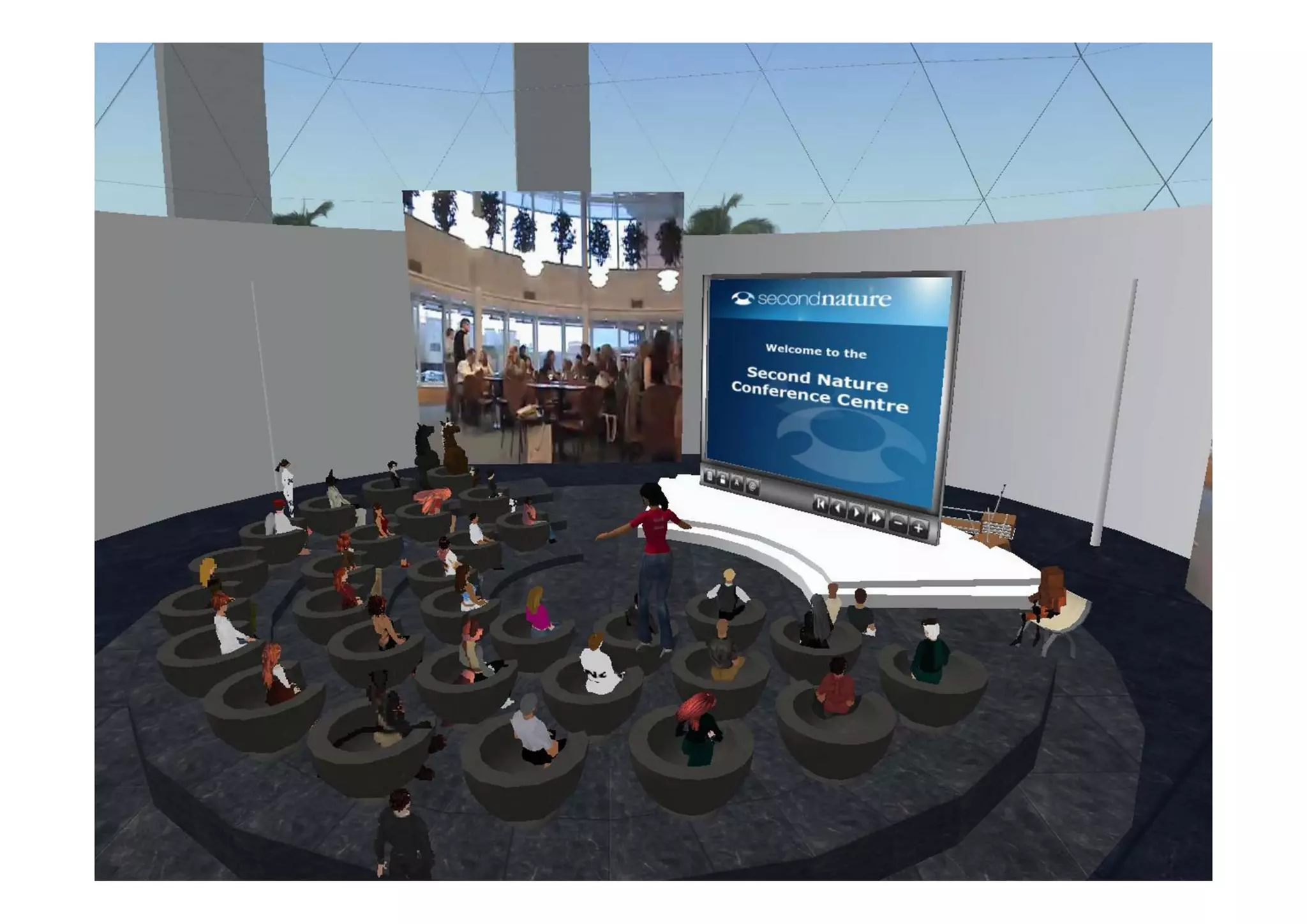
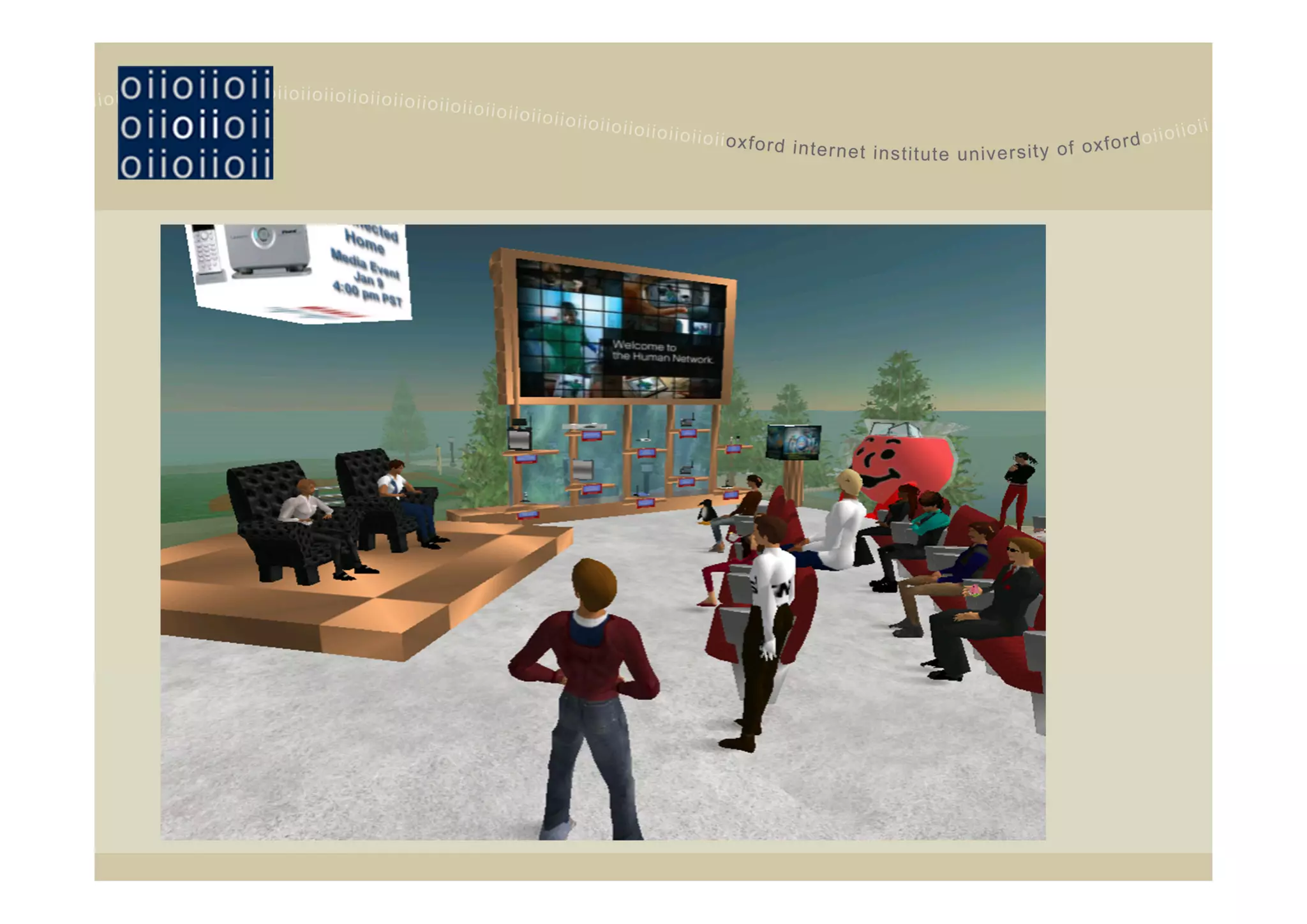
• Online worlds
   – For socializing
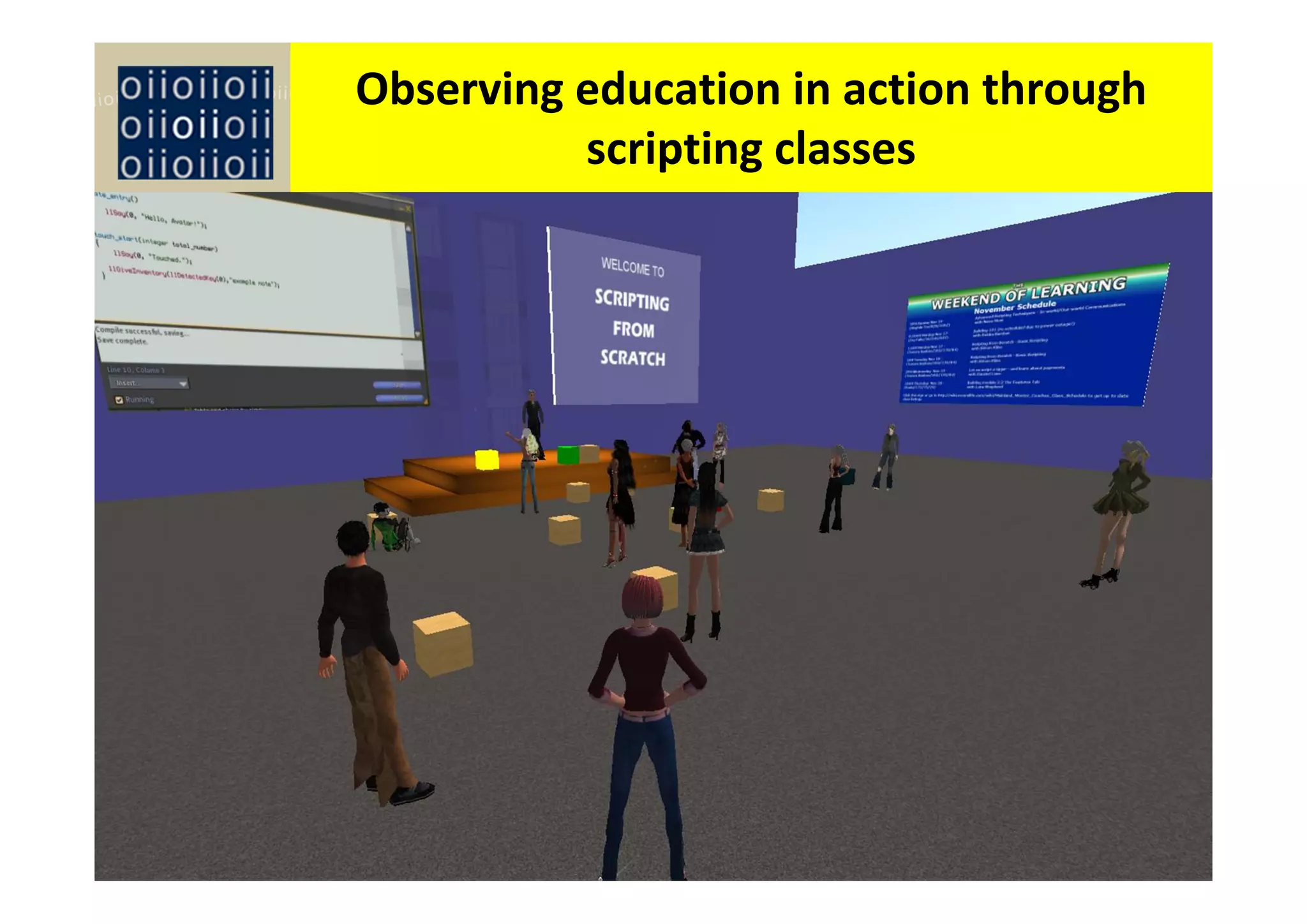
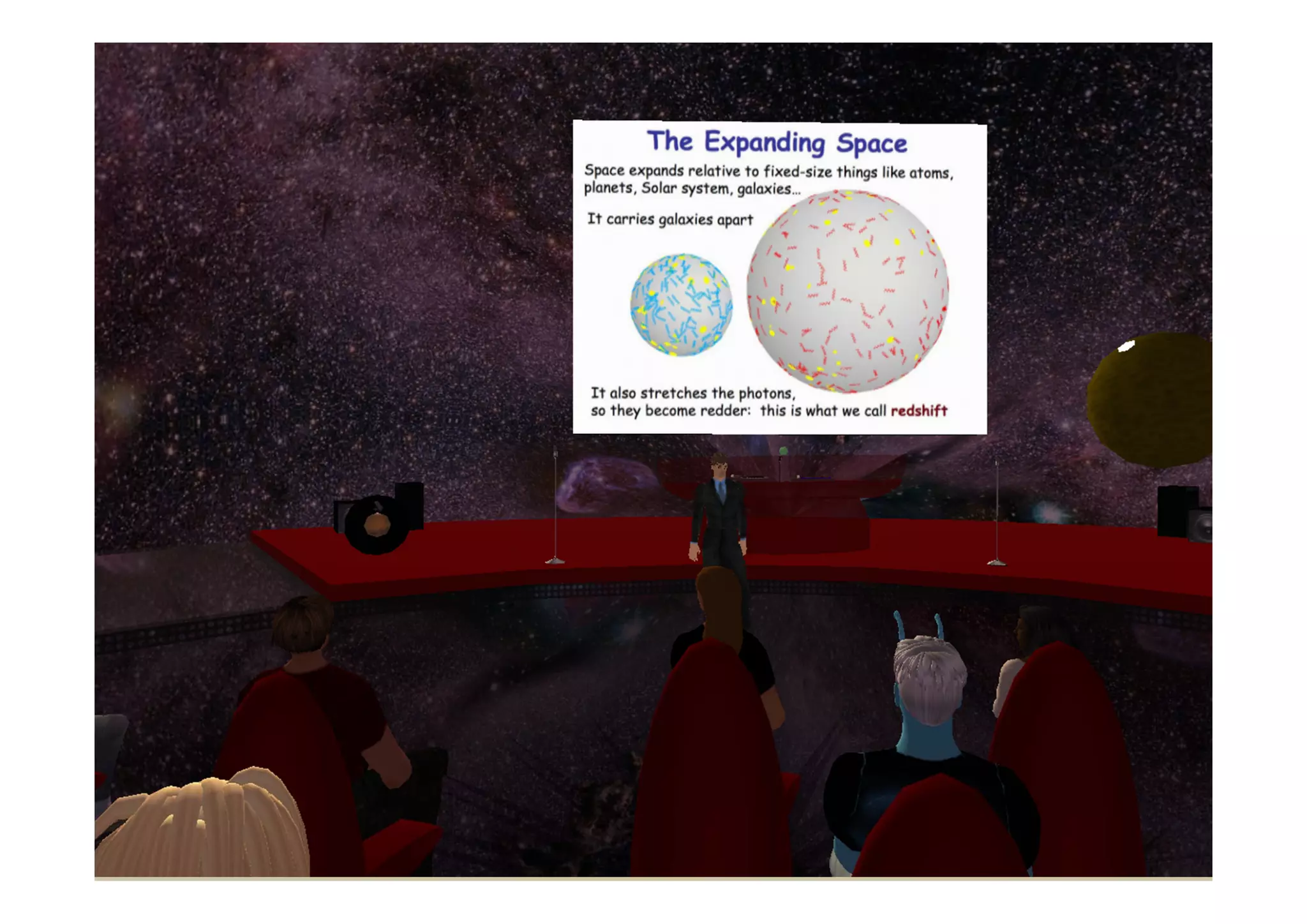
• Education
   – Classes and co‐visualizations
Why are Virtual Environments Important?


• They are the most ‘extreme’ form of mediated being 
  there together
• Technologies for ‘being there together’ are 
  proliferating
• There are many preconceptions that mediated ‘being 
  there together’ is not as good as face‐to‐face
• Virtual Environments can help us to understand the 
  future of mediated collaboration
Definition of Shared Virtual Environments and two End‐states


• Definition: presence, plus interacting, plus 
  Copresence 
  – Sensory experience of being in a place other than 
    the one you are physically in, and being able to 
    interact with it, and being there and interacting 
    with others
• There are only two End‐States: totally 
  immersive video vs. computer‐generated
• We can work backwards from these ‐ to less 
  immersive forms of being there together
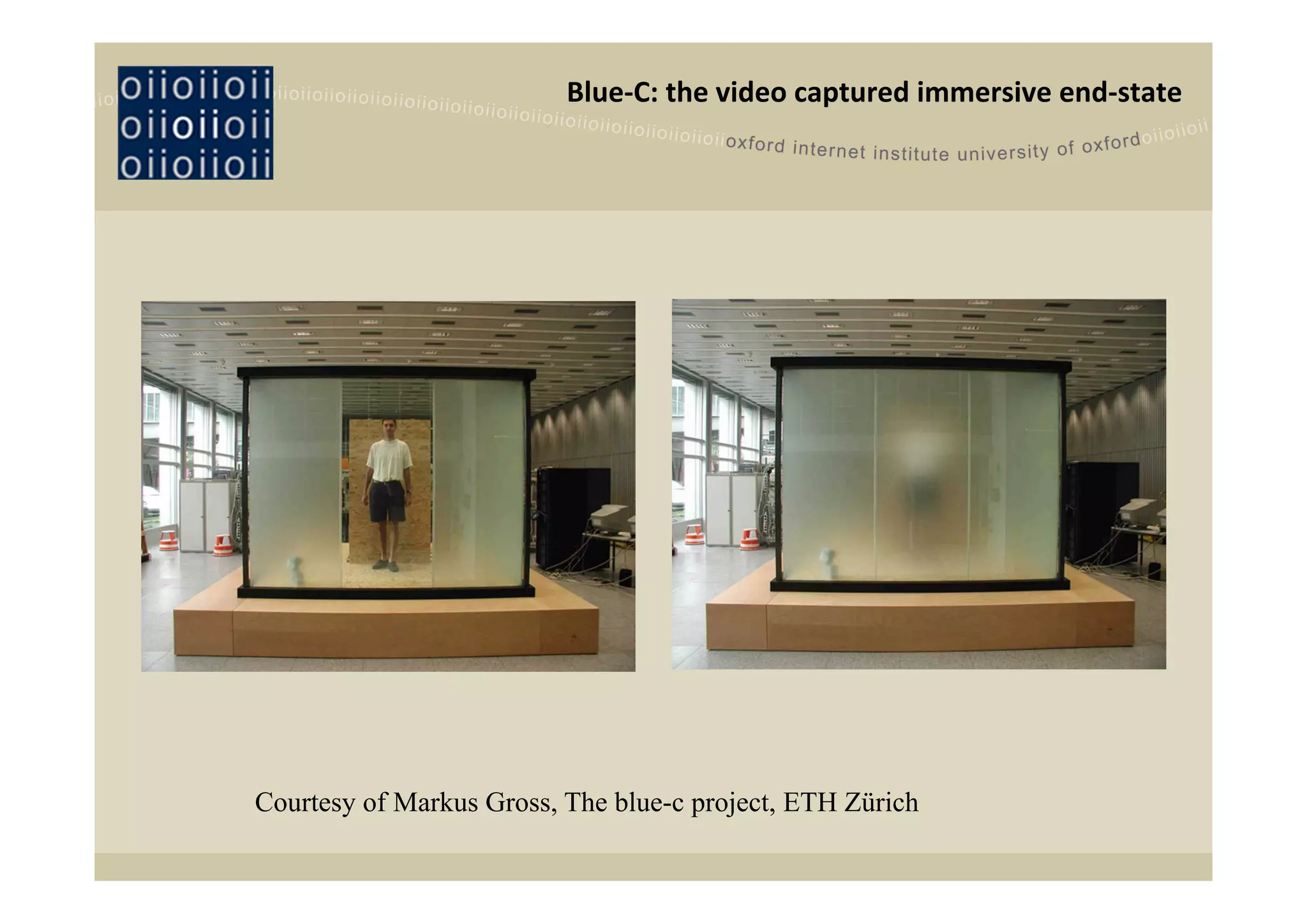
Blue‐C: the video captured immersive end‐state


Courtesy of Markus Gross, The blue-c project, ETH Zürich
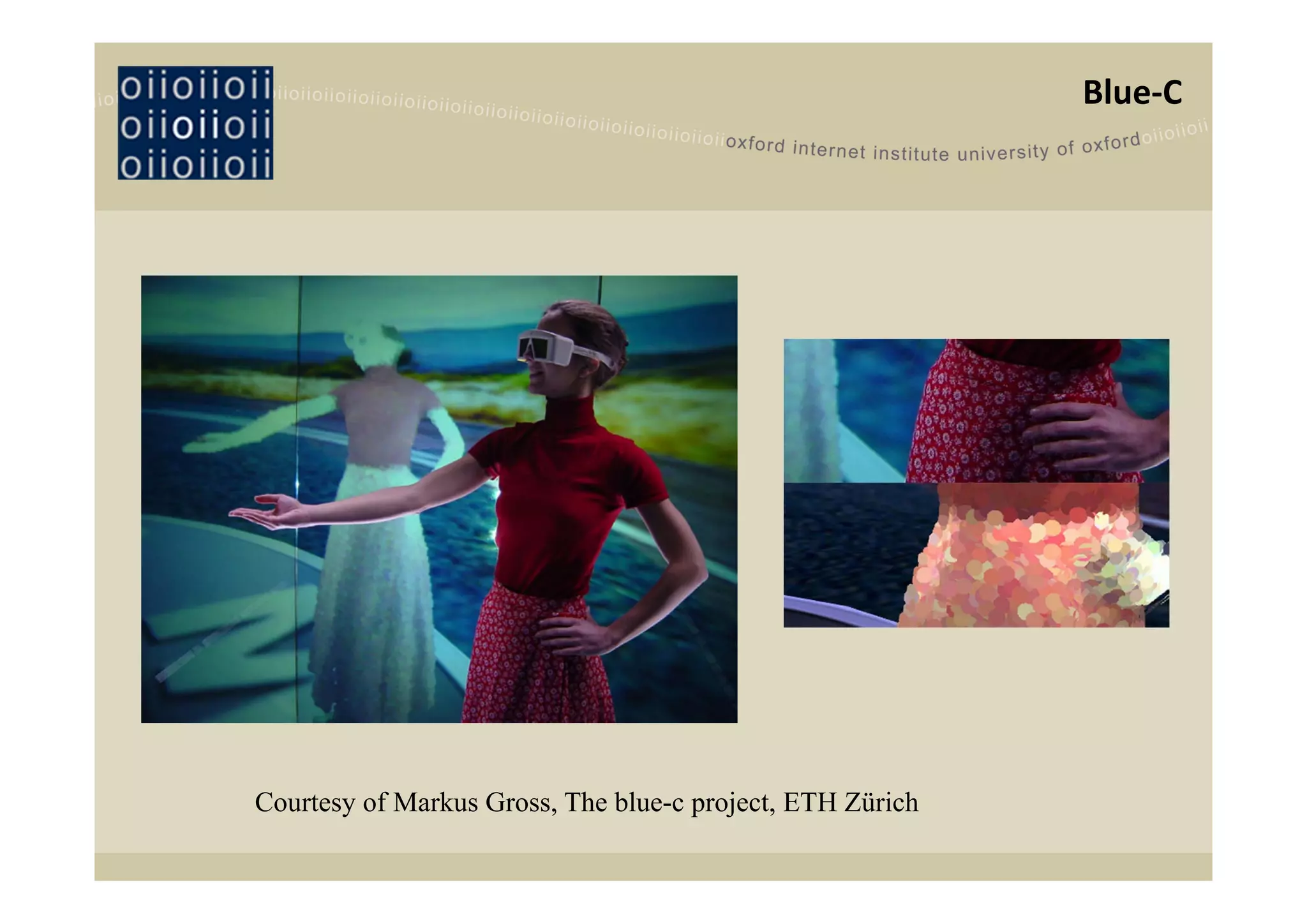
Blue‐C


Courtesy of Markus Gross, The blue-c project, ETH Zürich
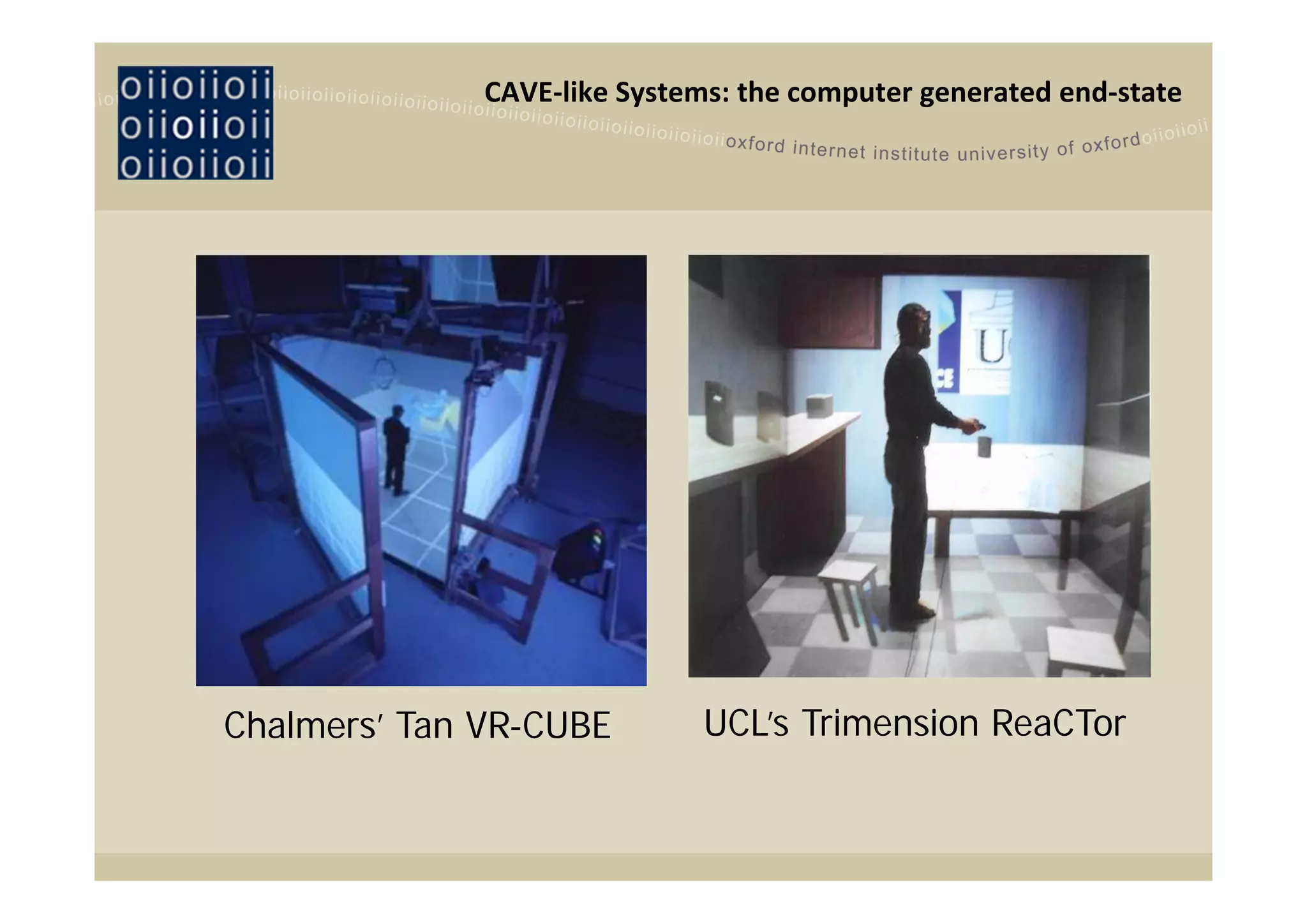
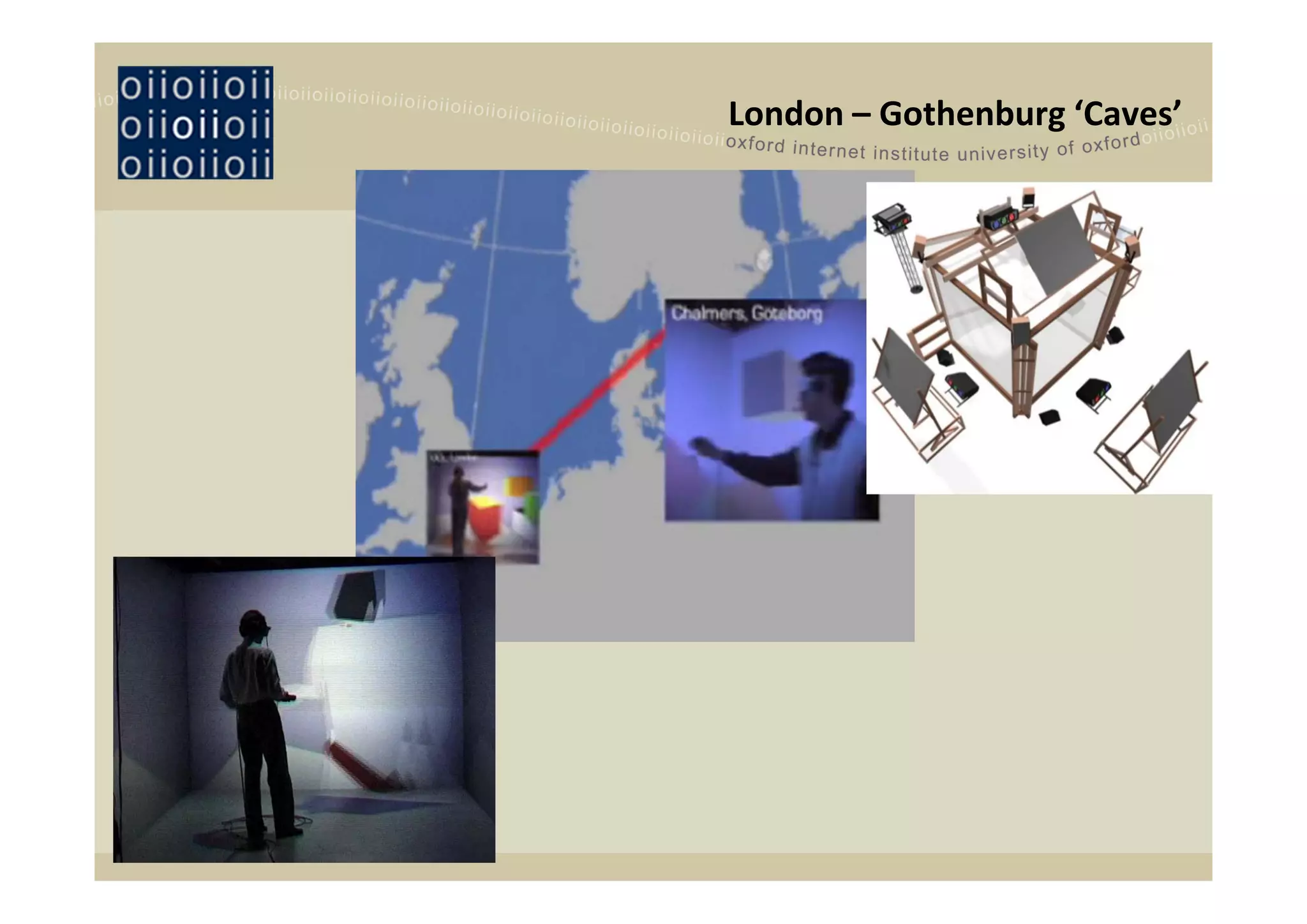
CAVE‐like Systems: the computer generated end‐state


Chalmers’ Tan VR-CUBE         UCL’s Trimension ReaCTor
London – Gothenburg ‘Caves’
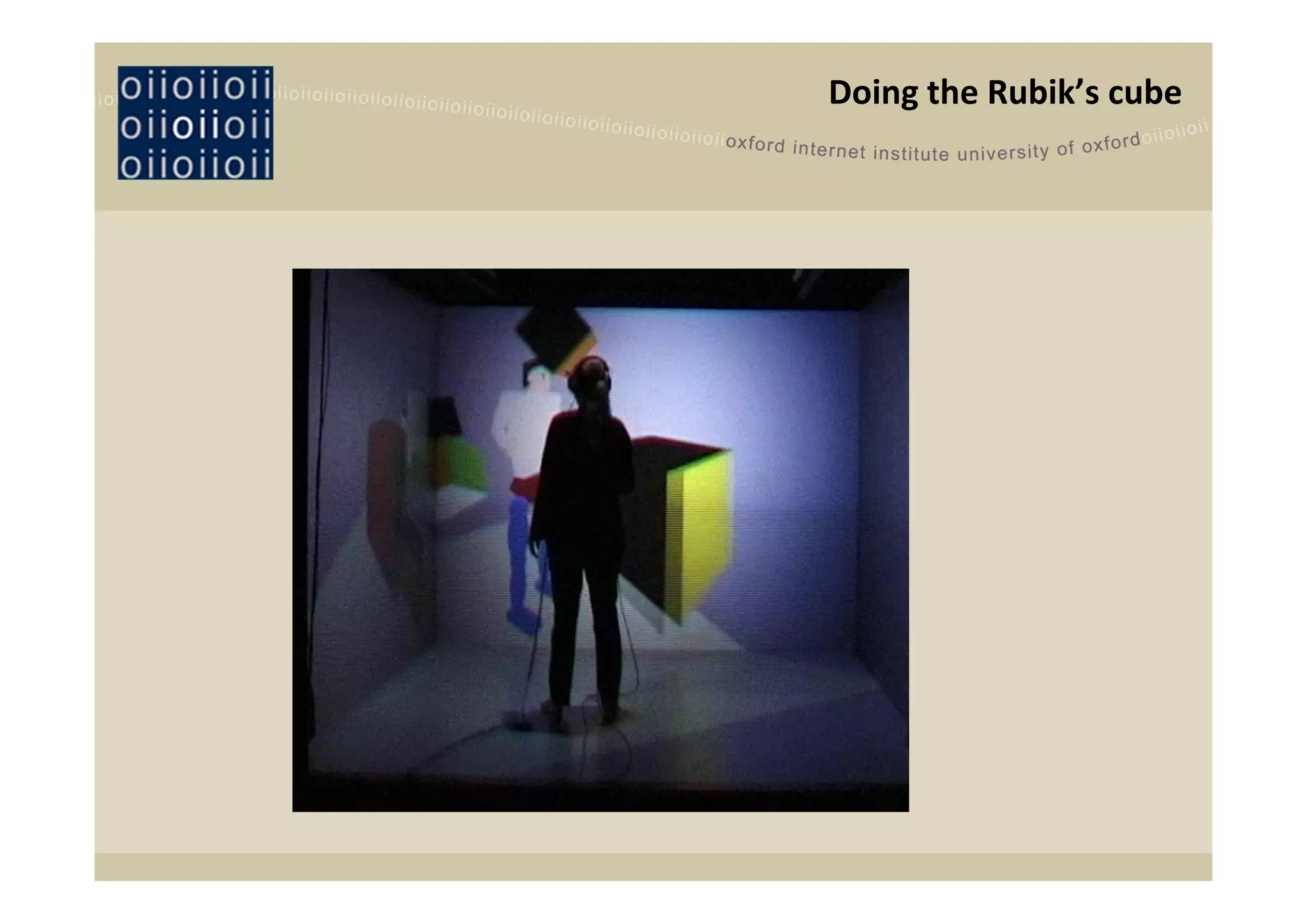
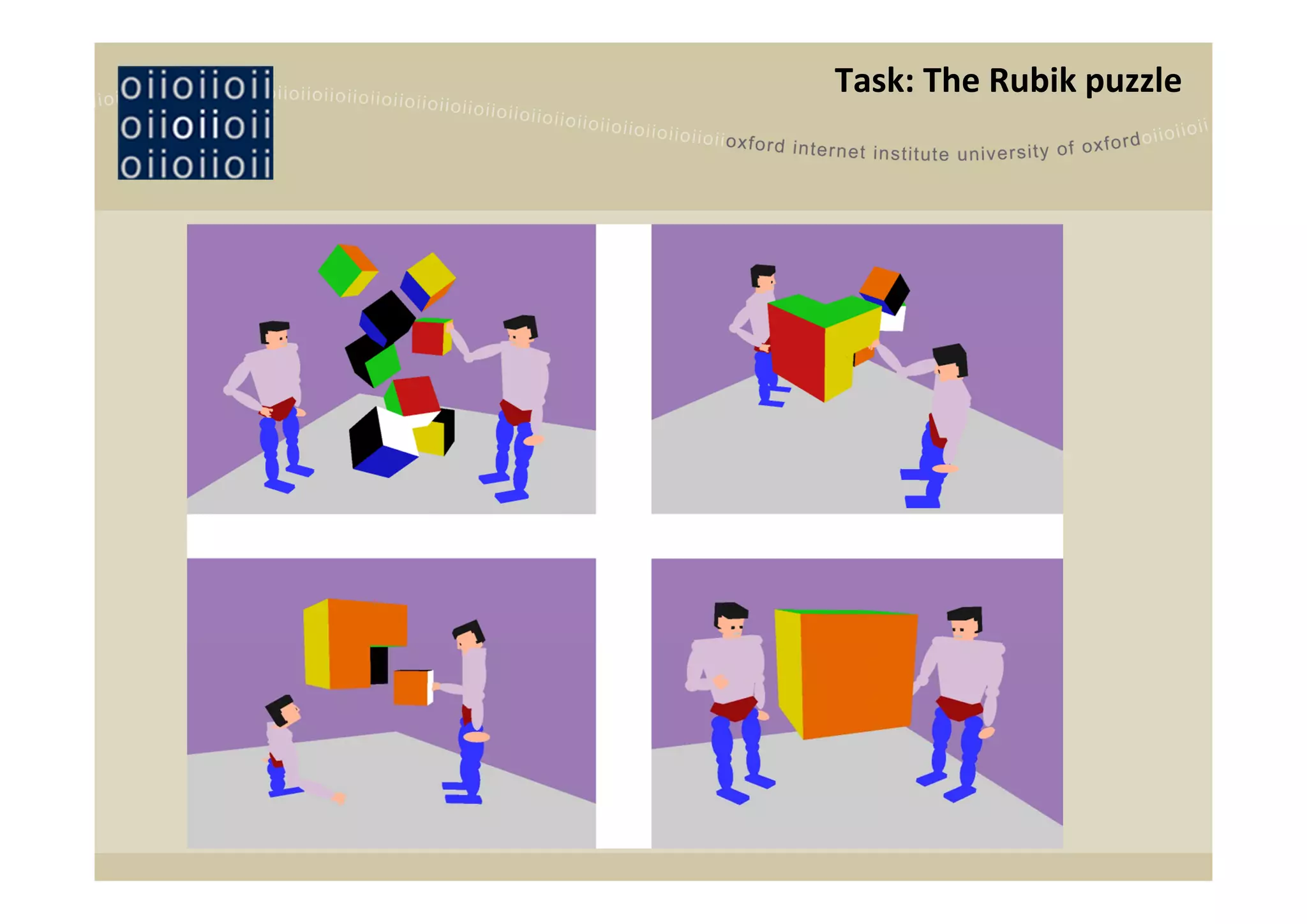
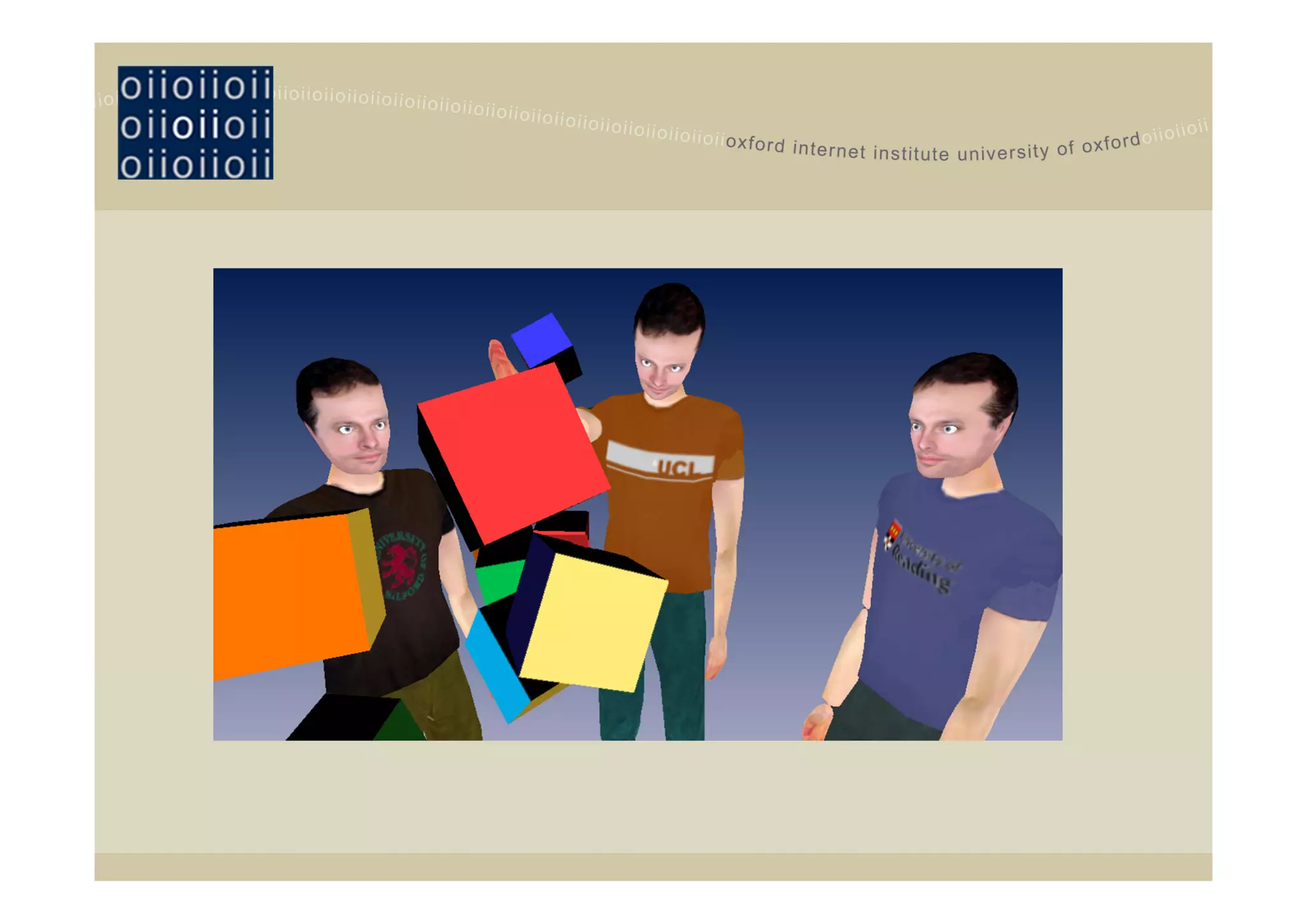
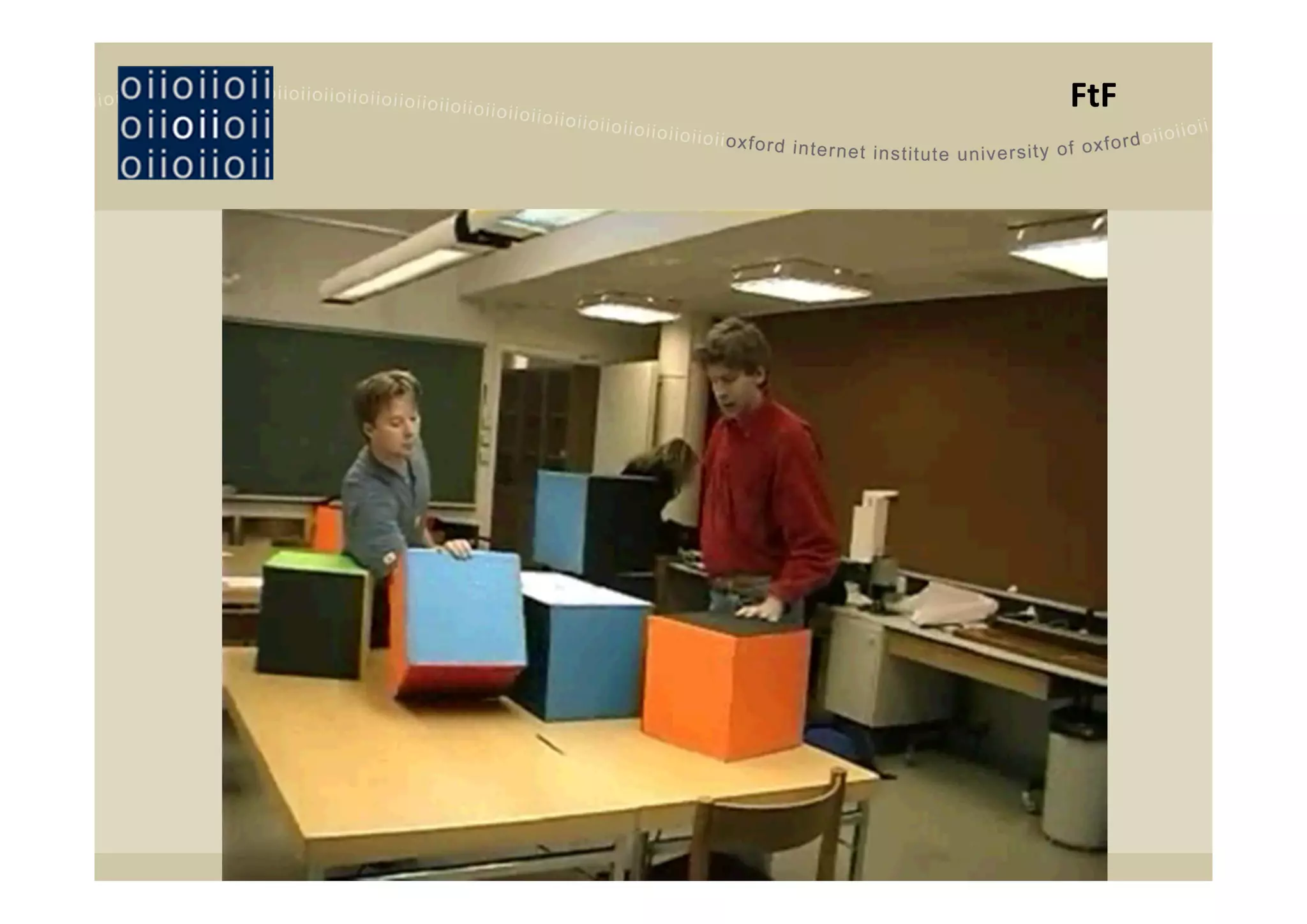
Doing the Rubik’s cube
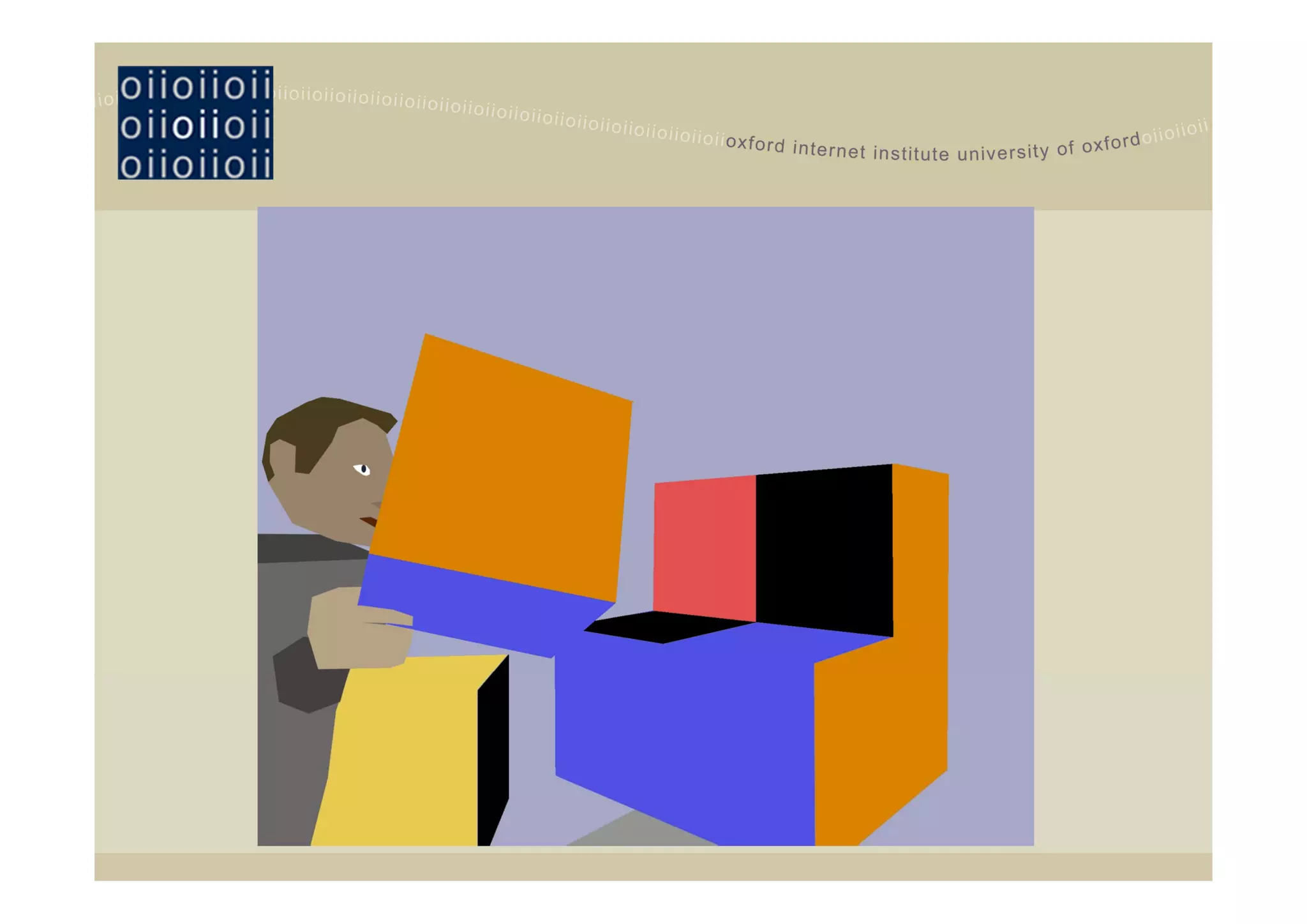
Task: The Rubik puzzle
FtF
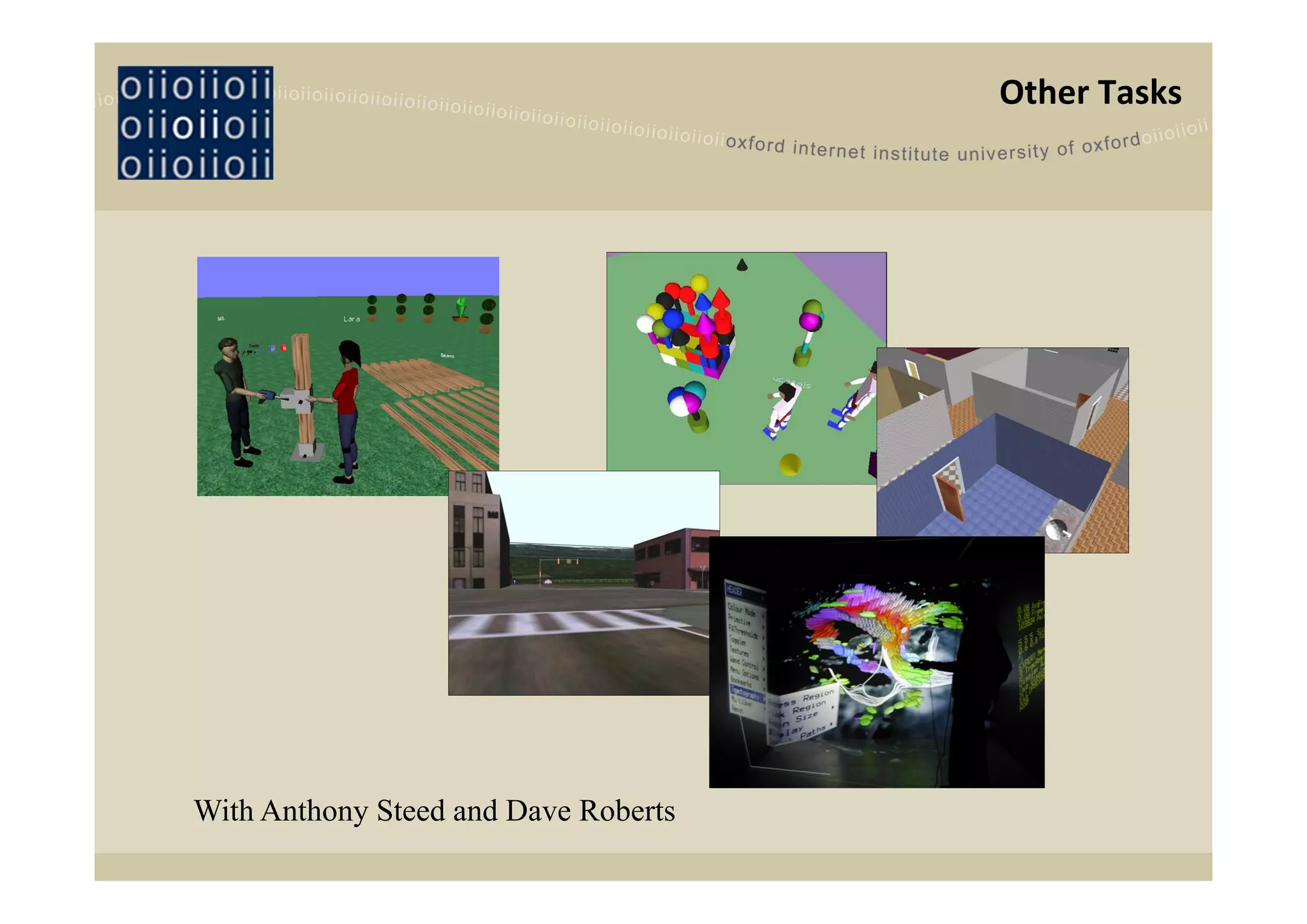
Other Tasks


With Anthony Steed and Dave Roberts
Some Findings


• Collaboration is as good as face‐to‐face
• The more immersive, the more sense of 
  the being there together (other things 
  equal!)
• Technology determines ‘leadership’
• Following and not following conventions 
  (going through avatars, leaning, pointing)
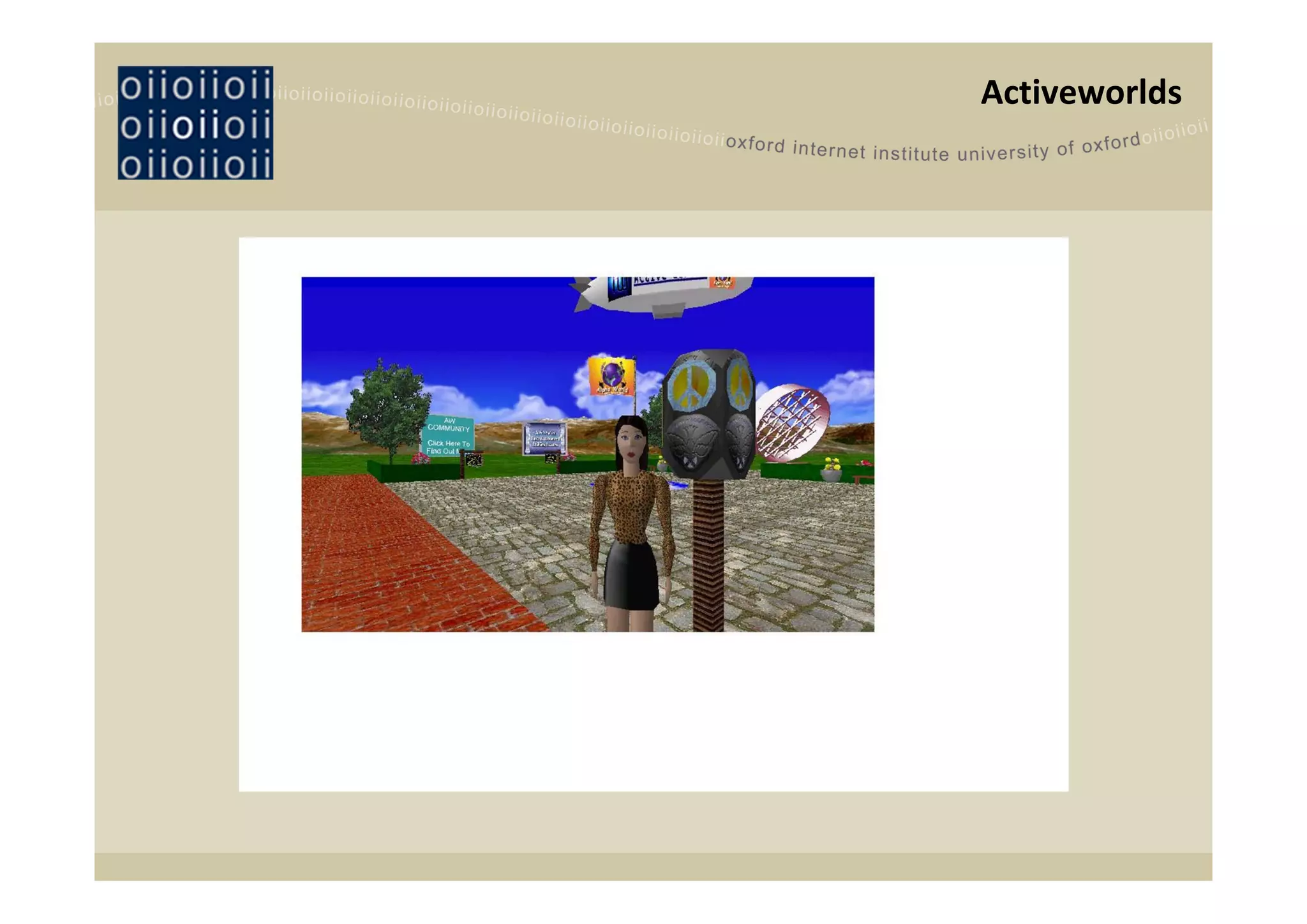
Activeworlds
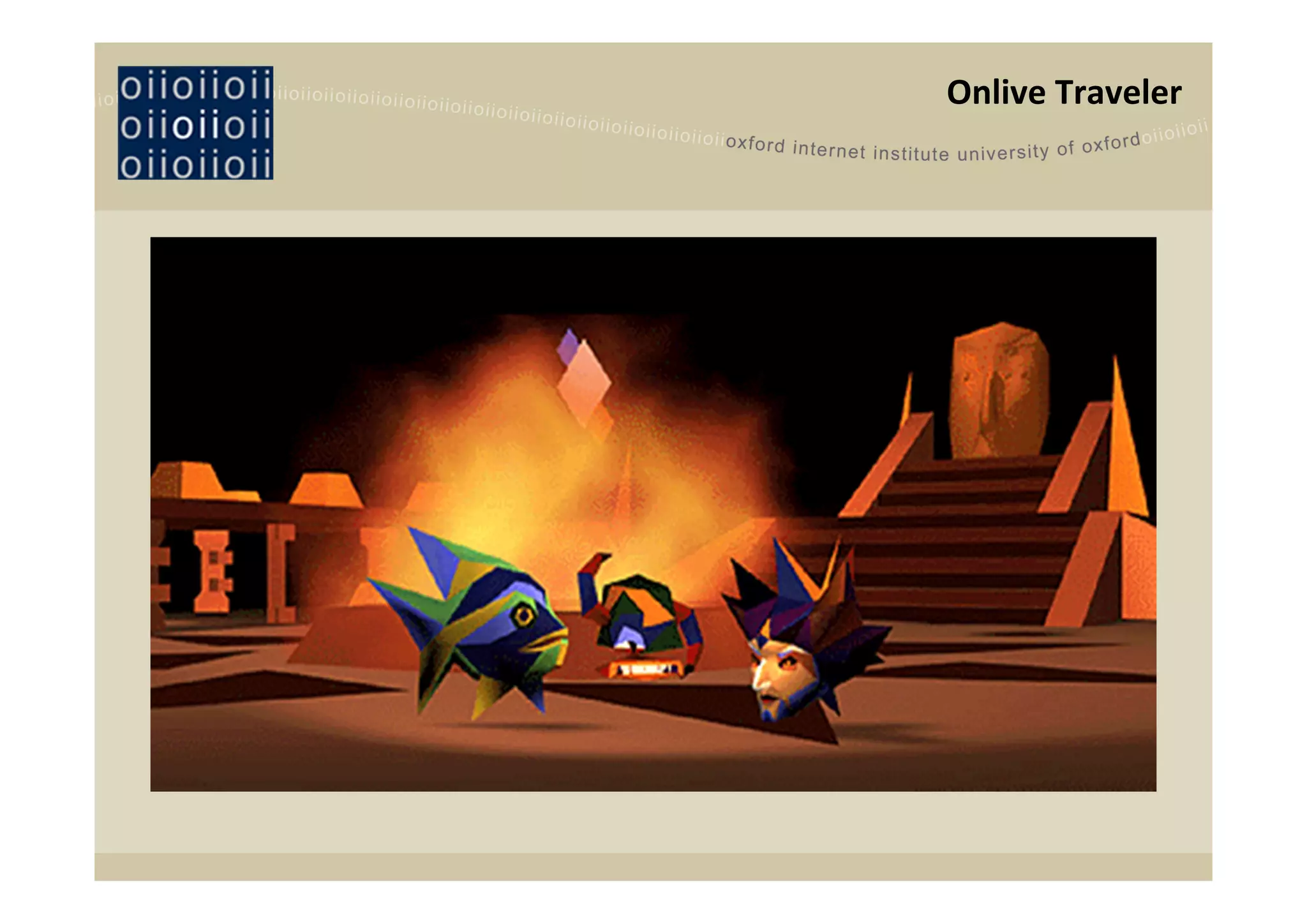
Onlive Traveler
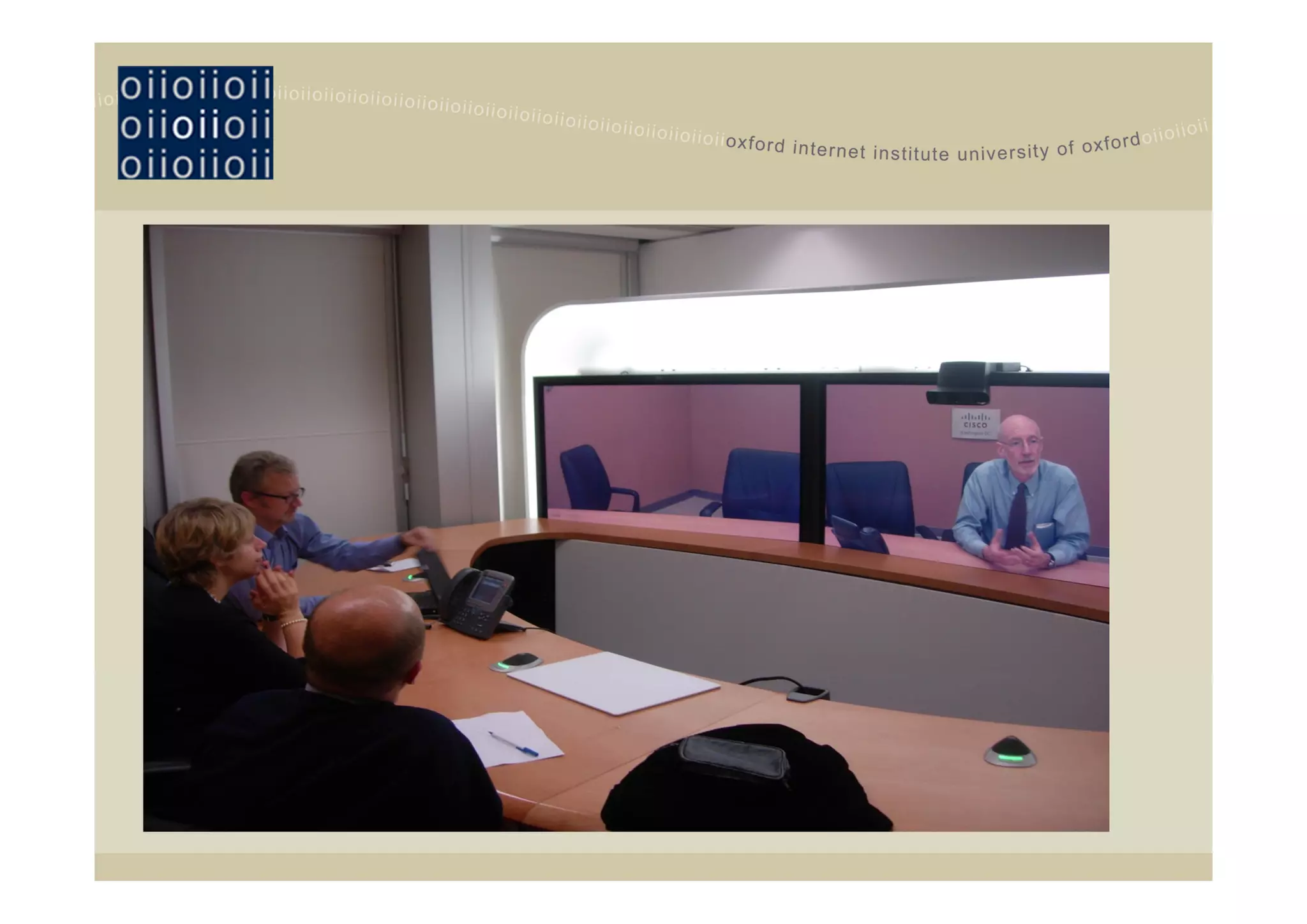
HP Halo
More Findings


• videoconferencing has been available for decades, but is not 
  widely used
   – the ‘I’m having a bad hair day’ problem
   – Findings about skype and grandparents and distributed 
      couples: realism doesn’t matter, being there together does
• In online virtual worlds, some social cues are not needed, 
  some forms of non‐verbal communication have limited uses
• online virtual worlds are enjoyable for socializing and joint 
  spatial activity
• Avatars need consistency
• Voice is a reality check
• People develop a stake in their world
Different Media for Being Together


•   Instant Messaging
•   Social Networking
•   Videoconferencing
•   Mobile Phones
•   Shared workspaces
•   All have
    – High‐Low Spatial Component
    – Self‐presentation component
    – Large or Small Group Interaction
Tools for Thinking about the Future 


• Only Two End‐States (video versus computer‐
  generated), with different affordances
• Online spaces support spatial interaction, social 
  norms, and engaging content 
• There are limits to the number of others that can be 
  focused on
• Mixed or Augmented Reality are subject to attention 
  limits
• All mediated forms of togetherness approximate the 
  two end‐states
Technology and Social Outlook


• Technological problems are solvable
• the technology for large 3D displays and interaction is 
  becoming cheap and widespread 
• Users adapt to modality and self‐representation 
• co‐visualization and co‐manipulation of spaces works well
• lots of things can be done together in online worlds that can’t 
  be done in the real world
• online sociability be can better than real world sociability 
• online spaces can be more imaginative and interesting than 
  real ones
• Convergence and mixing of modalities
Collaboration Outlook


• How much face, body and space is needed?
• Facial photorealism/videoconferencing versus 
  Spatial computer generated environment?
  – Not quite
• Large population worlds, small groups of 
  faces?
• How different is collaborating from 
  socializing?
• Time, money and environmental reasons 
  dictate less travel
Observing education in action through 
          scripting classes
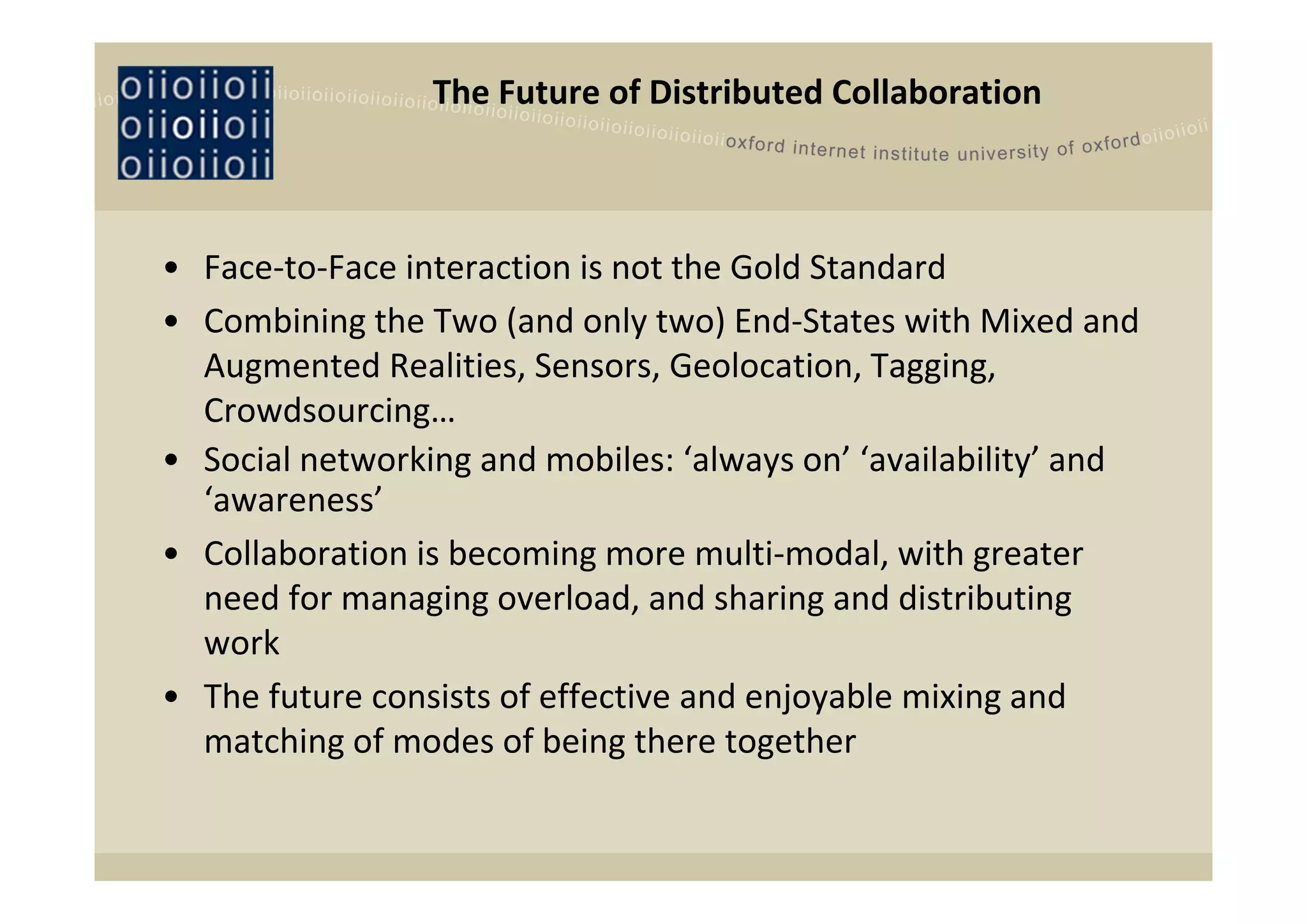
The Future of Distributed Collaboration


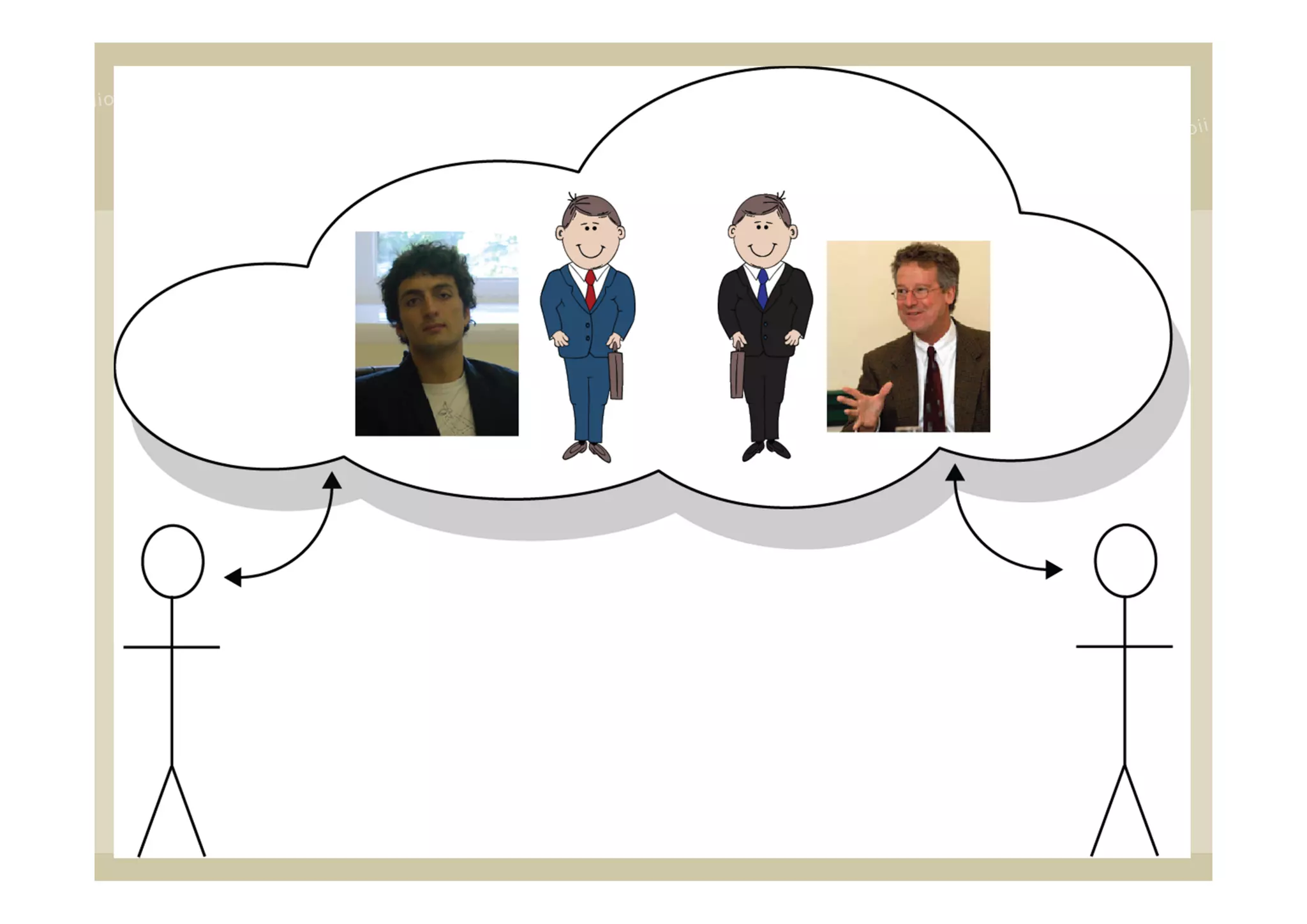
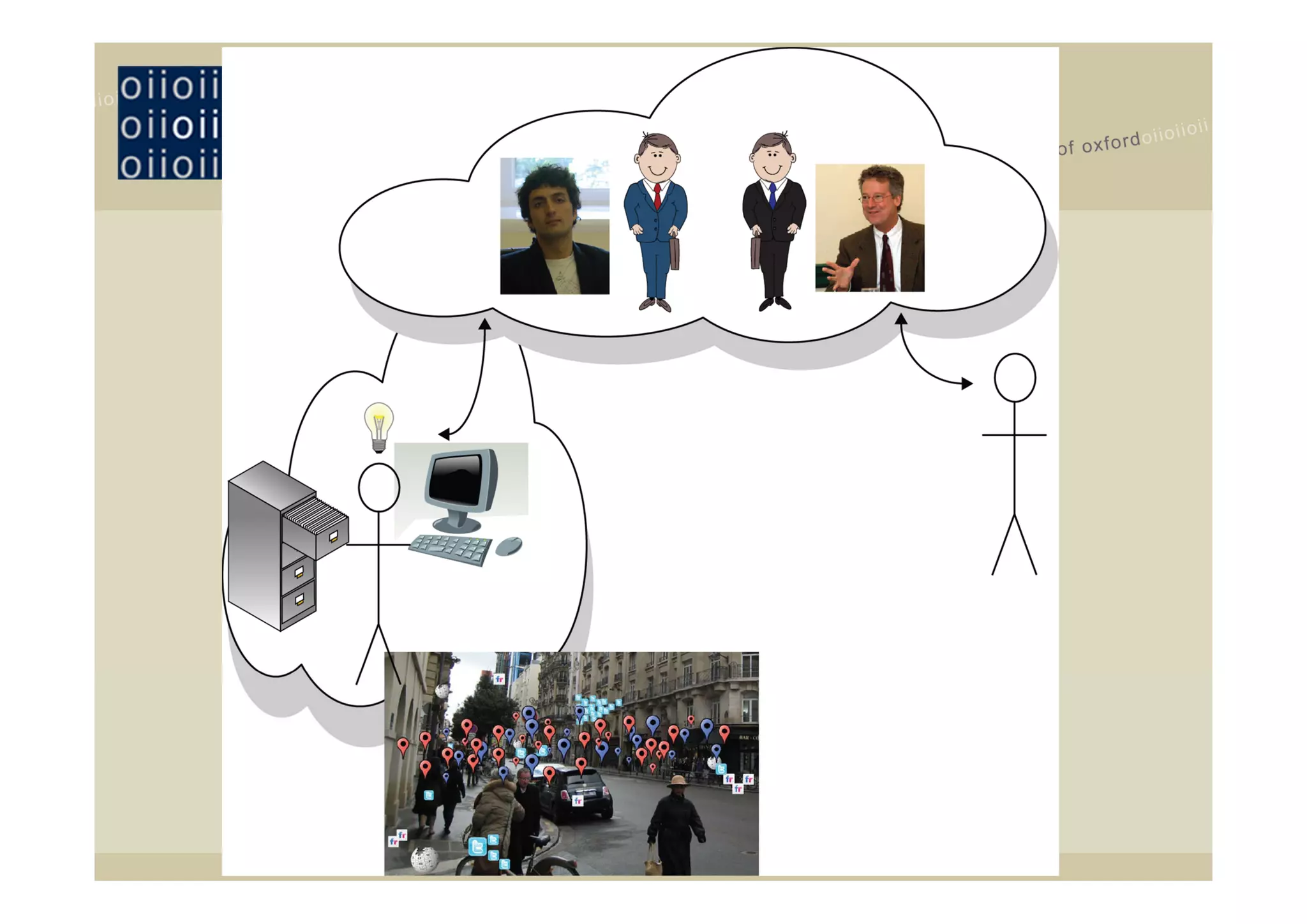
• Face‐to‐Face interaction is not the Gold Standard
• Combining the Two (and only two) End‐States with Mixed and 
  Augmented Realities, Sensors, Geolocation, Tagging, 
  Crowdsourcing…
• Social networking and mobiles: ‘always on’ ‘availability’ and 
  ‘awareness’ 
• Collaboration is becoming more multi‐modal, with greater 
  need for managing overload, and sharing and distributing 
  work
• The future consists of effective and enjoyable mixing and 
  matching of modes of being there together

Virtual Environments and the Future of Collaboration