Sharing ideas and sharing data: Researchers and Web 2.0 Lucy Power & Eric T. Meyer Oxford Internet Institute NeSC Workshop on Users, e-Research, and Web 2.0, 18 Jan 2010


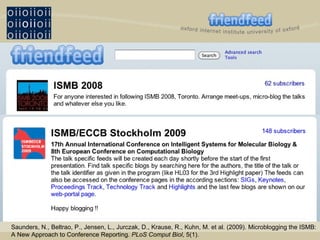
Saunders, N., Beltrao, P., Jensen, L., Jurczak, D., Krause, R., Kuhn, M. et al. (2009). Microblogging the ISMB: A New Approach to Conference Reporting.  PLoS Comput Biol , 5(1).
 
 
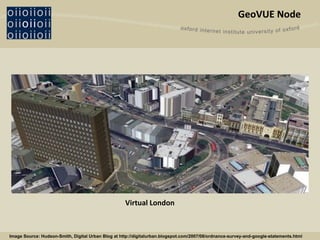
GeoVUE Node Virtual London Image Source: Hudson-Smith, Digital Urban Blog at http://digitalurban.blogspot.com/2007/08/ordnance-survey-and-google-statements.html
GeoVUE Node
 
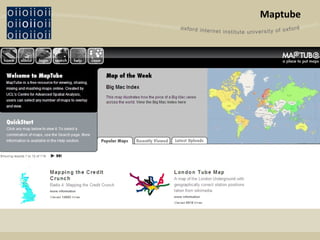
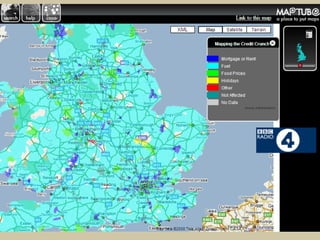
Maptube
 
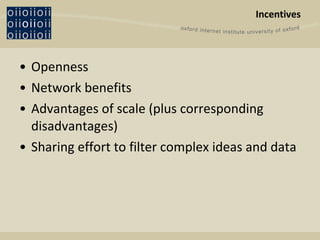
Incentives Openness Network benefits Advantages of scale (plus corresponding disadvantages) Sharing effort to filter complex ideas and data
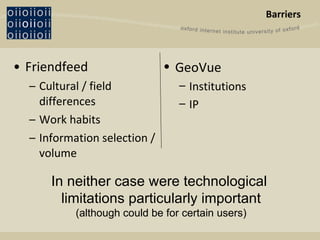
Barriers Friendfeed Cultural / field differences Work habits Information selection / volume GeoVue Institutions IP In neither case were technological  limitations particularly important (although could be for certain users)
Oxford e-Social Science (OeSS) Node of the National e-Social Science Directorate Oxford Internet Institute University of Oxford Lucy Power DPhil Candidate lucy.power@oii.ox.ac.uk  Eric T. Meyer Research Fellow [email_address] http://people.oii.ox.ac.uk/meyer  Oxford e-Social Science Project

Sharing ideas and sharing data: Researchers and Web 2.0

  • 1.
    Sharing ideas andsharing data: Researchers and Web 2.0 Lucy Power & Eric T. Meyer Oxford Internet Institute NeSC Workshop on Users, e-Research, and Web 2.0, 18 Jan 2010
  • 2.
  • 3.
  • 4.
  • 5.
    Saunders, N., Beltrao,P., Jensen, L., Jurczak, D., Krause, R., Kuhn, M. et al. (2009). Microblogging the ISMB: A New Approach to Conference Reporting. PLoS Comput Biol , 5(1).
  • 6.
  • 7.
  • 8.
    GeoVUE Node VirtualLondon Image Source: Hudson-Smith, Digital Urban Blog at http://digitalurban.blogspot.com/2007/08/ordnance-survey-and-google-statements.html
  • 9.
    GeoVUE Node VirtualLondon Image Source: Hudson-Smith, Digital Urban Blog at http://digitalurban.blogspot.com/2007/08/ordnance-survey-and-google-statements.html
  • 10.
  • 11.
  • 12.
  • 13.
  • 14.
    Incentives Openness Networkbenefits Advantages of scale (plus corresponding disadvantages) Sharing effort to filter complex ideas and data
  • 15.
    Barriers Friendfeed Cultural/ field differences Work habits Information selection / volume GeoVue Institutions IP In neither case were technological limitations particularly important (although could be for certain users)
  • 16.
    Oxford e-Social Science(OeSS) Node of the National e-Social Science Directorate Oxford Internet Institute University of Oxford Lucy Power DPhil Candidate lucy.power@oii.ox.ac.uk Eric T. Meyer Research Fellow [email_address] http://people.oii.ox.ac.uk/meyer Oxford e-Social Science Project

Editor's Notes

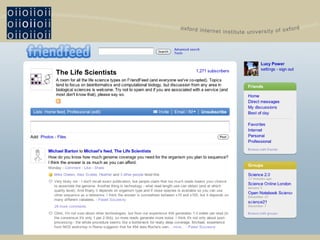
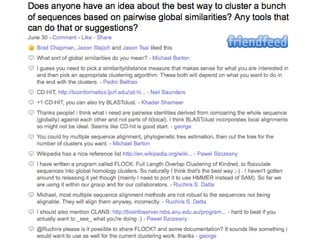
  • #3 FF is a feed aggregator – that is, it takes information from places that users input, such as their blogs, blogs they read, Twitter, flickr (photos), Facebook status updates etc. People can see all of these updates in one place, and join groups that speak to their professional or personal interests. E.g. Life scientists. Readers can “like” or “comment” on particular items or posts. What’s interesting and relevant about this is that (a) it’s a social network there is coordination going on in the sense of a SIM (b) participants are doing science online (NEXT SLIDE)
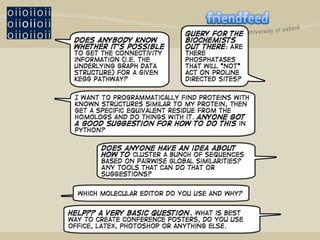
  • #4 Asking for advice on FF is becoming increasingly common – discussions ensue (see next slide)
  • #5 Discussion and potential solution via FF.
  • #6 Conference blogging/microblogging - We found that it enhanced our note-taking skills, allowed us to compile notes from parallel sessions, attracted wider interest from non-attend- ees, and, in addition to the ‘‘live’’ aspect, generated a permanent archive of the meeting. microblogging, I mean we just sort of thought "maybe FriendFeed is a good way to take notes while we're attending a presentation" It's pretty easy to create a post which is the title of the presentation, and the comments are other notes, so it sort of started from there, we just thought well this might be a nice easy practical way of taking our conference notes, and doing it all together rather than doing it in our private notebook, so we were doing that, and then this caught the attention of one of the conference organisers, and happily in a positive way, because [laughs]. I mean, thinking about it later, we didn't sort of ask permission or anything, but as it turned out they were very open to it and very happy about it.
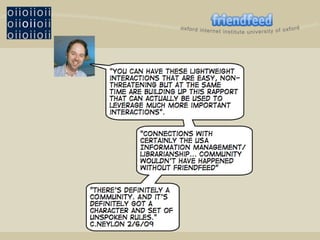
  • #7 What effect FF is having for those who use it… lightweight interactions, connections with those you would not have met otherwise http://blog.openwetware.org/scienceintheopen/2008/06/12/friendfeed-for-scientists-what-why-and-how/
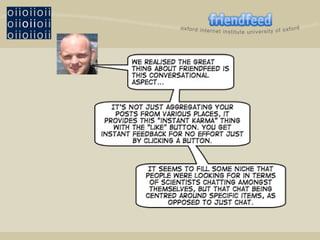
  • #8 What effect FF is having for those who use it… lightweight interactions, connections with those you would not have met otherwise NS: I share a lot of Google reader stuff in there, which tends to be research-related. So bioinformatics stuff, programming stuff, that kind of thing. I import a feed from CiteULike, which is the... you probably know CiteULike, online reference managers. And that actually works surprisingly well, because of this thing where people can "like" items, so if you post an interesting journal article, and somebody 'likes' it, you can say, here are people who are doing the same kind of thing that I'm doing, so they're worth knowing. Some days you even get a few comments coming up around the journal articles, which you could think of as a kind of first steps towards some sort of online journal club, I suppose.
  • #17 Computerization Movement? A shift away from the lone researcher A diffuse (across fields) and heterogeneous (top-down and bottom-up) movement