
Impact as a process:
considering the reach of
resources from the start
Eric T. Meyer & Kathryn Eccles
Oxford Internet Institute, University of Oxford
Digital Humanities@Oxford Summer School
8th July 2013
@etmeyer
@KathrynEccles
#tidsr
#dhoxss
Slides at:
What is impact and why
consider it?
What do we mean by impact?
• Reaching intended audience
• Reaching new audiences
• Attracting users
• Attracting new usage
• Enabling new research questions
• Enabling new approaches to education
What’s the point?
 Gather data for investors and stakeholders
 Use your impact in future funding applications
 Know that you’re reaching your audience
 Be iterative and adapt
 Develop and extend your resource
 Ensure you’re a relevant part of the community
Where to begin?
 Identify your audience and key stakeholders
 Set your goals. What types of impact do you envisage your
resource having?
 What steps are you taking to ensure these types of impact?
 Identify connections
 What resources do you see as successful in terms of audience
and impact?
 Do you see your resource as part of a network of connected
resources?
Measuring usage and impact
What could you measure?
 Users
 Types of use
 Awareness
 Citation practices
 Marketing strategies
 Embedding
Methods
Quantitative methods
Webometrics
Web Analytics
Log file analysis
Scientometrics / bibliometrics
Content Analysis
Qualitative methods
 Interviews
 Focus groups
 User feedback
 Referrer analysis
Content Analysis
New methods
Data collection:
Social media
 Twitter
 Facebook
 Podcasting
 YouTube/Vimeo
Data management:
Visualisation
Digitisation and Impact
TIDSR: The first usage and
impact study
 JISC funded project
 July 2008-April 2009
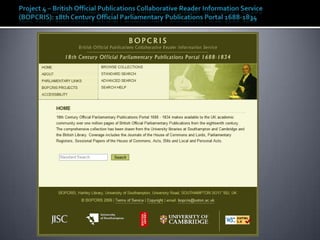
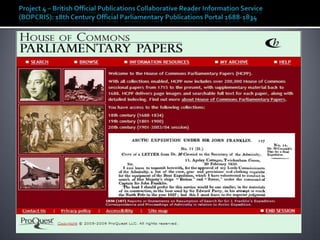
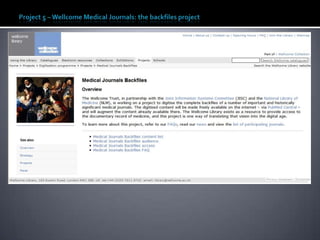
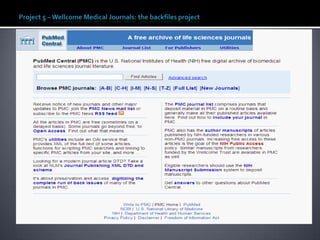
 Looked at five specific JISC-funded resources
 Designed to test the TIDSR methods and review them for
the TIDSR toolkit
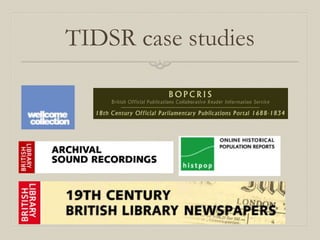
TIDSR case studies
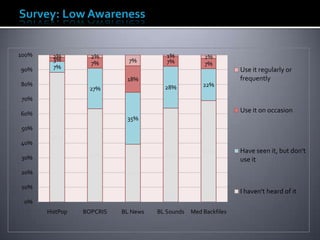
88%
63%
39%
63%
69%
7%
27%
35%
28% 22%
3%
7%
18%
7% 7%
2% 2%
7%
1% 2%
0%
10%
20%
30%
40%
50%
60%
70%
80%
90%
100%
HistPop BOPCRIS BL News BL Sounds Med Backfiles
Use it regularly or
frequently
Use it on occasion
Have seen it, but don't
use it
I haven't heard of it
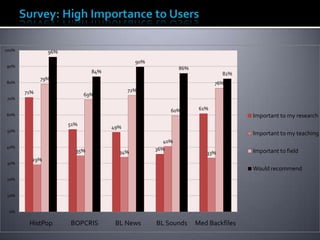
71%
51%
49%
36%
61%
29%
35% 34%
40%
33%
79%
69%
72%
60%
76%
96%
84%
90%
86%
82%
0%
10%
20%
30%
40%
50%
60%
70%
80%
90%
100%
HistPop BOPCRIS BL News BL Sounds Med Backfiles
Important to my research
Important to my teaching
Important to field
Would recommend
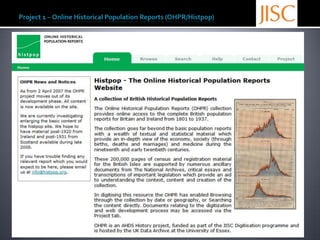
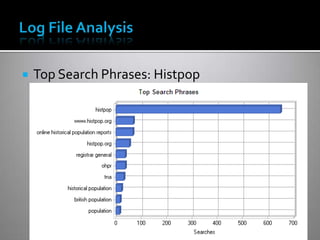
 Top Search Phrases: Histpop
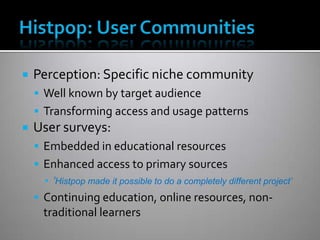
 Perception: Specific niche community
 Well known by target audience
 Transforming access and usage patterns
 User surveys:
 Embedded in educational resources
 Enhanced access to primary sources
▪ ‘Histpop made it possible to do a completely different project’
 Continuing education, online resources, non-
traditional learners
9%
36%
53%
38%
43%
55%
36%
38%
50%
48%
36%
21%
6%
13%
10%
0%
7%
2%
0%
0%
0% 20% 40% 60% 80% 100%
HistPop
BOPCRIS
BL News
BL
Sounds
Med
Backfiles
Original version Original + URL Online version Other
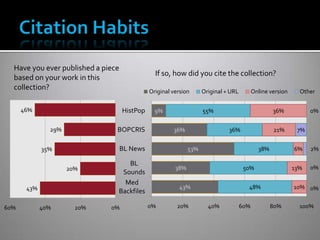
46%
29%
35%
20%
43%
0%20%40%60%
Have you ever published a piece
based on your work in this
collection?
If so, how did you cite the collection?
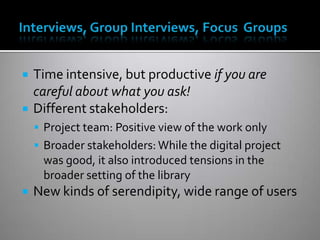
 Time intensive, but productive if you are
careful about what you ask!
 Different stakeholders:
 Project team: Positive view of the work only
 Broader stakeholders: While the digital project
was good, it also introduced tensions in the
broader setting of the library
 New kinds of serendipity, wide range of users
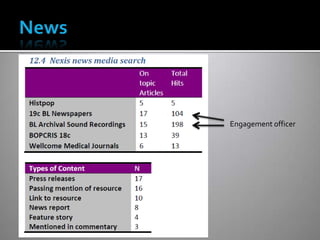
Engagement officer
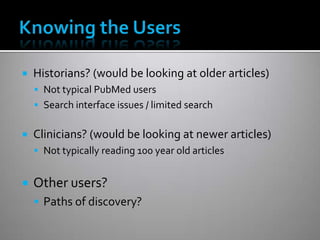
 Historians? (would be looking at older articles)
 Not typical PubMed users
 Search interface issues / limited search
 Clinicians? (would be looking at newer articles)
 Not typically reading 100 year old articles
 Other users?
 Paths of discovery?
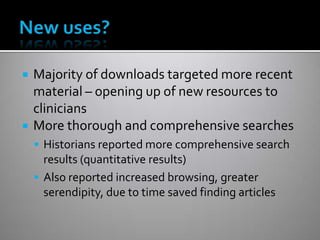
 Majority of downloads targeted more recent
material – opening up of new resources to
clinicians
 More thorough and comprehensive searches
 Historians reported more comprehensive search
results (quantitative results)
 Also reported increased browsing, greater
serendipity, due to time saved finding articles
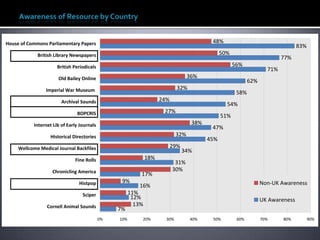
7%
12%
16%
17%
31%
34%
45%
47%
51%
54%
58%
62%
71%
77%
83%
13%
11%
9%
30%
18%
29%
32%
38%
27%
24%
32%
36%
56%
50%
48%
0% 10% 20% 30% 40% 50% 60% 70% 80% 90%
Cornell Animal Sounds
Sciper
Histpop
Chronicling America
Fine Rolls
Wellcome Medical Journal Backfiles
Historical Directories
Internet Lib of Early Journals
BOPCRIS
Archival Sounds
Imperial War Museum
Old Bailey Online
British Periodicals
British Library Newspapers
House of Commons Parliamentary Papers
Non-UK Awareness
UK Awareness
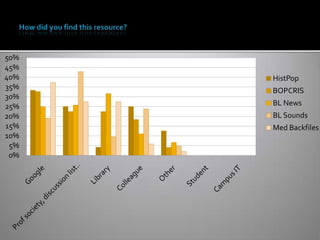
0%
5%
10%
15%
20%
25%
30%
35%
40%
45%
50%
HistPop
BOPCRIS
BL News
BL Sounds
Med Backfiles
http://microsites.oii.ox.ac.uk/tidsr/
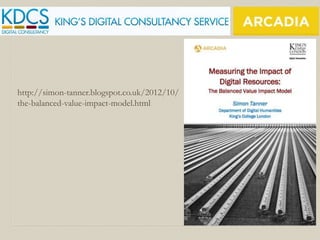
http://simon-tanner.blogspot.co.uk/2012/10/
the-balanced-value-impact-model.html
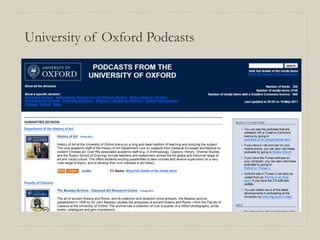
University of Oxford Podcasts
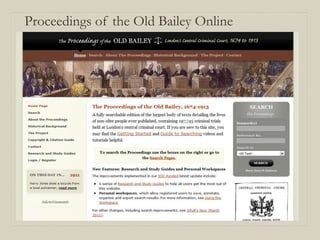
Proceedings of the Old Bailey Online
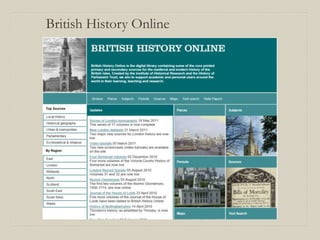
British History Online
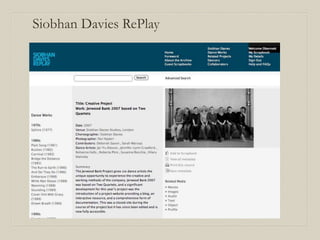
Siobhan Davies RePlay
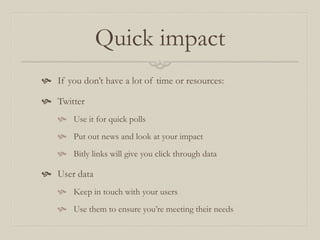
Quick impact
 If you don’t have a lot of time or resources:
 Twitter
 Use it for quick polls
 Put out news and look at your impact
 Bitly links will give you click through data
 User data
 Keep in touch with your users
 Use them to ensure you’re meeting their needs
http://www.rin.ac.uk/humanities-case-studies
Bulger, M., Meyer, E.T., de la Flor, G., Terras, M., Wyatt, S., Jirotka, M., Eccles, K., Madsen, C.
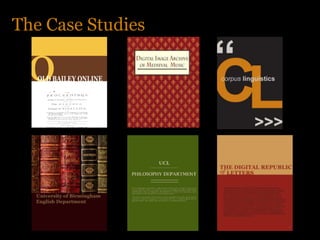
The Case Studies
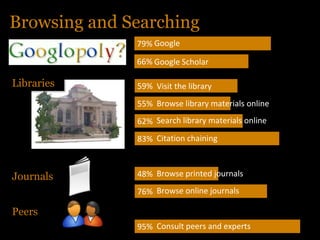
Browsing and Searching
Libraries
Journals
Peers
79%
66%
Google
Google Scholar
59%
55%
62%
83%
48%
76%
95%
Visit the library
Browse library materials online
Search library materials online
Citation chaining
Browse printed journals
Browse online journals
Consult peers and experts
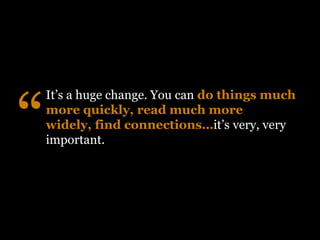
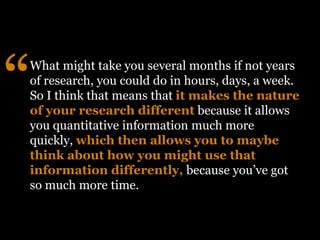
It’s a huge change. You can do things much
more quickly, read much more
widely, find connections…it’s very, very
important.“
What might take you several months if not years
of research, you could do in hours, days, a week.
So I think that means that it makes the nature
of your research different because it allows
you quantitative information much more
quickly, which then allows you to maybe
think about how you might use that
information differently, because you’ve got
so much more time.
“
Eric T. Meyer
eric.meyer@oii.ox.ac.uk
http://www.oii.ox.ac.uk/people/?id=120
Kathryn Eccles
kathryn.eccles@oii.ox.ac.uk
http://www.oii.ox.ac.uk/people/?id=138
Oxford e-Social Science Project
Project work funded by:
Possible discussion topics
• Discoverability
• of what?
• by whom?
• by what means? (manual, automatic, guided, etc.)
• Citation habits and the link to impact
• Community engagement
• Engaging atypical communities
• Enabling unexpected uses
• Having the resources to measure your resources
• Impact ‘agenda’ versus increasing one’s impact

2013 Oxford Digital Humanities Summer School Workshop

  • 1.
    Impact as aprocess: considering the reach of resources from the start Eric T. Meyer & Kathryn Eccles Oxford Internet Institute, University of Oxford Digital Humanities@Oxford Summer School 8th July 2013 @etmeyer @KathrynEccles #tidsr #dhoxss Slides at:
  • 2.
    What is impactand why consider it? What do we mean by impact? • Reaching intended audience • Reaching new audiences • Attracting users • Attracting new usage • Enabling new research questions • Enabling new approaches to education
  • 3.
    What’s the point? Gather data for investors and stakeholders  Use your impact in future funding applications  Know that you’re reaching your audience  Be iterative and adapt  Develop and extend your resource  Ensure you’re a relevant part of the community
  • 4.
    Where to begin? Identify your audience and key stakeholders  Set your goals. What types of impact do you envisage your resource having?  What steps are you taking to ensure these types of impact?  Identify connections  What resources do you see as successful in terms of audience and impact?  Do you see your resource as part of a network of connected resources?
  • 5.
    Measuring usage andimpact What could you measure?  Users  Types of use  Awareness  Citation practices  Marketing strategies  Embedding
  • 6.
    Methods Quantitative methods Webometrics Web Analytics Logfile analysis Scientometrics / bibliometrics Content Analysis Qualitative methods  Interviews  Focus groups  User feedback  Referrer analysis Content Analysis
  • 7.
    New methods Data collection: Socialmedia  Twitter  Facebook  Podcasting  YouTube/Vimeo Data management: Visualisation
  • 8.
  • 9.
    TIDSR: The firstusage and impact study  JISC funded project  July 2008-April 2009  Looked at five specific JISC-funded resources  Designed to test the TIDSR methods and review them for the TIDSR toolkit
  • 10.
  • 12.
    88% 63% 39% 63% 69% 7% 27% 35% 28% 22% 3% 7% 18% 7% 7% 2%2% 7% 1% 2% 0% 10% 20% 30% 40% 50% 60% 70% 80% 90% 100% HistPop BOPCRIS BL News BL Sounds Med Backfiles Use it regularly or frequently Use it on occasion Have seen it, but don't use it I haven't heard of it
  • 13.
    71% 51% 49% 36% 61% 29% 35% 34% 40% 33% 79% 69% 72% 60% 76% 96% 84% 90% 86% 82% 0% 10% 20% 30% 40% 50% 60% 70% 80% 90% 100% HistPop BOPCRISBL News BL Sounds Med Backfiles Important to my research Important to my teaching Important to field Would recommend
  • 15.
     Top SearchPhrases: Histpop
  • 16.
     Perception: Specificniche community  Well known by target audience  Transforming access and usage patterns  User surveys:  Embedded in educational resources  Enhanced access to primary sources ▪ ‘Histpop made it possible to do a completely different project’  Continuing education, online resources, non- traditional learners
  • 19.
    9% 36% 53% 38% 43% 55% 36% 38% 50% 48% 36% 21% 6% 13% 10% 0% 7% 2% 0% 0% 0% 20% 40%60% 80% 100% HistPop BOPCRIS BL News BL Sounds Med Backfiles Original version Original + URL Online version Other 46% 29% 35% 20% 43% 0%20%40%60% Have you ever published a piece based on your work in this collection? If so, how did you cite the collection?
  • 22.
     Time intensive,but productive if you are careful about what you ask!  Different stakeholders:  Project team: Positive view of the work only  Broader stakeholders: While the digital project was good, it also introduced tensions in the broader setting of the library  New kinds of serendipity, wide range of users
  • 23.
  • 28.
     Historians? (wouldbe looking at older articles)  Not typical PubMed users  Search interface issues / limited search  Clinicians? (would be looking at newer articles)  Not typically reading 100 year old articles  Other users?  Paths of discovery?
  • 29.
     Majority ofdownloads targeted more recent material – opening up of new resources to clinicians  More thorough and comprehensive searches  Historians reported more comprehensive search results (quantitative results)  Also reported increased browsing, greater serendipity, due to time saved finding articles
  • 30.
    7% 12% 16% 17% 31% 34% 45% 47% 51% 54% 58% 62% 71% 77% 83% 13% 11% 9% 30% 18% 29% 32% 38% 27% 24% 32% 36% 56% 50% 48% 0% 10% 20%30% 40% 50% 60% 70% 80% 90% Cornell Animal Sounds Sciper Histpop Chronicling America Fine Rolls Wellcome Medical Journal Backfiles Historical Directories Internet Lib of Early Journals BOPCRIS Archival Sounds Imperial War Museum Old Bailey Online British Periodicals British Library Newspapers House of Commons Parliamentary Papers Non-UK Awareness UK Awareness
  • 31.
  • 32.
  • 33.
  • 35.
  • 36.
    Proceedings of theOld Bailey Online
  • 37.
  • 39.
  • 40.
    Quick impact  Ifyou don’t have a lot of time or resources:  Twitter  Use it for quick polls  Put out news and look at your impact  Bitly links will give you click through data  User data  Keep in touch with your users  Use them to ensure you’re meeting their needs
  • 41.
    http://www.rin.ac.uk/humanities-case-studies Bulger, M., Meyer,E.T., de la Flor, G., Terras, M., Wyatt, S., Jirotka, M., Eccles, K., Madsen, C.
  • 42.
  • 43.
    Browsing and Searching Libraries Journals Peers 79% 66% Google GoogleScholar 59% 55% 62% 83% 48% 76% 95% Visit the library Browse library materials online Search library materials online Citation chaining Browse printed journals Browse online journals Consult peers and experts
  • 44.
    It’s a hugechange. You can do things much more quickly, read much more widely, find connections…it’s very, very important.“
  • 45.
    What might takeyou several months if not years of research, you could do in hours, days, a week. So I think that means that it makes the nature of your research different because it allows you quantitative information much more quickly, which then allows you to maybe think about how you might use that information differently, because you’ve got so much more time. “
  • 46.
    Eric T. Meyer eric.meyer@oii.ox.ac.uk http://www.oii.ox.ac.uk/people/?id=120 KathrynEccles kathryn.eccles@oii.ox.ac.uk http://www.oii.ox.ac.uk/people/?id=138 Oxford e-Social Science Project Project work funded by:
  • 47.
    Possible discussion topics •Discoverability • of what? • by whom? • by what means? (manual, automatic, guided, etc.) • Citation habits and the link to impact • Community engagement • Engaging atypical communities • Enabling unexpected uses • Having the resources to measure your resources • Impact ‘agenda’ versus increasing one’s impact

Editor's Notes

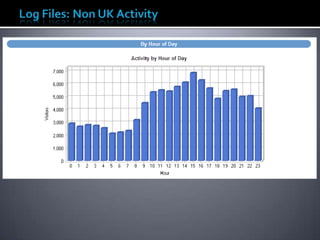
  • #16 The information we gathered enabled us to look at which search terms were used to find the resource (most popular (649 searches) was ‘Histpop’ showing that this project chose a good, catchy name – next most popular ‘www.histpop.org’ at 68 searches, ‘Online Historical Population Reports’ just behind at 67 searches). The top referrer sites allowed us to see important information about where visitors were coming from, and by following the URLs of the top referrer sites, the context of the link. Access statistics allowed us to see when the site was most popular, and where visitors were coming from. All of this information allows you to learn more about your users and the usage of your site.