Virtual Community

      Digital Identity Forum
           25 October 2005

            Aleks Krotoski
       University of Surrey
This talk
   Richard spoke about the difference between
    identity and identification.
   I’ll be explaining what the social groups in
    virtual worlds do, who forms them, what they
    mean to the participants and how the
    relationships that emerge become bonds that
    evolve into something greater than what
    happens in “just a game”, but can have
    implications for offline business as well.
   As an example…
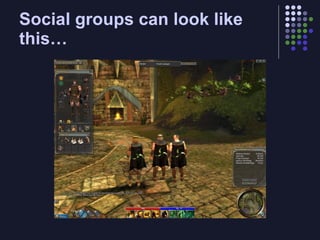
Social groups can look like
this…
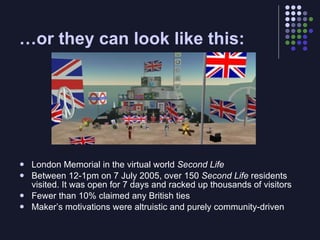
…or they can look like this:


   London Memorial in the virtual world Second Life
   Between 12-1pm on 7 July 2005, over 150 Second Life residents
    visited. It was open for 7 days and racked up thousands of visitors
   Fewer than 10% claimed any British ties
   Maker’s motivations were altruistic and purely community-driven
Virtual Communities: What they
do
   Game goals
       Kill things
       Solve things
       Create things
       Advance their abilities
   Social Goals
       Chatting about this and that
       Make friends
       Try on different identities
       Develop social networks and kudos
Social Life of Virtual Worlds
   Who goes online for social reasons?
     Depends upon the game, depends upon the player
   Refresher on Richard’s statistics
   Most players are in guilds
     Guilds are in-game groups
   Socialising effects how long community members stick around
     Social types play more often and for longer
     Strong community ties means dollars and cents for the
      companies responsible for putting these products together
   Why do people socialise?
     Psychological mumbo-jumbo
     Teamwork
Virtual Communities: Who they
are
   Demographics
   Boundaries and norms
       Maintenance: Mr. Bungle, The Sims Online Mafia and
        Virtual Sit-ins
   Hierarchies
       Guild leaders are older and female
       New ideas and innovations must be vetted by group
        leaders within the existing social norm structures of the
        virtual community
       Exit and entry rituals
   Demarcation – badges of honour as reputation
Reputation
   Reputation is the basis for all relationships in virtual
    worlds.
       Think eBay
   How can you tell an avatar’s reputation?
   There are the obvious physical signs, but
    importantly…
   It’s based on trust
       Which is based on past experience…
       …which is either based upon functional goals or pre-
        existing social relationships…
       …or some kind of disinterested third party
Virtual Community: Second
Life
   Good comparison with other, more traditional
    forms of virtual community, like Chatrooms
       Discussions, creations
       Set in game-like world
   Over 45,000 residents
   Approximately 20,000 of them active (log on
    once a month)
Virtual Communities of SL
         Neualtenburg
             “Ownership, Collaboration, Government”
             23 citizens with an elaborate government
              structure
             “In the real world the Neualtenburg Projekt exists
              as a nonprofit cooperative which shares the
              [subscription costs] and flattens the regressive
              land-use fees of [Linden Lab], making it less
              expensive for small landowners to hold land. In
              the virtual world the project is a small regional
              government within the government of LL,
              providing community-shared infrastructure,
              democratic control of the region, and a cohesive
              architectural theme.”
             Also seeking “investors”
Virtual Communities of SL
   Live2Give
       “An innovative online community for people dealing with
        Cerebral Palsy and similar conditions.”
   Brigadoon
       “An innovative online community for people dealing with
        Asperger's Syndrome and Autism.”
   One-offs
       Fashion shows
       Fundraising
         London Memorial
         Cancer walk
         Katrina
How is any of this useful?
   Transfer to the “real” world
       73% of online newsgroups got together in real world in
        1999
       RMT: in-world entrepreneurs are making money by selling
        to virtual communities
   Offline Business applications
       Reaching distributed populations
       Prototyping and market researching
         Avalon and Mrs. Jones

       Wells Fargo
       In-game branding
In Sum
   Virtual communities operate in very similar ways to
    other communities – both on and offline
   They bring together distributed individuals based on
    common experience, motivations and reputation
   This is particularly true for virtual world participants
    because of the explicit social design of the software
   There is a great potential for crossover between the
    two spheres, BUT any new implementations should
    be carefully integrated within the existing social
    norms of these valuable virtual communities
Thank You
Questions?


             Aleks Krotoski
             a.krotoski@surrey.ac.uk
             www.toastkid.com

Virtual Community

  • 1.
    Virtual Community Digital Identity Forum 25 October 2005 Aleks Krotoski University of Surrey
  • 2.
    This talk  Richard spoke about the difference between identity and identification.  I’ll be explaining what the social groups in virtual worlds do, who forms them, what they mean to the participants and how the relationships that emerge become bonds that evolve into something greater than what happens in “just a game”, but can have implications for offline business as well.  As an example…
  • 3.
    Social groups canlook like this…
  • 4.
    …or they canlook like this:  London Memorial in the virtual world Second Life  Between 12-1pm on 7 July 2005, over 150 Second Life residents visited. It was open for 7 days and racked up thousands of visitors  Fewer than 10% claimed any British ties  Maker’s motivations were altruistic and purely community-driven
  • 5.
    Virtual Communities: Whatthey do  Game goals  Kill things  Solve things  Create things  Advance their abilities  Social Goals  Chatting about this and that  Make friends  Try on different identities  Develop social networks and kudos
  • 6.
    Social Life ofVirtual Worlds  Who goes online for social reasons?  Depends upon the game, depends upon the player  Refresher on Richard’s statistics  Most players are in guilds  Guilds are in-game groups  Socialising effects how long community members stick around  Social types play more often and for longer  Strong community ties means dollars and cents for the companies responsible for putting these products together  Why do people socialise?  Psychological mumbo-jumbo  Teamwork
  • 7.
    Virtual Communities: Whothey are  Demographics  Boundaries and norms  Maintenance: Mr. Bungle, The Sims Online Mafia and Virtual Sit-ins  Hierarchies  Guild leaders are older and female  New ideas and innovations must be vetted by group leaders within the existing social norm structures of the virtual community  Exit and entry rituals  Demarcation – badges of honour as reputation
  • 8.
    Reputation  Reputation is the basis for all relationships in virtual worlds.  Think eBay  How can you tell an avatar’s reputation?  There are the obvious physical signs, but importantly…  It’s based on trust  Which is based on past experience…  …which is either based upon functional goals or pre- existing social relationships…  …or some kind of disinterested third party
  • 9.
    Virtual Community: Second Life  Good comparison with other, more traditional forms of virtual community, like Chatrooms  Discussions, creations  Set in game-like world  Over 45,000 residents  Approximately 20,000 of them active (log on once a month)
  • 10.
    Virtual Communities ofSL  Neualtenburg  “Ownership, Collaboration, Government”  23 citizens with an elaborate government structure  “In the real world the Neualtenburg Projekt exists as a nonprofit cooperative which shares the [subscription costs] and flattens the regressive land-use fees of [Linden Lab], making it less expensive for small landowners to hold land. In the virtual world the project is a small regional government within the government of LL, providing community-shared infrastructure, democratic control of the region, and a cohesive architectural theme.”  Also seeking “investors”
  • 11.
    Virtual Communities ofSL  Live2Give  “An innovative online community for people dealing with Cerebral Palsy and similar conditions.”  Brigadoon  “An innovative online community for people dealing with Asperger's Syndrome and Autism.”  One-offs  Fashion shows  Fundraising  London Memorial  Cancer walk  Katrina
  • 12.
    How is anyof this useful?  Transfer to the “real” world  73% of online newsgroups got together in real world in 1999  RMT: in-world entrepreneurs are making money by selling to virtual communities  Offline Business applications  Reaching distributed populations  Prototyping and market researching  Avalon and Mrs. Jones  Wells Fargo  In-game branding
  • 13.
    In Sum  Virtual communities operate in very similar ways to other communities – both on and offline  They bring together distributed individuals based on common experience, motivations and reputation  This is particularly true for virtual world participants because of the explicit social design of the software  There is a great potential for crossover between the two spheres, BUT any new implementations should be carefully integrated within the existing social norms of these valuable virtual communities
  • 14.
    Thank You Questions? Aleks Krotoski a.krotoski@surrey.ac.uk www.toastkid.com