Online Communities KCB201 Virtual Cultures Dr Axel Bruns [email_address]
Strength in Numbers Technocultural frameworks: prescribe certain roles for their users determine (to some extent) what individuals are able to do within them The networked environment: individuals in the network have limited ability to change these frameworks they may struggle to cope with information overload, and must do so by managing and evaluating information in order to create meaning from it but networked people in online communities are able to create their own technocultures! Virtual communities: beware the early hype! (until the mid-1990s) “ technology will not in itself fulfill this potential – this latent technical power must be used intelligently and deliberately by an informed population” (Howard Rheingold qtd. in Flew, p. 62)
Online Communities Potential benefits: new forms of personal and community identity independent of physical attributes or geographic location communities of interest collecting information and developing a shared understanding of the world new forms of collaboration and social organisation opportunity for active, participatory membership / citizenship active user participation as content creators lowering barriers to cultural and social participation ability to operate in fields of interest neglected by mainstream media, business, politics, research, … spaces for niche, grassroots, vernacular experimentation ability to build cooperative networks with other communities move from participatory culture to collective intelligence
[…]
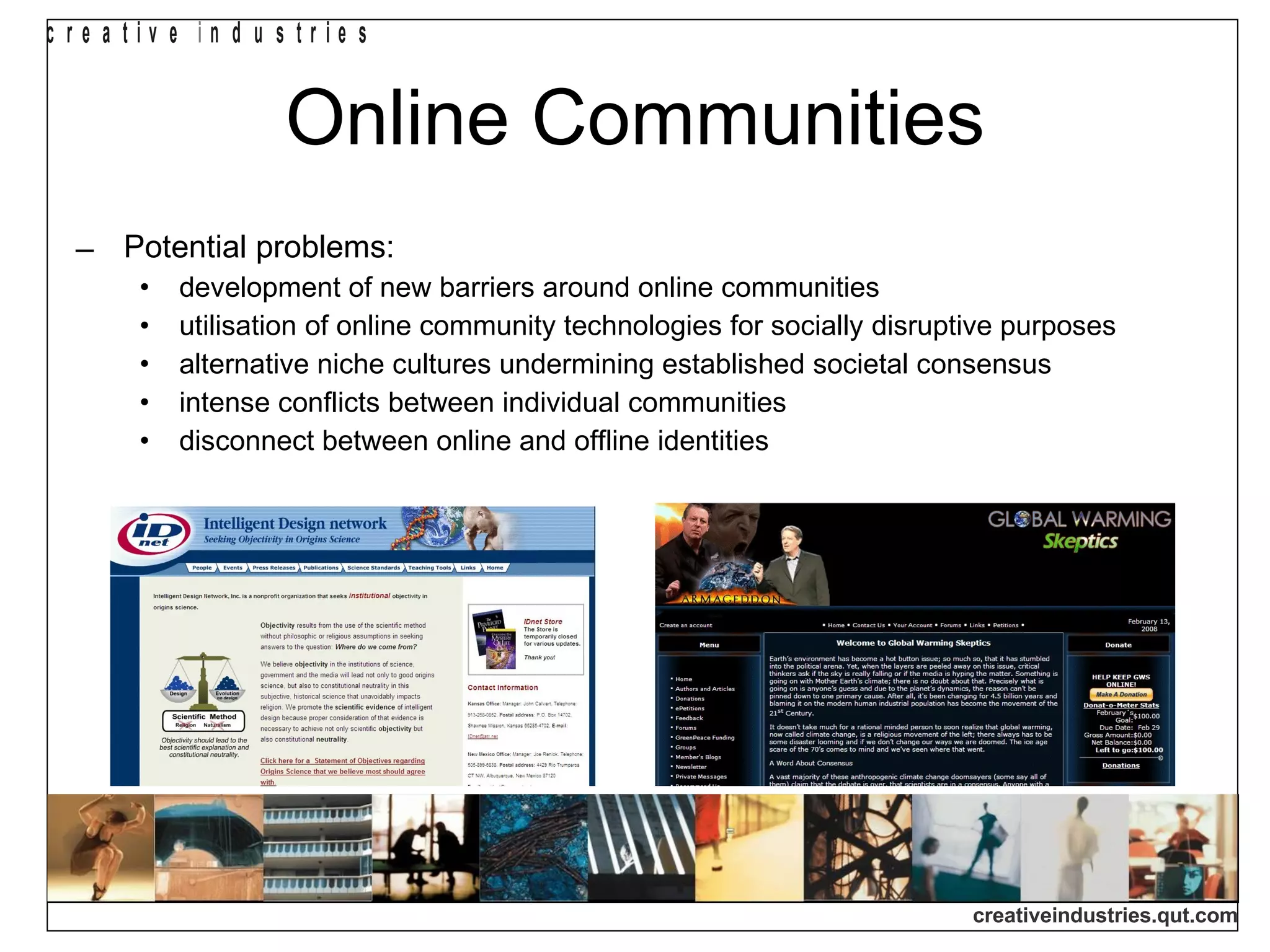
Online Communities Potential problems: development of new barriers around online communities utilisation of online community technologies for socially disruptive purposes alternative niche cultures undermining established societal consensus intense conflicts between individual communities  disconnect between online and offline identities
Online and Offline Communities Worlds connect (and collide): online and offline communities often overlap but are rarely identical online communities may require less commitment users drift in and out as time and interest dictate online communities may command more commitment interest communities can be more intense than geographically based communities online communities exist  only  through members’ content contributions change can happen more rapidly online communities constantly create and change their rules and protocols they are constantly changing and evolving
Community Research Understanding mediated communities (Flew, p. 81): how do people use new media technologies as part of their everyday lives? who are these people? (sociodemographic structures) adopting online identities does not mean a disconnection from the offline world! “ We need to treat Internet media as continuous with and embedded in other social spaces.” (Miller & Slater qtd. in Flew, p. 81) See e.g.: Henry Jenkins –  Convergence Culture Eric von Hippel –  Democratizing Innovation Nancy K. Baym –  Tune In, Log On also online RPG communities, local suburban communities…
Community Power Impact of online communities: as cultural institutions fan communities influencing the future development of media franchises (e.g.  Lord of the Rings ), or developing them further themselves (e.g. fan fiction) as media practitioners citizen journalism providing a corrective to mainstream news filesharers setting up alternative distribution frameworks for music and movies as knowledge managers social bookmarking participants sifting through and making sense of World Wide Web content wiki contributors collaborating in building and organising knowledge bases as economic factors viral marketing and user criticism influencing success or failure of new products travel reviews affecting hotels and tour operators, and undermining printed travel guides as political movements global coalitions of activist communities organising world-wide protests for poverty reduction or against economic globalisation national and local online communities conducting viral political campaigns not just collections of individuals operating within the existing technoculture, but independent institutions within society, changing the technocultural environment!

KCB201 Week 6 Slidecast: Online Communities

  • 1.
    Online Communities KCB201Virtual Cultures Dr Axel Bruns [email_address]
  • 2.
    Strength in NumbersTechnocultural frameworks: prescribe certain roles for their users determine (to some extent) what individuals are able to do within them The networked environment: individuals in the network have limited ability to change these frameworks they may struggle to cope with information overload, and must do so by managing and evaluating information in order to create meaning from it but networked people in online communities are able to create their own technocultures! Virtual communities: beware the early hype! (until the mid-1990s) “ technology will not in itself fulfill this potential – this latent technical power must be used intelligently and deliberately by an informed population” (Howard Rheingold qtd. in Flew, p. 62)
  • 3.
    Online Communities Potentialbenefits: new forms of personal and community identity independent of physical attributes or geographic location communities of interest collecting information and developing a shared understanding of the world new forms of collaboration and social organisation opportunity for active, participatory membership / citizenship active user participation as content creators lowering barriers to cultural and social participation ability to operate in fields of interest neglected by mainstream media, business, politics, research, … spaces for niche, grassroots, vernacular experimentation ability to build cooperative networks with other communities move from participatory culture to collective intelligence
  • 4.
  • 5.
    Online Communities Potentialproblems: development of new barriers around online communities utilisation of online community technologies for socially disruptive purposes alternative niche cultures undermining established societal consensus intense conflicts between individual communities disconnect between online and offline identities
  • 6.
    Online and OfflineCommunities Worlds connect (and collide): online and offline communities often overlap but are rarely identical online communities may require less commitment users drift in and out as time and interest dictate online communities may command more commitment interest communities can be more intense than geographically based communities online communities exist only through members’ content contributions change can happen more rapidly online communities constantly create and change their rules and protocols they are constantly changing and evolving
  • 7.
    Community Research Understandingmediated communities (Flew, p. 81): how do people use new media technologies as part of their everyday lives? who are these people? (sociodemographic structures) adopting online identities does not mean a disconnection from the offline world! “ We need to treat Internet media as continuous with and embedded in other social spaces.” (Miller & Slater qtd. in Flew, p. 81) See e.g.: Henry Jenkins – Convergence Culture Eric von Hippel – Democratizing Innovation Nancy K. Baym – Tune In, Log On also online RPG communities, local suburban communities…
  • 8.
    Community Power Impactof online communities: as cultural institutions fan communities influencing the future development of media franchises (e.g. Lord of the Rings ), or developing them further themselves (e.g. fan fiction) as media practitioners citizen journalism providing a corrective to mainstream news filesharers setting up alternative distribution frameworks for music and movies as knowledge managers social bookmarking participants sifting through and making sense of World Wide Web content wiki contributors collaborating in building and organising knowledge bases as economic factors viral marketing and user criticism influencing success or failure of new products travel reviews affecting hotels and tour operators, and undermining printed travel guides as political movements global coalitions of activist communities organising world-wide protests for poverty reduction or against economic globalisation national and local online communities conducting viral political campaigns not just collections of individuals operating within the existing technoculture, but independent institutions within society, changing the technocultural environment!