Virtual Colonoscopy

1
What is virtual colonoscopy?









Medical imaging procedure.
Also known as CT colonography.
Non invasive procedure.
uses x rays and computers.
2D and 3D images of rectum and entire colon.
display them on a screen.
can provide 3D reconstructed endoluminal
views of the bowel.
2
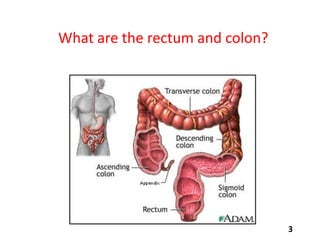
What are the rectum and colon?

3
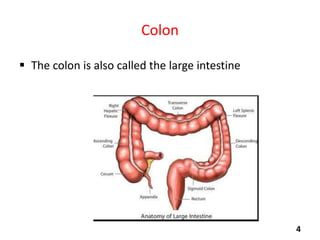
Colon
 The colon is also called the large intestine

4
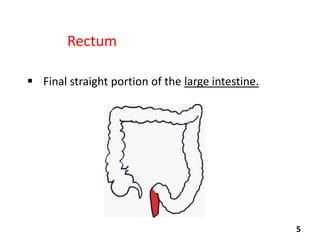
Rectum
 Final straight portion of the large intestine.

5
Why the Test is Performed
 Follow-up on colon cancer or polyps
 Look for the cause of:
• Abdominal pain, changes in bowel movements, or
weight loss
• anemia due to low iron
• Blood in the stool
• Screen for cancer of the colon

6
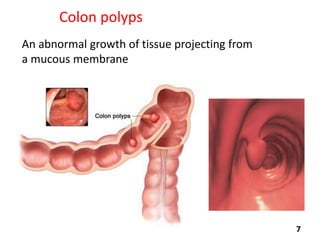
Colon polyps
An abnormal growth of tissue projecting from
a mucous membrane

7
How to Prepare for the Test

 Patient need to empty bowels before the exam
 patient will usually be asked to take laxatives or other
oral agents at home the day before the procedure to
clear stool from the colon.

8
How the Test is Performed

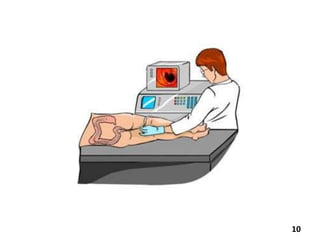
 Patient is asked to lie on his/her left side on a
narrow table that is connected to an MRI or CT
scan machine.
 knees will be up towards the chest.
 A small, flexible tube will be inserted into rectum.
 Air is pumped through the tube to make the colon
bigger and easier to see.
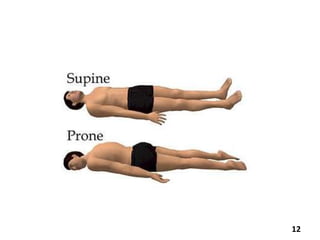
After this is done, patient will be asked to lie in
supine position.
9
10
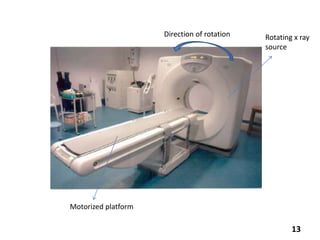
 The table moves through the scanner to produce
a series of two-dimensional cross-sections along
the length of the colon.
 A computer program puts these images together
to create a three-dimensional picture that can be
viewed on the video screen .
 patient is asked to hold his/her breath during the
scan to avoid distortion on the images.
 The scan is then repeated with the patient lying
in a prone position .
11
12
Direction of rotation

Rotating x ray
source

Motorized platform

13
Advantages
 Virtual colonoscopy is less invasive, safer, and
takes less time than a regular colonoscopy.
 A thin tube to insert air into the colon is placed
in the rectum rather than a long flexible tube
that is moved up your colon.
 Patients do not require anesthesia or sedation
and can return home on their own or get back to
work immediately after the test.
 VC provides clearer, more detailed images
14
Disadvantages
a radiologist cannot take tissue samples (biopsy) or
remove polyps during VC, so a
conventional colonoscopy must be performed if
abnormalities are found.
 may not show polyps smaller than 10 mm
 There is a slight risk that the CT scan can interfere
with implanted or external medical devices.


15
Risks
The risks of virtual colonoscopy include
 exposure to radiation and
 perforation—a hole or tear in the
lining of the colon.

16
Bibliography
 http://www.nlm.nih.gov/medlineplus/ency/ar
ticle/007253.htm
 http://digestive.niddk.nih.gov/ddiseases/pubs
/virtualcolonoscopy/
 http://en.wikipedia.org/wiki/Virtual_colonosc
opy

17
18

Virtual colonoscopy

  • 1.
  • 2.
    What is virtualcolonoscopy?        Medical imaging procedure. Also known as CT colonography. Non invasive procedure. uses x rays and computers. 2D and 3D images of rectum and entire colon. display them on a screen. can provide 3D reconstructed endoluminal views of the bowel. 2
  • 3.
    What are therectum and colon? 3
  • 4.
    Colon  The colonis also called the large intestine 4
  • 5.
    Rectum  Final straightportion of the large intestine. 5
  • 6.
    Why the Testis Performed  Follow-up on colon cancer or polyps  Look for the cause of: • Abdominal pain, changes in bowel movements, or weight loss • anemia due to low iron • Blood in the stool • Screen for cancer of the colon 6
  • 7.
    Colon polyps An abnormalgrowth of tissue projecting from a mucous membrane 7
  • 8.
    How to Preparefor the Test  Patient need to empty bowels before the exam  patient will usually be asked to take laxatives or other oral agents at home the day before the procedure to clear stool from the colon. 8
  • 9.
    How the Testis Performed  Patient is asked to lie on his/her left side on a narrow table that is connected to an MRI or CT scan machine.  knees will be up towards the chest.  A small, flexible tube will be inserted into rectum.  Air is pumped through the tube to make the colon bigger and easier to see. After this is done, patient will be asked to lie in supine position. 9
  • 10.
  • 11.
     The tablemoves through the scanner to produce a series of two-dimensional cross-sections along the length of the colon.  A computer program puts these images together to create a three-dimensional picture that can be viewed on the video screen .  patient is asked to hold his/her breath during the scan to avoid distortion on the images.  The scan is then repeated with the patient lying in a prone position . 11
  • 12.
  • 13.
    Direction of rotation Rotatingx ray source Motorized platform 13
  • 14.
    Advantages  Virtual colonoscopyis less invasive, safer, and takes less time than a regular colonoscopy.  A thin tube to insert air into the colon is placed in the rectum rather than a long flexible tube that is moved up your colon.  Patients do not require anesthesia or sedation and can return home on their own or get back to work immediately after the test.  VC provides clearer, more detailed images 14
  • 15.
    Disadvantages a radiologist cannottake tissue samples (biopsy) or remove polyps during VC, so a conventional colonoscopy must be performed if abnormalities are found.  may not show polyps smaller than 10 mm  There is a slight risk that the CT scan can interfere with implanted or external medical devices.  15
  • 16.
    Risks The risks ofvirtual colonoscopy include  exposure to radiation and  perforation—a hole or tear in the lining of the colon. 16
  • 17.
  • 18.