Non Cirrhotic Portal Fibrosis
Dr. Pratik Edwards
Anatomy and Physiology
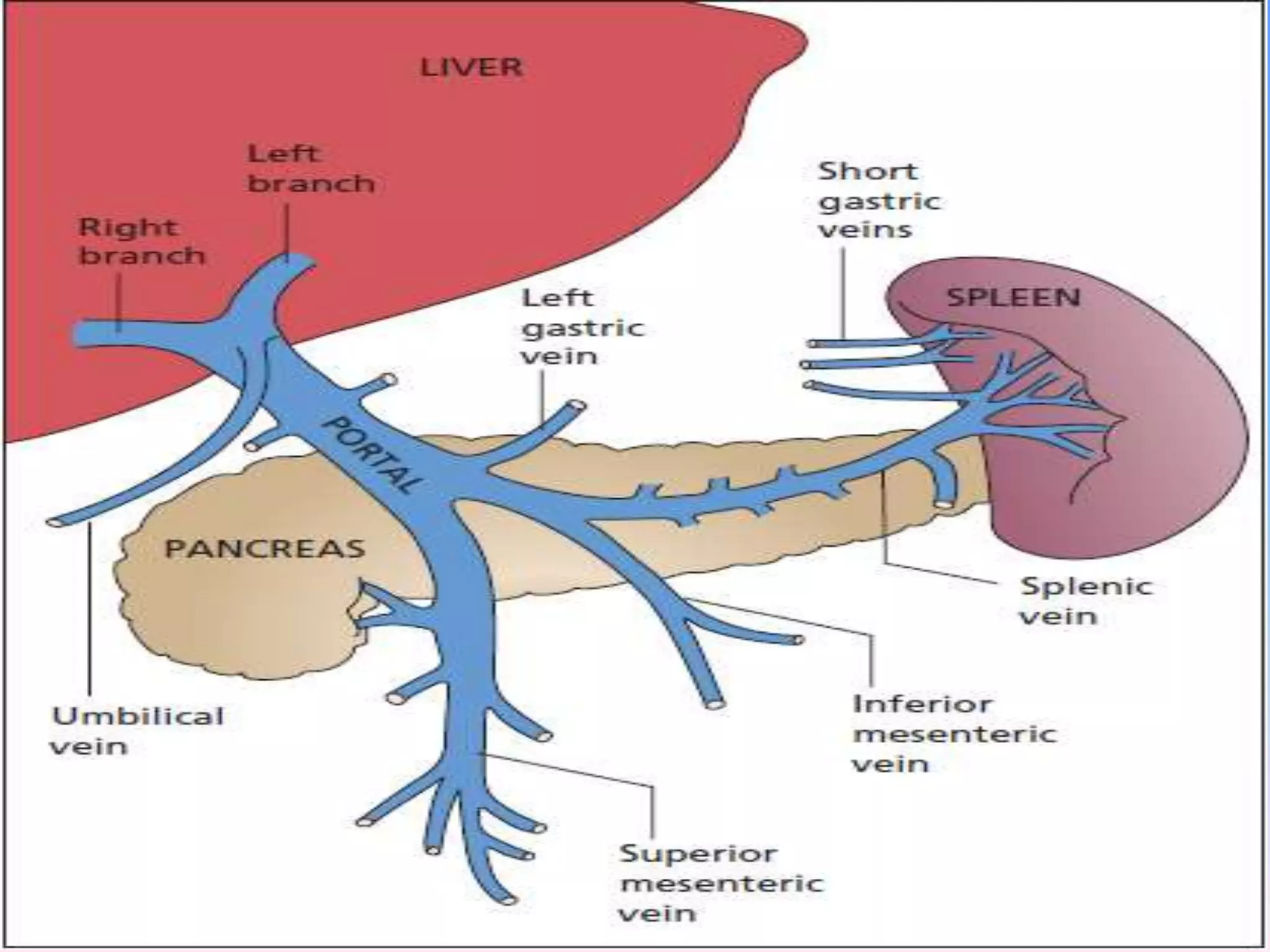
• The portal vein is formed by the union of the superior mesenteric
vein and the splenic vein just posterior to the head of the pancreas
at about the level of the second lumbar vertebra
• Enters the liver at the porta hepatis in two main branches, one to
each lobe; it is without valves in its larger channels
• Portal blood flow is about 1000–1200ml/min
• Contributes 40ml/min or 72% of the total oxygen supply to the liver
• Normal Portal pressure is about 7 – 10 mmHg
• Normal portal vein diameter is 1 cm
Non-cirrhotic portal fibrosis
• Syndrome of obscure etiology
• ‘Obliterative portovenopathy’ leading to PHT,
• Massive splenomegaly
• well-tolerated episodes of variceal bleeding
• In young adults,
• Low socioeconomic backgrounds
• Normal hepatic functions
Lesion in NCPF
•It is generally vascular.
•Location of lesion:
1. Branches of Portal vein
2. Perisinusoidal area of Liver
Epidemlology
• Reported worlwide, but maximum cases from india
• Male predominance of 2:1 to 4:1
• Age: Mainly a disease of young men
(25 – 35 years)
• Low socioeconomic background
Etiology
• Poorly understood
• Several Hypothesis are proposed:
1.Malntrition
2.Exposure to toxics and metals
3.Recuurent intestinal infections`
1. Infective hypothesis
Abdominal Infection
Portal pyaemia
Pylephlebitis
Thrombosis
Sclerosis
Obliteration of small and medium sized portal radicle
2. Exposure to trace metals and chemicals
Chronic exporure to :
Arsenic,
8 vinyl chloride monomer,
Coppersulfate
Methotrexate
hypervitaminosis A
6-mercaptopurine
azathiopine
corticosteroids
3. Immumological and Immunogenetic
hypoothesis
• Reduction in cytotoxic/ suppressor T - Lymphocytes
• Decreased T4/T8 lymphocyte ratio
• Reduction in cell mediated immunity
Pathology
• Liver may be normal or markedly nodular.
• Nodularity is confined to sub - capsular zone.
• Portal venous system shows prominent and dilated branches
with marked sclerosis the wall.
• Significant perivascular fibrosis along the portal vein and its
branches.
Gross pathology
Pathology
• Patchy and segmental sub endothelial thickening of the large
and medium sized intrahepatic branches of portal vein.
• Emergence of new aberrant portal channels is characteristic
of NCPF
Microscopy:
Clinical features
• Gastrointestinal bleed (one or more well tolerated episodes).
• Feeling of lump in left upper quadrant of abdomen (due to
enlargement of spleen).
• Left upper quadrant pain (due to perislenitis and splenic
infarction)
Symptoms
Clinical features
• Splenomegaly
(Size of spleen ranges from 4 – 15cms below left coastal
margin)
• Liver enlargement
(Palpable upto 2cms below coastal margin)
• Rarely – Jaundice, Ascites and Liver failure.
Signs
Laboratory features
• Anaemia (either microcytic hypochromic/
normocytic normochromic)
• Leukopenia
• Thrombocytopenia
• Bone marrow is hypercellular
• Mild compensated DIC(due to endotoxaemia or portosystemic
collaterals)
• LFT – normal/ mildly deranged.
Radiology
• Portal and splenic veins are dilated and multiple collateral
present at the splenic hilum.
• There is marked thickening of portal vein wall specially of
intraheptic branches.
• There may be spontaneous lieno renal shunt.
Ultrasonography
Radiology
• Dilatation of portal and splenic vein along with various
collaterals.
Spleno porto venography
Endoscopy
Esophagogastric varices
Anorectal varices
Differential diagnosis:
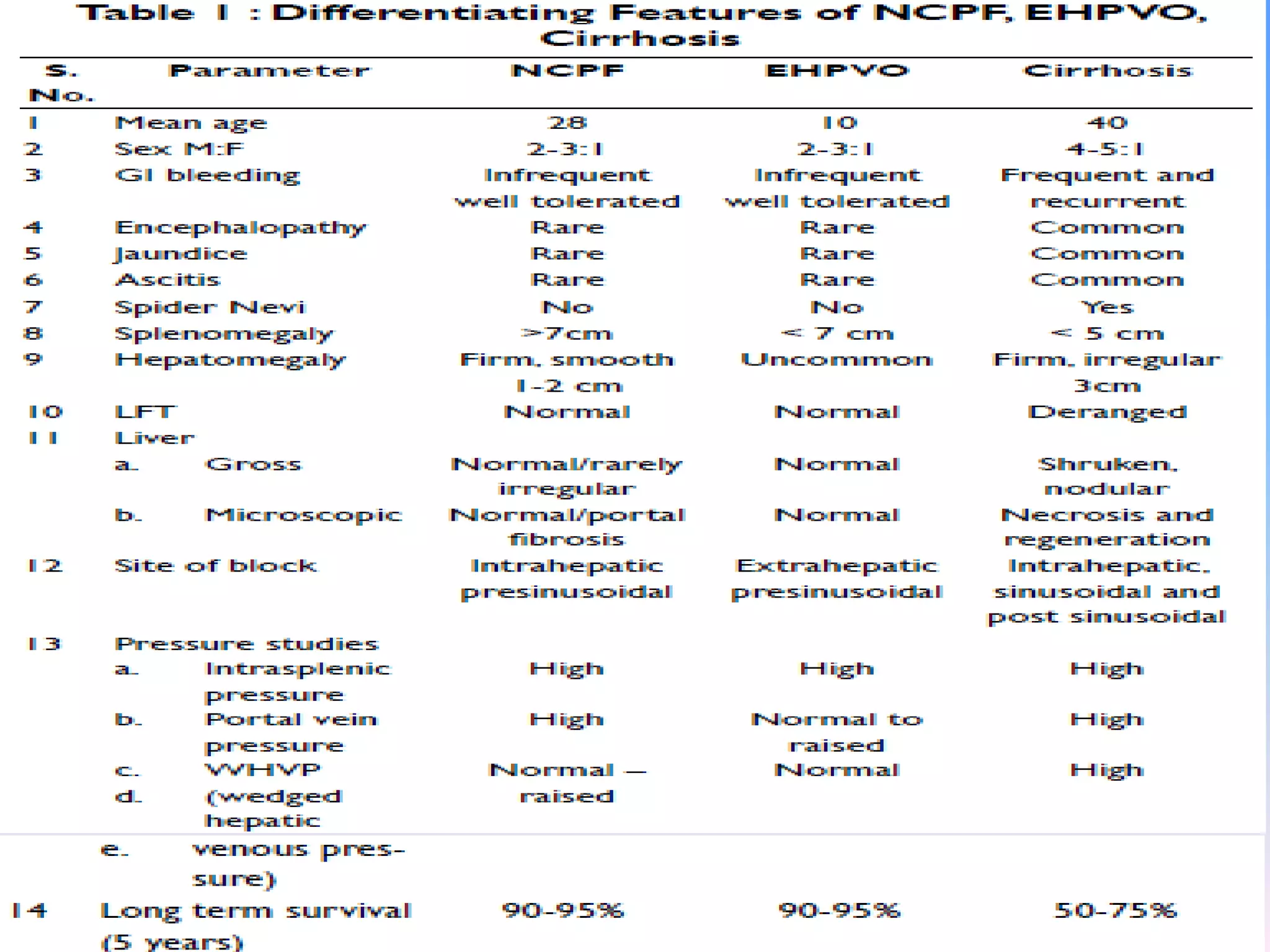
1. EHPVO (Extra hepatic portal vein obstruction)
2. Compensated cirrhosis in the young
3. Tropical splenomegaly syndrome
4. Splenomegaly of myeloid syndrome
5. Kala azar
6. Felty’s syndrome
Management
It involves control of acute bleeding (variceal bleeding) and
prevention of rebleeding by medical and surgical means.
Medical management:
1. Emergency treatment
2. Primary Prophylaxis
1. Emergency Mangement
• Initial resuscitation with replacement of blood volume loss is
done with blood transfusion and IV fluids
• Specific traement of bleeding lesion done
by:
a. Pharmacotherapy
b. Endoscopictherapy
c. Ballon tamponade
a. Pharmacotherapy : Drugs used are
Somatostatin,
octreotide
terlipressin
vasopressin : 0.1 – 0.5 u/min
b. Endoscopic therapy :
i. Endoscopic variceal ligation:
Banding device attached to the tip of the
endoscope is used to ligate varix using rubber
bands. One to three bands are applied to each varix
ii. Endoscopic sclerotherapy:
sclerosants used are 1.5% sodium tetradecyl
sulphate, cyanoacrylate, 5% ethanolamine oleate,
absolute alcohol, 3% phenol in water and
5% phenol in oil
c. Balloon tamponade: Used only in massive bleeding
as temporary measure.
2. Primary Prophylaxis
Used in patients with increased chances of bleeding such as
patients with large varices, red wale markings on varices and
severe liver failure.
It includes:
a. b– blockers
b. Vasodilators
c. Combined therapy
a. b – Blockers: Noncardioselective b blockers
like propanolol and nadolol are used.
These drugs act by reducing portal and
collateral blood flow.
Doses : -
Propranolol : 20 mg every 12 hours until
there is 25% reduction in resting heart rate
Nadolol: 10 mg every 12 hours
b. Vasodilators: Isosorbide mononitrate reduce portal
pressure gradient.
c. Combined therapy: Both b – blockers and Isosrbide
mononitrate are used.
Surgical Management
Indication for Surgery:
1. Failure of endoscopic therapy to control acute bleeding.
2. Recurrent bleeding.
3. Symptomatic hypersplenism.
4. Repeated splenic infection.
5. Patient who desires for one time treatment.
Surgery options are:
1. Porto – systemic shunt:
a. Total shunt: Portal blood is completely diverted to systemic
circulation.
Eg: -Central splenorenal shunt with splenectomy,
-Mesocaval shunt,
-Portocaval shunt.
b. Selective shunts: Decompresses the gastrosplenic- portal
zone with maintained portal perfusion
of the liver through hepato petal collateral.
Eg:- -Distal spleno renal shunt (Warren shunt),
-Distal spleno caval shunt,
-Gastroepiploic to left renal shunt,
-Left gastric vein to left renal vein shunt.
2. Devascularisation procedure:
Indications:
-failed shunt,
-patient who have no shuntable vein
-in emergency when shunt can not be
performed.
Eg: Sugiura deevascularization
• The prognosis of patients with NCPF is good
• 5 years survival in patients in whom variceal
bleeding can be controlled has been reported to be
approximately 95–100%.
• It is not merely absence of cirrhosis, but also of
hepatic venous outflow obstruction, such as veno-
occlusive disease and Budd–Chiari syndrome.
Non cirrhotic portal fibrosis

Non cirrhotic portal fibrosis

  • 1.
    Non Cirrhotic PortalFibrosis Dr. Pratik Edwards
  • 3.
    Anatomy and Physiology •The portal vein is formed by the union of the superior mesenteric vein and the splenic vein just posterior to the head of the pancreas at about the level of the second lumbar vertebra • Enters the liver at the porta hepatis in two main branches, one to each lobe; it is without valves in its larger channels • Portal blood flow is about 1000–1200ml/min • Contributes 40ml/min or 72% of the total oxygen supply to the liver • Normal Portal pressure is about 7 – 10 mmHg • Normal portal vein diameter is 1 cm
  • 4.
    Non-cirrhotic portal fibrosis •Syndrome of obscure etiology • ‘Obliterative portovenopathy’ leading to PHT, • Massive splenomegaly • well-tolerated episodes of variceal bleeding • In young adults, • Low socioeconomic backgrounds • Normal hepatic functions
  • 5.
    Lesion in NCPF •Itis generally vascular. •Location of lesion: 1. Branches of Portal vein 2. Perisinusoidal area of Liver
  • 6.
    Epidemlology • Reported worlwide,but maximum cases from india • Male predominance of 2:1 to 4:1 • Age: Mainly a disease of young men (25 – 35 years) • Low socioeconomic background
  • 7.
    Etiology • Poorly understood •Several Hypothesis are proposed: 1.Malntrition 2.Exposure to toxics and metals 3.Recuurent intestinal infections`
  • 8.
    1. Infective hypothesis AbdominalInfection Portal pyaemia Pylephlebitis Thrombosis Sclerosis Obliteration of small and medium sized portal radicle
  • 9.
    2. Exposure totrace metals and chemicals Chronic exporure to : Arsenic, 8 vinyl chloride monomer, Coppersulfate Methotrexate hypervitaminosis A 6-mercaptopurine azathiopine corticosteroids
  • 10.
    3. Immumological andImmunogenetic hypoothesis • Reduction in cytotoxic/ suppressor T - Lymphocytes • Decreased T4/T8 lymphocyte ratio • Reduction in cell mediated immunity
  • 12.
    Pathology • Liver maybe normal or markedly nodular. • Nodularity is confined to sub - capsular zone. • Portal venous system shows prominent and dilated branches with marked sclerosis the wall. • Significant perivascular fibrosis along the portal vein and its branches. Gross pathology
  • 13.
    Pathology • Patchy andsegmental sub endothelial thickening of the large and medium sized intrahepatic branches of portal vein. • Emergence of new aberrant portal channels is characteristic of NCPF Microscopy:
  • 14.
    Clinical features • Gastrointestinalbleed (one or more well tolerated episodes). • Feeling of lump in left upper quadrant of abdomen (due to enlargement of spleen). • Left upper quadrant pain (due to perislenitis and splenic infarction) Symptoms
  • 15.
    Clinical features • Splenomegaly (Sizeof spleen ranges from 4 – 15cms below left coastal margin) • Liver enlargement (Palpable upto 2cms below coastal margin) • Rarely – Jaundice, Ascites and Liver failure. Signs
  • 16.
    Laboratory features • Anaemia(either microcytic hypochromic/ normocytic normochromic) • Leukopenia • Thrombocytopenia • Bone marrow is hypercellular • Mild compensated DIC(due to endotoxaemia or portosystemic collaterals) • LFT – normal/ mildly deranged.
  • 17.
    Radiology • Portal andsplenic veins are dilated and multiple collateral present at the splenic hilum. • There is marked thickening of portal vein wall specially of intraheptic branches. • There may be spontaneous lieno renal shunt. Ultrasonography
  • 18.
    Radiology • Dilatation ofportal and splenic vein along with various collaterals. Spleno porto venography Endoscopy Esophagogastric varices Anorectal varices
  • 19.
    Differential diagnosis: 1. EHPVO(Extra hepatic portal vein obstruction) 2. Compensated cirrhosis in the young 3. Tropical splenomegaly syndrome 4. Splenomegaly of myeloid syndrome 5. Kala azar 6. Felty’s syndrome
  • 21.
    Management It involves controlof acute bleeding (variceal bleeding) and prevention of rebleeding by medical and surgical means. Medical management: 1. Emergency treatment 2. Primary Prophylaxis
  • 22.
    1. Emergency Mangement •Initial resuscitation with replacement of blood volume loss is done with blood transfusion and IV fluids • Specific traement of bleeding lesion done by: a. Pharmacotherapy b. Endoscopictherapy c. Ballon tamponade
  • 23.
    a. Pharmacotherapy :Drugs used are Somatostatin, octreotide terlipressin vasopressin : 0.1 – 0.5 u/min b. Endoscopic therapy : i. Endoscopic variceal ligation: Banding device attached to the tip of the endoscope is used to ligate varix using rubber bands. One to three bands are applied to each varix ii. Endoscopic sclerotherapy: sclerosants used are 1.5% sodium tetradecyl sulphate, cyanoacrylate, 5% ethanolamine oleate, absolute alcohol, 3% phenol in water and 5% phenol in oil c. Balloon tamponade: Used only in massive bleeding as temporary measure.
  • 24.
    2. Primary Prophylaxis Usedin patients with increased chances of bleeding such as patients with large varices, red wale markings on varices and severe liver failure. It includes: a. b– blockers b. Vasodilators c. Combined therapy
  • 25.
    a. b –Blockers: Noncardioselective b blockers like propanolol and nadolol are used. These drugs act by reducing portal and collateral blood flow. Doses : - Propranolol : 20 mg every 12 hours until there is 25% reduction in resting heart rate Nadolol: 10 mg every 12 hours b. Vasodilators: Isosorbide mononitrate reduce portal pressure gradient. c. Combined therapy: Both b – blockers and Isosrbide mononitrate are used.
  • 26.
    Surgical Management Indication forSurgery: 1. Failure of endoscopic therapy to control acute bleeding. 2. Recurrent bleeding. 3. Symptomatic hypersplenism. 4. Repeated splenic infection. 5. Patient who desires for one time treatment.
  • 27.
    Surgery options are: 1.Porto – systemic shunt: a. Total shunt: Portal blood is completely diverted to systemic circulation. Eg: -Central splenorenal shunt with splenectomy, -Mesocaval shunt, -Portocaval shunt. b. Selective shunts: Decompresses the gastrosplenic- portal zone with maintained portal perfusion of the liver through hepato petal collateral. Eg:- -Distal spleno renal shunt (Warren shunt), -Distal spleno caval shunt, -Gastroepiploic to left renal shunt, -Left gastric vein to left renal vein shunt.
  • 28.
    2. Devascularisation procedure: Indications: -failedshunt, -patient who have no shuntable vein -in emergency when shunt can not be performed. Eg: Sugiura deevascularization
  • 29.
    • The prognosisof patients with NCPF is good • 5 years survival in patients in whom variceal bleeding can be controlled has been reported to be approximately 95–100%. • It is not merely absence of cirrhosis, but also of hepatic venous outflow obstruction, such as veno- occlusive disease and Budd–Chiari syndrome.