ANOOPA.B
BSc MIT INTERN
KSHEMA
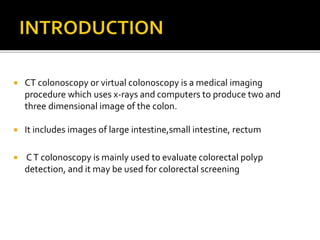
 CT colonoscopy or virtual colonoscopy is a medical imaging
procedure which uses x-rays and computers to produce two and
three dimensional image of the colon.
 It includes images of large intestine,small intestine, rectum
 CT colonoscopy is mainly used to evaluate colorectal polyp
detection, and it may be used for colorectal screening
 Screening for polyps
 Incomplete colonoscopy
 Colorectal cancer
 Pregnancy
 Presence of barium in the bowel
 Information about the procedure
 Instruct the patient to remove all the metallic objects from
the part of interest
 The patient will usually be asked to take laxatives or other
oral agents at home the day before the procedure
.
 The patient is placed in a supine position on the examination
table.
 A thin tube is inserted into the rectum , so the air can be
pumped through the tube in order to inflate the colon for
better viewing
 The table moves through the scanner to produce a series of
two dimensional cross sections along the length of the colon.
 A computer program puts these images together to create a
three-dimensional pictures that can be viewed on the video
screen.
 The patient is asked to hold his/her breath during the scan to
avoid distortion on the images
 The scan is then repeated with the patient lying in a prone
position.
 After the examination , the images produced by the scanner
must be processed in to a 3d images.
 The patient may resume normal activity after the procedure.
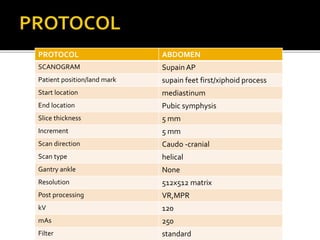
PROTOCOL ABDOMEN
SCANOGRAM Supain AP
Patient position/land mark supain feet first/xiphoid process
Start location mediastinum
End location Pubic symphysis
Slice thickness 5 mm
Increment 5 mm
Scan direction Caudo -cranial
Scan type helical
Gantry ankle None
Resolution 512x512 matrix
Post processing VR,MPR
kV 120
mAs 250
Filter standard
 MOV_0263.mp4
 Three dimensional navigator
 3D colon
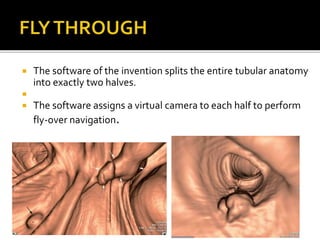
 Fly through

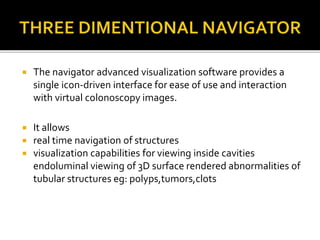
 The navigator advanced visualization software provides a
single icon-driven interface for ease of use and interaction
with virtual colonoscopy images.
 It allows
 real time navigation of structures
 visualization capabilities for viewing inside cavities
endoluminal viewing of 3D surface rendered abnormalities of
tubular structures eg: polyps,tumors,clots
 It is intuitive and is intended to provide image visualization
of the colon for masses, cancers, polyps and other lesion and
allows the user to perform 3D measurements, real time
volume rendering.
 No complications
 No such post procedure care for virtual colonoscopy
 VC is more comfortable than conventional colonoscopy for some
people it does not use a colonoscope.
 No sedation is needed, and the patient can return to his/her usual
activities or go home after the procedure with of the aid of any
other person.
 The lack of sedation also lowers the risk of the procedure since
some people may have adverse reactions to sedative medications
used during conventional colonoscopy.
 VC provides clearer, more detailed images than the conventional
method
 VC takes less time than the conventional colonoscopy
 VC provides a secondary benefit of revealing disease or
abnormalities outside the colon.
 The main disadvantage ofVC is that a radiologist cannot take tissue
samples(biopsy)or remove polyps duringVC , so a conventional
colonoscopy must be performed if abnormalities are found.
 AlsoVC does not show as much detail as a conventional
colonoscopy , so polyps smaller than between 2 and 10 mm in
diameter may not show up on the images.
THANK YOU

CT COLONOSCOPY

  • 1.
  • 2.
     CT colonoscopyor virtual colonoscopy is a medical imaging procedure which uses x-rays and computers to produce two and three dimensional image of the colon.  It includes images of large intestine,small intestine, rectum  CT colonoscopy is mainly used to evaluate colorectal polyp detection, and it may be used for colorectal screening
  • 5.
     Screening forpolyps  Incomplete colonoscopy  Colorectal cancer
  • 6.
     Pregnancy  Presenceof barium in the bowel
  • 7.
     Information aboutthe procedure  Instruct the patient to remove all the metallic objects from the part of interest  The patient will usually be asked to take laxatives or other oral agents at home the day before the procedure .
  • 8.
     The patientis placed in a supine position on the examination table.  A thin tube is inserted into the rectum , so the air can be pumped through the tube in order to inflate the colon for better viewing
  • 9.
     The tablemoves through the scanner to produce a series of two dimensional cross sections along the length of the colon.  A computer program puts these images together to create a three-dimensional pictures that can be viewed on the video screen.  The patient is asked to hold his/her breath during the scan to avoid distortion on the images
  • 10.
     The scanis then repeated with the patient lying in a prone position.  After the examination , the images produced by the scanner must be processed in to a 3d images.  The patient may resume normal activity after the procedure.
  • 11.
    PROTOCOL ABDOMEN SCANOGRAM SupainAP Patient position/land mark supain feet first/xiphoid process Start location mediastinum End location Pubic symphysis Slice thickness 5 mm Increment 5 mm Scan direction Caudo -cranial Scan type helical Gantry ankle None Resolution 512x512 matrix Post processing VR,MPR kV 120 mAs 250 Filter standard
  • 12.
  • 13.
     Three dimensionalnavigator  3D colon  Fly through 
  • 14.
     The navigatoradvanced visualization software provides a single icon-driven interface for ease of use and interaction with virtual colonoscopy images.  It allows  real time navigation of structures  visualization capabilities for viewing inside cavities endoluminal viewing of 3D surface rendered abnormalities of tubular structures eg: polyps,tumors,clots
  • 15.
     It isintuitive and is intended to provide image visualization of the colon for masses, cancers, polyps and other lesion and allows the user to perform 3D measurements, real time volume rendering.
  • 19.
  • 20.
     No suchpost procedure care for virtual colonoscopy
  • 21.
     VC ismore comfortable than conventional colonoscopy for some people it does not use a colonoscope.  No sedation is needed, and the patient can return to his/her usual activities or go home after the procedure with of the aid of any other person.  The lack of sedation also lowers the risk of the procedure since some people may have adverse reactions to sedative medications used during conventional colonoscopy.  VC provides clearer, more detailed images than the conventional method
  • 22.
     VC takesless time than the conventional colonoscopy  VC provides a secondary benefit of revealing disease or abnormalities outside the colon.
  • 23.
     The maindisadvantage ofVC is that a radiologist cannot take tissue samples(biopsy)or remove polyps duringVC , so a conventional colonoscopy must be performed if abnormalities are found.  AlsoVC does not show as much detail as a conventional colonoscopy , so polyps smaller than between 2 and 10 mm in diameter may not show up on the images.
  • 24.