ANESTHETIC EQUIPMENT Chapter 4  VAAA  pp. 165-215
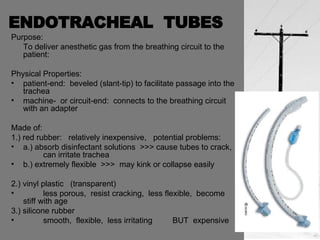
ENDOTRACHEAL  TUBES Purpose: To deliver anesthetic gas from the breathing circuit to the patient: Physical Properties: patient-end:  beveled (slant-tip) to facilitate passage into the trachea machine-  or circuit-end:  connects to the breathing circuit with an adapter Made of: 1.) red rubber:  relatively inexpensive,  potential problems: a.) absorb disinfectant solutions  >>> cause tubes to crack,  can irritate trachea b.) extremely flexible  >>>  may kink or collapse easily  2.) vinyl plastic  (transparent) less porous,  resist cracking,  less flexible,  become  stiff with age 3.) silicone rubber smooth,  flexible,  less irritating  BUT  expensive
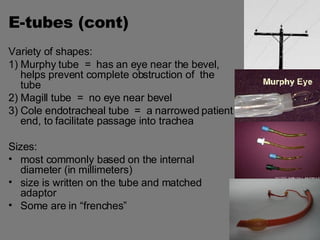
E-tubes (cont) Variety of shapes: 1) Murphy tube  =  has an eye near the bevel,  helps prevent complete obstruction of  the tube 2) Magill tube  =  no eye near bevel 3) Cole endotracheal tube  =  a narrowed patient end, to facilitate passage into trachea Sizes:  most commonly based on the internal diameter (in millimeters) size is written on the tube and matched adaptor Some are in โ€œfrenchesโ€
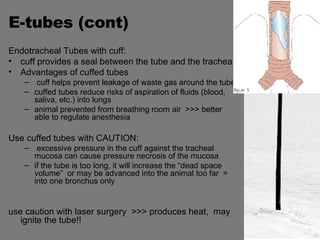
E-tubes (cont) Endotracheal Tubes with cuff: cuff provides a seal between the tube and the trachea Advantages of cuffed tubes cuff helps prevent leakage of waste gas around the tube cuffed tubes reduce risks of aspiration of fluids (blood, saliva, etc.) into lungs animal prevented from breathing room air  >>> better able to regulate anesthesia Use cuffed tubes with CAUTION: excessive pressure in the cuff against the tracheal mucosa can cause pressure necrosis of the mucosa  if the tube is too long, it will increase the โ€œdead space volumeโ€  or may be advanced into the animal too far  =  into one bronchus only use caution with laser surgery  >>> produces heat,  may ignite the tube!!
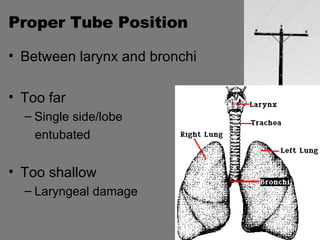
Proper Tube Position Between larynx and bronchi Too far Single side/lobe  entubated Too shallow Laryngeal damage
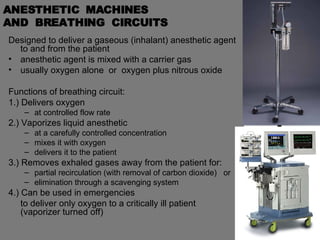
ANESTHETIC  MACHINES  AND  BREATHING  CIRCUITS Designed to deliver a gaseous (inhalant) anesthetic agent to and from the patient anesthetic agent is mixed with a carrier gas  usually oxygen alone  or  oxygen plus nitrous oxide Functions of breathing circuit: 1.) Delivers oxygen  at controlled flow rate 2.) Vaporizes liquid anesthetic  at a carefully controlled concentration mixes it with oxygen delivers it to the patient 3.) Removes exhaled gases away from the patient for:  partial recirculation (with removal of carbon dioxide)  or elimination through a scavenging system 4.) Can be used in emergencies to deliver only oxygen to a critically ill patient  (vaporizer turned off)
COMPONENTS  OF  THE ANESTHETIC  DELIVERY  SYSTEM  When confused โ€œfollow the flowโ€ trace O2 through system Three major components of system: compressed gas supply anesthetic machine breathing circuit
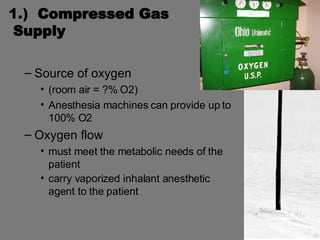
1.)  Compressed Gas  Supply Source of oxygen  (room air = ?% O2) Anesthesia machines can provide up to  100% O2 Oxygen flow  must meet the metabolic needs of the patient carry vaporized inhalant anesthetic agent to the patient
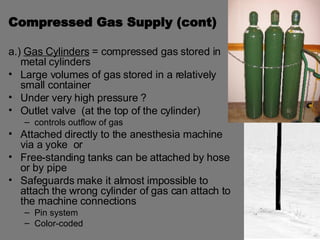
Compressed Gas Supply (cont) a.)  Gas Cylinders  = compressed gas stored in metal cylinders  Large volumes of gas stored in a relatively small container Under very high pressure ? Outlet valve  (at the top of the cylinder)  controls outflow of gas Attached directly to the anesthesia machine via a yoke  or Free-standing tanks can be attached by hose or by pipe Safeguards make it almost impossible to attach the wrong cylinder of gas can attach to the machine connections Pin system  Color-coded
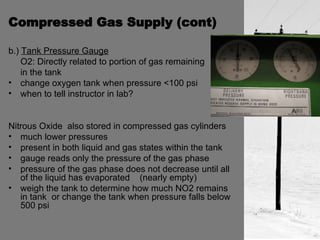
Compressed Gas Supply (cont) b.)  Tank Pressure Gauge   O2: Directly related to portion of gas remaining  in the tank change oxygen tank when pressure <100 psi when to tell instructor in lab? Nitrous Oxide  also stored in compressed gas cylinders much lower pressures present in both liquid and gas states within the tank gauge reads only the pressure of the gas phase pressure of the gas phase does not decrease until all of the liquid has evaporated  (nearly empty) weigh the tank to determine how much NO2 remains in tank  or change the tank when pressure falls below 500 psi
Compressed Gas Supply (cont) c.)  Pressure Reducing Valve   โ€œPressure regulatorโ€ reduces the pressure from ? to ? Provides a safe operating pressure and allowing a constant flow of gas to the anesthesia machine Works regardless of the pressure in the tank (as long as it is above ?)
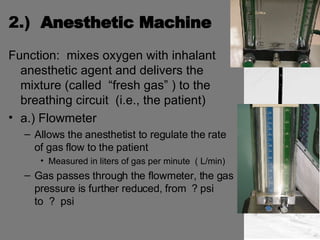
2.)  Anesthetic Machine Function:  mixes oxygen with inhalant anesthetic agent and delivers the mixture (called  โ€œfresh gasโ€ ) to the breathing circuit  (i.e., the patient) a.) Flowmeter Allows the anesthetist to regulate the rate of gas flow to the patient Measured in liters of gas per minute  ( L/min) Gas passes through the flowmeter, the gas pressure is further reduced, from  ? psi  to  ?  psi
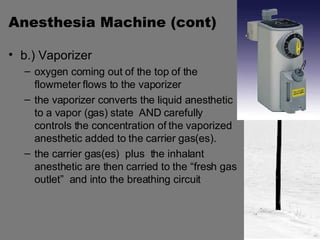
Anesthesia Machine (cont) b.) Vaporizer  oxygen coming out of the top of the flowmeter flows to the vaporizer the vaporizer converts the liquid anesthetic to a vapor (gas) state  AND carefully controls the concentration of the vaporized anesthetic added to the carrier gas(es). the carrier gas(es)  plus  the inhalant anesthetic are then carried to the โ€œfresh gas outletโ€  and into the breathing circuit
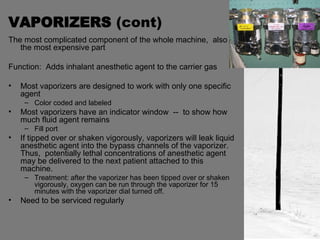
VAPORIZERS  (cont) The most complicated component of the whole machine,  also the most expensive part Function:  Adds inhalant anesthetic agent to the carrier gas Most vaporizers are designed to work with only one specific agent Color coded and labeled Most vaporizers have an indicator window  --  to show how much fluid agent remains Fill port If tipped over or shaken vigorously, vaporizers will leak liquid anesthetic agent into the bypass channels of the vaporizer.  Thus,  potentially lethal concentrations of anesthetic agent may be delivered to the next patient attached to this machine. Treatment: after the vaporizer has been tipped over or shaken vigorously, oxygen can be run through the vaporizer for 15 minutes with the vaporizer dial turned off. Need to be serviced regularly
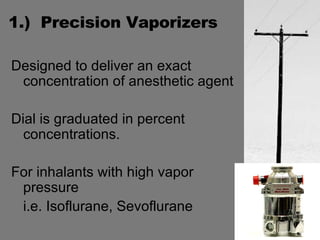
1.)  Precision Vaporizers  Designed to deliver an exact concentration of anesthetic agent Dial is graduated in percent concentrations. For inhalants with high vapor pressure i.e. Isoflurane, Sevoflurane
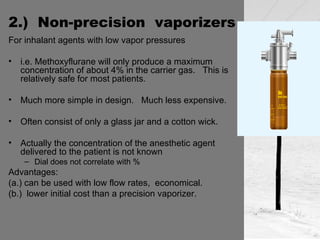
2.)  Non-precision  vaporizers For inhalant agents with low vapor pressures    i.e. Methoxyflurane will only produce a maximum concentration of about 4% in the carrier gas.  This is relatively safe for most patients. Much more simple in design.  Much less expensive. Often consist of only a glass jar and a cotton wick. Actually the concentration of the anesthetic agent delivered to the patient is not known Dial does not correlate with % Advantages:  (a.) can be used with low flow rates,  economical. (b.)  lower initial cost than a precision vaporizer.
VOC  versus  VIC VOC  =  โ€œvaporizer out of circuit,โ€   =  the vaporizer is not placed within the breathing circuit. Precision vaporizers are located out of the circuit  because they offer high resistance to the flow of gases. VIC  =  โ€œvaporizer in circuit,โ€   =  the vaporizer is within the breathing circuit;  the carrier gas(es) enter the circuit directly from the flowmeter;  recycled exhaled gases  pass through the vaporizer each time they flow through the circuit.  Non-precision vaporizers are usually placed within the circuit because they offer little resistance to the flow of gases through the circuit.
3 FACTORS  INFLUENCE  VAPORIZER  FUNCTION The concentration of inhalant anesthetic agent delivered by the anesthesia machine may be affected by several environmental factors: a.)  Temperature Volatile anesthetic agents vaporize more readily at higher temperatures. cold room versus one in a warm or hot room. Most precision vaporizers are  โ€œtemperature compensated,โ€   such that there is little variation in the output of anesthetic agent. Non-precision or older precision vaporizers are not temperature compensated compensation can be done manually, using a thermometer and a temperature adjustment scale.
FACTORS  THAT  MAY INFLUENCE  VAPORIZER  FUNCTION b.)  Carrier  Gas  Flow  Rate The volume of carrier gas that flows through the vaporizer may affect the efficiency of the vaporization of the agent.  Most modern precision vaporizers are โ€œ flow compensated โ€ designed to compensate for variations in carrier gas flow rates.  These vaporizers will vaporize the concentration of agent indicated on the vaporizer dial over a wide range of carrier gas flow rates. However, even for these vaporizers,  flow compensation is not unlimited.  Flows that are very high  (above 5 L/min)  or very low (below 500 ml/min) may affect the vaporizer output even in a flow compensated precision vaporizer.
FACTORS  THAT  INFLUENCE  VAPORIZER  FUNCTION c .)  Back Pressure Back pressure refers to an increase in pressure within the breathing circuit, which may cause gas from the breathing circuit to flow back into the vaporizer under pressure.  This may occur, for example, when an animal is โ€œbagged.โ€ Most precision vaporizers are โ€œ back pressure compensated โ€ to minimize this risk.
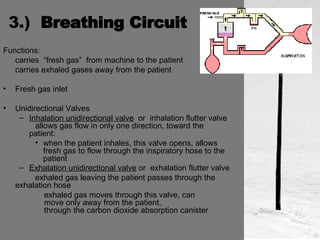
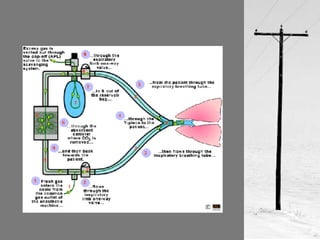
3.)  Breathing Circuit Functions:  carries  โ€œfresh gasโ€  from machine to the patient carries exhaled gases away from the patient Fresh gas inlet Unidirectional Valves Inhalation unidirectional valve   or  inhalation flutter valve  allows gas flow in only one direction, toward the patient: when the patient inhales, this valve opens, allows fresh gas to flow through the inspiratory hose to the patient Exhalation unidirectional valve  or  exhalation flutter valve   exhaled gas leaving the patient passes through the  exhalation hose   exhaled gas moves through this valve, can    move only away from the patient,    through the carbon dioxide absorption canister
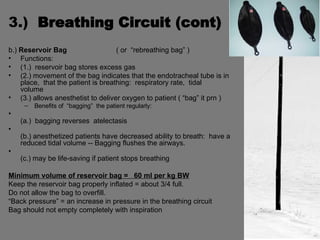
3.)  Breathing Circuit (cont) b.)  Reservoir Bag   ( or  โ€œrebreathing bagโ€ ) Functions: (1.)  reservoir bag stores excess gas (2.) movement of the bag indicates that the endotracheal tube is in  place,  that the patient is breathing:  respiratory rate,  tidal  volume (3.) allows anesthetist to deliver oxygen to patient ( โ€œbagโ€ it prn ) Benefits of  โ€œbaggingโ€  the patient regularly: (a.)  bagging reverses  atelectasis (b.) anesthetized patients have decreased ability to breath:  have a reduced tidal volume -- Bagging flushes the airways. (c.) may be life-saving if patient stops breathing Minimum volume of reservoir bag =  60 ml per kg BW Keep the reservoir bag properly inflated = about 3/4 full. Do not allow the bag to overfill. โ€œ Back pressureโ€ = an increase in pressure in the breathing circuit Bag should not empty completely with inspiration
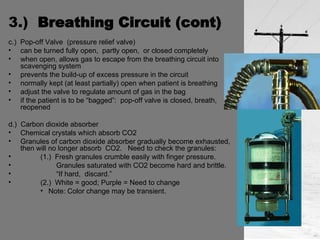
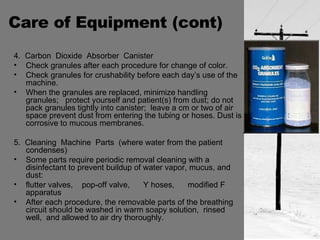
3.)  Breathing Circuit (cont) c.)  Pop-off Valve  (pressure relief valve) can be turned fully open,  partly open,  or closed completely when open, allows gas to escape from the breathing circuit into scavenging system prevents the build-up of excess pressure in the circuit normally kept (at least partially) open when patient is breathing  adjust the valve to regulate amount of gas in the bag if the patient is to be โ€œbaggedโ€:  pop-off valve is closed, breath, reopened d.)  Carbon dioxide absorber Chemical crystals which absorb CO2 Granules of carbon dioxide absorber gradually become exhausted,  then will no longer absorb  CO2.  Need to check the granules: (1.)  Fresh granules crumble easily with finger pressure.   Granules saturated with CO2 become hard and brittle.   โ€œ If hard,  discard.โ€ (2.)  White = good; Purple = Need to change Note: Color change may be transient.
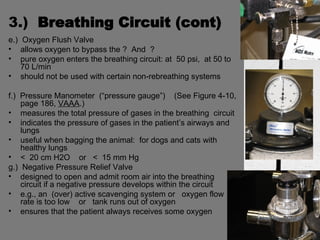
3.)  Breathing Circuit (cont) e.)  Oxygen Flush Valve allows oxygen to bypass the ?  And  ? pure oxygen enters the breathing circuit: at  50 psi,  at 50 to 70 L/min should not be used with certain non-rebreathing systems f.)  Pressure Manometer  (โ€œpressure gaugeโ€)  (See Figure 4-10, page 186,  VAAA .) measures the total pressure of gases in the breathing  circuit indicates the pressure of gases in the patientโ€™s airways and lungs useful when bagging the animal:  for dogs and cats with healthy lungs <  20 cm H2O  or  <  15 mm Hg g.)  Negative Pressure Relief Valve designed to open and admit room air into the breathing circuit if a negative pressure develops within the circuit e.g., an  (over) active scavenging system or  oxygen flow rate is too low  or  tank runs out of oxygen ensures that the patient always receives some oxygen
ย 
ย 
OPERATION  OF  THE  ANESTHETIC  MACHINE decisions,  decisions,  decisions !!!! A.  Choice  of  Breathing  Circuit   (three major choices)  (See Table 4-6, page 196,  VAAA.) The choice of a breathing circuit will determine the following: a.) where the exhaled gases go:  partially or totally recycled,  eliminated entirely b.) oxygen (and nitrous oxide)  flow rate(s) c.) status of the pop-off valve: open or closed d.) type of breathing circuit apparatus:  a Bain system, Y-Piece tubing, Modified Y, etc
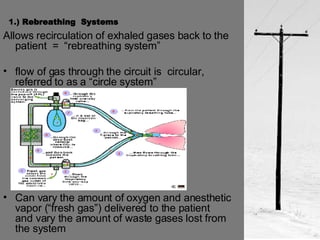
1.)  Rebreathing  Systems Allows recirculation of exhaled gases back to the patient  =  โ€œrebreathing systemโ€ flow of gas through the circuit is  circular,  referred to as a โ€œcircle systemโ€ Can vary the amount of oxygen and anesthetic vapor (โ€œfresh gasโ€) delivered to the patient  and vary the amount of waste gases lost from the system
a.)  Total  Rebreathing System  (aka  โ€œclosed systemsโ€) All  of the exhaled gases remain in the circuit and are recirculated oxygen flow rate is very low,  providing only enough oxygen to meet the metabolic needs of the patient only the volume of oxygen used by the patient is replaced through the oxygen flow meter  (about 10 ml of 100% O2/kg/minute ) the  pop-off valve is closed entirely very economical  =  low flow rates of oxygen and anesthetic agent Serious Risks of Total Rebreathing Systems: a.) accumulation of  CO2 >>> fully relying on an efficient  CO2 absorber b.) increased pressure in circuit  (โ€œback pressureโ€)  =  must  balance  O2 use by the patient with fresh gas input
b.)  Partial  Rebreathing  System  (aka  โ€œsemiclosed systemโ€) some volume of gases exhaled by the patient remain in the circuit  and are returned to the patient some volume of gases exhaled by the patient are eliminated through the pop-off valve into the scavenger system flow rate of fresh gas  (oxygen plus anesthetic vapors) is much higher than for the total rebreathing system pop-off valve is partially open,  allowing some exhaled gases to flow into the scavenging system
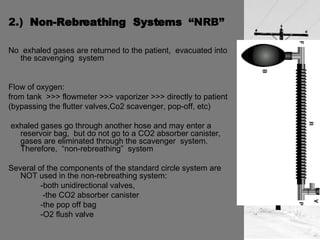
2.)  Non-Rebreathing  Systems  โ€œNRBโ€ No  exhaled gases are returned to the patient,  evacuated into the scavenging  system Flow of oxygen:  from tank  >>> flowmeter >>> vaporizer >>> directly to patient  (bypassing the flutter valves,Co2 scavenger, pop-off, etc) exhaled gases go through another hose and may enter a reservoir bag,  but do not go to a CO2 absorber canister,  gases are eliminated through the scavenger  system.  Therefore,  โ€œnon-rebreathingโ€  system Several of the components of the standard circle system are NOT used in the non-rebreathing system:  -both unidirectional valves,    -the CO2 absorber canister -the pop off bag -O2 flush valve
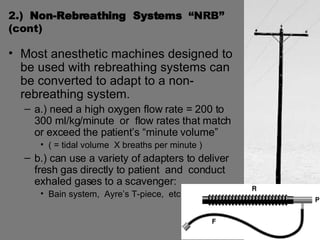
2.)  Non-Rebreathing  Systems  โ€œNRBโ€ (cont) Most anesthetic machines designed to be used with rebreathing systems can be converted to adapt to a non-rebreathing system. a.) need a high oxygen flow rate = 200 to 300 ml/kg/minute  or  flow rates that match or exceed the patientโ€™s โ€œminute volumeโ€  ( = tidal volume  X breaths per minute )  b.) can use a variety of adapters to deliver fresh gas directly to patient  and  conduct exhaled gases to a scavenger: Bain system,  Ayreโ€™s T-piece,  etc
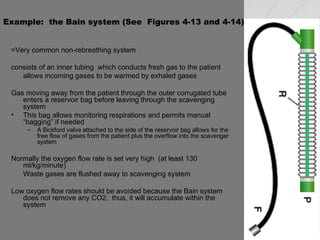
Example:  the Bain system (See  Figures 4-13 and 4-14) =Very common non-rebreathing system consists of an inner tubing  which conducts fresh gas to the patient allows incoming gases to be warmed by exhaled gases Gas moving away from the patient through the outer corrugated tube enters a reservoir bag before leaving through the scavenging system This bag allows monitoring respirations and permits manual โ€œbaggingโ€ if needed  A Bickford valve attached to the side of the reservoir bag allows for the free flow of gases from the patient plus the overflow into the scavenger system Normally the oxygen flow rate is set very high  (at least 130 ml/kg/minute) Waste gases are flushed away to scavenging system Low oxygen flow rates should be avoided because the Bain system does not remove any CO2;  thus, it will accumulate within the system
Criteria  for  Choice  of  Rebreathing  versus  Non-Rebreathing  System 1.)  Patient size  Non-rebreathing systems offer little resistance to the movement of gases.  Use a non-rebreathing system for patients weighing less than  7 kg  (15 lbs.) 2.)  Convenience  Non-rebreathing circuits are generally lighter,  cause less pull on  the endotracheal tube 3.)  Cost  Total rebreathing systems are the most economical;  non-rebreathing  systems are the most costly to use  --  considering costs of O2 and the anesthetic agent. 4.)  Control  =  ability to change the depth (planes) of anesthesia quickly rebreathing system>>>>relatively slow non-rebreathing system >>>> much faster
Choosing which system (cont) 5.)  Conservation of heat and moisture Fresh gas coming from a vaporizer is cool ( 16  C)  and dry  (near 0% humidity).  Rebreathing systems warm and humidify the gas in the circuit to the degree that the gases are recycled to the patient. With non-rebreathing systems, the warmed and humidified gases exhaled by the patient are lost through the scavenging system;  the patient breathes only  the dry, cool gas coming from the vaporizer,  producing significant heat and water losses. 6.)  Production of waste gases:  less  to  more volume produced total rebreathing >> partial rebreathing>> non-rebreathing
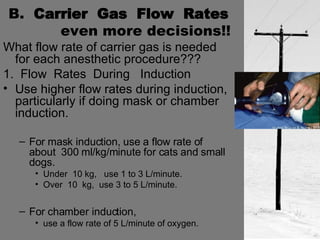
B.  Carrier  Gas  Flow  Rates  even more decisions!! What flow rate of carrier gas is needed for each anesthetic procedure??? 1.  Flow  Rates  During  Induction  Use higher flow rates during induction, particularly if doing mask or chamber induction.  For mask induction, use a flow rate of about  300 ml/kg/minute for cats and small dogs. Under  10 kg,  use 1 to 3 L/minute. Over  10  kg,  use 3 to 5 L/minute. For chamber induction,  use a flow rate of 5 L/minute of oxygen.
Carrier Flow Rates (cont) 2.  Flow  Rates  During  Maintenance Non-rebreathing systems,  use relatively high flow rates: >130 ml/kg/minute for a Bain circuit >200 ml/kg/minute for other circuits Partial rebreathing systems, use relatively low flow use  25 to 50 ml/kg/minute (typically 1-2L/min)
CARE  AND  USE  OF  ANESTHETIC  EQUIPMENT  Daily  Setup  each day before use, the anesthesia machine should be thoroughly checked for problems.  ( See protocol for lab. ) Ongoing  Maintenance  (periodic maintenance =proper performance) 1.  Oxygen  (and  Nitrous  Oxide)  Tanks After use,  turn off the outlet valve;  remove pressure  remaining in machine by draining  off oxygen via the oxygen  flush button. 2.  Oxygen  Flowmeter Turn the dial to off position;  do not overtighten. 3.  Vaporizer Before a procedure is begun,  fill the vaporizer. Turn off the vaporizer when it is not in use. These vaporizers need to be cleaned and recalibrated every one to two to three years depending on how much they are used. Signs of need of cleaning: dial movement feels sticky,  produces resistance anesthetic in vaporizer turns brown cannot maintain patient at surgical anesthetic plane even at high vaporizer settings
Care of Equipment (cont) 4.  Carbon  Dioxide  Absorber  Canister Check granules after each procedure for change of color. Check granules for crushability before each dayโ€™s use of the machine. When the granules are replaced, minimize handling granules;  protect yourself and patient(s) from dust; do not pack granules tightly into canister;  leave a cm or two of air space prevent dust from entering the tubing or hoses. Dust is corrosive to mucous membranes. 5.  Cleaning  Machine  Parts  (where water from the patient condenses) Some parts require periodic removal cleaning with a disinfectant to prevent buildup of water vapor, mucus, and dust: flutter valves,  pop-off valve,  Y hoses,  modified F apparatus  After each procedure, the removable parts of the breathing circuit should be washed in warm soapy solution,  rinsed well,  and allowed to air dry thoroughly.
Care of Equipment (cont) 6.  Disinfecting  Anesthetic  Equipment Equipment that contacts the patientโ€™s airway or oral cavity requires thorough disinfection. 7.  Cleaning  Endotracheal  Tubes No ideal agent for disinfection:  chlorhexidine  =  harmless to tissues,  but does not kill all  microorganisms and spores. All items exposed to disinfectants must be thoroughly rinsed with water and dried before use. Eventually such items deteriorate and must be replaced.
ย 

Vets 238 Anesthetic Equipment Final

  • 1.
    ANESTHETIC EQUIPMENT Chapter4 VAAA pp. 165-215
  • 2.
    ENDOTRACHEAL TUBESPurpose: To deliver anesthetic gas from the breathing circuit to the patient: Physical Properties: patient-end: beveled (slant-tip) to facilitate passage into the trachea machine- or circuit-end: connects to the breathing circuit with an adapter Made of: 1.) red rubber: relatively inexpensive, potential problems: a.) absorb disinfectant solutions >>> cause tubes to crack, can irritate trachea b.) extremely flexible >>> may kink or collapse easily 2.) vinyl plastic (transparent) less porous, resist cracking, less flexible, become stiff with age 3.) silicone rubber smooth, flexible, less irritating BUT expensive
  • 3.
    E-tubes (cont) Varietyof shapes: 1) Murphy tube = has an eye near the bevel, helps prevent complete obstruction of the tube 2) Magill tube = no eye near bevel 3) Cole endotracheal tube = a narrowed patient end, to facilitate passage into trachea Sizes: most commonly based on the internal diameter (in millimeters) size is written on the tube and matched adaptor Some are in โ€œfrenchesโ€
  • 4.
    E-tubes (cont) EndotrachealTubes with cuff: cuff provides a seal between the tube and the trachea Advantages of cuffed tubes cuff helps prevent leakage of waste gas around the tube cuffed tubes reduce risks of aspiration of fluids (blood, saliva, etc.) into lungs animal prevented from breathing room air >>> better able to regulate anesthesia Use cuffed tubes with CAUTION: excessive pressure in the cuff against the tracheal mucosa can cause pressure necrosis of the mucosa if the tube is too long, it will increase the โ€œdead space volumeโ€ or may be advanced into the animal too far = into one bronchus only use caution with laser surgery >>> produces heat, may ignite the tube!!
  • 5.
    Proper Tube PositionBetween larynx and bronchi Too far Single side/lobe entubated Too shallow Laryngeal damage
  • 6.
    ANESTHETIC MACHINES AND BREATHING CIRCUITS Designed to deliver a gaseous (inhalant) anesthetic agent to and from the patient anesthetic agent is mixed with a carrier gas usually oxygen alone or oxygen plus nitrous oxide Functions of breathing circuit: 1.) Delivers oxygen at controlled flow rate 2.) Vaporizes liquid anesthetic at a carefully controlled concentration mixes it with oxygen delivers it to the patient 3.) Removes exhaled gases away from the patient for: partial recirculation (with removal of carbon dioxide) or elimination through a scavenging system 4.) Can be used in emergencies to deliver only oxygen to a critically ill patient (vaporizer turned off)
  • 7.
    COMPONENTS OF THE ANESTHETIC DELIVERY SYSTEM When confused โ€œfollow the flowโ€ trace O2 through system Three major components of system: compressed gas supply anesthetic machine breathing circuit
  • 8.
    1.) CompressedGas Supply Source of oxygen (room air = ?% O2) Anesthesia machines can provide up to 100% O2 Oxygen flow must meet the metabolic needs of the patient carry vaporized inhalant anesthetic agent to the patient
  • 9.
    Compressed Gas Supply(cont) a.) Gas Cylinders = compressed gas stored in metal cylinders Large volumes of gas stored in a relatively small container Under very high pressure ? Outlet valve (at the top of the cylinder) controls outflow of gas Attached directly to the anesthesia machine via a yoke or Free-standing tanks can be attached by hose or by pipe Safeguards make it almost impossible to attach the wrong cylinder of gas can attach to the machine connections Pin system Color-coded
  • 10.
    Compressed Gas Supply(cont) b.) Tank Pressure Gauge O2: Directly related to portion of gas remaining in the tank change oxygen tank when pressure <100 psi when to tell instructor in lab? Nitrous Oxide also stored in compressed gas cylinders much lower pressures present in both liquid and gas states within the tank gauge reads only the pressure of the gas phase pressure of the gas phase does not decrease until all of the liquid has evaporated (nearly empty) weigh the tank to determine how much NO2 remains in tank or change the tank when pressure falls below 500 psi
  • 11.
    Compressed Gas Supply(cont) c.) Pressure Reducing Valve โ€œPressure regulatorโ€ reduces the pressure from ? to ? Provides a safe operating pressure and allowing a constant flow of gas to the anesthesia machine Works regardless of the pressure in the tank (as long as it is above ?)
  • 12.
    2.) AnestheticMachine Function: mixes oxygen with inhalant anesthetic agent and delivers the mixture (called โ€œfresh gasโ€ ) to the breathing circuit (i.e., the patient) a.) Flowmeter Allows the anesthetist to regulate the rate of gas flow to the patient Measured in liters of gas per minute ( L/min) Gas passes through the flowmeter, the gas pressure is further reduced, from ? psi to ? psi
  • 13.
    Anesthesia Machine (cont)b.) Vaporizer oxygen coming out of the top of the flowmeter flows to the vaporizer the vaporizer converts the liquid anesthetic to a vapor (gas) state AND carefully controls the concentration of the vaporized anesthetic added to the carrier gas(es). the carrier gas(es) plus the inhalant anesthetic are then carried to the โ€œfresh gas outletโ€ and into the breathing circuit
  • 14.
    VAPORIZERS (cont)The most complicated component of the whole machine, also the most expensive part Function: Adds inhalant anesthetic agent to the carrier gas Most vaporizers are designed to work with only one specific agent Color coded and labeled Most vaporizers have an indicator window -- to show how much fluid agent remains Fill port If tipped over or shaken vigorously, vaporizers will leak liquid anesthetic agent into the bypass channels of the vaporizer. Thus, potentially lethal concentrations of anesthetic agent may be delivered to the next patient attached to this machine. Treatment: after the vaporizer has been tipped over or shaken vigorously, oxygen can be run through the vaporizer for 15 minutes with the vaporizer dial turned off. Need to be serviced regularly
  • 15.
    1.) PrecisionVaporizers Designed to deliver an exact concentration of anesthetic agent Dial is graduated in percent concentrations. For inhalants with high vapor pressure i.e. Isoflurane, Sevoflurane
  • 16.
    2.) Non-precision vaporizers For inhalant agents with low vapor pressures i.e. Methoxyflurane will only produce a maximum concentration of about 4% in the carrier gas. This is relatively safe for most patients. Much more simple in design. Much less expensive. Often consist of only a glass jar and a cotton wick. Actually the concentration of the anesthetic agent delivered to the patient is not known Dial does not correlate with % Advantages: (a.) can be used with low flow rates, economical. (b.) lower initial cost than a precision vaporizer.
  • 17.
    VOC versus VIC VOC = โ€œvaporizer out of circuit,โ€ = the vaporizer is not placed within the breathing circuit. Precision vaporizers are located out of the circuit because they offer high resistance to the flow of gases. VIC = โ€œvaporizer in circuit,โ€ = the vaporizer is within the breathing circuit; the carrier gas(es) enter the circuit directly from the flowmeter; recycled exhaled gases pass through the vaporizer each time they flow through the circuit. Non-precision vaporizers are usually placed within the circuit because they offer little resistance to the flow of gases through the circuit.
  • 18.
    3 FACTORS INFLUENCE VAPORIZER FUNCTION The concentration of inhalant anesthetic agent delivered by the anesthesia machine may be affected by several environmental factors: a.) Temperature Volatile anesthetic agents vaporize more readily at higher temperatures. cold room versus one in a warm or hot room. Most precision vaporizers are โ€œtemperature compensated,โ€ such that there is little variation in the output of anesthetic agent. Non-precision or older precision vaporizers are not temperature compensated compensation can be done manually, using a thermometer and a temperature adjustment scale.
  • 19.
    FACTORS THAT MAY INFLUENCE VAPORIZER FUNCTION b.) Carrier Gas Flow Rate The volume of carrier gas that flows through the vaporizer may affect the efficiency of the vaporization of the agent. Most modern precision vaporizers are โ€œ flow compensated โ€ designed to compensate for variations in carrier gas flow rates. These vaporizers will vaporize the concentration of agent indicated on the vaporizer dial over a wide range of carrier gas flow rates. However, even for these vaporizers, flow compensation is not unlimited. Flows that are very high (above 5 L/min) or very low (below 500 ml/min) may affect the vaporizer output even in a flow compensated precision vaporizer.
  • 20.
    FACTORS THAT INFLUENCE VAPORIZER FUNCTION c .) Back Pressure Back pressure refers to an increase in pressure within the breathing circuit, which may cause gas from the breathing circuit to flow back into the vaporizer under pressure. This may occur, for example, when an animal is โ€œbagged.โ€ Most precision vaporizers are โ€œ back pressure compensated โ€ to minimize this risk.
  • 21.
    3.) BreathingCircuit Functions: carries โ€œfresh gasโ€ from machine to the patient carries exhaled gases away from the patient Fresh gas inlet Unidirectional Valves Inhalation unidirectional valve or inhalation flutter valve allows gas flow in only one direction, toward the patient: when the patient inhales, this valve opens, allows fresh gas to flow through the inspiratory hose to the patient Exhalation unidirectional valve or exhalation flutter valve exhaled gas leaving the patient passes through the exhalation hose exhaled gas moves through this valve, can move only away from the patient, through the carbon dioxide absorption canister
  • 22.
    3.) BreathingCircuit (cont) b.) Reservoir Bag ( or โ€œrebreathing bagโ€ ) Functions: (1.) reservoir bag stores excess gas (2.) movement of the bag indicates that the endotracheal tube is in place, that the patient is breathing: respiratory rate, tidal volume (3.) allows anesthetist to deliver oxygen to patient ( โ€œbagโ€ it prn ) Benefits of โ€œbaggingโ€ the patient regularly: (a.) bagging reverses atelectasis (b.) anesthetized patients have decreased ability to breath: have a reduced tidal volume -- Bagging flushes the airways. (c.) may be life-saving if patient stops breathing Minimum volume of reservoir bag = 60 ml per kg BW Keep the reservoir bag properly inflated = about 3/4 full. Do not allow the bag to overfill. โ€œ Back pressureโ€ = an increase in pressure in the breathing circuit Bag should not empty completely with inspiration
  • 23.
    3.) BreathingCircuit (cont) c.) Pop-off Valve (pressure relief valve) can be turned fully open, partly open, or closed completely when open, allows gas to escape from the breathing circuit into scavenging system prevents the build-up of excess pressure in the circuit normally kept (at least partially) open when patient is breathing adjust the valve to regulate amount of gas in the bag if the patient is to be โ€œbaggedโ€: pop-off valve is closed, breath, reopened d.) Carbon dioxide absorber Chemical crystals which absorb CO2 Granules of carbon dioxide absorber gradually become exhausted, then will no longer absorb CO2. Need to check the granules: (1.) Fresh granules crumble easily with finger pressure. Granules saturated with CO2 become hard and brittle. โ€œ If hard, discard.โ€ (2.) White = good; Purple = Need to change Note: Color change may be transient.
  • 24.
    3.) BreathingCircuit (cont) e.) Oxygen Flush Valve allows oxygen to bypass the ? And ? pure oxygen enters the breathing circuit: at 50 psi, at 50 to 70 L/min should not be used with certain non-rebreathing systems f.) Pressure Manometer (โ€œpressure gaugeโ€) (See Figure 4-10, page 186, VAAA .) measures the total pressure of gases in the breathing circuit indicates the pressure of gases in the patientโ€™s airways and lungs useful when bagging the animal: for dogs and cats with healthy lungs < 20 cm H2O or < 15 mm Hg g.) Negative Pressure Relief Valve designed to open and admit room air into the breathing circuit if a negative pressure develops within the circuit e.g., an (over) active scavenging system or oxygen flow rate is too low or tank runs out of oxygen ensures that the patient always receives some oxygen
  • 25.
  • 26.
  • 27.
    OPERATION OF THE ANESTHETIC MACHINE decisions, decisions, decisions !!!! A. Choice of Breathing Circuit (three major choices) (See Table 4-6, page 196, VAAA.) The choice of a breathing circuit will determine the following: a.) where the exhaled gases go: partially or totally recycled, eliminated entirely b.) oxygen (and nitrous oxide) flow rate(s) c.) status of the pop-off valve: open or closed d.) type of breathing circuit apparatus: a Bain system, Y-Piece tubing, Modified Y, etc
  • 28.
    1.) Rebreathing Systems Allows recirculation of exhaled gases back to the patient = โ€œrebreathing systemโ€ flow of gas through the circuit is circular, referred to as a โ€œcircle systemโ€ Can vary the amount of oxygen and anesthetic vapor (โ€œfresh gasโ€) delivered to the patient and vary the amount of waste gases lost from the system
  • 29.
    a.) Total Rebreathing System (aka โ€œclosed systemsโ€) All of the exhaled gases remain in the circuit and are recirculated oxygen flow rate is very low, providing only enough oxygen to meet the metabolic needs of the patient only the volume of oxygen used by the patient is replaced through the oxygen flow meter (about 10 ml of 100% O2/kg/minute ) the pop-off valve is closed entirely very economical = low flow rates of oxygen and anesthetic agent Serious Risks of Total Rebreathing Systems: a.) accumulation of CO2 >>> fully relying on an efficient CO2 absorber b.) increased pressure in circuit (โ€œback pressureโ€) = must balance O2 use by the patient with fresh gas input
  • 30.
    b.) Partial Rebreathing System (aka โ€œsemiclosed systemโ€) some volume of gases exhaled by the patient remain in the circuit and are returned to the patient some volume of gases exhaled by the patient are eliminated through the pop-off valve into the scavenger system flow rate of fresh gas (oxygen plus anesthetic vapors) is much higher than for the total rebreathing system pop-off valve is partially open, allowing some exhaled gases to flow into the scavenging system
  • 31.
    2.) Non-Rebreathing Systems โ€œNRBโ€ No exhaled gases are returned to the patient, evacuated into the scavenging system Flow of oxygen: from tank >>> flowmeter >>> vaporizer >>> directly to patient (bypassing the flutter valves,Co2 scavenger, pop-off, etc) exhaled gases go through another hose and may enter a reservoir bag, but do not go to a CO2 absorber canister, gases are eliminated through the scavenger system. Therefore, โ€œnon-rebreathingโ€ system Several of the components of the standard circle system are NOT used in the non-rebreathing system: -both unidirectional valves, -the CO2 absorber canister -the pop off bag -O2 flush valve
  • 32.
    2.) Non-Rebreathing Systems โ€œNRBโ€ (cont) Most anesthetic machines designed to be used with rebreathing systems can be converted to adapt to a non-rebreathing system. a.) need a high oxygen flow rate = 200 to 300 ml/kg/minute or flow rates that match or exceed the patientโ€™s โ€œminute volumeโ€ ( = tidal volume X breaths per minute ) b.) can use a variety of adapters to deliver fresh gas directly to patient and conduct exhaled gases to a scavenger: Bain system, Ayreโ€™s T-piece, etc
  • 33.
    Example: theBain system (See Figures 4-13 and 4-14) =Very common non-rebreathing system consists of an inner tubing which conducts fresh gas to the patient allows incoming gases to be warmed by exhaled gases Gas moving away from the patient through the outer corrugated tube enters a reservoir bag before leaving through the scavenging system This bag allows monitoring respirations and permits manual โ€œbaggingโ€ if needed A Bickford valve attached to the side of the reservoir bag allows for the free flow of gases from the patient plus the overflow into the scavenger system Normally the oxygen flow rate is set very high (at least 130 ml/kg/minute) Waste gases are flushed away to scavenging system Low oxygen flow rates should be avoided because the Bain system does not remove any CO2; thus, it will accumulate within the system
  • 34.
    Criteria for Choice of Rebreathing versus Non-Rebreathing System 1.) Patient size Non-rebreathing systems offer little resistance to the movement of gases. Use a non-rebreathing system for patients weighing less than 7 kg (15 lbs.) 2.) Convenience Non-rebreathing circuits are generally lighter, cause less pull on the endotracheal tube 3.) Cost Total rebreathing systems are the most economical; non-rebreathing systems are the most costly to use -- considering costs of O2 and the anesthetic agent. 4.) Control = ability to change the depth (planes) of anesthesia quickly rebreathing system>>>>relatively slow non-rebreathing system >>>> much faster
  • 35.
    Choosing which system(cont) 5.) Conservation of heat and moisture Fresh gas coming from a vaporizer is cool ( 16 C) and dry (near 0% humidity). Rebreathing systems warm and humidify the gas in the circuit to the degree that the gases are recycled to the patient. With non-rebreathing systems, the warmed and humidified gases exhaled by the patient are lost through the scavenging system; the patient breathes only the dry, cool gas coming from the vaporizer, producing significant heat and water losses. 6.) Production of waste gases: less to more volume produced total rebreathing >> partial rebreathing>> non-rebreathing
  • 36.
    B. Carrier Gas Flow Rates even more decisions!! What flow rate of carrier gas is needed for each anesthetic procedure??? 1. Flow Rates During Induction Use higher flow rates during induction, particularly if doing mask or chamber induction. For mask induction, use a flow rate of about 300 ml/kg/minute for cats and small dogs. Under 10 kg, use 1 to 3 L/minute. Over 10 kg, use 3 to 5 L/minute. For chamber induction, use a flow rate of 5 L/minute of oxygen.
  • 37.
    Carrier Flow Rates(cont) 2. Flow Rates During Maintenance Non-rebreathing systems, use relatively high flow rates: >130 ml/kg/minute for a Bain circuit >200 ml/kg/minute for other circuits Partial rebreathing systems, use relatively low flow use 25 to 50 ml/kg/minute (typically 1-2L/min)
  • 38.
    CARE AND USE OF ANESTHETIC EQUIPMENT Daily Setup each day before use, the anesthesia machine should be thoroughly checked for problems. ( See protocol for lab. ) Ongoing Maintenance (periodic maintenance =proper performance) 1. Oxygen (and Nitrous Oxide) Tanks After use, turn off the outlet valve; remove pressure remaining in machine by draining off oxygen via the oxygen flush button. 2. Oxygen Flowmeter Turn the dial to off position; do not overtighten. 3. Vaporizer Before a procedure is begun, fill the vaporizer. Turn off the vaporizer when it is not in use. These vaporizers need to be cleaned and recalibrated every one to two to three years depending on how much they are used. Signs of need of cleaning: dial movement feels sticky, produces resistance anesthetic in vaporizer turns brown cannot maintain patient at surgical anesthetic plane even at high vaporizer settings
  • 39.
    Care of Equipment(cont) 4. Carbon Dioxide Absorber Canister Check granules after each procedure for change of color. Check granules for crushability before each dayโ€™s use of the machine. When the granules are replaced, minimize handling granules; protect yourself and patient(s) from dust; do not pack granules tightly into canister; leave a cm or two of air space prevent dust from entering the tubing or hoses. Dust is corrosive to mucous membranes. 5. Cleaning Machine Parts (where water from the patient condenses) Some parts require periodic removal cleaning with a disinfectant to prevent buildup of water vapor, mucus, and dust: flutter valves, pop-off valve, Y hoses, modified F apparatus After each procedure, the removable parts of the breathing circuit should be washed in warm soapy solution, rinsed well, and allowed to air dry thoroughly.
  • 40.
    Care of Equipment(cont) 6. Disinfecting Anesthetic Equipment Equipment that contacts the patientโ€™s airway or oral cavity requires thorough disinfection. 7. Cleaning Endotracheal Tubes No ideal agent for disinfection: chlorhexidine = harmless to tissues, but does not kill all microorganisms and spores. All items exposed to disinfectants must be thoroughly rinsed with water and dried before use. Eventually such items deteriorate and must be replaced.
  • 41.