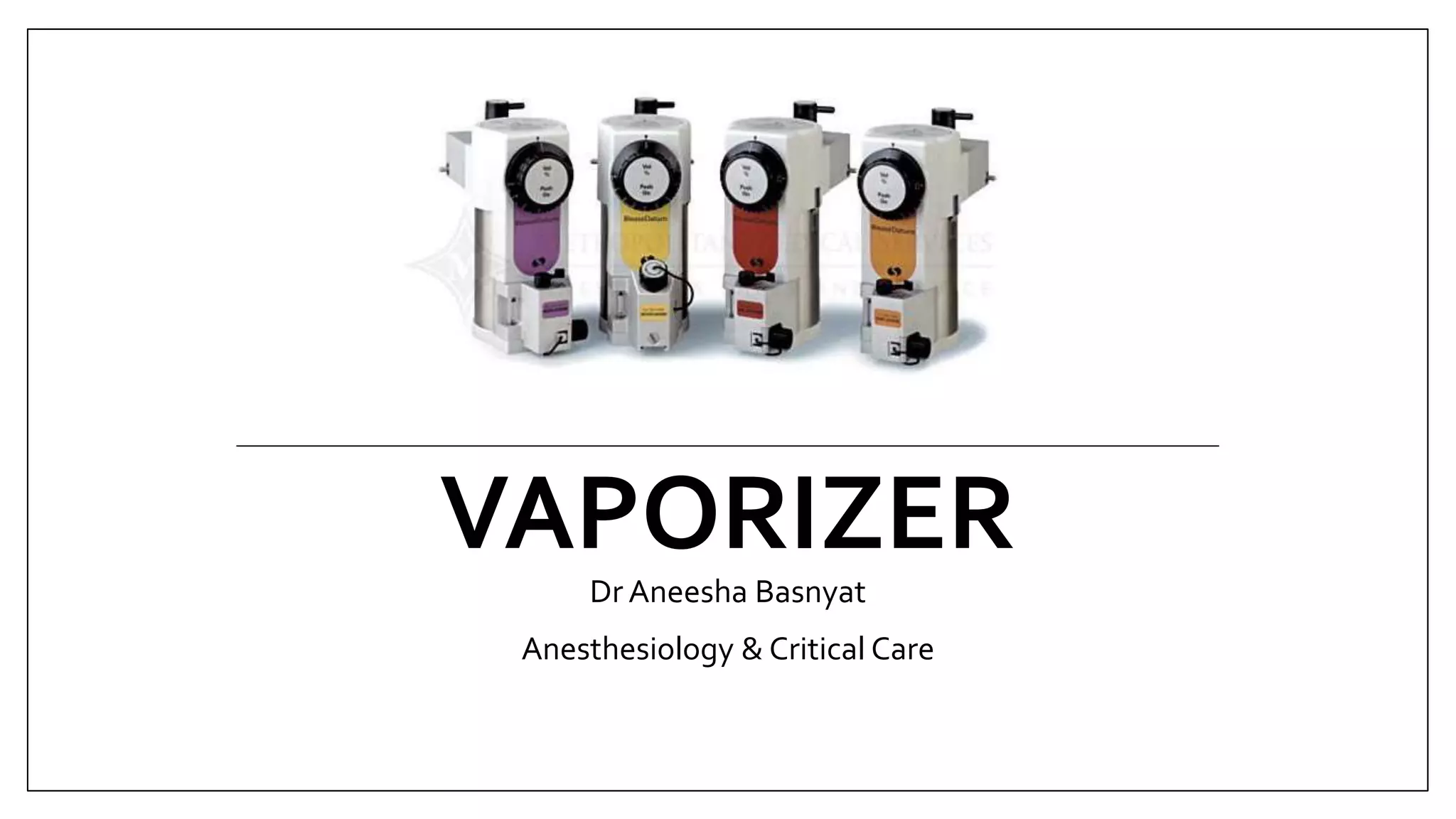
VAPORIZERDr Aneesha Basnyat
Anesthesiology & Critical Care
OBJECTIVES
• Basic terminologies
• The working principles
• Various types of vaporizer
• How desflurane vaporizers are different from other common vaporizers
• Different variables affecting vaporizer output
• Effect of altitude
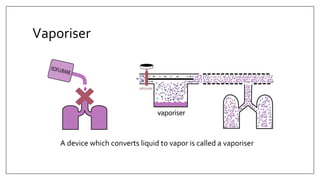
Vaporiser
A device which converts liquid to vapor is called a vaporiser
VAPORIZER
• Anesthetic agent delivery system orVapor delivery system
• A ‘vaporizer’ is a device that changes a liquid anesthetic agent into its
vapor and adds a controlled amount of that vapor to the fresh gas flow or
the breathing system.
VAPOR
• a gas state of a substance at a temperature where it can co-exist with its
liquid form
• “Gas below the critical temperature”
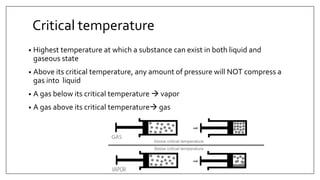
Critical temperature
• Highest temperature at which a substance can exist in both liquid and
gaseous state
• Above its critical temperature, any amount of pressure will NOT compress a
gas into liquid
• A gas below its critical temperature  vapor
• A gas above its critical temperature gas
Vapor pressure
• Pressure exerted by a vapor in thermodynamic equilibrium with its
condensed phases (solid or liquid) at a given temperature in a closed
system.
• The pressure exerted by the vapor when in equilibrium with the liquid
phase at constant temperature is called “saturated vapor pressure”.
• depends only on the liquid and Temperature, not affected by ambient
pressure.
• separate vaporizer for different anesthetic agents
Boiling point
• temperature at which the saturated vapor pressure = atmospheric
pressure and at which all the liquid agent changes to the vapor phase.
• The lower the atmospheric pressure, lower the boiling point (high
altitudes).
Gas Concentration
• Expressed by Partial pressure and volume percent
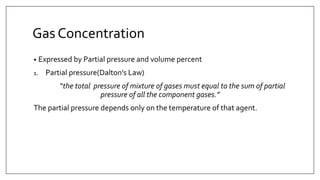
1. Partial pressure(Dalton’s Law)
“the total pressure of mixture of gases must equal to the sum of partial
pressure of all the component gases.”
The partial pressure depends only on the temperature of that agent.
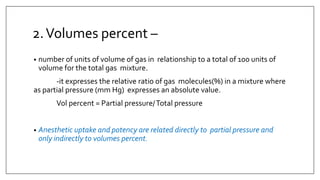
2.Volumes percent –
• number of units of volume of gas in relationship to a total of 100 units of
volume for the total gas mixture.
-it expresses the relative ratio of gas molecules(%) in a mixture where
as partial pressure (mm Hg) expresses an absolute value.
Vol percent = Partial pressure/Total pressure
• Anesthetic uptake and potency are related directly to partial pressure and
only indirectly to volumes percent.
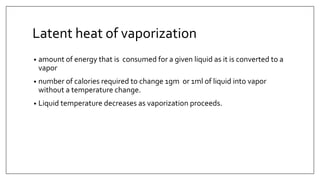
Latent heat of vaporization
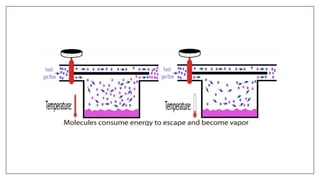
• amount of energy that is consumed for a given liquid as it is converted to a
vapor
• number of calories required to change 1gm or 1ml of liquid into vapor
without a temperature change.
• Liquid temperature decreases as vaporization proceeds.
Specific heat
• the number of calories required to increase the temperature of 1g or 1ml of
a substance by 1°C.
• Importance:
• to maintain a stable temperature.
• choosing the material to construct a vaporizer.
Thermal conductivity
• a measure of the speed with which heat flows through a substance.
• The higher the value, the better the substance conducts heat
• Cu > Al> brass> Steel >> Glass
• Thermostabilization - metals that have relatively higher thermal
conductivity to minimize temperature changes
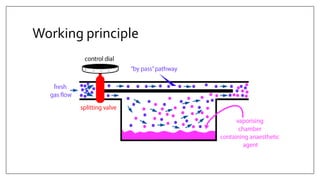
Working principle
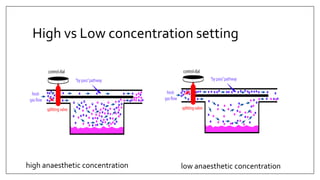
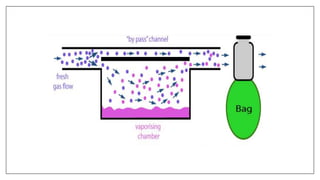
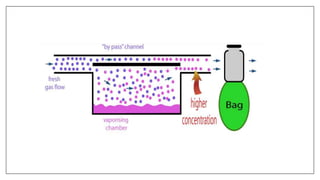
High vs Low concentration setting
high anaesthetic concentration low anaesthetic concentration
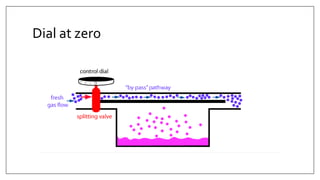
Dial at zero
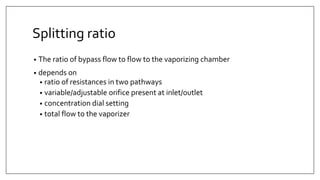
Splitting ratio
• The ratio of bypass flow to flow to the vaporizing chamber
• depends on
• ratio of resistances in two pathways
• variable/adjustable orifice present at inlet/outlet
• concentration dial setting
• total flow to the vaporizer
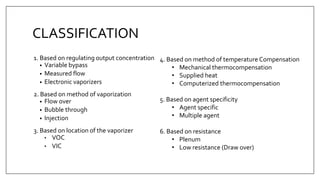
CLASSIFICATION
1. Based on regulating output concentration
• Variable bypass
• Measured flow
• Electronic vaporizers
2. Based on method of vaporization
• Flow over
• Bubble through
• Injection
3. Based on location of the vaporizer
• VOC
• VIC
4. Based on method of temperature Compensation
• Mechanical thermocompensation
• Supplied heat
• Computerized thermocompensation
5. Based on agent specificity
• Agent specific
• Multiple agent
6. Based on resistance
• Plenum
• Low resistance (Draw over)
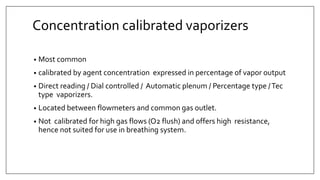
Concentration calibrated vaporizers
• Most common
• calibrated by agent concentration expressed in percentage of vapor output
• Direct reading / Dial controlled / Automatic plenum / Percentage type /Tec
type vaporizers.
• Located between flowmeters and common gas outlet.
• Not calibrated for high gas flows (O2 flush) and offers high resistance,
hence not suited for use in breathing system.
Variable bypass vaporiser
• Vapor pressure of most anesthetic agents greater than their partial pressure at
room temperature
• clinically useful concentrations accomplished by SPLITTING the gas flow that
passes through the vaporizer
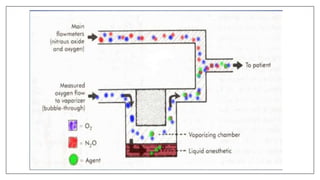
Measured flow vaporiser
• The vaporizer heats the anesthetic agent to a temperature above its boiling
point (so it behaves as gas) and this is then metered into the fresh gas flow.
• A measured flow is sent by a separate oxygen flow meter to pass to the
vaporizer with the output being at SVP for the anesthetic agent.
• In order to dilute this otherwise lethal concentration, output from that
flowmeter is combined with gas passing form the main flowmeter
• Operator has to set the flow to the vaporizer and bypass with separate
flowmeters
• Respective flows have to be calculated for each agent for a given temp
and vapour output
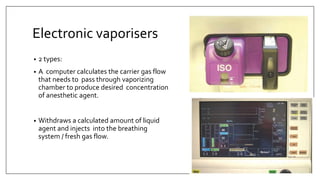
Electronic vaporisers
• 2 types:
• A computer calculates the carrier gas flow
that needs to pass through vaporizing
chamber to produce desired concentration
of anesthetic agent.
• Withdraws a calculated amount of liquid
agent and injects into the breathing
system / fresh gas flow.
Depending on the method of vaporisation
Flow over
• a stream of carrier gas passes
over the surface of the liquid.
• Most commonly used.
• baffles or spiral tracks:
increases surface area 
efficiency of vaporization
increased
• Wicks: capillary action.
Bubble through
• the carrier gas is bubbled through
the volatile liquid, further increasing
the gas-liquid interface.
Injection:
• injecting a known amount of liquid
anesthetic agent (from a reservoir in
the vaporizer or from the bottle of
agent) into a known volume of gas.
Temperaturecompensation
• thermocompensation
• supplied heat
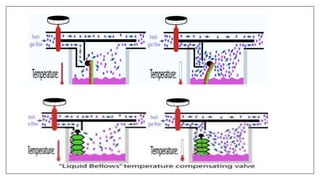
A) mechanical thermocompensation
• altering the splitting ratio using thermal element.
B) supplied heat
• An electric heater
C) computerized thermocompensation
• The amount of agent injected into the breathing system or fresh
gas flow may be altered.
• Computerized control of the amount of carrier gas that flows
through the vaporizing chamber.
Different vaporizers
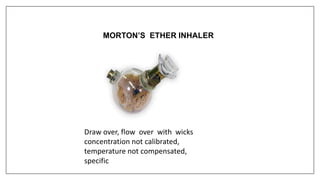
MORTON’S ETHER INHALER
Draw over, flow over with wicks
concentration not calibrated,
temperature not compensated,
specific
agent
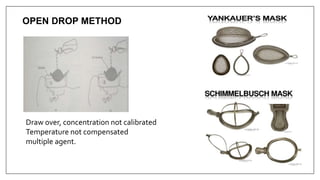
OPEN DROP METHOD
Draw over, concentration not calibrated
Temperature not compensated
multiple agent.
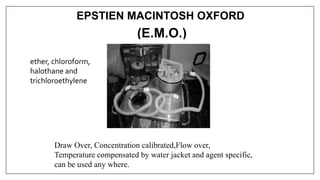
EPSTIEN MACINTOSH OXFORD
(E.M.O.)
Draw Over, Concentration calibrated,Flow over,
Temperature compensated by water jacket and agent specific,
can be used any where.
ether, chloroform,
halothane and
trichloroethylene
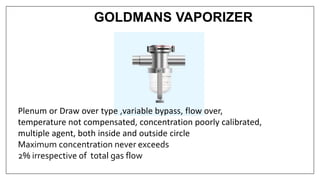
GOLDMANS VAPORIZER
Plenum or Draw over type ,variable bypass, flow over,
temperature not compensated, concentration poorly calibrated,
multiple agent, both inside and outside circle
Maximum concentration never exceeds
2% irrespective of total gas flow
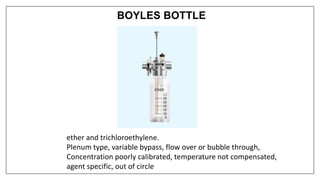
BOYLES BOTTLE
ether and trichloroethylene.
Plenum type, variable bypass, flow over or bubble through,
Concentration poorly calibrated, temperature not compensated,
agent specific, out of circle
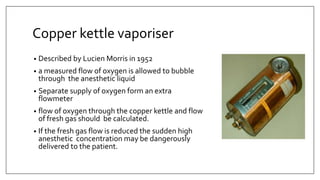
Copper kettle vaporiser
• Described by Lucien Morris in 1952
• a measured flow of oxygen is allowed to bubble
through the anesthetic liquid
• Separate supply of oxygen form an extra
flowmeter
• flow of oxygen through the copper kettle and flow
of fresh gas should be calculated.
• If the fresh gas flow is reduced the sudden high
anesthetic concentration may be dangerously
delivered to the patient.
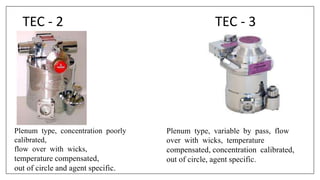
TEC - 2
Plenum type, concentration poorly
calibrated,
flow over with wicks,
temperature compensated,
out of circle and agent specific.
TEC - 3
Plenum type, variable by pass, flow
over with wicks, temperature
compensated, concentration calibrated,
out of circle, agent specific.
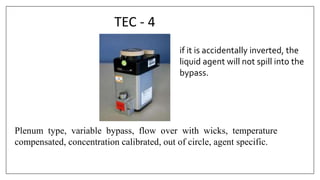
TEC - 4
Plenum type, variable bypass, flow over with wicks, temperature
compensated, concentration calibrated, out of circle, agent specific.
if it is accidentally inverted, the
liquid agent will not spill into the
bypass.
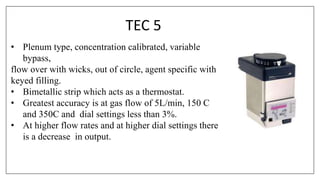
TEC 5
• Plenum type, concentration calibrated, variable
bypass,
flow over with wicks, out of circle, agent specific with
keyed filling.
• Bimetallic strip which acts as a thermostat.
• Greatest accuracy is at gas flow of 5L/min, 150 C
and 350C and dial settings less than 3%.
• At higher flow rates and at higher dial settings there
is a decrease in output.
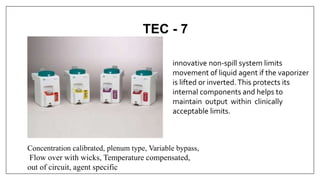
TEC - 7
Concentration calibrated, plenum type, Variable bypass,
Flow over with wicks, Temperature compensated,
out of circuit, agent specific
innovative non-spill system limits
movement of liquid agent if the vaporizer
is lifted or inverted.This protects its
internal components and helps to
maintain output within clinically
acceptable limits.
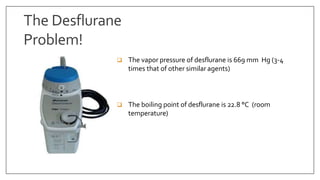
The Desflurane
Problem!
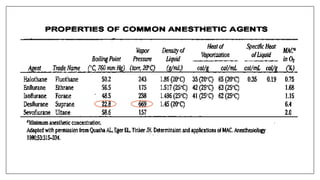
 The vapor pressure of desflurane is 669 mm Hg (3-4
times that of other similar agents)
 The boiling point of desflurane is 22.8 °C (room
temperature)
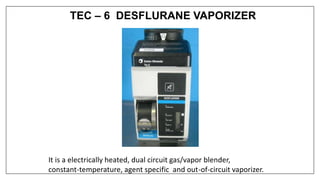
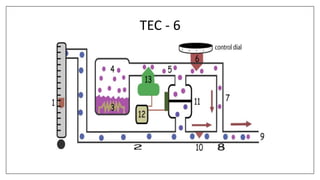
TEC – 6 DESFLURANE VAPORIZER
It is a electrically heated, dual circuit gas/vapor blender,
constant-temperature, agent specific and out-of-circuit vaporizer.
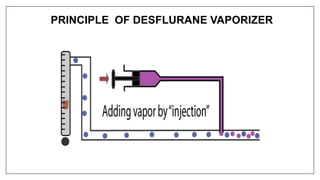
PRINCIPLE OF DESFLURANE VAPORIZER
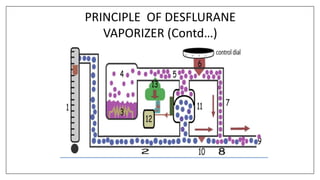
PRINCIPLE OF DESFLURANE
VAPORIZER (Contd…)
TEC - 6
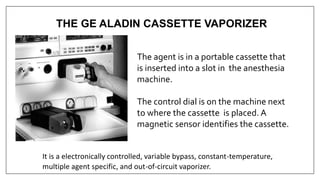
THE GE ALADIN CASSETTE VAPORIZER
It is a electronically controlled, variable bypass, constant-temperature,
multiple agent specific, and out-of-circuit vaporizer.
The agent is in a portable cassette that
is inserted into a slot in the anesthesia
machine.
The control dial is on the machine next
to where the cassette is placed. A
magnetic sensor identifies the cassette.
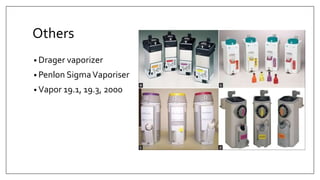
Others
• Drager vaporizer
• Penlon SigmaVaporiser
• Vapor 19.1, 19.3, 2000
Factors affecting vaporization
• Flow through the vaporizing chamber
• Efficiency of vaporization
• Temperature
• Gas flow rate
• Carrier gas composition
• Time
• Volatility
• Boiling point
• Area of contact with the liquid.
Effects of Altitude
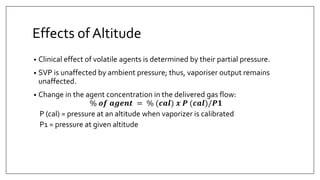
• Clinical effect of volatile agents is determined by their partial pressure.
• SVP is unaffected by ambient pressure; thus, vaporiser output remains
unaffected.
• Change in the agent concentration in the delivered gas flow:
% 𝒐𝒇 𝒂𝒈𝒆𝒏𝒕 = % (𝒄𝒂𝒍) 𝒙 𝑷 (𝒄𝒂𝒍)/𝑷𝟏
P (cal) = pressure at an altitude when vaporizer is calibrated
P1 = pressure at given altitude
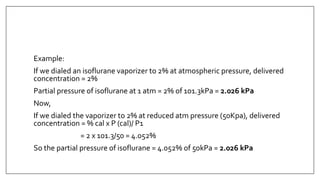
Example:
If we dialed an isoflurane vaporizer to 2% at atmospheric pressure, delivered
concentration = 2%
Partial pressure of isoflurane at 1 atm = 2% of 101.3kPa = 2.026 kPa
Now,
If we dialed the vaporizer to 2% at reduced atm pressure (50Kpa), delivered
concentration = % cal x P (cal)/ P1
= 2 x 101.3/50 = 4.052%
So the partial pressure of isoflurane = 4.052% of 50kPa = 2.026 kPa
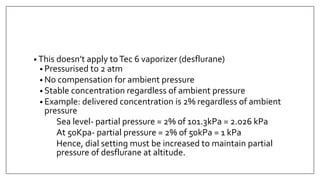
• This doesn’t apply toTec 6 vaporizer (desflurane)
• Pressurised to 2 atm
• No compensation for ambient pressure
• Stable concentration regardless of ambient pressure
• Example: delivered concentration is 2% regardless of ambient
pressure
Sea level- partial pressure = 2% of 101.3kPa = 2.026 kPa
At 50Kpa- partial pressure = 2% of 50kPa = 1 kPa
Hence, dial setting must be increased to maintain partial
pressure of desflurane at altitude.
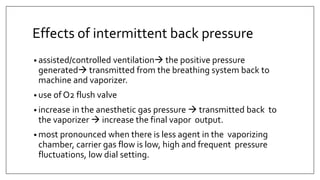
Effects of intermittent back pressure
• assisted/controlled ventilation the positive pressure
generated transmitted from the breathing system back to
machine and vaporizer.
• use of O2 flush valve
• increase in the anesthetic gas pressure  transmitted back to
the vaporizer  increase the final vapor output.
• most pronounced when there is less agent in the vaporizing
chamber, carrier gas flow is low, high and frequent pressure
fluctuations, low dial setting.
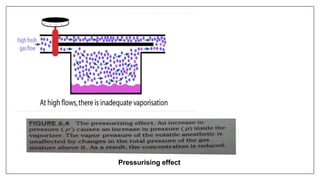
• Pressurizing effect: the output of some vaporizers decreases
when there is back pressure.This effect is greater with high
flows, large pressure fluctuations and low vaporizer settings.
• Pressurizing effect – with high gas flows  output decreased
(less significant)
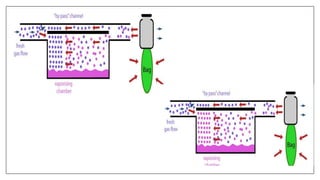
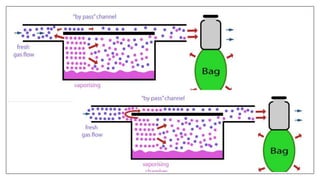
• Pumping effect – with low gas flows  output increased
Pressurising effect
Modifications to minimize pumping effect
1. Alterations to the vaporizer: small chamber, increased bypass
area, long inlet tube, resistance at the outlet
2. Alterations to the anesthesia machine: unidirectional valve,
pressure relief valve
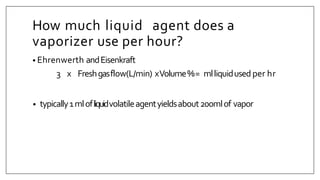
How much liquid agent does a
vaporizer use per hour?
• Ehrenwerth andEisenkraft
3 x Freshgasflow(L/min) xVolume%= mlliquidused per hr
• typically1mlofliquidvolatileagentyieldsabout200mlof vapor
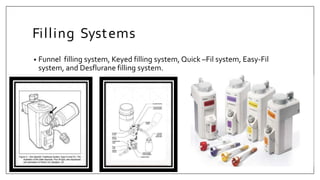
Filling Systems
• Funnel filling system, Keyed filling system, Quick –Fil system, Easy-Fil
system, and Desflurane filling system.
Safety features of modern vaporizers
• Keyed filling system
• Low filling port
• Secured vaporizers (less ability to move them minimizes tipping)
• Interlock devices or vaporizer exclusion systems – prevent more than one
vaporizer from being turned ON at a time.
Hazards of modern vaporizers
• Incorrect agent
• Tipping
• Overfilling
• Reversed flow
• Leaks
• Physical damage
• Contaminants in the vaporizing
chamber
• Obstruction to fresh gas flow
due to problems in mounting
system
• Interlock malfunction
• Concentration dial in wrong
position
Conclusion
• Inhalational anesthetic agent is an integral part of “balanced
anesthesia”. Hence its important to know functioning and the
working principle of “vaporizer”, the device intended to deliver
vapors of inhalational agent.
References
• Dorsch and Dorsch
• International Anesthesia Research Society
THANKYOU

Vaporizer

  • 1.
  • 2.
    OBJECTIVES • Basic terminologies •The working principles • Various types of vaporizer • How desflurane vaporizers are different from other common vaporizers • Different variables affecting vaporizer output • Effect of altitude
  • 3.
    Vaporiser A device whichconverts liquid to vapor is called a vaporiser
  • 4.
    VAPORIZER • Anesthetic agentdelivery system orVapor delivery system • A ‘vaporizer’ is a device that changes a liquid anesthetic agent into its vapor and adds a controlled amount of that vapor to the fresh gas flow or the breathing system.
  • 5.
    VAPOR • a gasstate of a substance at a temperature where it can co-exist with its liquid form • “Gas below the critical temperature”
  • 6.
    Critical temperature • Highesttemperature at which a substance can exist in both liquid and gaseous state • Above its critical temperature, any amount of pressure will NOT compress a gas into liquid • A gas below its critical temperature  vapor • A gas above its critical temperature gas
  • 7.
    Vapor pressure • Pressureexerted by a vapor in thermodynamic equilibrium with its condensed phases (solid or liquid) at a given temperature in a closed system. • The pressure exerted by the vapor when in equilibrium with the liquid phase at constant temperature is called “saturated vapor pressure”. • depends only on the liquid and Temperature, not affected by ambient pressure. • separate vaporizer for different anesthetic agents
  • 8.
    Boiling point • temperatureat which the saturated vapor pressure = atmospheric pressure and at which all the liquid agent changes to the vapor phase. • The lower the atmospheric pressure, lower the boiling point (high altitudes).
  • 10.
    Gas Concentration • Expressedby Partial pressure and volume percent 1. Partial pressure(Dalton’s Law) “the total pressure of mixture of gases must equal to the sum of partial pressure of all the component gases.” The partial pressure depends only on the temperature of that agent.
  • 11.
    2.Volumes percent – •number of units of volume of gas in relationship to a total of 100 units of volume for the total gas mixture. -it expresses the relative ratio of gas molecules(%) in a mixture where as partial pressure (mm Hg) expresses an absolute value. Vol percent = Partial pressure/Total pressure • Anesthetic uptake and potency are related directly to partial pressure and only indirectly to volumes percent.
  • 12.
    Latent heat ofvaporization • amount of energy that is consumed for a given liquid as it is converted to a vapor • number of calories required to change 1gm or 1ml of liquid into vapor without a temperature change. • Liquid temperature decreases as vaporization proceeds.
  • 13.
    Specific heat • thenumber of calories required to increase the temperature of 1g or 1ml of a substance by 1°C. • Importance: • to maintain a stable temperature. • choosing the material to construct a vaporizer.
  • 14.
    Thermal conductivity • ameasure of the speed with which heat flows through a substance. • The higher the value, the better the substance conducts heat • Cu > Al> brass> Steel >> Glass • Thermostabilization - metals that have relatively higher thermal conductivity to minimize temperature changes
  • 15.
  • 16.
    High vs Lowconcentration setting high anaesthetic concentration low anaesthetic concentration
  • 17.
  • 18.
    Splitting ratio • Theratio of bypass flow to flow to the vaporizing chamber • depends on • ratio of resistances in two pathways • variable/adjustable orifice present at inlet/outlet • concentration dial setting • total flow to the vaporizer
  • 19.
    CLASSIFICATION 1. Based onregulating output concentration • Variable bypass • Measured flow • Electronic vaporizers 2. Based on method of vaporization • Flow over • Bubble through • Injection 3. Based on location of the vaporizer • VOC • VIC 4. Based on method of temperature Compensation • Mechanical thermocompensation • Supplied heat • Computerized thermocompensation 5. Based on agent specificity • Agent specific • Multiple agent 6. Based on resistance • Plenum • Low resistance (Draw over)
  • 20.
    Concentration calibrated vaporizers •Most common • calibrated by agent concentration expressed in percentage of vapor output • Direct reading / Dial controlled / Automatic plenum / Percentage type /Tec type vaporizers. • Located between flowmeters and common gas outlet. • Not calibrated for high gas flows (O2 flush) and offers high resistance, hence not suited for use in breathing system.
  • 21.
    Variable bypass vaporiser •Vapor pressure of most anesthetic agents greater than their partial pressure at room temperature • clinically useful concentrations accomplished by SPLITTING the gas flow that passes through the vaporizer
  • 22.
    Measured flow vaporiser •The vaporizer heats the anesthetic agent to a temperature above its boiling point (so it behaves as gas) and this is then metered into the fresh gas flow. • A measured flow is sent by a separate oxygen flow meter to pass to the vaporizer with the output being at SVP for the anesthetic agent. • In order to dilute this otherwise lethal concentration, output from that flowmeter is combined with gas passing form the main flowmeter • Operator has to set the flow to the vaporizer and bypass with separate flowmeters • Respective flows have to be calculated for each agent for a given temp and vapour output
  • 24.
    Electronic vaporisers • 2types: • A computer calculates the carrier gas flow that needs to pass through vaporizing chamber to produce desired concentration of anesthetic agent. • Withdraws a calculated amount of liquid agent and injects into the breathing system / fresh gas flow.
  • 25.
    Depending on themethod of vaporisation Flow over • a stream of carrier gas passes over the surface of the liquid. • Most commonly used. • baffles or spiral tracks: increases surface area  efficiency of vaporization increased • Wicks: capillary action. Bubble through • the carrier gas is bubbled through the volatile liquid, further increasing the gas-liquid interface. Injection: • injecting a known amount of liquid anesthetic agent (from a reservoir in the vaporizer or from the bottle of agent) into a known volume of gas.
  • 26.
  • 27.
    A) mechanical thermocompensation •altering the splitting ratio using thermal element. B) supplied heat • An electric heater C) computerized thermocompensation • The amount of agent injected into the breathing system or fresh gas flow may be altered. • Computerized control of the amount of carrier gas that flows through the vaporizing chamber.
  • 30.
  • 31.
    MORTON’S ETHER INHALER Drawover, flow over with wicks concentration not calibrated, temperature not compensated, specific agent
  • 32.
    OPEN DROP METHOD Drawover, concentration not calibrated Temperature not compensated multiple agent.
  • 33.
    EPSTIEN MACINTOSH OXFORD (E.M.O.) DrawOver, Concentration calibrated,Flow over, Temperature compensated by water jacket and agent specific, can be used any where. ether, chloroform, halothane and trichloroethylene
  • 34.
    GOLDMANS VAPORIZER Plenum orDraw over type ,variable bypass, flow over, temperature not compensated, concentration poorly calibrated, multiple agent, both inside and outside circle Maximum concentration never exceeds 2% irrespective of total gas flow
  • 35.
    BOYLES BOTTLE ether andtrichloroethylene. Plenum type, variable bypass, flow over or bubble through, Concentration poorly calibrated, temperature not compensated, agent specific, out of circle
  • 36.
    Copper kettle vaporiser •Described by Lucien Morris in 1952 • a measured flow of oxygen is allowed to bubble through the anesthetic liquid • Separate supply of oxygen form an extra flowmeter • flow of oxygen through the copper kettle and flow of fresh gas should be calculated. • If the fresh gas flow is reduced the sudden high anesthetic concentration may be dangerously delivered to the patient.
  • 37.
    TEC - 2 Plenumtype, concentration poorly calibrated, flow over with wicks, temperature compensated, out of circle and agent specific. TEC - 3 Plenum type, variable by pass, flow over with wicks, temperature compensated, concentration calibrated, out of circle, agent specific.
  • 38.
    TEC - 4 Plenumtype, variable bypass, flow over with wicks, temperature compensated, concentration calibrated, out of circle, agent specific. if it is accidentally inverted, the liquid agent will not spill into the bypass.
  • 39.
    TEC 5 • Plenumtype, concentration calibrated, variable bypass, flow over with wicks, out of circle, agent specific with keyed filling. • Bimetallic strip which acts as a thermostat. • Greatest accuracy is at gas flow of 5L/min, 150 C and 350C and dial settings less than 3%. • At higher flow rates and at higher dial settings there is a decrease in output.
  • 40.
    TEC - 7 Concentrationcalibrated, plenum type, Variable bypass, Flow over with wicks, Temperature compensated, out of circuit, agent specific innovative non-spill system limits movement of liquid agent if the vaporizer is lifted or inverted.This protects its internal components and helps to maintain output within clinically acceptable limits.
  • 41.
    The Desflurane Problem!  Thevapor pressure of desflurane is 669 mm Hg (3-4 times that of other similar agents)  The boiling point of desflurane is 22.8 °C (room temperature)
  • 42.
    TEC – 6DESFLURANE VAPORIZER It is a electrically heated, dual circuit gas/vapor blender, constant-temperature, agent specific and out-of-circuit vaporizer.
  • 43.
  • 44.
  • 45.
  • 46.
    THE GE ALADINCASSETTE VAPORIZER It is a electronically controlled, variable bypass, constant-temperature, multiple agent specific, and out-of-circuit vaporizer. The agent is in a portable cassette that is inserted into a slot in the anesthesia machine. The control dial is on the machine next to where the cassette is placed. A magnetic sensor identifies the cassette.
  • 47.
    Others • Drager vaporizer •Penlon SigmaVaporiser • Vapor 19.1, 19.3, 2000
  • 48.
    Factors affecting vaporization •Flow through the vaporizing chamber • Efficiency of vaporization • Temperature • Gas flow rate • Carrier gas composition • Time • Volatility • Boiling point • Area of contact with the liquid.
  • 49.
    Effects of Altitude •Clinical effect of volatile agents is determined by their partial pressure. • SVP is unaffected by ambient pressure; thus, vaporiser output remains unaffected. • Change in the agent concentration in the delivered gas flow: % 𝒐𝒇 𝒂𝒈𝒆𝒏𝒕 = % (𝒄𝒂𝒍) 𝒙 𝑷 (𝒄𝒂𝒍)/𝑷𝟏 P (cal) = pressure at an altitude when vaporizer is calibrated P1 = pressure at given altitude
  • 50.
    Example: If we dialedan isoflurane vaporizer to 2% at atmospheric pressure, delivered concentration = 2% Partial pressure of isoflurane at 1 atm = 2% of 101.3kPa = 2.026 kPa Now, If we dialed the vaporizer to 2% at reduced atm pressure (50Kpa), delivered concentration = % cal x P (cal)/ P1 = 2 x 101.3/50 = 4.052% So the partial pressure of isoflurane = 4.052% of 50kPa = 2.026 kPa
  • 51.
    • This doesn’tapply toTec 6 vaporizer (desflurane) • Pressurised to 2 atm • No compensation for ambient pressure • Stable concentration regardless of ambient pressure • Example: delivered concentration is 2% regardless of ambient pressure Sea level- partial pressure = 2% of 101.3kPa = 2.026 kPa At 50Kpa- partial pressure = 2% of 50kPa = 1 kPa Hence, dial setting must be increased to maintain partial pressure of desflurane at altitude.
  • 52.
    Effects of intermittentback pressure • assisted/controlled ventilation the positive pressure generated transmitted from the breathing system back to machine and vaporizer. • use of O2 flush valve • increase in the anesthetic gas pressure  transmitted back to the vaporizer  increase the final vapor output. • most pronounced when there is less agent in the vaporizing chamber, carrier gas flow is low, high and frequent pressure fluctuations, low dial setting.
  • 57.
    • Pressurizing effect:the output of some vaporizers decreases when there is back pressure.This effect is greater with high flows, large pressure fluctuations and low vaporizer settings. • Pressurizing effect – with high gas flows  output decreased (less significant) • Pumping effect – with low gas flows  output increased
  • 58.
  • 59.
    Modifications to minimizepumping effect 1. Alterations to the vaporizer: small chamber, increased bypass area, long inlet tube, resistance at the outlet 2. Alterations to the anesthesia machine: unidirectional valve, pressure relief valve
  • 60.
    How much liquidagent does a vaporizer use per hour? • Ehrenwerth andEisenkraft 3 x Freshgasflow(L/min) xVolume%= mlliquidused per hr • typically1mlofliquidvolatileagentyieldsabout200mlof vapor
  • 61.
    Filling Systems • Funnelfilling system, Keyed filling system, Quick –Fil system, Easy-Fil system, and Desflurane filling system.
  • 62.
    Safety features ofmodern vaporizers • Keyed filling system • Low filling port • Secured vaporizers (less ability to move them minimizes tipping) • Interlock devices or vaporizer exclusion systems – prevent more than one vaporizer from being turned ON at a time.
  • 63.
    Hazards of modernvaporizers • Incorrect agent • Tipping • Overfilling • Reversed flow • Leaks • Physical damage • Contaminants in the vaporizing chamber • Obstruction to fresh gas flow due to problems in mounting system • Interlock malfunction • Concentration dial in wrong position
  • 64.
    Conclusion • Inhalational anestheticagent is an integral part of “balanced anesthesia”. Hence its important to know functioning and the working principle of “vaporizer”, the device intended to deliver vapors of inhalational agent.
  • 65.
    References • Dorsch andDorsch • International Anesthesia Research Society
  • 66.

Editor's Notes

  • #7 on Earth, at room temperature, all the gaseous forms of common anesthetic  agents exist as vapours
  • #12 The highest partial pressure that can be exerted by a gas at a given temperature is its Vapor Pressure.
  • #17 Fresh gas enters the inlet of the vaporiser and is divided into two flow pathways. The splitting valve, depending on the setting of the control dial, adjusts how much goes through each of the pathways. The fresh gas that is sent along the “by pass” pathway doesn’t come into contact with any vapor. On the other hand, the fresh gas that is sent to the vaporising chamber becomes fully saturated with vapor. At the exit end of the vaporiser, the by pass gas (vaporless) meets the chamber gas (fully saturated with vapor) and the two mix. The resultant output depends on how much of fresh gas went though each of the pathways.
  • #18 When you dial a high anaesthetic concentration requirement, the splitting valve sends more fresh gas via the vaporising chamber. Similarly, when you dial a low anaesthetic concentration requirement, the splitting valve sends less fresh gas via the vaporising chamber.
  • #19 Finally, when you set the dial to zero to make vaporiser deliver no anaesthetic vapor, the splitting valve sends all the fresh gas via the by pass pathway and nothing through the vaporising chamber.
  • #31 Two metals of different coefficients of thermal expansion are fixed together. Depending upon VC temperature the strip move away or towards control valve.
  • #35 1952
  • #39 Tec 3 has larger bypass. It is more reliable and accurate
  • #44 higher the temperature, higher is the saturated vapor pressure. Desflurane has a very low boiling point (about 23 degrees Centigrade) and even at room temperature, has an high vapor pressure. Also, for small changes in temperature, the vapor pressure of desflurane changes quite dramatically.  I.e. desflurane is said to have a very steep “Vapor Pressure versus Temperature curve”. Unlike other anesthetic agents, desflurane cnt compensate for even a small change in temperature by the use of bimetallic strip or bellows. So it requires special vaporizer.
  • #45 Electrically heated to a constant temperature, usually 39-40 degree Celsius, that is not affected by room temperature.; liquid desflurane changes to vapor at 2atm (200kPa or 1500mmHg)
  • #46 the fresh gas flow coming from the flow meters does not split into two streams.  There is only one stream for the fresh gas flow, and into this stream, the anaesthetic agent is directly injected. The rate of desflurane gas injection must be adjusted to match the fresh gas flow going through the vaporiser. if you increased the fresh gas flow, but didn’t increase the injection rate, the emerging mixture will now be inaccurate, the concentration being lower than before.
  • #47 11- differential pressure transducer; t has a diaphragm that on one side is exposed to the pressure in pipe [2] carrying fresh gas and the other side of the diaphragm is exposed to the pressure in pipe [5] carrying Desflurane.  When the pressure is equal on both sides of the diaphragm, it lies in a neutral position.