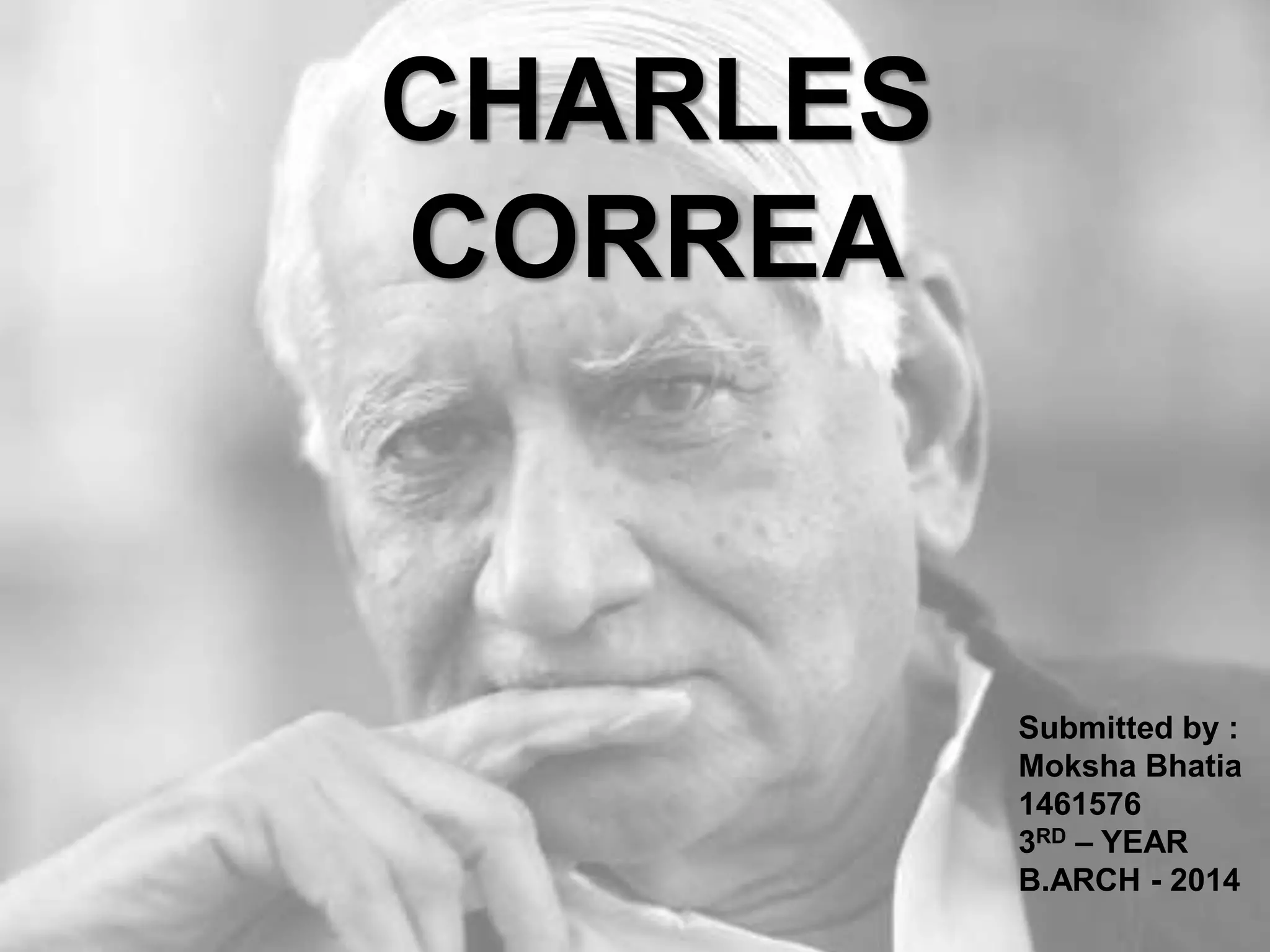
CHARLES
CORREA
Submitted by :
Moksha Bhatia
1461576
3RD – YEAR
B.ARCH - 2014
EARLY LIFE
• Born on – September 1, 1930 in Hyderabad.
• Died on – June 16, 2015 in Mumbai.
• Became fascinated with the principles of design as
a child.
• Charles Correa was an Indian architect, urban
planner, international lecturer, traveler and activist.
• Correa began his higher studies at St. Xavier's
College, Mumbai at the University of Bombay.
• studied at the University of Michigan (1949–53) and
the Massachusetts Institute of Technology (MIT)
(1953–55)
• At Michigan 2 professors who influenced him –
Walter Salders and Buckminister Fuller
• In 1958 he established his own Mumbai
based professional practice.
• He has been influenced by Le Corbusier ,
• From 1970–75, he was Chief Architect for
New Bombay .
• In 1985, Prime Minister Rajiv Gandhi
appointed him Chairman of the National
Commission on Urbanization.
• In 1987, won gold medal of IIA (Indian
Institute Of Architects)
• In 1990, won gold medal of UIA ( Union Of
International Associations)
OTHER AWARDS
• RIBA Royal Gold Medal – 1984.
• Padma Vibhushan (2006) and Padma Shri
(1972).
• Praemium Imperiale (1994)
• 7th Aga Khan Award for Architecture for
Madhya Pradesh Legislative Assembly (1998)
• Austrian Decoration for Science and Art (2005)
PHILOSOPHY
• Key to Correa’s design approach is his understanding of
the unique cultural requirements and needs of his native
country.
• The basic philosophy of Charles Correa in planning the
buildings, the architect has tried to give long corridors
and wide arches, which provide shades and ventilation.
• He has successfully expressed his philosophy
combining with regional traditions within a modern
environment .
• The buildings of Charles Correa are responsive to the
environment , especially to the climate.
• Open to sky space pervasive theme in his architecture.
CONTRIBUTION
• Correa's work in India shows a careful
development, understanding and adaptation
of Modernism to a non-western culture.
• Correa's early works attempt to explore a
local vernacular within a modern
environment.
• He has designed some of the most
outstanding buildings in India and has
received many of the world’s most important
architecture awards
FEW BUILDINGS
• Kanchanjunga Apartments
• Sonmarg Apartments
• Brtitish council
• Vidhan Sabha Bhopal
• Jawahar kala Kendara
• Bharat Bhavan
• Aga Khan Museum
• Cidade de Goa Resort Hotel
• City Centre
• Champalimand Foundation Research Centre
• Salvaco Church, Mumbai..
• LIC building
• Gandhi Aashram
• Sardar Vallabhbhai Patel Stadium, Ahmedabad
VIDHAN BHAVAN, BHOPAL
• The Vidhan Bhavan is a huge building,
covering an area of more than 32,000 sq.
meters of built space.
• The whole building presents as extremely
pleasing vision of powerful curves and
straight vertical and horizontal lines.
• The building is located in center of Bhopal.
• It is a form which finds many echoes in
Bhopal's history, from the magnificent stupa at
Sanchi to the Great capital of Mandu.
• the plan of the building developed as a circle,
so it could have an autonomous unity and
presence, regardless of the direction from which
it is approached
• The Vidhan Bhavan is divided into nine
compartments of squares each enclosing in it
a pattern of gardens within gardens
• Entry to the building is through three main
gates or 'dwars', one for people at large
through the kund, one for member of the
legislature and minister and one for the
Speaker of the House. There is also a smaller
entrance for the Chief Minister and Ministers
attending cabinet meetings.
• Centrally Air-Conditioned
• Integrated Sound-Cum-Electronic Voting
System.
VIP ENTRANCE
LEGISLATOR’S FOYER
VIDHAN PARISHAD
VIDHAN SABHA
COURT OF PEOPLE
CABINET ROOM
LIBRARY
COMBINED HALL
PUBLIC ENTRANCE
REFLECTING POOL
CENTRAL HALL
COURTYARD
PUBLIC ENTRANCE
COURT OF PEOPLE
The Vidhan Sabha, accommodating 366
members in a circular volume capped by a
dome (above) and the legislator's foyer
VIP ENTRANCE
CENTRAL HALL
COURTYARD
Charles Correa won prestigous
AGA KHAN award in 1999 for this.
BRITISH COUNCIL, NEW
DELHI
• Year : 1987-1992
• Materials: walls – red sandstone sculptures: black
rock quarried from Mahabalipuram
• It is the headquarters of their office in India
• Houses a library, an auditorium and an art gallery
too.
• These elements are arranged in a series of layers –
represents the historic interfaces that have existed
between India and Britain
• he created a series of three courtyards
representing the three cosmic local points that stad
for the world center in hindu, muslim and european
cultures.
LONGITUDINAL SECTION
Champalimaud Foundation
Research Centre
• Opened on the 5th of Oct 2010.
• Location: Lisbon, Portugal. on the waterfront of
Pedrouços
• a private biomedical research foundation
• The mission of the Foundation is "to develop
programmes of advanced biomedical research and
provide clinical care of excellence, with a focus on
translating pioneering scientific discoveries into
solutions which can improve the quality of life of
individuals around the world."
• Has a curved stone form with circular cut-
aways
• Comprises two buildings, first - research
laboratories and treatment rooms, second
housing an auditorium and exhibition area.
research laboratories and treatment rooms
an auditorium and exhibition area.
• A central pathway crosses the site between
the buildings, leading towards two monolithic
stone sculptures and an outdoor
amphitheater.
• Above the pathway, a glass tubular bridge
connects the two buildings together.
• Attempted to use NATURE as therapy. The
WATER around us. The SKY above. The
healing presence of RAIN FORESTS. All
these are therapies for the patients
• Uses the highest levels of contemporary
science & medicine to help people grappling
with real problems; cancer, brain damage,
blindness.
• The buildings are arranged to create a 125
A central pathwaya glass tubular bridge
pathway leading
diagonally across the
site, towards open seas
• Pathway is on an incline so that when
walking upwards one can see only the sky
ahead.
• At the top of the ramp there are two stone
monoliths, straight from the quarry
• From the highest point, a large body of
water is visible which appears to
connect to the ocean beyond
• In the centre of the water body, just
below the surface, is an oval shaped
stainless steel object, slightly convex so
that it reflects the blue sky and the passing
clouds above
AUDITORIUM FOYER
CONCLUSION
Main basic features of his
design
Thank
you

Charles correa

  • 1.
    CHARLES CORREA Submitted by : MokshaBhatia 1461576 3RD – YEAR B.ARCH - 2014
  • 2.
    EARLY LIFE • Bornon – September 1, 1930 in Hyderabad. • Died on – June 16, 2015 in Mumbai. • Became fascinated with the principles of design as a child. • Charles Correa was an Indian architect, urban planner, international lecturer, traveler and activist. • Correa began his higher studies at St. Xavier's College, Mumbai at the University of Bombay. • studied at the University of Michigan (1949–53) and the Massachusetts Institute of Technology (MIT) (1953–55) • At Michigan 2 professors who influenced him – Walter Salders and Buckminister Fuller
  • 3.
    • In 1958he established his own Mumbai based professional practice. • He has been influenced by Le Corbusier , • From 1970–75, he was Chief Architect for New Bombay . • In 1985, Prime Minister Rajiv Gandhi appointed him Chairman of the National Commission on Urbanization. • In 1987, won gold medal of IIA (Indian Institute Of Architects) • In 1990, won gold medal of UIA ( Union Of International Associations)
  • 4.
    OTHER AWARDS • RIBARoyal Gold Medal – 1984. • Padma Vibhushan (2006) and Padma Shri (1972). • Praemium Imperiale (1994) • 7th Aga Khan Award for Architecture for Madhya Pradesh Legislative Assembly (1998) • Austrian Decoration for Science and Art (2005)
  • 5.
    PHILOSOPHY • Key toCorrea’s design approach is his understanding of the unique cultural requirements and needs of his native country. • The basic philosophy of Charles Correa in planning the buildings, the architect has tried to give long corridors and wide arches, which provide shades and ventilation. • He has successfully expressed his philosophy combining with regional traditions within a modern environment . • The buildings of Charles Correa are responsive to the environment , especially to the climate. • Open to sky space pervasive theme in his architecture.
  • 6.
    CONTRIBUTION • Correa's workin India shows a careful development, understanding and adaptation of Modernism to a non-western culture. • Correa's early works attempt to explore a local vernacular within a modern environment. • He has designed some of the most outstanding buildings in India and has received many of the world’s most important architecture awards
  • 7.
    FEW BUILDINGS • KanchanjungaApartments • Sonmarg Apartments • Brtitish council • Vidhan Sabha Bhopal • Jawahar kala Kendara • Bharat Bhavan • Aga Khan Museum • Cidade de Goa Resort Hotel • City Centre • Champalimand Foundation Research Centre • Salvaco Church, Mumbai.. • LIC building • Gandhi Aashram • Sardar Vallabhbhai Patel Stadium, Ahmedabad
  • 8.
  • 9.
    • The VidhanBhavan is a huge building, covering an area of more than 32,000 sq. meters of built space. • The whole building presents as extremely pleasing vision of powerful curves and straight vertical and horizontal lines. • The building is located in center of Bhopal. • It is a form which finds many echoes in Bhopal's history, from the magnificent stupa at Sanchi to the Great capital of Mandu.
  • 10.
    • the planof the building developed as a circle, so it could have an autonomous unity and presence, regardless of the direction from which it is approached • The Vidhan Bhavan is divided into nine compartments of squares each enclosing in it a pattern of gardens within gardens • Entry to the building is through three main gates or 'dwars', one for people at large through the kund, one for member of the legislature and minister and one for the Speaker of the House. There is also a smaller entrance for the Chief Minister and Ministers attending cabinet meetings. • Centrally Air-Conditioned • Integrated Sound-Cum-Electronic Voting System.
  • 11.
    VIP ENTRANCE LEGISLATOR’S FOYER VIDHANPARISHAD VIDHAN SABHA COURT OF PEOPLE CABINET ROOM LIBRARY COMBINED HALL PUBLIC ENTRANCE REFLECTING POOL CENTRAL HALL COURTYARD
  • 14.
  • 15.
  • 16.
    The Vidhan Sabha,accommodating 366 members in a circular volume capped by a dome (above) and the legislator's foyer
  • 17.
  • 18.
  • 19.
  • 20.
    Charles Correa wonprestigous AGA KHAN award in 1999 for this.
  • 21.
  • 22.
    • Year :1987-1992 • Materials: walls – red sandstone sculptures: black rock quarried from Mahabalipuram • It is the headquarters of their office in India • Houses a library, an auditorium and an art gallery too. • These elements are arranged in a series of layers – represents the historic interfaces that have existed between India and Britain • he created a series of three courtyards representing the three cosmic local points that stad for the world center in hindu, muslim and european cultures.
  • 27.
  • 31.
  • 32.
    • Opened onthe 5th of Oct 2010. • Location: Lisbon, Portugal. on the waterfront of Pedrouços • a private biomedical research foundation • The mission of the Foundation is "to develop programmes of advanced biomedical research and provide clinical care of excellence, with a focus on translating pioneering scientific discoveries into solutions which can improve the quality of life of individuals around the world." • Has a curved stone form with circular cut- aways • Comprises two buildings, first - research laboratories and treatment rooms, second housing an auditorium and exhibition area.
  • 33.
    research laboratories andtreatment rooms an auditorium and exhibition area.
  • 34.
    • A centralpathway crosses the site between the buildings, leading towards two monolithic stone sculptures and an outdoor amphitheater. • Above the pathway, a glass tubular bridge connects the two buildings together. • Attempted to use NATURE as therapy. The WATER around us. The SKY above. The healing presence of RAIN FORESTS. All these are therapies for the patients • Uses the highest levels of contemporary science & medicine to help people grappling with real problems; cancer, brain damage, blindness. • The buildings are arranged to create a 125
  • 35.
    A central pathwayaglass tubular bridge pathway leading diagonally across the site, towards open seas
  • 37.
    • Pathway ison an incline so that when walking upwards one can see only the sky ahead. • At the top of the ramp there are two stone monoliths, straight from the quarry • From the highest point, a large body of water is visible which appears to connect to the ocean beyond • In the centre of the water body, just below the surface, is an oval shaped stainless steel object, slightly convex so that it reflects the blue sky and the passing clouds above
  • 41.
  • 43.
  • 44.
    Main basic featuresof his design
  • 46.