z
CHETTINAD
HOUSES
AJITH KUMAR M M
S3 B.ARCH ROLL :4
z Society & Culture
 •Chettiars, were one of the earliest business
communities in India. They settled almost mid-center
between the capitals of the Pandya Kingdom in Madurai
and the Chola Empire in Thanjavur in the 13th century.
 Karaikudi is known as the capital of Chettinad , which
includes Karaikudi and 74 other villagers.
 They earned money by crossing the seas and their
business acumen made them successful and
prosperous.
 Their social life is unique. At the apex of the family
household is the AACHI the senior female in the house.
z
 She controlled, if not every thing the finances of the household.
 As a result of their traveling the Chettiars integrated diverse
influences into their traditions which contributed to their uniqueness.
Important factors in the Chettinad village
 Clan temples
 Oorain
 Erys
z
CLAN TEMPLES
 Chettinad is a geo-cultural
territory which is organized
around the 9 clan temples.
 Each member of the Chettiar
community belongs to a clan and
each clan has its own temple run
by its own committee
z
The 9 Clan Temples are:
 Illayathakudi
 Mattur
 Vairavan
 Iraniyur
 Pillaiyarpatti
 Nemam
 Illupaikudi
 Soraikudi
 Vellankud
z
OORANI
 Oorani is a Tamil word for the
surface water storage tank
located in the villages and towns.
In Chettinad,
 each village comprises a
minimum of three water bodies in
accordance with the storage
needs of the villagers for drinking
and bathing.
z
 The roofs typical of Chettinad
architecture are designed to
harvest water in the
courtyards and then divert
tothe various different ponds
through a water drainage
network
z
ERYS
 Erys are the traditional surface water
storage reservoirs found in Tamil Nadu.
Organized into a huge network over
theages, they have played a very
important role for the ecosystem and for
irrigation in areas with low-rainfall.
z
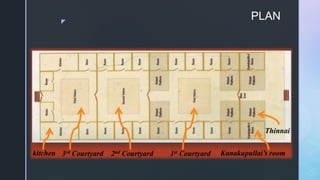
Spatial Planning
 Most Chettiar mansions comprised of a public reception area abutting the street.
 The basic floor plan of a Chettinad house consists of an outside verandah
(thinnai) for guests, with a room for conducting business on one or both ends.
 An interior courtyard to be used in ceremonies, with a raised seating area at one
or both ends.
 A series of small double rooms opening off the main courtyard, for storage,
prayer and sleeping.
 They later expanded vertically into two-storeyed structures, and horizontally
through the addition of numerous halls and courtyards that could accommodate
guests at marriages and other ceremonies.
 The rear hall served as the women's domain where the women of the community
reared children, engaged in food preservation and went about other domestic
activities.
z
 Buildings are divided into portions –”Kattu”.
 Mugappu – The reception or entrance of the house.
 Valavu – Living area of the house. In the valavu, there are 4 platforms
that are called as Pattalai, each at 4 corners.
 Pattalai – Living halls of each family. Along with Pattalai, valavu
consists of numerous Irattai veedu.
 Irattai veedu – rooms used by each family to keep their belongings.
 Nadai – Corridor
 Irandankattu – used for dining / with storerooms for storing
crockery/kitchenware.
 Moonamkattu – Kitchen
 Thottam – Garden, stables, cowsheds etc.,
z
 The magnificent mansions in Chettinad are the finest examples
of combinations of vernacular architecture & amalgam of South
East & European architecture.
 The source of inspiration derived from can be attributed to their
connection with Trade, Travel, Temples, Tradition and Taste.
 On the ground floor, the architecture is typically Tamil, while one
can see Western influences on the higher floors.
 This reflects the Chettiar way of life, a combination of their
vibrant traditions
z
PLAN
z
z
Characteristic Features
 Cluster Houses.
 East West orientation.
 High – rise compound wall front side.
 Entrance Arch with stone steps.
 Elevated plinth.
 Tiled Portico.
 Facade with stucco sculptures.
 Verandah – Thinnai, two platforms with wooden pillars on it.
 Pattalai - smaller version of the thinnai- platforms.
 Open Courtyard, Mutram.
z
 Edges of the passages are lined with cut stone slabs known as
vellaikkallu.
 The stone pillars meant for supporting the roof.
 Sloping clay - tiled roofs.
 The color-glass arch flanked by pillars on either sides.
 Square – flat tiles floor of the mutram will have rectangle stone slabs on
all the four corners to bear the brunt of the falling rain water.
 Small single / double rooms on one side or either side of the passage.
 High door frame with ornate wood work.
 Double main door.
z
 Kitchen on the last kattu.
 Staircase on one or two or all the four corners.
 Banquet Hall, Bhojan Hall, Panthi kattu on the side of the first kattu.
 Floors laid with -Italian marble Black and White, Granite & Athangudi tiles
 Japanese and Spanish tiles were both used for side wallsA
 ll the mediums used in making columns viz, wood, stone, brick, and iron,
 First floor facade is invariably adorned by colonnade made of stone, wood, and
bricks
 Window niches and arches above are decorated with stucco work or paintings.
 Designed for collecting / harvesting rain water especially in courtyard
z
Climate and Materials
 Chettinad is a hot and semi-arid region.
 The climate was taken into consideration in the design of their
homes and the materials used.
 The houses were built around an East/West central courtyard which
brings shade, light, coolness and air to the entire home.
 BUILDING MATERIALS USED - The materials used for
construction and the essential components of this luxury home are
brick and lime plaster walls, terracotta tiled roofs, stone pillars, teak
columns, and marble and stone floors.
 The roof is terracotta tiled – which helps in shutting out the
immense heat.
z
z
z
Arts and Crafts
 The arts & crafts of Chettinad occupy a distinct position in
South Indian folklore.
 Wood carving, silver embellishment, woven saris, palm
leaf baskets, gold jewelry, handmade tiles, architectural
styles, refined cuisine and egg plastering are among their
more visible contributions to the wide-ranging repertoire
of Indian arts and crafts.
 Chettinad baskets has a special attraction as they have
intricate patterns made with date-palm leaves.
 A special feature of any chettinad house is the decorative
art of "Kolam" practiced everyday at dawn on the
cleansed threshold of the house.
z
z
z
THANK YOU

chettinad Houses

  • 1.
  • 2.
    z Society &Culture  •Chettiars, were one of the earliest business communities in India. They settled almost mid-center between the capitals of the Pandya Kingdom in Madurai and the Chola Empire in Thanjavur in the 13th century.  Karaikudi is known as the capital of Chettinad , which includes Karaikudi and 74 other villagers.  They earned money by crossing the seas and their business acumen made them successful and prosperous.  Their social life is unique. At the apex of the family household is the AACHI the senior female in the house.
  • 3.
    z  She controlled,if not every thing the finances of the household.  As a result of their traveling the Chettiars integrated diverse influences into their traditions which contributed to their uniqueness. Important factors in the Chettinad village  Clan temples  Oorain  Erys
  • 4.
    z CLAN TEMPLES  Chettinadis a geo-cultural territory which is organized around the 9 clan temples.  Each member of the Chettiar community belongs to a clan and each clan has its own temple run by its own committee
  • 5.
    z The 9 ClanTemples are:  Illayathakudi  Mattur  Vairavan  Iraniyur  Pillaiyarpatti  Nemam  Illupaikudi  Soraikudi  Vellankud
  • 6.
    z OORANI  Oorani isa Tamil word for the surface water storage tank located in the villages and towns. In Chettinad,  each village comprises a minimum of three water bodies in accordance with the storage needs of the villagers for drinking and bathing.
  • 7.
    z  The roofstypical of Chettinad architecture are designed to harvest water in the courtyards and then divert tothe various different ponds through a water drainage network
  • 8.
    z ERYS  Erys arethe traditional surface water storage reservoirs found in Tamil Nadu. Organized into a huge network over theages, they have played a very important role for the ecosystem and for irrigation in areas with low-rainfall.
  • 9.
    z Spatial Planning  MostChettiar mansions comprised of a public reception area abutting the street.  The basic floor plan of a Chettinad house consists of an outside verandah (thinnai) for guests, with a room for conducting business on one or both ends.  An interior courtyard to be used in ceremonies, with a raised seating area at one or both ends.  A series of small double rooms opening off the main courtyard, for storage, prayer and sleeping.  They later expanded vertically into two-storeyed structures, and horizontally through the addition of numerous halls and courtyards that could accommodate guests at marriages and other ceremonies.  The rear hall served as the women's domain where the women of the community reared children, engaged in food preservation and went about other domestic activities.
  • 10.
    z  Buildings aredivided into portions –”Kattu”.  Mugappu – The reception or entrance of the house.  Valavu – Living area of the house. In the valavu, there are 4 platforms that are called as Pattalai, each at 4 corners.  Pattalai – Living halls of each family. Along with Pattalai, valavu consists of numerous Irattai veedu.  Irattai veedu – rooms used by each family to keep their belongings.  Nadai – Corridor  Irandankattu – used for dining / with storerooms for storing crockery/kitchenware.  Moonamkattu – Kitchen  Thottam – Garden, stables, cowsheds etc.,
  • 11.
    z  The magnificentmansions in Chettinad are the finest examples of combinations of vernacular architecture & amalgam of South East & European architecture.  The source of inspiration derived from can be attributed to their connection with Trade, Travel, Temples, Tradition and Taste.  On the ground floor, the architecture is typically Tamil, while one can see Western influences on the higher floors.  This reflects the Chettiar way of life, a combination of their vibrant traditions
  • 12.
  • 13.
  • 14.
    z Characteristic Features  ClusterHouses.  East West orientation.  High – rise compound wall front side.  Entrance Arch with stone steps.  Elevated plinth.  Tiled Portico.  Facade with stucco sculptures.  Verandah – Thinnai, two platforms with wooden pillars on it.  Pattalai - smaller version of the thinnai- platforms.  Open Courtyard, Mutram.
  • 15.
    z  Edges ofthe passages are lined with cut stone slabs known as vellaikkallu.  The stone pillars meant for supporting the roof.  Sloping clay - tiled roofs.  The color-glass arch flanked by pillars on either sides.  Square – flat tiles floor of the mutram will have rectangle stone slabs on all the four corners to bear the brunt of the falling rain water.  Small single / double rooms on one side or either side of the passage.  High door frame with ornate wood work.  Double main door.
  • 16.
    z  Kitchen onthe last kattu.  Staircase on one or two or all the four corners.  Banquet Hall, Bhojan Hall, Panthi kattu on the side of the first kattu.  Floors laid with -Italian marble Black and White, Granite & Athangudi tiles  Japanese and Spanish tiles were both used for side wallsA  ll the mediums used in making columns viz, wood, stone, brick, and iron,  First floor facade is invariably adorned by colonnade made of stone, wood, and bricks  Window niches and arches above are decorated with stucco work or paintings.  Designed for collecting / harvesting rain water especially in courtyard
  • 17.
    z Climate and Materials Chettinad is a hot and semi-arid region.  The climate was taken into consideration in the design of their homes and the materials used.  The houses were built around an East/West central courtyard which brings shade, light, coolness and air to the entire home.  BUILDING MATERIALS USED - The materials used for construction and the essential components of this luxury home are brick and lime plaster walls, terracotta tiled roofs, stone pillars, teak columns, and marble and stone floors.  The roof is terracotta tiled – which helps in shutting out the immense heat.
  • 18.
  • 19.
  • 20.
    z Arts and Crafts The arts & crafts of Chettinad occupy a distinct position in South Indian folklore.  Wood carving, silver embellishment, woven saris, palm leaf baskets, gold jewelry, handmade tiles, architectural styles, refined cuisine and egg plastering are among their more visible contributions to the wide-ranging repertoire of Indian arts and crafts.  Chettinad baskets has a special attraction as they have intricate patterns made with date-palm leaves.  A special feature of any chettinad house is the decorative art of "Kolam" practiced everyday at dawn on the cleansed threshold of the house.
  • 21.
  • 22.
  • 23.