CONSTRUCTION IN
HISTORY
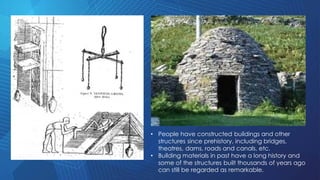
• People have constructed buildings and other
structures since prehistory, including bridges,
theatres, dams, roads and canals, etc.
• Building materials in past have a long history and
some of the structures built thousands of years ago
can still be regarded as remarkable.
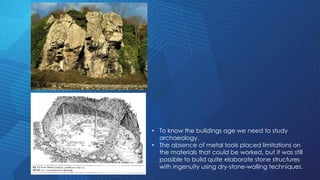
• To know the buildings age we need to study
archaeology.
• The absence of metal tools placed limitations on
the materials that could be worked, but it was still
possible to build quite elaborate stone structures
with ingenuity using dry-stone-walling techniques.
Jericho - late Neolithic period First Mud Bricks
The first mud bricks, formed with the hands rather than wooden moulds, belong to the late Neolithic
period and were found in Jericho.
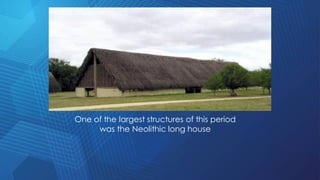
One of the largest structures of this period
was the Neolithic long house
CONSTRUCTION IN ANCIENT
MESOPOTAMIA
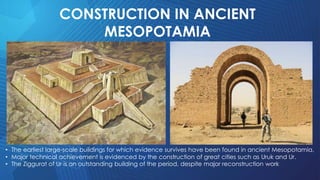
• The earliest large-scale buildings for which evidence survives have been found in ancient Mesopotamia.
• Major technical achievement is evidenced by the construction of great cities such as Uruk and Ur.
• The Ziggurat of Ur is an outstanding building of the period, despite major reconstruction work
CONSTRUCTION IN ANCIENT
MESOPOTAMIA
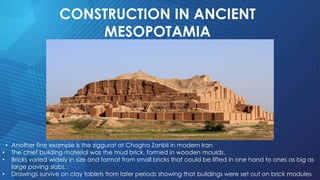
• Another fine example is the ziggurat at Chogha Zanbil in modern Iran
• The chief building material was the mud brick, formed in wooden moulds.
• Bricks varied widely in size and format from small bricks that could be lifted in one hand to ones as big as
large paving slabs.
• Drawings survive on clay tablets from later periods showing that buildings were set out on brick modules
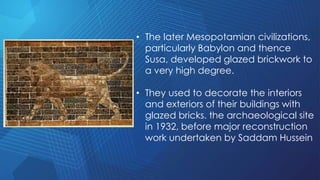
• The later Mesopotamian civilizations,
particularly Babylon and thence
Susa, developed glazed brickwork to
a very high degree.
• They used to decorate the interiors
and exteriors of their buildings with
glazed bricks. the archaeological site
in 1932, before major reconstruction
work undertaken by Saddam Hussein
CONSTRUCTION IN ANCIENT EGYPT
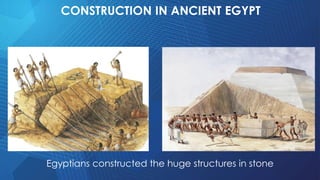
Egyptians constructed the huge structures in stone
CONSTRUCTION IN ANCIENT EGYPT
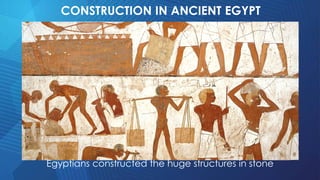
Egyptians constructed the huge structures in stone
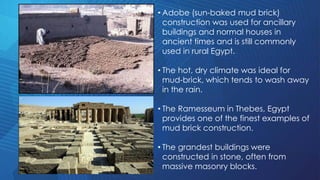
• Adobe (sun-baked mud brick)
construction was used for ancillary
buildings and normal houses in
ancient times and is still commonly
used in rural Egypt.
• The hot, dry climate was ideal for
mud-brick, which tends to wash away
in the rain.
• The Ramesseum in Thebes, Egypt
provides one of the finest examples of
mud brick construction.
• The grandest buildings were
constructed in stone, often from
massive masonry blocks.
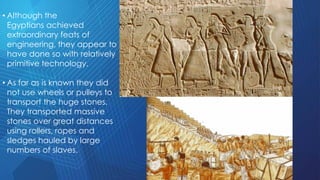
• Although the
Egyptians achieved
extraordinary feats of
engineering, they appear to
have done so with relatively
primitive technology.
• As far as is known they did
not use wheels or pulleys to
transport the huge stones.
They transported massive
stones over great distances
using rollers, ropes and
sledges hauled by large
numbers of slaves.
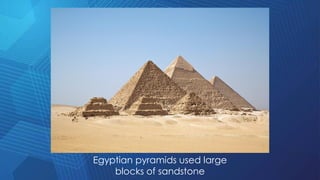
Egyptian pyramids used large
blocks of sandstone
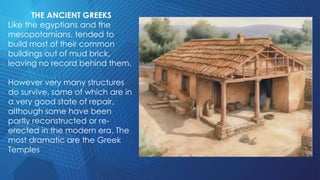
THE ANCIENT GREEKS
Like the egyptians and the
mesopotamians, tended to
build most of their common
buildings out of mud brick,
leaving no record behind them.
However very many structures
do survive, some of which are in
a very good state of repair,
although some have been
partly reconstructed or re-
erected in the modern era. The
most dramatic are the Greek
Temples
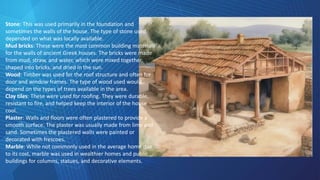
Stone: This was used primarily in the foundation and
sometimes the walls of the house. The type of stone used
depended on what was locally available.
Mud bricks: These were the most common building materials
for the walls of ancient Greek houses. The bricks were made
from mud, straw, and water, which were mixed together,
shaped into bricks, and dried in the sun.
Wood: Timber was used for the roof structure and often for
door and window frames. The type of wood used would
depend on the types of trees available in the area.
Clay tiles: These were used for roofing. They were durable,
resistant to fire, and helped keep the interior of the house
cool.
Plaster: Walls and floors were often plastered to provide a
smooth surface. The plaster was usually made from lime and
sand. Sometimes the plastered walls were painted or
decorated with frescoes.
Marble: While not commonly used in the average home due
to its cost, marble was used in wealthier homes and public
buildings for columns, statues, and decorative elements.
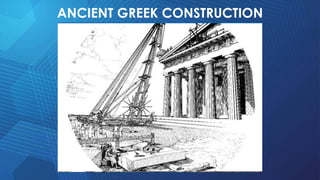
ANCIENT GREEK CONSTRUCTION
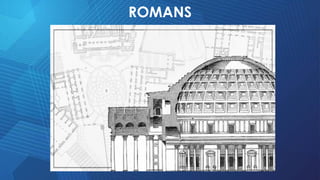
ROMANS
ROMANS
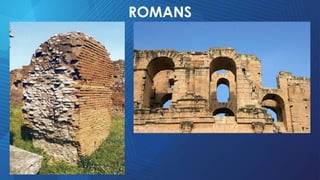
• In striking contrast to previous cultures, an enormous amount is known
about Roman building construction.
• The great Roman breakthrough was the development of hydraulic
lime mortar. They used brick or stone to build the outer skins of the wall
and then filled the cavity with massive amounts of concrete.
• They not only used it for walls but also to form arches, barrel vaults and
domes The Romans developed systems of hollow pots for making their
domes and sophisticated heating and ventilation systems for their
thermal baths.
• Glass was commonly used in windows
ROMANS
VEDIC PERIOD BUDDHIST
Period Gupta Period
VEDIC PERIOD BUDDHIST
Period Gupta Period
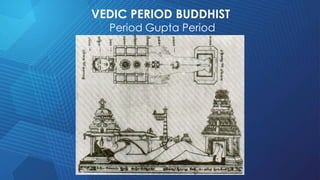
•Houses of the Vedic period were made of
wood with bamboo rigging.
•Roofs were thatched and walls were made of
reed bundles in wooden framework.
•Palace and temple construction brought new
challenges for the ancient Indian builders
VEDIC PERIOD BUDDHIST
Period Gupta Period
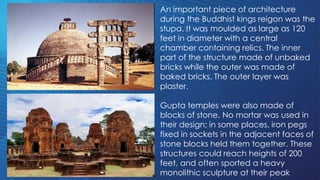
An important piece of architecture
during the Buddhist kings reigon was the
stupa. It was moulded as large as 120
feet in diameter with a central
chamber containing relics. The inner
part of the structure made of unbaked
bricks while the outer was made of
baked bricks. The outer layer was
plaster.
Gupta temples were also made of
blocks of stone. No mortar was used in
their design; in some places, iron pegs
fixed in sockets in the adjacent faces of
stone blocks held them together. These
structures could reach heights of 200
feet, and often sported a heavy
monolithic sculpture at their peak
SEVENTEENTH CENTURY
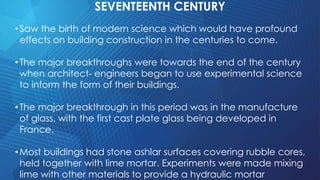
•Saw the birth of modern science which would have profound
effects on building construction in the centuries to come.
•The major breakthroughs were towards the end of the century
when architect- engineers began to use experimental science
to inform the form of their buildings.
•The major breakthrough in this period was in the manufacture
of glass, with the first cast plate glass being developed in
France.
•Most buildings had stone ashlar surfaces covering rubble cores,
held together with lime mortar. Experiments were made mixing
lime with other materials to provide a hydraulic mortar
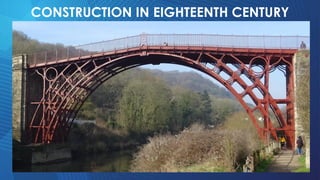
CONSTRUCTION IN EIGHTEENTH CENTURY
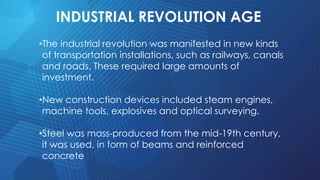
INDUSTRIAL REVOLUTION AGE
•The industrial revolution was manifested in new kinds
of transportation installations, such as railways, canals
and roads. These required large amounts of
investment.
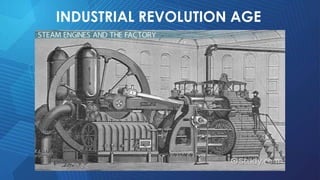
•New construction devices included steam engines,
machine tools, explosives and optical surveying.
•Steel was mass-produced from the mid-19th century,
it was used, in form of beams and reinforced
concrete
INDUSTRIAL REVOLUTION AGE
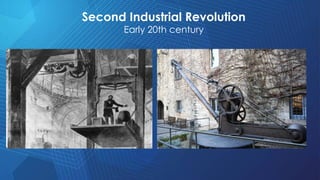
Second Industrial Revolution
Early 20th century
Second Industrial Revolution
Early 20th century
• Elevators and cranes made high rise buildings and skyscrapers possible
• Heavy equipments and power tools decreased the workforce needed.
• computer-aided design.
• Trade unions were formed to protect construction workers' interests.
• Personal protective equipment such as hard hats and earmuffs also came
into use.
• At the end of the 20th century, ecology, energy conservation and
sustainable development have become more important issues of
construction

1 BACKROUND OF CONSTRUCTION.pdf

  • 1.
  • 2.
    • People haveconstructed buildings and other structures since prehistory, including bridges, theatres, dams, roads and canals, etc. • Building materials in past have a long history and some of the structures built thousands of years ago can still be regarded as remarkable.
  • 3.
    • To knowthe buildings age we need to study archaeology. • The absence of metal tools placed limitations on the materials that could be worked, but it was still possible to build quite elaborate stone structures with ingenuity using dry-stone-walling techniques.
  • 5.
    Jericho - lateNeolithic period First Mud Bricks The first mud bricks, formed with the hands rather than wooden moulds, belong to the late Neolithic period and were found in Jericho.
  • 6.
    One of thelargest structures of this period was the Neolithic long house
  • 7.
    CONSTRUCTION IN ANCIENT MESOPOTAMIA •The earliest large-scale buildings for which evidence survives have been found in ancient Mesopotamia. • Major technical achievement is evidenced by the construction of great cities such as Uruk and Ur. • The Ziggurat of Ur is an outstanding building of the period, despite major reconstruction work
  • 8.
    CONSTRUCTION IN ANCIENT MESOPOTAMIA •Another fine example is the ziggurat at Chogha Zanbil in modern Iran • The chief building material was the mud brick, formed in wooden moulds. • Bricks varied widely in size and format from small bricks that could be lifted in one hand to ones as big as large paving slabs. • Drawings survive on clay tablets from later periods showing that buildings were set out on brick modules
  • 9.
    • The laterMesopotamian civilizations, particularly Babylon and thence Susa, developed glazed brickwork to a very high degree. • They used to decorate the interiors and exteriors of their buildings with glazed bricks. the archaeological site in 1932, before major reconstruction work undertaken by Saddam Hussein
  • 10.
    CONSTRUCTION IN ANCIENTEGYPT Egyptians constructed the huge structures in stone
  • 11.
    CONSTRUCTION IN ANCIENTEGYPT Egyptians constructed the huge structures in stone
  • 12.
    • Adobe (sun-bakedmud brick) construction was used for ancillary buildings and normal houses in ancient times and is still commonly used in rural Egypt. • The hot, dry climate was ideal for mud-brick, which tends to wash away in the rain. • The Ramesseum in Thebes, Egypt provides one of the finest examples of mud brick construction. • The grandest buildings were constructed in stone, often from massive masonry blocks.
  • 13.
    • Although the Egyptiansachieved extraordinary feats of engineering, they appear to have done so with relatively primitive technology. • As far as is known they did not use wheels or pulleys to transport the huge stones. They transported massive stones over great distances using rollers, ropes and sledges hauled by large numbers of slaves.
  • 14.
    Egyptian pyramids usedlarge blocks of sandstone
  • 15.
    THE ANCIENT GREEKS Likethe egyptians and the mesopotamians, tended to build most of their common buildings out of mud brick, leaving no record behind them. However very many structures do survive, some of which are in a very good state of repair, although some have been partly reconstructed or re- erected in the modern era. The most dramatic are the Greek Temples
  • 16.
    Stone: This wasused primarily in the foundation and sometimes the walls of the house. The type of stone used depended on what was locally available. Mud bricks: These were the most common building materials for the walls of ancient Greek houses. The bricks were made from mud, straw, and water, which were mixed together, shaped into bricks, and dried in the sun. Wood: Timber was used for the roof structure and often for door and window frames. The type of wood used would depend on the types of trees available in the area. Clay tiles: These were used for roofing. They were durable, resistant to fire, and helped keep the interior of the house cool. Plaster: Walls and floors were often plastered to provide a smooth surface. The plaster was usually made from lime and sand. Sometimes the plastered walls were painted or decorated with frescoes. Marble: While not commonly used in the average home due to its cost, marble was used in wealthier homes and public buildings for columns, statues, and decorative elements.
  • 17.
  • 18.
  • 19.
    ROMANS • In strikingcontrast to previous cultures, an enormous amount is known about Roman building construction. • The great Roman breakthrough was the development of hydraulic lime mortar. They used brick or stone to build the outer skins of the wall and then filled the cavity with massive amounts of concrete. • They not only used it for walls but also to form arches, barrel vaults and domes The Romans developed systems of hollow pots for making their domes and sophisticated heating and ventilation systems for their thermal baths. • Glass was commonly used in windows
  • 20.
  • 21.
  • 22.
    VEDIC PERIOD BUDDHIST PeriodGupta Period •Houses of the Vedic period were made of wood with bamboo rigging. •Roofs were thatched and walls were made of reed bundles in wooden framework. •Palace and temple construction brought new challenges for the ancient Indian builders
  • 23.
  • 24.
    An important pieceof architecture during the Buddhist kings reigon was the stupa. It was moulded as large as 120 feet in diameter with a central chamber containing relics. The inner part of the structure made of unbaked bricks while the outer was made of baked bricks. The outer layer was plaster. Gupta temples were also made of blocks of stone. No mortar was used in their design; in some places, iron pegs fixed in sockets in the adjacent faces of stone blocks held them together. These structures could reach heights of 200 feet, and often sported a heavy monolithic sculpture at their peak
  • 25.
    SEVENTEENTH CENTURY •Saw thebirth of modern science which would have profound effects on building construction in the centuries to come. •The major breakthroughs were towards the end of the century when architect- engineers began to use experimental science to inform the form of their buildings. •The major breakthrough in this period was in the manufacture of glass, with the first cast plate glass being developed in France. •Most buildings had stone ashlar surfaces covering rubble cores, held together with lime mortar. Experiments were made mixing lime with other materials to provide a hydraulic mortar
  • 26.
  • 27.
    INDUSTRIAL REVOLUTION AGE •Theindustrial revolution was manifested in new kinds of transportation installations, such as railways, canals and roads. These required large amounts of investment. •New construction devices included steam engines, machine tools, explosives and optical surveying. •Steel was mass-produced from the mid-19th century, it was used, in form of beams and reinforced concrete
  • 28.
  • 29.
  • 30.
    Second Industrial Revolution Early20th century • Elevators and cranes made high rise buildings and skyscrapers possible • Heavy equipments and power tools decreased the workforce needed. • computer-aided design. • Trade unions were formed to protect construction workers' interests. • Personal protective equipment such as hard hats and earmuffs also came into use. • At the end of the 20th century, ecology, energy conservation and sustainable development have become more important issues of construction