PR-VER-02 v1.0                  Verification Process for SSC Pacific                           8/18/09


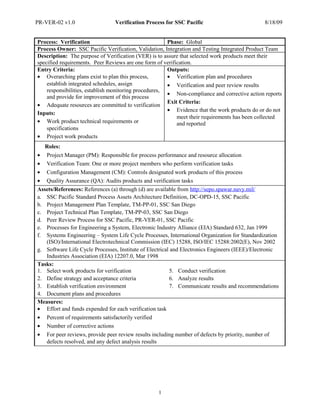
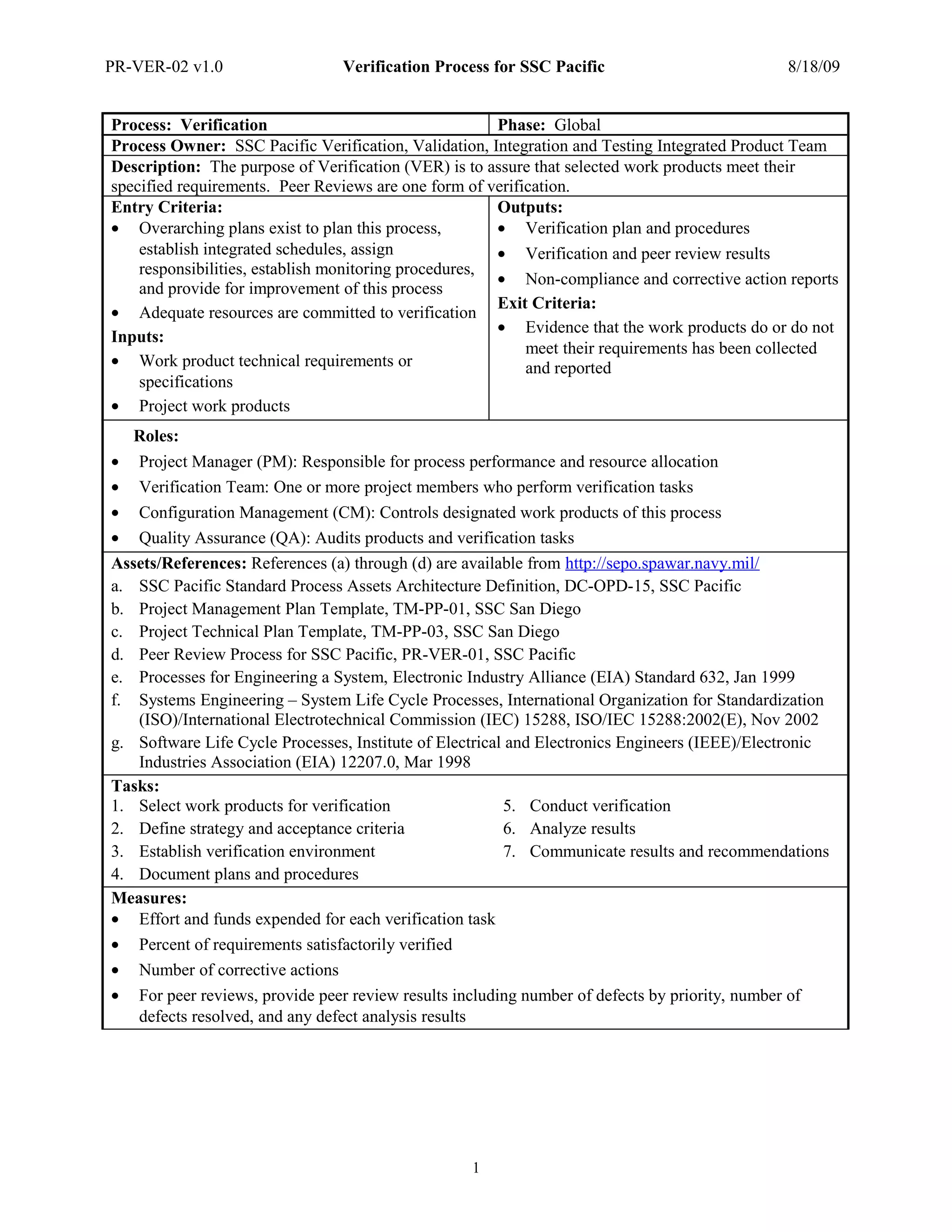
Process: Verification                                  Phase: Global
Process Owner: SSC Pacific Verification, Validation, Integration and Testing Integrated Product Team
Description: The purpose of Verification (VER) is to assure that selected work products meet their
specified requirements. Peer Reviews are one form of verification.
Entry Criteria:                                        Outputs:
• Overarching plans exist to plan this process,        • Verification plan and procedures
    establish integrated schedules, assign             • Verification and peer review results
    responsibilities, establish monitoring procedures,
                                                       • Non-compliance and corrective action reports
    and provide for improvement of this process
                                                       Exit Criteria:
• Adequate resources are committed to verification
                                                       • Evidence that the work products do or do not
Inputs:
                                                           meet their requirements has been collected
• Work product technical requirements or                   and reported
    specifications
• Project work products
   Roles:
• Project Manager (PM): Responsible for process performance and resource allocation
• Verification Team: One or more project members who perform verification tasks
• Configuration Management (CM): Controls designated work products of this process
• Quality Assurance (QA): Audits products and verification tasks
Assets/References: References (a) through (d) are available from http://sepo.spawar.navy.mil/
a. SSC Pacific Standard Process Assets Architecture Definition, DC-OPD-15, SSC Pacific
b. Project Management Plan Template, TM-PP-01, SSC San Diego
c. Project Technical Plan Template, TM-PP-03, SSC San Diego
d. Peer Review Process for SSC Pacific, PR-VER-01, SSC Pacific
e. Processes for Engineering a System, Electronic Industry Alliance (EIA) Standard 632, Jan 1999
f. Systems Engineering – System Life Cycle Processes, International Organization for Standardization
   (ISO)/International Electrotechnical Commission (IEC) 15288, ISO/IEC 15288:2002(E), Nov 2002
g. Software Life Cycle Processes, Institute of Electrical and Electronics Engineers (IEEE)/Electronic
   Industries Association (EIA) 12207.0, Mar 1998
Tasks:
1. Select work products for verification                 5. Conduct verification
2. Define strategy and acceptance criteria               6. Analyze results
3. Establish verification environment                    7. Communicate results and recommendations
4. Document plans and procedures
Measures:
• Effort and funds expended for each verification task
• Percent of requirements satisfactorily verified
• Number of corrective actions
• For peer reviews, provide peer review results including number of defects by priority, number of
   defects resolved, and any defect analysis results


                                                  1
PR-VER-02 v1.0                   Verification Process for SSC Pacific                              8/18/09


INTRODUCTION: This process is included in the SSC Pacific set of standard processes described in the
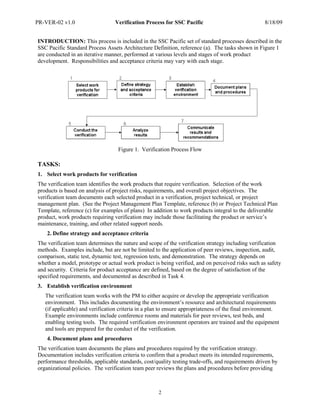
SSC Pacific Standard Process Assets Architecture Definition, reference (a). The tasks shown in Figure 1
are conducted in an iterative manner, performed at various levels and stages of work product
development. Responsibilities and acceptance criteria may vary with each stage.


                                   Figure 1. Verification Process Flow

TASKS:
1. Select work products for verification
The verification team identifies the work products that require verification. Selection of the work
products is based on analysis of project risks, requirements, and overall project objectives. The
verification team documents each selected product in a verification, project technical, or project
management plan. (See the Project Management Plan Template, reference (b) or Project Technical Plan
Template, reference (c) for examples of plans) In addition to work products integral to the deliverable
product, work products requiring verification may include those facilitating the product or service’s
maintenance, training, and other related support needs.
    2. Define strategy and acceptance criteria
The verification team determines the nature and scope of the verification strategy including verification
methods. Examples include, but are not be limited to the application of peer reviews, inspection, audit,
comparison, static test, dynamic test, regression tests, and demonstration. The strategy depends on
whether a model, prototype or actual work product is being verified, and on perceived risks such as safety
and security. Criteria for product acceptance are defined, based on the degree of satisfaction of the
specified requirements, and documented as described in Task 4.
3. Establish verification environment
   The verification team works with the PM to either acquire or develop the appropriate verification
   environment. This includes documenting the environment’s resource and architectural requirements
   (if applicable) and verification criteria in a plan to ensure appropriateness of the final environment.
   Example environments include conference rooms and materials for peer reviews, test beds, and
   enabling testing tools. The required verification environment operators are trained and the equipment
   and tools are prepared for the conduct of the verification.
    4. Document plans and procedures
The verification team documents the plans and procedures required by the verification strategy.
Documentation includes verification criteria to confirm that a product meets its intended requirements,
performance thresholds, applicable standards, cost/quality testing trade-offs, and requirements driven by
organizational policies. The verification team peer reviews the plans and procedures before providing


                                                    2
PR-VER-02 v1.0                    Verification Process for SSC Pacific                             8/18/09


them to CM to be placed under configuration control. The conduct of peer reviews follows the Peer
Review Process, reference (d).
    5. Conduct verification
The verification team carries out the verification consistent with the plans and procedures in a manner
that ensures that verification actions, conditions and outcomes can be replicated. If the appropriate
verification method is a peer review, follow the guidance in reference (d). Records of verification actions
and outcomes are kept and provided to CM to be placed under configuration control. Defect data is
reported using the appropriate change request or trouble report mechanism.
    6. Analyze results
The verification team analyzes the collected verification data, using verification criteria from Task 3, to
identify non-conformance issues and determine needed corrective actions. Defects in the work product or
service’s requirements may be included if the verification team has the appropriate knowledge to make a
determination. Analysis methods, results, recommendations, and status are documented, peer reviewed,
and provided to CM to be placed under configuration control.
    7. Communicate results and recommendations
The PM and verification team communicate verification results and recommendations to appropriate
stakeholders.


                                                     3

Verification process

  • 1.
    PR-VER-02 v1.0 Verification Process for SSC Pacific 8/18/09 Process: Verification Phase: Global Process Owner: SSC Pacific Verification, Validation, Integration and Testing Integrated Product Team Description: The purpose of Verification (VER) is to assure that selected work products meet their specified requirements. Peer Reviews are one form of verification. Entry Criteria: Outputs: • Overarching plans exist to plan this process, • Verification plan and procedures establish integrated schedules, assign • Verification and peer review results responsibilities, establish monitoring procedures, • Non-compliance and corrective action reports and provide for improvement of this process Exit Criteria: • Adequate resources are committed to verification • Evidence that the work products do or do not Inputs: meet their requirements has been collected • Work product technical requirements or and reported specifications • Project work products Roles: • Project Manager (PM): Responsible for process performance and resource allocation • Verification Team: One or more project members who perform verification tasks • Configuration Management (CM): Controls designated work products of this process • Quality Assurance (QA): Audits products and verification tasks Assets/References: References (a) through (d) are available from http://sepo.spawar.navy.mil/ a. SSC Pacific Standard Process Assets Architecture Definition, DC-OPD-15, SSC Pacific b. Project Management Plan Template, TM-PP-01, SSC San Diego c. Project Technical Plan Template, TM-PP-03, SSC San Diego d. Peer Review Process for SSC Pacific, PR-VER-01, SSC Pacific e. Processes for Engineering a System, Electronic Industry Alliance (EIA) Standard 632, Jan 1999 f. Systems Engineering – System Life Cycle Processes, International Organization for Standardization (ISO)/International Electrotechnical Commission (IEC) 15288, ISO/IEC 15288:2002(E), Nov 2002 g. Software Life Cycle Processes, Institute of Electrical and Electronics Engineers (IEEE)/Electronic Industries Association (EIA) 12207.0, Mar 1998 Tasks: 1. Select work products for verification 5. Conduct verification 2. Define strategy and acceptance criteria 6. Analyze results 3. Establish verification environment 7. Communicate results and recommendations 4. Document plans and procedures Measures: • Effort and funds expended for each verification task • Percent of requirements satisfactorily verified • Number of corrective actions • For peer reviews, provide peer review results including number of defects by priority, number of defects resolved, and any defect analysis results 1
  • 2.
    PR-VER-02 v1.0 Verification Process for SSC Pacific 8/18/09 INTRODUCTION: This process is included in the SSC Pacific set of standard processes described in the SSC Pacific Standard Process Assets Architecture Definition, reference (a). The tasks shown in Figure 1 are conducted in an iterative manner, performed at various levels and stages of work product development. Responsibilities and acceptance criteria may vary with each stage. Figure 1. Verification Process Flow TASKS: 1. Select work products for verification The verification team identifies the work products that require verification. Selection of the work products is based on analysis of project risks, requirements, and overall project objectives. The verification team documents each selected product in a verification, project technical, or project management plan. (See the Project Management Plan Template, reference (b) or Project Technical Plan Template, reference (c) for examples of plans) In addition to work products integral to the deliverable product, work products requiring verification may include those facilitating the product or service’s maintenance, training, and other related support needs. 2. Define strategy and acceptance criteria The verification team determines the nature and scope of the verification strategy including verification methods. Examples include, but are not be limited to the application of peer reviews, inspection, audit, comparison, static test, dynamic test, regression tests, and demonstration. The strategy depends on whether a model, prototype or actual work product is being verified, and on perceived risks such as safety and security. Criteria for product acceptance are defined, based on the degree of satisfaction of the specified requirements, and documented as described in Task 4. 3. Establish verification environment The verification team works with the PM to either acquire or develop the appropriate verification environment. This includes documenting the environment’s resource and architectural requirements (if applicable) and verification criteria in a plan to ensure appropriateness of the final environment. Example environments include conference rooms and materials for peer reviews, test beds, and enabling testing tools. The required verification environment operators are trained and the equipment and tools are prepared for the conduct of the verification. 4. Document plans and procedures The verification team documents the plans and procedures required by the verification strategy. Documentation includes verification criteria to confirm that a product meets its intended requirements, performance thresholds, applicable standards, cost/quality testing trade-offs, and requirements driven by organizational policies. The verification team peer reviews the plans and procedures before providing 2
  • 3.
    PR-VER-02 v1.0 Verification Process for SSC Pacific 8/18/09 them to CM to be placed under configuration control. The conduct of peer reviews follows the Peer Review Process, reference (d). 5. Conduct verification The verification team carries out the verification consistent with the plans and procedures in a manner that ensures that verification actions, conditions and outcomes can be replicated. If the appropriate verification method is a peer review, follow the guidance in reference (d). Records of verification actions and outcomes are kept and provided to CM to be placed under configuration control. Defect data is reported using the appropriate change request or trouble report mechanism. 6. Analyze results The verification team analyzes the collected verification data, using verification criteria from Task 3, to identify non-conformance issues and determine needed corrective actions. Defects in the work product or service’s requirements may be included if the verification team has the appropriate knowledge to make a determination. Analysis methods, results, recommendations, and status are documented, peer reviewed, and provided to CM to be placed under configuration control. 7. Communicate results and recommendations The PM and verification team communicate verification results and recommendations to appropriate stakeholders. 3