Generation and Energy Marketing


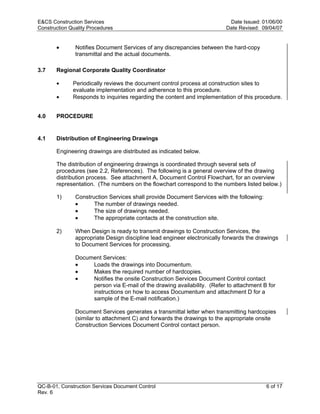
SCGEM Engineering and
 Construction Services


   Construction Quality
   Assurance Program
            &
     Quality Control
       Procedures
Southern Company Generation
                           Engineering and Construction Services
                                   Construction Services
                  Construction QA Program and Quality Control Procedures

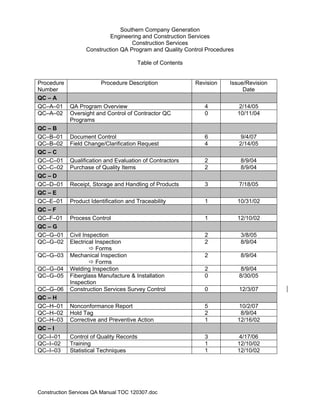
                                      Table of Contents


Procedure               Procedure Description             Revision    Issue/Revision
Number                                                                     Date
QC – A
QC–A–01 QA Program Overview                                  4              2/14/05


                                                                     y
QC–A–02 Oversight and Control of Contractor QC               0             10/11/04
          Programs


                                                          op
QC – B
QC–B–01 Document Control                                     6              9/4/07
QC–B–02 Field Change/Clarification Request                   4             2/14/05


                                                     C
QC – C
QC–C–01 Qualification and Evaluation of Contractors          2              8/9/04
QC–C–02 Purchase of Quality Items                            2              8/9/04
QC – D

QC – E                                       d
QC–D–01 Receipt, Storage and Handling of Products            3             7/18/05
                                   lle
QC–E–01 Product Identification and Traceability              1             10/31/02
QC – F
QC–F–01 Process Control                                      1             12/10/02
                       tro

QC – G
QC–G–01 Civil Inspection                                     2              3/8/05
QC–G–02 Electrical Inspection                                2              8/9/04
                      Forms
            on


QC–G–03 Mechanical Inspection                                2              8/9/04
                      Forms
QC–G–04 Welding Inspection                                   2              8/9/04
QC–G–05 Fiberglass Manufacture & Installation                0             8/30/05
 nc


          Inspection
QC–G–06 Construction Services Survey Control                 0             12/3/07
QC – H
QC–H–01 Nonconformance Report                                5             10/2/07
U


QC–H–02 Hold Tag                                             2              8/9/04
QC–H–03 Corrective and Preventive Action                     1             12/16/02
QC – I
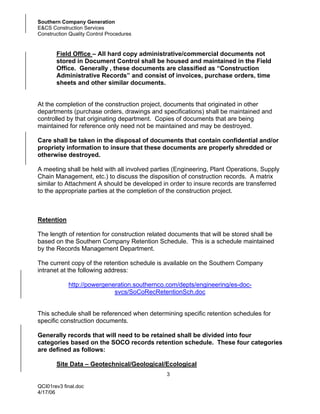
QC–I–01   Control of Quality Records                         3              4/17/06
QC–I–02   Training                                           1             12/10/02
QC–I–03   Statistical Techniques                             1             12/10/02


Construction Services QA Manual TOC 120307.doc
SCG Engineering and Construction Services

                                  Construction Services

                    Construction Quality Control Procedures


                   QC Procedure Number (QC – A – 01)


                   Quality Assurance Program Overview


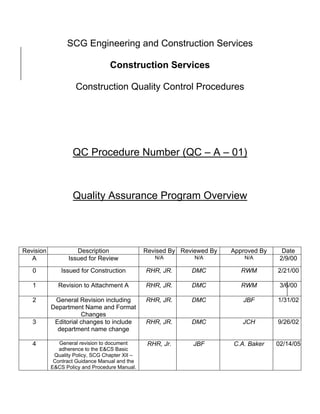
Revision             Description                Revised By Reviewed By   Approved By     Date
   A              Issued for Review                N/A         N/A           N/A        2/9/00
   0           Issued for Construction          RHR, JR.      DMC           RWM        2/21/00

   1         Revision to Attachment A           RHR, JR.      DMC           RWM         3/6/00

   2        General Revision including          RHR, JR.      DMC           JBF        1/31/02
           Department Name and Format
                      Changes
   3        Editorial changes to include        RHR, JR.      DMC           JCH        9/26/02
             department name change

   4          General revision to document       RHR, Jr.     JBF        C.A. Baker    02/14/05
              adherence to the E&CS Basic
            Quality Policy, SCG Chapter XII –
            Contract Guidance Manual and the
           E&CS Policy and Procedure Manual.
SCG E&CS Construction Services
Construction Quality Control Procedures


QC – A – 01
Quality Assurance Program Overview


Purpose

The purpose of this procedure is to outline the construction quality assurance program
of SCG Engineering and Construction Services (E&CS) Construction Services. This
procedure will give an overview of the program, describing overall responsibilities, areas
to be covered by the program and a general list of criteria that will be used to determine
when this QA program will be invoked.


Scope

This procedure sets forth the construction quality program requirements that are to be
applied to work performed by SCG E&CS Construction Services. It is intended that this
QA program will meet the requirements of the SCG Engineering & Construction
Services Basic Quality Policy (BQP) as it relates to Construction Services. It is also
intended that this Program, where applicable, will meet the criteria outlined in the
SCG Chapter XII Contract Guidance Manual.

This Construction QA Program and Quality Control Procedures Manual is Volume
5 of the E&CS Policy and Procedure Manual. The 5 volumes in the E&CS Policy
and Procedure Manual are as follows:

  •   Volume 1:     Corporate Policies and Procedures
  •   Volume 2:     Site Administration Policies and Procedures
  •   Volume 3:     Construction and Contract Administration Policies and Procedures
  •   Volume 4:     Environmental, Health and Safety Policies and Procedures
  •   Volume 5:     Construction QA Program and Quality Control Procedures

ISO 9001 has been used as a reference and guideline, but this program is not designed
to meet the requirements of ISO 9001. A list of procedures included in this QA program
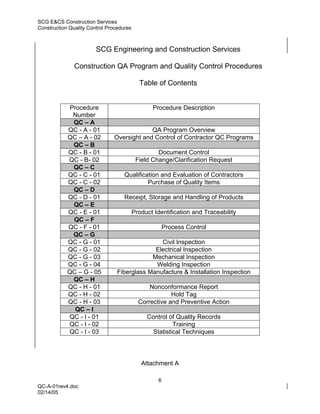
is shown as Attachment A to this procedure.


Responsibility

The decision to implement this QA program for a particular construction job will be
made at the sole discretion of the management of SCG E&CS Construction Services.
The decision to implement this program (or any part of this program) for a particular job
will be based on, but will not be limited to, the following criteria:

                                            1
QC-A-01rev4.doc
02/14/05
SCG E&CS Construction Services
Construction Quality Control Procedures

    •      Size and cost of the project
    •      Effect of the project on the overall goals of the Southern Company
    •      Critical nature of the job (quality/safety)

The implementation of this QA program will be initiated by a “letter to file” from the
appropriate management of SCG E&CS Construction Services. This letter will outline
the areas of the program appropriate for the particular job. Refer to Attachment D for
a sample letter.

The decision to “Stop Work” resides with the management of SCG Engineering and
Construction Services and is no way affected by the decision to implement or not
implement this QA Program.


Construction Site Organizational Structure

Each construction site shall have at least one E&CS Construction
Services QC representative or individual identified as the QA/QC contact.
Depending on the construction site, this QA/QC function may be
expanded to include additional personnel as dictated by the size of the
project and/or scope of work activities. The organizational structure for
the project shall be aligned in such a manner as to allow the on site QC
representative the necessary autonomy to perform the QA/QC function in
an unbiased manner.

In addition, the onsite E&CS Construction Services QC representative will
work with the Corporate QC Coordinator to conduct periodic assessments
of the overall QA/QC implementation for the project.


Program Implementation

Implementation of the Construction Services QA/QC Program on a particular job
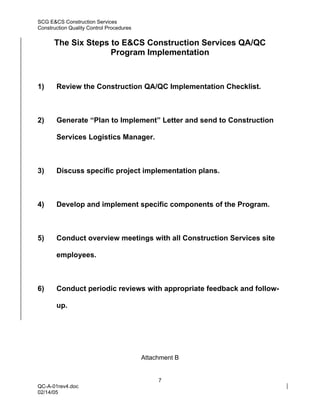
site will generally following the six steps listed on Attachment B and outlined
below.

•   Step 1: Review the Construction QA/QC Implementation Checklist
    (Attachment C) – This checklist should be used as a discussion guide by
    Construction Site Management, the Corporate QC Coordinator and the Project
    Manager to insure that all aspects of the Program are being considered.

•   Step 2: Generate “Plan to Implement” Letter (Attachment D) and send to
    Construction Services Logistics Manager – This letter should be used to
    document the intent to implement the Program and any anticipated deviations
    from full implementation. Copies of the letter should be sent to the Regional


                                            2
QC-A-01rev4.doc
02/14/05
SCG E&CS Construction Services
Construction Quality Control Procedures

    Construction Manager, the Project Manager, the Corporate QC Coordinator
    and onsite Document Control.

•   Step 3: Discuss specific project implementation plans –Construction Site
    Management with assistance from the Corporate QC Coordinator should
    discuss specific implementation plans for the particular construction project.

•   Step 4: Develop and implement specific components of the Program –
    Construction Site Management should develop site specific plans based on
    discussions in step 3 above and assign responsibilities for implementation.

•   Step 5: Conduct overview meetings with all Construction Services site
    employees – At some point in the six step process, the Corporate QC
    Coordinator will generally conduct an overview meeting on the generic QA/QC
    Program. If the majority of the onsite Construction Services personnel are not
    familiar with the QA/QC Program, this overview could occur earlier in the six
    step process. However, holding the overview meeting at this stage allows
    Construction Site Management to interject specific requirements and
    responsibilities for the particular construction site. Attendance in this
    overview meeting will be documented in the individual’s training records in
    SHIPS.

•   Step 6: Conduct periodic reviews with appropriate feedback and followup to
    Construction Site Management. – The Corporate QC Coordinator with
    assistance from the on site QC representative will conduct periodic
    assessments of the onsite Program implementation. Tools for these
    assessments will be the implementation checklist (attachment C) and process
    observations based on specific components of the QA/QC Program. Results
    of the assessments will be shared with site Construction Management and will
    be used as the basis for future assessments.


Quality Assessments

Various reviews and assessments will be carried out to verify that Construction
Services projects are following the requirements of the Construction Services
QA/QC Program. These reviews and/or assessments will consist of, but not be
limited to, the following:

•   Assessments conducted by the E&CS Manager QA in accordance with the
    E&CS Basic Quality Policy

•   Assessments associated with Sarbanes Oxley required controls

•   Assessments associated with administrative procedure 3H – Site Assessment
    and Peer Review
                                          3
QC-A-01rev4.doc
02/14/05
SCG E&CS Construction Services
Construction Quality Control Procedures


•   Periodic assessments performed by the Construction Services QC
    Coordinator as outlined in Step 6 of the Implementation Process above.

•   On site assessments conducted by Construction Site Management


•   Approvals and Revisions

Procedures issued for review and comment will be identified with an “alpha” revision
designation. Procedures approved for use will be issued with a numerical revision
designation, beginning with “0”. All procedures approved for use will be dated and
contain the initials and/or signature of the following:

    •      Person who prepared or revised the procedure
    •      Construction Logistics Manager or designee
    •      Vice President Construction Services or designee

A brief description of the reason for a revision will be given on the cover sheet along
with appropriate approvals. Material within a procedure that has been revised or added
will be indicated with “bold” type and a “bar” ( ).


Distribution of the Manual

As outlined in administrative procedure 1A – Policy and Procedure Manual
Overview, there will not be a controlled distribution of this Manual. The web copy
of the Manual will always be up-to-date and will contain the latest revision of all
procedures. The web version of this Manual can be accessed from the
Construction Services home page. Refer to Attachment E for the steps in
accessing the Construction Services home page and the QA Manual.

Notification of newly approved or revised procedures will be via an email
distribution list. It will be the responsibility of the Users of this Manual to access
and/or print the approved or revised procedures from the web.


Document Control

For document control and record keeping purposes, the original signed
procedures shall be maintained in a notebook by the Construction Logistics
Manager or designee. This designee will generally be the Corporate QC
Coordinator.

As procedures are revised, the voided procedures shall be marked “VOID” on the
cover page, removed from the “Current” notebook and placed in a second
                                           4
QC-A-01rev4.doc
02/14/05
SCG E&CS Construction Services
Construction Quality Control Procedures

“Voided” notebook. By definition, the “Current” notebook shall contain only the
original signed copies of the current revision of all procedures. The “Voided”
notebook shall contain all revisions of the voided original procedures.


                                          5
QC-A-01rev4.doc
02/14/05
SCG E&CS Construction Services
Construction Quality Control Procedures


                        SCG Engineering and Construction Services

               Construction QA Program and Quality Control Procedures

                                            Table of Contents


             Procedure                           Procedure Description
              Number
              QC – A
            QC - A - 01                     QA Program Overview
            QC – A - 02        Oversight and Control of Contractor QC Programs
              QC – B
            QC - B - 01                            Document Control
            QC - B- 02                     Field Change/Clarification Request
              QC – C
            QC - C - 01             Qualification and Evaluation of Contractors
            QC - C - 02                      Purchase of Quality Items
              QC – D
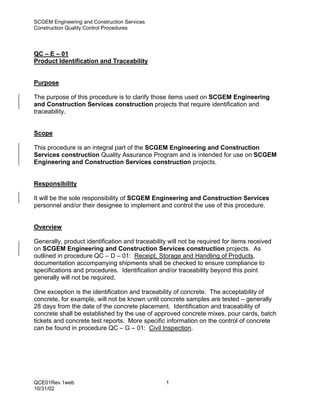
            QC - D - 01             Receipt, Storage and Handling of Products
              QC – E
            QC - E - 01                   Product Identification and Traceability
              QC – F
            QC - F - 01                                 Process Control
              QC – G
            QC - G - 01                         Civil Inspection
            QC - G - 02                       Electrical Inspection
            QC - G - 03                      Mechanical Inspection
            QC - G - 04                       Welding Inspection
            QC – G - 05          Fiberglass Manufacture & Installation Inspection
              QC – H
            QC - H - 01                         Nonconformance Report
            QC - H - 02                                 Hold Tag
            QC - H - 03                     Corrective and Preventive Action
               QC – I
            QC - I - 01                        Control of Quality Records
            QC - I - 02                                  Training
            QC - I - 03                          Statistical Techniques


                                             Attachment A

                                                    6
QC-A-01rev4.doc
02/14/05
SCG E&CS Construction Services
Construction Quality Control Procedures


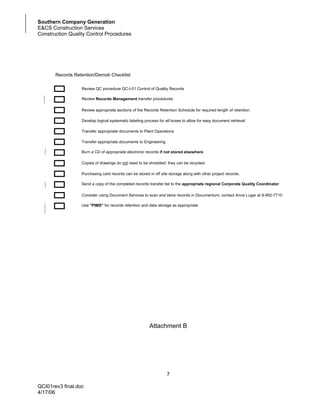
      The Six Steps to E&CS Construction Services QA/QC
                    Program Implementation


1)     Review the Construction QA/QC Implementation Checklist.


2)     Generate “Plan to Implement” Letter and send to Construction

       Services Logistics Manager.


3)     Discuss specific project implementation plans.


4)     Develop and implement specific components of the Program.


5)     Conduct overview meetings with all Construction Services site

       employees.


6)     Conduct periodic reviews with appropriate feedback and follow-

       up.


                                          Attachment B


                                               7
QC-A-01rev4.doc
02/14/05
SCG E&CS Construction Services
Construction Quality Control Procedures

      SCG ENGINEERING AND CONSTRUCTION SERVICES
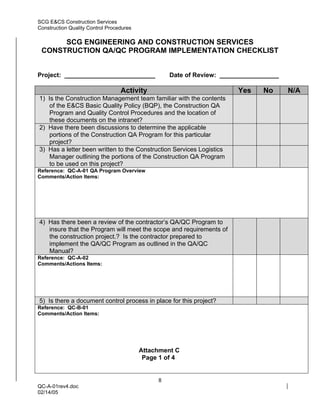
 CONSTRUCTION QA/QC PROGRAM IMPLEMENTATION CHECKLIST


Project: __________________________                Date of Review: _________________

                                  Activity                             Yes     No      N/A
1) Is the Construction Management team familiar with the contents
    of the E&CS Basic Quality Policy (BQP), the Construction QA
    Program and Quality Control Procedures and the location of
    these documents on the intranet?
2) Have there been discussions to determine the applicable
    portions of the Construction QA Program for this particular
    project?
3) Has a letter been written to the Construction Services Logistics
    Manager outlining the portions of the Construction QA Program
    to be used on this project?
Reference: QC-A-01 QA Program Overview
Comments/Action Items:


4) Has there been a review of the contractor’s QA/QC Program to
   insure that the Program will meet the scope and requirements of
   the construction project.? Is the contractor prepared to
   implement the QA/QC Program as outlined in the QA/QC
   Manual?
Reference: QC-A-02
Comments/Actions Items:


5) Is there a document control process in place for this project?
Reference: QC-B-01
Comments/Action Items:


                                          Attachment C
                                           Page 1 of 4


                                               8
QC-A-01rev4.doc
02/14/05
SCG E&CS Construction Services
Construction Quality Control Procedures

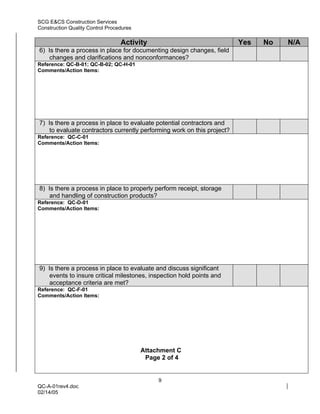
                                  Activity                               Yes   No   N/A
6) Is there a process in place for documenting design changes, field
    changes and clarifications and nonconformances?
Reference: QC-B-01; QC-B-02; QC-H-01
Comments/Action Items:


7) Is there a process in place to evaluate potential contractors and
    to evaluate contractors currently performing work on this project?
Reference: QC-C-01
Comments/Action Items:


8) Is there a process in place to properly perform receipt, storage
    and handling of construction products?
Reference: QC-D-01
Comments/Action Items:


9) Is there a process in place to evaluate and discuss significant
    events to insure critical milestones, inspection hold points and
    acceptance criteria are met?
Reference: QC-F-01
Comments/Action Items:


                                          Attachment C
                                           Page 2 of 4


                                               9
QC-A-01rev4.doc
02/14/05
SCG E&CS Construction Services
Construction Quality Control Procedures

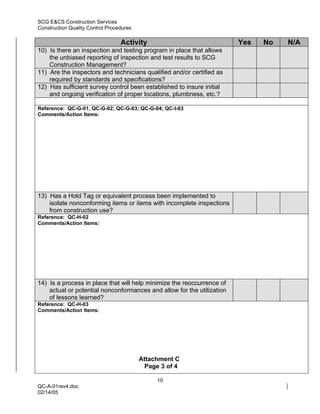
                                  Activity                              Yes   No   N/A
10) Is there an inspection and testing program in place that allows
    the unbiased reporting of inspection and test results to SCG
    Construction Management?
11) Are the inspectors and technicians qualified and/or certified as
    required by standards and specifications?
12) Has sufficient survey control been established to insure initial
    and ongoing verification of proper locations, plumbness, etc.?

Reference: QC-G-01, QC-G-02; QC-G-03; QC-G-04; QC-I-03
Comments/Action Items:


13) Has a Hold Tag or equivalent process been implemented to
    isolate nonconforming items or items with incomplete inspections
    from construction use?
Reference: QC-H-02
Comments/Action Items:


14) Is a process in place that will help minimize the reoccurrence of
    actual or potential nonconformances and allow for the utilization
    of lessons learned?
Reference: QC-H-03
Comments/Action Items:


                                          Attachment C
                                           Page 3 of 4

                                               10
QC-A-01rev4.doc
02/14/05
SCG E&CS Construction Services
Construction Quality Control Procedures

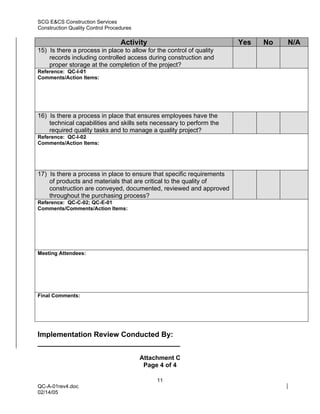
                                  Activity                             Yes   No   N/A
15) Is there a process in place to allow for the control of quality
    records including controlled access during construction and
    proper storage at the completion of the project?
Reference: QC-I-01
Comments/Action Items:


16) Is there a process in place that ensures employees have the
    technical capabilities and skills sets necessary to perform the
    required quality tasks and to manage a quality project?
Reference: QC-I-02
Comments/Action Items:


17) Is there a process in place to ensure that specific requirements
    of products and materials that are critical to the quality of
    construction are conveyed, documented, reviewed and approved
    throughout the purchasing process?
Reference: QC-C-02; QC-E-01
Comments/Comments/Action Items:


Meeting Attendees:


Final Comments:


Implementation Review Conducted By:
___________________________________

                                          Attachment C
                                           Page 4 of 4

                                               11
QC-A-01rev4.doc
02/14/05
SCG E&CS Construction Services
Construction Quality Control Procedures


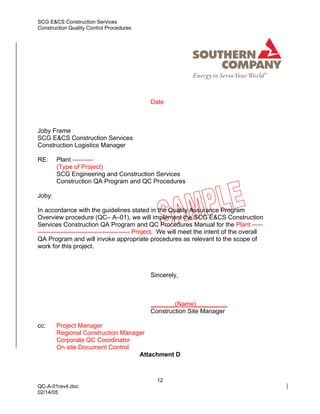
                                              Date


Joby Frame
SCG E&CS Construction Services
Construction Logistics Manager

RE:     Plant ----------
        (Type of Project)
        SCG Engineering and Construction Services
        Construction QA Program and QC Procedures

Joby:

In accordance with the guidelines stated in the Quality Assurance Program
Overview procedure (QC– A–01), we will implement the SCG E&CS Construction
Services Construction QA Program and QC Procedures Manual for the Plant -----
-------------------------------------------- Project. We will meet the intent of the overall
QA Program and will invoke appropriate procedures as relevant to the scope of
work for this project.


                                              Sincerely,


                                              _______(Name)_________
                                              Construction Site Manager

cc:     Project Manager
        Regional Construction Manager
        Corporate QC Coordinator
        On site Document Control
                                   Attachment D


                                                12
QC-A-01rev4.doc
02/14/05
SCG E&CS Construction Services
Construction Quality Control Procedures


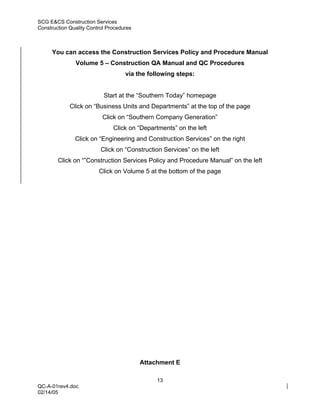
     You can access the Construction Services Policy and Procedure Manual
               Volume 5 – Construction QA Manual and QC Procedures
                                    via the following steps:


                           Start at the “Southern Today” homepage
             Click on “Business Units and Departments” at the top of the page
                          Click on “Southern Company Generation”
                               Click on “Departments” on the left
               Click on “Engineering and Construction Services” on the right
                          Click on “Construction Services” on the left
        Click on “”Construction Services Policy and Procedure Manual” on the left
                         Click on Volume 5 at the bottom of the page


                                          Attachment E

                                               13
QC-A-01rev4.doc
02/14/05
SCGEM Engineering and Construction Services

                                   Construction Services

                    Construction Quality Control Procedures


                   QC Procedure Number (QC – A – 02)


           Oversight and Control of Contractor QC Programs


Revision          Description          Revised By Reviewed By   Approved By    Date
   A           Issued for Review       R. Reynolds     N/A          N/A       8/18/04

   0         Issued for Construction   R. Reynolds   J. Frame     A. Baker    10/11/04
SCGEM E&CS Construction Services
Construction Quality Control Procedures


QC – A - 02
Oversight and Control of Contractor QC Programs


Purpose

The purpose of this procedure is to outline the guidelines for providing oversight and
control of a contractor’s quality control program on SCGEM E&CS Construction
Services construction projects.


Scope

This procedure is to be used by SCGEM E&CS Construction Services to manage and
evaluate a contractor’s quality control program. The Construction Services QA/QC
Program will be used as a benchmark to gauge the completeness of the contractor’s
program. The contractor’s program, as a minimum, should contain components that
mirror the Construction Services QA Program.

This procedure is an integral part of the SCGEM E&CS Construction Services
construction Quality Assurance Program and is intended for use on SCGEM
Engineering and Construction Services construction projects.


Responsibility

It will be the responsibility of SCGEM Engineering and Construction Services personnel
and/or their designee to implement and control the use of this procedure. It will be the
responsibility of the contractors performing work on E&CS construction sites to
implement their quality control program as outlined in their quality control manual.


Construction Projects with Prime Contractors

As part of the initial bid package, potential contractors are instructed to prepare their bids to
include an on site QC program that contains, as a minimum, components that mirror the
Construction Services QA Program.

Upon award of a contract, the contractor will be expected to implement their QC
program as outlined in their QC manual. Generally, it is expected that QC inspection in
the field will be performed by the Contractor supplemented, as needed, with 3rd party
testing personnel hired by the Contractor.

On site E&CS Construction Services personnel will perform periodic QA surveillance of
the Contractor’s program and the Contractor’s completed work. This QA surveillance
should include all aspects of the Contractor’s program as outlined in the Contractor’s
qca02rev0.doc                                     1
10/11/04
SCGEM E&CS Construction Services
Construction Quality Control Procedures

QC Manual. As a general rule, Construction Services personnel should perform QA
surveillance/inspection on a minimum of 10% of the work accepted as complete by the
Contractor’s QC group. The percentage and frequency of these inspections should be
increased, as necessary, based on such factors as:

   ♦ scope and criticality of the work
   ♦ contractor’s previous performance
   ♦ site specific and/or industry standards or requirements

If the results of the QA surveillance indicate issues with the contractor’s performance,
the contractor shall be immediately notified and steps shall be taken to identify and
correct the cause of the problems. There shall be an increase in QA surveillance by
Construction Services until such time as the results of the surveillance indicate a
sustainable improvement in the contractor’s performance.

Whenever possible, the number of inspections required should be calculated based on
a defined number of possible inspections, for example:

   ♦   number of bolted connections
   ♦   number of welds
   ♦   number of terminations
   ♦   number of structural members received and accepted
   ♦   number of hanger supports

In addition the Corporate QC Coordinator will work with the onsite E&CS Construction
Services QC representative to conduct periodic assessments of the overall QA/QC
implementation for the project.

Qualifications of QC Personnel

It will be the responsibility of the contractor to employ qualified inspection personnel in
sufficient numbers to properly staff the job. The qualifications of these individuals shall
be submitted to Construction Services for review. In addition, as the need arises, the
contractor will be responsible for hiring a qualified 3rd party testing agency to
supplement QC staffing requirements. The qualifications of this agency along with the
qualifications of inspectors/technicians assigned to the construction project shall be
submitted to Construction Services for review.

Contractor’s QC Organization

The contractor’s on site organization shall be structured in such a manner as to allow
the QC personnel the necessary autonomy to perform inspections and tests in an
unbiased manner.


qca02rev0.doc                                     2
10/11/04
SCGEM E&CS Construction Services
Construction Quality Control Procedures

Inspection and Testing Plan

The contractor shall submit to Construction Services an inspection and testing plan
related to the scope of work being performed. This plan shall include, as a minimum,
such items as:

   ♦ type and frequency of testing or inspections
   ♦ proposed routing of completed and/or in process inspection documentation to
     verify contractor QC acceptance
   ♦ timely routing and distribution of 3rd party inspection and test reports
   ♦ hold points for in process operations to allow time for Construction Services
     inspection, review or periodic QA surveillance
   ♦ timely submittal of completed inspections to allow time for Construction Services
     inspection, review or periodic QA surveillance
   ♦ copies of proposed forms, checklists and reports*
   ♦ types and methods of transmittals
   ♦ responsible parties

   *Construction Services forms, checklists and reports may be used in lieu of
    contractor’s documents if mutually agreeable


Labor Broker Construction Projects

In a labor broker arrangement, the E&CS Construction Services QA Program and QC
Procedures will be the governing documents for all non ASME work performed on the
project. All ASME code work performed on the project shall be in accordance with the
labor broker’s ASME Quality Control Manual. The labor broker’s ASME Quality Control
Manual shall meet the requirements of the ASME Boiler and Pressure Vessel Code,
Sections I, B31.1, and VIII, Division 1, the National Board Inspection Code and
Jurisdictional requirements and shall be the governing document in all Code related
work on the project.

A site specific overview procedure should be written that:

    ♦ encompasses the relevant portions of the labor broker’s QA/QC program via
      addendums
    ♦ links the site specific QA Program to the overall Corporate E&CS Construction
      Services QA Program
    ♦ defines the scope and parameters of the site specific QA Program as noted
      above
    ♦ defines site specific roles and responsibilities
    ♦ outlines the review, approval and controlled distribution process for the site
      specific QA Manual


qca02rev0.doc                                   3
10/11/04
SCGEM E&CS Construction Services
Construction Quality Control Procedures

Generally speaking, this site specific procedure should be modeled after quality control
procedure QC-A-01. To maintain continuity with the Corporate QA Program, this site
specific overview procedure should be entitled: QC-A-00: Site Specific QA/QC
Program Overview.

Distribution and control of this site specific QA Program Manual shall be controlled by
on site Construction Services Management by the method most appropriate for the
project (i.e. web site, S drive, hard copy).

In order to instill Quality as part of the job, it is anticipated that initial QC inspection will
be performed by the crafts performing the work. Verification of QC inspection and QA
oversight will be performed by E&CS Construction Services management personnel.

Each construction site shall have at least one E&CS Construction Services QC
representative. Depending on the construction site, this QA/QC function may be
expanded to include additional personnel as dictated by the division of work activities
among the craft and Construction Services personnel. The organizational structure for
the project shall be aligned in such a manner as to allow the on site QC representative
the necessary autonomy to perform the QA/QC function in an unbiased manner.

In addition, the Corporate QC Coordinator will work with the onsite E&CS Construction
Services QC representative to conduct periodic assessments of the overall QA/QC
implementation for the project.


Document Control

All contractor and 3rd party completed inspection and testing reports shall be submitted
to Construction Services in a timely and controlled manner. These documents shall be
assembled into appropriate turnover packages as outlined in administrative procedure
3G – Processing Startup Packages. At the completion of the construction project, this
documentation shall be processed in accordance with procedure QC – I – 01: Control
of Quality Records.


qca02rev0.doc                                        4
10/11/04
Southern Company Generation

                Engineering and Construction Services

                            Construction Services

               Construction Services Quality Procedures


                                                              y
                                                 op
                           Procedure QC–B–01


                                          C
           Construction Services Document Control
                                        d
                                  lle
                   Rev. 6                  Rev. 5
Date               9/4/07                  8/16/06
Revised By         R.H. Reynolds, Jr.      R.H. Reynolds Jr
Reviewed By
                     tro

Construction       T.L. Magnus             T.L. Magnus
Approved By
Construction       K.D. Russell            D.L. McKinney
               on
  nc
U
E&CS Construction Services                                                                                  Date Issued: 01/06/00
Construction Quality Procedures                                                                            Date Revised: 09/04/07


                                                              Contents


1.0   PURPOSE AND SCOPE ..................................................................................................3
  1.1   Purpose .........................................................................................................................3
  1.2   Scope ............................................................................................................................3

2.0   DEFINTIONS AND REFERENCES ..................................................................................4
  2.1   Definitions......................................................................................................................4


                                                                                                           y
  2.2   References ....................................................................................................................4


                                                                                          op
3.0   RESPONSIBiLITY.............................................................................................................4
  3.1   Construction Services ...................................................................................................5
  3.2   Recipients of Controlled Documents .............................................................................5
  3.3   Construction Services Construction Site Manager........................................................5
  3.4   Construction Services Site Quality Lead .......................................................................5


                                                                                C
  3.5   Document Services .......................................................................................................5
  3.6   Construction Services Document Control .....................................................................5
  3.7   Regional Corporate Quality Coordinator .......................................................................6

4.0
  4.1                                                              d
      PROCEDURE ...................................................................................................................5
        Distribution of Engineering Drawings ............................................................................6
                                                    lle
  4.2   Design Change Notices (DCN) .....................................................................................8
  4.3   Advance Print ................................................................................................................8
  4.4   Printing of Drawings from Documentum........................................................................8
  4.5   CD Copies of Drawings .................................................................................................9
                                  tro

  4.6   Miscellaneous Document Transmittal Tracking System................................................9
  4.7   Assessment of Document Control...............................................................................10

5.0       KEY CONTACTS ............................................................................................................10
                 on


6.0       QUALITY RECORDS ......................................................................................................10

7.0       ATTACHMENTS .............................................................................................................10
 nc
U


QC-B-01, Construction Services Document Control                                                                                  2 of 17
Rev. 6
E&CS Construction Services                                                 Date Issued: 01/06/00
Construction Quality Procedures                                           Date Revised: 09/04/07


1.0    PURPOSE AND SCOPE


1.1    Purpose

       This procedure documents the proper distribution of controlled documents issued to and
       distributed on Engineering and Construction Services (E&CS) construction sites.


                                                                          y
       This procedure is an integral part of the E&CS Construction Services construction
       Quality Assurance program. This procedure documents the processes in place on


                                                              op
       construction projects using hard-copy transmittals and copies of drawings distributed by
       E&CS Document Services. This procedure also documents the electronic transmittal
       notification process, the printing of drawings directly from Documentum, and the use of
       PIMS for document control.


                                                       C
1.2    Scope


                                                  d
       This procedure affects all E&CS Construction Services personnel and contractors who
       work for them. For this procedure, controlled documents shall include, but are not
                                    lle
       limited to, the following:

       •       Engineering and Construction Services drawings and other controlled documents
               issued by E&CS Document Services via Documentum.
                         tro

       •       Documents received from the contractors performing work on E&CS construction
               sites.

       •       Documents distributed by Construction Services onsite personnel to the
            on


               contractors performing work on E&CS construction sites.

       •       Design Change Notices (DCN), Construction Miscellaneous Transmittal Forms
               (CMTF), and other documents utilizing the Project Information Management
               System (PIMS).
 nc


       •       Advance prints the Design organization transmits to or makes available to
               Construction Services.
U


QC-B-01, Construction Services Document Control                                            3 of 17
Rev. 6
E&CS Construction Services                                                Date Issued: 01/06/00
Construction Quality Procedures                                          Date Revised: 09/04/07


2.0    DEFINTIONS AND REFERENCES


2.1    Definitions

       advance print – A drawing transmitted by Design instead of Document Control.
             Examples include an in-process drawing or an official drawing being transmitted
             early.

       Construction Miscellaneous Transmittal Form (CMTF) – A PIMS-generated form used by


                                                                         y
              Construction Services and contractors to transmit contract deliverables and other
              miscellaneous documents.


                                                              op
       Design Change Notice (DCN) – A PIMS-generated form Design uses to transmit
              advance engineering design information to Construction Services prior to a
              formal drawing revision.


                                                      C
       Documentum – A document management system supported by E&CS Document
            Services. Documentum is the repository for official quality records.


                                                  d
       Project Information Management System (PIMS) – A Web-based document and data
               management system used by E&CS to manage documentation generated during
               the life cycle of a construction project to include engineering design,
                                    lle
               procurement, and construction.

       Transmittal Tracking Database – A Microsoft® Access database used for the generation
             and tracking of site document transmittals.
                         tro

2.2    References
            on


       E&CS Basic Quality Program
       Design Procedure D2-03, Domestic Drawing Process
       Design Procedure D2-09, Vendor Document Processing
       Design Procedure D3-02, Preparation and Distribution of Design Change Notices
       Construction Services Procedure QC-H-01, Nonconformance Report
 nc


       Construction Services Procedure QC-I-01, Control of Quality Records
       Procedure DS 3-1, Document Transmittal
       PIMS Guideline 3-A, Design Change Notice
       PIMS Guideline 2-H, Construction Miscellaneous Transmittal Form (under development)
U


       Transmittal Tracking Access Database Instruction Manual


QC-B-01, Construction Services Document Control                                            4 of 17
Rev. 6
E&CS Construction Services                                                 Date Issued: 01/06/00
Construction Quality Procedures                                           Date Revised: 09/04/07


3.0    RESPONSIBILITY


3.1    Construction Services

       Construction Services shall maintain this Construction Services procedure. Prior to the
       transmittal of any documents, Construction Services shall notify Document Services of
       the following:

       •       The number of documents needed.


                                                                          y
       •       The contact employees at the job site.
       •       In the case of drawings, the number of each size needed.


                                                              op
3.2    Recipients of Controlled Documents


                                                       C
       Recipients of controlled documents shall be responsible for:

       •       Updating controlled documents when issued.
       •       Destroying or marking voided documents when new drawing revisions are
               issued.
                                                  d
                                    lle
3.3    Construction Services Construction Site Manager

       The Construction Services construction site manager or designee shall be responsible
       for implementing and ensuring adherence to the scope and requirements of this
                         tro

       procedure.


3.4    Construction Services Site Quality Lead
            on


       The Construction Services site quality lead or designee shall be responsible for ensuring
       quality preplanning, monitoring, and administration of this procedure.
 nc


3.5    Document Services

       •       Notifies the onsite Construction Services Document Control contact person of
U


               document availability via E-mail.
       •       Generates transmitted letters for hard-copy transmittals and forwards them to
               onsite Construction Services Document Control contact person.

3.6    Construction Services Document Control

       •       Receives E-mail from Document Services of document availability.
       •       Reviews transmitted hardcopy for accuracy and completeness.


QC-B-01, Construction Services Document Control                                           5 of 17
Rev. 6
E&CS Construction Services                                                 Date Issued: 01/06/00
Construction Quality Procedures                                           Date Revised: 09/04/07


       •       Notifies Document Services of any discrepancies between the hard-copy
               transmittal and the actual documents.

3.7    Regional Corporate Quality Coordinator

       •      Periodically reviews the document control process at construction sites to
              evaluate implementation and adherence to this procedure.
       •      Responds to inquiries regarding the content and implementation of this procedure.


                                                                          y
4.0    PROCEDURE


                                                               op
4.1    Distribution of Engineering Drawings

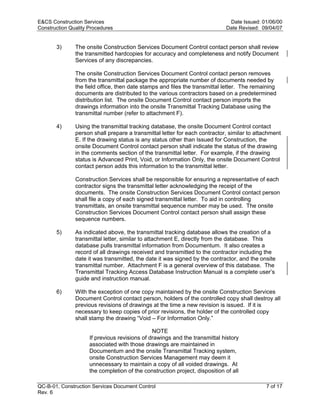
       Engineering drawings are distributed as indicated below.


                                                       C
       The distribution of engineering drawings is coordinated through several sets of
       procedures (see 2.2, References). The following is a general overview of the drawing
       distribution process. See attachment A, Document Control Flowchart, for an overview

                                                  d
       representation. (The numbers on the flowchart correspond to the numbers listed below.)
                                    lle
       1)      Construction Services shall provide Document Services with the following:
               •      The number of drawings needed.
               •      The size of drawings needed.
               •      The appropriate contacts at the construction site.
                         tro

       2)      When Design is ready to transmit drawings to Construction Services, the
               appropriate Design discipline lead engineer electronically forwards the drawings
               to Document Services for processing.
            on


               Document Services:
               •    Loads the drawings into Documentum.
               •    Makes the required number of hardcopies.
               •    Notifies the onsite Construction Services Document Control contact
 nc


                    person via E-mail of the drawing availability. (Refer to attachment B for
                    instructions on how to access Documentum and attachment D for a
                    sample of the E-mail notification.)
U


               Document Services generates a transmittal letter when transmitting hardcopies
               (similar to attachment C) and forwards the drawings to the appropriate onsite
               Construction Services Document Control contact person.


QC-B-01, Construction Services Document Control                                            6 of 17
Rev. 6
E&CS Construction Services                                                    Date Issued: 01/06/00
Construction Quality Procedures                                              Date Revised: 09/04/07


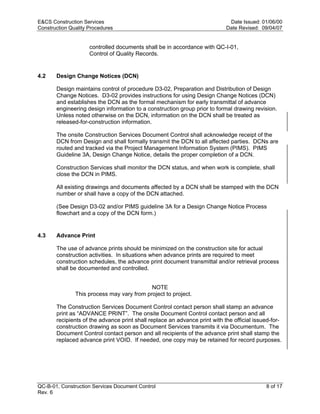
       3)      The onsite Construction Services Document Control contact person shall review
               the transmitted hardcopies for accuracy and completeness and notify Document
               Services of any discrepancies.

               The onsite Construction Services Document Control contact person removes
               from the transmittal package the appropriate number of documents needed by
               the field office, then date stamps and files the transmittal letter. The remaining
               documents are distributed to the various contractors based on a predetermined
               distribution list. The onsite Document Control contact person imports the
               drawings information into the onsite Transmittal Tracking Database using the


                                                                              y
               transmittal number (refer to attachment F).


                                                                 op
       4)      Using the transmittal tracking database, the onsite Document Control contact
               person shall prepare a transmittal letter for each contractor, similar to attachment
               E. If the drawing status is any status other than Issued for Construction, the
               onsite Document Control contact person shall indicate the status of the drawing
               in the comments section of the transmittal letter. For example, if the drawing


                                                          C
               status is Advanced Print, Void, or Information Only, the onsite Document Control
               contact person adds this information to the transmittal letter.

               Construction Services shall be responsible for ensuring a representative of each

                                                  d
               contractor signs the transmittal letter acknowledging the receipt of the
               documents. The onsite Construction Services Document Control contact person
                                     lle
               shall file a copy of each signed transmittal letter. To aid in controlling
               transmittals, an onsite transmittal sequence number may be used. The onsite
               Construction Services Document Control contact person shall assign these
               sequence numbers.
                         tro

       5)      As indicated above, the transmittal tracking database allows the creation of a
               transmittal letter, similar to attachment E, directly from the database. This
               database pulls transmittal information from Documentum. It also creates a
               record of all drawings received and transmitted to the contractor including the
            on


               date it was transmitted, the date it was signed by the contractor, and the onsite
               transmittal number. Attachment F is a general overview of this database. The
               Transmittal Tracking Access Database Instruction Manual is a complete user’s
               guide and instruction manual.
 nc


       6)      With the exception of one copy maintained by the onsite Construction Services
               Document Control contact person, holders of the controlled copy shall destroy all
               previous revisions of drawings at the time a new revision is issued. If it is
U


               necessary to keep copies of prior revisions, the holder of the controlled copy
               shall stamp the drawing “Void – For Information Only.”

                                               NOTE
                     If previous revisions of drawings and the transmittal history
                     associated with those drawings are maintained in
                     Documentum and the onsite Transmittal Tracking system,
                     onsite Construction Services Management may deem it
                     unnecessary to maintain a copy of all voided drawings. At
                     the completion of the construction project, disposition of all

QC-B-01, Construction Services Document Control                                              7 of 17
Rev. 6
E&CS Construction Services                                                   Date Issued: 01/06/00
Construction Quality Procedures                                             Date Revised: 09/04/07


                     controlled documents shall be in accordance with QC-I-01,
                     Control of Quality Records.


4.2    Design Change Notices (DCN)

       Design maintains control of procedure D3-02, Preparation and Distribution of Design
       Change Notices. D3-02 provides instructions for using Design Change Notices (DCN)
       and establishes the DCN as the formal mechanism for early transmittal of advance
       engineering design information to a construction group prior to formal drawing revision.


                                                                            y
       Unless noted otherwise on the DCN, information on the DCN shall be treated as
       released-for-construction information.


                                                                op
       The onsite Construction Services Document Control shall acknowledge receipt of the
       DCN from Design and shall formally transmit the DCN to all affected parties. DCNs are
       routed and tracked via the Project Management Information System (PIMS). PIMS


                                                        C
       Guideline 3A, Design Change Notice, details the proper completion of a DCN.

       Construction Services shall monitor the DCN status, and when work is complete, shall
       close the DCN in PIMS.


                                                  d
       All existing drawings and documents affected by a DCN shall be stamped with the DCN
       number or shall have a copy of the DCN attached.
                                    lle
       (See Design D3-02 and/or PIMS guideline 3A for a Design Change Notice Process
       flowchart and a copy of the DCN form.)
                         tro

4.3    Advance Print

       The use of advance prints should be minimized on the construction site for actual
            on


       construction activities. In situations when advance prints are required to meet
       construction schedules, the advance print document transmittal and/or retrieval process
       shall be documented and controlled.
 nc


                                            NOTE
               This process may vary from project to project.

       The Construction Services Document Control contact person shall stamp an advance
U


       print as “ADVANCE PRINT”. The onsite Document Control contact person and all
       recipients of the advance print shall replace an advance print with the official issued-for-
       construction drawing as soon as Document Services transmits it via Documentum. The
       Document Control contact person and all recipients of the advance print shall stamp the
       replaced advance print VOID. If needed, one copy may be retained for record purposes.


QC-B-01, Construction Services Document Control                                             8 of 17
Rev. 6
E&CS Construction Services                                                   Date Issued: 01/06/00
Construction Quality Procedures                                             Date Revised: 09/04/07


4.4    Printing of Drawings from Documentum

       To expedite the delivery of drawings to the construction site, many projects use the E-
       mail notification process discussed in 4.1, Distribution of Drawings, and print all drawings
       onsite. E&CS personnel can conduct simple drawing searches and print single drawings
       through the Documentum Web site. (Refer to attachment B for instructions on accessing
       the Documentum Web site.) However, to print the massive volume of drawings needed
       for the jobsite, the onsite Document Control staff will need to install the Documentum
       Desktop Client. (The Documentum Web site provides instructions for loading the
       Documentum Desktop Client.)


                                                                            y
       Drawings printed from Documentum intended for use by the contractor shall be


                                                                op
       transmitted through the onsite Construction Services document control.


4.5    CD Copies of Drawings


                                                        C
       If allowed by the contract, in lieu of hard-copy drawings, projects may opt to create a
       copy of Documentum drawing images on a CD and send the CD to the contractor. The
       CD enables the contractor to print as many copies of the drawings as needed. A


                                                  d
       transmittal letter generated from the transmittal tracking database accompanies the CD
       sent to the contractor as it would hard-copy drawings.
                                    lle
                                             NOTE
               For some projects, Document Services is able to create the CD
               and send it to the onsite Construction Services Document Control
                         tro

               contact person, saving the time and cost of creating the CDs
               onsite.
            on


4.6    Miscellaneous Document Transmittal Tracking System

       Each construction site shall establish a miscellaneous document transmittal tracking
       process to record the routing of important documents and correspondence generated
       during the course of a construction project. The transmittal tracking database has the
 nc


       capability of tracking miscellaneous transmittals. (This process is explained in detail in
       the Transmittal Tracking Access Database Instruction Manual.)
U


                                             NOTE
               The scope and magnitude of the construction project influences
               the type of miscellaneous transmittal tracking system to be used.
               Two important aspects of the tracking process include:

               •       Having documentation verifying contractors and other
                       affected parties received and signed for all documents sent
                       to them by Construction Services.


QC-B-01, Construction Services Document Control                                             9 of 17
Rev. 6
E&CS Construction Services                                                  Date Issued: 01/06/00
Construction Quality Procedures                                            Date Revised: 09/04/07


               •        Ensuring Construction Services is aware of documents
                       sent to them by contractors and is able to review and
                       respond to them in a timely manner.


4.6.1   Construction Miscellaneous Transmittal Form

        The Construction Miscellaneous Transmittal Form (CMTF) is being developed in PIMS.
        The CMTF will route and control miscellaneous documents transmitted between the
        contractor and Construction Services. This form, once implemented, will allow either


                                                                           y
        Construction Services or the contractor to transmit documents via the CMTF. The
        proper completion of a CMTF will be detailed in PIMS Guideline 2-H, Construction


                                                               op
        Miscellaneous Transmittal Form. On sites where the contractor has access to PIMS, the
        CMTF will become the primary method used to transmit miscellaneous documents
        between Construction Services and the contractor.


                                                        C
4.7     Assessment of Document Control

        Periodically, the onsite Construction Services Document Control contact person shall:

        •                                         d
               Review the controlled documents he or she and the contractors maintain to
                                    lle
               ensure only current documents are in use.

        •      Control all drawings used for construction, ensuring the latest revision. (See
               procedure QC-A-02, Oversight and Control of Contractor QC Programs, for a
                         tro

               guide to establish the review criteria.)

        •      Document any discrepancies found in the contractors’ documents and notify the
               contractor for immediate remediation. Recurring problems may require that a
               nonconformance report be issued (see procedure QC-H-01, Nonconformance
            on


               Report).

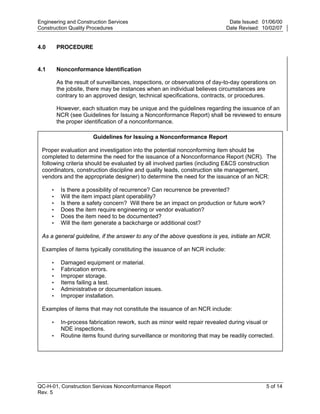
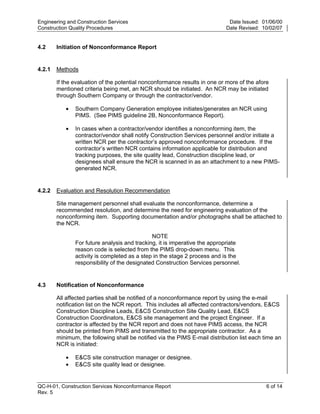
        Additional reviews of document control may be conducted by the Construction Services
        site quality lead and the Regional Corporate Quality Coordinator.
 nc


5.0     KEY CONTACTS
U


        For questions regarding the content and implementation of this procedure, contact the
        appropriate Regional Corporate Quality Coordinator.


6.0     QUALITY RECORDS

        The document transmittal forms discussed in this procedure are considered quality
        records and shall be stored and managed in accordance with Quality Procedure QC-I-
        01. These documents shall exist as hard-copy transmittals stored in Construction

QC-B-01, Construction Services Document Control                                           10 of 17
Rev. 6
E&CS Construction Services                                              Date Issued: 01/06/00
Construction Quality Procedures                                        Date Revised: 09/04/07


       Services Document Control and as electronic copies within the PIMS system.
       Transmittal data is stored and tracked in the transmittal tracking systems.


7.0    ATTACHMENTS

       Attachment A – Document Control Flowchart
       Attachment B – Document Services/Documentum Web site
       Attachment C – Sample Document Services Drawing Transmittal Letter


                                                                        y
       Attachment D – Sample Document Services E-mail Notification
       Attachment E – Sample Construction Services Document Transmittal Letter


                                                            op
       Attachment F – Transmittal Tracking Database Input Screen


                                                     C
                                                  d
                                    lle
                         tro
            on
 nc
U


QC-B-01, Construction Services Document Control                                      11 of 17
Rev. 6
E&CS Construction Services                                                                                           Date Issued: 01/06/00
Construction Quality Procedures                                                                                     Date Revised: 09/04/07


                                       Attachment A – Document Control Flowchart

QC - B - 01
Document Control


                                                                     Document Control Flow Chart

                                                                                         Design Engineering transmits drawings electronically to E&CS
 E&CS Construction determines                      E&CS Document Services              Document Services in Birmingham. E&CS Document Services
    the number and size of                     maintains the master list of approved    sends an electronic notification that drawings are ready for
  documents needed and the                        drawings in the Documentum               import, makes hard copies and transmits copies via a


                                                                                                                    y
  appropriate on site contacts.                             database.                      transmittal letter to the Construction Services on site
                                                                                                              Document Control.
                1                                               2                                                           2


                                                                                                 op
     Contractor signs on site                      Documents are distributed
  transmittal letter and returns                    to the various contractors         Construction Services on site Document Control reviews hard copy
    to Construction Services                     via an on site transmittal letter.    transmittals for accuracy and completeness. Copies are removed
       Document Control.                          On site Document Control to          for Construction Services use and the transmittal is date stamped
                                               use transmittal tracking database          and filed. On site Document Control will import all drawings
                                                                                           information via the transmittal number into the transmittal


                                                                                       C
                         4&5                    for tracking transmitted drawings.                              tracking database.

                                                             4&5
                                                                                                                            3
Voided documents are destroyed or stamped
   "Void - For Information Only". On site
 Construction Services Document Control
 maintains one copy of voided documents
 unless on site Construction Management                                         d
                                                              lle
  feels that suitable historical records are
           maintained elsewhere.
                6
                                       tro
                     on
 nc
U


QC-B-01, Construction Services Document Control                                                                                             12 of 17
Rev. 6
E&CS Construction Services                                               Date Issued: 01/06/00
Construction Quality Procedures                                         Date Revised: 09/04/07


                 Attachment B – Document Services/Documentum Web Site


How to access the Web site:

Start at:
> Southern Today Home Page (on Southern Company intranet)
  > Click on “Business Units and Departments”
     > Click on “Southern Company Generation”


                                                                        y
        > Click on “Departments”


                                                                op
           > Click on “Engineering and Construction Services”
               > Click on “Documentum”
                  Click on “Documentum Drawing Simple Search” feature


                                                       C
                                                  OR
                  Click on “Desktop Client (DTC) Documentum Interface”


                                                  d
                                    lle
                         tro
            on
 nc
U


QC-B-01, Construction Services Document Control                                       13 of 17
Rev. 6
E&CS Construction Services                                       Date Issued: 01/06/00
Construction Quality Procedures                                 Date Revised: 09/04/07


      Attachment C – Sample Document Services Drawing Transmittal Letter


                                                                 y
                                                       op
                                                  C
                                                  d
                                    lle
                         tro
            on
 nc
U


QC-B-01, Construction Services Document Control                               14 of 17
Rev. 6
E&CS Construction Services                                          Date Issued: 01/06/00
Construction Quality Procedures                                    Date Revised: 09/04/07


               Attachment D – Sample Document Services E-mail Notification


                                                                   y
                                                         op
                                                  C
                                                  d
                                    lle
                         tro
            on
 nc
U


QC-B-01, Construction Services Document Control                                  15 of 17
Rev. 6
E&CS Construction Services                                        Date Issued: 01/06/00
Construction Quality Procedures                                  Date Revised: 09/04/07


       Attachment E – Sample Construction Services Document Transmittal Letter


                                                                 y
                                                       op
                                                  C
                                                  d
                                    lle
                         tro
            on
 nc
U


QC-B-01, Construction Services Document Control                                  16 of 17
Rev. 6
E&CS Construction Services                                                   Date Issued: 01/06/00
Construction Quality Procedures                                             Date Revised: 09/04/07


            Attachment F – Transmittal Tracking Database Input Screen


Overview
The Transmittal Tracking Access Database is password protected and is unique to each
construction site. This database can be used to develop an onsite tracking system capturing
the transmittal of all drawings to the contractors on the job and the date received (signed) by the
contractors’ representatives. The system will also generate a unique transmittal letter for each
transmittal to each contractor. The screen below is the main input screen. This system imports
drawing information directly from the Documentum system maintained by E&CS Document


                                                                            y
Services. This system can also be used to track miscellaneous transmittals.


                                                                op
Refer to the Transmittal Tracking Access Database Instruction Manual for specific
information.


                                                         C
                                                  d
                                     lle
                         tro
            on
 nc
U


QC-B-01, Construction Services Document Control                                            17 of 17
Rev. 6
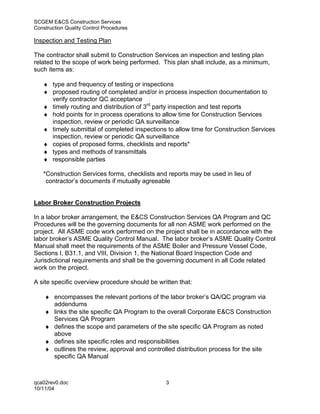
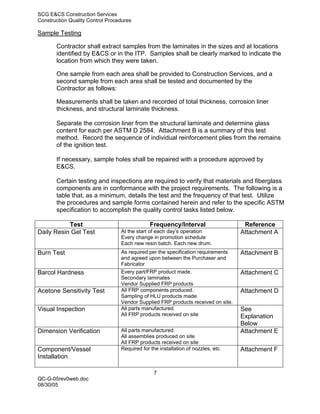
SCG Engineering and Construction Services

                                   Construction Services

                     Construction Quality Control Procedures


                   QC Procedure Number (QC – B – 02)


                      Field Change/Clarification Request


Revision           Description               Revised By   Reviewed By   Approved By    Date
   A            Issued for Review               N/A           N/A           N/A       11/8/99
   0         Issued for Construction          RHR, Jr.       DMC           RWM        11/17/99

   1         General Revision, Including      RHR, Jr.       DMC           RWM         3/6/00
           Renumbering to Fit QA Program
                      Format
   2         General Revision, Including     RHR, JR.        WCL           JBF        1/31/02
             Department Name Change
   3         Department name change;          RHR, Jr.       WDP           JCH        10/14/02
              addition of FCR process
           flowchart; update attachments
   4       Incorporation of Best Practices    RHR, Jr.       JBF        C.A. Baker    02/14/05
            by Administrative QC Review
             Committee: E. Boerner, C.
              Casey, T. Duncan and S.
                      Lumsden
SCG E&CS Construction Services
Construction Quality Control Procedures


QC – B – 02
Field Change/Clarification Request


Purpose

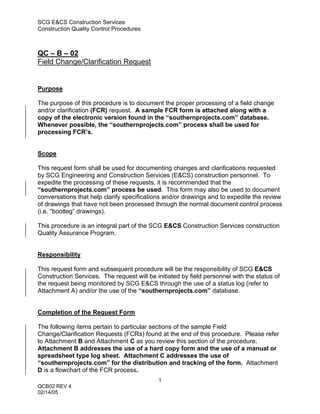
The purpose of this procedure is to document the proper processing of a field change
and/or clarification (FCR) request. A sample FCR form is attached along with a
copy of the electronic version found in the “southernprojects.com” database.
Whenever possible, the “southernprojects.com” process shall be used for
processing FCR’s.


Scope

This request form shall be used for documenting changes and clarifications requested
by SCG Engineering and Construction Services (E&CS) construction personnel. To
expedite the processing of these requests, it is recommended that the
“southernprojects.com” process be used. This form may also be used to document
conversations that help clarify specifications and/or drawings and to expedite the review
of drawings that have not been processed through the normal document control process
(i.e. “bootleg” drawings).

This procedure is an integral part of the SCG E&CS Construction Services construction
Quality Assurance Program.


Responsibility

This request form and subsequent procedure will be the responsibility of SCG E&CS
Construction Services. The request will be initiated by field personnel with the status of
the request being monitored by SCG E&CS through the use of a status log (refer to
Attachment A) and/or the use of the “southernprojects.com” database.


Completion of the Request Form

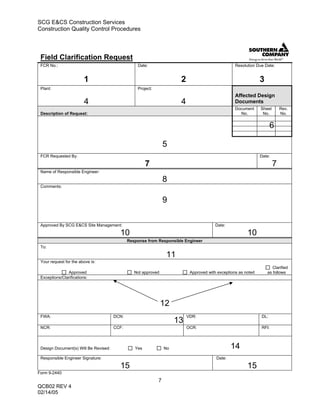
The following items pertain to particular sections of the sample Field
Change/Clarification Requests (FCRs) found at the end of this procedure. Please refer
to Attachment B and Attachment C as you review this section of the procedure.
Attachment B addresses the use of a hard copy form and the use of a manual or
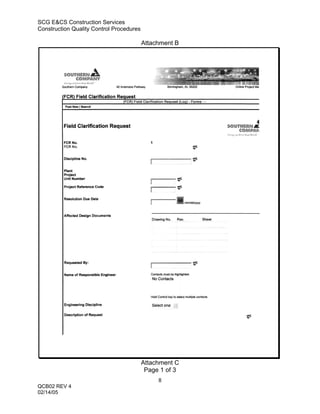
spreadsheet type log sheet. Attachment C addresses the use of
“southernprojects.com” for the distribution and tracking of the form. Attachment
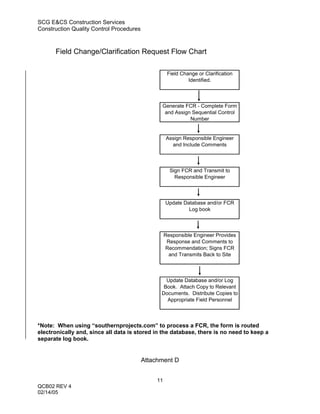
D is a flowchart of the FCR process.
                                            1
QCB02 REV 4
02/14/05
SCG E&CS Construction Services
Construction Quality Control Procedures


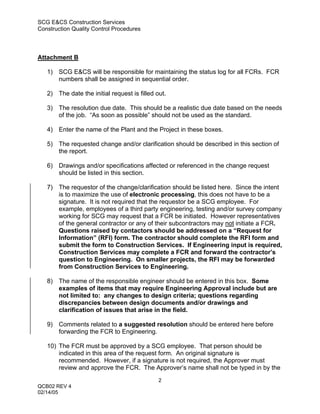
Attachment B

   1) SCG E&CS will be responsible for maintaining the status log for all FCRs. FCR
      numbers shall be assigned in sequential order.

   2) The date the initial request is filled out.

   3) The resolution due date. This should be a realistic due date based on the needs
      of the job. “As soon as possible” should not be used as the standard.

   4) Enter the name of the Plant and the Project in these boxes.

   5) The requested change and/or clarification should be described in this section of
      the report.

   6) Drawings and/or specifications affected or referenced in the change request
      should be listed in this section.

   7) The requestor of the change/clarification should be listed here. Since the intent
      is to maximize the use of electronic processing, this does not have to be a
      signature. It is not required that the requestor be a SCG employee. For
      example, employees of a third party engineering, testing and/or survey company
      working for SCG may request that a FCR be initiated. However representatives
      of the general contractor or any of their subcontractors may not initiate a FCR.
      Questions raised by contactors should be addressed on a “Request for
      Information” (RFI) form. The contractor should complete the RFI form and
      submit the form to Construction Services. If Engineering input is required,
      Construction Services may complete a FCR and forward the contractor’s
      question to Engineering. On smaller projects, the RFI may be forwarded
      from Construction Services to Engineering.

   8) The name of the responsible engineer should be entered in this box. Some
      examples of items that may require Engineering Approval include but are
      not limited to: any changes to design criteria; questions regarding
      discrepancies between design documents and/or drawings and
      clarification of issues that arise in the field.

   9) Comments related to a suggested resolution should be entered here before
      forwarding the FCR to Engineering.

   10) The FCR must be approved by a SCG employee. That person should be
       indicated in this area of the request form. An original signature is
       recommended. However, if a signature is not required, the Approver must
       review and approve the FCR. The Approver’s name shall not be typed in by the
                                              2
QCB02 REV 4
02/14/05
SCG E&CS Construction Services
Construction Quality Control Procedures

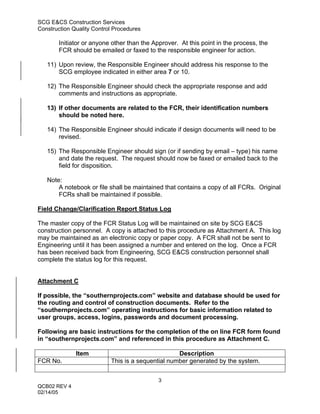
        Initiator or anyone other than the Approver. At this point in the process, the
        FCR should be emailed or faxed to the responsible engineer for action.

   11) Upon review, the Responsible Engineer should address his response to the
       SCG employee indicated in either area 7 or 10.

   12) The Responsible Engineer should check the appropriate response and add
       comments and instructions as appropriate.

   13) If other documents are related to the FCR, their identification numbers
       should be noted here.

   14) The Responsible Engineer should indicate if design documents will need to be
       revised.

   15) The Responsible Engineer should sign (or if sending by email – type) his name
       and date the request. The request should now be faxed or emailed back to the
       field for disposition.

   Note:
       A notebook or file shall be maintained that contains a copy of all FCRs. Original
       FCRs shall be maintained if possible.

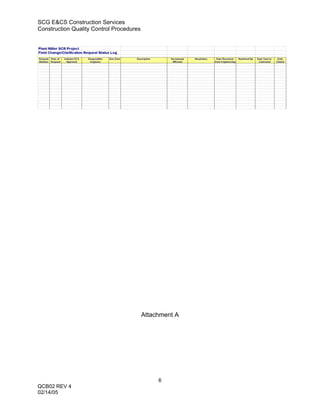
Field Change/Clarification Report Status Log

The master copy of the FCR Status Log will be maintained on site by SCG E&CS
construction personnel. A copy is attached to this procedure as Attachment A. This log
may be maintained as an electronic copy or paper copy. A FCR shall not be sent to
Engineering until it has been assigned a number and entered on the log. Once a FCR
has been received back from Engineering, SCG E&CS construction personnel shall
complete the status log for this request.


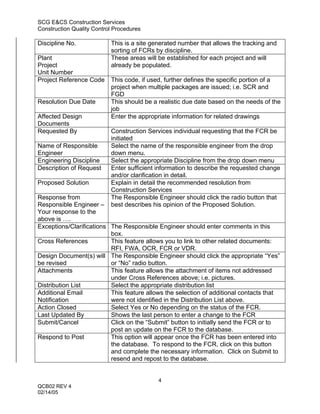
Attachment C

If possible, the “southernprojects.com” website and database should be used for
the routing and control of construction documents. Refer to the
“southernprojects.com” operating instructions for basic information related to
user groups, access, logins, passwords and document processing.

Following are basic instructions for the completion of the on line FCR form found
in “southernprojects.com” and referenced in this procedure as Attachment C.

              Item                                 Description
FCR No.                    This is a sequential number generated by the system.


                                             3
QCB02 REV 4
02/14/05
SCG E&CS Construction Services
Construction Quality Control Procedures

Discipline No.             This is a site generated number that allows the tracking and
                           sorting of FCRs by discipline.
Plant                      These areas will be established for each project and will
Project                    already be populated.
Unit Number
Project Reference Code     This code, if used, further defines the specific portion of a
                           project when multiple packages are issued; i.e. SCR and
                           FGD
Resolution Due Date        This should be a realistic due date based on the needs of the
                           job
Affected Design            Enter the appropriate information for related drawings
Documents
Requested By               Construction Services individual requesting that the FCR be
                           initiated
Name of Responsible        Select the name of the responsible engineer from the drop
Engineer                   down menu.
Engineering Discipline     Select the appropriate Discipline from the drop down menu
Description of Request     Enter sufficient information to describe the requested change
                           and/or clarification in detail.
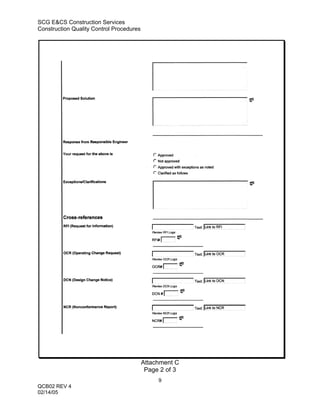
Proposed Solution          Explain in detail the recommended resolution from
                           Construction Services
Response from              The Responsible Engineer should click the radio button that
Responsible Engineer –     best describes his opinion of the Proposed Solution.
Your response to the
above is ….
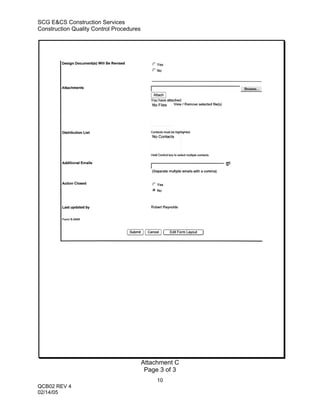
Exceptions/Clarifications The Responsible Engineer should enter comments in this
                          box.
Cross References          This feature allows you to link to other related documents:
                          RFI, FWA, OCR, FCR or VDR.
Design Document(s) will The Responsible Engineer should click the appropriate “Yes”
be revised                or “No” radio button.
Attachments               This feature allows the attachment of items not addressed
                          under Cross References above; i.e. pictures.
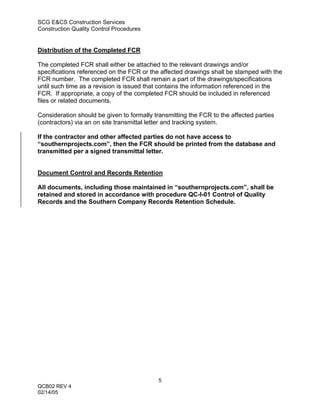
Distribution List         Select the appropriate distribution list
Additional Email          This feature allows the selection of additional contacts that
Notification              were not identified in the Distribution List above.
Action Closed             Select Yes or No depending on the status of the FCR.
Last Updated By           Shows the last person to enter a change to the FCR
Submit/Cancel             Click on the “Submit” button to initially send the FCR or to
                          post an update on the FCR to the database.
Respond to Post           This option will appear once the FCR has been entered into
                          the database. To respond to the FCR, click on this button
                          and complete the necessary information. Click on Submit to
                          resend and repost to the database.


                                            4
QCB02 REV 4
02/14/05
SCG E&CS Construction Services
Construction Quality Control Procedures


Distribution of the Completed FCR

The completed FCR shall either be attached to the relevant drawings and/or
specifications referenced on the FCR or the affected drawings shall be stamped with the
FCR number. The completed FCR shall remain a part of the drawings/specifications
until such time as a revision is issued that contains the information referenced in the
FCR. If appropriate, a copy of the completed FCR should be included in referenced
files or related documents.

Consideration should be given to formally transmitting the FCR to the affected parties
(contractors) via an on site transmittal letter and tracking system.

If the contractor and other affected parties do not have access to
“southernprojects.com”, then the FCR should be printed from the database and
transmitted per a signed transmittal letter.


Document Control and Records Retention

All documents, including those maintained in “southernprojects.com”, shall be
retained and stored in accordance with procedure QC-I-01 Control of Quality
Records and the Southern Company Records Retention Schedule.


                                           5
QCB02 REV 4
02/14/05
SCG E&CS Construction Services
Construction Quality Control Procedures


                                          Attachment A


                                               6
QCB02 REV 4
02/14/05
SCG E&CS Construction Services
Construction Quality Control Procedures


 Field Clarification Request
 FCR No.:                                         Date:                                            Resolution Due Date:


                         1                                             2                                        3
 Plant:                                           Project:
                                                                                                   Affected Design
                         4                                             4                           Documents
                                                                                                   Document     Sheet       Rev.
 Description of Request:                                                                             No.         No.        No.


                                                                                                                      6

                                                                 5
 FCR Requested By:                                                                                              Date:

                                                       7                                                                7
 Name of Responsible Engineer:

                                                                 8
 Comments:


                                                                 9

 Approved By SCG E&CS Site Management:                                                   Date:

                                         10                                                              10
                                              Response from Responsible Engineer
 To:

                                                                 11
 Your request for the above is:
                                                                                                                       Clarified
               Approved                          Not approved               Approved with exceptions as noted       as follows
 Exceptions/Clarifications:


                                                                12
 FWA:                                  DCN:                                VDR:                                 DL:
                                                                      13
 NCR:                                  CCF:                                OCR:                                 RFI:


 Design Document(s) Will Be Revised:             Yes             No                              14
 Responsible Engineer Signature:                                                         Date:

                                         15                                                              15
Form 9-2440
                                                             7
QCB02 REV 4
02/14/05
SCG E&CS Construction Services
Construction Quality Control Procedures

                                          Attachment B


                                          Attachment C
                                           Page 1 of 3
                                               8
QCB02 REV 4
02/14/05
SCG E&CS Construction Services
Construction Quality Control Procedures


                                          Attachment C
                                           Page 2 of 3
                                               9
QCB02 REV 4
02/14/05
SCG E&CS Construction Services
Construction Quality Control Procedures


                                          Attachment C
                                           Page 3 of 3
                                               10
QCB02 REV 4
02/14/05
SCG E&CS Construction Services
Construction Quality Control Procedures


      Field Change/Clarification Request Flow Chart

                                                     Field Change or Clarification
                                                              Identified.


                                                Generate FCR - Complete Form
                                                 and Assign Sequential Control
                                                           Number


                                                    Assign Responsible Engineer
                                                      and Include Comments


                                                      Sign FCR and Transmit to
                                                        Responsible Engineer


                                                    Update Database and/or FCR
                                                             Log book


                                                    Responsible Engineer Provides
                                                     Response and Comments to
                                                    Recommendation; Signs FCR
                                                      and Transmits Back to Site


                                                  Update Database and/or Log
                                                 Book. Attach Copy to Relevant
                                                Documents. Distribute Copies to
                                                  Appropriate Field Personnel


*Note: When using “southernprojects.com” to process a FCR, the form is routed
electronically and, since all data is stored in the database, there is no need to keep a
separate log book.


                                          Attachment D


                                               11
QCB02 REV 4
02/14/05
SCGEM Engineering and Construction Services

                                    Construction Services

                     Construction Quality Control Procedures


                    QC Procedure Number (QC – C – 01)


               Qualification and Evaluation of Contractors


Revision          Description                Revised By   Reviewed By   Approved By    Date
   A           Issued for Review                N/A           N/A           N/A       9/18/00

   0        Issued for Construction           RHR,Jr.        DMC           RWM        12/18/00

   1         Department name change;          RHR, Jr.       WSN        JBF for JCH   11/26/02
            update Attachments A and B;
                editorial changes and
                     clarifications
   2       Incorporation of Best Practices    RHR, Jr.       JBF         A. Baker      8/9/04
            by Administrative QC Review
             Committee: E. Boerner, C.
              Casey, T. Duncan and S.
                       Lumsden
SCGEM E&CS Construction Services
Construction Quality Control Procedures


QC – C – 01
Qualification and Evaluation of Contractors


Purpose

The purpose of this procedure is twofold:

1)      to outline the general guidelines for the periodic evaluation of the performance of
        contractors who are currently providing goods and/or services on SCGEM
        Engineering and Construction Services (E&CS) construction projects and

2)      to outline the general guidelines for the qualification of potential contractors who
        have expressed a willingness to provide goods and/or services on SCGEM
        Engineering and Construction Services (E&CS) construction projects.


Scope

It is intended that the guidelines given in this procedure will be used for the qualification
and/or evaluation of contractors who have either expressed a willingness to provide
goods and services or are currently providing such services on SCGEM Engineering
and Construction Services (E&CS) construction projects.

This procedure is an integral part of the SCGEM E&CS Construction Services
construction Quality Assurance Program and is intended for use on SCGEM
Engineering and Construction Services construction projects.


Responsibility

It will be the responsibility of SCGEM E&CS Construction Services personnel to
implement and control the use of this procedure. Construction Services shall work
closely with Supply Chain Management in the implementation of this procedure,
especially dealing with the qualification of contractors.


Contractor Performance Review

Generally, the responsible SCGEM Engineering and Construction Services
Construction Site Manager or designee will perform a performance evaluation (see
Attachment A) on all contractors providing goods and services on the project.
Contractor performance should be reviewed at least every twelve (12) months or at the
completion of the contracted work, whichever is shorter. All ratings should be explained
with comments giving as much detail as possible. Pertinent data should be used as
backup or clarification. Attachment A is an example of the evaluation form found in
QC-C-01rev2web.doc                                1
8/9/04
SCGEM E&CS Construction Services
Construction Quality Control Procedures

the SCGEM Chapter XII Contracts Guidance Manual. The results of the performance
evaluation shall be considered confidential. The evaluation may be used as a guide to
discuss performance with the contractor, but the completed form shall not be shared
with or given to the contractor. The completed performance evaluation shall be
maintained as a confidential document and shared with other SCGEM personnel on a
“need to know” basis.

After completion of the contracted work, or at anytime deemed appropriate by SCGEM
E&CS Construction Services management, a review session shall be held with the
contractor to cover the contractor’s overall performance. As indicated on Attachment A,
the following areas should be addressed:

       o       Safety
       o       Schedule
       o       Budget
       o       Quality
       o       Coordination
       o       Environmental
       o       Responsiveness
       o       Administrative

An electronic copy of all completed performance evaluations shall be sent via email to
the SCGEM E&CS Construction Services Corporate Quality Control Coordinator at 241
Ralph McGill Blvd., Atlanta, GA. These evaluations shall be maintained as confidential
documents and shared with other SCGEM employees on a “need to know” basis. A
hard copy of all evaluations will be maintained in a confidential notebook by the
Corporate QC Coordinator. In addition, an electronic copy will be forwarded to
Supply Chain Management (SCM) for inclusion in the Contractor Performance
database maintained by SCM. Construction Services employees needing access
to this database should contact the Corporate QC Coordinator and SCM. These
evaluations may be used as input in determining qualified contractors for future projects.

On site copies of evaluations shall be considered confidential documents and
shall be stored with the project records in accordance with procedure QC-I-01
Control of Quality Records.


Qualification of Contractors

Overview
SCGEM E&CS Construction Services, with input from Supply Chain Management, will
maintain various lists of qualified contractors who have expressed a willingness to
provide goods and/or services on Southern Company construction projects. These lists
will be developed and maintained in a manner that will insure competitiveness, fresh
ideas and innovation, minority participation, quality and safety.


QC-C-01rev2web.doc                              2
8/9/04
SCGEM E&CS Construction Services
Construction Quality Control Procedures

The following information is provided as a guide only. The basis for identifying
contractors may vary based on the work scope, complexity, criticality of work and
number of available contractors.


Process
The development of a qualified contractor bid list shall be a multi – step procedure. This
process is outlined as follows:

Step 1: Identify Work Scope - prepare a brief description of the scope of work being
        planned including any unique or special requirements

Step 2: Develop List of Potential Contractors – obtain a list of qualified contractors from
        Supply Chain Management. Identify potential contractors from other sources.

Step 3: Screen All Contractors Through Supply Chain Management – insure that any
        “new” potential contractors meet the requirements of the Supply Chain
        Management Department.

Step 4: Send “Supplier Evaluation Questionnaire” to Potential Contractors – Contact
        Supply Chain Management and have them send a copy of the Supplier
        Evaluation Questionnaire to any new potential contractors including a scope of
        work and any unique or special requirements. Contact Supply Chain
        Management for instructions on completing this questionnaire on line via the
        Internet.

Step 5: Perform Initial Evaluation of Completed Questionnaire – the completed
        questionnaires should be reviewed for completeness and relevance of the
        answers to the various questions. The contractor should be contacted as
        necessary to clarify their answers. References supplied by the contractor
        should be contacted and asked the following questions:
        1) Why was the contractor chosen for the work?
        2) What are the contractor’s strengths?
        3) What are the contractor’s weaknesses?
        4) What type of problems did you encounter?
        5    Would you use this contractor again?

Step 6: Perform Site Visit – if the results of Step 5 are favorable, a site visit should be
        taken. The site that is visited should be as similar to the work that will be
        performed for Southern Company as possible. To add consistency to the
        information obtained on the site visit, a checklist similar to Attachment B should
        be completed as part of the site visit.

Step 7: Final Evaluation and Ranking of Contractors – once all the information
        mentioned above has been assembled and evaluated, the contractors shall be
        evaluated and ranked. This ranking shall be based on criteria similar to
        Attachment C. The weights or points assigned to each area may be changed
QC-C-01rev2web.doc                               3
8/9/04
SCGEM E&CS Construction Services
Construction Quality Control Procedures

         as appropriate for a particular scope of work. Generally, the higher the
         confidence level that the contractor meets the requirements of the particular
         category, the higher the point value assigned. A brief description of each
         category follows:

         o Recent Relevant Experience: is the contractor currently performing (or has
           he recently performed) work similar to the work anticipated for the upcoming
           Southern Company project(s)

         o Other Experience: has the contractor performed work that, although not
           directly related to the type of work anticipated for the Southern Company
           project, would nonetheless add valuable experience to the type of work
           anticipated

         o Use of Subcontractors: does the contractor tend to “sub” much of the work
           or use their own workers. Generally, the fewer the subs, the higher the point
           value.

         o Safety: based on site observations and data submitted, evaluate the
           contractor’s safety record.

         o QA Program: based on site observations and data submitted, evaluate the
           contractor’s QA program. Does the contractor have a written QA Program.

         o Customer Feedback: Based on the responses to Step 5 above and the on
           site visit,. evaluate the prior and current customer’s responses.

         o Staff: evaluate the contractor’s organization to determine their ability to
           manage the construction project.

         o Overall Assessment: based on all information reviewed, evaluate the
           contractor’s overall ability to perform the anticipated work.

         o Total: determine the numeric total of all categories. The contractors with the
           highest scores should be added to the bid list. The size of the bid list should
           be based on such factors as: bid scope, complexity of the work and number
           of qualified contractors competing for the work.

Document Control
Completed questionnaires, site visit checklists, evaluation forms, lists of qualified
contractors and other documents related to this process shall be maintained and
controlled as confidential documents. All documents shall be retained and stored in
accordance with procedure QC-I-01 Control of Quality Records and the Southern
Company Records Retention Schedule.


QC-C-01rev2web.doc                               4
8/9/04
SCGEM E&CS Construction Services
Construction Quality Control Procedures


                              Southern Company Generation
                                      Contractor performance Evaluation

Plant:
Project:

Contractor                                                  Sub Contractors                  Recommended
Contract Number:                                                  (if any)                   Yes    No*
Job Superintendent
Completion Date:
           Estimated
              Actual

Price:
              Original
                 Final
Do You Recommend Contractor Stay on Bid List?

*Explain on 2nd Page     * Give Specific Details on any Category Marked “Fair” or “Poor”
DESCRIPTION                                     Excellent          Good              *Fair         *Poor
Overall Management of Work
Quality of Work
Construction Method and Techniques
Ability to Man Job
Labor Relations
Worker Attitudes
Supervision – Quality
Supervision – Quantity
Home Office Support
Control of Sub Contractors
Cooperation with Other Contractors and A/E’s
Communications with Owner
Attitude with Correcting Errors
Responsiveness to Owner’s Requests
Equipment Availability
Tool Supply
Invoicing Methods
Job Cleanliness and Orderliness
Cost Control
Scheduling Control
Quality Control                                      Attachment A
Safety Program                                        Page 1 of 2
Environmental Stewardship


QC-C-01rev2web.doc                                          5
8/9/04
SCGEM E&CS Construction Services
Construction Quality Control Procedures

Schedule:                                                   Cost:
Ahead of Schedule                                           Less than Estimated
On Schedule                                                 As Estimated
Longer than Schedule                                        Over Estimate
Substantially Longer than Schedule                          Substantially Over Estimate

Extras:      Yes       No            Reasonable Requests:                   Excessive Requests: *

                                                     COMMENTS


Prepared By:

Job Title:

Plant:

Date:


                                                   Attachment A
                                                    Page 2 of 2


QC-C-01rev2web.doc                                            6
8/9/04
SCGEM E&CS Construction Services
Construction Quality Control Procedures


CONTRACTOR SITE VISIT CHECKLIST

Contractor and Site Location:                               Date: ________________________


Scope of Work and Quantities:


Type Contract (LS, Unit Price, ETC)


Number of Personnel:

 Management and Staff:

 Superintendents:

 Craft by Discipline:


Union/Non Union

 Long Term or Local Hire

List of Subcontractors and Work Scope


Other Contractors On Site Requiring Interface

List with Scope


Equipment and Material Procurement

Who Supplies?


Types?


Who Makes Take offs?


Who Schedules Deliveries?


                                            ATTACHMENT B
                                              Page 1 of 3
QC-C-01rev2web.doc                                7
8/9/04
SCGEM E&CS Construction Services
Construction Quality Control Procedures


CONTRACTOR SITE VISIT CHECKLIST
(CONTINUED)

Planning and Scheduling

Who scheduled work?

Amount of Pre Award Scheduling?

Method of Scheduling and Detail?


Quality Control

Who Provides QC?


Describe


Safety

What is contractor’s program?


Competent person on site?


Drug Testing?


Safety Record?


Other Functions/Services Provided by Contractor


                                           ATTACHMENT B
                                            PAGE 2 OF 3

QC-C-01rev2web.doc                                8
8/9/04
SCGEM E&CS Construction Services
Construction Quality Control Procedures

CONTRACTOR SITE VISIT CHECKLIST
(CONTINUED)


Site Walkaround and Work Observations

Types of Work Observed


Work Quality


Productivity


Organization


Cleanliness


Safety


Quality Control


Owner Interviews

Why was this contractor chosen for this work?


What are the contractor’s strengths


What are the contractor’s weaknesses?


What types of problems have you encountered?


Would you hire this contractor again?


SCGEM employees conducting site visit and/or interviews:

_____________________________________________________ Date: _________________

_____________________________________________________ Date: _________________
                                                ATTACHMENT B
                                                 PAGE 3 0F 3


QC-C-01rev2web.doc                                   9
8/9/04
SCGEM E&CS Construction Services
Construction Quality Control Procedures


     CO N TR ACTO R EVA LUA TIO N W O R KSH EET

                 Contractor               Recent G eneral        O ther   Use of Subs S afety Q A Program   Custom er   Staff    O verall  Total
                                          Civil/Elec./M ech.   Experience                                   Feedback           Assessm ent
                                                (25pts)          (5pts)      (5pts)   (5pts)     (5pts)      (15pts)    (5pts)   (20pts)


                                                                 ATTACHMENT C


QC-C-01rev2web.doc                                                         10
8/9/04
SCGEM Engineering and Construction Services

                                      Construction Services

                      Construction Quality Control Procedures


                     QC Procedure Number (QC – C – 02)


                         PURCHASE OF QUALITY ITEMS


Revision            Description                Revised    Reviewed By   Approved By    Date
                                                 By
   A           Issued for Review                 N/A          N/A           N/A       11/8/00

   0        Issued for Construction            RHR, Jr.      DMC           RWM        12/18/00

   1         Department name change;           RHR, Jr.      PBG           JCH        10/15/02
           minor editorial and clarification
                      changes.
   2       Incorporation of Best Practices     RHR, JR.      JBF         A. Baker      8/9/04
            by Administrative QC Review
             Committee: E. Boerner, C.
              Casey, T. Duncan and S.
                      Lumsden
SCGEM E&CS Construction Services
Construction Quality Control Procedures


QC – C - 02
Purchase of Quality Items


Purpose

The purpose of this procedure is to outline the guidelines for insuring that the specific
requirements of products and materials that are critical to the quality of construction are
conveyed and documented throughout the purchasing process. The end result of this
process is the purchasing and receipt of the correct quality items. It is understood that
approved Southern Company purchasing processes such as the Accounting Material
and Procurement System (AMPS) and/or the Work Order Management System
(WOMS) will be used for the purchasing of these quality items.

It is intended that this procedure will meet the requirements outlined in the
SCGEM Chapter XII Contracts Compliance Manual.


Scope

This procedure only addresses items purchased by SCGEM E&CS Construction
Services that affect the quality of construction. Examples include but are not limited to:
reinforcing steel, structural steel, high strength bolts, cable and gas line piping. This
procedure will not address such non-quality items as office supplies, office equipment,
miscellaneous bolts and piping, cleaning supplies, etc. Additionally, this procedure
does not apply to ASME construction work.

This procedure is an integral part of the SCGEM E&CS Construction Services
construction Quality Assurance Program and is intended for use on SCGEM
Engineering and Construction Services construction projects.


Responsibility

It will be the sole responsibility of SCGEM Engineering and Construction Services
personnel and/or their designee to implement and control the use of this procedure. It
will be the responsibility of the person requesting the purchase of materials to indicate
whether the items are “quality” items and to furnish all specification requirements.


Procedure

To insure that critical information related to the quality items is conveyed throughout the
purchasing process, the following steps should be followed:


QC-C-02rev2web.doc                               1
8/9/04
SCGEM E&CS Construction Services
Construction Quality Control Procedures


Step 1: Identify quality items: Items that must meet certain specifications requirements
        or must replace specific components or equipment shall be identified.
        Requirements for these items shall be determined, documented and forwarded
        throughout the purchasing process. These requirements will be based on such
        criteria as job site specifications and/or drawings, industry standards, and
        specific requirements of replacement components or equipment.

Step 2: Prepare purchasing document: The specification requirements outlined in Step
        1 above shall be included in the purchasing document (EWO, material
        requisition request, Purchase Order, etc.).

Step 3: Review of purchase document: The originator of the initial purchase request
        shall review the purchase document to insure all required specification
        information is correct. If the purchasing document is prepared electronically,
        via the Accounting Material and Procurement System (AMPS), the completed
        electronic material requisition must be routed to the original requestor. The
        original requestor must review the requisition and indicate approval by routing
        the requisition to Supply Chain Management or to the next level of approval.

         NOTE: The last person reviewing the material requisition must forward the
         document to Supply Chain Management. If the material requisition is not
         forwarded to Supply Chain Management, the items will not be ordered.

Step 4: Purchase Items: Once the purchase document has been reviewed and
        approved, the purchase document shall be processed as expeditiously as
        possible.

Step 5: Receipt of Purchased Items: Purchased items should be received, stored and
        handled in accordance with procedure QC-D-01: Receipt, Storage and
        Handling of Products. As indicated in QC-D-01, items shall be inspected to the
        extent necessary to insure that the requirements of the purchasing document
        have been met.


Document Control

All purchase documents shall be filed and maintained throughout the construction
process. At the completion of the construction project, this documentation shall be
processed in accordance with procedure QC – I – 01: Control of Quality Records.


QC-C-02rev2web.doc                              2
8/9/04
SCG Engineering and Construction Services

                                  Construction Services

                  Construction Quality Control Procedures


                QC Procedure Number (QC – D – 01)


           Receipt, Storage and Handling of Products


Revision           Description                Revised By   Reviewed By   Approved By    Date
   A            Issued for Review                N/A           N/A           N/A       4/3/00

   0         Issued for Construction           RHR, Jr.       DMC           RWM        5/30/00

   1          Department Name Change;          RHR, Jr.       SKW           JCH        11/4/02
               revise Document Control
           section; minor editorial changes
   2         Incorporate Best Practices by     RHR, Jr.       JBF         A. Baker     8/9/04
           Civil, Electrical and Mechanical
                QC Review Committees
   3        Incorporate Department Name        RHR, Jr.       JBF        C. A. Baker   7/18/05
           Change; Further define levels of
                storage and preventive
               maintenance requirements
SCG E&CS Construction Services
Construction Quality Control Procedures


QC – D - 01
Receipt, Storage and Handling of Products


Purpose

The purpose of this procedure is to outline the general guidelines necessary to insure
that the quality of items received on SCG Engineering and Construction Services
(E&CS) construction projects is in compliance with manufacture’s literature, applicable
codes, standards and specifications and is maintained throughout the receipt, storage
and handling process.


Scope

Generally, items shall be received, stored and handled in accordance with the
manufacturer’s recommendations. In addition, specific requirements listed in job site
specifications shall be followed as they apply to items received on site. In lieu of
recommendations and specifications, the guidelines listed in this procedure shall be
followed.

This procedure is an integral part of the SCG E&CS Construction Services Quality
Assurance Program.


Responsibility

Generally, it will be the responsibility of the contractors employed by SCG Engineering
and Construction Services to insure that items received on site are received, stored and
handled in a manner that will maintain the quality of the items received. SCG
Engineering and Construction Services will perform whatever inspections are deemed
necessary to insure the quality of items is being maintained. The contractor shall be
responsible for implementing a comprehensive and/or computerized receipt, storage
and handling plan.


Safety

Every employee has an individual responsibility for his or her personal safety and for the
safety of others as well. Each employee should be knowledgeable of the safety rules
applicable to his or her work. Employees must accept personal responsibility for
cooperating and complying with all EH&S policies and procedures. Prior to beginning
work, all employees shall review and have a thorough understanding of all applicable


QC-D-01rev3web.doc                          1
07/18/05
SCG E&CS Construction Services
Construction Quality Control Procedures

safety procedures contained in the E&CS Construction Services EH&S Policies and
Procedures Manual.


Receiving Inspection Requirements

A preliminary visual inspection shall be performed prior to unloading to determine if any
damage occurred during shipping and to insure compliance to the applicable purchase
order. Observations shall be made for the following:

       o      Fire
       o      Excessive Exposure
       o      Environmental Damage
       o      Tie Down Failure
       o      Rough Handling

Any indication of the above conditions shall be brought to the attention of the
appropriate discipline leads, preferably before unloading. Receipt, storage and handling
requirements for specific items may be found in the particular discipline inspection
procedures: QC-G-01 Civil Inspection, QC-G-02 Electrical Inspection, QC-G-03
Mechanical Inspection and QC-G-04 Welding Inspection.

After unloading, the following areas should also be checked:

       o      Identifications and Markings – verify that identifications and
              markings are in accordance with applicable codes, specifications,
              drawings, purchase orders, etc.
       o      Manufacturing Documentation – assurance that the item
              received was fabricated, tested and inspected prior to shipment; if
              required, assure that mill test reports or other required
              documentation has been received and all items met or exceeded
              requirements.
       o      Protection Covers and Seals - assure covers and seals meet
              their intended function.
       o      Coatings and Preservatives – verification that coatings and
              preservatives have been applied in accordance with specifications
              and have not been damaged during shipment.
       o      Physical Damage – perform a closer inspection than what was
              done prior to unloading to check for broken, cracked, missing,
              deformed or misaligned parts.
       o      Cleanliness – perform a more thorough visual inspection to assure
              that accessible internal and external areas and components are
              free of dirt, mill scale, weld spatter, oil, grease, etc. as required by
              specifications or manufacturer’s recommendations.


QC-D-01rev3web.doc                            2
07/18/05
SCG E&CS Construction Services
Construction Quality Control Procedures

Results of the above inspection should be documented either on an Equipment/Material
Receipt Inspection Report similar to Attachment A, or as part of a Daily Inspection
Report.


Nonconforming Items and Incomplete Inspections

Items that have not been completely inspected or have documentation pending
shall be isolated from acceptable items and identified with a hold tag
(QC – H – 02). In addition to the above, nonconforming items shall also have a
nonconformance report issued per procedure QC – H – 01.


Storage Requirements

Items shall be stored in a manner that will maintain the quality of the item and minimize
the possibility of damage due to corrosion, contamination, deterioration or physical
damage. The contractor shall be required to identify and maintain the location of all
items received and stored.

First and foremost, items shall be stored in accordance with manufacturer’s
recommendations and job site specifications. In situations where these documents are
not available, the following general classification of items shall apply:

       1)     Level A: Items classified to Level A are those that are exceptionally
              sensitive to environmental conditions and require special measures
              for protection from one or more of the following effects:
              temperatures outside specified limits; sudden temperature changes;
              humidity and vapors; physical damage and airborne contamination.
              Items requiring Level A storage shall be stored in an area meeting all
              the requirements of Level B below. In addition the storage area shall
              have the capability to maintain temperature and humidity levels
              within specified limits, a ventilation system with filters to provide an
              atmosphere free of dust and harmful vapors and any other
              appropriate conditions required by the manufacturer or job site
              specifications. Some items that may require this level of storage are
              special electronic equipment, special instrumentation, and special
              materials such as chemicals that are sensitive to the environment.

       2)     Level B: Items classified to Level B are those that are sensitive to
              environmental conditions and require measures for protection from
              the effects of temperature extremes, humidity and vapors, physical
              damage and airborne contamination, but do not require the special
              protection required for Level A items. Level B items shall be stored
              within a fire-resistant, tear-resistant weather tight and well ventilated
              building or equivalent enclosure. The area shall be situated and


QC-D-01rev3web.doc                          3
07/18/05
SCG E&CS Construction Services
Construction Quality Control Procedures

              constructed so that it will not be subject to flooding; the floor shall
              be paved or equal and well drained. Items shall be placed on pallets
              or shoring to permit air circulation. The area shall be provided with
              uniform heating and temperature control or its equivalent to prevent
              condensation and corrosion. The minimum temperature shall be
              40°F and the maximum temperature shall be 140 °F or less if
              stipulated by the manufacturer or jobsite specifications. Items that
              may require this level of storage are instrumentation, batteries, welding
              electrodes and wire, switchgear, control panels, paints and coatings,
              motors, generators and computers.

       3)     Level C: Items classified to Level C are those that require protection
              from exposure to the environment, airborne contamination and
              physical damage. Protection from water vapor and condensation is
              not as important as for Level B items. Level C items shall be stored
              indoors or in an equivalent environment with all provisions and
              requirements listed above for Level B with the exception that heat
              and temperature control is not required. Items that may require this
              level of storage include welding electrodes hermetically sealed in
              metal containers, pumps, valves, compressors, fans, blowers, bolts,
              bagged cement and bagged grout.

       4)     Level D: Items classified as Level D are less sensitive to the
              environment than those for Level C. Level D items may be stored
              outdoors in an area marked and designated for storage, which is well
              drained, preferably gravel covered or paved and reasonably removed from
              the actual construction area and traffic. Items shall be stored on cribbing
              or equivalent to allow for air circulation and to avoid trapping water. Items
              shall be positioned or covered to avoid trapping moisture in pockets
              or internally. Items that may require this level of storage include
              reinforcing steel, structural steel, piping, tanks, and jacketed electrical
              cable.


Preventive Maintenance for Items in Storage

A preventive maintenance plan shall be in place for items in storage. All storage
areas shall be inspected at least monthly to insure items are being storage in
accordance with the proper storage area referenced above. In addition to the
requirements mentioned above, the following items shall be checked and verified:

       1)     Items shall be stored in such a manner as to permit easy access for
              inspection or maintenance.

       2)     Items and containers shall be plainly marked and stored in such a manner
              to allow easy identification without excessive handling.


QC-D-01rev3web.doc                           4
07/18/05
SCG E&CS Construction Services
Construction Quality Control Procedures


       3)     Equipment such as motor operated valves (MOVs), skids, motors, etc. that
              can not be stored in a controlled environment must have heaters
              energized to prevent condensation and corrosion.

       4)     Care shall be taken to insure that all keys and associated hardware
              received with shipments are properly controlled and routed to SCG E&CS
              Construction Services.

       5)     All covers, caps, plugs and other closures shall be kept intact.
              Covers removed for internal access shall be immediately replaced
              and resealed after completion of the purpose for removal.

       6)      Temporary preservatives shall be left intact during storage. Should
               reapplication of preservatives be required only those previously
               approved shall be used.

       7)      Items pressurized with inert gas shall be monitored at such a
               frequency as to ensure that the gas pressure is maintained within
               specified limits during storage.

       8)      Desiccant humidity indicators shall also be monitored and
               desiccants shall be changed or reprocessed when specified.

       9)      Instrumentation racks shall be energized as specified by the
               manufacturer.

       10)     Rotating electrical equipment shall be given insulation resistance
               tests on a scheduled basis.

       11)     The shafts of rotating equipment shall be rotated on a periodic
               basis. The degree of turn shall be established so that the parts
               receive a coating of lubrication, where applicable, and so that the
               shaft does not come to rest in a previous position.

       12)     Periodic maintenance inspection should be verified on checklists
               similar to Attachments B and C.


Handling Requirements

Handling of equipment and materials shall be done in accordance with manufacturer’s
recommendations. Hoisting equipment shall not be loaded beyond its safe operating
range as certified by the equipment manufacturer. All lifting and rigging shall be done in
accordance with appropriate safety requirements. Before beginning any lifting


QC-D-01rev3web.doc                          5
07/18/05
SCG E&CS Construction Services
Construction Quality Control Procedures

operations, the E&CS Construction Services EH&S Policies and Procedures Manual
mentioned above shall be reviewed and implemented as appropriate.

Care must be taken to insure that the handling of equipment and materials does not
damage or any way degrade the quality of items being handled.


Document Control

Care shall be taken to insure that all packing slips, invoices, drawings, mill test reports,
material safety data sheets, vendor supplied documentation etc., received with
shipments, are properly controlled and routed to SCG E&CS Construction Services.

The contractor shall maintain a receipt inspection log of all items received. SCG E&CS
Construction Services reserves the right to review this receipt inspection log and all the
contractor’s receipt, storage and handling procedures.

All relevant documents shall be filed, stored and maintained throughout the construction
project. At the completion of the project, this documentation shall be processed in
accordance with procedure QC-I-01: Control of Quality Records.


QC-D-01rev3web.doc                            6
07/18/05
SCG E&CS Construction Services
Construction Quality Control Procedures

Equipment/Material Receipt Inspection Report                           Date:


Tag/Mark/Identification Number:


Vendor:


Description of Shipment:


Serial/Heat/Lot Number:


Documentation Received


Storage Location


Complete This Section Before Unloading
Is there evidence of any of the following?

   Yes         No                                        Yes      No
                      1. Fire Damage                                   4. Tie - Down Failure
                      2. Excessive Exposure                            5. Rough Handling
                      3. Environmental Damage                          6. Item Damage


Item Inspection Checklist                                      Date:

Use a check for conformance, an "X" for nonconformance or N/A

          1.   Proper Documentation                                    5. Physical Damage
          2.   Identification and Markings                             6. Coatings and Preservatives
          3.   Protective Covers and Seals                             7. Compliance to Drawings
          4.   Cleanliness


Comments


Receipt Inspector                                              Date:

                                                Attachment A


QC-D-01rev3web.doc                                        7
07/18/05
SCG E&CS Construction Services
Construction Quality Control Procedures

         Plant/Project: ____________________ Unit: ___________________

              Mechanical Equipment Maintenance Inspection Checklist

 Description of Equipment: ________________________________________
 Date Received: _____________________
 No. Pages Attached: ________________
 Vendor Drawing Numbers:


 On the following criteria give date of inspection or use N/A as needed


 External Openings and/or
 Machined Surfaces Protected          _________

 Shaft Rotated                       _________
 (Next Dates Required)                _________          _________   _________

 Equipment Lubricated                 _________
 (Next Dates Required)                _________          _________   _________

 Purge Gas(Nitrogen Blanket)          _________
 (Positive Pressure Maintained)

 Moisture Barriers in Use             _________

 Internal Heaters Energized          _________

 Insulation Checks(Meggering)        _________
 (Next Dates Required)               _________           _________   _________

 Follow up Inspections               _________
 (Next Dates Required)               _________           _________   _________


 Inspection Notes           ________________________________________

                            ________________________________________

                            ________________________________________

 Contractor _______________________                      Date ___________

 Inspector    ________________________                   Date ___________


                                          Attachment B

QC-D-01rev3web.doc                            8
07/18/05
SCG E&CS Construction Services
Construction Quality Control Procedures

                        Plant _________________ Unit _______
                      Electrical Equipment Maintenance Checklist
                                                   Exhibit 1

Equipment Number                                           Equipment location

Maintenance date                                               Number of pages attached


                                                   YES         NO      N/A                COMMENTS
Physical integrity of equipment
    • External openings and or machined
         surfaces protected
    • No visible signs of damage

    •    Mechanical connections maintained

Motor shaft rotates freely

Bearings – greased, oiled or cleaned

Commutator and slipring assembly maintained
Barriers
    • Covers used to protect against physical
         damage and the environment
    • Heaters used to protect component
         against moisture or humidity
Hydraulics, pneumatics
    • Liquid levels maintained
         (Record level)
    • Pressure values maintained
         (Record psig)
    • Oil Testing completed

MSDS Report on file

Interior compartment of equipment clean and free
of debris

Temporary connections complete

Electrical tests complete
    List each test performed and results
Follow up inspection required

Construction HOLD TAG attached


COMMENTS:


Signature                                                             Date

                                                Attachment C

QC-D-01rev3web.doc                                    9
07/18/05
SCGEM Engineering and Construction Services

                    Construction Quality Control Procedures


                    QC Procedure Number (QC – E – 01)


           PRODUCT IDENTIFICATION AND TRACEABILITY


Revision           Description           Revised    Reviewed By   Approved By      Date
                                           By
   A           Issued for Review           N/A          N/A           N/A         11/8/00

   0         Issued for Construction     RHR, Jr.      DMC           RWM          12/18/00

   1        Department name change and   RHR, Jr.      RWM        J. C. Huggins   10/31/02
               minor editorial changes
SCGEM Engineering and Construction Services
Construction Quality Control Procedures


QC – E – 01
Product Identification and Traceability


Purpose

The purpose of this procedure is to clarify those items used on SCGEM Engineering
and Construction Services construction projects that require identification and
traceability.


Scope

This procedure is an integral part of the SCGEM Engineering and Construction
Services construction Quality Assurance Program and is intended for use on SCGEM
Engineering and Construction Services construction projects.


Responsibility

It will be the sole responsibility of SCGEM Engineering and Construction Services
personnel and/or their designee to implement and control the use of this procedure.


Overview

Generally, product identification and traceability will not be required for items received
on SCGEM Engineering and Construction Services construction projects. As
outlined in procedure QC – D – 01: Receipt, Storage and Handling of Products,
documentation accompanying shipments shall be checked to ensure compliance to
specifications and procedures. Identification and/or traceability beyond this point
generally will not be required.

One exception is the identification and traceability of concrete. The acceptability of
concrete, for example, will not be known until concrete samples are tested – generally
28 days from the date of the concrete placement. Identification and traceability of
concrete shall be established by the use of approved concrete mixes, pour cards, batch
tickets and concrete test reports. More specific information on the control of concrete
can be found in procedure QC – G – 01: Civil Inspection.


QCE01Rev.1web                                     1
10/31/02
SCGEM Engineering and Construction Services
Construction Quality Control Procedures


Document Control

Documentation that establishes identification and traceability of products shall be filed
and maintained through out the construction process. At the completion of the
construction project, this documentation shall be processed in accordance with
procedure QC – I – 01: Control of Quality Records.


QCE01Rev.1web                                    2
10/31/02
SCGEM Engineering and Construction Services

                 Construction Quality Control Procedures


                 QC Procedure Number (QC – F – 01)


                               PROCESS CONTROL


Revision        Description           Revised By Reviewed By    Approved By        Date
   A         Issued for Review          N/A          N/A             N/A         12/13/00

   0       Issued for Construction    RHR, Jr.      DMC            RWM           12/18/00

   1       Department name change;    RHR, Jr.      GHS        John C. Huggins   12/10/02
            minor editorial changes
SCGEM Engineering and Construction Services
Construction Quality Control Procedures


QC – F - 01
Process Control


Purpose

The purpose of this procedure is to identify those special processes that may occur on a
SCGEM Engineering and Construction Services construction project that will
require pre-qualification of the process. This pre-qualification will involve the review of
the processes to:

        o     insure conformance to industry standards, manufacturer’s
              recommendations and job site specifications and procedures

        o     establish monitoring and controls as appropriate to insure the desired
              results are obtained


Scope

Other processes not currently listed in this procedure, may, at the discretion of SCGEM
Engineering and Construction Services, be added to this procedure on a case by
case basis.

This procedure is an integral part of the SCGEM Engineering and Construction
Services construction Quality Assurance Program and is intended for use on SCGEM
Engineering and Construction Services construction projects.


Responsibility

It will be the responsibility of the contractor(s) employed by SCGEM Engineering and
Construction Services to supply the required information for the special processes
referenced in this procedure. SCGEM Engineering and Construction reserves the
right to review and approve these proposed processes prior to the commencement of
work.

Engineers and others preparing inquiry packages shall include appropriate sections of
this procedure in their inquiry packages to insure that SCGEM Engineering and
Construction Services has a through understanding of how the successful contractor
plans to perform the particular process(es). Those individuals preparing inquiry
packages should reference the section of this procedure entitled “Inquiry Packages” for
suggested language.


QC-F-01rev1web.doc                               1
12/10/02
SCGEM Engineering and Construction Services
Construction Quality Control Procedures


Special Processes

SCGEM Engineering and Construction Services reserves the right to review and
approve the special processes listed in Table 1 and 2 following. These lists may be
amended as deemed appropriate by SCGEM Engineering and Construction
Services based on the requirements of a particular project. Generally the contractor
will be required to submit written procedures for all processes in Table 1 and 2 that are
referenced in the particular inquiry package. However, as indicated below, SCGEM
Engineering and Construction Services site management may waive the
requirements for a written procedure for those processes listed in Table 2. Those
processes listed in Table 1 will always require a written procedure from the contractor.

                          Table 1 – Written Procedure Required

       o      Welding
       o      NDE

                 Table 2 – Written Procedure May Be Required (Case by Case)

       o      Non Shrink Grouting
       o      Surface Preparation and Coating of Structural Steel
       o      High Strength Bolting
       o      Steel Fit-up and Dimensional Inspection
       o      Earthwork Operations
       o      Concrete Operations
       o      Piping Installation
       o      Installation of Equipment
       o      Installation of Electrical Systems
       o      Caisson Operations
       o      Piling Operations
       o      Installation of Fiberglass Components

For each process listed above and, any other process deemed appropriate by SCGEM
Engineering and Construction Services, there shall be a review of the proposed
procedure for performing this process. This review and/or meetings shall be held before
the work begins. The contractor shall make reference to industry standards,
manufacturer’s recommendations, welding procedure specifications (WPS), job site
specifications and procedures where possible. Attachment A should be used as a guide
to insure that key areas are documented in the process procedure and/or discussed and
documented in any process procedure meetings. Based on the particular process and
how it will be applied on a particular job site, SCGEM Engineering and Construction
Services site management reserves the right to waive the requirement for a written
procedure from the contractor.


QC-F-01rev1web.doc                               2
12/10/02
SCGEM Engineering and Construction Services
Construction Quality Control Procedures


When reviewing the contractor’s proposed process, SCGEM Engineering and
Construction Services personnel shall review the inspection procedures included in
this manual to insure that the “key inspection attributes” described in the inspection
procedures can be verified. Those procedures are: QC – G – 01: Civil Inspection, QC
– G – 02: Electrical Inspection; QC – G – 03: Mechanical Inspection and QC – G – 04:
Welding Inspection. As necessary, the contractor’s procedures shall be modified to
allow the verification of the key inspection areas described in these referenced
inspection procedures.


Inquiry Packages

Those SCGEM Engineering and Construction Services individuals preparing inquiry
packages should use language similar to the following in the inquiry package.
Reference shall be made to the appropriate processes in Table 1 and 2 above.
Language similar to the following shall be included:

       “The successful contractor shall submit, prior to the start of work, written procedures in the
       following areas as they relate to the scope of work. A meeting will be held with the contractor
       prior to the start of work to discuss these processes. (List processes here from Table 1 and 2)

       The above referenced processes shall contain the following information:
              Scope of work covered by the procedure
              Key personnel involved in the process and their responsibilities
              Relevant codes, standards, job site specifications that effect the process
              Other relevant documents (mix designs, mill test reports, manufacturer’s literature, etc.)
              Procedural steps involved in the process
              Special conditions that will need to be addressed
              Key inspection areas and/or hold points
              Acceptance criteria
              Relevant forms, checklists, etc.

       SCGEM Engineering and Construction Services reserves the right, after reviewing the
       proposed processes, to request clarifications and or revisions as necessary.”


Document Control

A copy of all written process procedures and discussions regarding special processes
shall be documented and forwarded to SCGEM Engineering and Construction
Services. All documentation shall be filed and maintained throughout the construction
process. At the completion of the construction project, this documentation shall be
processed in accordance with procedure QC – I – 01: Control of Quality Records.


QC-F-01rev1web.doc                                      3
12/10/02
SCGEM Engineering and Construction Services
Construction Quality Control Procedures


                              PROCESS PROCEDURE KEY AREAS


   Scope of work covered by the procedure.


   Key personnel involved in the implementation of the procedure and their
   responsibilities.


   Relevant codes, standards, job site specifications, procedures and drawings that
   effect the process.


   Other relevant documents such as mix designs, grout literature, welding procedure
   specifications, coatings literature, mill test reports etc. as they apply to the scope of
   work.


   Procedural steps involved in the process (explain in a logical manner how the process
   will be accomplished).


   Explain how special conditions will be addressed (for example, how hot and cold
   weather concreting requirements will be met).


   Explain key inspection areas and/or hold points.


   Define acceptance criteria.


   Include copies of all relevant forms, checklists, etc.


   Describe any issues that need to be resolved prior to the start of work.


                                          ATTACHMENT A


QC-F-01rev1web.doc                             4
12/10/02
SCG Engineering and Construction Services

                                Construction Services

                     Construction Quality Control Procedures


                   QC Procedure Number (QC – G – 01)


                                         Civil Inspection


Revision            Description               Revised By   Reviewed By   Approved By    Date
   A             Issued for Review                N/A          N/A           N/A       7/17/00
   0          Issued for Construction          RHR,Jr.        DMC           RWM        7/26/00

   1       Department name change; minor       RHR, Jr.       WDP           JCH        11/4/02
                   editorial changes
   2         Incorporate Best Practices by     RHR, Jr.       JBF        C.A. Baker    3/8/05
           Civil QC Review Committee: M.
            Adkins, D. Presley, B. Lyon, M.
                       Saunders
SCG E&CS Construction Services
Construction Quality Control Procedures


QC – G - 01
Civil Inspection


Purpose

The purpose of this procedure is to outline the general guidelines necessary to assure
that the civil construction activities performed on SCG Engineering and Construction
Services construction projects are performed in accordance with applicable codes,
standards, specifications and drawings.


Scope

This procedure will cover general inspection criteria in the areas of: Survey Control,
Caisson Inspection, Piling Inspection, Soils Inspection, Reinforcing Steel Inspection,
Concrete Inspection, Grouting Inspection, Structural Steel Inspection, Coatings
Inspection, and Ductwork Inspection and Insulation.

Construction activities and subsequent inspection criteria shall be based on job site
specifications, procedures and drawings. In lieu of jobsite specifications or where
referenced by jobsite specifications, national codes and standards shall be used.
Samples of these documents are listed under the section “Reference Documents”.

This procedure is an integral part of the SCG Engineering and Construction Services
construction Quality Assurance Program.


Responsibility

Generally, it will be the responsibility of the contractors employed by SCG Engineering
and Construction Services to insure that construction activities are performed in
accordance with applicable specifications, procedures, drawings, codes and standards.
SCG Engineering and Construction Services reserves the right to perform whatever
inspections and tests are deemed necessary to insure that construction activities are
being performed in accordance with job requirements and/or to require contractors
and/or testing agency personnel to perform these inspections and tests. SCG
Engineering and Construction Services also reserves the right to review the
qualifications of all contractor and/or testing agency personnel performing inspections
and/or tests, and to request that personnel be replaced if their qualifications are not
appropriate for the inspections and tests being performed.


QCG01rev2 .doc                                 1
3/8/05
SCG E&CS Construction Services
Construction Quality Control Procedures


Reference Documents

Following is a partial list of reference documents that may be useful in the
implementation of this procedure.

o      ACI Concrete Field Testing Technician Grade I Training Manual
o      ACI Manual of Concrete Practice
o      AISC Manual of Steel Construction
o      ASTM Volume 01.04 Steel – Structural, Reinforcing, Pressure Vessel, Railway
o      ASTM Volume 01.08 Fasteners; Rolling Element Bearings
o      ASTM Volume 04.01 Cement, Lime; Gypsum
o      ASTM Volume 04.02 Concrete and Aggregates
o      ASTM Volume 04.08 Soils and Rock (Part 1)
o      ASTM Volume 04.09 Soils and Rock (Part 2)
o      AWS D1.1 Structural Welding Code - Steel
o      Corps of Engineers Standards:
       o CRD C611 – Test Method for Flow of Grout Mixtures (Flow Cone Method)
       o CRD C621 – Specifications for Non Shrink Grout
o      CRSI Manual of Standard Practice
o      CRSI Placing Reinforcing Bars Handbook
o      SCG Inspection of Caissons Training Manual
o      SCG Inspection of Grading, Excavation and Compacted Fill (Soils Inspection)
       Training Manual
o      SCG Inspection of Piling Training Manual
o      SCG Inspection of Reinforcing Steel Training Manual
o      SCG Structural Steel Inspection Training Manual
o      PCA Design and Control of Concrete Mixtures Manual
o      SSPC Inspection of Coatings and Linings Handbook
o      SSPC Surface Preparation Standards
o      SSPC Vis 1 – Visual Standard for Abrasive Blast Cleaned Steel
o      SSPC-Vis 2 – Standard Method of Evaluating Degree of Rusting on Painted
       Steel Surfaces
o      SSPC Vis 3 – Visual Standard for Power and Hand Tool Cleaned Steel


Safety

Every employee has an individual responsibility for his or her personal safety and for
the safety of others as well. Each employee should be knowledgeable of the safety
rules applicable to his or her work. Employees must accept personal responsibility for
cooperating and complying with all EH&S policies and procedures. Prior to beginning
work, all employees shall review and have a thorough understanding of all applicable
safety procedures contained in the E&CS Construction Services EH&S Policies and
Procedures Manual.


QCG01rev2 .doc                                 2
3/8/05
SCG E&CS Construction Services
Construction Quality Control Procedures

Survey Control

It will generally be the contractor’s responsibility to furnish his own survey crew
and to establish survey control for the ongoing construction based on previously
established control monuments. The contractor shall establish and maintain
survey control to the accuracy required to meet industry and job site standards
and requirements. The contractor may hire a separate survey company in lieu of
using in house personnel, but may not use the same survey crew and/or
company currently employed by Construction Services. Construction Services
reserves the right to review and approve the qualifications of the third party
survey company.

Construction Services also reserves the right to perform its own independent
surveys to confirm compliance to industry and job site standards and
requirements.


Caisson Inspection

Caisson construction shall be performed in accordance with job site specifications,
procedures and drawings. Caisson inspection shall be performed by qualified
personnel who shall verify that requirements of the specifications, procedures and
drawings are being met. The caisson inspector shall complete a report similar to
Attachment A for each caisson drilled.

In addition to the key inspection items listed on Attachment A, the following items may
be required:

o      Daily Inspection Reports or log book documenting construction progress
o      Observation and documentation of acceptable load testing of dowels
o      Observation of mixing and testing of dowel grout for required compressive
       strength
o      Inspection of rebar and placement of rebar cage in the caisson
o      Inspection of concrete placement operations

Documentation
Generally, a file shall be maintained for each caisson. Included in this file, as a
minimum, should be the following information:

o      Daily Inspection Reports or copies of daily log entries
o      Detailed Caisson Inspection Report similar to Attachment A
o      Documentation on acceptable dowel grout compressive strength and load testing
       of dowels
o      Completed Concrete Pour Card – refer to Attachment L.
o      Concrete Test Report documenting fresh concrete tests and compressive
       strength tests – refer to Attachment M.


QCG01rev2 .doc                                  3
3/8/05
SCG E&CS Construction Services
Construction Quality Control Procedures

o      Copies of any Design Change Notices, Field Change Requests or
       Nonconformance Reports related to the particular caisson
o      Copies of asbuilt sketches generated by the survey crews documenting actual
       final location of the caisson

These files should be maintained throughout the construction process. At the
completion of the project, these records shall be processed in accordance with
procedure QC-I-01 Control of Quality Records.


Piling Inspection

Piling construction activities shall be performed in accordance with job site
specifications, procedures and drawings. Piling inspection shall be performed by
qualified personnel who shall verify that requirements of the specifications, procedures
and drawings are being met.

Key Inspection Attributes
The following are minimum key inspection items that should be checked and or verified
during the construction process:

o      proper location and layout
o      blow count (hammer blows per foot)
o      plumbness or inclination
o      preparation of asbuilt drawings
o      proper type of pile
o      damage to the pile prior to, during and after driving
o      proper penetration to required bearing capacity
o      heave observations
o      hammer performance
o      final pile tip elevation
o      butt elevation before and after driving piles
o      splices (if required)
o      tip diameter (as applicable)
o      butt diameter (as applicable)
o      concrete volumes (as applicable)

Documentation
A daily record or log should be maintained on all piling operations. These daily activities
may be recorded on a daily inspection report or on forms similar to Attachment B and
C. These forms may need to be modified for the particular type of piling operation.
These reports should be maintained throughout the construction process. At the
completion of the project, these records shall be processed in accordance with
procedure QC-I-01 Control of Quality Records.


QCG01rev2 .doc                                  4
3/8/05
SCG E&CS Construction Services
Construction Quality Control Procedures

Soils Inspection

Earthwork construction activities shall be performed in accordance with job site
specifications, procedures and drawings. Soils inspection shall be performed by
qualified personnel who shall verify that requirements of the specifications, procedures
and drawings are being met.

Key Inspection Attributes
The following are minimum key inspection items that should be checked and or verified
during earthwork operations:

o      proper equipment and method to achieve required compaction
o      proper foundation preparation
o      backfill is performed with acceptable material
o      lift thickness of backfill material
o      proper material moisture content
o      adequate compaction
o      testing frequency
o      verification that field tests on fill material are compared to the proper Proctor test
o      verification that backfill around pipes and other structures is performed in
       accordance with site specifications (generally thinner lift thickness and hand
       power tampers)
o      verification that field tests are performed in accordance with ASTM standards
       and that compaction test results meet or exceed job specification requirements

Daily Inspection Report
In addition to the appropriate test data reports required for each field test, a Daily
Inspection report may be required. Although particular requirements may vary based on
job site requirements, the following basic minimum requirements should be noted on a
Daily Inspection report or equivalent document. This data may be documented on
line as part of a Daily Log using the Southern Projects database. Refer to
Attachment D for an example.

o      Indicate all pertinent information and activities related to the key inspection
       activities noted above:
       o       Type material encountered
       o       Type and amount of equipment being used
       o       Date, weather and temperature
       o       Area(s) being worked
       o       Number and type of personnel involved in the work
o      Indicate any irregular activities:
       o       Failing tests
       o       Equipment failure
       o       Sudden changes in the weather
       o       Changes in material encountered
o      Be accurate, concise and neat:


QCG01rev2 .doc                                   5
3/8/05
SCG E&CS Construction Services
Construction Quality Control Procedures


Test Reports
Test results should be recorded on test reports similar to Attachment E – K. These test
reports allow for the recording of the following test results:
o      Attachment E: Moisture Content of Soils – Direct Heat Method
o      Attachment F: Particle Size Analysis of Soils
o      Attachment G: Atterberg Limits
o      Attachment H: Moisture Density Relations of Soils – Proctor Test
o      Attachment I: Sand Cone Method of Field Testing
o      Attachment J: Drive Cylinder Method of Field Testing
o      Attachment K: Nuclear Gauge Method of Field Testing

After review by SCG E&CS Construction Services, these reports should be filed and
maintained throughout the construction process. They should be processed in
accordance with procedure QC-I-01 Control of Quality Records.


Reinforcing Steel Inspection

Reinforcing steel shall be received, stored and handled in accordance with procedure
QC-D-01 (Receipt, Storage and Handling of Products). As part of the receipt
inspection, mill test reports shall be checked against the appropriate ASTM standards
and fabricated bars shall be randomly checked against the bar lists for compliance. Any
nonconforming items shall be processed in accordance with procedure QC-H-01.

Key Inspection Attributes:
In addition to the receipt inspection items listed above, the following are minimum key
inspection items that should be checked and or verified as a part of reinforcing steel
inspection:

o      reinforcing steel is stored off the ground in a well drained graveled laydown area
       in accordance with the storage requirements listed in QC-D-01.
o      reinforcing steel is installed per the drawings (note location, spacing, number,
       type and size of bars placed).
o      reinforcing steel has at least the minimum amount of concrete cover on outside
       edges as specified on the drawings.
o      cleanliness of the reinforcing steel. Verify that all mud, oil, excessive rust, etc.
       has been removed from the reinforcing steel.
o      reinforcing steel lap splices are of the length specified on the drawings.
o      mechanical splices (if required) are installed per manufacturer’s
       recommendations.
o      reinforcing steel is tied securely and will not move or be dislodged during
       concrete placement.
o      the Pour Card has been signed indicating that the reinforcing steel is ready for
       concrete placement.


QCG01rev2 .doc                                  6
3/8/05
SCG E&CS Construction Services
Construction Quality Control Procedures


Concrete Inspection and Testing

Concrete construction activities shall be performed in accordance with job site
specifications, procedures and drawings. Concrete inspection and testing shall be
performed by qualified personnel who shall verify that requirements of the
specifications, procedures and drawings are being met. Tests of concrete required to
determine compliance to specifications shall be made by a certified ACI Concrete Field
Testing Technician Grade I or equivalent.

Unless specified elsewhere in the specifications and/or drawings, a minimum of
six concrete cylinders shall be made and will be considered a set. Unless stated
elsewhere, the cylinders will be tested as follows: 2 cylinders at 7 days, 2 at 28
days and 2 held in reserve. Test results should be recorded on a spreadsheet
and in a manner consistent with QC procedure QC-I-03: Statistical Techniques.
Unless noted otherwise in plan specifications or drawings, one set of cylinders
shall be made for every 150 cubic yards of concrete placed as outlined in ASTM C
94. At least one set of cylinders shall be made on each day concrete is placed
regardless of the quantity of concrete.

Using QC procedure QC-F-01: Process Control as a guide, Construction Services
should schedule a meeting with the contractor prior to the first concrete pour.
The purpose of this meeting is to allow the contractor to describe his plans for
the concrete pour including all the areas listed in this section of the procedure.
The contractor should include the qualifications of key personnel and the plan for
training new employees.


Batch Plant Inspection

SCG E&CS Construction Services reserves the right to inspect any and all concrete
batch plants that will be supplying concrete to the construction site. A “walk through”
inspection should be performed prior to the start of concrete production. If deemed
necessary, inspections may be performed during concrete production. Following are
key inspection items for each type of batch plant inspection:

       Initial Inspection
       o        verify that aggregates are loaded in correct bins
       o        verify that aggregates are not contaminated
       o        verify that scales and measuring devices have current calibration stickers
                and appear to be working properly
       o        verify that the plant has a current ASTM, NRMCA, DOT or equivalent
                certification
       o        verify that concrete trucks are in good working condition
       o        verify that overall operation of the plant appears to be professional,
                orderly, reasonably clean, well maintained, etc.


QCG01rev2 .doc                                  7
3/8/05
SCG E&CS Construction Services
Construction Quality Control Procedures

       o       verify that batch plant operators appear knowledgeable (look for
               certificates or certifications)
       o       verify that batch tickets will supply necessary information (amount of hold
               back water, list of ingredients, batch times, size of load, indication of mix
               ordered, etc.)
       o       verify that the plant and delivery equipment can produce uniform
               concrete per the requirements of ASTM C-94
       o       insure that the plant and delivery equipment can meet the capacity
               requirements of the job

       During Concrete Production (if required):
       o     verify that correct mix has been loaded into the batch plant computer
       o     verify that equipment is working properly (admixture dispensers, scales,
             moisture indicators, etc.)
       o     verify that truck counters have been reset to zero once the mixing water
             has been added to the mix
       o     verify that water used to “wash down” the concrete truck prior to leaving
             the plant area does not enter the concrete mix
       o     verify that the amount of hold back water is indicated on the batch ticket
       o     have a reasonable level of confidence that the concrete leaving the plant
             will meet specifications for temperature, air content and slump (testing at
             the plant should be done as deemed necessary)


Concrete Mix Design
All proposed concrete mixes must be submitted to SCG Engineering and Construction
Services for review and acceptance prior to use. The proposed mixes submitted for
use shall include a concrete strength break history as specified in ASTM C94 and shall
contain acceptable test results and/or certificates of conformance on all ingredients that
will be used in the particular concrete mixes.

Concrete Pre placement
Concrete pre placement construction activities shall consist of foundation preparation,
rebar and embed placement, form construction and all other activities necessary to
prepare for concrete placement.

       Key Inspection Attributes
       Following are minimum key inspection items that should be checked and/or
       verified prior to concrete placement:
       o       verify that the concrete foundation surface has been cleaned of any
               laitance
       o       verify that the concrete foundation surface has been sufficiently
               roughened to provide adequate bonding to the new concrete
       o       verify that all trash (mud, dirt, paper) has been removed from the
               placement area
       o       verify that the placement area is damp but not wet


QCG01rev2 .doc                                   8
3/8/05
SCG E&CS Construction Services
Construction Quality Control Procedures

       o       verify that all puddles of water have been removed
       o       in the case of a soil foundation, verify that it has been properly compacted
       o       verify that forms appear sufficiently sturdy to support the weight of the wet
               concrete
       o       verify that the forms are clean and free of foreign materials
       o       verify that form release agent has been applied to the forms
       o       verify that large holes and cracks have been filled to prevent mortar loss
       o       verify that the reinforcing steel has been properly installed (secure,
               properly spaced and placed, proper clearance between reinforcing steel
               and the form work and free of all foreign material)
       o       verify that all embedded items have been properly installed (secure,
               properly spaced and placed, free of all foreign material)
       o       verify that the placement area is clean and free of foreign material
       o       verify that necessary precautions have been taken for hot or cold weather
               concreting
       o       verify that arrangements have been made to allow for the proper storage
               of concrete cylinders per ASTM C31
       o       verify that arrangements have been made to allow for the proper
               placement of the concrete
       o       verify that the Concrete Pour Card has been signed and filled out properly
               by all involved parties (refer to Attachment L)

Concrete Placement
Concrete placement activities shall consist of the actual placing of the concrete and all
testing that is required on the fresh concrete prior to and during placement.

       Key Inspection Attributes
       Following are minimum key inspection items that should be checked and/or
       verified prior and during concrete placement:
       o       Prior to depositing concrete in the placement, verify that the concrete has
               been tested for slump, air content, temperature, etc. and verify that it met
               all specification requirements (concrete test results should be recorded on
               a form similar to Attachment M)
       o       Prior to concrete placement, verify that the concrete truck tickets have
               been received and reviewed for items such as: amount of hold back water
               available, time of batching, size of load, proper mix designation
       o       verify that the concrete truck tickets and batch tickets are attached to the
               concrete test report (Attachment M)
       o       verify that the concrete is being placed to allow for proper consolidation
               and prevent segregation
       o       verify that the concrete is being properly vibrated
       o       verify that special care is being taken around sumps, tanks, etc. to provide
               for adequate consolidation and prevent the formation of air pockets
       o       verify that testing is being performed at the frequency and at the location
               required by the specifications


QCG01rev2 .doc                                   9
3/8/05
SCG E&CS Construction Services
Construction Quality Control Procedures

       o       verify that the concrete is being finished per the requirements of the
               specifications or drawings

Concrete Post Placement
Concrete post placement activities shall consist of application and maintenance of
curing compound or other methods of curing, form removal, concrete repair and storage
of concrete cylinders. The contractor shall demonstrate to Construction Services
that curing has been maintained by the submittal of curing records similar to
Attachment L page 2.

       Key Inspection Attributes
       Following are minimum key inspection items that should be checked and/or
       verified as part of concrete post placement activities:
       o       verify that the required method of curing has been initiated
       o       verify that the placement is checked regularly to insure continuous curing
               (watch for dry spots)
       o       verify that curing is maintained as long as required.
       o       verify that severe weather precautions have been taken as required (hot
               or cold weather) as specified in ACI 305 and ACI 306
       o       verify that concrete forms have been left in place as long as required to
               insure that form removal will not damage the concrete or workers (be
               cautious of forms supporting the weight of the concrete to insure the
               concrete has gained sufficient strength to support its own weight)
       o       If repair of concrete is required, verify that it is repaired in accordance with
               specifications (based on the severity of the repair, determine if a
               nonconformance report is required)
       o       verify that concrete cylinders are being stored on site in accordance with
               ASTM and job site requirements
       o       verify that concrete cylinders are shipped to the testing laboratory and
               subsequently tested in accordance with ASTM and job site requirements

Documentation
The Concrete Pour Card (Attachment L) and Concrete Test Report (Attachment M) and
all supporting documents related to the concrete pour should be placed in the master
file for the particular concrete pour. These files should be maintained throughout the
construction process and processed in accordance with procedure QC-I-01 Control of
Quality Records. A labeling system shall be developed for the project that
maintains traceability between the concrete test report and the Concrete Pour
Card.


Grouting Inspection

Non shrink structural grout shall be shipped to the job site in bags and shall be received,
stored and handled in accordance with procedure QC-D-01 (Receipt, Storage and
Handling of Products). Specifically, bagged grout shall be stored in accordance with


QCG01rev2 .doc                                   10
3/8/05
SCG E&CS Construction Services
Construction Quality Control Procedures

QC-D-01 “Storage Requirements” – Item #2. Any nonconforming items shall be
processed in accordance with procedure QC-D-01 and procedure QC-H-01.
Construction Services shall be given the opportunity to review manufacturer’s literature,
including compressive test results, prior to the grout being used on the job site.

The contractor shall submit his procedures, suggested vendors and
manufacturer’s literature along with the proposed plan for placement to
Construction Services for review prior to the first placement. This procedure
should list the qualifications of key personnel and the plan for training new
employees.

Grout Placement
Non shrink grout shall be mixed, placed, cured and tested in accordance with the
manufacturer’s recommendations and/or job site specifications and procedures. A
Grout Pour Card similar to Attachment N should be initiated and completed for all
grout pours.

Key Inspection Attributes
Following are minimum key inspection items that should be checked and/or verified as
part of grout placement activities. Attachment O should be used as a guide when
verifying these areas:

o      verify that the grout meets the requirements of the job in regard to intended
       use, required compressive strength and workability
o      check the date on the grout bags to insure that the grout has not exceeded
       the indicated shelf life
o      verify that the concrete foundation that will receive the grout has been cleaned,
       roughened and saturated with water for 24 hours prior to grout placement.
o      complete Page 1 of the Grout Pour Card
o      verify that the grout has been mixed per manufacturer’s literature. It is
       recommended that a test batch be mixed prior to the first production
       placement to verify that workability and compressive strength requirements are
       met.
o      verify the temperature of the mixed grout to insure compliance to specifications
       and/or manufacturer’s literature. Ice water or hot water should be considered as
       means of regulating the mixed grout temperature.
o      verify that grout forms have been constructed to facilitate rapid, continuous
       placement and complete filling of the space to be grouted.
o      verify that, depending on the size of the grout placement, the form on the grout
       placing side has been constructed at a 45°angle.
o      verify that for large grout placements, metal bands or straps have been placed
       under the base plates to facilitate moving grout into difficult areas. These should
       only be used if allowed by the grout manufacturer.
o      verify that grouting only proceeds from the grout placing side of the form to
       prevent the entrapment of air pockets


QCG01rev2 .doc                                 11
3/8/05
SCG E&CS Construction Services
Construction Quality Control Procedures

o      verify that all required testing is done in accordance with specifications.
       Generally, nonshrink grout cubes should be made, cured and tested in
       accordance with ASTM C1107 and should be recorded on a form similar to
       Attachment M.
o      verify that the grout is cured in accordance with manufacturer’s
       recommendations and/or specifications. Page 2 of the Grout Pour Card or
       equivalent document shall be completed.


Structural Steel Inspection

Structural steel, including high strength bolts, washers and nuts shall be received,
stored and handled in accordance with procedure QC-D-01: Receipt, Storage and
Handling of Products. Structural steel shall be stored in accordance with Item #1 under
Storage Requirements while nuts, bolts and washers shall be stored in accordance with
Item #2 of QC-D-01. As a part of receipt inspection, individual members shall be
randomly checked against the fabrication drawings via the piece number for
compliance. Any nonconforming items shall be processed in accordance with
procedure QC-H-01.

Erection
Structural steel erection, high strength bolting and welding processes shall be in
accordance with job site specifications, procedures, and drawings; the AISC Manual of
Steel Construction; AWS D1.1 Structural Welding Code; OSHA Steel Erection
Standard – 29 CFR Part 1926 Subpart R and procedure QC-G-04 Welding Inspection.
Daily activities should be recorded in the Daily Activity Log in the Southern Projects
database, on a Daily Inspection Report or in a log book.

Per OSHA requirements, prior to erecting steel, the steel erector shall be provided
with documentation that shows that the concrete in the footings, piers and walls
and the mortar in masonry piers and walls has attained either 75 percent of the
intended minimum compressive design strength or sufficient strength to support
the loads imposed during steel erection. In addition, the steel erector shall
receive written notification of any repairs, replacements and modifications to the
anchor bolts.

During erection, the contractor shall verify “in story” and overall plumbness per
AISC and job site requirements.

Key Inspection Attributes
Following are minimum key inspection items that should be checked and/or verified as
part of structural steel erection activities:
o       structural members are assembled per the drawings
o       unless stated otherwise on job site specifications and/or drawings, structural
        steel shall be erected in accordance with AISC specifications


QCG01rev2 .doc                               12
3/8/05
SCG E&CS Construction Services
Construction Quality Control Procedures

o      fit up bolts and drift pins shall not be used to bring out of tolerance fabricated
       members and parts into place.
o      drift pins shall not be driven with such force as to damage adjacent metal
o      burning of bolt holes shall not be allowed
o      no cutting of structural steel will be permitted without approval of SCG
       Engineering and Construction Services or its designee
o      high strength nuts and bolts shall be discarded if the nut cannot be turned freely
       by hand the entire threaded length of the bolt
o      visual welding inspection shall be performed in accordance with the AWS
       Structural Welding Code, job site specifications and procedure QC-G-04 Welding
       Inspection
o      high strength bolting shall be performed in accordance with the AISC
       Specification for Structural Joints, job site specifications and as noted below

High Strength Bolting
High strength bolting activities may be recorded on a report similar to Attachment P.
This report should be modified based on the particular bolting operation being used
(turn-of-nut, direct tension indicator, calibrated wrench, etc.).

As specified in the AISC Manual of Steel Construction, before bolting operations begin,
a tension measuring device (i.e. Skidmore Wilhelm) shall be used to verify minimum bolt
tension for each type of bolt assembly. AISC requires that a minimum of three bolts be
tested for each type bolt assembly to insure that the anticipated bolting process will
develop a tension not less than 5% above the requirements of AISC Specifications for
Structural Joints Table 4. The results of this verification testing should be recorded on a
form similar to Attachment Q.

If job site specifications require the use of a torque wrench for verifying bolt tension or if
the arbitration method as outlined in the Specification for Structural Joints Using
ASTM A325 or A490 bolts is used, the resulting “job inspection or arbitration torque”
shall be determined in accordance with AISC requirements using a representative
sample of five bolts from the diameter, length and grade of the bolts used in the actual
work. The resulting job inspection/arbitration torque shall be based on the average of
three values after rejecting the high and low values. Attachment R may be used for
determining this value. If this technique is used, unless stated otherwise in job site
specifications, 100% of bolted connections shall be inspected visually and 10% but not
less than 2 bolts per connection shall be checked to verify the required minimum
tension.

In addition to using a torque wrench to verify bolt tension, tightened bolts can be
inspected by:

(1)    examining the surfaces of the nuts to determine whether each unit has been
       impacted. The impact wrench usually burnishes or sometimes distorts the edge
       or flats of the nut of an A325 bolt. However, heat-treated nuts used on some
       high strength structural bolts are hard and therefore are unlikely to be distorted.


QCG01rev2 .doc                                   13
3/8/05
SCG E&CS Construction Services
Construction Quality Control Procedures


(2)    for the turn of nut method, observing “match marks” placed on the bolt end and
       the nut by the bolting operator before final tightening but after “snug tight”. After
       final tightening, verify that the difference between the marks is in accordance with
       specifications.

(3)    for direct tension indicator washers, verifying that the inspection gauge will
       not enter the gap remaining after the tensioning process has been
       completed at least 50% of the time.

(4)    verifying at least full bolt thread engagement after tensioning; some job
       specifications may require additional thread engagement beyond full

Documentation
All completed forms and reports should be filed and maintained throughout the
construction process. At the completion of the project, these records shall be
processed in accordance with procedure QC-I-01 Control of Quality Records.


Coatings Inspection

Paints and coatings shall be received, stored and handled in accordance with procedure
QC-D-01: Receipt, Storage and Handling of Products. Paints and coatings shall be
stored in accordance with Item #3 “Storage Requirements” of QC–D-01. A Materials
Safety Data Sheet shall be on site for each type of coatings received and should be
reviewed by the appropriate personnel before the start of work.

Paint and/or coatings shall be applied in accordance with job site specifications,
procedures, drawings and manufacturer’s recommendations. Daily activities should be
recorded in the Southern Projects database, on a Daily Inspection Report or in a log
book.

Key Inspection Attributes
Following are minimum key inspection items that should be checked and/or verified as
part of paints and coatings application activities:

o      Ambient Conditions – check at the beginning of work and every 4 hours
       thereafter or more often if conditions change
       o      air temperature
       o      wet bulb temperature
       o      relative humidity
       o      dew point
       o      wind velocity
       o      surface temperature of material being coated
o      Surface Preparation


QCG01rev2 .doc                                  14
3/8/05
SCG E&CS Construction Services
Construction Quality Control Procedures

        o      surface has been cleaned per specification requirements (SSPC-SP6,
               SSPC-SP10, etc.)
o       Equipment, Material and Application Checklist
        o      MSDS has been received and reviewed by appropriate personnel
        o      application equipment clean and in good working condition
        o      coatings being mixed per manufacturer’s recommendation
        o      coatings being applied per manufacturer’s recommendation using good
               technique to prevent overspraying, uneven thickness, etc.
        o      equipment properly and thoroughly cleaned after use
o       Wet Film Thickness Readings
        o      numerous wet film thickness readings should be taken to gauge technique
               and ultimate dry film thickness
o       Dry Film Thickness Readings
        o      dry film thickness readings should be taken to verify compliance to
               specifications (take minimum of 5 measurements spaced evenly over
               every 100 square feet)
o       Holiday Detection
        o      testing to detect holidays (pinholes), if required by specifications
        o      repair of holidays if detected

Documentation
Results of coatings inspections may be recorded on a form similar to Attachment S. All
completed forms and reports should be filed and maintained throughout the construction
process. At the completion of the project, these records shall be processed in
accordance with procedure QC-I-01 Control of Quality Records.


Ductwork Inspection and Insulation

Ductwork components shall be received, stored and handled in accordance with
procedure QC-D-01: Receipt, Storage and Handling of Products. Ductwork
components shall be stored in accordance with Item #1 “Storage Requirements”
of QC-D-01.

Ductwork components shall be assembled in accordance with job site
specifications, procedures, drawings and manufacturer’s recommendations.
Daily activities should be recorded in the Southern Projects database, on a Daily
Inspection Report or in a log book.

Key Inspection Attributes
Following are minimum key inspection items that should be checked and/or
verified as part of ductwork assembly activities:

    •   Duct assembled in proper sequence per drawings and specifications
    •   Duct erected plumb and square per specification requirements
    •   All stitch welds completed per drawings and specifications and inspected

QCG01rev2 .doc                               15
3/8/05
SCG E&CS Construction Services
Construction Quality Control Procedures

    •   All seal welds completed per drawings and specifications and inspected
    •   Expansion joints erected and installed per drawings and specifications
    •   Duct assembly free of dirt and trash
    •   Access doors installed per drawings and specifications and closed and
        tight
    •   Ductwork sealed as required
    •   Ductwork tested as required
    •   Lagging and insulation installed per drawings and specifications
           o verify thickness and type of insulation required
           o name plates, code stamps, etc. are to be left exposed
           o stagger joints on double layer insulation
           o insulation must be kept dry until properly weatherproofed

Documentation
All documentation of ductwork inspections shall be maintained and updated until
such time that the system can be released to plant operations personnel. At that
time, all documentation shall be assembled as part of the appropriate turn over
package and processed in accordance with procedure QC-I-01: Control of Quality
Records and administrative procedure 3G: Processing Startup Packages.


QCG01rev2 .doc                            16
3/8/05
SCG E&CS Construction Services
Construction Quality Control Procedures


                                          Attachment A
                                           Page 1 of 2

QCG01rev2 .doc                                 17
3/8/05
SCG E&CS Construction Services
Construction Quality Control Procedures

                    Reference Elevation:      _________________                     CAISSON INSPECTION REPORT
                    Ground Elevation:         _________________
                    Outer Casing Top Elev.:   _________________                     BOWEN SCR PROJECT
                    Inner Casing Top Elev.:   _________________
                                                                                    CAISSON NUMBER/MARK: _________
                                       Outer Casing
                                       Diam. D =

                                                                               Casing Thickness:
                                         Inner Casing                                  Outer: ____ in.
                                         Diam. D =                                     Inner: ____in.


                                                                               Soil Conditions:


                                                                               Water Conditions:
              Ground Water
              Elev :


                                                                               Compressible Material (bentonite)

                                                                               Calculated = __________ (Cu. Ft.)
                                                                               Actual     = __________ (Cu. Ft.)
             Auger Refusal Elev.:
             Soil Auger =
             Rock Auger =


             Outer Casing                                             Inner Casing Bot.           Grout:
             Bot Elev :                                               Elev :
                                                                                                  Calculated = __________ Bags **
                                                                   Final Bearing.                 Actual     = __________ Bags **
                                                                   Elev :                                                3
                                                                                                  ** 1 Bag = 94 lbs. ~1 ft


                   TEST HOLE # _______                  TEST HOLE # ________              TEST HOLE # __________
                   Depth: ________ ft.                  Depth: ________ ft.               Depth: ________ ft.
                   Voids/Seams:                         Voids/Seams:                      Voids/Seams:
                      Total No. Top 1.5D ______            Total No. Top 1.5D ______         Total No. Top 1.5D ______
                      Total Thickness ______in             Total Thickness ______in          Total Thickness ______in
                      Total No. Bot. 0.5D ______           Total No. Bot. 0.5D ______        Total No. Bot. 0.5D______
                      Total Thickness ______in             Total Thickness ______in          Total Thickness ______in
                   Watertightness                       Watertightness                    Watertightness
                           No Flow __________                   No Flow __________                No Flow __________
                           Flow (gpm)                           Flow (gpm)                        Flow (gpm)


                                                              Attachment A
                                                               Page 2 of 2


QCG01rev2 .doc                                                         18
3/8/05
SCG E&CS Construction Services
Construction Quality Control Procedures


                                   PILING DRIVING RECORD
  PROJECT:                                            CONTRACTOR:


  PILE NUMBER:                                        DATE:


  FOUNDATION TYPE:                                    LOCATION:

              MAKE AND MODEL RATED ENERGY                      TYPE PILE
     HAMMER


              DRIVING RIG NO.      RAM WEIGHT                  TIP DIAMETER        BUTT DIAMETER


                                                        PILE
              OPERATING PRESSURE   AVG. BLOWS/MIN.             LENGTH DRIVEN       PILE WEIGHT


  FURNISH LENGTH       ELEVATION OF CUTOFF            ELEVATION OF TIP             LENGTH CUTOFF TO TIP


               BLOWS               BLOWS              BLOWS                BLOWS              BLOWS
                 PER                 PER                PER                  PER                PER
     FT.        FOOT      FT.       FOOT        FT.    FOOT       FT.       FOOT      FT.      FOOT
      1                   21                    41                61                   81
      2                   22                    42                62                   82
      3                   23                    43                63                   83
      4                   24                    44                64                   84
      5                   25                    45                65                   85
      6                   26                    46                66                   86
      7                   27                    47                67                   87
      8                   28                    48                68                   88
      9                   29                    49                69                   89
     10                   30                    50                70                   90
     11                   31                    51                71                   91
     12                   32                    52                72                   92
     13                   33                    53                73                   93
     14                   34                    54                74                   94
     15                   35                    55                75                   95
     16                   36                    56                76                   96
     17                   37                    57                77                   97
     18                   38                    58                78                   98
     19                   39                    59                79                   99
     20                   40                    60                80                  100

  Comments:


  INSPECTOR:                                          DATE:

  E&CS:                                               DATE:

                                           ATTACHMENT B


QCG01rev2 .doc                                         19
3/8/05
SCG E&CS Construction Services
Construction Quality Control Procedures


                               PILING DRIVING RECORD
                   PRECAST PRESTRESSED CONCRETE PILE
PROJECT:                                           CONTRACTOR:


PILE NUMBER:                                       DATE:


FOUNDATION TYPE:                                   LOCATION:

            MAKE AND MODEL RATED ENERGY                        TYPE PILE
   HAMMER


            DRIVING RIG NO.    RAM WEIGHT                      LENGTH               PENETRATION LENGTH


                                                        PILE
                 STROKE        AVG. BLOWS/MIN.                 CUTOFF LENGTH        TENSION BAR
                                                                                    EMBEDMENT LENGTH


        PILE SET ON POINT?                PILE PLUMB?               PILE ORIENTATION CORRECT?
            YES NO                        YES NO                            YES        NO

             BLOWS             BLOWS                BLOWS                  BLOWS
               PER               PER                  PER                   PER
   FT.        FOOT       FT.    FOOT        FT.      FOOT                  MINUTE
    1                    21                 41
    2                    22                 42
    3                    23                 43
    4                    24                 44
    5                    25                 45
    6                    26                 46
    7                    27                 47
    8                    28                 48
    9                    29                 49
   10                    30                 50
   11                    31                 51
   12                    32                 52
   13                    33                 53
   14                    34                 54
   15                    35                 55
   16                    36                 56
   17                    37                 57
   18                    38                 58
   19                    39                 59
   20                    40                 60

Comments:


INSPECTOR:                                         DATE:

E&CS :                                             DATE:

                                             ATTACHMENT C
QCG01rev2 .doc                                          20
3/8/05
SCG E&CS Construction Services
Construction Quality Control Procedures


 Daily Log
 Plant:                                                               Project:

 Today’s Date:                                     Day of Week:                          Ground Conditions (dry, damp, wet,
                                                                                         frozen):

 Equipment Used Today:


 Idle Equipment Today:


 Work Performed:


 Craft/Supervision observed in work areas:

 Difficulties with Contractor or Representative:


 Unforeseen Development on Job (Describe conditions, action taken, person contacted, recommended actions):


 Other Comments, Conversation Notes, or Pertinent Facts:


                                                                  ATTACHMENT D

 Site Coordinator:


QCG01rev2 .doc                                                            21
3/8/05
SCG E&CS Construction Services
Construction Quality Control Procedures


Moisture Content of Soils

Direct Heat Method (ASTM D4959)

Date: ________________________                                  Sample Location: _____________________


Technician: __________________________                          Sample Description: ___________________


Test Number                      1          2           3             4            5       6

Scale Number

Wet Weight of Sample

Dry Weight of Sample

Weight of Moisture

Percent Moisture


                                                   Wt. Of Moisture
                                 % Moisture =                              x 100
                                                   Wt. Of Dry Soil*


* Wt. Of Dry Soil = Dry Wt. Of Sample

Direct Heat Methods shall be periodically compared to the Oven Dry Method (ASTM D2216)
to confirm validity of results.


                                                     Attachment E


QCG01rev2 .doc                                                22
3/8/05
SCG E&CS Construction Services
Construction Quality Control Procedures


                                          Attachment F
                                           Page 1 of 2

QCG01rev2 .doc                                 23
3/8/05
SCG E&CS Construction Services
Construction Quality Control Procedures


                                          Attachment F
                                           Page 2 of 2

QCG01rev2 .doc                                 24
3/8/05
SCG E&CS Construction Services
Construction Quality Control Procedures


                                          Attachment G

QCG01rev2 .doc                                 25
3/8/05
SCG E&CS Construction Services
Construction Quality Control Procedures


                                          Attachment H
                                           Page 1 of 2

QCG01rev2 .doc                                 26
3/8/05
SCG E&CS Construction Services
Construction Quality Control Procedures


                                          Attachment H
                                           Page 2 of 2

QCG01rev2 .doc                                 27
3/8/05
SCG E&CS Construction Services
Construction Quality Control Procedures


                                          Attachment I


QCG01rev2 .doc                                 28
3/8/05
SCG E&CS Construction Services
Construction Quality Control Procedures


                                          Attachment J

QCG01rev2 .doc                                 29
3/8/05
SCG E&CS Construction Services
Construction Quality Control Procedures


                                          Attachment K


QCG01rev2 .doc                                 30
3/8/05
SCG E&CS Construction Services
Construction Quality Control Procedures


                                  CONCRETE POUR CARD
    SCGEM E&CS CONSTRUCTION SERVICES
    PROJECT: ____________________________________
    POUR _____________             MIX DESIGN _________           CONTRACTOR ______________


                             Craft        Date    Survey/QC         Date     SCGEM          Date
             Item
                         Representative   Time   Representative     Time   Representative   Time
    Foundation Prep.

    Drains

    Reinforcing Steel

    Cadweld

    Mechanical

    Electrical

    Embed
    Forms (Including
    Line and Grade)
    Waterstop
    Clean-Out Before
    Placement
    Construction Joint

    Safety and Access


    DESIGNATED READY (SCGEM) _______________________       DATE ____________   TIME ____________

    PLACEMENT STARTED          DATE __________________   TIME __________________

    POUR COMPLETED             DATE __________________   TIME __________________

    PLACEMENT INSPECTOR __________________________        ANTICIPATED CUBIC YARDS________
                                                   APPROXIMATE YARDS PLACED __________

      COMMENTS/REMARKS __________________________________________________________________

      _______________________________________________________________________________________

      _______________________________________________________________________________________

      _______________________________________________________________________________________
                                           ATTACHMENT L
      _______________________________________________________________________________________
                                            PAGE 1 0F 2


QCG01rev2 .doc                                     31
3/8/05
SCG E&CS Construction Services
Construction Quality Control Procedures


                                 CONCRETE POUR CARD
                                              (CONTINUED)
 POUR NUMBER:
                                           DATE POUR COMPLETED:

                                           TIME POUR COMPLETED:

 TYPE CURE REQUIRED:
                                           DATE CURE STARTED:

                                           TIME CURE STARTED:


                                            CURE RECORD
 DATE            WEATHER         AMBIENT      CURE            CONCRETE           VERIFIED BY:
                                  TEMP.     CONDITION       SURFACE TEMP


                                    Yes        No        Explain Corrective Action Taken:

 Concrete Repairs Needed?


                                    Yes        No        Type Finish Required:

 Finish Required?


        ALL CONCRETE POST PLACEMENT ACTIVITIES HAVE BEEN COMPLETED AND INSPECTED AND THIS
                         PLACEMENT IS HEREBY RELEASED FOR FURTHER USE.


 CONTRACTOR:                               ATTACHMENT L             DATE:
                                            PAGE 2 OF 2


QCG01rev2 .doc                                      32
3/8/05
SCG E&CS Construction Services
Construction Quality Control Procedures


                                                                                                           Set ID:


Client:     SCGEM Engineering and Construction Services
Project:    Plant Bowen SCR Project                                                                     Contractor:
                                                                                                    Pour Number:

WORK REQUEST INFO                                                      TICKET INFORMATION
Date Requested                Time Requested                           Time Batched                Time Sampled
Date Called                   Time Called                              Truck No                    Ticket No.
Type Work                                                              Concrete Plant
No. Of Sets                   No. Of Cyls                              Spec Comp Str                  PSI At                      Days
Requested By                                                           Mix ID                      Mix Type
                                                                       Truck Revolutions: _______________
FIELD DATA
Date                                                                   Load Size                        (Cubic Yards)
Sampled/Rec’d
                                                                                                          3                               3
Conc. Supplier                                                         Sampled at                       YD of                     Total YD
Sampled By                                                             Water Added On-site                            Gallons
No Cyls Molded                                                         On-Site H2O Authorized By

Location Of Concrete Placement:

                                                                                                        Curing Facilities: (Field/ Lab)

Remarks:


                         Result                     MIX ID                                                Result              MIX ID
                                                   Specified                                                                Specified
                                           HI:                                                                              HI:
           Air Temp                                                                  Air Content (%)
                                           Low:                                                                            Low:
                                           HI:
    Concrete Temp
                                           Low:                                                                             HI:
                                                                            Plastic Unit Weight (pcf)
                                           HI:                                                                             Low:
             Slump
                                           Low :


Concrete Inspector Performing Tests: ________________________                                                         Date: __________
             Print Name: _____________________________________

Date REC Cyl No Test Date          Age       Curing      Load (Lbs.)   COMP Strength        Type                Comment            Inspector
                                  (Days)                                                 Fracture                                    Initials


Type Of CAP       Sulfur:                        PAQ:                                    Other:
Note: Cylinders have nominal diameter of 6.00 inches unless otherwise indicated.


Concrete Lab Supervisor: _______________________________                                                Date: _________________
Print Name: _________________________________

Note: A copy of this test report will be maintained on site until final breaks are completed. At that time the completed
signed original will replace the copy in the job site files.


                                                                           Attachment M


QCG01rev2 .doc                                                                        33
3/8/05
SCG E&CS Construction Services
Construction Quality Control Procedures

                                        GROUT POUR CARD

MCINTOSH CC PROJECT                                         SCGEM E&CS CONSTRUCTION SERVICES

UNIT NO: ______________                                                 PROJECT NO: _______________


EQUIPMENT NO:                                               GROUT POUR NO:


DRAWING NO:                                                 SPEC. NO:


 Piece Mark, Equip. No., or         Item Description           Type of Grout        Grouting Specification
        Dwg. No.                                                                       Requirements


CHECKLIST:                    SAT         N/A                                     SAT        N/A

 Concrete Cured                                             Anchor Bolts
 Surface Prep'd                                             Leveling Screws
 Surface Wet (24 hrs)                                       Equip. Level
 Formwork                                                   Rough Alignment
 Grout Shelf Life                                           Pipe Connections
 Ambient Temp.                                              Ice Water Available
 Surface Temp.

REMARKS/EXCEPTIONS:


DESIGNATED READY

Civil: ___________________________________________                     Date: ___________________________

E and I: ________________________________________                      Date: ___________________________

Mech/PPG: ____________________________________                         Date: ___________________________


     AUTHORIZATION IS HEREBY ISSUED TO PROCEED WITH GROUTING WORK IN ACCORDANCE WITH
            APPLICABLE DRAWINGS AND SPECIFICATIONS FOR THE ITEMS LISTED ABOVE.


Quality Control: ___________________________________                   Date: ___________________________

                                                Attachment N
                                                 Page 1 of 2
QCG01rev2 .doc                                         34
3/8/05
SCG E&CS Construction Services
Construction Quality Control Procedures


                                      GROUT POUR CARD
                                                 (continued)


  No. of Grout                                    Cube Identification Numbers
  Cubes Taken         1          2         3       4            5         6         7          8          9


CURING CHECKLIST                          SAT      N/A                   Grouting Specification Requirements


 Initial Curing
 Final Curing
 Curing Maintained As Required
                                          Yes      No                                Comments


 Any indication of cracking?
 Corrective Action Needed?

  THIS GROUT PLACEMENT HAS MET ALL SPECIFICATION REQUIREMENTS AND IS HEREBY RELEASED FOR
                               FURTHER USE AND/OR LOADING


Quality Control: ___________________________________                 Date: ___________________________


                                                Attachment N
                                                 Page 2 of 2


QCG01rev2 .doc                                       35
3/8/05
SCG E&CS Construction Services
Construction Quality Control Procedures


                                          Attachment O

QCG01rev2 .doc                                36
3/8/05
SCG E&CS Construction Services
Construction Quality Control Procedures


Plant McIntosh CC Project


            Inspection of Bolted Connections - Load Indicator Washers

Unit:

Location:

Drawings:

Maximum Allowable Gap:


Connection Description     Number of Bolts   Inspection     Comments/Results
                             Inspected       (Pass/Fail)


Signature                                                      Date


                                             Attachment P


QCG01rev2 .doc                                     37
3/8/05
SCG E&CS Construction Services
Construction Quality Control Procedures

  Project Name: _______________________


                      Verification of Required Minimum Bolt Tension


  Skidmore Number:

  Calibration Date:

  Date of Test:

  Bolt Type:

  Bolt Diameter and Length:

  Test Results:
                                          Bolts         Tension               Average
                                           1                                  3 Bolts*
                                           2
                                           3

  * Results must be 5% greater than results in Table 4 of AISC Specification for
    Structural Joints Using ASTM A325 or A490 Bolts

  Remarks:


  Signature                                                            Date

                                            Attachment Q


QCG01rev2 .doc                                     38
3/8/05
SCG E&CS Construction Services
Construction Quality Control Procedures


Project: _________________________

                 Determination of Job Inspection/Arbitration Torque


Skidmore Number:

Calibration Date:

Date of Test:

Bolt Type:

Bolt Diameter and Length:

Torque Wrench Type and Serial Number:


Test Results:
                             Bolts         Tension               Torque               Average
                                          Readings*             Readings              Torque**
                               1
                               2
                               3
                               4
                               5
* Per Table 4 of AISC Specification for Structural Joints
 ** Job inspection torque shall be the average of three values after rejecting the high and low values

Remarks:


Signature                                                             Date


                                                Attachment R


QCG01rev2 .doc                                         39
3/8/05
SCG E&CS Construction Services
Construction Quality Control Procedures

                             Coatings Quality Control Checklist

Location of Work: ______________________                                  Date: _______________

Contractor and Manpower: __________________________________________

Coatings Being Applied: ____________________________________________

                                          Ambient Conditions

      Task – Check at beginning of work and every 4 hours           1       2     3        4         Specs.
                           thereafter
    1) Check and record air temperature
    2) Check and record wet bulb temperature
    3) Determine and record relative humidity
    4) Determine and record dew point
    5) Check and record wind velocity
    6) Check and record surface temperature of steel

                                          Surface Preparation

                                    Task                                   Yes    No       N/A        Specs
   1)    Is the surface to be coated clean, free of excessive overspray
         and prepared per manufacturer’s recommendations?
   2)    Has the prime coat been “touched up” as necessary?
   3)    Have initial readings of the prime coat DFT been taken to
         serve as a reference point for the final coat?
   4)    Has blast profile readings been taken as required?

                           Equipment, Material and Application Checklist

                                    Task                                    YES       NO       N/A
  1)     Have the MSDS been received and reviewed by appropriate
         personnel?
  2)     Is the coating being stored in a climate controlled
         environment per manufacturer’s literature?
  3)     Is the coatings application equipment clean and in good working
         order?
  4)     Is the coating material being mixed per manufacturer’s
         recommendations?
  5)     Is the coating material being applied per manufacturer’s
         recommendation, using good technique to insure proper
         application?
  6)     List equipment being used:


                                            Attachment S
                                             Page 1 of 2

QCG01rev2 .doc                                    40
3/8/05
SCG E&CS Construction Services
Construction Quality Control Procedures


                                                                             1         2         3     Specs.
  7)      Wet Film Thickness Readings


                                                                                 Yes       No        N/A
  8)     Has the equipment been properly cleaned after use?


                                            Final Inspection

   Task – take minimum of 5 measurements spaced                 1   2    3       4          5        Specs
           evenly over every 100 square feet
  1)   Dry film thickness readings less prime coat DFT

  Prime Coat DFT: ___________

  2)     Type equipment used for DFT readings:


                                                                        Yes      No        N/A
  3)     If holiday (pinhole) detection testing is performed,
         were pinholes detected?

  4)     If holiday (pinholes) were detected, have they
         been repaired?


Comments:
    _____________________________________________________________________
    _____________________________________________________________________
    _____________________________________________________________________
    _____________________________________________________________________
    _________________________________________


Signature: ________________________________________ Date: ______________

                                             Attachment S
                                              Page 2 of 2


QCG01rev2 .doc                                      41
3/8/05
SCGEM Engineering and Construction Services

                                     Construction Services

                       Construction Quality Control Procedures


                     QC Procedure Number (QC – G – 02)


                                       Electrical Inspection


Revision          Description              Revised By   Reviewed By   Approved By     Date
   A           Issued for Review              N/A           N/A           N/A        7/7/00
   0        Issued for Construction           MJP          DMC           RWM        7/26/00

   1         Department name change;        RHR, Jr.       PRM           JCH        12/10/02
               editorial changes and
                    clarifications
   2       Incorporate Best Practices by    RHR, Jr.       JBF         A. Baker      8/9/04
               Electrical QC Review
             Committee: J. Cannon, J.
            Goddard, R. Page, D. Webb
SCGEM E&CS Construction Services
Construction Quality Control Procedures


QC – G – 02
Electrical Inspection


Purpose

        This procedure establishes guidelines for the construction and installation
        inspection of electrical components at SCGEM Engineering and Construction
        Services (E&CS) construction projects.


Scope

        Electrical components covered under this procedure shall include, but not limited
        to, grounding systems, embedded items, raceway and cable tray systems, cable
        installation and termination, and electrical equipment. The Turbine Generator and
        plant substations are not included in this procedure. In lieu of manufacturer’s
        recommendations and specifications, the guidelines in this procedure shall be
        followed. This procedure is an integral part of the SCGEM E&CS Construction
        Services construction Quality Assurance Program.


Responsibility

        It is the responsibility of the contractors employed by SCGEM E&CS
        Construction Services to ensure that electrical equipment is received, stored,
        maintained, handled and installed in a manner that will ensure the quality of
        equipment.

        SCGEM E&CS Construction Services will perform whatever inspections are
        deemed necessary to ensure the quality of items being installed has been
        maintained.

        The contractor or SCGEM employee or designee will complete the Electrical
        Inspection Checklist(s) as required.

        The contractor, SCGEM employee or designee is responsible for completing the
        required documentation for this procedure. Any deviations will be reported in
        accordance with procedure QC- H-01, Nonconformance Report and QC-H-02,
        Hold Tag Procedure.

        The contractors and SCGEM are responsible for coordinating work activities with
        other disciplines involved in electrical discipline installations.

        The contractor and SCGEM will ensure all deficiencies have been resolved.
                                                  1
QC-G-02rev2web.doc
8/9/04
SCGEM E&CS Construction Services
Construction Quality Control Procedures


References

       National Fire Protection Association – Section 70 – National Electrical Code
       National Electrical Safety Code
       American Electricians Handbook
       ANSI , IEEE Standards
       Illuminating Engineering Society of North America
       E&CS Construction Services EH&S Policies and Procedures
       Electrical inspection sample checklists and forms


General

       •   Tools that require calibration shall be calibrated in accordance with
           manufacturer recommendations.

       •   Equipment manufacturers will provide rigging, lifting and handling instructions
           for installing electrical equipment. The contractor, SCGEM or designee will
           verify that equipment is being supported, moved and set in place in such a
           manner as to provide maximum protection and safety for personnel and
           equipment.

       •    All work performed will be accomplished in a workmanlike standard,
           according to site specifications, drawings, manufacturer recommendations
           and contract documents.


Safety

       Every employee has an individual responsibility for his or her personal safety and
       for the safety of others as well. Each employee should be knowledgeable of the
       safety rules applicable to his or her work. Employees must accept personal
       responsibility for cooperating and complying with all EH&S policies and procedures.
       Prior to beginning work, all employees shall review and have a thorough
       understanding of all applicable safety procedures contained in the E&CS
       Construction Services EH&S Policies and Procedures Manual.


Construction Systems

       Receipt, Storage and Handling of Electrical Equipment
       When electrical equipment has been received and placed in its designated area,
       all documentation and storage requirements will be performed as recommended

                                                  2
QC-G-02rev2web.doc
8/9/04
SCGEM E&CS Construction Services
Construction Quality Control Procedures


       by the manufacturer. Some key inspection attributes include but are not limited
       to the following:

       •       Visual inspection of equipment received
                   Damage
                   Correct size, layout, type, labels, etc.
                   Loose wiring or components
                   Complete shipment
       •       Physical integrity check of equipment upon receipt and storage
       •       Electrical and mechanical integrity checks of rotating and non rotating
               equipment
       •       Maintenance requirements of equipment while in temporary or final
               storage location; including the use of temporary heaters and protection
               from the weather
       •       Documentation of all equipment received, stored or handled

       Refer to Receipt, Storage and Handling of Products procedure QC-D-01,
       NonConformance Report Procedure QC-H-01 and Hold Tag Procedure QC-H-02
       for additional information.

       Electrical equipment that is stored at its final or permanent location without the
       benefit of temporary storage in a warehouse shall be subjected to the same
       requirements as outlined above and in procedure QC-D-01.

       Grounding Systems
       Grounding systems are provided for raceway and cable tray systems, electrical
       equipment and enclosures, building structures and other miscellaneous
       components. A properly installed grounding system will limit the damage to
       electrical equipment and personnel in case of fault currents or lightning strikes.

       Inspection of grounding systems will verify the grounding systems are installed in
       accordance with the site specification and drawings. Some key inspection
       attributes include but are not limited to the following:

       •       Ground grid construction and installation, including conductors, ground
               rods and their connections
       •       Electrical and mechanical integrity of :
                      Site grounding system
                      Bonding systems for raceway, cable tray, equipment and building
                      structures
                      Exothermic weld, mechanical or compression connections
       •       Ground system documentation


                                                  3
QC-G-02rev2web.doc
8/9/04
SCGEM E&CS Construction Services
Construction Quality Control Procedures


       Electrical Embedded Items
       An embedded item includes but is not limited to raceways, pull boxes,
       penetrations, grounding systems and electrical equipment foundation supports.
       Electrical embedded items will be installed, inspected and coordinated with the
       civil discipline before cable installation and equipment installation proceeds.
       Grounding systems checks will run concurrent with other ground testing
       requirements. Some key inspection attributes include but are not limited to the
       following:

       •       Embedded metallic and nonmetallic raceway systems construction checks
               including
                      Depth of burial
                      Raceways support systems
                      Bends and bending radius
                      Raceway identification
                      Turn up location

       •       General constructions specifications for electrical pull box / manhole
               construction, including OSHA Confined Space requirements
       •       Electrical and mechanical integrity checks of grounding / bonding system
       •       Visual inspection of embedded anchor bolts, equipment pads or grounding
               plates
       •       Embedded items documentation

       Raceway and cable tray systems
       Raceway and cable tray systems are the foundation for protecting electrical
       conductors from damage from initial construction to start-up testing to plant
       operations. Checks of these systems will verify the system is properly
       constructed, routed, grounded, supported and identified. As a minimum, verify
       the raceway and cable tray systems are installed in accordance with site
       drawings and specifications. Some key inspection attributes include but are not
       limited to the following:

       •       Metallic, nonmetallic, special raceways and cable tray systems installation
               checks including
                      Bends and bending radius requirements
                      Separation and clearance requirements
       •       Electrical and mechanical integrity checks of the grounding and bonding
               systems
       •       Mechanical integrity checks of raceway and cable tray support system(s)
               including
                      Raceways protection through penetrations
                      Raceways identification
       •       Raceway and cable tray documentation


                                                  4
QC-G-02rev2web.doc
8/9/04
SCGEM E&CS Construction Services
Construction Quality Control Procedures


       Cable Installation
       Power, control and telecommunication conductors are essential for any plant.
       Proper installation techniques will limit stress damage to conductors and reduce
       operational testing requirements of the conductor over its service life. The
       contractor and Construction Services will verify proper cable installation
       techniques are used, cable routing and supports are used and cable ends are
       prepared for termination. Some key inspection attributes include but are not
       limited to the following:

       •       Cable manufacturer specifications for:
                      Cable reel storage and field handling practices
                      Cable reel set up requirements
                      Cable pulling tension(s)
                      Bending radius and training radius
                      Approved cable pulling equipment / material (lubricants)
                      Special cable installation
                      Cable separation and support requirements
       •       Spare cable installation checks
       •       Spliced or coiled cable checks
       •       Cable installation techniques
       •       Cable testing after installation
       •       Cable installation documentation

       Cable Termination
       Power, control and telecommunication conductor terminations are used to
       provide continuity between the power supply and load. Proper terminations will
       reduce the voltage drop in a circuit and reduce the troubleshooting problems that
       may exist due to improper terminations. Cable termination checks will verify the
       proper hardware and techniques are used for terminating the various types of
       conductors, including armored cable and spliced conductors. As a minimum,
       verify the cables are terminated in accordance with site drawings, specifications
       and manufacturer recommendations.

       High Potential testing and meggering shall be performed per job site
       specifications and cable/vendor manufacturer’s recommendations. In lieu
       of these requirements and where appropriate, Power Generation procedure
       GEN-5031: High Potential Testing and Meggering shall be referenced. This
       procedure can be accessed via the following address:

           http://powergeneration.southernco.com/plants/policy-procedures/gpc/ga_default.html

       Some key inspection attributes include but are not limited to the following:

       •       Site listing of approved equipment and material used for cable termination
       •       Electrical and mechanical integrity checks of high and low voltage cable
               terminations
                                                     5
QC-G-02rev2web.doc
8/9/04
SCGEM E&CS Construction Services
Construction Quality Control Procedures


       •       Cable manufacturers specifications for cable splicing and special
               conductor terminations
       •       Visual inspection checks of high or low voltage terminations
       •       Cable termination documentation
       •       Verify bolt torque requirements

       Equipment Installation
       Equipment installation includes but is not limited to rotating equipment,
       enclosures, transformers and other associated equipment. Proper installation
       techniques are mandatory to ensure equipment functions as intended.
       Equipment checks will verify equipment location, orientation, configuration,
       supports and anchoring systems are in accordance with site specifications.
       Equipment and system testing will ensure equipment will function during start up
       and operational phases. As a minimum, a check will be made to verify all
       electrical equipment has been installed in accordance with site drawings,
       specifications and manufacturer recommendations. Some key inspection
       attributes include but are not limited to the following:

       •       Equipment manufacturer specifications for:
                      General equipment installation
                      Special equipment installation
                      Rigging, lifting and handling practices
                      Equipment stored in permanently installed location
       •       Electrical and mechanical integrity checks for rotating and non rotating
               equipment
       •       Equipment Installation documentation
       •       Verify bolt torque
       •       Bus meggering or hot pot testing
       •       Internal wiring checks


       Lighting Systems
       Lighting systems shall be designed and constructed in accordance with
       job site specifications to maintain a minimum illumination level in
       accordance with IESNA guidelines and the National Electrical Code. In
       addition, the design shall be based on minimum OSHA requirements for
       areas at typical industrial sites. Some key inspection attributes include but
       are not limited to the following:

       •       verification of appropriate fixture for application per requirements
       •       verification of proper egress lighting
       •       verification of proper emergency lighting
       •       verification of lighting levels at specific points
       •       verification of lighting levels at work surfaces
       •       verification of required outdoor lighting
                                                  6
QC-G-02rev2web.doc
8/9/04
SCGEM E&CS Construction Services
Construction Quality Control Procedures


       •       inspection of lighting panel boards and contactors
       •       inspection of photocells to insure conformance to specifications


Electrical Start up Check Points

       The Startup process shall be performed in accordance with SCGEM E&CS
       Construction Services administrative procedure 3G – Processing Startup
       Packages.


Sample Forms and Checklists

       Sample electrical inspection forms and checklists can be found on the
       E&CS Construction Services web page via the following address:

               http://powergeneration.southernco.com/depts/engineering/procedures/fh/qc-
                                             procedures.pdf

       The following forms are available for use on the web site as deemed
       appropriate by Construction Services site management:

               Exhibit 1:      Electrical Equipment Maintenance Checklist
               Exhibit 2:      Grounding Checklist
               Exhibit 3:      Electrical Embedded Items Checklist
               Exhibit 4:      Raceway/Cable Tray Installation Checklist
               Exhibit 5:      Electrical Cable Installation Checklist
               Exhibit 6:      Electrical Cable Termination Checklist
               Exhibit 7:      Electrical Equipment Installation Checklist
               Exhibit 8:      Electrical Motor Checklist
               Exhibit 9:      Electrical Equipment Verification Checklist
               Exhibit 10:     Hi-Pot Megger Data Sheet
               Exhibit 11:     Cable Test Report

       Additional forms and checklists related to startup activities are available in
       the specific Startup manual for the project.


Document Control

       All documentation of equipment inspections on SCGEM E&CS Construction
       Services construction projects shall be maintained and updated until such time
       that equipment has been released to plant operations personnel. At that time, all
       appropriate documentation shall be assembled as part of the appropriate turn

                                                    7
QC-G-02rev2web.doc
8/9/04
SCGEM E&CS Construction Services
Construction Quality Control Procedures


       over package and processed in accordance with procedure QC-I-01 Control of
       Quality Records.


                                              8
QC-G-02rev2web.doc
8/9/04
SCGEM Engineering and Construction Services

                                Construction Services

                 Construction Quality Control Procedures


                QC Procedure Number (QC – G – 03)


                        MECHANICAL INSPECTION


Revision            Description              Revised By   Reviewed By   Approved By    Date
   A             Issued for Review              N/A           N/A           N/A       6/22/00

   0          Issued for Construction           JME          DMC           RWM        7/12/00

   1          Department name change;         RHR, Jr.       JMS           JCH        11/4/02
                editorial changes and
                     clarifications
   2        Incorporate Best Practices by     RHR, Jr.       JBF         A. Baker     8/9/04
           the Mechanical QC Procedure
             Review Committee: R. Hall,
           R. Joyce, M. Mingus, K. Purcell
SCGEM E&CS Construction Services
Construction Quality Control Procedures


QC – G – 03
Mechanical Inspection


Purpose

The purpose of this procedure is to outline the general guidelines necessary for the
inspections of mechanical equipment, piping systems, piping support structures,
instrumentation, valves, insulation and lagging, and hydrostatic testing at SCGEM
Engineering and Construction Services (E&CS) construction projects.


Scope

Mechanical equipment covered under this procedure shall include, but not be limited to,
motorized and non-motorized valves, pumps, compressors, tanks, heat exchangers,
fired and unfired vessels, filter/demineralizer vessels, in line components (expansion
joints, etc.) and other equipment that is within the mechanical inspection scope of
work.

Generally, mechanical equipment, piping, piping support structures, in line
components, instrumentation, valves, and insulation and lagging should be received,
stored, maintained and installed in accordance with manufacturer’s recommendations
and mechanical engineering practices. In addition, specific requirements listed in
project specifications and drawings shall be followed. In lieu of manufacturer’s
recommendations and specifications, the guidelines in this procedure should be
followed.

This procedure is an integral part of the SCGEM E&CS Construction Services Quality
Assurance Program and is intended for use on SCGEM E&CS Construction Services
construction projects.


Responsibility

Generally, it will be the responsibility of the contractors employed by SCGEM E&CS
Construction Services to ensure that mechanical equipment, piping, piping supports, in
line components, instrumentation, valves, insulation and lagging are received, stored,
maintained, handled, and installed in a manner that will ensure the quality of equipment
received. SCGEM Engineering and Construction Services reserves the right to perform
inspections and tests as deemed necessary to ensure that the quality of items is
maintained.


QC-G-03rev2web.doc                         1
8/9/04
SCGEM E&CS Construction Services
Construction Quality Control Procedures


Safety

Every employee has an individual responsibility for his or her personal safety and
for the safety of others as well. Each employee should be knowledgeable of the
safety rules applicable to his or her work. Employees must accept personal
responsibility for cooperating and complying with all EH&S policies and
procedures. Prior to beginning work, all employees shall review and have a
thorough understanding of all applicable safety procedures contained in the
E&CS Construction Services EH&S Policies and Procedures Manual.


Receipt, Storage and Handling of Mechanical Equipment

To ensure that all mechanical equipment is received, stored and handled per
requirements, refer to Receipt, Storage and Handling of Products procedure
QC – D – 01.


Nonconformance Reporting and Hold Tag Requirements

Refer to QC – H – 01 Nonconformance Report procedure and QC – H – 02 Hold Tag
procedure for guidelines covering the initiation, follow-up and resolution of
nonconforming items associated with mechanical equipment on SCGEM Engineering
and Construction Services construction projects.


Mechanical Equipment Maintenance Requirements

When mechanical equipment has been received and all preliminary inspections have
been performed, couplings for driven equipment that are not installed, (loosely attached
to the equipment), should be removed, packaged, tagged and placed in storage until
equipment installation prior to equipment turnover. Inspection personnel should
complete a maintenance checklist (refer to sample forms for an example) and update
same as needed until equipment has been released to plant operations personnel.
Inspection personnel should refer to manufacturer’s recommendations, governing codes
(ie. ASME, ASTM, ANSI), mechanical engineering specifications, project specifications
and drawings for:

o Type of storage required - refer to QC procedure QC-D-01 Receipt, Storage and
  Handling of Products for additional information on storage requirements

o Shaft Rotation – Motor shafts are rotated ¼ turn or 90 degrees and pump shafts are
  rotated per vendor requirements ensuring proper shaft lubrication and lubricant
  levels.

o Equipment Lubrication – Assess type and frequency of lubrication.

QC-G-03rev2web.doc                         2
8/9/04
SCGEM E&CS Construction Services
Construction Quality Control Procedures

o Inert-Gas Blankets (Nitrogen Purge) – If equipment requires nitrogen purge, refer to
  manufacturer’s literature for required minimum test pressure. If
  manufacturer’s recommendations are not available, 10 psig is considered an
  accepted minimum to maintain positive pressure.

o Moisture Control – Proper methods of moisture control such as contact preservatives
  or vapor-proof barriers with dessicants and/or heating should be in place as required.

o Internal Heaters – Equipment having large motors are equipped with strip heaters
  that must be energized during storage.

o Protection of machined or bearing surfaces – Machined surfaces such as threads,
  shafts, key ways, bearings and coupling surfaces must be protected at all times;
  protection of these surfaces could include protective coatings such as waxed paper
  or polyethylene, and vendor supplied packaging used in shipping.

o Insulation checks (Meggering) – Periodic insulation checks are required by
  meggering performed by electricians. Refer to QC procedure QC-G-02 Electrical
  Inspection for further information.

o Protection of all external openings – All external openings should be protected by
  caps, plugs, etc. and rodent screens should be in place; motors should be protected
  from entry by rodents, insects, wind blown sand and debris.

o Frequency of inspections – Required follow up maintenance/inspection dates
  (usually every ninety days) should be assessed, and checklists should be updated as
  work is performed.


Mechanical Equipment Installation Requirements

When mechanical equipment is ready for installation, a checklist of inspection items
should be followed (refer to the list of sample forms for an example). As stated
earlier, always refer to any manufacturer’s recommendations, governing codes,
mechanical engineering specifications, quality assurance procedures, and project
specifications for the following items:

o Rigging and handling instructions for placing and installing equipment – ensure that
  equipment is being supported, moved and set in place in such a manner as to
  provide protection and safety for personnel and equipment.

o Review location, type and size of all anchor bolts per drawings and confirm that
  anchor bolts have been installed.

o Foundation plates, shimming, grouting data, etc. – all foundation/support inspections
  should have been completed and foundations/supports should be ready to receive
  equipment. After equipment has been placed on support structure, check that
  equipment has been shimmed, grouted etc. as required.
QC-G-03rev2web.doc                         3
8/9/04
SCGEM E&CS Construction Services
Construction Quality Control Procedures


After equipment has been placed on its permanent foundation and all requirements for
shimming and grouting have been met, prior to equipment start-up, mechanical
inspection personnel should:

o   Review all applicable equipment flushing, cleaning and dismantling instructions to
    be followed during start-up operations.

o   Coupling instructions – Coupling alignment tolerances and measurements should be
    checked and adjustments made as needed so that no undue stresses are placed on
    the shafts, bearings, housings, and other components of joined equipment.

o   Lubrication requirements – Assess equipment lubrication type, and/or frequency.

o   All external openings must have remained covered and openings should be clear
    and clean.

o   Preservatives on couplings – Check the type of coupling preservative and that the
    preservative is applied when required.

o   Trim piping installation – Inspect skid mounted trim piping per drawings to ensure
    that all vendor supplied piping has been received and/or installed prior to installation
    of external piping or equipment.

o After the installation of external piping systems, check equipment alignment
  tolerances necessary to compensate for piping strain on equipment and ensure that
  adjustments are made as needed.

o   Ensure type of mechanical packing required and that equipment has been packed.


Start-up Check Points

When mechanical equipment is ready for start-up, the appropriate site specific
startup manual shall be referenced. The specific checklists in the startup manual
shall be completed and included in the turnover packages. Construction
Services administrative procedure 3G – Processing Startup Packages shall be
referenced for additional information.

In general, verify that the following items have been completed. Refer to the
sample forms for example checklists.

o Check that orifice plates are installed as required per drawings.

o Shaft rotation – Shafts on rotating equipment should be lubricated and shafts must
  be rotated as required.

o Final coupling alignment check – Ensure that couplings are still in alignment and
QC-G-03rev2web.doc                           4
8/9/04
SCGEM E&CS Construction Services
Construction Quality Control Procedures

  that tolerances are acceptable; also check that coupling preservatives are intact.

o Couplings are bolted together – Check that couplings are bolted together and
  joined equipment is not in an unacceptable strain.

o Lubrication – Ensure that equipment is still adequately lubricated.


Piping Systems Inspection

When inspecting piping systems the following items should be checked: Refer to the
sample forms for a sample checklist.

o Check piping per installation drawings noting material, size, pipe schedule and
  location where piping is to be installed; be aware of how the various components will
  be connected such as welded, bell-and-spigot, soldered, brazed, screwed or flanged
  connections.

o Check drawings and specifications for any non-destructive testing (NDE) that may be
  required and ensure that all NDE is performed. Ensure technicians performing
  NDE are properly qualified and/or certified.

o Note location of components that are a part of the system such as valves, pumps,
  orifice plates, flanges, instrumentation connections etc. and ensure that components
  are installed as required.

o Inspect piping during fit-up for cleanliness making sure that all dirt, oil, grime, or other
  foreign matter is removed prior to final fit-up.

o Refer to governing codes and standards, drawings, and weld procedure
  specifications, (WPS) for welding on piping system components; ensure that welding
  is being performed by qualified welders and inspect welding performed on the various
  piping components (refer to QC procedure QC – G – 04).

o Inspect gaskets to ensure that gaskets are in good condition noting condition of bolt
  holes, any evidence of wear, and cleanliness of gasket.

o Ensure that all flanged joints are fit up so that the gasket contact faces bear uniformly
  on the gasket, and then are assembled with relatively uniform bolt stress using the
  prescribed torque sequence. All bolts should be engaged so that there is visible
  evidence of complete threading through the nut or threaded attachment. Any
  compound or lubricant used in threaded joints shall be suitable for the service
  conditions, and shall not react unfavorably with either the service fluid or the piping
  materials.

o For field routed piping systems, check that piping has been routed in such a manner
  as to avoid other systems and equipment allowing for insulation and movement that
  occurs during operation.
QC-G-03rev2web.doc                            5
8/9/04
SCGEM E&CS Construction Services
Construction Quality Control Procedures


o Check drawings and specifications for other tests which must be performed on
  various piping systems such as air pressure tests and hydro testing. Ensure that
  these tests are performed as needed and document the results of these tests.


Hanger/Support Inspection

Pipe hangers form a vital part of a piping system and should be erected to ensure
correct operation. Constant support and spring hangers require careful adjustment to
obtain design elevations of systems and travel range of the hanger springs. When
inspecting piping hangers/supports, a checklist similar to Attachment E should be used.
Inspection items to be checked should include the following:

o Check piping and/or hanger drawings noting type of support (constant support,
  variable support, rigid, snubbers, etc.), location of support, and various component
  parts.

o Inspect completed hanger components to ensure that there are no loose nuts,
  missing washers, loose bolts etc.

o Attachment to building steel structure should be in the form of recognized standard
  weld lug components; all welding to the underside flange of building steel shall be
  parallel to the beam web; welding across the beam flange should not be allowed.

o Hangers should be installed so that their nameplates are visible and accessible.

o Constant support hangers should be provided with a permanently attached metallic
  scale pointer indicating the hot and cold positions on both sides. The rated load,
  travel, hot and cold settings, the manufacturer’s serial number, and identifying
  hanger symbol shall be clearly marked. The load adjustment for constant support
  hangers is preset at the factory and should not be changed without specific
  instructions from the manufacturer.

o Constant support hangers must be fitted with travel stops and shall be provided with
  a positive and substantial means of blocking during erection and hydrostatic testing of
  the pipe.

o After the piping system is complete, including insulation and hydrostatic testing,
  ensure that the travel stops are removed and the load on the variable spring hangers
  are adjusted until the load indicator moves to the cold position given on the drawing.
  This position should be the same as the position stamped on the hanger nameplate.

o When piping is put into service, inspect the piping to make sure that the pipe is
  moving as intended and is not causing the hangers to deflect against travel stops or
  off the load or travel scale. When the system has reached normal operating
  temperature, inspect the spring hangers and if necessary adjust the hanger to the
  indicated hot position on the hanger.
QC-G-03rev2web.doc                          6
8/9/04
SCGEM E&CS Construction Services
Construction Quality Control Procedures


o Inspect pipe risers or runs to ensure that risers are guided or anchored at locations of
  no movement to minimize piping stress. Sufficient restraints should be fitted in overly
  flexible pipe to prevent damage due to water hammer, vibration, or wind loading.

o Ensure that piping shoes or insulation saddles are installed for all insulated pipes
  where necessary to protect the insulation at a bearing point.

o For field routed piping systems, check supports for welding of component parts, loose
  nuts, bolts, etc. and ensure that supports will not interfere with other systems and/or
  equipment.


Instrumentation Inspection

Another vital part of any piping system is the instrumentation associated with that
system. An instrumentation piping system can be defined generally as the piping and
tubing system on the downstream side of the instrument root valve which is connected
to the main piping, vessel, or equipment. Plant instrumentation systems control and
monitor many components of the piping system such as instrument air used to open
and close control valves, flow meters, temperature gauges, pressure gauges and level
meters to monitor the various fluids being transported through the system.

When inspecting instrumentation, always refer to the code or standard the
instrumentation has been erected to (ie. ASME or ANSI). Generally, this will be the
same code governing the piping system that the instrumentation is associated with.
When performing instrumentation inspection, a checklist similar to Attachment F should
be used.

Items to be inspected should include:

o Check piping and instrumentation diagrams (P & I D ‘s) for location of root valves on
  piping systems that tubing will be welded to. Check which type of instrument the
  tubing will be attached to and where the instrument will be mounted (ie. locally
  mounted at or near the piping system or mounted in an instrumentation cabinet in a
  predetermined location).

o Inspect tubing to ensure that the correct size (outside diameter in inches and
  fractions of inches) and wall thickness (thousandths of an inch) of tubing is being
  used per the drawings. Tubing should be marked by the manufacturer showing type
  of tubing and size. Inspect tubing end preparations to ensure that tube ends are cut
  smooth and even and all rough edges are removed. Ensure that all filings and other
  contaminants are removed prior to tubing being welded.

o Check drawings and specifications for any non-destructive testing (NDE) that may be
  required and ensure that NDE is performed as required.

o Refer to governing codes and standards, drawings and weld procedure specifications
QC-G-03rev2web.doc                          7
8/9/04
SCGEM E&CS Construction Services
Construction Quality Control Procedures

  (WPS) for welding on instrumentation system components. Ensure that welding is
  performed by qualified welders and inspect welding performed on the various
  instrumentation components.

o Inspect support systems used for tubing routes ensuring that tubing is rigidly
  supported and placed in tube track on standard components and that the tubing is
  clamped to the tube track.

o Instrument piping should not be run or attached to electrical cable trays and in no
   instance shall conduit be allowed to touch sample or instrument lines. If possible,
  instrument lines should be run on columns and walls, but only attached to ceilings
  with ceiling-hung hangers.

o For a single tubing line installed in exposed locations, subject to accidental crushing
  or damage, the tubing line should be protected by tube track with covers, as required,
  and rigidly attached to the building structure by welding or bolting. When instrument
  lines penetrate a wall or floor, ensure that tubing and piping do not come in contact
  with the concrete.

o Inspect tubing bends to ensure that bends are smooth and tubing is not crimped.

o For tubing connections made with compression fitting connectors, check connectors
  using a fitting manufacturer’s inspection gauge to be sure that couplings have been
  sufficiently tightened.

o Instrumentation valves should be inspected prior to installation to ensure that the
  valve body, material, flange, type and rating are compatible with the system into
  which it will be installed.

o Pressure testing for leak detection in instrumentation systems and process tubing
  shall be performed in accordance with the requirements of the applicable codes:

  1) Instrumentation piping may be pressure tested along with the main process piping
     to which it is connected.
  2) During testing, the instrumentation valve or valve manifold should be kept closed
     and the piping connected to the instrument (downstream) side of the closed valve
     shall be vented to prevent damage by over pressurization.
  3) If provision for venting is not provided in the instrument side of the instrument
     valve or valve manifold, the valve outlet connections should be disconnected and
     plugged during pressure testing.
  4) If an instrument piping system is tested separately, the instrument shall be
     disconnected and the test pressure shall be applied from the instrument
     connection and back to the main process line root valve.
  5) Check drawings and specifications for other tests which must be performed
     on various piping systems such as air pressure tests and hydro testing.
     Ensure that these tests are performed as needed and document the results
     of these tests.

QC-G-03rev2web.doc                          8
8/9/04
SCGEM E&CS Construction Services
Construction Quality Control Procedures

  6)   Pneumatic lines or instrument air lines should only be tested with clean, dry, oil-
       free air.


Valve Inspection

There are many types of valves associated with the various piping systems. Some
valves are a simple design and are manually opened or closed with a simple lever or
handwheel. More intricate designs may be pneumatically or electronically controlled.
Different types of valves the inspector should be familiar with could include globe
valves, gate valves, butterfly valves, ball valves and check valves. When inspecting
valves in a piping system, a checklist similar to the example in the sample forms
should be used.

o For the proper procedure for receipt inspection and storage requirements for valves
  refer to QC procedure QC – D –01 Receipt, Storage and Handling of Products.

o Refer to codes and standards, piping drawings, instrument details, and vendor
  drawings to ensure valve type, material classification, valve size, and any associated
  instrumentation such as instrument air. Ensure that the valve is rated for service at
  the same operating temperatures and pressures as the piping system to which it is
  attached.

o Check drawings and specifications for any NDE that must be performed. Generally
  any NDE required of other piping system welds will also be required for any welds on
  valves.

o Refer to governing codes and standards, drawings, and WPS for welding of valves
  into a piping system. Ensure that welding is performed by qualified welders, and
  valve welds are inspected (refer to QC procedure QC – G – 04).

o Check interior of valves prior to installation to ensure that ports are clean and dirt,
  grime, grease or other contaminants have been removed.

o Inspect fit-up of valves with bolted flanges being sure that the proper gasket is being
  used and that the gasket is installed properly.

o Refer to manufacturer recommendations and project specifications for the proper
  torque sequence of bolted flanges and ensure that flanged connections are torqued
  per the correct procedure.


Piping System Insulation and Lagging Inspection

Piping is frequently covered by layers of insulation. Pipe insulation amounts to
wrapping the pipe in a blanket of insulating material. The thickness of the blanket of
insulation depends on the application. Materials used for insulation vary, and are

QC-G-03rev2web.doc                            9
8/9/04
SCGEM E&CS Construction Services
Construction Quality Control Procedures

selected according to the requirements of the application. Typical insulating materials
could include polystyrene foam, fiberglass, calcium silicate, and mineral wool. An outer
wrapping may be used to protect the insulating material against the effects of water,
chemicals, and mold, or other damaging conditions. For underground piping, insulation
also protects against possible rusting and corrosion caused by exposure to water and
chemicals in the soil. For additional protection, the outer sheathing is usually covered
with a layer of a waterproofing or cement-like material called “mastic”. Refer to the
sample forms for an example of a piping insulation and lagging checklist.

o To ensure that insulating material is received, stored and handled per requirements,
  refer to Receipt, Storage and Handling of Products procedure QC – D – 01.

o Refer to piping drawings, codes and standards, project specifications, and
  manufacturer’s requirements for the proper type and thickness of piping insulation.

o Prior to installation, ensure that piping, flanges and welds are free of all foreign matter
  such as dirt, grime, grit and grease.

o Check that welds and flanges are insulated with a removable type of insulation.

o Ensure that instrumentation lines are insulated up to and including the root valve of
  the instrument.

o Check that single layer joints are staggered, and multi-layer longitudinal and
  circumferential joints are staggered.

o Inspect wires or bands for proper tightening and that excess length has been cut off.

o Fittings, bends and valve bodies should be insulated with segments of block or board
  insulation, preformed pipe fittings or prefab blankets. Flange insulation should be
  beveled back one bolt length on one side of the flange with the bevel on the head
  side of the flange.

o Ensure that electrical tracing cable is fastened to the metal surface or an intermediate
  layer.

o Inspect piping insulation that penetrates floors or walls to be sure that insulation is
  being protected by bands or collars.

o Inspect insulation appearance to ensure that insulation is neat and convenient for
  equipment operation.

o If pipe hangers require insulation, they should be insulated in such a manner that will
  allow pipe movement without damage to insulation or jacketing.


QC-G-03rev2web.doc                           10
8/9/04
SCGEM E&CS Construction Services
Construction Quality Control Procedures


Hydrostatic Leak Tests

Refer to the sample forms for an example of a hydrostatic testing checklist. Steps
used in hydrostatic leak testing are as follows:

o Venting shall be provided at all high points of the piping system in the position in
  which the test is to be conducted to purge air pockets while the component or
  system is filling. Venting during the filling of the system may be provided by the
  loosening of flanges having a minimum of four bolts or by the use of equipment vents.

o Water shall normally be used as the hydrostatic test fluid unless otherwise specified.
  Test water shall be clean and shall be of such quality, as required by the particular
  system, to minimize corrosion of the materials in the piping system. The
  temperature of the water and the piping system/materials shall be adjusted per
  applicable codes and standards.

o Test equipment shall be examined before pressure is applied to ensure that it is
  tightly connected. All low-pressure filling lines and all other items not subject to the
  test pressure shall be disconnected or isolated by valves or other suitable means.

o Piping systems shall be subjected to a hydrostatic test pressure so that every point in
  the system is not less than 1.5 times the design pressure. However, the pressure
  shall not exceed the maximum allowable test pressure of any non-isolated
  component such as vessels, pumps, or valves in the system.

o Hydrostatic test pressure should be continuously maintained for a minimum of ten
  (10) minutes. After the required test period, the pressure shall be reduced to
  normal operating pressure and the system shall be inspected for leaks.

o Examinations for leakage shall be made of all joints and connections. The piping
  system, exclusive of possible localized instances at pump or valve packing, shall
  show no visual evidence of weeping or leaking.

o Ensure that there is a test water disposal plan that meets all applicable
  regulations, codes and standards.


Sample Forms and Checklists

Sample mechanical inspection forms and checklists can be found on the
E&CS Construction Services web page via the following address:

     http://powergeneration.southernco.com/depts/engineering/procedures/fh/qc-
                                   procedures.pdf


QC-G-03rev2web.doc                            11
8/9/04
SCGEM E&CS Construction Services
Construction Quality Control Procedures

The following forms are available for use on the web site as deemed
appropriate by Construction Services site management:

               Exhibit 1:      Mechanical Equipment Maintenance Checklist
               Exhibit 2:      Mechanical Equipment Installation Checklist
               Exhibit 3:      Rotating Equipment Data Sheet
               Exhibit 4:      Mechanical Equipment Pre-Startup/Operations Checklist
               Exhibit 5:      Piping System Inspection Checklist
               Exhibit 6:      Instrumentation Inspection Checklist
               Exhibit 7:      Insulation and Lagging Inspection Checklist
               Exhibit 8:      Coupling Alignment Data Sheet
               Exhibit 9:      Hydrostatic Leak Testing Checklist

       Additional forms and checklists related to startup activities are
       available in the specific Startup manual for the project.


Document Control

All documentation of mechanical inspections performed on SCGEM E&CS
Construction Services construction projects shall be maintained and updated until such
time that equipment and/or systems have been released to plant operations personnel.
At that time, all documentation shall be assembled as part of the appropriate turn over
package and processed in accordance with procedure QC-I-01 Control of Quality
Records and administrative procedure 3G – Processing Startup Packages.


QC-G-03rev2web.doc                           12
8/9/04
SCGEM Engineering and Construction Services

                                 Construction Services

                   Construction Quality Control Procedures


                 QC Procedure Number (QC – G – 04)


                              WELDING INSPECTION


Revision           Description             Revised By   Reviewed By   Approved By    Date
   A            Issued for Review             N/A           N/A           N/A       5/10/00

   0         Issued for Construction          JME        RHR, Jr.        RWM         6/7/00

   1         Department name change;        RHR, Jr.       RLJ           JCH        12/10/02
               editorial changes and
                     clarifications
   2       Incorporate Best Practices by    RHR, Jr.       JBF         A. Baker      8/9/04
              Civil and Mechanical QC
                Review Committees
SCGEM E&CS Construction Services
Construction Quality Control Procedures


QC – G – 04
Welding Inspection


Purpose

The purpose of this procedure is to outline the general guidelines for the visual inspection of
welding performed at SCGEM Engineering and Construction Services (E&CS) construction
projects. For weldments that require inspection beyond the visual level, applicable NDE
standards shall be referenced.


Scope

This procedure is an integral part of the SCGEM E&CS Construction Services Quality
Assurance Program and is intended for use on SCGEM Engineering and Construction
Services construction projects.


Responsibility

Generally, it will be the responsibility of the contractor to ensure that welding is performed
according to the applicable section of the governing codes (ie. AWS D1.1, ANSI B31.1,
ASME Boiler and Pressure Vessel Code), approved welding procedure specifications
(WPS), and project specifications and drawings. The contractor will be responsible for
inspecting all welds and insuring that the welds meet all specification requirements.
The contractor will also be responsible for insuring all inspection personnel possess
the necessary qualifications and/or certifications to perform welding inspection.

SCGEM E&CS Construction Services personnel will perform inspections ranging from
random observations to total weld inspection as deemed necessary to ensure weld quality.
The degree of weld inspection will be based on the structural significance, prior experience,
and past observations. SCGEM E&CS Construction Services shall also review the
qualifications of inspection personnel (reference ASNT-TC -1A) to ensure they possess the
necessary skills and experience to perform required inspections. In addition, all WPS’s
and welder qualification records shall be submitted to E&CS for review and
acceptance.


Safety

Every employee has an individual responsibility for his or her personal safety and for
the safety of others as well. Each employee should be knowledgeable of the safety
rules applicable to his or her work. Employees must accept personal responsibility
QC-G-04rev2web.doc                             1
8/9/04
SCGEM E&CS Construction Services
Construction Quality Control Procedures


for cooperating and complying with all EH&S policies and procedures. Prior to
beginning work, all employees shall review and have a thorough understanding of all
applicable safety procedures contained in the E&CS Construction Services EH&S
Policies and Procedures Manual.


Visual Welding Inspection

The contractor shall insure that welders and welding operators are qualified in the process
being performed. If applicable, inspection personnel will be aware of any welder retest
dates and welder’s symbols. Inspection personnel shall be responsible for preparing and
maintaining a Visual Weld Inspection Report as needed for inspected welds at project
locations. (See Attachment A). Where applicable, weld maps shall be used by the
contractor to document the location of all welds and the identification of the welder
who completed the weld. This documentation shall be considered to be an integral part of
the welding process. As required, inspection personnel shall monitor the welding process
during the following stages for compliance to codes and specifications.


   •   Inspect weld joint preparation and fit-up – assess adequacy of methods of pre-
       cleaning per WPS (insure removal of all dirt, oil, grease, etc.) and check weld joint
       geometry, clearance dimensions, alignment and support.

   •   Verify preheat requirements

   •   Assess welding in progress – interpass temperature should be within nominal ranges
       specified in the WPS; the root pass should be inspected for condition of inside
       surfaces. Per AWS requirements, welding shall not be performed when:

       •   the ambient temperature is lower than 0º F (-20º C)
       •   surfaces are wet or exposed to rain, snow or high wind velocities
       •   welding personnel are exposed to inclement conditions

   •   Check that work areas are being kept clean and safe; that electrode stubs and
       damaged electrodes are being discarded in the designated electrode disposal
       containers, and that electrodes are stored properly.

   •   Inspect post-weld clean up – weld area should be brushed or cleaned by acceptable
       methods and surface slag, dirt, mill scale, etc. should be removed.

   •   Inspect completed weld – inspect the completed weld and heat-affected zones for
       surface discontinuities and examine for proper weld profile and proper blending of
       adjoining surfaces.

   •   Verify post weld heat treatment
QC-G-04rev2web.doc                            2
8/9/04
SCGEM E&CS Construction Services
Construction Quality Control Procedures


    •   Determine if weld is acceptable or unacceptable per applicable standards; if
        unacceptable, ensure immediate repair or place weld on hold pending
        corrective action. If necessary initiate a nonconformance report (NCR) and issue a
        Hold Tag. (Reference Procedures QC – H – 01 and QC – H – 02).

    •   Document the inspection on the Visual Weld Inspection Report.


Acceptance Criteria

The acceptance criteria for all welding performed on SCGEM Engineering and Construction
Services construction projects will be controlled by the applicable section of the governing
code, weld procedure specifications (WPS), and project specifications and drawings. In
general, inspection personnel should also verify that:

1) Welds are correct size, length and placement per drawings.

2) No specific weld has been omitted.

3) No unspecified weld has been added without approval.

4) All NDE processes are performed in accordance with applicable codes and
   standards.


Welding Rod Composition

Welding procedure specifications (WPS) shall be referenced for required electrode
composition and/or size. This shall be accomplished prior to the commencement of
welding.

Welding Rod Storage

Covered electrodes shall be stored in unopened containers separated by AWS
classification and size. Opened containers of welding filler materials shall be stored
separately as follows:

•   Cellulosic -Type covered electrodes (Exx10) and flux-cored electrodes shall be stored in
    clean, dry areas and do not need to be heated in an oven.

•   Low – Hydrogen electrodes (such as Exx16 or Exx18) shall be placed in a vented
    electrode holding oven or in a portable rod warmer until needed; electrode types should
    never be mixed when issued to the welder for use.

The rod oven shall be checked to ensure that the required temperature is being maintained
(250 degrees F minimum to 350 degrees F maximum). When portable rod warmers are
QC-G-04rev2web.doc                            3
8/9/04
SCGEM E&CS Construction Services
Construction Quality Control Procedures


used, they shall be energized at all times except during transit. Portable rod ovens shall be
capable of maintaining a minimum temperature of 125 degrees F. Bare welding rods, bare
electrodes, and consumable insert rings shall be stored separately by AWS classification
and need not be stored in heated ovens. Covered electrodes and flux-cored electrodes
which have become wet or contaminated shall not be used. At completion of the assigned
weld(s), all unused filler material shall be returned to storage. (Refer to AWS D1.1 sections
5.3.2.1 – 5.3.2.4) for storage and reuse of welding consumables.


Welding Machines

All machines being used for welding shall be in satisfactory working condition and set at
WPS nominal amperages required to maintain a stable arc for the type and size of
electrode, welding position, and particular weld joint configuration. Any unsafe conditions
such as worn leads, tripping hazards, electrical shock, or fire hazards shall be noted and
reported to the appropriate personnel.


Base Material Composition

Welding procedure specifications (WPS) shall be referenced to verify the required base
material composition for weldments. Base material composition may be assessed by
checking manufacturer mill test reports or purchase orders. Any base metal imperfections
or deviations should be noted and/or rectified prior to welding.


Weld Repair/Rework

It is important that construction not progress to the point that welds can not be inspected.
Inspection personnel shall be notified in a timely manner in order to inspect completed
welds while the welds are still accessible. For welds that have unacceptable discrepancies
and repair/rework is required, work shall be performed to the same specifications as the
original weld (unless there is special engineering documentation to change processes). The
completed weld shall meet the same acceptance standards as the original weld. Welds
found unacceptable shall be noted on the Visual Inspection Report stating the reason(s) for
rejection. If necessary, a nonconformance report (reference QC – H – 01) and/or a Hold
Tag (reference QC – H – 02) may be issued. When the repaired/reworked weld has been
found acceptable, the Visual Inspection Report and/or NCR report shall be updated to verify
acceptance.


Document Control

All documentation of welding performed at SCGEM Engineering and Construction Services
construction projects shall be maintained and updated until such time as equipment and/or
systems have been released to plant operations personnel. At that time, all documentation
QC-G-04rev2web.doc                            4
8/9/04
SCGEM E&CS Construction Services
Construction Quality Control Procedures


shall be assembled as part of the appropriate turn over package and processed in
accordance with procedure QC-I-01 Control of Quality Records.


QC-G-04rev2web.doc                          5
8/9/04
SCGEM E&CS Construction Services
Construction Quality Control Procedures


QC-G-04rev2web.doc                        6
8/9/04
SCG Engineering and Construction Services

                            Construction Services

              Construction Quality Control Procedures


             QC Procedure Number (QC – G – 05)


       Fiberglass Manufacture and Installation Inspection


Revision         Description          Revised By   Reviewed By   Approved By    Date
   A          Issued for Review          N/A           N/A           N/A       8/10/05

   0        Issued for Construction    RHR, Jr.       JBF        C.A. Baker    8/30/05
SCG E&CS Construction Services
Construction Quality Control Procedures

QC – G – 05

Fiberglass Manufacture and Installation Inspection


Purpose

The purpose of this procedure is to outline the general guidelines necessary for the
inspection of fiberglass components manufactured and installed on SCG Engineering
and Construction Services (E&CS) construction projects.


Scope

Items covered under this procedure shall include, but not be limited to, raw materials
used in the process, vendor manufactured products, work in process, finished products
and proper receipt, storage and handling of all materials.

Generally, the components and items discussed in this procedure should be received,
stored, maintained, manufactured, and installed in accordance with manufacturer’s
recommendations and the specific requirements listed in the project specifications and
drawings. In lieu of manufacturer’s recommendations and specifications, the guidelines
in this procedure should be followed.

This procedure is an integral part of the SCG E&CS Construction Services Quality
Assurance Program and is intended for use on SCG E&CS Construction Services
construction projects.


Responsibility

Generally, it will be the responsibility of the contractors employed by SCG E&CS
Construction Services to ensure that all components are manufactured, stored,
maintained, handled, and installed in accordance with the specifications and industry
best practices. SCG E&CS Construction Services reserves the right to perform
inspections and tests as deemed necessary to ensure that the quality of items is
maintained.

The contractor shall implement a quality control (QC) program, which verifies and
documents that equipment and fabrication operations comply with the project
specification and drawings.


                                          1
QC-G-05rev0web.doc
08/30/05
SCG E&CS Construction Services
Construction Quality Control Procedures

       As a minimum, the QC procedure shall include adequate inspection and/or
       testing to verify and document the following:

           o   Allowable visual defects
           o   Sequence and thickness of laminates
           o   Glass content of laminates
           o   Barcol hardness
           o   Lack of acetone sensitivity
           o   Dimensional tolerances
           o   Conformance to Design Drawings/Details
           o   Surface preparation prior to secondary overlays
           o   Environmental conditions during fabrication
           o   Peel testing
           o   Proper receipt, storage, and handling of materials
           o   Traceability
           o   Proper mixing techniques

       A QC Manual covering all procedures, inspection forms, testing and inspection
       requirements, organizational responsibilities, and other information as needed to
       completely describe the Contractor's QC activities shall be submitted to the
       Purchaser for approval. The submittal shall include a project specific Inspection
       and Test Plan (ITP) containing each item to be checked, and including
       frequency, acceptance criteria and document reference.

       The Contractor’s QC records shall be made available for the Purchaser’s review
       at all times during the fabrication.

Safety

       Every employee has an individual responsibility for his or her personal safety and
       for the safety of others as well. Each employee should be knowledgeable of the
       safety rules applicable to his or her work. Employees must accept personal
       responsibility for cooperating and complying with all EH&S policies and
       procedures. Prior to beginning work, all employees shall review and have a
       thorough understanding of all applicable safety procedures contained in the
       E&CS Construction Services EH&S Policies and Procedures Manual.

Bonder Qualification

       At the option of Engineering and Construction Services (E&CS), the Contractor
       and/or FRP Joining Subcontractor will be required to prepare a Bonding
       Procedure Specification (BPS) and implement a procedure that qualifies the BPS
       and the performance of each employee (bonder) directly performing the joining.

       The qualification procedure shall be in accordance with ASME B31.3. The BPS
       shall be based on the project specification, with additional information as required
       by ASME B31.3.
                                           2
QC-G-05rev0web.doc
08/30/05
SCG E&CS Construction Services
Construction Quality Control Procedures


Reference Documents

       The latest revision of the following specifications and industry standards shall be
       considered an integral part of this Procedure where applicable.


Standards

       American Society of Mechanical Engineers
         o ASME RTP-1 Reinforced Thermoset Plastic Corrosion Resistant
             Equipment.

       American Society for Testing and Materials (ASTM)
         o ASTM D 638: Standard Test Method for Tensile Properties
         o ASTM D 790: Standard Test Method for Flexural Properties of Reinforced
             Plastics
         o ASTM D 883: Definitions of Terms Relating to Plastics
         o ASTM D 2471: Standard Test Method for Gel Time and Peak Exothermic
             Temperature of Reacting Thermosetting Resins
         o ASTM D 2563: Classifying Visual Defects in Glass-Reinforced Plastic
             Laminates
         o ASTM D 2583: Method of Test for Indentation Hardness of Plastics by
             Means of a Barcol Impressor
         o ASTM D 2584: Method of Test for Ignition Loss of Cured Reinforced
             Resins
         o ASTM D 2925: Standard Test Method for Beam Deflection
         o ASTM D 3567: Practice for Determining Dimensions of Reinforced
             Thermosetting Resin Pipe and Fittings
         o ASTM D 5364: Standard Guide for Design, Fabrication, and Erection of
             Fiberglass Reinforced Plastic Chimney Liners with Coal-Fired Units


       Conflicting documents shall be brought to the attention of Construction Services.


Terminology

       Refer to the glossary found as attachment I of this procedure, and consult the
       appropriate project specifications for the correct terminology as it relates to that
       project.


                                            3
QC-G-05rev0web.doc
08/30/05
SCG E&CS Construction Services
Construction Quality Control Procedures


Inspection for the Receipt, Storage, and Handling of Fiberglass Components

        All components covered by this procedure shall comply with the general
        guidelines outlined in quality procedure QC-D-01: Receipt, Storage and Handling
        of Products. The Receiving Report included in procedure QC-D-01 shall be used
        as applicable. Utilize the procedures and sample forms contained herein to
        accomplish the quality control tasks listed below.

        The following are minimum inspection items that should be verified for receipt,
        storage, and handling of fiberglass components.

Raw Materials

Resin

        Resins, promoters, catalysts and other process chemicals should be stored in
        clean, sealed, and clearly marked containers and be clearly marked with the
        correct HAZMAT labeling. Items shall be stored in a manner that ensures that
        any required temperature limitation are maintained.

        MSDS for all materials must be on site at all times.

        Fiberglass materials should be kept in a clean dry condition.

        In addition, the following specific requirements apply:

        The supplier of resin is responsible for providing a Certified Test Report, which
        shall include the following information:

           o   Resin Type and Identification
           o   Name of Manufacturer
           o   Batch Number
           o   Date of Manufacture
           o   Drum or Bulk Number
           o   Resin ID Number
           o   Gel Time Test Results
           o   Viscosity Test Results
           o   Manufacturer’s Specified Shelf Life

        In addition to the above, the resin container shall be inspected for damage or
        punctures to the drum or top.

        The resin shall be inspected to ensure that there is no moisture present on the
        surface of the resin or any foreign materials present in the resin.


                                            4
QC-G-05rev0web.doc
08/30/05
SCG E&CS Construction Services
Construction Quality Control Procedures

       This information shall be documented and reviewed for conformance to
       specification requirements prior to acceptance and use in the field.

Glass Reinforcement

       The supplier of the fiberglass is responsible for providing a Certified Test Report
       or a Typical Properties Report, which shall include the following information:

           o   Glass Type
           o   Name of Manufacturer
           o   Batch Number
           o   Bulk Number
           o   Date of Manufacture

       In addition to the above and the requirements of QC-D-01, upon receipt, the
       fiberglass components shall be inspected for any evidence of the following:

           o   Moisture or evidence of previous exposure to moisture
           o   Material separation
           o   Frayed strands
           o   Dirty or contaminated material
           o   Binder quality
       Glass that does not meet the acceptance standards of the glass manufacturer
       shall not be used.


Vendor Supplied Fiberglass Components

       A Certified Test Report should accompany all vendor-supplied components. The
       Certified Test Report should contain, as a minimum, the following information:

           o Part or Batch Number
           o Date of Manufacture of each part
           o Appropriate test(s) and/or inspections to ensure the quality of each part:
                    Dimensions
                    Visual Defect Inspection
                    Barcol Hardness
                    Glass or Resin Content of the laminate


Inspection and Testing of Manufacturing Process

       Inspection and Testing shall be performed as required by the Contractor’s
       approved ITP.


                                           5
QC-G-05rev0web.doc
08/30/05
SCG E&CS Construction Services
Construction Quality Control Procedures

General Requirements are as follows;

Resin Testing

       Contractor shall test resin to establish cure characteristics and verify that it meets
       the acceptance standards of the resin manufacturer.

       Gel time of the resin shall be checked daily using the procedure and form
       included in this procedure as Attachment A.

       Resin testing shall be performed in accordance with ASTM D2471. Gel time,
       time to peak exotherm, and peak exotherm temperature shall be recorded.

       If resin is used in the form it is received, one test shall be performed for each
       manufacturer's batch number.

       If resin is altered with additives, one test shall be performed for each drum of
       resin, or portion thereof, that is mixed with additives.

       Documentation shall be provided for each test that includes resin type,
       manufacturer, batch and lot number, drum number, listing and amount of
       additives, description and manufacturer of additives, catalyst type and amount.

       Minimum Barcol hardness for all finished laminates is 90% of the resin
       manufacturer's recommendation for Barcol hardness, unless noted otherwise.

Peel Testing

       Peel testing shall be employed to verify bond strength for secondary overlays,
       such as when bonding to cured laminates after a prolonged stoppage, or when
       surfaces have potentially been contaminated. Peel testing will be performed as
       directed by Construction Services.

       Peel test laminates shall be removed for evaluation in the presence of
       Construction Services.

       If peel tests show any indication of a substandard bond, the area shall be
       retested. Changes in surface preparation procedures, types of materials used, or
       modification of environmental conditions may be required to enhance the bond to
       an acceptable level.

       Construction Services reserves the right to require additional peel tests as
       deemed necessary. A summary of the Peel Test procedure is found in this
       procedure on Attachment H.


                                            6
QC-G-05rev0web.doc
08/30/05
SCG E&CS Construction Services
Construction Quality Control Procedures

Sample Testing

       Contractor shall extract samples from the laminates in the sizes and at locations
       identified by E&CS or in the ITP. Samples shall be clearly marked to indicate the
       location from which they were taken.

       One sample from each area shall be provided to Construction Services, and a
       second sample from each area shall be tested and documented by the
       Contractor as follows:

       Measurements shall be taken and recorded of total thickness, corrosion liner
       thickness, and structural laminate thickness.

       Separate the corrosion liner from the structural laminate and determine glass
       content for each per ASTM D 2584. Attachment B is a summary of this test
       method. Record the sequence of individual reinforcement plies from the remains
       of the ignition test.

       If necessary, sample holes shall be repaired with a procedure approved by
       E&CS.

       Certain testing and inspections are required to verify that materials and fiberglass
       components are in conformance with the project requirements. The following is a
       table that, as a minimum, details the test and the frequency of that test. Utilize
       the procedures and sample forms contained herein and refer to the specific ASTM
       specification to accomplish the quality control tasks listed below.
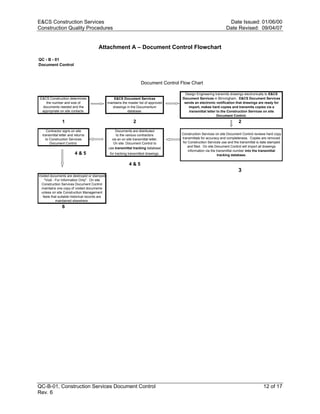
           Test                                Frequency/Interval                   Reference
Daily Resin Gel Test              At the start of each day’s operation             Attachment A
                                  Every change in promotion schedule
                                  Each new resin batch. Each new drum.
Burn Test                         As required per the specification requirements   Attachment B
                                  and agreed upon between the Purchaser and
                                  Fabricator
Barcol Hardness                   Every part/FRP product made.                     Attachment C
                                  Secondary laminates
                                  Vendor Supplied FRP products
Acetone Sensitivity Test          All FRP components produced.                     Attachment D
                                  Sampling of HLU products made.
                                  Vendor Supplied FRP products received on site.
Visual Inspection                 All parts manufactured.                          See
                                  All FRP products received on site                Explanation
                                                                                   Below
Dimension Verification            All parts manufactured.                          Attachment E
                                  All assemblies produced on site
                                  All FRP products received on site
Component/Vessel                  Required for the installation of nozzles, etc.   Attachment F
Installation

                                                 7
QC-G-05rev0web.doc
08/30/05
SCG E&CS Construction Services
Construction Quality Control Procedures
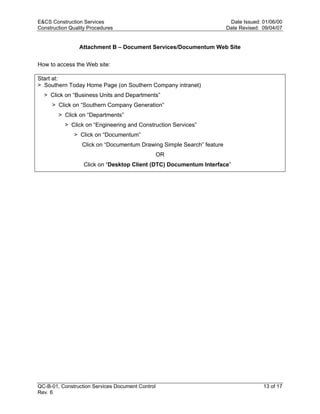

Surveillance Inspection           Frequency as approved by the Purchaser and   Attachment G
Checklist                         more frequently if discrepancies are found
Peel Bond Test Procedure          Assembly of secondary laminates              Attachment H


Visual Inspection

       All laminates shall be visually inspected on interior and exterior surfaces.

       In lieu of specific project requirements, the Contractor shall establish a visual
       inspection program, based on RTP-1 (Table 6-1, Level 2) criteria.

       Allowable visual defects apply to small-localized areas of no more than 1 square
       foot and shall not be repeated in adjacent areas within a radius of 4 feet..


Dimensional Tolerances

   ASME RTP-1 shall be used as a reference for acceptable dimensional tolerances;
   however, specific requirements of the project specifications and drawings shall
   always govern and supersede the requirements of RTP-1.


Documentation

   Written certification of all required inspection and tests is necessary prior to product
   acceptance. Relevant paper work, as required by the approved QC program shall
   be completed within 8 hours of each inspection or test and made available to
   Construction Services for review.

   The Contractor shall maintain a file of all documents required for the project,
   including inspection records traceable back through the production process and
   records of receipt and inspection of raw materials, such as resin and glass
   reinforcement lot numbers. These records shall state the specifications governing
   the receipt and inspection of the materials and shall include results of all testing.

   All QC documentation shall be available at the jobsite for review at anytime by
   Construction Services. The Contractor shall provide to Construction Services
   detailed records of all inspections and test results including the following:

           o Daily QC checklist and summary.
           o Measurements of wet bulb, dry bulb temperatures, relative humidity, and
             dew point temperatures of the fabrication space and materials, taken at
             the beginning of each shift and after the lunch break during all laminating
             work.notation of all deviations and corrective measures taken.
           o Notation of any damaged components and corrective measures taken


                                               8
QC-G-05rev0web.doc
08/30/05
SCG E&CS Construction Services
Construction Quality Control Procedures
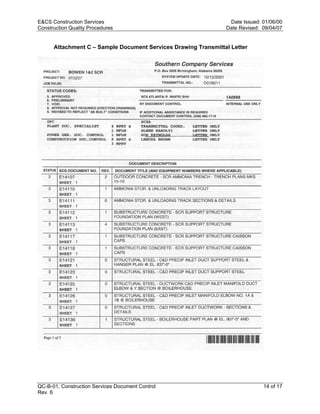
E&CS QA Oversight

General

   E&CS reserves the right to visit, inspect, witness, or observe any fabrication,
   evaluation, or test performed on components being fabricated. E&CS also reserves
   the right to use a qualified third party representative for such surveillance.

   E&CS shall be given access to the equipment, fabrication area and all quality control
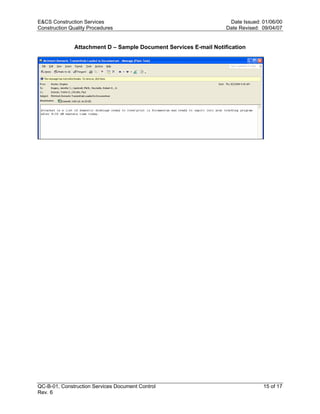
   records during fabrication and upon completion, for the purpose of verifying
   compliance to project specifications.

   All phases of fabrication shall be subject to inspections by E&CS. E&CS shall be
   provided free access during working hours to check all work as well as any
   documentation relating to the work.

   The Contractor must ensure that the fabrication area is safe for entry and must
   provide safe access for the E&CS personnel. Scheduling of inspection, due to
   limited accessibility, shall be coordinated with the Contractor, (i.e., use of existing
   scaffolding, man-lifts, temporary platforms, etc.) Mold releases, dust, or any
   coatings that may restrict visual laminate inspection shall be removed.


   The Contractor shall provide advance notice to E&CS (at least 8 hours prior) of the
   following milestones for use in scheduling inspections of any equipment, and to
   witness any testing required by quality control procedures, and project
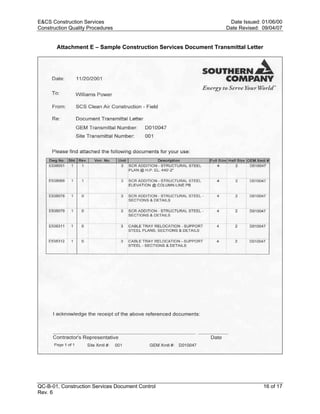
   specifications. A decision by E&CS not to inspect or witness tests shall in no way
   relieve the Contractor from full responsibility for the quality and correctness of the
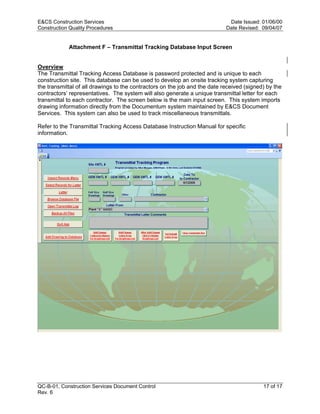
   work. The following milestones shall be considered hold or witness points:

           o   Beginning of fabrication of components.
           o   Completion of shop components, prior to shipping.
           o   Beginning of application of corrosion liner for each major component.
           o   Beginning of the filament winding for each shell section.
           o   Beginning of each significant joining.
           o   Final completion.

   Above milestones are of particular importance on first article inspections. Additional
   milestones may be included as requested by the E&CS.

   Inspection by E&CS does not relieve any responsibility of the Contractor to meet the
   requirements of this specification.

   E&CS retains the right to employ any of the following techniques as a part of the
   inspection:


                                            9
QC-G-05rev0web.doc
08/30/05
SCG E&CS Construction Services
Construction Quality Control Procedures

           o Photography.
           o Magnification or other special viewing techniques.
           o Ultrasonic, magnetic or other special non-destructive measurement
             techniques.
           o Barcol hardness testing.
           o Acetone sensitivity testing.


Final Inspection

   E&CS will carry out a final inspection of the equipment prior to shipment from the
   shop for shop fabricated parts, or prior to Contractor’s demobilization from the job
   site for field fabricated parts. Contractor shall give E&CS a minimum of five days
   advance notice of completion.

   Prior to final inspection by E&CS, equipment shall be cleaned of all foreign material,
   and obstructions to the inspection shall be removed.


Key Inspection Attributes:

   Major manufacturing and assembly tasks are listed below with important QA/QC
   considerations for each phase of fabrication. It is the responsibility of the contractor
   or fabricator to insure compliance to these key inspection attributes.

General Fiberglass Manufacturing and Installation Inspection

   Quality Control is the responsibility of the fabricator throughout the manufacturing
   and assembly process. E&CS is responsible for verification of the
   contractor/fabricator’s inspection and testing plan, (ITP)

   Key Inspection Attributes:

   The following are inspection areas that should be checked and/or verified during
   general fiberglass manufacturing operations. Specific inspection guidelines and
   procedures are found in this document under specific areas of manufacturing such as
   piping. The procedures and sample forms contained herein define inspection points
   and required data to accomplish the quality control tasks listed below.

           o   Materials receiving and storage
           o   Inspection of the manufacturers quality control (QC) procedure
           o   Qualifications of the QC inspector and laminators (form and frequency)
           o   Allowable visual defects
           o   Laminate construction sequences and thickness
           o   Glass content of laminates
           o   Cure of laminates (Barcol hardness)
           o   Acetone sensitivity
                                          10
QC-G-05rev0web.doc
08/30/05
SCG E&CS Construction Services
Construction Quality Control Procedures

           o Dimensional tolerances
           o Surface preparation prior to secondary overlays.
           o Environmental conditions during fabrication and installation
           o Peel testing (as appropriate)
           o Resin, catalyst, and additives usage
           o Reinforcement and other materials usage
           o Promotion and catalyzation procedures
           o Molds and tooling
           o Manufacturers/contractors lab/testing ability
           o Workmanship
           o Exterior surface coating
           o Identification tags or labels
           o Handling and storage procedures
           o Where possible verify actual weight of completed component, such as
             weight of pipe, stack liner can, tank, etc.
           o Completion of pressure testing as required
           o Finished fiberglass component is clean

Resin Promotion and Catalyzation Process Inspection

       Verify that this process is performed in accordance with the project specifications
       and the resin manufacturers requirements. Utilize the procedures and sample
       forms contained herein to accomplish the quality control tasks listed below.

       Key Inspection Attributes:

       The following are minimum inspection issues that should be checked and or
       verified during the resin promotion and catalyzation activities.

           o Ensure that resin, catalyst, and all additives, meet the specification
             requirements.
           o Mixing procedures
           o Percentage of promoters and additives that are added to the resin
           o Delivery of correct amount of catalyst to resin during fabrication operations
           o Testing such as gel testing, are performed prior to usage of resin

Pipe and Duct Manufacturing Inspection

       Verify that pipe and duct manufacturing activities are being performed in
       accordance with the project specifications, procedures, and drawings. Utilize the
       procedures and sample forms contained herein to accomplish the quality control
       tasks listed below.


       Key Inspection Attributes:


                                          11
QC-G-05rev0web.doc
08/30/05
SCG E&CS Construction Services
Construction Quality Control Procedures

       In addition to the attributes found in the “General Fiberglass Manufacturing and
       Installation Inspection” section of the procedure, the following are inspection
       issues that should be checked and/or verified during the on site pipe and duct
       manufacturing process.

           o Diameter
           o Liner application
                    Thickness and laminate sequence
           o Structural laminate application
                    Thickness and laminate sequence
           o Filament winding application (if applicable)
                    Filament winding strand yield
                    Filament winding bandwidth
                    Filament winding band strands per inch
           o Proper wet out
           o Hand lay up procedure (if applicable)
           o Roundness and concentricity
           o Application of all buildups such as stiffeners, support pads, bells, etc.


Fittings Manufacturing Inspection

       Verify that fittings manufacturing activities shall be performed in accordance with the
       project specifications, procedures, and drawings. Utilize the procedures and sample
       forms contained herein to accomplish the quality control tasks listed below.

       Key Inspection Attributes:

       In addition to the attributes found in the “General Fiberglass Manufacturing and
       Installation Inspection” section of the procedure, the following are inspection
       issues that should be checked and/or verified during on site fittings
       manufacturing process.

           o Correct diameter
           o Liner application
                    Thickness and laminate sequence
           o Structural laminate application
                    Thickness and laminate sequence
           o Flange fabrication to include:
                    Flange thickness
                    Flange flatness
                    Flange drilling
                    Flange hub
                    Integral manufacturing method
           o Flange type (for example, stub end, full faced drilled, etc.)


                                           12
QC-G-05rev0web.doc
08/30/05
SCG E&CS Construction Services
Construction Quality Control Procedures

Tank, Stack, and Vessel Manufacturing Inspection

       Tank, stack, and vessel manufacturing activities shall be performed in
       accordance with the project specifications, procedures, and drawings. Utilize the
       procedures and sample forms contained herein to accomplish the quality control
       tasks listed below.

       Key Inspection Attributes:

       In addition to the attributes found in the “General Fiberglass Manufacturing and
       Installation Inspection” section of the procedure, the following are inspection
       issues that should be checked and/or verified during the tank and vessel
       manufacturing process.

           o Correct diameter
           o Liner application
                     Thickness and laminate sequence
           o Structural laminate application
                     Thickness and laminate sequence
           o Filament winding application (if applicable)
                     Filament winding strand yield
                     Filament winding bandwidth
                     Filament winding band strands per inch
           o Proper wet out
           o Large hand lay up process:
                     Shell
                     Bottom
                     Top
           o Special internal or external components
           o Bottom knuckle application
           o Roundness and concentricity
           o Alignment of shell to major joined sections, such as dome top and flat
             bottom
           o Where applicable, flatness of bottom to pad and correct set up
           o Secondary laminations
           o Placement of anchor lugs, lifting lugs, ladder attachments, pipe guides,
             and other attachments
           o Additional lamination for stiffeners, buildups, support pads, bells, and
             other fiberglass work
           o Inspect cutouts
           o Application of insulation jacket (where applicable)
           o If oblation is required, ensure that no micro cracking exists at the time of
             oblation and assembly
           o Non-skid application (if required).
           o Gussets (where applicable).


                                           13
QC-G-05rev0web.doc
08/30/05
SCG E&CS Construction Services
Construction Quality Control Procedures


Joining and Assembly Inspection

       Verify that joining and assembly activities are performed in accordance with the
       project specifications, procedures, and drawings. Utilize the procedures and
       sample forms contained herein to accomplish the quality control tasks listed
       below.

       Key Inspection Attributes:

       In addition to the attributes found in the “General Fiberglass Manufacturing and
       Installation Inspection” section of the procedure, the following are inspection
       issues that should be checked and/or verified during the joining and assembly
       process.

           o Correct components to be joined
           o Facility/site has a dedicated quality control inspector and qualified
             bonding/assembly crew
           o Surface preparation prior to secondary overlays
           o Component fit up
           o Environmental conditions at time of lamination
           o Peel testing (if appropriate)
           o Resin, catalyst, and additives usage
           o Reinforcement and other materials usage
           o Promotion and catalyzation procedures
           o Laminate sequence and width
           o Repair procedure (if any)
           o Documentation


Non-conformance Reporting, Hold Tag Requirements and Repairs

       Quality control procedures QC – H – 01 Nonconformance Reporting and QC – H
       – 02 Hold Tags shall be referenced for guidelines covering the initiation, follow-
       up and resolution of nonconforming items associated with items covered by this
       procedure.

       A component will be considered to be a non-conformance when it is found to
       deviate from the Specifications or Design Drawings.

       All non-conformances shall be documented and immediately brought to the
       attention of E&CS.

       Damaged material and material not conforming to the Specifications and
       approved drawings may be rejected by E&CS at any time.


                                           14
QC-G-05rev0web.doc
08/30/05
SCG E&CS Construction Services
Construction Quality Control Procedures

       The Fabricator shall correct or replace any components in non-conformance.

       Any repairs recommended by the Contractor shall be submitted to E&CS for
       approval prior to implementation.


Document Control

   All documentation of inspections performed on fiberglass components manufactured
   and installed on SCG E&CS Construction Services construction projects shall be
   maintained and updated until such time that equipment and/or systems have been
   released to plant operations personnel. At that time, all documentation shall be
   assembled as part of the appropriate turn-over package and processed in
   accordance with procedure QC-I-01 Control of Quality Records and administrative
   procedure 3G – Processing Startup Packages.


                                          15
QC-G-05rev0web.doc
08/30/05
SCG E&CS Construction Services
Construction Quality Control Procedures

                        Resin Evaluation & Test Procedure ASTM D2471

     Following is a summary of the test method. Refer to the indicated ASTM for
                        specific instructions on performing this test.

Gel Time:

Gel time is defined as the timer interval between the mixing of a resin with catalyst and
            promoter, and the point where the mixture becomes unworkable due to
            gelation.

Gel time tests follow this procedure:

1.           Make a note of all information on the resin to be tested, including type of
             resin, resin manufacturer, date of manufacture, batch and drum numbers,
             and date of test. If required, note type of promotion and type of catalyst,
             including percent used in the test. Also, if required, include temperature at
             time of test.

2.           Set gel time counter to zero.

3.    a.     When using a Gel Timer, weigh and place 200g sample of resin in a paper
             cup, measure and add an appropriate amount of catalyst and mix for at
             least one minute.

      b.     When using a “Hot Pot” Gel Timer, set the thermostat at the desired test
             temperature (usually 70 deg. F to 75 deg. F). Weight and place a 100g
             resin sample in an aluminum gel cap. Measure and add an appropriate
             amount of catalyst and mix for at least one minute.

4.           Place the sample in the gel timer.

5.           Insert a wire utensil and stir.

6.           When the resin gels, note the time shown on the counter and record it on
             the Resin Evaluation & Test Log.

7.           Record comments, if any, and sign the log.

Viscosity Test:

Responsibility for viscosity testing is left to the manufacturer of the resin. SCG E&CS
requests a full report on this test at the time of delivery of the resin.


                                          Attachment A
                                           Page 1 of 2
                                               16
QC-G-05rev0web.doc
08/30/05
SCG E&CS Construction Services
Construction Quality Control Procedures

                               Daily Resin Gel Test (ASTM D 2471)

                                                    Date:
                                                    Resin Lot Number:

Resin Type:

Catalyst Used:


Additives:
                               Amount                         Comments
Additives include:            Wt.               %
Cobalt (6%)
DMA
Antimony Trioxide
2-4 P
SAG 47
Other:


GEL TEST:
              Percent/        Resin     Dew         Relative Ambient    Mandrel   Gel    Inspector’s
Time of       Amount of       Temp.     Point       Humidity Temp.      Temp.*    Time   Initials**
Test          Catalyst Used


* = Mandrel temp. only need for liner resin.
**= Inspector to initial each test.


                                                Attachment A
                                                 Page 2 of 2
                                                     17
QC-G-05rev0web.doc
08/30/05
SCG E&CS Construction Services
Construction Quality Control Procedures

            Glass & Resin Content in Laminates (Burn Test) ASTM D-2584

      Following is a summary of the test method. Refer to the indicated ASTM for
                         specific instructions on performing this test.

1.           This test follows ASTM Designation D-2584. Line names indicated refer to lines on
             the Ignition Loss Report (See Appendix “G”).

2.           Fill out background information on the Ignition Loss Report.

3.           Cut several 1” by 1” sample pieces; note their thickness on line C.

       a.    When filament wound pipe is to be burned, the liner and winding should be
             separated and burned individually. Indicate type of material being burned in
             Section B, “Type of Sample”.

       b.    When hand lay-up samples are to be burned, do not separate laminate from liner.
             Burn as a composite laminate, and mark the “Hand Lay-up” box in Section B.

4.           Number and mark each crucible. Note crucible numbers on Line A.

5.           Number and mark each crucible on a gram scale and note the weight on Line E.

6.           Place one sample in each crucible, and weigh the crucible and sample together.
             Note the weight on Line D, “Weight of Sample+Crucible Before Burn”.

7.           Subtract Line E from Line D to get Line F, “Weight of Sample”.

8.           Place crucibles in a burn oven set at 1,150 deg. F - 1,200 deg. F. The oven should
             be preheated to burn temperature before insertion of samples. Once samples are
             in the oven, turn the fan on. Burning of samples will take two to four hours,
             depending on sample thickness.

9.           When all the resin has burned off and only glass remains in the crucible, weigh the
             sample and crucible together. Note the weight on Line G.

10.          Subtract Line G from Line D; note the difference on Line H.

11.          Subtract Line H from Line F; note the difference on Line I.

12.          Divide Line H by Line F; note the result on Line J (% resin).

13.          Divide Line I by Line F; note the result on Line K (% glass).

14.          Fill in the remaining portion of the sheet and sign.

                                          Attachment B
                                           Page 1 of 2


                                              18
QC-G-05rev0web.doc
08/30/05
SCG E&CS Construction Services
Construction Quality Control Procedures

                   “Burn Test” - Ignition Loss Report ASTM D 2584
Date of Test:                             Job:

Sample Description:


A) Crucible No.:
B) Type of Sample
(Check Appropriate Box)
    Liner Only
    Filament Winding
    Liner & Winding
    Hand Lay-up
C) Sample Thickness
D) Weight of Sample +
   Crucible Before Burn
E) Weight of Crucible
F) Weight of Sample
G) Weight of Sample +
   Crucible After Burn
H) Weight of Resin
I) Weight of Glass
J) % Resin
K) % Glass

Comments:


Signed:


                                                 Attachment B
                                                  Page 2 of 2


                                                    19
QC-G-05rev0web.doc
08/30/05
SCG E&CS Construction Services
Construction Quality Control Procedures

                       Barcol Hardness Measurement ASTM D 2583

     Following is a summary of the test method. Refer to the indicated ASTM for
                        specific instructions on performing this test.


1.           Fill out background information on the Barcol Hardness Report, including
             date of test, description of sample, and the specified Barcol for the test.

2.           Note and record the areas from which the readings have been taken (shell
             interior, bottom interior, overlays, etc.) in the boxes labeled A through H.

3.           Check the calibration of the Barcol Impressor with an aluminum calibration
             disc before taking any readings.

4.           Take ten (10) readings from each area listed. Record each reading in lines
             1-10 on the report.

5.           Discard the two lowest and two highest readings, and average the
             remaining six readings.

6.           Compare the averages for each location to the specified Barcol for the test.
             Make a note of whether or not they conform. Make any necessary
             comments and sign.


                                          Attachment C
                                           Page 1 of 2


                                             20
QC-G-05rev0web.doc
08/30/05
SCG E&CS Construction Services
Construction Quality Control Procedures

                                 Barcol Hardness Report ASTM 2583

Date of Test:                             Job:

Sample Description:

Specified Barcol:

Location
Reading #
1
2
3
4
5
6
7
8
9
10
SUM
Sum Without
2 Low/High
Average of
Six
Conform:

Signed:

Dated:


                                                 Attachment C
                                                  Page 2 of 2

                                                    21
QC-G-05rev0web.doc
08/30/05
SCG E&CS Construction Services
Construction Quality Control Procedures

                                   Acetone Sensitivity Test


An Acetone Test should be applied to any secondary laminate surface, within the
          following parameters:

•            Perform three (3) tests per quadrant per specific elevation, or perform three
             (3) tests per joint.
•            Acetone used for testing must be clean.

Acetone Testing Procedure:

1.           Note test location--elevation and radial location (in degrees--see drawings
             for reference) on the Acetone Sensitivity Report Form.

2.           Apply 5 drops of acetone to a small area of the laminate surface.

3.           With a clean finger, rub the acetone into the surface until the liquid
             evaporates.

4.           Check the laminate surface for tackiness.

5.           If the laminate feels tacky, note a “fail” on the test report. If not, indicate
             passage by checking “OK” on the report.

6.           Sign the report.


                                          Attachment D
                                           Page 1 of 2


                                             22
QC-G-05rev0web.doc
08/30/05
SCG E&CS Construction Services
 Construction Quality Control Procedures

                                     Acetone Sensitivity Test Report
 Job:

 Signed:

                                                                    Check One
Line No.   Date          Time          Elevation        Location    OK      Fail    Other
                                       (ft. & in.)      (deg.)                     Entries*


 * = Refer to related entries by line number.


                                                     Attachment D
                                                      Page 2 of 2
                                                        23
 QC-G-05rev0web.doc
 08/30/05
SCG E&CS Construction Services
Construction Quality Control Procedures

                                     Dimension Inspection

Test all goods, whether manufactured or purchased, for the following:

             a.        Flatness.
             b.        Roundness.
             c.        Size.
             d.        Assembly Dimensions:
                       --Degrees and Elevation of all nozzles on shell wall.
                       --Degrees and Length of Radius for all nozzles on cover.
             e.        Thickness.

Refer to project engineering drawings for reference to specified dimensions. ASME
RTP-1 should be used as a reference if specific dimensional tolerances are not given in
the site specific specifications and drawings.

Dimensional measurements should be recorded on a log similar to the attached
Dimensional Inspection Log.


                                          Attachment E
                                           Page 1 of 4


                                             24
QC-G-05rev0web.doc
08/30/05
SCG E&CS Construction Services
Construction Quality Control Procedures

                                       Dimension Inspection Log
Job:                                                            Date:


Refer to drawings and specifications for dimensional guidelines.

          Measure.       Dimensions             Drawing                 Tolerances   Accept   Reject
Item      Type           or Orientation         Specification           (refer**)


                                                 Attachment E
                                                  Page 2 of 4
                                                      25
QC-G-05rev0web.doc
08/30/05
SCG E&CS Construction Services
Construction Quality Control Procedures


                                     Mandrel Dimensional Check

Refer to job site specifications for specific acceptance criteria.


Vessel Number:                                         Pull Number:

Dimension

Concentricity                                                   0 degrees - 180 degrees F
(Acceptance Criteria:
_________on diameter)                                                90 degrees - 270 degrees F


Pi Tape Reading                                                          Base Ring
(Acceptance Criteria:
________on diameter)                                                     Mid Ring

                                                                         Top Ring


Levelness of Mold Panels                                                         +/ -
(Acceptance Criteria:
__________per foot)


Appearance of Mold Panels                                                Accepted:
       Cleanliness
       Absence of burrs                                                  Rejected:
       Indentations
       Plate joints match up

Has laser been retargeted?                                               Accepted:
   Must be done after each part removal
                                                                         Rejected:

Foreman/Operator

_____________________________________
(name)        (date)

Contractor Inspector

_____________________________________
(name)        (date)

                                           Attachment E
                                            Page 3 of 4


                                                26
QC-G-05rev0web.doc
08/30/05
SCG E&CS Construction Services
Construction Quality Control Procedures

                        Setting Base Can Inspection & Acceptance

Refer to job site specifications for specific acceptance criteria

Vessel Number

 Drawing Number

Tolerance                                 Accepted   Rejected   Remarks

Is vessel level within tolerance.
Acceptance criteria: _______

Is vessel square to datum                                       _______________
plane w/in tolerance?
Acceptance criteria: ________


Is vessel orientation
w/in tolerance?
Acceptance criteria: _________

Are elevations w/in tolerance.
Acceptance criteria: __________


Comments:


Action Required:


 Accepted

 Rejected

Contractor Inspector


______________________________
name)      (date)

                                          Attachment E
                                           Page 4 of 4
                                             27
QC-G-05rev0web.doc
08/30/05
SCG E&CS Construction Services
Construction Quality Control Procedures


                            Component/Vessel Installation Inspection
Job:                                                  Contract #:
Item:                                                 Drawing #:                            Rev. #:
W.O. #:
                                                  Layout By:          Checked By:          Verified By:
                         Per Drawing              (Initial/Date)      (Initial/Date)       (Initial/Date)
Layout
Nozzle Size
Elevation
Orientation
Set
Bolt Holes
Extension
Level
Plumb
Installation
Final Lay-up
Wax Coat
Comments:


Note:          Subject checks are to be made prior to secondary bonding, hole drilling, installation, critical cuts, etc.


                                                  Attachment F
                                                   Page 1 of 1


                                                       28
QC-G-05rev0web.doc
08/30/05
SCG E&CS Construction Services
Construction Quality Control Procedures

                                Surveillance Inspection Checklist

Job:                                              Date:

A. Materials Storage and Handling                         Check One
                                                          Acceptable   Not Acceptable
Process Chemicals:
  Containers Sealed
  Containers Marked
  Containers Clean
Fiberglass Materials
  Well Organized
  Clean Area
  Dry
Pumping Equipment
  Cleaned & Flushed
General Storage Area
  Cleanliness
  Dryness

B. Work Areas
Winding Area:
  Fiberglass Materials
      Covered & Clean
  Resin Baths & parts
      Cleared
  Process Chemical Containers
      Stored
Mold Surface Area:
  Molds, Fittings, Patterns
      Kept Clean, Dry
  Fiberglass Materials Covers and Clean
  Process Chemicals Stored
  General Area Cleanliness
Tools & Equipment:
  Cleanliness
  Condition
Work Surfaces Condition
C. Parts Procurement Rather Than Manufactured on site
Stored in Safe Location
Adequately Supported
Protected from Elements

Comments:____________________________________________________________
_____________________________________________________________________
_____________________________________________________________________

Name                                                  Date ____________________________
                                             Attachment G
                                              Page1 of 1


                                                   29
QC-G-05rev0web.doc
08/30/05
SCG E&CS Construction Services
Construction Quality Control Procedures

                                  Peel Bond Test Procedure

General Method for Performing Peel Test

A Peel Bond Test is performed to test secondary bonding performance. It should also
be run prior to the start of work to verify proper application technique.

First the area to be bonded is properly prepared by grinding with a 16 or 24 grit disk.
This removes any paraffinated resin or contaminants. Or in the case of the mold
surface, it roughens the surface and exposes glass fibers.

Next a piece of mylar is taped over 1/2 of the area to be tested.

Next a laminate is prepared consisting of 3 layers of 1-1/2 ounce mat* cut to 6” x 12”
along with a proper amount of resin and catalyst.

Next the glass is wet out and applied over the test area being careful to center the
laminate over the prepared area and the mylar area, i.e., 6” x 6” over the mylar and 6” x
6” over the prepared area.

After the laminate has properly cured, the laminate is removed by lifting along the no
bond mylar side and pulling the laminate free from the test area.

If the laminate pops free from the test area with little or no fibers tearing, it has failed the
test. The prepared area needs to be inspected to see if it was ground properly to the
right profile and to see if all contaminants have been removed.

If the laminate tears loose exposing numerous fibers along this substrate, the test
shows that a proper bond has been achieved.


*Some specifications may also include 1 layer of 24 ounce woven roving


                                          Attachment H
                                           Page 1 of 2


                                             30
QC-G-05rev0web.doc
08/30/05
SCG E&CS Construction Services
Construction Quality Control Procedures


                                          Peel Bond Test Report
Date of Test:                                        Location:

Part Description:

(If more than one area will be tested on a particular part, a map of the part showing the numbered test areas should
be attached to this report.)

                Area Number              Accept                  Reject           Comments
                    1
                    2
                    3
                    4
                    5
                    6
                    7
                    8
                    9
                    10


CONTRACTOR INSPECTOR:                                                           Date:


                                                  Attachment H
                                                   Page 2 of 2


                                                      31
QC-G-05rev0web.doc
08/30/05
SCG E&CS Construction Services
Construction Quality Control Procedures


                                          GLOSSARY


Air Bubble – Air entrapment within and between the plies of reinforcement, usually
             spherical in shape.
Barcol Hardness – A hardness value obtained by measuring the resistance to
            penetration of a sharp steel-point under a spring load. The hardness
            value is used as a measure of the degree of cure of a laminate.
Burned –       Showing evidence of thermal decomposition through some discoloration,
               distortion or destruction of a laminate and usually resulting from excessive
               exotherm temperatures.
"C" Glass – Monofilaments of corrosion resistant "C" grade glass commonly used on
            the interior surface of a laminate in contact with corrosive process stream.
            Also known as "C" veil.
Catalyst –     A liquid or paste formulation which, when added to resin, markedly
               accelerates the cure.
Chip –        A small piece broken off a laminate edge or surface.
Cobalt Napthenate – A dark purple liquid formulation of active cobalt in a solvent. Used
            as a promoter in resin to speed up and control cure.
Corrosion – The action of the chemical environment on the resin or reinforcements
            causing a loss of physical strength and material.
Corrosion Barrier – The process side of an FRP laminate normally consisting or surface
             veil(s) and chopped strand mat. The corrosion barrier, also known as the
             liner, may occasionally be on the exterior surface.
Crack –        An actual separation of the laminate, visible on opposite surfaces and
               extending through the thickness; a fracture.
Crazing –      A form of random and shallow cracking that occurs in the outer 5 to 10
               mils on the exterior or interior surface of a laminate.
Cumene Hydro Peroxide (CHP) – A liquid catalyst used with reactive resins to reduce
           high exotherm temperatures.
Defect –       A condition in a laminate that may compromise corrosion resistance or
               structural integrity. The defect may have been designed or manufactured
               into the laminate, damaged in transit or installation, or resulted from
               operating or upset conditions.
Delamination – The separation of layers of material in a laminate.

                                          Attachment I
                                          Page 1 of 4


                                            32
QC-G-05rev0web.doc
08/30/05
SCG E&CS Construction Services
Construction Quality Control Procedures


Dimethylaniline (DMA) – A liquid solution added to resin to accelerate the rate of cure.
Dry Spot –     An area of incomplete surface film where the reinforcement has not been
               wetted out with resin.
Exotherm – That point in the curing process of resin where heat is given off as a by-
            product.
Fiber Prominence – Distinctly visible glass fibers in a cured laminate. Similar to
             jackstraw.
First Article Inspection – An inspection conducted on the first part in a series to ensure
                that all construction details such as dimensions, resin, reinforcements, etc.
                are correct on this very first part. An example would be inspecting the first
                pipe in a series of ten pipe to ensure conformance to specifications and
                drawings.
Filament Winding – A process for fabricating a composite structure in which continuous
            fiber reinforcements are saturated with resin and mechanically wound onto
            a mold in a previously prescribed manner, producing a laminate designed
            to meet certain stress conditions.
Foreign Inclusion – Any inclusions in a laminate, which are foreign to its composition.
Fracture –    Rupture of a laminate surface without complete penetration.
Gel Time – The time span between catalyzation of a resin and gelation.
Hand Lay-Up – Laminates produced by hand-applied methods, usually using alternating
           layers of mat and woven roving.
Jackstraw – Distinctly visible glass fibers in a cured laminate. Similar to fiber
             prominence.
Laminate – Multiple layers of glass held in matrix with a cured resin.
Liner –       The process side of a laminate usually consisting of surface veil(s) and
               chopped strand mat. Also known as the corrosion barrier.
Mat – Fiber reinforcement made of "E" glass cut into 0.5" to 2" lengths and held loosely
              together by a resin binder soluble in styrene.
Methyl Ethyl Ketone Peroxide (MEKP) – Standard catalyst used to cure resin.
Mylar – Polyester film 1 to 2 mils thick used as a release film in wet laminate work. The
             film imparts a mirror-smooth finish to cured laminates. Also used for
             photographic documentation of a mylar control area (defects).


                                          Attachment I
                                          Page 2 of 4


                                             33
QC-G-05rev0web.doc
08/30/05
SCG E&CS Construction Services
Construction Quality Control Procedures


Oblation – This is a process whereby a circular section of a large diameter fiberglass
            reinforced plastic tank (up to 60’ in diameter) is forced into an elliptical
            shape by compressing the section at the poles. Tank sections can be
            forced into elliptical sections to reduce the width for purposes of shipping
            over roadways. Large tank sections can be further deflected to form a
            near “figure 8” or dog bone shape. This additional deflection allows
            nesting of two or more sections to reduce shipping costs. Once on the job
            site, the tank sections are de-nested, de-oblated and the sections are
            bonded together.
Pit (Pin hole) – Small crater in the surface of a laminate with its width approximately of
               the same order of magnitude as its depth.
Promoter – A chemical solution, usually cobalt naphthenate, used in combination with
           catalyst and accelerator to control cure of resin.
Resin –        In simple terms (for the fiberglass industry), resin is one component of a
               fiberglass structure. Initially resin is liquid than with the addition of
               promoters, catalyst, and reinforcements, and after a exothermic reaction
               becomes solid.
Resin Pocket – An apparent accumulation of excess resin in a small, localized area
            within the laminate.
Resin Putty – A putty-like mixture of fumed silica, milled glass fibers and resin.
Scratch –      Shallow mark, groove, furrow or channel caused by improper handling or
               storage.
Star Cracking – A fracture in a laminate usually caused by impact and characterized by
             fine cracks radiating away from the center of impact.
Structural Wall – That portion of a laminate composed of filament winding or alternating
             layers of mat and woven roving and intended to provide structural
             strength.
Surface Veil A glass or synthetic veil usually used on the process side of FRP in
             contact with the process stream. The veil holds about 90% resin and is
             highly corrosion resistant. Veils most commonly used are "C" glass and
             Nexus.
Uni-Directional Roving – Continuous, parallel rovings held together with periodic cross
             strands of glass or synthetic fiber. Available in warp, weft or angled rolled
             goods, with a common weight of about 15 ½ oz per square yard.
Wax Coat – A resin solution, typically with a short gel time, containing paraffin wax and
           used as a top coat over cured laminates.

                                          Attachment I
                                          Page 3 of 4

                                             34
QC-G-05rev0web.doc
08/30/05
SCG E&CS Construction Services
Construction Quality Control Procedures


Woven Roving – Heavy fabric woven with continuous glass fiber strands. Used
           primarily as structural reinforcement in hand lay-up laminates.
Wrinkles –     Imperfections that have the appearance of a wave molded into one or
                more plies of fabric or other reinforcement


                                          Attachment I
                                          Page 4 of 4


                                             35
QC-G-05rev0web.doc
08/30/05
Southern Company Generation

              Engineering and Construction Services

                              Construction Services

                      Construction Quality Procedures


                                                        y
                                                        op
                         QC Procedure QC-G-06


                                                        C
                         (Revised Number: MT-CS-06)
                                              d
                                       lle
            Construction Services Survey Control
                       tro
           on
nc


                       Rev. 0
Date                   12/03/07
Revised By             Rob Reynolds, Jr
Reviewed By
  Construction Svcs    Teresa Magnus
U


  Design               Thomas Rickets
  Engineering Svcs     Tom Chandler, Christa Edwards,
                       Valerie Piazza
  Technical Svcs       Terri Hartsfield, Larry Wall
Approved By
  Construction Svcs    Keith Russell
E&CS Construction Services                                                                                   Date Issued: 12/03/07
Construction Quality Procedures


                                                              Contents

1.0   PURPOSE AND SCOPE ..................................................................................................3
  1.1   Purpose .........................................................................................................................3
  1.2   Scope ............................................................................................................................3

2.0   DEFINTIONS AND REFERENCES ..................................................................................3
  2.1   Definitions......................................................................................................................3
  2.2   References ....................................................................................................................3


                                                                                                           y
3.0   RESPONSIBILITY.............................................................................................................4


                                                                                          op
  3.1   Construction Site Manager............................................................................................4
  3.2   Site Quality Lead ...........................................................................................................4
  3.3   Site Discipline Lead.......................................................................................................4
  3.4   Survey Entities ..............................................................................................................4
  3.5   All Construction Personnel ............................................................................................4


                                                                                C
4.0   PROCEDURE ...................................................................................................................5
  4.1   Establishing Baseline Survey Control – Construction Services ....................................5
  4.2   Creating Temporary Survey Control – Contractors .......................................................5
  4.3
  4.4                                                              d
        Survey Process Procedure............................................................................................6
        Construction Services Verification and Oversight Activities ..........................................7
                                                    lle
5.0       KEY CONTACTS ..............................................................................................................9

6.0       QUALITY RECORDS ........................................................................................................9
                                  tro

7.0       ATTACHMENTS ...............................................................................................................9
                 on
 nc
U


QC-G-06 Construction Services Survey Control                                                                                       2 of 9
Revised Number: MT-CS-06
Rev. 0
E&CS Construction Services                                                  Date Issued: 12/03/07
Construction Quality Procedures


1.0    PURPOSE AND SCOPE


1.1    Purpose

       This procedure outlines general guidelines for proper survey layout, control, and
       verification on Southern Company Generation Engineering and Construction Services
       (E&CS) construction sites.


                                                                          y
                                                               op
1.2    Scope

       This procedure is an integral part of the E&CS Construction Services Quality Program.
       The guidelines and criteria outlined in this procedure apply to the following:


                                                       C
       •   Contractors performing survey activities on E&CS construction sites.

       •   Third-party survey companies performing survey activities for contractors.

       •                                       d
           Third-party survey companies or other internal survey entities performing survey
                                    lle
           activities for Construction Services.

       •   Construction Services personnel as applicable from a construction management and
           quality oversight perspective.
                         tro

2.0    DEFINTIONS AND REFERENCES
            on


2.1    Definitions

       None.
 nc


2.2    References
U


       E&CS Basic Quality Program

       Construction Services Policy and Procedure Manual, Volume 5, Construction QA
       Manual and Quality Control Procedures

               QC-A-02, Oversight and Control of Contractor QC Programs
               QC-F-01, Process Control
               QC-G-01, Civil Inspection
               QC-I-01, Control of Quality Records

QC-G-06 Construction Services Survey Control                                               3 of 9
Revised Number: MT-CS-06
Rev. 0
E&CS Construction Services                                                   Date Issued: 12/03/07
Construction Quality Procedures


3.0    RESPONSIBILITY


3.1    Construction Site Manager

       The Construction Services construction site manager or designee shall implement and
       ensure adherence to the scope and requirements of this procedure.


                                                                            y
3.2    Site Quality Lead


                                                                op
       The Construction Services site quality lead or designee shall ensure quality preplanning,
       monitoring, and administration of this procedure.


                                                        C
3.3    Site Discipline Lead

       The Construction Services site discipline leads shall ensure all entities performing
       survey activities on E&CS construction sites submit process procedures outlining the key
       components of their planned survey activities for review and acceptance.

                                               d
                                    lle
3.4    Survey Entities

       All entities performing survey activities on E&CS construction sites shall submit for
       review and acceptance to Construction Services process procedures outlining the key
                         tro

       components of their planned survey activities as outlined in this procedure and
       procedure QC-A-02.
            on


3.5    All Construction Personnel

       Each Construction Services employee shall be responsible for the following:
 nc


       •   Being accountable for his or her personal safety and for the safety of others.

       •   Knowing the safety rules applicable to his or her work.

       •   Accepting personal responsibility for cooperating and complying with all
U


           Environmental Health and Safety (EH&S) policies and procedures.

       •   Prior to beginning work, reviewing and having a thorough understanding of all
           applicable safety procedures contained in the E&CS Construction Services EH&S
           Policies and Procedures Manual.


QC-G-06 Construction Services Survey Control                                                4 of 9
Revised Number: MT-CS-06
Rev. 0
E&CS Construction Services                                                       Date Issued: 12/03/07
Construction Quality Procedures


4.0    PROCEDURE


4.1    Establishing Baseline Survey Control – Construction Services

       Construction Services or its designee shall establish initial baseline survey control for the
       construction site. This control may consist of previously established benchmarks that
       have been verified as suitable for control purposes and/or newly established control that
       meets the accuracy and precision criteria for the project.


                                                                                y
       To establish or restore baseline monuments or when setting temporary control
       monuments:


                                                                   op
       •   Perform a closed-loop traverse using tripods; adjust tribrachs at each setup.

       •   Do not use prism poles when setting horizontal control.


                                                           C
       •   Double all angles and distances and calculate the mean. Angles shall be doubled by
           inverting the scope and reading Direct & Reverse (Face 1 & Face 2).

       •
                                                 d
           Ensure the unadjusted closure is 1:20,000 feet, at a minimum.

           Establish the vertical control or elevations on said monuments by differential
                                      lle
       •
           methods.

       •   Ensure the unadjusted level-loop closure is a minimum of the square root of the
           number of miles times 0.035. Use an instrument capable of achieving this level of
                         tro

           accuracy.

       If the error of closure is within the allowable criteria stated above, it is recommended that
       the compass rule or least squares method be used for calculating and balancing
            on


       horizontal control while the proportional distance method is recommended for calculating
       and balancing vertical control.
 nc


4.2    Creating Temporary Survey Control – Contractors

       Contractors will establish their own temporary survey control for the ongoing
       construction activities within their scope of work. The contractor shall establish and
       maintain this survey control to the accuracy and precision required to meet industry and
U


       jobsite standards and requirements. Contractors shall verify all survey control is relative
       and is checked against newly added or existing structures, not just against site control
       monuments. Contractors shall also perform routine verification of objects “laid-out” in
       the field to their theoretical or calculated location to ensure relative locations in the field.

       When setting temporary control monuments, points or benchmarks:

       •   Perform a closed-loop traverse using tripods; adjust tribrachs at each setup.


QC-G-06 Construction Services Survey Control                                                      5 of 9
Revised Number: MT-CS-06
Rev. 0
E&CS Construction Services                                                     Date Issued: 12/03/07
Construction Quality Procedures


        •   Do not use prism poles when setting horizontal control.

        •   Double all angles and distances and calculate the mean. Angles shall be doubled by
            inverting the scope and reading Direct & Reverse (Face 1 & Face 2).

        •   Ensure the unadjusted closure is 1:20,000 ft, at a minimum.

        •   Establish the vertical control or elevations on said monuments by differential
            methods.


                                                                             y
        •   Ensure the unadjusted level-loop closure of the square root of the number of miles
            times 0.035 at a minimum. Use an instrument capable of achieving this level of


                                                                 op
            accuracy.

        •   Surveys used to set temporary control monuments shall be certified by the
            contractor’s Registered Land Surveyor (RLS) or equivalent individual.


                                                          C
        •   Set all temporary control points or temporary benchmarks and then verify them by
            running a closed traverse to an approved permanent site baseline control monument.

        •

                                                d
            Set all temporary control points or temporary benchmarks in a location that is not
            subject to disturbance and/or movement by vibrations, traffic, construction activities,
            and so forth.
                                      lle
        •   Field verify temporary control points/benchmarks prior to each use or if there is any
            evidence that the point has been disturbed.
                         tro


4.2.1   Changes
             on


        Under no circumstances shall published baseline monument coordinates be changed by
        a contractor.
 nc


4.2.2   Verification

        Construction Services reserves the right to perform independent surveys to confirm
        compliance to these requirements.
U


4.3     Survey Process Procedure

        All entities performing survey activities on E&CS construction sites shall submit a survey
        process procedure to Construction Services that contains, at a minimum, the following
        components:


QC-G-06 Construction Services Survey Control                                                   6 of 9
Revised Number: MT-CS-06
Rev. 0
E&CS Construction Services                                                      Date Issued: 12/03/07
Construction Quality Procedures


        •   Scope of the survey and/or layout being performed by the contractor.

        •   Identification of personnel responsible for construction layout and/or verification,
            including experience and qualifications.

        •   Identification of RLS or an equivalent individual who is responsible for certifying
            temporary control surveys.

        •   Type of instruments and equipment being used, their accuracy, methods used to
            verify their calibration and/or accuracy, and calibration schedule.


                                                                              y
        •   Procedures and methodology used to perform the work.


                                                                  op
        •   Process used to verify survey and/or layouts to ensure accuracy and limit errors.

        •   Relevant codes, standards, job specifications, procedures, and drawings.


                                                          C
        •   Pre-placement verification and as-built procedures.

        •   Process of how layout and/or verification calculations, field notes, and so forth are


        •                                        d
            documented and stored in the contractor’s project files.

            Process for timely notification of Construction Services for review of layout and as-
                                      lle
            built verification.

        Survey entities shall submit this process procedure to Construction Services prior to the
        start of work with sufficient lead time to allow for review. Contractors and/or their
                         tro

        surveyors shall not begin work until Construction Services accepts their survey process
        procedure.
             on


4.4     Construction Services Verification and Oversight Activities


4.4.1   Survey Process Procedure Key Components
 nc


        As part of the review process, Construction Services shall ensure, at a minimum, the
        process procedure sufficiently addresses the following components:

            Personnel – Do the surveyors, especially the lead surveyor, have construction layout
U


        •
            experience? Has the RLS or equivalent individual been identified?

            Land survey experience alone is not an adequate substitute for construction layout
            experience. Construction Services shall determine if the survey crew leader and
            team have the proper experience and qualifications for the performance of
            construction/industrial layout/staking surveying.


QC-G-06 Construction Services Survey Control                                                       7 of 9
Revised Number: MT-CS-06
Rev. 0
E&CS Construction Services                                                      Date Issued: 12/03/07
Construction Quality Procedures


        •   Equipment – Does the plan adequately address the type of equipment to be used on
            site? Is the type and accuracy of the equipment sufficient for the scope of work to be
            performed? Does the plan address annual calibration of the equipment?

            The equipment shall have a minimum angular tolerance of three seconds.

        •   Technique – Does the plan adequately address the survey process to ensure good
            survey practices? Are baseline survey control monuments identified and referenced
            to state grid and/or plant grid coordinates? Will additional temporary control be
            required? If yes, where will it be located? Will this temporary control allow clear and


                                                                              y
            balanced lines of sight? Is there a clear understanding of how temporary control will
            be verified and “tied in” to existing control?


                                                                  op
            The distance from the occupied point to the point to be staked or verified, shall be no
            greater than the positional tolerance of the equipment being used and the accuracy
            requirements of the point being staked (such as anchor bolts vs. caisson locations).


                                                          C
        •   Field layout – Does the plan specifically address how particular field layouts will be
            performed, such as anchor bolts, caissons, foundations, earthwork, and structural
            steel plumbness?

        •
                                                 d
            Review of survey data – Does the plan address a process for the timely submittal of
            survey data and the specific type of data to be submitted to Construction Services for
                                       lle
            review? Do the proposed data reports allow a review of the survey precision and
            accuracy?

        •   Contractor document control – Does the plan address a controlled process for the
                         tro

            storage and maintenance of survey data?

        •   Construction Services verification and oversight – Does the plan establish
            designated “hold points” so that Construction Services will be notified in a timely
             on


            manner of ongoing survey activities in order to perform verification and oversight?


4.4.2   Construction Services Oversight Activities
 nc


        In addition to the review and acceptance of the survey process procedure, Construction
        Services needs to be prepared to perform the following oversight and verification
        activities:
U


        •   Timely verification of contractor calculated coordinates prior to layout

        •   Timely verification of contractor established coordinates and control:

            —   Prior to excavation.

            —   After the mud slab is placed.


QC-G-06 Construction Services Survey Control                                                   8 of 9
Revised Number: MT-CS-06
Rev. 0
E&CS Construction Services                                                        Date Issued: 12/03/07
Construction Quality Procedures


           —   On foundations after the concrete is placed. This control shall then be used for
               all layout related to that foundation.

       •   Periodic verification of formwork, rebar, embeds, anchor bolts, as work progresses.

       •   Verification of caisson layout prior to caisson placement.

       •   Verification of as-built of caissons’ locations after placement.

       •   Verification of equipment centerlines before equipment is set.


                                                                                 y
       •   Verification of structural steel plumbness.


                                                                    op
       •   Verification that all survey control is relative and is checked against newly added or
           existing structures, not just against site control monuments.

           Routine verification of objects that are “laid-out” in the field to their theoretical or


                                                           C
       •
           calculated location to ensure relative locations in the field.

       •   Periodic surveillance of contractor survey field practices to ensure good survey
           technique to include good instrument setup, use of secure, undamaged control

                                                  d
           monuments, and clear and balanced shots.
                                      lle
5.0    KEY CONTACTS
                         tro

       For questions regarding the content and implementation of this procedure, contact the
       appropriate Construction Services regional corporate quality coordinator.
            on


6.0    QUALITY RECORDS

       The various survey data transmitted to Construction Services for review shall be
       considered quality records and shall be stored and managed in accordance with
 nc


       procedure QC-I-01.


7.0    ATTACHMENTS
U


       None.


QC-G-06 Construction Services Survey Control                                                          9 of 9
Revised Number: MT-CS-06
Rev. 0
Southern Company Generation


              Engineering and Construction Services

      Construction Services Quality Control Procedures


                                                               y
                                                 op
                                             C
                           Procedure QC-H-01 d
                                    lle
   Construction Services Nonconformance Report
                     tro
          on


                     Rev. 4                  Rev. 5
Date                 8/9/04                  10/02/07
Revised By           Robert H Reynolds, Jr   Jonathan McCarra, Robert H Reynolds
nc


Reviewed By
  Construction       Joby B Frame            Teresa L Magnus
  Engineering Svcs                           Valerie Piazza
Approved By
  Construction       C. Ashley Baker         Keith D Russell
U
Engineering and Construction Services                                                                       Date Issued: 01/06/00
Construction Quality Procedures                                                                            Date Revised: 10/02/07


                                                                   Contents


1.0    PURPOSE AND SCOPE ............................................................................................3
1.1      Purpose ................................................................................................................... 3
1.2      Scope ...................................................................................................................... 3

2.0    DEFINITIONS AND REFERENCES ...........................................................................3
2.1      Definitions................................................................................................................ 3


                                                                                                            y
2.2      References .............................................................................................................. 4


                                                                                          op
3.0    RESPONSIBILITY.......................................................................................................4
3.1      Construction Site Manager...................................................................................... 4
3.2      Site Quality Lead ..................................................................................................... 4
3.3      Construction Services Personnel ............................................................................ 4
3.4      Project Engineer...................................................................................................... 4


                                                                               C
4.0    PROCEDURE .............................................................................................................5
4.1      Nonconformance Identification................................................................................ 5
4.2      Initiation of Nonconformance Report....................................................................... 6
4.3
4.4                                                               d
         Notification of Nonconformance .............................................................................. 6
         Resolution of Nonconformance ............................................................................... 7
                                                  lle
4.5      Distribution of the NCR............................................................................................ 8
4.6      Status and Tracking Reports................................................................................... 8

5.0    KEY CONTACTS ........................................................................................................9
                               tro

6.0    QUALITY RECORDS ..................................................................................................9

7.0    ATTACHMENTS .........................................................................................................9
         Attachment A – Noncomformance Process Flowchart
              on


         Attachment B – Sample Nonconformance Report
         Attachment C – Historical Summary of Changes
 nc
U


QC-H-01, Construction Services Nonconformance Report                                                                               2 of 14
Rev. 5
Engineering and Construction Services                                       Date Issued: 01/06/00
Construction Quality Procedures                                            Date Revised: 10/02/07


1.0    PURPOSE AND SCOPE


1.1    Purpose

       This procedure describes the proper identification, evaluation, disposition, and resolution
       of nonconforming items, and is an integral part of the Engineering and Construction
       Services (E&CS) Construction Services Quality Program.


                                                                            y
                                                                op
1.2    Scope

       This procedure shall be used by E&CS Construction Services personnel who perform
       work on E&CS Construction Services projects to identify, evaluate, and resolve


                                                        C
       nonconforming items.

       This procedure applies to nonconforming items and services identified through
       surveillances, audits, observations or actions by personnel, or the inspection of
       purchased items or services.
                                               d
                                        lle
       Personnel shall use the Project Information Management System (PIMS)
       Nonconformance Report (NCR) to identify, dispose, and resolve all nonconforming
       items.
                        tro

2.0    DEFINITIONS AND REFERENCES
            on


2.1    Definitions

       nonconformance – An item, system, document, method, or activity that does not
            comply with an approved design, technical specifications, contracts, or
 nc


            procedures.

       reject – Replacing a nonconforming item with an item that meets the applicable
               requirements.
U


       repair – Request for the item to undergo a review and evaluation by Design and other
              appropriate parties so it may be modified to or accepted in a condition that does
              not meet the original specified requirements.

       rework – Making adjustments to the item in question to bring it into original design or
             specified condition. This is not considered a repair. “Rework” is an appropriate
             description for nonconforming administrative items, such as nonconforming
             contractor site-specific quality plans.


QC-H-01, Construction Services Nonconformance Report                                       3 of 14
Rev. 5
Engineering and Construction Services                                       Date Issued: 01/06/00
Construction Quality Procedures                                            Date Revised: 10/02/07


       void – Indicates that after review and evaluation by appropriate parties, it was decided
              that it was not necessary to issue an NCR.

       use as is – A description requiring Design evaluation, used when the recommended
              resolution makes no changes or modifications to the nonconforming item or
              circumstance listed on the NCR.


2.2    References


                                                                           y
       Design procedure D3-06, Handling Construction Nonconformance Requests


                                                               op
       Construction Services Policy and Procedure Manual, volume 6, PIMS guideline 2B,
              Nonconformance Report

       Construction Services Policy and Procedure Manual, volume 5, Construction QA Manual


                                                       C
              and Quality Control Procedures

               QC-A-02, Oversight and Control of Contractor QC Programs
               QC-H-03, Corrective and Preventive Action


                                               d
                                        lle
3.0    RESPONSIBILITY
                        tro

3.1    Construction Site Manager

       The construction site manager or designee shall implement and ensure adherence to the
       scope and requirements of this procedure.
            on


3.2    Site Quality Lead

       The Construction Services site quality lead or designee shall ensure quality preplanning,
 nc


       monitoring, and administration of this procedure.


3.3    Construction Services Personnel
U


       Construction Services personnel shall enter a description of the NCR resolution, attach
       relevant documents and/or pictures, and submit the resolution to site management for
       NCR approval and closure.


3.4    Project Engineer

       The Engineering Services project engineer or designee maintains the responsibility for
       ensuring the timely response to all NCR reports forwarded to Design.

QC-H-01, Construction Services Nonconformance Report                                       4 of 14
Rev. 5
Engineering and Construction Services                                          Date Issued: 01/06/00
Construction Quality Procedures                                               Date Revised: 10/02/07


4.0       PROCEDURE


4.1       Nonconformance Identification

          As the result of surveillances, inspections, or observations of day-to-day operations on
          the jobsite, there may be instances when an individual believes circumstances are
          contrary to an approved design, technical specifications, contracts, or procedures.

          However, each situation may be unique and the guidelines regarding the issuance of an


                                                                              y
          NCR (see Guidelines for Issuing a Nonconformance Report) shall be reviewed to ensure
          the proper identification of a nonconformance.


                                                                  op
                        Guidelines for Issuing a Nonconformance Report

 Proper evaluation and investigation into the potential nonconforming item should be


                                                          C
 completed to determine the need for the issuance of a Nonconformance Report (NCR). The
 following criteria should be evaluated by all involved parties (including E&CS construction
 coordinators, construction discipline and quality leads, construction site management,
 vendors and the appropriate designer) to determine the need for the issuance of an NCR:

      •                                           d
           Is there a possibility of recurrence? Can recurrence be prevented?
                                        lle
      •    Will the item impact plant operability?
      •    Is there a safety concern? Will there be an impact on production or future work?
      •    Does the item require engineering or vendor evaluation?
      •    Does the item need to be documented?
                          tro

      •    Will the item generate a backcharge or additional cost?

 As a general guideline, if the answer to any of the above questions is yes, initiate an NCR.

 Examples of items typically constituting the issuance of an NCR include:
               on


      •    Damaged equipment or material.
      •    Fabrication errors.
      •    Improper storage.
 nc


      •    Items failing a test.
      •    Administrative or documentation issues.
      •    Improper installation.

 Examples of items that may not constitute the issuance of an NCR include:
U


      •    In-process fabrication rework, such as minor weld repair revealed during visual or
           NDE inspections.
      •    Routine items found during surveillance or monitoring that may be readily corrected.


QC-H-01, Construction Services Nonconformance Report                                          5 of 14
Rev. 5
Engineering and Construction Services                                        Date Issued: 01/06/00
Construction Quality Procedures                                             Date Revised: 10/02/07


4.2     Initiation of Nonconformance Report


4.2.1   Methods

        If the evaluation of the potential nonconformance results in one or more of the afore
        mentioned criteria being met, an NCR should be initiated. An NCR may be initiated
        through Southern Company or through the contractor/vendor.

           •   Southern Company Generation employee initiates/generates an NCR using


                                                                             y
               PIMS. (See PIMS guideline 2B, Nonconformance Report).


                                                                 op
           •   In cases when a contractor/vendor identifies a nonconforming item, the
               contractor/vendor shall notify Construction Services personnel and/or initiate a
               written NCR per the contractor’s approved nonconformance procedure. If the
               contractor’s written NCR contains information applicable for distribution and


                                                         C
               tracking purposes, the site quality lead, Construction discipline lead, or
               designees shall ensure the NCR is scanned in as an attachment to a new PIMS-
               generated NCR.


4.2.2   Evaluation and Resolution Recommendationd
                                        lle
        Site management personnel shall evaluate the nonconformance, determine a
        recommended resolution, and determine the need for engineering evaluation of the
        nonconforming item. Supporting documentation and/or photographs shall be attached to
                         tro

        the NCR.

                                              NOTE
               For future analysis and tracking, it is imperative the appropriate
               reason code is selected from the PIMS drop-down menu. This
               on


               activity is completed as a step in the stage 2 process and is the
               responsibility of the designated Construction Services personnel.
 nc


4.3     Notification of Nonconformance

        All affected parties shall be notified of a nonconformance report by using the e-mail
        notification list on the NCR report. This includes all affected contractors/vendors, E&CS
U


        Construction Discipline Leads, E&CS Construction Site Quality Lead, E&CS
        Construction Coordinators, E&CS site management and the project Engineer. If a
        contractor is affected by the NCR report and does not have PIMS access, the NCR
        should be printed from PIMS and transmitted to the appropriate contractor. As a
        minimum, the following shall be notified via the PIMS E-mail distribution list each time an
        NCR is initiated:

           •   E&CS site construction manager or designee.
           •   E&CS site quality lead or designee.


QC-H-01, Construction Services Nonconformance Report                                        6 of 14
Rev. 5
Engineering and Construction Services                                        Date Issued: 01/06/00
Construction Quality Procedures                                             Date Revised: 10/02/07


4.3.1   Engineering Notification

        During the initial evaluation of the nonconformance, E&CS construction personnel
        determine the need for engineering evaluation of the nonconforming item (see 4.2.2,
        Evaluation and Resolution Recommendation). If Construction Services determines a
        need for engineering evaluation, it shall seek evaluation from the responsible engineer.

        If a nonconforming item does not comply with an approved design drawing, design plan,
        or technical specification, the responsible engineer shall evaluate the nonconformance
        as detailed below.


                                                                             y
        Engineering evaluation shall be required for the following recommendations-from-site-


                                                                 op
        for-resolution (see stage 2 of the NCR form):

           •   Repair.
           •   Use as is.


                                                         C
        1. Mark the Engineering Approval Required selection box, found in stage 2 of the PIMS
           Nonconformance Report, “Yes”.

        2. Select the appropriate E&CS Design engineer.

        3. Notify the E&CS project engineer.    d
                                        lle
        For informational purposes, it is recommended that engineering be notified for the
        following “Recommendations from Site for Resolution”:
                         tro

           •   Rework.
           •   Reject.
           •   Void.
               on


4.4     Resolution of Nonconformance

        Depending on the nature of the nonconformance, the NCR may either be resolved onsite
        with the final closeout being preformed by site management, or may be sent to Design
 nc


        for resolution and/or comment.


4.4.1   Design Resolution
U


        The site quality lead, construction discipline lead, or representative will initiate an NCR
        using the PIMS Form Center database and monitor it through completion. If the NCR
        requires Design approval as noted above, forward the report to the appropriate engineer
        (include the details and all supporting documents). This will ensure the NCR is
        completed correctly, appropriate documents are attached, and appropriate distribution
        and transmittals are made.


QC-H-01, Construction Services Nonconformance Report                                         7 of 14
Rev. 5
Engineering and Construction Services                                       Date Issued: 01/06/00
Construction Quality Procedures                                            Date Revised: 10/02/07


        When an NCR is forwarded to Design, the appropriate project engineer will supply the
        site with a detailed response and/or comment on how the report should be resolved.
        (See D3-06, Handling Construction Nonconformance Requests.)

        When an NCR is resolved, Construction Services personnel shall enter a description of
        the resolution, attach relevant documents and/or pictures, and submit the resolution to
        site management for approval and closure.


4.4.2   Onsite Resolution


                                                                           y
        Site management shall be responsible for monitoring all NCRs and submitting


                                                                op
        recommendations from the site. If the NCR can be closed out from the site without
        having Design input, the site management will close out the NCR report.

        When an NCR is resolved, site management shall review the description of the


                                                        C
        resolution as well as any relevant documents and/or pictures, and upon approval closes
        out the NCR.


4.5     Distribution of the NCR
                                               d
                                        lle
        Documentation on NCRs is essential for maintaining the integrity of E&CS work.
        Appropriate reference shall be established through one of the following:

           •   Attach a copy of the NCR to the relevant drawings and/or specifications
                        tro

               referenced on the NCR.

           •   Stamp the affected drawings with the NCR number.

        The completed NCR shall remain a part of the drawing(s)/specification(s) until a revision
               on


        that contains the information referenced in the NCR is issued. If appropriate, a copy of
        the completed NCR should be included in referenced files or related documents.

        If the contractor does not have access to PIMS, then the NCR should be printed from the
        database and transmitted to the contractor via a signed transmittal letter.
 nc


4.6     Status and Tracking Reports
U


        PIMS provides various status reports. The reports generally fall into two categories:
        auto-generated reports and on-demand reports. See PIMS guideline 1-D, General User
        Guideline for instructions on running these reports.


QC-H-01, Construction Services Nonconformance Report                                       8 of 14
Rev. 5
Engineering and Construction Services                                     Date Issued: 01/06/00
Construction Quality Procedures                                          Date Revised: 10/02/07


5.0    KEY CONTACTS

       For questions regarding the content and implementation of this procedure, contact the
       appropriate Construction Services regional corporate quality coordinator.


6.0    QUALITY RECORDS

       Documents generated as a result of the NCR process shall be processed in accordance


                                                                         y
       with procedure QC-I-01, Control of Quality Records.


                                                             op
7.0    ATTACHMENTS

       Attachment A, Nonconformance Process Flowchart


                                                       C
       Attachment B, Sample Nonconformance Report

       Attachment C, Historical Summary of Changes

                                              d
                                        lle
                        tro
            on
 nc
U


QC-H-01, Construction Services Nonconformance Report                                    9 of 14
Rev. 5
Engineering and Construction Services                                                          Date Issued: 01/06/00
Construction Quality Procedures                                                               Date Revised: 10/02/07


                               Attachment A – Nonconformance Report Flowchart
                                                                                                                        Stage 1
                                               Nonconformance identified.
                                              (This could be the result of a
                                                contractor-initiated NCR.)


                                                Generate NCR in PIMS.
                                                 Complete stage 1 and
                                                    Submit for Site
                                                  Recommendations.


                                                                                               y
                                                                                                                         Stage 2


                                                                               op
                                               Site management reviews
              Engineering Approval Required       NCR and determines                Engineering Approval Not Required
                                               recommendation, need for
                                              Design approval and reason
                                                        code.


                                                                        C
    Select responsible engineer from                                           Site management adds relevant
      drop-down menu, determine                                                   documents and/or pictures,
       distribution, attach relevant                                           selects distribution, then clicks
   documents and/or pictures, and click                                          “Submit for Site Resolution.”
   “Submit for Engineering Response.”


                                                           d
                                              lle
                                                                                                                         Stage 3
   Responsible engineer (RE) provides
         response and comments to
   recommendation; RE should indicate
    if design documents will be revised,
                                 tro

       select distribution, add relevant
     documents and click “Approve and
                    Submit.”
               on


    Reference NCR or attach copy of
     the NCR to relevant documents;
    distribute copies to contractors via
      PIMS or hard-copy transmittal.
 nc


                                                                                                                         Stage 4
        When the NCR is resolved,
      Construction Services enters a
       description of the resolution,
   attaches relevant documents and/or
U


        pictures, selects the proper
    distribution, and clicks “Submit for
                 Approval.”


                                                                                                                         Stage 5
   Site management reviews the NCR;
   upon approval, clicks “Approve and
     Close.” If the NCR results in the
     creation/generation of additional
     forms, they may be initiated and
      linked to the NCR at this stage.


QC-H-01, Construction Services Nonconformance Report                                                                    10 of 14
Rev. 5
Engineering and Construction Services                                  Date Issued: 01/06/00
Construction Quality Procedures                                       Date Revised: 10/02/07


                        Attachment B – Sample Nonconformance Report
                                          (1 of 3)


                                                                      y
                                                          op
                                                       C
                                              d
                                        lle
                        tro
            on
 nc
U


QC-H-01, Construction Services Nonconformance Report                                11 of 14
Rev. 5
Engineering and Construction Services                                  Date Issued: 01/06/00
Construction Quality Procedures                                       Date Revised: 10/02/07


                        Attachment B – Sample Nonconformance Report
                                          (2 of 3)


                                                                      y
                                                          op
                                                       C
                                              d
                                        lle
                        tro
            on
 nc
U


QC-H-01, Construction Services Nonconformance Report                                12 of 14
Rev. 5
Engineering and Construction Services                                  Date Issued: 01/06/00
Construction Quality Procedures                                       Date Revised: 10/02/07


                        Attachment B – Sample Nonconformance Report
                                          (3 of 3)


                                                                      y
                                                          op
                                                       C
                                              d
                                        lle
                        tro
            on
 nc
U


QC-H-01, Construction Services Nonconformance Report                                13 of 14
Rev. 5
Engineering and Construction Services                                    Date Issued: 01/06/00
Construction Quality Procedures                                         Date Revised: 10/02/07


                         Attachment C – Historical Summary of Changes

Rev. 0                                                       Approved by Robert W McManus
01/06/00                                                       Reviewed by David M Crawley
                                                             Revised by Robert H Reynolds, Jr
Remarks:
Issued


Rev. 1                                                       Approved by Robert W McManus


                                                                         y
03/06/00                                                       Reviewed by David M Crawley
                                                             Revised by Robert H Reynolds, Jr


                                                              op
Remarks:
General revision, including renumbering to fit QA Program format


                                                       C
Rev. 2                                                             Approved by Joby B Frame
03/26/02                                                              Reviewed by W C Lyon
                                                             Revised by Robert H Reynolds, Jr
Remarks:


                                               d
General revision, including department name change
                                        lle
Rev. 3                                                           Approved by John C Huggins
10/14/02                                                       Reviewed by W Dexter Presley
                                                             Revised by Robert H Reynolds, Jr
Remarks:
                        tro

Department name change; addition of NCR process flowchart; update attachments


Rev. 4                                                            Approved by C Ashley Baker
            on


08/09/04                                                           Reviewed by Joby B Frame
                                                             Revised by Robert H Reynolds, Jr
Remarks:
Incorporation of best practices by administrative QC Review Committee: E Boerner, C Casey, T
Duncan, and S Lumsden.
 nc


Rev. 5                                                              Approved by Keith Russell
10/02/07                                                         Reviewed by Teresa Magnus
U


                                        Revised by Jonathan McCarra and Robert H Reynolds, Jr
Remarks:
Editorial changes – standardize format to comply with Project Controls documentation and
update based on current construction practices. Added clarifying language throughout.


QC-H-01, Construction Services Nonconformance Report                                  14 of 14
Rev. 5
SCGEM Engineering and Construction Services

                               Construction Services

                Construction Quality Control Procedures


               QC Procedure Number (QC – H – 02)


                                 Hold Tag Procedure


Revision          Description                Revised By   Reviewed By   Approved By     Date
   A           Issued for Review                N/A           N/A           N/A        4/3/00

   0        Issued for Construction           RHR, Jr.       DMC           RWM         7/7/00

   1         Department name change;          RHR, Jr.       RER           JCH        12/10/02
                editorial changes and
               clarifications; update to
                     Attachment A
   2       Incorporation of Best Practices    RHR, Jr.       JBF         A. Baker      8/9/04
            by Administrative QC Review
             Committee: E. Boerner, C.
              Casey, T. Duncan and S.
                       Lumsden
SCGEM E&CS Construction Services
Construction Quality Control Procedures

QC – H - 02
Hold Tag Procedure


Purpose

The purpose of this procedure is to outline the general guidelines for the use of hold
tags on SCGEM Engineering and Construction Services (E&CS) construction projects.
This procedure will outline basic requirements for the issue, tracking and removal of
hold tags on items received and used at these projects.


Scope

This procedure is an integral part of the SCGEM E&CS Construction Services
construction Quality Assurance Program. This Hold Tag procedure is for use on
SCGEM E&CS Construction Services construction projects only and is not intended for
use by Operating Plant personnel. Every effort will be made to insure that the hold tag
referenced in this procedure can be easily distinguished from hold tags issued by the
Operating Plant. The Hold Tag referenced in this procedure shall have the words
“SCGEM Engineering and Construction Services” plainly typed on the Hold Tag. In
addition, the Hold Tag shall be printed on yellow paper to distinguish it from the red
Operating Plant hold tag. Refer to Attachment A for an example.

Generally, a Hold Tag will be used to isolate nonconforming items or items with
incomplete inspections from construction use until such time as the nonconformance
has been resolved or the inspection has been completed.


Responsibility

It will be the sole responsibility of SCGEM E&CS Construction Services personnel to
control the use of the hold tag referenced in this procedure.


Hold Tag Criteria

A Hold Tag similar to Attachment A should be used to isolate items from construction
use. Generally, Hold Tags will be issued as part of the initial receipt inspection
performed as part of procedure QC – D – 01 on Receipt, Storage and Handling of
Products. However, a Hold Tag may be issued at any time that there is a need to isolate
an item. For nonconformance items, a nonconformance report (reference procedure QC
– H – 01) shall be issued prior to initiating a Hold Tag.


                                           1
QC-H-02rev2web.doc
8/9/04
SCGEM E&CS Construction Services
Construction Quality Control Procedures

Hold tags may be issued to isolate items that have been placed on “Hold” pending
receipt of documentation or final inspection.


Hold Tag Process

Once the decision has been made that a Hold Tag needs to be issued, the following
processes shall be followed:

       Nonconformances:

       1)      Issue a nonconformance report (NCR) per QC – H - 01.

       2)      Issue the Hold Tag using the next available sequence number and
               fill out the Hold Tag log (reference Attachment B). Be sure to
               reference the NCR number on the Hold Tag.

       3)      Fill out the Hold Tag (reference Attachment A), make a copy of the
               Hold Tag and file the copy with the log.

       4)      Attach the Hold Tag to the item in nonconformance.

       5)      Once the nonconformance has been resolved and the NCR has
               been closed, the Hold Tag shall be removed and filed with the log.
               The Hold Tag shall not be removed until the NCR has been
               resolved.

       6)      The Hold Tag log shall be updated to reflect the resolution of the
               Hold Tag.

       Incomplete Documentation or Inspections:

       1)      Issue the Hold Tag using the next available sequence number and fill out
               the Hold Tag log (reference Attachment B). “N/A” the reference to the
               NCR number.

       2)      Fill out the Hold Tag (reference Attachment A), make a copy of the Hold
               Tag and file the copy with the log.

       3)      Attach the Hold Tag to the affected item(s).

       4)      Once the documentation has been received and/or the inspection
               satisfactorily completed, the Hold Tag shall be removed and filed with the
               log.


                                             2
QC-H-02rev2web.doc
8/9/04
SCGEM E&CS Construction Services
Construction Quality Control Procedures

       5)      The Hold Tag log shall be updated to reflect the resolution of the Hold
               Tag.


Hold Tag Log

The Hold Tag log shall be maintained on site. It shall be the responsibility of on site
SCGEM E&CS Construction Services personnel to insure that this log is properly
maintained. The following numbered items pertain to particular sections of the sample
Hold Tag log (Attachment B).

       1)      Hold Tag Number – sequential numbering of the hold tag.

       2)      Date of Issue – date hold tag is issued.

       3)      Initiator – Person who initiates the hold tag.

       4)      NCR Number – number of the nonconformance report that
               documents the reason for the hold tag (reference QC – H – 01).
               This shall be marked “N/A” if the hold tag is issued for reasons
               other than a NCR.

       5)      Reason Hold Tag Was Issued – a short description of why the
               Hold Tag was issued.

       6)      Resolution – brief description of why the hold tag was removed.

       7)      Hold Tag Removed By – authorized person who removed the hold
               tag.

       8)      Date Removed – date hold tag was removed.

The Hold Tag Status log must be completed for each hold tag issued. A hold tag
will not be considered closed until all the information on the status log has been
completed.


Document Control

The Hold Tag status log and the original Hold Tags shall be filed and
maintained throughout the construction process. At the completion of the
construction project, this documentation shall be processed in accordance with
procedure QC – I – 01: Control of Quality Records.


                                              3
QC-H-02rev2web.doc
8/9/04
SCGEM E&CS Construction Services
Construction Quality Control Procedures


             SCGEM Engineering and Construction Services – Hold Tag

                              HOLD – DO NOT USE
           Hold Tag No. ______________________ Date: _____________________

           NCR Number (if applicable): _________________

           Reason for Hold Tag: __________________________________________


                                                  Initiator: _____________________


                                          Attachment A


                                                  4
QC-H-02rev2web.doc
8/9/04
Hold Tag Status Log
Hold Tag    Date   Initiator    NCR Number       Reason Hold Tag Was Issued   Resolution   Hold Tag     Date
Number       of                (If Applicable)                                             Removed    Removed
           Issue                                                                              By


   1        2         3              4                       5                    6           7         8


                                                        Attachment B
                                                             5
SCGEM Engineering and Construction Services

               Construction Quality Control Procedures


               QC Procedure Number (QC – H – 03)


                   Corrective and Preventive Action


Revision          Description          Revised By   Reviewed By    Approved By        Date
   A           Issued for Review          N/A           N/A             N/A         04/13/00
   0         Issued for Construction    RHR, Jr.       DMC            RWM           5/30/00

   1         Department name change;    RHR, Jr.       KDR        John C. Huggins   12/16/02
               editorial changes and
                    clarifications
SCGEM Engineering and Construction Services
Construction Quality Control Procedures


QC – H - 03
Corrective and Preventive Action


Purpose

The purpose of this procedure is to outline the corrective or preventive action that will be
taken to minimize the reoccurrence of actual or potential nonconformities on SCGEM
Engineering and Construction Services construction projects. This procedure will
summarize the controls that are in place to identify and prevent a nonconformance and
the steps taken to correct the nonconformance and ensure that the nonconformance
does not reoccur.

Scope

This procedure is an integral part of the SCGEM Engineering and Construction
Services construction Quality Assurance Program and is intended for use on SCGEM
Engineering and Construction Services construction projects.

Responsibility

It will be the sole responsibility of SCGEM Engineering and Construction Services
personnel and their designees to implement and control the use of this procedure.

Controls

Controls are in place for documenting and analyzing the causes of nonconforming items
or situations. Based on the particular situation, a nonconformance report (reference
QC – H – 01) and a Hold Tag (reference QC – H – 02) may be issued. Part of the
nonconformance and hold tag process is the documentation of the recommended
resolution to the nonconformance and a description of how the nonconformance was
finally resolved. A NCR and hold tag status log shall be periodically distributed to all
interested and involved parties for review and analysis. The DCN/FCR/NCR database
may also be used to analyze and distribute this information.

In a similar manner, a Field Change/Clarification Request procedure (reference
QC – B – 02) is in place for requesting clarifications and/or changes from SCGEM
Engineering and Construction Services – Fossil and Hydro Engineering for
drawings and specifications issued to the field. A FCR status log is periodically
distributed to all interested and involved parties for review and analysis. The
DCN/FCR/NCR database may also be used to analyze and distribute this
information.


QC-H-03rev1web.doc                            1
12/16/02
SCGEM Engineering and Construction Services
Construction Quality Control Procedures

Weekly update meetings with follow-up “breakout” meetings shall be held on site with all
involved parties to discuss construction progress and issues. At the conclusion of
significant milestones, one or more “lessons learned” meetings shall be held to discuss
lessons learned from the work just completed and how issues encountered can be
prevented in the future. Detailed minutes of these meetings shall be taken and
distributed to appropriate individuals. Individuals involved in these meetings shall be
from SCGEM Engineering and Construction Services and other organizations such
as SCGEM E&CS Fossil and Hydro Engineering, contractors and Plant personnel as
appropriate.

Reports and test results shall be analyzed as appropriate to identify trends that
could lead to a nonconforming situation. For example, the monitoring of concrete
test results to ensure that concrete strengths, slump and air content tests are
tracking consistently.


Identification of Trends

Periodically, appropriate test results and the NCR, FCR and Hold Tag status logs
and/or databases shall be reviewed and analyzed for potential trends. These trends
may be of actual nonconformances already documented or events that may lead to a
nonconformance if not addressed. For more accurate identification of potential trends,
the largest sample size possible shall be used. Where possible, this should include a
review of the entire status log, database or all test results related to a particular activity
or scope of work.

Examples of potential trends are as follows:

       o      multiple deficiencies on a single activity; i.e. welding errors

       o      high number of deficiencies by a single contractor compared to total work
              scope

       o      high number of deficiencies for a particular scope of work (i.e. concrete,
              fabrication errors, etc.)

       o      declining test results or fluctuating test results indicating a potential lack of
              control and consistency. (For example, concrete batch plant operations or
              soil compaction operations.)


QC-H-03rev1web.doc                             2
12/16/02
SCGEM Engineering and Construction Services
Construction Quality Control Procedures


Analysis of Potential Trends

Once a potential trend has been identified, the following process shall be
implemented:

      o       Based on available data, determine if a trend truly exists or whether
              the nonconformance(s) were merely abnormalities that have already
              been corrected.

       o      If a trend does exist, it should be brought to the attention of
              SCGEM Engineering and Construction Services management
              and first line supervision.

       o      The root cause of the nonconforming trend shall be identified.

       o      A determination shall be made as to the benefits of pursuing
              corrective action of the root cause based on the significance of the
              nonconforming trend compared to job status.

       o      Work with management and others to prevent a reoccurrence
              of the nonconforming trends by appropriate training, proper
              notifications, clarifications, etc.


QC-H-03rev1web.doc                            3
12/16/02
Southern Company Generation

                     Engineering and Construction Services

                                     Construction Services

                    Construction Quality Control Procedures


                    QC Procedure Number (QC – I – 01)


                              Control of Quality Records


Revision          Description                Revised By   Reviewed By   Approved By     Date
   A           Issued for Review                N/A           N/A           N/A        9/7/00
   0        Issued for Construction           RHR, Jr.       DMC           RWM        12/18/00

   1         Department name change;          RHR, Jr.       TED           JCH        12/10/02
              updated reference to the
            Southern Company retention
            schedule; removed examples
   2       Incorporation of Best Practices    RHR, Jr.       JBF         A. Baker      8/9/04
            by Administrative QC Review
              Committee: E. Boerner,
             C. Casey, T. Duncan and S.
                      Lumsden
   3        Revised to reflect changes to     RHR, Jr.       JBF           DLM        4/17/06
           SOCO Retention Schedule and
            current construction practices
Southern Company Generation
E&CS Construction Services
Construction Quality Control Procedures


QC – I - 01
Control of Quality Records


Purpose

The purpose of this procedure is to outline the general guidelines necessary to assure
that appropriate construction records are maintained and stored in a controlled manner
during and after the construction process.


Scope

This procedure will outline the basic process for maintaining and storing appropriate
records generated during construction on Engineering and Construction Services
(E&CS) construction projects.

This procedure is an integral part of the E&CS Construction Services Quality Assurance
Program.


Responsibility

Generally, it will be the responsibility of E&CS Construction Services personnel and
their designees to ensure that the appropriate records are maintained and stored in a
controlled manner.

Records transfer procedures shall be obtained from the appropriate contact in the
Records Management Department. The appropriate contact shall be determined based
on the location of the construction project and the intended records storage location.


Reference Documents

   Southern Company Records Retention Schedule

   E&CS Construction Services Policy and Procedure Manual Volume 5 –
   Construction QA Program and QC Procedures

   E&CS Construction Services Policy and Procedure Manual Volume 6 – PIMS
   Procedure Manual

                                               1

QCI01rev3 final.doc
4/17/06
Southern Company Generation
E&CS Construction Services
Construction Quality Control Procedures


Records

Records shall be stored on the jobsite during construction in a manner that allows for
safe and secure storage and convenient retrieval. At the completion of the construction
project, appropriate personnel from E&CS Construction Services will decide which
records need to be maintained and stored and which records can be discarded.

At the start of a construction project, consideration shall be given to the eventual
storage of records. If electronic storage is anticipated, paper documents may need to
be scanned on a routine basis in order to prevent a backlog at the completion of the
project. If the construction project involves multiple units, it may be desirable to go
through a records retention process at the completion of each unit. This will help
preserve the integrity of records by preventing the combination of records from different
units. This process may also be desirable when records storage space is critical.
These advantages must be weighted against the ability for rapid record retrieval if the
records were to remain on site throughout the construction project.

Generally, records should be stored and maintained in at least one of the
following four locations:

       Document Control – All hard copy quality documents should be housed in
       the onsite Document Control Center. The on site Document Control Center
       shall be the single repository for all hard copy documents and associated
       transmittals, databases and spreadsheets. Quality documents shall not be
       housed in individual files that are not maintained by Document Control.

       Project Information Management System (PIMS) – PIMS shall be used as
       the main source for the transfer of information between all parties involved
       in the construction process to include vendors, contractors, Construction
       Services personnel and Design Engineering personnel. Documents
       generated in PIMS shall be stored and maintained in PIMS along with all
       associated correspondence. The use of email for the transfer of important
       documentation and correspondence shall be discouraged in favor of the
       PIMS system. Refer to the PIMS Procedure Manual for further information
       on the use of this system.

       Site Specific Shared (S) Drive and Folders – The use of a site specific
       shared drive or shared folders is a recommended method for the updating
       and sharing of dynamic, ever changing data (such as spreadsheets that are
       updated daily). This type of data should be updated and posted to PIMS on
       a regular basis. Quality documents shall not be stored on individual “C” or
       hard drives.


                                               2

QCI01rev3 final.doc
4/17/06
Southern Company Generation
E&CS Construction Services
Construction Quality Control Procedures


       Field Office – All hard copy administrative/commercial documents not
       stored in Document Control shall be housed and maintained in the Field
       Office. Generally , these documents are classified as “Construction
       Administrative Records” and consist of invoices, purchase orders, time
       sheets and other similar documents.


At the completion of the construction project, documents that originated in other
departments (purchase orders, drawings and specifications) shall be maintained and
controlled by that originating department. Copies of documents that are being
maintained for reference only need not be maintained and may be destroyed.

Care shall be taken in the disposal of documents that contain confidential and/or
propriety information to insure that these documents are properly shredded or
otherwise destroyed.

A meeting shall be held with all involved parties (Engineering, Plant Operations, Supply
Chain Management, etc.) to discuss the disposition of construction records. A matrix
similar to Attachment A should be developed in order to insure records are transferred
to the appropriate parties at the completion of the construction project.


Retention

The length of retention for construction related documents that will be stored shall be
based on the Southern Company Retention Schedule. This is a schedule maintained
by the Records Management Department.

The current copy of the retention schedule is available on the Southern Company
intranet at the following address:

            http://powergeneration.southernco.com/depts/engineering/es-doc-
                            svcs/SoCoRecRetentionSch.doc


This schedule shall be referenced when determining specific retention schedules for
specific construction documents.

Generally records that will need to be retained shall be divided into four
categories based on the SOCO records retention schedule. These four categories
are defined as follows:

       Site Data – Geotechnical/Geological/Ecological
                                               3

QCI01rev3 final.doc
4/17/06
Southern Company Generation
E&CS Construction Services
Construction Quality Control Procedures

       This data shall consist of such documents as soil/rock test results, caisson
       logs, drill logs and other geological, geotechnical, seismic, and
       environmental data. A more detailed list can be found in Section
       D&E.05.001 in the Records Retention Schedule. This type of record shall
       be retained permanently.

       Construction Quality Records
       These are records generated during the course of a construction project
       that document the ongoing process of achieving a quality end product.
       Examples of documents in this category include, but are not limited to,
       change control documents such as FCRs, NCRs and RFIs, construction
       inspection reports, photos and checklists, test results, signed turnover
       packages and releases (if not maintained by others), welding procedures,
       and inspector and welder qualifications/certifications. This should include
       all related databases and spreadsheets that support these documents. A
       more detailed list can be found in Section D&E06.001 in the Records
       Retention Schedule. This type of record shall be retained for Life of Plant
       plus 6 years.

       Construction Administrative Records
       These are records generated during the course of a construction project
       that document the ongoing administrative activities associated with the
       construction project. Safety documents generated during the course of
       construction will be stored in accordance with this section except as noted
       in the following section. Examples of documents in this category include,
       but are not limited to, bid documents, contractor construction schedules,
       drawing transmittals and databases, miscellaneous transmittals, general
       correspondence, invoices, letters to contractors, field work authorizations,
       back charge authorizations, time sheets, purchasing card statements,
       contracts (if not maintained by others), and weekly and monthly progress
       reports and photos. A more detailed list can be found in Section
       D&E06.002 in the Records Retention Schedule. This type of record shall be
       retained until the completion of the construction project plus 6 years.

       Safety Incident and Accident Records
       Safety incident investigations and vehicle accident reports shall be
       retained in accordance with sections RSK.01.010 and section RSK.01.013 of
       the SOCO Retention Schedule. This type of record shall be retained for the
       current year plus 7 years.

Refer to Attachment B for a list of activities associated with the records retention
process.


                                                4

QCI01rev3 final.doc
4/17/06
Southern Company Generation
E&CS Construction Services
Construction Quality Control Procedures


Storage

Generally, unless electronic storage of records has been considered, records will be
sent to Records Management for long term storage. It will be the responsibility of
E&CS Construction Services to maintain the listing of records that have been sent to
Records Management. Copies of this master list shall be sent to the appropriate
Regional Corporate QC Coordinator, the plant and other interested parties.

The records storage process shall be controlled by the records transfer procedures
obtained from Records Management. To allow for proper retrieval of information,
consideration shall be given to the proper labeling of boxes. Boxes shall be labeled with
sufficient detail to allow the retrieval of individual boxes based on the retrieval request.
Prior to the labeling of all boxes, a logical systematic labeling process shall be
developed by the appropriate onsite Construction Services personnel. Refer to
Attachment A for examples.


                                                5

QCI01rev3 final.doc
4/17/06
Southern Company Generation
E&CS Construction Services
Construction Quality Control Procedures


Control of Quality Records
Demobilizatin Matrix - Examples

             Document Description                        Disposition          Recipient of Stored Items     Type of Record    Records     Length of Storage         Comments
                                                   Store/Transfer/Destroy                                                     Retention
                                                                                                                              Category


3rd Party Inspection Reports and/or CDs                    Store                Records Management            Quality        D&E 06.001     LP + 6 years
Bid Packages                                               Store                Records Management          Administative    D&E 06.002     CL + 6 years      If not retained by
                                                                                                                                                              SCM, Engineering or
                                                                                                                                                              others
Contracts                                                  Store                Records Management          Administative    D&E 06.002     CL + 6 years      If not retained by
                                                                                                                                                              SCM or others
Contractor Performance Reviews                           Transfer           Supply Chain Mgmt. database /
                                                                                                            Administative    D&E 06.002     CL + 6 years
                                                                              Corporate QC Coordinator
Contractor RFI's and Logs                                  Store                Records Management            Quality        D&E 06.001     LP + 6 years
Contractor Schedules and CDs                               Store                Records Management          Administative    D&E 06.002     CL + 6 years
Copies of Documents (drawings, etc.)                  Destroy/Recycle                    N/A                                                    N/A
Daily Inspection Reports                                   Store                Records Management             Quality       D&E 06.001     LP+ 6 years
Daily Outage Reports                                       Store                Records Management             Quality       D&E 06.001     LP + 6 years
DCN, FCR, NCR database forms and logs                      Store             Records Management / PIMS         Quality       D&E 06.001     LP + 6 years
(PIMS data)
Document Control Vendor and Domestic                       Store                Records Management          Administative    D&E 06.002     CL + 6 years
Drawing Transmittals
Drawing and Misc. Transmittal Records (CD)                Store                Records Management           Administative    D&E 06.002     CL + 6 years
Drawing Logs                                              Store                Records Management           Administative    D&E 06.002     CL + 6 years
FWA's                                                     Store             Records Management / PIMS       Administative    D&E 06.002     CL + 6 years
General Correspondence                                    Store                Records Management           Administative    D&E 06.002     CL + 6 years
Invoices                                                  Store                Records Management           Administative    D&E 06.002     CL + 6 years
Letters to Contractors                                    Store                Records Management           Administative    D&E 06.002     CL + 6 years
Manuals - Operation and Maintenance                      Transfer                Plant Operations             Quality        D&E 06.001     LP + 6 years      If not transferred to
                                                                                                                                                              the Plant
Procurement Card Records                                   Store                Records Management          Administative    D&E 06.002     CL + 6 years
Quality Control Records: Concrete Breaks,                  Store                Records Management            Quality        D&E 06.001     LP + 6 years
Pour Cards, Mill Test Reports, Soil Tests, Grout
Submittals, Concrete Mixes, Inspection Reports

Drill Logs, Caisson Logs, Piling Logs,                     Store                Records Management            Site Data      D&E 05.001      Permanent        If not transferred to
Subsurface Investigations                                                                                                                                     Design Engineering
                                                                                                                                                              or others
Safety Incident and Accident Reports                       Store                Records Management              Safety       RSK.01.010     CY + 7 years
                                                                                                                             RSK.01.013
Signed Turnover Packages and Release Forms               Transfer                 Plant Operations             Quality       D&E 06.001     LP + 6 years      If not transferred to
                                                                                                                                                              the Plant
Timesheets                                                 Store                Records Management          Administative    D&E 06.002     CL + 6 years
Weekly and Monthly Progress Reports                        Store                Records Management          Administative    D&E 06.002     CL + 6 years
Weld Procedures and Certs.                                 Store                Records Management            Quality        D&E 06.001     LP + 6 years

LP = life of plant plus 6 years
CL = close of construction project + 6 years
CY = current year + 7 years


                                                                                  Attachment A


                                                                                              6

QCI01rev3 final.doc
4/17/06
Southern Company Generation
E&CS Construction Services
Construction Quality Control Procedures


       Records Retention/Demob Checklist

                  Review QC procedure QC-I-01 Control of Quality Records

                  Review Records Management transfer procedures

                  Review appropriate sections of the Records Retention Schedule for required length of retention

                  Develop logical systematic labeling process for all boxes to allow for easy document retrieval

                  Transfer appropriate documents to Plant Operations

                  Transfer appropriate documents to Engineering

                  Burn a CD of appropriate electronic records if not stored elsewhere

                  Copies of drawings do not need to be shredded; they can be recycled.

                  Purchasing card records can be stored in off site storage along with other project records.

                  Send a copy of the completed records transfer list to the appropriate regional Corporate Quality Coordinator

                  Consider using Document Services to scan and store records in Documentum; contact Anne Lugar at 8-992-7710

                  Use "PIMS" for records retention and data storage as appropriate


                                                         Attachment B


                                                                   7

QCI01rev3 final.doc
4/17/06
SCGEM Engineering and Construction Services

                Construction Quality Control Procedures


                QC Procedure Number (QC – I – 02)


                                         Training


Revision          Description            Revised By   Reviewed By    Approved By       Date
   A           Issued for Review            N/A           N/A             N/A         3/13/00
   0         Issued for Construction      RHR, Jr.       DMC            RWM           4/13/00

   1         Department name change;      RHR, Jr.       RRH        John C. Huggins   12/10/02
             editorial changes; remove
               outdated attachments
SCGEM Engineering and Construction Services
Construction Quality Control Procedures


QC – I - 02
Training


Purpose

The purpose of this procedure is to outline the general guidelines necessary for
identifying training needs and for providing training for all SCGEM Engineering and
Construction Services construction employees performing activities affecting quality.


Scope

This procedure will address the general process of ensuring that SCGEM Engineering
and Construction Services construction employees receive the training necessary to
perform and/or inspect quality activities. This training will include, but not be limited to,
company sponsored training, on site training, vendor training, safety training, seminars
and conferences. All personnel will receive training on the SCGEM Engineering and
Construction Services Construction QA Program.

This procedure is an integral part of the SCGEM Engineering and Construction
Services Construction Quality Assurance Program.


Responsibility

The identification of training needs and the completion of appropriate training will be the
responsibility of all employees working in SCGEM Engineering and Construction
Services. Coordination and consolidation of construction training needs along with
the tracking of completed training will be the responsibility of the construction QC
Coordinator. Oversight will be provided by the SCGEM Engineering and
Construction Services management team. The management team will ensure that
personnel have the technical capability and skill sets necessary to perform the
required quality tasks and to manage a quality project.


Identification of Training Needs

SCGEM Engineering and Construction Services will perform ongoing training need
assessments using surveys, employee input, job requirements and management input
as a basis for determining necessary training. Appropriate training will be arranged
using the input from these assessments. There will also be periodic reviews comparing
job requirements against current personnel skills. Training will be scheduled based on
the results of these reviews.

QC-I-02rev1web.doc                            1
12/10/02
SCGEM Engineering and Construction Services
Construction Quality Control Procedures


Training Records

Training records will be maintained in the Southern Human Resources Information and
Payroll System (SHIPS). Reports will be generated from this system for management
and employee use on an as-needed basis. Employees may access their own
training records through Peoplenet via the SOFI Home Page. Within PeopleNet,
employees should click on "Employee Data" and then click on "View Your
Training Summary".


QC-I-02rev1web.doc                            2
12/10/02
SCGEM Engineering and Construction Services

                  Construction Quality Control Procedures


                   QC Procedure Number (QC – I – 03)


                               Statistical Techniques


Revision          Description          Revised By   Reviewed By    Approved By       Date
   A           Issued for Review          N/A           N/A             N/A         8/21/00
   0         Issued for Construction    RHR, Jr.       DMC            RWM           12/18/00

   1         Department name change;    RHR, Jr.       RLR        John C. Huggins   12/10/02
                 editorial changes
SCGEM Engineering and Construction Services
Construction Quality Control Procedures


QC – I - 03
Statistical Techniques


Purpose

The purpose of this procedure is to outline the general guidelines necessary to assure
that statistical techniques are used as appropriate to monitor and evaluate the quality of
activities performed on SCGEM Engineering and Construction Services
construction projects. Examples of techniques that could possibly lend themselves
to such activities are:

o       the evaluation of concrete strength test results
o       the evaluation of compacted soil test results
o       the evaluation of soil moisture content test correlations
o       the evaluation of torque and tension correlations for high strength bolting


Scope

This procedure will cover the basic process for obtaining the test data necessary to
properly use statistical techniques for the evaluation of the activities referenced above.
As specific techniques are identified, they will be described and included as
attachments to this procedure.

This procedure is an integral part of the SCGEM Engineering and Construction
Services construction Quality Assurance Program.


Responsibility

Generally, it will be the responsibility of the contractors employed by SCGEM
Engineering and Construction Services to ensure that test data is submitted in a
timely manner to SCGEM Engineering and Construction Services personnel for
analysis. This data may be submitted by the contractor or by the subcontractor or
testing agency supplying the service for the contractor.

SCGEM Engineering and Construction Services reserves the right to perform
whatever inspections and tests are deemed necessary to insure quality
workmanship and conformance to project specifications, procedures and
drawings.
                                              1


QC-I-03rev1aweb.docweb
12/10/02
SCGEM Engineering and Construction Services
Construction Quality Control Procedures


Analysis and interpretation of the data submitted will be the responsibility of SCGEM
Engineering and Construction Services and/or their designee.


Data

All data submitted for analysis shall be obtained and tested in accordance with
applicable codes and standards. Data submitted for analysis should be obtained from
a random sampling process that ensures that the data is not biased. The larger the
sample size submitted, the more meaningful will be the results. Test results should be
submitted to SCGEM Engineering and Construction Services in a timely manner.
The types of data that will need to be submitted will be outlined within each specific
attached application.


Analysis

The test data submitted will be analyzed using statistical techniques to determine such
factors as:

       o      test uniformity
       o      mix design strength requirements
       o      compaction test requirements
       o      correlation factors

The results from the statistical evaluation will be used to:

       o      verify that proposed concrete mixes meet job site and ACI requirements
       o      identify trends that, if left unattended, may lead to unsatisfactory results
       o      identify uniformity and consistency issues that need to be addressed
       o      ensure that correlations are valid


Document Control

The results of these evaluations should be maintained throughout the construction
process and should become part of the permanent records upon completion of the
project. These records should be processed in accordance with procedure QC-I-
01: Control of Quality Records.


                                              2


QC-I-03rev1aweb.docweb
12/10/02
SCGEM Engineering and Construction Services
Construction Quality Control Procedures


                   Evaluation of Strength Test Results of Concrete


Purpose

The purpose of this attachment is to outline the general guidelines necessary to assure
that statistical techniques are used as appropriate to monitor and evaluate the quality of
concrete activities performed on SCGEM Engineering and Construction Services
construction projects.


Scope

This attachment will cover the use of statistical techniques for the evaluation of concrete
strengths as outlined in ACI 214 and as summarized in ACI 318, ASTM C 94 and/or job
site specifications.

This attachment is an integral part of procedure QC – I - 03 Statistical Techniques.


Responsibility

Generally, it will be the responsibility of the contractors employed by SCGEM
Engineering and Construction Services to ensure that test data is submitted in a
timely manner to SCGEM Engineering and Construction Services personnel for
analysis. This data may be submitted by the contractor or by the subcontractor or
testing agency supplying the service for the contractor.

SCGEM Engineering and Construction Services reserves the right to perform
whatever inspections and tests are deemed necessary to insure quality
workmanship and conformance to project specifications, procedures and
drawings.

Analysis and interpretation of the data submitted will be the responsibility of SCGEM
Engineering and Construction Services and/or their designee.


                                         ATTACHMENT A
                                              1OF 3
                                                3


QC-I-03rev1aweb.docweb
12/10/02
SCGEM Engineering and Construction Services
Construction Quality Control Procedures


Data

All data submitted for analysis shall be obtained and tested in accordance with
applicable ASTM standards. All proposed concrete mixes should be submitted to
SCGEM Engineering and Construction Services for review and approval prior to use.
The proposed mixes should include a concrete strength break history as specified in
ACI 214, ACI 318 and ASTM C 94 and should contain acceptable test results and/or
certificates of conformance on all ingredients that will be used in the particular concrete
mixes. The proposed mixes should also meet all design requirements as specified in
job site specifications and drawings.


Concrete test results should be submitted to SCGEM Engineering and Construction
Services in a timely manner. All test results shall reference the particular mix
designation, strength requirements and the date the tests were performed. The results
of the following tests shall be submitted:

       o      slump
       o      air content
       o      concrete temperature
       o      unit weight (when applicable)
       o      individual cylinder breaks at the ages specified in the job site
              specifications (generally at 7 and 28 days)


Reporting and Analysis

Concrete test results should be recorded on a spreadsheet similar to the attached.
This spreadsheet can be used:

       o      to verify that proposed mixes meet the job site strength requirements.

       o      to verify that proposed mixes meet the overdesign requirements of
              ACI 214, ACI 318 and ASTM C94.

       o      for early detection of potential 28 day concrete strength problems.

       o      to monitor the uniformity of the concrete.


                                         ATTACHMENT A
                                              2 OF 3
                                                 4


QC-I-03rev1aweb.docweb
12/10/02
SCGEM Engineering and Construction Services
Construction Quality Control Procedures


                                              ATTACHMENT A
                                                  3 OF 3
                                                   5

Qa qc

  • 1.
    Generation and EnergyMarketing SCGEM Engineering and Construction Services Construction Quality Assurance Program & Quality Control Procedures
  • 2.
    Southern Company Generation Engineering and Construction Services Construction Services Construction QA Program and Quality Control Procedures Table of Contents Procedure Procedure Description Revision Issue/Revision Number Date QC – A QC–A–01 QA Program Overview 4 2/14/05 y QC–A–02 Oversight and Control of Contractor QC 0 10/11/04 Programs op QC – B QC–B–01 Document Control 6 9/4/07 QC–B–02 Field Change/Clarification Request 4 2/14/05 C QC – C QC–C–01 Qualification and Evaluation of Contractors 2 8/9/04 QC–C–02 Purchase of Quality Items 2 8/9/04 QC – D QC – E d QC–D–01 Receipt, Storage and Handling of Products 3 7/18/05 lle QC–E–01 Product Identification and Traceability 1 10/31/02 QC – F QC–F–01 Process Control 1 12/10/02 tro QC – G QC–G–01 Civil Inspection 2 3/8/05 QC–G–02 Electrical Inspection 2 8/9/04 Forms on QC–G–03 Mechanical Inspection 2 8/9/04 Forms QC–G–04 Welding Inspection 2 8/9/04 QC–G–05 Fiberglass Manufacture & Installation 0 8/30/05 nc Inspection QC–G–06 Construction Services Survey Control 0 12/3/07 QC – H QC–H–01 Nonconformance Report 5 10/2/07 U QC–H–02 Hold Tag 2 8/9/04 QC–H–03 Corrective and Preventive Action 1 12/16/02 QC – I QC–I–01 Control of Quality Records 3 4/17/06 QC–I–02 Training 1 12/10/02 QC–I–03 Statistical Techniques 1 12/10/02 Construction Services QA Manual TOC 120307.doc
  • 3.
    SCG Engineering andConstruction Services Construction Services Construction Quality Control Procedures QC Procedure Number (QC – A – 01) Quality Assurance Program Overview Revision Description Revised By Reviewed By Approved By Date A Issued for Review N/A N/A N/A 2/9/00 0 Issued for Construction RHR, JR. DMC RWM 2/21/00 1 Revision to Attachment A RHR, JR. DMC RWM 3/6/00 2 General Revision including RHR, JR. DMC JBF 1/31/02 Department Name and Format Changes 3 Editorial changes to include RHR, JR. DMC JCH 9/26/02 department name change 4 General revision to document RHR, Jr. JBF C.A. Baker 02/14/05 adherence to the E&CS Basic Quality Policy, SCG Chapter XII – Contract Guidance Manual and the E&CS Policy and Procedure Manual.
  • 4.
    SCG E&CS ConstructionServices Construction Quality Control Procedures QC – A – 01 Quality Assurance Program Overview Purpose The purpose of this procedure is to outline the construction quality assurance program of SCG Engineering and Construction Services (E&CS) Construction Services. This procedure will give an overview of the program, describing overall responsibilities, areas to be covered by the program and a general list of criteria that will be used to determine when this QA program will be invoked. Scope This procedure sets forth the construction quality program requirements that are to be applied to work performed by SCG E&CS Construction Services. It is intended that this QA program will meet the requirements of the SCG Engineering & Construction Services Basic Quality Policy (BQP) as it relates to Construction Services. It is also intended that this Program, where applicable, will meet the criteria outlined in the SCG Chapter XII Contract Guidance Manual. This Construction QA Program and Quality Control Procedures Manual is Volume 5 of the E&CS Policy and Procedure Manual. The 5 volumes in the E&CS Policy and Procedure Manual are as follows: • Volume 1: Corporate Policies and Procedures • Volume 2: Site Administration Policies and Procedures • Volume 3: Construction and Contract Administration Policies and Procedures • Volume 4: Environmental, Health and Safety Policies and Procedures • Volume 5: Construction QA Program and Quality Control Procedures ISO 9001 has been used as a reference and guideline, but this program is not designed to meet the requirements of ISO 9001. A list of procedures included in this QA program is shown as Attachment A to this procedure. Responsibility The decision to implement this QA program for a particular construction job will be made at the sole discretion of the management of SCG E&CS Construction Services. The decision to implement this program (or any part of this program) for a particular job will be based on, but will not be limited to, the following criteria: 1 QC-A-01rev4.doc 02/14/05
  • 5.
    SCG E&CS ConstructionServices Construction Quality Control Procedures • Size and cost of the project • Effect of the project on the overall goals of the Southern Company • Critical nature of the job (quality/safety) The implementation of this QA program will be initiated by a “letter to file” from the appropriate management of SCG E&CS Construction Services. This letter will outline the areas of the program appropriate for the particular job. Refer to Attachment D for a sample letter. The decision to “Stop Work” resides with the management of SCG Engineering and Construction Services and is no way affected by the decision to implement or not implement this QA Program. Construction Site Organizational Structure Each construction site shall have at least one E&CS Construction Services QC representative or individual identified as the QA/QC contact. Depending on the construction site, this QA/QC function may be expanded to include additional personnel as dictated by the size of the project and/or scope of work activities. The organizational structure for the project shall be aligned in such a manner as to allow the on site QC representative the necessary autonomy to perform the QA/QC function in an unbiased manner. In addition, the onsite E&CS Construction Services QC representative will work with the Corporate QC Coordinator to conduct periodic assessments of the overall QA/QC implementation for the project. Program Implementation Implementation of the Construction Services QA/QC Program on a particular job site will generally following the six steps listed on Attachment B and outlined below. • Step 1: Review the Construction QA/QC Implementation Checklist (Attachment C) – This checklist should be used as a discussion guide by Construction Site Management, the Corporate QC Coordinator and the Project Manager to insure that all aspects of the Program are being considered. • Step 2: Generate “Plan to Implement” Letter (Attachment D) and send to Construction Services Logistics Manager – This letter should be used to document the intent to implement the Program and any anticipated deviations from full implementation. Copies of the letter should be sent to the Regional 2 QC-A-01rev4.doc 02/14/05
  • 6.
    SCG E&CS ConstructionServices Construction Quality Control Procedures Construction Manager, the Project Manager, the Corporate QC Coordinator and onsite Document Control. • Step 3: Discuss specific project implementation plans –Construction Site Management with assistance from the Corporate QC Coordinator should discuss specific implementation plans for the particular construction project. • Step 4: Develop and implement specific components of the Program – Construction Site Management should develop site specific plans based on discussions in step 3 above and assign responsibilities for implementation. • Step 5: Conduct overview meetings with all Construction Services site employees – At some point in the six step process, the Corporate QC Coordinator will generally conduct an overview meeting on the generic QA/QC Program. If the majority of the onsite Construction Services personnel are not familiar with the QA/QC Program, this overview could occur earlier in the six step process. However, holding the overview meeting at this stage allows Construction Site Management to interject specific requirements and responsibilities for the particular construction site. Attendance in this overview meeting will be documented in the individual’s training records in SHIPS. • Step 6: Conduct periodic reviews with appropriate feedback and followup to Construction Site Management. – The Corporate QC Coordinator with assistance from the on site QC representative will conduct periodic assessments of the onsite Program implementation. Tools for these assessments will be the implementation checklist (attachment C) and process observations based on specific components of the QA/QC Program. Results of the assessments will be shared with site Construction Management and will be used as the basis for future assessments. Quality Assessments Various reviews and assessments will be carried out to verify that Construction Services projects are following the requirements of the Construction Services QA/QC Program. These reviews and/or assessments will consist of, but not be limited to, the following: • Assessments conducted by the E&CS Manager QA in accordance with the E&CS Basic Quality Policy • Assessments associated with Sarbanes Oxley required controls • Assessments associated with administrative procedure 3H – Site Assessment and Peer Review 3 QC-A-01rev4.doc 02/14/05
  • 7.
    SCG E&CS ConstructionServices Construction Quality Control Procedures • Periodic assessments performed by the Construction Services QC Coordinator as outlined in Step 6 of the Implementation Process above. • On site assessments conducted by Construction Site Management • Approvals and Revisions Procedures issued for review and comment will be identified with an “alpha” revision designation. Procedures approved for use will be issued with a numerical revision designation, beginning with “0”. All procedures approved for use will be dated and contain the initials and/or signature of the following: • Person who prepared or revised the procedure • Construction Logistics Manager or designee • Vice President Construction Services or designee A brief description of the reason for a revision will be given on the cover sheet along with appropriate approvals. Material within a procedure that has been revised or added will be indicated with “bold” type and a “bar” ( ). Distribution of the Manual As outlined in administrative procedure 1A – Policy and Procedure Manual Overview, there will not be a controlled distribution of this Manual. The web copy of the Manual will always be up-to-date and will contain the latest revision of all procedures. The web version of this Manual can be accessed from the Construction Services home page. Refer to Attachment E for the steps in accessing the Construction Services home page and the QA Manual. Notification of newly approved or revised procedures will be via an email distribution list. It will be the responsibility of the Users of this Manual to access and/or print the approved or revised procedures from the web. Document Control For document control and record keeping purposes, the original signed procedures shall be maintained in a notebook by the Construction Logistics Manager or designee. This designee will generally be the Corporate QC Coordinator. As procedures are revised, the voided procedures shall be marked “VOID” on the cover page, removed from the “Current” notebook and placed in a second 4 QC-A-01rev4.doc 02/14/05
  • 8.
    SCG E&CS ConstructionServices Construction Quality Control Procedures “Voided” notebook. By definition, the “Current” notebook shall contain only the original signed copies of the current revision of all procedures. The “Voided” notebook shall contain all revisions of the voided original procedures. 5 QC-A-01rev4.doc 02/14/05
  • 9.
    SCG E&CS ConstructionServices Construction Quality Control Procedures SCG Engineering and Construction Services Construction QA Program and Quality Control Procedures Table of Contents Procedure Procedure Description Number QC – A QC - A - 01 QA Program Overview QC – A - 02 Oversight and Control of Contractor QC Programs QC – B QC - B - 01 Document Control QC - B- 02 Field Change/Clarification Request QC – C QC - C - 01 Qualification and Evaluation of Contractors QC - C - 02 Purchase of Quality Items QC – D QC - D - 01 Receipt, Storage and Handling of Products QC – E QC - E - 01 Product Identification and Traceability QC – F QC - F - 01 Process Control QC – G QC - G - 01 Civil Inspection QC - G - 02 Electrical Inspection QC - G - 03 Mechanical Inspection QC - G - 04 Welding Inspection QC – G - 05 Fiberglass Manufacture & Installation Inspection QC – H QC - H - 01 Nonconformance Report QC - H - 02 Hold Tag QC - H - 03 Corrective and Preventive Action QC – I QC - I - 01 Control of Quality Records QC - I - 02 Training QC - I - 03 Statistical Techniques Attachment A 6 QC-A-01rev4.doc 02/14/05
  • 10.
    SCG E&CS ConstructionServices Construction Quality Control Procedures The Six Steps to E&CS Construction Services QA/QC Program Implementation 1) Review the Construction QA/QC Implementation Checklist. 2) Generate “Plan to Implement” Letter and send to Construction Services Logistics Manager. 3) Discuss specific project implementation plans. 4) Develop and implement specific components of the Program. 5) Conduct overview meetings with all Construction Services site employees. 6) Conduct periodic reviews with appropriate feedback and follow- up. Attachment B 7 QC-A-01rev4.doc 02/14/05
  • 11.
    SCG E&CS ConstructionServices Construction Quality Control Procedures SCG ENGINEERING AND CONSTRUCTION SERVICES CONSTRUCTION QA/QC PROGRAM IMPLEMENTATION CHECKLIST Project: __________________________ Date of Review: _________________ Activity Yes No N/A 1) Is the Construction Management team familiar with the contents of the E&CS Basic Quality Policy (BQP), the Construction QA Program and Quality Control Procedures and the location of these documents on the intranet? 2) Have there been discussions to determine the applicable portions of the Construction QA Program for this particular project? 3) Has a letter been written to the Construction Services Logistics Manager outlining the portions of the Construction QA Program to be used on this project? Reference: QC-A-01 QA Program Overview Comments/Action Items: 4) Has there been a review of the contractor’s QA/QC Program to insure that the Program will meet the scope and requirements of the construction project.? Is the contractor prepared to implement the QA/QC Program as outlined in the QA/QC Manual? Reference: QC-A-02 Comments/Actions Items: 5) Is there a document control process in place for this project? Reference: QC-B-01 Comments/Action Items: Attachment C Page 1 of 4 8 QC-A-01rev4.doc 02/14/05
  • 12.
    SCG E&CS ConstructionServices Construction Quality Control Procedures Activity Yes No N/A 6) Is there a process in place for documenting design changes, field changes and clarifications and nonconformances? Reference: QC-B-01; QC-B-02; QC-H-01 Comments/Action Items: 7) Is there a process in place to evaluate potential contractors and to evaluate contractors currently performing work on this project? Reference: QC-C-01 Comments/Action Items: 8) Is there a process in place to properly perform receipt, storage and handling of construction products? Reference: QC-D-01 Comments/Action Items: 9) Is there a process in place to evaluate and discuss significant events to insure critical milestones, inspection hold points and acceptance criteria are met? Reference: QC-F-01 Comments/Action Items: Attachment C Page 2 of 4 9 QC-A-01rev4.doc 02/14/05
  • 13.
    SCG E&CS ConstructionServices Construction Quality Control Procedures Activity Yes No N/A 10) Is there an inspection and testing program in place that allows the unbiased reporting of inspection and test results to SCG Construction Management? 11) Are the inspectors and technicians qualified and/or certified as required by standards and specifications? 12) Has sufficient survey control been established to insure initial and ongoing verification of proper locations, plumbness, etc.? Reference: QC-G-01, QC-G-02; QC-G-03; QC-G-04; QC-I-03 Comments/Action Items: 13) Has a Hold Tag or equivalent process been implemented to isolate nonconforming items or items with incomplete inspections from construction use? Reference: QC-H-02 Comments/Action Items: 14) Is a process in place that will help minimize the reoccurrence of actual or potential nonconformances and allow for the utilization of lessons learned? Reference: QC-H-03 Comments/Action Items: Attachment C Page 3 of 4 10 QC-A-01rev4.doc 02/14/05
  • 14.
    SCG E&CS ConstructionServices Construction Quality Control Procedures Activity Yes No N/A 15) Is there a process in place to allow for the control of quality records including controlled access during construction and proper storage at the completion of the project? Reference: QC-I-01 Comments/Action Items: 16) Is there a process in place that ensures employees have the technical capabilities and skills sets necessary to perform the required quality tasks and to manage a quality project? Reference: QC-I-02 Comments/Action Items: 17) Is there a process in place to ensure that specific requirements of products and materials that are critical to the quality of construction are conveyed, documented, reviewed and approved throughout the purchasing process? Reference: QC-C-02; QC-E-01 Comments/Comments/Action Items: Meeting Attendees: Final Comments: Implementation Review Conducted By: ___________________________________ Attachment C Page 4 of 4 11 QC-A-01rev4.doc 02/14/05
  • 15.
    SCG E&CS ConstructionServices Construction Quality Control Procedures Date Joby Frame SCG E&CS Construction Services Construction Logistics Manager RE: Plant ---------- (Type of Project) SCG Engineering and Construction Services Construction QA Program and QC Procedures Joby: In accordance with the guidelines stated in the Quality Assurance Program Overview procedure (QC– A–01), we will implement the SCG E&CS Construction Services Construction QA Program and QC Procedures Manual for the Plant ----- -------------------------------------------- Project. We will meet the intent of the overall QA Program and will invoke appropriate procedures as relevant to the scope of work for this project. Sincerely, _______(Name)_________ Construction Site Manager cc: Project Manager Regional Construction Manager Corporate QC Coordinator On site Document Control Attachment D 12 QC-A-01rev4.doc 02/14/05
  • 16.
    SCG E&CS ConstructionServices Construction Quality Control Procedures You can access the Construction Services Policy and Procedure Manual Volume 5 – Construction QA Manual and QC Procedures via the following steps: Start at the “Southern Today” homepage Click on “Business Units and Departments” at the top of the page Click on “Southern Company Generation” Click on “Departments” on the left Click on “Engineering and Construction Services” on the right Click on “Construction Services” on the left Click on “”Construction Services Policy and Procedure Manual” on the left Click on Volume 5 at the bottom of the page Attachment E 13 QC-A-01rev4.doc 02/14/05
  • 17.
    SCGEM Engineering andConstruction Services Construction Services Construction Quality Control Procedures QC Procedure Number (QC – A – 02) Oversight and Control of Contractor QC Programs Revision Description Revised By Reviewed By Approved By Date A Issued for Review R. Reynolds N/A N/A 8/18/04 0 Issued for Construction R. Reynolds J. Frame A. Baker 10/11/04
  • 18.
    SCGEM E&CS ConstructionServices Construction Quality Control Procedures QC – A - 02 Oversight and Control of Contractor QC Programs Purpose The purpose of this procedure is to outline the guidelines for providing oversight and control of a contractor’s quality control program on SCGEM E&CS Construction Services construction projects. Scope This procedure is to be used by SCGEM E&CS Construction Services to manage and evaluate a contractor’s quality control program. The Construction Services QA/QC Program will be used as a benchmark to gauge the completeness of the contractor’s program. The contractor’s program, as a minimum, should contain components that mirror the Construction Services QA Program. This procedure is an integral part of the SCGEM E&CS Construction Services construction Quality Assurance Program and is intended for use on SCGEM Engineering and Construction Services construction projects. Responsibility It will be the responsibility of SCGEM Engineering and Construction Services personnel and/or their designee to implement and control the use of this procedure. It will be the responsibility of the contractors performing work on E&CS construction sites to implement their quality control program as outlined in their quality control manual. Construction Projects with Prime Contractors As part of the initial bid package, potential contractors are instructed to prepare their bids to include an on site QC program that contains, as a minimum, components that mirror the Construction Services QA Program. Upon award of a contract, the contractor will be expected to implement their QC program as outlined in their QC manual. Generally, it is expected that QC inspection in the field will be performed by the Contractor supplemented, as needed, with 3rd party testing personnel hired by the Contractor. On site E&CS Construction Services personnel will perform periodic QA surveillance of the Contractor’s program and the Contractor’s completed work. This QA surveillance should include all aspects of the Contractor’s program as outlined in the Contractor’s qca02rev0.doc 1 10/11/04
  • 19.
    SCGEM E&CS ConstructionServices Construction Quality Control Procedures QC Manual. As a general rule, Construction Services personnel should perform QA surveillance/inspection on a minimum of 10% of the work accepted as complete by the Contractor’s QC group. The percentage and frequency of these inspections should be increased, as necessary, based on such factors as: ♦ scope and criticality of the work ♦ contractor’s previous performance ♦ site specific and/or industry standards or requirements If the results of the QA surveillance indicate issues with the contractor’s performance, the contractor shall be immediately notified and steps shall be taken to identify and correct the cause of the problems. There shall be an increase in QA surveillance by Construction Services until such time as the results of the surveillance indicate a sustainable improvement in the contractor’s performance. Whenever possible, the number of inspections required should be calculated based on a defined number of possible inspections, for example: ♦ number of bolted connections ♦ number of welds ♦ number of terminations ♦ number of structural members received and accepted ♦ number of hanger supports In addition the Corporate QC Coordinator will work with the onsite E&CS Construction Services QC representative to conduct periodic assessments of the overall QA/QC implementation for the project. Qualifications of QC Personnel It will be the responsibility of the contractor to employ qualified inspection personnel in sufficient numbers to properly staff the job. The qualifications of these individuals shall be submitted to Construction Services for review. In addition, as the need arises, the contractor will be responsible for hiring a qualified 3rd party testing agency to supplement QC staffing requirements. The qualifications of this agency along with the qualifications of inspectors/technicians assigned to the construction project shall be submitted to Construction Services for review. Contractor’s QC Organization The contractor’s on site organization shall be structured in such a manner as to allow the QC personnel the necessary autonomy to perform inspections and tests in an unbiased manner. qca02rev0.doc 2 10/11/04
  • 20.
    SCGEM E&CS ConstructionServices Construction Quality Control Procedures Inspection and Testing Plan The contractor shall submit to Construction Services an inspection and testing plan related to the scope of work being performed. This plan shall include, as a minimum, such items as: ♦ type and frequency of testing or inspections ♦ proposed routing of completed and/or in process inspection documentation to verify contractor QC acceptance ♦ timely routing and distribution of 3rd party inspection and test reports ♦ hold points for in process operations to allow time for Construction Services inspection, review or periodic QA surveillance ♦ timely submittal of completed inspections to allow time for Construction Services inspection, review or periodic QA surveillance ♦ copies of proposed forms, checklists and reports* ♦ types and methods of transmittals ♦ responsible parties *Construction Services forms, checklists and reports may be used in lieu of contractor’s documents if mutually agreeable Labor Broker Construction Projects In a labor broker arrangement, the E&CS Construction Services QA Program and QC Procedures will be the governing documents for all non ASME work performed on the project. All ASME code work performed on the project shall be in accordance with the labor broker’s ASME Quality Control Manual. The labor broker’s ASME Quality Control Manual shall meet the requirements of the ASME Boiler and Pressure Vessel Code, Sections I, B31.1, and VIII, Division 1, the National Board Inspection Code and Jurisdictional requirements and shall be the governing document in all Code related work on the project. A site specific overview procedure should be written that: ♦ encompasses the relevant portions of the labor broker’s QA/QC program via addendums ♦ links the site specific QA Program to the overall Corporate E&CS Construction Services QA Program ♦ defines the scope and parameters of the site specific QA Program as noted above ♦ defines site specific roles and responsibilities ♦ outlines the review, approval and controlled distribution process for the site specific QA Manual qca02rev0.doc 3 10/11/04
  • 21.
    SCGEM E&CS ConstructionServices Construction Quality Control Procedures Generally speaking, this site specific procedure should be modeled after quality control procedure QC-A-01. To maintain continuity with the Corporate QA Program, this site specific overview procedure should be entitled: QC-A-00: Site Specific QA/QC Program Overview. Distribution and control of this site specific QA Program Manual shall be controlled by on site Construction Services Management by the method most appropriate for the project (i.e. web site, S drive, hard copy). In order to instill Quality as part of the job, it is anticipated that initial QC inspection will be performed by the crafts performing the work. Verification of QC inspection and QA oversight will be performed by E&CS Construction Services management personnel. Each construction site shall have at least one E&CS Construction Services QC representative. Depending on the construction site, this QA/QC function may be expanded to include additional personnel as dictated by the division of work activities among the craft and Construction Services personnel. The organizational structure for the project shall be aligned in such a manner as to allow the on site QC representative the necessary autonomy to perform the QA/QC function in an unbiased manner. In addition, the Corporate QC Coordinator will work with the onsite E&CS Construction Services QC representative to conduct periodic assessments of the overall QA/QC implementation for the project. Document Control All contractor and 3rd party completed inspection and testing reports shall be submitted to Construction Services in a timely and controlled manner. These documents shall be assembled into appropriate turnover packages as outlined in administrative procedure 3G – Processing Startup Packages. At the completion of the construction project, this documentation shall be processed in accordance with procedure QC – I – 01: Control of Quality Records. qca02rev0.doc 4 10/11/04
  • 22.
    Southern Company Generation Engineering and Construction Services Construction Services Construction Services Quality Procedures y op Procedure QC–B–01 C Construction Services Document Control d lle Rev. 6 Rev. 5 Date 9/4/07 8/16/06 Revised By R.H. Reynolds, Jr. R.H. Reynolds Jr Reviewed By tro Construction T.L. Magnus T.L. Magnus Approved By Construction K.D. Russell D.L. McKinney on nc U
  • 23.
    E&CS Construction Services Date Issued: 01/06/00 Construction Quality Procedures Date Revised: 09/04/07 Contents 1.0 PURPOSE AND SCOPE ..................................................................................................3 1.1 Purpose .........................................................................................................................3 1.2 Scope ............................................................................................................................3 2.0 DEFINTIONS AND REFERENCES ..................................................................................4 2.1 Definitions......................................................................................................................4 y 2.2 References ....................................................................................................................4 op 3.0 RESPONSIBiLITY.............................................................................................................4 3.1 Construction Services ...................................................................................................5 3.2 Recipients of Controlled Documents .............................................................................5 3.3 Construction Services Construction Site Manager........................................................5 3.4 Construction Services Site Quality Lead .......................................................................5 C 3.5 Document Services .......................................................................................................5 3.6 Construction Services Document Control .....................................................................5 3.7 Regional Corporate Quality Coordinator .......................................................................6 4.0 4.1 d PROCEDURE ...................................................................................................................5 Distribution of Engineering Drawings ............................................................................6 lle 4.2 Design Change Notices (DCN) .....................................................................................8 4.3 Advance Print ................................................................................................................8 4.4 Printing of Drawings from Documentum........................................................................8 4.5 CD Copies of Drawings .................................................................................................9 tro 4.6 Miscellaneous Document Transmittal Tracking System................................................9 4.7 Assessment of Document Control...............................................................................10 5.0 KEY CONTACTS ............................................................................................................10 on 6.0 QUALITY RECORDS ......................................................................................................10 7.0 ATTACHMENTS .............................................................................................................10 nc U QC-B-01, Construction Services Document Control 2 of 17 Rev. 6
  • 24.
    E&CS Construction Services Date Issued: 01/06/00 Construction Quality Procedures Date Revised: 09/04/07 1.0 PURPOSE AND SCOPE 1.1 Purpose This procedure documents the proper distribution of controlled documents issued to and distributed on Engineering and Construction Services (E&CS) construction sites. y This procedure is an integral part of the E&CS Construction Services construction Quality Assurance program. This procedure documents the processes in place on op construction projects using hard-copy transmittals and copies of drawings distributed by E&CS Document Services. This procedure also documents the electronic transmittal notification process, the printing of drawings directly from Documentum, and the use of PIMS for document control. C 1.2 Scope d This procedure affects all E&CS Construction Services personnel and contractors who work for them. For this procedure, controlled documents shall include, but are not lle limited to, the following: • Engineering and Construction Services drawings and other controlled documents issued by E&CS Document Services via Documentum. tro • Documents received from the contractors performing work on E&CS construction sites. • Documents distributed by Construction Services onsite personnel to the on contractors performing work on E&CS construction sites. • Design Change Notices (DCN), Construction Miscellaneous Transmittal Forms (CMTF), and other documents utilizing the Project Information Management System (PIMS). nc • Advance prints the Design organization transmits to or makes available to Construction Services. U QC-B-01, Construction Services Document Control 3 of 17 Rev. 6
  • 25.
    E&CS Construction Services Date Issued: 01/06/00 Construction Quality Procedures Date Revised: 09/04/07 2.0 DEFINTIONS AND REFERENCES 2.1 Definitions advance print – A drawing transmitted by Design instead of Document Control. Examples include an in-process drawing or an official drawing being transmitted early. Construction Miscellaneous Transmittal Form (CMTF) – A PIMS-generated form used by y Construction Services and contractors to transmit contract deliverables and other miscellaneous documents. op Design Change Notice (DCN) – A PIMS-generated form Design uses to transmit advance engineering design information to Construction Services prior to a formal drawing revision. C Documentum – A document management system supported by E&CS Document Services. Documentum is the repository for official quality records. d Project Information Management System (PIMS) – A Web-based document and data management system used by E&CS to manage documentation generated during the life cycle of a construction project to include engineering design, lle procurement, and construction. Transmittal Tracking Database – A Microsoft® Access database used for the generation and tracking of site document transmittals. tro 2.2 References on E&CS Basic Quality Program Design Procedure D2-03, Domestic Drawing Process Design Procedure D2-09, Vendor Document Processing Design Procedure D3-02, Preparation and Distribution of Design Change Notices Construction Services Procedure QC-H-01, Nonconformance Report nc Construction Services Procedure QC-I-01, Control of Quality Records Procedure DS 3-1, Document Transmittal PIMS Guideline 3-A, Design Change Notice PIMS Guideline 2-H, Construction Miscellaneous Transmittal Form (under development) U Transmittal Tracking Access Database Instruction Manual QC-B-01, Construction Services Document Control 4 of 17 Rev. 6
  • 26.
    E&CS Construction Services Date Issued: 01/06/00 Construction Quality Procedures Date Revised: 09/04/07 3.0 RESPONSIBILITY 3.1 Construction Services Construction Services shall maintain this Construction Services procedure. Prior to the transmittal of any documents, Construction Services shall notify Document Services of the following: • The number of documents needed. y • The contact employees at the job site. • In the case of drawings, the number of each size needed. op 3.2 Recipients of Controlled Documents C Recipients of controlled documents shall be responsible for: • Updating controlled documents when issued. • Destroying or marking voided documents when new drawing revisions are issued. d lle 3.3 Construction Services Construction Site Manager The Construction Services construction site manager or designee shall be responsible for implementing and ensuring adherence to the scope and requirements of this tro procedure. 3.4 Construction Services Site Quality Lead on The Construction Services site quality lead or designee shall be responsible for ensuring quality preplanning, monitoring, and administration of this procedure. nc 3.5 Document Services • Notifies the onsite Construction Services Document Control contact person of U document availability via E-mail. • Generates transmitted letters for hard-copy transmittals and forwards them to onsite Construction Services Document Control contact person. 3.6 Construction Services Document Control • Receives E-mail from Document Services of document availability. • Reviews transmitted hardcopy for accuracy and completeness. QC-B-01, Construction Services Document Control 5 of 17 Rev. 6
  • 27.
    E&CS Construction Services Date Issued: 01/06/00 Construction Quality Procedures Date Revised: 09/04/07 • Notifies Document Services of any discrepancies between the hard-copy transmittal and the actual documents. 3.7 Regional Corporate Quality Coordinator • Periodically reviews the document control process at construction sites to evaluate implementation and adherence to this procedure. • Responds to inquiries regarding the content and implementation of this procedure. y 4.0 PROCEDURE op 4.1 Distribution of Engineering Drawings Engineering drawings are distributed as indicated below. C The distribution of engineering drawings is coordinated through several sets of procedures (see 2.2, References). The following is a general overview of the drawing distribution process. See attachment A, Document Control Flowchart, for an overview d representation. (The numbers on the flowchart correspond to the numbers listed below.) lle 1) Construction Services shall provide Document Services with the following: • The number of drawings needed. • The size of drawings needed. • The appropriate contacts at the construction site. tro 2) When Design is ready to transmit drawings to Construction Services, the appropriate Design discipline lead engineer electronically forwards the drawings to Document Services for processing. on Document Services: • Loads the drawings into Documentum. • Makes the required number of hardcopies. • Notifies the onsite Construction Services Document Control contact nc person via E-mail of the drawing availability. (Refer to attachment B for instructions on how to access Documentum and attachment D for a sample of the E-mail notification.) U Document Services generates a transmittal letter when transmitting hardcopies (similar to attachment C) and forwards the drawings to the appropriate onsite Construction Services Document Control contact person. QC-B-01, Construction Services Document Control 6 of 17 Rev. 6
  • 28.
    E&CS Construction Services Date Issued: 01/06/00 Construction Quality Procedures Date Revised: 09/04/07 3) The onsite Construction Services Document Control contact person shall review the transmitted hardcopies for accuracy and completeness and notify Document Services of any discrepancies. The onsite Construction Services Document Control contact person removes from the transmittal package the appropriate number of documents needed by the field office, then date stamps and files the transmittal letter. The remaining documents are distributed to the various contractors based on a predetermined distribution list. The onsite Document Control contact person imports the drawings information into the onsite Transmittal Tracking Database using the y transmittal number (refer to attachment F). op 4) Using the transmittal tracking database, the onsite Document Control contact person shall prepare a transmittal letter for each contractor, similar to attachment E. If the drawing status is any status other than Issued for Construction, the onsite Document Control contact person shall indicate the status of the drawing in the comments section of the transmittal letter. For example, if the drawing C status is Advanced Print, Void, or Information Only, the onsite Document Control contact person adds this information to the transmittal letter. Construction Services shall be responsible for ensuring a representative of each d contractor signs the transmittal letter acknowledging the receipt of the documents. The onsite Construction Services Document Control contact person lle shall file a copy of each signed transmittal letter. To aid in controlling transmittals, an onsite transmittal sequence number may be used. The onsite Construction Services Document Control contact person shall assign these sequence numbers. tro 5) As indicated above, the transmittal tracking database allows the creation of a transmittal letter, similar to attachment E, directly from the database. This database pulls transmittal information from Documentum. It also creates a record of all drawings received and transmitted to the contractor including the on date it was transmitted, the date it was signed by the contractor, and the onsite transmittal number. Attachment F is a general overview of this database. The Transmittal Tracking Access Database Instruction Manual is a complete user’s guide and instruction manual. nc 6) With the exception of one copy maintained by the onsite Construction Services Document Control contact person, holders of the controlled copy shall destroy all previous revisions of drawings at the time a new revision is issued. If it is U necessary to keep copies of prior revisions, the holder of the controlled copy shall stamp the drawing “Void – For Information Only.” NOTE If previous revisions of drawings and the transmittal history associated with those drawings are maintained in Documentum and the onsite Transmittal Tracking system, onsite Construction Services Management may deem it unnecessary to maintain a copy of all voided drawings. At the completion of the construction project, disposition of all QC-B-01, Construction Services Document Control 7 of 17 Rev. 6
  • 29.
    E&CS Construction Services Date Issued: 01/06/00 Construction Quality Procedures Date Revised: 09/04/07 controlled documents shall be in accordance with QC-I-01, Control of Quality Records. 4.2 Design Change Notices (DCN) Design maintains control of procedure D3-02, Preparation and Distribution of Design Change Notices. D3-02 provides instructions for using Design Change Notices (DCN) and establishes the DCN as the formal mechanism for early transmittal of advance engineering design information to a construction group prior to formal drawing revision. y Unless noted otherwise on the DCN, information on the DCN shall be treated as released-for-construction information. op The onsite Construction Services Document Control shall acknowledge receipt of the DCN from Design and shall formally transmit the DCN to all affected parties. DCNs are routed and tracked via the Project Management Information System (PIMS). PIMS C Guideline 3A, Design Change Notice, details the proper completion of a DCN. Construction Services shall monitor the DCN status, and when work is complete, shall close the DCN in PIMS. d All existing drawings and documents affected by a DCN shall be stamped with the DCN number or shall have a copy of the DCN attached. lle (See Design D3-02 and/or PIMS guideline 3A for a Design Change Notice Process flowchart and a copy of the DCN form.) tro 4.3 Advance Print The use of advance prints should be minimized on the construction site for actual on construction activities. In situations when advance prints are required to meet construction schedules, the advance print document transmittal and/or retrieval process shall be documented and controlled. nc NOTE This process may vary from project to project. The Construction Services Document Control contact person shall stamp an advance U print as “ADVANCE PRINT”. The onsite Document Control contact person and all recipients of the advance print shall replace an advance print with the official issued-for- construction drawing as soon as Document Services transmits it via Documentum. The Document Control contact person and all recipients of the advance print shall stamp the replaced advance print VOID. If needed, one copy may be retained for record purposes. QC-B-01, Construction Services Document Control 8 of 17 Rev. 6
  • 30.
    E&CS Construction Services Date Issued: 01/06/00 Construction Quality Procedures Date Revised: 09/04/07 4.4 Printing of Drawings from Documentum To expedite the delivery of drawings to the construction site, many projects use the E- mail notification process discussed in 4.1, Distribution of Drawings, and print all drawings onsite. E&CS personnel can conduct simple drawing searches and print single drawings through the Documentum Web site. (Refer to attachment B for instructions on accessing the Documentum Web site.) However, to print the massive volume of drawings needed for the jobsite, the onsite Document Control staff will need to install the Documentum Desktop Client. (The Documentum Web site provides instructions for loading the Documentum Desktop Client.) y Drawings printed from Documentum intended for use by the contractor shall be op transmitted through the onsite Construction Services document control. 4.5 CD Copies of Drawings C If allowed by the contract, in lieu of hard-copy drawings, projects may opt to create a copy of Documentum drawing images on a CD and send the CD to the contractor. The CD enables the contractor to print as many copies of the drawings as needed. A d transmittal letter generated from the transmittal tracking database accompanies the CD sent to the contractor as it would hard-copy drawings. lle NOTE For some projects, Document Services is able to create the CD and send it to the onsite Construction Services Document Control tro contact person, saving the time and cost of creating the CDs onsite. on 4.6 Miscellaneous Document Transmittal Tracking System Each construction site shall establish a miscellaneous document transmittal tracking process to record the routing of important documents and correspondence generated during the course of a construction project. The transmittal tracking database has the nc capability of tracking miscellaneous transmittals. (This process is explained in detail in the Transmittal Tracking Access Database Instruction Manual.) U NOTE The scope and magnitude of the construction project influences the type of miscellaneous transmittal tracking system to be used. Two important aspects of the tracking process include: • Having documentation verifying contractors and other affected parties received and signed for all documents sent to them by Construction Services. QC-B-01, Construction Services Document Control 9 of 17 Rev. 6
  • 31.
    E&CS Construction Services Date Issued: 01/06/00 Construction Quality Procedures Date Revised: 09/04/07 • Ensuring Construction Services is aware of documents sent to them by contractors and is able to review and respond to them in a timely manner. 4.6.1 Construction Miscellaneous Transmittal Form The Construction Miscellaneous Transmittal Form (CMTF) is being developed in PIMS. The CMTF will route and control miscellaneous documents transmitted between the contractor and Construction Services. This form, once implemented, will allow either y Construction Services or the contractor to transmit documents via the CMTF. The proper completion of a CMTF will be detailed in PIMS Guideline 2-H, Construction op Miscellaneous Transmittal Form. On sites where the contractor has access to PIMS, the CMTF will become the primary method used to transmit miscellaneous documents between Construction Services and the contractor. C 4.7 Assessment of Document Control Periodically, the onsite Construction Services Document Control contact person shall: • d Review the controlled documents he or she and the contractors maintain to lle ensure only current documents are in use. • Control all drawings used for construction, ensuring the latest revision. (See procedure QC-A-02, Oversight and Control of Contractor QC Programs, for a tro guide to establish the review criteria.) • Document any discrepancies found in the contractors’ documents and notify the contractor for immediate remediation. Recurring problems may require that a nonconformance report be issued (see procedure QC-H-01, Nonconformance on Report). Additional reviews of document control may be conducted by the Construction Services site quality lead and the Regional Corporate Quality Coordinator. nc 5.0 KEY CONTACTS U For questions regarding the content and implementation of this procedure, contact the appropriate Regional Corporate Quality Coordinator. 6.0 QUALITY RECORDS The document transmittal forms discussed in this procedure are considered quality records and shall be stored and managed in accordance with Quality Procedure QC-I- 01. These documents shall exist as hard-copy transmittals stored in Construction QC-B-01, Construction Services Document Control 10 of 17 Rev. 6
  • 32.
    E&CS Construction Services Date Issued: 01/06/00 Construction Quality Procedures Date Revised: 09/04/07 Services Document Control and as electronic copies within the PIMS system. Transmittal data is stored and tracked in the transmittal tracking systems. 7.0 ATTACHMENTS Attachment A – Document Control Flowchart Attachment B – Document Services/Documentum Web site Attachment C – Sample Document Services Drawing Transmittal Letter y Attachment D – Sample Document Services E-mail Notification Attachment E – Sample Construction Services Document Transmittal Letter op Attachment F – Transmittal Tracking Database Input Screen C d lle tro on nc U QC-B-01, Construction Services Document Control 11 of 17 Rev. 6
  • 33.
    E&CS Construction Services Date Issued: 01/06/00 Construction Quality Procedures Date Revised: 09/04/07 Attachment A – Document Control Flowchart QC - B - 01 Document Control Document Control Flow Chart Design Engineering transmits drawings electronically to E&CS E&CS Construction determines E&CS Document Services Document Services in Birmingham. E&CS Document Services the number and size of maintains the master list of approved sends an electronic notification that drawings are ready for documents needed and the drawings in the Documentum import, makes hard copies and transmits copies via a y appropriate on site contacts. database. transmittal letter to the Construction Services on site Document Control. 1 2 2 op Contractor signs on site Documents are distributed transmittal letter and returns to the various contractors Construction Services on site Document Control reviews hard copy to Construction Services via an on site transmittal letter. transmittals for accuracy and completeness. Copies are removed Document Control. On site Document Control to for Construction Services use and the transmittal is date stamped use transmittal tracking database and filed. On site Document Control will import all drawings information via the transmittal number into the transmittal C 4&5 for tracking transmitted drawings. tracking database. 4&5 3 Voided documents are destroyed or stamped "Void - For Information Only". On site Construction Services Document Control maintains one copy of voided documents unless on site Construction Management d lle feels that suitable historical records are maintained elsewhere. 6 tro on nc U QC-B-01, Construction Services Document Control 12 of 17 Rev. 6
  • 34.
    E&CS Construction Services Date Issued: 01/06/00 Construction Quality Procedures Date Revised: 09/04/07 Attachment B – Document Services/Documentum Web Site How to access the Web site: Start at: > Southern Today Home Page (on Southern Company intranet) > Click on “Business Units and Departments” > Click on “Southern Company Generation” y > Click on “Departments” op > Click on “Engineering and Construction Services” > Click on “Documentum” Click on “Documentum Drawing Simple Search” feature C OR Click on “Desktop Client (DTC) Documentum Interface” d lle tro on nc U QC-B-01, Construction Services Document Control 13 of 17 Rev. 6
  • 35.
    E&CS Construction Services Date Issued: 01/06/00 Construction Quality Procedures Date Revised: 09/04/07 Attachment C – Sample Document Services Drawing Transmittal Letter y op C d lle tro on nc U QC-B-01, Construction Services Document Control 14 of 17 Rev. 6
  • 36.
    E&CS Construction Services Date Issued: 01/06/00 Construction Quality Procedures Date Revised: 09/04/07 Attachment D – Sample Document Services E-mail Notification y op C d lle tro on nc U QC-B-01, Construction Services Document Control 15 of 17 Rev. 6
  • 37.
    E&CS Construction Services Date Issued: 01/06/00 Construction Quality Procedures Date Revised: 09/04/07 Attachment E – Sample Construction Services Document Transmittal Letter y op C d lle tro on nc U QC-B-01, Construction Services Document Control 16 of 17 Rev. 6
  • 38.
    E&CS Construction Services Date Issued: 01/06/00 Construction Quality Procedures Date Revised: 09/04/07 Attachment F – Transmittal Tracking Database Input Screen Overview The Transmittal Tracking Access Database is password protected and is unique to each construction site. This database can be used to develop an onsite tracking system capturing the transmittal of all drawings to the contractors on the job and the date received (signed) by the contractors’ representatives. The system will also generate a unique transmittal letter for each transmittal to each contractor. The screen below is the main input screen. This system imports drawing information directly from the Documentum system maintained by E&CS Document y Services. This system can also be used to track miscellaneous transmittals. op Refer to the Transmittal Tracking Access Database Instruction Manual for specific information. C d lle tro on nc U QC-B-01, Construction Services Document Control 17 of 17 Rev. 6
  • 39.
    SCG Engineering andConstruction Services Construction Services Construction Quality Control Procedures QC Procedure Number (QC – B – 02) Field Change/Clarification Request Revision Description Revised By Reviewed By Approved By Date A Issued for Review N/A N/A N/A 11/8/99 0 Issued for Construction RHR, Jr. DMC RWM 11/17/99 1 General Revision, Including RHR, Jr. DMC RWM 3/6/00 Renumbering to Fit QA Program Format 2 General Revision, Including RHR, JR. WCL JBF 1/31/02 Department Name Change 3 Department name change; RHR, Jr. WDP JCH 10/14/02 addition of FCR process flowchart; update attachments 4 Incorporation of Best Practices RHR, Jr. JBF C.A. Baker 02/14/05 by Administrative QC Review Committee: E. Boerner, C. Casey, T. Duncan and S. Lumsden
  • 40.
    SCG E&CS ConstructionServices Construction Quality Control Procedures QC – B – 02 Field Change/Clarification Request Purpose The purpose of this procedure is to document the proper processing of a field change and/or clarification (FCR) request. A sample FCR form is attached along with a copy of the electronic version found in the “southernprojects.com” database. Whenever possible, the “southernprojects.com” process shall be used for processing FCR’s. Scope This request form shall be used for documenting changes and clarifications requested by SCG Engineering and Construction Services (E&CS) construction personnel. To expedite the processing of these requests, it is recommended that the “southernprojects.com” process be used. This form may also be used to document conversations that help clarify specifications and/or drawings and to expedite the review of drawings that have not been processed through the normal document control process (i.e. “bootleg” drawings). This procedure is an integral part of the SCG E&CS Construction Services construction Quality Assurance Program. Responsibility This request form and subsequent procedure will be the responsibility of SCG E&CS Construction Services. The request will be initiated by field personnel with the status of the request being monitored by SCG E&CS through the use of a status log (refer to Attachment A) and/or the use of the “southernprojects.com” database. Completion of the Request Form The following items pertain to particular sections of the sample Field Change/Clarification Requests (FCRs) found at the end of this procedure. Please refer to Attachment B and Attachment C as you review this section of the procedure. Attachment B addresses the use of a hard copy form and the use of a manual or spreadsheet type log sheet. Attachment C addresses the use of “southernprojects.com” for the distribution and tracking of the form. Attachment D is a flowchart of the FCR process. 1 QCB02 REV 4 02/14/05
  • 41.
    SCG E&CS ConstructionServices Construction Quality Control Procedures Attachment B 1) SCG E&CS will be responsible for maintaining the status log for all FCRs. FCR numbers shall be assigned in sequential order. 2) The date the initial request is filled out. 3) The resolution due date. This should be a realistic due date based on the needs of the job. “As soon as possible” should not be used as the standard. 4) Enter the name of the Plant and the Project in these boxes. 5) The requested change and/or clarification should be described in this section of the report. 6) Drawings and/or specifications affected or referenced in the change request should be listed in this section. 7) The requestor of the change/clarification should be listed here. Since the intent is to maximize the use of electronic processing, this does not have to be a signature. It is not required that the requestor be a SCG employee. For example, employees of a third party engineering, testing and/or survey company working for SCG may request that a FCR be initiated. However representatives of the general contractor or any of their subcontractors may not initiate a FCR. Questions raised by contactors should be addressed on a “Request for Information” (RFI) form. The contractor should complete the RFI form and submit the form to Construction Services. If Engineering input is required, Construction Services may complete a FCR and forward the contractor’s question to Engineering. On smaller projects, the RFI may be forwarded from Construction Services to Engineering. 8) The name of the responsible engineer should be entered in this box. Some examples of items that may require Engineering Approval include but are not limited to: any changes to design criteria; questions regarding discrepancies between design documents and/or drawings and clarification of issues that arise in the field. 9) Comments related to a suggested resolution should be entered here before forwarding the FCR to Engineering. 10) The FCR must be approved by a SCG employee. That person should be indicated in this area of the request form. An original signature is recommended. However, if a signature is not required, the Approver must review and approve the FCR. The Approver’s name shall not be typed in by the 2 QCB02 REV 4 02/14/05
  • 42.
    SCG E&CS ConstructionServices Construction Quality Control Procedures Initiator or anyone other than the Approver. At this point in the process, the FCR should be emailed or faxed to the responsible engineer for action. 11) Upon review, the Responsible Engineer should address his response to the SCG employee indicated in either area 7 or 10. 12) The Responsible Engineer should check the appropriate response and add comments and instructions as appropriate. 13) If other documents are related to the FCR, their identification numbers should be noted here. 14) The Responsible Engineer should indicate if design documents will need to be revised. 15) The Responsible Engineer should sign (or if sending by email – type) his name and date the request. The request should now be faxed or emailed back to the field for disposition. Note: A notebook or file shall be maintained that contains a copy of all FCRs. Original FCRs shall be maintained if possible. Field Change/Clarification Report Status Log The master copy of the FCR Status Log will be maintained on site by SCG E&CS construction personnel. A copy is attached to this procedure as Attachment A. This log may be maintained as an electronic copy or paper copy. A FCR shall not be sent to Engineering until it has been assigned a number and entered on the log. Once a FCR has been received back from Engineering, SCG E&CS construction personnel shall complete the status log for this request. Attachment C If possible, the “southernprojects.com” website and database should be used for the routing and control of construction documents. Refer to the “southernprojects.com” operating instructions for basic information related to user groups, access, logins, passwords and document processing. Following are basic instructions for the completion of the on line FCR form found in “southernprojects.com” and referenced in this procedure as Attachment C. Item Description FCR No. This is a sequential number generated by the system. 3 QCB02 REV 4 02/14/05
  • 43.
    SCG E&CS ConstructionServices Construction Quality Control Procedures Discipline No. This is a site generated number that allows the tracking and sorting of FCRs by discipline. Plant These areas will be established for each project and will Project already be populated. Unit Number Project Reference Code This code, if used, further defines the specific portion of a project when multiple packages are issued; i.e. SCR and FGD Resolution Due Date This should be a realistic due date based on the needs of the job Affected Design Enter the appropriate information for related drawings Documents Requested By Construction Services individual requesting that the FCR be initiated Name of Responsible Select the name of the responsible engineer from the drop Engineer down menu. Engineering Discipline Select the appropriate Discipline from the drop down menu Description of Request Enter sufficient information to describe the requested change and/or clarification in detail. Proposed Solution Explain in detail the recommended resolution from Construction Services Response from The Responsible Engineer should click the radio button that Responsible Engineer – best describes his opinion of the Proposed Solution. Your response to the above is …. Exceptions/Clarifications The Responsible Engineer should enter comments in this box. Cross References This feature allows you to link to other related documents: RFI, FWA, OCR, FCR or VDR. Design Document(s) will The Responsible Engineer should click the appropriate “Yes” be revised or “No” radio button. Attachments This feature allows the attachment of items not addressed under Cross References above; i.e. pictures. Distribution List Select the appropriate distribution list Additional Email This feature allows the selection of additional contacts that Notification were not identified in the Distribution List above. Action Closed Select Yes or No depending on the status of the FCR. Last Updated By Shows the last person to enter a change to the FCR Submit/Cancel Click on the “Submit” button to initially send the FCR or to post an update on the FCR to the database. Respond to Post This option will appear once the FCR has been entered into the database. To respond to the FCR, click on this button and complete the necessary information. Click on Submit to resend and repost to the database. 4 QCB02 REV 4 02/14/05
  • 44.
    SCG E&CS ConstructionServices Construction Quality Control Procedures Distribution of the Completed FCR The completed FCR shall either be attached to the relevant drawings and/or specifications referenced on the FCR or the affected drawings shall be stamped with the FCR number. The completed FCR shall remain a part of the drawings/specifications until such time as a revision is issued that contains the information referenced in the FCR. If appropriate, a copy of the completed FCR should be included in referenced files or related documents. Consideration should be given to formally transmitting the FCR to the affected parties (contractors) via an on site transmittal letter and tracking system. If the contractor and other affected parties do not have access to “southernprojects.com”, then the FCR should be printed from the database and transmitted per a signed transmittal letter. Document Control and Records Retention All documents, including those maintained in “southernprojects.com”, shall be retained and stored in accordance with procedure QC-I-01 Control of Quality Records and the Southern Company Records Retention Schedule. 5 QCB02 REV 4 02/14/05
  • 45.
    SCG E&CS ConstructionServices Construction Quality Control Procedures Attachment A 6 QCB02 REV 4 02/14/05
  • 46.
    SCG E&CS ConstructionServices Construction Quality Control Procedures Field Clarification Request FCR No.: Date: Resolution Due Date: 1 2 3 Plant: Project: Affected Design 4 4 Documents Document Sheet Rev. Description of Request: No. No. No. 6 5 FCR Requested By: Date: 7 7 Name of Responsible Engineer: 8 Comments: 9 Approved By SCG E&CS Site Management: Date: 10 10 Response from Responsible Engineer To: 11 Your request for the above is: Clarified Approved Not approved Approved with exceptions as noted as follows Exceptions/Clarifications: 12 FWA: DCN: VDR: DL: 13 NCR: CCF: OCR: RFI: Design Document(s) Will Be Revised: Yes No 14 Responsible Engineer Signature: Date: 15 15 Form 9-2440 7 QCB02 REV 4 02/14/05
  • 47.
    SCG E&CS ConstructionServices Construction Quality Control Procedures Attachment B Attachment C Page 1 of 3 8 QCB02 REV 4 02/14/05
  • 48.
    SCG E&CS ConstructionServices Construction Quality Control Procedures Attachment C Page 2 of 3 9 QCB02 REV 4 02/14/05
  • 49.
    SCG E&CS ConstructionServices Construction Quality Control Procedures Attachment C Page 3 of 3 10 QCB02 REV 4 02/14/05
  • 50.
    SCG E&CS ConstructionServices Construction Quality Control Procedures Field Change/Clarification Request Flow Chart Field Change or Clarification Identified. Generate FCR - Complete Form and Assign Sequential Control Number Assign Responsible Engineer and Include Comments Sign FCR and Transmit to Responsible Engineer Update Database and/or FCR Log book Responsible Engineer Provides Response and Comments to Recommendation; Signs FCR and Transmits Back to Site Update Database and/or Log Book. Attach Copy to Relevant Documents. Distribute Copies to Appropriate Field Personnel *Note: When using “southernprojects.com” to process a FCR, the form is routed electronically and, since all data is stored in the database, there is no need to keep a separate log book. Attachment D 11 QCB02 REV 4 02/14/05
  • 51.
    SCGEM Engineering andConstruction Services Construction Services Construction Quality Control Procedures QC Procedure Number (QC – C – 01) Qualification and Evaluation of Contractors Revision Description Revised By Reviewed By Approved By Date A Issued for Review N/A N/A N/A 9/18/00 0 Issued for Construction RHR,Jr. DMC RWM 12/18/00 1 Department name change; RHR, Jr. WSN JBF for JCH 11/26/02 update Attachments A and B; editorial changes and clarifications 2 Incorporation of Best Practices RHR, Jr. JBF A. Baker 8/9/04 by Administrative QC Review Committee: E. Boerner, C. Casey, T. Duncan and S. Lumsden
  • 52.
    SCGEM E&CS ConstructionServices Construction Quality Control Procedures QC – C – 01 Qualification and Evaluation of Contractors Purpose The purpose of this procedure is twofold: 1) to outline the general guidelines for the periodic evaluation of the performance of contractors who are currently providing goods and/or services on SCGEM Engineering and Construction Services (E&CS) construction projects and 2) to outline the general guidelines for the qualification of potential contractors who have expressed a willingness to provide goods and/or services on SCGEM Engineering and Construction Services (E&CS) construction projects. Scope It is intended that the guidelines given in this procedure will be used for the qualification and/or evaluation of contractors who have either expressed a willingness to provide goods and services or are currently providing such services on SCGEM Engineering and Construction Services (E&CS) construction projects. This procedure is an integral part of the SCGEM E&CS Construction Services construction Quality Assurance Program and is intended for use on SCGEM Engineering and Construction Services construction projects. Responsibility It will be the responsibility of SCGEM E&CS Construction Services personnel to implement and control the use of this procedure. Construction Services shall work closely with Supply Chain Management in the implementation of this procedure, especially dealing with the qualification of contractors. Contractor Performance Review Generally, the responsible SCGEM Engineering and Construction Services Construction Site Manager or designee will perform a performance evaluation (see Attachment A) on all contractors providing goods and services on the project. Contractor performance should be reviewed at least every twelve (12) months or at the completion of the contracted work, whichever is shorter. All ratings should be explained with comments giving as much detail as possible. Pertinent data should be used as backup or clarification. Attachment A is an example of the evaluation form found in QC-C-01rev2web.doc 1 8/9/04
  • 53.
    SCGEM E&CS ConstructionServices Construction Quality Control Procedures the SCGEM Chapter XII Contracts Guidance Manual. The results of the performance evaluation shall be considered confidential. The evaluation may be used as a guide to discuss performance with the contractor, but the completed form shall not be shared with or given to the contractor. The completed performance evaluation shall be maintained as a confidential document and shared with other SCGEM personnel on a “need to know” basis. After completion of the contracted work, or at anytime deemed appropriate by SCGEM E&CS Construction Services management, a review session shall be held with the contractor to cover the contractor’s overall performance. As indicated on Attachment A, the following areas should be addressed: o Safety o Schedule o Budget o Quality o Coordination o Environmental o Responsiveness o Administrative An electronic copy of all completed performance evaluations shall be sent via email to the SCGEM E&CS Construction Services Corporate Quality Control Coordinator at 241 Ralph McGill Blvd., Atlanta, GA. These evaluations shall be maintained as confidential documents and shared with other SCGEM employees on a “need to know” basis. A hard copy of all evaluations will be maintained in a confidential notebook by the Corporate QC Coordinator. In addition, an electronic copy will be forwarded to Supply Chain Management (SCM) for inclusion in the Contractor Performance database maintained by SCM. Construction Services employees needing access to this database should contact the Corporate QC Coordinator and SCM. These evaluations may be used as input in determining qualified contractors for future projects. On site copies of evaluations shall be considered confidential documents and shall be stored with the project records in accordance with procedure QC-I-01 Control of Quality Records. Qualification of Contractors Overview SCGEM E&CS Construction Services, with input from Supply Chain Management, will maintain various lists of qualified contractors who have expressed a willingness to provide goods and/or services on Southern Company construction projects. These lists will be developed and maintained in a manner that will insure competitiveness, fresh ideas and innovation, minority participation, quality and safety. QC-C-01rev2web.doc 2 8/9/04
  • 54.
    SCGEM E&CS ConstructionServices Construction Quality Control Procedures The following information is provided as a guide only. The basis for identifying contractors may vary based on the work scope, complexity, criticality of work and number of available contractors. Process The development of a qualified contractor bid list shall be a multi – step procedure. This process is outlined as follows: Step 1: Identify Work Scope - prepare a brief description of the scope of work being planned including any unique or special requirements Step 2: Develop List of Potential Contractors – obtain a list of qualified contractors from Supply Chain Management. Identify potential contractors from other sources. Step 3: Screen All Contractors Through Supply Chain Management – insure that any “new” potential contractors meet the requirements of the Supply Chain Management Department. Step 4: Send “Supplier Evaluation Questionnaire” to Potential Contractors – Contact Supply Chain Management and have them send a copy of the Supplier Evaluation Questionnaire to any new potential contractors including a scope of work and any unique or special requirements. Contact Supply Chain Management for instructions on completing this questionnaire on line via the Internet. Step 5: Perform Initial Evaluation of Completed Questionnaire – the completed questionnaires should be reviewed for completeness and relevance of the answers to the various questions. The contractor should be contacted as necessary to clarify their answers. References supplied by the contractor should be contacted and asked the following questions: 1) Why was the contractor chosen for the work? 2) What are the contractor’s strengths? 3) What are the contractor’s weaknesses? 4) What type of problems did you encounter? 5 Would you use this contractor again? Step 6: Perform Site Visit – if the results of Step 5 are favorable, a site visit should be taken. The site that is visited should be as similar to the work that will be performed for Southern Company as possible. To add consistency to the information obtained on the site visit, a checklist similar to Attachment B should be completed as part of the site visit. Step 7: Final Evaluation and Ranking of Contractors – once all the information mentioned above has been assembled and evaluated, the contractors shall be evaluated and ranked. This ranking shall be based on criteria similar to Attachment C. The weights or points assigned to each area may be changed QC-C-01rev2web.doc 3 8/9/04
  • 55.
    SCGEM E&CS ConstructionServices Construction Quality Control Procedures as appropriate for a particular scope of work. Generally, the higher the confidence level that the contractor meets the requirements of the particular category, the higher the point value assigned. A brief description of each category follows: o Recent Relevant Experience: is the contractor currently performing (or has he recently performed) work similar to the work anticipated for the upcoming Southern Company project(s) o Other Experience: has the contractor performed work that, although not directly related to the type of work anticipated for the Southern Company project, would nonetheless add valuable experience to the type of work anticipated o Use of Subcontractors: does the contractor tend to “sub” much of the work or use their own workers. Generally, the fewer the subs, the higher the point value. o Safety: based on site observations and data submitted, evaluate the contractor’s safety record. o QA Program: based on site observations and data submitted, evaluate the contractor’s QA program. Does the contractor have a written QA Program. o Customer Feedback: Based on the responses to Step 5 above and the on site visit,. evaluate the prior and current customer’s responses. o Staff: evaluate the contractor’s organization to determine their ability to manage the construction project. o Overall Assessment: based on all information reviewed, evaluate the contractor’s overall ability to perform the anticipated work. o Total: determine the numeric total of all categories. The contractors with the highest scores should be added to the bid list. The size of the bid list should be based on such factors as: bid scope, complexity of the work and number of qualified contractors competing for the work. Document Control Completed questionnaires, site visit checklists, evaluation forms, lists of qualified contractors and other documents related to this process shall be maintained and controlled as confidential documents. All documents shall be retained and stored in accordance with procedure QC-I-01 Control of Quality Records and the Southern Company Records Retention Schedule. QC-C-01rev2web.doc 4 8/9/04
  • 56.
    SCGEM E&CS ConstructionServices Construction Quality Control Procedures Southern Company Generation Contractor performance Evaluation Plant: Project: Contractor Sub Contractors Recommended Contract Number: (if any) Yes No* Job Superintendent Completion Date: Estimated Actual Price: Original Final Do You Recommend Contractor Stay on Bid List? *Explain on 2nd Page * Give Specific Details on any Category Marked “Fair” or “Poor” DESCRIPTION Excellent Good *Fair *Poor Overall Management of Work Quality of Work Construction Method and Techniques Ability to Man Job Labor Relations Worker Attitudes Supervision – Quality Supervision – Quantity Home Office Support Control of Sub Contractors Cooperation with Other Contractors and A/E’s Communications with Owner Attitude with Correcting Errors Responsiveness to Owner’s Requests Equipment Availability Tool Supply Invoicing Methods Job Cleanliness and Orderliness Cost Control Scheduling Control Quality Control Attachment A Safety Program Page 1 of 2 Environmental Stewardship QC-C-01rev2web.doc 5 8/9/04
  • 57.
    SCGEM E&CS ConstructionServices Construction Quality Control Procedures Schedule: Cost: Ahead of Schedule Less than Estimated On Schedule As Estimated Longer than Schedule Over Estimate Substantially Longer than Schedule Substantially Over Estimate Extras: Yes No Reasonable Requests: Excessive Requests: * COMMENTS Prepared By: Job Title: Plant: Date: Attachment A Page 2 of 2 QC-C-01rev2web.doc 6 8/9/04
  • 58.
    SCGEM E&CS ConstructionServices Construction Quality Control Procedures CONTRACTOR SITE VISIT CHECKLIST Contractor and Site Location: Date: ________________________ Scope of Work and Quantities: Type Contract (LS, Unit Price, ETC) Number of Personnel: Management and Staff: Superintendents: Craft by Discipline: Union/Non Union Long Term or Local Hire List of Subcontractors and Work Scope Other Contractors On Site Requiring Interface List with Scope Equipment and Material Procurement Who Supplies? Types? Who Makes Take offs? Who Schedules Deliveries? ATTACHMENT B Page 1 of 3 QC-C-01rev2web.doc 7 8/9/04
  • 59.
    SCGEM E&CS ConstructionServices Construction Quality Control Procedures CONTRACTOR SITE VISIT CHECKLIST (CONTINUED) Planning and Scheduling Who scheduled work? Amount of Pre Award Scheduling? Method of Scheduling and Detail? Quality Control Who Provides QC? Describe Safety What is contractor’s program? Competent person on site? Drug Testing? Safety Record? Other Functions/Services Provided by Contractor ATTACHMENT B PAGE 2 OF 3 QC-C-01rev2web.doc 8 8/9/04
  • 60.
    SCGEM E&CS ConstructionServices Construction Quality Control Procedures CONTRACTOR SITE VISIT CHECKLIST (CONTINUED) Site Walkaround and Work Observations Types of Work Observed Work Quality Productivity Organization Cleanliness Safety Quality Control Owner Interviews Why was this contractor chosen for this work? What are the contractor’s strengths What are the contractor’s weaknesses? What types of problems have you encountered? Would you hire this contractor again? SCGEM employees conducting site visit and/or interviews: _____________________________________________________ Date: _________________ _____________________________________________________ Date: _________________ ATTACHMENT B PAGE 3 0F 3 QC-C-01rev2web.doc 9 8/9/04
  • 61.
    SCGEM E&CS ConstructionServices Construction Quality Control Procedures CO N TR ACTO R EVA LUA TIO N W O R KSH EET Contractor Recent G eneral O ther Use of Subs S afety Q A Program Custom er Staff O verall Total Civil/Elec./M ech. Experience Feedback Assessm ent (25pts) (5pts) (5pts) (5pts) (5pts) (15pts) (5pts) (20pts) ATTACHMENT C QC-C-01rev2web.doc 10 8/9/04
  • 62.
    SCGEM Engineering andConstruction Services Construction Services Construction Quality Control Procedures QC Procedure Number (QC – C – 02) PURCHASE OF QUALITY ITEMS Revision Description Revised Reviewed By Approved By Date By A Issued for Review N/A N/A N/A 11/8/00 0 Issued for Construction RHR, Jr. DMC RWM 12/18/00 1 Department name change; RHR, Jr. PBG JCH 10/15/02 minor editorial and clarification changes. 2 Incorporation of Best Practices RHR, JR. JBF A. Baker 8/9/04 by Administrative QC Review Committee: E. Boerner, C. Casey, T. Duncan and S. Lumsden
  • 63.
    SCGEM E&CS ConstructionServices Construction Quality Control Procedures QC – C - 02 Purchase of Quality Items Purpose The purpose of this procedure is to outline the guidelines for insuring that the specific requirements of products and materials that are critical to the quality of construction are conveyed and documented throughout the purchasing process. The end result of this process is the purchasing and receipt of the correct quality items. It is understood that approved Southern Company purchasing processes such as the Accounting Material and Procurement System (AMPS) and/or the Work Order Management System (WOMS) will be used for the purchasing of these quality items. It is intended that this procedure will meet the requirements outlined in the SCGEM Chapter XII Contracts Compliance Manual. Scope This procedure only addresses items purchased by SCGEM E&CS Construction Services that affect the quality of construction. Examples include but are not limited to: reinforcing steel, structural steel, high strength bolts, cable and gas line piping. This procedure will not address such non-quality items as office supplies, office equipment, miscellaneous bolts and piping, cleaning supplies, etc. Additionally, this procedure does not apply to ASME construction work. This procedure is an integral part of the SCGEM E&CS Construction Services construction Quality Assurance Program and is intended for use on SCGEM Engineering and Construction Services construction projects. Responsibility It will be the sole responsibility of SCGEM Engineering and Construction Services personnel and/or their designee to implement and control the use of this procedure. It will be the responsibility of the person requesting the purchase of materials to indicate whether the items are “quality” items and to furnish all specification requirements. Procedure To insure that critical information related to the quality items is conveyed throughout the purchasing process, the following steps should be followed: QC-C-02rev2web.doc 1 8/9/04
  • 64.
    SCGEM E&CS ConstructionServices Construction Quality Control Procedures Step 1: Identify quality items: Items that must meet certain specifications requirements or must replace specific components or equipment shall be identified. Requirements for these items shall be determined, documented and forwarded throughout the purchasing process. These requirements will be based on such criteria as job site specifications and/or drawings, industry standards, and specific requirements of replacement components or equipment. Step 2: Prepare purchasing document: The specification requirements outlined in Step 1 above shall be included in the purchasing document (EWO, material requisition request, Purchase Order, etc.). Step 3: Review of purchase document: The originator of the initial purchase request shall review the purchase document to insure all required specification information is correct. If the purchasing document is prepared electronically, via the Accounting Material and Procurement System (AMPS), the completed electronic material requisition must be routed to the original requestor. The original requestor must review the requisition and indicate approval by routing the requisition to Supply Chain Management or to the next level of approval. NOTE: The last person reviewing the material requisition must forward the document to Supply Chain Management. If the material requisition is not forwarded to Supply Chain Management, the items will not be ordered. Step 4: Purchase Items: Once the purchase document has been reviewed and approved, the purchase document shall be processed as expeditiously as possible. Step 5: Receipt of Purchased Items: Purchased items should be received, stored and handled in accordance with procedure QC-D-01: Receipt, Storage and Handling of Products. As indicated in QC-D-01, items shall be inspected to the extent necessary to insure that the requirements of the purchasing document have been met. Document Control All purchase documents shall be filed and maintained throughout the construction process. At the completion of the construction project, this documentation shall be processed in accordance with procedure QC – I – 01: Control of Quality Records. QC-C-02rev2web.doc 2 8/9/04
  • 65.
    SCG Engineering andConstruction Services Construction Services Construction Quality Control Procedures QC Procedure Number (QC – D – 01) Receipt, Storage and Handling of Products Revision Description Revised By Reviewed By Approved By Date A Issued for Review N/A N/A N/A 4/3/00 0 Issued for Construction RHR, Jr. DMC RWM 5/30/00 1 Department Name Change; RHR, Jr. SKW JCH 11/4/02 revise Document Control section; minor editorial changes 2 Incorporate Best Practices by RHR, Jr. JBF A. Baker 8/9/04 Civil, Electrical and Mechanical QC Review Committees 3 Incorporate Department Name RHR, Jr. JBF C. A. Baker 7/18/05 Change; Further define levels of storage and preventive maintenance requirements
  • 66.
    SCG E&CS ConstructionServices Construction Quality Control Procedures QC – D - 01 Receipt, Storage and Handling of Products Purpose The purpose of this procedure is to outline the general guidelines necessary to insure that the quality of items received on SCG Engineering and Construction Services (E&CS) construction projects is in compliance with manufacture’s literature, applicable codes, standards and specifications and is maintained throughout the receipt, storage and handling process. Scope Generally, items shall be received, stored and handled in accordance with the manufacturer’s recommendations. In addition, specific requirements listed in job site specifications shall be followed as they apply to items received on site. In lieu of recommendations and specifications, the guidelines listed in this procedure shall be followed. This procedure is an integral part of the SCG E&CS Construction Services Quality Assurance Program. Responsibility Generally, it will be the responsibility of the contractors employed by SCG Engineering and Construction Services to insure that items received on site are received, stored and handled in a manner that will maintain the quality of the items received. SCG Engineering and Construction Services will perform whatever inspections are deemed necessary to insure the quality of items is being maintained. The contractor shall be responsible for implementing a comprehensive and/or computerized receipt, storage and handling plan. Safety Every employee has an individual responsibility for his or her personal safety and for the safety of others as well. Each employee should be knowledgeable of the safety rules applicable to his or her work. Employees must accept personal responsibility for cooperating and complying with all EH&S policies and procedures. Prior to beginning work, all employees shall review and have a thorough understanding of all applicable QC-D-01rev3web.doc 1 07/18/05
  • 67.
    SCG E&CS ConstructionServices Construction Quality Control Procedures safety procedures contained in the E&CS Construction Services EH&S Policies and Procedures Manual. Receiving Inspection Requirements A preliminary visual inspection shall be performed prior to unloading to determine if any damage occurred during shipping and to insure compliance to the applicable purchase order. Observations shall be made for the following: o Fire o Excessive Exposure o Environmental Damage o Tie Down Failure o Rough Handling Any indication of the above conditions shall be brought to the attention of the appropriate discipline leads, preferably before unloading. Receipt, storage and handling requirements for specific items may be found in the particular discipline inspection procedures: QC-G-01 Civil Inspection, QC-G-02 Electrical Inspection, QC-G-03 Mechanical Inspection and QC-G-04 Welding Inspection. After unloading, the following areas should also be checked: o Identifications and Markings – verify that identifications and markings are in accordance with applicable codes, specifications, drawings, purchase orders, etc. o Manufacturing Documentation – assurance that the item received was fabricated, tested and inspected prior to shipment; if required, assure that mill test reports or other required documentation has been received and all items met or exceeded requirements. o Protection Covers and Seals - assure covers and seals meet their intended function. o Coatings and Preservatives – verification that coatings and preservatives have been applied in accordance with specifications and have not been damaged during shipment. o Physical Damage – perform a closer inspection than what was done prior to unloading to check for broken, cracked, missing, deformed or misaligned parts. o Cleanliness – perform a more thorough visual inspection to assure that accessible internal and external areas and components are free of dirt, mill scale, weld spatter, oil, grease, etc. as required by specifications or manufacturer’s recommendations. QC-D-01rev3web.doc 2 07/18/05
  • 68.
    SCG E&CS ConstructionServices Construction Quality Control Procedures Results of the above inspection should be documented either on an Equipment/Material Receipt Inspection Report similar to Attachment A, or as part of a Daily Inspection Report. Nonconforming Items and Incomplete Inspections Items that have not been completely inspected or have documentation pending shall be isolated from acceptable items and identified with a hold tag (QC – H – 02). In addition to the above, nonconforming items shall also have a nonconformance report issued per procedure QC – H – 01. Storage Requirements Items shall be stored in a manner that will maintain the quality of the item and minimize the possibility of damage due to corrosion, contamination, deterioration or physical damage. The contractor shall be required to identify and maintain the location of all items received and stored. First and foremost, items shall be stored in accordance with manufacturer’s recommendations and job site specifications. In situations where these documents are not available, the following general classification of items shall apply: 1) Level A: Items classified to Level A are those that are exceptionally sensitive to environmental conditions and require special measures for protection from one or more of the following effects: temperatures outside specified limits; sudden temperature changes; humidity and vapors; physical damage and airborne contamination. Items requiring Level A storage shall be stored in an area meeting all the requirements of Level B below. In addition the storage area shall have the capability to maintain temperature and humidity levels within specified limits, a ventilation system with filters to provide an atmosphere free of dust and harmful vapors and any other appropriate conditions required by the manufacturer or job site specifications. Some items that may require this level of storage are special electronic equipment, special instrumentation, and special materials such as chemicals that are sensitive to the environment. 2) Level B: Items classified to Level B are those that are sensitive to environmental conditions and require measures for protection from the effects of temperature extremes, humidity and vapors, physical damage and airborne contamination, but do not require the special protection required for Level A items. Level B items shall be stored within a fire-resistant, tear-resistant weather tight and well ventilated building or equivalent enclosure. The area shall be situated and QC-D-01rev3web.doc 3 07/18/05
  • 69.
    SCG E&CS ConstructionServices Construction Quality Control Procedures constructed so that it will not be subject to flooding; the floor shall be paved or equal and well drained. Items shall be placed on pallets or shoring to permit air circulation. The area shall be provided with uniform heating and temperature control or its equivalent to prevent condensation and corrosion. The minimum temperature shall be 40°F and the maximum temperature shall be 140 °F or less if stipulated by the manufacturer or jobsite specifications. Items that may require this level of storage are instrumentation, batteries, welding electrodes and wire, switchgear, control panels, paints and coatings, motors, generators and computers. 3) Level C: Items classified to Level C are those that require protection from exposure to the environment, airborne contamination and physical damage. Protection from water vapor and condensation is not as important as for Level B items. Level C items shall be stored indoors or in an equivalent environment with all provisions and requirements listed above for Level B with the exception that heat and temperature control is not required. Items that may require this level of storage include welding electrodes hermetically sealed in metal containers, pumps, valves, compressors, fans, blowers, bolts, bagged cement and bagged grout. 4) Level D: Items classified as Level D are less sensitive to the environment than those for Level C. Level D items may be stored outdoors in an area marked and designated for storage, which is well drained, preferably gravel covered or paved and reasonably removed from the actual construction area and traffic. Items shall be stored on cribbing or equivalent to allow for air circulation and to avoid trapping water. Items shall be positioned or covered to avoid trapping moisture in pockets or internally. Items that may require this level of storage include reinforcing steel, structural steel, piping, tanks, and jacketed electrical cable. Preventive Maintenance for Items in Storage A preventive maintenance plan shall be in place for items in storage. All storage areas shall be inspected at least monthly to insure items are being storage in accordance with the proper storage area referenced above. In addition to the requirements mentioned above, the following items shall be checked and verified: 1) Items shall be stored in such a manner as to permit easy access for inspection or maintenance. 2) Items and containers shall be plainly marked and stored in such a manner to allow easy identification without excessive handling. QC-D-01rev3web.doc 4 07/18/05
  • 70.
    SCG E&CS ConstructionServices Construction Quality Control Procedures 3) Equipment such as motor operated valves (MOVs), skids, motors, etc. that can not be stored in a controlled environment must have heaters energized to prevent condensation and corrosion. 4) Care shall be taken to insure that all keys and associated hardware received with shipments are properly controlled and routed to SCG E&CS Construction Services. 5) All covers, caps, plugs and other closures shall be kept intact. Covers removed for internal access shall be immediately replaced and resealed after completion of the purpose for removal. 6) Temporary preservatives shall be left intact during storage. Should reapplication of preservatives be required only those previously approved shall be used. 7) Items pressurized with inert gas shall be monitored at such a frequency as to ensure that the gas pressure is maintained within specified limits during storage. 8) Desiccant humidity indicators shall also be monitored and desiccants shall be changed or reprocessed when specified. 9) Instrumentation racks shall be energized as specified by the manufacturer. 10) Rotating electrical equipment shall be given insulation resistance tests on a scheduled basis. 11) The shafts of rotating equipment shall be rotated on a periodic basis. The degree of turn shall be established so that the parts receive a coating of lubrication, where applicable, and so that the shaft does not come to rest in a previous position. 12) Periodic maintenance inspection should be verified on checklists similar to Attachments B and C. Handling Requirements Handling of equipment and materials shall be done in accordance with manufacturer’s recommendations. Hoisting equipment shall not be loaded beyond its safe operating range as certified by the equipment manufacturer. All lifting and rigging shall be done in accordance with appropriate safety requirements. Before beginning any lifting QC-D-01rev3web.doc 5 07/18/05
  • 71.
    SCG E&CS ConstructionServices Construction Quality Control Procedures operations, the E&CS Construction Services EH&S Policies and Procedures Manual mentioned above shall be reviewed and implemented as appropriate. Care must be taken to insure that the handling of equipment and materials does not damage or any way degrade the quality of items being handled. Document Control Care shall be taken to insure that all packing slips, invoices, drawings, mill test reports, material safety data sheets, vendor supplied documentation etc., received with shipments, are properly controlled and routed to SCG E&CS Construction Services. The contractor shall maintain a receipt inspection log of all items received. SCG E&CS Construction Services reserves the right to review this receipt inspection log and all the contractor’s receipt, storage and handling procedures. All relevant documents shall be filed, stored and maintained throughout the construction project. At the completion of the project, this documentation shall be processed in accordance with procedure QC-I-01: Control of Quality Records. QC-D-01rev3web.doc 6 07/18/05
  • 72.
    SCG E&CS ConstructionServices Construction Quality Control Procedures Equipment/Material Receipt Inspection Report Date: Tag/Mark/Identification Number: Vendor: Description of Shipment: Serial/Heat/Lot Number: Documentation Received Storage Location Complete This Section Before Unloading Is there evidence of any of the following? Yes No Yes No 1. Fire Damage 4. Tie - Down Failure 2. Excessive Exposure 5. Rough Handling 3. Environmental Damage 6. Item Damage Item Inspection Checklist Date: Use a check for conformance, an "X" for nonconformance or N/A 1. Proper Documentation 5. Physical Damage 2. Identification and Markings 6. Coatings and Preservatives 3. Protective Covers and Seals 7. Compliance to Drawings 4. Cleanliness Comments Receipt Inspector Date: Attachment A QC-D-01rev3web.doc 7 07/18/05
  • 73.
    SCG E&CS ConstructionServices Construction Quality Control Procedures Plant/Project: ____________________ Unit: ___________________ Mechanical Equipment Maintenance Inspection Checklist Description of Equipment: ________________________________________ Date Received: _____________________ No. Pages Attached: ________________ Vendor Drawing Numbers: On the following criteria give date of inspection or use N/A as needed External Openings and/or Machined Surfaces Protected _________ Shaft Rotated _________ (Next Dates Required) _________ _________ _________ Equipment Lubricated _________ (Next Dates Required) _________ _________ _________ Purge Gas(Nitrogen Blanket) _________ (Positive Pressure Maintained) Moisture Barriers in Use _________ Internal Heaters Energized _________ Insulation Checks(Meggering) _________ (Next Dates Required) _________ _________ _________ Follow up Inspections _________ (Next Dates Required) _________ _________ _________ Inspection Notes ________________________________________ ________________________________________ ________________________________________ Contractor _______________________ Date ___________ Inspector ________________________ Date ___________ Attachment B QC-D-01rev3web.doc 8 07/18/05
  • 74.
    SCG E&CS ConstructionServices Construction Quality Control Procedures Plant _________________ Unit _______ Electrical Equipment Maintenance Checklist Exhibit 1 Equipment Number Equipment location Maintenance date Number of pages attached YES NO N/A COMMENTS Physical integrity of equipment • External openings and or machined surfaces protected • No visible signs of damage • Mechanical connections maintained Motor shaft rotates freely Bearings – greased, oiled or cleaned Commutator and slipring assembly maintained Barriers • Covers used to protect against physical damage and the environment • Heaters used to protect component against moisture or humidity Hydraulics, pneumatics • Liquid levels maintained (Record level) • Pressure values maintained (Record psig) • Oil Testing completed MSDS Report on file Interior compartment of equipment clean and free of debris Temporary connections complete Electrical tests complete List each test performed and results Follow up inspection required Construction HOLD TAG attached COMMENTS: Signature Date Attachment C QC-D-01rev3web.doc 9 07/18/05
  • 75.
    SCGEM Engineering andConstruction Services Construction Quality Control Procedures QC Procedure Number (QC – E – 01) PRODUCT IDENTIFICATION AND TRACEABILITY Revision Description Revised Reviewed By Approved By Date By A Issued for Review N/A N/A N/A 11/8/00 0 Issued for Construction RHR, Jr. DMC RWM 12/18/00 1 Department name change and RHR, Jr. RWM J. C. Huggins 10/31/02 minor editorial changes
  • 76.
    SCGEM Engineering andConstruction Services Construction Quality Control Procedures QC – E – 01 Product Identification and Traceability Purpose The purpose of this procedure is to clarify those items used on SCGEM Engineering and Construction Services construction projects that require identification and traceability. Scope This procedure is an integral part of the SCGEM Engineering and Construction Services construction Quality Assurance Program and is intended for use on SCGEM Engineering and Construction Services construction projects. Responsibility It will be the sole responsibility of SCGEM Engineering and Construction Services personnel and/or their designee to implement and control the use of this procedure. Overview Generally, product identification and traceability will not be required for items received on SCGEM Engineering and Construction Services construction projects. As outlined in procedure QC – D – 01: Receipt, Storage and Handling of Products, documentation accompanying shipments shall be checked to ensure compliance to specifications and procedures. Identification and/or traceability beyond this point generally will not be required. One exception is the identification and traceability of concrete. The acceptability of concrete, for example, will not be known until concrete samples are tested – generally 28 days from the date of the concrete placement. Identification and traceability of concrete shall be established by the use of approved concrete mixes, pour cards, batch tickets and concrete test reports. More specific information on the control of concrete can be found in procedure QC – G – 01: Civil Inspection. QCE01Rev.1web 1 10/31/02
  • 77.
    SCGEM Engineering andConstruction Services Construction Quality Control Procedures Document Control Documentation that establishes identification and traceability of products shall be filed and maintained through out the construction process. At the completion of the construction project, this documentation shall be processed in accordance with procedure QC – I – 01: Control of Quality Records. QCE01Rev.1web 2 10/31/02
  • 78.
    SCGEM Engineering andConstruction Services Construction Quality Control Procedures QC Procedure Number (QC – F – 01) PROCESS CONTROL Revision Description Revised By Reviewed By Approved By Date A Issued for Review N/A N/A N/A 12/13/00 0 Issued for Construction RHR, Jr. DMC RWM 12/18/00 1 Department name change; RHR, Jr. GHS John C. Huggins 12/10/02 minor editorial changes
  • 79.
    SCGEM Engineering andConstruction Services Construction Quality Control Procedures QC – F - 01 Process Control Purpose The purpose of this procedure is to identify those special processes that may occur on a SCGEM Engineering and Construction Services construction project that will require pre-qualification of the process. This pre-qualification will involve the review of the processes to: o insure conformance to industry standards, manufacturer’s recommendations and job site specifications and procedures o establish monitoring and controls as appropriate to insure the desired results are obtained Scope Other processes not currently listed in this procedure, may, at the discretion of SCGEM Engineering and Construction Services, be added to this procedure on a case by case basis. This procedure is an integral part of the SCGEM Engineering and Construction Services construction Quality Assurance Program and is intended for use on SCGEM Engineering and Construction Services construction projects. Responsibility It will be the responsibility of the contractor(s) employed by SCGEM Engineering and Construction Services to supply the required information for the special processes referenced in this procedure. SCGEM Engineering and Construction reserves the right to review and approve these proposed processes prior to the commencement of work. Engineers and others preparing inquiry packages shall include appropriate sections of this procedure in their inquiry packages to insure that SCGEM Engineering and Construction Services has a through understanding of how the successful contractor plans to perform the particular process(es). Those individuals preparing inquiry packages should reference the section of this procedure entitled “Inquiry Packages” for suggested language. QC-F-01rev1web.doc 1 12/10/02
  • 80.
    SCGEM Engineering andConstruction Services Construction Quality Control Procedures Special Processes SCGEM Engineering and Construction Services reserves the right to review and approve the special processes listed in Table 1 and 2 following. These lists may be amended as deemed appropriate by SCGEM Engineering and Construction Services based on the requirements of a particular project. Generally the contractor will be required to submit written procedures for all processes in Table 1 and 2 that are referenced in the particular inquiry package. However, as indicated below, SCGEM Engineering and Construction Services site management may waive the requirements for a written procedure for those processes listed in Table 2. Those processes listed in Table 1 will always require a written procedure from the contractor. Table 1 – Written Procedure Required o Welding o NDE Table 2 – Written Procedure May Be Required (Case by Case) o Non Shrink Grouting o Surface Preparation and Coating of Structural Steel o High Strength Bolting o Steel Fit-up and Dimensional Inspection o Earthwork Operations o Concrete Operations o Piping Installation o Installation of Equipment o Installation of Electrical Systems o Caisson Operations o Piling Operations o Installation of Fiberglass Components For each process listed above and, any other process deemed appropriate by SCGEM Engineering and Construction Services, there shall be a review of the proposed procedure for performing this process. This review and/or meetings shall be held before the work begins. The contractor shall make reference to industry standards, manufacturer’s recommendations, welding procedure specifications (WPS), job site specifications and procedures where possible. Attachment A should be used as a guide to insure that key areas are documented in the process procedure and/or discussed and documented in any process procedure meetings. Based on the particular process and how it will be applied on a particular job site, SCGEM Engineering and Construction Services site management reserves the right to waive the requirement for a written procedure from the contractor. QC-F-01rev1web.doc 2 12/10/02
  • 81.
    SCGEM Engineering andConstruction Services Construction Quality Control Procedures When reviewing the contractor’s proposed process, SCGEM Engineering and Construction Services personnel shall review the inspection procedures included in this manual to insure that the “key inspection attributes” described in the inspection procedures can be verified. Those procedures are: QC – G – 01: Civil Inspection, QC – G – 02: Electrical Inspection; QC – G – 03: Mechanical Inspection and QC – G – 04: Welding Inspection. As necessary, the contractor’s procedures shall be modified to allow the verification of the key inspection areas described in these referenced inspection procedures. Inquiry Packages Those SCGEM Engineering and Construction Services individuals preparing inquiry packages should use language similar to the following in the inquiry package. Reference shall be made to the appropriate processes in Table 1 and 2 above. Language similar to the following shall be included: “The successful contractor shall submit, prior to the start of work, written procedures in the following areas as they relate to the scope of work. A meeting will be held with the contractor prior to the start of work to discuss these processes. (List processes here from Table 1 and 2) The above referenced processes shall contain the following information: Scope of work covered by the procedure Key personnel involved in the process and their responsibilities Relevant codes, standards, job site specifications that effect the process Other relevant documents (mix designs, mill test reports, manufacturer’s literature, etc.) Procedural steps involved in the process Special conditions that will need to be addressed Key inspection areas and/or hold points Acceptance criteria Relevant forms, checklists, etc. SCGEM Engineering and Construction Services reserves the right, after reviewing the proposed processes, to request clarifications and or revisions as necessary.” Document Control A copy of all written process procedures and discussions regarding special processes shall be documented and forwarded to SCGEM Engineering and Construction Services. All documentation shall be filed and maintained throughout the construction process. At the completion of the construction project, this documentation shall be processed in accordance with procedure QC – I – 01: Control of Quality Records. QC-F-01rev1web.doc 3 12/10/02
  • 82.
    SCGEM Engineering andConstruction Services Construction Quality Control Procedures PROCESS PROCEDURE KEY AREAS Scope of work covered by the procedure. Key personnel involved in the implementation of the procedure and their responsibilities. Relevant codes, standards, job site specifications, procedures and drawings that effect the process. Other relevant documents such as mix designs, grout literature, welding procedure specifications, coatings literature, mill test reports etc. as they apply to the scope of work. Procedural steps involved in the process (explain in a logical manner how the process will be accomplished). Explain how special conditions will be addressed (for example, how hot and cold weather concreting requirements will be met). Explain key inspection areas and/or hold points. Define acceptance criteria. Include copies of all relevant forms, checklists, etc. Describe any issues that need to be resolved prior to the start of work. ATTACHMENT A QC-F-01rev1web.doc 4 12/10/02
  • 83.
    SCG Engineering andConstruction Services Construction Services Construction Quality Control Procedures QC Procedure Number (QC – G – 01) Civil Inspection Revision Description Revised By Reviewed By Approved By Date A Issued for Review N/A N/A N/A 7/17/00 0 Issued for Construction RHR,Jr. DMC RWM 7/26/00 1 Department name change; minor RHR, Jr. WDP JCH 11/4/02 editorial changes 2 Incorporate Best Practices by RHR, Jr. JBF C.A. Baker 3/8/05 Civil QC Review Committee: M. Adkins, D. Presley, B. Lyon, M. Saunders
  • 84.
    SCG E&CS ConstructionServices Construction Quality Control Procedures QC – G - 01 Civil Inspection Purpose The purpose of this procedure is to outline the general guidelines necessary to assure that the civil construction activities performed on SCG Engineering and Construction Services construction projects are performed in accordance with applicable codes, standards, specifications and drawings. Scope This procedure will cover general inspection criteria in the areas of: Survey Control, Caisson Inspection, Piling Inspection, Soils Inspection, Reinforcing Steel Inspection, Concrete Inspection, Grouting Inspection, Structural Steel Inspection, Coatings Inspection, and Ductwork Inspection and Insulation. Construction activities and subsequent inspection criteria shall be based on job site specifications, procedures and drawings. In lieu of jobsite specifications or where referenced by jobsite specifications, national codes and standards shall be used. Samples of these documents are listed under the section “Reference Documents”. This procedure is an integral part of the SCG Engineering and Construction Services construction Quality Assurance Program. Responsibility Generally, it will be the responsibility of the contractors employed by SCG Engineering and Construction Services to insure that construction activities are performed in accordance with applicable specifications, procedures, drawings, codes and standards. SCG Engineering and Construction Services reserves the right to perform whatever inspections and tests are deemed necessary to insure that construction activities are being performed in accordance with job requirements and/or to require contractors and/or testing agency personnel to perform these inspections and tests. SCG Engineering and Construction Services also reserves the right to review the qualifications of all contractor and/or testing agency personnel performing inspections and/or tests, and to request that personnel be replaced if their qualifications are not appropriate for the inspections and tests being performed. QCG01rev2 .doc 1 3/8/05
  • 85.
    SCG E&CS ConstructionServices Construction Quality Control Procedures Reference Documents Following is a partial list of reference documents that may be useful in the implementation of this procedure. o ACI Concrete Field Testing Technician Grade I Training Manual o ACI Manual of Concrete Practice o AISC Manual of Steel Construction o ASTM Volume 01.04 Steel – Structural, Reinforcing, Pressure Vessel, Railway o ASTM Volume 01.08 Fasteners; Rolling Element Bearings o ASTM Volume 04.01 Cement, Lime; Gypsum o ASTM Volume 04.02 Concrete and Aggregates o ASTM Volume 04.08 Soils and Rock (Part 1) o ASTM Volume 04.09 Soils and Rock (Part 2) o AWS D1.1 Structural Welding Code - Steel o Corps of Engineers Standards: o CRD C611 – Test Method for Flow of Grout Mixtures (Flow Cone Method) o CRD C621 – Specifications for Non Shrink Grout o CRSI Manual of Standard Practice o CRSI Placing Reinforcing Bars Handbook o SCG Inspection of Caissons Training Manual o SCG Inspection of Grading, Excavation and Compacted Fill (Soils Inspection) Training Manual o SCG Inspection of Piling Training Manual o SCG Inspection of Reinforcing Steel Training Manual o SCG Structural Steel Inspection Training Manual o PCA Design and Control of Concrete Mixtures Manual o SSPC Inspection of Coatings and Linings Handbook o SSPC Surface Preparation Standards o SSPC Vis 1 – Visual Standard for Abrasive Blast Cleaned Steel o SSPC-Vis 2 – Standard Method of Evaluating Degree of Rusting on Painted Steel Surfaces o SSPC Vis 3 – Visual Standard for Power and Hand Tool Cleaned Steel Safety Every employee has an individual responsibility for his or her personal safety and for the safety of others as well. Each employee should be knowledgeable of the safety rules applicable to his or her work. Employees must accept personal responsibility for cooperating and complying with all EH&S policies and procedures. Prior to beginning work, all employees shall review and have a thorough understanding of all applicable safety procedures contained in the E&CS Construction Services EH&S Policies and Procedures Manual. QCG01rev2 .doc 2 3/8/05
  • 86.
    SCG E&CS ConstructionServices Construction Quality Control Procedures Survey Control It will generally be the contractor’s responsibility to furnish his own survey crew and to establish survey control for the ongoing construction based on previously established control monuments. The contractor shall establish and maintain survey control to the accuracy required to meet industry and job site standards and requirements. The contractor may hire a separate survey company in lieu of using in house personnel, but may not use the same survey crew and/or company currently employed by Construction Services. Construction Services reserves the right to review and approve the qualifications of the third party survey company. Construction Services also reserves the right to perform its own independent surveys to confirm compliance to industry and job site standards and requirements. Caisson Inspection Caisson construction shall be performed in accordance with job site specifications, procedures and drawings. Caisson inspection shall be performed by qualified personnel who shall verify that requirements of the specifications, procedures and drawings are being met. The caisson inspector shall complete a report similar to Attachment A for each caisson drilled. In addition to the key inspection items listed on Attachment A, the following items may be required: o Daily Inspection Reports or log book documenting construction progress o Observation and documentation of acceptable load testing of dowels o Observation of mixing and testing of dowel grout for required compressive strength o Inspection of rebar and placement of rebar cage in the caisson o Inspection of concrete placement operations Documentation Generally, a file shall be maintained for each caisson. Included in this file, as a minimum, should be the following information: o Daily Inspection Reports or copies of daily log entries o Detailed Caisson Inspection Report similar to Attachment A o Documentation on acceptable dowel grout compressive strength and load testing of dowels o Completed Concrete Pour Card – refer to Attachment L. o Concrete Test Report documenting fresh concrete tests and compressive strength tests – refer to Attachment M. QCG01rev2 .doc 3 3/8/05
  • 87.
    SCG E&CS ConstructionServices Construction Quality Control Procedures o Copies of any Design Change Notices, Field Change Requests or Nonconformance Reports related to the particular caisson o Copies of asbuilt sketches generated by the survey crews documenting actual final location of the caisson These files should be maintained throughout the construction process. At the completion of the project, these records shall be processed in accordance with procedure QC-I-01 Control of Quality Records. Piling Inspection Piling construction activities shall be performed in accordance with job site specifications, procedures and drawings. Piling inspection shall be performed by qualified personnel who shall verify that requirements of the specifications, procedures and drawings are being met. Key Inspection Attributes The following are minimum key inspection items that should be checked and or verified during the construction process: o proper location and layout o blow count (hammer blows per foot) o plumbness or inclination o preparation of asbuilt drawings o proper type of pile o damage to the pile prior to, during and after driving o proper penetration to required bearing capacity o heave observations o hammer performance o final pile tip elevation o butt elevation before and after driving piles o splices (if required) o tip diameter (as applicable) o butt diameter (as applicable) o concrete volumes (as applicable) Documentation A daily record or log should be maintained on all piling operations. These daily activities may be recorded on a daily inspection report or on forms similar to Attachment B and C. These forms may need to be modified for the particular type of piling operation. These reports should be maintained throughout the construction process. At the completion of the project, these records shall be processed in accordance with procedure QC-I-01 Control of Quality Records. QCG01rev2 .doc 4 3/8/05
  • 88.
    SCG E&CS ConstructionServices Construction Quality Control Procedures Soils Inspection Earthwork construction activities shall be performed in accordance with job site specifications, procedures and drawings. Soils inspection shall be performed by qualified personnel who shall verify that requirements of the specifications, procedures and drawings are being met. Key Inspection Attributes The following are minimum key inspection items that should be checked and or verified during earthwork operations: o proper equipment and method to achieve required compaction o proper foundation preparation o backfill is performed with acceptable material o lift thickness of backfill material o proper material moisture content o adequate compaction o testing frequency o verification that field tests on fill material are compared to the proper Proctor test o verification that backfill around pipes and other structures is performed in accordance with site specifications (generally thinner lift thickness and hand power tampers) o verification that field tests are performed in accordance with ASTM standards and that compaction test results meet or exceed job specification requirements Daily Inspection Report In addition to the appropriate test data reports required for each field test, a Daily Inspection report may be required. Although particular requirements may vary based on job site requirements, the following basic minimum requirements should be noted on a Daily Inspection report or equivalent document. This data may be documented on line as part of a Daily Log using the Southern Projects database. Refer to Attachment D for an example. o Indicate all pertinent information and activities related to the key inspection activities noted above: o Type material encountered o Type and amount of equipment being used o Date, weather and temperature o Area(s) being worked o Number and type of personnel involved in the work o Indicate any irregular activities: o Failing tests o Equipment failure o Sudden changes in the weather o Changes in material encountered o Be accurate, concise and neat: QCG01rev2 .doc 5 3/8/05
  • 89.
    SCG E&CS ConstructionServices Construction Quality Control Procedures Test Reports Test results should be recorded on test reports similar to Attachment E – K. These test reports allow for the recording of the following test results: o Attachment E: Moisture Content of Soils – Direct Heat Method o Attachment F: Particle Size Analysis of Soils o Attachment G: Atterberg Limits o Attachment H: Moisture Density Relations of Soils – Proctor Test o Attachment I: Sand Cone Method of Field Testing o Attachment J: Drive Cylinder Method of Field Testing o Attachment K: Nuclear Gauge Method of Field Testing After review by SCG E&CS Construction Services, these reports should be filed and maintained throughout the construction process. They should be processed in accordance with procedure QC-I-01 Control of Quality Records. Reinforcing Steel Inspection Reinforcing steel shall be received, stored and handled in accordance with procedure QC-D-01 (Receipt, Storage and Handling of Products). As part of the receipt inspection, mill test reports shall be checked against the appropriate ASTM standards and fabricated bars shall be randomly checked against the bar lists for compliance. Any nonconforming items shall be processed in accordance with procedure QC-H-01. Key Inspection Attributes: In addition to the receipt inspection items listed above, the following are minimum key inspection items that should be checked and or verified as a part of reinforcing steel inspection: o reinforcing steel is stored off the ground in a well drained graveled laydown area in accordance with the storage requirements listed in QC-D-01. o reinforcing steel is installed per the drawings (note location, spacing, number, type and size of bars placed). o reinforcing steel has at least the minimum amount of concrete cover on outside edges as specified on the drawings. o cleanliness of the reinforcing steel. Verify that all mud, oil, excessive rust, etc. has been removed from the reinforcing steel. o reinforcing steel lap splices are of the length specified on the drawings. o mechanical splices (if required) are installed per manufacturer’s recommendations. o reinforcing steel is tied securely and will not move or be dislodged during concrete placement. o the Pour Card has been signed indicating that the reinforcing steel is ready for concrete placement. QCG01rev2 .doc 6 3/8/05
  • 90.
    SCG E&CS ConstructionServices Construction Quality Control Procedures Concrete Inspection and Testing Concrete construction activities shall be performed in accordance with job site specifications, procedures and drawings. Concrete inspection and testing shall be performed by qualified personnel who shall verify that requirements of the specifications, procedures and drawings are being met. Tests of concrete required to determine compliance to specifications shall be made by a certified ACI Concrete Field Testing Technician Grade I or equivalent. Unless specified elsewhere in the specifications and/or drawings, a minimum of six concrete cylinders shall be made and will be considered a set. Unless stated elsewhere, the cylinders will be tested as follows: 2 cylinders at 7 days, 2 at 28 days and 2 held in reserve. Test results should be recorded on a spreadsheet and in a manner consistent with QC procedure QC-I-03: Statistical Techniques. Unless noted otherwise in plan specifications or drawings, one set of cylinders shall be made for every 150 cubic yards of concrete placed as outlined in ASTM C 94. At least one set of cylinders shall be made on each day concrete is placed regardless of the quantity of concrete. Using QC procedure QC-F-01: Process Control as a guide, Construction Services should schedule a meeting with the contractor prior to the first concrete pour. The purpose of this meeting is to allow the contractor to describe his plans for the concrete pour including all the areas listed in this section of the procedure. The contractor should include the qualifications of key personnel and the plan for training new employees. Batch Plant Inspection SCG E&CS Construction Services reserves the right to inspect any and all concrete batch plants that will be supplying concrete to the construction site. A “walk through” inspection should be performed prior to the start of concrete production. If deemed necessary, inspections may be performed during concrete production. Following are key inspection items for each type of batch plant inspection: Initial Inspection o verify that aggregates are loaded in correct bins o verify that aggregates are not contaminated o verify that scales and measuring devices have current calibration stickers and appear to be working properly o verify that the plant has a current ASTM, NRMCA, DOT or equivalent certification o verify that concrete trucks are in good working condition o verify that overall operation of the plant appears to be professional, orderly, reasonably clean, well maintained, etc. QCG01rev2 .doc 7 3/8/05
  • 91.
    SCG E&CS ConstructionServices Construction Quality Control Procedures o verify that batch plant operators appear knowledgeable (look for certificates or certifications) o verify that batch tickets will supply necessary information (amount of hold back water, list of ingredients, batch times, size of load, indication of mix ordered, etc.) o verify that the plant and delivery equipment can produce uniform concrete per the requirements of ASTM C-94 o insure that the plant and delivery equipment can meet the capacity requirements of the job During Concrete Production (if required): o verify that correct mix has been loaded into the batch plant computer o verify that equipment is working properly (admixture dispensers, scales, moisture indicators, etc.) o verify that truck counters have been reset to zero once the mixing water has been added to the mix o verify that water used to “wash down” the concrete truck prior to leaving the plant area does not enter the concrete mix o verify that the amount of hold back water is indicated on the batch ticket o have a reasonable level of confidence that the concrete leaving the plant will meet specifications for temperature, air content and slump (testing at the plant should be done as deemed necessary) Concrete Mix Design All proposed concrete mixes must be submitted to SCG Engineering and Construction Services for review and acceptance prior to use. The proposed mixes submitted for use shall include a concrete strength break history as specified in ASTM C94 and shall contain acceptable test results and/or certificates of conformance on all ingredients that will be used in the particular concrete mixes. Concrete Pre placement Concrete pre placement construction activities shall consist of foundation preparation, rebar and embed placement, form construction and all other activities necessary to prepare for concrete placement. Key Inspection Attributes Following are minimum key inspection items that should be checked and/or verified prior to concrete placement: o verify that the concrete foundation surface has been cleaned of any laitance o verify that the concrete foundation surface has been sufficiently roughened to provide adequate bonding to the new concrete o verify that all trash (mud, dirt, paper) has been removed from the placement area o verify that the placement area is damp but not wet QCG01rev2 .doc 8 3/8/05
  • 92.
    SCG E&CS ConstructionServices Construction Quality Control Procedures o verify that all puddles of water have been removed o in the case of a soil foundation, verify that it has been properly compacted o verify that forms appear sufficiently sturdy to support the weight of the wet concrete o verify that the forms are clean and free of foreign materials o verify that form release agent has been applied to the forms o verify that large holes and cracks have been filled to prevent mortar loss o verify that the reinforcing steel has been properly installed (secure, properly spaced and placed, proper clearance between reinforcing steel and the form work and free of all foreign material) o verify that all embedded items have been properly installed (secure, properly spaced and placed, free of all foreign material) o verify that the placement area is clean and free of foreign material o verify that necessary precautions have been taken for hot or cold weather concreting o verify that arrangements have been made to allow for the proper storage of concrete cylinders per ASTM C31 o verify that arrangements have been made to allow for the proper placement of the concrete o verify that the Concrete Pour Card has been signed and filled out properly by all involved parties (refer to Attachment L) Concrete Placement Concrete placement activities shall consist of the actual placing of the concrete and all testing that is required on the fresh concrete prior to and during placement. Key Inspection Attributes Following are minimum key inspection items that should be checked and/or verified prior and during concrete placement: o Prior to depositing concrete in the placement, verify that the concrete has been tested for slump, air content, temperature, etc. and verify that it met all specification requirements (concrete test results should be recorded on a form similar to Attachment M) o Prior to concrete placement, verify that the concrete truck tickets have been received and reviewed for items such as: amount of hold back water available, time of batching, size of load, proper mix designation o verify that the concrete truck tickets and batch tickets are attached to the concrete test report (Attachment M) o verify that the concrete is being placed to allow for proper consolidation and prevent segregation o verify that the concrete is being properly vibrated o verify that special care is being taken around sumps, tanks, etc. to provide for adequate consolidation and prevent the formation of air pockets o verify that testing is being performed at the frequency and at the location required by the specifications QCG01rev2 .doc 9 3/8/05
  • 93.
    SCG E&CS ConstructionServices Construction Quality Control Procedures o verify that the concrete is being finished per the requirements of the specifications or drawings Concrete Post Placement Concrete post placement activities shall consist of application and maintenance of curing compound or other methods of curing, form removal, concrete repair and storage of concrete cylinders. The contractor shall demonstrate to Construction Services that curing has been maintained by the submittal of curing records similar to Attachment L page 2. Key Inspection Attributes Following are minimum key inspection items that should be checked and/or verified as part of concrete post placement activities: o verify that the required method of curing has been initiated o verify that the placement is checked regularly to insure continuous curing (watch for dry spots) o verify that curing is maintained as long as required. o verify that severe weather precautions have been taken as required (hot or cold weather) as specified in ACI 305 and ACI 306 o verify that concrete forms have been left in place as long as required to insure that form removal will not damage the concrete or workers (be cautious of forms supporting the weight of the concrete to insure the concrete has gained sufficient strength to support its own weight) o If repair of concrete is required, verify that it is repaired in accordance with specifications (based on the severity of the repair, determine if a nonconformance report is required) o verify that concrete cylinders are being stored on site in accordance with ASTM and job site requirements o verify that concrete cylinders are shipped to the testing laboratory and subsequently tested in accordance with ASTM and job site requirements Documentation The Concrete Pour Card (Attachment L) and Concrete Test Report (Attachment M) and all supporting documents related to the concrete pour should be placed in the master file for the particular concrete pour. These files should be maintained throughout the construction process and processed in accordance with procedure QC-I-01 Control of Quality Records. A labeling system shall be developed for the project that maintains traceability between the concrete test report and the Concrete Pour Card. Grouting Inspection Non shrink structural grout shall be shipped to the job site in bags and shall be received, stored and handled in accordance with procedure QC-D-01 (Receipt, Storage and Handling of Products). Specifically, bagged grout shall be stored in accordance with QCG01rev2 .doc 10 3/8/05
  • 94.
    SCG E&CS ConstructionServices Construction Quality Control Procedures QC-D-01 “Storage Requirements” – Item #2. Any nonconforming items shall be processed in accordance with procedure QC-D-01 and procedure QC-H-01. Construction Services shall be given the opportunity to review manufacturer’s literature, including compressive test results, prior to the grout being used on the job site. The contractor shall submit his procedures, suggested vendors and manufacturer’s literature along with the proposed plan for placement to Construction Services for review prior to the first placement. This procedure should list the qualifications of key personnel and the plan for training new employees. Grout Placement Non shrink grout shall be mixed, placed, cured and tested in accordance with the manufacturer’s recommendations and/or job site specifications and procedures. A Grout Pour Card similar to Attachment N should be initiated and completed for all grout pours. Key Inspection Attributes Following are minimum key inspection items that should be checked and/or verified as part of grout placement activities. Attachment O should be used as a guide when verifying these areas: o verify that the grout meets the requirements of the job in regard to intended use, required compressive strength and workability o check the date on the grout bags to insure that the grout has not exceeded the indicated shelf life o verify that the concrete foundation that will receive the grout has been cleaned, roughened and saturated with water for 24 hours prior to grout placement. o complete Page 1 of the Grout Pour Card o verify that the grout has been mixed per manufacturer’s literature. It is recommended that a test batch be mixed prior to the first production placement to verify that workability and compressive strength requirements are met. o verify the temperature of the mixed grout to insure compliance to specifications and/or manufacturer’s literature. Ice water or hot water should be considered as means of regulating the mixed grout temperature. o verify that grout forms have been constructed to facilitate rapid, continuous placement and complete filling of the space to be grouted. o verify that, depending on the size of the grout placement, the form on the grout placing side has been constructed at a 45°angle. o verify that for large grout placements, metal bands or straps have been placed under the base plates to facilitate moving grout into difficult areas. These should only be used if allowed by the grout manufacturer. o verify that grouting only proceeds from the grout placing side of the form to prevent the entrapment of air pockets QCG01rev2 .doc 11 3/8/05
  • 95.
    SCG E&CS ConstructionServices Construction Quality Control Procedures o verify that all required testing is done in accordance with specifications. Generally, nonshrink grout cubes should be made, cured and tested in accordance with ASTM C1107 and should be recorded on a form similar to Attachment M. o verify that the grout is cured in accordance with manufacturer’s recommendations and/or specifications. Page 2 of the Grout Pour Card or equivalent document shall be completed. Structural Steel Inspection Structural steel, including high strength bolts, washers and nuts shall be received, stored and handled in accordance with procedure QC-D-01: Receipt, Storage and Handling of Products. Structural steel shall be stored in accordance with Item #1 under Storage Requirements while nuts, bolts and washers shall be stored in accordance with Item #2 of QC-D-01. As a part of receipt inspection, individual members shall be randomly checked against the fabrication drawings via the piece number for compliance. Any nonconforming items shall be processed in accordance with procedure QC-H-01. Erection Structural steel erection, high strength bolting and welding processes shall be in accordance with job site specifications, procedures, and drawings; the AISC Manual of Steel Construction; AWS D1.1 Structural Welding Code; OSHA Steel Erection Standard – 29 CFR Part 1926 Subpart R and procedure QC-G-04 Welding Inspection. Daily activities should be recorded in the Daily Activity Log in the Southern Projects database, on a Daily Inspection Report or in a log book. Per OSHA requirements, prior to erecting steel, the steel erector shall be provided with documentation that shows that the concrete in the footings, piers and walls and the mortar in masonry piers and walls has attained either 75 percent of the intended minimum compressive design strength or sufficient strength to support the loads imposed during steel erection. In addition, the steel erector shall receive written notification of any repairs, replacements and modifications to the anchor bolts. During erection, the contractor shall verify “in story” and overall plumbness per AISC and job site requirements. Key Inspection Attributes Following are minimum key inspection items that should be checked and/or verified as part of structural steel erection activities: o structural members are assembled per the drawings o unless stated otherwise on job site specifications and/or drawings, structural steel shall be erected in accordance with AISC specifications QCG01rev2 .doc 12 3/8/05
  • 96.
    SCG E&CS ConstructionServices Construction Quality Control Procedures o fit up bolts and drift pins shall not be used to bring out of tolerance fabricated members and parts into place. o drift pins shall not be driven with such force as to damage adjacent metal o burning of bolt holes shall not be allowed o no cutting of structural steel will be permitted without approval of SCG Engineering and Construction Services or its designee o high strength nuts and bolts shall be discarded if the nut cannot be turned freely by hand the entire threaded length of the bolt o visual welding inspection shall be performed in accordance with the AWS Structural Welding Code, job site specifications and procedure QC-G-04 Welding Inspection o high strength bolting shall be performed in accordance with the AISC Specification for Structural Joints, job site specifications and as noted below High Strength Bolting High strength bolting activities may be recorded on a report similar to Attachment P. This report should be modified based on the particular bolting operation being used (turn-of-nut, direct tension indicator, calibrated wrench, etc.). As specified in the AISC Manual of Steel Construction, before bolting operations begin, a tension measuring device (i.e. Skidmore Wilhelm) shall be used to verify minimum bolt tension for each type of bolt assembly. AISC requires that a minimum of three bolts be tested for each type bolt assembly to insure that the anticipated bolting process will develop a tension not less than 5% above the requirements of AISC Specifications for Structural Joints Table 4. The results of this verification testing should be recorded on a form similar to Attachment Q. If job site specifications require the use of a torque wrench for verifying bolt tension or if the arbitration method as outlined in the Specification for Structural Joints Using ASTM A325 or A490 bolts is used, the resulting “job inspection or arbitration torque” shall be determined in accordance with AISC requirements using a representative sample of five bolts from the diameter, length and grade of the bolts used in the actual work. The resulting job inspection/arbitration torque shall be based on the average of three values after rejecting the high and low values. Attachment R may be used for determining this value. If this technique is used, unless stated otherwise in job site specifications, 100% of bolted connections shall be inspected visually and 10% but not less than 2 bolts per connection shall be checked to verify the required minimum tension. In addition to using a torque wrench to verify bolt tension, tightened bolts can be inspected by: (1) examining the surfaces of the nuts to determine whether each unit has been impacted. The impact wrench usually burnishes or sometimes distorts the edge or flats of the nut of an A325 bolt. However, heat-treated nuts used on some high strength structural bolts are hard and therefore are unlikely to be distorted. QCG01rev2 .doc 13 3/8/05
  • 97.
    SCG E&CS ConstructionServices Construction Quality Control Procedures (2) for the turn of nut method, observing “match marks” placed on the bolt end and the nut by the bolting operator before final tightening but after “snug tight”. After final tightening, verify that the difference between the marks is in accordance with specifications. (3) for direct tension indicator washers, verifying that the inspection gauge will not enter the gap remaining after the tensioning process has been completed at least 50% of the time. (4) verifying at least full bolt thread engagement after tensioning; some job specifications may require additional thread engagement beyond full Documentation All completed forms and reports should be filed and maintained throughout the construction process. At the completion of the project, these records shall be processed in accordance with procedure QC-I-01 Control of Quality Records. Coatings Inspection Paints and coatings shall be received, stored and handled in accordance with procedure QC-D-01: Receipt, Storage and Handling of Products. Paints and coatings shall be stored in accordance with Item #3 “Storage Requirements” of QC–D-01. A Materials Safety Data Sheet shall be on site for each type of coatings received and should be reviewed by the appropriate personnel before the start of work. Paint and/or coatings shall be applied in accordance with job site specifications, procedures, drawings and manufacturer’s recommendations. Daily activities should be recorded in the Southern Projects database, on a Daily Inspection Report or in a log book. Key Inspection Attributes Following are minimum key inspection items that should be checked and/or verified as part of paints and coatings application activities: o Ambient Conditions – check at the beginning of work and every 4 hours thereafter or more often if conditions change o air temperature o wet bulb temperature o relative humidity o dew point o wind velocity o surface temperature of material being coated o Surface Preparation QCG01rev2 .doc 14 3/8/05
  • 98.
    SCG E&CS ConstructionServices Construction Quality Control Procedures o surface has been cleaned per specification requirements (SSPC-SP6, SSPC-SP10, etc.) o Equipment, Material and Application Checklist o MSDS has been received and reviewed by appropriate personnel o application equipment clean and in good working condition o coatings being mixed per manufacturer’s recommendation o coatings being applied per manufacturer’s recommendation using good technique to prevent overspraying, uneven thickness, etc. o equipment properly and thoroughly cleaned after use o Wet Film Thickness Readings o numerous wet film thickness readings should be taken to gauge technique and ultimate dry film thickness o Dry Film Thickness Readings o dry film thickness readings should be taken to verify compliance to specifications (take minimum of 5 measurements spaced evenly over every 100 square feet) o Holiday Detection o testing to detect holidays (pinholes), if required by specifications o repair of holidays if detected Documentation Results of coatings inspections may be recorded on a form similar to Attachment S. All completed forms and reports should be filed and maintained throughout the construction process. At the completion of the project, these records shall be processed in accordance with procedure QC-I-01 Control of Quality Records. Ductwork Inspection and Insulation Ductwork components shall be received, stored and handled in accordance with procedure QC-D-01: Receipt, Storage and Handling of Products. Ductwork components shall be stored in accordance with Item #1 “Storage Requirements” of QC-D-01. Ductwork components shall be assembled in accordance with job site specifications, procedures, drawings and manufacturer’s recommendations. Daily activities should be recorded in the Southern Projects database, on a Daily Inspection Report or in a log book. Key Inspection Attributes Following are minimum key inspection items that should be checked and/or verified as part of ductwork assembly activities: • Duct assembled in proper sequence per drawings and specifications • Duct erected plumb and square per specification requirements • All stitch welds completed per drawings and specifications and inspected QCG01rev2 .doc 15 3/8/05
  • 99.
    SCG E&CS ConstructionServices Construction Quality Control Procedures • All seal welds completed per drawings and specifications and inspected • Expansion joints erected and installed per drawings and specifications • Duct assembly free of dirt and trash • Access doors installed per drawings and specifications and closed and tight • Ductwork sealed as required • Ductwork tested as required • Lagging and insulation installed per drawings and specifications o verify thickness and type of insulation required o name plates, code stamps, etc. are to be left exposed o stagger joints on double layer insulation o insulation must be kept dry until properly weatherproofed Documentation All documentation of ductwork inspections shall be maintained and updated until such time that the system can be released to plant operations personnel. At that time, all documentation shall be assembled as part of the appropriate turn over package and processed in accordance with procedure QC-I-01: Control of Quality Records and administrative procedure 3G: Processing Startup Packages. QCG01rev2 .doc 16 3/8/05
  • 100.
    SCG E&CS ConstructionServices Construction Quality Control Procedures Attachment A Page 1 of 2 QCG01rev2 .doc 17 3/8/05
  • 101.
    SCG E&CS ConstructionServices Construction Quality Control Procedures Reference Elevation: _________________ CAISSON INSPECTION REPORT Ground Elevation: _________________ Outer Casing Top Elev.: _________________ BOWEN SCR PROJECT Inner Casing Top Elev.: _________________ CAISSON NUMBER/MARK: _________ Outer Casing Diam. D = Casing Thickness: Inner Casing Outer: ____ in. Diam. D = Inner: ____in. Soil Conditions: Water Conditions: Ground Water Elev : Compressible Material (bentonite) Calculated = __________ (Cu. Ft.) Actual = __________ (Cu. Ft.) Auger Refusal Elev.: Soil Auger = Rock Auger = Outer Casing Inner Casing Bot. Grout: Bot Elev : Elev : Calculated = __________ Bags ** Final Bearing. Actual = __________ Bags ** Elev : 3 ** 1 Bag = 94 lbs. ~1 ft TEST HOLE # _______ TEST HOLE # ________ TEST HOLE # __________ Depth: ________ ft. Depth: ________ ft. Depth: ________ ft. Voids/Seams: Voids/Seams: Voids/Seams: Total No. Top 1.5D ______ Total No. Top 1.5D ______ Total No. Top 1.5D ______ Total Thickness ______in Total Thickness ______in Total Thickness ______in Total No. Bot. 0.5D ______ Total No. Bot. 0.5D ______ Total No. Bot. 0.5D______ Total Thickness ______in Total Thickness ______in Total Thickness ______in Watertightness Watertightness Watertightness No Flow __________ No Flow __________ No Flow __________ Flow (gpm) Flow (gpm) Flow (gpm) Attachment A Page 2 of 2 QCG01rev2 .doc 18 3/8/05
  • 102.
    SCG E&CS ConstructionServices Construction Quality Control Procedures PILING DRIVING RECORD PROJECT: CONTRACTOR: PILE NUMBER: DATE: FOUNDATION TYPE: LOCATION: MAKE AND MODEL RATED ENERGY TYPE PILE HAMMER DRIVING RIG NO. RAM WEIGHT TIP DIAMETER BUTT DIAMETER PILE OPERATING PRESSURE AVG. BLOWS/MIN. LENGTH DRIVEN PILE WEIGHT FURNISH LENGTH ELEVATION OF CUTOFF ELEVATION OF TIP LENGTH CUTOFF TO TIP BLOWS BLOWS BLOWS BLOWS BLOWS PER PER PER PER PER FT. FOOT FT. FOOT FT. FOOT FT. FOOT FT. FOOT 1 21 41 61 81 2 22 42 62 82 3 23 43 63 83 4 24 44 64 84 5 25 45 65 85 6 26 46 66 86 7 27 47 67 87 8 28 48 68 88 9 29 49 69 89 10 30 50 70 90 11 31 51 71 91 12 32 52 72 92 13 33 53 73 93 14 34 54 74 94 15 35 55 75 95 16 36 56 76 96 17 37 57 77 97 18 38 58 78 98 19 39 59 79 99 20 40 60 80 100 Comments: INSPECTOR: DATE: E&CS: DATE: ATTACHMENT B QCG01rev2 .doc 19 3/8/05
  • 103.
    SCG E&CS ConstructionServices Construction Quality Control Procedures PILING DRIVING RECORD PRECAST PRESTRESSED CONCRETE PILE PROJECT: CONTRACTOR: PILE NUMBER: DATE: FOUNDATION TYPE: LOCATION: MAKE AND MODEL RATED ENERGY TYPE PILE HAMMER DRIVING RIG NO. RAM WEIGHT LENGTH PENETRATION LENGTH PILE STROKE AVG. BLOWS/MIN. CUTOFF LENGTH TENSION BAR EMBEDMENT LENGTH PILE SET ON POINT? PILE PLUMB? PILE ORIENTATION CORRECT? YES NO YES NO YES NO BLOWS BLOWS BLOWS BLOWS PER PER PER PER FT. FOOT FT. FOOT FT. FOOT MINUTE 1 21 41 2 22 42 3 23 43 4 24 44 5 25 45 6 26 46 7 27 47 8 28 48 9 29 49 10 30 50 11 31 51 12 32 52 13 33 53 14 34 54 15 35 55 16 36 56 17 37 57 18 38 58 19 39 59 20 40 60 Comments: INSPECTOR: DATE: E&CS : DATE: ATTACHMENT C QCG01rev2 .doc 20 3/8/05
  • 104.
    SCG E&CS ConstructionServices Construction Quality Control Procedures Daily Log Plant: Project: Today’s Date: Day of Week: Ground Conditions (dry, damp, wet, frozen): Equipment Used Today: Idle Equipment Today: Work Performed: Craft/Supervision observed in work areas: Difficulties with Contractor or Representative: Unforeseen Development on Job (Describe conditions, action taken, person contacted, recommended actions): Other Comments, Conversation Notes, or Pertinent Facts: ATTACHMENT D Site Coordinator: QCG01rev2 .doc 21 3/8/05
  • 105.
    SCG E&CS ConstructionServices Construction Quality Control Procedures Moisture Content of Soils Direct Heat Method (ASTM D4959) Date: ________________________ Sample Location: _____________________ Technician: __________________________ Sample Description: ___________________ Test Number 1 2 3 4 5 6 Scale Number Wet Weight of Sample Dry Weight of Sample Weight of Moisture Percent Moisture Wt. Of Moisture % Moisture = x 100 Wt. Of Dry Soil* * Wt. Of Dry Soil = Dry Wt. Of Sample Direct Heat Methods shall be periodically compared to the Oven Dry Method (ASTM D2216) to confirm validity of results. Attachment E QCG01rev2 .doc 22 3/8/05
  • 106.
    SCG E&CS ConstructionServices Construction Quality Control Procedures Attachment F Page 1 of 2 QCG01rev2 .doc 23 3/8/05
  • 107.
    SCG E&CS ConstructionServices Construction Quality Control Procedures Attachment F Page 2 of 2 QCG01rev2 .doc 24 3/8/05
  • 108.
    SCG E&CS ConstructionServices Construction Quality Control Procedures Attachment G QCG01rev2 .doc 25 3/8/05
  • 109.
    SCG E&CS ConstructionServices Construction Quality Control Procedures Attachment H Page 1 of 2 QCG01rev2 .doc 26 3/8/05
  • 110.
    SCG E&CS ConstructionServices Construction Quality Control Procedures Attachment H Page 2 of 2 QCG01rev2 .doc 27 3/8/05
  • 111.
    SCG E&CS ConstructionServices Construction Quality Control Procedures Attachment I QCG01rev2 .doc 28 3/8/05
  • 112.
    SCG E&CS ConstructionServices Construction Quality Control Procedures Attachment J QCG01rev2 .doc 29 3/8/05
  • 113.
    SCG E&CS ConstructionServices Construction Quality Control Procedures Attachment K QCG01rev2 .doc 30 3/8/05
  • 114.
    SCG E&CS ConstructionServices Construction Quality Control Procedures CONCRETE POUR CARD SCGEM E&CS CONSTRUCTION SERVICES PROJECT: ____________________________________ POUR _____________ MIX DESIGN _________ CONTRACTOR ______________ Craft Date Survey/QC Date SCGEM Date Item Representative Time Representative Time Representative Time Foundation Prep. Drains Reinforcing Steel Cadweld Mechanical Electrical Embed Forms (Including Line and Grade) Waterstop Clean-Out Before Placement Construction Joint Safety and Access DESIGNATED READY (SCGEM) _______________________ DATE ____________ TIME ____________ PLACEMENT STARTED DATE __________________ TIME __________________ POUR COMPLETED DATE __________________ TIME __________________ PLACEMENT INSPECTOR __________________________ ANTICIPATED CUBIC YARDS________ APPROXIMATE YARDS PLACED __________ COMMENTS/REMARKS __________________________________________________________________ _______________________________________________________________________________________ _______________________________________________________________________________________ _______________________________________________________________________________________ ATTACHMENT L _______________________________________________________________________________________ PAGE 1 0F 2 QCG01rev2 .doc 31 3/8/05
  • 115.
    SCG E&CS ConstructionServices Construction Quality Control Procedures CONCRETE POUR CARD (CONTINUED) POUR NUMBER: DATE POUR COMPLETED: TIME POUR COMPLETED: TYPE CURE REQUIRED: DATE CURE STARTED: TIME CURE STARTED: CURE RECORD DATE WEATHER AMBIENT CURE CONCRETE VERIFIED BY: TEMP. CONDITION SURFACE TEMP Yes No Explain Corrective Action Taken: Concrete Repairs Needed? Yes No Type Finish Required: Finish Required? ALL CONCRETE POST PLACEMENT ACTIVITIES HAVE BEEN COMPLETED AND INSPECTED AND THIS PLACEMENT IS HEREBY RELEASED FOR FURTHER USE. CONTRACTOR: ATTACHMENT L DATE: PAGE 2 OF 2 QCG01rev2 .doc 32 3/8/05
  • 116.
    SCG E&CS ConstructionServices Construction Quality Control Procedures Set ID: Client: SCGEM Engineering and Construction Services Project: Plant Bowen SCR Project Contractor: Pour Number: WORK REQUEST INFO TICKET INFORMATION Date Requested Time Requested Time Batched Time Sampled Date Called Time Called Truck No Ticket No. Type Work Concrete Plant No. Of Sets No. Of Cyls Spec Comp Str PSI At Days Requested By Mix ID Mix Type Truck Revolutions: _______________ FIELD DATA Date Load Size (Cubic Yards) Sampled/Rec’d 3 3 Conc. Supplier Sampled at YD of Total YD Sampled By Water Added On-site Gallons No Cyls Molded On-Site H2O Authorized By Location Of Concrete Placement: Curing Facilities: (Field/ Lab) Remarks: Result MIX ID Result MIX ID Specified Specified HI: HI: Air Temp Air Content (%) Low: Low: HI: Concrete Temp Low: HI: Plastic Unit Weight (pcf) HI: Low: Slump Low : Concrete Inspector Performing Tests: ________________________ Date: __________ Print Name: _____________________________________ Date REC Cyl No Test Date Age Curing Load (Lbs.) COMP Strength Type Comment Inspector (Days) Fracture Initials Type Of CAP Sulfur: PAQ: Other: Note: Cylinders have nominal diameter of 6.00 inches unless otherwise indicated. Concrete Lab Supervisor: _______________________________ Date: _________________ Print Name: _________________________________ Note: A copy of this test report will be maintained on site until final breaks are completed. At that time the completed signed original will replace the copy in the job site files. Attachment M QCG01rev2 .doc 33 3/8/05
  • 117.
    SCG E&CS ConstructionServices Construction Quality Control Procedures GROUT POUR CARD MCINTOSH CC PROJECT SCGEM E&CS CONSTRUCTION SERVICES UNIT NO: ______________ PROJECT NO: _______________ EQUIPMENT NO: GROUT POUR NO: DRAWING NO: SPEC. NO: Piece Mark, Equip. No., or Item Description Type of Grout Grouting Specification Dwg. No. Requirements CHECKLIST: SAT N/A SAT N/A Concrete Cured Anchor Bolts Surface Prep'd Leveling Screws Surface Wet (24 hrs) Equip. Level Formwork Rough Alignment Grout Shelf Life Pipe Connections Ambient Temp. Ice Water Available Surface Temp. REMARKS/EXCEPTIONS: DESIGNATED READY Civil: ___________________________________________ Date: ___________________________ E and I: ________________________________________ Date: ___________________________ Mech/PPG: ____________________________________ Date: ___________________________ AUTHORIZATION IS HEREBY ISSUED TO PROCEED WITH GROUTING WORK IN ACCORDANCE WITH APPLICABLE DRAWINGS AND SPECIFICATIONS FOR THE ITEMS LISTED ABOVE. Quality Control: ___________________________________ Date: ___________________________ Attachment N Page 1 of 2 QCG01rev2 .doc 34 3/8/05
  • 118.
    SCG E&CS ConstructionServices Construction Quality Control Procedures GROUT POUR CARD (continued) No. of Grout Cube Identification Numbers Cubes Taken 1 2 3 4 5 6 7 8 9 CURING CHECKLIST SAT N/A Grouting Specification Requirements Initial Curing Final Curing Curing Maintained As Required Yes No Comments Any indication of cracking? Corrective Action Needed? THIS GROUT PLACEMENT HAS MET ALL SPECIFICATION REQUIREMENTS AND IS HEREBY RELEASED FOR FURTHER USE AND/OR LOADING Quality Control: ___________________________________ Date: ___________________________ Attachment N Page 2 of 2 QCG01rev2 .doc 35 3/8/05
  • 119.
    SCG E&CS ConstructionServices Construction Quality Control Procedures Attachment O QCG01rev2 .doc 36 3/8/05
  • 120.
    SCG E&CS ConstructionServices Construction Quality Control Procedures Plant McIntosh CC Project Inspection of Bolted Connections - Load Indicator Washers Unit: Location: Drawings: Maximum Allowable Gap: Connection Description Number of Bolts Inspection Comments/Results Inspected (Pass/Fail) Signature Date Attachment P QCG01rev2 .doc 37 3/8/05
  • 121.
    SCG E&CS ConstructionServices Construction Quality Control Procedures Project Name: _______________________ Verification of Required Minimum Bolt Tension Skidmore Number: Calibration Date: Date of Test: Bolt Type: Bolt Diameter and Length: Test Results: Bolts Tension Average 1 3 Bolts* 2 3 * Results must be 5% greater than results in Table 4 of AISC Specification for Structural Joints Using ASTM A325 or A490 Bolts Remarks: Signature Date Attachment Q QCG01rev2 .doc 38 3/8/05
  • 122.
    SCG E&CS ConstructionServices Construction Quality Control Procedures Project: _________________________ Determination of Job Inspection/Arbitration Torque Skidmore Number: Calibration Date: Date of Test: Bolt Type: Bolt Diameter and Length: Torque Wrench Type and Serial Number: Test Results: Bolts Tension Torque Average Readings* Readings Torque** 1 2 3 4 5 * Per Table 4 of AISC Specification for Structural Joints ** Job inspection torque shall be the average of three values after rejecting the high and low values Remarks: Signature Date Attachment R QCG01rev2 .doc 39 3/8/05
  • 123.
    SCG E&CS ConstructionServices Construction Quality Control Procedures Coatings Quality Control Checklist Location of Work: ______________________ Date: _______________ Contractor and Manpower: __________________________________________ Coatings Being Applied: ____________________________________________ Ambient Conditions Task – Check at beginning of work and every 4 hours 1 2 3 4 Specs. thereafter 1) Check and record air temperature 2) Check and record wet bulb temperature 3) Determine and record relative humidity 4) Determine and record dew point 5) Check and record wind velocity 6) Check and record surface temperature of steel Surface Preparation Task Yes No N/A Specs 1) Is the surface to be coated clean, free of excessive overspray and prepared per manufacturer’s recommendations? 2) Has the prime coat been “touched up” as necessary? 3) Have initial readings of the prime coat DFT been taken to serve as a reference point for the final coat? 4) Has blast profile readings been taken as required? Equipment, Material and Application Checklist Task YES NO N/A 1) Have the MSDS been received and reviewed by appropriate personnel? 2) Is the coating being stored in a climate controlled environment per manufacturer’s literature? 3) Is the coatings application equipment clean and in good working order? 4) Is the coating material being mixed per manufacturer’s recommendations? 5) Is the coating material being applied per manufacturer’s recommendation, using good technique to insure proper application? 6) List equipment being used: Attachment S Page 1 of 2 QCG01rev2 .doc 40 3/8/05
  • 124.
    SCG E&CS ConstructionServices Construction Quality Control Procedures 1 2 3 Specs. 7) Wet Film Thickness Readings Yes No N/A 8) Has the equipment been properly cleaned after use? Final Inspection Task – take minimum of 5 measurements spaced 1 2 3 4 5 Specs evenly over every 100 square feet 1) Dry film thickness readings less prime coat DFT Prime Coat DFT: ___________ 2) Type equipment used for DFT readings: Yes No N/A 3) If holiday (pinhole) detection testing is performed, were pinholes detected? 4) If holiday (pinholes) were detected, have they been repaired? Comments: _____________________________________________________________________ _____________________________________________________________________ _____________________________________________________________________ _____________________________________________________________________ _________________________________________ Signature: ________________________________________ Date: ______________ Attachment S Page 2 of 2 QCG01rev2 .doc 41 3/8/05
  • 125.
    SCGEM Engineering andConstruction Services Construction Services Construction Quality Control Procedures QC Procedure Number (QC – G – 02) Electrical Inspection Revision Description Revised By Reviewed By Approved By Date A Issued for Review N/A N/A N/A 7/7/00 0 Issued for Construction MJP DMC RWM 7/26/00 1 Department name change; RHR, Jr. PRM JCH 12/10/02 editorial changes and clarifications 2 Incorporate Best Practices by RHR, Jr. JBF A. Baker 8/9/04 Electrical QC Review Committee: J. Cannon, J. Goddard, R. Page, D. Webb
  • 126.
    SCGEM E&CS ConstructionServices Construction Quality Control Procedures QC – G – 02 Electrical Inspection Purpose This procedure establishes guidelines for the construction and installation inspection of electrical components at SCGEM Engineering and Construction Services (E&CS) construction projects. Scope Electrical components covered under this procedure shall include, but not limited to, grounding systems, embedded items, raceway and cable tray systems, cable installation and termination, and electrical equipment. The Turbine Generator and plant substations are not included in this procedure. In lieu of manufacturer’s recommendations and specifications, the guidelines in this procedure shall be followed. This procedure is an integral part of the SCGEM E&CS Construction Services construction Quality Assurance Program. Responsibility It is the responsibility of the contractors employed by SCGEM E&CS Construction Services to ensure that electrical equipment is received, stored, maintained, handled and installed in a manner that will ensure the quality of equipment. SCGEM E&CS Construction Services will perform whatever inspections are deemed necessary to ensure the quality of items being installed has been maintained. The contractor or SCGEM employee or designee will complete the Electrical Inspection Checklist(s) as required. The contractor, SCGEM employee or designee is responsible for completing the required documentation for this procedure. Any deviations will be reported in accordance with procedure QC- H-01, Nonconformance Report and QC-H-02, Hold Tag Procedure. The contractors and SCGEM are responsible for coordinating work activities with other disciplines involved in electrical discipline installations. The contractor and SCGEM will ensure all deficiencies have been resolved. 1 QC-G-02rev2web.doc 8/9/04
  • 127.
    SCGEM E&CS ConstructionServices Construction Quality Control Procedures References National Fire Protection Association – Section 70 – National Electrical Code National Electrical Safety Code American Electricians Handbook ANSI , IEEE Standards Illuminating Engineering Society of North America E&CS Construction Services EH&S Policies and Procedures Electrical inspection sample checklists and forms General • Tools that require calibration shall be calibrated in accordance with manufacturer recommendations. • Equipment manufacturers will provide rigging, lifting and handling instructions for installing electrical equipment. The contractor, SCGEM or designee will verify that equipment is being supported, moved and set in place in such a manner as to provide maximum protection and safety for personnel and equipment. • All work performed will be accomplished in a workmanlike standard, according to site specifications, drawings, manufacturer recommendations and contract documents. Safety Every employee has an individual responsibility for his or her personal safety and for the safety of others as well. Each employee should be knowledgeable of the safety rules applicable to his or her work. Employees must accept personal responsibility for cooperating and complying with all EH&S policies and procedures. Prior to beginning work, all employees shall review and have a thorough understanding of all applicable safety procedures contained in the E&CS Construction Services EH&S Policies and Procedures Manual. Construction Systems Receipt, Storage and Handling of Electrical Equipment When electrical equipment has been received and placed in its designated area, all documentation and storage requirements will be performed as recommended 2 QC-G-02rev2web.doc 8/9/04
  • 128.
    SCGEM E&CS ConstructionServices Construction Quality Control Procedures by the manufacturer. Some key inspection attributes include but are not limited to the following: • Visual inspection of equipment received Damage Correct size, layout, type, labels, etc. Loose wiring or components Complete shipment • Physical integrity check of equipment upon receipt and storage • Electrical and mechanical integrity checks of rotating and non rotating equipment • Maintenance requirements of equipment while in temporary or final storage location; including the use of temporary heaters and protection from the weather • Documentation of all equipment received, stored or handled Refer to Receipt, Storage and Handling of Products procedure QC-D-01, NonConformance Report Procedure QC-H-01 and Hold Tag Procedure QC-H-02 for additional information. Electrical equipment that is stored at its final or permanent location without the benefit of temporary storage in a warehouse shall be subjected to the same requirements as outlined above and in procedure QC-D-01. Grounding Systems Grounding systems are provided for raceway and cable tray systems, electrical equipment and enclosures, building structures and other miscellaneous components. A properly installed grounding system will limit the damage to electrical equipment and personnel in case of fault currents or lightning strikes. Inspection of grounding systems will verify the grounding systems are installed in accordance with the site specification and drawings. Some key inspection attributes include but are not limited to the following: • Ground grid construction and installation, including conductors, ground rods and their connections • Electrical and mechanical integrity of : Site grounding system Bonding systems for raceway, cable tray, equipment and building structures Exothermic weld, mechanical or compression connections • Ground system documentation 3 QC-G-02rev2web.doc 8/9/04
  • 129.
    SCGEM E&CS ConstructionServices Construction Quality Control Procedures Electrical Embedded Items An embedded item includes but is not limited to raceways, pull boxes, penetrations, grounding systems and electrical equipment foundation supports. Electrical embedded items will be installed, inspected and coordinated with the civil discipline before cable installation and equipment installation proceeds. Grounding systems checks will run concurrent with other ground testing requirements. Some key inspection attributes include but are not limited to the following: • Embedded metallic and nonmetallic raceway systems construction checks including Depth of burial Raceways support systems Bends and bending radius Raceway identification Turn up location • General constructions specifications for electrical pull box / manhole construction, including OSHA Confined Space requirements • Electrical and mechanical integrity checks of grounding / bonding system • Visual inspection of embedded anchor bolts, equipment pads or grounding plates • Embedded items documentation Raceway and cable tray systems Raceway and cable tray systems are the foundation for protecting electrical conductors from damage from initial construction to start-up testing to plant operations. Checks of these systems will verify the system is properly constructed, routed, grounded, supported and identified. As a minimum, verify the raceway and cable tray systems are installed in accordance with site drawings and specifications. Some key inspection attributes include but are not limited to the following: • Metallic, nonmetallic, special raceways and cable tray systems installation checks including Bends and bending radius requirements Separation and clearance requirements • Electrical and mechanical integrity checks of the grounding and bonding systems • Mechanical integrity checks of raceway and cable tray support system(s) including Raceways protection through penetrations Raceways identification • Raceway and cable tray documentation 4 QC-G-02rev2web.doc 8/9/04
  • 130.
    SCGEM E&CS ConstructionServices Construction Quality Control Procedures Cable Installation Power, control and telecommunication conductors are essential for any plant. Proper installation techniques will limit stress damage to conductors and reduce operational testing requirements of the conductor over its service life. The contractor and Construction Services will verify proper cable installation techniques are used, cable routing and supports are used and cable ends are prepared for termination. Some key inspection attributes include but are not limited to the following: • Cable manufacturer specifications for: Cable reel storage and field handling practices Cable reel set up requirements Cable pulling tension(s) Bending radius and training radius Approved cable pulling equipment / material (lubricants) Special cable installation Cable separation and support requirements • Spare cable installation checks • Spliced or coiled cable checks • Cable installation techniques • Cable testing after installation • Cable installation documentation Cable Termination Power, control and telecommunication conductor terminations are used to provide continuity between the power supply and load. Proper terminations will reduce the voltage drop in a circuit and reduce the troubleshooting problems that may exist due to improper terminations. Cable termination checks will verify the proper hardware and techniques are used for terminating the various types of conductors, including armored cable and spliced conductors. As a minimum, verify the cables are terminated in accordance with site drawings, specifications and manufacturer recommendations. High Potential testing and meggering shall be performed per job site specifications and cable/vendor manufacturer’s recommendations. In lieu of these requirements and where appropriate, Power Generation procedure GEN-5031: High Potential Testing and Meggering shall be referenced. This procedure can be accessed via the following address: http://powergeneration.southernco.com/plants/policy-procedures/gpc/ga_default.html Some key inspection attributes include but are not limited to the following: • Site listing of approved equipment and material used for cable termination • Electrical and mechanical integrity checks of high and low voltage cable terminations 5 QC-G-02rev2web.doc 8/9/04
  • 131.
    SCGEM E&CS ConstructionServices Construction Quality Control Procedures • Cable manufacturers specifications for cable splicing and special conductor terminations • Visual inspection checks of high or low voltage terminations • Cable termination documentation • Verify bolt torque requirements Equipment Installation Equipment installation includes but is not limited to rotating equipment, enclosures, transformers and other associated equipment. Proper installation techniques are mandatory to ensure equipment functions as intended. Equipment checks will verify equipment location, orientation, configuration, supports and anchoring systems are in accordance with site specifications. Equipment and system testing will ensure equipment will function during start up and operational phases. As a minimum, a check will be made to verify all electrical equipment has been installed in accordance with site drawings, specifications and manufacturer recommendations. Some key inspection attributes include but are not limited to the following: • Equipment manufacturer specifications for: General equipment installation Special equipment installation Rigging, lifting and handling practices Equipment stored in permanently installed location • Electrical and mechanical integrity checks for rotating and non rotating equipment • Equipment Installation documentation • Verify bolt torque • Bus meggering or hot pot testing • Internal wiring checks Lighting Systems Lighting systems shall be designed and constructed in accordance with job site specifications to maintain a minimum illumination level in accordance with IESNA guidelines and the National Electrical Code. In addition, the design shall be based on minimum OSHA requirements for areas at typical industrial sites. Some key inspection attributes include but are not limited to the following: • verification of appropriate fixture for application per requirements • verification of proper egress lighting • verification of proper emergency lighting • verification of lighting levels at specific points • verification of lighting levels at work surfaces • verification of required outdoor lighting 6 QC-G-02rev2web.doc 8/9/04
  • 132.
    SCGEM E&CS ConstructionServices Construction Quality Control Procedures • inspection of lighting panel boards and contactors • inspection of photocells to insure conformance to specifications Electrical Start up Check Points The Startup process shall be performed in accordance with SCGEM E&CS Construction Services administrative procedure 3G – Processing Startup Packages. Sample Forms and Checklists Sample electrical inspection forms and checklists can be found on the E&CS Construction Services web page via the following address: http://powergeneration.southernco.com/depts/engineering/procedures/fh/qc- procedures.pdf The following forms are available for use on the web site as deemed appropriate by Construction Services site management: Exhibit 1: Electrical Equipment Maintenance Checklist Exhibit 2: Grounding Checklist Exhibit 3: Electrical Embedded Items Checklist Exhibit 4: Raceway/Cable Tray Installation Checklist Exhibit 5: Electrical Cable Installation Checklist Exhibit 6: Electrical Cable Termination Checklist Exhibit 7: Electrical Equipment Installation Checklist Exhibit 8: Electrical Motor Checklist Exhibit 9: Electrical Equipment Verification Checklist Exhibit 10: Hi-Pot Megger Data Sheet Exhibit 11: Cable Test Report Additional forms and checklists related to startup activities are available in the specific Startup manual for the project. Document Control All documentation of equipment inspections on SCGEM E&CS Construction Services construction projects shall be maintained and updated until such time that equipment has been released to plant operations personnel. At that time, all appropriate documentation shall be assembled as part of the appropriate turn 7 QC-G-02rev2web.doc 8/9/04
  • 133.
    SCGEM E&CS ConstructionServices Construction Quality Control Procedures over package and processed in accordance with procedure QC-I-01 Control of Quality Records. 8 QC-G-02rev2web.doc 8/9/04
  • 134.
    SCGEM Engineering andConstruction Services Construction Services Construction Quality Control Procedures QC Procedure Number (QC – G – 03) MECHANICAL INSPECTION Revision Description Revised By Reviewed By Approved By Date A Issued for Review N/A N/A N/A 6/22/00 0 Issued for Construction JME DMC RWM 7/12/00 1 Department name change; RHR, Jr. JMS JCH 11/4/02 editorial changes and clarifications 2 Incorporate Best Practices by RHR, Jr. JBF A. Baker 8/9/04 the Mechanical QC Procedure Review Committee: R. Hall, R. Joyce, M. Mingus, K. Purcell
  • 135.
    SCGEM E&CS ConstructionServices Construction Quality Control Procedures QC – G – 03 Mechanical Inspection Purpose The purpose of this procedure is to outline the general guidelines necessary for the inspections of mechanical equipment, piping systems, piping support structures, instrumentation, valves, insulation and lagging, and hydrostatic testing at SCGEM Engineering and Construction Services (E&CS) construction projects. Scope Mechanical equipment covered under this procedure shall include, but not be limited to, motorized and non-motorized valves, pumps, compressors, tanks, heat exchangers, fired and unfired vessels, filter/demineralizer vessels, in line components (expansion joints, etc.) and other equipment that is within the mechanical inspection scope of work. Generally, mechanical equipment, piping, piping support structures, in line components, instrumentation, valves, and insulation and lagging should be received, stored, maintained and installed in accordance with manufacturer’s recommendations and mechanical engineering practices. In addition, specific requirements listed in project specifications and drawings shall be followed. In lieu of manufacturer’s recommendations and specifications, the guidelines in this procedure should be followed. This procedure is an integral part of the SCGEM E&CS Construction Services Quality Assurance Program and is intended for use on SCGEM E&CS Construction Services construction projects. Responsibility Generally, it will be the responsibility of the contractors employed by SCGEM E&CS Construction Services to ensure that mechanical equipment, piping, piping supports, in line components, instrumentation, valves, insulation and lagging are received, stored, maintained, handled, and installed in a manner that will ensure the quality of equipment received. SCGEM Engineering and Construction Services reserves the right to perform inspections and tests as deemed necessary to ensure that the quality of items is maintained. QC-G-03rev2web.doc 1 8/9/04
  • 136.
    SCGEM E&CS ConstructionServices Construction Quality Control Procedures Safety Every employee has an individual responsibility for his or her personal safety and for the safety of others as well. Each employee should be knowledgeable of the safety rules applicable to his or her work. Employees must accept personal responsibility for cooperating and complying with all EH&S policies and procedures. Prior to beginning work, all employees shall review and have a thorough understanding of all applicable safety procedures contained in the E&CS Construction Services EH&S Policies and Procedures Manual. Receipt, Storage and Handling of Mechanical Equipment To ensure that all mechanical equipment is received, stored and handled per requirements, refer to Receipt, Storage and Handling of Products procedure QC – D – 01. Nonconformance Reporting and Hold Tag Requirements Refer to QC – H – 01 Nonconformance Report procedure and QC – H – 02 Hold Tag procedure for guidelines covering the initiation, follow-up and resolution of nonconforming items associated with mechanical equipment on SCGEM Engineering and Construction Services construction projects. Mechanical Equipment Maintenance Requirements When mechanical equipment has been received and all preliminary inspections have been performed, couplings for driven equipment that are not installed, (loosely attached to the equipment), should be removed, packaged, tagged and placed in storage until equipment installation prior to equipment turnover. Inspection personnel should complete a maintenance checklist (refer to sample forms for an example) and update same as needed until equipment has been released to plant operations personnel. Inspection personnel should refer to manufacturer’s recommendations, governing codes (ie. ASME, ASTM, ANSI), mechanical engineering specifications, project specifications and drawings for: o Type of storage required - refer to QC procedure QC-D-01 Receipt, Storage and Handling of Products for additional information on storage requirements o Shaft Rotation – Motor shafts are rotated ¼ turn or 90 degrees and pump shafts are rotated per vendor requirements ensuring proper shaft lubrication and lubricant levels. o Equipment Lubrication – Assess type and frequency of lubrication. QC-G-03rev2web.doc 2 8/9/04
  • 137.
    SCGEM E&CS ConstructionServices Construction Quality Control Procedures o Inert-Gas Blankets (Nitrogen Purge) – If equipment requires nitrogen purge, refer to manufacturer’s literature for required minimum test pressure. If manufacturer’s recommendations are not available, 10 psig is considered an accepted minimum to maintain positive pressure. o Moisture Control – Proper methods of moisture control such as contact preservatives or vapor-proof barriers with dessicants and/or heating should be in place as required. o Internal Heaters – Equipment having large motors are equipped with strip heaters that must be energized during storage. o Protection of machined or bearing surfaces – Machined surfaces such as threads, shafts, key ways, bearings and coupling surfaces must be protected at all times; protection of these surfaces could include protective coatings such as waxed paper or polyethylene, and vendor supplied packaging used in shipping. o Insulation checks (Meggering) – Periodic insulation checks are required by meggering performed by electricians. Refer to QC procedure QC-G-02 Electrical Inspection for further information. o Protection of all external openings – All external openings should be protected by caps, plugs, etc. and rodent screens should be in place; motors should be protected from entry by rodents, insects, wind blown sand and debris. o Frequency of inspections – Required follow up maintenance/inspection dates (usually every ninety days) should be assessed, and checklists should be updated as work is performed. Mechanical Equipment Installation Requirements When mechanical equipment is ready for installation, a checklist of inspection items should be followed (refer to the list of sample forms for an example). As stated earlier, always refer to any manufacturer’s recommendations, governing codes, mechanical engineering specifications, quality assurance procedures, and project specifications for the following items: o Rigging and handling instructions for placing and installing equipment – ensure that equipment is being supported, moved and set in place in such a manner as to provide protection and safety for personnel and equipment. o Review location, type and size of all anchor bolts per drawings and confirm that anchor bolts have been installed. o Foundation plates, shimming, grouting data, etc. – all foundation/support inspections should have been completed and foundations/supports should be ready to receive equipment. After equipment has been placed on support structure, check that equipment has been shimmed, grouted etc. as required. QC-G-03rev2web.doc 3 8/9/04
  • 138.
    SCGEM E&CS ConstructionServices Construction Quality Control Procedures After equipment has been placed on its permanent foundation and all requirements for shimming and grouting have been met, prior to equipment start-up, mechanical inspection personnel should: o Review all applicable equipment flushing, cleaning and dismantling instructions to be followed during start-up operations. o Coupling instructions – Coupling alignment tolerances and measurements should be checked and adjustments made as needed so that no undue stresses are placed on the shafts, bearings, housings, and other components of joined equipment. o Lubrication requirements – Assess equipment lubrication type, and/or frequency. o All external openings must have remained covered and openings should be clear and clean. o Preservatives on couplings – Check the type of coupling preservative and that the preservative is applied when required. o Trim piping installation – Inspect skid mounted trim piping per drawings to ensure that all vendor supplied piping has been received and/or installed prior to installation of external piping or equipment. o After the installation of external piping systems, check equipment alignment tolerances necessary to compensate for piping strain on equipment and ensure that adjustments are made as needed. o Ensure type of mechanical packing required and that equipment has been packed. Start-up Check Points When mechanical equipment is ready for start-up, the appropriate site specific startup manual shall be referenced. The specific checklists in the startup manual shall be completed and included in the turnover packages. Construction Services administrative procedure 3G – Processing Startup Packages shall be referenced for additional information. In general, verify that the following items have been completed. Refer to the sample forms for example checklists. o Check that orifice plates are installed as required per drawings. o Shaft rotation – Shafts on rotating equipment should be lubricated and shafts must be rotated as required. o Final coupling alignment check – Ensure that couplings are still in alignment and QC-G-03rev2web.doc 4 8/9/04
  • 139.
    SCGEM E&CS ConstructionServices Construction Quality Control Procedures that tolerances are acceptable; also check that coupling preservatives are intact. o Couplings are bolted together – Check that couplings are bolted together and joined equipment is not in an unacceptable strain. o Lubrication – Ensure that equipment is still adequately lubricated. Piping Systems Inspection When inspecting piping systems the following items should be checked: Refer to the sample forms for a sample checklist. o Check piping per installation drawings noting material, size, pipe schedule and location where piping is to be installed; be aware of how the various components will be connected such as welded, bell-and-spigot, soldered, brazed, screwed or flanged connections. o Check drawings and specifications for any non-destructive testing (NDE) that may be required and ensure that all NDE is performed. Ensure technicians performing NDE are properly qualified and/or certified. o Note location of components that are a part of the system such as valves, pumps, orifice plates, flanges, instrumentation connections etc. and ensure that components are installed as required. o Inspect piping during fit-up for cleanliness making sure that all dirt, oil, grime, or other foreign matter is removed prior to final fit-up. o Refer to governing codes and standards, drawings, and weld procedure specifications, (WPS) for welding on piping system components; ensure that welding is being performed by qualified welders and inspect welding performed on the various piping components (refer to QC procedure QC – G – 04). o Inspect gaskets to ensure that gaskets are in good condition noting condition of bolt holes, any evidence of wear, and cleanliness of gasket. o Ensure that all flanged joints are fit up so that the gasket contact faces bear uniformly on the gasket, and then are assembled with relatively uniform bolt stress using the prescribed torque sequence. All bolts should be engaged so that there is visible evidence of complete threading through the nut or threaded attachment. Any compound or lubricant used in threaded joints shall be suitable for the service conditions, and shall not react unfavorably with either the service fluid or the piping materials. o For field routed piping systems, check that piping has been routed in such a manner as to avoid other systems and equipment allowing for insulation and movement that occurs during operation. QC-G-03rev2web.doc 5 8/9/04
  • 140.
    SCGEM E&CS ConstructionServices Construction Quality Control Procedures o Check drawings and specifications for other tests which must be performed on various piping systems such as air pressure tests and hydro testing. Ensure that these tests are performed as needed and document the results of these tests. Hanger/Support Inspection Pipe hangers form a vital part of a piping system and should be erected to ensure correct operation. Constant support and spring hangers require careful adjustment to obtain design elevations of systems and travel range of the hanger springs. When inspecting piping hangers/supports, a checklist similar to Attachment E should be used. Inspection items to be checked should include the following: o Check piping and/or hanger drawings noting type of support (constant support, variable support, rigid, snubbers, etc.), location of support, and various component parts. o Inspect completed hanger components to ensure that there are no loose nuts, missing washers, loose bolts etc. o Attachment to building steel structure should be in the form of recognized standard weld lug components; all welding to the underside flange of building steel shall be parallel to the beam web; welding across the beam flange should not be allowed. o Hangers should be installed so that their nameplates are visible and accessible. o Constant support hangers should be provided with a permanently attached metallic scale pointer indicating the hot and cold positions on both sides. The rated load, travel, hot and cold settings, the manufacturer’s serial number, and identifying hanger symbol shall be clearly marked. The load adjustment for constant support hangers is preset at the factory and should not be changed without specific instructions from the manufacturer. o Constant support hangers must be fitted with travel stops and shall be provided with a positive and substantial means of blocking during erection and hydrostatic testing of the pipe. o After the piping system is complete, including insulation and hydrostatic testing, ensure that the travel stops are removed and the load on the variable spring hangers are adjusted until the load indicator moves to the cold position given on the drawing. This position should be the same as the position stamped on the hanger nameplate. o When piping is put into service, inspect the piping to make sure that the pipe is moving as intended and is not causing the hangers to deflect against travel stops or off the load or travel scale. When the system has reached normal operating temperature, inspect the spring hangers and if necessary adjust the hanger to the indicated hot position on the hanger. QC-G-03rev2web.doc 6 8/9/04
  • 141.
    SCGEM E&CS ConstructionServices Construction Quality Control Procedures o Inspect pipe risers or runs to ensure that risers are guided or anchored at locations of no movement to minimize piping stress. Sufficient restraints should be fitted in overly flexible pipe to prevent damage due to water hammer, vibration, or wind loading. o Ensure that piping shoes or insulation saddles are installed for all insulated pipes where necessary to protect the insulation at a bearing point. o For field routed piping systems, check supports for welding of component parts, loose nuts, bolts, etc. and ensure that supports will not interfere with other systems and/or equipment. Instrumentation Inspection Another vital part of any piping system is the instrumentation associated with that system. An instrumentation piping system can be defined generally as the piping and tubing system on the downstream side of the instrument root valve which is connected to the main piping, vessel, or equipment. Plant instrumentation systems control and monitor many components of the piping system such as instrument air used to open and close control valves, flow meters, temperature gauges, pressure gauges and level meters to monitor the various fluids being transported through the system. When inspecting instrumentation, always refer to the code or standard the instrumentation has been erected to (ie. ASME or ANSI). Generally, this will be the same code governing the piping system that the instrumentation is associated with. When performing instrumentation inspection, a checklist similar to Attachment F should be used. Items to be inspected should include: o Check piping and instrumentation diagrams (P & I D ‘s) for location of root valves on piping systems that tubing will be welded to. Check which type of instrument the tubing will be attached to and where the instrument will be mounted (ie. locally mounted at or near the piping system or mounted in an instrumentation cabinet in a predetermined location). o Inspect tubing to ensure that the correct size (outside diameter in inches and fractions of inches) and wall thickness (thousandths of an inch) of tubing is being used per the drawings. Tubing should be marked by the manufacturer showing type of tubing and size. Inspect tubing end preparations to ensure that tube ends are cut smooth and even and all rough edges are removed. Ensure that all filings and other contaminants are removed prior to tubing being welded. o Check drawings and specifications for any non-destructive testing (NDE) that may be required and ensure that NDE is performed as required. o Refer to governing codes and standards, drawings and weld procedure specifications QC-G-03rev2web.doc 7 8/9/04
  • 142.
    SCGEM E&CS ConstructionServices Construction Quality Control Procedures (WPS) for welding on instrumentation system components. Ensure that welding is performed by qualified welders and inspect welding performed on the various instrumentation components. o Inspect support systems used for tubing routes ensuring that tubing is rigidly supported and placed in tube track on standard components and that the tubing is clamped to the tube track. o Instrument piping should not be run or attached to electrical cable trays and in no instance shall conduit be allowed to touch sample or instrument lines. If possible, instrument lines should be run on columns and walls, but only attached to ceilings with ceiling-hung hangers. o For a single tubing line installed in exposed locations, subject to accidental crushing or damage, the tubing line should be protected by tube track with covers, as required, and rigidly attached to the building structure by welding or bolting. When instrument lines penetrate a wall or floor, ensure that tubing and piping do not come in contact with the concrete. o Inspect tubing bends to ensure that bends are smooth and tubing is not crimped. o For tubing connections made with compression fitting connectors, check connectors using a fitting manufacturer’s inspection gauge to be sure that couplings have been sufficiently tightened. o Instrumentation valves should be inspected prior to installation to ensure that the valve body, material, flange, type and rating are compatible with the system into which it will be installed. o Pressure testing for leak detection in instrumentation systems and process tubing shall be performed in accordance with the requirements of the applicable codes: 1) Instrumentation piping may be pressure tested along with the main process piping to which it is connected. 2) During testing, the instrumentation valve or valve manifold should be kept closed and the piping connected to the instrument (downstream) side of the closed valve shall be vented to prevent damage by over pressurization. 3) If provision for venting is not provided in the instrument side of the instrument valve or valve manifold, the valve outlet connections should be disconnected and plugged during pressure testing. 4) If an instrument piping system is tested separately, the instrument shall be disconnected and the test pressure shall be applied from the instrument connection and back to the main process line root valve. 5) Check drawings and specifications for other tests which must be performed on various piping systems such as air pressure tests and hydro testing. Ensure that these tests are performed as needed and document the results of these tests. QC-G-03rev2web.doc 8 8/9/04
  • 143.
    SCGEM E&CS ConstructionServices Construction Quality Control Procedures 6) Pneumatic lines or instrument air lines should only be tested with clean, dry, oil- free air. Valve Inspection There are many types of valves associated with the various piping systems. Some valves are a simple design and are manually opened or closed with a simple lever or handwheel. More intricate designs may be pneumatically or electronically controlled. Different types of valves the inspector should be familiar with could include globe valves, gate valves, butterfly valves, ball valves and check valves. When inspecting valves in a piping system, a checklist similar to the example in the sample forms should be used. o For the proper procedure for receipt inspection and storage requirements for valves refer to QC procedure QC – D –01 Receipt, Storage and Handling of Products. o Refer to codes and standards, piping drawings, instrument details, and vendor drawings to ensure valve type, material classification, valve size, and any associated instrumentation such as instrument air. Ensure that the valve is rated for service at the same operating temperatures and pressures as the piping system to which it is attached. o Check drawings and specifications for any NDE that must be performed. Generally any NDE required of other piping system welds will also be required for any welds on valves. o Refer to governing codes and standards, drawings, and WPS for welding of valves into a piping system. Ensure that welding is performed by qualified welders, and valve welds are inspected (refer to QC procedure QC – G – 04). o Check interior of valves prior to installation to ensure that ports are clean and dirt, grime, grease or other contaminants have been removed. o Inspect fit-up of valves with bolted flanges being sure that the proper gasket is being used and that the gasket is installed properly. o Refer to manufacturer recommendations and project specifications for the proper torque sequence of bolted flanges and ensure that flanged connections are torqued per the correct procedure. Piping System Insulation and Lagging Inspection Piping is frequently covered by layers of insulation. Pipe insulation amounts to wrapping the pipe in a blanket of insulating material. The thickness of the blanket of insulation depends on the application. Materials used for insulation vary, and are QC-G-03rev2web.doc 9 8/9/04
  • 144.
    SCGEM E&CS ConstructionServices Construction Quality Control Procedures selected according to the requirements of the application. Typical insulating materials could include polystyrene foam, fiberglass, calcium silicate, and mineral wool. An outer wrapping may be used to protect the insulating material against the effects of water, chemicals, and mold, or other damaging conditions. For underground piping, insulation also protects against possible rusting and corrosion caused by exposure to water and chemicals in the soil. For additional protection, the outer sheathing is usually covered with a layer of a waterproofing or cement-like material called “mastic”. Refer to the sample forms for an example of a piping insulation and lagging checklist. o To ensure that insulating material is received, stored and handled per requirements, refer to Receipt, Storage and Handling of Products procedure QC – D – 01. o Refer to piping drawings, codes and standards, project specifications, and manufacturer’s requirements for the proper type and thickness of piping insulation. o Prior to installation, ensure that piping, flanges and welds are free of all foreign matter such as dirt, grime, grit and grease. o Check that welds and flanges are insulated with a removable type of insulation. o Ensure that instrumentation lines are insulated up to and including the root valve of the instrument. o Check that single layer joints are staggered, and multi-layer longitudinal and circumferential joints are staggered. o Inspect wires or bands for proper tightening and that excess length has been cut off. o Fittings, bends and valve bodies should be insulated with segments of block or board insulation, preformed pipe fittings or prefab blankets. Flange insulation should be beveled back one bolt length on one side of the flange with the bevel on the head side of the flange. o Ensure that electrical tracing cable is fastened to the metal surface or an intermediate layer. o Inspect piping insulation that penetrates floors or walls to be sure that insulation is being protected by bands or collars. o Inspect insulation appearance to ensure that insulation is neat and convenient for equipment operation. o If pipe hangers require insulation, they should be insulated in such a manner that will allow pipe movement without damage to insulation or jacketing. QC-G-03rev2web.doc 10 8/9/04
  • 145.
    SCGEM E&CS ConstructionServices Construction Quality Control Procedures Hydrostatic Leak Tests Refer to the sample forms for an example of a hydrostatic testing checklist. Steps used in hydrostatic leak testing are as follows: o Venting shall be provided at all high points of the piping system in the position in which the test is to be conducted to purge air pockets while the component or system is filling. Venting during the filling of the system may be provided by the loosening of flanges having a minimum of four bolts or by the use of equipment vents. o Water shall normally be used as the hydrostatic test fluid unless otherwise specified. Test water shall be clean and shall be of such quality, as required by the particular system, to minimize corrosion of the materials in the piping system. The temperature of the water and the piping system/materials shall be adjusted per applicable codes and standards. o Test equipment shall be examined before pressure is applied to ensure that it is tightly connected. All low-pressure filling lines and all other items not subject to the test pressure shall be disconnected or isolated by valves or other suitable means. o Piping systems shall be subjected to a hydrostatic test pressure so that every point in the system is not less than 1.5 times the design pressure. However, the pressure shall not exceed the maximum allowable test pressure of any non-isolated component such as vessels, pumps, or valves in the system. o Hydrostatic test pressure should be continuously maintained for a minimum of ten (10) minutes. After the required test period, the pressure shall be reduced to normal operating pressure and the system shall be inspected for leaks. o Examinations for leakage shall be made of all joints and connections. The piping system, exclusive of possible localized instances at pump or valve packing, shall show no visual evidence of weeping or leaking. o Ensure that there is a test water disposal plan that meets all applicable regulations, codes and standards. Sample Forms and Checklists Sample mechanical inspection forms and checklists can be found on the E&CS Construction Services web page via the following address: http://powergeneration.southernco.com/depts/engineering/procedures/fh/qc- procedures.pdf QC-G-03rev2web.doc 11 8/9/04
  • 146.
    SCGEM E&CS ConstructionServices Construction Quality Control Procedures The following forms are available for use on the web site as deemed appropriate by Construction Services site management: Exhibit 1: Mechanical Equipment Maintenance Checklist Exhibit 2: Mechanical Equipment Installation Checklist Exhibit 3: Rotating Equipment Data Sheet Exhibit 4: Mechanical Equipment Pre-Startup/Operations Checklist Exhibit 5: Piping System Inspection Checklist Exhibit 6: Instrumentation Inspection Checklist Exhibit 7: Insulation and Lagging Inspection Checklist Exhibit 8: Coupling Alignment Data Sheet Exhibit 9: Hydrostatic Leak Testing Checklist Additional forms and checklists related to startup activities are available in the specific Startup manual for the project. Document Control All documentation of mechanical inspections performed on SCGEM E&CS Construction Services construction projects shall be maintained and updated until such time that equipment and/or systems have been released to plant operations personnel. At that time, all documentation shall be assembled as part of the appropriate turn over package and processed in accordance with procedure QC-I-01 Control of Quality Records and administrative procedure 3G – Processing Startup Packages. QC-G-03rev2web.doc 12 8/9/04
  • 147.
    SCGEM Engineering andConstruction Services Construction Services Construction Quality Control Procedures QC Procedure Number (QC – G – 04) WELDING INSPECTION Revision Description Revised By Reviewed By Approved By Date A Issued for Review N/A N/A N/A 5/10/00 0 Issued for Construction JME RHR, Jr. RWM 6/7/00 1 Department name change; RHR, Jr. RLJ JCH 12/10/02 editorial changes and clarifications 2 Incorporate Best Practices by RHR, Jr. JBF A. Baker 8/9/04 Civil and Mechanical QC Review Committees
  • 148.
    SCGEM E&CS ConstructionServices Construction Quality Control Procedures QC – G – 04 Welding Inspection Purpose The purpose of this procedure is to outline the general guidelines for the visual inspection of welding performed at SCGEM Engineering and Construction Services (E&CS) construction projects. For weldments that require inspection beyond the visual level, applicable NDE standards shall be referenced. Scope This procedure is an integral part of the SCGEM E&CS Construction Services Quality Assurance Program and is intended for use on SCGEM Engineering and Construction Services construction projects. Responsibility Generally, it will be the responsibility of the contractor to ensure that welding is performed according to the applicable section of the governing codes (ie. AWS D1.1, ANSI B31.1, ASME Boiler and Pressure Vessel Code), approved welding procedure specifications (WPS), and project specifications and drawings. The contractor will be responsible for inspecting all welds and insuring that the welds meet all specification requirements. The contractor will also be responsible for insuring all inspection personnel possess the necessary qualifications and/or certifications to perform welding inspection. SCGEM E&CS Construction Services personnel will perform inspections ranging from random observations to total weld inspection as deemed necessary to ensure weld quality. The degree of weld inspection will be based on the structural significance, prior experience, and past observations. SCGEM E&CS Construction Services shall also review the qualifications of inspection personnel (reference ASNT-TC -1A) to ensure they possess the necessary skills and experience to perform required inspections. In addition, all WPS’s and welder qualification records shall be submitted to E&CS for review and acceptance. Safety Every employee has an individual responsibility for his or her personal safety and for the safety of others as well. Each employee should be knowledgeable of the safety rules applicable to his or her work. Employees must accept personal responsibility QC-G-04rev2web.doc 1 8/9/04
  • 149.
    SCGEM E&CS ConstructionServices Construction Quality Control Procedures for cooperating and complying with all EH&S policies and procedures. Prior to beginning work, all employees shall review and have a thorough understanding of all applicable safety procedures contained in the E&CS Construction Services EH&S Policies and Procedures Manual. Visual Welding Inspection The contractor shall insure that welders and welding operators are qualified in the process being performed. If applicable, inspection personnel will be aware of any welder retest dates and welder’s symbols. Inspection personnel shall be responsible for preparing and maintaining a Visual Weld Inspection Report as needed for inspected welds at project locations. (See Attachment A). Where applicable, weld maps shall be used by the contractor to document the location of all welds and the identification of the welder who completed the weld. This documentation shall be considered to be an integral part of the welding process. As required, inspection personnel shall monitor the welding process during the following stages for compliance to codes and specifications. • Inspect weld joint preparation and fit-up – assess adequacy of methods of pre- cleaning per WPS (insure removal of all dirt, oil, grease, etc.) and check weld joint geometry, clearance dimensions, alignment and support. • Verify preheat requirements • Assess welding in progress – interpass temperature should be within nominal ranges specified in the WPS; the root pass should be inspected for condition of inside surfaces. Per AWS requirements, welding shall not be performed when: • the ambient temperature is lower than 0º F (-20º C) • surfaces are wet or exposed to rain, snow or high wind velocities • welding personnel are exposed to inclement conditions • Check that work areas are being kept clean and safe; that electrode stubs and damaged electrodes are being discarded in the designated electrode disposal containers, and that electrodes are stored properly. • Inspect post-weld clean up – weld area should be brushed or cleaned by acceptable methods and surface slag, dirt, mill scale, etc. should be removed. • Inspect completed weld – inspect the completed weld and heat-affected zones for surface discontinuities and examine for proper weld profile and proper blending of adjoining surfaces. • Verify post weld heat treatment QC-G-04rev2web.doc 2 8/9/04
  • 150.
    SCGEM E&CS ConstructionServices Construction Quality Control Procedures • Determine if weld is acceptable or unacceptable per applicable standards; if unacceptable, ensure immediate repair or place weld on hold pending corrective action. If necessary initiate a nonconformance report (NCR) and issue a Hold Tag. (Reference Procedures QC – H – 01 and QC – H – 02). • Document the inspection on the Visual Weld Inspection Report. Acceptance Criteria The acceptance criteria for all welding performed on SCGEM Engineering and Construction Services construction projects will be controlled by the applicable section of the governing code, weld procedure specifications (WPS), and project specifications and drawings. In general, inspection personnel should also verify that: 1) Welds are correct size, length and placement per drawings. 2) No specific weld has been omitted. 3) No unspecified weld has been added without approval. 4) All NDE processes are performed in accordance with applicable codes and standards. Welding Rod Composition Welding procedure specifications (WPS) shall be referenced for required electrode composition and/or size. This shall be accomplished prior to the commencement of welding. Welding Rod Storage Covered electrodes shall be stored in unopened containers separated by AWS classification and size. Opened containers of welding filler materials shall be stored separately as follows: • Cellulosic -Type covered electrodes (Exx10) and flux-cored electrodes shall be stored in clean, dry areas and do not need to be heated in an oven. • Low – Hydrogen electrodes (such as Exx16 or Exx18) shall be placed in a vented electrode holding oven or in a portable rod warmer until needed; electrode types should never be mixed when issued to the welder for use. The rod oven shall be checked to ensure that the required temperature is being maintained (250 degrees F minimum to 350 degrees F maximum). When portable rod warmers are QC-G-04rev2web.doc 3 8/9/04
  • 151.
    SCGEM E&CS ConstructionServices Construction Quality Control Procedures used, they shall be energized at all times except during transit. Portable rod ovens shall be capable of maintaining a minimum temperature of 125 degrees F. Bare welding rods, bare electrodes, and consumable insert rings shall be stored separately by AWS classification and need not be stored in heated ovens. Covered electrodes and flux-cored electrodes which have become wet or contaminated shall not be used. At completion of the assigned weld(s), all unused filler material shall be returned to storage. (Refer to AWS D1.1 sections 5.3.2.1 – 5.3.2.4) for storage and reuse of welding consumables. Welding Machines All machines being used for welding shall be in satisfactory working condition and set at WPS nominal amperages required to maintain a stable arc for the type and size of electrode, welding position, and particular weld joint configuration. Any unsafe conditions such as worn leads, tripping hazards, electrical shock, or fire hazards shall be noted and reported to the appropriate personnel. Base Material Composition Welding procedure specifications (WPS) shall be referenced to verify the required base material composition for weldments. Base material composition may be assessed by checking manufacturer mill test reports or purchase orders. Any base metal imperfections or deviations should be noted and/or rectified prior to welding. Weld Repair/Rework It is important that construction not progress to the point that welds can not be inspected. Inspection personnel shall be notified in a timely manner in order to inspect completed welds while the welds are still accessible. For welds that have unacceptable discrepancies and repair/rework is required, work shall be performed to the same specifications as the original weld (unless there is special engineering documentation to change processes). The completed weld shall meet the same acceptance standards as the original weld. Welds found unacceptable shall be noted on the Visual Inspection Report stating the reason(s) for rejection. If necessary, a nonconformance report (reference QC – H – 01) and/or a Hold Tag (reference QC – H – 02) may be issued. When the repaired/reworked weld has been found acceptable, the Visual Inspection Report and/or NCR report shall be updated to verify acceptance. Document Control All documentation of welding performed at SCGEM Engineering and Construction Services construction projects shall be maintained and updated until such time as equipment and/or systems have been released to plant operations personnel. At that time, all documentation QC-G-04rev2web.doc 4 8/9/04
  • 152.
    SCGEM E&CS ConstructionServices Construction Quality Control Procedures shall be assembled as part of the appropriate turn over package and processed in accordance with procedure QC-I-01 Control of Quality Records. QC-G-04rev2web.doc 5 8/9/04
  • 153.
    SCGEM E&CS ConstructionServices Construction Quality Control Procedures QC-G-04rev2web.doc 6 8/9/04
  • 154.
    SCG Engineering andConstruction Services Construction Services Construction Quality Control Procedures QC Procedure Number (QC – G – 05) Fiberglass Manufacture and Installation Inspection Revision Description Revised By Reviewed By Approved By Date A Issued for Review N/A N/A N/A 8/10/05 0 Issued for Construction RHR, Jr. JBF C.A. Baker 8/30/05
  • 155.
    SCG E&CS ConstructionServices Construction Quality Control Procedures QC – G – 05 Fiberglass Manufacture and Installation Inspection Purpose The purpose of this procedure is to outline the general guidelines necessary for the inspection of fiberglass components manufactured and installed on SCG Engineering and Construction Services (E&CS) construction projects. Scope Items covered under this procedure shall include, but not be limited to, raw materials used in the process, vendor manufactured products, work in process, finished products and proper receipt, storage and handling of all materials. Generally, the components and items discussed in this procedure should be received, stored, maintained, manufactured, and installed in accordance with manufacturer’s recommendations and the specific requirements listed in the project specifications and drawings. In lieu of manufacturer’s recommendations and specifications, the guidelines in this procedure should be followed. This procedure is an integral part of the SCG E&CS Construction Services Quality Assurance Program and is intended for use on SCG E&CS Construction Services construction projects. Responsibility Generally, it will be the responsibility of the contractors employed by SCG E&CS Construction Services to ensure that all components are manufactured, stored, maintained, handled, and installed in accordance with the specifications and industry best practices. SCG E&CS Construction Services reserves the right to perform inspections and tests as deemed necessary to ensure that the quality of items is maintained. The contractor shall implement a quality control (QC) program, which verifies and documents that equipment and fabrication operations comply with the project specification and drawings. 1 QC-G-05rev0web.doc 08/30/05
  • 156.
    SCG E&CS ConstructionServices Construction Quality Control Procedures As a minimum, the QC procedure shall include adequate inspection and/or testing to verify and document the following: o Allowable visual defects o Sequence and thickness of laminates o Glass content of laminates o Barcol hardness o Lack of acetone sensitivity o Dimensional tolerances o Conformance to Design Drawings/Details o Surface preparation prior to secondary overlays o Environmental conditions during fabrication o Peel testing o Proper receipt, storage, and handling of materials o Traceability o Proper mixing techniques A QC Manual covering all procedures, inspection forms, testing and inspection requirements, organizational responsibilities, and other information as needed to completely describe the Contractor's QC activities shall be submitted to the Purchaser for approval. The submittal shall include a project specific Inspection and Test Plan (ITP) containing each item to be checked, and including frequency, acceptance criteria and document reference. The Contractor’s QC records shall be made available for the Purchaser’s review at all times during the fabrication. Safety Every employee has an individual responsibility for his or her personal safety and for the safety of others as well. Each employee should be knowledgeable of the safety rules applicable to his or her work. Employees must accept personal responsibility for cooperating and complying with all EH&S policies and procedures. Prior to beginning work, all employees shall review and have a thorough understanding of all applicable safety procedures contained in the E&CS Construction Services EH&S Policies and Procedures Manual. Bonder Qualification At the option of Engineering and Construction Services (E&CS), the Contractor and/or FRP Joining Subcontractor will be required to prepare a Bonding Procedure Specification (BPS) and implement a procedure that qualifies the BPS and the performance of each employee (bonder) directly performing the joining. The qualification procedure shall be in accordance with ASME B31.3. The BPS shall be based on the project specification, with additional information as required by ASME B31.3. 2 QC-G-05rev0web.doc 08/30/05
  • 157.
    SCG E&CS ConstructionServices Construction Quality Control Procedures Reference Documents The latest revision of the following specifications and industry standards shall be considered an integral part of this Procedure where applicable. Standards American Society of Mechanical Engineers o ASME RTP-1 Reinforced Thermoset Plastic Corrosion Resistant Equipment. American Society for Testing and Materials (ASTM) o ASTM D 638: Standard Test Method for Tensile Properties o ASTM D 790: Standard Test Method for Flexural Properties of Reinforced Plastics o ASTM D 883: Definitions of Terms Relating to Plastics o ASTM D 2471: Standard Test Method for Gel Time and Peak Exothermic Temperature of Reacting Thermosetting Resins o ASTM D 2563: Classifying Visual Defects in Glass-Reinforced Plastic Laminates o ASTM D 2583: Method of Test for Indentation Hardness of Plastics by Means of a Barcol Impressor o ASTM D 2584: Method of Test for Ignition Loss of Cured Reinforced Resins o ASTM D 2925: Standard Test Method for Beam Deflection o ASTM D 3567: Practice for Determining Dimensions of Reinforced Thermosetting Resin Pipe and Fittings o ASTM D 5364: Standard Guide for Design, Fabrication, and Erection of Fiberglass Reinforced Plastic Chimney Liners with Coal-Fired Units Conflicting documents shall be brought to the attention of Construction Services. Terminology Refer to the glossary found as attachment I of this procedure, and consult the appropriate project specifications for the correct terminology as it relates to that project. 3 QC-G-05rev0web.doc 08/30/05
  • 158.
    SCG E&CS ConstructionServices Construction Quality Control Procedures Inspection for the Receipt, Storage, and Handling of Fiberglass Components All components covered by this procedure shall comply with the general guidelines outlined in quality procedure QC-D-01: Receipt, Storage and Handling of Products. The Receiving Report included in procedure QC-D-01 shall be used as applicable. Utilize the procedures and sample forms contained herein to accomplish the quality control tasks listed below. The following are minimum inspection items that should be verified for receipt, storage, and handling of fiberglass components. Raw Materials Resin Resins, promoters, catalysts and other process chemicals should be stored in clean, sealed, and clearly marked containers and be clearly marked with the correct HAZMAT labeling. Items shall be stored in a manner that ensures that any required temperature limitation are maintained. MSDS for all materials must be on site at all times. Fiberglass materials should be kept in a clean dry condition. In addition, the following specific requirements apply: The supplier of resin is responsible for providing a Certified Test Report, which shall include the following information: o Resin Type and Identification o Name of Manufacturer o Batch Number o Date of Manufacture o Drum or Bulk Number o Resin ID Number o Gel Time Test Results o Viscosity Test Results o Manufacturer’s Specified Shelf Life In addition to the above, the resin container shall be inspected for damage or punctures to the drum or top. The resin shall be inspected to ensure that there is no moisture present on the surface of the resin or any foreign materials present in the resin. 4 QC-G-05rev0web.doc 08/30/05
  • 159.
    SCG E&CS ConstructionServices Construction Quality Control Procedures This information shall be documented and reviewed for conformance to specification requirements prior to acceptance and use in the field. Glass Reinforcement The supplier of the fiberglass is responsible for providing a Certified Test Report or a Typical Properties Report, which shall include the following information: o Glass Type o Name of Manufacturer o Batch Number o Bulk Number o Date of Manufacture In addition to the above and the requirements of QC-D-01, upon receipt, the fiberglass components shall be inspected for any evidence of the following: o Moisture or evidence of previous exposure to moisture o Material separation o Frayed strands o Dirty or contaminated material o Binder quality Glass that does not meet the acceptance standards of the glass manufacturer shall not be used. Vendor Supplied Fiberglass Components A Certified Test Report should accompany all vendor-supplied components. The Certified Test Report should contain, as a minimum, the following information: o Part or Batch Number o Date of Manufacture of each part o Appropriate test(s) and/or inspections to ensure the quality of each part: Dimensions Visual Defect Inspection Barcol Hardness Glass or Resin Content of the laminate Inspection and Testing of Manufacturing Process Inspection and Testing shall be performed as required by the Contractor’s approved ITP. 5 QC-G-05rev0web.doc 08/30/05
  • 160.
    SCG E&CS ConstructionServices Construction Quality Control Procedures General Requirements are as follows; Resin Testing Contractor shall test resin to establish cure characteristics and verify that it meets the acceptance standards of the resin manufacturer. Gel time of the resin shall be checked daily using the procedure and form included in this procedure as Attachment A. Resin testing shall be performed in accordance with ASTM D2471. Gel time, time to peak exotherm, and peak exotherm temperature shall be recorded. If resin is used in the form it is received, one test shall be performed for each manufacturer's batch number. If resin is altered with additives, one test shall be performed for each drum of resin, or portion thereof, that is mixed with additives. Documentation shall be provided for each test that includes resin type, manufacturer, batch and lot number, drum number, listing and amount of additives, description and manufacturer of additives, catalyst type and amount. Minimum Barcol hardness for all finished laminates is 90% of the resin manufacturer's recommendation for Barcol hardness, unless noted otherwise. Peel Testing Peel testing shall be employed to verify bond strength for secondary overlays, such as when bonding to cured laminates after a prolonged stoppage, or when surfaces have potentially been contaminated. Peel testing will be performed as directed by Construction Services. Peel test laminates shall be removed for evaluation in the presence of Construction Services. If peel tests show any indication of a substandard bond, the area shall be retested. Changes in surface preparation procedures, types of materials used, or modification of environmental conditions may be required to enhance the bond to an acceptable level. Construction Services reserves the right to require additional peel tests as deemed necessary. A summary of the Peel Test procedure is found in this procedure on Attachment H. 6 QC-G-05rev0web.doc 08/30/05
  • 161.
    SCG E&CS ConstructionServices Construction Quality Control Procedures Sample Testing Contractor shall extract samples from the laminates in the sizes and at locations identified by E&CS or in the ITP. Samples shall be clearly marked to indicate the location from which they were taken. One sample from each area shall be provided to Construction Services, and a second sample from each area shall be tested and documented by the Contractor as follows: Measurements shall be taken and recorded of total thickness, corrosion liner thickness, and structural laminate thickness. Separate the corrosion liner from the structural laminate and determine glass content for each per ASTM D 2584. Attachment B is a summary of this test method. Record the sequence of individual reinforcement plies from the remains of the ignition test. If necessary, sample holes shall be repaired with a procedure approved by E&CS. Certain testing and inspections are required to verify that materials and fiberglass components are in conformance with the project requirements. The following is a table that, as a minimum, details the test and the frequency of that test. Utilize the procedures and sample forms contained herein and refer to the specific ASTM specification to accomplish the quality control tasks listed below. Test Frequency/Interval Reference Daily Resin Gel Test At the start of each day’s operation Attachment A Every change in promotion schedule Each new resin batch. Each new drum. Burn Test As required per the specification requirements Attachment B and agreed upon between the Purchaser and Fabricator Barcol Hardness Every part/FRP product made. Attachment C Secondary laminates Vendor Supplied FRP products Acetone Sensitivity Test All FRP components produced. Attachment D Sampling of HLU products made. Vendor Supplied FRP products received on site. Visual Inspection All parts manufactured. See All FRP products received on site Explanation Below Dimension Verification All parts manufactured. Attachment E All assemblies produced on site All FRP products received on site Component/Vessel Required for the installation of nozzles, etc. Attachment F Installation 7 QC-G-05rev0web.doc 08/30/05
  • 162.
    SCG E&CS ConstructionServices Construction Quality Control Procedures Surveillance Inspection Frequency as approved by the Purchaser and Attachment G Checklist more frequently if discrepancies are found Peel Bond Test Procedure Assembly of secondary laminates Attachment H Visual Inspection All laminates shall be visually inspected on interior and exterior surfaces. In lieu of specific project requirements, the Contractor shall establish a visual inspection program, based on RTP-1 (Table 6-1, Level 2) criteria. Allowable visual defects apply to small-localized areas of no more than 1 square foot and shall not be repeated in adjacent areas within a radius of 4 feet.. Dimensional Tolerances ASME RTP-1 shall be used as a reference for acceptable dimensional tolerances; however, specific requirements of the project specifications and drawings shall always govern and supersede the requirements of RTP-1. Documentation Written certification of all required inspection and tests is necessary prior to product acceptance. Relevant paper work, as required by the approved QC program shall be completed within 8 hours of each inspection or test and made available to Construction Services for review. The Contractor shall maintain a file of all documents required for the project, including inspection records traceable back through the production process and records of receipt and inspection of raw materials, such as resin and glass reinforcement lot numbers. These records shall state the specifications governing the receipt and inspection of the materials and shall include results of all testing. All QC documentation shall be available at the jobsite for review at anytime by Construction Services. The Contractor shall provide to Construction Services detailed records of all inspections and test results including the following: o Daily QC checklist and summary. o Measurements of wet bulb, dry bulb temperatures, relative humidity, and dew point temperatures of the fabrication space and materials, taken at the beginning of each shift and after the lunch break during all laminating work.notation of all deviations and corrective measures taken. o Notation of any damaged components and corrective measures taken 8 QC-G-05rev0web.doc 08/30/05
  • 163.
    SCG E&CS ConstructionServices Construction Quality Control Procedures E&CS QA Oversight General E&CS reserves the right to visit, inspect, witness, or observe any fabrication, evaluation, or test performed on components being fabricated. E&CS also reserves the right to use a qualified third party representative for such surveillance. E&CS shall be given access to the equipment, fabrication area and all quality control records during fabrication and upon completion, for the purpose of verifying compliance to project specifications. All phases of fabrication shall be subject to inspections by E&CS. E&CS shall be provided free access during working hours to check all work as well as any documentation relating to the work. The Contractor must ensure that the fabrication area is safe for entry and must provide safe access for the E&CS personnel. Scheduling of inspection, due to limited accessibility, shall be coordinated with the Contractor, (i.e., use of existing scaffolding, man-lifts, temporary platforms, etc.) Mold releases, dust, or any coatings that may restrict visual laminate inspection shall be removed. The Contractor shall provide advance notice to E&CS (at least 8 hours prior) of the following milestones for use in scheduling inspections of any equipment, and to witness any testing required by quality control procedures, and project specifications. A decision by E&CS not to inspect or witness tests shall in no way relieve the Contractor from full responsibility for the quality and correctness of the work. The following milestones shall be considered hold or witness points: o Beginning of fabrication of components. o Completion of shop components, prior to shipping. o Beginning of application of corrosion liner for each major component. o Beginning of the filament winding for each shell section. o Beginning of each significant joining. o Final completion. Above milestones are of particular importance on first article inspections. Additional milestones may be included as requested by the E&CS. Inspection by E&CS does not relieve any responsibility of the Contractor to meet the requirements of this specification. E&CS retains the right to employ any of the following techniques as a part of the inspection: 9 QC-G-05rev0web.doc 08/30/05
  • 164.
    SCG E&CS ConstructionServices Construction Quality Control Procedures o Photography. o Magnification or other special viewing techniques. o Ultrasonic, magnetic or other special non-destructive measurement techniques. o Barcol hardness testing. o Acetone sensitivity testing. Final Inspection E&CS will carry out a final inspection of the equipment prior to shipment from the shop for shop fabricated parts, or prior to Contractor’s demobilization from the job site for field fabricated parts. Contractor shall give E&CS a minimum of five days advance notice of completion. Prior to final inspection by E&CS, equipment shall be cleaned of all foreign material, and obstructions to the inspection shall be removed. Key Inspection Attributes: Major manufacturing and assembly tasks are listed below with important QA/QC considerations for each phase of fabrication. It is the responsibility of the contractor or fabricator to insure compliance to these key inspection attributes. General Fiberglass Manufacturing and Installation Inspection Quality Control is the responsibility of the fabricator throughout the manufacturing and assembly process. E&CS is responsible for verification of the contractor/fabricator’s inspection and testing plan, (ITP) Key Inspection Attributes: The following are inspection areas that should be checked and/or verified during general fiberglass manufacturing operations. Specific inspection guidelines and procedures are found in this document under specific areas of manufacturing such as piping. The procedures and sample forms contained herein define inspection points and required data to accomplish the quality control tasks listed below. o Materials receiving and storage o Inspection of the manufacturers quality control (QC) procedure o Qualifications of the QC inspector and laminators (form and frequency) o Allowable visual defects o Laminate construction sequences and thickness o Glass content of laminates o Cure of laminates (Barcol hardness) o Acetone sensitivity 10 QC-G-05rev0web.doc 08/30/05
  • 165.
    SCG E&CS ConstructionServices Construction Quality Control Procedures o Dimensional tolerances o Surface preparation prior to secondary overlays. o Environmental conditions during fabrication and installation o Peel testing (as appropriate) o Resin, catalyst, and additives usage o Reinforcement and other materials usage o Promotion and catalyzation procedures o Molds and tooling o Manufacturers/contractors lab/testing ability o Workmanship o Exterior surface coating o Identification tags or labels o Handling and storage procedures o Where possible verify actual weight of completed component, such as weight of pipe, stack liner can, tank, etc. o Completion of pressure testing as required o Finished fiberglass component is clean Resin Promotion and Catalyzation Process Inspection Verify that this process is performed in accordance with the project specifications and the resin manufacturers requirements. Utilize the procedures and sample forms contained herein to accomplish the quality control tasks listed below. Key Inspection Attributes: The following are minimum inspection issues that should be checked and or verified during the resin promotion and catalyzation activities. o Ensure that resin, catalyst, and all additives, meet the specification requirements. o Mixing procedures o Percentage of promoters and additives that are added to the resin o Delivery of correct amount of catalyst to resin during fabrication operations o Testing such as gel testing, are performed prior to usage of resin Pipe and Duct Manufacturing Inspection Verify that pipe and duct manufacturing activities are being performed in accordance with the project specifications, procedures, and drawings. Utilize the procedures and sample forms contained herein to accomplish the quality control tasks listed below. Key Inspection Attributes: 11 QC-G-05rev0web.doc 08/30/05
  • 166.
    SCG E&CS ConstructionServices Construction Quality Control Procedures In addition to the attributes found in the “General Fiberglass Manufacturing and Installation Inspection” section of the procedure, the following are inspection issues that should be checked and/or verified during the on site pipe and duct manufacturing process. o Diameter o Liner application Thickness and laminate sequence o Structural laminate application Thickness and laminate sequence o Filament winding application (if applicable) Filament winding strand yield Filament winding bandwidth Filament winding band strands per inch o Proper wet out o Hand lay up procedure (if applicable) o Roundness and concentricity o Application of all buildups such as stiffeners, support pads, bells, etc. Fittings Manufacturing Inspection Verify that fittings manufacturing activities shall be performed in accordance with the project specifications, procedures, and drawings. Utilize the procedures and sample forms contained herein to accomplish the quality control tasks listed below. Key Inspection Attributes: In addition to the attributes found in the “General Fiberglass Manufacturing and Installation Inspection” section of the procedure, the following are inspection issues that should be checked and/or verified during on site fittings manufacturing process. o Correct diameter o Liner application Thickness and laminate sequence o Structural laminate application Thickness and laminate sequence o Flange fabrication to include: Flange thickness Flange flatness Flange drilling Flange hub Integral manufacturing method o Flange type (for example, stub end, full faced drilled, etc.) 12 QC-G-05rev0web.doc 08/30/05
  • 167.
    SCG E&CS ConstructionServices Construction Quality Control Procedures Tank, Stack, and Vessel Manufacturing Inspection Tank, stack, and vessel manufacturing activities shall be performed in accordance with the project specifications, procedures, and drawings. Utilize the procedures and sample forms contained herein to accomplish the quality control tasks listed below. Key Inspection Attributes: In addition to the attributes found in the “General Fiberglass Manufacturing and Installation Inspection” section of the procedure, the following are inspection issues that should be checked and/or verified during the tank and vessel manufacturing process. o Correct diameter o Liner application Thickness and laminate sequence o Structural laminate application Thickness and laminate sequence o Filament winding application (if applicable) Filament winding strand yield Filament winding bandwidth Filament winding band strands per inch o Proper wet out o Large hand lay up process: Shell Bottom Top o Special internal or external components o Bottom knuckle application o Roundness and concentricity o Alignment of shell to major joined sections, such as dome top and flat bottom o Where applicable, flatness of bottom to pad and correct set up o Secondary laminations o Placement of anchor lugs, lifting lugs, ladder attachments, pipe guides, and other attachments o Additional lamination for stiffeners, buildups, support pads, bells, and other fiberglass work o Inspect cutouts o Application of insulation jacket (where applicable) o If oblation is required, ensure that no micro cracking exists at the time of oblation and assembly o Non-skid application (if required). o Gussets (where applicable). 13 QC-G-05rev0web.doc 08/30/05
  • 168.
    SCG E&CS ConstructionServices Construction Quality Control Procedures Joining and Assembly Inspection Verify that joining and assembly activities are performed in accordance with the project specifications, procedures, and drawings. Utilize the procedures and sample forms contained herein to accomplish the quality control tasks listed below. Key Inspection Attributes: In addition to the attributes found in the “General Fiberglass Manufacturing and Installation Inspection” section of the procedure, the following are inspection issues that should be checked and/or verified during the joining and assembly process. o Correct components to be joined o Facility/site has a dedicated quality control inspector and qualified bonding/assembly crew o Surface preparation prior to secondary overlays o Component fit up o Environmental conditions at time of lamination o Peel testing (if appropriate) o Resin, catalyst, and additives usage o Reinforcement and other materials usage o Promotion and catalyzation procedures o Laminate sequence and width o Repair procedure (if any) o Documentation Non-conformance Reporting, Hold Tag Requirements and Repairs Quality control procedures QC – H – 01 Nonconformance Reporting and QC – H – 02 Hold Tags shall be referenced for guidelines covering the initiation, follow- up and resolution of nonconforming items associated with items covered by this procedure. A component will be considered to be a non-conformance when it is found to deviate from the Specifications or Design Drawings. All non-conformances shall be documented and immediately brought to the attention of E&CS. Damaged material and material not conforming to the Specifications and approved drawings may be rejected by E&CS at any time. 14 QC-G-05rev0web.doc 08/30/05
  • 169.
    SCG E&CS ConstructionServices Construction Quality Control Procedures The Fabricator shall correct or replace any components in non-conformance. Any repairs recommended by the Contractor shall be submitted to E&CS for approval prior to implementation. Document Control All documentation of inspections performed on fiberglass components manufactured and installed on SCG E&CS Construction Services construction projects shall be maintained and updated until such time that equipment and/or systems have been released to plant operations personnel. At that time, all documentation shall be assembled as part of the appropriate turn-over package and processed in accordance with procedure QC-I-01 Control of Quality Records and administrative procedure 3G – Processing Startup Packages. 15 QC-G-05rev0web.doc 08/30/05
  • 170.
    SCG E&CS ConstructionServices Construction Quality Control Procedures Resin Evaluation & Test Procedure ASTM D2471 Following is a summary of the test method. Refer to the indicated ASTM for specific instructions on performing this test. Gel Time: Gel time is defined as the timer interval between the mixing of a resin with catalyst and promoter, and the point where the mixture becomes unworkable due to gelation. Gel time tests follow this procedure: 1. Make a note of all information on the resin to be tested, including type of resin, resin manufacturer, date of manufacture, batch and drum numbers, and date of test. If required, note type of promotion and type of catalyst, including percent used in the test. Also, if required, include temperature at time of test. 2. Set gel time counter to zero. 3. a. When using a Gel Timer, weigh and place 200g sample of resin in a paper cup, measure and add an appropriate amount of catalyst and mix for at least one minute. b. When using a “Hot Pot” Gel Timer, set the thermostat at the desired test temperature (usually 70 deg. F to 75 deg. F). Weight and place a 100g resin sample in an aluminum gel cap. Measure and add an appropriate amount of catalyst and mix for at least one minute. 4. Place the sample in the gel timer. 5. Insert a wire utensil and stir. 6. When the resin gels, note the time shown on the counter and record it on the Resin Evaluation & Test Log. 7. Record comments, if any, and sign the log. Viscosity Test: Responsibility for viscosity testing is left to the manufacturer of the resin. SCG E&CS requests a full report on this test at the time of delivery of the resin. Attachment A Page 1 of 2 16 QC-G-05rev0web.doc 08/30/05
  • 171.
    SCG E&CS ConstructionServices Construction Quality Control Procedures Daily Resin Gel Test (ASTM D 2471) Date: Resin Lot Number: Resin Type: Catalyst Used: Additives: Amount Comments Additives include: Wt. % Cobalt (6%) DMA Antimony Trioxide 2-4 P SAG 47 Other: GEL TEST: Percent/ Resin Dew Relative Ambient Mandrel Gel Inspector’s Time of Amount of Temp. Point Humidity Temp. Temp.* Time Initials** Test Catalyst Used * = Mandrel temp. only need for liner resin. **= Inspector to initial each test. Attachment A Page 2 of 2 17 QC-G-05rev0web.doc 08/30/05
  • 172.
    SCG E&CS ConstructionServices Construction Quality Control Procedures Glass & Resin Content in Laminates (Burn Test) ASTM D-2584 Following is a summary of the test method. Refer to the indicated ASTM for specific instructions on performing this test. 1. This test follows ASTM Designation D-2584. Line names indicated refer to lines on the Ignition Loss Report (See Appendix “G”). 2. Fill out background information on the Ignition Loss Report. 3. Cut several 1” by 1” sample pieces; note their thickness on line C. a. When filament wound pipe is to be burned, the liner and winding should be separated and burned individually. Indicate type of material being burned in Section B, “Type of Sample”. b. When hand lay-up samples are to be burned, do not separate laminate from liner. Burn as a composite laminate, and mark the “Hand Lay-up” box in Section B. 4. Number and mark each crucible. Note crucible numbers on Line A. 5. Number and mark each crucible on a gram scale and note the weight on Line E. 6. Place one sample in each crucible, and weigh the crucible and sample together. Note the weight on Line D, “Weight of Sample+Crucible Before Burn”. 7. Subtract Line E from Line D to get Line F, “Weight of Sample”. 8. Place crucibles in a burn oven set at 1,150 deg. F - 1,200 deg. F. The oven should be preheated to burn temperature before insertion of samples. Once samples are in the oven, turn the fan on. Burning of samples will take two to four hours, depending on sample thickness. 9. When all the resin has burned off and only glass remains in the crucible, weigh the sample and crucible together. Note the weight on Line G. 10. Subtract Line G from Line D; note the difference on Line H. 11. Subtract Line H from Line F; note the difference on Line I. 12. Divide Line H by Line F; note the result on Line J (% resin). 13. Divide Line I by Line F; note the result on Line K (% glass). 14. Fill in the remaining portion of the sheet and sign. Attachment B Page 1 of 2 18 QC-G-05rev0web.doc 08/30/05
  • 173.
    SCG E&CS ConstructionServices Construction Quality Control Procedures “Burn Test” - Ignition Loss Report ASTM D 2584 Date of Test: Job: Sample Description: A) Crucible No.: B) Type of Sample (Check Appropriate Box) Liner Only Filament Winding Liner & Winding Hand Lay-up C) Sample Thickness D) Weight of Sample + Crucible Before Burn E) Weight of Crucible F) Weight of Sample G) Weight of Sample + Crucible After Burn H) Weight of Resin I) Weight of Glass J) % Resin K) % Glass Comments: Signed: Attachment B Page 2 of 2 19 QC-G-05rev0web.doc 08/30/05
  • 174.
    SCG E&CS ConstructionServices Construction Quality Control Procedures Barcol Hardness Measurement ASTM D 2583 Following is a summary of the test method. Refer to the indicated ASTM for specific instructions on performing this test. 1. Fill out background information on the Barcol Hardness Report, including date of test, description of sample, and the specified Barcol for the test. 2. Note and record the areas from which the readings have been taken (shell interior, bottom interior, overlays, etc.) in the boxes labeled A through H. 3. Check the calibration of the Barcol Impressor with an aluminum calibration disc before taking any readings. 4. Take ten (10) readings from each area listed. Record each reading in lines 1-10 on the report. 5. Discard the two lowest and two highest readings, and average the remaining six readings. 6. Compare the averages for each location to the specified Barcol for the test. Make a note of whether or not they conform. Make any necessary comments and sign. Attachment C Page 1 of 2 20 QC-G-05rev0web.doc 08/30/05
  • 175.
    SCG E&CS ConstructionServices Construction Quality Control Procedures Barcol Hardness Report ASTM 2583 Date of Test: Job: Sample Description: Specified Barcol: Location Reading # 1 2 3 4 5 6 7 8 9 10 SUM Sum Without 2 Low/High Average of Six Conform: Signed: Dated: Attachment C Page 2 of 2 21 QC-G-05rev0web.doc 08/30/05
  • 176.
    SCG E&CS ConstructionServices Construction Quality Control Procedures Acetone Sensitivity Test An Acetone Test should be applied to any secondary laminate surface, within the following parameters: • Perform three (3) tests per quadrant per specific elevation, or perform three (3) tests per joint. • Acetone used for testing must be clean. Acetone Testing Procedure: 1. Note test location--elevation and radial location (in degrees--see drawings for reference) on the Acetone Sensitivity Report Form. 2. Apply 5 drops of acetone to a small area of the laminate surface. 3. With a clean finger, rub the acetone into the surface until the liquid evaporates. 4. Check the laminate surface for tackiness. 5. If the laminate feels tacky, note a “fail” on the test report. If not, indicate passage by checking “OK” on the report. 6. Sign the report. Attachment D Page 1 of 2 22 QC-G-05rev0web.doc 08/30/05
  • 177.
    SCG E&CS ConstructionServices Construction Quality Control Procedures Acetone Sensitivity Test Report Job: Signed: Check One Line No. Date Time Elevation Location OK Fail Other (ft. & in.) (deg.) Entries* * = Refer to related entries by line number. Attachment D Page 2 of 2 23 QC-G-05rev0web.doc 08/30/05
  • 178.
    SCG E&CS ConstructionServices Construction Quality Control Procedures Dimension Inspection Test all goods, whether manufactured or purchased, for the following: a. Flatness. b. Roundness. c. Size. d. Assembly Dimensions: --Degrees and Elevation of all nozzles on shell wall. --Degrees and Length of Radius for all nozzles on cover. e. Thickness. Refer to project engineering drawings for reference to specified dimensions. ASME RTP-1 should be used as a reference if specific dimensional tolerances are not given in the site specific specifications and drawings. Dimensional measurements should be recorded on a log similar to the attached Dimensional Inspection Log. Attachment E Page 1 of 4 24 QC-G-05rev0web.doc 08/30/05
  • 179.
    SCG E&CS ConstructionServices Construction Quality Control Procedures Dimension Inspection Log Job: Date: Refer to drawings and specifications for dimensional guidelines. Measure. Dimensions Drawing Tolerances Accept Reject Item Type or Orientation Specification (refer**) Attachment E Page 2 of 4 25 QC-G-05rev0web.doc 08/30/05
  • 180.
    SCG E&CS ConstructionServices Construction Quality Control Procedures Mandrel Dimensional Check Refer to job site specifications for specific acceptance criteria. Vessel Number: Pull Number: Dimension Concentricity 0 degrees - 180 degrees F (Acceptance Criteria: _________on diameter) 90 degrees - 270 degrees F Pi Tape Reading Base Ring (Acceptance Criteria: ________on diameter) Mid Ring Top Ring Levelness of Mold Panels +/ - (Acceptance Criteria: __________per foot) Appearance of Mold Panels Accepted: Cleanliness Absence of burrs Rejected: Indentations Plate joints match up Has laser been retargeted? Accepted: Must be done after each part removal Rejected: Foreman/Operator _____________________________________ (name) (date) Contractor Inspector _____________________________________ (name) (date) Attachment E Page 3 of 4 26 QC-G-05rev0web.doc 08/30/05
  • 181.
    SCG E&CS ConstructionServices Construction Quality Control Procedures Setting Base Can Inspection & Acceptance Refer to job site specifications for specific acceptance criteria Vessel Number Drawing Number Tolerance Accepted Rejected Remarks Is vessel level within tolerance. Acceptance criteria: _______ Is vessel square to datum _______________ plane w/in tolerance? Acceptance criteria: ________ Is vessel orientation w/in tolerance? Acceptance criteria: _________ Are elevations w/in tolerance. Acceptance criteria: __________ Comments: Action Required: Accepted Rejected Contractor Inspector ______________________________ name) (date) Attachment E Page 4 of 4 27 QC-G-05rev0web.doc 08/30/05
  • 182.
    SCG E&CS ConstructionServices Construction Quality Control Procedures Component/Vessel Installation Inspection Job: Contract #: Item: Drawing #: Rev. #: W.O. #: Layout By: Checked By: Verified By: Per Drawing (Initial/Date) (Initial/Date) (Initial/Date) Layout Nozzle Size Elevation Orientation Set Bolt Holes Extension Level Plumb Installation Final Lay-up Wax Coat Comments: Note: Subject checks are to be made prior to secondary bonding, hole drilling, installation, critical cuts, etc. Attachment F Page 1 of 1 28 QC-G-05rev0web.doc 08/30/05
  • 183.
    SCG E&CS ConstructionServices Construction Quality Control Procedures Surveillance Inspection Checklist Job: Date: A. Materials Storage and Handling Check One Acceptable Not Acceptable Process Chemicals: Containers Sealed Containers Marked Containers Clean Fiberglass Materials Well Organized Clean Area Dry Pumping Equipment Cleaned & Flushed General Storage Area Cleanliness Dryness B. Work Areas Winding Area: Fiberglass Materials Covered & Clean Resin Baths & parts Cleared Process Chemical Containers Stored Mold Surface Area: Molds, Fittings, Patterns Kept Clean, Dry Fiberglass Materials Covers and Clean Process Chemicals Stored General Area Cleanliness Tools & Equipment: Cleanliness Condition Work Surfaces Condition C. Parts Procurement Rather Than Manufactured on site Stored in Safe Location Adequately Supported Protected from Elements Comments:____________________________________________________________ _____________________________________________________________________ _____________________________________________________________________ Name Date ____________________________ Attachment G Page1 of 1 29 QC-G-05rev0web.doc 08/30/05
  • 184.
    SCG E&CS ConstructionServices Construction Quality Control Procedures Peel Bond Test Procedure General Method for Performing Peel Test A Peel Bond Test is performed to test secondary bonding performance. It should also be run prior to the start of work to verify proper application technique. First the area to be bonded is properly prepared by grinding with a 16 or 24 grit disk. This removes any paraffinated resin or contaminants. Or in the case of the mold surface, it roughens the surface and exposes glass fibers. Next a piece of mylar is taped over 1/2 of the area to be tested. Next a laminate is prepared consisting of 3 layers of 1-1/2 ounce mat* cut to 6” x 12” along with a proper amount of resin and catalyst. Next the glass is wet out and applied over the test area being careful to center the laminate over the prepared area and the mylar area, i.e., 6” x 6” over the mylar and 6” x 6” over the prepared area. After the laminate has properly cured, the laminate is removed by lifting along the no bond mylar side and pulling the laminate free from the test area. If the laminate pops free from the test area with little or no fibers tearing, it has failed the test. The prepared area needs to be inspected to see if it was ground properly to the right profile and to see if all contaminants have been removed. If the laminate tears loose exposing numerous fibers along this substrate, the test shows that a proper bond has been achieved. *Some specifications may also include 1 layer of 24 ounce woven roving Attachment H Page 1 of 2 30 QC-G-05rev0web.doc 08/30/05
  • 185.
    SCG E&CS ConstructionServices Construction Quality Control Procedures Peel Bond Test Report Date of Test: Location: Part Description: (If more than one area will be tested on a particular part, a map of the part showing the numbered test areas should be attached to this report.) Area Number Accept Reject Comments 1 2 3 4 5 6 7 8 9 10 CONTRACTOR INSPECTOR: Date: Attachment H Page 2 of 2 31 QC-G-05rev0web.doc 08/30/05
  • 186.
    SCG E&CS ConstructionServices Construction Quality Control Procedures GLOSSARY Air Bubble – Air entrapment within and between the plies of reinforcement, usually spherical in shape. Barcol Hardness – A hardness value obtained by measuring the resistance to penetration of a sharp steel-point under a spring load. The hardness value is used as a measure of the degree of cure of a laminate. Burned – Showing evidence of thermal decomposition through some discoloration, distortion or destruction of a laminate and usually resulting from excessive exotherm temperatures. "C" Glass – Monofilaments of corrosion resistant "C" grade glass commonly used on the interior surface of a laminate in contact with corrosive process stream. Also known as "C" veil. Catalyst – A liquid or paste formulation which, when added to resin, markedly accelerates the cure. Chip – A small piece broken off a laminate edge or surface. Cobalt Napthenate – A dark purple liquid formulation of active cobalt in a solvent. Used as a promoter in resin to speed up and control cure. Corrosion – The action of the chemical environment on the resin or reinforcements causing a loss of physical strength and material. Corrosion Barrier – The process side of an FRP laminate normally consisting or surface veil(s) and chopped strand mat. The corrosion barrier, also known as the liner, may occasionally be on the exterior surface. Crack – An actual separation of the laminate, visible on opposite surfaces and extending through the thickness; a fracture. Crazing – A form of random and shallow cracking that occurs in the outer 5 to 10 mils on the exterior or interior surface of a laminate. Cumene Hydro Peroxide (CHP) – A liquid catalyst used with reactive resins to reduce high exotherm temperatures. Defect – A condition in a laminate that may compromise corrosion resistance or structural integrity. The defect may have been designed or manufactured into the laminate, damaged in transit or installation, or resulted from operating or upset conditions. Delamination – The separation of layers of material in a laminate. Attachment I Page 1 of 4 32 QC-G-05rev0web.doc 08/30/05
  • 187.
    SCG E&CS ConstructionServices Construction Quality Control Procedures Dimethylaniline (DMA) – A liquid solution added to resin to accelerate the rate of cure. Dry Spot – An area of incomplete surface film where the reinforcement has not been wetted out with resin. Exotherm – That point in the curing process of resin where heat is given off as a by- product. Fiber Prominence – Distinctly visible glass fibers in a cured laminate. Similar to jackstraw. First Article Inspection – An inspection conducted on the first part in a series to ensure that all construction details such as dimensions, resin, reinforcements, etc. are correct on this very first part. An example would be inspecting the first pipe in a series of ten pipe to ensure conformance to specifications and drawings. Filament Winding – A process for fabricating a composite structure in which continuous fiber reinforcements are saturated with resin and mechanically wound onto a mold in a previously prescribed manner, producing a laminate designed to meet certain stress conditions. Foreign Inclusion – Any inclusions in a laminate, which are foreign to its composition. Fracture – Rupture of a laminate surface without complete penetration. Gel Time – The time span between catalyzation of a resin and gelation. Hand Lay-Up – Laminates produced by hand-applied methods, usually using alternating layers of mat and woven roving. Jackstraw – Distinctly visible glass fibers in a cured laminate. Similar to fiber prominence. Laminate – Multiple layers of glass held in matrix with a cured resin. Liner – The process side of a laminate usually consisting of surface veil(s) and chopped strand mat. Also known as the corrosion barrier. Mat – Fiber reinforcement made of "E" glass cut into 0.5" to 2" lengths and held loosely together by a resin binder soluble in styrene. Methyl Ethyl Ketone Peroxide (MEKP) – Standard catalyst used to cure resin. Mylar – Polyester film 1 to 2 mils thick used as a release film in wet laminate work. The film imparts a mirror-smooth finish to cured laminates. Also used for photographic documentation of a mylar control area (defects). Attachment I Page 2 of 4 33 QC-G-05rev0web.doc 08/30/05
  • 188.
    SCG E&CS ConstructionServices Construction Quality Control Procedures Oblation – This is a process whereby a circular section of a large diameter fiberglass reinforced plastic tank (up to 60’ in diameter) is forced into an elliptical shape by compressing the section at the poles. Tank sections can be forced into elliptical sections to reduce the width for purposes of shipping over roadways. Large tank sections can be further deflected to form a near “figure 8” or dog bone shape. This additional deflection allows nesting of two or more sections to reduce shipping costs. Once on the job site, the tank sections are de-nested, de-oblated and the sections are bonded together. Pit (Pin hole) – Small crater in the surface of a laminate with its width approximately of the same order of magnitude as its depth. Promoter – A chemical solution, usually cobalt naphthenate, used in combination with catalyst and accelerator to control cure of resin. Resin – In simple terms (for the fiberglass industry), resin is one component of a fiberglass structure. Initially resin is liquid than with the addition of promoters, catalyst, and reinforcements, and after a exothermic reaction becomes solid. Resin Pocket – An apparent accumulation of excess resin in a small, localized area within the laminate. Resin Putty – A putty-like mixture of fumed silica, milled glass fibers and resin. Scratch – Shallow mark, groove, furrow or channel caused by improper handling or storage. Star Cracking – A fracture in a laminate usually caused by impact and characterized by fine cracks radiating away from the center of impact. Structural Wall – That portion of a laminate composed of filament winding or alternating layers of mat and woven roving and intended to provide structural strength. Surface Veil A glass or synthetic veil usually used on the process side of FRP in contact with the process stream. The veil holds about 90% resin and is highly corrosion resistant. Veils most commonly used are "C" glass and Nexus. Uni-Directional Roving – Continuous, parallel rovings held together with periodic cross strands of glass or synthetic fiber. Available in warp, weft or angled rolled goods, with a common weight of about 15 ½ oz per square yard. Wax Coat – A resin solution, typically with a short gel time, containing paraffin wax and used as a top coat over cured laminates. Attachment I Page 3 of 4 34 QC-G-05rev0web.doc 08/30/05
  • 189.
    SCG E&CS ConstructionServices Construction Quality Control Procedures Woven Roving – Heavy fabric woven with continuous glass fiber strands. Used primarily as structural reinforcement in hand lay-up laminates. Wrinkles – Imperfections that have the appearance of a wave molded into one or more plies of fabric or other reinforcement Attachment I Page 4 of 4 35 QC-G-05rev0web.doc 08/30/05
  • 190.
    Southern Company Generation Engineering and Construction Services Construction Services Construction Quality Procedures y op QC Procedure QC-G-06 C (Revised Number: MT-CS-06) d lle Construction Services Survey Control tro on nc Rev. 0 Date 12/03/07 Revised By Rob Reynolds, Jr Reviewed By Construction Svcs Teresa Magnus U Design Thomas Rickets Engineering Svcs Tom Chandler, Christa Edwards, Valerie Piazza Technical Svcs Terri Hartsfield, Larry Wall Approved By Construction Svcs Keith Russell
  • 191.
    E&CS Construction Services Date Issued: 12/03/07 Construction Quality Procedures Contents 1.0 PURPOSE AND SCOPE ..................................................................................................3 1.1 Purpose .........................................................................................................................3 1.2 Scope ............................................................................................................................3 2.0 DEFINTIONS AND REFERENCES ..................................................................................3 2.1 Definitions......................................................................................................................3 2.2 References ....................................................................................................................3 y 3.0 RESPONSIBILITY.............................................................................................................4 op 3.1 Construction Site Manager............................................................................................4 3.2 Site Quality Lead ...........................................................................................................4 3.3 Site Discipline Lead.......................................................................................................4 3.4 Survey Entities ..............................................................................................................4 3.5 All Construction Personnel ............................................................................................4 C 4.0 PROCEDURE ...................................................................................................................5 4.1 Establishing Baseline Survey Control – Construction Services ....................................5 4.2 Creating Temporary Survey Control – Contractors .......................................................5 4.3 4.4 d Survey Process Procedure............................................................................................6 Construction Services Verification and Oversight Activities ..........................................7 lle 5.0 KEY CONTACTS ..............................................................................................................9 6.0 QUALITY RECORDS ........................................................................................................9 tro 7.0 ATTACHMENTS ...............................................................................................................9 on nc U QC-G-06 Construction Services Survey Control 2 of 9 Revised Number: MT-CS-06 Rev. 0
  • 192.
    E&CS Construction Services Date Issued: 12/03/07 Construction Quality Procedures 1.0 PURPOSE AND SCOPE 1.1 Purpose This procedure outlines general guidelines for proper survey layout, control, and verification on Southern Company Generation Engineering and Construction Services (E&CS) construction sites. y op 1.2 Scope This procedure is an integral part of the E&CS Construction Services Quality Program. The guidelines and criteria outlined in this procedure apply to the following: C • Contractors performing survey activities on E&CS construction sites. • Third-party survey companies performing survey activities for contractors. • d Third-party survey companies or other internal survey entities performing survey lle activities for Construction Services. • Construction Services personnel as applicable from a construction management and quality oversight perspective. tro 2.0 DEFINTIONS AND REFERENCES on 2.1 Definitions None. nc 2.2 References U E&CS Basic Quality Program Construction Services Policy and Procedure Manual, Volume 5, Construction QA Manual and Quality Control Procedures QC-A-02, Oversight and Control of Contractor QC Programs QC-F-01, Process Control QC-G-01, Civil Inspection QC-I-01, Control of Quality Records QC-G-06 Construction Services Survey Control 3 of 9 Revised Number: MT-CS-06 Rev. 0
  • 193.
    E&CS Construction Services Date Issued: 12/03/07 Construction Quality Procedures 3.0 RESPONSIBILITY 3.1 Construction Site Manager The Construction Services construction site manager or designee shall implement and ensure adherence to the scope and requirements of this procedure. y 3.2 Site Quality Lead op The Construction Services site quality lead or designee shall ensure quality preplanning, monitoring, and administration of this procedure. C 3.3 Site Discipline Lead The Construction Services site discipline leads shall ensure all entities performing survey activities on E&CS construction sites submit process procedures outlining the key components of their planned survey activities for review and acceptance. d lle 3.4 Survey Entities All entities performing survey activities on E&CS construction sites shall submit for review and acceptance to Construction Services process procedures outlining the key tro components of their planned survey activities as outlined in this procedure and procedure QC-A-02. on 3.5 All Construction Personnel Each Construction Services employee shall be responsible for the following: nc • Being accountable for his or her personal safety and for the safety of others. • Knowing the safety rules applicable to his or her work. • Accepting personal responsibility for cooperating and complying with all U Environmental Health and Safety (EH&S) policies and procedures. • Prior to beginning work, reviewing and having a thorough understanding of all applicable safety procedures contained in the E&CS Construction Services EH&S Policies and Procedures Manual. QC-G-06 Construction Services Survey Control 4 of 9 Revised Number: MT-CS-06 Rev. 0
  • 194.
    E&CS Construction Services Date Issued: 12/03/07 Construction Quality Procedures 4.0 PROCEDURE 4.1 Establishing Baseline Survey Control – Construction Services Construction Services or its designee shall establish initial baseline survey control for the construction site. This control may consist of previously established benchmarks that have been verified as suitable for control purposes and/or newly established control that meets the accuracy and precision criteria for the project. y To establish or restore baseline monuments or when setting temporary control monuments: op • Perform a closed-loop traverse using tripods; adjust tribrachs at each setup. • Do not use prism poles when setting horizontal control. C • Double all angles and distances and calculate the mean. Angles shall be doubled by inverting the scope and reading Direct & Reverse (Face 1 & Face 2). • d Ensure the unadjusted closure is 1:20,000 feet, at a minimum. Establish the vertical control or elevations on said monuments by differential lle • methods. • Ensure the unadjusted level-loop closure is a minimum of the square root of the number of miles times 0.035. Use an instrument capable of achieving this level of tro accuracy. If the error of closure is within the allowable criteria stated above, it is recommended that the compass rule or least squares method be used for calculating and balancing on horizontal control while the proportional distance method is recommended for calculating and balancing vertical control. nc 4.2 Creating Temporary Survey Control – Contractors Contractors will establish their own temporary survey control for the ongoing construction activities within their scope of work. The contractor shall establish and maintain this survey control to the accuracy and precision required to meet industry and U jobsite standards and requirements. Contractors shall verify all survey control is relative and is checked against newly added or existing structures, not just against site control monuments. Contractors shall also perform routine verification of objects “laid-out” in the field to their theoretical or calculated location to ensure relative locations in the field. When setting temporary control monuments, points or benchmarks: • Perform a closed-loop traverse using tripods; adjust tribrachs at each setup. QC-G-06 Construction Services Survey Control 5 of 9 Revised Number: MT-CS-06 Rev. 0
  • 195.
    E&CS Construction Services Date Issued: 12/03/07 Construction Quality Procedures • Do not use prism poles when setting horizontal control. • Double all angles and distances and calculate the mean. Angles shall be doubled by inverting the scope and reading Direct & Reverse (Face 1 & Face 2). • Ensure the unadjusted closure is 1:20,000 ft, at a minimum. • Establish the vertical control or elevations on said monuments by differential methods. y • Ensure the unadjusted level-loop closure of the square root of the number of miles times 0.035 at a minimum. Use an instrument capable of achieving this level of op accuracy. • Surveys used to set temporary control monuments shall be certified by the contractor’s Registered Land Surveyor (RLS) or equivalent individual. C • Set all temporary control points or temporary benchmarks and then verify them by running a closed traverse to an approved permanent site baseline control monument. • d Set all temporary control points or temporary benchmarks in a location that is not subject to disturbance and/or movement by vibrations, traffic, construction activities, and so forth. lle • Field verify temporary control points/benchmarks prior to each use or if there is any evidence that the point has been disturbed. tro 4.2.1 Changes on Under no circumstances shall published baseline monument coordinates be changed by a contractor. nc 4.2.2 Verification Construction Services reserves the right to perform independent surveys to confirm compliance to these requirements. U 4.3 Survey Process Procedure All entities performing survey activities on E&CS construction sites shall submit a survey process procedure to Construction Services that contains, at a minimum, the following components: QC-G-06 Construction Services Survey Control 6 of 9 Revised Number: MT-CS-06 Rev. 0
  • 196.
    E&CS Construction Services Date Issued: 12/03/07 Construction Quality Procedures • Scope of the survey and/or layout being performed by the contractor. • Identification of personnel responsible for construction layout and/or verification, including experience and qualifications. • Identification of RLS or an equivalent individual who is responsible for certifying temporary control surveys. • Type of instruments and equipment being used, their accuracy, methods used to verify their calibration and/or accuracy, and calibration schedule. y • Procedures and methodology used to perform the work. op • Process used to verify survey and/or layouts to ensure accuracy and limit errors. • Relevant codes, standards, job specifications, procedures, and drawings. C • Pre-placement verification and as-built procedures. • Process of how layout and/or verification calculations, field notes, and so forth are • d documented and stored in the contractor’s project files. Process for timely notification of Construction Services for review of layout and as- lle built verification. Survey entities shall submit this process procedure to Construction Services prior to the start of work with sufficient lead time to allow for review. Contractors and/or their tro surveyors shall not begin work until Construction Services accepts their survey process procedure. on 4.4 Construction Services Verification and Oversight Activities 4.4.1 Survey Process Procedure Key Components nc As part of the review process, Construction Services shall ensure, at a minimum, the process procedure sufficiently addresses the following components: Personnel – Do the surveyors, especially the lead surveyor, have construction layout U • experience? Has the RLS or equivalent individual been identified? Land survey experience alone is not an adequate substitute for construction layout experience. Construction Services shall determine if the survey crew leader and team have the proper experience and qualifications for the performance of construction/industrial layout/staking surveying. QC-G-06 Construction Services Survey Control 7 of 9 Revised Number: MT-CS-06 Rev. 0
  • 197.
    E&CS Construction Services Date Issued: 12/03/07 Construction Quality Procedures • Equipment – Does the plan adequately address the type of equipment to be used on site? Is the type and accuracy of the equipment sufficient for the scope of work to be performed? Does the plan address annual calibration of the equipment? The equipment shall have a minimum angular tolerance of three seconds. • Technique – Does the plan adequately address the survey process to ensure good survey practices? Are baseline survey control monuments identified and referenced to state grid and/or plant grid coordinates? Will additional temporary control be required? If yes, where will it be located? Will this temporary control allow clear and y balanced lines of sight? Is there a clear understanding of how temporary control will be verified and “tied in” to existing control? op The distance from the occupied point to the point to be staked or verified, shall be no greater than the positional tolerance of the equipment being used and the accuracy requirements of the point being staked (such as anchor bolts vs. caisson locations). C • Field layout – Does the plan specifically address how particular field layouts will be performed, such as anchor bolts, caissons, foundations, earthwork, and structural steel plumbness? • d Review of survey data – Does the plan address a process for the timely submittal of survey data and the specific type of data to be submitted to Construction Services for lle review? Do the proposed data reports allow a review of the survey precision and accuracy? • Contractor document control – Does the plan address a controlled process for the tro storage and maintenance of survey data? • Construction Services verification and oversight – Does the plan establish designated “hold points” so that Construction Services will be notified in a timely on manner of ongoing survey activities in order to perform verification and oversight? 4.4.2 Construction Services Oversight Activities nc In addition to the review and acceptance of the survey process procedure, Construction Services needs to be prepared to perform the following oversight and verification activities: U • Timely verification of contractor calculated coordinates prior to layout • Timely verification of contractor established coordinates and control: — Prior to excavation. — After the mud slab is placed. QC-G-06 Construction Services Survey Control 8 of 9 Revised Number: MT-CS-06 Rev. 0
  • 198.
    E&CS Construction Services Date Issued: 12/03/07 Construction Quality Procedures — On foundations after the concrete is placed. This control shall then be used for all layout related to that foundation. • Periodic verification of formwork, rebar, embeds, anchor bolts, as work progresses. • Verification of caisson layout prior to caisson placement. • Verification of as-built of caissons’ locations after placement. • Verification of equipment centerlines before equipment is set. y • Verification of structural steel plumbness. op • Verification that all survey control is relative and is checked against newly added or existing structures, not just against site control monuments. Routine verification of objects that are “laid-out” in the field to their theoretical or C • calculated location to ensure relative locations in the field. • Periodic surveillance of contractor survey field practices to ensure good survey technique to include good instrument setup, use of secure, undamaged control d monuments, and clear and balanced shots. lle 5.0 KEY CONTACTS tro For questions regarding the content and implementation of this procedure, contact the appropriate Construction Services regional corporate quality coordinator. on 6.0 QUALITY RECORDS The various survey data transmitted to Construction Services for review shall be considered quality records and shall be stored and managed in accordance with nc procedure QC-I-01. 7.0 ATTACHMENTS U None. QC-G-06 Construction Services Survey Control 9 of 9 Revised Number: MT-CS-06 Rev. 0
  • 199.
    Southern Company Generation Engineering and Construction Services Construction Services Quality Control Procedures y op C Procedure QC-H-01 d lle Construction Services Nonconformance Report tro on Rev. 4 Rev. 5 Date 8/9/04 10/02/07 Revised By Robert H Reynolds, Jr Jonathan McCarra, Robert H Reynolds nc Reviewed By Construction Joby B Frame Teresa L Magnus Engineering Svcs Valerie Piazza Approved By Construction C. Ashley Baker Keith D Russell U
  • 200.
    Engineering and ConstructionServices Date Issued: 01/06/00 Construction Quality Procedures Date Revised: 10/02/07 Contents 1.0 PURPOSE AND SCOPE ............................................................................................3 1.1 Purpose ................................................................................................................... 3 1.2 Scope ...................................................................................................................... 3 2.0 DEFINITIONS AND REFERENCES ...........................................................................3 2.1 Definitions................................................................................................................ 3 y 2.2 References .............................................................................................................. 4 op 3.0 RESPONSIBILITY.......................................................................................................4 3.1 Construction Site Manager...................................................................................... 4 3.2 Site Quality Lead ..................................................................................................... 4 3.3 Construction Services Personnel ............................................................................ 4 3.4 Project Engineer...................................................................................................... 4 C 4.0 PROCEDURE .............................................................................................................5 4.1 Nonconformance Identification................................................................................ 5 4.2 Initiation of Nonconformance Report....................................................................... 6 4.3 4.4 d Notification of Nonconformance .............................................................................. 6 Resolution of Nonconformance ............................................................................... 7 lle 4.5 Distribution of the NCR............................................................................................ 8 4.6 Status and Tracking Reports................................................................................... 8 5.0 KEY CONTACTS ........................................................................................................9 tro 6.0 QUALITY RECORDS ..................................................................................................9 7.0 ATTACHMENTS .........................................................................................................9 Attachment A – Noncomformance Process Flowchart on Attachment B – Sample Nonconformance Report Attachment C – Historical Summary of Changes nc U QC-H-01, Construction Services Nonconformance Report 2 of 14 Rev. 5
  • 201.
    Engineering and ConstructionServices Date Issued: 01/06/00 Construction Quality Procedures Date Revised: 10/02/07 1.0 PURPOSE AND SCOPE 1.1 Purpose This procedure describes the proper identification, evaluation, disposition, and resolution of nonconforming items, and is an integral part of the Engineering and Construction Services (E&CS) Construction Services Quality Program. y op 1.2 Scope This procedure shall be used by E&CS Construction Services personnel who perform work on E&CS Construction Services projects to identify, evaluate, and resolve C nonconforming items. This procedure applies to nonconforming items and services identified through surveillances, audits, observations or actions by personnel, or the inspection of purchased items or services. d lle Personnel shall use the Project Information Management System (PIMS) Nonconformance Report (NCR) to identify, dispose, and resolve all nonconforming items. tro 2.0 DEFINITIONS AND REFERENCES on 2.1 Definitions nonconformance – An item, system, document, method, or activity that does not comply with an approved design, technical specifications, contracts, or nc procedures. reject – Replacing a nonconforming item with an item that meets the applicable requirements. U repair – Request for the item to undergo a review and evaluation by Design and other appropriate parties so it may be modified to or accepted in a condition that does not meet the original specified requirements. rework – Making adjustments to the item in question to bring it into original design or specified condition. This is not considered a repair. “Rework” is an appropriate description for nonconforming administrative items, such as nonconforming contractor site-specific quality plans. QC-H-01, Construction Services Nonconformance Report 3 of 14 Rev. 5
  • 202.
    Engineering and ConstructionServices Date Issued: 01/06/00 Construction Quality Procedures Date Revised: 10/02/07 void – Indicates that after review and evaluation by appropriate parties, it was decided that it was not necessary to issue an NCR. use as is – A description requiring Design evaluation, used when the recommended resolution makes no changes or modifications to the nonconforming item or circumstance listed on the NCR. 2.2 References y Design procedure D3-06, Handling Construction Nonconformance Requests op Construction Services Policy and Procedure Manual, volume 6, PIMS guideline 2B, Nonconformance Report Construction Services Policy and Procedure Manual, volume 5, Construction QA Manual C and Quality Control Procedures QC-A-02, Oversight and Control of Contractor QC Programs QC-H-03, Corrective and Preventive Action d lle 3.0 RESPONSIBILITY tro 3.1 Construction Site Manager The construction site manager or designee shall implement and ensure adherence to the scope and requirements of this procedure. on 3.2 Site Quality Lead The Construction Services site quality lead or designee shall ensure quality preplanning, nc monitoring, and administration of this procedure. 3.3 Construction Services Personnel U Construction Services personnel shall enter a description of the NCR resolution, attach relevant documents and/or pictures, and submit the resolution to site management for NCR approval and closure. 3.4 Project Engineer The Engineering Services project engineer or designee maintains the responsibility for ensuring the timely response to all NCR reports forwarded to Design. QC-H-01, Construction Services Nonconformance Report 4 of 14 Rev. 5
  • 203.
    Engineering and ConstructionServices Date Issued: 01/06/00 Construction Quality Procedures Date Revised: 10/02/07 4.0 PROCEDURE 4.1 Nonconformance Identification As the result of surveillances, inspections, or observations of day-to-day operations on the jobsite, there may be instances when an individual believes circumstances are contrary to an approved design, technical specifications, contracts, or procedures. However, each situation may be unique and the guidelines regarding the issuance of an y NCR (see Guidelines for Issuing a Nonconformance Report) shall be reviewed to ensure the proper identification of a nonconformance. op Guidelines for Issuing a Nonconformance Report Proper evaluation and investigation into the potential nonconforming item should be C completed to determine the need for the issuance of a Nonconformance Report (NCR). The following criteria should be evaluated by all involved parties (including E&CS construction coordinators, construction discipline and quality leads, construction site management, vendors and the appropriate designer) to determine the need for the issuance of an NCR: • d Is there a possibility of recurrence? Can recurrence be prevented? lle • Will the item impact plant operability? • Is there a safety concern? Will there be an impact on production or future work? • Does the item require engineering or vendor evaluation? • Does the item need to be documented? tro • Will the item generate a backcharge or additional cost? As a general guideline, if the answer to any of the above questions is yes, initiate an NCR. Examples of items typically constituting the issuance of an NCR include: on • Damaged equipment or material. • Fabrication errors. • Improper storage. nc • Items failing a test. • Administrative or documentation issues. • Improper installation. Examples of items that may not constitute the issuance of an NCR include: U • In-process fabrication rework, such as minor weld repair revealed during visual or NDE inspections. • Routine items found during surveillance or monitoring that may be readily corrected. QC-H-01, Construction Services Nonconformance Report 5 of 14 Rev. 5
  • 204.
    Engineering and ConstructionServices Date Issued: 01/06/00 Construction Quality Procedures Date Revised: 10/02/07 4.2 Initiation of Nonconformance Report 4.2.1 Methods If the evaluation of the potential nonconformance results in one or more of the afore mentioned criteria being met, an NCR should be initiated. An NCR may be initiated through Southern Company or through the contractor/vendor. • Southern Company Generation employee initiates/generates an NCR using y PIMS. (See PIMS guideline 2B, Nonconformance Report). op • In cases when a contractor/vendor identifies a nonconforming item, the contractor/vendor shall notify Construction Services personnel and/or initiate a written NCR per the contractor’s approved nonconformance procedure. If the contractor’s written NCR contains information applicable for distribution and C tracking purposes, the site quality lead, Construction discipline lead, or designees shall ensure the NCR is scanned in as an attachment to a new PIMS- generated NCR. 4.2.2 Evaluation and Resolution Recommendationd lle Site management personnel shall evaluate the nonconformance, determine a recommended resolution, and determine the need for engineering evaluation of the nonconforming item. Supporting documentation and/or photographs shall be attached to tro the NCR. NOTE For future analysis and tracking, it is imperative the appropriate reason code is selected from the PIMS drop-down menu. This on activity is completed as a step in the stage 2 process and is the responsibility of the designated Construction Services personnel. nc 4.3 Notification of Nonconformance All affected parties shall be notified of a nonconformance report by using the e-mail notification list on the NCR report. This includes all affected contractors/vendors, E&CS U Construction Discipline Leads, E&CS Construction Site Quality Lead, E&CS Construction Coordinators, E&CS site management and the project Engineer. If a contractor is affected by the NCR report and does not have PIMS access, the NCR should be printed from PIMS and transmitted to the appropriate contractor. As a minimum, the following shall be notified via the PIMS E-mail distribution list each time an NCR is initiated: • E&CS site construction manager or designee. • E&CS site quality lead or designee. QC-H-01, Construction Services Nonconformance Report 6 of 14 Rev. 5
  • 205.
    Engineering and ConstructionServices Date Issued: 01/06/00 Construction Quality Procedures Date Revised: 10/02/07 4.3.1 Engineering Notification During the initial evaluation of the nonconformance, E&CS construction personnel determine the need for engineering evaluation of the nonconforming item (see 4.2.2, Evaluation and Resolution Recommendation). If Construction Services determines a need for engineering evaluation, it shall seek evaluation from the responsible engineer. If a nonconforming item does not comply with an approved design drawing, design plan, or technical specification, the responsible engineer shall evaluate the nonconformance as detailed below. y Engineering evaluation shall be required for the following recommendations-from-site- op for-resolution (see stage 2 of the NCR form): • Repair. • Use as is. C 1. Mark the Engineering Approval Required selection box, found in stage 2 of the PIMS Nonconformance Report, “Yes”. 2. Select the appropriate E&CS Design engineer. 3. Notify the E&CS project engineer. d lle For informational purposes, it is recommended that engineering be notified for the following “Recommendations from Site for Resolution”: tro • Rework. • Reject. • Void. on 4.4 Resolution of Nonconformance Depending on the nature of the nonconformance, the NCR may either be resolved onsite with the final closeout being preformed by site management, or may be sent to Design nc for resolution and/or comment. 4.4.1 Design Resolution U The site quality lead, construction discipline lead, or representative will initiate an NCR using the PIMS Form Center database and monitor it through completion. If the NCR requires Design approval as noted above, forward the report to the appropriate engineer (include the details and all supporting documents). This will ensure the NCR is completed correctly, appropriate documents are attached, and appropriate distribution and transmittals are made. QC-H-01, Construction Services Nonconformance Report 7 of 14 Rev. 5
  • 206.
    Engineering and ConstructionServices Date Issued: 01/06/00 Construction Quality Procedures Date Revised: 10/02/07 When an NCR is forwarded to Design, the appropriate project engineer will supply the site with a detailed response and/or comment on how the report should be resolved. (See D3-06, Handling Construction Nonconformance Requests.) When an NCR is resolved, Construction Services personnel shall enter a description of the resolution, attach relevant documents and/or pictures, and submit the resolution to site management for approval and closure. 4.4.2 Onsite Resolution y Site management shall be responsible for monitoring all NCRs and submitting op recommendations from the site. If the NCR can be closed out from the site without having Design input, the site management will close out the NCR report. When an NCR is resolved, site management shall review the description of the C resolution as well as any relevant documents and/or pictures, and upon approval closes out the NCR. 4.5 Distribution of the NCR d lle Documentation on NCRs is essential for maintaining the integrity of E&CS work. Appropriate reference shall be established through one of the following: • Attach a copy of the NCR to the relevant drawings and/or specifications tro referenced on the NCR. • Stamp the affected drawings with the NCR number. The completed NCR shall remain a part of the drawing(s)/specification(s) until a revision on that contains the information referenced in the NCR is issued. If appropriate, a copy of the completed NCR should be included in referenced files or related documents. If the contractor does not have access to PIMS, then the NCR should be printed from the database and transmitted to the contractor via a signed transmittal letter. nc 4.6 Status and Tracking Reports U PIMS provides various status reports. The reports generally fall into two categories: auto-generated reports and on-demand reports. See PIMS guideline 1-D, General User Guideline for instructions on running these reports. QC-H-01, Construction Services Nonconformance Report 8 of 14 Rev. 5
  • 207.
    Engineering and ConstructionServices Date Issued: 01/06/00 Construction Quality Procedures Date Revised: 10/02/07 5.0 KEY CONTACTS For questions regarding the content and implementation of this procedure, contact the appropriate Construction Services regional corporate quality coordinator. 6.0 QUALITY RECORDS Documents generated as a result of the NCR process shall be processed in accordance y with procedure QC-I-01, Control of Quality Records. op 7.0 ATTACHMENTS Attachment A, Nonconformance Process Flowchart C Attachment B, Sample Nonconformance Report Attachment C, Historical Summary of Changes d lle tro on nc U QC-H-01, Construction Services Nonconformance Report 9 of 14 Rev. 5
  • 208.
    Engineering and ConstructionServices Date Issued: 01/06/00 Construction Quality Procedures Date Revised: 10/02/07 Attachment A – Nonconformance Report Flowchart Stage 1 Nonconformance identified. (This could be the result of a contractor-initiated NCR.) Generate NCR in PIMS. Complete stage 1 and Submit for Site Recommendations. y Stage 2 op Site management reviews Engineering Approval Required NCR and determines Engineering Approval Not Required recommendation, need for Design approval and reason code. C Select responsible engineer from Site management adds relevant drop-down menu, determine documents and/or pictures, distribution, attach relevant selects distribution, then clicks documents and/or pictures, and click “Submit for Site Resolution.” “Submit for Engineering Response.” d lle Stage 3 Responsible engineer (RE) provides response and comments to recommendation; RE should indicate if design documents will be revised, tro select distribution, add relevant documents and click “Approve and Submit.” on Reference NCR or attach copy of the NCR to relevant documents; distribute copies to contractors via PIMS or hard-copy transmittal. nc Stage 4 When the NCR is resolved, Construction Services enters a description of the resolution, attaches relevant documents and/or U pictures, selects the proper distribution, and clicks “Submit for Approval.” Stage 5 Site management reviews the NCR; upon approval, clicks “Approve and Close.” If the NCR results in the creation/generation of additional forms, they may be initiated and linked to the NCR at this stage. QC-H-01, Construction Services Nonconformance Report 10 of 14 Rev. 5
  • 209.
    Engineering and ConstructionServices Date Issued: 01/06/00 Construction Quality Procedures Date Revised: 10/02/07 Attachment B – Sample Nonconformance Report (1 of 3) y op C d lle tro on nc U QC-H-01, Construction Services Nonconformance Report 11 of 14 Rev. 5
  • 210.
    Engineering and ConstructionServices Date Issued: 01/06/00 Construction Quality Procedures Date Revised: 10/02/07 Attachment B – Sample Nonconformance Report (2 of 3) y op C d lle tro on nc U QC-H-01, Construction Services Nonconformance Report 12 of 14 Rev. 5
  • 211.
    Engineering and ConstructionServices Date Issued: 01/06/00 Construction Quality Procedures Date Revised: 10/02/07 Attachment B – Sample Nonconformance Report (3 of 3) y op C d lle tro on nc U QC-H-01, Construction Services Nonconformance Report 13 of 14 Rev. 5
  • 212.
    Engineering and ConstructionServices Date Issued: 01/06/00 Construction Quality Procedures Date Revised: 10/02/07 Attachment C – Historical Summary of Changes Rev. 0 Approved by Robert W McManus 01/06/00 Reviewed by David M Crawley Revised by Robert H Reynolds, Jr Remarks: Issued Rev. 1 Approved by Robert W McManus y 03/06/00 Reviewed by David M Crawley Revised by Robert H Reynolds, Jr op Remarks: General revision, including renumbering to fit QA Program format C Rev. 2 Approved by Joby B Frame 03/26/02 Reviewed by W C Lyon Revised by Robert H Reynolds, Jr Remarks: d General revision, including department name change lle Rev. 3 Approved by John C Huggins 10/14/02 Reviewed by W Dexter Presley Revised by Robert H Reynolds, Jr Remarks: tro Department name change; addition of NCR process flowchart; update attachments Rev. 4 Approved by C Ashley Baker on 08/09/04 Reviewed by Joby B Frame Revised by Robert H Reynolds, Jr Remarks: Incorporation of best practices by administrative QC Review Committee: E Boerner, C Casey, T Duncan, and S Lumsden. nc Rev. 5 Approved by Keith Russell 10/02/07 Reviewed by Teresa Magnus U Revised by Jonathan McCarra and Robert H Reynolds, Jr Remarks: Editorial changes – standardize format to comply with Project Controls documentation and update based on current construction practices. Added clarifying language throughout. QC-H-01, Construction Services Nonconformance Report 14 of 14 Rev. 5
  • 213.
    SCGEM Engineering andConstruction Services Construction Services Construction Quality Control Procedures QC Procedure Number (QC – H – 02) Hold Tag Procedure Revision Description Revised By Reviewed By Approved By Date A Issued for Review N/A N/A N/A 4/3/00 0 Issued for Construction RHR, Jr. DMC RWM 7/7/00 1 Department name change; RHR, Jr. RER JCH 12/10/02 editorial changes and clarifications; update to Attachment A 2 Incorporation of Best Practices RHR, Jr. JBF A. Baker 8/9/04 by Administrative QC Review Committee: E. Boerner, C. Casey, T. Duncan and S. Lumsden
  • 214.
    SCGEM E&CS ConstructionServices Construction Quality Control Procedures QC – H - 02 Hold Tag Procedure Purpose The purpose of this procedure is to outline the general guidelines for the use of hold tags on SCGEM Engineering and Construction Services (E&CS) construction projects. This procedure will outline basic requirements for the issue, tracking and removal of hold tags on items received and used at these projects. Scope This procedure is an integral part of the SCGEM E&CS Construction Services construction Quality Assurance Program. This Hold Tag procedure is for use on SCGEM E&CS Construction Services construction projects only and is not intended for use by Operating Plant personnel. Every effort will be made to insure that the hold tag referenced in this procedure can be easily distinguished from hold tags issued by the Operating Plant. The Hold Tag referenced in this procedure shall have the words “SCGEM Engineering and Construction Services” plainly typed on the Hold Tag. In addition, the Hold Tag shall be printed on yellow paper to distinguish it from the red Operating Plant hold tag. Refer to Attachment A for an example. Generally, a Hold Tag will be used to isolate nonconforming items or items with incomplete inspections from construction use until such time as the nonconformance has been resolved or the inspection has been completed. Responsibility It will be the sole responsibility of SCGEM E&CS Construction Services personnel to control the use of the hold tag referenced in this procedure. Hold Tag Criteria A Hold Tag similar to Attachment A should be used to isolate items from construction use. Generally, Hold Tags will be issued as part of the initial receipt inspection performed as part of procedure QC – D – 01 on Receipt, Storage and Handling of Products. However, a Hold Tag may be issued at any time that there is a need to isolate an item. For nonconformance items, a nonconformance report (reference procedure QC – H – 01) shall be issued prior to initiating a Hold Tag. 1 QC-H-02rev2web.doc 8/9/04
  • 215.
    SCGEM E&CS ConstructionServices Construction Quality Control Procedures Hold tags may be issued to isolate items that have been placed on “Hold” pending receipt of documentation or final inspection. Hold Tag Process Once the decision has been made that a Hold Tag needs to be issued, the following processes shall be followed: Nonconformances: 1) Issue a nonconformance report (NCR) per QC – H - 01. 2) Issue the Hold Tag using the next available sequence number and fill out the Hold Tag log (reference Attachment B). Be sure to reference the NCR number on the Hold Tag. 3) Fill out the Hold Tag (reference Attachment A), make a copy of the Hold Tag and file the copy with the log. 4) Attach the Hold Tag to the item in nonconformance. 5) Once the nonconformance has been resolved and the NCR has been closed, the Hold Tag shall be removed and filed with the log. The Hold Tag shall not be removed until the NCR has been resolved. 6) The Hold Tag log shall be updated to reflect the resolution of the Hold Tag. Incomplete Documentation or Inspections: 1) Issue the Hold Tag using the next available sequence number and fill out the Hold Tag log (reference Attachment B). “N/A” the reference to the NCR number. 2) Fill out the Hold Tag (reference Attachment A), make a copy of the Hold Tag and file the copy with the log. 3) Attach the Hold Tag to the affected item(s). 4) Once the documentation has been received and/or the inspection satisfactorily completed, the Hold Tag shall be removed and filed with the log. 2 QC-H-02rev2web.doc 8/9/04
  • 216.
    SCGEM E&CS ConstructionServices Construction Quality Control Procedures 5) The Hold Tag log shall be updated to reflect the resolution of the Hold Tag. Hold Tag Log The Hold Tag log shall be maintained on site. It shall be the responsibility of on site SCGEM E&CS Construction Services personnel to insure that this log is properly maintained. The following numbered items pertain to particular sections of the sample Hold Tag log (Attachment B). 1) Hold Tag Number – sequential numbering of the hold tag. 2) Date of Issue – date hold tag is issued. 3) Initiator – Person who initiates the hold tag. 4) NCR Number – number of the nonconformance report that documents the reason for the hold tag (reference QC – H – 01). This shall be marked “N/A” if the hold tag is issued for reasons other than a NCR. 5) Reason Hold Tag Was Issued – a short description of why the Hold Tag was issued. 6) Resolution – brief description of why the hold tag was removed. 7) Hold Tag Removed By – authorized person who removed the hold tag. 8) Date Removed – date hold tag was removed. The Hold Tag Status log must be completed for each hold tag issued. A hold tag will not be considered closed until all the information on the status log has been completed. Document Control The Hold Tag status log and the original Hold Tags shall be filed and maintained throughout the construction process. At the completion of the construction project, this documentation shall be processed in accordance with procedure QC – I – 01: Control of Quality Records. 3 QC-H-02rev2web.doc 8/9/04
  • 217.
    SCGEM E&CS ConstructionServices Construction Quality Control Procedures SCGEM Engineering and Construction Services – Hold Tag HOLD – DO NOT USE Hold Tag No. ______________________ Date: _____________________ NCR Number (if applicable): _________________ Reason for Hold Tag: __________________________________________ Initiator: _____________________ Attachment A 4 QC-H-02rev2web.doc 8/9/04
  • 218.
    Hold Tag StatusLog Hold Tag Date Initiator NCR Number Reason Hold Tag Was Issued Resolution Hold Tag Date Number of (If Applicable) Removed Removed Issue By 1 2 3 4 5 6 7 8 Attachment B 5
  • 219.
    SCGEM Engineering andConstruction Services Construction Quality Control Procedures QC Procedure Number (QC – H – 03) Corrective and Preventive Action Revision Description Revised By Reviewed By Approved By Date A Issued for Review N/A N/A N/A 04/13/00 0 Issued for Construction RHR, Jr. DMC RWM 5/30/00 1 Department name change; RHR, Jr. KDR John C. Huggins 12/16/02 editorial changes and clarifications
  • 220.
    SCGEM Engineering andConstruction Services Construction Quality Control Procedures QC – H - 03 Corrective and Preventive Action Purpose The purpose of this procedure is to outline the corrective or preventive action that will be taken to minimize the reoccurrence of actual or potential nonconformities on SCGEM Engineering and Construction Services construction projects. This procedure will summarize the controls that are in place to identify and prevent a nonconformance and the steps taken to correct the nonconformance and ensure that the nonconformance does not reoccur. Scope This procedure is an integral part of the SCGEM Engineering and Construction Services construction Quality Assurance Program and is intended for use on SCGEM Engineering and Construction Services construction projects. Responsibility It will be the sole responsibility of SCGEM Engineering and Construction Services personnel and their designees to implement and control the use of this procedure. Controls Controls are in place for documenting and analyzing the causes of nonconforming items or situations. Based on the particular situation, a nonconformance report (reference QC – H – 01) and a Hold Tag (reference QC – H – 02) may be issued. Part of the nonconformance and hold tag process is the documentation of the recommended resolution to the nonconformance and a description of how the nonconformance was finally resolved. A NCR and hold tag status log shall be periodically distributed to all interested and involved parties for review and analysis. The DCN/FCR/NCR database may also be used to analyze and distribute this information. In a similar manner, a Field Change/Clarification Request procedure (reference QC – B – 02) is in place for requesting clarifications and/or changes from SCGEM Engineering and Construction Services – Fossil and Hydro Engineering for drawings and specifications issued to the field. A FCR status log is periodically distributed to all interested and involved parties for review and analysis. The DCN/FCR/NCR database may also be used to analyze and distribute this information. QC-H-03rev1web.doc 1 12/16/02
  • 221.
    SCGEM Engineering andConstruction Services Construction Quality Control Procedures Weekly update meetings with follow-up “breakout” meetings shall be held on site with all involved parties to discuss construction progress and issues. At the conclusion of significant milestones, one or more “lessons learned” meetings shall be held to discuss lessons learned from the work just completed and how issues encountered can be prevented in the future. Detailed minutes of these meetings shall be taken and distributed to appropriate individuals. Individuals involved in these meetings shall be from SCGEM Engineering and Construction Services and other organizations such as SCGEM E&CS Fossil and Hydro Engineering, contractors and Plant personnel as appropriate. Reports and test results shall be analyzed as appropriate to identify trends that could lead to a nonconforming situation. For example, the monitoring of concrete test results to ensure that concrete strengths, slump and air content tests are tracking consistently. Identification of Trends Periodically, appropriate test results and the NCR, FCR and Hold Tag status logs and/or databases shall be reviewed and analyzed for potential trends. These trends may be of actual nonconformances already documented or events that may lead to a nonconformance if not addressed. For more accurate identification of potential trends, the largest sample size possible shall be used. Where possible, this should include a review of the entire status log, database or all test results related to a particular activity or scope of work. Examples of potential trends are as follows: o multiple deficiencies on a single activity; i.e. welding errors o high number of deficiencies by a single contractor compared to total work scope o high number of deficiencies for a particular scope of work (i.e. concrete, fabrication errors, etc.) o declining test results or fluctuating test results indicating a potential lack of control and consistency. (For example, concrete batch plant operations or soil compaction operations.) QC-H-03rev1web.doc 2 12/16/02
  • 222.
    SCGEM Engineering andConstruction Services Construction Quality Control Procedures Analysis of Potential Trends Once a potential trend has been identified, the following process shall be implemented: o Based on available data, determine if a trend truly exists or whether the nonconformance(s) were merely abnormalities that have already been corrected. o If a trend does exist, it should be brought to the attention of SCGEM Engineering and Construction Services management and first line supervision. o The root cause of the nonconforming trend shall be identified. o A determination shall be made as to the benefits of pursuing corrective action of the root cause based on the significance of the nonconforming trend compared to job status. o Work with management and others to prevent a reoccurrence of the nonconforming trends by appropriate training, proper notifications, clarifications, etc. QC-H-03rev1web.doc 3 12/16/02
  • 223.
    Southern Company Generation Engineering and Construction Services Construction Services Construction Quality Control Procedures QC Procedure Number (QC – I – 01) Control of Quality Records Revision Description Revised By Reviewed By Approved By Date A Issued for Review N/A N/A N/A 9/7/00 0 Issued for Construction RHR, Jr. DMC RWM 12/18/00 1 Department name change; RHR, Jr. TED JCH 12/10/02 updated reference to the Southern Company retention schedule; removed examples 2 Incorporation of Best Practices RHR, Jr. JBF A. Baker 8/9/04 by Administrative QC Review Committee: E. Boerner, C. Casey, T. Duncan and S. Lumsden 3 Revised to reflect changes to RHR, Jr. JBF DLM 4/17/06 SOCO Retention Schedule and current construction practices
  • 224.
    Southern Company Generation E&CSConstruction Services Construction Quality Control Procedures QC – I - 01 Control of Quality Records Purpose The purpose of this procedure is to outline the general guidelines necessary to assure that appropriate construction records are maintained and stored in a controlled manner during and after the construction process. Scope This procedure will outline the basic process for maintaining and storing appropriate records generated during construction on Engineering and Construction Services (E&CS) construction projects. This procedure is an integral part of the E&CS Construction Services Quality Assurance Program. Responsibility Generally, it will be the responsibility of E&CS Construction Services personnel and their designees to ensure that the appropriate records are maintained and stored in a controlled manner. Records transfer procedures shall be obtained from the appropriate contact in the Records Management Department. The appropriate contact shall be determined based on the location of the construction project and the intended records storage location. Reference Documents Southern Company Records Retention Schedule E&CS Construction Services Policy and Procedure Manual Volume 5 – Construction QA Program and QC Procedures E&CS Construction Services Policy and Procedure Manual Volume 6 – PIMS Procedure Manual 1 QCI01rev3 final.doc 4/17/06
  • 225.
    Southern Company Generation E&CSConstruction Services Construction Quality Control Procedures Records Records shall be stored on the jobsite during construction in a manner that allows for safe and secure storage and convenient retrieval. At the completion of the construction project, appropriate personnel from E&CS Construction Services will decide which records need to be maintained and stored and which records can be discarded. At the start of a construction project, consideration shall be given to the eventual storage of records. If electronic storage is anticipated, paper documents may need to be scanned on a routine basis in order to prevent a backlog at the completion of the project. If the construction project involves multiple units, it may be desirable to go through a records retention process at the completion of each unit. This will help preserve the integrity of records by preventing the combination of records from different units. This process may also be desirable when records storage space is critical. These advantages must be weighted against the ability for rapid record retrieval if the records were to remain on site throughout the construction project. Generally, records should be stored and maintained in at least one of the following four locations: Document Control – All hard copy quality documents should be housed in the onsite Document Control Center. The on site Document Control Center shall be the single repository for all hard copy documents and associated transmittals, databases and spreadsheets. Quality documents shall not be housed in individual files that are not maintained by Document Control. Project Information Management System (PIMS) – PIMS shall be used as the main source for the transfer of information between all parties involved in the construction process to include vendors, contractors, Construction Services personnel and Design Engineering personnel. Documents generated in PIMS shall be stored and maintained in PIMS along with all associated correspondence. The use of email for the transfer of important documentation and correspondence shall be discouraged in favor of the PIMS system. Refer to the PIMS Procedure Manual for further information on the use of this system. Site Specific Shared (S) Drive and Folders – The use of a site specific shared drive or shared folders is a recommended method for the updating and sharing of dynamic, ever changing data (such as spreadsheets that are updated daily). This type of data should be updated and posted to PIMS on a regular basis. Quality documents shall not be stored on individual “C” or hard drives. 2 QCI01rev3 final.doc 4/17/06
  • 226.
    Southern Company Generation E&CSConstruction Services Construction Quality Control Procedures Field Office – All hard copy administrative/commercial documents not stored in Document Control shall be housed and maintained in the Field Office. Generally , these documents are classified as “Construction Administrative Records” and consist of invoices, purchase orders, time sheets and other similar documents. At the completion of the construction project, documents that originated in other departments (purchase orders, drawings and specifications) shall be maintained and controlled by that originating department. Copies of documents that are being maintained for reference only need not be maintained and may be destroyed. Care shall be taken in the disposal of documents that contain confidential and/or propriety information to insure that these documents are properly shredded or otherwise destroyed. A meeting shall be held with all involved parties (Engineering, Plant Operations, Supply Chain Management, etc.) to discuss the disposition of construction records. A matrix similar to Attachment A should be developed in order to insure records are transferred to the appropriate parties at the completion of the construction project. Retention The length of retention for construction related documents that will be stored shall be based on the Southern Company Retention Schedule. This is a schedule maintained by the Records Management Department. The current copy of the retention schedule is available on the Southern Company intranet at the following address: http://powergeneration.southernco.com/depts/engineering/es-doc- svcs/SoCoRecRetentionSch.doc This schedule shall be referenced when determining specific retention schedules for specific construction documents. Generally records that will need to be retained shall be divided into four categories based on the SOCO records retention schedule. These four categories are defined as follows: Site Data – Geotechnical/Geological/Ecological 3 QCI01rev3 final.doc 4/17/06
  • 227.
    Southern Company Generation E&CSConstruction Services Construction Quality Control Procedures This data shall consist of such documents as soil/rock test results, caisson logs, drill logs and other geological, geotechnical, seismic, and environmental data. A more detailed list can be found in Section D&E.05.001 in the Records Retention Schedule. This type of record shall be retained permanently. Construction Quality Records These are records generated during the course of a construction project that document the ongoing process of achieving a quality end product. Examples of documents in this category include, but are not limited to, change control documents such as FCRs, NCRs and RFIs, construction inspection reports, photos and checklists, test results, signed turnover packages and releases (if not maintained by others), welding procedures, and inspector and welder qualifications/certifications. This should include all related databases and spreadsheets that support these documents. A more detailed list can be found in Section D&E06.001 in the Records Retention Schedule. This type of record shall be retained for Life of Plant plus 6 years. Construction Administrative Records These are records generated during the course of a construction project that document the ongoing administrative activities associated with the construction project. Safety documents generated during the course of construction will be stored in accordance with this section except as noted in the following section. Examples of documents in this category include, but are not limited to, bid documents, contractor construction schedules, drawing transmittals and databases, miscellaneous transmittals, general correspondence, invoices, letters to contractors, field work authorizations, back charge authorizations, time sheets, purchasing card statements, contracts (if not maintained by others), and weekly and monthly progress reports and photos. A more detailed list can be found in Section D&E06.002 in the Records Retention Schedule. This type of record shall be retained until the completion of the construction project plus 6 years. Safety Incident and Accident Records Safety incident investigations and vehicle accident reports shall be retained in accordance with sections RSK.01.010 and section RSK.01.013 of the SOCO Retention Schedule. This type of record shall be retained for the current year plus 7 years. Refer to Attachment B for a list of activities associated with the records retention process. 4 QCI01rev3 final.doc 4/17/06
  • 228.
    Southern Company Generation E&CSConstruction Services Construction Quality Control Procedures Storage Generally, unless electronic storage of records has been considered, records will be sent to Records Management for long term storage. It will be the responsibility of E&CS Construction Services to maintain the listing of records that have been sent to Records Management. Copies of this master list shall be sent to the appropriate Regional Corporate QC Coordinator, the plant and other interested parties. The records storage process shall be controlled by the records transfer procedures obtained from Records Management. To allow for proper retrieval of information, consideration shall be given to the proper labeling of boxes. Boxes shall be labeled with sufficient detail to allow the retrieval of individual boxes based on the retrieval request. Prior to the labeling of all boxes, a logical systematic labeling process shall be developed by the appropriate onsite Construction Services personnel. Refer to Attachment A for examples. 5 QCI01rev3 final.doc 4/17/06
  • 229.
    Southern Company Generation E&CSConstruction Services Construction Quality Control Procedures Control of Quality Records Demobilizatin Matrix - Examples Document Description Disposition Recipient of Stored Items Type of Record Records Length of Storage Comments Store/Transfer/Destroy Retention Category 3rd Party Inspection Reports and/or CDs Store Records Management Quality D&E 06.001 LP + 6 years Bid Packages Store Records Management Administative D&E 06.002 CL + 6 years If not retained by SCM, Engineering or others Contracts Store Records Management Administative D&E 06.002 CL + 6 years If not retained by SCM or others Contractor Performance Reviews Transfer Supply Chain Mgmt. database / Administative D&E 06.002 CL + 6 years Corporate QC Coordinator Contractor RFI's and Logs Store Records Management Quality D&E 06.001 LP + 6 years Contractor Schedules and CDs Store Records Management Administative D&E 06.002 CL + 6 years Copies of Documents (drawings, etc.) Destroy/Recycle N/A N/A Daily Inspection Reports Store Records Management Quality D&E 06.001 LP+ 6 years Daily Outage Reports Store Records Management Quality D&E 06.001 LP + 6 years DCN, FCR, NCR database forms and logs Store Records Management / PIMS Quality D&E 06.001 LP + 6 years (PIMS data) Document Control Vendor and Domestic Store Records Management Administative D&E 06.002 CL + 6 years Drawing Transmittals Drawing and Misc. Transmittal Records (CD) Store Records Management Administative D&E 06.002 CL + 6 years Drawing Logs Store Records Management Administative D&E 06.002 CL + 6 years FWA's Store Records Management / PIMS Administative D&E 06.002 CL + 6 years General Correspondence Store Records Management Administative D&E 06.002 CL + 6 years Invoices Store Records Management Administative D&E 06.002 CL + 6 years Letters to Contractors Store Records Management Administative D&E 06.002 CL + 6 years Manuals - Operation and Maintenance Transfer Plant Operations Quality D&E 06.001 LP + 6 years If not transferred to the Plant Procurement Card Records Store Records Management Administative D&E 06.002 CL + 6 years Quality Control Records: Concrete Breaks, Store Records Management Quality D&E 06.001 LP + 6 years Pour Cards, Mill Test Reports, Soil Tests, Grout Submittals, Concrete Mixes, Inspection Reports Drill Logs, Caisson Logs, Piling Logs, Store Records Management Site Data D&E 05.001 Permanent If not transferred to Subsurface Investigations Design Engineering or others Safety Incident and Accident Reports Store Records Management Safety RSK.01.010 CY + 7 years RSK.01.013 Signed Turnover Packages and Release Forms Transfer Plant Operations Quality D&E 06.001 LP + 6 years If not transferred to the Plant Timesheets Store Records Management Administative D&E 06.002 CL + 6 years Weekly and Monthly Progress Reports Store Records Management Administative D&E 06.002 CL + 6 years Weld Procedures and Certs. Store Records Management Quality D&E 06.001 LP + 6 years LP = life of plant plus 6 years CL = close of construction project + 6 years CY = current year + 7 years Attachment A 6 QCI01rev3 final.doc 4/17/06
  • 230.
    Southern Company Generation E&CSConstruction Services Construction Quality Control Procedures Records Retention/Demob Checklist Review QC procedure QC-I-01 Control of Quality Records Review Records Management transfer procedures Review appropriate sections of the Records Retention Schedule for required length of retention Develop logical systematic labeling process for all boxes to allow for easy document retrieval Transfer appropriate documents to Plant Operations Transfer appropriate documents to Engineering Burn a CD of appropriate electronic records if not stored elsewhere Copies of drawings do not need to be shredded; they can be recycled. Purchasing card records can be stored in off site storage along with other project records. Send a copy of the completed records transfer list to the appropriate regional Corporate Quality Coordinator Consider using Document Services to scan and store records in Documentum; contact Anne Lugar at 8-992-7710 Use "PIMS" for records retention and data storage as appropriate Attachment B 7 QCI01rev3 final.doc 4/17/06
  • 231.
    SCGEM Engineering andConstruction Services Construction Quality Control Procedures QC Procedure Number (QC – I – 02) Training Revision Description Revised By Reviewed By Approved By Date A Issued for Review N/A N/A N/A 3/13/00 0 Issued for Construction RHR, Jr. DMC RWM 4/13/00 1 Department name change; RHR, Jr. RRH John C. Huggins 12/10/02 editorial changes; remove outdated attachments
  • 232.
    SCGEM Engineering andConstruction Services Construction Quality Control Procedures QC – I - 02 Training Purpose The purpose of this procedure is to outline the general guidelines necessary for identifying training needs and for providing training for all SCGEM Engineering and Construction Services construction employees performing activities affecting quality. Scope This procedure will address the general process of ensuring that SCGEM Engineering and Construction Services construction employees receive the training necessary to perform and/or inspect quality activities. This training will include, but not be limited to, company sponsored training, on site training, vendor training, safety training, seminars and conferences. All personnel will receive training on the SCGEM Engineering and Construction Services Construction QA Program. This procedure is an integral part of the SCGEM Engineering and Construction Services Construction Quality Assurance Program. Responsibility The identification of training needs and the completion of appropriate training will be the responsibility of all employees working in SCGEM Engineering and Construction Services. Coordination and consolidation of construction training needs along with the tracking of completed training will be the responsibility of the construction QC Coordinator. Oversight will be provided by the SCGEM Engineering and Construction Services management team. The management team will ensure that personnel have the technical capability and skill sets necessary to perform the required quality tasks and to manage a quality project. Identification of Training Needs SCGEM Engineering and Construction Services will perform ongoing training need assessments using surveys, employee input, job requirements and management input as a basis for determining necessary training. Appropriate training will be arranged using the input from these assessments. There will also be periodic reviews comparing job requirements against current personnel skills. Training will be scheduled based on the results of these reviews. QC-I-02rev1web.doc 1 12/10/02
  • 233.
    SCGEM Engineering andConstruction Services Construction Quality Control Procedures Training Records Training records will be maintained in the Southern Human Resources Information and Payroll System (SHIPS). Reports will be generated from this system for management and employee use on an as-needed basis. Employees may access their own training records through Peoplenet via the SOFI Home Page. Within PeopleNet, employees should click on "Employee Data" and then click on "View Your Training Summary". QC-I-02rev1web.doc 2 12/10/02
  • 234.
    SCGEM Engineering andConstruction Services Construction Quality Control Procedures QC Procedure Number (QC – I – 03) Statistical Techniques Revision Description Revised By Reviewed By Approved By Date A Issued for Review N/A N/A N/A 8/21/00 0 Issued for Construction RHR, Jr. DMC RWM 12/18/00 1 Department name change; RHR, Jr. RLR John C. Huggins 12/10/02 editorial changes
  • 235.
    SCGEM Engineering andConstruction Services Construction Quality Control Procedures QC – I - 03 Statistical Techniques Purpose The purpose of this procedure is to outline the general guidelines necessary to assure that statistical techniques are used as appropriate to monitor and evaluate the quality of activities performed on SCGEM Engineering and Construction Services construction projects. Examples of techniques that could possibly lend themselves to such activities are: o the evaluation of concrete strength test results o the evaluation of compacted soil test results o the evaluation of soil moisture content test correlations o the evaluation of torque and tension correlations for high strength bolting Scope This procedure will cover the basic process for obtaining the test data necessary to properly use statistical techniques for the evaluation of the activities referenced above. As specific techniques are identified, they will be described and included as attachments to this procedure. This procedure is an integral part of the SCGEM Engineering and Construction Services construction Quality Assurance Program. Responsibility Generally, it will be the responsibility of the contractors employed by SCGEM Engineering and Construction Services to ensure that test data is submitted in a timely manner to SCGEM Engineering and Construction Services personnel for analysis. This data may be submitted by the contractor or by the subcontractor or testing agency supplying the service for the contractor. SCGEM Engineering and Construction Services reserves the right to perform whatever inspections and tests are deemed necessary to insure quality workmanship and conformance to project specifications, procedures and drawings. 1 QC-I-03rev1aweb.docweb 12/10/02
  • 236.
    SCGEM Engineering andConstruction Services Construction Quality Control Procedures Analysis and interpretation of the data submitted will be the responsibility of SCGEM Engineering and Construction Services and/or their designee. Data All data submitted for analysis shall be obtained and tested in accordance with applicable codes and standards. Data submitted for analysis should be obtained from a random sampling process that ensures that the data is not biased. The larger the sample size submitted, the more meaningful will be the results. Test results should be submitted to SCGEM Engineering and Construction Services in a timely manner. The types of data that will need to be submitted will be outlined within each specific attached application. Analysis The test data submitted will be analyzed using statistical techniques to determine such factors as: o test uniformity o mix design strength requirements o compaction test requirements o correlation factors The results from the statistical evaluation will be used to: o verify that proposed concrete mixes meet job site and ACI requirements o identify trends that, if left unattended, may lead to unsatisfactory results o identify uniformity and consistency issues that need to be addressed o ensure that correlations are valid Document Control The results of these evaluations should be maintained throughout the construction process and should become part of the permanent records upon completion of the project. These records should be processed in accordance with procedure QC-I- 01: Control of Quality Records. 2 QC-I-03rev1aweb.docweb 12/10/02
  • 237.
    SCGEM Engineering andConstruction Services Construction Quality Control Procedures Evaluation of Strength Test Results of Concrete Purpose The purpose of this attachment is to outline the general guidelines necessary to assure that statistical techniques are used as appropriate to monitor and evaluate the quality of concrete activities performed on SCGEM Engineering and Construction Services construction projects. Scope This attachment will cover the use of statistical techniques for the evaluation of concrete strengths as outlined in ACI 214 and as summarized in ACI 318, ASTM C 94 and/or job site specifications. This attachment is an integral part of procedure QC – I - 03 Statistical Techniques. Responsibility Generally, it will be the responsibility of the contractors employed by SCGEM Engineering and Construction Services to ensure that test data is submitted in a timely manner to SCGEM Engineering and Construction Services personnel for analysis. This data may be submitted by the contractor or by the subcontractor or testing agency supplying the service for the contractor. SCGEM Engineering and Construction Services reserves the right to perform whatever inspections and tests are deemed necessary to insure quality workmanship and conformance to project specifications, procedures and drawings. Analysis and interpretation of the data submitted will be the responsibility of SCGEM Engineering and Construction Services and/or their designee. ATTACHMENT A 1OF 3 3 QC-I-03rev1aweb.docweb 12/10/02
  • 238.
    SCGEM Engineering andConstruction Services Construction Quality Control Procedures Data All data submitted for analysis shall be obtained and tested in accordance with applicable ASTM standards. All proposed concrete mixes should be submitted to SCGEM Engineering and Construction Services for review and approval prior to use. The proposed mixes should include a concrete strength break history as specified in ACI 214, ACI 318 and ASTM C 94 and should contain acceptable test results and/or certificates of conformance on all ingredients that will be used in the particular concrete mixes. The proposed mixes should also meet all design requirements as specified in job site specifications and drawings. Concrete test results should be submitted to SCGEM Engineering and Construction Services in a timely manner. All test results shall reference the particular mix designation, strength requirements and the date the tests were performed. The results of the following tests shall be submitted: o slump o air content o concrete temperature o unit weight (when applicable) o individual cylinder breaks at the ages specified in the job site specifications (generally at 7 and 28 days) Reporting and Analysis Concrete test results should be recorded on a spreadsheet similar to the attached. This spreadsheet can be used: o to verify that proposed mixes meet the job site strength requirements. o to verify that proposed mixes meet the overdesign requirements of ACI 214, ACI 318 and ASTM C94. o for early detection of potential 28 day concrete strength problems. o to monitor the uniformity of the concrete. ATTACHMENT A 2 OF 3 4 QC-I-03rev1aweb.docweb 12/10/02
  • 239.
    SCGEM Engineering andConstruction Services Construction Quality Control Procedures ATTACHMENT A 3 OF 3 5