Software Quality
Assurance
Introduction
O Defining and monitoring the software engineering
process and methods used in delivery of products or
services
O It encompasses the entire software development life
cycle which includes process such as
 Requirements development
 Software design
 Coding
 Reviews and inspections
 Product integration
 Testing
Benefits of SQA
O SQA team should ensure that
 Software development and maintenance are followed
 Review, inspections and testing are conducted as
planned
 Compatibility of SQA plan and software development
plan
 Redefine the processes, if required
 Conduct internal audits
Who?
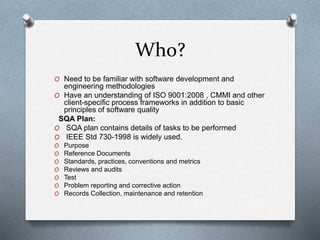
O Need to be familiar with software development and
engineering methodologies
O Have an understanding of ISO 9001:2008 , CMMI and other
client-specific process frameworks in addition to basic
principles of software quality
SQA Plan:
O SQA plan contains details of tasks to be performed
O IEEE Std 730-1998 is widely used.
O Purpose
O Reference Documents
O Standards, practices, conventions and metrics
O Reviews and audits
O Test
O Problem reporting and corrective action
O Records Collection, maintenance and retention
Process
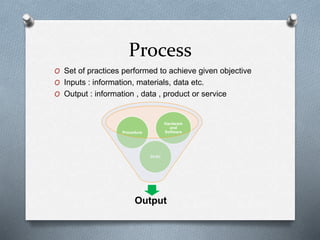
O Set of practices performed to achieve given objective
O Inputs : information, materials, data etc.
O Output : information , data , product or service
Output
Skills
Procedure
Hardware
and
Software
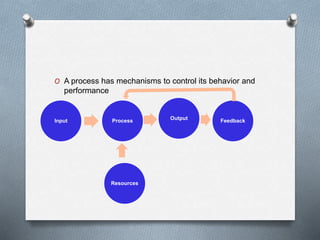
O A process has mechanisms to control its behavior and
performance
Input Process Output Feedback
Resources
Process Frameworks
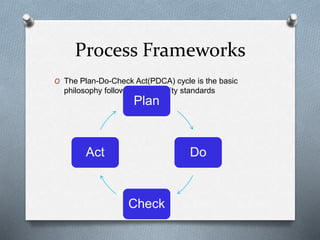
O The Plan-Do-Check Act(PDCA) cycle is the basic
philosophy followed in all quality standards
Plan
Do
Check
Act
Some process frameworks and quality standards
O ISO 9001
O SEI’s CMMI
O Six Sigma
O TMMi (Test Maturity Model Integration)

Software qualityassurance

  • 1.
  • 2.
    Introduction O Defining andmonitoring the software engineering process and methods used in delivery of products or services O It encompasses the entire software development life cycle which includes process such as  Requirements development  Software design  Coding  Reviews and inspections  Product integration  Testing
  • 3.
    Benefits of SQA OSQA team should ensure that  Software development and maintenance are followed  Review, inspections and testing are conducted as planned  Compatibility of SQA plan and software development plan  Redefine the processes, if required  Conduct internal audits
  • 4.
    Who? O Need tobe familiar with software development and engineering methodologies O Have an understanding of ISO 9001:2008 , CMMI and other client-specific process frameworks in addition to basic principles of software quality SQA Plan: O SQA plan contains details of tasks to be performed O IEEE Std 730-1998 is widely used. O Purpose O Reference Documents O Standards, practices, conventions and metrics O Reviews and audits O Test O Problem reporting and corrective action O Records Collection, maintenance and retention
  • 5.
    Process O Set ofpractices performed to achieve given objective O Inputs : information, materials, data etc. O Output : information , data , product or service Output Skills Procedure Hardware and Software
  • 6.
    O A processhas mechanisms to control its behavior and performance Input Process Output Feedback Resources
  • 7.
    Process Frameworks O ThePlan-Do-Check Act(PDCA) cycle is the basic philosophy followed in all quality standards Plan Do Check Act
  • 8.
    Some process frameworksand quality standards O ISO 9001 O SEI’s CMMI O Six Sigma O TMMi (Test Maturity Model Integration)

Editor's Notes

  • #3 Change management Configuration management
  • #4 As per the Quality Principles suggested “The quality of a product is largely determined by the quality of the process that are used to develop and maintain it” Projects use prescribed procedures and standards Documents and records are maintained for audit purpose
  • #5 The job of SQA members does not involve being too knowledgeable about software technology and programming More: Management Documentation Tools, techniques and methodologies Code Control Media Control Supplier Control Training and Risk Management
  • #6 The output also depends on the Nature, Speciation's and people
  • #7 Two parameters Effectiveness: meeting desirable attributes expected by the customer Efficiency: concerns the resources used for the service or product to be delivered
  • #8 Plan: Establish the objectives and define the processes necessary to deliver results Do: Implement the plan, execute the process Check: Analyze the results obtained and compare them against the expected results Act: If the differences between actual and expected results are significant, corrective actions need to be taken to modify the process
  • #9 ISO and CMMI are most widely used in IT industry Six Sigma defines processes to achieve near-perfect products TMMi is finding favor with the testing community