
Presented by
P. Naresh
Reg.No.20L81S0701
Department of pharmaceutical analysis
A Seminar as a part of Curricular requirement for
M.Pharm I year II Semester
FACTORY ACCEPTANCE TEST
Contents
1.Introduction
2.General scope
3.Overview
4.Fat-details
5.Conclusion
6.References
Introduction
• Is a test conducted at the Venders premises , usually by a third
party to verify that the system , Equipment operates according to
the specifications.
• Inspection and static or dynamic testing of system or major system
components to support the qualification of an equipment system
conducted and documented at a supplier site .
General scope
• Testing equipment for compliance with GMP.
• Completeness of installation.
• Dimensions and correct design.
• Materials and surfaces.
• Functional tests, performance tests and safety functions.
• Completeness of documentation.
• FAT refers to a Factory Acceptance Test.
• This is a way to ensure that equipment or systems being purchased
meet the agreed upon design specifications his happens before
arriving at the customer’s plant, however, for complex systems
with high integration, tests may need to be performed at the
customer’s location.
• Factory Acceptance Tests allow any issues to be corrected either at
the vendor’s location or before production – leveraging the technical
expertise and resources of the vendor, preventing any potential cross-
contamination with the customer’s plant and improving the general
quality of the product delivered to the customer.
• While there are some general guidelines for FATs,
each FAT is a customized procedure.
• The complexity of the Factory Acceptance Test performed is
generally determined by factors such as the degree of customization,
familiarity with equipment, familiarity with the vendor and degree
of integration.
• When consideration of these factors has been made the customer
and supplier may involve several people in the Factory Acceptance
Test.
• From the customer this might include plant support
such as engineering, maintenance, quality assurance, technicians or
corporate engineering.
• The supplier may include designers, manufacturing representatives
and sales as participants.
• Planning determines and documents the tests to be carried out, test
criteria, protocols, tools needed and look for, along with specifics
for variances and acceptability.
• The personnel who should be involved along
with their responsibilities should also be determined.
• OEM and Baker work together to coordinate and perform tests
according to requirements, specifications and agreements as
planned.
• The specified results and outcomes are collected and measured
according to the plan.
• The specified results and outcomes are collected and
measured according to the plan.
• It is determined whether objectives and criteria of tests have been
met or not.
• Faults, failures, errors and hazards are identified according to pre-
determined criteria.
• Issues needing resolved are corrected for acceptance (may require
re-testing).
• OEM and Baker sign-off on acceptance of equipment/systems.
PLANNNING
PERFORM TEST
ACTIVITIES
GATHER TEST
RESULTS
IDENTIFY ISSUES AND
CORRECT
SIGN-OFF
COMMUNICATION
Overview
• A Level 1 - FAT is the most basic level of equipment
testing conducted at the OEM.
• This is often the level of acceptance test for equipment that is
similar to other equipment in the plant or for equipment that has
simple to moderate upgrades or modifications.
• Generally a Level 1 - FAT will review equipment dimensions,
and quality of fabrication, dry cycle of motors and mechanical
devices.
Considerations for FAT
• Purchase of new equipment/system.
• If purchasing from a new vendor If the machine/system has simple
to moderate custom designs.
• For development of plant/corporate personnel or if there is an
opportunity for plant/team to become familiar with equipment.
• Another (i.e. corporate specified equipment to be used in a
particular plant.
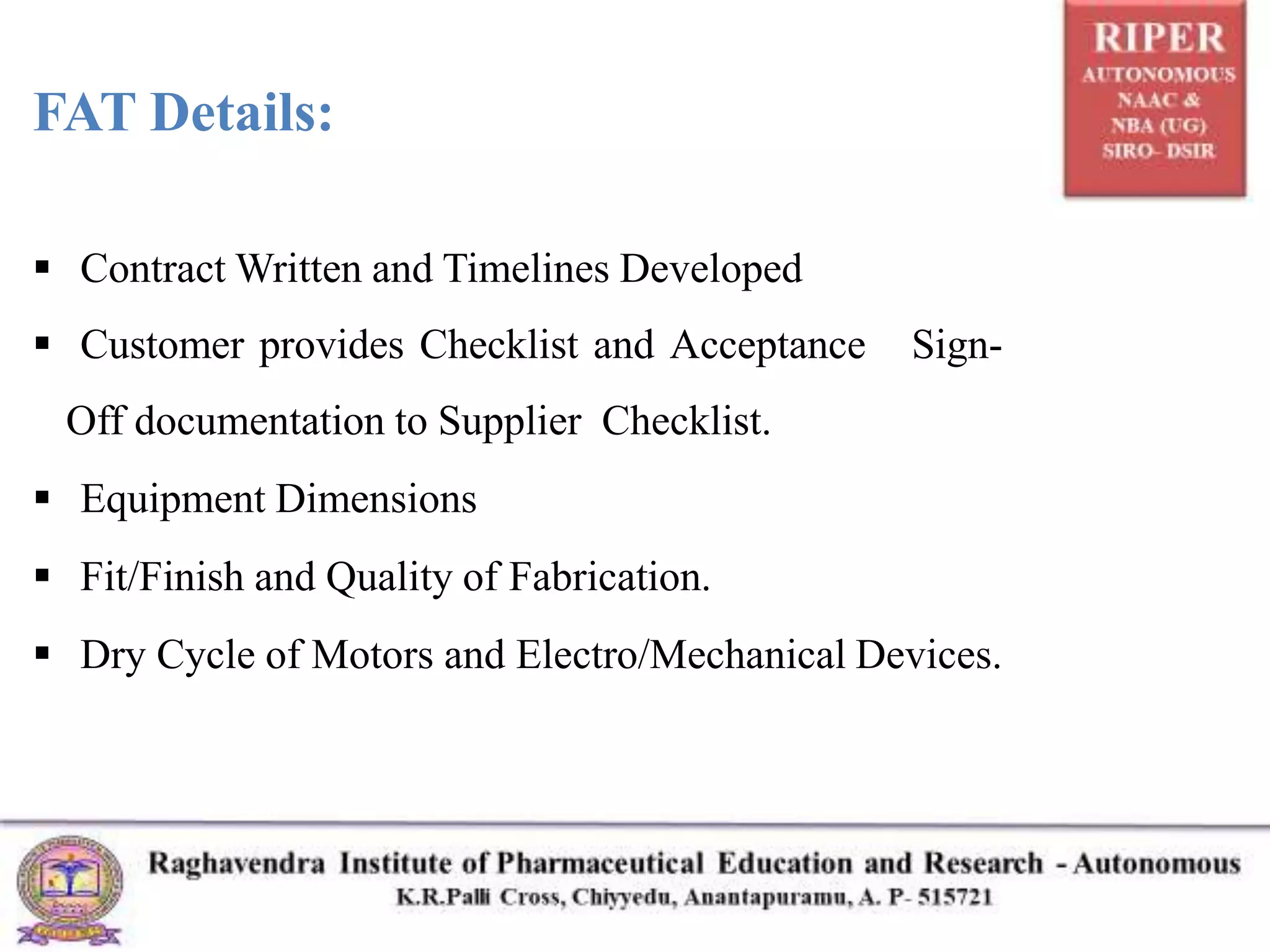
FAT Details:
 Contract Written and Timelines Developed
 Customer provides Checklist and Acceptance Sign-
Off documentation to Supplier Checklist.
 Equipment Dimensions
 Fit/Finish and Quality of Fabrication.
 Dry Cycle of Motors and Electro/Mechanical Devices.
Safety:
 Correct Guarding
 E-Stop Functionality.
 Safety Switch Functionality.
 Rough/Sharp Edges & Surfaces
 High-level overview of PLC Program.
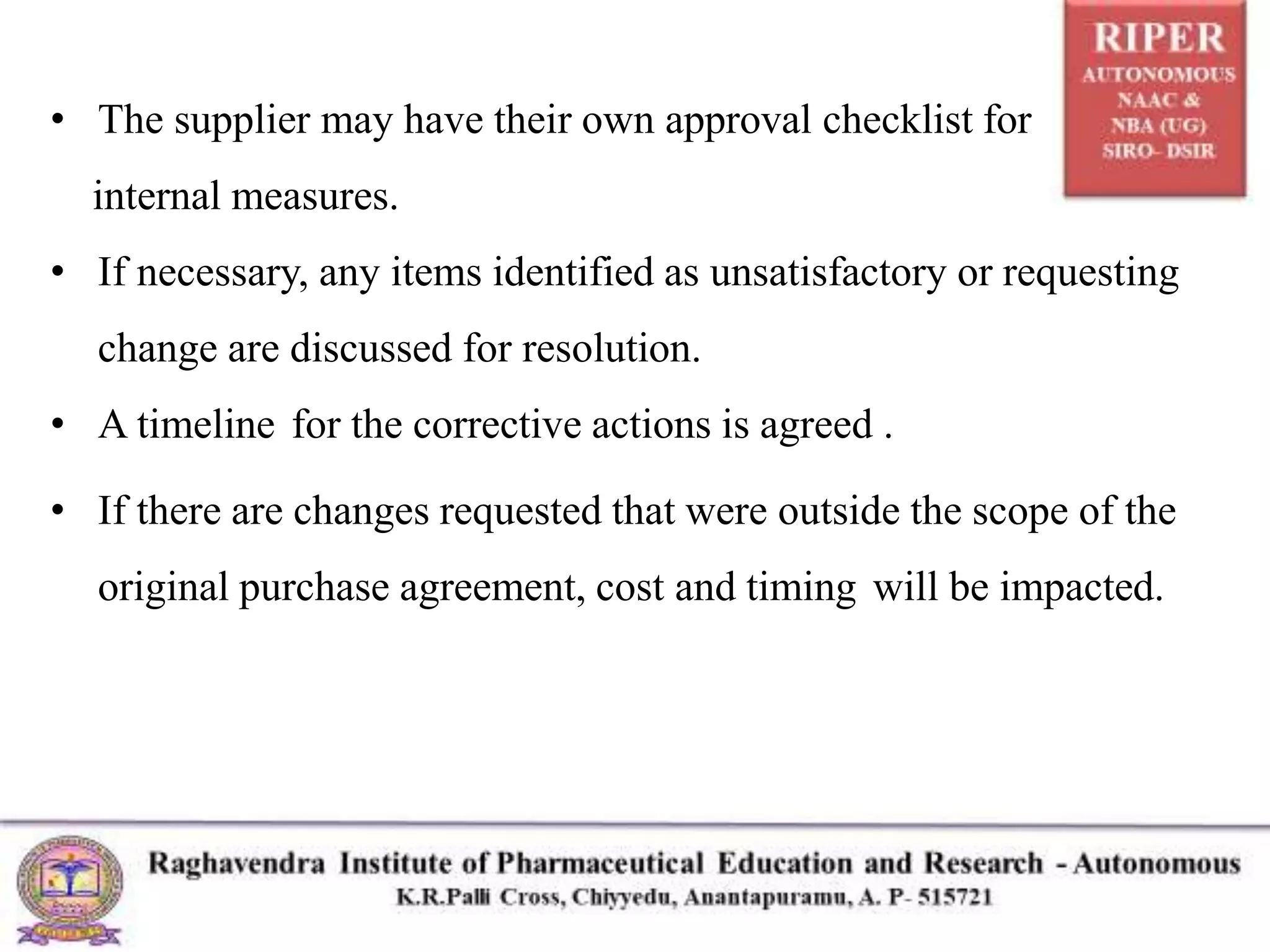
• The supplier may have their own approval checklist for
internal measures.
• If necessary, any items identified as unsatisfactory or requesting
change are discussed for resolution.
• A timeline for the corrective actions is agreed .
• If there are changes requested that were outside the scope of the
original purchase agreement, cost and timing will be impacted.
Cost, Time, Quality Implications:
 Cost:
• Level 1 - FATs are typically a no-cost line item on the original
purchase agreement.
• Baker covers their own costs to send any representatives to the
supplier.
 Time:
• Per the project timeline, the Level 1 - FAT is typically scheduled to
be conducted approximately 1-2 weeks prior to the promised ship
date.
Benefit:
• Piece-of-mind knowing that the equipment being purchased
meets all requirements before arriving on your dock.
• Vendor does not have to work on equipment at the job site
(Cost/Timing/Expertise implications).
• Reduction of installation/start-up time.
How to ensure smooth preparation/execution of
FAT?
Ensure that all involved parties participate in the writing and approval
of the test protocols:
FAT
Engineering validation
production Quality Assurance
Purchasing Manufacturing
Conclusion:
• The value of a factory acceptance test can be found in each of the
cost, time and benefit areas. If issues are identified early on and the
Baker can rely on OEM expertise, it will save money and time over
the project life cycle. Additionally, the training and learning
opportunities before operation provide significant preparation prior
to operation in the plant.
References :
1. Webster`s Seventh New collegiate Dictionary, Spring
field,MA, 595-604 ,1965.
2. Cole Graham C.”Pharma ceutical Production Facilities”
2 nd Edition, CRC Press,p-199 .
2. NLI Quality Assurance Manual ,Supplements, Rev.8,12/14/07.
FACTORY ACCEPTANCE TEST

FACTORY ACCEPTANCE TEST

  • 1.
    Presented by P. Naresh Reg.No.20L81S0701 Departmentof pharmaceutical analysis A Seminar as a part of Curricular requirement for M.Pharm I year II Semester FACTORY ACCEPTANCE TEST
  • 2.
  • 3.
    Introduction • Is atest conducted at the Venders premises , usually by a third party to verify that the system , Equipment operates according to the specifications. • Inspection and static or dynamic testing of system or major system components to support the qualification of an equipment system conducted and documented at a supplier site .
  • 4.
    General scope • Testingequipment for compliance with GMP. • Completeness of installation. • Dimensions and correct design. • Materials and surfaces. • Functional tests, performance tests and safety functions. • Completeness of documentation.
  • 5.
    • FAT refersto a Factory Acceptance Test. • This is a way to ensure that equipment or systems being purchased meet the agreed upon design specifications his happens before arriving at the customer’s plant, however, for complex systems with high integration, tests may need to be performed at the customer’s location.
  • 6.
    • Factory AcceptanceTests allow any issues to be corrected either at the vendor’s location or before production – leveraging the technical expertise and resources of the vendor, preventing any potential cross- contamination with the customer’s plant and improving the general quality of the product delivered to the customer.
  • 7.
    • While thereare some general guidelines for FATs, each FAT is a customized procedure. • The complexity of the Factory Acceptance Test performed is generally determined by factors such as the degree of customization, familiarity with equipment, familiarity with the vendor and degree of integration. • When consideration of these factors has been made the customer and supplier may involve several people in the Factory Acceptance Test.
  • 8.
    • From thecustomer this might include plant support such as engineering, maintenance, quality assurance, technicians or corporate engineering. • The supplier may include designers, manufacturing representatives and sales as participants. • Planning determines and documents the tests to be carried out, test criteria, protocols, tools needed and look for, along with specifics for variances and acceptability.
  • 9.
    • The personnelwho should be involved along with their responsibilities should also be determined. • OEM and Baker work together to coordinate and perform tests according to requirements, specifications and agreements as planned. • The specified results and outcomes are collected and measured according to the plan.
  • 10.
    • The specifiedresults and outcomes are collected and measured according to the plan. • It is determined whether objectives and criteria of tests have been met or not. • Faults, failures, errors and hazards are identified according to pre- determined criteria. • Issues needing resolved are corrected for acceptance (may require re-testing). • OEM and Baker sign-off on acceptance of equipment/systems.
  • 11.
    PLANNNING PERFORM TEST ACTIVITIES GATHER TEST RESULTS IDENTIFYISSUES AND CORRECT SIGN-OFF COMMUNICATION
  • 12.
    Overview • A Level1 - FAT is the most basic level of equipment testing conducted at the OEM. • This is often the level of acceptance test for equipment that is similar to other equipment in the plant or for equipment that has simple to moderate upgrades or modifications. • Generally a Level 1 - FAT will review equipment dimensions, and quality of fabrication, dry cycle of motors and mechanical devices.
  • 13.
    Considerations for FAT •Purchase of new equipment/system. • If purchasing from a new vendor If the machine/system has simple to moderate custom designs. • For development of plant/corporate personnel or if there is an opportunity for plant/team to become familiar with equipment. • Another (i.e. corporate specified equipment to be used in a particular plant.
  • 14.
    FAT Details:  ContractWritten and Timelines Developed  Customer provides Checklist and Acceptance Sign- Off documentation to Supplier Checklist.  Equipment Dimensions  Fit/Finish and Quality of Fabrication.  Dry Cycle of Motors and Electro/Mechanical Devices.
  • 15.
    Safety:  Correct Guarding E-Stop Functionality.  Safety Switch Functionality.  Rough/Sharp Edges & Surfaces  High-level overview of PLC Program.
  • 16.
    • The suppliermay have their own approval checklist for internal measures. • If necessary, any items identified as unsatisfactory or requesting change are discussed for resolution. • A timeline for the corrective actions is agreed . • If there are changes requested that were outside the scope of the original purchase agreement, cost and timing will be impacted.
  • 17.
    Cost, Time, QualityImplications:  Cost: • Level 1 - FATs are typically a no-cost line item on the original purchase agreement. • Baker covers their own costs to send any representatives to the supplier.  Time: • Per the project timeline, the Level 1 - FAT is typically scheduled to be conducted approximately 1-2 weeks prior to the promised ship date.
  • 18.
    Benefit: • Piece-of-mind knowingthat the equipment being purchased meets all requirements before arriving on your dock. • Vendor does not have to work on equipment at the job site (Cost/Timing/Expertise implications). • Reduction of installation/start-up time.
  • 19.
    How to ensuresmooth preparation/execution of FAT? Ensure that all involved parties participate in the writing and approval of the test protocols: FAT Engineering validation production Quality Assurance Purchasing Manufacturing
  • 20.
    Conclusion: • The valueof a factory acceptance test can be found in each of the cost, time and benefit areas. If issues are identified early on and the Baker can rely on OEM expertise, it will save money and time over the project life cycle. Additionally, the training and learning opportunities before operation provide significant preparation prior to operation in the plant.
  • 21.
    References : 1. Webster`sSeventh New collegiate Dictionary, Spring field,MA, 595-604 ,1965. 2. Cole Graham C.”Pharma ceutical Production Facilities” 2 nd Edition, CRC Press,p-199 . 2. NLI Quality Assurance Manual ,Supplements, Rev.8,12/14/07.