Validation, Verification, Qualification:
Which is right and does it really matter?
Definitions:
(According to Webster, relative to quality endeavors)
• Validation is an act, process, or instance to
support or corroborate something on a
sound authoritative basis
•Verification is the act or process of
establishing the truth or reality of something
•Qualification is an act or process to assure
something complies with some condition,
standard, or specific requirements
Definitions:
(According to the FDA)
Per the Code of Federal Regulations Title 21 – Food and
Drugs, Part 820 – Quality System Regulations:
•Validation means confirmation by examination and
provision of objective evidence that the particular
requirements for a specific intended use can be
consistently fulfilled. [CFR 21 Part 820.3(z)]
•Verification means confirmation by examination and
provision of objective evidence that specified requirements
have been fulfilled. [CFR 21 Part 820.3(aa)]
•Qualification – NOT DEFINED
BSC Examples
Validation Examples:
•Design Validation, Sterilization Validation, Test Method Validation,
Software Validation, and Process Validation
Verification Examples:
•Design Verification and Process Verification.
Qualification Examples:
•Installation Qualification, Operational Qualification, Process
Performance Qualification, Product Performance Qualification, and
Supplied Material Qualification
Some General Observations
(When the Terms are Used)
•Verifications tend to be used when assessing something
completed that is static and is not prone to inadvertent
change.
•Validations tend to be used when assessing something
dynamic that is more prone to inadvertent change. They
also tend to be larger endeavors including one or more
subordinate qualifications (and/or verifications).
•Qualifications tend to be smaller in scope than
validations, tend to be less dynamic, and are frequently a
subset of a greater validation initiative.
General Observations
(BSC Examples)
•A Design Verification verifies that a frozen (static) design
meets top level product specifications.
• A Process Validation validates that the on-going
(dynamic) manufacturing process produces product that
meets product/print specifications and consist of
Installation Qualifications, Operational Qualifications,
Process Performance Qualifications, a Product
Performance Qualification and perhaps Process
Verifications.
•An Installation Qualification qualifies that equipment was
installed correctly and are a subset of a Process
Validation (or possibly a Test Method Validation).
Validation, Verification, and Qualification
So how important is the name of these activities (Val, Ver, Qual)?
Not that important at all.
So what does matter in all of this?
What matters most is the nature and timing or the activity, not the
name of the activity.
Nature: Who, what, (possibly where), why, and how is the activity being
objectively demonstrated.
Timing: When can the activity be started and when must the activity be
completed.
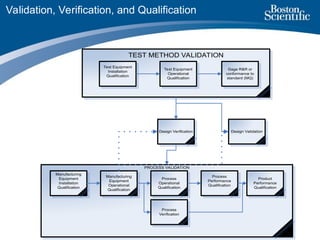
Validation, Verification, and Qualification
TEST METHOD VALIDATION
Test Equipment
Installation
Qualification
Test Equipment
Operational
Qualification
Gage R&R or
conformance to
standard (MQ)
Design Verification Design Validation
PROCESS VALIDATION
Manufacturing
Equipment
Installation
Qualification
Manufacturing
Equipment
Operational
Qualification
Process
Operational
Qualification
Process
Performance
Qualification
Product
Performance
Qualification
Process
Verification
Validation, Verification, and Qualification
(Generic Verification/Validation/Qualification Considerations)
•Assessment conducted per pre-established plan and/or
protocol(s) with clear vision of what constitutes “success.”
•Objective Acceptance Criteria (generally statistically based).
•Ideally, acceptance criteria determination should be risk
based.
•Assessment should be thoroughly documented, yet concise.
•Final report should justify all deviations and have clear
concise conclusion (i.e. Pass or Fail).
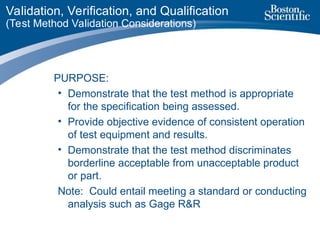
Validation, Verification, and Qualification
(Test Method Validation Considerations)
PURPOSE:
• Demonstrate that the test method is appropriate
for the specification being assessed.
• Provide objective evidence of consistent operation
of test equipment and results.
• Demonstrate that the test method discriminates
borderline acceptable from unacceptable product
or part.
Note: Could entail meeting a standard or conducting
analysis such as Gage R&R
Validation, Verification, and Qualification
(Test Method Validation Considerations)
TIMING: Before Using in a formal study
RECORDS: TMV Protocol and Report
• Potentially: Equipment prints and specs, software
validation documentation, data sheet validation
documentation.
PERSONAL INSIGHT:
Make sure your acceptance criteria is realistic.
Validation, Verification, and Qualification
(Design Verification Considerations)
PURPOSE:
• To establish documented evidence that the design
output meets pre-established design input
requirements as identified in the Product
Specification.
TIMING:
• During development phase on a frozen design,
generally prior to Process Validation
Validation, Verification, and Qualification
(Design Verification Considerations)
RECORDS: DV Master Plan (DVMP), DV Protocols,
DV Report(s) [Perhaps a DVMR]
PERSONAL INSIGHT:
•Remember it’s a verification, not a discovery
experiment. Success should be at least probable.
•Limit/Challenge testing (if not done earlier) is critical
to defend spec tolerances.
•Should use risk based, statistical acceptance criteria
•Use contingency planning in DVMP and DV
Protocols (e.g. double sample attribute plans vs.
single sample attribute plans) anticipate issues (vs.
writing deviations in the report)
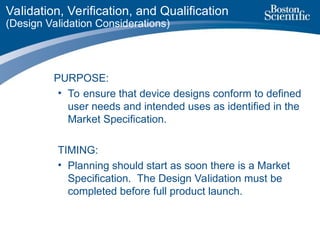
Validation, Verification, and Qualification
(Design Validation Considerations)
PURPOSE:
• To ensure that device designs conform to defined
user needs and intended uses as identified in the
Market Specification.
TIMING:
• Planning should start as soon there is a Market
Specification. The Design Validation must be
completed before full product launch.
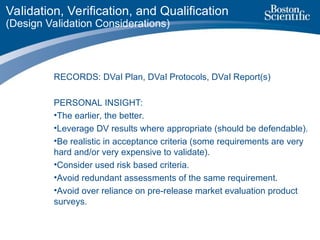
Validation, Verification, and Qualification
(Design Validation Considerations)
RECORDS: DVal Plan, DVal Protocols, DVal Report(s)
PERSONAL INSIGHT:
•The earlier, the better.
•Leverage DV results where appropriate (should be defendable).
•Be realistic in acceptance criteria (some requirements are very
hard and/or very expensive to validate).
•Consider used risk based criteria.
•Avoid redundant assessments of the same requirement.
•Avoid over reliance on pre-release market evaluation product
surveys.
Validation, Verification, and Qualification
(Process Validation Considerations)
PURPOSE:
• To establish documented evidence that a process
consistently produces an output that meets its
predetermined requirements and that the overall
manufacturing line produces a product that meets
finished device requirements.
TIMING:
• Planning can start as design and process are
solidified. The Process Validation must be
completed before full product launch.
Validation, Verification, and Qualification
(Process Validation Considerations)
RECORDS: Master Validation Plan (MVP), PV Protocols, Master
Validation Report (MVR)
PERSONAL INSIGHT:
•Limit/Challenge OQ testing at parameter limits is critical to
defending full process.
•Decide early what constitutes validated window for future
process changes.
•Should use risk based, statistical acceptance criteria.
•As with DV, use contingency planning in MVP and PV Protocols
(e.g. double sample attribute plans vs. single sample attribute
plans) anticipate issues (vs. writing deviations in the report).
•Plan for line extensions and other likely future changes when
planning and identify the requirements for implementing those
future changes.
Validation, Verification, and Qualification
Questions, Discussion
Validation,_Verification,_Qualification.ppt

Validation,_Verification,_Qualification.ppt

  • 1.
    Validation, Verification, Qualification: Whichis right and does it really matter?
  • 2.
    Definitions: (According to Webster,relative to quality endeavors) • Validation is an act, process, or instance to support or corroborate something on a sound authoritative basis •Verification is the act or process of establishing the truth or reality of something •Qualification is an act or process to assure something complies with some condition, standard, or specific requirements
  • 3.
    Definitions: (According to theFDA) Per the Code of Federal Regulations Title 21 – Food and Drugs, Part 820 – Quality System Regulations: •Validation means confirmation by examination and provision of objective evidence that the particular requirements for a specific intended use can be consistently fulfilled. [CFR 21 Part 820.3(z)] •Verification means confirmation by examination and provision of objective evidence that specified requirements have been fulfilled. [CFR 21 Part 820.3(aa)] •Qualification – NOT DEFINED
  • 4.
    BSC Examples Validation Examples: •DesignValidation, Sterilization Validation, Test Method Validation, Software Validation, and Process Validation Verification Examples: •Design Verification and Process Verification. Qualification Examples: •Installation Qualification, Operational Qualification, Process Performance Qualification, Product Performance Qualification, and Supplied Material Qualification
  • 5.
    Some General Observations (Whenthe Terms are Used) •Verifications tend to be used when assessing something completed that is static and is not prone to inadvertent change. •Validations tend to be used when assessing something dynamic that is more prone to inadvertent change. They also tend to be larger endeavors including one or more subordinate qualifications (and/or verifications). •Qualifications tend to be smaller in scope than validations, tend to be less dynamic, and are frequently a subset of a greater validation initiative.
  • 6.
    General Observations (BSC Examples) •ADesign Verification verifies that a frozen (static) design meets top level product specifications. • A Process Validation validates that the on-going (dynamic) manufacturing process produces product that meets product/print specifications and consist of Installation Qualifications, Operational Qualifications, Process Performance Qualifications, a Product Performance Qualification and perhaps Process Verifications. •An Installation Qualification qualifies that equipment was installed correctly and are a subset of a Process Validation (or possibly a Test Method Validation).
  • 7.
    Validation, Verification, andQualification So how important is the name of these activities (Val, Ver, Qual)? Not that important at all. So what does matter in all of this? What matters most is the nature and timing or the activity, not the name of the activity. Nature: Who, what, (possibly where), why, and how is the activity being objectively demonstrated. Timing: When can the activity be started and when must the activity be completed.
  • 8.
    Validation, Verification, andQualification TEST METHOD VALIDATION Test Equipment Installation Qualification Test Equipment Operational Qualification Gage R&R or conformance to standard (MQ) Design Verification Design Validation PROCESS VALIDATION Manufacturing Equipment Installation Qualification Manufacturing Equipment Operational Qualification Process Operational Qualification Process Performance Qualification Product Performance Qualification Process Verification
  • 9.
    Validation, Verification, andQualification (Generic Verification/Validation/Qualification Considerations) •Assessment conducted per pre-established plan and/or protocol(s) with clear vision of what constitutes “success.” •Objective Acceptance Criteria (generally statistically based). •Ideally, acceptance criteria determination should be risk based. •Assessment should be thoroughly documented, yet concise. •Final report should justify all deviations and have clear concise conclusion (i.e. Pass or Fail).
  • 10.
    Validation, Verification, andQualification (Test Method Validation Considerations) PURPOSE: • Demonstrate that the test method is appropriate for the specification being assessed. • Provide objective evidence of consistent operation of test equipment and results. • Demonstrate that the test method discriminates borderline acceptable from unacceptable product or part. Note: Could entail meeting a standard or conducting analysis such as Gage R&R
  • 11.
    Validation, Verification, andQualification (Test Method Validation Considerations) TIMING: Before Using in a formal study RECORDS: TMV Protocol and Report • Potentially: Equipment prints and specs, software validation documentation, data sheet validation documentation. PERSONAL INSIGHT: Make sure your acceptance criteria is realistic.
  • 12.
    Validation, Verification, andQualification (Design Verification Considerations) PURPOSE: • To establish documented evidence that the design output meets pre-established design input requirements as identified in the Product Specification. TIMING: • During development phase on a frozen design, generally prior to Process Validation
  • 13.
    Validation, Verification, andQualification (Design Verification Considerations) RECORDS: DV Master Plan (DVMP), DV Protocols, DV Report(s) [Perhaps a DVMR] PERSONAL INSIGHT: •Remember it’s a verification, not a discovery experiment. Success should be at least probable. •Limit/Challenge testing (if not done earlier) is critical to defend spec tolerances. •Should use risk based, statistical acceptance criteria •Use contingency planning in DVMP and DV Protocols (e.g. double sample attribute plans vs. single sample attribute plans) anticipate issues (vs. writing deviations in the report)
  • 14.
    Validation, Verification, andQualification (Design Validation Considerations) PURPOSE: • To ensure that device designs conform to defined user needs and intended uses as identified in the Market Specification. TIMING: • Planning should start as soon there is a Market Specification. The Design Validation must be completed before full product launch.
  • 15.
    Validation, Verification, andQualification (Design Validation Considerations) RECORDS: DVal Plan, DVal Protocols, DVal Report(s) PERSONAL INSIGHT: •The earlier, the better. •Leverage DV results where appropriate (should be defendable). •Be realistic in acceptance criteria (some requirements are very hard and/or very expensive to validate). •Consider used risk based criteria. •Avoid redundant assessments of the same requirement. •Avoid over reliance on pre-release market evaluation product surveys.
  • 16.
    Validation, Verification, andQualification (Process Validation Considerations) PURPOSE: • To establish documented evidence that a process consistently produces an output that meets its predetermined requirements and that the overall manufacturing line produces a product that meets finished device requirements. TIMING: • Planning can start as design and process are solidified. The Process Validation must be completed before full product launch.
  • 17.
    Validation, Verification, andQualification (Process Validation Considerations) RECORDS: Master Validation Plan (MVP), PV Protocols, Master Validation Report (MVR) PERSONAL INSIGHT: •Limit/Challenge OQ testing at parameter limits is critical to defending full process. •Decide early what constitutes validated window for future process changes. •Should use risk based, statistical acceptance criteria. •As with DV, use contingency planning in MVP and PV Protocols (e.g. double sample attribute plans vs. single sample attribute plans) anticipate issues (vs. writing deviations in the report). •Plan for line extensions and other likely future changes when planning and identify the requirements for implementing those future changes.
  • 18.
    Validation, Verification, andQualification Questions, Discussion