VERBS
REGULAR & IRREGULAR
TRANSITIVE & INTRANSITIVE
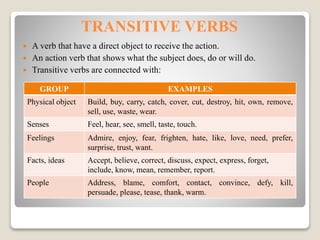
TRANSITIVE VERBS
 A verb that have a direct object to receive the action.
 An action verb that shows what the subject does, do or will do.
 Transitive verbs are connected with:
GROUP EXAMPLES
Physical object Build, buy, carry, catch, cover, cut, destroy, hit, own, remove,
sell, use, waste, wear.
Senses Feel, hear, see, smell, taste, touch.
Feelings Admire, enjoy, fear, frighten, hate, like, love, need, prefer,
surprise, trust, want.
Facts, ideas Accept, believe, correct, discuss, expect, express, forget,
include, know, mean, remember, report.
People Address, blame, comfort, contact, convince, defy, kill,
persuade, please, tease, thank, warm.
Example: He kicks the ball to the other player.
 The verb kicks is the action. The pronoun he is the subject. What does the
subject kicks? Ball. The subject is doing the action.
 The action verb answers the questions “Who does the action and what the
subject does”
 If the question is answered, that means it is a transitive verb.
Example: Ahmad loves football sport.
 The verb loves is the action. The noun is Ahmad and he is doing the action.
The object receiving the action is football.
 There are verbs that have more than one meaning in transitive and another one
in intransitive.
 For example, the verb ‘run’ means ‘move quickly’ in intransitive and in
transitive it means ‘manage or operate’.
Example: He runs at enormous speed.
 The verb is ‘runs’ and the subject doing the action is ‘he’. What does he runs?
He runs the company smoothly because he has the skills.
 The verb is ‘runs’ and the subject is ‘he’. What does he runs? The company.
INTRANSITIVE VERBS
 An action verb that cannot have a direct object to receive the action.
 Many verbs normally do not have an object, they are the intransitive verbs.
 They are often refer to:
GROUP EXAMPLES
Existence Appear, die, disappear, live, happen, remain.
The human body Ache, bleed, blush, faint, shiver, smile.
Human noises Cough, cry, laugh, speak, snore, scream, yawn.
Light, smell, vibration Glow, shine, sparkle, stink, throb, vibrate.
Position, movement Arrive, come, depart, fall, flow, go, kneel, run, sit, sleep,
stand, swim, wait, walk, work.
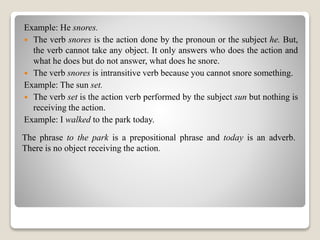
Example: He snores.
 The verb snores is the action done by the pronoun or the subject he. But,
the verb cannot take any object. It only answers who does the action and
what he does but do not answer, what does he snore.
 The verb snores is intransitive verb because you cannot snore something.
Example: The sun set.
 The verb set is the action verb performed by the subject sun but nothing is
receiving the action.
Example: I walked to the park today.
The phrase to the park is a prepositional phrase and today is an adverb.
There is no object receiving the action.
EXERCISE
1. She was crying all day long.
2. We showed her the photo album.
3. The doctor advised me to exercise regularly.
4. It was raining at that time.
5. She laughed at the joke.
6. She gave a cookie to the child.
7. They slept in the street.
8. I ate the cherries.
9. My father doesn’t drink coffee.
10. He always keeps his money in a wallet.
REGULAR AND IRREGULAR VERB
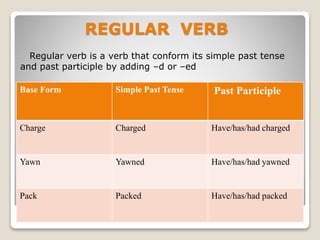
REGULAR VERB
Regular verb is a verb that conform its simple past tense
and past participle by adding –d or –ed
Base Form Simple Past Tense Past Participle
Charge Charged Have/has/had charged
Yawn Yawned Have/has/had yawned
Pack Packed Have/has/had packed
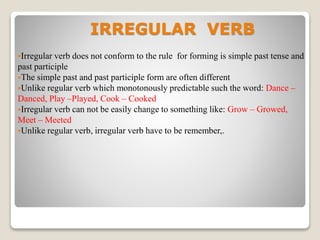
IRREGULAR VERB
Irregular verb does not conform to the rule for forming is simple past tense and
past participle
The simple past and past participle form are often different
Unlike regular verb which monotonously predictable such the word: Dance –
Danced, Play –Played, Cook – Cooked
Irregular verb can not be easily change to something like: Grow – Growed,
Meet – Meeted
Unlike regular verb, irregular verb have to be remember,.
Base Form Simple Past Tense Past Participle
Arise Arose Arisen
Break Broke Broken
Eat Ate Eaten
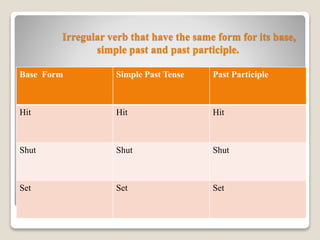
Irregular verb that have the same form for its base,
simple past and past participle.
Base Form Simple Past Tense Past Participle
Hit Hit Hit
Shut Shut Shut
Set Set Set
Verb that can be either regular or irregular verb
Base Form Simple Past Tense Past Participle
Dream Dreamed/Dreamt Dreamed/Dreamt
Spell Spelled/Spelt Spelled/Spelt
Hang Hanged/Hung Hanged/Hung
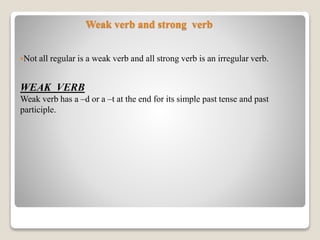
Weak verb and strong verb
Not all regular is a weak verb and all strong verb is an irregular verb.
WEAK VERB
Weak verb has a –d or a –t at the end for its simple past tense and past
participle.
Base Form Simple Past
Tense
Past Participle Type Of Verb
Hate Hated Has Hated Regular verb
Love Loved Has loved Regular verb
Keep Kept Has kept Irregular verb
Shoot Shot Has shot Irregular verb
REFERENCE
 (n.d.). Retrieved December 8, 2014, from Crossword Clue Solver:
http://www.crosswordsolver.org/o-words
 Small, L. H. (2005). Fundamentals of Phonetics. Boston: Publishers'
Design and Production Services, Inc. .
 The Intransitive Verb. (n.d.). Retrieved December 4, 2014, from
http://www.chompchomp.com/terms/intransitiveverb.htm
 Underhill, A. (1994). Sound Foundation. Learning and Teaching
Pronunciation. United Kingdom: Design and Illustration. Macmillan
Publishers Limited 1994.
 Biber,D.2010. Student Grammar of Spoken and Written English .
Edinburgh Gate, Harlow. Pearson Education Limited.
 (n.d).Retrieved December 7,2014, from Learn English:
http://learnenglish.britishcouncil.org/en/english-grammar/verbs/irregular-
verbs

Verbs: Regular Irregular & Transitive Intransitive

  • 1.
  • 2.
    TRANSITIVE VERBS  Averb that have a direct object to receive the action.  An action verb that shows what the subject does, do or will do.  Transitive verbs are connected with: GROUP EXAMPLES Physical object Build, buy, carry, catch, cover, cut, destroy, hit, own, remove, sell, use, waste, wear. Senses Feel, hear, see, smell, taste, touch. Feelings Admire, enjoy, fear, frighten, hate, like, love, need, prefer, surprise, trust, want. Facts, ideas Accept, believe, correct, discuss, expect, express, forget, include, know, mean, remember, report. People Address, blame, comfort, contact, convince, defy, kill, persuade, please, tease, thank, warm.
  • 3.
    Example: He kicksthe ball to the other player.  The verb kicks is the action. The pronoun he is the subject. What does the subject kicks? Ball. The subject is doing the action.  The action verb answers the questions “Who does the action and what the subject does”  If the question is answered, that means it is a transitive verb. Example: Ahmad loves football sport.  The verb loves is the action. The noun is Ahmad and he is doing the action. The object receiving the action is football.  There are verbs that have more than one meaning in transitive and another one in intransitive.  For example, the verb ‘run’ means ‘move quickly’ in intransitive and in transitive it means ‘manage or operate’. Example: He runs at enormous speed.  The verb is ‘runs’ and the subject doing the action is ‘he’. What does he runs? He runs the company smoothly because he has the skills.  The verb is ‘runs’ and the subject is ‘he’. What does he runs? The company.
  • 4.
    INTRANSITIVE VERBS  Anaction verb that cannot have a direct object to receive the action.  Many verbs normally do not have an object, they are the intransitive verbs.  They are often refer to: GROUP EXAMPLES Existence Appear, die, disappear, live, happen, remain. The human body Ache, bleed, blush, faint, shiver, smile. Human noises Cough, cry, laugh, speak, snore, scream, yawn. Light, smell, vibration Glow, shine, sparkle, stink, throb, vibrate. Position, movement Arrive, come, depart, fall, flow, go, kneel, run, sit, sleep, stand, swim, wait, walk, work.
  • 5.
    Example: He snores. The verb snores is the action done by the pronoun or the subject he. But, the verb cannot take any object. It only answers who does the action and what he does but do not answer, what does he snore.  The verb snores is intransitive verb because you cannot snore something. Example: The sun set.  The verb set is the action verb performed by the subject sun but nothing is receiving the action. Example: I walked to the park today. The phrase to the park is a prepositional phrase and today is an adverb. There is no object receiving the action.
  • 6.
    EXERCISE 1. She wascrying all day long. 2. We showed her the photo album. 3. The doctor advised me to exercise regularly. 4. It was raining at that time. 5. She laughed at the joke. 6. She gave a cookie to the child. 7. They slept in the street. 8. I ate the cherries. 9. My father doesn’t drink coffee. 10. He always keeps his money in a wallet.
  • 7.
  • 8.
    REGULAR VERB Regular verbis a verb that conform its simple past tense and past participle by adding –d or –ed Base Form Simple Past Tense Past Participle Charge Charged Have/has/had charged Yawn Yawned Have/has/had yawned Pack Packed Have/has/had packed
  • 9.
    IRREGULAR VERB Irregular verbdoes not conform to the rule for forming is simple past tense and past participle The simple past and past participle form are often different Unlike regular verb which monotonously predictable such the word: Dance – Danced, Play –Played, Cook – Cooked Irregular verb can not be easily change to something like: Grow – Growed, Meet – Meeted Unlike regular verb, irregular verb have to be remember,.
  • 10.
    Base Form SimplePast Tense Past Participle Arise Arose Arisen Break Broke Broken Eat Ate Eaten
  • 11.
    Irregular verb thathave the same form for its base, simple past and past participle. Base Form Simple Past Tense Past Participle Hit Hit Hit Shut Shut Shut Set Set Set
  • 12.
    Verb that canbe either regular or irregular verb Base Form Simple Past Tense Past Participle Dream Dreamed/Dreamt Dreamed/Dreamt Spell Spelled/Spelt Spelled/Spelt Hang Hanged/Hung Hanged/Hung
  • 13.
    Weak verb andstrong verb Not all regular is a weak verb and all strong verb is an irregular verb. WEAK VERB Weak verb has a –d or a –t at the end for its simple past tense and past participle.
  • 14.
    Base Form SimplePast Tense Past Participle Type Of Verb Hate Hated Has Hated Regular verb Love Loved Has loved Regular verb Keep Kept Has kept Irregular verb Shoot Shot Has shot Irregular verb
  • 15.
    REFERENCE  (n.d.). RetrievedDecember 8, 2014, from Crossword Clue Solver: http://www.crosswordsolver.org/o-words  Small, L. H. (2005). Fundamentals of Phonetics. Boston: Publishers' Design and Production Services, Inc. .  The Intransitive Verb. (n.d.). Retrieved December 4, 2014, from http://www.chompchomp.com/terms/intransitiveverb.htm  Underhill, A. (1994). Sound Foundation. Learning and Teaching Pronunciation. United Kingdom: Design and Illustration. Macmillan Publishers Limited 1994.  Biber,D.2010. Student Grammar of Spoken and Written English . Edinburgh Gate, Harlow. Pearson Education Limited.  (n.d).Retrieved December 7,2014, from Learn English: http://learnenglish.britishcouncil.org/en/english-grammar/verbs/irregular- verbs