TENSES
GRAMMAR
TENSES
• Verb tenses are tools that are used to express
time. They refer to the time of action and tell
the time and state of an action. present tense,
past tense and future time refer to the time of
action and tell the time and state of an action.
THE DIVISIONS
• The present tense referring to present time
• The past tense referring to past time
• The future time referring to future time
FURTHER DIVISIONS
• Each tense has four forms:
• Simple or Indefinite – It merely states an action or event. It does
not say anything about the completeness of the action.
• Continuous or Progressive – It indicates that an action is in
progress at a given time and is incomplete at the point of
reference.
• Perfect – It indicates that the action is complete.
• Perfect Continuous – It indicates that an action has been in
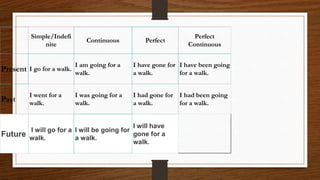
progress for a period of time. Study the table for use of tenses
given below.
Simple/Indefi
nite
Continuous Perfect
Perfect
Continuous
Present I go for a walk.
I am going for a
walk.
I have gone for
a walk.
I have been going
for a walk.
Past
I went for a
walk.
I was going for a
walk.
I had gone for
a walk.
I had been going
for a walk.
Future
I will go for a
walk.
I will be going for
a walk.
I will have
gone for a
walk.
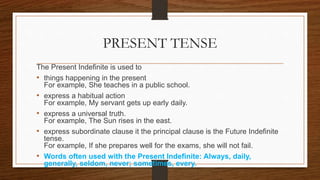
PRESENT TENSE
The Present Indefinite is used to
• things happening in the present
For example, She teaches in a public school.
• express a habitual action
For example, My servant gets up early daily.
• express a universal truth.
For example, The Sun rises in the east.
• express subordinate clause it the principal clause is the Future Indefinite
tense.
For example, If she prepares well for the exams, she will not fail.
• Words often used with the Present Indefinite: Always, daily,
generally, seldom, never; sometimes, every.
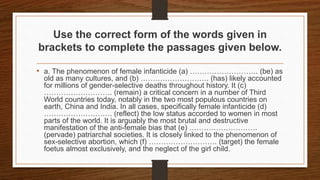
Use the correct form of the words given in
brackets to complete the passages given below.
• a. The phenomenon of female infanticide (a) ………………………. (be) as
old as many cultures, and (b) ………………………. (has) likely accounted
for millions of gender-selective deaths throughout history. It (c)
………………………. (remain) a critical concern in a number of Third
World countries today, notably in the two most populous countries on
earth, China and India. In all cases, specifically female infanticide (d)
………………………. (reflect) the low status accorded to women in most
parts of the world. It is arguably the most brutal and destructive
manifestation of the anti-female bias that (e) ……………………….
(pervade) patriarchal societies. It is closely linked to the phenomenon of
sex-selective abortion, which (f) ………………………. (target) the female
foetus almost exclusively, and the neglect of the girl child.
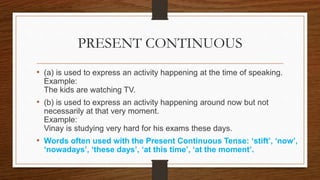
PRESENT CONTINUOUS
• (a) is used to express an activity happening at the time of speaking.
Example:
The kids are watching TV.
• (b) is used to express an activity happening around now but not
necessarily at that very moment.
Example:
Vinay is studying very hard for his exams these days.
• Words often used with the Present Continuous Tense: ‘stift’, ‘now’,
‘nowadays’, ‘these days’, ‘at this time’, ‘at the moment’.
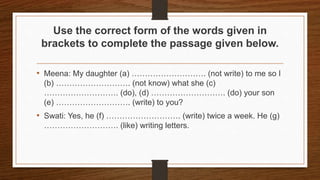
Use the correct form of the words given in
brackets to complete the passage given below.
• Meena: My daughter (a) ………………………. (not write) to me so I
(b) ………………………. (not know) what she (c)
………………………. (do), (d) ………………………. (do) your son
(e) ………………………. (write) to you?
• Swati: Yes, he (f) ………………………. (write) twice a week. He (g)
………………………. (like) writing letters.
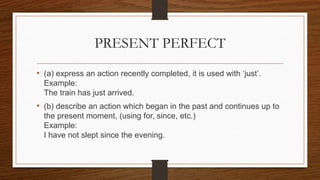
PRESENT PERFECT
• (a) express an action recently completed, it is used with ‘just’.
Example:
The train has just arrived.
• (b) describe an action which began in the past and continues up to
the present moment, (using for, since, etc.)
Example:
I have not slept since the evening.
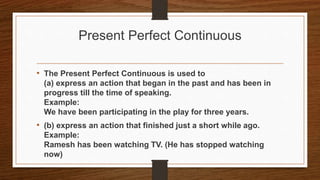
Present Perfect Continuous
• The Present Perfect Continuous is used to
(a) express an action that began in the past and has been in
progress till the time of speaking.
Example:
We have been participating in the play for three years.
• (b) express an action that finished just a short while ago.
Example:
Ramesh has been watching TV. (He has stopped watching
now)
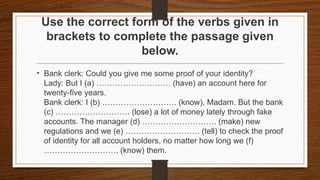
Use the correct form of the verbs given in
brackets to complete the passage given
below.
• Bank clerk: Could you give me some proof of your identity?
Lady: But I (a) ………………………. (have) an account here for
twenty-five years.
Bank clerk: I (b) ………………………. (know), Madam. But the bank
(c) ………………………. (lose) a lot of money lately through fake
accounts. The manager (d) ………………………. (make) new
regulations and we (e) ………………………. (tell) to check the proof
of identity for all account holders, no matter how long we (f)
………………………. (know) them.
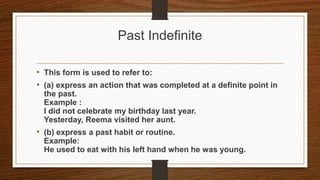
Past Indefinite
• This form is used to refer to:
• (a) express an action that was completed at a definite point in
the past.
Example :
I did not celebrate my birthday last year.
Yesterday, Reema visited her aunt.
• (b) express a past habit or routine.
Example:
He used to eat with his left hand when he was young.
Past Continuous
• This form is used:
• (a) express an action in progress before the moment of
speaking.
Example :
It was pouring heavily at 6 o’clock this morning.
• (b) The time reference may be replaced with a verb in the
simple past.
Example :
The phone rang when she was taking her food.
Past Perfect
• As in the Past Continuous Tense, here too there are two actions, both
in the past. The past perfect is used to describe an action which was
completed just before or sometime before the second action in the
past.
• (a) It is used with such verbs as: ‘hope’, ‘expect’, ‘think’, etc. to
suggest that an expected past action did not take place.
Example :
(i) I had hoped that she would not decline my invitation, (but she did)
• (b) In this tense, the form remains unchanged irrespective of person
or number.
Example :
(i) He had done his duty before the next shift started.
(ii) They had done their duty before the next shift started.
Past Perfect Continuous
• (a) expresses an action that was finished at some definite time
in the past but which had been going on before it was finished
or had recently finished.
Example:
Ramesh had been working in this factory since he came to
Delhi.
• (b) At times, this tense can be expressed in a repeated action
of the past.
Example:
Geeta had been trying since morning to contact her friend.
Use the correct form of the verbs given in
brackets to complete the passage given below.
• He was an old man who (a) ………………………. (fish) alone in a
skiff, a small light boat, in the Gulf stream and he (b)
………………………. (go) eighty-four days without taking the
fish. In the first forty days a boy (c) ………………………. (be)
with him. But after forty days without a fish the boy’s parents
(d) ………………………. (tell) him that the old man (e)
………………………. (be) definitely unlucky and the boy (f)
………………………. (go) at their orders in another boat, which
caught three big fishes the first week.
Future Tense
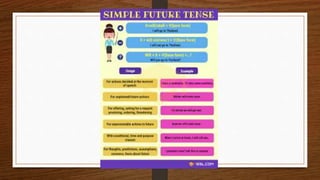
• For referring to the future, the modal auxiliaries shall and will are
used with the bare infinitive.
Future time is expressed in the following ways:
1. will/shall + infinitive to denote future actions
Examples:
• We shall go for a picnic tomorrow.
• He will reach by 5:30 p.m.
• 2. is/am/are + going to + infinitive
Example:
• We are going to play football this evening.
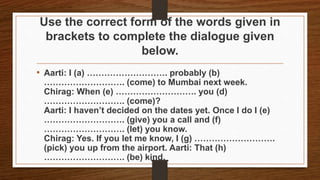
Use the correct form of the words given in
brackets to complete the dialogue given
below.
• Aarti: I (a) ………………………. probably (b)
………………………. (come) to Mumbai next week.
Chirag: When (e) ………………………. you (d)
………………………. (come)?
Aarti: I haven’t decided on the dates yet. Once I do I (e)
………………………. (give) you a call and (f)
………………………. (let) you know.
Chirag: Yes. If you let me know, I (g) ……………………….
(pick) you up from the airport. Aarti: That (h)
………………………. (be) kind.
G11 ENG TENSES.pptx
G11 ENG TENSES.pptx
G11 ENG TENSES.pptx

G11 ENG TENSES.pptx

  • 2.
  • 3.
    TENSES • Verb tensesare tools that are used to express time. They refer to the time of action and tell the time and state of an action. present tense, past tense and future time refer to the time of action and tell the time and state of an action.
  • 4.
    THE DIVISIONS • Thepresent tense referring to present time • The past tense referring to past time • The future time referring to future time
  • 5.
    FURTHER DIVISIONS • Eachtense has four forms: • Simple or Indefinite – It merely states an action or event. It does not say anything about the completeness of the action. • Continuous or Progressive – It indicates that an action is in progress at a given time and is incomplete at the point of reference. • Perfect – It indicates that the action is complete. • Perfect Continuous – It indicates that an action has been in progress for a period of time. Study the table for use of tenses given below.
  • 6.
    Simple/Indefi nite Continuous Perfect Perfect Continuous Present Igo for a walk. I am going for a walk. I have gone for a walk. I have been going for a walk. Past I went for a walk. I was going for a walk. I had gone for a walk. I had been going for a walk. Future I will go for a walk. I will be going for a walk. I will have gone for a walk.
  • 7.
    PRESENT TENSE The PresentIndefinite is used to • things happening in the present For example, She teaches in a public school. • express a habitual action For example, My servant gets up early daily. • express a universal truth. For example, The Sun rises in the east. • express subordinate clause it the principal clause is the Future Indefinite tense. For example, If she prepares well for the exams, she will not fail. • Words often used with the Present Indefinite: Always, daily, generally, seldom, never; sometimes, every.
  • 8.
    Use the correctform of the words given in brackets to complete the passages given below. • a. The phenomenon of female infanticide (a) ………………………. (be) as old as many cultures, and (b) ………………………. (has) likely accounted for millions of gender-selective deaths throughout history. It (c) ………………………. (remain) a critical concern in a number of Third World countries today, notably in the two most populous countries on earth, China and India. In all cases, specifically female infanticide (d) ………………………. (reflect) the low status accorded to women in most parts of the world. It is arguably the most brutal and destructive manifestation of the anti-female bias that (e) ………………………. (pervade) patriarchal societies. It is closely linked to the phenomenon of sex-selective abortion, which (f) ………………………. (target) the female foetus almost exclusively, and the neglect of the girl child.
  • 9.
    PRESENT CONTINUOUS • (a)is used to express an activity happening at the time of speaking. Example: The kids are watching TV. • (b) is used to express an activity happening around now but not necessarily at that very moment. Example: Vinay is studying very hard for his exams these days. • Words often used with the Present Continuous Tense: ‘stift’, ‘now’, ‘nowadays’, ‘these days’, ‘at this time’, ‘at the moment’.
  • 10.
    Use the correctform of the words given in brackets to complete the passage given below. • Meena: My daughter (a) ………………………. (not write) to me so I (b) ………………………. (not know) what she (c) ………………………. (do), (d) ………………………. (do) your son (e) ………………………. (write) to you? • Swati: Yes, he (f) ………………………. (write) twice a week. He (g) ………………………. (like) writing letters.
  • 11.
    PRESENT PERFECT • (a)express an action recently completed, it is used with ‘just’. Example: The train has just arrived. • (b) describe an action which began in the past and continues up to the present moment, (using for, since, etc.) Example: I have not slept since the evening.
  • 12.
    Present Perfect Continuous •The Present Perfect Continuous is used to (a) express an action that began in the past and has been in progress till the time of speaking. Example: We have been participating in the play for three years. • (b) express an action that finished just a short while ago. Example: Ramesh has been watching TV. (He has stopped watching now)
  • 13.
    Use the correctform of the verbs given in brackets to complete the passage given below. • Bank clerk: Could you give me some proof of your identity? Lady: But I (a) ………………………. (have) an account here for twenty-five years. Bank clerk: I (b) ………………………. (know), Madam. But the bank (c) ………………………. (lose) a lot of money lately through fake accounts. The manager (d) ………………………. (make) new regulations and we (e) ………………………. (tell) to check the proof of identity for all account holders, no matter how long we (f) ………………………. (know) them.
  • 14.
    Past Indefinite • Thisform is used to refer to: • (a) express an action that was completed at a definite point in the past. Example : I did not celebrate my birthday last year. Yesterday, Reema visited her aunt. • (b) express a past habit or routine. Example: He used to eat with his left hand when he was young.
  • 15.
    Past Continuous • Thisform is used: • (a) express an action in progress before the moment of speaking. Example : It was pouring heavily at 6 o’clock this morning. • (b) The time reference may be replaced with a verb in the simple past. Example : The phone rang when she was taking her food.
  • 16.
    Past Perfect • Asin the Past Continuous Tense, here too there are two actions, both in the past. The past perfect is used to describe an action which was completed just before or sometime before the second action in the past. • (a) It is used with such verbs as: ‘hope’, ‘expect’, ‘think’, etc. to suggest that an expected past action did not take place. Example : (i) I had hoped that she would not decline my invitation, (but she did) • (b) In this tense, the form remains unchanged irrespective of person or number. Example : (i) He had done his duty before the next shift started. (ii) They had done their duty before the next shift started.
  • 17.
    Past Perfect Continuous •(a) expresses an action that was finished at some definite time in the past but which had been going on before it was finished or had recently finished. Example: Ramesh had been working in this factory since he came to Delhi. • (b) At times, this tense can be expressed in a repeated action of the past. Example: Geeta had been trying since morning to contact her friend.
  • 18.
    Use the correctform of the verbs given in brackets to complete the passage given below. • He was an old man who (a) ………………………. (fish) alone in a skiff, a small light boat, in the Gulf stream and he (b) ………………………. (go) eighty-four days without taking the fish. In the first forty days a boy (c) ………………………. (be) with him. But after forty days without a fish the boy’s parents (d) ………………………. (tell) him that the old man (e) ………………………. (be) definitely unlucky and the boy (f) ………………………. (go) at their orders in another boat, which caught three big fishes the first week.
  • 19.
    Future Tense • Forreferring to the future, the modal auxiliaries shall and will are used with the bare infinitive. Future time is expressed in the following ways: 1. will/shall + infinitive to denote future actions Examples: • We shall go for a picnic tomorrow. • He will reach by 5:30 p.m. • 2. is/am/are + going to + infinitive Example: • We are going to play football this evening.
  • 20.
    Use the correctform of the words given in brackets to complete the dialogue given below. • Aarti: I (a) ………………………. probably (b) ………………………. (come) to Mumbai next week. Chirag: When (e) ………………………. you (d) ………………………. (come)? Aarti: I haven’t decided on the dates yet. Once I do I (e) ………………………. (give) you a call and (f) ………………………. (let) you know. Chirag: Yes. If you let me know, I (g) ………………………. (pick) you up from the airport. Aarti: That (h) ………………………. (be) kind.