THE TENSES
CONTENTS
• Introduction
• Classification based on Time Frame
• Classification based on Aspect
• Block diagram of Tenses
• List of Rules
• Present Tense
• Past Tense
• Future Tense
• List of Examples
INTRODUCTION
The word Tense is derived
from Latin word “Tempus” which
means ‘Time’. A verb indicates the
time of an action, event or condition by
changing its form.
Based on Time Frame
The verb tenses may be
categorized according to the time
frame:
• Present Tense
• Past Tense
• Future Tense
Present Tense :---
Present tense expresses an unchanging,
repeated, or reoccurring action or situation that exists
only now. It can also represent a widespread truth.
Past Tense :---
Past tense expresses an action or situation
that was started and finished in the past.
Future Tense :---
Future tense expresses an action or situation
that will occur in the future.
Based on Aspect
Verb tenses may also be
categorized according to aspect.
“Aspect refers to the nature of the action
described by the verb.”
There are Four aspects:
• Indefinite or Simple
• Continuous or Progressive
• Perfect or Complete
• Perfect Continuous
Indefinite Tense
The three indefinite tenses, or
simple tenses, describe an action but do not state
whether the action is finished.
Continuous Tense
The three continuous tenses,
incomplete tenses, or progressive tenses,
describe an unfinished action.
Perfect Tense
The three complete tenses, or
perfect tenses, describe a finished action.
Perfect Continuous Tense
To combine the complete tenses and the
incomplete tenses, to describe an action which was in
progress and then finished.
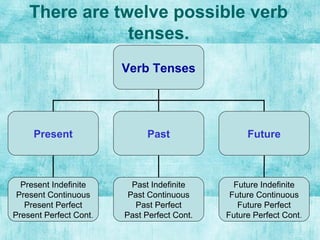
There are twelve possible verb
tenses.
Verb Tenses
Present Past Future
Present Indefinite
Present Continuous
Present Perfect
Present Perfect Cont.
Past Indefinite
Past Continuous
Past Perfect
Past Perfect Cont.
Future Indefinite
Future Continuous
Future Perfect
Future Perfect Cont.
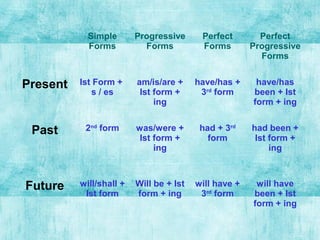
Simple
Forms
Progressive
Forms
Perfect
Forms
Perfect
Progressive
Forms
Present Ist Form +
s / es
am/is/are +
Ist form +
ing
have/has +
3rd
form
have/has
been + Ist
form + ing
Past 2nd
form was/were +
Ist form +
ing
had + 3rd
form
had been +
Ist form +
ing
Future will/shall +
Ist form
Will be + Ist
form + ing
will have +
3rd
form
will have
been + Ist
form + ing
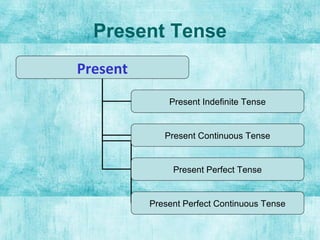
Present Tense
Present
Present Indefinite Tense
Present Continuous Tense
Present Perfect Tense
Present Perfect Continuous Tense
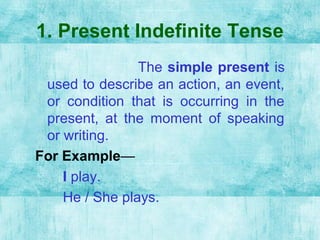
1. Present Indefinite Tense
The simple present is
used to describe an action, an event,
or condition that is occurring in the
present, at the moment of speaking
or writing.
For Example—
I play.
He / She plays.
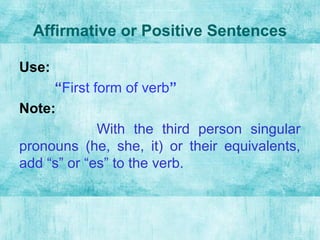
Affirmative or Positive Sentences
Use:
“First form of verb”
Note:
With the third person singular
pronouns (he, she, it) or their equivalents,
add “s” or “es” to the verb.
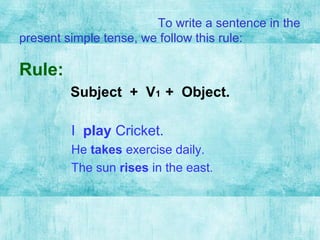
To write a sentence in the
present simple tense, we follow this rule:
Rule:
Subject + V1 + Object.
I play Cricket.
He takes exercise daily.
The sun rises in the east.
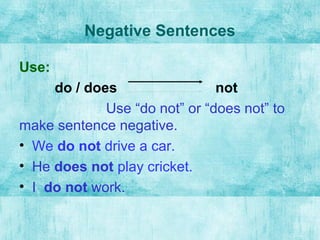
Negative Sentences
Use:
do / does not
Use “do not” or “does not” to
make sentence negative.
• We do not drive a car.
• He does not play cricket.
• I do not work.
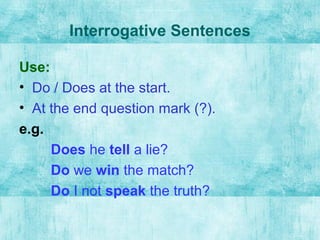
Interrogative Sentences
Use:
• Do / Does at the start.
• At the end question mark (?).
e.g.
Does he tell a lie?
Do we win the match?
Do I not speak the truth?
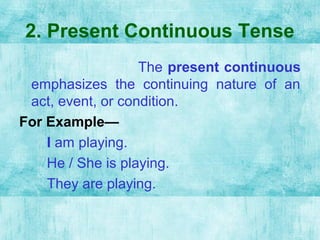
2. Present Continuous Tense
The present continuous
emphasizes the continuing nature of an
act, event, or condition.
For Example—
I am playing.
He / She is playing.
They are playing.
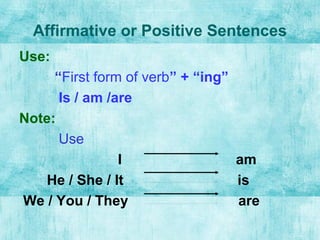
Affirmative or Positive Sentences
Use:
“First form of verb” + “ing”
Is / am /are
Note:
Use
I am
He / She / It is
We / You / They are
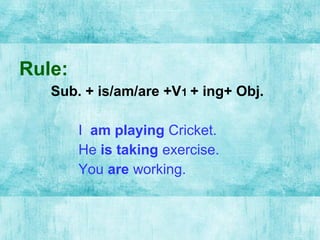
Rule:
Sub. + is/am/are +V1 + ing+ Obj.
I am playing Cricket.
He is taking exercise.
You are working.
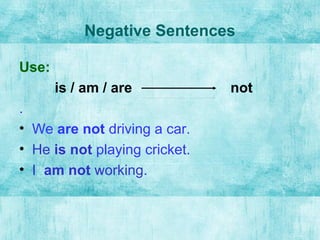
Negative Sentences
Use:
is / am / are not
.
• We are not driving a car.
• He is not playing cricket.
• I am not working.
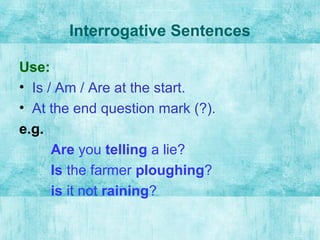
Interrogative Sentences
Use:
• Is / Am / Are at the start.
• At the end question mark (?).
e.g.
Are you telling a lie?
Is the farmer ploughing?
is it not raining?
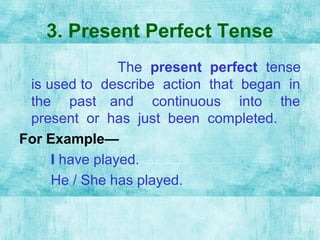
3. Present Perfect Tense
The present perfect tense
is used to describe action that began in
the past and continuous into the
present or has just been completed.
For Example—
I have played.
He / She has played.
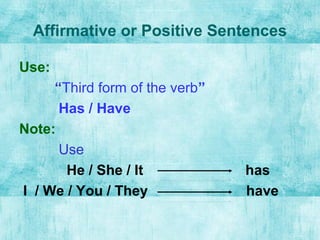
Affirmative or Positive Sentences
Use:
“Third form of the verb”
Has / Have
Note:
Use
He / She / It has
I / We / You / They have
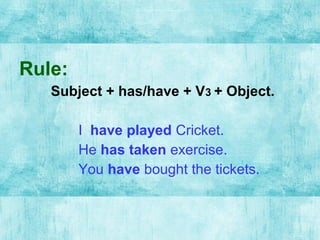
Rule:
Subject + has/have + V3 + Object.
I have played Cricket.
He has taken exercise.
You have bought the tickets.
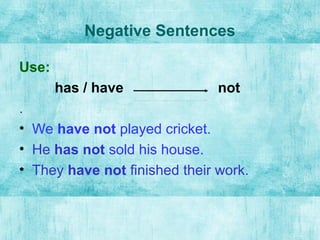
Negative Sentences
Use:
has / have not
.
• We have not played cricket.
• He has not sold his house.
• They have not finished their work.
Interrogative Sentences
Use:
• Has / Have at the start.
• At the end question mark (?).
e.g.
Have you bought the tickets?
Has the farmer finished his work?
Have you got prize?
4. Present Perfect Cont.
Tense
The present perfect
continuous is used to describe an
action, event, or condition that has
begun in the past and continuous into the
present.
For Example—
I / You have been playing.
He / She has been playing.
Affirmative or Positive Sentences
Use:
Has / Have been
“First form of the verb” + “ing”
“Since” and “For” are used.
Note:
Use
He / She / It has been
I / We / You / They have been
“Since”:
For point of time.
“For”:
For period of time.
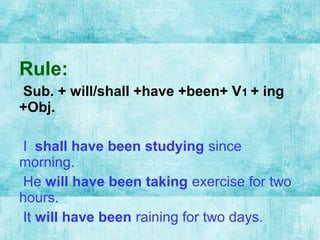
Rule:
Sub. + has/have +been+ V1 + ing +Obj.
I have been studying since morning.
He has been taking exercise for two hours.
It has been raining for two days.
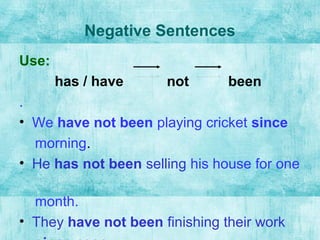
Negative Sentences
Use:
has / have not been
.
• We have not been playing cricket since
morning.
• He has not been selling his house for one
month.
• They have not been finishing their work
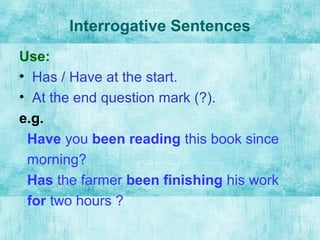
Interrogative Sentences
Use:
• Has / Have at the start.
• At the end question mark (?).
e.g.
Have you been reading this book since
morning?
Has the farmer been finishing his work
for two hours ?
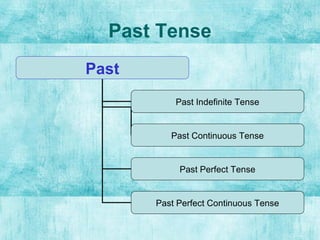
Past Tense
Past
Past Indefinite Tense
Past Perfect Tense
Past Perfect Continuous Tense
Past Continuous Tense
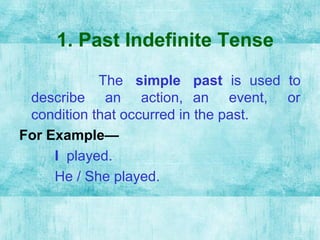
1. Past Indefinite Tense
The simple past is used to
describe an action, an event, or
condition that occurred in the past.
For Example—
I played.
He / She played.
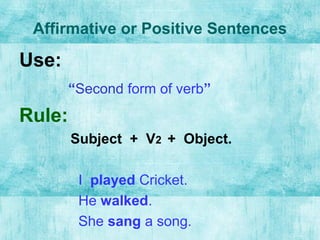
Affirmative or Positive Sentences
Use:
“Second form of verb”
Rule:
Subject + V2 + Object.
I played Cricket.
He walked.
She sang a song.
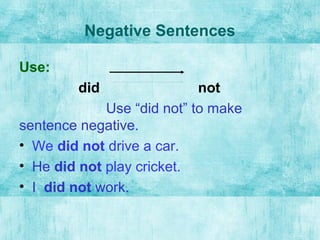
Negative Sentences
Use:
did not
Use “did not” to make
sentence negative.
• We did not drive a car.
• He did not play cricket.
• I did not work.
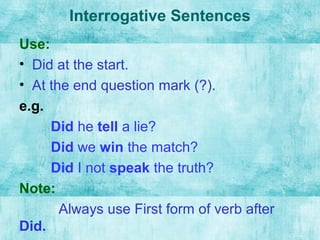
Interrogative Sentences
Use:
• Did at the start.
• At the end question mark (?).
e.g.
Did he tell a lie?
Did we win the match?
Did I not speak the truth?
Note:
Always use First form of verb after
Did.
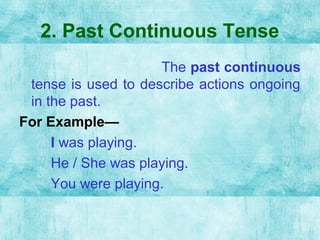
2. Past Continuous Tense
The past continuous
tense is used to describe actions ongoing
in the past.
For Example—
I was playing.
He / She was playing.
You were playing.
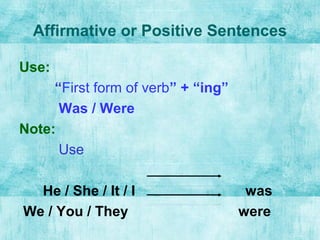
Affirmative or Positive Sentences
Use:
“First form of verb” + “ing”
Was / Were
Note:
Use
He / She / It / I was
We / You / They were
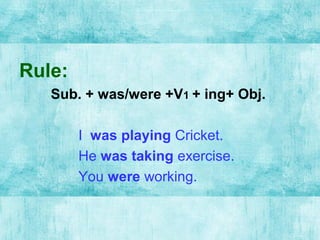
Rule:
Sub. + was/were +V1 + ing+ Obj.
I was playing Cricket.
He was taking exercise.
You were working.
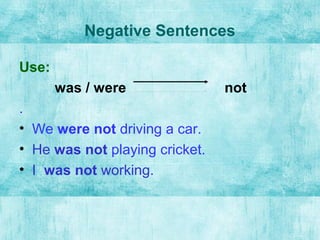
Negative Sentences
Use:
was / were not
.
• We were not driving a car.
• He was not playing cricket.
• I was not working.
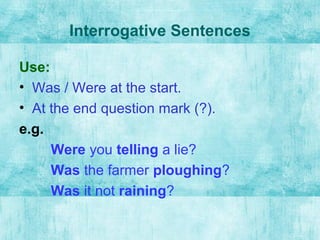
Interrogative Sentences
Use:
• Was / Were at the start.
• At the end question mark (?).
e.g.
Were you telling a lie?
Was the farmer ploughing?
Was it not raining?
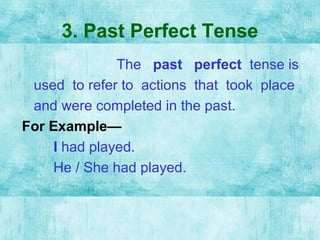
3. Past Perfect Tense
The past perfect tense is
used to refer to actions that took place
and were completed in the past.
For Example—
I had played.
He / She had played.
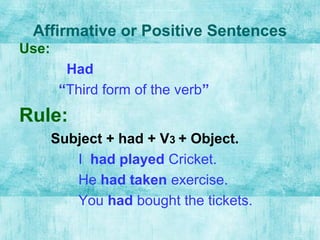
Affirmative or Positive Sentences
Use:
Had
“Third form of the verb”
Rule:
Subject + had + V3 + Object.
I had played Cricket.
He had taken exercise.
You had bought the tickets.
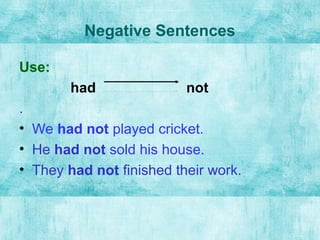
Negative Sentences
Use:
had not
.
• We had not played cricket.
• He had not sold his house.
• They had not finished their work.
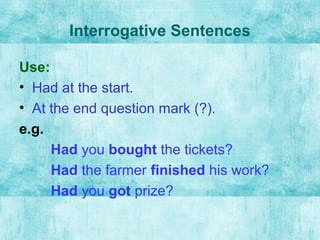
Interrogative Sentences
Use:
• Had at the start.
• At the end question mark (?).
e.g.
Had you bought the tickets?
Had the farmer finished his work?
Had you got prize?
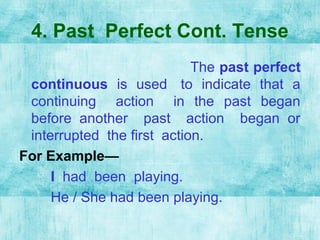
4. Past Perfect Cont. Tense
The past perfect
continuous is used to indicate that a
continuing action in the past began
before another past action began or
interrupted the first action.
For Example—
I had been playing.
He / She had been playing.
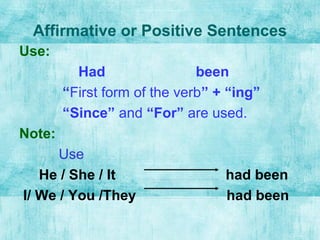
Affirmative or Positive Sentences
Use:
Had been
“First form of the verb” + “ing”
“Since” and “For” are used.
Note:
Use
He / She / It had been
I/ We / You /They had been
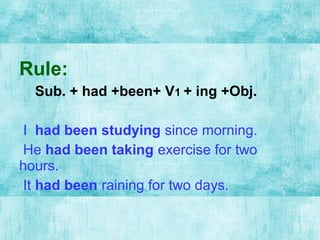
Rule:
Sub. + had +been+ V1 + ing +Obj.
I had been studying since morning.
He had been taking exercise for two
hours.
It had been raining for two days.
Negative Sentences
Use:
had not been
.
• We had not been playing cricket since
morning.
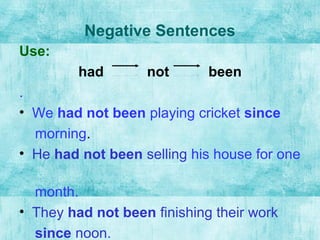
• He had not been selling his house for one
month.
• They had not been finishing their work
since noon.
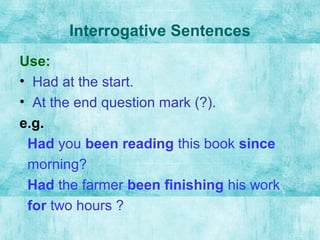
Interrogative Sentences
Use:
• Had at the start.
• At the end question mark (?).
e.g.
Had you been reading this book since
morning?
Had the farmer been finishing his work
for two hours ?
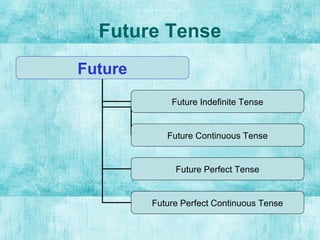
Future Tense
Future
Future Indefinite Tense
Future Perfect Tense
Future Perfect Continuous Tense
Future Continuous Tense
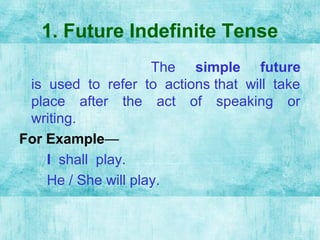
1. Future Indefinite Tense
The simple future
is used to refer to actions that will take
place after the act of speaking or
writing.
For Example—
I shall play.
He / She will play.
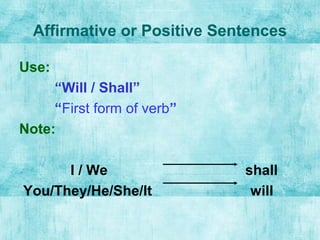
Affirmative or Positive Sentences
Use:
“Will / Shall”
“First form of verb”
Note:
I / We shall
You/They/He/She/It will
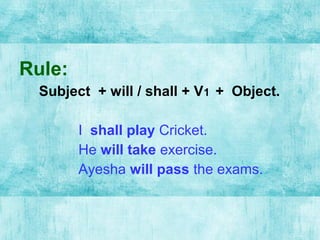
Rule:
Subject + will / shall + V1 + Object.
I shall play Cricket.
He will take exercise.
Ayesha will pass the exams.
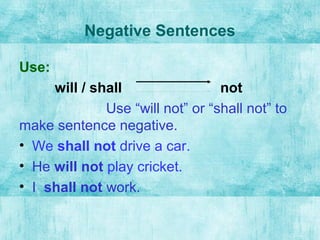
Negative Sentences
Use:
will / shall not
Use “will not” or “shall not” to
make sentence negative.
• We shall not drive a car.
• He will not play cricket.
• I shall not work.
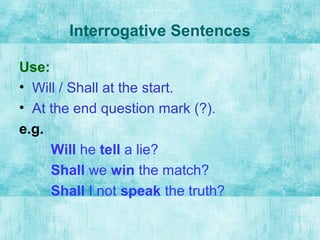
Interrogative Sentences
Use:
• Will / Shall at the start.
• At the end question mark (?).
e.g.
Will he tell a lie?
Shall we win the match?
Shall I not speak the truth?
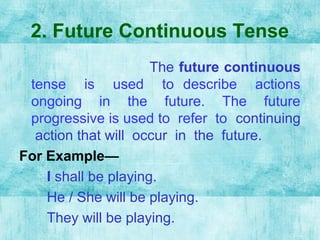
2. Future Continuous Tense
The future continuous
tense is used to describe actions
ongoing in the future. The future
progressive is used to refer to continuing
action that will occur in the future.
For Example—
I shall be playing.
He / She will be playing.
They will be playing.
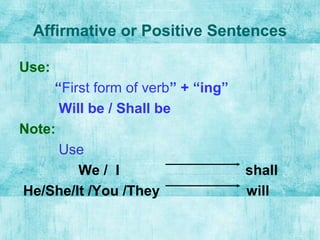
Affirmative or Positive Sentences
Use:
“First form of verb” + “ing”
Will be / Shall be
Note:
Use
We / I shall
He/She/It /You /They will
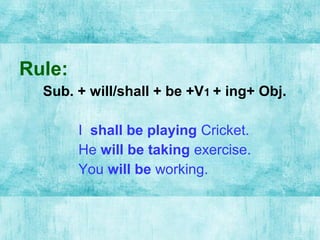
Rule:
Sub. + will/shall + be +V1 + ing+ Obj.
I shall be playing Cricket.
He will be taking exercise.
You will be working.
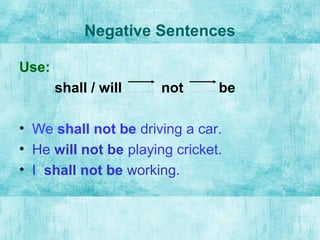
Negative Sentences
Use:
shall / will not be
• We shall not be driving a car.
• He will not be playing cricket.
• I shall not be working.
Interrogative Sentences
Use:
• Will / Shall at the start.
• At the end question mark (?).
e.g.
Will you be telling a lie?
Will the farmer be ploughing?
Will it be raining?
3. Future Perfect Tense
The future perfect
is used to refer to an action that will be
completed sometime in the future before
another action takes place.
For Example—
I shall have played.
He / She will have played.
Affirmative or Positive Sentences
Use:
“Third form of the verb”
Will have / Shall have
Note:
Use
He /She/You /They will have
I / We shall have
Rule:
Subject + will/shall have + V3 + Object.
I shall have played Cricket.
He will have taken exercise.
You will have bought the tickets.
Negative Sentences
Use:
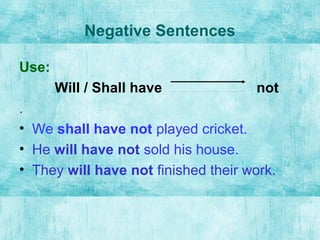
Will / Shall have not
.
• We shall have not played cricket.
• He will have not sold his house.
• They will have not finished their work.
Interrogative Sentences
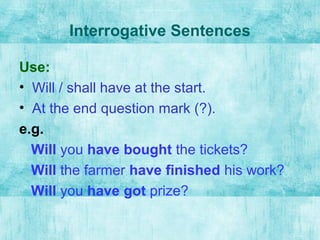
Use:
• Will / shall have at the start.
• At the end question mark (?).
e.g.
Will you have bought the tickets?
Will the farmer have finished his work?
Will you have got prize?
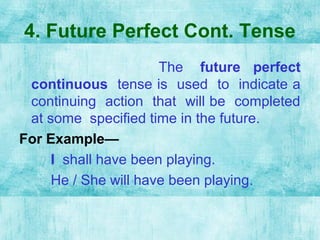
4. Future Perfect Cont. Tense
The future perfect
continuous tense is used to indicate a
continuing action that will be completed
at some specified time in the future.
For Example—
I shall have been playing.
He / She will have been playing.
Affirmative or Positive Sentences
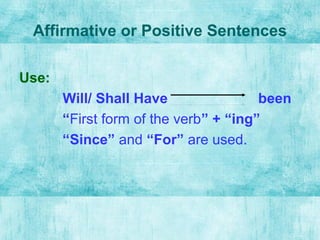
Use:
Will/ Shall Have been
“First form of the verb” + “ing”
“Since” and “For” are used.
Rule:
Sub. + will/shall +have +been+ V1 + ing
+Obj.
I shall have been studying since
morning.
He will have been taking exercise for two
hours.
It will have been raining for two days.
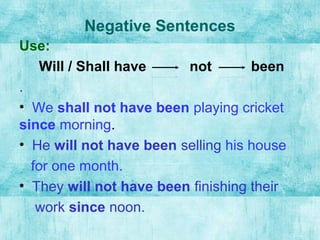
Negative Sentences
Use:
Will / Shall have not been
.
• We shall not have been playing cricket
since morning.
• He will not have been selling his house
for one month.
• They will not have been finishing their
work since noon.
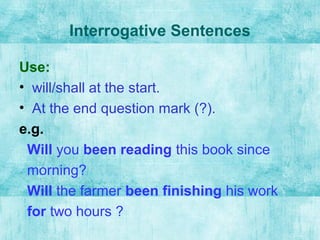
Interrogative Sentences
Use:
• will/shall at the start.
• At the end question mark (?).
e.g.
Will you been reading this book since
morning?
Will the farmer been finishing his work
for two hours ?
THE END

Tenses

  • 1.
  • 2.
    CONTENTS • Introduction • Classificationbased on Time Frame • Classification based on Aspect • Block diagram of Tenses • List of Rules • Present Tense • Past Tense • Future Tense • List of Examples
  • 3.
    INTRODUCTION The word Tenseis derived from Latin word “Tempus” which means ‘Time’. A verb indicates the time of an action, event or condition by changing its form.
  • 4.
    Based on TimeFrame The verb tenses may be categorized according to the time frame: • Present Tense • Past Tense • Future Tense
  • 5.
    Present Tense :--- Presenttense expresses an unchanging, repeated, or reoccurring action or situation that exists only now. It can also represent a widespread truth. Past Tense :--- Past tense expresses an action or situation that was started and finished in the past. Future Tense :--- Future tense expresses an action or situation that will occur in the future.
  • 6.
    Based on Aspect Verbtenses may also be categorized according to aspect. “Aspect refers to the nature of the action described by the verb.” There are Four aspects: • Indefinite or Simple • Continuous or Progressive • Perfect or Complete • Perfect Continuous
  • 7.
    Indefinite Tense The threeindefinite tenses, or simple tenses, describe an action but do not state whether the action is finished. Continuous Tense The three continuous tenses, incomplete tenses, or progressive tenses, describe an unfinished action. Perfect Tense The three complete tenses, or perfect tenses, describe a finished action. Perfect Continuous Tense To combine the complete tenses and the incomplete tenses, to describe an action which was in progress and then finished.
  • 8.
    There are twelvepossible verb tenses. Verb Tenses Present Past Future Present Indefinite Present Continuous Present Perfect Present Perfect Cont. Past Indefinite Past Continuous Past Perfect Past Perfect Cont. Future Indefinite Future Continuous Future Perfect Future Perfect Cont.
  • 9.
    Simple Forms Progressive Forms Perfect Forms Perfect Progressive Forms Present Ist Form+ s / es am/is/are + Ist form + ing have/has + 3rd form have/has been + Ist form + ing Past 2nd form was/were + Ist form + ing had + 3rd form had been + Ist form + ing Future will/shall + Ist form Will be + Ist form + ing will have + 3rd form will have been + Ist form + ing
  • 10.
    Present Tense Present Present IndefiniteTense Present Continuous Tense Present Perfect Tense Present Perfect Continuous Tense
  • 11.
    1. Present IndefiniteTense The simple present is used to describe an action, an event, or condition that is occurring in the present, at the moment of speaking or writing. For Example— I play. He / She plays.
  • 12.
    Affirmative or PositiveSentences Use: “First form of verb” Note: With the third person singular pronouns (he, she, it) or their equivalents, add “s” or “es” to the verb.
  • 13.
    To write asentence in the present simple tense, we follow this rule: Rule: Subject + V1 + Object. I play Cricket. He takes exercise daily. The sun rises in the east.
  • 14.
    Negative Sentences Use: do /does not Use “do not” or “does not” to make sentence negative. • We do not drive a car. • He does not play cricket. • I do not work.
  • 15.
    Interrogative Sentences Use: • Do/ Does at the start. • At the end question mark (?). e.g. Does he tell a lie? Do we win the match? Do I not speak the truth?
  • 16.
    2. Present ContinuousTense The present continuous emphasizes the continuing nature of an act, event, or condition. For Example— I am playing. He / She is playing. They are playing.
  • 17.
    Affirmative or PositiveSentences Use: “First form of verb” + “ing” Is / am /are Note: Use I am He / She / It is We / You / They are
  • 18.
    Rule: Sub. + is/am/are+V1 + ing+ Obj. I am playing Cricket. He is taking exercise. You are working.
  • 19.
    Negative Sentences Use: is /am / are not . • We are not driving a car. • He is not playing cricket. • I am not working.
  • 20.
    Interrogative Sentences Use: • Is/ Am / Are at the start. • At the end question mark (?). e.g. Are you telling a lie? Is the farmer ploughing? is it not raining?
  • 21.
    3. Present PerfectTense The present perfect tense is used to describe action that began in the past and continuous into the present or has just been completed. For Example— I have played. He / She has played.
  • 22.
    Affirmative or PositiveSentences Use: “Third form of the verb” Has / Have Note: Use He / She / It has I / We / You / They have
  • 23.
    Rule: Subject + has/have+ V3 + Object. I have played Cricket. He has taken exercise. You have bought the tickets.
  • 24.
    Negative Sentences Use: has /have not . • We have not played cricket. • He has not sold his house. • They have not finished their work.
  • 25.
    Interrogative Sentences Use: • Has/ Have at the start. • At the end question mark (?). e.g. Have you bought the tickets? Has the farmer finished his work? Have you got prize?
  • 26.
    4. Present PerfectCont. Tense The present perfect continuous is used to describe an action, event, or condition that has begun in the past and continuous into the present. For Example— I / You have been playing. He / She has been playing.
  • 27.
    Affirmative or PositiveSentences Use: Has / Have been “First form of the verb” + “ing” “Since” and “For” are used. Note: Use He / She / It has been I / We / You / They have been
  • 28.
    “Since”: For point oftime. “For”: For period of time. Rule: Sub. + has/have +been+ V1 + ing +Obj. I have been studying since morning. He has been taking exercise for two hours. It has been raining for two days.
  • 29.
    Negative Sentences Use: has /have not been . • We have not been playing cricket since morning. • He has not been selling his house for one month. • They have not been finishing their work
  • 30.
    Interrogative Sentences Use: • Has/ Have at the start. • At the end question mark (?). e.g. Have you been reading this book since morning? Has the farmer been finishing his work for two hours ?
  • 31.
    Past Tense Past Past IndefiniteTense Past Perfect Tense Past Perfect Continuous Tense Past Continuous Tense
  • 32.
    1. Past IndefiniteTense The simple past is used to describe an action, an event, or condition that occurred in the past. For Example— I played. He / She played.
  • 33.
    Affirmative or PositiveSentences Use: “Second form of verb” Rule: Subject + V2 + Object. I played Cricket. He walked. She sang a song.
  • 34.
    Negative Sentences Use: did not Use“did not” to make sentence negative. • We did not drive a car. • He did not play cricket. • I did not work.
  • 35.
    Interrogative Sentences Use: • Didat the start. • At the end question mark (?). e.g. Did he tell a lie? Did we win the match? Did I not speak the truth? Note: Always use First form of verb after Did.
  • 36.
    2. Past ContinuousTense The past continuous tense is used to describe actions ongoing in the past. For Example— I was playing. He / She was playing. You were playing.
  • 37.
    Affirmative or PositiveSentences Use: “First form of verb” + “ing” Was / Were Note: Use He / She / It / I was We / You / They were
  • 38.
    Rule: Sub. + was/were+V1 + ing+ Obj. I was playing Cricket. He was taking exercise. You were working.
  • 39.
    Negative Sentences Use: was /were not . • We were not driving a car. • He was not playing cricket. • I was not working.
  • 40.
    Interrogative Sentences Use: • Was/ Were at the start. • At the end question mark (?). e.g. Were you telling a lie? Was the farmer ploughing? Was it not raining?
  • 41.
    3. Past PerfectTense The past perfect tense is used to refer to actions that took place and were completed in the past. For Example— I had played. He / She had played.
  • 42.
    Affirmative or PositiveSentences Use: Had “Third form of the verb” Rule: Subject + had + V3 + Object. I had played Cricket. He had taken exercise. You had bought the tickets.
  • 43.
    Negative Sentences Use: had not . •We had not played cricket. • He had not sold his house. • They had not finished their work.
  • 44.
    Interrogative Sentences Use: • Hadat the start. • At the end question mark (?). e.g. Had you bought the tickets? Had the farmer finished his work? Had you got prize?
  • 45.
    4. Past PerfectCont. Tense The past perfect continuous is used to indicate that a continuing action in the past began before another past action began or interrupted the first action. For Example— I had been playing. He / She had been playing.
  • 46.
    Affirmative or PositiveSentences Use: Had been “First form of the verb” + “ing” “Since” and “For” are used. Note: Use He / She / It had been I/ We / You /They had been
  • 47.
    Rule: Sub. + had+been+ V1 + ing +Obj. I had been studying since morning. He had been taking exercise for two hours. It had been raining for two days.
  • 48.
    Negative Sentences Use: had notbeen . • We had not been playing cricket since morning. • He had not been selling his house for one month. • They had not been finishing their work since noon.
  • 49.
    Interrogative Sentences Use: • Hadat the start. • At the end question mark (?). e.g. Had you been reading this book since morning? Had the farmer been finishing his work for two hours ?
  • 50.
    Future Tense Future Future IndefiniteTense Future Perfect Tense Future Perfect Continuous Tense Future Continuous Tense
  • 51.
    1. Future IndefiniteTense The simple future is used to refer to actions that will take place after the act of speaking or writing. For Example— I shall play. He / She will play.
  • 52.
    Affirmative or PositiveSentences Use: “Will / Shall” “First form of verb” Note: I / We shall You/They/He/She/It will
  • 53.
    Rule: Subject + will/ shall + V1 + Object. I shall play Cricket. He will take exercise. Ayesha will pass the exams.
  • 54.
    Negative Sentences Use: will /shall not Use “will not” or “shall not” to make sentence negative. • We shall not drive a car. • He will not play cricket. • I shall not work.
  • 55.
    Interrogative Sentences Use: • Will/ Shall at the start. • At the end question mark (?). e.g. Will he tell a lie? Shall we win the match? Shall I not speak the truth?
  • 56.
    2. Future ContinuousTense The future continuous tense is used to describe actions ongoing in the future. The future progressive is used to refer to continuing action that will occur in the future. For Example— I shall be playing. He / She will be playing. They will be playing.
  • 57.
    Affirmative or PositiveSentences Use: “First form of verb” + “ing” Will be / Shall be Note: Use We / I shall He/She/It /You /They will
  • 58.
    Rule: Sub. + will/shall+ be +V1 + ing+ Obj. I shall be playing Cricket. He will be taking exercise. You will be working.
  • 59.
    Negative Sentences Use: shall /will not be • We shall not be driving a car. • He will not be playing cricket. • I shall not be working.
  • 60.
    Interrogative Sentences Use: • Will/ Shall at the start. • At the end question mark (?). e.g. Will you be telling a lie? Will the farmer be ploughing? Will it be raining?
  • 61.
    3. Future PerfectTense The future perfect is used to refer to an action that will be completed sometime in the future before another action takes place. For Example— I shall have played. He / She will have played.
  • 62.
    Affirmative or PositiveSentences Use: “Third form of the verb” Will have / Shall have Note: Use He /She/You /They will have I / We shall have
  • 63.
    Rule: Subject + will/shallhave + V3 + Object. I shall have played Cricket. He will have taken exercise. You will have bought the tickets.
  • 64.
    Negative Sentences Use: Will /Shall have not . • We shall have not played cricket. • He will have not sold his house. • They will have not finished their work.
  • 65.
    Interrogative Sentences Use: • Will/ shall have at the start. • At the end question mark (?). e.g. Will you have bought the tickets? Will the farmer have finished his work? Will you have got prize?
  • 66.
    4. Future PerfectCont. Tense The future perfect continuous tense is used to indicate a continuing action that will be completed at some specified time in the future. For Example— I shall have been playing. He / She will have been playing.
  • 67.
    Affirmative or PositiveSentences Use: Will/ Shall Have been “First form of the verb” + “ing” “Since” and “For” are used.
  • 68.
    Rule: Sub. + will/shall+have +been+ V1 + ing +Obj. I shall have been studying since morning. He will have been taking exercise for two hours. It will have been raining for two days.
  • 69.
    Negative Sentences Use: Will /Shall have not been . • We shall not have been playing cricket since morning. • He will not have been selling his house for one month. • They will not have been finishing their work since noon.
  • 70.
    Interrogative Sentences Use: • will/shallat the start. • At the end question mark (?). e.g. Will you been reading this book since morning? Will the farmer been finishing his work for two hours ?
  • 71.

Editor's Notes