Veganuary Project
Analysis
Oli Walwyn
Planning
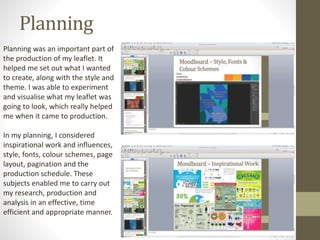
Planning was an important part of
the production of my leaflet. It
helped me set out what I wanted
to create, along with the style and
theme. I was able to experiment
and visualise what my leaflet was
going to look, which really helped
me when it came to production.
In my planning, I considered
inspirational work and influences,
style, fonts, colour schemes, page
layout, pagination and the
production schedule. These
subjects enabled me to carry out
my research, production and
analysis in an effective, time
efficient and appropriate manner.
Planning
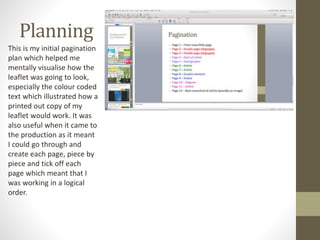
This is my initial pagination
plan which helped me
mentally visualise how the
leaflet was going to look,
especially the colour coded
text which illustrated how a
printed out copy of my
leaflet would work. It was
also useful when it came to
the production as it meant
I could go through and
create each page, piece by
piece and tick off each
page which meant that I
was working in a logical
order.
Preparation
It was important to prepare going
into the production phase of the
module. A lot of my preparation
revolves around research into
veganism and collecting data
using an online questionnaire. To
begin with, I simply googled
veganism and clicked on some of
the relevant links. I then began
processing the information and
creating a fact file of vegan facts
that I could use for my leaflet,
article and infographics. I
conducted research into veganism
by asking people that I know 8
questions about veganism. It was
successful as I got 7 responses in
the first 24 hours. I then analysed
the data and used it to refine my
research on veganism.
Time Management
Time management was an
essential part of staying on
track and using my time
effectively. It meant that I
could come into class each
day and know exact what
needs doing to stay on track
to finish on time.
As I was working in a
relatively small timeframe, I
thought that it would be
better finish a rough sketch
of my pages and have time
to go back and improve on
them than not get my leaflet
finished in time. This worked
well as it meant that I got
valuable feedback to help
improve on my style and
consistency.
File Formatting
A large part of being organised fell down to how and where my work was saved.
Because of the nature of this project and to be efficient and orderly, everything had to
be saved in order as otherwise it would be a confusing mess of files and folders. I
categorised all my files into different sections for example, inside my ‘Veganuary’
folder, there were 6 subfolders each with different parts of the project in them to help
me find everything quicker and easier. To ensure that I didn’t lose any saved work, I
regularly backed up my work to Google Drive cloud storage and on my USB stick. This
meant that nothing could be lost and made sure that I didn’t miss any deadlines.
Reviewing Work In Progress
While my leaflet and infographics
were in production, I was
consistently asking the people
around me and my tutor for
feedback, advice and how to
improve on my work. This was
useful to me as everyone else was
doing the same work as me and
so had some interesting and
creative ideas.
They also offer insight from a new
perspective which I wouldn’t be
able to see, such as “the font
needs to be clearer and bigger” or
“the colours need reworking so
they match better”. It was also
useful to take a break from my
work and come back and view the
work in full, analysing what I like
and dislike about the image.
Reviewing Work In Progress
Reviewing my work was
particularly important when
putting together my A5 leaflet
as there were many elements
that needed improvements and
changes. It was one of the
production tasks that took me
the longest so it was helpful to
get feedback without
submitting the work. It also
helped correct consistency
errors and unite the themes of
my work. For example, in the
image to the right, it is
noticeable that the range
colours that I have used don’t
particularly blend and mix well.
This is one of the things I was
able to change before
submission.
Technical Competencies And
Creative Abilities
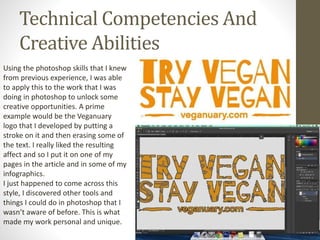
Using the photoshop skills that I knew
from previous experience, I was able
to apply this to the work that I was
doing in photoshop to unlock some
creative opportunities. A prime
example would be the Veganuary
logo that I developed by putting a
stroke on it and then erasing some of
the text. I really liked the resulting
affect and so I put it on one of my
pages in the article and in some of my
infographics.
I just happened to come across this
style, I discovered other tools and
things I could do in photoshop that I
wasn’t aware of before. This is what
made my work personal and unique.
Infographics
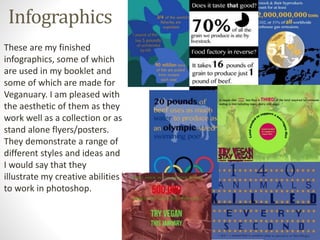
These are my finished
infographics, some of which
are used in my booklet and
some of which are made for
Veganuary. I am pleased with
the aesthetic of them as they
work well as a collection or as
stand alone flyers/posters.
They demonstrate a range of
different styles and ideas and
I would say that they
illustrate my creative abilities
to work in photoshop.
Final Product
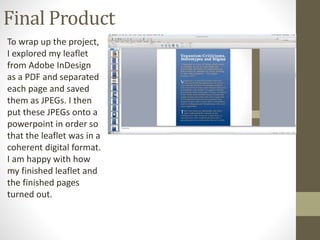
To wrap up the project,
I explored my leaflet
from Adobe InDesign
as a PDF and separated
each page and saved
them as JPEGs. I then
put these JPEGs onto a
powerpoint in order so
that the leaflet was in a
coherent digital format.
I am happy with how
my finished leaflet and
the finished pages
turned out.

Veganuary analysis

  • 1.
  • 2.
    Planning Planning was animportant part of the production of my leaflet. It helped me set out what I wanted to create, along with the style and theme. I was able to experiment and visualise what my leaflet was going to look, which really helped me when it came to production. In my planning, I considered inspirational work and influences, style, fonts, colour schemes, page layout, pagination and the production schedule. These subjects enabled me to carry out my research, production and analysis in an effective, time efficient and appropriate manner.
  • 3.
    Planning This is myinitial pagination plan which helped me mentally visualise how the leaflet was going to look, especially the colour coded text which illustrated how a printed out copy of my leaflet would work. It was also useful when it came to the production as it meant I could go through and create each page, piece by piece and tick off each page which meant that I was working in a logical order.
  • 4.
    Preparation It was importantto prepare going into the production phase of the module. A lot of my preparation revolves around research into veganism and collecting data using an online questionnaire. To begin with, I simply googled veganism and clicked on some of the relevant links. I then began processing the information and creating a fact file of vegan facts that I could use for my leaflet, article and infographics. I conducted research into veganism by asking people that I know 8 questions about veganism. It was successful as I got 7 responses in the first 24 hours. I then analysed the data and used it to refine my research on veganism.
  • 5.
    Time Management Time managementwas an essential part of staying on track and using my time effectively. It meant that I could come into class each day and know exact what needs doing to stay on track to finish on time. As I was working in a relatively small timeframe, I thought that it would be better finish a rough sketch of my pages and have time to go back and improve on them than not get my leaflet finished in time. This worked well as it meant that I got valuable feedback to help improve on my style and consistency.
  • 6.
    File Formatting A largepart of being organised fell down to how and where my work was saved. Because of the nature of this project and to be efficient and orderly, everything had to be saved in order as otherwise it would be a confusing mess of files and folders. I categorised all my files into different sections for example, inside my ‘Veganuary’ folder, there were 6 subfolders each with different parts of the project in them to help me find everything quicker and easier. To ensure that I didn’t lose any saved work, I regularly backed up my work to Google Drive cloud storage and on my USB stick. This meant that nothing could be lost and made sure that I didn’t miss any deadlines.
  • 7.
    Reviewing Work InProgress While my leaflet and infographics were in production, I was consistently asking the people around me and my tutor for feedback, advice and how to improve on my work. This was useful to me as everyone else was doing the same work as me and so had some interesting and creative ideas. They also offer insight from a new perspective which I wouldn’t be able to see, such as “the font needs to be clearer and bigger” or “the colours need reworking so they match better”. It was also useful to take a break from my work and come back and view the work in full, analysing what I like and dislike about the image.
  • 8.
    Reviewing Work InProgress Reviewing my work was particularly important when putting together my A5 leaflet as there were many elements that needed improvements and changes. It was one of the production tasks that took me the longest so it was helpful to get feedback without submitting the work. It also helped correct consistency errors and unite the themes of my work. For example, in the image to the right, it is noticeable that the range colours that I have used don’t particularly blend and mix well. This is one of the things I was able to change before submission.
  • 9.
    Technical Competencies And CreativeAbilities Using the photoshop skills that I knew from previous experience, I was able to apply this to the work that I was doing in photoshop to unlock some creative opportunities. A prime example would be the Veganuary logo that I developed by putting a stroke on it and then erasing some of the text. I really liked the resulting affect and so I put it on one of my pages in the article and in some of my infographics. I just happened to come across this style, I discovered other tools and things I could do in photoshop that I wasn’t aware of before. This is what made my work personal and unique.
  • 10.
    Infographics These are myfinished infographics, some of which are used in my booklet and some of which are made for Veganuary. I am pleased with the aesthetic of them as they work well as a collection or as stand alone flyers/posters. They demonstrate a range of different styles and ideas and I would say that they illustrate my creative abilities to work in photoshop.
  • 11.
    Final Product To wrapup the project, I explored my leaflet from Adobe InDesign as a PDF and separated each page and saved them as JPEGs. I then put these JPEGs onto a powerpoint in order so that the leaflet was in a coherent digital format. I am happy with how my finished leaflet and the finished pages turned out.