WORKINGTO A
BRIEF
LO1
OliWalwyn
Contractual Brief
Definition – A contractual brief is the most common type of brief. It is an
agreement to complete a specific task within a specific time period for an
agreed upon sum of money set and agreed upon by 2 parties, usually a
media company and a client. If either of these parties breaks the contract
or doesn’t abide the brief then they are in breach of the contractual brief
and could face legal action.
Advantages – The advantages of a contractual brief are that it offers
security to both the media company and client and is a legally binding
contract.There is protection if either party doesn’t follow the contractual
brief as legal action can be taken to ensure that the issue is resolved.
Disadvantages – The disadvantages of a contractual brief is that you have to
be very careful in the terms and conditions of the contract to ensure you
do not sign and agree to something that you don’t want to agree to.This
can often involve reading through pages of contractual jargon which is
time consuming, especially for an independent freelance worker.
Formal Brief
Definition – A formal brief is a type of brief in which the client provides a
media company that simply establishes the product they want to be made.
The brief only contains necessary information that’s needed for the project
to be completed. Any additional information should be made through
negotiations with the company and client.
Advantages – It’s concise as the brief only contains information that the
company actually needs.There’s no siphoning of information or
clarification needed.
Disadvantages – Formal briefs are not necessarily legally binding meaning
that there isn’t that additional level of security or contract that ensures that
both parties get what they want.Any more information other than the
brief will have to be retained through negotiations with the
company/client.
Informal Brief
Definition – An informal brief is a verbal agreement between the company
and the client.There isn’t a contact or written document that is needed. It
could just be a phone call between the two parties.
Advantages –This could make the project have more creativity and freedom
as there isn’t a clear goal or objective to reach.
Disadvantages – On the contrary, it could be so vague that you just don’t
know what to do. It is also risky as there is no document to say that you’re
going to get paid a set amount, it is probably a bad idea to enter one of
these projects. It would involve a large amount of trust and cooperation in
order for nothing to go wrong.
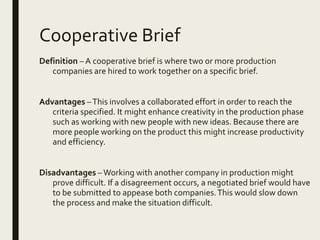
Cooperative Brief
Definition – A cooperative brief is where two or more production
companies are hired to work together on a specific brief.
Advantages –This involves a collaborated effort in order to reach the
criteria specified. It might enhance creativity in the production phase
such as working with new people with new ideas. Because there are
more people working on the product this might increase productivity
and efficiency.
Disadvantages –Working with another company in production might
prove difficult. If a disagreement occurs, a negotiated brief would have
to be submitted to appease both companies.This would slow down
the process and make the situation difficult.
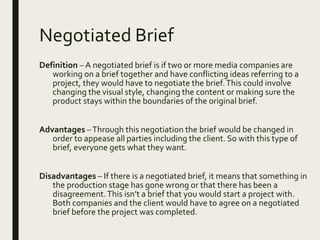
Negotiated Brief
Definition – A negotiated brief is if two or more media companies are
working on a brief together and have conflicting ideas referring to a
project, they would have to negotiate the brief.This could involve
changing the visual style, changing the content or making sure the
product stays within the boundaries of the original brief.
Advantages –Through this negotiation the brief would be changed in
order to appease all parties including the client. So with this type of
brief, everyone gets what they want.
Disadvantages – If there is a negotiated brief, it means that something in
the production stage has gone wrong or that there has been a
disagreement.This isn’t a brief that you would start a project with.
Both companies and the client would have to agree on a negotiated
brief before the project was completed.
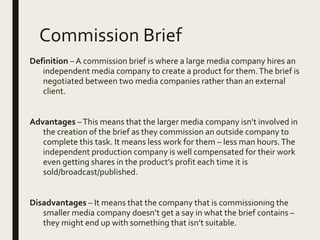
Commission Brief
Definition – A commission brief is where a large media company hires an
independent media company to create a product for them.The brief is
negotiated between two media companies rather than an external
client.
Advantages –This means that the larger media company isn’t involved in
the creation of the brief as they commission an outside company to
complete this task. It means less work for them – less man hours.The
independent production company is well compensated for their work
even getting shares in the product’s profit each time it is
sold/broadcast/published.
Disadvantages – It means that the company that is commissioning the
smaller media company doesn’t get a say in what the brief contains –
they might end up with something that isn’t suitable.
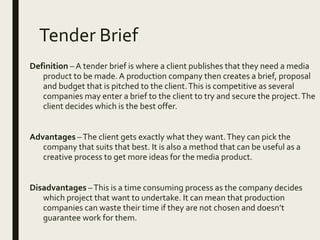
Tender Brief
Definition – A tender brief is where a client publishes that they need a media
product to be made. A production company then creates a brief, proposal
and budget that is pitched to the client.This is competitive as several
companies may enter a brief to the client to try and secure the project.The
client decides which is the best offer.
Advantages –The client gets exactly what they want.They can pick the
company that suits that best. It is also a method that can be useful as a
creative process to get more ideas for the media product.
Disadvantages –This is a time consuming process as the company decides
which project that want to undertake. It can mean that production
companies can waste their time if they are not chosen and doesn’t
guarantee work for them.
Competition Brief
Definition – A competition brief is a brief that is made available to all
participating production companies. Each company then completes the
brief. All projects are then judged and the best is awarded the project and
gets it published.This is often used as a free to enter competition.
Advantages –The client only has to pay the winning company which means
that its cheaper for them while also getting lots of ideas.
Disadvantages – It means that production companies might not get paid as
if they don’t win they don’t get anything. It is a very competitive type of
brief.
My Brief
Which structure/structures will your client brief use?
My client brief used an informal brief structure. It was largely a verbal
contract which was fine because I am familiar with the client.
Reference your reasons for choice/choices.
The reason for this type of brief is that it’s what came naturally when
arranging the project with my client. It was easier to negotiate the
terms of the project in verbal language rather than
misunderstanding each other in text.
Reading the Brief
Why is important to thoroughly read your brief?
It is very important to read your brief correctly.This will ensure that you
fully understand what it being asked of you and the nature and
demands of the project.
It will ensure you have a good understanding of what the outcome and
final product will be and that you are on the same page as the client.
It will make sure you have the time, resources and workforce to complete
the project to mutual expectations.
When you first have your brief, it is important to read it in detail and to
check if there is anything that isn’t clear or isn’t correct. If there is, it’s
important to discuss these concerns with the client immediately.
Reading the Brief
What is the nature and demand of your client brief?
The nature of your client brief is what is being asked of you in the
project and what your final outcome and product will be.
The demand of your client brief is the time constraints/limits, the
resources and workforce that you will need to complete the
project to the expected standards.
These are both very significant aspects of the brief.
Negotiating a Brief
Why is it important to discuss the brief with your client prior to
production?
It is important to discuss the brief with your client before
production as this makes sure that the brief is explicitly clear
to both parties and expectations are realistic and mutual.
If there any issues with the brief or anything that doesn’t make
sense, it should be discussed with the client immediately.
Ensure that the product they are asking of is feasible, that it
doesn't break any laws or regulations and that you completely
understand what it being asked of you.
Negotiating a Brief
What are the advantages and disadvantages of employing
discretion with a brief?
Discretion with a brief is using your intuition to guide the company to
make the best decision when decided what to do.
The advantages of this method is that if done correctly, you can get
your thoughts and ideas into the brief without encountering any
conflict or friction between you and the client.
The disadvantages of doing this is that if you are not clear enough, you
might end up with a brief that you’re not happy with.There has to
be a balance of clarity and discretion in order to get the best brief
outcome.
Negotiating a Brief
Are there any potential legal/ethical/regulatory issues with the brief’s
proposed product?
There were a few considerations that I had to make when negotiating the
brief.The main one was the usage of the ‘Perfect Choice Funeral Plans’
logo in my work for my client.This is an organisation that my client is a
part of and I didn’t want to use the logo without the proper permissions
in case of copyright regulations. I asked my client to confirm that I was
able to use the logo and the issue was resolved.
The only ethical consideration was to be vigilant when creating products for
people that are grieving, as it is a particularly sensitive time for them.
Negotiating a Brief
Amendments you have considered to:
The Product –The initial final product may need to be changed due to being
too ambitious or due to breaking a law or regulations.There might not be
enough time to create the product in time.
The Budget – Any amendments to the budget will quite often be due to a lack
of money to complete what has been briefed. If this is the case, the budget
will have to be decreased and the project scaled down accordingly.
The Conditions –The brief will state an initial fee that the production company
will be paid for the project.This might need to be changed due to any
amendments that have been made to the product or budget. If the change
is not made before the contract is signed it is very difficult to try and get
paid extra money for the project running over the time period or if it
requires more money so this should be taken into consideration.
Opportunities
What opportunities could this brief allow you to explore?
Self Development –The brief could outline something that you are
already familiar with such as creating an advert or designing a
poster and could enable you to develop this skill by working to
a different set of styles or themes.
Learning new skills –The brief could allow you to explore new
areas of work that you haven’t ventured into before.This might
enable you to learn new skills or techniques to help you in your
production.
Opportunities
Multi-skilling – Often, projects and briefs require a combination of
skills in order to be completed to their full potential.This will
enable you to multi-task better and optimise the production
phase of the brief.
Contributing to a project – If the client is happy with how you
complete this project, they might give you a chance to work on
a bigger project or work with more experienced designers.The
brief might involve a collaboration with a range of different
media producers and it good experience.

Working to a brief pro forma

  • 1.
  • 2.
    Contractual Brief Definition –A contractual brief is the most common type of brief. It is an agreement to complete a specific task within a specific time period for an agreed upon sum of money set and agreed upon by 2 parties, usually a media company and a client. If either of these parties breaks the contract or doesn’t abide the brief then they are in breach of the contractual brief and could face legal action. Advantages – The advantages of a contractual brief are that it offers security to both the media company and client and is a legally binding contract.There is protection if either party doesn’t follow the contractual brief as legal action can be taken to ensure that the issue is resolved. Disadvantages – The disadvantages of a contractual brief is that you have to be very careful in the terms and conditions of the contract to ensure you do not sign and agree to something that you don’t want to agree to.This can often involve reading through pages of contractual jargon which is time consuming, especially for an independent freelance worker.
  • 3.
    Formal Brief Definition –A formal brief is a type of brief in which the client provides a media company that simply establishes the product they want to be made. The brief only contains necessary information that’s needed for the project to be completed. Any additional information should be made through negotiations with the company and client. Advantages – It’s concise as the brief only contains information that the company actually needs.There’s no siphoning of information or clarification needed. Disadvantages – Formal briefs are not necessarily legally binding meaning that there isn’t that additional level of security or contract that ensures that both parties get what they want.Any more information other than the brief will have to be retained through negotiations with the company/client.
  • 4.
    Informal Brief Definition –An informal brief is a verbal agreement between the company and the client.There isn’t a contact or written document that is needed. It could just be a phone call between the two parties. Advantages –This could make the project have more creativity and freedom as there isn’t a clear goal or objective to reach. Disadvantages – On the contrary, it could be so vague that you just don’t know what to do. It is also risky as there is no document to say that you’re going to get paid a set amount, it is probably a bad idea to enter one of these projects. It would involve a large amount of trust and cooperation in order for nothing to go wrong.
  • 5.
    Cooperative Brief Definition –A cooperative brief is where two or more production companies are hired to work together on a specific brief. Advantages –This involves a collaborated effort in order to reach the criteria specified. It might enhance creativity in the production phase such as working with new people with new ideas. Because there are more people working on the product this might increase productivity and efficiency. Disadvantages –Working with another company in production might prove difficult. If a disagreement occurs, a negotiated brief would have to be submitted to appease both companies.This would slow down the process and make the situation difficult.
  • 6.
    Negotiated Brief Definition –A negotiated brief is if two or more media companies are working on a brief together and have conflicting ideas referring to a project, they would have to negotiate the brief.This could involve changing the visual style, changing the content or making sure the product stays within the boundaries of the original brief. Advantages –Through this negotiation the brief would be changed in order to appease all parties including the client. So with this type of brief, everyone gets what they want. Disadvantages – If there is a negotiated brief, it means that something in the production stage has gone wrong or that there has been a disagreement.This isn’t a brief that you would start a project with. Both companies and the client would have to agree on a negotiated brief before the project was completed.
  • 7.
    Commission Brief Definition –A commission brief is where a large media company hires an independent media company to create a product for them.The brief is negotiated between two media companies rather than an external client. Advantages –This means that the larger media company isn’t involved in the creation of the brief as they commission an outside company to complete this task. It means less work for them – less man hours.The independent production company is well compensated for their work even getting shares in the product’s profit each time it is sold/broadcast/published. Disadvantages – It means that the company that is commissioning the smaller media company doesn’t get a say in what the brief contains – they might end up with something that isn’t suitable.
  • 8.
    Tender Brief Definition –A tender brief is where a client publishes that they need a media product to be made. A production company then creates a brief, proposal and budget that is pitched to the client.This is competitive as several companies may enter a brief to the client to try and secure the project.The client decides which is the best offer. Advantages –The client gets exactly what they want.They can pick the company that suits that best. It is also a method that can be useful as a creative process to get more ideas for the media product. Disadvantages –This is a time consuming process as the company decides which project that want to undertake. It can mean that production companies can waste their time if they are not chosen and doesn’t guarantee work for them.
  • 9.
    Competition Brief Definition –A competition brief is a brief that is made available to all participating production companies. Each company then completes the brief. All projects are then judged and the best is awarded the project and gets it published.This is often used as a free to enter competition. Advantages –The client only has to pay the winning company which means that its cheaper for them while also getting lots of ideas. Disadvantages – It means that production companies might not get paid as if they don’t win they don’t get anything. It is a very competitive type of brief.
  • 10.
    My Brief Which structure/structureswill your client brief use? My client brief used an informal brief structure. It was largely a verbal contract which was fine because I am familiar with the client. Reference your reasons for choice/choices. The reason for this type of brief is that it’s what came naturally when arranging the project with my client. It was easier to negotiate the terms of the project in verbal language rather than misunderstanding each other in text.
  • 11.
    Reading the Brief Whyis important to thoroughly read your brief? It is very important to read your brief correctly.This will ensure that you fully understand what it being asked of you and the nature and demands of the project. It will ensure you have a good understanding of what the outcome and final product will be and that you are on the same page as the client. It will make sure you have the time, resources and workforce to complete the project to mutual expectations. When you first have your brief, it is important to read it in detail and to check if there is anything that isn’t clear or isn’t correct. If there is, it’s important to discuss these concerns with the client immediately.
  • 12.
    Reading the Brief Whatis the nature and demand of your client brief? The nature of your client brief is what is being asked of you in the project and what your final outcome and product will be. The demand of your client brief is the time constraints/limits, the resources and workforce that you will need to complete the project to the expected standards. These are both very significant aspects of the brief.
  • 13.
    Negotiating a Brief Whyis it important to discuss the brief with your client prior to production? It is important to discuss the brief with your client before production as this makes sure that the brief is explicitly clear to both parties and expectations are realistic and mutual. If there any issues with the brief or anything that doesn’t make sense, it should be discussed with the client immediately. Ensure that the product they are asking of is feasible, that it doesn't break any laws or regulations and that you completely understand what it being asked of you.
  • 14.
    Negotiating a Brief Whatare the advantages and disadvantages of employing discretion with a brief? Discretion with a brief is using your intuition to guide the company to make the best decision when decided what to do. The advantages of this method is that if done correctly, you can get your thoughts and ideas into the brief without encountering any conflict or friction between you and the client. The disadvantages of doing this is that if you are not clear enough, you might end up with a brief that you’re not happy with.There has to be a balance of clarity and discretion in order to get the best brief outcome.
  • 15.
    Negotiating a Brief Arethere any potential legal/ethical/regulatory issues with the brief’s proposed product? There were a few considerations that I had to make when negotiating the brief.The main one was the usage of the ‘Perfect Choice Funeral Plans’ logo in my work for my client.This is an organisation that my client is a part of and I didn’t want to use the logo without the proper permissions in case of copyright regulations. I asked my client to confirm that I was able to use the logo and the issue was resolved. The only ethical consideration was to be vigilant when creating products for people that are grieving, as it is a particularly sensitive time for them.
  • 16.
    Negotiating a Brief Amendmentsyou have considered to: The Product –The initial final product may need to be changed due to being too ambitious or due to breaking a law or regulations.There might not be enough time to create the product in time. The Budget – Any amendments to the budget will quite often be due to a lack of money to complete what has been briefed. If this is the case, the budget will have to be decreased and the project scaled down accordingly. The Conditions –The brief will state an initial fee that the production company will be paid for the project.This might need to be changed due to any amendments that have been made to the product or budget. If the change is not made before the contract is signed it is very difficult to try and get paid extra money for the project running over the time period or if it requires more money so this should be taken into consideration.
  • 17.
    Opportunities What opportunities couldthis brief allow you to explore? Self Development –The brief could outline something that you are already familiar with such as creating an advert or designing a poster and could enable you to develop this skill by working to a different set of styles or themes. Learning new skills –The brief could allow you to explore new areas of work that you haven’t ventured into before.This might enable you to learn new skills or techniques to help you in your production.
  • 18.
    Opportunities Multi-skilling – Often,projects and briefs require a combination of skills in order to be completed to their full potential.This will enable you to multi-task better and optimise the production phase of the brief. Contributing to a project – If the client is happy with how you complete this project, they might give you a chance to work on a bigger project or work with more experienced designers.The brief might involve a collaboration with a range of different media producers and it good experience.