Download to read offline

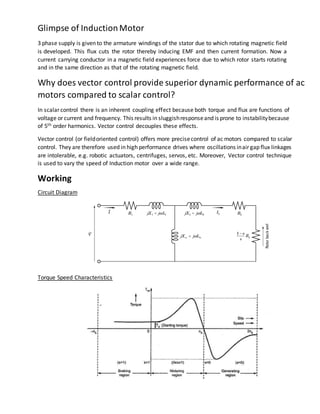
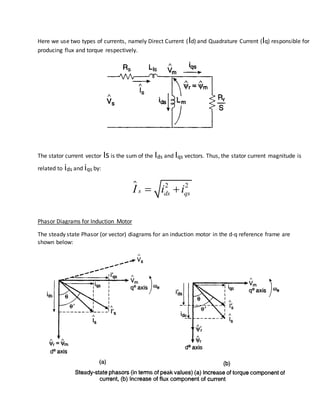
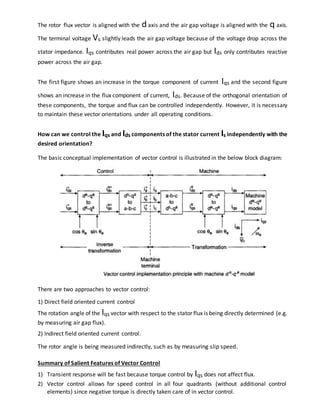

Vector control of AC induction motors provides superior dynamic performance compared to scalar control by decoupling torque and flux control. Vector control represents the stator currents as direct and quadrature components (Ids and Iqs) that independently control flux and torque. This allows precise and independent control of torque and flux to eliminate oscillations for applications requiring high performance like robotics. Vector control implementations determine the orientation of Ids and Iqs either directly by measuring airgap flux or indirectly by measuring slip speed to achieve independent control of the current components.


