DEPARTMENTAL PRESENTATION
PARUL INSTITUTE OF AYURVEDA
PRESENTED BY-
DR. SUJIT KUMAR
1ST YEAR PG SCHOLAR
GUIDED BY –
DR.VAIDEHI V. RAOLE (HOD AND PROF.)
DR.SUNIL NIKHATE (ASSO. PROF.)
DR.DEEPIKA CHOUDHARI (ASSIST. PROF.)
DR.NARENDRA YADNIK (ASSIST. PROF.)
MAJJA DHATU
DEPARTMENT OF KRIYA SHARIRA
CONTENTS
 INTRODUCTION
 DEFINITON OF MAJJA DHATU
 SYNONYMS OF MAJJA DHTU
 LOCATION OF MAJJA DHATU
 PHYSIOLOGICAL IMPORTANCE OF MAJJA DHATU IN
THE CAVITY OF BONES
 RELATION OF ASTHI AND MAJJA WITH NERVOUS
TISSUE AND MARROW
 MAJJADHARA KALA
 CLINICAL AND PATHOLOGICAL SIMILARITY BETWEEN
PITTADHARA AND MAJJADHARA KALA
 FUNCTIONS OF MAJJA DHATU
 DISORDERS OF MAJJA DHATU
INTRODUCTION
 The Sixth dhatu nourish after Asthi Dhatu is Majja Dhatu.
 It is embedded deep inside the Asthi, hence it is called as
Majja Dhatu.
 Majja Dhatu is located deep inside the bones or cavities
of bones , hence Majja dhatu is difficult to see or examine.
LITERARY MEANING OF MAJJA DHATU
• Literary meaning of Majja is one who is bathed in
fluid or one who is embedded in some other
constituent. Majja dhatu is embedded inside Asthi
dhatu.
DEFINITION OF MAJJA DHATU
Eú®ÉäÊiÉiÉjɺÉÉèʹɪÉǨɺlÉïÉÆ¨ÉvªÉä ºÉ¨ÉÒ®hÉ:
**31**
¨ÉänüºÉºiÉÉÊxÉ{ÉÚªÉÇxiÉä×Éä½ýÉä ¨ÉWÉÉiÉiÉ:º¨ÉÞiÉ:*
(C.CHI.15/31)
 During formation of Asthi dhatu, Vata creates spaces in the
bones.
 These spaces are filled with nourishing tissues of Medas or
fat which is known as Majja. The final essence of the Asthi
dhatu which is a Semisolid Substance becomes Majja in the
Process of Metabolism.
 The unctuous Material is found inside bone is called as
Majja.
SYNONYMS OF MAJJA DHATU
Asthi-Sneha – Majja is the unctuous, fatty tissues
located inside Asthi, hence it is called as Asthi
Sneha.
Asthi – Sambhava – Majja dhatu is formed after
Asthi dhatu, hence it is called as Asthi – Sambhava.
ShukraSara – Shukra Dhatu is formed after Majja
dhatu , hence ShukraSara is a Synonyms of Majja
dhatu.
Vimajjan – Majja dhatu is hidden inside Asthi
dhatu , hence Vimajjan is the Synonym of Majja
dhatu.
LOCATION OF MAJJA DHATU
 Majja dhatu is found at following site-
1. Inside the Cavities of all bones.
2. MajjaVaha Srotas.
3. MajjaDhara Kala.
MAJJA VAHA SROTAS
1.Roots of Majjavaha Srotas are as –
¨ÉWɴɽýÉxÉÉÆ »ÉÉäiɺÉɨɺlÉÒÊxɨÉÚ™Æü
ºÉxvɪÉõÉ* (C. VI. 5/8)1.Asthi (Bones) and Sandhi (Joints) are
roots of Majjavaha Srotas.
PHYSIOLOGICAL IMPORTANCE OF MAJJA
DHATU IN THE CAVITY OF BONES
 Samanya – Vishesha Siddhanta can be applied to
understand Organisation of Majja Dhatu inside Cavity of
Bones.
1) Soft Majja dhatu is Organised inside hard Asthi dhatu.
2) Hard and tough bones protects Majja dhatu.
3) Soft and unctuous (snigdha) Majja dhatu balances dryness
of Asthi dhatu and Strengthens the bones.
4) Soft and unctuous Majja dhatu fills the Cavity of bones and
regulates Akasha and Vayu Mahabhuta of Asthi dhatu.
5) Soft Majja dhatu Strengthens the bones and it also makes
bones flexible.
CONTI....
 Considering this Physiology interdependence of Asthi
and Majja dhatu , it can be said that Bones (Asthi ) are
Physiological root of Majja Dhatu.
SANDHI – ROOT OF MAJJAVAHA SROTAS
 In Ayurveda, Sandhi or joint is a broad concept
which is described below-
1) Two or more Asthi join together to form Sandhi
(Joint).
2) Conjugation of Mamsapeshi, Snayu and Sira
is also called as Sandhi.
RELATION OF ASTHI AND MAJJA WITH
NERVOUS TISSUE AND MARROW
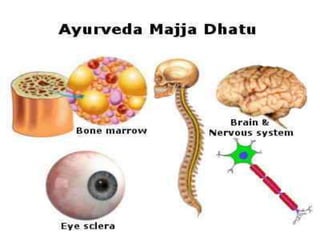
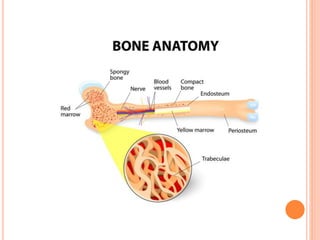
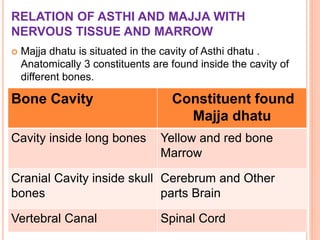
 Majja dhatu is situated in the cavity of Asthi dhatu .
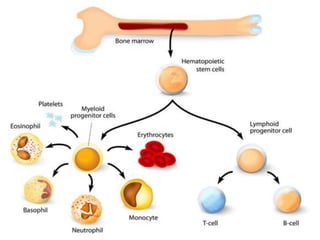
Anatomically 3 constituents are found inside the cavity of
different bones.
Bone Cavity Constituent found
Majja dhatu
Cavity inside long bones Yellow and red bone
Marrow
Cranial Cavity inside skull
bones
Cerebrum and Other
parts Brain
Vertebral Canal Spinal Cord
CONTI....
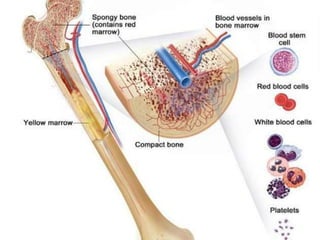
 Yellow and Red bone Marrow inside Marrow
Cavity of long bones should be learned as Majja
dhatu.
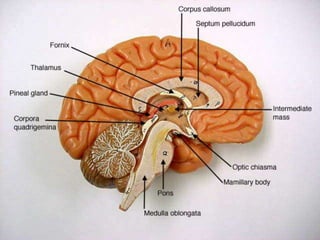
 Cerebrum and Other parts of Brain Located inside
Cranial Cavity Should be learned as Majja dhatu.
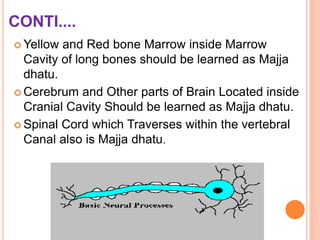
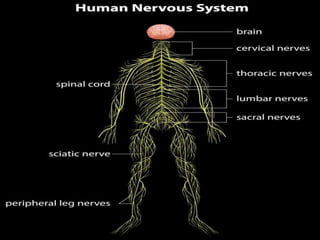
 Spinal Cord which Traverses within the vertebral
Canal also is Majja dhatu.
CEREBRUM (MASTISHKA) AND MAJJA
DHATU
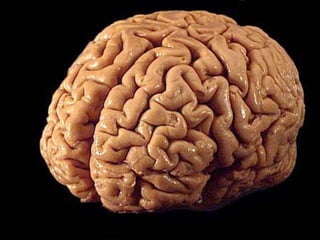
 Unctuous Medo dhatu perfuses inside the cranial cavity and
become Majja dhatu , which is called as Mastulunga or
Mastishka.
CRANIAL CAVITY
1. Cranial cavity is formed of eight skull bones. Skull bones
are joined (Sandhi) together inside which cranial cavity is
formed.
2. Body constituent located inside any bony structure is Majja
dhatu .
3. Practically , Brain is present inside the bones (Asthi)
of cranial cavity hence by applying logic, it Can be said
that brain which is a Nervous tissue is Majja dhatu.
VERTEBRAL COLUMN, MAJJA DHATU AND
SPINAL CORD
1. Thirty- two small vertebral bones (Asthi) join
together (Sandhi) to form vertebral column.
2. Spinal Cord is Protected inside vertebral Canal.
3. As Majja dhatu resides in Asthi, So Spinal Cord
should be a part of Majja dhatu.
4. Thirty- three Vertebrae (Asthi) and Inter- Vertebral
joints (Sandhi ) are Moolasthana of Majja dhatu,
hence spinal Cord is the most important part of
Majja dhatu.
CLINICAL SIGNIFICANCE OF VERTEBRAL
COLUMN (ASTHI) AND SPINAL CORD
(MAJJA DHATU)
Trauma or Accidents of Vertebral column can
damage Spinal Column (Majja) within it which
may result in paralysis of Skeletal Muscles as
well as loss of sensation.
Degeneration changes in inter- vertebral
foramina compress Spinal Cord nerve roots
which Produce Symptoms like numbness,
Pain and Weakness.
IMPORTANCE OF VERTEBRAL COLUMN
 Vertebral Column consists of 33 Vertebrae and
many joints. It encloses Majja dhatu in the form of
Spinal Column.
 Vertebral Column is the most important root of
Majja Dhatu.
MAJJADHARA KALA – SITE OF MAJJA
DHATU
Eú™üÉ:Jɱ´ÉÊ{ÉºÉ”É ¦É´ÉÎxiÉ
vÉÉi´ÉɶɪÉÉxiÉ®¨ÉªÉÉÇnüÉ:**5** (S.SHA.4/5)1.Kala is a membranous structure which forms
marginal boundaries inside the cavities of organs.
CONTI.....
 Kala can be compared with external membranous
Sheaths or Secretory and Epithelial Membranes.
FEATURES OF MAJJADHARA KALA
1.Majjadhara kala is not independently described.
According to Acharya Sushruta Majjadhara Kala is
same as Pittadhara kala.
2.Acharya Sushruta has described embryological
development of kala.
3.Acharya Sushruta has explained Kala while
stating symptoms of Snake – poisoning in human
Beings.
CONTI.....
 According to Sushruta, Snake poisoning gradually
spreads in the body by destroying every Kala.
 While describing course of Snake – poisoning,
Majjadhara kala is mentioned in Sushruta
Samhita.
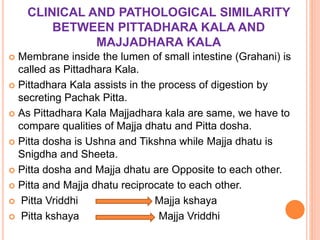
CLINICAL AND PATHOLOGICAL SIMILARITY
BETWEEN PITTADHARA KALA AND
MAJJADHARA KALA
 Membrane inside the lumen of small intestine (Grahani) is
called as Pittadhara Kala.
 Pittadhara Kala assists in the process of digestion by
secreting Pachak Pitta.
 As Pittadhara Kala Majjadhara kala are same, we have to
compare qualities of Majja dhatu and Pitta dosha.
 Pitta dosha is Ushna and Tikshna while Majja dhatu is
Snigdha and Sheeta.
 Pitta dosha and Majja dhatu are Opposite to each other.
 Pitta and Majja dhatu reciprocate to each other.
 Pitta Vriddhi Majja kshaya
 Pitta kshaya Majja Vriddhi
CONTI....
 Excess heat of Pitta reduces coldness of Majja
dhatu and excess heat of Pitta dosha also reduces
water contents (Jala) of Majja Dhatu.
 Fainting or Syncope (Bhrama) is a common
symptom of Majja kshaya and Pitta Vriddhi.
 Hot and Pungent food can lead to Pitta dushti as
well as Majja dushti.
 Madhura and Tikta Aushadi is advised for Majja-
dushti and these Aushadhi also reduces Pitta –
dushti.
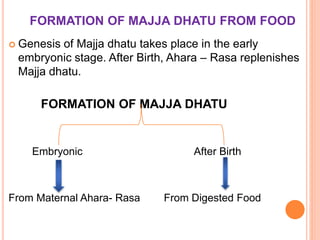
FORMATION OF MAJJA DHATU FROM FOOD
 Genesis of Majja dhatu takes place in the early
embryonic stage. After Birth, Ahara – Rasa replenishes
Majja dhatu.
FORMATION OF MAJJA DHATU
Embryonic After Birth
From Maternal Ahara- Rasa From Digested Food
FORMATION OF MAJJA DHATU
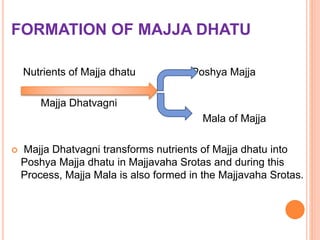
Nutrients of Majja dhatu Poshya Majja
Majja Dhatvagni
Mala of Majja
 Majja Dhatvagni transforms nutrients of Majja dhatu into
Poshya Majja dhatu in Majjavaha Srotas and during this
Process, Majja Mala is also formed in the Majjavaha Srotas.
PHYSIOLOGY OF MAJJAVAHA SROTAS
 Process of synthesis of Majja dhatu takes place in entire
body as Majja dhatu is located inside Asthi dhatu.
 We have seen that Majja is located inside long bones, in flat
bones and it is also located inside spinal cord of Vertebral
Column.
 Hence Process of synthesis of Majja dhatu takes place in
whole body.
 Sweet and Unctuous food (Madhur and Snigdha) is
homologous to Majja dhatu.
 Jatharagni transforms such type of food into nutrients of
Majja dhatu.
 Nutrients of Majja dhatu are present in Ahara – Rasa.
 After absorption of Ahara – Rasa, Nutrients of Majja dhatu
are transported in Majjavaha Srotas.
CONTI....
 In Majjavaha Srotas, Majja – Dhatvagni transforms
nutrients of Majja dhatu (Poshak Majja) into stable
(Poshya) Majja dhatu.
 Stable Majja dhatu (Poshya Majja) gets lodged
inside all bones.
 Poshya Majja dhatu carries out function.
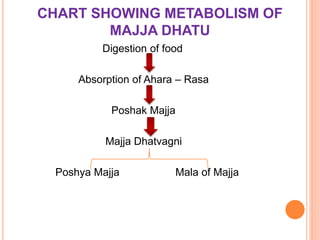
CHART SHOWING METABOLISM OF
MAJJA DHATU
Digestion of food
Absorption of Ahara – Rasa
Poshak Majja
Majja Dhatvagni
Poshya Majja Mala of Majja
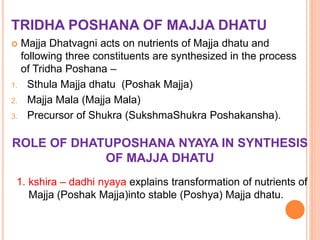
TRIDHA POSHANA OF MAJJA DHATU
 Majja Dhatvagni acts on nutrients of Majja dhatu and
following three constituents are synthesized in the process
of Tridha Poshana –
1. Sthula Majja dhatu (Poshak Majja)
2. Majja Mala (Majja Mala)
3. Precursor of Shukra (SukshmaShukra Poshakansha).
ROLE OF DHATUPOSHANA NYAYA IN SYNTHESIS
OF MAJJA DHATU
1. kshira – dadhi nyaya explains transformation of nutrients of
Majja (Poshak Majja)into stable (Poshya) Majja dhatu.
CONTI.....
2. Kedara – kulya nyaya explains transformation of Poshak
Majja from Majjavaha Srotas to Majja dhatu inside every
bone.
3. Khale – kapota nyaya explains action of Majja dhatvagni
exclusively on poshak Majja (nutrients of Majja) dhatu.
PANCHABHAUTIK CONSTITUTION OF MAJJA
DHATU
1. Ap (Jala) Mahabhuta is predominantly present in
Majja dhatu.
PROPERTIES OF MAJJA DHATU
 Majja dhatu is unctuous (Snigdha), Viscus (Picchila), soft
(Mridu) and Heavy (guru).
WASTE PRODUCTS OF MAJJA DHATU
¨ÉWÉ: ×Éä½ýÉä%ÊIÉÊ´É]Âüi´ÉSÉÉÆ*
(C.CHI.15/19)
xÉäjÉÊ´É]Âü i´ÉIÉÖSÉ×Éä½ýÉä| (S.SU.46/529)
• Sneha formed in the metabolism of Majja dhatu is called
as Mala (waste) of Majja dhatu.
• Netra Sneha- Oily secretion of eyes is called as Majja
Mala.
CONTI......
 Twaka Sneha – Oil excreted from skin is also a
waste product of majja dahtu.
 Vit Sneha – Vit means Purisha or Faeces.
 (Waste Product of Majja which gets excreted along
with Vit (faeces) is called as Vit Sneha.
UPADHATU OF MAJJA DHATU
According to Sharngadhara Samhita Kesha (Hair)
are upadhatu of Majja dhatu.
FUNCTIONS OF MAJJA DHATU
¨ÉWÉÉ×É佯ý ¤É™Æü ¶ÉÖGú{ÉÖËŸü {ÉÚ®hɨɺlÉïÉÆ
SÉ Eú®ÉäÊiÉ|(S.SU.15/5).
 Purana is the most important function of Majja dhatu.
Purana means to fill the spaces or gaps or cavities.
 Majja dhatu fills the cavities in the bones and serves the
fuction of Purana.
 While serving the function of purana, it controls Akash
and Vayu Mahabhuta present inside Asthi dhatu and thus
balances vata dosha.
 Majja dhatu lubricates Asthi dhatu and makes all bones
strong and flexible.
 Majja dhatu also strengthens musculoskeletal joints and
thus makes them strong and flexible.
 Majja dhatu enhances endurance power of all joints of
body.
ANJALI – PRAMANA OF MAJJA
BEúÉä ¨ÉWÉɪÉÉ:,¨ÉκiɹEúºªÉÉvÉÉljÉÊ™ü:
|(C.SHA.7/15)
 Anjali – Pramana of Majja dhatu is one Anjali. Mastishka
(brain) is a component of Majja dhatu.
 Anjali – Pramana of Mastishka is ½ Anjali.
FEATURES OF MAJJA DHATUSARA
¨ÉÞuüƒûɤəü´ÉxiÉ: Ê×ÉMvÉ´ÉhÉǺ´É®É:
ºlÉÚ™ünüÒPÉÇ´ÉÞkɺÉxvɪÉõɨÉWɺÉÉ®É:*
iÉä nüÒPÉÉǪÉÖ¹ÉÉä¤É™ü´ÉxiÉ: ¸ÉÖiÉÊ´ÉkÉÊ´ÉYÉÉxÉÉ{ÉiªÉ-
ºÉƨÉÉxɦÉÉVÉõɦɴÉÎxiÉ** (C.VI.8/108)
• Uttam Majja sara person has soft skin (Mridu
anga) and Strong body.
CONTI....
 Complexion (varna) of such person is unctuous,
Voice is soft (Snigdha).
 Joints of uttam Majja sara person are big, long
and rounded.
 Uttam majja sara person is endowed with
longevity, strength, intelligence, wealth.
 Uttam Majja sara person has mastery over
Science, Fine arts or on Music,etc.
 Uttam Majja sara person loves Children, gets
rewards and respect in the Society.
ASHRAYASHRAYI SAMBANDHA OF KAPHA
DOSHA WITH MAJJA DHATU
•Panchabhautik constitution of kapha dosha and
Majja dhatu are similar, hence they keep
Ashrayashrayi Sambandha with each other.
• Both Kapha and Majja dhatu have predominance of
jala Mahabhuta due to which Kapha as well as Majja
dhatu are Snigdha (unctuous), Guru(Heavy),
Slakshana(Soft) and Sthira(Stable).
•Thus Kapha – Vriddhi leads to Majja – Vriddhi and
Kapha – kshaya leads to Majja – kshaya.
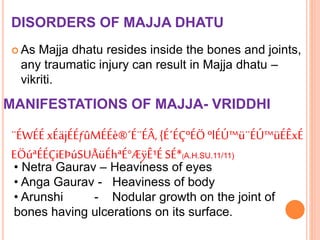
DISORDERS OF MAJJA DHATU
 As Majja dhatu resides inside the bones and joints,
any traumatic injury can result in Majja dhatu –
vikriti.
MANIFESTATIONS OF MAJJA- VRIDDHI
¨ÉWÉÉ xÉäjÉɃûMÉÉ讴ɨÉÂ,{É´ÉǺÉÖºlÉÚ™ü¨ÉÚ™üÉÊxÉ
EÖúªÉÉÇiEÞúSUÅüÉhªÉ°ÆÿʹÉSÉ*(A.H.SU.11/11)
• Netra Gaurav – Heaviness of eyes
• Anga Gaurav - Heaviness of body
• Arunshi - Nodular growth on the joint of
bones having ulcerations on its surface.
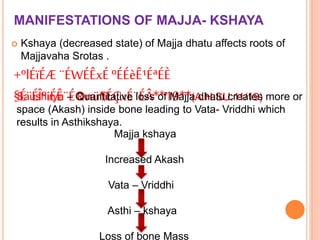
MANIFESTATIONS OF MAJJA- KSHAYA
 Kshaya (decreased state) of Majja dhatu affects roots of
Majjavaha Srotas .
+ºlÉïÉÆ ¨ÉWÉÊxɺÉÉèʹɪÉÈ
§É¨ÉκiÉʨɮnü¶ÉÇxɨÉÂ**19**(A.H.SU.11/19)Saushirya – Quantitative loss of Majja dhatu creates more or
space (Akash) inside bone leading to Vata- Vriddhi which
results in Asthikshaya.
Majja kshaya
Increased Akash
Vata – Vriddhi
Asthi – kshaya
Loss of bone Mass
CONTI.....
 Bhrama and Timira Darshana – Bhrama means fainting and
Timira Darshana meand Blackouts.
 Fainting and Blackouts are often observed in consussion
type of head injury which results in vibration of brain or
Mastishka.
INTER- RELATIONSHIP BETWEEN MAJJA
DHATU AND VATA DOSHA
•Vata dosha controls all body movements by coordinating
movements of bones, tendons and muscles.
•Majja dhatu lubricates body constituent and balances Vata
dosha while Vata dosha controls all sensory and motor
functions of the body.
Dr.Sujit Kumar MD Majja Dhatu PPT

Dr.Sujit Kumar MD Majja Dhatu PPT

  • 1.
    DEPARTMENTAL PRESENTATION PARUL INSTITUTEOF AYURVEDA PRESENTED BY- DR. SUJIT KUMAR 1ST YEAR PG SCHOLAR GUIDED BY – DR.VAIDEHI V. RAOLE (HOD AND PROF.) DR.SUNIL NIKHATE (ASSO. PROF.) DR.DEEPIKA CHOUDHARI (ASSIST. PROF.) DR.NARENDRA YADNIK (ASSIST. PROF.) MAJJA DHATU DEPARTMENT OF KRIYA SHARIRA
  • 2.
    CONTENTS  INTRODUCTION  DEFINITONOF MAJJA DHATU  SYNONYMS OF MAJJA DHTU  LOCATION OF MAJJA DHATU  PHYSIOLOGICAL IMPORTANCE OF MAJJA DHATU IN THE CAVITY OF BONES  RELATION OF ASTHI AND MAJJA WITH NERVOUS TISSUE AND MARROW  MAJJADHARA KALA  CLINICAL AND PATHOLOGICAL SIMILARITY BETWEEN PITTADHARA AND MAJJADHARA KALA  FUNCTIONS OF MAJJA DHATU  DISORDERS OF MAJJA DHATU
  • 4.
    INTRODUCTION  The Sixthdhatu nourish after Asthi Dhatu is Majja Dhatu.  It is embedded deep inside the Asthi, hence it is called as Majja Dhatu.  Majja Dhatu is located deep inside the bones or cavities of bones , hence Majja dhatu is difficult to see or examine. LITERARY MEANING OF MAJJA DHATU • Literary meaning of Majja is one who is bathed in fluid or one who is embedded in some other constituent. Majja dhatu is embedded inside Asthi dhatu.
  • 6.
    DEFINITION OF MAJJADHATU Eú®ÉäÊiÉiÉjɺÉÉèʹɪÉǨɺlÉïÉÆ¨ÉvªÉä ºÉ¨ÉÒ®hÉ: **31** ¨ÉänüºÉºiÉÉÊxÉ{ÉÚªÉÇxiÉä×Éä½ýÉä ¨ÉWÉÉiÉiÉ:º¨ÉÞiÉ:* (C.CHI.15/31)  During formation of Asthi dhatu, Vata creates spaces in the bones.  These spaces are filled with nourishing tissues of Medas or fat which is known as Majja. The final essence of the Asthi dhatu which is a Semisolid Substance becomes Majja in the Process of Metabolism.  The unctuous Material is found inside bone is called as Majja.
  • 8.
    SYNONYMS OF MAJJADHATU Asthi-Sneha – Majja is the unctuous, fatty tissues located inside Asthi, hence it is called as Asthi Sneha. Asthi – Sambhava – Majja dhatu is formed after Asthi dhatu, hence it is called as Asthi – Sambhava. ShukraSara – Shukra Dhatu is formed after Majja dhatu , hence ShukraSara is a Synonyms of Majja dhatu. Vimajjan – Majja dhatu is hidden inside Asthi dhatu , hence Vimajjan is the Synonym of Majja dhatu.
  • 9.
    LOCATION OF MAJJADHATU  Majja dhatu is found at following site- 1. Inside the Cavities of all bones. 2. MajjaVaha Srotas. 3. MajjaDhara Kala. MAJJA VAHA SROTAS 1.Roots of Majjavaha Srotas are as – ¨ÉWɴɽýÉxÉÉÆ »ÉÉäiɺÉɨɺlÉÒÊxɨÉÚ™Æü ºÉxvɪÉõÉ* (C. VI. 5/8)1.Asthi (Bones) and Sandhi (Joints) are roots of Majjavaha Srotas.
  • 11.
    PHYSIOLOGICAL IMPORTANCE OFMAJJA DHATU IN THE CAVITY OF BONES  Samanya – Vishesha Siddhanta can be applied to understand Organisation of Majja Dhatu inside Cavity of Bones. 1) Soft Majja dhatu is Organised inside hard Asthi dhatu. 2) Hard and tough bones protects Majja dhatu. 3) Soft and unctuous (snigdha) Majja dhatu balances dryness of Asthi dhatu and Strengthens the bones. 4) Soft and unctuous Majja dhatu fills the Cavity of bones and regulates Akasha and Vayu Mahabhuta of Asthi dhatu. 5) Soft Majja dhatu Strengthens the bones and it also makes bones flexible.
  • 12.
    CONTI....  Considering thisPhysiology interdependence of Asthi and Majja dhatu , it can be said that Bones (Asthi ) are Physiological root of Majja Dhatu. SANDHI – ROOT OF MAJJAVAHA SROTAS  In Ayurveda, Sandhi or joint is a broad concept which is described below- 1) Two or more Asthi join together to form Sandhi (Joint). 2) Conjugation of Mamsapeshi, Snayu and Sira is also called as Sandhi.
  • 14.
    RELATION OF ASTHIAND MAJJA WITH NERVOUS TISSUE AND MARROW  Majja dhatu is situated in the cavity of Asthi dhatu . Anatomically 3 constituents are found inside the cavity of different bones. Bone Cavity Constituent found Majja dhatu Cavity inside long bones Yellow and red bone Marrow Cranial Cavity inside skull bones Cerebrum and Other parts Brain Vertebral Canal Spinal Cord
  • 15.
    CONTI....  Yellow andRed bone Marrow inside Marrow Cavity of long bones should be learned as Majja dhatu.  Cerebrum and Other parts of Brain Located inside Cranial Cavity Should be learned as Majja dhatu.  Spinal Cord which Traverses within the vertebral Canal also is Majja dhatu.
  • 16.
    CEREBRUM (MASTISHKA) ANDMAJJA DHATU  Unctuous Medo dhatu perfuses inside the cranial cavity and become Majja dhatu , which is called as Mastulunga or Mastishka. CRANIAL CAVITY 1. Cranial cavity is formed of eight skull bones. Skull bones are joined (Sandhi) together inside which cranial cavity is formed. 2. Body constituent located inside any bony structure is Majja dhatu . 3. Practically , Brain is present inside the bones (Asthi) of cranial cavity hence by applying logic, it Can be said that brain which is a Nervous tissue is Majja dhatu.
  • 19.
    VERTEBRAL COLUMN, MAJJADHATU AND SPINAL CORD 1. Thirty- two small vertebral bones (Asthi) join together (Sandhi) to form vertebral column. 2. Spinal Cord is Protected inside vertebral Canal. 3. As Majja dhatu resides in Asthi, So Spinal Cord should be a part of Majja dhatu. 4. Thirty- three Vertebrae (Asthi) and Inter- Vertebral joints (Sandhi ) are Moolasthana of Majja dhatu, hence spinal Cord is the most important part of Majja dhatu.
  • 21.
    CLINICAL SIGNIFICANCE OFVERTEBRAL COLUMN (ASTHI) AND SPINAL CORD (MAJJA DHATU) Trauma or Accidents of Vertebral column can damage Spinal Column (Majja) within it which may result in paralysis of Skeletal Muscles as well as loss of sensation. Degeneration changes in inter- vertebral foramina compress Spinal Cord nerve roots which Produce Symptoms like numbness, Pain and Weakness.
  • 22.
    IMPORTANCE OF VERTEBRALCOLUMN  Vertebral Column consists of 33 Vertebrae and many joints. It encloses Majja dhatu in the form of Spinal Column.  Vertebral Column is the most important root of Majja Dhatu. MAJJADHARA KALA – SITE OF MAJJA DHATU Eú™üÉ:Jɱ´ÉÊ{ÉºÉ”É ¦É´ÉÎxiÉ vÉÉi´ÉɶɪÉÉxiÉ®¨ÉªÉÉÇnüÉ:**5** (S.SHA.4/5)1.Kala is a membranous structure which forms marginal boundaries inside the cavities of organs.
  • 23.
    CONTI.....  Kala canbe compared with external membranous Sheaths or Secretory and Epithelial Membranes. FEATURES OF MAJJADHARA KALA 1.Majjadhara kala is not independently described. According to Acharya Sushruta Majjadhara Kala is same as Pittadhara kala. 2.Acharya Sushruta has described embryological development of kala. 3.Acharya Sushruta has explained Kala while stating symptoms of Snake – poisoning in human Beings.
  • 24.
    CONTI.....  According toSushruta, Snake poisoning gradually spreads in the body by destroying every Kala.  While describing course of Snake – poisoning, Majjadhara kala is mentioned in Sushruta Samhita.
  • 25.
    CLINICAL AND PATHOLOGICALSIMILARITY BETWEEN PITTADHARA KALA AND MAJJADHARA KALA  Membrane inside the lumen of small intestine (Grahani) is called as Pittadhara Kala.  Pittadhara Kala assists in the process of digestion by secreting Pachak Pitta.  As Pittadhara Kala Majjadhara kala are same, we have to compare qualities of Majja dhatu and Pitta dosha.  Pitta dosha is Ushna and Tikshna while Majja dhatu is Snigdha and Sheeta.  Pitta dosha and Majja dhatu are Opposite to each other.  Pitta and Majja dhatu reciprocate to each other.  Pitta Vriddhi Majja kshaya  Pitta kshaya Majja Vriddhi
  • 26.
    CONTI....  Excess heatof Pitta reduces coldness of Majja dhatu and excess heat of Pitta dosha also reduces water contents (Jala) of Majja Dhatu.  Fainting or Syncope (Bhrama) is a common symptom of Majja kshaya and Pitta Vriddhi.  Hot and Pungent food can lead to Pitta dushti as well as Majja dushti.  Madhura and Tikta Aushadi is advised for Majja- dushti and these Aushadhi also reduces Pitta – dushti.
  • 27.
    FORMATION OF MAJJADHATU FROM FOOD  Genesis of Majja dhatu takes place in the early embryonic stage. After Birth, Ahara – Rasa replenishes Majja dhatu. FORMATION OF MAJJA DHATU Embryonic After Birth From Maternal Ahara- Rasa From Digested Food
  • 28.
    FORMATION OF MAJJADHATU Nutrients of Majja dhatu Poshya Majja Majja Dhatvagni Mala of Majja  Majja Dhatvagni transforms nutrients of Majja dhatu into Poshya Majja dhatu in Majjavaha Srotas and during this Process, Majja Mala is also formed in the Majjavaha Srotas.
  • 29.
    PHYSIOLOGY OF MAJJAVAHASROTAS  Process of synthesis of Majja dhatu takes place in entire body as Majja dhatu is located inside Asthi dhatu.  We have seen that Majja is located inside long bones, in flat bones and it is also located inside spinal cord of Vertebral Column.  Hence Process of synthesis of Majja dhatu takes place in whole body.  Sweet and Unctuous food (Madhur and Snigdha) is homologous to Majja dhatu.  Jatharagni transforms such type of food into nutrients of Majja dhatu.  Nutrients of Majja dhatu are present in Ahara – Rasa.  After absorption of Ahara – Rasa, Nutrients of Majja dhatu are transported in Majjavaha Srotas.
  • 30.
    CONTI....  In MajjavahaSrotas, Majja – Dhatvagni transforms nutrients of Majja dhatu (Poshak Majja) into stable (Poshya) Majja dhatu.  Stable Majja dhatu (Poshya Majja) gets lodged inside all bones.  Poshya Majja dhatu carries out function.
  • 31.
    CHART SHOWING METABOLISMOF MAJJA DHATU Digestion of food Absorption of Ahara – Rasa Poshak Majja Majja Dhatvagni Poshya Majja Mala of Majja
  • 32.
    TRIDHA POSHANA OFMAJJA DHATU  Majja Dhatvagni acts on nutrients of Majja dhatu and following three constituents are synthesized in the process of Tridha Poshana – 1. Sthula Majja dhatu (Poshak Majja) 2. Majja Mala (Majja Mala) 3. Precursor of Shukra (SukshmaShukra Poshakansha). ROLE OF DHATUPOSHANA NYAYA IN SYNTHESIS OF MAJJA DHATU 1. kshira – dadhi nyaya explains transformation of nutrients of Majja (Poshak Majja)into stable (Poshya) Majja dhatu.
  • 33.
    CONTI..... 2. Kedara –kulya nyaya explains transformation of Poshak Majja from Majjavaha Srotas to Majja dhatu inside every bone. 3. Khale – kapota nyaya explains action of Majja dhatvagni exclusively on poshak Majja (nutrients of Majja) dhatu. PANCHABHAUTIK CONSTITUTION OF MAJJA DHATU 1. Ap (Jala) Mahabhuta is predominantly present in Majja dhatu.
  • 34.
    PROPERTIES OF MAJJADHATU  Majja dhatu is unctuous (Snigdha), Viscus (Picchila), soft (Mridu) and Heavy (guru). WASTE PRODUCTS OF MAJJA DHATU ¨ÉWÉ: ×Éä½ýÉä%ÊIÉÊ´É]Âüi´ÉSÉÉÆ* (C.CHI.15/19) xÉäjÉÊ´É]Âü i´ÉIÉÖSÉ×Éä½ýÉä| (S.SU.46/529) • Sneha formed in the metabolism of Majja dhatu is called as Mala (waste) of Majja dhatu. • Netra Sneha- Oily secretion of eyes is called as Majja Mala.
  • 35.
    CONTI......  Twaka Sneha– Oil excreted from skin is also a waste product of majja dahtu.  Vit Sneha – Vit means Purisha or Faeces.  (Waste Product of Majja which gets excreted along with Vit (faeces) is called as Vit Sneha. UPADHATU OF MAJJA DHATU According to Sharngadhara Samhita Kesha (Hair) are upadhatu of Majja dhatu.
  • 36.
    FUNCTIONS OF MAJJADHATU ¨ÉWÉÉ×É佯ý ¤É™Æü ¶ÉÖGú{ÉÖËŸü {ÉÚ®hɨɺlÉïÉÆ SÉ Eú®ÉäÊiÉ|(S.SU.15/5).  Purana is the most important function of Majja dhatu. Purana means to fill the spaces or gaps or cavities.  Majja dhatu fills the cavities in the bones and serves the fuction of Purana.  While serving the function of purana, it controls Akash and Vayu Mahabhuta present inside Asthi dhatu and thus balances vata dosha.  Majja dhatu lubricates Asthi dhatu and makes all bones strong and flexible.  Majja dhatu also strengthens musculoskeletal joints and thus makes them strong and flexible.  Majja dhatu enhances endurance power of all joints of body.
  • 37.
    ANJALI – PRAMANAOF MAJJA BEúÉä ¨ÉWÉɪÉÉ:,¨ÉκiɹEúºªÉÉvÉÉljÉÊ™ü: |(C.SHA.7/15)  Anjali – Pramana of Majja dhatu is one Anjali. Mastishka (brain) is a component of Majja dhatu.  Anjali – Pramana of Mastishka is ½ Anjali. FEATURES OF MAJJA DHATUSARA ¨ÉÞuüƒûɤəü´ÉxiÉ: Ê×ÉMvÉ´ÉhÉǺ´É®É: ºlÉÚ™ünüÒPÉÇ´ÉÞkɺÉxvɪÉõɨÉWɺÉÉ®É:* iÉä nüÒPÉÉǪÉÖ¹ÉÉä¤É™ü´ÉxiÉ: ¸ÉÖiÉÊ´ÉkÉÊ´ÉYÉÉxÉÉ{ÉiªÉ- ºÉƨÉÉxɦÉÉVÉõɦɴÉÎxiÉ** (C.VI.8/108) • Uttam Majja sara person has soft skin (Mridu anga) and Strong body.
  • 38.
    CONTI....  Complexion (varna)of such person is unctuous, Voice is soft (Snigdha).  Joints of uttam Majja sara person are big, long and rounded.  Uttam majja sara person is endowed with longevity, strength, intelligence, wealth.  Uttam Majja sara person has mastery over Science, Fine arts or on Music,etc.  Uttam Majja sara person loves Children, gets rewards and respect in the Society.
  • 39.
    ASHRAYASHRAYI SAMBANDHA OFKAPHA DOSHA WITH MAJJA DHATU •Panchabhautik constitution of kapha dosha and Majja dhatu are similar, hence they keep Ashrayashrayi Sambandha with each other. • Both Kapha and Majja dhatu have predominance of jala Mahabhuta due to which Kapha as well as Majja dhatu are Snigdha (unctuous), Guru(Heavy), Slakshana(Soft) and Sthira(Stable). •Thus Kapha – Vriddhi leads to Majja – Vriddhi and Kapha – kshaya leads to Majja – kshaya.
  • 40.
    DISORDERS OF MAJJADHATU  As Majja dhatu resides inside the bones and joints, any traumatic injury can result in Majja dhatu – vikriti. MANIFESTATIONS OF MAJJA- VRIDDHI ¨ÉWÉÉ xÉäjÉɃûMÉÉ讴ɨÉÂ,{É´ÉǺÉÖºlÉÚ™ü¨ÉÚ™üÉÊxÉ EÖúªÉÉÇiEÞúSUÅüÉhªÉ°ÆÿʹÉSÉ*(A.H.SU.11/11) • Netra Gaurav – Heaviness of eyes • Anga Gaurav - Heaviness of body • Arunshi - Nodular growth on the joint of bones having ulcerations on its surface.
  • 41.
    MANIFESTATIONS OF MAJJA-KSHAYA  Kshaya (decreased state) of Majja dhatu affects roots of Majjavaha Srotas . +ºlÉïÉÆ ¨ÉWÉÊxɺÉÉèʹɪÉÈ §É¨ÉκiÉʨɮnü¶ÉÇxɨÉÂ**19**(A.H.SU.11/19)Saushirya – Quantitative loss of Majja dhatu creates more or space (Akash) inside bone leading to Vata- Vriddhi which results in Asthikshaya. Majja kshaya Increased Akash Vata – Vriddhi Asthi – kshaya Loss of bone Mass
  • 42.
    CONTI.....  Bhrama andTimira Darshana – Bhrama means fainting and Timira Darshana meand Blackouts.  Fainting and Blackouts are often observed in consussion type of head injury which results in vibration of brain or Mastishka. INTER- RELATIONSHIP BETWEEN MAJJA DHATU AND VATA DOSHA •Vata dosha controls all body movements by coordinating movements of bones, tendons and muscles. •Majja dhatu lubricates body constituent and balances Vata dosha while Vata dosha controls all sensory and motor functions of the body.