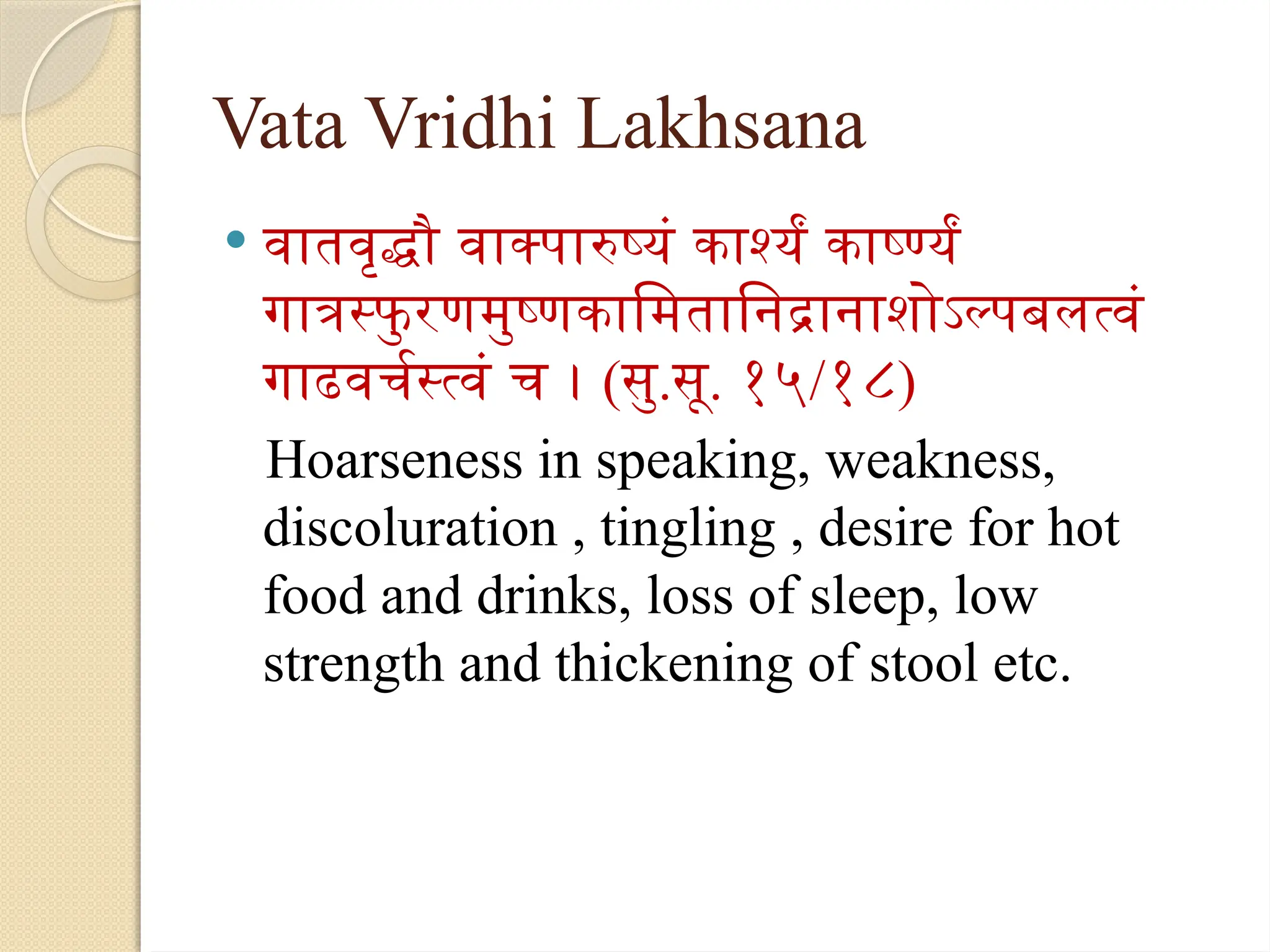
Concept of VATA Dosha
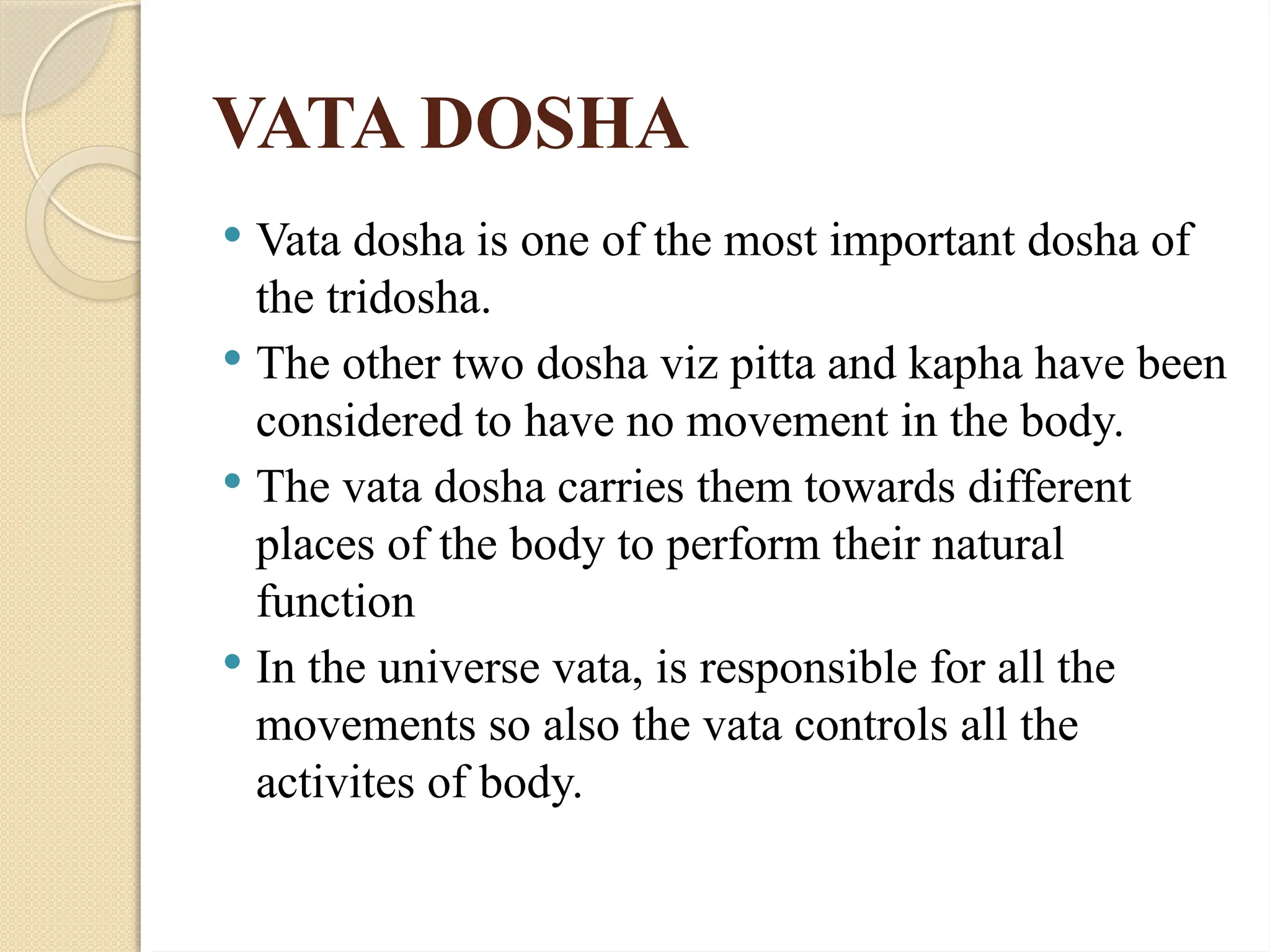
VATA DOSHA
 Vata dosha is one of the most important dosha of
the tridosha.
 The other two dosha viz pitta and kapha have been
considered to have no movement in the body.
 The vata dosha carries them towards different
places of the body to perform their natural
function
 In the universe vata, is responsible for all the
movements so also the vata controls all the
activites of body.
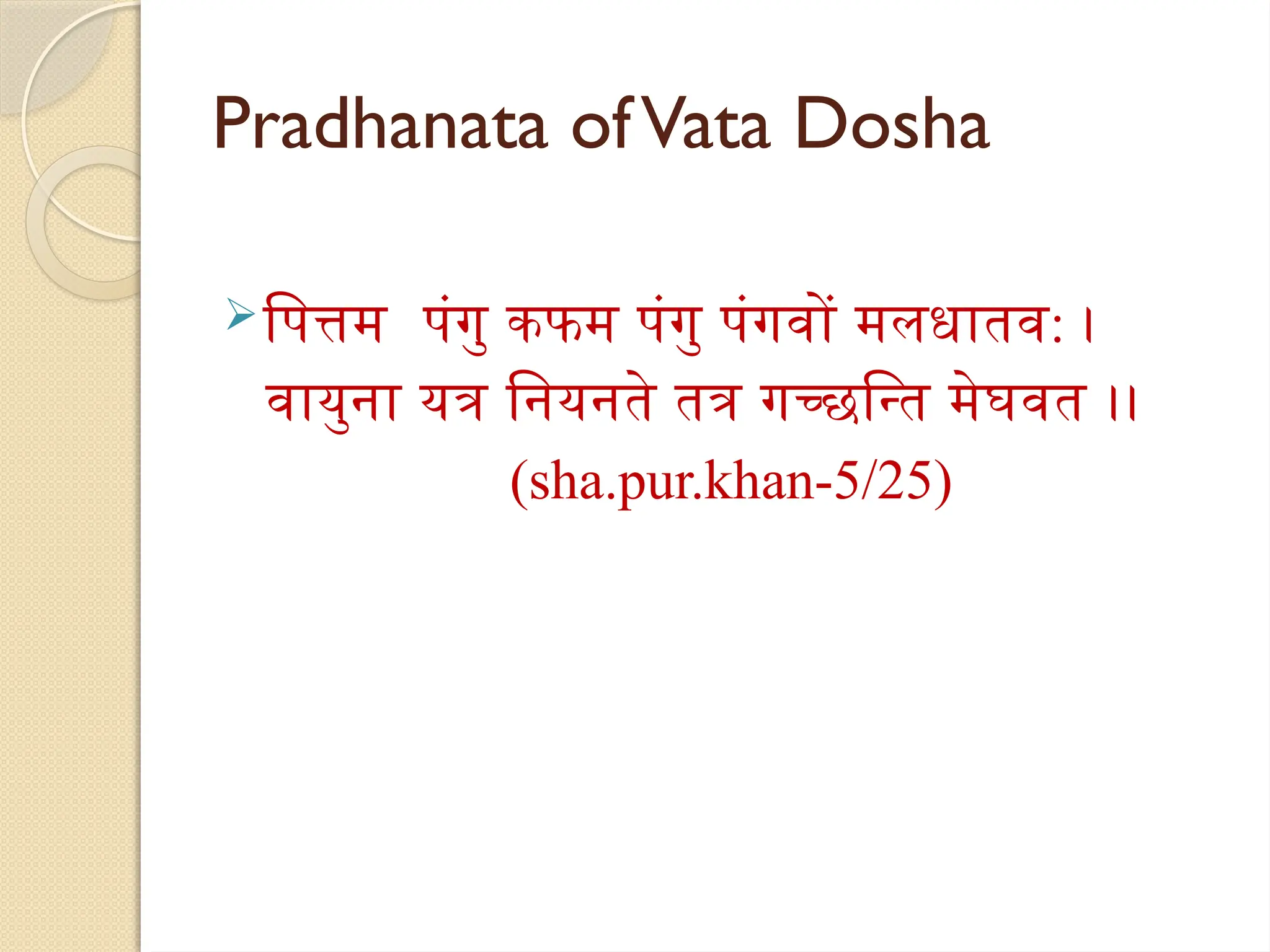
Pradhanata ofVata Dosha
पित्तम पंगु कफम पंगु पंगवों मलधातव: ।
वायुना यत्र नियनते तत्र गच्छन्ति मेघवत ।।
(sha.pur.khan-5/25)
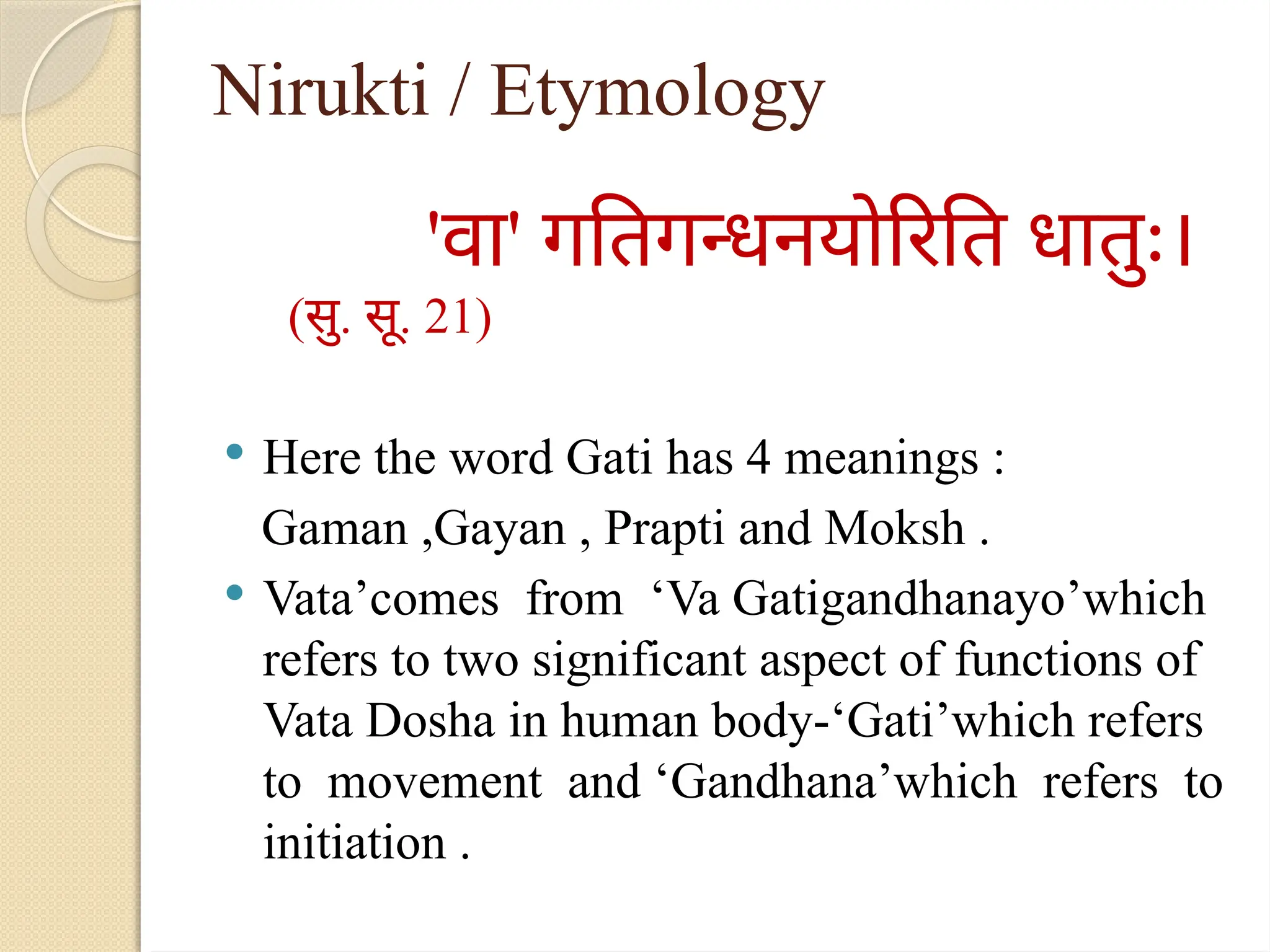
Nirukti / Etymology
'वा' गतिगन्धनयोरिति धातुः।
(सु. सू. 21)
 Here the word Gati has 4 meanings :
Gaman ,Gayan , Prapti and Moksh .
 Vata’comes from ‘Va Gatigandhanayo’which
refers to two significant aspect of functions of
Vata Dosha in human body-‘Gati’which refers
to movement and ‘Gandhana’which refers to
initiation .
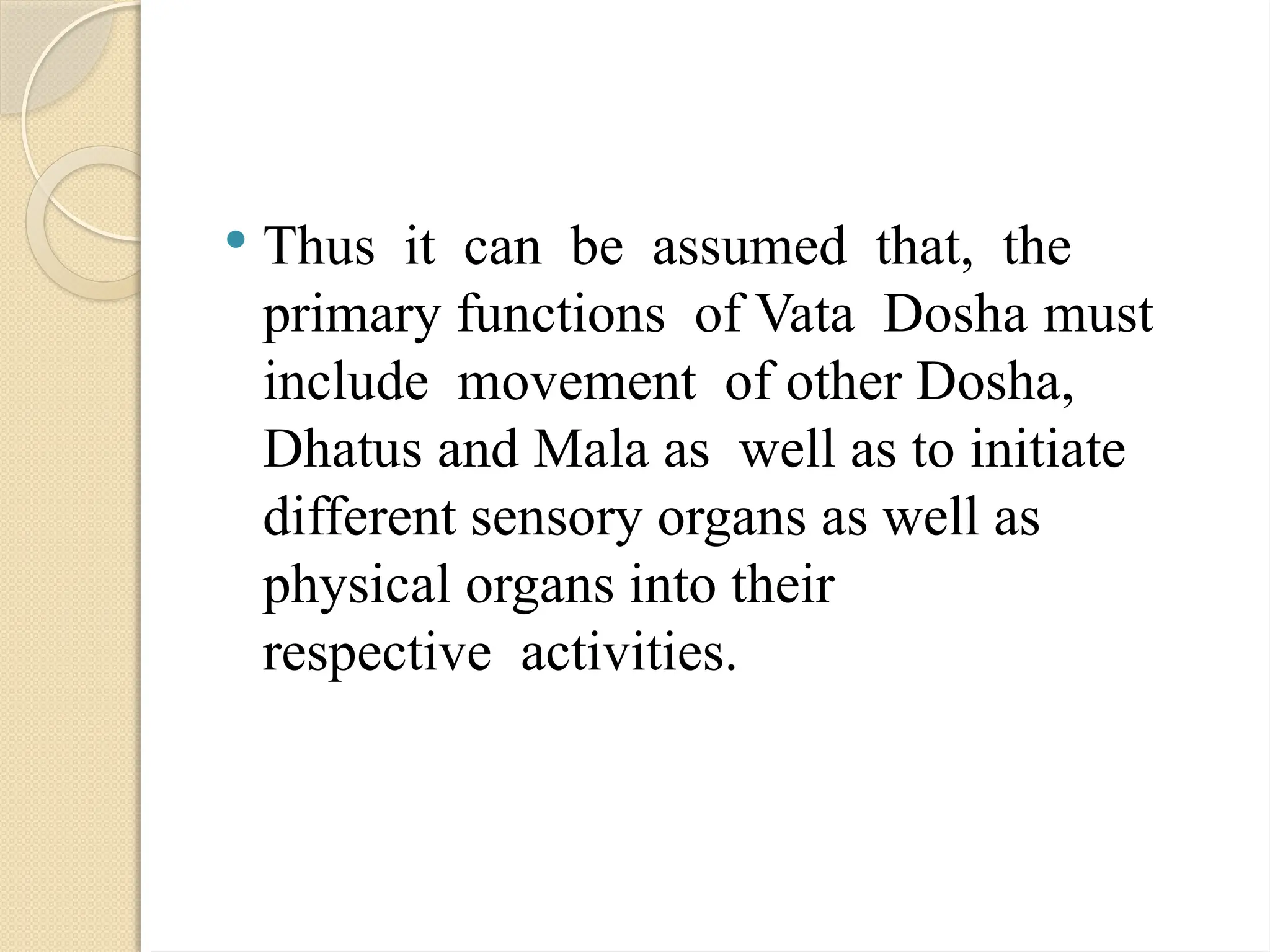
 Thus it can be assumed that, the
primary functions of Vata Dosha must
include movement of other Dosha,
Dhatus and Mala as well as to initiate
different sensory organs as well as
physical organs into their
respective activities.
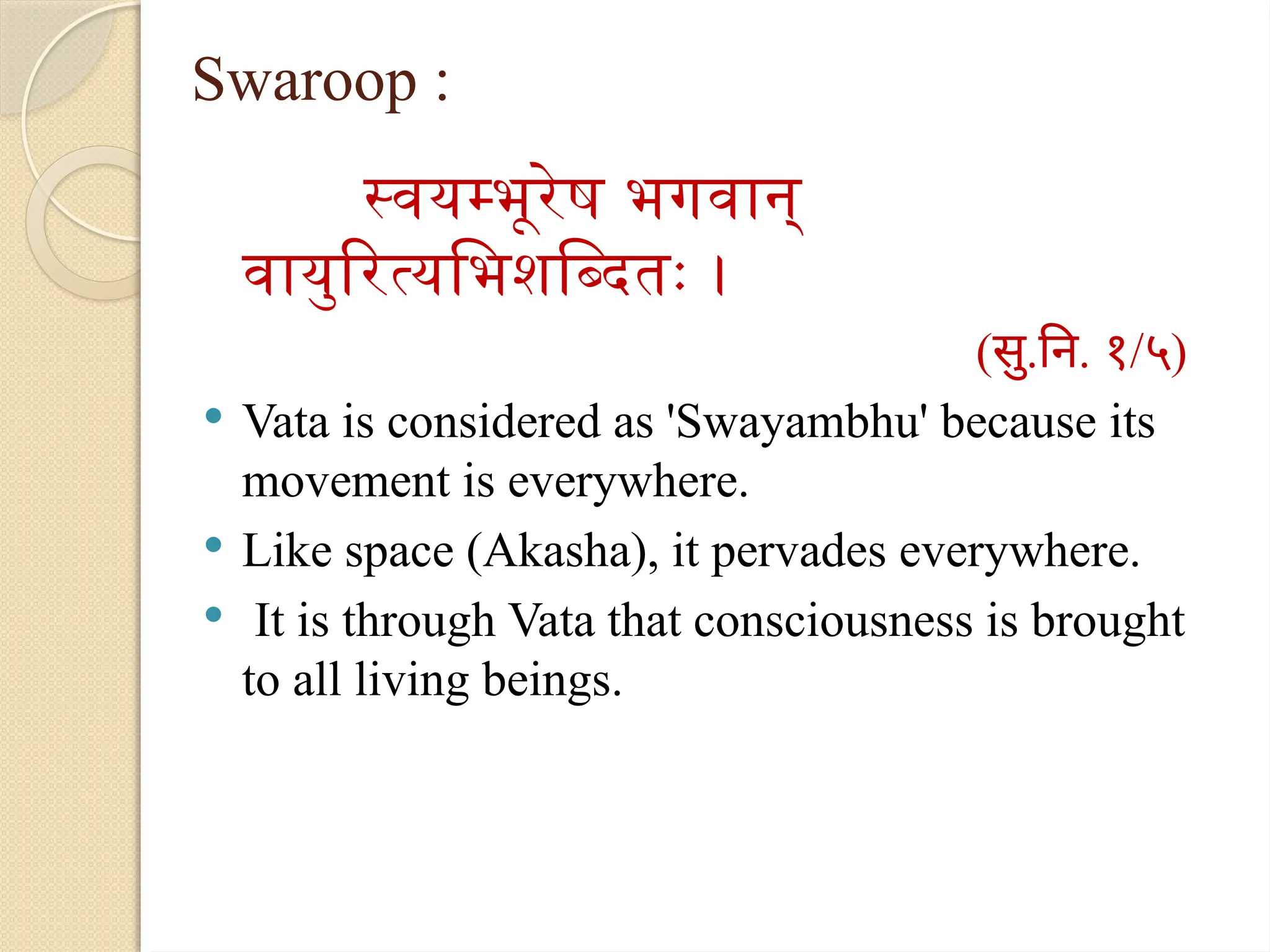
Swaroop :
स्वयम्भूरेष भगवान्
वायुरित्यभिशब्दितः ।
(सु.नि. १/५)
 Vata is considered as 'Swayambhu' because its
movement is everywhere.
 Like space (Akasha), it pervades everywhere.
 It is through Vata that consciousness is brought
to all living beings.
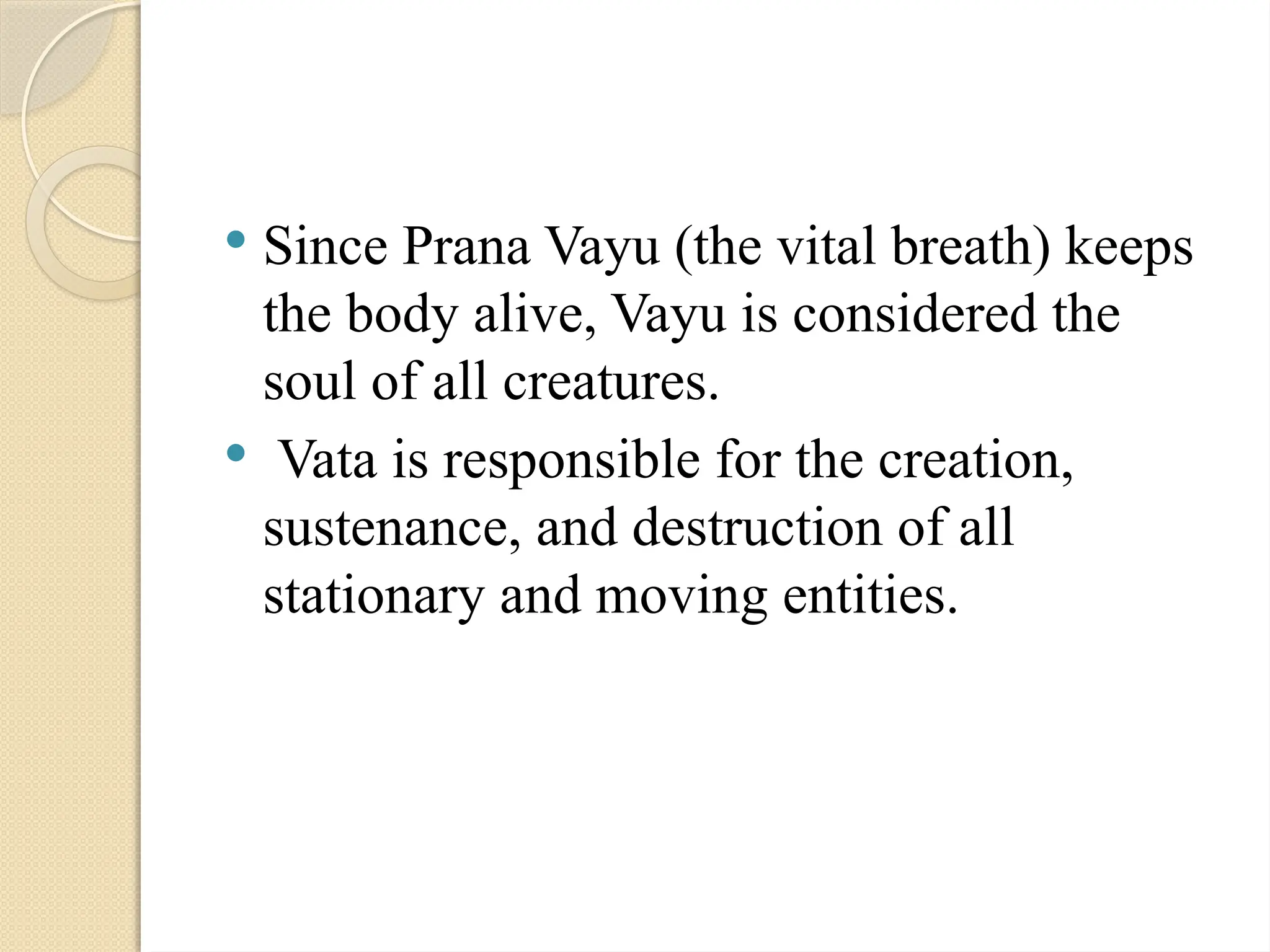
 Since Prana Vayu (the vital breath) keeps
the body alive, Vayu is considered the
soul of all creatures.
 Vata is responsible for the creation,
sustenance, and destruction of all
stationary and moving entities.
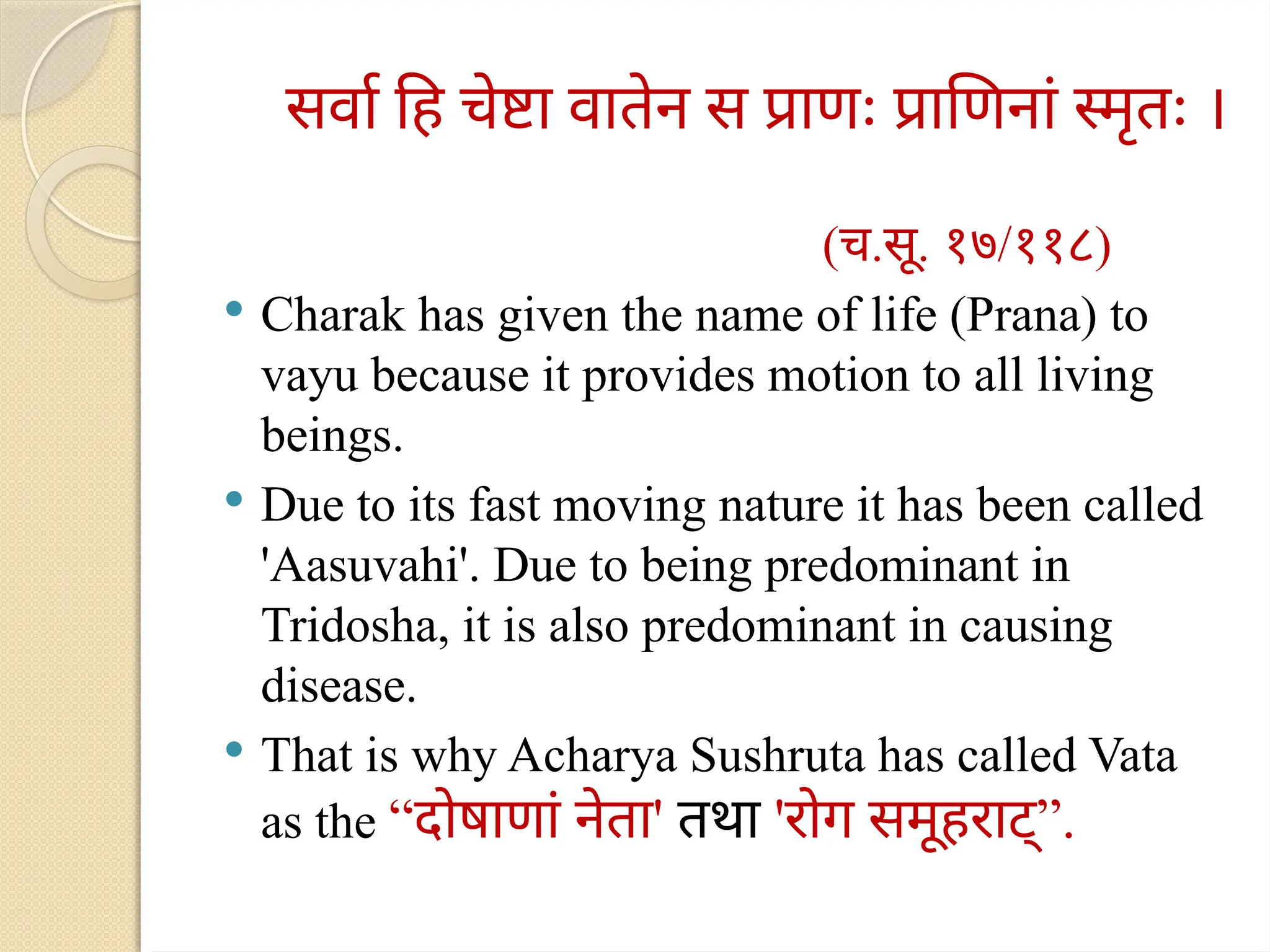
सर्वा हि चेष्टा वातेन स प्राणः प्राणिनां स्मृतः ।
(च.सू. १७/११८)
 Charak has given the name of life (Prana) to
vayu because it provides motion to all living
beings.
 Due to its fast moving nature it has been called
'Aasuvahi'. Due to being predominant in
Tridosha, it is also predominant in causing
disease.
 That is why Acharya Sushruta has called Vata
as the “दोषाणां नेता' तथा ' ”
रोग समूहराट् .
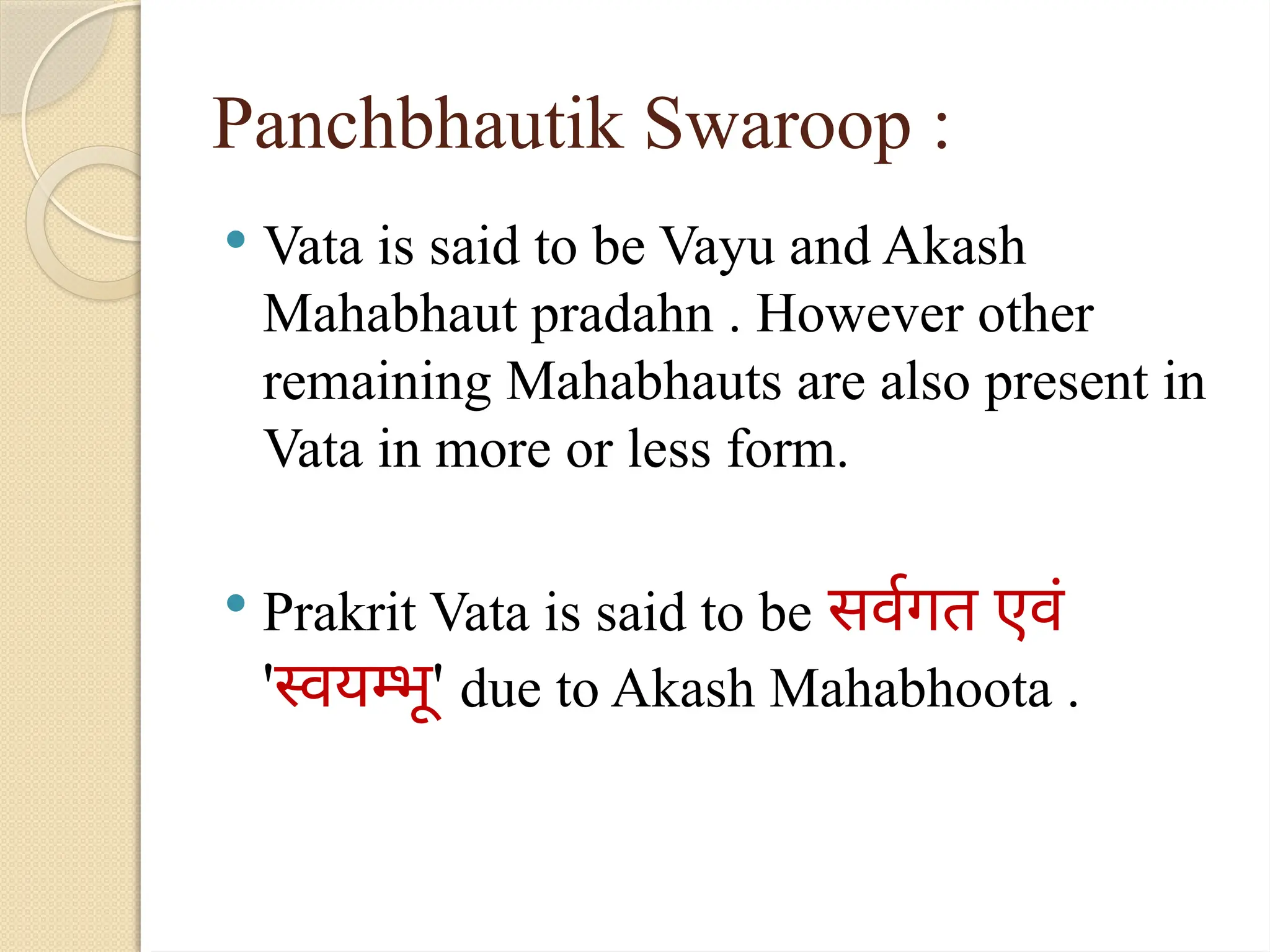
Panchbhautik Swaroop :
 Vata is said to be Vayu and Akash
Mahabhaut pradahn . However other
remaining Mahabhauts are also present in
Vata in more or less form.
 Prakrit Vata is said to be सर्वगत एवं
'स्वयम्भू' due to Akash Mahabhoota .
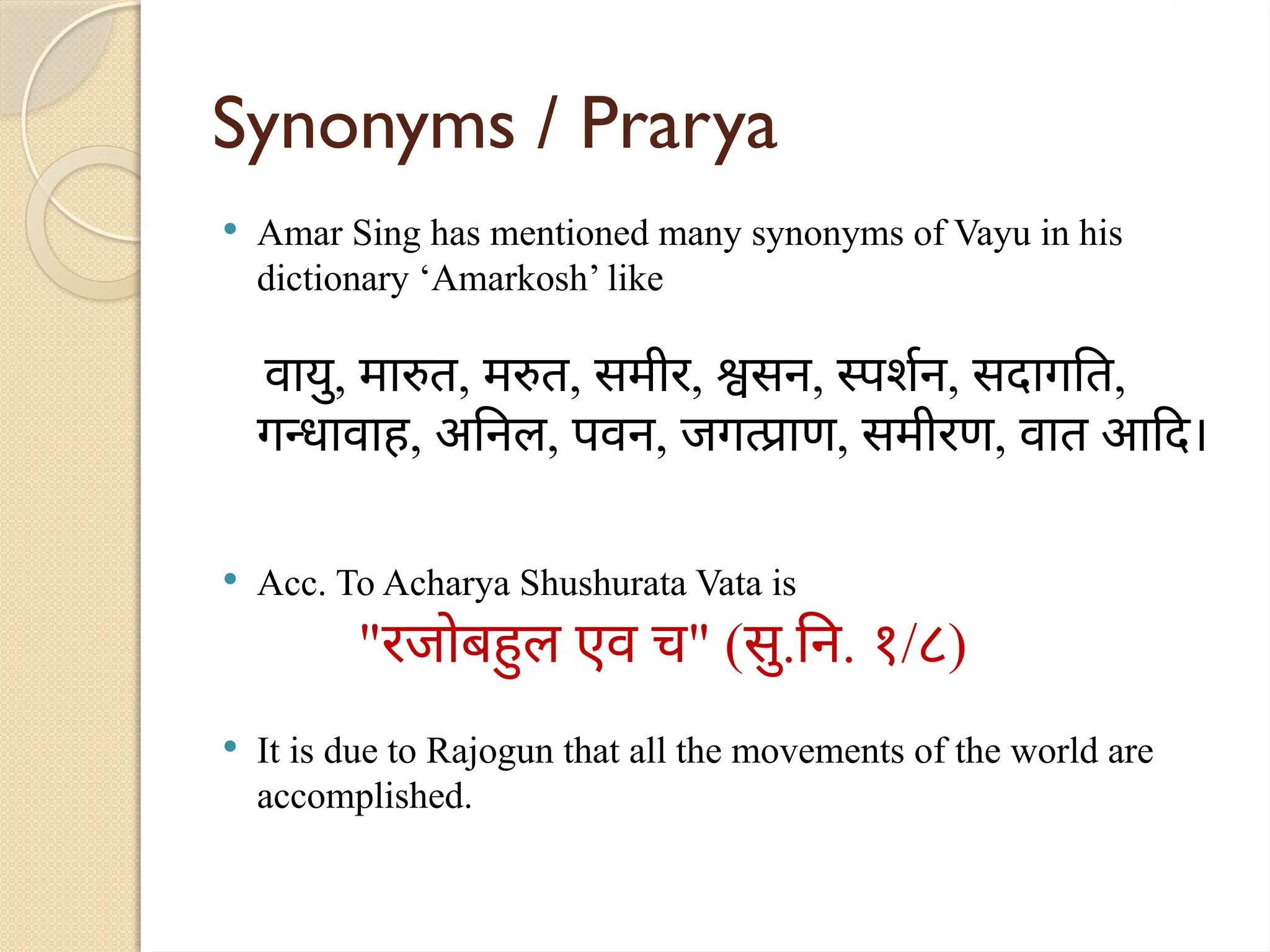
Synonyms / Prarya
 Amar Sing has mentioned many synonyms of Vayu in his
dictionary ‘Amarkosh’ like
वायु, मारुत, मरुत, समीर, श्वसन, स्पर्शन, सदागति,
गन्धावाह, अनिल, पवन, जगत्प्राण, समीरण, वात आदि।
 Acc. To Acharya Shushurata Vata is
"रजोबहुल एव च" (सु.नि. १/८)
 It is due to Rajogun that all the movements of the world are
accomplished.
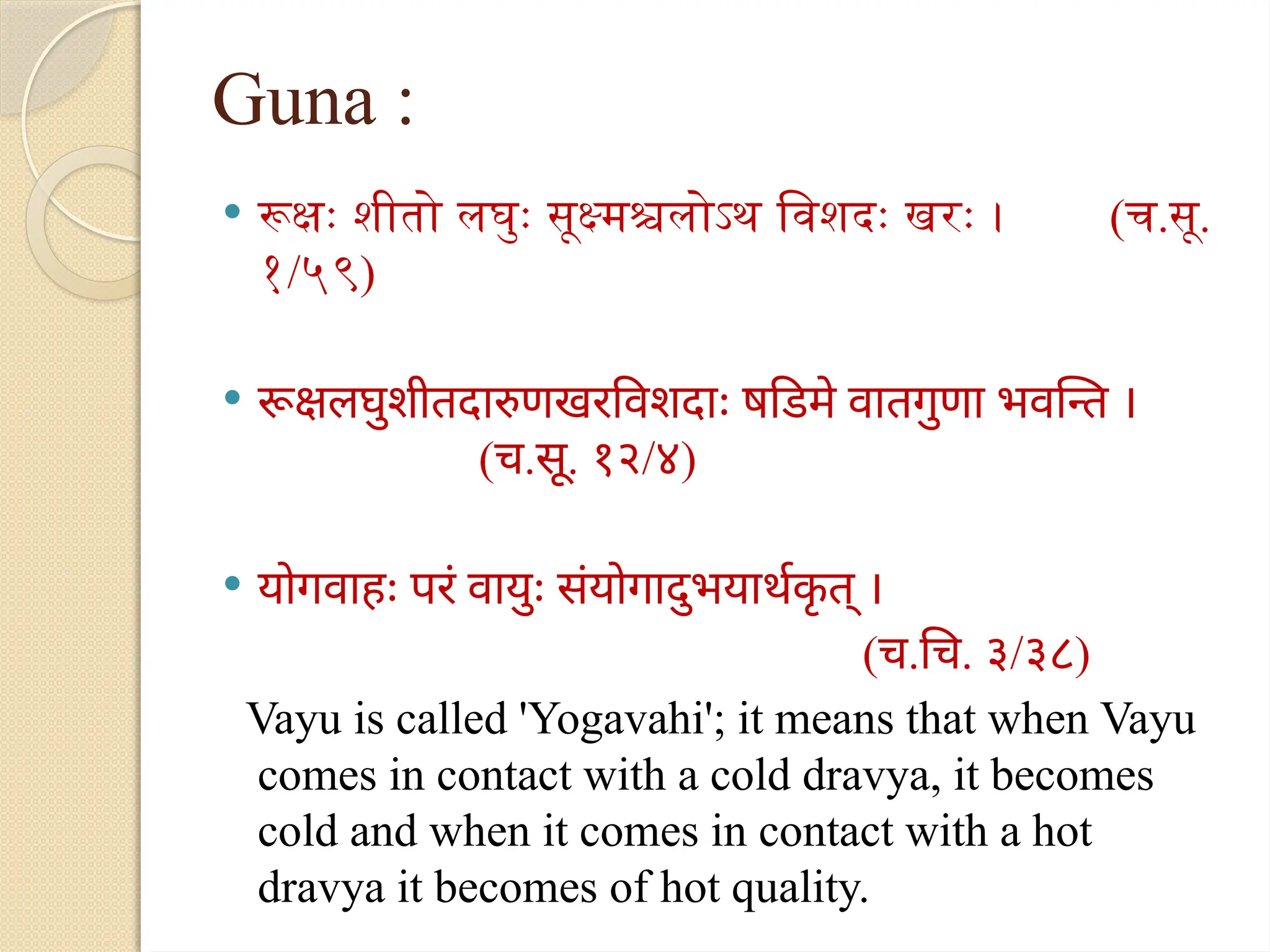
Guna :
 रूक्षः शीतो लघुः सूक्ष्मश्चलोऽथ विशदः खरः । (च.सू.
१/५९)
 रूक्षलघुशीतदारुणखरविशदाः षडिमे वातगुणा भवन्ति ।
(च.सू. १२/४)
 योगवाहः परं वायुः संयोगादुभयार्थक
ृ त् ।
(च.चि. ३/३८)
Vayu is called 'Yogavahi'; it means that when Vayu
comes in contact with a cold dravya, it becomes
cold and when it comes in contact with a hot
dravya it becomes of hot quality.
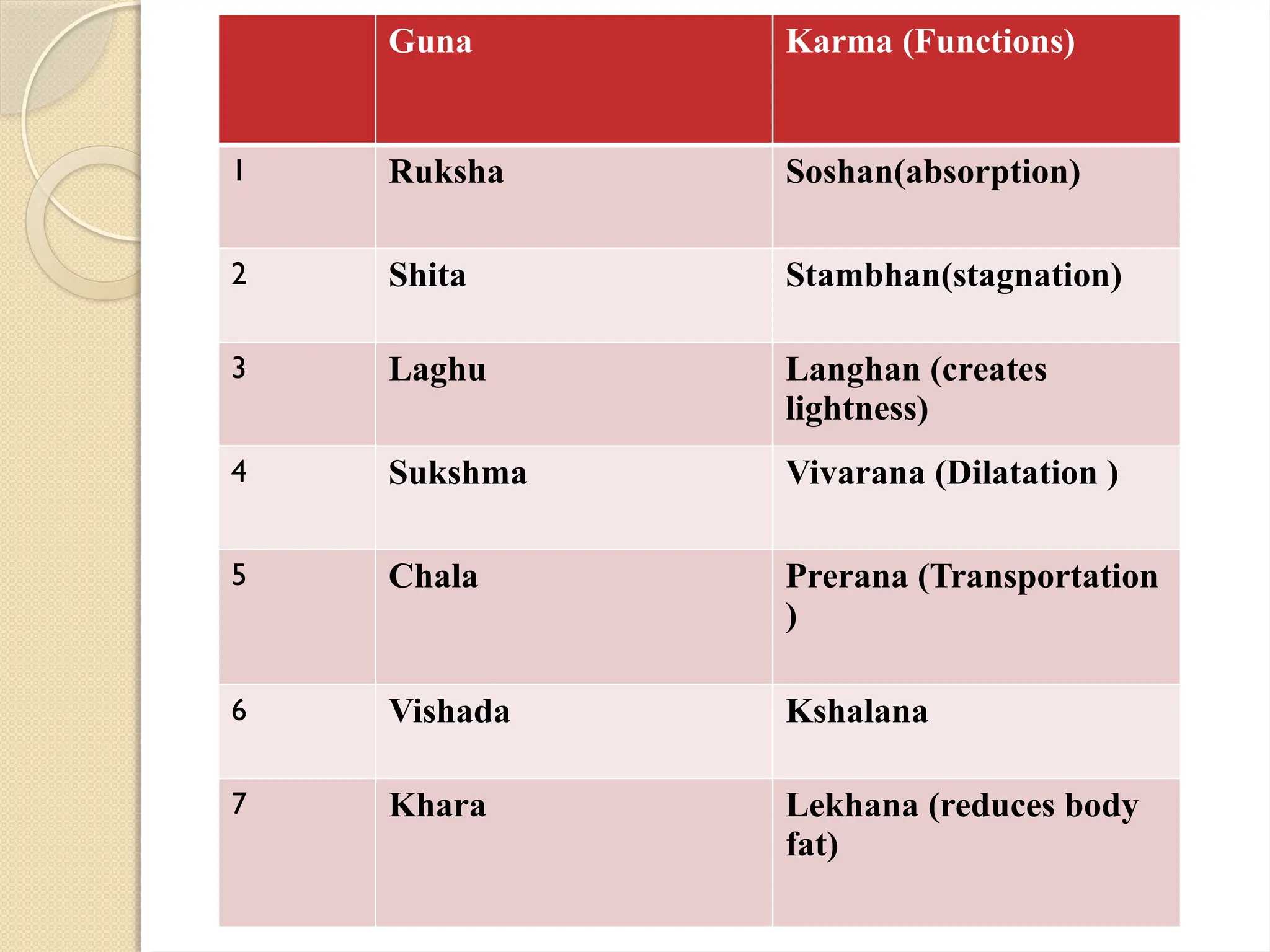
Guna Karma (Functions)
1 Ruksha Soshan(absorption)
2 Shita Stambhan(stagnation)
3 Laghu Langhan (creates
lightness)
4 Sukshma Vivarana (Dilatation )
5 Chala Prerana (Transportation
)
6 Vishada Kshalana
7 Khara Lekhana (reduces body
fat)
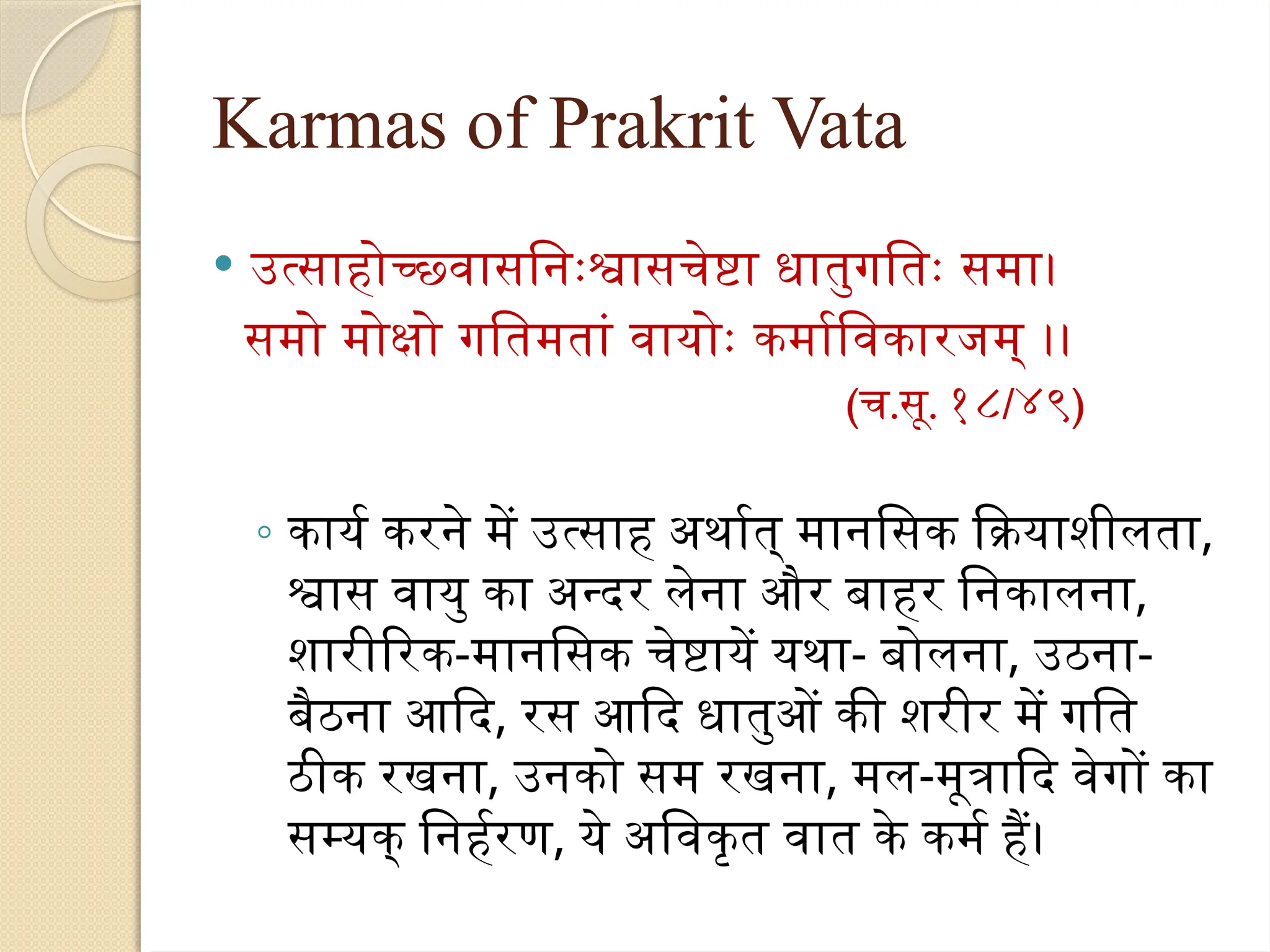
Karmas of Prakrit Vata
 उत्साहोच्छ्वासनिःश्वासचेष्टा धातुगतिः समा।
समो मोक्षो गतिमतां वायोः कर्माविकारजम् ।।
(च.सू. १८/४९)
◦ कार्य करने में उत्साह अर्थात् मानसिक क्रियाशीलता,
श्वास वायु का अन्दर लेना और बाहर निकालना,
शारीरिक-मानसिक चेष्टायें यथा- बोलना, उठना-
बैठना आदि, रस आदि धातुओं की शरीर में गति
ठीक रखना, उनको सम रखना, मल-मूत्रादि वेगों का
सम्यक् निर्हरण, ये अविकृत वात के कर्म हैं।
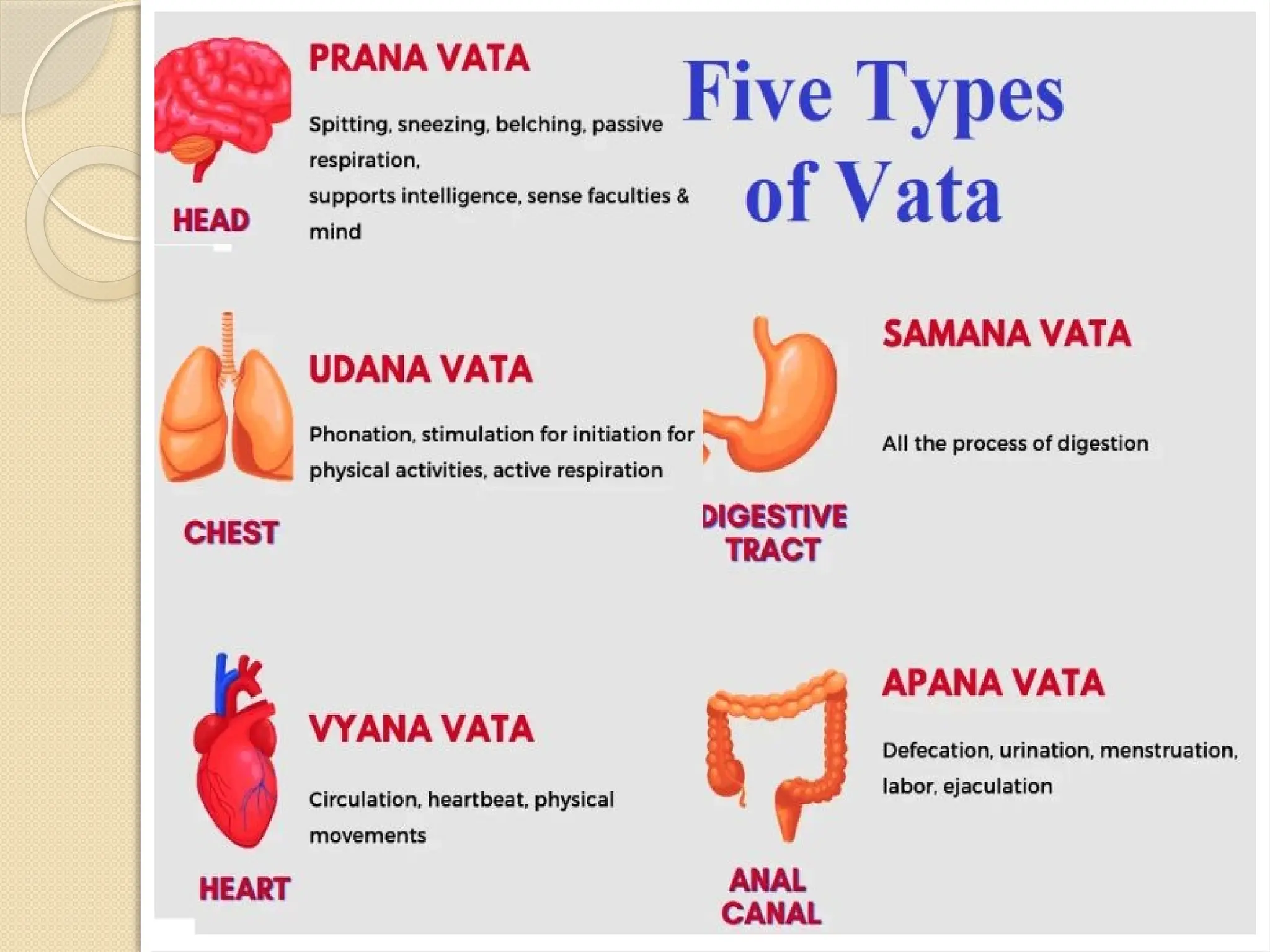
 These Karmas are reflected in five types
of Vata :
1 Prana Vata : Swas Prashwas
2 Udana Vata : Utsaha
3 Samana Vata : Samanata of Dhatus
4 Vyana Vata : Cheshta
5 Apana Vata : Excretion of Mala and
Mutra
Karma by Acharya Sushurata
 प्रस्पन्दनोद्वहनपूरणविवेकधारणलक्षणो वायु: पश्चया
विभक्तः शरीरं धारयति । (सु.सू. १५/४)

प्रस्पन्दन : Movements of body like moving , walking
 उद्वहन : upliftment of sense organs like breathing,speech
etc.
 पूरण : Filling the lungs with air and stomach with food .
 विवेक : Seperation of Kitta and Prasad part .
 धारण : Holds Shukra , Mutra , Artava and Excreting them
on time .
Some other Karmas of vata mentioned in
वातकलाकलीय अध्याय
 यानि तु खलु वायोः कुपिताकुपितस्य शरीराशरीरचरस्य
शरीरेषु चरतः कर्माणि बहिःशरीरेभ्यो वा भवन्ति,
तेषामवयवान् प्रत्यक्षानुमानोपदेशैः साधयित्वा नमस्कृत्य
वायवे यथाशक्ति प्रवक्ष्यामः- वायुस्तन्त्रयन्त्रधरः,
प्राणोदानसमानव्यानापानात्मा, प्रवर्तकश्चेष्टानामुच्चावचानां,
नियन्ता प्रणेता च मनसः, सर्वेन्द्रियाणामुद्योजकः,
सर्वेन्द्रियार्थानामभिवोढा, सर्वशरीरधातुव्यूहकरः,
सन्धानकरः शरीरस्य, प्रवर्तको वाचः, प्रकृतिः स्पर्शशब्दयोः,
श्रोत्रस्पर्शनयोर्मूलं, हर्षोत्साहयोर्योनिः, समीरणोऽग्नेः,
दोषसंशोषणः , क्षेप्ता बहिर्मलानां, स्थूलाणुस्रोतसां भेत्ता,
कर्तागर्भाकृतीनाम्,
आयुषोऽनुवृत्तिप्रत्ययभूतो भवत्यकुपितः|
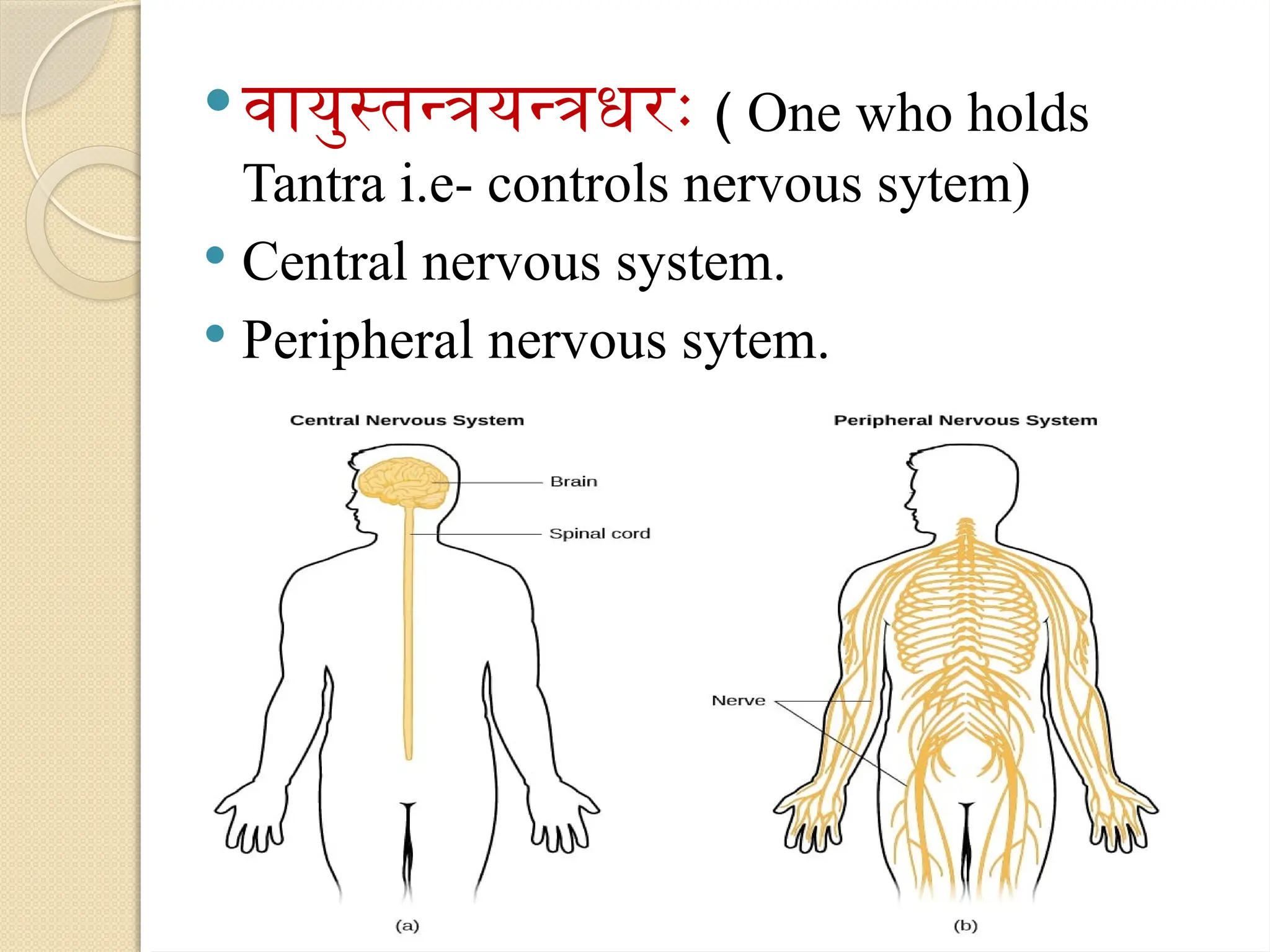
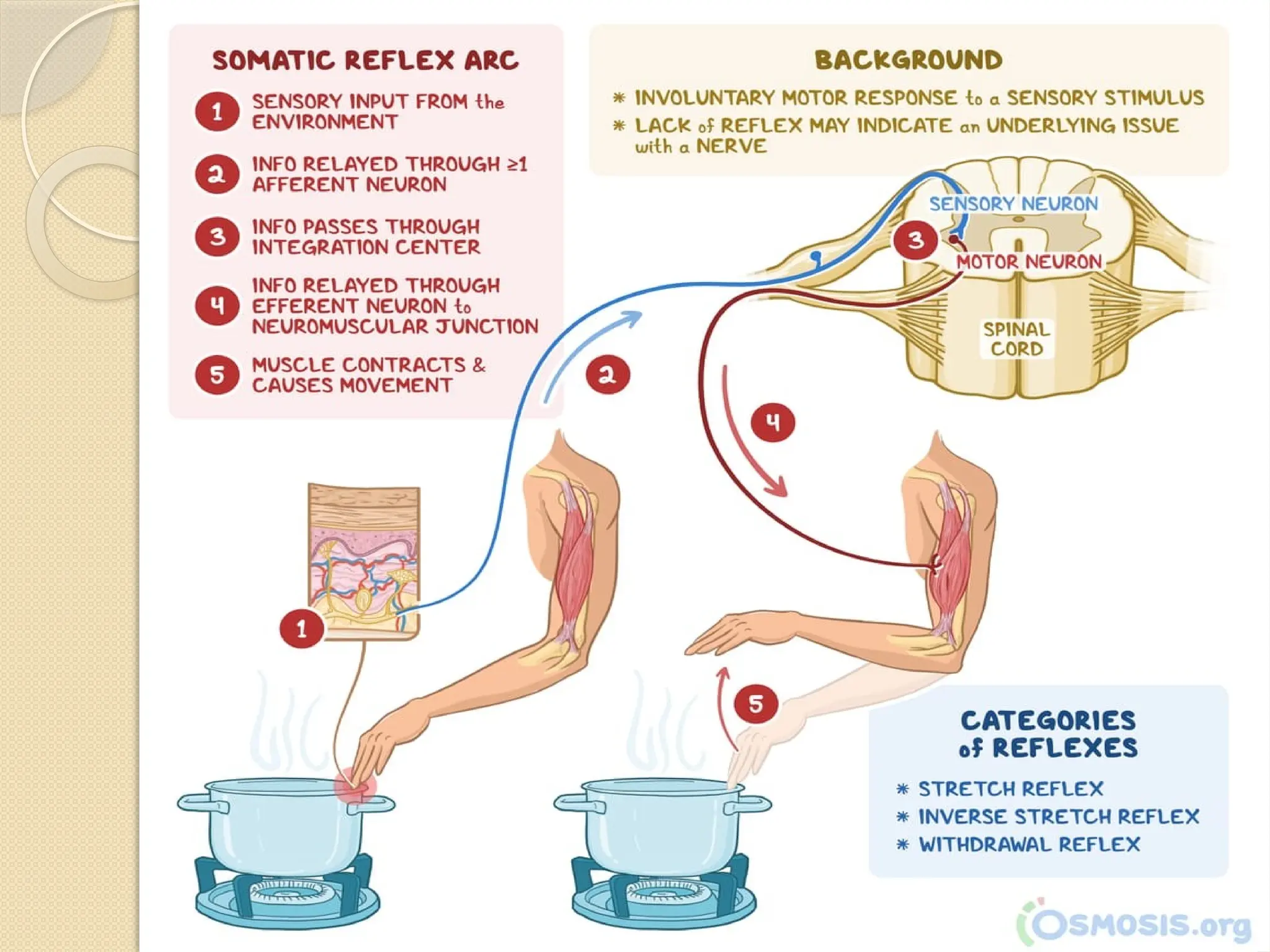
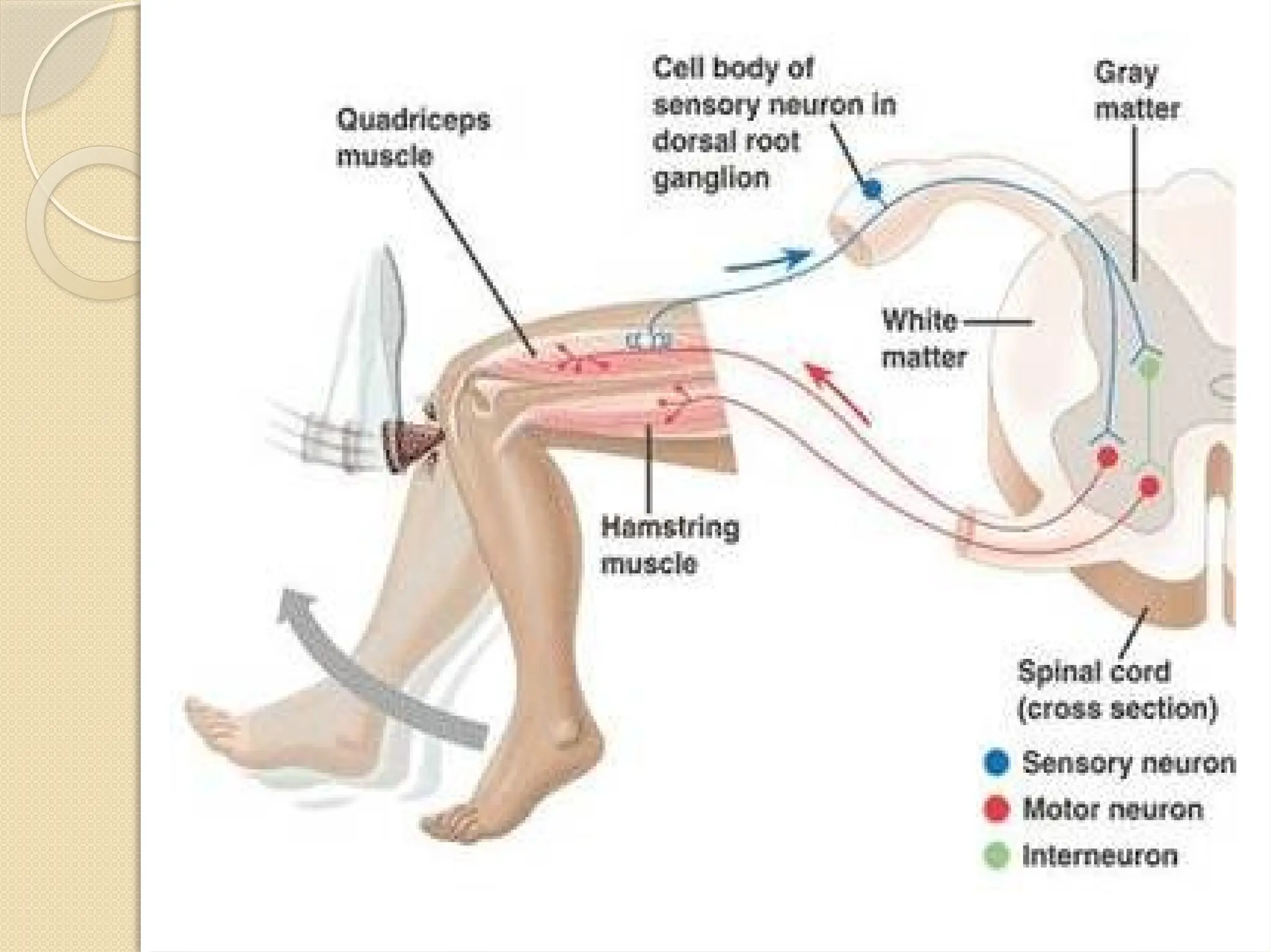
वायुस्तन्त्रयन्त्रधरः ( One who holds
Tantra i.e- controls nervous sytem)
 Central nervous system.
 Peripheral nervous sytem.
 प्राणोदानसमान व्यानापानात्मा (It is the soul
of 5 types of Vayu )
 प्रर्वतकश्चेष्टानामुच्चावचानां (It is the
promoter of all the functions of Vayu)
 नियन्ता प्रणेता च मनसः (It controls and
propels Mana)
 सर्वेन्द्रियाणां उष्द्योजकः (Stimulator of
all senses): This relates to the
central nervous system, which
activates and coordinates sensory
functions.
 सर्वेन्द्रियार्थानाम् अभिवोढा -(Carrier of sensory
perceptions): This corresponds to the sensory
pathways that transmit information from
sensory organs to the brain for processing.
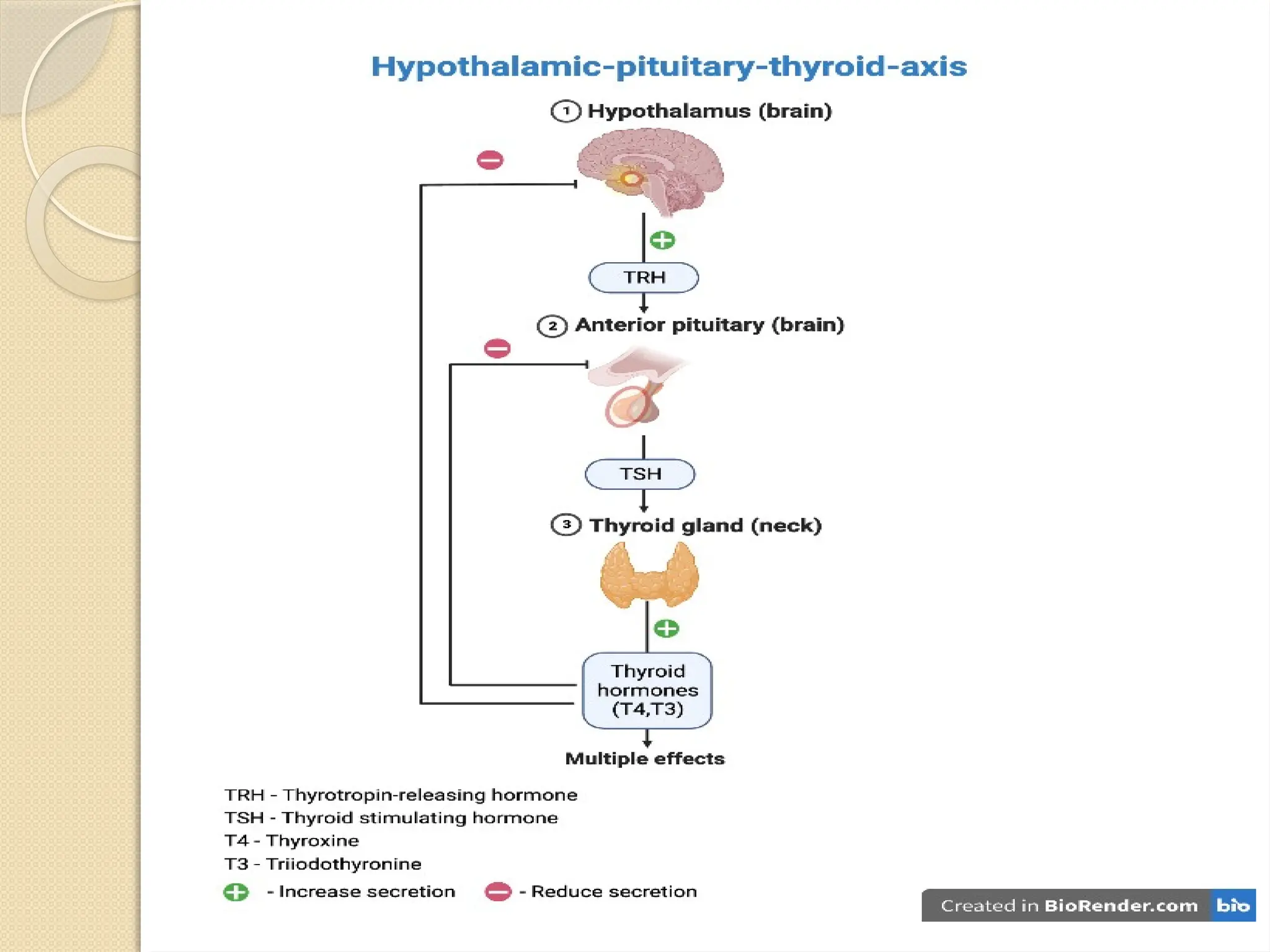
 सर्वशरीर धातु व्यूहकरः - maintains
homeostasis or regulation of bodily tissues
and organs, where various systems (nervous,
endocrine) maintain balance and regulate
bodily functions to support the overall
structure of the body.
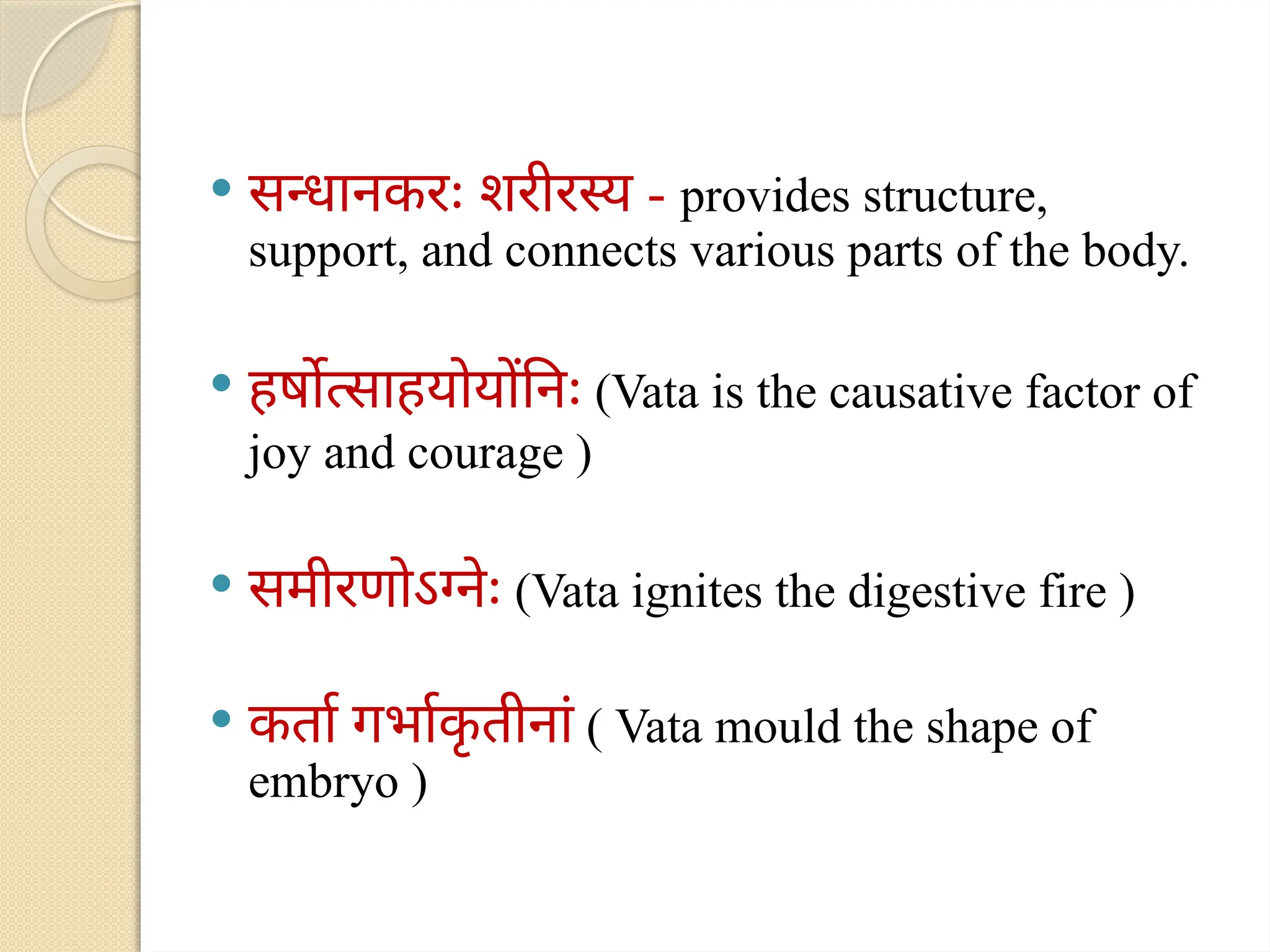
 सन्धानकरः शरीरस्य - provides structure,
support, and connects various parts of the body.
 हर्षोत्साहयोयोंनिः (Vata is the causative factor of
joy and courage )
 समीरणोऽग्नेः (Vata ignites the digestive fire )
 कर्ता गर्भाक
ृ तीनां ( Vata mould the shape of
embryo )
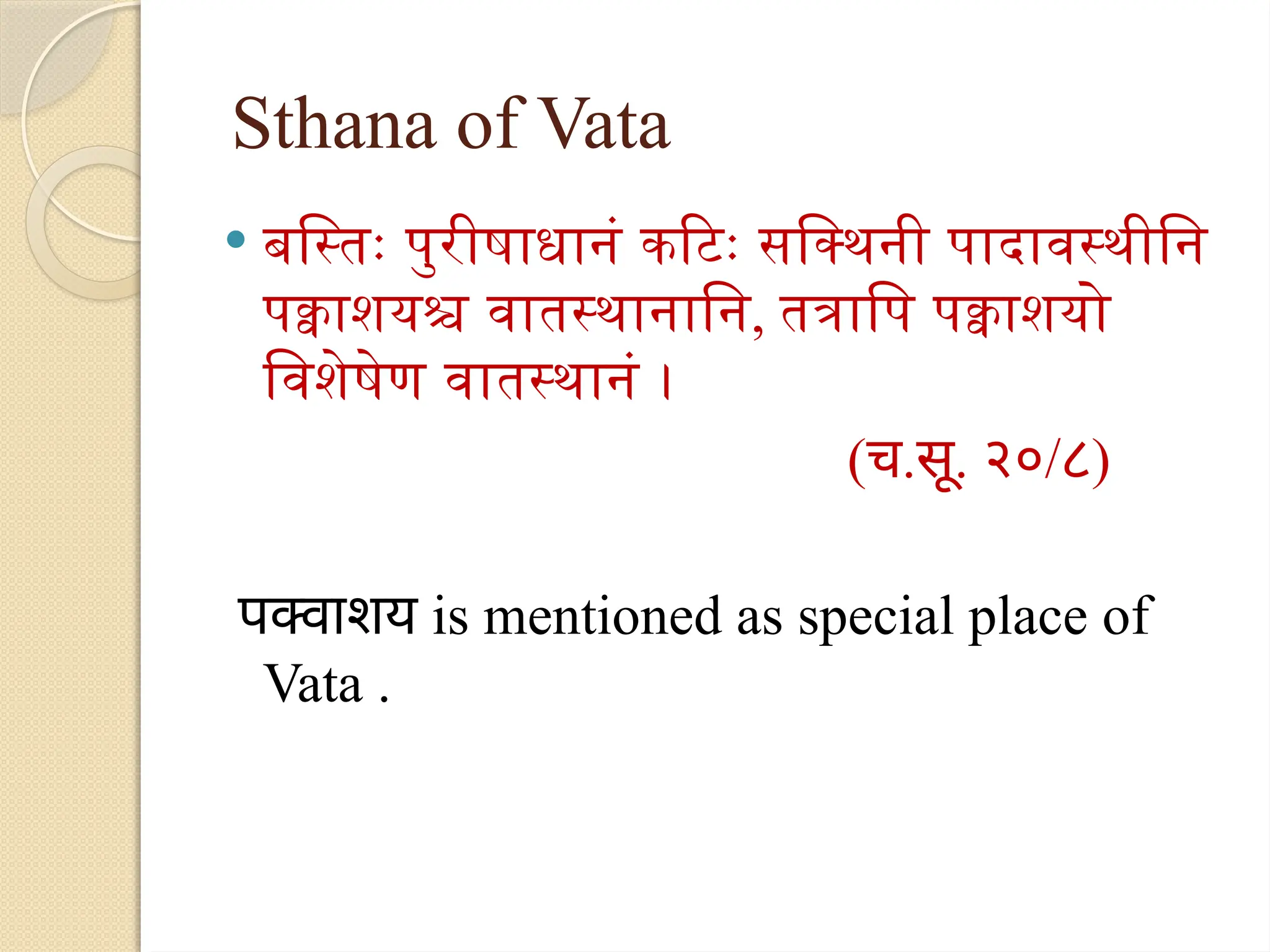
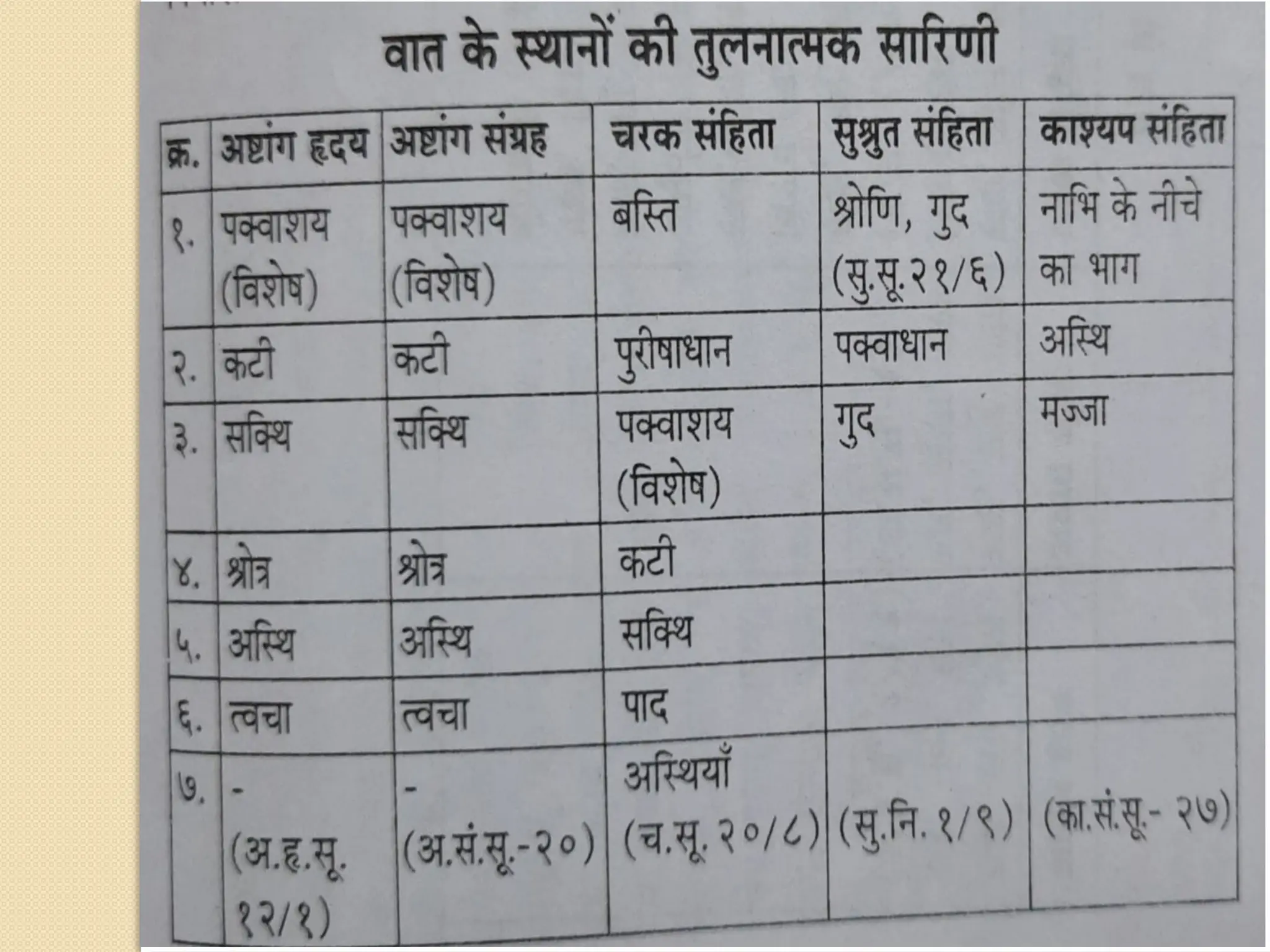
Sthana of Vata
 बस्तिः पुरीषाधानं कटिः सक्थिनी पादावस्थीनि
पक्वाशयश्च वातस्थानानि, तत्रापि पक्वाशयो
विशेषेण वातस्थानं ।
(च.सू. २०/८)
पक्वाशय is mentioned as special place of
Vata .
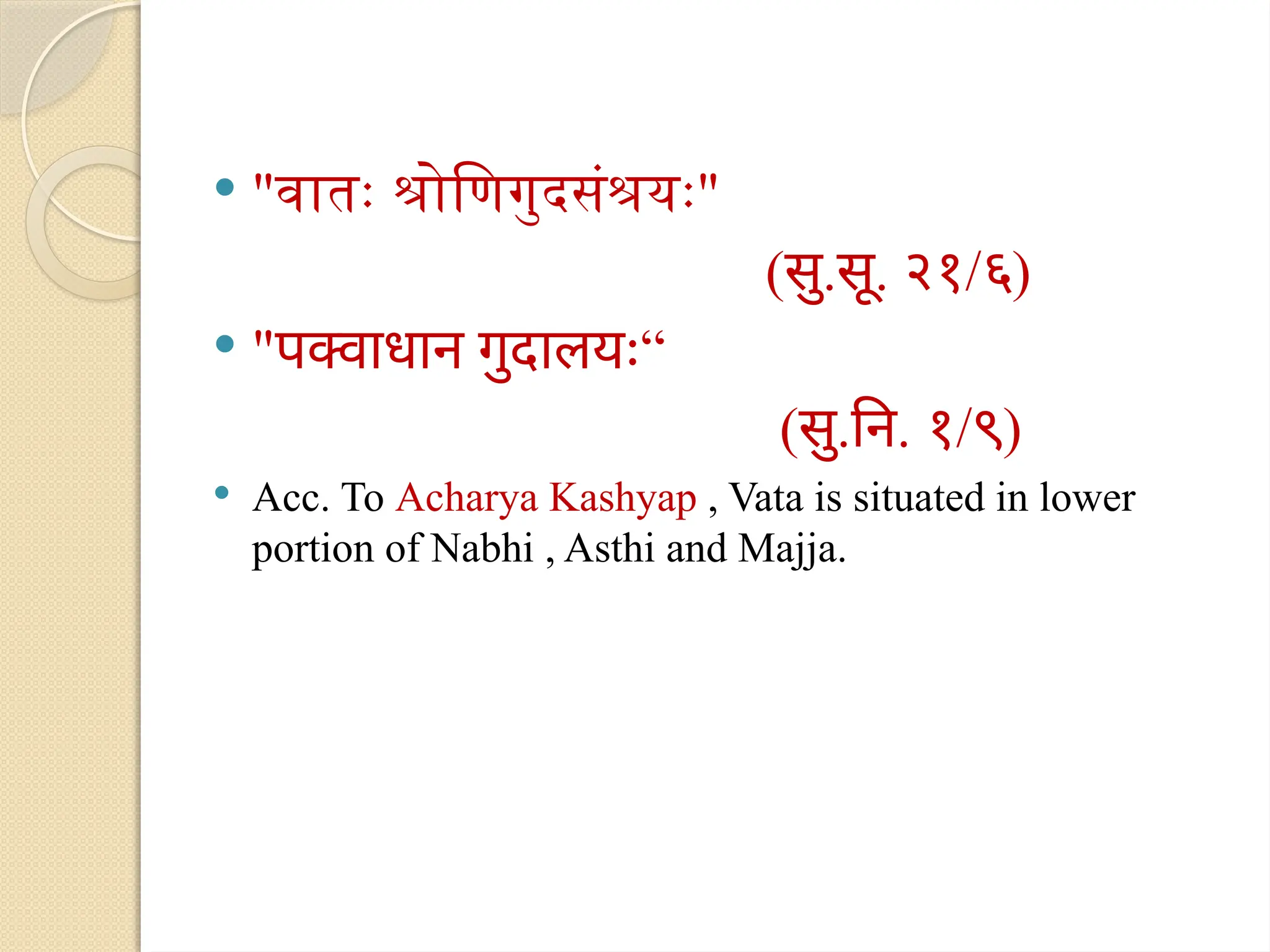
 "वातः श्रोणिगुदसंश्रयः"
(सु.सू. २१/६)
 " “
पक्वाधान गुदालयः
(सु.नि. १/९)
 Acc. To Acharya Kashyap , Vata is situated in lower
portion of Nabhi , Asthi and Majja.
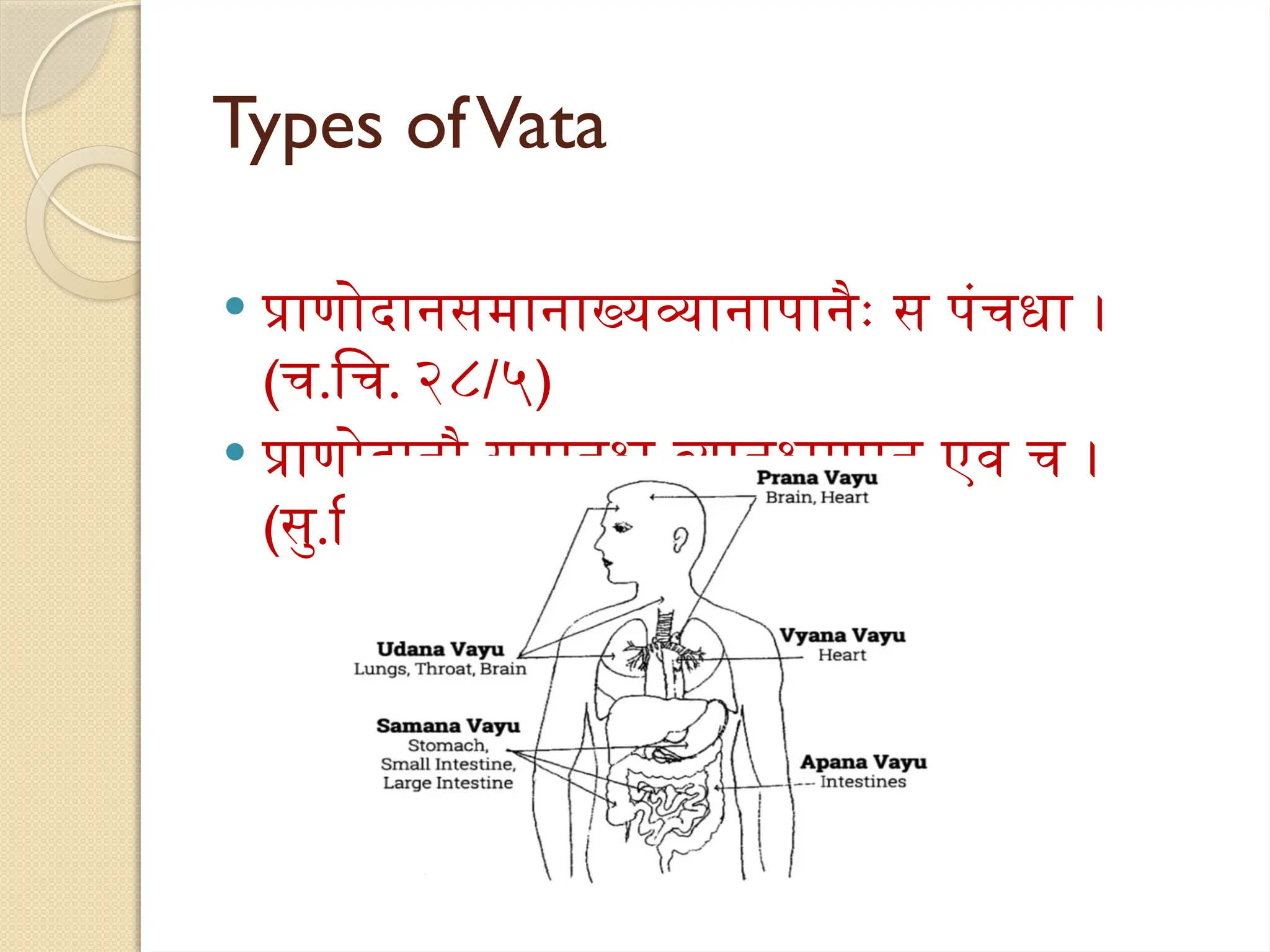
Types ofVata
 प्राणोदानसमानाख्यव्यानापानैः स पंचधा ।
(च.चि. २८/५)
 प्राणोदानौ समानश्च व्यानश्चापान एव च ।
(सु.नि. १/१२)
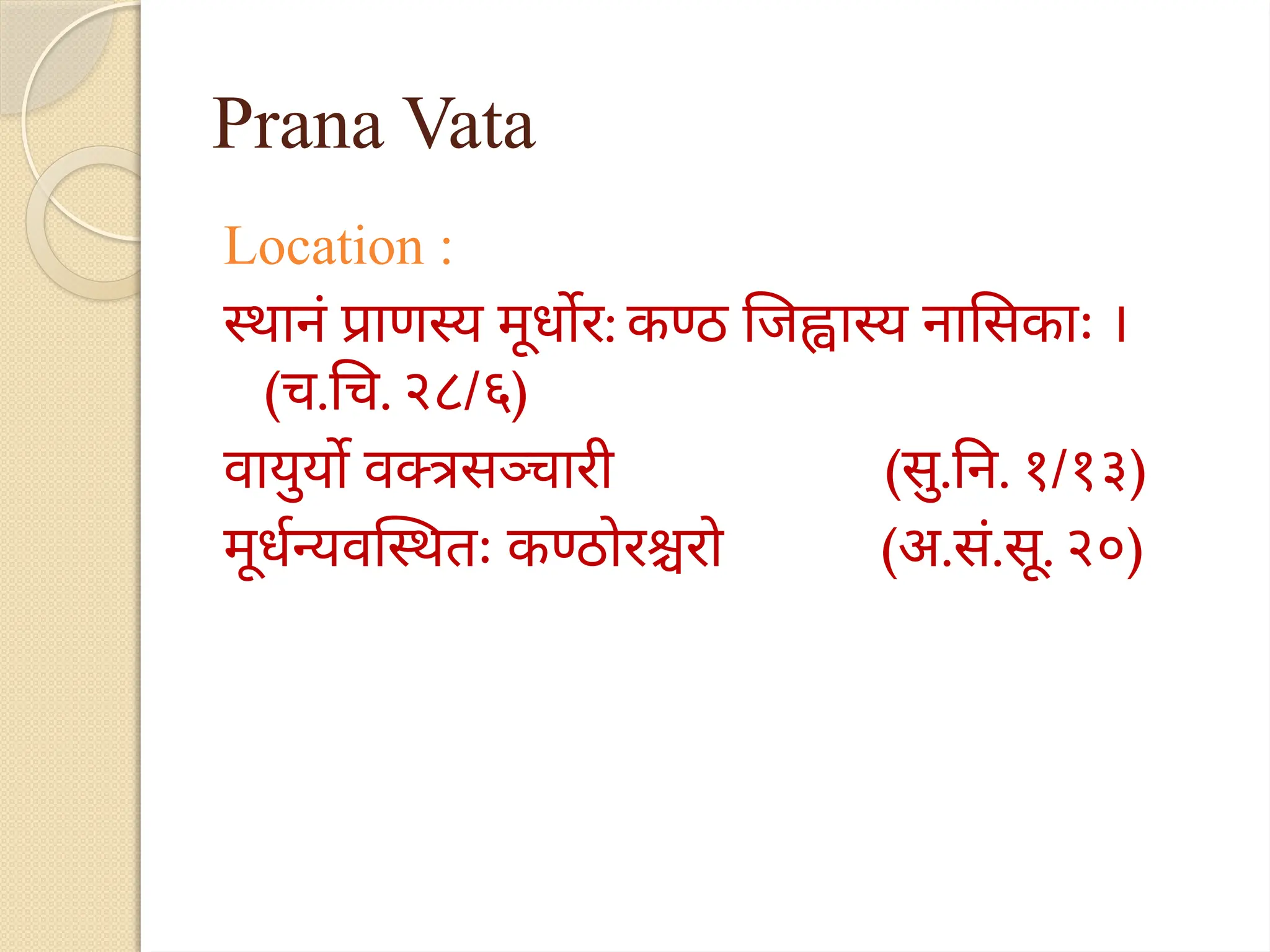
Prana Vata
Location :
स्थानं प्राणस्य मूर्धोर: कण्ठ जिह्वास्य नासिकाः ।
(च.चि. २८/६)
वायुर्यो वक्त्रसञ्चारी (सु.नि. १/१३)
मूर्धन्यवस्थितः कण्ठोरश्चरो (अ.सं.सू. २०)
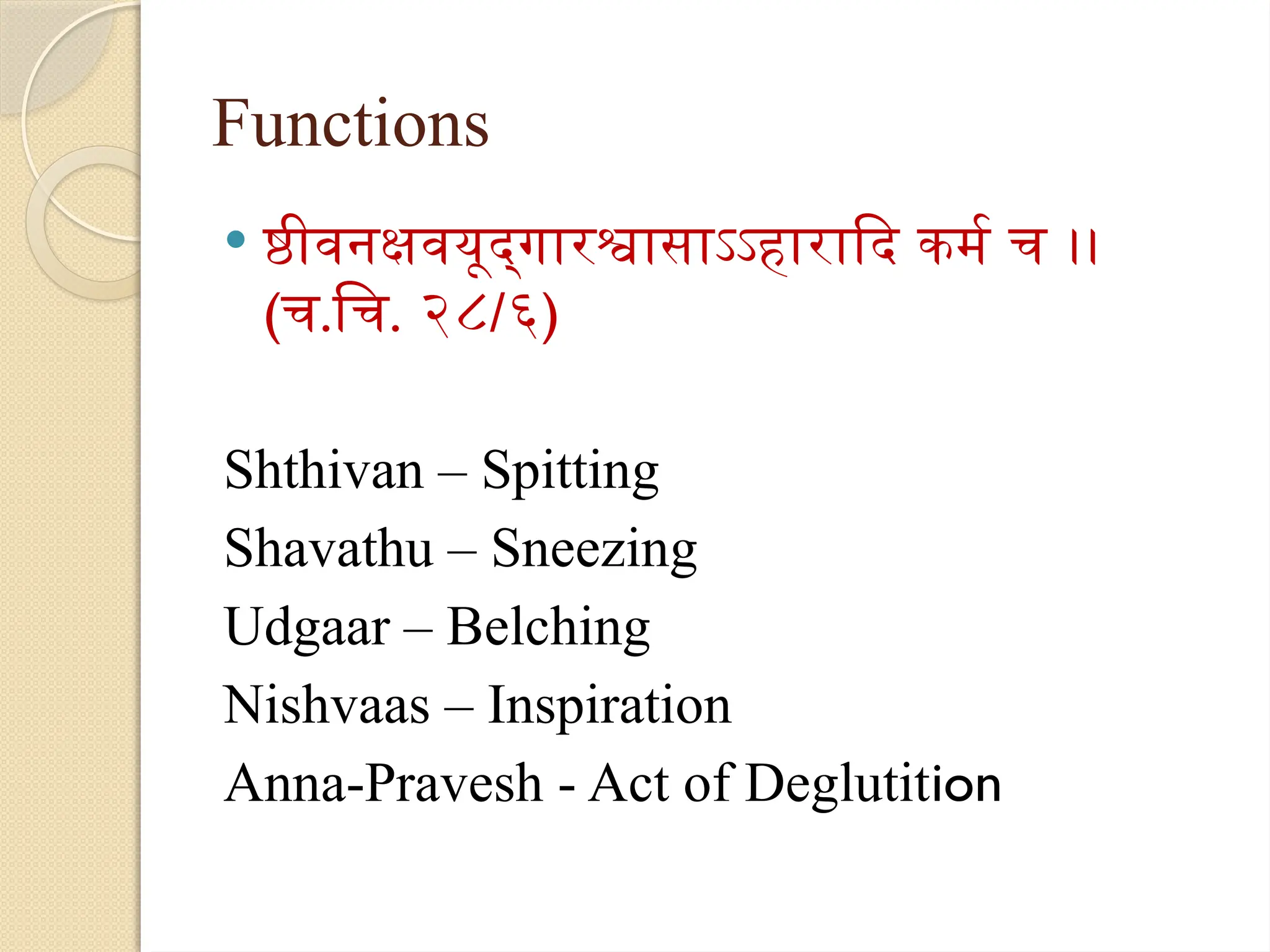
Functions
 ष्ठीवनक्षवयूद्‌
गारश्वासाऽऽहारादि कर्म च ।।
(च.चि. २८/६)
Shthivan – Spitting
Shavathu – Sneezing
Udgaar – Belching
Nishvaas – Inspiration
Anna-Pravesh - Act of Deglutition
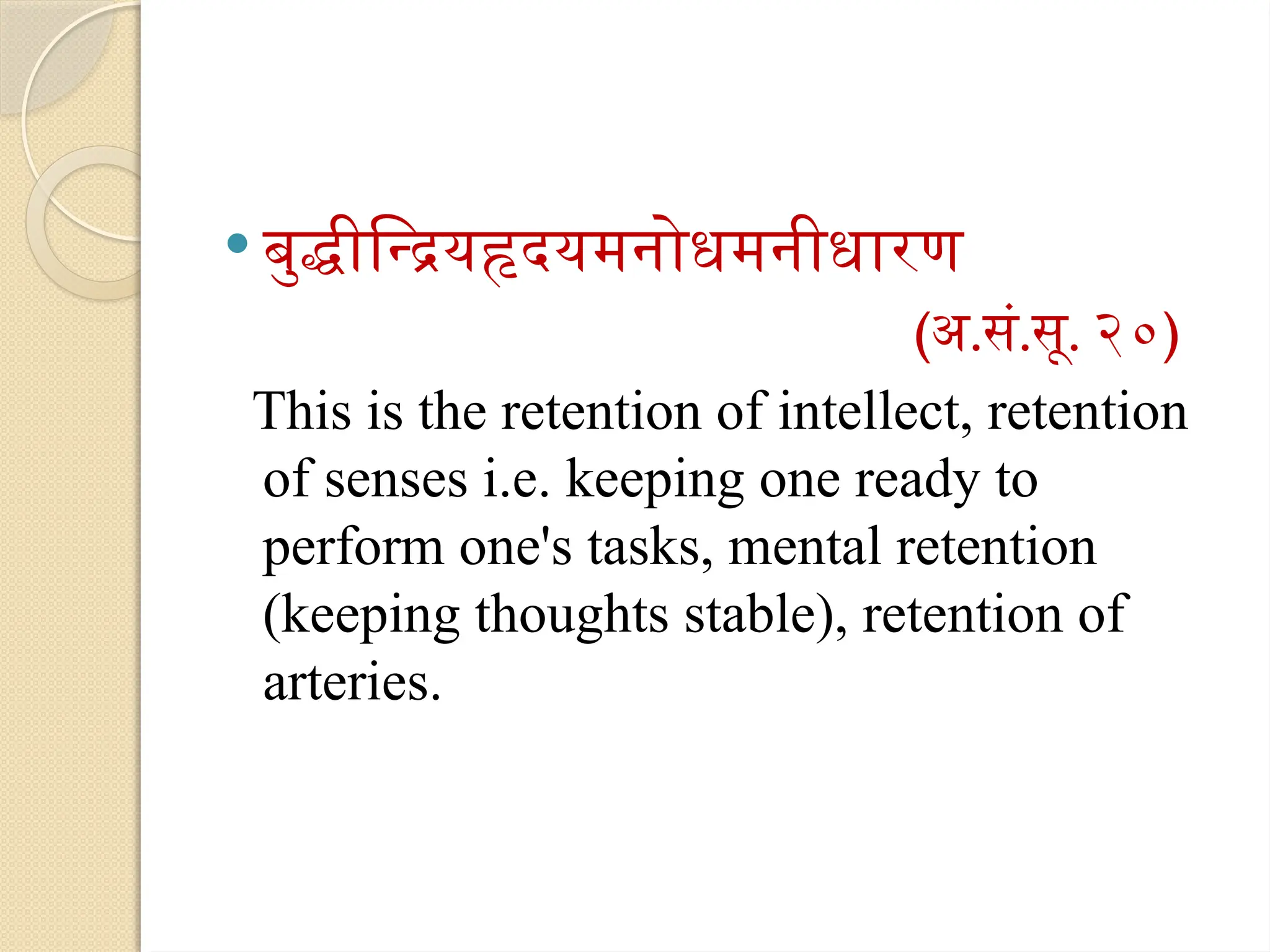
 बुद्धीन्द्रियहृदयमनोधमनीधारण
(अ.सं.सू. २०)
This is the retention of intellect, retention
of senses i.e. keeping one ready to
perform one's tasks, mental retention
(keeping thoughts stable), retention of
arteries.
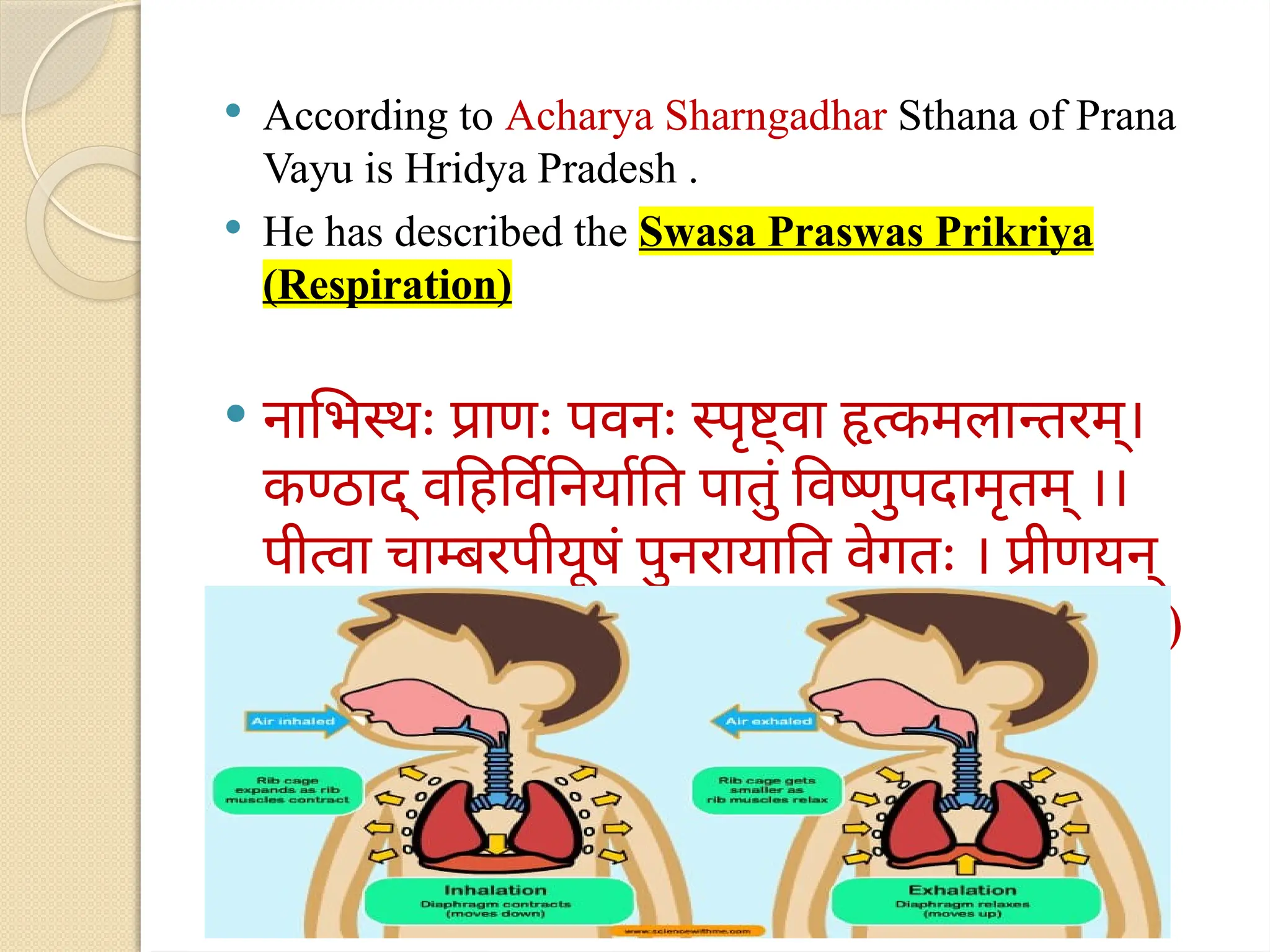
 According to Acharya Sharngadhar Sthana of Prana
Vayu is Hridya Pradesh .
 He has described the Swasa Praswas Prikriya
(Respiration)
 नाभिस्थः प्राणः पवनः स्पृष्ट्वा हृत्कमलान्तरम्।
कण्ठाद् वहिर्विनिर्याति पातुं विष्णुपदामृतम् ।।
पीत्वा चाम्बरपीयूषं पुनरायाति वेगतः । प्रीणयन्
देहमखिलं जीवयन् जठरानलम् ।।(शा.पू. ५/५१)
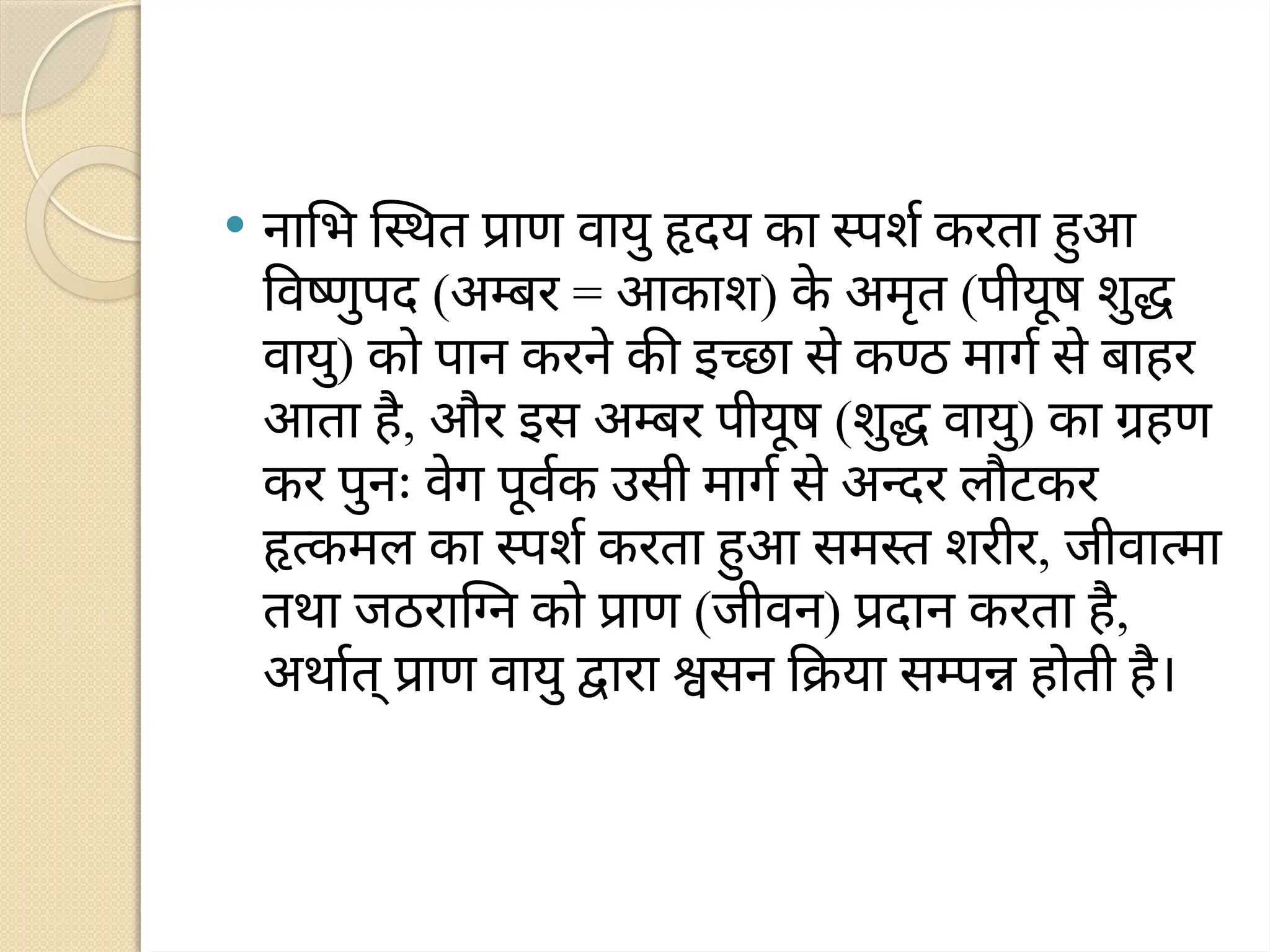
 नाभि स्थित प्राण वायु हृदय का स्पर्श करता हुआ
विष्णुपद (अम्बर = आकाश) क
े अमृत (पीयूष शुद्ध
वायु) को पान करने की इच्छा से कण्ठ मार्ग से बाहर
आता है, और इस अम्बर पीयूष (शुद्ध वायु) का ग्रहण
कर पुनः वेग पूर्वक उसी मार्ग से अन्दर लौटकर
हृत्कमल का स्पर्श करता हुआ समस्त शरीर, जीवात्मा
तथा जठराग्नि को प्राण (जीवन) प्रदान करता है,
अर्थात् प्राण वायु द्वारा श्वसन क्रिया सम्पन्न होती है।
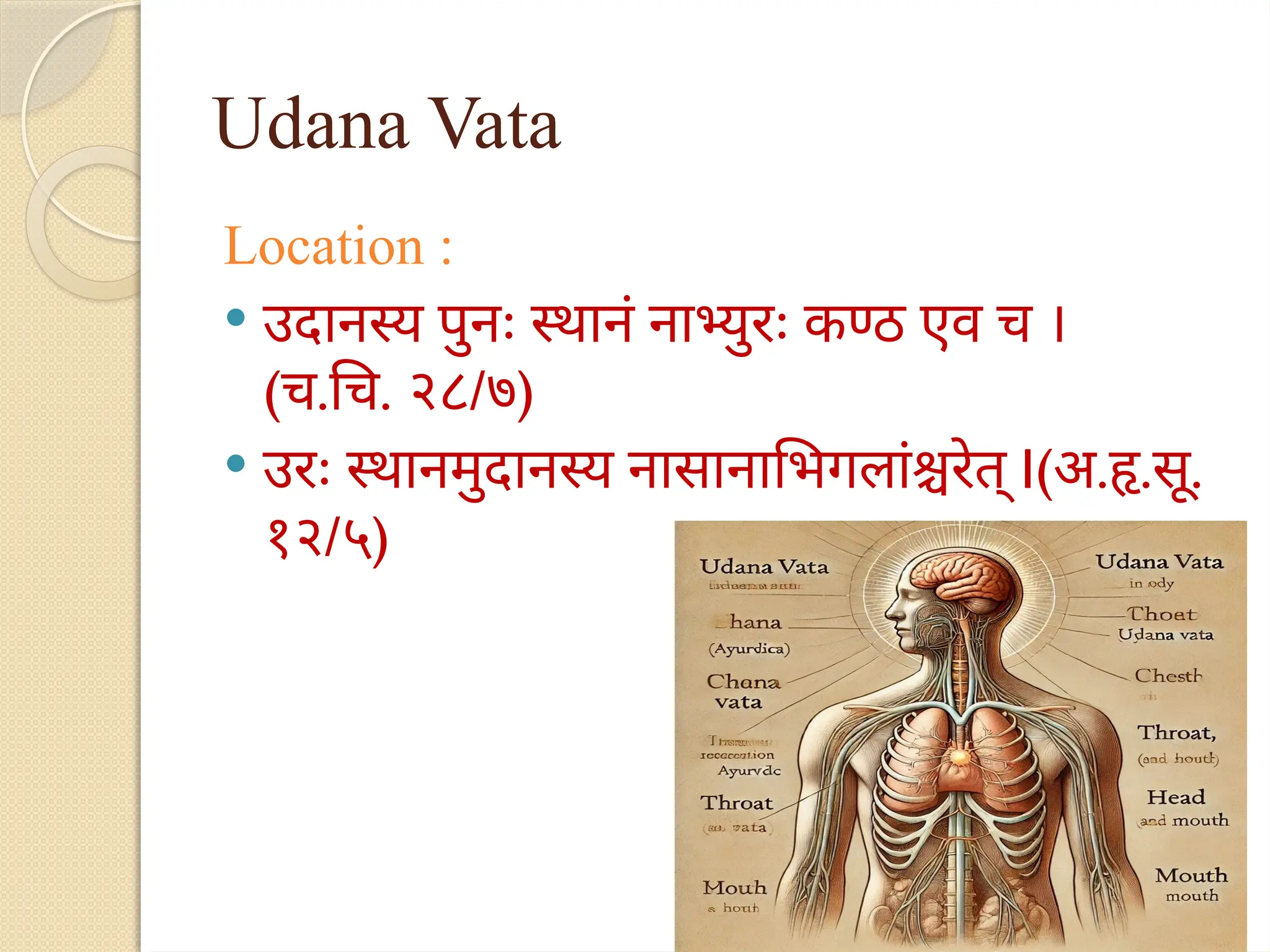
Udana Vata
Location :
 उदानस्य पुनः स्थानं नाभ्युरः कण्ठ एव च ।
(च.चि. २८/७)
 उरः स्थानमुदानस्य नासानाभिगलांश्चरेत् I(अ.हृ.सू.
१२/५)
Functions
वाक्प्रवृत्ति प्रयत्नौजोबलवर्णादि कर्म च ।
(च.चि. २८/७)
 Vak pravrutti - Stimulates Peripheral Speech
Apparatus for Articulation of Sound
 Prayatna-Stimulator, action initiator
 Urja - Element of energy and activeness
 Bala-Inoculates strength, stamina and courage
 Varna - Enhances Skin complexion, looks and
personality
 प्धीधृतिस्मृतिमनोविबोधनादिक्रियः ।
(अ.सं.सू.- २०)
 Dhi (wisdom), Dhriti (patience), memory,
Mano Vibodhan (making the mind
conscious and active).
 Smruti - Develops and facilitates memory
power
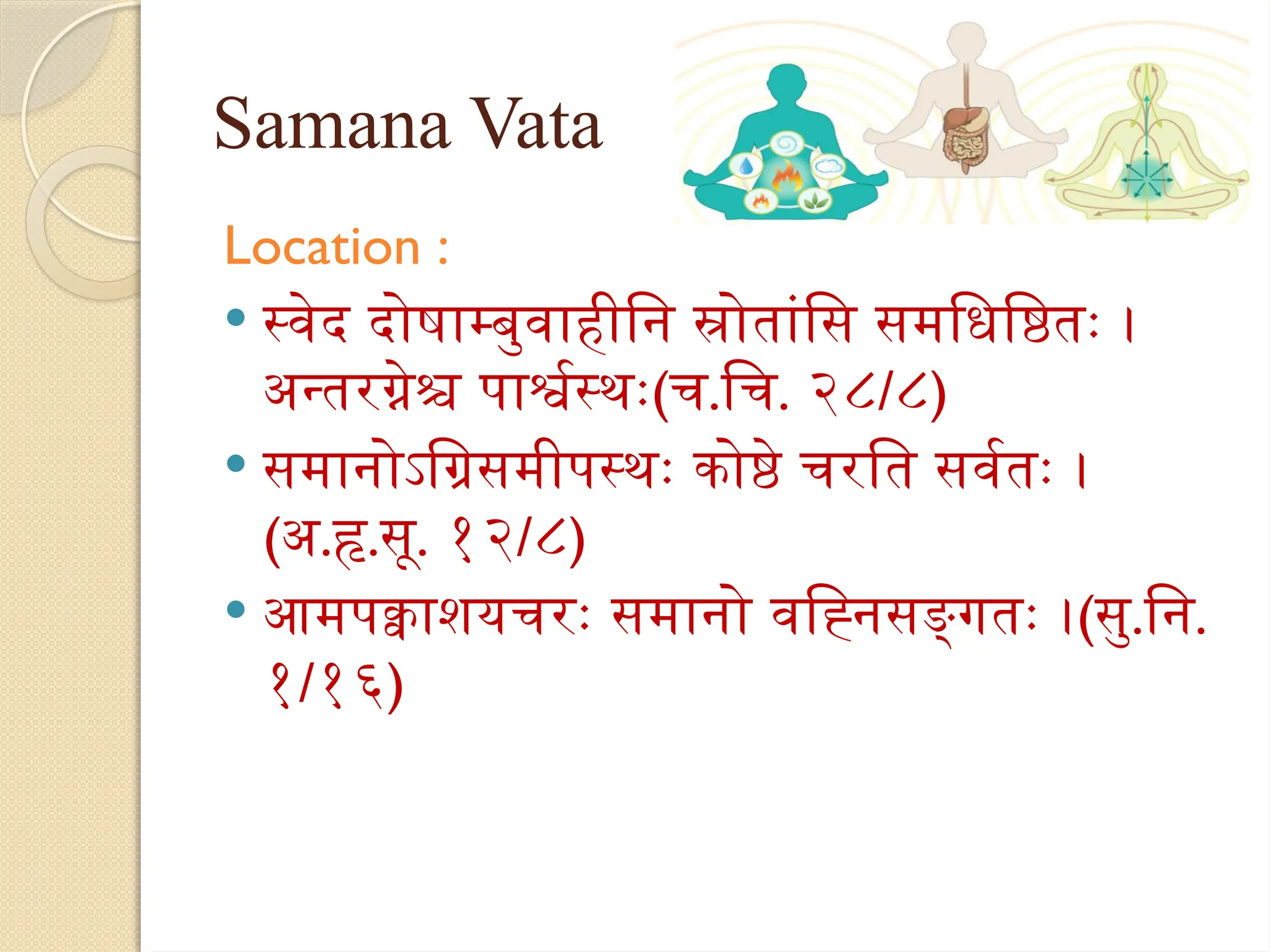
Samana Vata
Location :
 स्वेद दोषाम्बुवाहीनि स्रोतांसि समधिष्ठितः ।
अन्तरग्नेश्च पार्श्वस्थः(च.चि. २८/८)
 समानोऽग्रिसमीपस्थः कोष्ठे चरति सर्वतः ।
(अ.हृ.सू. १२/८)
 आमपक्वाशयचरः समानो वह्निसङ्गतः ।(सु.नि.
१/१६)
Functions
 समानोऽग्नि बलप्रदः । (च.चि. २८/८)
Saman Vayu provides strength to Agni
 अन्नं गृह्णाति पचति विवेचयति मुञ्श्चति ।
(अ.हृ.सू. १२/८)
 Anna Grunhati - Temporary storage of food
 Anna Pachati - Digestion of temporarily stored food
 Anna Vivechayati - Segregation and analysis of useful
and waste
 Anna Munchati - Absorption of essential nutrient part
(Sara) from Gl tract and propulsion of waste (Kitta)
part into colon
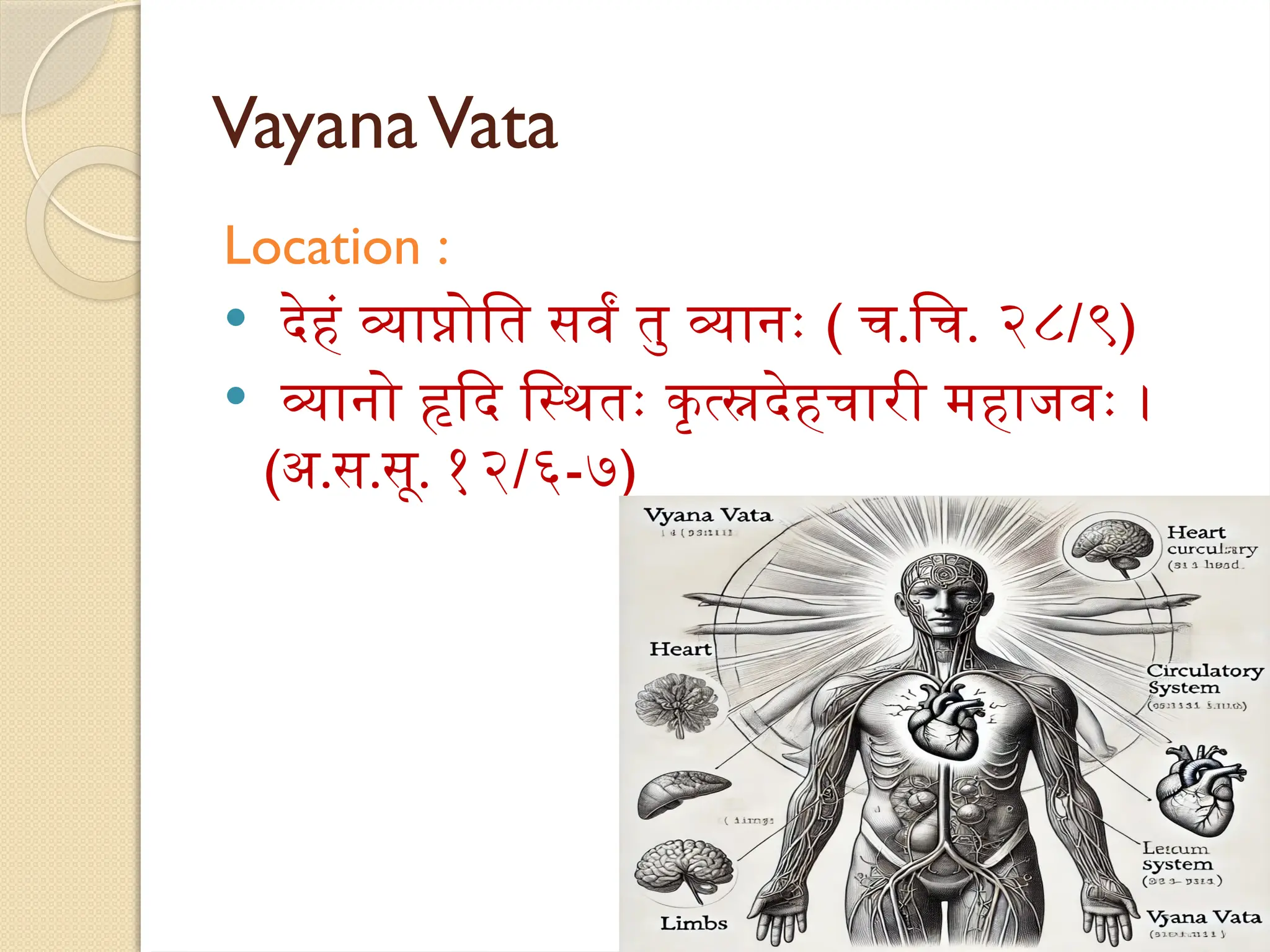
VayanaVata
Location :
 देहं व्याप्नोति सर्वं तु व्यानः ( च.चि. २८/९)
 व्यानो हृदि स्थितः कृत्स्नदेहचारी महाजवः ।
(अ.स.सू. १२/६-७)
Functions :
 शीघ्रगर्तिनृणाम्। गति प्रसारणाक्षेपनिमेषादिक्रियः सदा ।।
(च.चि. २८/९)
 स्वेदासृक्त्रावणश्चापि पञ्चधा चेष्टयत्यपि ।। (सु.नि.
१/१७)
 Apakshepana - Downward movements of body and
structures
 Utkshepana - Upwards movements of body and structures
 Unmesh-Nimesh - Closing and opening of eyes
 Sarva Kriya - Stimulates & accomplishes almost all
physical movements of body,
 Jrumbha (Yawning reflex)
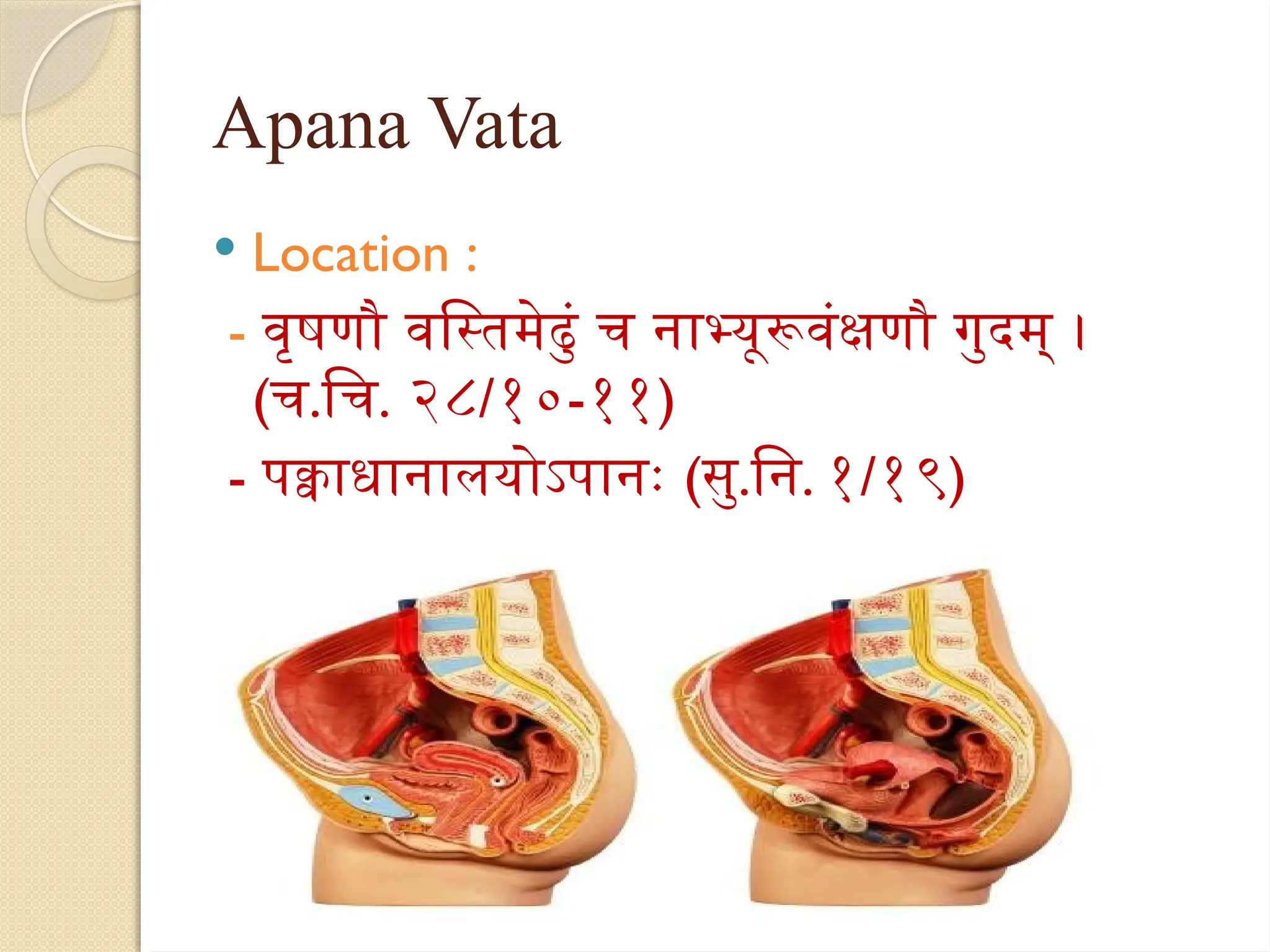
Apana Vata
 Location :
- वृषणौ वस्तिमेढुं च नाभ्यूरूवंक्षणौ गुदम् ।
(च.चि. २८/१०-११)
- पक्वाधानालयोऽपानः (सु.नि. १/१९)
Functions :
 अपानस्थानमन्त्रस्थः शुक्र-मूत्र-शकृन्ति च ।। सृजत्यार्तव-
गभौंच... .......।(च.चि. २८/१०-११)
 शकृन्मूत्रशुक्रगर्भार्त्तवान्यधः । (सु.नि. १/१९)
• Shukra Nishkramana - Ejaculation of seminal
and other reproductive fluid
• Artava Nishkramana- Ejaculation of menstural
blood
• Shakrut Nishkramana-Elimination of feces
• Mutra Nishkramana - Elimination of urine
• Garbha Nishkramana-Expulsion of Fetus
Vata Kshaya Lakshana
 वातक्षये मन्दचेष्टताऽल्पवाक्त्वम् प्रहषों
मूढ़संज्ञता च ।
(सु.सू.
१५/११)
Slow body movements
Reduced power of speech
Reduced happiness
Lack of inteligence
 प्रसेकारुचिहृल्लाससंज्ञामोहाल्पवाक्चेष्टताप्रहर्षा
ङ्गसादाग्निवैषम्यादिभिः क्षीणो वायुः पीडयति ।
(अ.सं.सू. १९)
Drooling ,Loss of appetite
Nausea ,Inability to think properly
Speaking less ,Lack of body movements
Unhappiness , Abnormality of digestion etc.
Vata Vridhi Lakhsana
 वातवृद्धौ वाक्पारुष्यं कार्श्यं कार्ष्ण्यं
गात्रस्फु रणमुष्णकामितानिद्रानाशोऽल्पबलत्वं
गाढवर्चस्त्वं च । (सु.सू. १५/१८)
Hoarseness in speaking, weakness,
discoluration , tingling , desire for hot
food and drinks, loss of sleep, low
strength and thickening of stool etc.
Concept of VAT Dosh.ppt (1).pptx ayurveda

Concept of VAT Dosh.ppt (1).pptx ayurveda

  • 1.
  • 2.
    VATA DOSHA  Vatadosha is one of the most important dosha of the tridosha.  The other two dosha viz pitta and kapha have been considered to have no movement in the body.  The vata dosha carries them towards different places of the body to perform their natural function  In the universe vata, is responsible for all the movements so also the vata controls all the activites of body.
  • 3.
    Pradhanata ofVata Dosha पित्तमपंगु कफम पंगु पंगवों मलधातव: । वायुना यत्र नियनते तत्र गच्छन्ति मेघवत ।। (sha.pur.khan-5/25)
  • 4.
    Nirukti / Etymology 'वा'गतिगन्धनयोरिति धातुः। (सु. सू. 21)  Here the word Gati has 4 meanings : Gaman ,Gayan , Prapti and Moksh .  Vata’comes from ‘Va Gatigandhanayo’which refers to two significant aspect of functions of Vata Dosha in human body-‘Gati’which refers to movement and ‘Gandhana’which refers to initiation .
  • 5.
     Thus itcan be assumed that, the primary functions of Vata Dosha must include movement of other Dosha, Dhatus and Mala as well as to initiate different sensory organs as well as physical organs into their respective activities.
  • 6.
    Swaroop : स्वयम्भूरेष भगवान् वायुरित्यभिशब्दितः। (सु.नि. १/५)  Vata is considered as 'Swayambhu' because its movement is everywhere.  Like space (Akasha), it pervades everywhere.  It is through Vata that consciousness is brought to all living beings.
  • 7.
     Since PranaVayu (the vital breath) keeps the body alive, Vayu is considered the soul of all creatures.  Vata is responsible for the creation, sustenance, and destruction of all stationary and moving entities.
  • 8.
    सर्वा हि चेष्टावातेन स प्राणः प्राणिनां स्मृतः । (च.सू. १७/११८)  Charak has given the name of life (Prana) to vayu because it provides motion to all living beings.  Due to its fast moving nature it has been called 'Aasuvahi'. Due to being predominant in Tridosha, it is also predominant in causing disease.  That is why Acharya Sushruta has called Vata as the “दोषाणां नेता' तथा ' ” रोग समूहराट् .
  • 9.
    Panchbhautik Swaroop : Vata is said to be Vayu and Akash Mahabhaut pradahn . However other remaining Mahabhauts are also present in Vata in more or less form.  Prakrit Vata is said to be सर्वगत एवं 'स्वयम्भू' due to Akash Mahabhoota .
  • 10.
    Synonyms / Prarya Amar Sing has mentioned many synonyms of Vayu in his dictionary ‘Amarkosh’ like वायु, मारुत, मरुत, समीर, श्वसन, स्पर्शन, सदागति, गन्धावाह, अनिल, पवन, जगत्प्राण, समीरण, वात आदि।  Acc. To Acharya Shushurata Vata is "रजोबहुल एव च" (सु.नि. १/८)  It is due to Rajogun that all the movements of the world are accomplished.
  • 11.
    Guna :  रूक्षःशीतो लघुः सूक्ष्मश्चलोऽथ विशदः खरः । (च.सू. १/५९)  रूक्षलघुशीतदारुणखरविशदाः षडिमे वातगुणा भवन्ति । (च.सू. १२/४)  योगवाहः परं वायुः संयोगादुभयार्थक ृ त् । (च.चि. ३/३८) Vayu is called 'Yogavahi'; it means that when Vayu comes in contact with a cold dravya, it becomes cold and when it comes in contact with a hot dravya it becomes of hot quality.
  • 12.
    Guna Karma (Functions) 1Ruksha Soshan(absorption) 2 Shita Stambhan(stagnation) 3 Laghu Langhan (creates lightness) 4 Sukshma Vivarana (Dilatation ) 5 Chala Prerana (Transportation ) 6 Vishada Kshalana 7 Khara Lekhana (reduces body fat)
  • 13.
    Karmas of PrakritVata  उत्साहोच्छ्वासनिःश्वासचेष्टा धातुगतिः समा। समो मोक्षो गतिमतां वायोः कर्माविकारजम् ।। (च.सू. १८/४९) ◦ कार्य करने में उत्साह अर्थात् मानसिक क्रियाशीलता, श्वास वायु का अन्दर लेना और बाहर निकालना, शारीरिक-मानसिक चेष्टायें यथा- बोलना, उठना- बैठना आदि, रस आदि धातुओं की शरीर में गति ठीक रखना, उनको सम रखना, मल-मूत्रादि वेगों का सम्यक् निर्हरण, ये अविकृत वात के कर्म हैं।
  • 14.
     These Karmasare reflected in five types of Vata : 1 Prana Vata : Swas Prashwas 2 Udana Vata : Utsaha 3 Samana Vata : Samanata of Dhatus 4 Vyana Vata : Cheshta 5 Apana Vata : Excretion of Mala and Mutra
  • 15.
    Karma by AcharyaSushurata  प्रस्पन्दनोद्वहनपूरणविवेकधारणलक्षणो वायु: पश्चया विभक्तः शरीरं धारयति । (सु.सू. १५/४)  प्रस्पन्दन : Movements of body like moving , walking  उद्वहन : upliftment of sense organs like breathing,speech etc.  पूरण : Filling the lungs with air and stomach with food .  विवेक : Seperation of Kitta and Prasad part .  धारण : Holds Shukra , Mutra , Artava and Excreting them on time .
  • 16.
    Some other Karmasof vata mentioned in वातकलाकलीय अध्याय  यानि तु खलु वायोः कुपिताकुपितस्य शरीराशरीरचरस्य शरीरेषु चरतः कर्माणि बहिःशरीरेभ्यो वा भवन्ति, तेषामवयवान् प्रत्यक्षानुमानोपदेशैः साधयित्वा नमस्कृत्य वायवे यथाशक्ति प्रवक्ष्यामः- वायुस्तन्त्रयन्त्रधरः, प्राणोदानसमानव्यानापानात्मा, प्रवर्तकश्चेष्टानामुच्चावचानां, नियन्ता प्रणेता च मनसः, सर्वेन्द्रियाणामुद्योजकः, सर्वेन्द्रियार्थानामभिवोढा, सर्वशरीरधातुव्यूहकरः, सन्धानकरः शरीरस्य, प्रवर्तको वाचः, प्रकृतिः स्पर्शशब्दयोः, श्रोत्रस्पर्शनयोर्मूलं, हर्षोत्साहयोर्योनिः, समीरणोऽग्नेः, दोषसंशोषणः , क्षेप्ता बहिर्मलानां, स्थूलाणुस्रोतसां भेत्ता, कर्तागर्भाकृतीनाम्, आयुषोऽनुवृत्तिप्रत्ययभूतो भवत्यकुपितः|
  • 17.
    वायुस्तन्त्रयन्त्रधरः ( Onewho holds Tantra i.e- controls nervous sytem)  Central nervous system.  Peripheral nervous sytem.
  • 20.
     प्राणोदानसमान व्यानापानात्मा(It is the soul of 5 types of Vayu )  प्रर्वतकश्चेष्टानामुच्चावचानां (It is the promoter of all the functions of Vayu)  नियन्ता प्रणेता च मनसः (It controls and propels Mana)  सर्वेन्द्रियाणां उष्द्योजकः (Stimulator of all senses): This relates to the central nervous system, which activates and coordinates sensory functions.
  • 21.
     सर्वेन्द्रियार्थानाम् अभिवोढा-(Carrier of sensory perceptions): This corresponds to the sensory pathways that transmit information from sensory organs to the brain for processing.  सर्वशरीर धातु व्यूहकरः - maintains homeostasis or regulation of bodily tissues and organs, where various systems (nervous, endocrine) maintain balance and regulate bodily functions to support the overall structure of the body.
  • 22.
     सन्धानकरः शरीरस्य- provides structure, support, and connects various parts of the body.  हर्षोत्साहयोयोंनिः (Vata is the causative factor of joy and courage )  समीरणोऽग्नेः (Vata ignites the digestive fire )  कर्ता गर्भाक ृ तीनां ( Vata mould the shape of embryo )
  • 24.
    Sthana of Vata बस्तिः पुरीषाधानं कटिः सक्थिनी पादावस्थीनि पक्वाशयश्च वातस्थानानि, तत्रापि पक्वाशयो विशेषेण वातस्थानं । (च.सू. २०/८) पक्वाशय is mentioned as special place of Vata .
  • 25.
     "वातः श्रोणिगुदसंश्रयः" (सु.सू.२१/६)  " “ पक्वाधान गुदालयः (सु.नि. १/९)  Acc. To Acharya Kashyap , Vata is situated in lower portion of Nabhi , Asthi and Majja.
  • 27.
    Types ofVata  प्राणोदानसमानाख्यव्यानापानैःस पंचधा । (च.चि. २८/५)  प्राणोदानौ समानश्च व्यानश्चापान एव च । (सु.नि. १/१२)
  • 29.
    Prana Vata Location : स्थानंप्राणस्य मूर्धोर: कण्ठ जिह्वास्य नासिकाः । (च.चि. २८/६) वायुर्यो वक्त्रसञ्चारी (सु.नि. १/१३) मूर्धन्यवस्थितः कण्ठोरश्चरो (अ.सं.सू. २०)
  • 30.
    Functions  ष्ठीवनक्षवयूद्‌ गारश्वासाऽऽहारादि कर्मच ।। (च.चि. २८/६) Shthivan – Spitting Shavathu – Sneezing Udgaar – Belching Nishvaas – Inspiration Anna-Pravesh - Act of Deglutition
  • 31.
     बुद्धीन्द्रियहृदयमनोधमनीधारण (अ.सं.सू. २०) Thisis the retention of intellect, retention of senses i.e. keeping one ready to perform one's tasks, mental retention (keeping thoughts stable), retention of arteries.
  • 32.
     According toAcharya Sharngadhar Sthana of Prana Vayu is Hridya Pradesh .  He has described the Swasa Praswas Prikriya (Respiration)  नाभिस्थः प्राणः पवनः स्पृष्ट्वा हृत्कमलान्तरम्। कण्ठाद् वहिर्विनिर्याति पातुं विष्णुपदामृतम् ।। पीत्वा चाम्बरपीयूषं पुनरायाति वेगतः । प्रीणयन् देहमखिलं जीवयन् जठरानलम् ।।(शा.पू. ५/५१)
  • 33.
     नाभि स्थितप्राण वायु हृदय का स्पर्श करता हुआ विष्णुपद (अम्बर = आकाश) क े अमृत (पीयूष शुद्ध वायु) को पान करने की इच्छा से कण्ठ मार्ग से बाहर आता है, और इस अम्बर पीयूष (शुद्ध वायु) का ग्रहण कर पुनः वेग पूर्वक उसी मार्ग से अन्दर लौटकर हृत्कमल का स्पर्श करता हुआ समस्त शरीर, जीवात्मा तथा जठराग्नि को प्राण (जीवन) प्रदान करता है, अर्थात् प्राण वायु द्वारा श्वसन क्रिया सम्पन्न होती है।
  • 34.
    Udana Vata Location : उदानस्य पुनः स्थानं नाभ्युरः कण्ठ एव च । (च.चि. २८/७)  उरः स्थानमुदानस्य नासानाभिगलांश्चरेत् I(अ.हृ.सू. १२/५)
  • 35.
    Functions वाक्प्रवृत्ति प्रयत्नौजोबलवर्णादि कर्मच । (च.चि. २८/७)  Vak pravrutti - Stimulates Peripheral Speech Apparatus for Articulation of Sound  Prayatna-Stimulator, action initiator  Urja - Element of energy and activeness  Bala-Inoculates strength, stamina and courage  Varna - Enhances Skin complexion, looks and personality
  • 36.
     प्धीधृतिस्मृतिमनोविबोधनादिक्रियः । (अ.सं.सू.-२०)  Dhi (wisdom), Dhriti (patience), memory, Mano Vibodhan (making the mind conscious and active).  Smruti - Develops and facilitates memory power
  • 37.
    Samana Vata Location : स्वेद दोषाम्बुवाहीनि स्रोतांसि समधिष्ठितः । अन्तरग्नेश्च पार्श्वस्थः(च.चि. २८/८)  समानोऽग्रिसमीपस्थः कोष्ठे चरति सर्वतः । (अ.हृ.सू. १२/८)  आमपक्वाशयचरः समानो वह्निसङ्गतः ।(सु.नि. १/१६)
  • 38.
    Functions  समानोऽग्नि बलप्रदः। (च.चि. २८/८) Saman Vayu provides strength to Agni  अन्नं गृह्णाति पचति विवेचयति मुञ्श्चति । (अ.हृ.सू. १२/८)  Anna Grunhati - Temporary storage of food  Anna Pachati - Digestion of temporarily stored food  Anna Vivechayati - Segregation and analysis of useful and waste  Anna Munchati - Absorption of essential nutrient part (Sara) from Gl tract and propulsion of waste (Kitta) part into colon
  • 39.
    VayanaVata Location :  देहंव्याप्नोति सर्वं तु व्यानः ( च.चि. २८/९)  व्यानो हृदि स्थितः कृत्स्नदेहचारी महाजवः । (अ.स.सू. १२/६-७)
  • 40.
    Functions :  शीघ्रगर्तिनृणाम्।गति प्रसारणाक्षेपनिमेषादिक्रियः सदा ।। (च.चि. २८/९)  स्वेदासृक्त्रावणश्चापि पञ्चधा चेष्टयत्यपि ।। (सु.नि. १/१७)  Apakshepana - Downward movements of body and structures  Utkshepana - Upwards movements of body and structures  Unmesh-Nimesh - Closing and opening of eyes  Sarva Kriya - Stimulates & accomplishes almost all physical movements of body,  Jrumbha (Yawning reflex)
  • 41.
    Apana Vata  Location: - वृषणौ वस्तिमेढुं च नाभ्यूरूवंक्षणौ गुदम् । (च.चि. २८/१०-११) - पक्वाधानालयोऽपानः (सु.नि. १/१९)
  • 42.
    Functions :  अपानस्थानमन्त्रस्थःशुक्र-मूत्र-शकृन्ति च ।। सृजत्यार्तव- गभौंच... .......।(च.चि. २८/१०-११)  शकृन्मूत्रशुक्रगर्भार्त्तवान्यधः । (सु.नि. १/१९) • Shukra Nishkramana - Ejaculation of seminal and other reproductive fluid • Artava Nishkramana- Ejaculation of menstural blood • Shakrut Nishkramana-Elimination of feces • Mutra Nishkramana - Elimination of urine • Garbha Nishkramana-Expulsion of Fetus
  • 43.
    Vata Kshaya Lakshana वातक्षये मन्दचेष्टताऽल्पवाक्त्वम् प्रहषों मूढ़संज्ञता च । (सु.सू. १५/११) Slow body movements Reduced power of speech Reduced happiness Lack of inteligence
  • 44.
     प्रसेकारुचिहृल्लाससंज्ञामोहाल्पवाक्चेष्टताप्रहर्षा ङ्गसादाग्निवैषम्यादिभिः क्षीणोवायुः पीडयति । (अ.सं.सू. १९) Drooling ,Loss of appetite Nausea ,Inability to think properly Speaking less ,Lack of body movements Unhappiness , Abnormality of digestion etc.
  • 45.
    Vata Vridhi Lakhsana वातवृद्धौ वाक्पारुष्यं कार्श्यं कार्ष्ण्यं गात्रस्फु रणमुष्णकामितानिद्रानाशोऽल्पबलत्वं गाढवर्चस्त्वं च । (सु.सू. १५/१८) Hoarseness in speaking, weakness, discoluration , tingling , desire for hot food and drinks, loss of sleep, low strength and thickening of stool etc.