WHAT IS AYURVEDA
A HOLISTIC SCIENCE OF LIFE, whose
principles are applied to maintain
Health of the----
• Body
• Mind
• Soul
AYURVEDA
Āyus + Veda = Ayurveda
Ayus means -> longevity(refers to all aspects of life from birth to death)
Veda means - > “ knowledge” or “science”(at the deepest level).
EIGHT BRANCHES OF AYURVEDA
• Kaaya-chikitsa --- Internal medicine.
• Kaumarabhrtyam --- Pediatrics.
• Shalya-chikitsa --- Surgery.
• Shalakaya tantra --- Eye & ENT.
• Bhuta vidya ---- Demonic possession(psychiatry)
• Agadtantra --- Toxicology.
• Rasayana --- Immunity and rejuvenation.
• Vajikaranam --- Aphrodisiacs & improving
AIM OF AYURVEDA
• To promote, protect and maintain the health of a healthy person.
• To treat and prevent the disease of a person.
TOPICS
• Tridosha
• Prakriti
• Diet
BASIC PRINCIPLES OF AYURVEDA
• Theory of Pancha mahabhuta (five basic elements).
• Tridoshas (Three doshas): Regulator of body metabolism
• Driving force - Agni (biological fire).
• Application of Ayurvedic fundament for betterment of our
PANCHMAHABHOOTA
All
matter in the universe is comprised of
five elements. These are known as
panchamahabhuta:
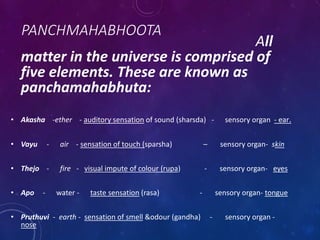
• Akasha -ether - auditory sensation of sound (sharsda) - sensory organ - ear.
• Vayu - air - sensation of touch (sparsha) – sensory organ- skin
• Thejo - fire - visual impute of colour (rupa) - sensory organ- eyes
• Apo - water - taste sensation (rasa) - sensory organ- tongue
• Pruthuvi - earth - sensation of smell &odour (gandha) - sensory organ -
nose
AKASH(SPACE)
VAYU (AIR)
PRITHVI (EARTH)
AGNI (FIRE)
JAL(WATER)
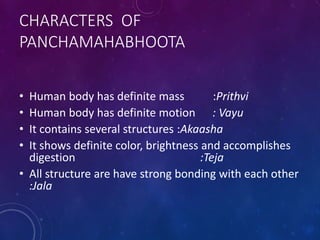
CHARACTERS OF
PANCHAMAHABHOOTA
• Human body has definite mass :Prithvi
• Human body has definite motion : Vayu
• It contains several structures :Akaasha
• It shows definite color, brightness and accomplishes
digestion :Teja
• All structure are have strong bonding with each other
:Jala
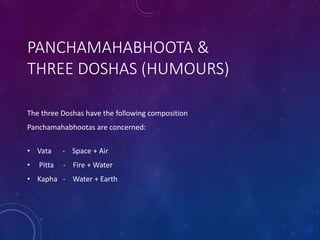
PANCHAMAHABHOOTA &
THREE DOSHAS (HUMOURS)
The three Doshas have the following composition
Panchamahabhootas are concerned:
• Vata - Space + Air
• Pitta - Fire + Water
• Kapha - Water + Earth
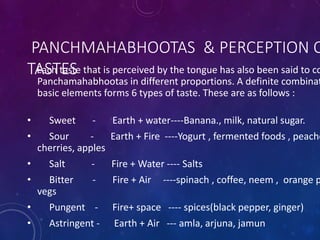
PANCHMAHABHOOTAS & PERCEPTION O
TASTES
Each taste that is perceived by the tongue has also been said to co
Panchamahabhootas in different proportions. A definite combinat
basic elements forms 6 types of taste. These are as follows :
• Sweet - Earth + water----Banana., milk, natural sugar.
• Sour - Earth + Fire ----Yogurt , fermented foods , peache
cherries, apples
• Salt - Fire + Water ---- Salts
• Bitter - Fire + Air ----spinach , coffee, neem , orange p
vegs
• Pungent - Fire+ space ---- spices(black pepper, ginger)
• Astringent - Earth + Air --- amla, arjuna, jamun
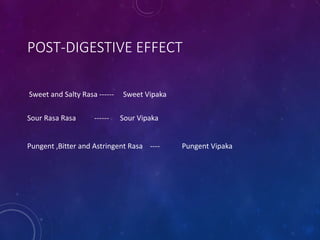
POST-DIGESTIVE EFFECT
Sweet and Salty Rasa ------ Sweet Vipaka
Sour Rasa Rasa ------ Sour Vipaka
Pungent ,Bitter and Astringent Rasa ---- Pungent Vipaka
TRIDOSHAS
• VATA DOSHA
• PITTA DOSHA
• KAPHA DOSHA
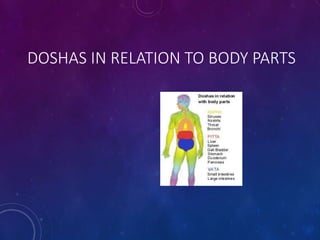
DOSHAS IN RELATION TO BODY PARTS
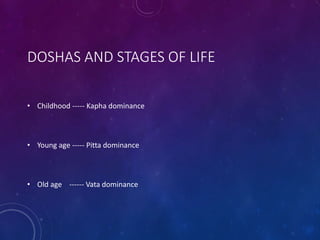
DOSHAS AND STAGES OF LIFE
• Childhood ----- Kapha dominance
• Young age ----- Pitta dominance
• Old age ------ Vata dominance
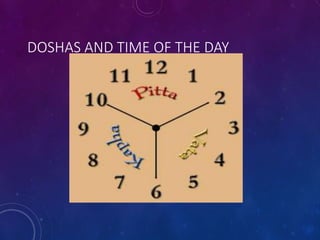
DOSHAS AND TIME OF THE DAY
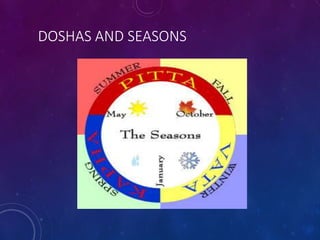
DOSHAS AND SEASONS
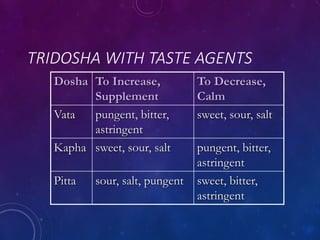
TRIDOSHA WITH TASTE AGENTS
Dosha To Increase,
Supplement
To Decrease,
Calm
Vata pungent, bitter,
astringent
sweet, sour, salt
Kapha sweet, sour, salt pungent, bitter,
astringent
Pitta sour, salt, pungent sweet, bitter,
astringent
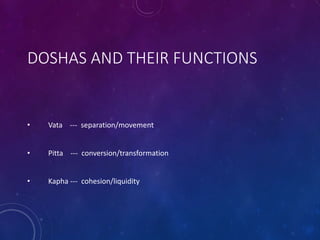
DOSHAS AND THEIR FUNCTIONS
• Vata --- separation/movement
• Pitta --- conversion/transformation
• Kapha --- cohesion/liquidity
FUNCTIONS OF VATA
Vata promotes and regulates the activities of the
mind.
Vata governs the intestinal motility facilitating the
downward movement of food we consume.
Vata governs whole process of respiration.
Vata generates consciousness and expression.
Vata stimulates the activities of Pitta and Kapha .
Vata assists in the fusion of the sperm and ovum
to create the zygote, ensures it's healthy
development and expulsion from the uterus.
Vata stimulates the expulsion of wastes from the
body.
FUNCTIONS OF PITTA
Pitta generates and maintains some natural urges, like
hunger, thirst.
Pitta represents various secretions, responsible for
digestion.
Pitta regulates the complexion and luster of skin.
Pitta helps in the maintenance of vision.
Pitta supports certain mental phenomenon like
intellectual comprehension, Conviction, courage.
It causes "Thermo-regulation" ,which is an important
function of Pitta.
FUNCTIONS OF KAPHA
Kapha maintains the structural integrity and confines Individual organs to their specific
location.
It protects the bodily organs against physiological injury.
Kapha imparts immunity against diseases.
It maintains the fluid balance.
Mental phenomenon like, intellectual stability, determinations are governed by Kapha.
GUNAS
Properties
OF
Doshas
VATA
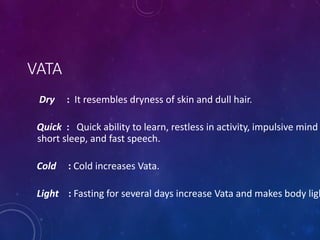
Dry : It resembles dryness of skin and dull hair.
Quick : Quick ability to learn, restless in activity, impulsive mind
short sleep, and fast speech.
Cold : Cold increases Vata.
Light : Fasting for several days increase Vata and makes body ligh
PITTA
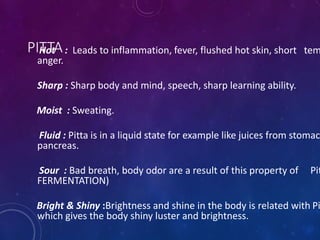
Hot : Leads to inflammation, fever, flushed hot skin, short tem
anger.
Sharp : Sharp body and mind, speech, sharp learning ability.
Moist : Sweating.
Fluid : Pitta is in a liquid state for example like juices from stomac
pancreas.
Sour : Bad breath, body odor are a result of this property of Pit
FERMENTATION)
Bright & Shiny :Brightness and shine in the body is related with Pi
which gives the body shiny luster and brightness.
KAPHA
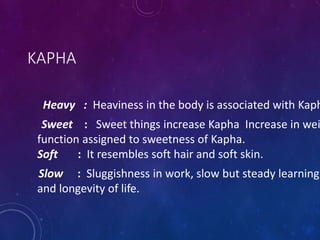
Heavy : Heaviness in the body is associated with Kaph
Sweet : Sweet things increase Kapha Increase in wei
function assigned to sweetness of Kapha.
Soft : It resembles soft hair and soft skin.
Slow : Sluggishness in work, slow but steady learning
and longevity of life.
TYPES OF DOSHAS
Each Dosha is further divided into five types depending on the place where it is
located (site) and the functions (action) it carries out.
TYPES OF VATA
PRANA VAYU
Site:
Brain, Nose, Throat
Site of action:
Head is the vital performer of Vata.
Prana Vayu performs vital function of respiration,
Heart functions, emotions and all the sense
stimulation come under direct control of this type.
UADANA VAYU
Site: -
Chest and throat.
Site of action:
Nose, Umbilical region and throat
• It acts in upward direction.
• It is mainly associated with orientation of speech.
• Production of energy and power in the body are linked with Udan
• It regulates of respiration.
SAMANA VAYU
Site:
Gastrointestinal tract.
Site of action:
Gastrointestinal tract.
• Mixing of ingested food with digestive juices and enzymes that
required to act on food material is the prime function of this type.
• Regulates peristaltic movements and appropriate secretion of
the digestive system.
VYANA VAYU
Site of action:
Whole body
• This vayu flows in pranic channels called nadis & infl
other vayu
Performs functions involving al
systems and each and every cell.
• It maintains the blood circulation in the physical body&
body shape, flexibility & sensitivity
• Is responsible for nerve impulse conduction & the perc
touch by means of skin.
Maintains the rhythm of the heartbeats, dilatation and co
APANA VAYU
Site:
Pelvis, Urinary Tract and the Reproductive system
Site of action :
Pelvic Urinary Tract and Reproductive system.
• This acts in downward direction.
• Responsible for elimination of waste products like urine and stoo
• For passage of menstruation bleed every month and for sexual f
TYPES OF PITTA
PACHAK PITTA
Site:
Stomach & small intestines.
• Responsible for digestion. The efficacy of digestion is controlled by making it hot,
slow, more or less
• The smallest, atomic types of cells receive the nutrient through the digestion and it
differentiates food into nutrients and waste products.
RANJAKA PITTA
Site:
Liver, spleen, liver red blood cells.
• The complex process of production of blood cells, balancing blood chemistry.
• Gives pigmentation to the skin & the red color to the blood
• Supply of nutrients to the organs through the circulation are all controlled and
regulated by it.
ALOCHAKA PITTA
Site:
Eyes
Maintains good Sight and Vision.
• It performs the actual process of vision.
• Any vision related disorder irrespective of anatomical structure involved is associated w
SADHAKA PITTA
Site:
Heart
• It controls the memory and contenment of the person.
• The dharma, artha, kama and moksha are being controlled by it, as the heart is the main
place for securing all these.
• The intellect, memory and the retention are all controlled by the sadhaka pitta.
The feelings of anger, happiness, love and devotion are associated with Sadhaka Pitta.
BHRAJAKA PITTA
Site:
Skin
Gives the natural glow, luster, color and brightness to the skin.
TYPES OF KAPHA
The primary functions of Kapha are structural stability and to bring about moistness/lubric
Kapha acts as lubricating and/or insulating material between the surfaces where maximu
expected.
KLEDAKA KAPHA
Site:
Stomach
• It is situated between the inner linings of the mucous m
of the stomach.
• It lubricates the food, helps them to mix with juices & fo
protective covering over the inner line of gastric mucosa
AVALAMBAKA KAPHA
Site:
Chest, lungs
• It keeps the chest, lungs, and back very strong.
• It facilitates strong muscles and protects the heart.
BODHAKA KAPHA
Site:
Tongue
• Helps in the identification of tastes.
• Salivation and primary lubrication of food are its prime functions.
SHLESHAKA KAPHA
Site:
Joints
• It lubricates every joint in the body.
• The union among the cells is controlled by shleshaka kapha.
• Keeps the joints and tissues well lubricated.
TARPAKA KAPHA
Site:
Head and sinus cavities.
Keeps the nose, mouth, eyes moist and well protected.
VITTATED DOSHAS
• Vittated Prana Vayu : Asthma
• Vittated Samana Vayu : Indigestion
• Vittated pachak Pitta : I.B.S,indigestion
• Vittated Ranjak Pitta : Anemia
• Vittated Shleshaka Kapha : Arthritis
• Vittated Bodhaka Kapha : Loss of taste.
SYMTOMS OF VATA IMBALANCE
• Prana Vata - Worries, overactive mind, sleep
problems, difficulty in breathing.
• Udana Vata - Dry coughs, sore throats, earaches,
general fatigue.
• Samana Vata - Slow or rapid digestion, flalulence,
intestinal cramps, poor assimilation, weak tissues.
• Apana Vata - Intestinal cramps, menstrual
problems, lower back pain, irregularity, diarrhea,
constipation, flatulence,infertility.
• Vyana Vata - Dry or rough skin, nervousness, poor
blood flow, stress-related problems.
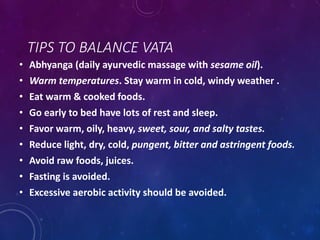
TIPS TO BALANCE VATA
• Abhyanga (daily ayurvedic massage with sesame oil).
• Warm temperatures. Stay warm in cold, windy weather .
• Eat warm & cooked foods.
• Go early to bed have lots of rest and sleep.
• Favor warm, oily, heavy, sweet, sour, and salty tastes.
• Reduce light, dry, cold, pungent, bitter and astringent foods.
• Avoid raw foods, juices.
• Fasting is avoided.
• Excessive aerobic activity should be avoided.
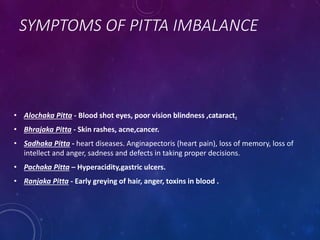
SYMPTOMS OF PITTA IMBALANCE
• Alochaka Pitta - Blood shot eyes, poor vision blindness ,cataract.
• Bhrajaka Pitta - Skin rashes, acne,cancer.
• Sadhaka Pitta - heart diseases. Anginapectoris (heart pain), loss of memory, loss of
intellect and anger, sadness and defects in taking proper decisions.
• Pachaka Pitta – Hyperacidity,gastric ulcers.
• Ranjaka Pitta - Early greying of hair, anger, toxins in blood .
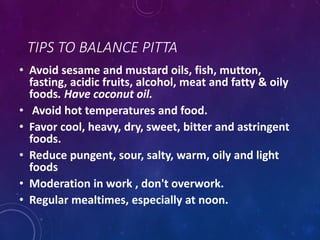
TIPS TO BALANCE PITTA
• Avoid sesame and mustard oils, fish, mutton,
fasting, acidic fruits, alcohol, meat and fatty & oily
foods. Have coconut oil.
• Avoid hot temperatures and food.
• Favor cool, heavy, dry, sweet, bitter and astringent
foods.
• Reduce pungent, sour, salty, warm, oily and light
foods
• Moderation in work , don't overwork.
• Regular mealtimes, especially at noon.
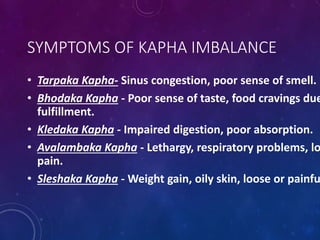
SYMPTOMS OF KAPHA IMBALANCE
• Tarpaka Kapha- Sinus congestion, poor sense of smell.
• Bhodaka Kapha - Poor sense of taste, food cravings due
fulfillment.
• Kledaka Kapha - Impaired digestion, poor absorption.
• Avalambaka Kapha - Lethargy, respiratory problems, lo
pain.
• Sleshaka Kapha - Weight gain, oily skin, loose or painfu
TIPS TO BALANCE KAPHA
• Vigorous regular exercise.
• Warm temperatures ,Stay warm in cold.
• Fresh fruits, vegetables and legumes.
• Favor pungent, bitter, astringent, light, dry and warm foods.
• Reduce heavy, oily, cold, sweet, sour and salty foods.
• Early to bed, early to rise.

AYURVEDA.pptx

  • 2.
    WHAT IS AYURVEDA AHOLISTIC SCIENCE OF LIFE, whose principles are applied to maintain Health of the---- • Body • Mind • Soul
  • 3.
    AYURVEDA Āyus + Veda= Ayurveda Ayus means -> longevity(refers to all aspects of life from birth to death) Veda means - > “ knowledge” or “science”(at the deepest level).
  • 4.
    EIGHT BRANCHES OFAYURVEDA • Kaaya-chikitsa --- Internal medicine. • Kaumarabhrtyam --- Pediatrics. • Shalya-chikitsa --- Surgery. • Shalakaya tantra --- Eye & ENT. • Bhuta vidya ---- Demonic possession(psychiatry) • Agadtantra --- Toxicology. • Rasayana --- Immunity and rejuvenation. • Vajikaranam --- Aphrodisiacs & improving
  • 5.
    AIM OF AYURVEDA •To promote, protect and maintain the health of a healthy person. • To treat and prevent the disease of a person.
  • 6.
  • 7.
    BASIC PRINCIPLES OFAYURVEDA • Theory of Pancha mahabhuta (five basic elements). • Tridoshas (Three doshas): Regulator of body metabolism • Driving force - Agni (biological fire). • Application of Ayurvedic fundament for betterment of our
  • 8.
    PANCHMAHABHOOTA All matter in theuniverse is comprised of five elements. These are known as panchamahabhuta: • Akasha -ether - auditory sensation of sound (sharsda) - sensory organ - ear. • Vayu - air - sensation of touch (sparsha) – sensory organ- skin • Thejo - fire - visual impute of colour (rupa) - sensory organ- eyes • Apo - water - taste sensation (rasa) - sensory organ- tongue • Pruthuvi - earth - sensation of smell &odour (gandha) - sensory organ - nose
  • 9.
  • 10.
  • 11.
  • 12.
  • 13.
  • 14.
    CHARACTERS OF PANCHAMAHABHOOTA • Humanbody has definite mass :Prithvi • Human body has definite motion : Vayu • It contains several structures :Akaasha • It shows definite color, brightness and accomplishes digestion :Teja • All structure are have strong bonding with each other :Jala
  • 15.
    PANCHAMAHABHOOTA & THREE DOSHAS(HUMOURS) The three Doshas have the following composition Panchamahabhootas are concerned: • Vata - Space + Air • Pitta - Fire + Water • Kapha - Water + Earth
  • 16.
    PANCHMAHABHOOTAS & PERCEPTIONO TASTES Each taste that is perceived by the tongue has also been said to co Panchamahabhootas in different proportions. A definite combinat basic elements forms 6 types of taste. These are as follows : • Sweet - Earth + water----Banana., milk, natural sugar. • Sour - Earth + Fire ----Yogurt , fermented foods , peache cherries, apples • Salt - Fire + Water ---- Salts • Bitter - Fire + Air ----spinach , coffee, neem , orange p vegs • Pungent - Fire+ space ---- spices(black pepper, ginger) • Astringent - Earth + Air --- amla, arjuna, jamun
  • 17.
    POST-DIGESTIVE EFFECT Sweet andSalty Rasa ------ Sweet Vipaka Sour Rasa Rasa ------ Sour Vipaka Pungent ,Bitter and Astringent Rasa ---- Pungent Vipaka
  • 18.
    TRIDOSHAS • VATA DOSHA •PITTA DOSHA • KAPHA DOSHA
  • 19.
    DOSHAS IN RELATIONTO BODY PARTS
  • 20.
    DOSHAS AND STAGESOF LIFE • Childhood ----- Kapha dominance • Young age ----- Pitta dominance • Old age ------ Vata dominance
  • 21.
    DOSHAS AND TIMEOF THE DAY
  • 22.
  • 23.
    TRIDOSHA WITH TASTEAGENTS Dosha To Increase, Supplement To Decrease, Calm Vata pungent, bitter, astringent sweet, sour, salt Kapha sweet, sour, salt pungent, bitter, astringent Pitta sour, salt, pungent sweet, bitter, astringent
  • 24.
    DOSHAS AND THEIRFUNCTIONS • Vata --- separation/movement • Pitta --- conversion/transformation • Kapha --- cohesion/liquidity
  • 25.
    FUNCTIONS OF VATA Vatapromotes and regulates the activities of the mind. Vata governs the intestinal motility facilitating the downward movement of food we consume. Vata governs whole process of respiration. Vata generates consciousness and expression. Vata stimulates the activities of Pitta and Kapha . Vata assists in the fusion of the sperm and ovum to create the zygote, ensures it's healthy development and expulsion from the uterus. Vata stimulates the expulsion of wastes from the body.
  • 26.
    FUNCTIONS OF PITTA Pittagenerates and maintains some natural urges, like hunger, thirst. Pitta represents various secretions, responsible for digestion. Pitta regulates the complexion and luster of skin. Pitta helps in the maintenance of vision. Pitta supports certain mental phenomenon like intellectual comprehension, Conviction, courage. It causes "Thermo-regulation" ,which is an important function of Pitta.
  • 27.
    FUNCTIONS OF KAPHA Kaphamaintains the structural integrity and confines Individual organs to their specific location. It protects the bodily organs against physiological injury. Kapha imparts immunity against diseases. It maintains the fluid balance. Mental phenomenon like, intellectual stability, determinations are governed by Kapha.
  • 28.
  • 29.
    VATA Dry : Itresembles dryness of skin and dull hair. Quick : Quick ability to learn, restless in activity, impulsive mind short sleep, and fast speech. Cold : Cold increases Vata. Light : Fasting for several days increase Vata and makes body ligh
  • 30.
    PITTA Hot : Leadsto inflammation, fever, flushed hot skin, short tem anger. Sharp : Sharp body and mind, speech, sharp learning ability. Moist : Sweating. Fluid : Pitta is in a liquid state for example like juices from stomac pancreas. Sour : Bad breath, body odor are a result of this property of Pit FERMENTATION) Bright & Shiny :Brightness and shine in the body is related with Pi which gives the body shiny luster and brightness.
  • 31.
    KAPHA Heavy : Heavinessin the body is associated with Kaph Sweet : Sweet things increase Kapha Increase in wei function assigned to sweetness of Kapha. Soft : It resembles soft hair and soft skin. Slow : Sluggishness in work, slow but steady learning and longevity of life.
  • 32.
    TYPES OF DOSHAS EachDosha is further divided into five types depending on the place where it is located (site) and the functions (action) it carries out.
  • 33.
    TYPES OF VATA PRANAVAYU Site: Brain, Nose, Throat Site of action: Head is the vital performer of Vata. Prana Vayu performs vital function of respiration, Heart functions, emotions and all the sense stimulation come under direct control of this type.
  • 34.
    UADANA VAYU Site: - Chestand throat. Site of action: Nose, Umbilical region and throat • It acts in upward direction. • It is mainly associated with orientation of speech. • Production of energy and power in the body are linked with Udan • It regulates of respiration.
  • 35.
    SAMANA VAYU Site: Gastrointestinal tract. Siteof action: Gastrointestinal tract. • Mixing of ingested food with digestive juices and enzymes that required to act on food material is the prime function of this type. • Regulates peristaltic movements and appropriate secretion of the digestive system.
  • 36.
    VYANA VAYU Site ofaction: Whole body • This vayu flows in pranic channels called nadis & infl other vayu Performs functions involving al systems and each and every cell. • It maintains the blood circulation in the physical body& body shape, flexibility & sensitivity • Is responsible for nerve impulse conduction & the perc touch by means of skin. Maintains the rhythm of the heartbeats, dilatation and co
  • 37.
    APANA VAYU Site: Pelvis, UrinaryTract and the Reproductive system Site of action : Pelvic Urinary Tract and Reproductive system. • This acts in downward direction. • Responsible for elimination of waste products like urine and stoo • For passage of menstruation bleed every month and for sexual f
  • 38.
    TYPES OF PITTA PACHAKPITTA Site: Stomach & small intestines. • Responsible for digestion. The efficacy of digestion is controlled by making it hot, slow, more or less • The smallest, atomic types of cells receive the nutrient through the digestion and it differentiates food into nutrients and waste products.
  • 39.
    RANJAKA PITTA Site: Liver, spleen,liver red blood cells. • The complex process of production of blood cells, balancing blood chemistry. • Gives pigmentation to the skin & the red color to the blood • Supply of nutrients to the organs through the circulation are all controlled and regulated by it.
  • 40.
    ALOCHAKA PITTA Site: Eyes Maintains goodSight and Vision. • It performs the actual process of vision. • Any vision related disorder irrespective of anatomical structure involved is associated w
  • 41.
    SADHAKA PITTA Site: Heart • Itcontrols the memory and contenment of the person. • The dharma, artha, kama and moksha are being controlled by it, as the heart is the main place for securing all these. • The intellect, memory and the retention are all controlled by the sadhaka pitta. The feelings of anger, happiness, love and devotion are associated with Sadhaka Pitta.
  • 42.
    BHRAJAKA PITTA Site: Skin Gives thenatural glow, luster, color and brightness to the skin.
  • 43.
    TYPES OF KAPHA Theprimary functions of Kapha are structural stability and to bring about moistness/lubric Kapha acts as lubricating and/or insulating material between the surfaces where maximu expected.
  • 44.
    KLEDAKA KAPHA Site: Stomach • Itis situated between the inner linings of the mucous m of the stomach. • It lubricates the food, helps them to mix with juices & fo protective covering over the inner line of gastric mucosa
  • 45.
    AVALAMBAKA KAPHA Site: Chest, lungs •It keeps the chest, lungs, and back very strong. • It facilitates strong muscles and protects the heart.
  • 46.
    BODHAKA KAPHA Site: Tongue • Helpsin the identification of tastes. • Salivation and primary lubrication of food are its prime functions.
  • 47.
    SHLESHAKA KAPHA Site: Joints • Itlubricates every joint in the body. • The union among the cells is controlled by shleshaka kapha. • Keeps the joints and tissues well lubricated.
  • 48.
    TARPAKA KAPHA Site: Head andsinus cavities. Keeps the nose, mouth, eyes moist and well protected.
  • 49.
    VITTATED DOSHAS • VittatedPrana Vayu : Asthma • Vittated Samana Vayu : Indigestion • Vittated pachak Pitta : I.B.S,indigestion • Vittated Ranjak Pitta : Anemia • Vittated Shleshaka Kapha : Arthritis • Vittated Bodhaka Kapha : Loss of taste.
  • 50.
    SYMTOMS OF VATAIMBALANCE • Prana Vata - Worries, overactive mind, sleep problems, difficulty in breathing. • Udana Vata - Dry coughs, sore throats, earaches, general fatigue. • Samana Vata - Slow or rapid digestion, flalulence, intestinal cramps, poor assimilation, weak tissues. • Apana Vata - Intestinal cramps, menstrual problems, lower back pain, irregularity, diarrhea, constipation, flatulence,infertility. • Vyana Vata - Dry or rough skin, nervousness, poor blood flow, stress-related problems.
  • 51.
    TIPS TO BALANCEVATA • Abhyanga (daily ayurvedic massage with sesame oil). • Warm temperatures. Stay warm in cold, windy weather . • Eat warm & cooked foods. • Go early to bed have lots of rest and sleep. • Favor warm, oily, heavy, sweet, sour, and salty tastes. • Reduce light, dry, cold, pungent, bitter and astringent foods. • Avoid raw foods, juices. • Fasting is avoided. • Excessive aerobic activity should be avoided.
  • 52.
    SYMPTOMS OF PITTAIMBALANCE • Alochaka Pitta - Blood shot eyes, poor vision blindness ,cataract. • Bhrajaka Pitta - Skin rashes, acne,cancer. • Sadhaka Pitta - heart diseases. Anginapectoris (heart pain), loss of memory, loss of intellect and anger, sadness and defects in taking proper decisions. • Pachaka Pitta – Hyperacidity,gastric ulcers. • Ranjaka Pitta - Early greying of hair, anger, toxins in blood .
  • 53.
    TIPS TO BALANCEPITTA • Avoid sesame and mustard oils, fish, mutton, fasting, acidic fruits, alcohol, meat and fatty & oily foods. Have coconut oil. • Avoid hot temperatures and food. • Favor cool, heavy, dry, sweet, bitter and astringent foods. • Reduce pungent, sour, salty, warm, oily and light foods • Moderation in work , don't overwork. • Regular mealtimes, especially at noon.
  • 54.
    SYMPTOMS OF KAPHAIMBALANCE • Tarpaka Kapha- Sinus congestion, poor sense of smell. • Bhodaka Kapha - Poor sense of taste, food cravings due fulfillment. • Kledaka Kapha - Impaired digestion, poor absorption. • Avalambaka Kapha - Lethargy, respiratory problems, lo pain. • Sleshaka Kapha - Weight gain, oily skin, loose or painfu
  • 55.
    TIPS TO BALANCEKAPHA • Vigorous regular exercise. • Warm temperatures ,Stay warm in cold. • Fresh fruits, vegetables and legumes. • Favor pungent, bitter, astringent, light, dry and warm foods. • Reduce heavy, oily, cold, sweet, sour and salty foods. • Early to bed, early to rise.