
Vascular anomalies, from
diagnosis to treatment
Mohamed M.A. Zaitoun, MD
Associate Professor of Interventional Radiology
Faculty of Medicine, Zagazig University, Egypt
FINR-Switzerland
Interventional Radiology Unit, Zagazig University Hospitals, Egypt
www.zaitounclinic.com
zaitoun2015@gmail.com
Disclosure
I have no actual or potential conflict of
interest in relation to this presentation.
Introduction
Classifications
Hemangiomas
Vascular Malformations
Post Treatment Appearance
Introduction
Classifications
Hemangiomas
Vascular Malformations
Post Treatment Appearance
Introduction
Vascular malformations and tumors comprise a
wide, heterogeneous spectrum of lesions that
involve all parts of the body and can cause
significant morbidity and even mortality in
both adults and children.
Vascular lesions represent the most common
cause of pediatric soft-tissue masses.
Navarro OM, Laffan EE, Ngan BY. Pediatric softtissue tumors and pseudotumors: MR imaging features with pathologic correlation. I.
Imaging approach, pseudotumors, vascular lesions, and adipocytic tumors. RadioGraphics 2009;29(3):88
The term hemangioma has been applied generically
to vascular lesions of differing cause and clinical
behavior.
Occasionally, confusion about terminology and
imaging guidelines continues to be responsible
for improper diagnosis and subsequent
treatment.
Since treatment strategy depends on the type of
malformation, correct diagnosis and classification
of a vascular anomaly are crucial.
Mulliken JB, Fishman SJ, Burrows PE. Vascular anomalies. Curr Probl Surg 2000;37(8):517–584.
. Hand JL, Frieden IJ. Vascular birthmarks of infancy: resolving nosologic confusion. Am J Med Genet 2002;108(4):257–264.
Our objective is to review the current
classification of vascular anomalies, to
describe the role of imaging in their diagnosis,
to summarize their distinctive
histopathogenic, clinical and imaging features,
and to discuss the treatment options.
Introduction
Classifications
Hemangiomas
Vascular Malformations
Post Treatment Appearance
Classification
Several classification systems have been
proposed for vascular anomalies:
1-Mulliken and Glowacki Classification
2-Jackson et al Classification
3-ISSVA Classification
1-Mulliken and Glowacki Classification
It is a biologic classification based on cellular
turnover, histologic features, natural history,
and physical findings.
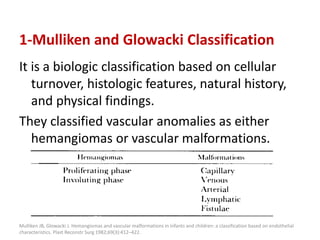
They classified vascular anomalies as either
hemangiomas or vascular malformations.
Mulliken JB, Glowacki J. Hemangiomas and vascular malformations in infants and children: a classification based on endothelial
characteristics. Plast Reconstr Surg 1982;69(3):412–422.
Hemangiomas are auto-involutive, benign,
vascular tumors of infancy and childhood,
characterized by rapid growth of endothelial
cells and subsequent slow involution.
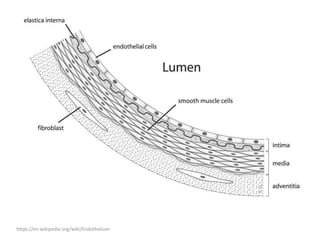
In comparison, vascular malformations arise
from dysplastic vessels without endothelial
proliferation.
They never regress, and, depending on flow
(high- or low-flow).
According to the preponderant vascular
channels, vascular malformations are
classified as venous, lymphatic, capillary,
arterial, or combined.
Mulliken JB, Glowacki J. Hemangiomas and vascular malformations in infants and children: a classification based on endothelial
characteristics. Plast Reconstr Surg 1982;69(3):412–422.
Moukaddam H, Pollak J, Haims AH. MRI characteristics and classification of peripheral vascular malformations and tumors. Skeletal Radiol
2009;38(6): 535–547.
Dubois J, Alison M. Vascular anomalies: what a radiologist needs to know. Pediatr Radiol 2010;40(6): 895–905.
https://en.wikipedia.org/wiki/Endothelium
2-Jackson et al Classification
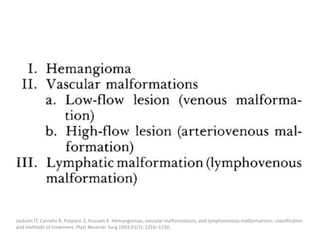
in 1993 Jackson et al proposed a radiologic
classification formulated in combination with
the biologic classification of Mulliken and
Glowacki.
This calssification subcategorized vascular
malformations according to their flow
dynamics as low-flow or high-flow
malformations.
Jackson IT, Carreño R, Potparic Z, Hussain K. Hemangiomas, vascular malformations, and lymphovenous malformations: classification
and methods of treatment. Plast Reconstr Surg 1993;91(7): 1216–1230.
3-ISSVA Classification
In 1996, these systems were adopted and
expanded by the International Society for the
Study of Vascular Anomalies (ISSVA).
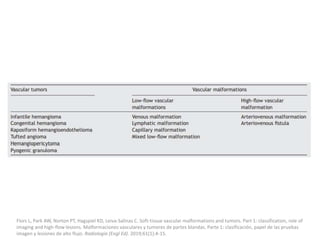
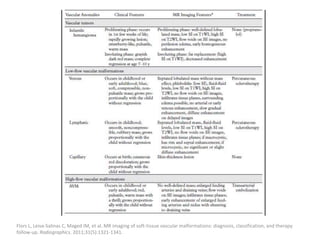
Two categories of vascular anomalies are
considered:
a) Vascular tumors (with infantile hemangioma
being the most common).
b) Vascular malformations.
Vascular malformations are subcategorized
according to their flow dynamics as:
(a) Low-flow malformations:
Venous
Lymphatic
Capillary
Capillary-venous
Capillary-lymphatic-venous.
(b) High-flow malformations:
Arteriovenous malformations (AVMs)
Arteriovenous fistulas (AVFs).
Thus, any malformation with an arterial
component is considered high flow, while
those without an arterial component are
considered low flow.
Enjolras O. Classification and management of the various superficial vascular anomalies: hemangiomas and vascular malformations. J
Dermatol 1997;24 (11):701–710.
Flors L, Park AW, Norton PT, Hagspiel KD, Leiva-Salinas C. Soft-tissue vascular malformations and tumors. Part 1: classification, role of
imaging and high-flow lesions. Malformaciones vasculares y tumores de partes blandas. Parte 1: clasificación, papel de las pruebas
imagen y lesiones de alto flujo. Radiologia (Engl Ed). 2019;61(1):4-15.
Flors L, Leiva-Salinas C, Maged IM, et al. MR imaging of soft-tissue vascular malformations: diagnosis, classification, and therapy
follow-up. Radiographics. 2011;31(5):1321-1341.
Introduction
Classifications
Hemangiomas
Vascular Malformations
Post Treatment Appearance
Hemangiomas
The term hemangioma is used to designate a
group of benign endothelial neoplasms that
includes:
1-Infantile Hemangioma (common hemangioma
of infancy)
2-Congenital Hemangioma
3-Kaposiform Hemangioendothelioma
Navarro OM, Laffan EE, Ngan BY. Pediatric softtissue tumors and pseudotumors: MR imaging features with pathologic correlation. I.
Imaging approach, pseudotumors, vascular lesions, and adipocytic tumors. RadioGraphics 2009;29(3):887–906
1-Infantile Hemangioma
Incidence
Clinical presentation
Imaging features
Treatment
Incidence
The most common vascular tumor of infancy,
with a prevalence of about 2-3% in all children
and a female predominance (female-to-male
ratio, 3-5:1).
The prevalence is even higher (10%) in
premature infants of very low birth weight.
Navarro OM, Laffan EE, Ngan BY. Pediatric softtissue tumors and pseudotumors: MR imaging features with pathologic correlation. I.
Imaging approach, pseudotumors, vascular lesions, and adipocytic tumors. RadioGraphics 2009;29(3):887–9
Ernemann U, Kramer U, Miller S, et al. Current concepts in the classification, diagnosis and treatment of vascular anomalies. Eur J Radiol
2010;75 (1):2–11.
Clinical presentation
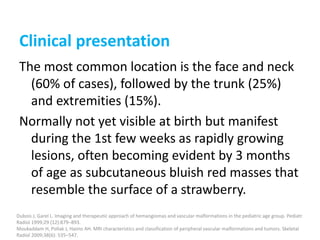
The most common location is the face and neck
(60% of cases), followed by the trunk (25%)
and extremities (15%).
Normally not yet visible at birth but manifest
during the 1st few weeks as rapidly growing
lesions, often becoming evident by 3 months
of age as subcutaneous bluish red masses that
resemble the surface of a strawberry.
Dubois J, Garel L. Imaging and therapeutic approach of hemangiomas and vascular malformations in the pediatric age group. Pediatr
Radiol 1999;29 (12):879–893.
Moukaddam H, Pollak J, Haims AH. MRI characteristics and classification of peripheral vascular malformations and tumors. Skeletal
Radiol 2009;38(6): 535–547.
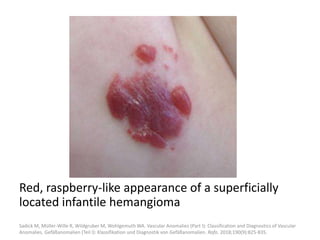
Red, raspberry-like appearance of a superficially
located infantile hemangioma
Sadick M, Müller-Wille R, Wildgruber M, Wohlgemuth WA. Vascular Anomalies (Part I): Classification and Diagnostics of Vascular
Anomalies. Gefäßanomalien (Teil I): Klassifikation und Diagnostik von Gefäßanomalien. Rofo. 2018;190(9):825-835.
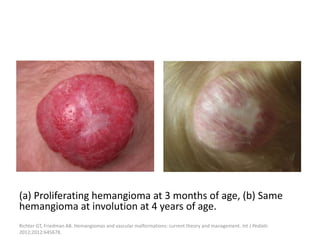
(a) Proliferating hemangioma at 3 months of age, (b) Same
hemangioma at involution at 4 years of age.
Richter GT, Friedman AB. Hemangiomas and vascular malformations: current theory and management. Int J Pediatr.
2012;2012:645678.
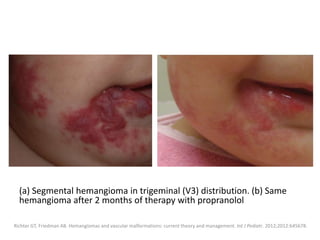
(a) Segmental hemangioma in trigeminal (V3) distribution. (b) Same
hemangioma after 2 months of therapy with propranolol
Richter GT, Friedman AB. Hemangiomas and vascular malformations: current theory and management. Int J Pediatr. 2012;2012:645678.
Reflecting the characteristic high-flow
component of this phase, they show bruit,
pulsatility, and warmth.
After a proliferating phase in the 1st few
months, a slow but constant regression
(involuting phase) can be seen, with the
process usually being completed by 7-10 years
of age.
Enjolras O. Classification and management of the various superficial vascular anomalies: hemangiomas and vascular malformations. J
Dermatol 1997;24 (11):701–710.
Ernemann U, Kramer U, Miller S, et al. Current concepts in the classification, diagnosis and treatment of vascular anomalies. Eur J
Radiol 2010;75 (1):2–11.
During that time, the hemangioma changes
color to grayish dark red, loses its toughness,
and alters in shape, developing into a
fibrofatty residuum.
Enjolras O. Classification and management of the various superficial vascular anomalies: hemangiomas and vascular malformations. J
Dermatol 1997;24 (11):701–710.
Ernemann U, Kramer U, Miller S, et al. Current concepts in the classification, diagnosis and treatment of vascular anomalies. Eur J
Radiol 2010;75 (1):2–11.
Histologically, in the proliferating phase,
hemangiomas consist of hyperplastic
proliferating endothelial cells that form
syncytial masses with increased turnover and
increased number of mast cells.
Later, the involuting phase shows progressive
perivascular deposition of fibrofatty tissue and
thinning of the endothelial lining.
Dubois J, Garel L. Imaging and therapeutic approach of hemangiomas and vascular malformations in the pediatric age group. Pediatr
Radiol 1999;29 (12):879–893.
Moukaddam H, Pollak J, Haims AH. MRI characteristics and classification of peripheral vascular malformations and tumors. Skeletal
Radiol 2009;38(6): 535–547.
Imaging features
a) Ultrasound:
The appearance on gray-scale US varies, but a
solid soft tissue mass is identified with
characteristic high vascularity on color
Doppler.
Arterial and venous waveforms can be seen on
spectral Doppler ultrasound.
The arterial flow is typically of low resistance
with relatively high velocities.
During the involuting phase, they show
decreased vascularity and increased vascular
resistance.
Paltiel HJ, Burrows PE, Kozakewich HP, Zurakowski D, Mulliken JB. Soft-tissue vascular anomalies: utility of US for diagnosis. Radiology.
2000;214:747---54.
Johnson CM, Navarro OM. Clinical and sonographic features of pediatric soft-tissue vascular anomalies part 2: vascular malformations.
Pediatr Radiol. 2017;47:1196---208
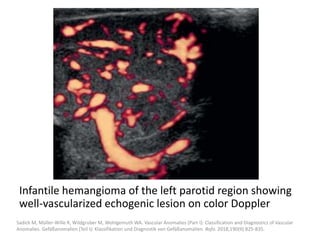
Infantile hemangioma of the left parotid region showing
well-vascularized echogenic lesion on color Doppler
Sadick M, Müller-Wille R, Wildgruber M, Wohlgemuth WA. Vascular Anomalies (Part I): Classification and Diagnostics of Vascular
Anomalies. Gefäßanomalien (Teil I): Klassifikation und Diagnostik von Gefäßanomalien. Rofo. 2018;190(9):825-835.
b) MRI: Differ according to the biologic phase.
Proliferating phase:
they present as well-defined masses, hypointense
on T1 and hyperintense on T2, often with
presence of internal flow voids on spin-echo (SE)
imaging reflecting high-flow vessels.
High-flow vessels appear hyperintense on GRE
permitting the distinction with phlebolitis or
other calcifications, which are hypointense on all
imaging sequences.
. Flors L, Leiva-Salinas C, Maged IM, Norton PT, Matsumoto AH, Angle JF, et al. MR imaging of soft-tissue vascular malformations:
diagnosis, classification, and therapy follow-up. Radiographics. 2011;31:321---40 [discussion 1340-1].
perilesional edema should never be seen; if
present, other soft tissue tumors (e.g.
metastases from neuroblastoma or
rhabdomyosarcoma among many others)
should be suspected and biopsy is needed.
Abernethy LJ. Classification and imaging of vascular malformations in children. Eur Radiol. 2003;13:24
Dubois J, Alison M. Vascular anomalies: what a radiologist needs to know. Pediatr Radiol. 2010;40:895---905.
Early homogenous contrast enhancement is
characteristic during the proliferative phase,
and large feeding arteries are usually depicted
with time-resolved MRA.
Despite the high-flow nature of the
hemangioma during this phase, arteriovenous
shunting is not seen, whereas it is in AVMs.
Navarro OM, Laffan EE, Ngan BY. Pediatric soft-tissue tumors and pseudo-tumors: MR imaging features with pathologic correlation: part
1. Imaging approach, pseudotumors, vascular lesions, and adipocytic tumors. Radiographics. 2009;29: 887---906.
Moukaddam H, Pollak J, Haims AH. MRI characteristics and classification of peripheral vascular malformations and tumors. Skeletal Radiol
2009;38(6): 535–547.
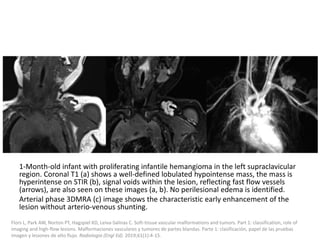
1-Month-old infant with proliferating infantile hemangioma in the left supraclavicular
region. Coronal T1 (a) shows a well-defined lobulated hypointense mass, the mass is
hyperintense on STIR (b), signal voids within the lesion, reflecting fast flow vessels
(arrows), are also seen on these images (a, b). No perilesional edema is identified.
Arterial phase 3DMRA (c) image shows the characteristic early enhancement of the
lesion without arterio-venous shunting.
Flors L, Park AW, Norton PT, Hagspiel KD, Leiva-Salinas C. Soft-tissue vascular malformations and tumors. Part 1: classification, role of
imaging and high-flow lesions. Malformaciones vasculares y tumores de partes blandas. Parte 1: clasificación, papel de las pruebas
imagen y lesiones de alto flujo. Radiologia (Engl Ed). 2019;61(1):4-15.
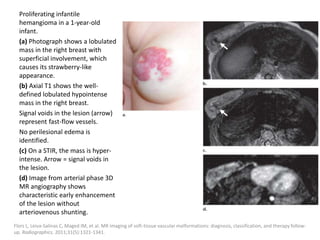
Proliferating infantile
hemangioma in a 1-year-old
infant.
(a) Photograph shows a lobulated
mass in the right breast with
superficial involvement, which
causes its strawberry-like
appearance.
(b) Axial T1 shows the well-
defined lobulated hypointense
mass in the right breast.
Signal voids in the lesion (arrow)
represent fast-flow vessels.
No perilesional edema is
identified.
(c) On a STIR, the mass is hyper-
intense. Arrow = signal voids in
the lesion.
(d) Image from arterial phase 3D
MR angiography shows
characteristic early enhancement
of the lesion without
arteriovenous shunting.
Flors L, Leiva-Salinas C, Maged IM, et al. MR imaging of soft-tissue vascular malformations: diagnosis, classification, and therapy follow-
up. Radiographics. 2011;31(5):1321-1341.
Involuting phase:
They appear as heterogeneous masses with
progressive deposition of internal fat
(hyperintense foci on T1), decreased flow
voids when compared to the proliferative
phase, and more heterogeneous contrast
enhancement.
Navarro OM, Laffan EE, Ngan BY. Pediatric soft-tissue tumors and pseudo-tumors: MR imaging features with pathologic correlation: part
1. Imaging approach, pseudotumors, vascular lesions, and adipocytic tumors. Radiographics. 2009;29: 887---906.
Restrepo R. Multimodality imaging of vascular anomalies. Pediatr Radiol. 2013;43 Suppl. 1:S141---54
Finally, after complete involution, a residual scar
is seen which appears hypointense on both T1
and T2.
Restrepo R. Multimodality imaging of vascular anomalies. Pediatr Radiol. 2013;43 Suppl. 1:S141—54.
Treatment
In most cases, no treatment is required because
of spontaneous involution.
Treatment may be needed when the
hemangioma is symptomatic or occurs in
regions where there is possible secondary loss
of function or lifetime aesthetic impairment.
Flors L, Park AW, Norton PT, Hagspiel KD, Leiva-Salinas C. Soft-tissue vascular malformations and tumors. Part 1: classification, role of
imaging and high-flow lesions. Malformaciones vasculares y tumores de partes blandas. Parte 1: clasificación, papel de las pruebas
imagen y lesiones de alto flujo. Radiologia (Engl Ed). 2019;61(1):4-15.
Medical treatment is usually attempted first,
with propranolol used as a first-line therapy
with excellent results.
it reduces the expression of VEGF and other
proangiogenic factors while also inducing
apoptosis of vascular endothelial cells;
excellent results have been reported.
Léauté-Labrèze C, Taïeb A. Efficacy of betablockers in infantile capillary haemangiomas: the physiopathological significance and
therapeutic consequences [in French]. Ann Dermatol Venereol 2008;135(12):860–862.
Dubois J, Alison M. Vascular anomalies: what a radiologist needs to know. Pediatr Radiol 2010;40(6): 895–905.
Mulligan PR, Prajapati HJ, Martin LG, Patel TH. Vascular anomalies: classification, imaging characteristics and implications for
interventional radiology treatment approaches. Br J Radiol. 2014;87:20130392.
When propranolol is contraindicated, oral
prednisolone can be attempted, with complete
involution rate of 30% and stop progression in
40% of cases.
Embolization and surgery are reserved for
unresponsive cases.
Embolization can be performed for tumoral growth
control, preoperatively to reduce or minimize
bleeding, and for consumption coagulopathy.
Leaute-Labreze C, Taieb A. Efficacy of beta-blockers in infantile capillary haemangiomas: the physiopathological significance and
therapeutic consequences. Ann Dermatol Venereol. 2008;135:860-2.
Dubois J, Alison M. Vascular anomalies: what a radiologist needs to know. Pediatr Radiol. 2010;40:895-905.
Mulligan PR, Prajapati HJ, Martin LG, Patel TH. Vascular anomalies: classification, imaging characteristics and implications for
interventional radiology treatment approaches. Br J Radiol. 2014;87:20130392.
2-Congenital Hemangioma
Incidence
Clinical presentation
Imaging features
Treatment
Incidence
A much less common vascular tumor, congenital
hemangioma is fully grown and clinically
evident at birth without gender
predominance.
Moukaddam H, Pollak J, Haims AH. MRI characteristics and classification of peripheral vascular malformations and tumors. Skeletal
Radiol 2009;38(6): 535–547.
Navarro OM, Laffan EE, Ngan BY. Pediatric softtissue tumors and pseudotumors: MR imaging features with pathologic correlation. I.
Imaging approach, pseudotumors, vascular lesions, and adipocytic tumors. RadioGraphics 2009;29(3):887–906
Clinical presentation
They typically present as solitary lesions, most
commonly in the head and neck or the
extremities.
Two subtypes are identified:
*Rapidly involuting congenital hemangiomas
(RICHs):
Completely regress during the first 2 years of life.
*Non-involuting congenital hemangiomas (NICHs):
Demonstrate growth proportional to that of the
child without regression.
Restrepo R. Multimodality imaging of vascular anomalies. Pediatr Radiol. 2013;43 Suppl. 1:S141-54
Mulligan PR, Prajapati HJ, Martin LG, Patel TH. Vascular anomalies: classification, imaging characteristics and implications for
interventional radiology treatment approaches. Br J Radiol. 2014;87:20130392.
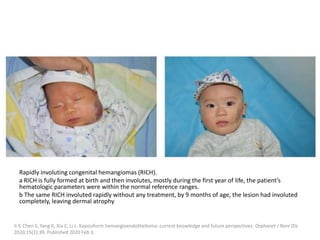
Rapidly involuting congenital hemangiomas (RICH).
a RICH is fully formed at birth and then involutes, mostly during the first year of life, the patient’s
hematologic parameters were within the normal reference ranges.
b The same RICH involuted rapidly without any treatment, by 9 months of age, the lesion had involuted
completely, leaving dermal atrophy
Ji Y, Chen S, Yang K, Xia C, Li L. Kaposiform hemangioendothelioma: current knowledge and future perspectives. Orphanet J Rare Dis.
2020;15(1):39. Published 2020 Feb 3.
Imaging features
Due to important overlap, imaging features
alone do not allow differentiating congenital
from infantile hemangioma, and clinical
history is paramount.
Vascular aneurysms, intravascular thrombi, an
increased venous component, and
arteriovenous shunting are some distinctive
findings.
Navarro OM, Laffan EE, Ngan BY. Pediatric softtissue tumors and pseudotumors: MR imaging features with pathologic correlation. I.
Imaging approach, pseudotumors, vascular lesions, and adipocytic tumors. RadioGraphics 2009;29(3):887–906.
Moukaddam H, Pollak J, Haims AH. MRI characteristics and classification of peripheral vascular malformations and tumors. Skeletal
Radiol 2009;38(6): 535–547.
Dubois J, Alison M. Vascular anomalies: what a radiologist needs to know. Pediatr Radiol 2010;40(6): 895–905.
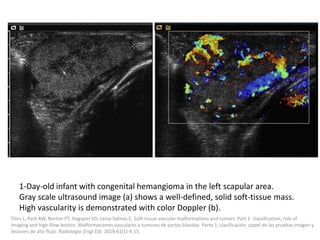
1-Day-old infant with congenital hemangioma in the left scapular area.
Gray scale ultrasound image (a) shows a well-defined, solid soft-tissue mass.
High vascularity is demonstrated with color Doppler (b).
Flors L, Park AW, Norton PT, Hagspiel KD, Leiva-Salinas C. Soft-tissue vascular malformations and tumors. Part 1: classification, role of
imaging and high-flow lesions. Malformaciones vasculares y tumores de partes blandas. Parte 1: clasificación, papel de las pruebas imagen y
lesiones de alto flujo. Radiologia (Engl Ed). 2019;61(1):4-15.
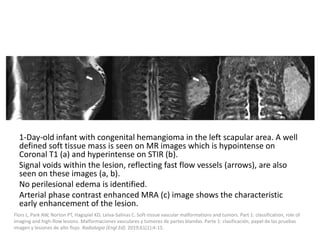
1-Day-old infant with congenital hemangioma in the left scapular area. A well
defined soft tissue mass is seen on MR images which is hypointense on
Coronal T1 (a) and hyperintense on STIR (b).
Signal voids within the lesion, reflecting fast flow vessels (arrows), are also
seen on these images (a, b).
No perilesional edema is identified.
Arterial phase contrast enhanced MRA (c) image shows the characteristic
early enhancement of the lesion.
Flors L, Park AW, Norton PT, Hagspiel KD, Leiva-Salinas C. Soft-tissue vascular malformations and tumors. Part 1: classification, role of
imaging and high-flow lesions. Malformaciones vasculares y tumores de partes blandas. Parte 1: clasificación, papel de las pruebas
imagen y lesiones de alto flujo. Radiologia (Engl Ed). 2019;61(1):4-15.
Treatment
NICH require treatment and surgical resection is
the treatment of choice because embolization
is usually not effective.
Dubois J, Alison M. Vascular anomalies: what a radiologist needs to know. Pediatr Radiol. 2010;40:895-905.
3-Kaposiform Hemangioendothelioma
Incidence
Clinical presentation
Imaging features
Treatment
Incidence
Kaposiform Hemangioendothelioma (KHE) is a
rare locally aggressive tumor, usually present
at birth.
Lalaji TA, Haller JO, Burgess RJ. A case of head and neck kaposiform hemangioendothelioma simulating a malignancy on imaging. Pediatr
Radiol. 2001;31:876---8.
Clinical presentation
They typically occur in the first decade of life, and
most commonly involve the peritoneal or
retroperitoneal space, upper and lower
extremities, and head and neck region.
Patients may present Kasabach-Merritt syndrome
(KMP), a potentially life threatening
thrombocytopenia, anemia and coagulopathy.
The tumor has a very low malignant potential but,
regional nodal metastases can be seen rarely.
Navarro OM, Laffan EE, Ngan BY. Pediatric softtissue tumors and pseudotumors: MR imaging features with pathologic correlation. I.
Imaging approach, pseudotumors, vascular lesions, and adipocytic tumors. RadioGraphics 2009;29(3):88
Moukaddam H, Pollak J, Haims AH. MRI characteristics and classification of peripheral vascular malformations and tumors. Skeletal
Radiol 2009;38(6): 535–547.
The manifestations of KHE are variable and
range from cutaneous lesions with wide
varieties of appearances to deep masses
without cutaneous signs.
In the majority of patients, KHE is a single soft
tissue mass with cutaneous findings that
range from an erythematous papule, plaque,
or nodule to an indurated, purple and firm
tumor.
Croteau SE, Liang MG, Kozakewich HP, Alomari AI, Fishman SJ, Mulliken JB, et al. Kaposiform hemangioendothelioma: atypical features
and risks of Kasabach-Merritt phenomenon in 107 referrals. J Pediatr. 2013;162(1):142–7.
Ji Y, Yang K, Peng S, Chen S, Xiang B, Xu Z, et al. Kaposiform haemangioendothelioma: clinical features, complications and risk factors
for Kasabach-Merritt phenomenon. Br J Dermatol. 2018;179(2):457–63.
With KMP, these lesions are purpuric, hot to the
touch, swollen and very painful.
Most patients experience progressive lesion
enlargement and/or symptom progression,
however, a small but significant minority of
KHEs don’t grow.
Gruman A, Liang MG, Mulliken JB, Fishman SJ, Burrows PE, Kozakewich HPW, et al. Kaposiform hemangioendothelioma without Kasabach-
Merritt phenomenon. J Am Acad Dermatol. 2005;52(4):616–22.
Rodriguez V, Lee A, Witman PM, Anderson PA. Kasabach-Merritt Phenomenon. J Pediatr Hematol Oncol. 2009;31(7):522–6
Chan S, Cassarino DS. Rapidly enlarging “bruise” on the Back of an infant. JAMA Dermatol. 2013;149(11):1337
Zhang G, Gao Y, Liu X. Kaposiform haemangioendothelioma in a nine-yearold boy with Kasabach-Merritt phenomenon. Br J Haematol.
2017;179(1):9
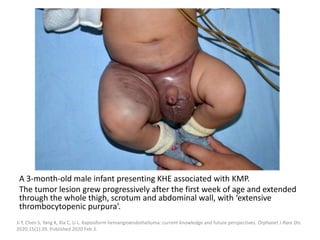
A 3-month-old male infant presenting KHE associated with KMP.
The tumor lesion grew progressively after the first week of age and extended
through the whole thigh, scrotum and abdominal wall, with ‘extensive
thrombocytopenic purpura’.
Ji Y, Chen S, Yang K, Xia C, Li L. Kaposiform hemangioendothelioma: current knowledge and future perspectives. Orphanet J Rare Dis.
2020;15(1):39. Published 2020 Feb 3.
Imaging features
Ill-defined margins, smaller feeding and draining
vessels, involvement of multiple tissue planes,
hemosiderin deposits, and destructive
changes are some distinctive MR imaging
findings from those of infantile hemangioma.
Moukaddam H, Pollak J, Haims AH. MRI characteristics and classification of peripheral vascular malformations and tumors. Skeletal
Radiol 2009;38(6): 535–547.
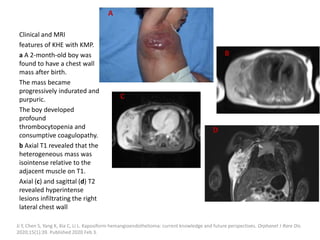
Clinical and MRI
features of KHE with KMP.
a A 2-month-old boy was
found to have a chest wall
mass after birth.
The mass became
progressively indurated and
purpuric.
The boy developed
profound
thrombocytopenia and
consumptive coagulopathy.
b Axial T1 revealed that the
heterogeneous mass was
isointense relative to the
adjacent muscle on T1.
Axial (c) and sagittal (d) T2
revealed hyperintense
lesions infiltrating the right
lateral chest wall
Ji Y, Chen S, Yang K, Xia C, Li L. Kaposiform hemangioendothelioma: current knowledge and future perspectives. Orphanet J Rare Dis.
2020;15(1):39. Published 2020 Feb 3.
A
B
C
D
Treatment
Multi-modality approach including surgical
resection, steroids, interferon, vincristine or
radiation therapy, has been attempted, but
resulted in variable effectiveness.
. Nozaki T, Nosaka S, Miyazaki O, Makidono A, Yamamoto A, Niwa T, et al. Syndromes associated with vascular tumors and malformations:
a pictorial review. Radiographics. 2013;33: 175---95.
Introduction
Classifications
Hemangiomas
Vascular Malformations
Post Treatment Appearance
Vascular Malformations
Vascular malformations are congenital
anomalies and are thus present at birth,
although not always evident.
They usually grow proportionally with the child
and show no regression.
Their growth can be exacerbated due to
hormonal changes during puberty or
pregnancy or as a result of thrombosis,
infection, trauma, or incomplete treatment.
Unlike hemangiomas, they may be infiltrative
and usually involve multiple tissue planes.
Classified into high flow and low flow, the latter
category accounts for more than 90% of
vascular lesions outside the central nervous
system.
This differentiation based on flow dynamics is
vital to planning surgical or image-guided
treatment procedures.
Moukaddam H, Pollak J, Haims AH. MRI characteristics and classification of peripheral vascular malformations and tumors. Skeletal
Radiol 2009;38(6): 535–547.
(I) Low-Flow Vascular Malformations
Venous Malformation
Lymphatic Malformation
Capillary Malformation
Mixed Low Flow Malformation
Fibro-Adipose Vascular Anomaly (FAVA)
Syndromes with low-flow vascular
malformations
Venous Malformation
Incidence
Clinical presentation
Imaging features
Treatment
Incidence
The most common peripheral vascular
malformation, account for almost two-thirds
of vascular malformations.
A venous malformation is defined as a simple
malformation with slow flow and an abnormal
venous network.
Dubois J, Soulez G, Oliva VL, Berthiaume MJ, Lapierre C, Therasse E. Soft-tissue venous malformations in adult patients: imaging and
therapeutic issues. RadioGraphics 2001;21(6):1519-1531.
Behr GG, Johnson CM. Vascular anomalies: hemangiomas and beyond --- part 2, slow-flow lesions. Am J Roentgenol. 2013;200:423-
36.
Clinical presentation
Usually located in the head and neck (40% of
cases), trunk (20%), and extremities (40%).
Already present at birth, but is usually not
clinically evident until late childhood or
adulthood, and may enlarge due to hormonal
changes during puberty.
Frequently asymptomatic.
Dubois J, Garel L. Imaging and therapeutic approach of hemangiomas and vascular malformations in the pediatric age group. Pediatr
Radiol 1999;29 (12):879–893.
Behr GG, Johnson CM. Vascular anomalies: hemangiomas and beyond --- part 2, slow-flow lesions. Am J Roentgenol. 2013;200:423---36.
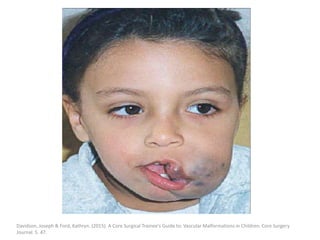
On clinical exam they present as sponge like,
compressible and non-pulsatile masses which
vary in size and shape and may be localized or
diffuse.
When superficial, lesions typically have a bluish
discoloration.
Dubois J, Garel L. Imaging and therapeutic approach of hemangiomas and vascular malformations in the pediatric age group. Pediatr
Radiol. 1999;29:879-93.
Donnelly LF, Adams DM, Bisset GS 3rd. Vascular malformations and hemangiomas: a practical approach in a multidisciplinary clinic. Am J
Roentgenol. 2000;174:597-608.
Fayad LM, Hazirolan T, Bluemke D, Mitchell S. Vascular malformations in the extremities: emphasis on MR imaging features that guide
treatment options. Skeletal Radiol. 2006;35: 127-37.
Davidson, Joseph & Ford, Kathryn. (2015). A Core Surgical Trainee's Guide to: Vascular Malformations in Children. Core Surgery
Journal. 5. 47.
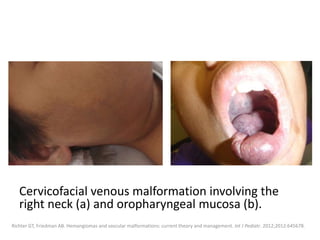
Cervicofacial venous malformation involving the
right neck (a) and oropharyngeal mucosa (b).
Richter GT, Friedman AB. Hemangiomas and vascular malformations: current theory and management. Int J Pediatr. 2012;2012:645678.
They characteristically reduce with extremity
elevation and local compression and enlarge
with dependent position and Valsalva
maneuvers.
Stiffness and discomfort may occur secondary to
hemorrhage and thrombophlebitis.
Lack of increased local temperature or bruit is
characteristic in comparison with high-flow
lesions.
El-Merhi F, Garg D, Cura M, Ghaith O. Peripheral vascular tumors and vascular malformations: imaging (magnetic resonance imaging
and conventional angiography), pathologic correlation and treatment options. Int J Cardiovasc Imag. 2013;29:379-93.
Restrepo R. Multimodality imaging of vascular anomalies. Pediatr Radiol. 2013;43 Suppl. 1:S141-54.
Like all vascular malformations, VMs may
infiltrate across multiple tissue planes
including skin, subcutaneous fat, skeletal
muscle, bones, joints and, internal organs.
The involvement of deep structures is
underestimated on clinical examination, and
potential manifestations include pain,
impaired function, and skeletal deformity.
Dubois J, Garel L. Imaging and therapeutic approach of hemangiomas and vascular malformations in the pediatric age group. Pediatr
Radiol. 1999;29:879-93.
Donnelly LF, Adams DM, Bisset GS 3rd. Vascular malformations and hemangiomas: a practical approach in a multidisciplinary clinic.
Am J Roentgenol. 2000;174:597-608.
Fayad LM, Hazirolan T, Bluemke D, Mitchell S. Vascular malformations in the extremities: emphasis on MR imaging features that guide
treatment options. Skeletal Radiol. 2006;35: 127-37.
Imaging features
a) Ultrasound:
Usually present as compressible, anechoic,
ectatic venous spaces separated by echogenic
septa and with scant monophasic low-velocity
flow.
The detection of flow can be enhanced by
applying compression or performing the
Valsalva maneuver.
Restrepo R. Multimodality imaging of vascular anomalies. Pediatr Radiol. 2013;43 Suppl. 1:S141-5
Johnson CM, Navarro OM. Clinical and sonographic features of pediatric soft-tissue vascular anomalies part 2: vascular malformations.
Pediatr Radiol. 2017;47:1196-2
When venous flow is not depicted, differentiation
from a lymphatic malformation can be
challenging.
Some US maneuvers may be helpful in highlighting
some changes in the venous channels.
Specifically, these will fill in during Valsalva
maneuvers, in dependent position, and drain
with compression, elevation of the body part
above the level of the heart or when Valsalva is
released.
Phleboliths are the hallmark of VMs and are
best depicted as small calcifications on
radiography and CT.
They can be seen on US as echogenic foci with
posterior acoustic shadowing.
Secondary signs of osseous involvement such as
bony expansion, osteolysisis, cortical thinning
and increased trabeculation can also be seen
on radiography and CT.
Behr GG, Johnson CM. Vascular anomalies: hemangiomas and beyond --- part 2, slow-flow lesions. Am J Roentgenol. 2013;200:423-
36.
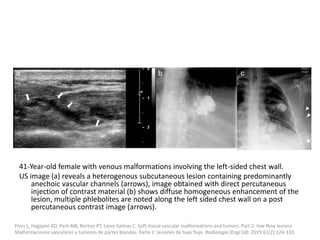
41-Year-old female with venous malformations involving the left-sided chest wall.
US image (a) reveals a heterogenous subcutaneous lesion containing predominantly
anechoic vascular channels (arrows), image obtained with direct percutaneous
injection of contrast material (b) shows diffuse homogeneous enhancement of the
lesion, multiple phlebolites are noted along the left sided chest wall on a post
percutaneous contrast image (arrows).
Flors L, Hagspiel KD, Park AW, Norton PT, Leiva-Salinas C. Soft-tissue vascular malformations and tumors. Part 2: low-flow lesions.
Malformaciones vasculares y tumores de partes blandas. Parte 2: lesiones de bajo flujo. Radiologia (Engl Ed). 2019;61(2):124-133.
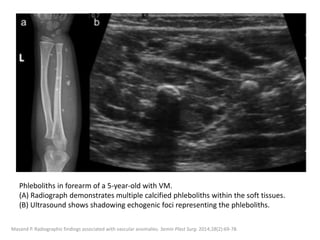
Phleboliths in forearm of a 5-year-old with VM.
(A) Radiograph demonstrates multiple calcified phleboliths within the soft tissues.
(B) Ultrasound shows shadowing echogenic foci representing the phleboliths.
Masand P. Radiographic findings associated with vascular anomalies. Semin Plast Surg. 2014;28(2):69-78.
b) MRI:
Present as lobulated, non-mass like lesions with
low to intermediate signal intensity on T1 and
hyperintensity on T2 and STIR.
Occasionally, hemorrhage or high protein
content may cause internal fluid-fluid levels.
In cases of thrombosis or hemorrhage,
heterogeneous signal intensity can be
observed on T1.
Ernemann U, Kramer U, Miller S, et al. Current concepts in the classification, diagnosis and treatment of vascular anomalies. Eur J
Radiol 2010;75 (1):2–11.
Flors L, Leiva-Salinas C, Maged IM, Norton PT, Matsumoto AH, Angle JF, et al. MR imaging of soft-tissue vascular malformations:
diagnosis, classification, and therapy follow-up. Radiographics. 2011;31:1321-40 [discussion 1340-1].
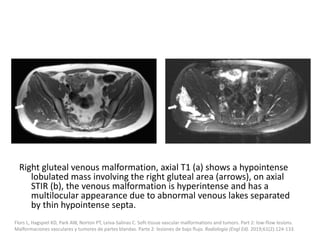
Right gluteal venous malformation, axial T1 (a) shows a hypointense
lobulated mass involving the right gluteal area (arrows), on axial
STIR (b), the venous malformation is hyperintense and has a
multilocular appearance due to abnormal venous lakes separated
by thin hypointense septa.
Flors L, Hagspiel KD, Park AW, Norton PT, Leiva-Salinas C. Soft-tissue vascular malformations and tumors. Part 2: low-flow lesions.
Malformaciones vasculares y tumores de partes blandas. Parte 2: lesiones de bajo flujo. Radiologia (Engl Ed). 2019;61(2):124-133.
VMs may infiltrate multiple tissue planes and fat
suppressed T2 and STIR provide excellent
delineation of the extension of the lesions.
Contrast administration is helpful and often
shows slow, gradual, delayed heterogeneous
contrast filling with characteristic diffuse
enhancement of the slow flowing venous
channels on delayed post-contrast T1.
Dubois J, Alison M. Vascular anomalies: what a radiologist needs to know. Pediatr Radiol. 2010;40:895-905.
Flors L, Leiva-Salinas C, Maged IM, Norton PT, Matsumoto AH, Angle JF, et al. MR imaging of soft-tissue vascular malformations:
diagnosis, classification, and therapy follow-up. Radiographics. 2011;31:1321---40 [discussion 1340-1].
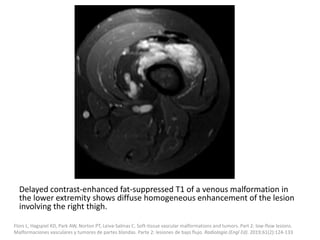
Delayed contrast-enhanced fat-suppressed T1 of a venous malformation in
the lower extremity shows diffuse homogeneous enhancement of the lesion
involving the right thigh.
Flors L, Hagspiel KD, Park AW, Norton PT, Leiva-Salinas C. Soft-tissue vascular malformations and tumors. Part 2: low-flow lesions.
Malformaciones vasculares y tumores de partes blandas. Parte 2: lesiones de bajo flujo. Radiologia (Engl Ed). 2019;61(2):124-133
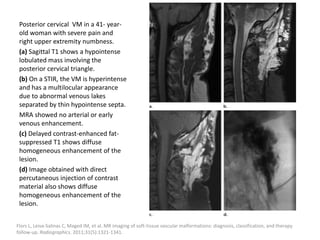
Posterior cervical VM in a 41- year-
old woman with severe pain and
right upper extremity numbness.
(a) Sagittal T1 shows a hypointense
lobulated mass involving the
posterior cervical triangle.
(b) On a STIR, the VM is hyperintense
and has a multilocular appearance
due to abnormal venous lakes
separated by thin hypointense septa.
MRA showed no arterial or early
venous enhancement.
(c) Delayed contrast-enhanced fat-
suppressed T1 shows diffuse
homogeneous enhancement of the
lesion.
(d) Image obtained with direct
percutaneous injection of contrast
material also shows diffuse
homogeneous enhancement of the
lesion.
Flors L, Leiva-Salinas C, Maged IM, et al. MR imaging of soft-tissue vascular malformations: diagnosis, classification, and therapy
follow-up. Radiographics. 2011;31(5):1321-1341.
Low-flow malformations are characterized by a lack
of arterial and early venous enhancement, and
absence of enlarged feeding vessels or
arteriovenous shunting.
Pleboliths, septations, or thrombosed vessels may
simulate flow voids on MRI, pleboliths and
calcifications typically appear as low signal
nodular foci on all sequences whereas signal
voids related to high flow characteristically
appear as high signal foci on GRE sequences and
demonstrate contrast enhancement.
Moukaddam H, Pollak J, Haims AH. MRI characteristics and classification of peripheral vascular malformations and tumors. Skeletal Radiol.
2009;38:535-47.
Flors L, Leiva-Salinas C, Norton PT, Park AW, Ogur T, Hagspiel KD. Ten frequently asked questions about MRI evaluation of soft-tissue vascular
anomalies. Am J Roentgenol. 2013;201:W554-62.
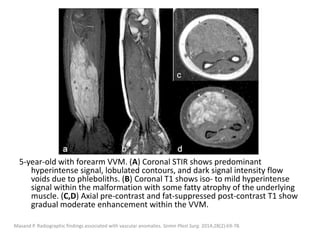
The best clue to identify a VM is the presence of phleboliths, these are
seen as small calcifications on radiography (a) and CT (b, c) and as
low signal small foci on all MRI sequences (d), the images presented
here correspond to three different patients.
Flors L, Hagspiel KD, Park AW, Norton PT, Leiva-Salinas C. Soft-tissue vascular malformations and tumors. Part 2: low-flow lesions.
Malformaciones vasculares y tumores de partes blandas. Parte 2: lesiones de bajo flujo. Radiologia (Engl Ed). 2019;61(2):124-133.
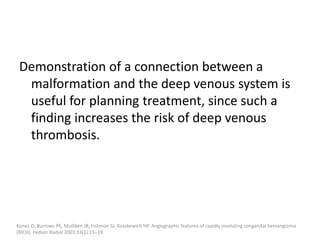
5-year-old with forearm VVM. (A) Coronal STIR shows predominant
hyperintense signal, lobulated contours, and dark signal intensity flow
voids due to phleboliths. (B) Coronal T1 shows iso- to mild hyperintense
signal within the malformation with some fatty atrophy of the underlying
muscle. (C,D) Axial pre-contrast and fat-suppressed post-contrast T1 show
gradual moderate enhancement within the VVM.
Masand P. Radiographic findings associated with vascular anomalies. Semin Plast Surg. 2014;28(2):69-78.
Demonstration of a connection between a
malformation and the deep venous system is
useful for planning treatment, since such a
finding increases the risk of deep venous
thrombosis.
Konez O, Burrows PE, Mulliken JB, Fishman SJ, Kozakewich HP. Angiographic features of rapidly involuting congenital hemangioma
(RICH). Pediatr Radiol 2003;33(1):15–19.
Treatment
Conservative management
Sclerotherapy
Endovenous ablation techniques
Post-procedural care
Müller-Wille R, Wildgruber M, Sadick M, Wohlgemuth WA. Vascular Anomalies (Part II): Interventional Therapy of Peripheral Vascular
Malformations [published online ahead of print, 2018 Feb 7]. Gefäßanomalien (Teil II): Interventionelle Therapie von peripheren
Gefäßmalformationen [published online ahead of print, 2018 Feb 7]. Rofo. 2018;10.1055/s-0044-101266.
Conservative management
Conservative management of VMs includes the
prescription of individually adjusted
compression garments.
Appropriately fitted compression garments can
reduce pain, slow progression, and deformity.
Paroxysmal pain secondary to intralesional
localized thrombosis can be managed with
generally available pain-relieving agents.
Legiehn GM, Heran MK. A Step-by-Step Practical Approach to Imaging Diagnosis and Interventional Radiologic Therapy in Vascular
Malformations. Semin Intervent Radiol 2010; 27: 209–231
Low-molecular-weight heparin (LMWH) can be
used to prevent ongoing clotting.
Occasionally, cessation of oral contraceptives
could be considered.
Unfortunately, direct medical treatment of VMs
has been quite limited until now.
Promising small case series showed that mTOR
inhibitors (sirolimus) seem to have a positive
clinical effect on VMs.
Triana P, Dore M, Cerezo VN et al. Sirolimus in the Treatment of Vascular Anomalies. Eur J Pediatr Surg 2017; 27: 86–90
Goldenberg DC, Carvas M, Adams D et al. Successful Treatment of a Complex Vascular Malformation With Sirolimus and Surgical
Resection. J Pediatr Hematol Oncol 2017; 39: e191–e195
Sclerotherapy
Invasive therapy is indicated in conjunction with
conservative management in symptomatic VMs
to reduce pain, disfigurement, hemorrhage, and
impairment of neighboring structures or to
reduce the thromboembolic risk.
Percutaneous sclerotherapy is the first-choice
invasive treatment method and can be combined
with additional laser therapy or surgical
procedures.
van der Vleuten CJ, Kater A, Wijnen MH et al. Effectiveness of sclerotherapy, surgery, and laser therapy in patients with venous
malformations: a systematic review. Cardiovasc Intervent Radiol 2014; 37: 977– 989
Ranieri M, Wohlgemuth W, Muller-Wille R et al. Vascular malformations of upper and lower extremity – from radiological
interventional therapy to surgical soft tissue reconstruction – an interdisciplinary treatment. Clin Hemorheol Microcirc 2017; 67: 355
–372.
The aim of sclerotherapy is to damage the
endothelial lining of the VM, resulting in
thrombosis, inflammation, and subsequent
fibrosis of the abnormal vein channels with a
reduction of the size.
Frequently used sclerosants for VMs are ethanol,
ethanol gel, polidocanol, sodium tetradecyl
sulfate, and bleomycin, however, systematic
reviews could not identify a significantly superior
sclerosing agent in terms of effectiveness.
Green D. Mechanism of action of sclerotherapy. Semin Dermatol 1993; 12: 88–97
Qiu Y, Chen H, Lin X et al. Outcomes and complications of sclerotherapy for venous malformations. Vasc Endovascular Surg 2013; 47: 454–461
van der Vleuten CJ, Kater A, Wijnen MH et al. Effectiveness of sclerotherapy, surgery, and laser therapy in patients with venous malformations: a
systematic review. Cardiovasc Intervent Radiol 2014; 37: 977– 989
ch SE, Lokhorst MM, Saeed P et al. Sclerotherapy for low-flow vascular malformations of the head and neck: A systematic review of sclerosing
agents. J Plast Reconstr Aesthet Surg 2016; 69: 295–304
1-Ethanol:
Highly concentrated ethanol is a very effective
sclerosant for the treatment of VMs.
It causes precipitation of endothelial cells and
thrombosis.
Nonetheless, absolute ethanol can result in serious
local and systemic side effects like compartment
compression, necrosis, ulcer, hyperpigmentation,
nerve injury, hypoglycemia, deep vein
thrombosis, pulmonary thrombosis, pulmonary
vasospasm, cardiac collapse, and death.
Zhang J, Li HB, Zhou SY et al. Comparison between absolute ethanol and bleomycin for the treatment of venous malformation in
children. Exp Ther Med 2013; 6: 305–309
Steiner F, FitzJohn T, Tan ST. Ethanol sclerotherapy for venous malformation. ANZ J Surg 2016; 86: 790
Ali S, Weiss CR, Sinha A et al. The treatment of venous malformations with percutaneous sclerotherapy at a single academic medical
center. Phlebology 2016; 31: 603–609
It has been shown that ethanol has a
significantly higher complication rate
compared to other sclerosants, therefore, it
should be used only by experienced
interventional radiologist.
Total dose of 0.2ml per kg appears to be the
threshold to reduce side effects.
Ethanol can be mixed with lipiodol for
radiopacity.
Spence J, Krings T, TerBrugge KG et al. Percutaneous treatment of facial venous malformations: a matched comparison of alcohol and
bleomycin sclerotherapy. Head Neck 2011; 33: 125–130
Bisdorff A, Mazighi M, Saint-Maurice JP et al. Ethanol threshold doses for systemic complications during sclerotherapy of superficial
venous malformations: a retrospective study. Neuroradiology 2011; 53: 891 –894
2-Ethanol gel:
To limit diffusion and to keep ethanol in the
malformation, it can be administrated in
highly viscous gel form.
Ethanol gel has a favorable safety profile in the
treatment of VMs compared to pure ethanol.
Dompmartin A, Blaizot X, Theron J et al. Radio-opaque ethylcellulose-ethanol is a safe and efficient sclerosing agent for venous
malformations. Eur Radiol 2011; 21: 2647–26
Schumacher M, Dupuy P, Bartoli JM et al. Treatment of venous malformations: first experience with a new sclerosing agent–a
multicenter study. Eur J Radiol 2011; 80: e366–e372
Teusch VI, Wohlgemuth WA, Hammer S et al. Ethanol-Gel Sclerotherapy of Venous Malformations: Effectiveness and Safety. Am J
Roentgenol 2017; 209: 1390–1395. doi:10.2214/AJR.16.17603
3-Polidocanol:
A local anesthetic also used as a sclerosant for
VMs with fewer side effects than absolute
ethanol.
There is some evidence that polidocanol foam,
made by mixing polidocanol with sterile air
(Tessari technique), has a higher rate of
obliteration compared to the application of
liquid polidocanol.
Tessari L, Cavezzi A, Frullini A. Preliminary experience with a new sclerosing foam in the treatment of varicose veins. Dermatol Surg 2001; 27: 58–60
Yamaki T, Nozaki M, Sakurai H et al. Prospective randomized efficacy of ultrasound-guided foam sclerotherapy compared with ultrasound-guided liquid sclerotherapy in the
treatment of symptomatic venous malformations. J Vasc Surg 2008; 47: 57
Horbach SE, Lokhorst MM, Saeed P et al. Sclerotherapy for low-flow vascular malformations of the head and neck: A systematic review of sclerosing agents. J Plast Reconstr Aesthet
Surg 2016; 69
Weitz-Tuoretmaa A, Keski-Nisula L, Rautio R et al. Quality of life after endovascular sclerotherapy of low-flow venous malformations: the efficacy of polidocanol compared with
ethanol. Acta Radiol 2017. doi:10.1177/0284185117741774
Polidocanol foam
Preparation of
Aethoxysklerol foam.
Müller-Wille R, Wildgruber M, Sadick M, Wohlgemuth WA. Vascular Anomalies (Part II): Interventional Therapy of Peripheral Vascular
Malformations [published online ahead of print, 2018 Feb 7]. Gefäßanomalien (Teil II): Interventionelle Therapie von peripheren
Gefäßmalformationen [published online ahead of print, 2018 Feb 7]. Rofo. 2018;10.1055/s-0044-101266
4-Sodium tetradecyl sulfate (STS):
STS is the active component of the sclerosant
drug Sotradecol.
It has been demonstrated that STS foam is an
effective sclerosing agent for VMs with a low
complication risk.
Alakailly X, Kummoona R, Quereshy FA et al. The use of sodium tetradecyl sulphate for the treatment of venous malformations of the
head and neck. J Maxillofac Oral Surg 2015; 14: 332–338
Park HS, Do YS, Park KB et al. Clinical outcome and predictors of treatment response in foam sodium tetradecyl sulfate sclerotherapy
of venous malformations. Eur Radiol 2016; 26: 1301–1310
5-Bleomycin:
Bleomycin is a cytotoxic, antineoplastic
antibiotic derived from Streptomyces
verticillus.
The sclerosing effect of bleomycin on the vessel
endothelium can be used for the treatment of
VMs.
Post-procedural swelling is less intensive after
bleomycin application compared to ethanol.
Spence J, Krings T, TerBrugge KG et al. Percutaneous treatment of facial venous malformations: a matched comparison of alcohol and bleomycin sclerotherapy.
Head Neck 2011; 33: 125–130
Zhang J, Li HB, Zhou SY et al. Comparison between absolute ethanol and bleomycin for the treatment of venous malformation in children. Exp Ther Med 2013; 6:
305–309
Songsaeng D, Churojana A, Khumthong R et al. Comparative outcomes for sclerotherapy of head and neck venous vascular malformation between alcohol and
bleomycin. J Med Assoc Thai 2015; 98:408-413
These properties made bleomycin the sclerosant of
choice in patients with airway compression.
However, there is a potential risk of pulmonary
fibrosis after bleomycin admission.
Therefore, bleomycin must be used in a very small
dose with no more than 1mg/kg body weight per
session.
Bleomycin may induce neoplasms, thus its use in
children is to be considered with special caution.
Legiehn GM, Heran MK. A Step-by-Step Practical Approach to Imaging Diagnosis and Interventional Radiologic Therapy in Vascular
Malformations. Semin Intervent Radiol 2010; 27: 209–231
Applications techniques
Direct needle puncture of the VM is performed with
a 20- or 21-gauge needle under real-time
ultrasound guidance.
The needle is connected to a 10 ml syringe of saline
and is gradually withdrawn while applying low
suction.
As soon as blood returns, a radiopaque contrast
agent is injected to obtain a phlebogram of the
VM to confirm the position, estimate the lesion
volume and compartmentalization and to identify
draining veins.
Venous malformation
(a) STIR sequence showed
a hyperintense venous
malformation with central
phleboliths (arrow)
(b) Percutaneous
puncture of the venous
malformation.
(c) Injection of contrast
media into the venous
malformation
(d) Injection of Polidocanol
foam.
Müller-Wille R, Wildgruber M, Sadick M, Wohlgemuth WA. Vascular Anomalies (Part II): Interventional Therapy of Peripheral Vascular
Malformations [published online ahead of print, 2018 Feb 7]. Gefäßanomalien (Teil II): Interventionelle Therapie von peripheren
Gefäßmalformationen [published online ahead of print, 2018 Feb 7]. Rofo. 2018;10.1055/s-0044-101266
Four different phlebographic patterns of VMs
can be observed:
Type I lesions: are VMs without considerable
venous drainage under fluoroscopy.
Type II VMs: have normal-sized venous drainage
Type III VMs: have enlarged venous drainage.
Type IV lesions: are composed of basically
ectatic dysplastic vein.
Puig S, Aref H, Chigot V et al. Classification of venous malformations in children and implications for sclerotherapy. Pediatr Radiol
2003; 33: 99–103
Classification of venous
malformations
Type I lesions are
isolated
malformations
without
phlebographically
visible venous
drainage.
Type II lesions
demonstrate normal-
sized venous drainage.
Type III lesions
demonstrate enlarged
venous drainage.
Type IV lesions are
composed of
essentially ectatic
dysplastic veins.
Müller-Wille R, Wildgruber M, Sadick M, Wohlgemuth WA. Vascular Anomalies (Part II): Interventional Therapy of Peripheral Vascular
Malformations [published online ahead of print, 2018 Feb 7]. Gefäßanomalien (Teil II): Interventionelle Therapie von peripheren
Gefäßmalformationen [published online ahead of print, 2018 Feb 7]. Rofo. 2018;10.1055/s-0044-101266
VMs with large draining veins suggest a higher risk
of complications during sclerotherapy.
After identification of the phlebographic patterns,
the sclerosant can be injected slowly under
fluoroscopy to displace the previously injected
contrast agent residing in the malformation.
A tourniquet or a pneumatic cuff at the venous
outflow minimizes the risk of accidental
migration into the deep venous system.
Puig S, Aref H, Chigot V et al. Classification of venous malformations in children and implications for sclerotherapy. Pediatr Radiol 2003;
33: 99–103
Additionally, local compression of visible
draining veins may be considered.
In some cases it is necessary to puncture the VM
more than once to treat the lesion completely.
However, injection has to be stopped if there is
increased resistance, extravasation of the
sclerosant, or skin blanching.
Müller-Wille R, Wildgruber M, Sadick M, Wohlgemuth WA. Vascular Anomalies (Part II): Interventional Therapy of Peripheral Vascular
Malformations [published online ahead of print, 2018 Feb 7]. Gefäßanomalien (Teil II): Interventionelle Therapie von peripheren
Gefäßmalformationen [published online ahead of print, 2018 Feb 7]. Rofo. 2018;10.1055/s-0044-101266
N.B. Additional venous outflow occlusion:
In cases with large draining veins, additional
occlusion may be indicated to avoid overflow
of the sclerosing agent into the deep vein
system.
Fibered microcoils or plugs of various types can
be placed through an access needle or a
catheter into the outflow vessel of the VM.
Burrows PE, Mason KP. Percutaneous treatment of low flow vascular malformations. J Vasc Interv Radiol 2004; 15: 431–445
Endovenous ablation techniques
Endovenous ablation techniques like endovenous
laser ablation (ELVA) or endovenous
radiofrequency ablation (ERFA) were successfully
used to close large embryonic venous channels
such as the lateral marginal vein in patients with
Klippel-Trenaunay syndrome (KTS).
It is recommended that patients presenting with
such anomalous veins be considered for
endovenous ablation therapy as early as possible
to reduce the risk of thromboembolism.
Berber O, Holt P, Hinchliffe R et al. Endovenous therapy for the treatment of congenital venous malformations. Ann Vasc Surg 2010;
24: 415 e13–417
Patel PA, Barnacle AM, Stuart S et al. Endovenous laser ablation therapy in children: applications and outcomes. Pediatr Radiol 2017;
47: 1353– 1363
Post-procedural care
Patients should wear their compression garments
to help involution of the lesion.
Limb elevation, ice packs, and pain medication (an
NSAID is normally sufficient) may be indicated.
To prevent deep vein thrombosis (DVT),
prophylactic anticoagulation with LMWH is
recommended.
Ultrasound should be performed to exclude DVT
one day after therapy of limb VMs.
Müller-Wille R, Wildgruber M, Sadick M, Wohlgemuth WA. Vascular Anomalies (Part II): Interventional Therapy of Peripheral Vascular
Malformations [published online ahead of print, 2018 Feb 7]. Gefäßanomalien (Teil II): Interventionelle Therapie von peripheren
Gefäßmalformationen [published online ahead of print, 2018 Feb 7]. Rofo. 2018;10.1055/s-0044-101266
Lymphatic Malformation
Incidence
Clinical presentation
Imaging features
Treatment
Incidence
Congenital lesions of the lymphatic system and
consist of cystic spaces filled with lymphatic
fluid and dilated lymphatic channels.
The second most common type of vascular
malformation after venous malformations.
Marler JJ, Mulliken JB. Current management of hemangiomas and vascular malformations. Clin Plast Surg. 2005;32:99-116.
Moukaddam H, Pollak J, Haims AH. MRI characteristics and classification of peripheral vascular malformations and tumors. Skeletal
Radiol. 2009;38:535---47.
Restrepo R. Multimodality imaging of vascular anomalies. Pediatr Radiol. 2013;43 Suppl. 1:S
Traditionally misnamed as ‘‘lymphangioma or
cystic hygroma’’, LMs can be divided into
macrocystic, micro-cystic and mixed types.
Microcystic LMs are composed of multiple cysts
smaller than 2 mm in a background of solid
matrix, whereas macrocystic lesions, have
larger cysts of variable sizes.
Sometimes, this distinction is based on the
sonographic characteristic of the lesion since it
will define treatment options; lesions are
categorized as macro-cystic when the size of the
cysts permits a needle to be inserted in.
Lymphatic malformations are commonly mixed,
containing both micro and macrocystic
components as well as other types of vascular
malformations, most commonly venous
malformations.
Sanlialp I, Karnak I, Tanyel FC, Senocak ME, Buyukpamukcu N. Sclerotherapy for lymphangioma in children. Int J Pediatr Otorhinolaryngol.
2003;67:795-800.
Moukaddam H, Pollak J, Haims AH. MRI characteristics and classification of peripheral vascular malformations and tumors. Skeletal
Radiol. 2009;38:535-47.
Behr GG, Johnson CM. Vascular anomalies: hemangiomas and beyond --- part 2, slow-flow lesions. Am J Roentgenol. 2013;200:423-36.
Clinical presentation
Unlike VMs, most LMs are identified in the first
two years of life.
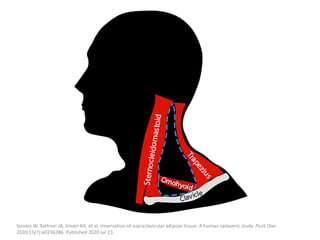
LMs are usually found in the neck (70-80%),
especially in the posterior cervical triangle,
and axillary region (20%).
Less commonly, the mediastinum,
retroperitoneum and the extremities may be
involved.
Dubois J, Garel L. Imaging and therapeutic approach of hemangiomas and vascular malformations in the pediatric age group. Pediatr
Radiol. 1999;29:879-93.
Moukaddam H, Pollak J, Haims AH. MRI characteristics and classification of peripheral vascular malformations and tumors. Skeletal
Radiol. 2009;38:535-47.
El-Merhi F, Garg D, Cura M, Ghaith O. Peripheral vascular tumors and vascular malformations: imaging (magnetic resonance imaging
and conventional angiography), pathologic correlation and treatment options. Int J Cardiovasc Imag. 2013;29:379-93.
Sievers W, Rathner JA, Green RA, et al. Innervation of supraclavicular adipose tissue: A human cadaveric study. PLoS One.
2020;15(7):e0236286. Published 2020 Jul 23.
Upon physical exam, they present as smooth,
non-pulsatile, soft tissue masses with a
rubbery consistency and without bruit or
increased temperature.
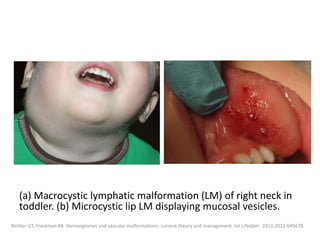
Dermal extension is common, especially with
microcystic LMs, and it is seen as numerous
small vesicles with associated skin thickening
and surrounding lymphedema.
Restrepo R. Multimodality imaging of vascular anomalies. Pediatr Radiol. 2013;43 Suppl. 1:S14
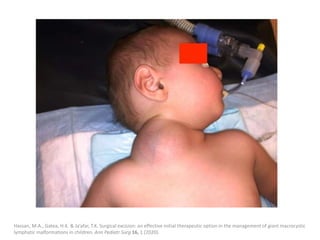
The macrocystic counter parts are seen as
smooth, translucent lobulated masses under
the normal cutis.
Unlike VMs, LMs are non-compressible.
They can get complicate by infection or bleeding
thus presenting with tenderness or sudden
enlargement of the lesion.
Moukaddam H, Pollak J, Haims AH. MRI characteristics and classification of peripheral vascular malformations and tumors. Skeletal
Radiol. 2009;38:535-47.
Behr GG, Johnson CM. Vascular anomalies: hemangiomas and beyond-part 2, slow-flow lesions. Am J Roentgenol. 2013;200:423-36.
Ernemann U, Kramer U, Miller S, Bisdas S, Rebmann H, Breuninger H, et al. Current concepts in the classification, diagnosis and
treatment of vascular anomalies. Eur J Radiol. 2010;75:2-11.
Hassan, M.A., Gatea, H.K. & Ja’afar, T.K. Surgical excision: an effective initial therapeutic option in the management of giant macrocystic
lymphatic malformations in children. Ann Pediatr Surg 16, 1 (2020).
(a) Macrocystic lymphatic malformation (LM) of right neck in
toddler. (b) Microcystic lip LM displaying mucosal vesicles.
Richter GT, Friedman AB. Hemangiomas and vascular malformations: current theory and management. Int J Pediatr. 2012;2012:645678.
Imaging features
(a) Ultrasound:
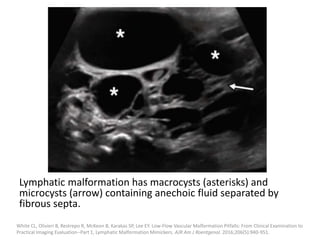
Macrocystic LMs appear as thin-walled cystic
lesions with posterior acoustic enhancement
on US.
Thin septa are often present.
Characteristically, arterial or venous waveforms
are absent within the cysts on Doppler US, but
may be detected within the septa.
Behr GG, Johnson CM. Vascular anomalies: hemangiomas and beyond- part 2, slow-flow lesions. Am J Roentgenol. 2013;200:423-36.
Johnson CM, Navarro OM. Clinical and sonographic features of pediatric soft-tissue vascular anomalies part 2: vascular
malformations. Pediatr Radiol. 2017;47:1196-208.
Unlike VMs, no change in appearance will occur
with Valsalva maneuvers, compression or
change in position.
The cysts in microcystic LMs are often too small
to be discernible by ultrasound, and they
often present as ill-defined hyperechoic
lesions; the posterior acoustic enhancement
suggests the cystic nature of the lesion.
Absent flow is demonstrated by Doppler.
Behr GG, Johnson CM. Vascular anomalies: hemangiomas and beyond- part 2, slow-flow lesions. Am J Roentgenol. 2013;200:423-36.
Johnson CM, Navarro OM. Clinical and sonographic features of pediatric soft-tissue vascular anomalies part 2: vascular malformations.
Pediatr Radiol. 2017;47:1196-208.
Lymphatic malformation has macrocysts (asterisks) and
microcysts (arrow) containing anechoic fluid separated by
fibrous septa.
White CL, Olivieri B, Restrepo R, McKeon B, Karakas SP, Lee EY. Low-Flow Vascular Malformation Pitfalls: From Clinical Examination to
Practical Imaging Evaluation--Part 1, Lymphatic Malformation Mimickers. AJR Am J Roentgenol. 2016;206(5):940-951.
(b) MRI:
LMs are usually seen as lobulated, septated
masses with intermediate to decreased T1
signal intensity and, like other vascular
anomalies, increased signal intensity on T2
and STIR.
Internal fluid-fluid levels are common.
LMs tend to infiltrate across fat planes and
involving multiple adjacent tissues.
Donnelly LF, Adams DM, Bisset GS 3rd. Vascular malformations and hemangiomas: a practical approach in a multidisciplinary clinic. Am
J Roentgenol. 2000;174:597-608.
Moukaddam H, Pollak J, Haims AH. MRI characteristics and classification of peripheral vascular malformations and tumors. Skeletal
Radiol. 2009;38:535-47.
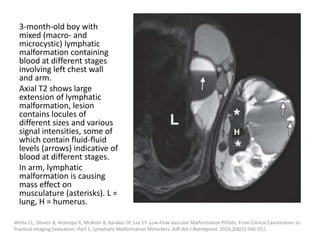
3-month-old boy with
mixed (macro- and
microcystic) lymphatic
malformation containing
blood at different stages
involving left chest wall
and arm.
Axial T2 shows large
extension of lymphatic
malformation, lesion
contains locules of
different sizes and various
signal intensities, some of
which contain fluid-fluid
levels (arrows) indicative of
blood at different stages.
In arm, lymphatic
malformation is causing
mass effect on
musculature (asterisks). L =
lung, H = humerus.
White CL, Olivieri B, Restrepo R, McKeon B, Karakas SP, Lee EY. Low-Flow Vascular Malformation Pitfalls: From Clinical Examination to
Practical Imaging Evaluation--Part 1, Lymphatic Malformation Mimickers. AJR Am J Roentgenol. 2016;206(5):940-951.
The pattern of contrast enhancement on MRI
will depend on the type of LM.
Microcystic LMs don’t usually enhance, whereas
macrocystic LMs exhibit rim and septal
enhancement with characteristic lack of
internal enhancement of the cystic structures.
Abernethy LJ. Classification and imaging of vascular malformations in children. Eur Radiol. 2003;13:2483-97
Moukaddam H, Pollak J, Haims AH. MRI characteristics and classification of peripheral vascular malformations and tumors. Skeletal
Radiol. 2009;38:535-47.
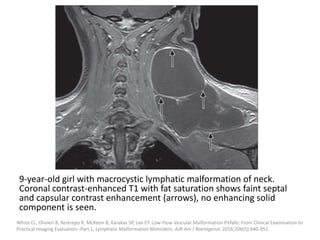
9-year-old girl with macrocystic lymphatic malformation of neck.
Coronal contrast-enhanced T1 with fat saturation shows faint septal
and capsular contrast enhancement (arrows), no enhancing solid
component is seen.
White CL, Olivieri B, Restrepo R, McKeon B, Karakas SP, Lee EY. Low-Flow Vascular Malformation Pitfalls: From Clinical Examination to
Practical Imaging Evaluation--Part 1, Lymphatic Malformation Mimickers. AJR Am J Roentgenol. 2016;206(5):940-951.
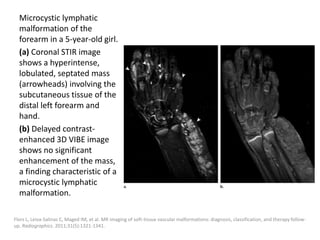
Microcystic lymphatic
malformation of the
forearm in a 5-year-old girl.
(a) Coronal STIR image
shows a hyperintense,
lobulated, septated mass
(arrowheads) involving the
subcutaneous tissue of the
distal left forearm and
hand.
(b) Delayed contrast-
enhanced 3D VIBE image
shows no significant
enhancement of the mass,
a finding characteristic of a
microcystic lymphatic
malformation.
Flors L, Leiva-Salinas C, Maged IM, et al. MR imaging of soft-tissue vascular malformations: diagnosis, classification, and therapy follow-
up. Radiographics. 2011;31(5):1321-1341.
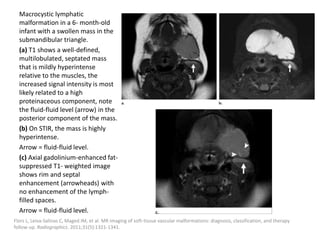
Macrocystic lymphatic
malformation in a 6- month-old
infant with a swollen mass in the
submandibular triangle.
(a) T1 shows a well-defined,
multilobulated, septated mass
that is mildly hyperintense
relative to the muscles, the
increased signal intensity is most
likely related to a high
proteinaceous component, note
the fluid-fluid level (arrow) in the
posterior component of the mass.
(b) On STIR, the mass is highly
hyperintense.
Arrow = fluid-fluid level.
(c) Axial gadolinium-enhanced fat-
suppressed T1- weighted image
shows rim and septal
enhancement (arrowheads) with
no enhancement of the lymph-
filled spaces.
Arrow = fluid-fluid level.
Flors L, Leiva-Salinas C, Maged IM, et al. MR imaging of soft-tissue vascular malformations: diagnosis, classification, and therapy
follow-up. Radiographics. 2011;31(5):1321-1341.
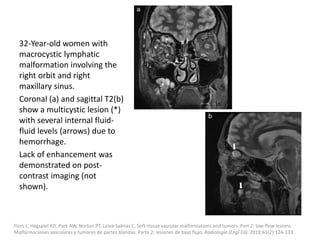
32-Year-old women with
macrocystic lymphatic
malformation involving the
right orbit and right
maxillary sinus.
Coronal (a) and sagittal T2(b)
show a multicystic lesion (*)
with several internal fluid-
fluid levels (arrows) due to
hemorrhage.
Lack of enhancement was
demonstrated on post-
contrast imaging (not
shown).
Flors L, Hagspiel KD, Park AW, Norton PT, Leiva-Salinas C. Soft-tissue vascular malformations and tumors. Part 2: low-flow lesions.
Malformaciones vasculares y tumores de partes blandas. Parte 2: lesiones de bajo flujo. Radiologia (Engl Ed). 2019;61(2):124-133.
Occasionally, microcystic lymphatic malformations
or combined lymphatic-venous malformations
may show diffuse enhancement, which is due to
septal enhancement of the small, nonperceptible
cysts in microcystic lymphatic malformations or
enhancement of the venous component in mixed
malformations.
This appearance may render them indistinguishable
from venous malformations.
Laor T, Burrows PE. Congenital anomalies and vascular birthmarks of the lower extremities. Magn Reson Imaging Clin N Am
1998;6(3):497–519.
Fayad LM, Hazirolan T, Bluemke D, Mitchell S. Vascular malformations in the extremities: emphasis on MR imaging features that guide
treatment options. Skeletal Radiol 2006;35(3):127–137
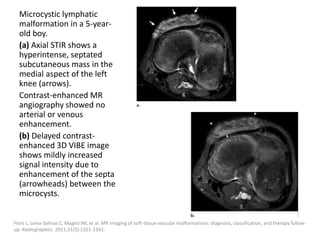
Microcystic lymphatic
malformation in a 5-year-
old boy.
(a) Axial STIR shows a
hyperintense, septated
subcutaneous mass in the
medial aspect of the left
knee (arrows).
Contrast-enhanced MR
angiography showed no
arterial or venous
enhancement.
(b) Delayed contrast-
enhanced 3D VIBE image
shows mildly increased
signal intensity due to
enhancement of the septa
(arrowheads) between the
microcysts.
Flors L, Leiva-Salinas C, Maged IM, et al. MR imaging of soft-tissue vascular malformations: diagnosis, classification, and therapy follow-
up. Radiographics. 2011;31(5):1321-1341.
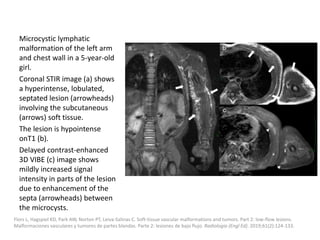
Microcystic lymphatic
malformation of the left arm
and chest wall in a 5-year-old
girl.
Coronal STIR image (a) shows
a hyperintense, lobulated,
septated lesion (arrowheads)
involving the subcutaneous
(arrows) soft tissue.
The lesion is hypointense
onT1 (b).
Delayed contrast-enhanced
3D VIBE (c) image shows
mildly increased signal
intensity in parts of the lesion
due to enhancement of the
septa (arrowheads) between
the microcysts.
Flors L, Hagspiel KD, Park AW, Norton PT, Leiva-Salinas C. Soft-tissue vascular malformations and tumors. Part 2: low-flow lesions.
Malformaciones vasculares y tumores de partes blandas. Parte 2: lesiones de bajo flujo. Radiologia (Engl Ed). 2019;61(2):124-133.
Treatment
Conservative management
Sclerotherapy
Post-procedural care
Conservative management
Small asymptomatic LMs can be monitored
without immediate treatment.
Antibiotic medications are indicated to prevent
and treat infections of LMs.
Recent studies demonstrated that mTOR
inhibitors (sirolimus) had a positive clinical
effect on extensive LMs especially in infants
with cervicofacial lesions.
Lackner H, Karastaneva A, Schwinger W et al. Sirolimus for the treatment of children with various complicated vascular anomalies. Eur J
Pediatr 2015; 174: 1579–1584
Triana P, Dore M, Cerezo VN et al. Sirolimus in the Treatment of Vascular Anomalies. Eur J Pediatr Surg 2017; 27: 86–90
Strychowsky JE, Rahbar R, O’Hare MJ et al. Sirolimus as treatment for 19 patients with refractory cervicofacial lymphatic malformation.
Laryngoscope 2017. doi:10.1002/lary.2678
Sclerotherapy
Indications for invasive therapy of LMs are
usually:
Recurrent infection
Recurrent hemorrhage
Impairment of neighboring structures (e. g.
upper airways)
Disfigurement.
Alomari AI, Karian VE, Lord DJ et al. Percutaneous sclerotherapy for lymphatic malformations: a retrospective analysis of patient-
evaluated improvement. J Vasc Interv Radiol 2006; 17: 1639–16
It has been demonstrated that percutaneous
sclerotherapy is very effective in reducing the
size and symptoms of macrocytic lesions with
a low risk for adverse events.
However, microcystic LM lesions respond less to
percutaneous sclerotherapy.
STS seems to be less effective and injection of
ethanol carries the risk of increased
complications.
The most commonly used sclerosants are:
Picibanil (OK-432)
Bleomycin
Doxycycline.
Alomari AI, Karian VE, Lord DJ et al. Percutaneous sclerotherapy for lymphatic malformations: a retrospective analysis of patient-
evaluated improvement. J Vasc Interv Radiol 2006; 17: 1639–16
Picibanil (OK-432):
Is a lyophilized mixture of group A Streptococcus
pyogenes with a high capacity to produce
fibrosis.
Intracystic injection of Picibanil has been shown
to be an effective and safe treatment for
macrocystic LMs in children.
Repeated injections are often required to
achieve clinical success.
Rebuffini E, Zuccarino L, Grecchi E et al. Picibanil (OK-432) in the treatment of head and neck lymphangiomas in children. Dent Res J (Isfahan) 2012;
9 (Suppl. 2): S192–S196
Gurgacz S, Zamora L, Scott NA. Percutaneous sclerotherapy for vascular malformations: a systematic review. Ann Vasc Surg 2014; 28: 1335– 1349
Motz KM, Nickley KB, Bedwell JR et al. OK432 versus doxycycline for treatment of macrocystic lymphatic malformations. Ann Otol Rhinol Laryngol
2014; 123: 81–88
Induces severe swelling for more than one week
after treatment.
In cases with potential airway compression,
elective intubation and ventilation following
sclerotherapy may be necessary.
Another typical side effect of Picibanil is post-
procedural fever.
It can be successfully treated with paracetamol
and resolves after 1-3 days.
Ravindranathan H, Gillis J, Lord DJ. Intensive care experience with sclerotherapy for cervicofacial lymphatic malformations. Pediatr Crit
Care Med 2008; 9: 304–309
Rebuffini E, Zuccarino L, Grecchi E et al. Picibanil (OK-432) in the treatment of head and neck lymphangiomas in children. Dent Res J
(Isfahan) 2012; 9 (Suppl. 2): S192–S196
Bleomycin:
The sclerosing effect of bleomycin has been well
known for over forty years.
Due to its low risk of swelling, it is a preferred
agent in patients with macrocystic LMs of the
head and neck area.
Must be used in very small doses to avoid side
effects like pulmonary fibrosis.
Yura J, Hashimoto T, Tsuruga N et al. Bleomycin treatment for cystic hygroma in children. Nihon Geka Hokan 1977; 46: 607–614
Legiehn GM, Heran MK. A Step-by-Step Practical Approach to Imaging Diagnosis and Interventional Radiologic Therapy in Vascular
Malformations. Semin Intervent Radiol 2010; 2
Yang Y, Sun M, Ma Q et al. Bleomycin A5 sclerotherapy for cervicofacial lymphatic malformations. J Vasc Surg 2011; 53: 150–155
Doxycycline:
Very effective for the treatment of macrocystic
and mixed head and neck lymphatic
malformations in children.
Positive effects are often seen after a single
session.
It has minimal side effects and is widely
available.
Motz KM, Nickley KB, Bedwell JR et al. OK432 versus doxycycline for treatment of macrocystic lymphatic malformations. Ann Otol Rhinol
Laryngol 2014; 123: 81–88
Cheng J. Doxycycline sclerotherapy in children with head and neck lymphatic malformations. J Pediatr Surg 2015; 50: 214
Thomas DM, Wieck MM, Grant CN et al. Doxycycline Sclerotherapy Is Superior in the Treatment of Pediatric Lymphatic Malformations. J Vasc
Interv Radiol 2016; 27: 1846–1856
Applications techniques
Cysts are cannulated with a needle under real-time
ultrasound guidance.
Alternatively, a pigtail catheter (3 to 5 French) can
be inserted in larger cysts, as the multiple side
holes facilitate aspiration of the lymphatic fluid
before injection of the sclerosing agent.
Contrast media can be injected to visualize the
whole lesion under fluoroscopy.
After aspiration of the entire cyst content, the LM
can then be treated with the sclerosant.
Müller-Wille R, Wildgruber M, Sadick M, Wohlgemuth WA. Vascular Anomalies (Part II): Interventional Therapy of Peripheral Vascular
Malformations [published online ahead of print, 2018 Feb 7]. Gefäßanomalien (Teil II): Interventionelle Therapie von peripheren
Gefäßmalformationen [published online ahead of print, 2018 Feb 7]. Rofo. 2018;10.1055/s-0044-101266.
Post-procedural care
Strict postoperative observation of the upper
airway is recommended after treatment of
patients with large cervical LMs.
Fever after injection of Picibanil can be treated
with paracetamol.
The positive effect of sclerotherapy is not visible
immediately, but after 4-6 weeks.
Ravindranathan H, Gillis J, Lord DJ. Intensive care experience with sclerotherapy for cervicofacial lymphatic malformations. Pediatr Crit
Care Med 2008; 9: 304–309
Capillary Malformation
Incidence
Clinical presentation
Imaging features
Treatment
Incidence
Present at birth in around 0.3% of children.
Traditionally named port-wine stains, they are
the least common and the most superficial of
all low flow vascular malformations.
Histologically, they are composed of ectatic thin-
walled capillary channels surrounded by
disorganized collagen.
Moukaddam H, Pollak J, Haims AH. MRI characteristics and classification of peripheral vascular malformations and tumors. Skeletal
Radiol. 2009;38:535---47.
Restrepo R. Multimodality imaging of vascular anomalies. Pediatr Radiol. 2013;43 Suppl. 1
They are usually limited to the superficial dermis
or mucous membranes; but, on occasions,
they may be the hallmark of complex
syndromes such as Sturge-Weber, Klippel-
Trenaunay, Parkes-Weber or Proteous
syndrome.
. Moukaddam H, Pollak J, Haims AH. MRI characteristics and classification of peripheral vascular malformations and tumors. Skeletal
Radiol. 2009;38:535-47.
Ernemann U, Kramer U, Miller S, Bisdas S, Rebmann H, Breuninger H, et al. Current concepts in the classification, diagnosis and
treatment of vascular anomalies. Eur J Radiol. 2010;75:2---11.
Clinical presentation
Unlike VMs, CMs are usually present as a
macular pink to dark red patch with irregular
borders without bruit or local warmth.
Like LMs, they are usually localized in the head
and neck region.
Symptoms may be the result of deeper
associated malformations.
Mulliken JB, Glowacki J. Hemangiomas and vascular malformations in infants and children: a classification based on endothelial characteristics. Plast
Reconstr Surg. 1982;69:412-22.
Berenguer B, Burrows PE, Zurakowski D, Mulliken JB. Sclerotherapy of craniofacial venous malformations: complications and results. Plast Reconstr Surg.
1999;104:1-11 [discussion 12-5].
Fayad LM, Hazirolan T, Bluemke D, Mitchell S. Vascular malformations in the extremities: emphasis on MR imaging features that guide treatment options.
Skeletal Radiol. 2006;35: 127-37.
Ernemann U, Kramer U, Miller S, Bisdas S, Rebmann H, Breuninger H, et al. Current concepts in the classification, diagnosis and treatment of vascular
anomalies. Eur J Radiol. 2010;75:2-11.
Behr GG, Johnson CM. Vascular anomalies: hemangiomas and beyond -part 2, slow-flow lesions. Am J Roentgenol. 2013;200:423-36.
Capillary malformation (port wine stain) of the left
face in infant.
Richter GT, Friedman AB. Hemangiomas and vascular malformations: current theory and management. Int J Pediatr.
2012;2012:645678.
Imaging features
Due to their superficial nature, diagnosis is usually
made by clinical exam and history.
Imaging is, therefore, not required for their
diagnosis but can be sometimes indicated to
exclude underlying disorders.
Skin thickening is usually the only finding on US.
MRI findings are also subtle, with skin thickening
and occasional increased subcutaneous thickness
and faint focal T2 hyperintensity and contrast
enhancement.
Fayad LM, Hazirolan T, Bluemke D, Mitchell S. Vascular malformations in the extremities: emphasis on MR imaging features that guide
treatment options. Skeletal Radiol. 2006;35: 127-37.
Moukaddam H, Pollak J, Haims AH. MRI characteristics and classification of peripheral vascular malformations and tumors. Skeletal Radiol.
2009;38:535-47.
Restrepo R. Multimodality imaging of vascular anomalies. Pediatr Radiol. 2013;43 Suppl. 1:S141-54.
Treatment
Laser therapy is the standard treatment.
Surgical procedure may be considered when
there is overgrowth of soft tissue or bone
enlargement.
Flors L, Hagspiel KD, Park AW, Norton PT, Leiva-Salinas C. Soft-tissue vascular malformations and tumors. Part 2: low-flow lesions.
Malformaciones vasculares y tumores de partes blandas. Parte 2: lesiones de bajo flujo. Radiologia (Engl Ed). 2019;61(2):124-133.
Mixed Low Flow Malformation
Incidence
Clinical presentation
Imaging features
Treatment
Incidence
This group includes capillary-venous
malformations, which are combined low-flow
malformations formed from dysplastic
capillary vessels and enlarged post-capillary
vascular spaces, and mixed venous and
lymphatic malformations.
.
Flors L, Leiva-Salinas C, Maged IM, et al. MR imaging of soft-tissue vascular malformations: diagnosis, classification, and therapy follow-
up. Radiographics. 2011;31(5):1321-1341.
Clinical presentation
Clinical presentation depends on location and
size of the lesion.
Flors L, Hagspiel KD, Park AW, Norton PT, Leiva-Salinas C. Soft-tissue vascular malformations and tumors. Part 2: low-flow lesions.
Malformaciones vasculares y tumores de partes blandas. Parte 2: lesiones de bajo flujo. Radiologia (Engl Ed). 2019;61(2):124-133
Imaging features
Imaging findings in capillary-venous may be
indistinguishable from those of VMs and
dynamic contrast-enhanced MRI can be useful
for this purpose, as capillary-venous
malformations will typically show early
enhancement, whereas only delayed
enhancement is seen in VMs.
Mixed lymphatic venous malformations present
as partially enhancing multi-cystic lesions.
van Rijswijk CS, van der Linden E, van der Woude HJ, van Baalen JM, Bloem JL. Value of dynamic contrast-enhanced MR imaging in
diagnosing and classifying peripheral vascular malformations. AJR Am J Roentgenol 2002;178(5):1181–1187.
Moukaddam H, Pollak J, Haims AH. MRI characteristics and classification of peripheral vascular malformations and tumors. Skeletal
Radiol. 2009;38:535-47.
Capillary-venous
malformation of the calf in
a 32-year-old woman.
(a) Axial T2 shows
hyperintense ill-defined
subcutaneous involvement
(arrows) of the lateral
aspect of the distal left
lower extremity.
(b) Image from MR
angiography shows
characteristic early diffuse
enhancement of the lesion
(*) and early venous
shunting (arrows).
Note the absence of
dilated arteries and
draining veins.
Flors L, Leiva-Salinas C, Maged IM, et al. MR imaging of soft-tissue vascular malformations: diagnosis, classification, and therapy
follow-up. Radiographics. 2011;31(5):1321-1341.
4-Year-old male with mixed
venous-lymphatic malformation.
Axial T1 (a) shows a hypointense
lobulated mass malformations
involving the perineum and
extending into the scrotum and
right thigh.
Axial STIR (b) shows a well-
defined septate hyperintense
lesion with few fluid-fluid levels
(arrowhead).
Delayed contrast-enhanced fat-
suppressed axial T1 (c)
demonstrates partial
enhancement of the lesion
(arrows).
A phlebolit is also noted as a
hypointense foci on this image
( arrowhead).
There was no arterial
enhancement (not shown).
Flors L, Hagspiel KD, Park AW, Norton PT, Leiva-Salinas C. Soft-tissue vascular malformations and tumors. Part 2: low-flow lesions.
Malformaciones vasculares y tumores de partes blandas. Parte 2: lesiones de bajo flujo. Radiologia (Engl Ed). 2019;61(2):124-133.
Treatment
These lesions are treated with a combination of
methods for venous and lymphatic
malformations, as described before.
Flors L, Hagspiel KD, Park AW, Norton PT, Leiva-Salinas C. Soft-tissue vascular malformations and tumors. Part 2: low-flow lesions.
Malformaciones vasculares y tumores de partes blandas. Parte 2: lesiones de bajo flujo. Radiologia (Engl Ed). 2019;61(2):124-133.
Fibro-Adipose Vascular Anomaly (FAVA)
Incidence
Clinical presentation
Imaging features
Treatment
Incidence
Recently described by Alomari et al, FAVA
constitutes a new rare vascular disorder with
distinct clinical, radiologic, and histopathologic
features.
Histologically, FAVA is characterized by fatty and
dense fibrous tissue with a venous malformation
involving the affected muscle.
Although this new entity shares some similarities
with the more common intra-muscular VMs, it is
important to recognize FAVA because of a
different management approach.
Alomari AI, Spencer SA, Arnold RW, Chaudry G, Kasser JR, Burrows PE, et al. Fibro-adipose vascular anomaly: clinical-radiologic-
pathologic features of a newly delineated disorder of the extremity. J Pediatr Orthop. 2014;34: 109-17.
Amarneh M, Shaikh R. Clinical and imaging features in fibro-adipose vascular anomaly (FAVA). Pediatr Radiol. 2020;50(3):380-387.
Clinical presentation
Patients present with complex symptoms
including persistent pain, discomfort,
functional impairment and contracture.
The clinical and imaging features can be
confusing and often overlap with those of
other vascular malformations and tumors.
The gastrocnemius muscle is the most
commonly affected muscle in FAVA.
Amarneh M, Shaikh R. Clinical and imaging features in fibro-adipose vascular anomaly (FAVA). Pediatr Radiol. 2020;50(3):380-387.
De Crée C (2015) Rupture of the Medial Head of the Gastrocnemius Muscle in Late-Career and Former Elite Jūdōka: A Case Report.
Ann Sports Med Res 2(5): 1032.
Imaging features
(a) Ultrasound:
Unlike VMs, a non-compressible, echogenic mass
characterizes FAVA on US.
(b) MRI:
The dominant fibrofatty solid component is seen
with associated phlebectasia characterized by
heterogeneous moderately hyperintense signal
on T2 which is less hyperintense than that seen in
common VMs.
Moderate to strong and homogeneous post-
contrast enhancement is also seen.
Alomari AI, Spencer SA, Arnold RW, Chaudry G, Kasser JR, Burrows PE, et al. Fibro-adipose vascular anomaly: clinical-radiologic-
pathologic features of a newly delineated disorder of the extremity. J Pediatr Orthop. 2014;34: 109-17.
Focal mass-like fibro-adipose
vascular anomaly (FAVA) in a
14-year-old girl with
progressive thigh pain over
the last 3 years.
a Axial T1 demonstrates the
muscle replaced by focal
heterogeneous FAVA lesion
(arrow), which is
hyperintense, representing
intralesional fat.
b, c Axial (b) and coronal (c)
fat-saturated T2 demonstrate
heterogeneous hyperintense
lesion along the direction of
the muscle.
d Contrast-enhanced axial fat-
saturated T1 demonstrates
heterogeneous enhancement.
Amarneh M, Shaikh R. Clinical and imaging features in fibro-adipose vascular anomaly (FAVA). Pediatr Radiol. 2020;50(3):380-387.
Focal infiltrative fibro-adipose
vascular anomaly (FAVA) in a 12-
year-old girl with posterior thigh pain.
a Axial T1 demonstrates an ill-defined
focal infiltrative FAVA lesion (arrow).
B Axial fat-saturated T2 demonstrates
heterogeneous hyperintense lesion
with interspersed dilated intralesional
veins.
C Sonographic image demonstrates
ill-defined hyperechoic infiltrative
lesion (thin arrow) involving the
muscle, also seen is an ectatic
anomalous vein (thick arrow).
d Intralesional venography
demonstrates a superficial anomalous
ectatic vein (thin white arrow),
embolization coils (wide white arrow)
placed in a deeper anomalous vein,
and beaded appearance of
intralesional veins (black arrow).
Amarneh M, Shaikh R. Clinical and imaging features in fibro-adipose vascular anomaly (FAVA). Pediatr Radiol. 2020;50(3):380-387.
Diffuse infiltrative fibro-adipose
vascular anomaly (FAVA) in a 13- year-
old boy with history of left hip
birthmark.
a Clinical photograph shows cutaneous
lymphatic vesicles (thick arrow), left
lower-extremity asymmetrical
overgrowth, and painful and dilated
superficial veins (thin arrows).
b, c Coronal fat-saturated T2 (b) and
axial T1 (c) demonstrate diffuse
infiltrative lesions in the gluteal and
hamstring muscles and the overlying
subcutis., asymmetrical overgrowth of
the subcutaneous fat is infiltrated by
isointense tissue, representing fibrous
tissue, lymphatic infiltrates, small
venous malformations and
phlebectasia (arrow).
d Axial fat-saturated T2 demonstrates
heterogeneous hyperintense lesion
replacing gastrocnemius muscle (thin
arrow)with an anomalous dilated
transfascial vein (thick arrow).
Amarneh M, Shaikh R. Clinical and imaging features in fibro-adipose vascular anomaly (FAVA). Pediatr Radiol. 2020;50(3):380-387.
MRI of a diffuse fibro-adipose vascular anomaly
(FAVA) of the right calf.
A, Axial T1 Both heads of the gastrocnemius
muscle were diffusely replaced by heterogeneous
soft tissue (arrows) with signal intensity higher
than adjacent normal muscles, note the
transfascial fatty component of the mass.
B, Axial T2 the heterogeneous high signal
intensity is higher than that of the normal
muscles but less intense than the fluid signal
typically seen in venous malformations, note the
dilated intramuscular vein (black arrow),
phlebolith (bent arrow), and thickened
subcutaneous fat (white arrows).
C, Axial fat-saturated T1 following contrast
administration demonstrating moderate to strong
enhancement.
D, Sagittal T1 depicts the longitudinal distribution
of the disease along the entire course of the
gastrocnemius (white and gray arrows), note
subcutaneous phlebectasia (black arrow).
E, Ultrasonography of a focal calf FAVA, the
affected part of the gastrocnemius muscle
demonstrated extensive, solid, and echogenic
changes entirely replacing the
normal fibrillary pattern, the dilated
intramuscular veins (straight arrows) contained a
clot (bent arrow), which was very tender.
F, Venous phase of angiography in a diffuse calf
FAVA. Note the marked phlebectasia (long
arrows) of both intrafascial and extrafascial
compartments, the deep veins were normal (short
arrows).
Alomari AI, Spencer SA, Arnold RW, Chaudry G, Kasser JR, Burrows PE, et al. Fibro-adipose vascular anomaly: clinical-radiologic-
pathologic features of a newly delineated disorder of the extremity. J Pediatr Orthop. 2014;34: 109-17.
Treatment
Although sclerotherapy can be performed on the
generally smaller venous component of FAVA, the
dominant solid fibro-fatty component is not
amenable to this intervention and depending on
the severity of symptoms, physical therapy
and/or surgical resection may be needed.
There is a report of image-guided percutaneous
cryoablation for control of symptoms in FAVA
lesions with significant improvement in pain.
Alomari AI, Spencer SA, Arnold RW, Chaudry G, Kasser JR, Burrows PE, et al. Fibro-adipose vascular anomaly: clinical-radiologic-
pathologic features of a newly delineated disorder of the extremity. J Pediatr Orthop. 2014;34: 109-17.
Shaikh R, Alomari AI, Kerr CL, Miller P, Spencer SA. Cryoablation in fibro-adipose vascular anomaly (AVFA): a minimally invasive
treatment option. Pediatr Radiol. 2016;46: 1179-86.
Syndromes with low-flow vascular
malformations
Soft-tissue vascular anomalies associated with
syndromes are usually low-flow.
VMs or combined LM-VM are found in Blue
rubber bleb nevus, Proteus and Maffuci
syndromes.
Capillary malformation may be the hallmark of
Sturge-Weber and Klippel-Trenaunay
syndromes.
Flors L, Hagspiel KD, Park AW, Norton PT, Leiva-Salinas C. Soft-tissue vascular malformations and tumors. Part 2: low-flow lesions.
Malformaciones vasculares y tumores de partes blandas. Parte 2: lesiones de bajo flujo. Radiologia (Engl Ed). 2019;61(2):124-133.
Blue rubber bleb nevus syndrome
Proteus syndrome
Maffucci syndrome
Sturge-Weber syndrome
Klippel-Trenaunay syndrome
Blue Rubber Bleb Nevus Syndrome
Blue rubber bleb nevus syndrome (BRBNS), or
Bean syndrome is a rare disorder, first
described by Bean in 1958 and characterized
by multiple cutaneous and gastrointestinal
VMs.
Patients can present with gastrointestinal
hemorrhage and bloody stools.
Intermittent small bowel obstruction caused by
intussusception or volvulus can also be seen.
Dubois J, Alison M. Vascular anomalies: what a radiologist needs to know. Pediatr Radiol. 2010;40:895-905.
Nozaki T, Nosaka S, Miyazaki O, Makidono A, Yamamoto A, Niwa T, et al. Syndromes associated with vascular tumors and malformations:
a pictorial review. Radiographics. 2013;33: 175-95.
Blue rubber bleb nevus syndrome
in a 32-year-old woman with an
extensive subcutaneous and
intramuscular venous
malformation.
(a) STIR shows the extent of the
venous malformation, which
appears as a hyperintense,
multilobulated, septated mass
involving the subcutaneous tissue
and muscles of the right upper
extremity, right chest wall, and
right pleural space, multiple
phleboliths (arrows) are seen as
signal voids in the lesion, the
presence of any pathologic
arterial inflow was excluded with
contrast-enhanced MRA.
(b) Delayed contrast-enhanced
fat-suppressed 3D VIBE T1 shows
diffuse nodular enhancement of
the venous malformation.
Flors L, Leiva-Salinas C, Maged IM, et al. MR imaging of soft-tissue vascular malformations: diagnosis, classification, and therapy follow-
up. Radiographics. 2011;31(5):1321-1341.
Blue rubber bleb nevus
syndrome in a 32-year-old
woman.
MR images demonstrate
an extensive subcutaneous
and intramuscular venous
malformation involving the
left forearm and left hand;
the lesion is hypointense
on axial T1 fat sat image
(a), hyperintense on axial
STIR (b) and demonstrates
diffuse delayed
enhancement on coronal
post contrast image (c).
Flors L, Hagspiel KD, Park AW, Norton PT, Leiva-Salinas C. Soft-tissue vascular malformations and tumors. Part 2: low-flow lesions.
Malformaciones vasculares y tumores de partes blandas. Parte 2: lesiones de bajo flujo. Radiologia (Engl Ed). 2019;61(2):124-133.
2-year-old boy with subcutaneous
and intramuscular venous
malformations.
(a) Axial T2 of pelvis shows multiple
well-circumscribed strongly
hyperintense masses (arrows) in
subcutaneous tissues, muscles, and
retroperitoneum, this type of T2
signal is characteristic of vascular
anomalies such as venous
malformations.
(b) AP DSA of abdomen after
percutaneous injection of contrast
material into venous malformation of
abdominal wall shows contrast
material pooling in lesion.
(c) Axial T2 of pelvis obtained with fat
saturation shows bilateral parailiac
lesions (arrows), additional lesions
can be seen adjacent to right iliac
vessels and along right anterior
abdominal wall (arrowheads)
,symmetric iliac location is
characteristic for blue rubber bleb
nevus syndrome.
Kassarjian A, Fishman SJ, Fox VL, Burrows PE. Imaging characteristics of blue rubber bleb nevus syndrome. AJR Am J Roentgenol.
2003;181(4):1041-1048.
Proteus Syndrome
A rare sporadic condition with complex
multisystemic involvement and wide clinical
variability.
It is characterized by asymmetric overgrowth of
the bones, skin, and other tissues, cutaneous
and visceral combined lymphatic-venous
malformations, bilateral ovarian
cystadenomas or a parotid monomorphic
adenoma, lung cysts and facial abnormalities.
Dubois J, Alison M. Vascular anomalies: what a radiologist needs to know. Pediatr Radiol. 2010;40:895-905.
Nozaki T, Nosaka S, Miyazaki O, Makidono A, Yamamoto A, Niwa T, et al. Syndromes associated with vascular tumors and
malformations: a pictorial review. Radiographics. 2013;33: 175-95.
Limb length discrepancy.
AP radiographs of the
pelvis and thighs (a) and
the legs and feet (b) of a
12-year-old male patient
show asymmetric
overgrowth of bones and
soft tissues in the right
side of the pelvis and the
right lower extremity, limb
length discrepancy, and
bowing in the left femur
and right fibula.
Jamis-Dow CA, Turner J, Biesecker LG, Choyke PL. Radiologic manifestations of Proteus syndrome. Radiographics. 2004;24(4):1051-
1068.
Venous malformations.
Axial MR image obtained
with a short inversion time
inversion recovery
sequence at the level of
the thighs in a patient aged
27 years shows multiple
enlarged veins in the
subcutaneous tissues and
posterior muscles of the
right thigh (arrows), as well
as a slight enlargement of
the right thigh with
increased subcutaneous
fat, which causes a mild
asymmetry in the cross-
sectional area of the
thighs.
Jamis-Dow CA, Turner J, Biesecker LG, Choyke PL. Radiologic manifestations of Proteus syndrome. Radiographics. 2004;24(4):1051-
1068.
Maffucci Syndrome
A rare sporadic disorder characterized by diffuse
enchondromatosis involving the phalanges of
the hands and feet associated with multiple
venous or lymphatic malformations.
Dubois J, Alison M. Vascular anomalies: what a radiologist needs to know. Pediatr Radiol. 2010;40:895-905.
Behr GG, Johnson CM. Vascular anomalies: hemangiomas and beyond - part 2, slow-flow lesions. Am J Roentgenol. 2013;200:423-36.
Frontal (a) and oblique (b) radiographs of the hands show the typical
ring-and-arc appearance of chondroid lesions in the matrix of the
osseous lesions, the well-defined round calcifications in the soft-tissue
masses are typical of phleboliths.
Zwenneke Flach H, Ginai AZ, Wolter Oosterhuis J. Best cases from the AFIP. Maffucci syndrome: radiologic and pathologic findings.
Armed Forces Institutes of Pathology. Radiographics. 2001;21(5):1311-1316.
(a) Photograph of the hand obtained during surgery shows the grayish
enchondromas, clearly visible after incisions were made and the skin
was moved aside. (b) Photograph of the hand obtained during surgery
shows the appearance after removal of the enchondromas.
Zwenneke Flach H, Ginai AZ, Wolter Oosterhuis J. Best cases from the AFIP. Maffucci syndrome: radiologic and pathologic findings.
Armed Forces Institutes of Pathology. Radiographics. 2001;21(5):1311-1316.
Sturge-Weber Syndrome
Also called encephalotrigeminal angiomatosis.
It is a neurocutaneous disorder that combines a
unilateral capillary malformation in the
trigeminal nerve distribution (port wine stain)
with a capillary-venous malformation in the
pia and arachnoid mater and choroid of the
eye, and atrophy and calcification in the
subjacent cerebral cortex.
Donnelly LF, Adams DM, Bisset GS 3rd. Vascular malformationsand hemangiomas: a practical approach in a multidisciplinaryclinic. Am J
Roentgenol. 2000;174:597-608
Nozaki T, Nosaka S, Miyazaki O, Makidono A, Yamamoto A,Niwa T, et al. Syndromes associated with vascular tumors and malformations: a
pictorial review. Radiographics. 2013;33:175-95
Flors L, Leiva-Salinas C, Norton PT, Park AW, Ogur T,Hagspiel KD. Ten frequently asked questions about MRI evaluation of soft-tissue
vascular anomalies. Am J Roentgenol.2013;201:W554-62
17-Year-old female with
Surge-Weber syndrome.
Susceptibility weighted image
(a) shows atrophy and cortical
mineralization involving the
sulcus of the right parietal-
temporal occipital convexity
(arrows), reflecting low
vascular malformations in the
pia mater.
Marked right calvarial
thickening is seen on axial T2
(b) and coronal T1 (c) images.
Facial capillary malformation
was present on clinical exam.
Flors L, Hagspiel KD, Park AW, Norton PT, Leiva-Salinas C. Soft-tissue vascular malformations and tumors. Part 2: low-flow lesions.
Malformaciones vasculares y tumores de partes blandas. Parte 2: lesiones de bajo flujo. Radiologia (Engl Ed). 2019;61(2):124-133.
Klippel-Trenaunay Syndrome
Is a condition of unknown etiology characterized
by combined capillary, venous and lymphatic
malformations of the extremities, usually the
lower limbs, in association with bone and soft-
tissue hypertrophy resulting from overgrowth.
Donnelly LF, Adams DM, Bisset GS 3rd. Vascular malformations and hemangiomas: a practical approach in a multidisciplinary clinic. Am J
Roentgenol. 2000;174:597-608
Dubois J, Alison M. Vascular anomalies: what a radiologist needs to know. Pediatr Radiol. 2010;40:895-905
Behr GG, Johnson CM. Vascular anomalies: hemangiomas and beyond - part 2, slow-flow lesions. Am J Roentgenol.2013;200:423-36
Nozaki T, Nosaka S, Miyazaki O, Makidono A, Yamamoto A,Niwa T, et al. Syndromes associated with vascular tumorsand malformations:
a pictorial review. Radiographics. 2013;33:175-95
5-Year-old male with Klippel-
Trenaunay syndrome and
hemihypertrophy of the left
lower extremity presented
with extensive subcutaneous
and intramuscular venous
malformations of the left calf
and distal thigh.
Axial delayed post-contrast
fat-suppressed 3D VIBE image
(a) shows the enhancing
venous malformations as well
as the left-sided
hemihypertrophy with
significant fatty overgrowth.
Varicose draining veins
(arrows) are demonstrated on
this image (a) as well as on
the coronal venous phase
MRA(MIP reconstruction) (b)
and venogram (c).
Flors L, Hagspiel KD, Park AW, Norton PT, Leiva-Salinas C. Soft-tissue vascular malformations and tumors. Part 2: low-flow lesions.
Malformaciones vasculares y tumores de partes blandas. Parte 2: lesiones de bajo flujo. Radiologia (Engl Ed). 2019;61(2):124-133.
(II) High-Flow Vascular Malformations
High-flow malformations make up
approximately 10% of malformations in the
extremities and include:
AVMs
AVFs.
Keep in mind that, during the proliferating
phase, infantile hemangiomas are also
considered high-flow lesions.
Dobson MJ, Hartley RW, Ashleigh R, Watson Y, Hawnaur JM. MR angiography and MR imaging of symptomatic vascular
malformations. Clin Radiol 1997;52(8):595-602.
Donnelly LF, Adams DM, Bisset GS 3rd. Vascular malformations and hemangiomas: a practical approach in a multidisciplinary clinic.
AJR Am J Roentgenol 2000;174(3):597–608.
AVFs are formed by a single vascular channel
between an artery and a vein, whereas AVMs
consist of feeding arteries, draining veins, and
a nidus composed of multiple dysplastic
vascular channels that connect the arteries
and veins, with absence of a normal capillary
bed.
Dubois J, Garel L. Imaging and therapeutic approach of hemangiomas and vascular malformations in the pediatric age group. Pediatr
Radiol 1999;29 (12):879-893.
Fayad LM, Hazirolan T, Bluemke D, Mitchell S. Vascular malformations in the extremities: emphasis on MR imaging features that guide
treatment options. Skeletal Radiol 2006;35(3):127–137
Arteriovenous Malformation (AVM)
Incidence
Clinical presentation
Imaging features
Treatment
Incidence
Classified in the group of congenital vascular
malformations (CVMs) and have an incidence
of 4-24/10,000.
AVMs may be associated with hereditary
hemorrhagic telangiectasia (HHT) or Parkes
Weber syndrome (PWS).
Fraulin FO, Flannigan RK, Sharma VK, McPhalen DF, Harrop RA. The epidemiological profile of the Vascular Birthmark Clinic at the
Alberta Children's Hospital. Can J Plast Surg 2012; 20:67–70.
Yakes WF, Vogelzang RL, Ivancev K, Yakes AM. New arteriographic classification of AVM based on the Yakes classification system. In:
Kim YW, Lee BB, Yakes WF, Do YS, editors. Congenital Vascular Malformations. Springer-Verlag Berlin Heidelberg; 2017
Patients with HHT have multiple telangiectasias
of the skin and mucosa, as well as multiple
AVMs in the lungs, liver, or brain.
PWS should be suspected in patients with limb
overgrowth, capillary malformation and
arteriovenous malformation (as the
predominant manifestation).
Wassef M, Blei F, Adams D et al. Vascular Anomalies Classification: Recommendations From the International Society for the Study of
Vascular Anomalies. Pediatrics 2015; 136: e203–e214
Grigg C, Anderson D, Earnshaw J. Diagnosis and Treatment of Hereditary Hemorrhagic Telangiectasia. Ochsner J 2017; 17: 157 –161
Clinical presentation
AVMs are already present at birth in the early
quiescent stage but don’t usually become
evident until childhood or adulthood.
Like other vascular malformations, they
generally increase proportionally in size as the
child grows, with growth being exacerbated
due to hormonal changes during puberty or
pregnancy or as a result of thrombosis,
infection, or trauma.
Donnelly LF, Adams DM, Bisset GS 3rd. Vascular malformations and hemangiomas: a practical approach in a multidisciplinary clinic.
AJR Am J Roentgenol 2000;174(3):597–608.
Fayad LM, Hazirolan T, Bluemke D, Mitchell S. Vascular malformations in the extremities: emphasis on MR imaging features that
guide treatment options. Skeletal Radiol 2006;35(3):127–137
Ernemann U, Kramer U, Miller S, et al. Current concepts in the classification, diagnosis and treatment of vascular anomalies. Eur J
Radiol 2010;75 (1):2–11.
Owing to their high blood flow, they manifest as a
red, pulsatile, warm mass with a thrill and may
lead to bone overgrowth, arterial steal
phenomenon, and cutaneous ischemia.
Ulceration and hemorrhage may be seen in later
stages.
Large AVMs can be associated with congestive heart
failure due to increased right cardiac preload.
Symptoms can be described using the Schobinger
staging system.
Ernemann U, Kramer U, Miller S, et al. Current concepts in the classification, diagnosis and treatment of vascular anomalies. Eur J
Radiol 2010;75 (1):2–11.
Dunham GM, Ingraham CR, Maki JH et al. Finding the Nidus: Detection and Workup of Non-Central Nervous System Arteriovenous
Malformations. Radiographics 2016; 36: 891–903
Schobinger clinical staging system for
AVMs
Finn M C, Glowacki J, Mulliken J B. Congenital vascular lesions: clinical application of a new classification. J Pediatr
Surg. 1983;18(06):894–900.
Evidence of skin involvement in limb AVM.
Patchy erythematous areas are palpably warmer and
pulsatile relative to adjacent skin.
Richter GT, Friedman AB. Hemangiomas and vascular malformations: current theory and management. Int J Pediatr.
2012;2012:645678.
Isolated high-flow arteriovenous malformation (AVM) of the
right hypothenar region.
Nassiri N, Cirillo-Penn NC, Thomas J. Evaluation and management of congenital peripheral arteriovenous malformations. J Vasc Surg.
2015;62(6):1667-1676.
Imaging features
(a) Ultrasound:
Frequently used as an initial screening modality
revealing an ill-defined area of heterogeneous
echogenicity without a discrete mass and a
hypervascular network of dilated, tortuous
channels including multiple arterial feeders
and venous drainers, which may become
aneurysmal as a result of long-standing
arterialization of the venous system.
Nassiri N, Cirillo-Penn NC, Thomas J. Evaluation and management of congenital peripheral arteriovenous malformations. J Vasc Surg.
2015;62:1667-76.
US can be used to grossly estimate the size of
the lesion and determine its complexity by
assessing the number of inflow and outflow
vessels and its association with adjacent
structures.
Spectral Doppler ultrasound reveals high-flow,
low-resistance vascular bed and arterialized
venous waveform.
Nassiri N, Cirillo-Penn NC, Thomas J. Evaluation and management of congenital peripheral arteriovenous malformations. J Vasc Surg.
2015;62:1667-76
Johnson CM, Navarro OM. Clinical and sonographic features of pediatric soft-tissue vascular anomalies part 2: vascular malformations.
Pediatr Radiol. 2017;47:1196-208
(b) MRI:
MR imaging findings include high-flow
serpentine and enlarged feeding arteries and
draining veins which appear as large flow
voids on SE images or high signal intensity foci
on GRE images with absence of a well-defined
mass.
Intraosseous extension of the lesion can be seen
as decreased marrow signal intensity on T1.
Ernemann U, Kramer U, Miller S, et al. Current concepts in the classification, diagnosis and treatment of vascular anomalies. Eur J
Radiol 2010;75 (1):2–11.
Areas of high signal intensity on T1 may represent
areas of hemorrhage, intravascular thrombosis,
or flow-related enhancement.
Gadolinium enhancement is useful in evaluating the
feeding arteries and draining veins.
The dynamic opacification of the AVM is well
assessed by using time-resolved dynamic 3D MR
angiography, with a contrast material rise time of
5-10 seconds.
Early venous filling is typically seen in AVMs.
Abernethy LJ. Classification and imaging of vascular malformations in children. Eur Radiol 2003;13 (11):2483-2497.
Flors L, Leiva-Salinas C, Maged IM, et al. MR imaging of soft-tissue vascular malformations: diagnosis, classification, and therapy follow-
up. Radiographics. 2011;31(5):1321-1341.
AVM of the proximal left
forearm in a 26-year-old
woman.
(a) Fast SE (STIR) image shows
the enlarged high-flow feeding
arteries, draining veins, and
nidus of the AVM as signal
voids (arrows).
(b) GRE (SSFP) image shows the
enlarged high-flow feeding
arteries, draining veins, and
nidus as high-signal-intensity
foci (arrows).
(c) MIP image from arterial
phase 3D MR angiography
shows the arterial supply of
the AVM, which is primarily via
a tortuous and dilated ulnar
artery (arrow), as well as early
filling of the nidus (*) and
draining veins (arrowheads).
Flors L, Leiva-Salinas C, Maged IM, et al. MR imaging of soft-tissue vascular malformations: diagnosis, classification, and therapy follow-
up. Radiographics. 2011;31(5):1321-1341.
Complex AVM affecting the
entire right lower extremity in
a 34-year-old woman.
(a) MIP image from arterial
phase 3D MR angiography
shows enlarged vasculature
and early venous shunting
(arrows) with filling of the
nidus (arrowheads), findings
most apparent near the
popliteal artery and along the
medial aspect of the foot.
(b) T1 shows femoral bone
marrow involvement as
decreased signal intensity
(arrow).
Atrophy of the right leg due to
muscular fatty atrophy was
likely secondary to arterial
steal phenomenon.
Flors L, Leiva-Salinas C, Maged IM, et al. MR imaging of soft-tissue vascular malformations: diagnosis, classification, and therapy follow-
up. Radiographics. 2011;31(5):1321-1341.
35-Year-old female with
AVM within the left foot.
Enlarged high-flow feeding
arteries, draining veins, as
well as the nidus of the
AVM are seen as signal
voids on FSE images (a)
(arrows).
Arterial phase MRA (b)
depicts the arterial supply
of the AVM, primarily by a
tortuous and dilated
dorsalis pedis artery (thin
arrow), as well as early
filling of the nidus
(asterisk), and the draining
veins (arrowheads).
Excellent correlation with
catheter angiography (c).
Flors L, Park AW, Norton PT, Hagspiel KD, Leiva-Salinas C. Soft-tissue vascular malformations and tumors. Part 1: classification, role of
imaging and high-flow lesions. Malformaciones vasculares y tumores de partes blandas. Parte 1: clasificación, papel de las pruebas
imagen y lesiones de alto flujo. Radiologia (Engl Ed). 2019;61(1):4-15.
35-Year-old female with
left facial arteriovenous
malformation.
Arteries, veins and nidus
appear as signal voids
(arrows) on fast spin echo
coronal T1-weighted (a)
and STIR (b) images.
Arterial phase MRA (c)
depicts arterial supply
primarily by tortuous and
dilated branches of the
external carotid artery
(arrow), nidus (asterisk)
and venous drainage
(arrowhead).
Flors L, Park AW, Norton PT, Hagspiel KD, Leiva-Salinas C. Soft-tissue vascular malformations and tumors. Part 1: classification, role of
imaging and high-flow lesions. Malformaciones vasculares y tumores de partes blandas. Parte 1: clasificación, papel de las pruebas
imagen y lesiones de alto flujo. Radiologia (Engl Ed). 2019;61(1):4-15.
Treatment
Conservative therapy
Endovascular therapy
Post-procedural care
Conservative therapy
Compression garments can improve symptoms
and quality of life.
Management of chronic pain should be
optimized by a specialist.
At present, the use of mTOR inhibitors for the
treatment of aggressive AVMs is less
promising.
Triana P, Dore M, Cerezo VN et al. Sirolimus in the Treatment of Vascular Anomalies. Eur J Pediatr Surg 2017; 27: 86–90
Endovascular therapy
Management options for AVMs include
endovascular therapy and surgery.
Surgical resection has several disadvantages:
1-High risk of massive intraoperative hemorrhage
2-High recurrence rate (by ischemia-induced
neovascularization)
3-Difficulties to achieve radical resection, especially
in extensive AVMs or lesions adjacent to vital
structures.
Yakes WF, Rossi P, Odink H. How I do it. Arteriovenous malformation management. Cardiovasc Intervent Radiol 1996; 19:65-71.
Lee BB, Lardeo J, Neville R. Arterio-venous malformation: how much do we know? Phlebology 2009; 24:193-200.
The endovascular treatment approach
circumvents most of these disadvantages.
Invasive therapy is indicated in patients with
progressive symptoms according to the
Schobinger classification.
In some cases preoperative embolization is an
option when complete surgical resection of
the nidus is achievable.
Ranieri M, Wohlgemuth W, Muller-Wille R et al. Vascular malformations of upper and lower extremity – from radiological interventional
therapy to surgical soft tissue reconstruction – an interdisciplinary treatment. Clin Hemorheol Microcirc 2017; 67: 355 –372.
Kohout MP, Hansen M, Pribaz JJ, Mulliken JB. Arteriovenous malformations of the head and neck: natural history and management.
Plast Reconstr Surg 1998;102(3):643–654.
Patient with stage 1 Schobinger AVM can be
followed up every 5 years if there is no
evidence of AVM growth.
Patients with stage 2 AVM are followed every
year, whereas stage 3 and 4 AVMs will be
followed closely between embolization
procedures.
Gilbert P, Dubois J, Giroux MF, Soulez G. New Treatment Approaches to Arteriovenous Malformations. Semin Intervent Radiol.
2017;34(3):258-271.
The goal of endovascular embolotherapy is to
occlude the nidus or fistula completely.
Commonly used agents are:
Ethanol
N-butyl cyanoacrylate (NBCA)
Ethylene-vinyl-alcohol-copolymer (EVOH)
Coils and plugs
Müller-Wille R, Wildgruber M, Sadick M, Wohlgemuth WA. Vascular Anomalies (Part II): Interventional Therapy of Peripheral Vascular
Malformations [published online ahead of print, 2018 Feb 7]. Gefäßanomalien (Teil II): Interventionelle Therapie von peripheren
Gefäßmalformationen [published online ahead of print, 2018 Feb 7]. Rofo. 2018;10.1055/s-0044-101266.
Ethanol
If injected in the right manner, ethanol is a very
potent embolic agent for the occlusion of
symptomatic fast-flow malformations.
Can cause permanent destruction of the nidus by
damaging the endothelium, denaturing proteins,
activating the coagulation system, and promoting
occlusion.
However, there is a high risk of tissue necrosis,
nerve injury and systemic effects due to the
immediate dislocation in the systemic circulation.
Cho SK, Do YS, Shin SW et al. Arteriovenous malformations of the body and extremities: analysis of therapeutic outcomes and
approaches according to a modified angiographic classification. J Endovasc Ther 2006; 13: 527–538
Gilbert P, Dubois J, Giroux MF, Soulez G. New treatment approaches to arteriovenous malformations. Semin Intervent Radiol 2017; 34:
258–271.
Because of its low viscosity, ethanol passes the
nidus very quickly into the lung circulation.
Therefore, the pulmonary arterial pressure (PAP)
should be monitored continuously during ethanol
application.
PAP above 25mmHg systolic can be found 10 to 15
minutes after application.
To avoid side effects, it is preferred to administer
less than 0.5 ml per kg bodyweight in small
aliquots.
Müller-Wille R, Wildgruber M, Sadick M, Wohlgemuth WA. Vascular Anomalies (Part II): Interventional Therapy of Peripheral Vascular
Malformations [published online ahead of print, 2018 Feb 7]. Gefäßanomalien (Teil II): Interventionelle Therapie von peripheren
Gefäßmalformationen [published online ahead of print, 2018 Feb 7]. Rofo. 2018;10.1055/s-0044-101266.
N-butyl cyanoacrylate (NBCA)
Liquid adhesive agent that polymerizes
irreversibly when exposed to blood.
Therefore, the microcatheter has to be flushed
with 40 % glucose solution.
To adjust polymerization time and to enable
fluoroscopic visibility, NBCA is commonly
mixed with Lipiodol (ratio: 1:1 to 1:5).
One major drawback of NBCA is the potential
risk of catheter tip adhesion.
As the liquid agent strictly follows the blood
flow, it is rarely possible to occlude the
complete nidus in large peripheral AVMs.
Müller-Wille R, Wildgruber M, Sadick M, Wohlgemuth WA. Vascular Anomalies (Part II): Interventional Therapy of Peripheral Vascular
Malformations [published online ahead of print, 2018 Feb 7]. Gefäßanomalien (Teil II): Interventionelle Therapie von peripheren
Gefäßmalformationen [published online ahead of print, 2018 Feb 7]. Rofo. 2018;10.1055/s-0044-101266.
Ethylene-vinyl-alcohol-copolymer (EVOH)
EVOH is a nonadhesive liquid embolic agent
mixed with dimethyl sulfoxide (DMSO) and
radiopaque tantalum powder.
Compared to NBCA, EVOH has a longer casting
time, allowing further penetration into the
nidus.
It can be administered slowly in a controlled
fashion under fluoroscopy, ideally using road
map techniques.
Wohlgemuth WA, Muller-Wille R, Teusch VI et al. The retrograde transvenous push-through method: a novel treatment of peripheral
arterio-venous malformations with dominant venous outflow. Cardiovasc Intervent Radiol 2015; 38: 623–63
Using the reflux of EVOH as a plug around the
catheter tip, an active forward push of EVOH
into the whole nidus is possible even against
the blood flow (“plug and push technique”).
However, EVOH has some disadvantages,
injection is very painful and embolization
should be performed under general
anesthesia.
Ethylene-vinyl-alcohol-copolymer (EVOH), EVOH is a non-adhesive liquid
embolic agent mixed with dimethyl sulfoxide (DMSO) and radiopaque
tantalum powder.
Müller-Wille R, Wildgruber M, Sadick M, Wohlgemuth WA. Vascular Anomalies (Part II): Interventional Therapy of Peripheral Vascular
Malformations [published online ahead of print, 2018 Feb 7]. Gefäßanomalien (Teil II): Interventionelle Therapie von peripheren
Gefäßmalformationen [published online ahead of print, 2018 Feb 7]. Rofo. 2018;10.1055/s-0044-101266.
EVOH (*) can be administered in a controlled manner under fluoroscopy, the
distribution of EVOH can be followed easily using the “road map” technique
(arrow).
Müller-Wille R, Wildgruber M, Sadick M, Wohlgemuth WA. Vascular Anomalies (Part II): Interventional Therapy of Peripheral Vascular
Malformations [published online ahead of print, 2018 Feb 7]. Gefäßanomalien (Teil II): Interventionelle Therapie von peripheren
Gefäßmalformationen [published online ahead of print, 2018 Feb 7]. Rofo. 2018;10.1055/s-0044-101266.
Plug and push
technique.
Using the reflux of
EVOH as a plug around
the detachable tip of
the microcatheter, an
active forward flow of
EVOH into the whole
nidus is possible
regardless of the flow
direction.
Müller-Wille R, Wildgruber M, Sadick M, Wohlgemuth WA. Vascular Anomalies (Part II): Interventional Therapy of Peripheral Vascular
Malformations [published online ahead of print, 2018 Feb 7]. Gefäßanomalien (Teil II): Interventionelle Therapie von peripheren
Gefäßmalformationen [published online ahead of print, 2018 Feb 7]. Rofo. 2018;10.1055/s-0044-101266.
Plugs and coils
Coils or vascular plugs are needed in some cases to
optimize hemodynamics for further treatment,
but those only occlude the feeding vessels and
never reach the actual nidus, therefore, their use
is considered as adjuvant, and mere coiling of
AMVs is obsolete nowadays.
Plugs and coils can be used in simple structured
AVMs (type 1), for example in pulmonary fast-flow
malformations, they also have a role as an embolic
agent for outflow occlusion (type II lesions).
Wohlgemuth WA, Muller-Wille R, Teusch VI et al. The retrograde transvenous push-through method: a novel treatment of peripheral
arteriovenous malformations with dominant venous outflow. Cardiovasc Intervent Radiol 2015; 38: 623–63
Müller-Wille R, Wildgruber M, Sadick M, Wohlgemuth WA. Vascular Anomalies (Part II): Interventional Therapy of Peripheral Vascular
Malformations [published online ahead of print, 2018 Feb 7]. Gefäßanomalien (Teil II): Interventionelle Therapie von peripheren
Gefäßmalformationen [published online ahead of print, 2018 Feb 7]. Rofo. 2018;10.1055/s-0044-101266.
Embolization technique
Baseline catheter-based diagnostic angiography
should be performed to determine the flow
characteristics and morphology of the
malformation.
AVMs can be classified into four types according to
their angiographic pattern.
AVM nidus access can be performed via
transarterial, transvenous, or direct puncture
routes, sometimes a combination of these
approaches is necessary.
Gilbert P, Dubois J, Giroux MF, Soulez G. New Treatment Approaches to Arteriovenous Malformations. Semin Intervent Radiol.
2017;34(3):258-271.
Angiographic classification according to Cho et
al.
A diagram for the 4 types of AVMs
based on nidus morphology.
Type I (arteriovenous fistulae):
No more than 3 separate arteries shunt to the initial
part of a single venous component.
Type II (arteriolovenous fistulae):
Multiple arterioles shunt to the initial part of a single
venous component, in which the arterial
components show a plexiform appearance on
angiography.
Type IIIa (arteriolovenulous fistulae with non-
dilated fistula):
Fine multiple shunts are present between arterioles and
venules and appear as a blush or fine striation on
angiography.
Type IIIb (arteriolovenulous fistulae with
dilated fistula):
Multiple shunts are present between arterioles and
venules and appear as a complex vascular network
on angiography.
In types I and II, the first identifiable venous structure
downstream of the shunt is the initial part of the
draining vein.
In types IIIa and IIIb, multiple venulous components of
the fistula unit collect to a draining vein.
A: arterial compartment of the fistula unit, V: venous
compartment of the fistula unit, S: shunt.
Cho SK, Do YS, Shin SW, et al. Arteriovenous malformations of the body and extremities: analysis of therapeutic outcomes and
approaches according to a modified angiographic classification. J Endovasc Ther. 2006;13(4):527-538.
Angiographic classification
according to Yakes and
Baumgartner.
Type I: direct arteriovenous
fistula.
Type II: multiple inflow arteries
into a nidus pattern with direct
artery-arteriolar to vein-venular
structures that might or might not
be aneurysmal.
Type IIIa: multiple arteries-
arterioles into an enlarged
aneurysmal vein with an enlarged
outflow vein.
Type IIIb: multiple arteries-
arterioles into an enlarged
aneurysmal vein with multiple
dilated outflow veins.
Type IV: innumerable micro-
arteriovenous connections
infiltrating an entire tissue.
Yakes W, Baumgartner I. Interventional treatment of arteriovenous malformations. Gefasschirurgie 2014;19(04):325–330
Traditionally these lesions are managed with
transarterial embolization, but direct puncture or
transvenous approach may be needed especially
in cases of:
1-Extreme arterial tortuosity
2-Innumerable arterial feeders
3-Important normal arterial branches arising in very
close proximity to the malformation
4-Previous surgical ligation or embolization of the
feeding artery.
Flors L, Park AW, Norton PT, Hagspiel KD, Leiva-Salinas C. Soft-tissue vascular malformations and tumors. Part 1: classification, role of
imaging and high-flow lesions. Malformaciones vasculares y tumores de partes blandas. Parte 1: clasificación, papel de las pruebas
imagen y lesiones de alto flujo. Radiologia (Engl Ed). 2019;61(1):4-15.
Yakes Type I/Cho Type I
AVMs of this nature will have a direct fistula
between the artery and the vein.
The treatment will be straight forward: blocking
the communication with a mechanical agent
such as coils or a vascular plug.
The approach can either be from the venous
side or the arterial side depending on the ease
to reach the target area.
Coils can be loaded on a 0.035- or 0.018-inch
system.
However, if the arteriovenous communication is
wide, a sizable Amplatzer plug may be
needed, therefore requiring a bigger
introducer sheath making venous access more
desirable and allowing a safer and easier
occlusion.
Gilbert P, Dubois J, Giroux MF, Soulez G. New Treatment Approaches to Arteriovenous Malformations. Semin Intervent Radiol.
2017;34(3):258-271.
Images of a 42-year-old woman
with a type I renal AVM.
A. Venous phase of the
pretreatment angiogram shows
the direct arteriovenous fistula
formation at two intrarenal
branches.
B. A selective angiogram of the
proximal portion of
arteriovenous fistula using a
microcatheter shows a type I
AVM more clearly.
Arteriovenous fistulae were
embolized with coils using the
intra-arterial approach.
C. Completion angiogram shows
complete obliteration of the
AVM. Other normal intrarenal
branches were completely
spared without flow disturbance.
Kim R, Do YS, Park KB. How to Treat Peripheral Arteriovenous Malformations. Korean J Radiol. 2021;22(4):568-576.
(a) CTA showing venous
aneurysm from direct fistula.
(b) Selective renal artery
angiography with dilated vein
and early enhancement of
renal vein from at least two
fistulas.
(c) Coil embolization of the
fistulas.
(d) Follow-up angiography.
(e) Follow-up CTA at 6
months confirming treatment
of direct fistulas.
Gilbert P, Dubois J, Giroux MF, Soulez G. New Treatment Approaches to Arteriovenous Malformations. Semin Intervent Radiol.
2017;34(3):258-271.
Yakes Type II
/Cho Type IIIb
These lesions are characterized by multiple
feeding arteries and arterioles that
communicate through a nidus, exiting in
multiple draining veins.
Transarterial approach is preferred but this type
is also amenable to direct puncture.
(a) Endovascular approach:
Arterial access and nonselective and selective
angiograms are first performed to map the
malformation and confirm the angioarchitecture
after which superselective catheterization is
performed.
Small microcatheters used for neurovascular work
are often times necessary.
Each pedicle leading to the nidus will be
superselectively catheterized and embolized.
(b) Direct puncture:
To achieve direct puncture, ultrasound guidance is
used.
Doppler wave form analysis helps target the proper
vessel.
Due to its location, at the boundary between artery
and vein, these vessels show the most
turbulence.
Surgical clamps often will be used as a flow
reduction technique.
For lesions that involve distal limbs such as
fingers and toes, tourniquets will be used to
protect the tip of the digit if it is not affected
and also the other non affected digits if in
proximity.
The tourniquet will increase the arterial
pressure in these segments and will be
protected if reflux occurs from an aggressive
injection.
Gilbert P, Dubois J, Giroux MF, Soulez G. New Treatment Approaches to Arteriovenous Malformations. Semin Intervent Radiol.
2017;34(3):258-271.
(a) Foot angiography with
AVM involving first toe.
(b, c) Distal selective
angiography showing
normal arteries at the tip
of toe.
(d, e) Protection of distal
aspect of toe with
tourniquet and ethanol
injection through
microcatheter and direct
puncture.
(f) Final run with normal
aspect of distal toe and
treatment of fistulas.
Gilbert P, Dubois J, Giroux MF, Soulez G. New Treatment Approaches to Arteriovenous Malformations. Semin Intervent Radiol.
2017;34(3):258-271.
Yakes Type II/Cho Type IIIB,
Abdominal and Pelvic AVMS
AVMs that are located deep and more
particularly in the abdomen have to be
considered differently.
Flow reduction techniques can be harder to
accomplish and nontarget embolization can
cause another set of problems.
These lesions are less likely to be embolized with
ethanol and will more than likely necessitate
curative surgical resection after embolization.
For this reason, the embolic agent preferred will
be a liquid embolic, glue or Onyx, that will be
followed by surgical resection.
Cassinotto C, Lapuyade B. Pancreatic arteriovenous malformation embolization with onyx. J Vasc Interv Radiol 2015;26(03):442–444
Gilbert P, Dubois J, Giroux MF, Soulez G. New Treatment Approaches to Arteriovenous Malformations. Semin Intervent Radiol.
2017;34(3):258-271.
(a-e) A 40-year-old male
patient presenting with
priapism and nonhealing
ulcer of penis from pelvic
AVM draining in venous
aneurysm and refluxing all
the way to penile veins
causing venous congestion.
(f) Endovascular approach
and filling of nidus of to
the venous aneurysm with
Onyx.
(g, h) Patient asymptomatic
at 2-month follow-up with
absence of significant
shunting on angiography.
Gilbert P, Dubois J, Giroux MF, Soulez G. New Treatment Approaches to Arteriovenous Malformations. Semin Intervent Radiol.
2017;34(3):258-271.
(a-d) CTA of a 55-year-old
male patient with
intermittent bleeding that
developed intractable
abdominal pain for the
past 3 weeks.
AVM nidus in mesosigmoid
with early draining veins
and inferior mesenteric
vein increased in size.
Wall of sigmoid colon
thickened with fat straining
confirming ischemic
changes.
(e-h) Embolization with
Onyx before surgical
resection.
Gilbert P, Dubois J, Giroux MF, Soulez G. New Treatment Approaches to Arteriovenous Malformations. Semin Intervent Radiol.
2017;34(3):258-271.
Yakes Type II/Cho Type IIIB, External Carotid AVMs
Malformations of the soft tissues of the head and
neck are vascularized by the external carotid
artery circuit.
For treatment of these lesions, knowledge of
communications between the internal and
external carotid artery is mandatory.
Blockage of some draining veins can be prohibited
(cavernous sinus) as opposed to most veins in the
peripheral circulation that have no consequences,
for the most part.
These lesions are treated in the same way.
Care must be taken if Onyx is used and one has to
ensure of the absence of peripheral vessels close
to the skin.
This superficial skin can be permanently tattooed by
the tantalum powder of the onyx.
Good results have been reported after ethanol
embolization of Yakes type II/Cho type III
extracranial AVMs involving the face or cervical
area with or without surgery.
Su L, Wang D, Han Y, Wang Z, Zheng L, Fan X. Absolute ethanol embolization of infiltrating-diffuse extracranial arteriovenous
malformations in the head and neck. Eur J Vasc Endovasc Surg 2015;50(01):114–121
Gilbert P, Dubois J, Giroux MF, Soulez G. New Treatment Approaches to Arteriovenous Malformations. Semin Intervent Radiol.
2017;34(3):258-271.
Yakes Types IIIA and IIIb
/Cho Type II
Architectural construct of these AVMs is
characterized by multiple inflow arterioles
draining into an aneurysmal venous sac that has
either a single outflow or multiple outflow veins.
It is believed that the AV fistulas are within the wall
of the aneurysmal vein and one of the key
components for successful treatment is
embolization of this vein if possible.
This type of malformation is most often seen in the
pelvis.
The first step remains decreasing the inflow by
an arterial endovascular approach with
ethanol embolization that can be followed up
with glue or Onyx embolization.
Coil packing of the aneurysmal venous pouch
can be done to complete the embolization in
the case of a single draining outflow vein.
This venous pouch can be reached either by a
retrograde venous approach or direct puncture if
accessible.
Mechanical occlusion of the venous drainage with
coil or Amplatzer plug can be combined with
liquid embolic or sclerosant agent injection in the
nidus (the push-through method).
In case where there are many draining veins, the
process can be more time consuming, as a
multitude of these veins may need to be
occluded with coils or liquid embolics.
Wohlgemuth WA, Müller-Wille R, Teusch VI, et al. The retrograde transvenous push-through method: a novel treatment of peripheral
arteriovenous malformations with dominant venous outflow. Cardiovasc Intervent Radiol 2015;38(03):623–6
Gilbert P, Dubois J, Giroux MF, Soulez G. New Treatment Approaches to Arteriovenous Malformations. Semin Intervent Radiol.
2017;34(3):258-271.
(a) Pelvic AVM draining into a
prominent gonadal vein.
(b, c) Feeding artery coming
primarily from ovarian branch
originating from renal
artery.
(d) Arterial endovascular
approach and ethanol
embolization to decrease the
inflow.
(e, f) Balloon occlusion to
decrease outflow and further
embolization with ethanol
from microcatheter inserted
through the balloon catheter.
(g) Deployment of an
Amplatzer plug to avoid
thrombus migration.
(h) Follow-up CTA confirming
occlusion of AVM.
Gilbert P, Dubois J, Giroux MF, Soulez G. New Treatment Approaches to Arteriovenous Malformations. Semin Intervent Radiol.
2017;34(3):258-271.
Cho Type IIIA
This type of AVM can be difficult to treat.
It is characterized by a mesh-like network of
arterioles draining into a nidus with multiple
outflow venules.
The difficulty lies on the fact that the size of these
feeding and outflowing vessels is too small to be
selectively catheterized and ethanol injection
would be too proximal with increased risk of
proximal nontarget embolization.
The strategy for this type of lesion is an arterial
endovascular approach, but the embolization will
be performed with Onyx, in this circumstance,
the properties of Onyx will allow deep
penetration, often penetrating the nidus.
Direct puncture under ultrasound guidance can be
done as a second step, targeting vessels that have
the most turbulence on color Doppler.
Ethanol can be injected after direct puncture of the
nidus.
Gilbert P, Dubois J, Giroux MF, Soulez G. New Treatment Approaches to Arteriovenous Malformations. Semin Intervent Radiol.
2017;34(3):258-271.
(a) MIP MRA showing a small but
very symptomatic AVM in right
labial region.
(b, c) Angiography shows multiple
feeding arteries that are very
small in size.
(d, e) Microcatheterization as
deep as possible and injection
with Onyx.
(f) Follow-up angiography
demonstrated a residual
nidus at superior aspect too small
for microcatheterization.
(g) Direct puncture under
ultrasound guidance and ethanol
injection.
(h, i)Follow-up angiography
demonstrates complete
embolization.
Gilbert P, Dubois J, Giroux MF, Soulez G. New Treatment Approaches to Arteriovenous Malformations. Semin Intervent Radiol.
2017;34(3):258-271.
Yakes Type IV
Another difficult-to-treat architectural lesion is
Yakes type IV.
It has the characteristics of an innumerable
amount of fistulas infiltrating tissue
interspersed with normal capillaries that
maintain the viability of the tissue.
A 50:50 mixture of ethanol and nonionic
contrast can apparently be curative.
Yakes W, Baumgartner I. Interventional treatment of arteriovenous malformations. Gefasschirurgie 2014;19(04):325–330
Müller-Wille R, Wildgruber M, Sadick M, Wohlgemuth WA. Vascular Anomalies (Part II): Interventional Therapy of Peripheral Vascular
Malformations [published online ahead of print, 2018 Feb 7]. Gefäßanomalien (Teil II): Interventionelle Therapie von peripheren
Gefäßmalformationen [published online ahead of print, 2018 Feb 7]. Rofo. 2018;10.1055/s-0044-101266.
Post-procedural care
Post-procedural pain should be treated
consequently often necessitating opioids to
avoid stressful post-interventional recovery,
which may prevent patients from a complete
treatment series with multiple sessions.
Close monitoring of the skin and neurovascular
assessments are mandatory.
After embolization, long-term clinical
surveillance with intermittent imaging should
be performed to rule out recurrence.
Incomplete nidus embolization may stimulate
aggressive growth.
Müller-Wille R, Wildgruber M, Sadick M, Wohlgemuth WA. Vascular Anomalies (Part II): Interventional Therapy of Peripheral Vascular
Malformations [published online ahead of print, 2018 Feb 7]. Gefäßanomalien (Teil II): Interventionelle Therapie von peripheren
Gefäßmalformationen [published online ahead of print, 2018 Feb 7]. Rofo. 2018;10.1055/s-0044-101266.
Arteriovenous Fistula (AVF)
Incidence
Clinical presentation
Imaging features
Treatment
Incidence
AVF is a single abnormal connection between an
artery and a vein without an intervening capillary.
Pulmonary AVM and vein of Galen aneurysm
malformation are some common misnomers
regarding this anomaly since in reality these
lesions are AVFs.
Congenital AVFs, usually found in the head and
neck, are different from the more common
acquired AVFs which are mostly the consequence
of an iatrogenic or traumatic penetrating injury.
Flors L, Leiva-Salinas C, Maged IM, et al. MR imaging of soft-tissue vascular malformations: diagnosis, classification, and therapy follow-
up. Radiographics. 2011;31(5):1321-1341.
Clinical presentation
Similar to AVMs, AVFs present as warm masses
with thrill.
High-out heart failure can also develop.
Flors L, Park AW, Norton PT, Hagspiel KD, Leiva-Salinas C. Soft-tissue vascular malformations and tumors. Part 1: classification, role of
imaging and high-flow lesions. Malformaciones vasculares y tumores de partes blandas. Parte 1: clasificación, papel de las pruebas
imagen y lesiones de alto flujo. Radiologia (Engl Ed). 2019;61(1):4-15.
Imaging features
(a) Doppler ultrasound:
Reveals low-resistance feeding arteries, draining
veins with arterialized flow and turbulent flow at
the point of communication.
(b) MRI:
Shows the arterial and venous components as large
signal voids on SE images or high-signal intensity
foci on GRE images.
Similarly to AVMs and as opposed to hemangiomas,
AVFs present without a well-defined mass.
Navarro OM, Laffan EE, Ngan BY. Pediatric soft-tissue tumors and pseudo-tumors: MR imaging features with pathologic correlation: part
1. Imaging approach, pseudotumors, vascular lesions, and adipocytic tumors. Radiographics. 2009;29: 887-906.
Treatment
Direct arteriovenous fistulas can be cured by use
of proximal occluding devices such as plugs
and coils.
Surgical resection may be sometimes needed.
Flors L, Park AW, Norton PT, Hagspiel KD, Leiva-Salinas C. Soft-tissue vascular malformations and tumors. Part 1: classification, role of
imaging and high-flow lesions. Malformaciones vasculares y tumores de partes blandas. Parte 1: clasificación, papel de las pruebas imagen
y lesiones de alto flujo. Radiologia (Engl Ed). 2019;61(1):4-15.
Syndromes with high-flow
vascular anomalies
Kasabach-Merritt syndrome
PHACE syndrome
Parkes Weber syndrome
Rendu-Osler-Weber syndrome
Kasabach-Merritt Syndrome
Condition characterized by the combination of
pediatric hemangiomas and
thrombocytopenia, hemolytic anemia and
coagulopathy.
It is a life threatening condition, with death
occurring in 12-24% of patients, seen
characteristically in patients with kaposiform
hemangioendotheliomas or tufted angiomas.
It is an entrapment coagulopathy that occurs when
blood coagulation factors and platelets are
trapped between vascular tumor cells.
It should be noted that Kasabach-Merritt
phenomena is a different entity that may occur in
patients with venous or other types of vascular
malformations, characterized by a being a
consumptive coagulopathy that occurs when
blood coagulation factors are consumed after
hemorrhage.
Nozaki T, Nosaka S, Miyazaki O, Makidono A, Yamamoto A, Niwa T, et al. Syndromes associated with vascular tumors and malformations: a
pictorial review. Radiographics. 2013;33: 175-95.
Patients with Kasabach-Merritt syndrome may
require surgical resection, corticosteroid,
interferon, chemotherapy, and radiation
therapy, whereas replacement therapy with
blood coagulation factors will be sufficient in
case of Kasabach-Merritt phenomena.
Nozaki T, Nosaka S, Miyazaki O, Makidono A, Yamamoto A, Niwa T, et al. Syndromes associated with vascular tumors and malformations: a
pictorial review. Radiographics. 2013;33: 175-95.
PHACE Syndrome
Characterized by posterior fossa malformations,
hemangiomas of the face and neck, arterial
anomalies, cardiac defects and/or coarctation
of the aorta, eye or endocrine anomalies.
Posterior fossa anomalies include Dandy-Walker
malformation and ventricular dilatation.
A large segmental hemangioma, involving the
face in 98% of cases is characteristic.
Nozaki T, Nosaka S, Miyazaki O, Makidono A, Yamamoto A, Niwa T, et al. Syndromes associated with vascular tumors and malformations:
a pictorial review. Radiographics. 2013;33: 175-95.
Cardiac and aortic anomalies include aortic
aneurysm, aortic dissection, atrial septal defect,
and ventricular septal defect.
Eye and endocrine anomalies include cataract,
glaucoma, microphthalmos, and optic nerve
hypoplasia.
When ventral developmental defects (such as
sterna clefting or supraumbilical raphe) are also
present, the syndrome is referred to as PHACES.
Patients with large infantile hemangiomas larger
than 5 cm in diameter in the face or head and
neck, brain MR imaging or MRA is
recommended to evaluate for PHACE
syndrome.
Recio-Rodríguez M, Martín Fernández-Mayoralas D, Jiménezde-la-Pena M, Fernández-Jaén A. PHACES syndrome (Pascual Castroviejo
type II): prenatal and postnatal magnetic resonance imaging. Radiologia. 2013;55:537-40.
Parkes Weber Syndrome
Involves a cutaneous capillary malformation with
limb hypertrophy in combination of AVMs-AVFs,
and congenital varicose veins.
The existence of high-flow lesions is the hall mark
of this syndrome which is easily confused with
Klippel-Trenaunay syndrome, also characterized
by limb hypertrophy.
This malformation is evident at birth with
enlargement and confluent erythematous
staining of the involved limb.
Dubois J, Alison M. Vascular anomalies: what a radiologist needs to know. Pediatr Radiol. 2010;40:895-905.
The lower limb is more frequently involved than
the upper limb.
The enlarged affected limb is warm, with
possible bruit and/or thrill, confirming the
diagnosis.
Overgrowth in an affected extremity is
subcutaneous, muscular, and bony.
High-output cardiac failure, secondary to the
AVMs, may occur.
Marler JJ, Mulliken JB. Current management of hemangiomas and vascular malformations. Clin Plast Surg. 2005;32(ix):99-116.
Diffuse AVMs or AVFs as well as fatty and bony
overgrowth are evident on imaging.
Treatment is targeted to the underlying lesions,
which is usually challenging because of the
presence of diffuse microfistulae.
Behr GG, Johnson C. Vascular anomalies: hemangiomas and beyond ---- part 1, fast-flow lesions. AJR Am J Roentgenol. 2013;200:414-22.
52-Year-old female with
Parkes Weber syndrome.
Cutaneous capillary
malformations with marked
left lower extremity
hypertrophy were noticeable
on clinical exam.
T1 (a) reveals marked limb
hypertrophy.
Arterial phase Contrast-
enhanced MRA (b) shows an
enlarged femoral artery
(arrow), numerous AVMs
throughout the extremity
(asterisk) and early venous
shunting (arrowhead).
Flors L, Park AW, Norton PT, Hagspiel KD, Leiva-Salinas C. Soft-tissue vascular malformations and tumors. Part 1: classification, role of
imaging and high-flow lesions. Malformaciones vasculares y tumores de partes blandas. Parte 1: clasificación, papel de las pruebas
imagen y lesiones de alto flujo. Radiologia (Engl Ed). 2019;61(1):4-15.
9-Year-old male with Parkes Weber syndrome, coronal STIR MR image (a) reveals
marked left limb hypertrophy, diffuse subcutaneous hyperintensity and dilated venous
shunting (arrows) secondary to multiple AVMs, left lower extremity arteriogram(b)
reveals a large AVM overlying the medial malleolus of the left ankle (arrow) with
dilated early venous shunting (arrowhead), direct puncture of the venous outflow of
the AVM in the left ankle (c) with alcohol sclerosis and decreased overall flow (d).
Flors L, Park AW, Norton PT, Hagspiel KD, Leiva-Salinas C. Soft-tissue vascular malformations and tumors. Part 1: classification, role of
imaging and high-flow lesions. Malformaciones vasculares y tumores de partes blandas. Parte 1: clasificación, papel de las pruebas
imagen y lesiones de alto flujo. Radiologia (Engl Ed). 2019;61(1):4-15.
Rendu-Osler-Weber Syndrome
Also known as hereditary hemorrhagic
telangiectasia (HHT), is a multiorgan autosomal
dominant disorder characterized by recurrent
epistaxis, multiple mucocutaneous telangiectasis,
and visceral arteriovenous malformations or
fistulae.
It is classified into five phenotypes according to
different gene mutation, the first subtype, HHT1,
caused by a mutation of the endoglin gene (ENG)
is the most common and has the highest
frequency of arteriovenous fistulae in the lungs.
Although epistaxis is the most frequent clinical
symptom, more severe manifestations of the
disease may result from liver, brain, or
gastrointestinal tract involvement.
Embolotherapy, the primary treatment for
pulmonary arteriovenous malformations, is
generally indicated for lesions with feeding
arteries 3 mm in diameter or larger.
Carette MF, Nedelcu C, Tassart M, Grange JD, Wislez M, Khalil A. Imaging of hereditary hemorrhagic telangiectasia. Cardiovasc Intervent
Radiol. 2009;32:745-57
Nozaki T, Nosaka S, Miyazaki O, Makidono A, Yamamoto A, Niwa T, et al. Syndromes associated with vascular tumors and malformations:
a pictorial review. Radiographics. 2013;33: 175-95
33-Year-old male with known
diagnosis of Rendu-Osler-Weber
syndrome.
Pulmonary arteriogram (a-d) shows
multiple bilateral arteriovenous
malformations (AVMs) predominately
involving the pulmonary bases
(arrows) (a: right, b: left).
Selective catheterization and arterial
embolization of a left basilar AVM
(arrow, c) with good results after
treatment (arrowhead, d).
Evidence of prior AVMs embolization
also noted on b (arrowheads).
Abdominal CT (e-h) reveals multiple
AVMs seen throughout the hepatic
parenchyma (arrows on e, f) with
arterial portal shunting and associated
hypertrophy of the celiac trunk and
hepatic arteries (voided arrows on f).
Multiple telangiectasias associated
with enteric mucosa in the region of
the pylorus, and ileocecal valve are
also seen(arrows on g,h).
Flors L, Park AW, Norton PT, Hagspiel KD, Leiva-Salinas C. Soft-tissue vascular malformations and tumors. Part 1: classification, role of
imaging and high-flow lesions. Malformaciones vasculares y tumores de partes blandas. Parte 1: clasificación, papel de las pruebas
imagen y lesiones de alto flujo. Radiologia (Engl Ed). 2019;61(1):4-15.
Introduction
Classifications
Hemangiomas
Vascular Malformations
Post Treatment Appearance
Venous Malformations
Arterial Malformations and AVMs
Venous Malformations
Ethanol causes almost instantaneous denudation of
endothelium, intense inflammatory reaction, and
thrombosis of the malformation associated with
significant swelling, during the following weeks,
fibrosis develops and progressive shrinking of the
malformation is observed.
A delay of up to several months is necessary to
evaluate the therapeutic response after
sclerotherapy, allowing time for the transient
inflammatory response to resolve.
Dubois J, Soulez G, Oliva VL, Berthiaume MJ, Lapierre C, Therasse E. Soft-tissue venous malformations in adult patients: imaging and therapeutic issues.
RadioGraphics 2001;21(6):1519-1531.
Johnson PL, Eckard DA, Brecheisen MA, Girod DA, Tsue TT. Percutaneous ethanol sclerotherapy of venous malformations of the tongue. AJNR Am J
Neuroradiol 2002;23(5):779-782.
Ernemann U, Kramer U, Miller S, et al. Current concepts in the classification, diagnosis and treatment of vascular anomalies. Eur J Radiol 2010;75 (1):2-
11.
At MR imaging, venous malformations after
sclerotherapy demonstrate heterogeneous
signal intensity on both T1 and T2, immediate
posttreatment MR imaging shows high signal
intensity in the treated areas as well as along
the intermuscular septa on T2 and STIR, the
high signal intensity in the treated
malformation persists up to 3 months after
treatment, but it is no longer seen along the
intermuscular septa.
At MR angiography, there is absence of
enhancement in the central portion of the
treated lesion with intense peripheral
hyperenhancement secondary to reactive
hyperemia, this enhancement is already seen on
arterial phase images.
Beyond 3 months the enhancement disappears and
a scar is left, which appears dark on T1 as well as
on STIR without gadolinium enhancement.
Progressive shrinkage of the lesion is often seen.
Hagspiel K, Stevens P, Leung D, et al. Vascular malformations of the body: treatment follow-up using MRI and 3D gadolinium-enhanced
MRA. In: CIRSE 2002. Abstracts of the annual meeting and postgraduate course of the Cardiovascular and Interventional Radiological
Society of Europe and the 4th Joint Meeting with the European Society of Cardiac Radiology (ESCR). Lucern, Switzerland, October 5-9,
2002. Cardiovasc Intervent Radiol 2002;25(suppl 2):S77-S265.
In cases of extensive malformations, it can be
difficult to detect the effects of treatment
despite multiple treatment sessions.
Gadolinium-enhanced imaging is therefore
useful in demonstrating residual perfusion of
the malformation and directing additional
treatment.
Dubois J, Soulez G, Oliva VL, Berthiaume MJ, Lapierre C, Therasse E. Soft-tissue venous malformations in adult patients: imaging and
therapeutic issues. RadioGraphics 2001;21(6):1519-1531.
MR imaging appearance of a venous
malformation in the calf after percutaneous
sclerotherapy.
(a) STIR obtained 2 months after treatment
shows loss of the typical lobulated
appearance of the malformation and
significant hyperintense perilesion
inflammation as well as edema along the
intermuscular fascia (arrowheads), the
sclerosed portions of the lesion have low
signal intensity (arrows).
(b) Arterial phase image from gadolinium-
enhanced 3D MRA shows slight
enhancement (*).
(c) Venous phase image from gadolinium-
enhanced 3D MRA shows significant diffuse
enhancement (*).
(d) Venous phase source image from 3D MRA
shows absence of enhancement in the
central portion of the lesion (arrowheads)
and significant enhancement along the
periphery of the lesion and in surrounding
soft tissues (arrows), findings consistent with
thrombosis of the treated areas of the
malformation, perilesion inflammation, and
inflammation of the remaining areas of the
malformation.
(e) STIR obtained 5 months after treatment
shows slight shrinkage of the malformation
with decreased signal intensity compared
with that in a and absence of fluid in the
intermuscular fascia.
Flors L, Leiva-Salinas C, Maged IM, et al. MR imaging of soft-tissue vascular malformations: diagnosis, classification, and therapy follow-
up. Radiographics. 2011;31(5):1321-1341.
MR imaging appearance of a posterior
cervical venous malformation (a,b)
before (c,d) after several sessions of
percutaneous sclerotherapy.
(a,b) a STIR, the venous malformation
is hyperintense and has a multilocular
appearance due to abnormal venous
lakes separated by thin hypointense
septa. b Delayed contrast-enhanced
fat-suppressed T1 shows diffuse
homogeneous enhancement of the
lesion.
(c,d) MR images show significant
shrinkage of the malformation with a
subcutaneous scar, which has low
signal intensity on a sagittal STIR
(arrow inc) and absence of gadolinium
enhancement on a delayed contrast-
enhanced fat-suppressed T1 (arrow in
d), the remaining portions of the
malformation appear as hyperintense
foci on the STIR image (arrowheads in
c) and as enhanced areas on the
delayed contrast-enhanced fat-
suppressed T1 (arrowheads in d).
Flors L, Leiva-Salinas C, Maged IM, et al. MR imaging of soft-tissue vascular malformations: diagnosis, classification, and therapy follow-
up. Radiographics. 2011;31(5):1321-1341.
Arterial Malformations and AVMs
The treatment strategy must be oriented toward
achieving complete eradication of the nidus of a
high-flow vascular malformation, since any
incomplete treatment may stimulate more
aggressive growth.
After transarterial embolization, thrombosis of the
malformation is often seen, MR angiography may
show reduced or absent shunting, with reduced
or absent early opacification of the venous
system.
Ernemann U, Kramer U, Miller S, et al. Current concepts in the classification, diagnosis and treatment of vascular anomalies. Eur J Radiol
2010;75 (1):2–11.
AVM of the knee in a 32-year-
old woman who underwent
two embolization procedures
and two sclerotherapy
sessions.
(a) Arterial phase MIP image
from MR angiography shows
the AVM after treatment.
The patient later became
pregnant, and the AVM grew
concomitantly.
(b) MIP image from MR
angiography shows the AVM 4
years later.
Flors L, Leiva-Salinas C, Maged IM, et al. MR imaging of soft-tissue vascular malformations: diagnosis, classification, and therapy follow-
up. Radiographics. 2011;31(5):1321-1341.
An early posttreatment study should be
performed, and any remaining malformation
must be treated in a second stage.
In cases where ferromagnetic coils are used for
embolization, susceptibility artifacts are
present, potentially obscuring residual
vascular malformation in their vicinity.
Hagspiel K, Stevens P, Leung D, et al. Vascular malformations of the body: treatment follow-up using MRI and 3D gadolinium-enhanced
MRA. In: CIRSE 2002. Abstracts of the annual meeting and postgraduate course of the Cardiovascular and Interventional Radiological
Society of Europe and the 4th Joint Meeting with the European Society of Cardiac Radiology (ESCR). Lucern, Switzerland, October 5-9,
Completely thrombosed
pelvic AVM after
transcatheter embolization in
a 29-year-old woman.
(a) Coronal T1 shows
thrombosis of the vascular
structures that composed the
malformation (arrows).
Coil-related metallic artifacts
(arrowheads) and absence of
the signal voids that represent
high-flow vessels are also
noted.
MR angiography showed
absence of abnormal arterial
or venous enhancement.
(b) Comparison image from
pretreatment arteriography
shows the vascular structures
that composed the
malformation (arrows).
Flors L, Leiva-Salinas C, Maged IM, et al. MR imaging of soft-tissue vascular malformations: diagnosis, classification, and therapy follow-
up. Radiographics. 2011;31(5):1321-1341.
Recurrent AVM of the right
hemipelvis in a 65-year-old
woman who underwent
transarterial embolization.
(a) Coronal T1 shows the AVM
as multiple large signal voids
(arrows). Arrowhead = coil-
related susceptibility artifact.
(b) Images from TWIST MR
angiography show the
hemodynamics of the AVM.
Left: Branches of the
hypertrophied right internal
iliac artery provide inflow
(arrow).
Right: There is early shunting
and filling of the nidus
(arrowheads) and a large
venous varix that drains into
the right internal iliac vein
(arrow)
Flors L, Leiva-Salinas C, Maged IM, et al. MR imaging of soft-tissue vascular malformations: diagnosis, classification, and therapy follow-
up. Radiographics. 2011;31(5):1321-1341.
Vascular anomalies.pptx

Vascular anomalies.pptx

  • 1.
    Vascular anomalies, from diagnosisto treatment Mohamed M.A. Zaitoun, MD Associate Professor of Interventional Radiology Faculty of Medicine, Zagazig University, Egypt FINR-Switzerland Interventional Radiology Unit, Zagazig University Hospitals, Egypt www.zaitounclinic.com zaitoun2015@gmail.com
  • 2.
    Disclosure I have noactual or potential conflict of interest in relation to this presentation.
  • 3.
  • 4.
  • 5.
    Introduction Vascular malformations andtumors comprise a wide, heterogeneous spectrum of lesions that involve all parts of the body and can cause significant morbidity and even mortality in both adults and children. Vascular lesions represent the most common cause of pediatric soft-tissue masses. Navarro OM, Laffan EE, Ngan BY. Pediatric softtissue tumors and pseudotumors: MR imaging features with pathologic correlation. I. Imaging approach, pseudotumors, vascular lesions, and adipocytic tumors. RadioGraphics 2009;29(3):88
  • 6.
    The term hemangiomahas been applied generically to vascular lesions of differing cause and clinical behavior. Occasionally, confusion about terminology and imaging guidelines continues to be responsible for improper diagnosis and subsequent treatment. Since treatment strategy depends on the type of malformation, correct diagnosis and classification of a vascular anomaly are crucial. Mulliken JB, Fishman SJ, Burrows PE. Vascular anomalies. Curr Probl Surg 2000;37(8):517–584. . Hand JL, Frieden IJ. Vascular birthmarks of infancy: resolving nosologic confusion. Am J Med Genet 2002;108(4):257–264.
  • 7.
    Our objective isto review the current classification of vascular anomalies, to describe the role of imaging in their diagnosis, to summarize their distinctive histopathogenic, clinical and imaging features, and to discuss the treatment options.
  • 8.
  • 9.
    Classification Several classification systemshave been proposed for vascular anomalies: 1-Mulliken and Glowacki Classification 2-Jackson et al Classification 3-ISSVA Classification
  • 10.
    1-Mulliken and GlowackiClassification It is a biologic classification based on cellular turnover, histologic features, natural history, and physical findings. They classified vascular anomalies as either hemangiomas or vascular malformations. Mulliken JB, Glowacki J. Hemangiomas and vascular malformations in infants and children: a classification based on endothelial characteristics. Plast Reconstr Surg 1982;69(3):412–422.
  • 11.
    Hemangiomas are auto-involutive,benign, vascular tumors of infancy and childhood, characterized by rapid growth of endothelial cells and subsequent slow involution. In comparison, vascular malformations arise from dysplastic vessels without endothelial proliferation.
  • 12.
    They never regress,and, depending on flow (high- or low-flow). According to the preponderant vascular channels, vascular malformations are classified as venous, lymphatic, capillary, arterial, or combined. Mulliken JB, Glowacki J. Hemangiomas and vascular malformations in infants and children: a classification based on endothelial characteristics. Plast Reconstr Surg 1982;69(3):412–422. Moukaddam H, Pollak J, Haims AH. MRI characteristics and classification of peripheral vascular malformations and tumors. Skeletal Radiol 2009;38(6): 535–547. Dubois J, Alison M. Vascular anomalies: what a radiologist needs to know. Pediatr Radiol 2010;40(6): 895–905.
  • 13.
  • 14.
    2-Jackson et alClassification in 1993 Jackson et al proposed a radiologic classification formulated in combination with the biologic classification of Mulliken and Glowacki. This calssification subcategorized vascular malformations according to their flow dynamics as low-flow or high-flow malformations.
  • 15.
    Jackson IT, CarreñoR, Potparic Z, Hussain K. Hemangiomas, vascular malformations, and lymphovenous malformations: classification and methods of treatment. Plast Reconstr Surg 1993;91(7): 1216–1230.
  • 16.
    3-ISSVA Classification In 1996,these systems were adopted and expanded by the International Society for the Study of Vascular Anomalies (ISSVA). Two categories of vascular anomalies are considered: a) Vascular tumors (with infantile hemangioma being the most common). b) Vascular malformations.
  • 17.
    Vascular malformations aresubcategorized according to their flow dynamics as: (a) Low-flow malformations: Venous Lymphatic Capillary Capillary-venous Capillary-lymphatic-venous.
  • 18.
    (b) High-flow malformations: Arteriovenousmalformations (AVMs) Arteriovenous fistulas (AVFs). Thus, any malformation with an arterial component is considered high flow, while those without an arterial component are considered low flow. Enjolras O. Classification and management of the various superficial vascular anomalies: hemangiomas and vascular malformations. J Dermatol 1997;24 (11):701–710.
  • 19.
    Flors L, ParkAW, Norton PT, Hagspiel KD, Leiva-Salinas C. Soft-tissue vascular malformations and tumors. Part 1: classification, role of imaging and high-flow lesions. Malformaciones vasculares y tumores de partes blandas. Parte 1: clasificación, papel de las pruebas imagen y lesiones de alto flujo. Radiologia (Engl Ed). 2019;61(1):4-15.
  • 20.
    Flors L, Leiva-SalinasC, Maged IM, et al. MR imaging of soft-tissue vascular malformations: diagnosis, classification, and therapy follow-up. Radiographics. 2011;31(5):1321-1341.
  • 21.
  • 22.
    Hemangiomas The term hemangiomais used to designate a group of benign endothelial neoplasms that includes: 1-Infantile Hemangioma (common hemangioma of infancy) 2-Congenital Hemangioma 3-Kaposiform Hemangioendothelioma Navarro OM, Laffan EE, Ngan BY. Pediatric softtissue tumors and pseudotumors: MR imaging features with pathologic correlation. I. Imaging approach, pseudotumors, vascular lesions, and adipocytic tumors. RadioGraphics 2009;29(3):887–906
  • 23.
  • 24.
    Incidence The most commonvascular tumor of infancy, with a prevalence of about 2-3% in all children and a female predominance (female-to-male ratio, 3-5:1). The prevalence is even higher (10%) in premature infants of very low birth weight. Navarro OM, Laffan EE, Ngan BY. Pediatric softtissue tumors and pseudotumors: MR imaging features with pathologic correlation. I. Imaging approach, pseudotumors, vascular lesions, and adipocytic tumors. RadioGraphics 2009;29(3):887–9 Ernemann U, Kramer U, Miller S, et al. Current concepts in the classification, diagnosis and treatment of vascular anomalies. Eur J Radiol 2010;75 (1):2–11.
  • 25.
    Clinical presentation The mostcommon location is the face and neck (60% of cases), followed by the trunk (25%) and extremities (15%). Normally not yet visible at birth but manifest during the 1st few weeks as rapidly growing lesions, often becoming evident by 3 months of age as subcutaneous bluish red masses that resemble the surface of a strawberry. Dubois J, Garel L. Imaging and therapeutic approach of hemangiomas and vascular malformations in the pediatric age group. Pediatr Radiol 1999;29 (12):879–893. Moukaddam H, Pollak J, Haims AH. MRI characteristics and classification of peripheral vascular malformations and tumors. Skeletal Radiol 2009;38(6): 535–547.
  • 26.
    Red, raspberry-like appearanceof a superficially located infantile hemangioma Sadick M, Müller-Wille R, Wildgruber M, Wohlgemuth WA. Vascular Anomalies (Part I): Classification and Diagnostics of Vascular Anomalies. Gefäßanomalien (Teil I): Klassifikation und Diagnostik von Gefäßanomalien. Rofo. 2018;190(9):825-835.
  • 27.
    (a) Proliferating hemangiomaat 3 months of age, (b) Same hemangioma at involution at 4 years of age. Richter GT, Friedman AB. Hemangiomas and vascular malformations: current theory and management. Int J Pediatr. 2012;2012:645678.
  • 28.
    (a) Segmental hemangiomain trigeminal (V3) distribution. (b) Same hemangioma after 2 months of therapy with propranolol Richter GT, Friedman AB. Hemangiomas and vascular malformations: current theory and management. Int J Pediatr. 2012;2012:645678.
  • 29.
    Reflecting the characteristichigh-flow component of this phase, they show bruit, pulsatility, and warmth. After a proliferating phase in the 1st few months, a slow but constant regression (involuting phase) can be seen, with the process usually being completed by 7-10 years of age. Enjolras O. Classification and management of the various superficial vascular anomalies: hemangiomas and vascular malformations. J Dermatol 1997;24 (11):701–710. Ernemann U, Kramer U, Miller S, et al. Current concepts in the classification, diagnosis and treatment of vascular anomalies. Eur J Radiol 2010;75 (1):2–11.
  • 30.
    During that time,the hemangioma changes color to grayish dark red, loses its toughness, and alters in shape, developing into a fibrofatty residuum. Enjolras O. Classification and management of the various superficial vascular anomalies: hemangiomas and vascular malformations. J Dermatol 1997;24 (11):701–710. Ernemann U, Kramer U, Miller S, et al. Current concepts in the classification, diagnosis and treatment of vascular anomalies. Eur J Radiol 2010;75 (1):2–11.
  • 31.
    Histologically, in theproliferating phase, hemangiomas consist of hyperplastic proliferating endothelial cells that form syncytial masses with increased turnover and increased number of mast cells. Later, the involuting phase shows progressive perivascular deposition of fibrofatty tissue and thinning of the endothelial lining. Dubois J, Garel L. Imaging and therapeutic approach of hemangiomas and vascular malformations in the pediatric age group. Pediatr Radiol 1999;29 (12):879–893. Moukaddam H, Pollak J, Haims AH. MRI characteristics and classification of peripheral vascular malformations and tumors. Skeletal Radiol 2009;38(6): 535–547.
  • 32.
    Imaging features a) Ultrasound: Theappearance on gray-scale US varies, but a solid soft tissue mass is identified with characteristic high vascularity on color Doppler. Arterial and venous waveforms can be seen on spectral Doppler ultrasound.
  • 33.
    The arterial flowis typically of low resistance with relatively high velocities. During the involuting phase, they show decreased vascularity and increased vascular resistance. Paltiel HJ, Burrows PE, Kozakewich HP, Zurakowski D, Mulliken JB. Soft-tissue vascular anomalies: utility of US for diagnosis. Radiology. 2000;214:747---54. Johnson CM, Navarro OM. Clinical and sonographic features of pediatric soft-tissue vascular anomalies part 2: vascular malformations. Pediatr Radiol. 2017;47:1196---208
  • 34.
    Infantile hemangioma ofthe left parotid region showing well-vascularized echogenic lesion on color Doppler Sadick M, Müller-Wille R, Wildgruber M, Wohlgemuth WA. Vascular Anomalies (Part I): Classification and Diagnostics of Vascular Anomalies. Gefäßanomalien (Teil I): Klassifikation und Diagnostik von Gefäßanomalien. Rofo. 2018;190(9):825-835.
  • 35.
    b) MRI: Differaccording to the biologic phase. Proliferating phase: they present as well-defined masses, hypointense on T1 and hyperintense on T2, often with presence of internal flow voids on spin-echo (SE) imaging reflecting high-flow vessels. High-flow vessels appear hyperintense on GRE permitting the distinction with phlebolitis or other calcifications, which are hypointense on all imaging sequences. . Flors L, Leiva-Salinas C, Maged IM, Norton PT, Matsumoto AH, Angle JF, et al. MR imaging of soft-tissue vascular malformations: diagnosis, classification, and therapy follow-up. Radiographics. 2011;31:321---40 [discussion 1340-1].
  • 36.
    perilesional edema shouldnever be seen; if present, other soft tissue tumors (e.g. metastases from neuroblastoma or rhabdomyosarcoma among many others) should be suspected and biopsy is needed. Abernethy LJ. Classification and imaging of vascular malformations in children. Eur Radiol. 2003;13:24 Dubois J, Alison M. Vascular anomalies: what a radiologist needs to know. Pediatr Radiol. 2010;40:895---905.
  • 37.
    Early homogenous contrastenhancement is characteristic during the proliferative phase, and large feeding arteries are usually depicted with time-resolved MRA. Despite the high-flow nature of the hemangioma during this phase, arteriovenous shunting is not seen, whereas it is in AVMs. Navarro OM, Laffan EE, Ngan BY. Pediatric soft-tissue tumors and pseudo-tumors: MR imaging features with pathologic correlation: part 1. Imaging approach, pseudotumors, vascular lesions, and adipocytic tumors. Radiographics. 2009;29: 887---906. Moukaddam H, Pollak J, Haims AH. MRI characteristics and classification of peripheral vascular malformations and tumors. Skeletal Radiol 2009;38(6): 535–547.
  • 38.
    1-Month-old infant withproliferating infantile hemangioma in the left supraclavicular region. Coronal T1 (a) shows a well-defined lobulated hypointense mass, the mass is hyperintense on STIR (b), signal voids within the lesion, reflecting fast flow vessels (arrows), are also seen on these images (a, b). No perilesional edema is identified. Arterial phase 3DMRA (c) image shows the characteristic early enhancement of the lesion without arterio-venous shunting. Flors L, Park AW, Norton PT, Hagspiel KD, Leiva-Salinas C. Soft-tissue vascular malformations and tumors. Part 1: classification, role of imaging and high-flow lesions. Malformaciones vasculares y tumores de partes blandas. Parte 1: clasificación, papel de las pruebas imagen y lesiones de alto flujo. Radiologia (Engl Ed). 2019;61(1):4-15.
  • 39.
    Proliferating infantile hemangioma ina 1-year-old infant. (a) Photograph shows a lobulated mass in the right breast with superficial involvement, which causes its strawberry-like appearance. (b) Axial T1 shows the well- defined lobulated hypointense mass in the right breast. Signal voids in the lesion (arrow) represent fast-flow vessels. No perilesional edema is identified. (c) On a STIR, the mass is hyper- intense. Arrow = signal voids in the lesion. (d) Image from arterial phase 3D MR angiography shows characteristic early enhancement of the lesion without arteriovenous shunting. Flors L, Leiva-Salinas C, Maged IM, et al. MR imaging of soft-tissue vascular malformations: diagnosis, classification, and therapy follow- up. Radiographics. 2011;31(5):1321-1341.
  • 40.
    Involuting phase: They appearas heterogeneous masses with progressive deposition of internal fat (hyperintense foci on T1), decreased flow voids when compared to the proliferative phase, and more heterogeneous contrast enhancement. Navarro OM, Laffan EE, Ngan BY. Pediatric soft-tissue tumors and pseudo-tumors: MR imaging features with pathologic correlation: part 1. Imaging approach, pseudotumors, vascular lesions, and adipocytic tumors. Radiographics. 2009;29: 887---906. Restrepo R. Multimodality imaging of vascular anomalies. Pediatr Radiol. 2013;43 Suppl. 1:S141---54
  • 41.
    Finally, after completeinvolution, a residual scar is seen which appears hypointense on both T1 and T2. Restrepo R. Multimodality imaging of vascular anomalies. Pediatr Radiol. 2013;43 Suppl. 1:S141—54.
  • 42.
    Treatment In most cases,no treatment is required because of spontaneous involution. Treatment may be needed when the hemangioma is symptomatic or occurs in regions where there is possible secondary loss of function or lifetime aesthetic impairment. Flors L, Park AW, Norton PT, Hagspiel KD, Leiva-Salinas C. Soft-tissue vascular malformations and tumors. Part 1: classification, role of imaging and high-flow lesions. Malformaciones vasculares y tumores de partes blandas. Parte 1: clasificación, papel de las pruebas imagen y lesiones de alto flujo. Radiologia (Engl Ed). 2019;61(1):4-15.
  • 43.
    Medical treatment isusually attempted first, with propranolol used as a first-line therapy with excellent results. it reduces the expression of VEGF and other proangiogenic factors while also inducing apoptosis of vascular endothelial cells; excellent results have been reported. Léauté-Labrèze C, Taïeb A. Efficacy of betablockers in infantile capillary haemangiomas: the physiopathological significance and therapeutic consequences [in French]. Ann Dermatol Venereol 2008;135(12):860–862. Dubois J, Alison M. Vascular anomalies: what a radiologist needs to know. Pediatr Radiol 2010;40(6): 895–905. Mulligan PR, Prajapati HJ, Martin LG, Patel TH. Vascular anomalies: classification, imaging characteristics and implications for interventional radiology treatment approaches. Br J Radiol. 2014;87:20130392.
  • 44.
    When propranolol iscontraindicated, oral prednisolone can be attempted, with complete involution rate of 30% and stop progression in 40% of cases. Embolization and surgery are reserved for unresponsive cases. Embolization can be performed for tumoral growth control, preoperatively to reduce or minimize bleeding, and for consumption coagulopathy. Leaute-Labreze C, Taieb A. Efficacy of beta-blockers in infantile capillary haemangiomas: the physiopathological significance and therapeutic consequences. Ann Dermatol Venereol. 2008;135:860-2. Dubois J, Alison M. Vascular anomalies: what a radiologist needs to know. Pediatr Radiol. 2010;40:895-905. Mulligan PR, Prajapati HJ, Martin LG, Patel TH. Vascular anomalies: classification, imaging characteristics and implications for interventional radiology treatment approaches. Br J Radiol. 2014;87:20130392.
  • 45.
  • 46.
    Incidence A much lesscommon vascular tumor, congenital hemangioma is fully grown and clinically evident at birth without gender predominance. Moukaddam H, Pollak J, Haims AH. MRI characteristics and classification of peripheral vascular malformations and tumors. Skeletal Radiol 2009;38(6): 535–547. Navarro OM, Laffan EE, Ngan BY. Pediatric softtissue tumors and pseudotumors: MR imaging features with pathologic correlation. I. Imaging approach, pseudotumors, vascular lesions, and adipocytic tumors. RadioGraphics 2009;29(3):887–906
  • 47.
    Clinical presentation They typicallypresent as solitary lesions, most commonly in the head and neck or the extremities. Two subtypes are identified: *Rapidly involuting congenital hemangiomas (RICHs): Completely regress during the first 2 years of life. *Non-involuting congenital hemangiomas (NICHs): Demonstrate growth proportional to that of the child without regression. Restrepo R. Multimodality imaging of vascular anomalies. Pediatr Radiol. 2013;43 Suppl. 1:S141-54 Mulligan PR, Prajapati HJ, Martin LG, Patel TH. Vascular anomalies: classification, imaging characteristics and implications for interventional radiology treatment approaches. Br J Radiol. 2014;87:20130392.
  • 48.
    Rapidly involuting congenitalhemangiomas (RICH). a RICH is fully formed at birth and then involutes, mostly during the first year of life, the patient’s hematologic parameters were within the normal reference ranges. b The same RICH involuted rapidly without any treatment, by 9 months of age, the lesion had involuted completely, leaving dermal atrophy Ji Y, Chen S, Yang K, Xia C, Li L. Kaposiform hemangioendothelioma: current knowledge and future perspectives. Orphanet J Rare Dis. 2020;15(1):39. Published 2020 Feb 3.
  • 49.
    Imaging features Due toimportant overlap, imaging features alone do not allow differentiating congenital from infantile hemangioma, and clinical history is paramount. Vascular aneurysms, intravascular thrombi, an increased venous component, and arteriovenous shunting are some distinctive findings. Navarro OM, Laffan EE, Ngan BY. Pediatric softtissue tumors and pseudotumors: MR imaging features with pathologic correlation. I. Imaging approach, pseudotumors, vascular lesions, and adipocytic tumors. RadioGraphics 2009;29(3):887–906. Moukaddam H, Pollak J, Haims AH. MRI characteristics and classification of peripheral vascular malformations and tumors. Skeletal Radiol 2009;38(6): 535–547. Dubois J, Alison M. Vascular anomalies: what a radiologist needs to know. Pediatr Radiol 2010;40(6): 895–905.
  • 50.
    1-Day-old infant withcongenital hemangioma in the left scapular area. Gray scale ultrasound image (a) shows a well-defined, solid soft-tissue mass. High vascularity is demonstrated with color Doppler (b). Flors L, Park AW, Norton PT, Hagspiel KD, Leiva-Salinas C. Soft-tissue vascular malformations and tumors. Part 1: classification, role of imaging and high-flow lesions. Malformaciones vasculares y tumores de partes blandas. Parte 1: clasificación, papel de las pruebas imagen y lesiones de alto flujo. Radiologia (Engl Ed). 2019;61(1):4-15.
  • 51.
    1-Day-old infant withcongenital hemangioma in the left scapular area. A well defined soft tissue mass is seen on MR images which is hypointense on Coronal T1 (a) and hyperintense on STIR (b). Signal voids within the lesion, reflecting fast flow vessels (arrows), are also seen on these images (a, b). No perilesional edema is identified. Arterial phase contrast enhanced MRA (c) image shows the characteristic early enhancement of the lesion. Flors L, Park AW, Norton PT, Hagspiel KD, Leiva-Salinas C. Soft-tissue vascular malformations and tumors. Part 1: classification, role of imaging and high-flow lesions. Malformaciones vasculares y tumores de partes blandas. Parte 1: clasificación, papel de las pruebas imagen y lesiones de alto flujo. Radiologia (Engl Ed). 2019;61(1):4-15.
  • 52.
    Treatment NICH require treatmentand surgical resection is the treatment of choice because embolization is usually not effective. Dubois J, Alison M. Vascular anomalies: what a radiologist needs to know. Pediatr Radiol. 2010;40:895-905.
  • 53.
  • 54.
    Incidence Kaposiform Hemangioendothelioma (KHE)is a rare locally aggressive tumor, usually present at birth. Lalaji TA, Haller JO, Burgess RJ. A case of head and neck kaposiform hemangioendothelioma simulating a malignancy on imaging. Pediatr Radiol. 2001;31:876---8.
  • 55.
    Clinical presentation They typicallyoccur in the first decade of life, and most commonly involve the peritoneal or retroperitoneal space, upper and lower extremities, and head and neck region. Patients may present Kasabach-Merritt syndrome (KMP), a potentially life threatening thrombocytopenia, anemia and coagulopathy. The tumor has a very low malignant potential but, regional nodal metastases can be seen rarely. Navarro OM, Laffan EE, Ngan BY. Pediatric softtissue tumors and pseudotumors: MR imaging features with pathologic correlation. I. Imaging approach, pseudotumors, vascular lesions, and adipocytic tumors. RadioGraphics 2009;29(3):88 Moukaddam H, Pollak J, Haims AH. MRI characteristics and classification of peripheral vascular malformations and tumors. Skeletal Radiol 2009;38(6): 535–547.
  • 56.
    The manifestations ofKHE are variable and range from cutaneous lesions with wide varieties of appearances to deep masses without cutaneous signs. In the majority of patients, KHE is a single soft tissue mass with cutaneous findings that range from an erythematous papule, plaque, or nodule to an indurated, purple and firm tumor. Croteau SE, Liang MG, Kozakewich HP, Alomari AI, Fishman SJ, Mulliken JB, et al. Kaposiform hemangioendothelioma: atypical features and risks of Kasabach-Merritt phenomenon in 107 referrals. J Pediatr. 2013;162(1):142–7. Ji Y, Yang K, Peng S, Chen S, Xiang B, Xu Z, et al. Kaposiform haemangioendothelioma: clinical features, complications and risk factors for Kasabach-Merritt phenomenon. Br J Dermatol. 2018;179(2):457–63.
  • 57.
    With KMP, theselesions are purpuric, hot to the touch, swollen and very painful. Most patients experience progressive lesion enlargement and/or symptom progression, however, a small but significant minority of KHEs don’t grow. Gruman A, Liang MG, Mulliken JB, Fishman SJ, Burrows PE, Kozakewich HPW, et al. Kaposiform hemangioendothelioma without Kasabach- Merritt phenomenon. J Am Acad Dermatol. 2005;52(4):616–22. Rodriguez V, Lee A, Witman PM, Anderson PA. Kasabach-Merritt Phenomenon. J Pediatr Hematol Oncol. 2009;31(7):522–6 Chan S, Cassarino DS. Rapidly enlarging “bruise” on the Back of an infant. JAMA Dermatol. 2013;149(11):1337 Zhang G, Gao Y, Liu X. Kaposiform haemangioendothelioma in a nine-yearold boy with Kasabach-Merritt phenomenon. Br J Haematol. 2017;179(1):9
  • 58.
    A 3-month-old maleinfant presenting KHE associated with KMP. The tumor lesion grew progressively after the first week of age and extended through the whole thigh, scrotum and abdominal wall, with ‘extensive thrombocytopenic purpura’. Ji Y, Chen S, Yang K, Xia C, Li L. Kaposiform hemangioendothelioma: current knowledge and future perspectives. Orphanet J Rare Dis. 2020;15(1):39. Published 2020 Feb 3.
  • 59.
    Imaging features Ill-defined margins,smaller feeding and draining vessels, involvement of multiple tissue planes, hemosiderin deposits, and destructive changes are some distinctive MR imaging findings from those of infantile hemangioma. Moukaddam H, Pollak J, Haims AH. MRI characteristics and classification of peripheral vascular malformations and tumors. Skeletal Radiol 2009;38(6): 535–547.
  • 60.
    Clinical and MRI featuresof KHE with KMP. a A 2-month-old boy was found to have a chest wall mass after birth. The mass became progressively indurated and purpuric. The boy developed profound thrombocytopenia and consumptive coagulopathy. b Axial T1 revealed that the heterogeneous mass was isointense relative to the adjacent muscle on T1. Axial (c) and sagittal (d) T2 revealed hyperintense lesions infiltrating the right lateral chest wall Ji Y, Chen S, Yang K, Xia C, Li L. Kaposiform hemangioendothelioma: current knowledge and future perspectives. Orphanet J Rare Dis. 2020;15(1):39. Published 2020 Feb 3. A B C D
  • 61.
    Treatment Multi-modality approach includingsurgical resection, steroids, interferon, vincristine or radiation therapy, has been attempted, but resulted in variable effectiveness. . Nozaki T, Nosaka S, Miyazaki O, Makidono A, Yamamoto A, Niwa T, et al. Syndromes associated with vascular tumors and malformations: a pictorial review. Radiographics. 2013;33: 175---95.
  • 62.
  • 63.
    Vascular Malformations Vascular malformationsare congenital anomalies and are thus present at birth, although not always evident. They usually grow proportionally with the child and show no regression. Their growth can be exacerbated due to hormonal changes during puberty or pregnancy or as a result of thrombosis, infection, trauma, or incomplete treatment.
  • 64.
    Unlike hemangiomas, theymay be infiltrative and usually involve multiple tissue planes. Classified into high flow and low flow, the latter category accounts for more than 90% of vascular lesions outside the central nervous system. This differentiation based on flow dynamics is vital to planning surgical or image-guided treatment procedures. Moukaddam H, Pollak J, Haims AH. MRI characteristics and classification of peripheral vascular malformations and tumors. Skeletal Radiol 2009;38(6): 535–547.
  • 65.
    (I) Low-Flow VascularMalformations Venous Malformation Lymphatic Malformation Capillary Malformation Mixed Low Flow Malformation Fibro-Adipose Vascular Anomaly (FAVA) Syndromes with low-flow vascular malformations
  • 66.
  • 67.
    Incidence The most commonperipheral vascular malformation, account for almost two-thirds of vascular malformations. A venous malformation is defined as a simple malformation with slow flow and an abnormal venous network. Dubois J, Soulez G, Oliva VL, Berthiaume MJ, Lapierre C, Therasse E. Soft-tissue venous malformations in adult patients: imaging and therapeutic issues. RadioGraphics 2001;21(6):1519-1531. Behr GG, Johnson CM. Vascular anomalies: hemangiomas and beyond --- part 2, slow-flow lesions. Am J Roentgenol. 2013;200:423- 36.
  • 68.
    Clinical presentation Usually locatedin the head and neck (40% of cases), trunk (20%), and extremities (40%). Already present at birth, but is usually not clinically evident until late childhood or adulthood, and may enlarge due to hormonal changes during puberty. Frequently asymptomatic. Dubois J, Garel L. Imaging and therapeutic approach of hemangiomas and vascular malformations in the pediatric age group. Pediatr Radiol 1999;29 (12):879–893. Behr GG, Johnson CM. Vascular anomalies: hemangiomas and beyond --- part 2, slow-flow lesions. Am J Roentgenol. 2013;200:423---36.
  • 69.
    On clinical examthey present as sponge like, compressible and non-pulsatile masses which vary in size and shape and may be localized or diffuse. When superficial, lesions typically have a bluish discoloration. Dubois J, Garel L. Imaging and therapeutic approach of hemangiomas and vascular malformations in the pediatric age group. Pediatr Radiol. 1999;29:879-93. Donnelly LF, Adams DM, Bisset GS 3rd. Vascular malformations and hemangiomas: a practical approach in a multidisciplinary clinic. Am J Roentgenol. 2000;174:597-608. Fayad LM, Hazirolan T, Bluemke D, Mitchell S. Vascular malformations in the extremities: emphasis on MR imaging features that guide treatment options. Skeletal Radiol. 2006;35: 127-37.
  • 70.
    Davidson, Joseph &Ford, Kathryn. (2015). A Core Surgical Trainee's Guide to: Vascular Malformations in Children. Core Surgery Journal. 5. 47.
  • 71.
    Cervicofacial venous malformationinvolving the right neck (a) and oropharyngeal mucosa (b). Richter GT, Friedman AB. Hemangiomas and vascular malformations: current theory and management. Int J Pediatr. 2012;2012:645678.
  • 72.
    They characteristically reducewith extremity elevation and local compression and enlarge with dependent position and Valsalva maneuvers. Stiffness and discomfort may occur secondary to hemorrhage and thrombophlebitis. Lack of increased local temperature or bruit is characteristic in comparison with high-flow lesions. El-Merhi F, Garg D, Cura M, Ghaith O. Peripheral vascular tumors and vascular malformations: imaging (magnetic resonance imaging and conventional angiography), pathologic correlation and treatment options. Int J Cardiovasc Imag. 2013;29:379-93. Restrepo R. Multimodality imaging of vascular anomalies. Pediatr Radiol. 2013;43 Suppl. 1:S141-54.
  • 73.
    Like all vascularmalformations, VMs may infiltrate across multiple tissue planes including skin, subcutaneous fat, skeletal muscle, bones, joints and, internal organs. The involvement of deep structures is underestimated on clinical examination, and potential manifestations include pain, impaired function, and skeletal deformity. Dubois J, Garel L. Imaging and therapeutic approach of hemangiomas and vascular malformations in the pediatric age group. Pediatr Radiol. 1999;29:879-93. Donnelly LF, Adams DM, Bisset GS 3rd. Vascular malformations and hemangiomas: a practical approach in a multidisciplinary clinic. Am J Roentgenol. 2000;174:597-608. Fayad LM, Hazirolan T, Bluemke D, Mitchell S. Vascular malformations in the extremities: emphasis on MR imaging features that guide treatment options. Skeletal Radiol. 2006;35: 127-37.
  • 74.
    Imaging features a) Ultrasound: Usuallypresent as compressible, anechoic, ectatic venous spaces separated by echogenic septa and with scant monophasic low-velocity flow. The detection of flow can be enhanced by applying compression or performing the Valsalva maneuver. Restrepo R. Multimodality imaging of vascular anomalies. Pediatr Radiol. 2013;43 Suppl. 1:S141-5 Johnson CM, Navarro OM. Clinical and sonographic features of pediatric soft-tissue vascular anomalies part 2: vascular malformations. Pediatr Radiol. 2017;47:1196-2
  • 75.
    When venous flowis not depicted, differentiation from a lymphatic malformation can be challenging. Some US maneuvers may be helpful in highlighting some changes in the venous channels. Specifically, these will fill in during Valsalva maneuvers, in dependent position, and drain with compression, elevation of the body part above the level of the heart or when Valsalva is released.
  • 76.
    Phleboliths are thehallmark of VMs and are best depicted as small calcifications on radiography and CT. They can be seen on US as echogenic foci with posterior acoustic shadowing. Secondary signs of osseous involvement such as bony expansion, osteolysisis, cortical thinning and increased trabeculation can also be seen on radiography and CT. Behr GG, Johnson CM. Vascular anomalies: hemangiomas and beyond --- part 2, slow-flow lesions. Am J Roentgenol. 2013;200:423- 36.
  • 77.
    41-Year-old female withvenous malformations involving the left-sided chest wall. US image (a) reveals a heterogenous subcutaneous lesion containing predominantly anechoic vascular channels (arrows), image obtained with direct percutaneous injection of contrast material (b) shows diffuse homogeneous enhancement of the lesion, multiple phlebolites are noted along the left sided chest wall on a post percutaneous contrast image (arrows). Flors L, Hagspiel KD, Park AW, Norton PT, Leiva-Salinas C. Soft-tissue vascular malformations and tumors. Part 2: low-flow lesions. Malformaciones vasculares y tumores de partes blandas. Parte 2: lesiones de bajo flujo. Radiologia (Engl Ed). 2019;61(2):124-133.
  • 78.
    Phleboliths in forearmof a 5-year-old with VM. (A) Radiograph demonstrates multiple calcified phleboliths within the soft tissues. (B) Ultrasound shows shadowing echogenic foci representing the phleboliths. Masand P. Radiographic findings associated with vascular anomalies. Semin Plast Surg. 2014;28(2):69-78.
  • 79.
    b) MRI: Present aslobulated, non-mass like lesions with low to intermediate signal intensity on T1 and hyperintensity on T2 and STIR. Occasionally, hemorrhage or high protein content may cause internal fluid-fluid levels. In cases of thrombosis or hemorrhage, heterogeneous signal intensity can be observed on T1. Ernemann U, Kramer U, Miller S, et al. Current concepts in the classification, diagnosis and treatment of vascular anomalies. Eur J Radiol 2010;75 (1):2–11. Flors L, Leiva-Salinas C, Maged IM, Norton PT, Matsumoto AH, Angle JF, et al. MR imaging of soft-tissue vascular malformations: diagnosis, classification, and therapy follow-up. Radiographics. 2011;31:1321-40 [discussion 1340-1].
  • 80.
    Right gluteal venousmalformation, axial T1 (a) shows a hypointense lobulated mass involving the right gluteal area (arrows), on axial STIR (b), the venous malformation is hyperintense and has a multilocular appearance due to abnormal venous lakes separated by thin hypointense septa. Flors L, Hagspiel KD, Park AW, Norton PT, Leiva-Salinas C. Soft-tissue vascular malformations and tumors. Part 2: low-flow lesions. Malformaciones vasculares y tumores de partes blandas. Parte 2: lesiones de bajo flujo. Radiologia (Engl Ed). 2019;61(2):124-133.
  • 81.
    VMs may infiltratemultiple tissue planes and fat suppressed T2 and STIR provide excellent delineation of the extension of the lesions. Contrast administration is helpful and often shows slow, gradual, delayed heterogeneous contrast filling with characteristic diffuse enhancement of the slow flowing venous channels on delayed post-contrast T1. Dubois J, Alison M. Vascular anomalies: what a radiologist needs to know. Pediatr Radiol. 2010;40:895-905. Flors L, Leiva-Salinas C, Maged IM, Norton PT, Matsumoto AH, Angle JF, et al. MR imaging of soft-tissue vascular malformations: diagnosis, classification, and therapy follow-up. Radiographics. 2011;31:1321---40 [discussion 1340-1].
  • 82.
    Delayed contrast-enhanced fat-suppressedT1 of a venous malformation in the lower extremity shows diffuse homogeneous enhancement of the lesion involving the right thigh. Flors L, Hagspiel KD, Park AW, Norton PT, Leiva-Salinas C. Soft-tissue vascular malformations and tumors. Part 2: low-flow lesions. Malformaciones vasculares y tumores de partes blandas. Parte 2: lesiones de bajo flujo. Radiologia (Engl Ed). 2019;61(2):124-133
  • 83.
    Posterior cervical VMin a 41- year- old woman with severe pain and right upper extremity numbness. (a) Sagittal T1 shows a hypointense lobulated mass involving the posterior cervical triangle. (b) On a STIR, the VM is hyperintense and has a multilocular appearance due to abnormal venous lakes separated by thin hypointense septa. MRA showed no arterial or early venous enhancement. (c) Delayed contrast-enhanced fat- suppressed T1 shows diffuse homogeneous enhancement of the lesion. (d) Image obtained with direct percutaneous injection of contrast material also shows diffuse homogeneous enhancement of the lesion. Flors L, Leiva-Salinas C, Maged IM, et al. MR imaging of soft-tissue vascular malformations: diagnosis, classification, and therapy follow-up. Radiographics. 2011;31(5):1321-1341.
  • 84.
    Low-flow malformations arecharacterized by a lack of arterial and early venous enhancement, and absence of enlarged feeding vessels or arteriovenous shunting. Pleboliths, septations, or thrombosed vessels may simulate flow voids on MRI, pleboliths and calcifications typically appear as low signal nodular foci on all sequences whereas signal voids related to high flow characteristically appear as high signal foci on GRE sequences and demonstrate contrast enhancement. Moukaddam H, Pollak J, Haims AH. MRI characteristics and classification of peripheral vascular malformations and tumors. Skeletal Radiol. 2009;38:535-47. Flors L, Leiva-Salinas C, Norton PT, Park AW, Ogur T, Hagspiel KD. Ten frequently asked questions about MRI evaluation of soft-tissue vascular anomalies. Am J Roentgenol. 2013;201:W554-62.
  • 85.
    The best clueto identify a VM is the presence of phleboliths, these are seen as small calcifications on radiography (a) and CT (b, c) and as low signal small foci on all MRI sequences (d), the images presented here correspond to three different patients. Flors L, Hagspiel KD, Park AW, Norton PT, Leiva-Salinas C. Soft-tissue vascular malformations and tumors. Part 2: low-flow lesions. Malformaciones vasculares y tumores de partes blandas. Parte 2: lesiones de bajo flujo. Radiologia (Engl Ed). 2019;61(2):124-133.
  • 86.
    5-year-old with forearmVVM. (A) Coronal STIR shows predominant hyperintense signal, lobulated contours, and dark signal intensity flow voids due to phleboliths. (B) Coronal T1 shows iso- to mild hyperintense signal within the malformation with some fatty atrophy of the underlying muscle. (C,D) Axial pre-contrast and fat-suppressed post-contrast T1 show gradual moderate enhancement within the VVM. Masand P. Radiographic findings associated with vascular anomalies. Semin Plast Surg. 2014;28(2):69-78.
  • 87.
    Demonstration of aconnection between a malformation and the deep venous system is useful for planning treatment, since such a finding increases the risk of deep venous thrombosis. Konez O, Burrows PE, Mulliken JB, Fishman SJ, Kozakewich HP. Angiographic features of rapidly involuting congenital hemangioma (RICH). Pediatr Radiol 2003;33(1):15–19.
  • 88.
    Treatment Conservative management Sclerotherapy Endovenous ablationtechniques Post-procedural care Müller-Wille R, Wildgruber M, Sadick M, Wohlgemuth WA. Vascular Anomalies (Part II): Interventional Therapy of Peripheral Vascular Malformations [published online ahead of print, 2018 Feb 7]. Gefäßanomalien (Teil II): Interventionelle Therapie von peripheren Gefäßmalformationen [published online ahead of print, 2018 Feb 7]. Rofo. 2018;10.1055/s-0044-101266.
  • 89.
    Conservative management Conservative managementof VMs includes the prescription of individually adjusted compression garments. Appropriately fitted compression garments can reduce pain, slow progression, and deformity. Paroxysmal pain secondary to intralesional localized thrombosis can be managed with generally available pain-relieving agents. Legiehn GM, Heran MK. A Step-by-Step Practical Approach to Imaging Diagnosis and Interventional Radiologic Therapy in Vascular Malformations. Semin Intervent Radiol 2010; 27: 209–231
  • 90.
    Low-molecular-weight heparin (LMWH)can be used to prevent ongoing clotting. Occasionally, cessation of oral contraceptives could be considered. Unfortunately, direct medical treatment of VMs has been quite limited until now. Promising small case series showed that mTOR inhibitors (sirolimus) seem to have a positive clinical effect on VMs. Triana P, Dore M, Cerezo VN et al. Sirolimus in the Treatment of Vascular Anomalies. Eur J Pediatr Surg 2017; 27: 86–90 Goldenberg DC, Carvas M, Adams D et al. Successful Treatment of a Complex Vascular Malformation With Sirolimus and Surgical Resection. J Pediatr Hematol Oncol 2017; 39: e191–e195
  • 91.
    Sclerotherapy Invasive therapy isindicated in conjunction with conservative management in symptomatic VMs to reduce pain, disfigurement, hemorrhage, and impairment of neighboring structures or to reduce the thromboembolic risk. Percutaneous sclerotherapy is the first-choice invasive treatment method and can be combined with additional laser therapy or surgical procedures. van der Vleuten CJ, Kater A, Wijnen MH et al. Effectiveness of sclerotherapy, surgery, and laser therapy in patients with venous malformations: a systematic review. Cardiovasc Intervent Radiol 2014; 37: 977– 989 Ranieri M, Wohlgemuth W, Muller-Wille R et al. Vascular malformations of upper and lower extremity – from radiological interventional therapy to surgical soft tissue reconstruction – an interdisciplinary treatment. Clin Hemorheol Microcirc 2017; 67: 355 –372.
  • 92.
    The aim ofsclerotherapy is to damage the endothelial lining of the VM, resulting in thrombosis, inflammation, and subsequent fibrosis of the abnormal vein channels with a reduction of the size. Frequently used sclerosants for VMs are ethanol, ethanol gel, polidocanol, sodium tetradecyl sulfate, and bleomycin, however, systematic reviews could not identify a significantly superior sclerosing agent in terms of effectiveness. Green D. Mechanism of action of sclerotherapy. Semin Dermatol 1993; 12: 88–97 Qiu Y, Chen H, Lin X et al. Outcomes and complications of sclerotherapy for venous malformations. Vasc Endovascular Surg 2013; 47: 454–461 van der Vleuten CJ, Kater A, Wijnen MH et al. Effectiveness of sclerotherapy, surgery, and laser therapy in patients with venous malformations: a systematic review. Cardiovasc Intervent Radiol 2014; 37: 977– 989 ch SE, Lokhorst MM, Saeed P et al. Sclerotherapy for low-flow vascular malformations of the head and neck: A systematic review of sclerosing agents. J Plast Reconstr Aesthet Surg 2016; 69: 295–304
  • 93.
    1-Ethanol: Highly concentrated ethanolis a very effective sclerosant for the treatment of VMs. It causes precipitation of endothelial cells and thrombosis. Nonetheless, absolute ethanol can result in serious local and systemic side effects like compartment compression, necrosis, ulcer, hyperpigmentation, nerve injury, hypoglycemia, deep vein thrombosis, pulmonary thrombosis, pulmonary vasospasm, cardiac collapse, and death. Zhang J, Li HB, Zhou SY et al. Comparison between absolute ethanol and bleomycin for the treatment of venous malformation in children. Exp Ther Med 2013; 6: 305–309 Steiner F, FitzJohn T, Tan ST. Ethanol sclerotherapy for venous malformation. ANZ J Surg 2016; 86: 790 Ali S, Weiss CR, Sinha A et al. The treatment of venous malformations with percutaneous sclerotherapy at a single academic medical center. Phlebology 2016; 31: 603–609
  • 94.
    It has beenshown that ethanol has a significantly higher complication rate compared to other sclerosants, therefore, it should be used only by experienced interventional radiologist. Total dose of 0.2ml per kg appears to be the threshold to reduce side effects. Ethanol can be mixed with lipiodol for radiopacity. Spence J, Krings T, TerBrugge KG et al. Percutaneous treatment of facial venous malformations: a matched comparison of alcohol and bleomycin sclerotherapy. Head Neck 2011; 33: 125–130 Bisdorff A, Mazighi M, Saint-Maurice JP et al. Ethanol threshold doses for systemic complications during sclerotherapy of superficial venous malformations: a retrospective study. Neuroradiology 2011; 53: 891 –894
  • 95.
    2-Ethanol gel: To limitdiffusion and to keep ethanol in the malformation, it can be administrated in highly viscous gel form. Ethanol gel has a favorable safety profile in the treatment of VMs compared to pure ethanol. Dompmartin A, Blaizot X, Theron J et al. Radio-opaque ethylcellulose-ethanol is a safe and efficient sclerosing agent for venous malformations. Eur Radiol 2011; 21: 2647–26 Schumacher M, Dupuy P, Bartoli JM et al. Treatment of venous malformations: first experience with a new sclerosing agent–a multicenter study. Eur J Radiol 2011; 80: e366–e372 Teusch VI, Wohlgemuth WA, Hammer S et al. Ethanol-Gel Sclerotherapy of Venous Malformations: Effectiveness and Safety. Am J Roentgenol 2017; 209: 1390–1395. doi:10.2214/AJR.16.17603
  • 96.
    3-Polidocanol: A local anestheticalso used as a sclerosant for VMs with fewer side effects than absolute ethanol. There is some evidence that polidocanol foam, made by mixing polidocanol with sterile air (Tessari technique), has a higher rate of obliteration compared to the application of liquid polidocanol. Tessari L, Cavezzi A, Frullini A. Preliminary experience with a new sclerosing foam in the treatment of varicose veins. Dermatol Surg 2001; 27: 58–60 Yamaki T, Nozaki M, Sakurai H et al. Prospective randomized efficacy of ultrasound-guided foam sclerotherapy compared with ultrasound-guided liquid sclerotherapy in the treatment of symptomatic venous malformations. J Vasc Surg 2008; 47: 57 Horbach SE, Lokhorst MM, Saeed P et al. Sclerotherapy for low-flow vascular malformations of the head and neck: A systematic review of sclerosing agents. J Plast Reconstr Aesthet Surg 2016; 69 Weitz-Tuoretmaa A, Keski-Nisula L, Rautio R et al. Quality of life after endovascular sclerotherapy of low-flow venous malformations: the efficacy of polidocanol compared with ethanol. Acta Radiol 2017. doi:10.1177/0284185117741774
  • 97.
    Polidocanol foam Preparation of Aethoxysklerolfoam. Müller-Wille R, Wildgruber M, Sadick M, Wohlgemuth WA. Vascular Anomalies (Part II): Interventional Therapy of Peripheral Vascular Malformations [published online ahead of print, 2018 Feb 7]. Gefäßanomalien (Teil II): Interventionelle Therapie von peripheren Gefäßmalformationen [published online ahead of print, 2018 Feb 7]. Rofo. 2018;10.1055/s-0044-101266
  • 98.
    4-Sodium tetradecyl sulfate(STS): STS is the active component of the sclerosant drug Sotradecol. It has been demonstrated that STS foam is an effective sclerosing agent for VMs with a low complication risk. Alakailly X, Kummoona R, Quereshy FA et al. The use of sodium tetradecyl sulphate for the treatment of venous malformations of the head and neck. J Maxillofac Oral Surg 2015; 14: 332–338 Park HS, Do YS, Park KB et al. Clinical outcome and predictors of treatment response in foam sodium tetradecyl sulfate sclerotherapy of venous malformations. Eur Radiol 2016; 26: 1301–1310
  • 99.
    5-Bleomycin: Bleomycin is acytotoxic, antineoplastic antibiotic derived from Streptomyces verticillus. The sclerosing effect of bleomycin on the vessel endothelium can be used for the treatment of VMs. Post-procedural swelling is less intensive after bleomycin application compared to ethanol. Spence J, Krings T, TerBrugge KG et al. Percutaneous treatment of facial venous malformations: a matched comparison of alcohol and bleomycin sclerotherapy. Head Neck 2011; 33: 125–130 Zhang J, Li HB, Zhou SY et al. Comparison between absolute ethanol and bleomycin for the treatment of venous malformation in children. Exp Ther Med 2013; 6: 305–309 Songsaeng D, Churojana A, Khumthong R et al. Comparative outcomes for sclerotherapy of head and neck venous vascular malformation between alcohol and bleomycin. J Med Assoc Thai 2015; 98:408-413
  • 100.
    These properties madebleomycin the sclerosant of choice in patients with airway compression. However, there is a potential risk of pulmonary fibrosis after bleomycin admission. Therefore, bleomycin must be used in a very small dose with no more than 1mg/kg body weight per session. Bleomycin may induce neoplasms, thus its use in children is to be considered with special caution. Legiehn GM, Heran MK. A Step-by-Step Practical Approach to Imaging Diagnosis and Interventional Radiologic Therapy in Vascular Malformations. Semin Intervent Radiol 2010; 27: 209–231
  • 101.
    Applications techniques Direct needlepuncture of the VM is performed with a 20- or 21-gauge needle under real-time ultrasound guidance. The needle is connected to a 10 ml syringe of saline and is gradually withdrawn while applying low suction. As soon as blood returns, a radiopaque contrast agent is injected to obtain a phlebogram of the VM to confirm the position, estimate the lesion volume and compartmentalization and to identify draining veins.
  • 102.
    Venous malformation (a) STIRsequence showed a hyperintense venous malformation with central phleboliths (arrow) (b) Percutaneous puncture of the venous malformation. (c) Injection of contrast media into the venous malformation (d) Injection of Polidocanol foam. Müller-Wille R, Wildgruber M, Sadick M, Wohlgemuth WA. Vascular Anomalies (Part II): Interventional Therapy of Peripheral Vascular Malformations [published online ahead of print, 2018 Feb 7]. Gefäßanomalien (Teil II): Interventionelle Therapie von peripheren Gefäßmalformationen [published online ahead of print, 2018 Feb 7]. Rofo. 2018;10.1055/s-0044-101266
  • 103.
    Four different phlebographicpatterns of VMs can be observed: Type I lesions: are VMs without considerable venous drainage under fluoroscopy. Type II VMs: have normal-sized venous drainage Type III VMs: have enlarged venous drainage. Type IV lesions: are composed of basically ectatic dysplastic vein. Puig S, Aref H, Chigot V et al. Classification of venous malformations in children and implications for sclerotherapy. Pediatr Radiol 2003; 33: 99–103
  • 104.
    Classification of venous malformations TypeI lesions are isolated malformations without phlebographically visible venous drainage. Type II lesions demonstrate normal- sized venous drainage. Type III lesions demonstrate enlarged venous drainage. Type IV lesions are composed of essentially ectatic dysplastic veins. Müller-Wille R, Wildgruber M, Sadick M, Wohlgemuth WA. Vascular Anomalies (Part II): Interventional Therapy of Peripheral Vascular Malformations [published online ahead of print, 2018 Feb 7]. Gefäßanomalien (Teil II): Interventionelle Therapie von peripheren Gefäßmalformationen [published online ahead of print, 2018 Feb 7]. Rofo. 2018;10.1055/s-0044-101266
  • 105.
    VMs with largedraining veins suggest a higher risk of complications during sclerotherapy. After identification of the phlebographic patterns, the sclerosant can be injected slowly under fluoroscopy to displace the previously injected contrast agent residing in the malformation. A tourniquet or a pneumatic cuff at the venous outflow minimizes the risk of accidental migration into the deep venous system. Puig S, Aref H, Chigot V et al. Classification of venous malformations in children and implications for sclerotherapy. Pediatr Radiol 2003; 33: 99–103
  • 106.
    Additionally, local compressionof visible draining veins may be considered. In some cases it is necessary to puncture the VM more than once to treat the lesion completely. However, injection has to be stopped if there is increased resistance, extravasation of the sclerosant, or skin blanching. Müller-Wille R, Wildgruber M, Sadick M, Wohlgemuth WA. Vascular Anomalies (Part II): Interventional Therapy of Peripheral Vascular Malformations [published online ahead of print, 2018 Feb 7]. Gefäßanomalien (Teil II): Interventionelle Therapie von peripheren Gefäßmalformationen [published online ahead of print, 2018 Feb 7]. Rofo. 2018;10.1055/s-0044-101266
  • 107.
    N.B. Additional venousoutflow occlusion: In cases with large draining veins, additional occlusion may be indicated to avoid overflow of the sclerosing agent into the deep vein system. Fibered microcoils or plugs of various types can be placed through an access needle or a catheter into the outflow vessel of the VM. Burrows PE, Mason KP. Percutaneous treatment of low flow vascular malformations. J Vasc Interv Radiol 2004; 15: 431–445
  • 108.
    Endovenous ablation techniques Endovenousablation techniques like endovenous laser ablation (ELVA) or endovenous radiofrequency ablation (ERFA) were successfully used to close large embryonic venous channels such as the lateral marginal vein in patients with Klippel-Trenaunay syndrome (KTS). It is recommended that patients presenting with such anomalous veins be considered for endovenous ablation therapy as early as possible to reduce the risk of thromboembolism. Berber O, Holt P, Hinchliffe R et al. Endovenous therapy for the treatment of congenital venous malformations. Ann Vasc Surg 2010; 24: 415 e13–417 Patel PA, Barnacle AM, Stuart S et al. Endovenous laser ablation therapy in children: applications and outcomes. Pediatr Radiol 2017; 47: 1353– 1363
  • 109.
    Post-procedural care Patients shouldwear their compression garments to help involution of the lesion. Limb elevation, ice packs, and pain medication (an NSAID is normally sufficient) may be indicated. To prevent deep vein thrombosis (DVT), prophylactic anticoagulation with LMWH is recommended. Ultrasound should be performed to exclude DVT one day after therapy of limb VMs. Müller-Wille R, Wildgruber M, Sadick M, Wohlgemuth WA. Vascular Anomalies (Part II): Interventional Therapy of Peripheral Vascular Malformations [published online ahead of print, 2018 Feb 7]. Gefäßanomalien (Teil II): Interventionelle Therapie von peripheren Gefäßmalformationen [published online ahead of print, 2018 Feb 7]. Rofo. 2018;10.1055/s-0044-101266
  • 110.
  • 111.
    Incidence Congenital lesions ofthe lymphatic system and consist of cystic spaces filled with lymphatic fluid and dilated lymphatic channels. The second most common type of vascular malformation after venous malformations. Marler JJ, Mulliken JB. Current management of hemangiomas and vascular malformations. Clin Plast Surg. 2005;32:99-116. Moukaddam H, Pollak J, Haims AH. MRI characteristics and classification of peripheral vascular malformations and tumors. Skeletal Radiol. 2009;38:535---47. Restrepo R. Multimodality imaging of vascular anomalies. Pediatr Radiol. 2013;43 Suppl. 1:S
  • 112.
    Traditionally misnamed as‘‘lymphangioma or cystic hygroma’’, LMs can be divided into macrocystic, micro-cystic and mixed types. Microcystic LMs are composed of multiple cysts smaller than 2 mm in a background of solid matrix, whereas macrocystic lesions, have larger cysts of variable sizes.
  • 113.
    Sometimes, this distinctionis based on the sonographic characteristic of the lesion since it will define treatment options; lesions are categorized as macro-cystic when the size of the cysts permits a needle to be inserted in. Lymphatic malformations are commonly mixed, containing both micro and macrocystic components as well as other types of vascular malformations, most commonly venous malformations. Sanlialp I, Karnak I, Tanyel FC, Senocak ME, Buyukpamukcu N. Sclerotherapy for lymphangioma in children. Int J Pediatr Otorhinolaryngol. 2003;67:795-800. Moukaddam H, Pollak J, Haims AH. MRI characteristics and classification of peripheral vascular malformations and tumors. Skeletal Radiol. 2009;38:535-47. Behr GG, Johnson CM. Vascular anomalies: hemangiomas and beyond --- part 2, slow-flow lesions. Am J Roentgenol. 2013;200:423-36.
  • 114.
    Clinical presentation Unlike VMs,most LMs are identified in the first two years of life. LMs are usually found in the neck (70-80%), especially in the posterior cervical triangle, and axillary region (20%). Less commonly, the mediastinum, retroperitoneum and the extremities may be involved. Dubois J, Garel L. Imaging and therapeutic approach of hemangiomas and vascular malformations in the pediatric age group. Pediatr Radiol. 1999;29:879-93. Moukaddam H, Pollak J, Haims AH. MRI characteristics and classification of peripheral vascular malformations and tumors. Skeletal Radiol. 2009;38:535-47. El-Merhi F, Garg D, Cura M, Ghaith O. Peripheral vascular tumors and vascular malformations: imaging (magnetic resonance imaging and conventional angiography), pathologic correlation and treatment options. Int J Cardiovasc Imag. 2013;29:379-93.
  • 115.
    Sievers W, RathnerJA, Green RA, et al. Innervation of supraclavicular adipose tissue: A human cadaveric study. PLoS One. 2020;15(7):e0236286. Published 2020 Jul 23.
  • 116.
    Upon physical exam,they present as smooth, non-pulsatile, soft tissue masses with a rubbery consistency and without bruit or increased temperature. Dermal extension is common, especially with microcystic LMs, and it is seen as numerous small vesicles with associated skin thickening and surrounding lymphedema. Restrepo R. Multimodality imaging of vascular anomalies. Pediatr Radiol. 2013;43 Suppl. 1:S14
  • 117.
    The macrocystic counterparts are seen as smooth, translucent lobulated masses under the normal cutis. Unlike VMs, LMs are non-compressible. They can get complicate by infection or bleeding thus presenting with tenderness or sudden enlargement of the lesion. Moukaddam H, Pollak J, Haims AH. MRI characteristics and classification of peripheral vascular malformations and tumors. Skeletal Radiol. 2009;38:535-47. Behr GG, Johnson CM. Vascular anomalies: hemangiomas and beyond-part 2, slow-flow lesions. Am J Roentgenol. 2013;200:423-36. Ernemann U, Kramer U, Miller S, Bisdas S, Rebmann H, Breuninger H, et al. Current concepts in the classification, diagnosis and treatment of vascular anomalies. Eur J Radiol. 2010;75:2-11.
  • 118.
    Hassan, M.A., Gatea,H.K. & Ja’afar, T.K. Surgical excision: an effective initial therapeutic option in the management of giant macrocystic lymphatic malformations in children. Ann Pediatr Surg 16, 1 (2020).
  • 119.
    (a) Macrocystic lymphaticmalformation (LM) of right neck in toddler. (b) Microcystic lip LM displaying mucosal vesicles. Richter GT, Friedman AB. Hemangiomas and vascular malformations: current theory and management. Int J Pediatr. 2012;2012:645678.
  • 120.
    Imaging features (a) Ultrasound: MacrocysticLMs appear as thin-walled cystic lesions with posterior acoustic enhancement on US. Thin septa are often present. Characteristically, arterial or venous waveforms are absent within the cysts on Doppler US, but may be detected within the septa. Behr GG, Johnson CM. Vascular anomalies: hemangiomas and beyond- part 2, slow-flow lesions. Am J Roentgenol. 2013;200:423-36. Johnson CM, Navarro OM. Clinical and sonographic features of pediatric soft-tissue vascular anomalies part 2: vascular malformations. Pediatr Radiol. 2017;47:1196-208.
  • 121.
    Unlike VMs, nochange in appearance will occur with Valsalva maneuvers, compression or change in position. The cysts in microcystic LMs are often too small to be discernible by ultrasound, and they often present as ill-defined hyperechoic lesions; the posterior acoustic enhancement suggests the cystic nature of the lesion. Absent flow is demonstrated by Doppler. Behr GG, Johnson CM. Vascular anomalies: hemangiomas and beyond- part 2, slow-flow lesions. Am J Roentgenol. 2013;200:423-36. Johnson CM, Navarro OM. Clinical and sonographic features of pediatric soft-tissue vascular anomalies part 2: vascular malformations. Pediatr Radiol. 2017;47:1196-208.
  • 122.
    Lymphatic malformation hasmacrocysts (asterisks) and microcysts (arrow) containing anechoic fluid separated by fibrous septa. White CL, Olivieri B, Restrepo R, McKeon B, Karakas SP, Lee EY. Low-Flow Vascular Malformation Pitfalls: From Clinical Examination to Practical Imaging Evaluation--Part 1, Lymphatic Malformation Mimickers. AJR Am J Roentgenol. 2016;206(5):940-951.
  • 123.
    (b) MRI: LMs areusually seen as lobulated, septated masses with intermediate to decreased T1 signal intensity and, like other vascular anomalies, increased signal intensity on T2 and STIR. Internal fluid-fluid levels are common. LMs tend to infiltrate across fat planes and involving multiple adjacent tissues. Donnelly LF, Adams DM, Bisset GS 3rd. Vascular malformations and hemangiomas: a practical approach in a multidisciplinary clinic. Am J Roentgenol. 2000;174:597-608. Moukaddam H, Pollak J, Haims AH. MRI characteristics and classification of peripheral vascular malformations and tumors. Skeletal Radiol. 2009;38:535-47.
  • 124.
    3-month-old boy with mixed(macro- and microcystic) lymphatic malformation containing blood at different stages involving left chest wall and arm. Axial T2 shows large extension of lymphatic malformation, lesion contains locules of different sizes and various signal intensities, some of which contain fluid-fluid levels (arrows) indicative of blood at different stages. In arm, lymphatic malformation is causing mass effect on musculature (asterisks). L = lung, H = humerus. White CL, Olivieri B, Restrepo R, McKeon B, Karakas SP, Lee EY. Low-Flow Vascular Malformation Pitfalls: From Clinical Examination to Practical Imaging Evaluation--Part 1, Lymphatic Malformation Mimickers. AJR Am J Roentgenol. 2016;206(5):940-951.
  • 125.
    The pattern ofcontrast enhancement on MRI will depend on the type of LM. Microcystic LMs don’t usually enhance, whereas macrocystic LMs exhibit rim and septal enhancement with characteristic lack of internal enhancement of the cystic structures. Abernethy LJ. Classification and imaging of vascular malformations in children. Eur Radiol. 2003;13:2483-97 Moukaddam H, Pollak J, Haims AH. MRI characteristics and classification of peripheral vascular malformations and tumors. Skeletal Radiol. 2009;38:535-47.
  • 126.
    9-year-old girl withmacrocystic lymphatic malformation of neck. Coronal contrast-enhanced T1 with fat saturation shows faint septal and capsular contrast enhancement (arrows), no enhancing solid component is seen. White CL, Olivieri B, Restrepo R, McKeon B, Karakas SP, Lee EY. Low-Flow Vascular Malformation Pitfalls: From Clinical Examination to Practical Imaging Evaluation--Part 1, Lymphatic Malformation Mimickers. AJR Am J Roentgenol. 2016;206(5):940-951.
  • 127.
    Microcystic lymphatic malformation ofthe forearm in a 5-year-old girl. (a) Coronal STIR image shows a hyperintense, lobulated, septated mass (arrowheads) involving the subcutaneous tissue of the distal left forearm and hand. (b) Delayed contrast- enhanced 3D VIBE image shows no significant enhancement of the mass, a finding characteristic of a microcystic lymphatic malformation. Flors L, Leiva-Salinas C, Maged IM, et al. MR imaging of soft-tissue vascular malformations: diagnosis, classification, and therapy follow- up. Radiographics. 2011;31(5):1321-1341.
  • 128.
    Macrocystic lymphatic malformation ina 6- month-old infant with a swollen mass in the submandibular triangle. (a) T1 shows a well-defined, multilobulated, septated mass that is mildly hyperintense relative to the muscles, the increased signal intensity is most likely related to a high proteinaceous component, note the fluid-fluid level (arrow) in the posterior component of the mass. (b) On STIR, the mass is highly hyperintense. Arrow = fluid-fluid level. (c) Axial gadolinium-enhanced fat- suppressed T1- weighted image shows rim and septal enhancement (arrowheads) with no enhancement of the lymph- filled spaces. Arrow = fluid-fluid level. Flors L, Leiva-Salinas C, Maged IM, et al. MR imaging of soft-tissue vascular malformations: diagnosis, classification, and therapy follow-up. Radiographics. 2011;31(5):1321-1341.
  • 129.
    32-Year-old women with macrocysticlymphatic malformation involving the right orbit and right maxillary sinus. Coronal (a) and sagittal T2(b) show a multicystic lesion (*) with several internal fluid- fluid levels (arrows) due to hemorrhage. Lack of enhancement was demonstrated on post- contrast imaging (not shown). Flors L, Hagspiel KD, Park AW, Norton PT, Leiva-Salinas C. Soft-tissue vascular malformations and tumors. Part 2: low-flow lesions. Malformaciones vasculares y tumores de partes blandas. Parte 2: lesiones de bajo flujo. Radiologia (Engl Ed). 2019;61(2):124-133.
  • 130.
    Occasionally, microcystic lymphaticmalformations or combined lymphatic-venous malformations may show diffuse enhancement, which is due to septal enhancement of the small, nonperceptible cysts in microcystic lymphatic malformations or enhancement of the venous component in mixed malformations. This appearance may render them indistinguishable from venous malformations. Laor T, Burrows PE. Congenital anomalies and vascular birthmarks of the lower extremities. Magn Reson Imaging Clin N Am 1998;6(3):497–519. Fayad LM, Hazirolan T, Bluemke D, Mitchell S. Vascular malformations in the extremities: emphasis on MR imaging features that guide treatment options. Skeletal Radiol 2006;35(3):127–137
  • 131.
    Microcystic lymphatic malformation ina 5-year- old boy. (a) Axial STIR shows a hyperintense, septated subcutaneous mass in the medial aspect of the left knee (arrows). Contrast-enhanced MR angiography showed no arterial or venous enhancement. (b) Delayed contrast- enhanced 3D VIBE image shows mildly increased signal intensity due to enhancement of the septa (arrowheads) between the microcysts. Flors L, Leiva-Salinas C, Maged IM, et al. MR imaging of soft-tissue vascular malformations: diagnosis, classification, and therapy follow- up. Radiographics. 2011;31(5):1321-1341.
  • 132.
    Microcystic lymphatic malformation ofthe left arm and chest wall in a 5-year-old girl. Coronal STIR image (a) shows a hyperintense, lobulated, septated lesion (arrowheads) involving the subcutaneous (arrows) soft tissue. The lesion is hypointense onT1 (b). Delayed contrast-enhanced 3D VIBE (c) image shows mildly increased signal intensity in parts of the lesion due to enhancement of the septa (arrowheads) between the microcysts. Flors L, Hagspiel KD, Park AW, Norton PT, Leiva-Salinas C. Soft-tissue vascular malformations and tumors. Part 2: low-flow lesions. Malformaciones vasculares y tumores de partes blandas. Parte 2: lesiones de bajo flujo. Radiologia (Engl Ed). 2019;61(2):124-133.
  • 133.
  • 134.
    Conservative management Small asymptomaticLMs can be monitored without immediate treatment. Antibiotic medications are indicated to prevent and treat infections of LMs. Recent studies demonstrated that mTOR inhibitors (sirolimus) had a positive clinical effect on extensive LMs especially in infants with cervicofacial lesions. Lackner H, Karastaneva A, Schwinger W et al. Sirolimus for the treatment of children with various complicated vascular anomalies. Eur J Pediatr 2015; 174: 1579–1584 Triana P, Dore M, Cerezo VN et al. Sirolimus in the Treatment of Vascular Anomalies. Eur J Pediatr Surg 2017; 27: 86–90 Strychowsky JE, Rahbar R, O’Hare MJ et al. Sirolimus as treatment for 19 patients with refractory cervicofacial lymphatic malformation. Laryngoscope 2017. doi:10.1002/lary.2678
  • 135.
    Sclerotherapy Indications for invasivetherapy of LMs are usually: Recurrent infection Recurrent hemorrhage Impairment of neighboring structures (e. g. upper airways) Disfigurement. Alomari AI, Karian VE, Lord DJ et al. Percutaneous sclerotherapy for lymphatic malformations: a retrospective analysis of patient- evaluated improvement. J Vasc Interv Radiol 2006; 17: 1639–16
  • 136.
    It has beendemonstrated that percutaneous sclerotherapy is very effective in reducing the size and symptoms of macrocytic lesions with a low risk for adverse events. However, microcystic LM lesions respond less to percutaneous sclerotherapy. STS seems to be less effective and injection of ethanol carries the risk of increased complications.
  • 137.
    The most commonlyused sclerosants are: Picibanil (OK-432) Bleomycin Doxycycline. Alomari AI, Karian VE, Lord DJ et al. Percutaneous sclerotherapy for lymphatic malformations: a retrospective analysis of patient- evaluated improvement. J Vasc Interv Radiol 2006; 17: 1639–16
  • 138.
    Picibanil (OK-432): Is alyophilized mixture of group A Streptococcus pyogenes with a high capacity to produce fibrosis. Intracystic injection of Picibanil has been shown to be an effective and safe treatment for macrocystic LMs in children. Repeated injections are often required to achieve clinical success. Rebuffini E, Zuccarino L, Grecchi E et al. Picibanil (OK-432) in the treatment of head and neck lymphangiomas in children. Dent Res J (Isfahan) 2012; 9 (Suppl. 2): S192–S196 Gurgacz S, Zamora L, Scott NA. Percutaneous sclerotherapy for vascular malformations: a systematic review. Ann Vasc Surg 2014; 28: 1335– 1349 Motz KM, Nickley KB, Bedwell JR et al. OK432 versus doxycycline for treatment of macrocystic lymphatic malformations. Ann Otol Rhinol Laryngol 2014; 123: 81–88
  • 139.
    Induces severe swellingfor more than one week after treatment. In cases with potential airway compression, elective intubation and ventilation following sclerotherapy may be necessary. Another typical side effect of Picibanil is post- procedural fever. It can be successfully treated with paracetamol and resolves after 1-3 days. Ravindranathan H, Gillis J, Lord DJ. Intensive care experience with sclerotherapy for cervicofacial lymphatic malformations. Pediatr Crit Care Med 2008; 9: 304–309 Rebuffini E, Zuccarino L, Grecchi E et al. Picibanil (OK-432) in the treatment of head and neck lymphangiomas in children. Dent Res J (Isfahan) 2012; 9 (Suppl. 2): S192–S196
  • 140.
    Bleomycin: The sclerosing effectof bleomycin has been well known for over forty years. Due to its low risk of swelling, it is a preferred agent in patients with macrocystic LMs of the head and neck area. Must be used in very small doses to avoid side effects like pulmonary fibrosis. Yura J, Hashimoto T, Tsuruga N et al. Bleomycin treatment for cystic hygroma in children. Nihon Geka Hokan 1977; 46: 607–614 Legiehn GM, Heran MK. A Step-by-Step Practical Approach to Imaging Diagnosis and Interventional Radiologic Therapy in Vascular Malformations. Semin Intervent Radiol 2010; 2 Yang Y, Sun M, Ma Q et al. Bleomycin A5 sclerotherapy for cervicofacial lymphatic malformations. J Vasc Surg 2011; 53: 150–155
  • 141.
    Doxycycline: Very effective forthe treatment of macrocystic and mixed head and neck lymphatic malformations in children. Positive effects are often seen after a single session. It has minimal side effects and is widely available. Motz KM, Nickley KB, Bedwell JR et al. OK432 versus doxycycline for treatment of macrocystic lymphatic malformations. Ann Otol Rhinol Laryngol 2014; 123: 81–88 Cheng J. Doxycycline sclerotherapy in children with head and neck lymphatic malformations. J Pediatr Surg 2015; 50: 214 Thomas DM, Wieck MM, Grant CN et al. Doxycycline Sclerotherapy Is Superior in the Treatment of Pediatric Lymphatic Malformations. J Vasc Interv Radiol 2016; 27: 1846–1856
  • 142.
    Applications techniques Cysts arecannulated with a needle under real-time ultrasound guidance. Alternatively, a pigtail catheter (3 to 5 French) can be inserted in larger cysts, as the multiple side holes facilitate aspiration of the lymphatic fluid before injection of the sclerosing agent. Contrast media can be injected to visualize the whole lesion under fluoroscopy. After aspiration of the entire cyst content, the LM can then be treated with the sclerosant. Müller-Wille R, Wildgruber M, Sadick M, Wohlgemuth WA. Vascular Anomalies (Part II): Interventional Therapy of Peripheral Vascular Malformations [published online ahead of print, 2018 Feb 7]. Gefäßanomalien (Teil II): Interventionelle Therapie von peripheren Gefäßmalformationen [published online ahead of print, 2018 Feb 7]. Rofo. 2018;10.1055/s-0044-101266.
  • 143.
    Post-procedural care Strict postoperativeobservation of the upper airway is recommended after treatment of patients with large cervical LMs. Fever after injection of Picibanil can be treated with paracetamol. The positive effect of sclerotherapy is not visible immediately, but after 4-6 weeks. Ravindranathan H, Gillis J, Lord DJ. Intensive care experience with sclerotherapy for cervicofacial lymphatic malformations. Pediatr Crit Care Med 2008; 9: 304–309
  • 144.
  • 145.
    Incidence Present at birthin around 0.3% of children. Traditionally named port-wine stains, they are the least common and the most superficial of all low flow vascular malformations. Histologically, they are composed of ectatic thin- walled capillary channels surrounded by disorganized collagen. Moukaddam H, Pollak J, Haims AH. MRI characteristics and classification of peripheral vascular malformations and tumors. Skeletal Radiol. 2009;38:535---47. Restrepo R. Multimodality imaging of vascular anomalies. Pediatr Radiol. 2013;43 Suppl. 1
  • 146.
    They are usuallylimited to the superficial dermis or mucous membranes; but, on occasions, they may be the hallmark of complex syndromes such as Sturge-Weber, Klippel- Trenaunay, Parkes-Weber or Proteous syndrome. . Moukaddam H, Pollak J, Haims AH. MRI characteristics and classification of peripheral vascular malformations and tumors. Skeletal Radiol. 2009;38:535-47. Ernemann U, Kramer U, Miller S, Bisdas S, Rebmann H, Breuninger H, et al. Current concepts in the classification, diagnosis and treatment of vascular anomalies. Eur J Radiol. 2010;75:2---11.
  • 147.
    Clinical presentation Unlike VMs,CMs are usually present as a macular pink to dark red patch with irregular borders without bruit or local warmth. Like LMs, they are usually localized in the head and neck region. Symptoms may be the result of deeper associated malformations. Mulliken JB, Glowacki J. Hemangiomas and vascular malformations in infants and children: a classification based on endothelial characteristics. Plast Reconstr Surg. 1982;69:412-22. Berenguer B, Burrows PE, Zurakowski D, Mulliken JB. Sclerotherapy of craniofacial venous malformations: complications and results. Plast Reconstr Surg. 1999;104:1-11 [discussion 12-5]. Fayad LM, Hazirolan T, Bluemke D, Mitchell S. Vascular malformations in the extremities: emphasis on MR imaging features that guide treatment options. Skeletal Radiol. 2006;35: 127-37. Ernemann U, Kramer U, Miller S, Bisdas S, Rebmann H, Breuninger H, et al. Current concepts in the classification, diagnosis and treatment of vascular anomalies. Eur J Radiol. 2010;75:2-11. Behr GG, Johnson CM. Vascular anomalies: hemangiomas and beyond -part 2, slow-flow lesions. Am J Roentgenol. 2013;200:423-36.
  • 148.
    Capillary malformation (portwine stain) of the left face in infant. Richter GT, Friedman AB. Hemangiomas and vascular malformations: current theory and management. Int J Pediatr. 2012;2012:645678.
  • 149.
    Imaging features Due totheir superficial nature, diagnosis is usually made by clinical exam and history. Imaging is, therefore, not required for their diagnosis but can be sometimes indicated to exclude underlying disorders. Skin thickening is usually the only finding on US. MRI findings are also subtle, with skin thickening and occasional increased subcutaneous thickness and faint focal T2 hyperintensity and contrast enhancement. Fayad LM, Hazirolan T, Bluemke D, Mitchell S. Vascular malformations in the extremities: emphasis on MR imaging features that guide treatment options. Skeletal Radiol. 2006;35: 127-37. Moukaddam H, Pollak J, Haims AH. MRI characteristics and classification of peripheral vascular malformations and tumors. Skeletal Radiol. 2009;38:535-47. Restrepo R. Multimodality imaging of vascular anomalies. Pediatr Radiol. 2013;43 Suppl. 1:S141-54.
  • 150.
    Treatment Laser therapy isthe standard treatment. Surgical procedure may be considered when there is overgrowth of soft tissue or bone enlargement. Flors L, Hagspiel KD, Park AW, Norton PT, Leiva-Salinas C. Soft-tissue vascular malformations and tumors. Part 2: low-flow lesions. Malformaciones vasculares y tumores de partes blandas. Parte 2: lesiones de bajo flujo. Radiologia (Engl Ed). 2019;61(2):124-133.
  • 151.
    Mixed Low FlowMalformation Incidence Clinical presentation Imaging features Treatment
  • 152.
    Incidence This group includescapillary-venous malformations, which are combined low-flow malformations formed from dysplastic capillary vessels and enlarged post-capillary vascular spaces, and mixed venous and lymphatic malformations. . Flors L, Leiva-Salinas C, Maged IM, et al. MR imaging of soft-tissue vascular malformations: diagnosis, classification, and therapy follow- up. Radiographics. 2011;31(5):1321-1341.
  • 153.
    Clinical presentation Clinical presentationdepends on location and size of the lesion. Flors L, Hagspiel KD, Park AW, Norton PT, Leiva-Salinas C. Soft-tissue vascular malformations and tumors. Part 2: low-flow lesions. Malformaciones vasculares y tumores de partes blandas. Parte 2: lesiones de bajo flujo. Radiologia (Engl Ed). 2019;61(2):124-133
  • 154.
    Imaging features Imaging findingsin capillary-venous may be indistinguishable from those of VMs and dynamic contrast-enhanced MRI can be useful for this purpose, as capillary-venous malformations will typically show early enhancement, whereas only delayed enhancement is seen in VMs. Mixed lymphatic venous malformations present as partially enhancing multi-cystic lesions. van Rijswijk CS, van der Linden E, van der Woude HJ, van Baalen JM, Bloem JL. Value of dynamic contrast-enhanced MR imaging in diagnosing and classifying peripheral vascular malformations. AJR Am J Roentgenol 2002;178(5):1181–1187. Moukaddam H, Pollak J, Haims AH. MRI characteristics and classification of peripheral vascular malformations and tumors. Skeletal Radiol. 2009;38:535-47.
  • 155.
    Capillary-venous malformation of thecalf in a 32-year-old woman. (a) Axial T2 shows hyperintense ill-defined subcutaneous involvement (arrows) of the lateral aspect of the distal left lower extremity. (b) Image from MR angiography shows characteristic early diffuse enhancement of the lesion (*) and early venous shunting (arrows). Note the absence of dilated arteries and draining veins. Flors L, Leiva-Salinas C, Maged IM, et al. MR imaging of soft-tissue vascular malformations: diagnosis, classification, and therapy follow-up. Radiographics. 2011;31(5):1321-1341.
  • 156.
    4-Year-old male withmixed venous-lymphatic malformation. Axial T1 (a) shows a hypointense lobulated mass malformations involving the perineum and extending into the scrotum and right thigh. Axial STIR (b) shows a well- defined septate hyperintense lesion with few fluid-fluid levels (arrowhead). Delayed contrast-enhanced fat- suppressed axial T1 (c) demonstrates partial enhancement of the lesion (arrows). A phlebolit is also noted as a hypointense foci on this image ( arrowhead). There was no arterial enhancement (not shown). Flors L, Hagspiel KD, Park AW, Norton PT, Leiva-Salinas C. Soft-tissue vascular malformations and tumors. Part 2: low-flow lesions. Malformaciones vasculares y tumores de partes blandas. Parte 2: lesiones de bajo flujo. Radiologia (Engl Ed). 2019;61(2):124-133.
  • 157.
    Treatment These lesions aretreated with a combination of methods for venous and lymphatic malformations, as described before. Flors L, Hagspiel KD, Park AW, Norton PT, Leiva-Salinas C. Soft-tissue vascular malformations and tumors. Part 2: low-flow lesions. Malformaciones vasculares y tumores de partes blandas. Parte 2: lesiones de bajo flujo. Radiologia (Engl Ed). 2019;61(2):124-133.
  • 158.
    Fibro-Adipose Vascular Anomaly(FAVA) Incidence Clinical presentation Imaging features Treatment
  • 159.
    Incidence Recently described byAlomari et al, FAVA constitutes a new rare vascular disorder with distinct clinical, radiologic, and histopathologic features. Histologically, FAVA is characterized by fatty and dense fibrous tissue with a venous malformation involving the affected muscle. Although this new entity shares some similarities with the more common intra-muscular VMs, it is important to recognize FAVA because of a different management approach. Alomari AI, Spencer SA, Arnold RW, Chaudry G, Kasser JR, Burrows PE, et al. Fibro-adipose vascular anomaly: clinical-radiologic- pathologic features of a newly delineated disorder of the extremity. J Pediatr Orthop. 2014;34: 109-17. Amarneh M, Shaikh R. Clinical and imaging features in fibro-adipose vascular anomaly (FAVA). Pediatr Radiol. 2020;50(3):380-387.
  • 160.
    Clinical presentation Patients presentwith complex symptoms including persistent pain, discomfort, functional impairment and contracture. The clinical and imaging features can be confusing and often overlap with those of other vascular malformations and tumors. The gastrocnemius muscle is the most commonly affected muscle in FAVA. Amarneh M, Shaikh R. Clinical and imaging features in fibro-adipose vascular anomaly (FAVA). Pediatr Radiol. 2020;50(3):380-387.
  • 161.
    De Crée C(2015) Rupture of the Medial Head of the Gastrocnemius Muscle in Late-Career and Former Elite Jūdōka: A Case Report. Ann Sports Med Res 2(5): 1032.
  • 162.
    Imaging features (a) Ultrasound: UnlikeVMs, a non-compressible, echogenic mass characterizes FAVA on US. (b) MRI: The dominant fibrofatty solid component is seen with associated phlebectasia characterized by heterogeneous moderately hyperintense signal on T2 which is less hyperintense than that seen in common VMs. Moderate to strong and homogeneous post- contrast enhancement is also seen. Alomari AI, Spencer SA, Arnold RW, Chaudry G, Kasser JR, Burrows PE, et al. Fibro-adipose vascular anomaly: clinical-radiologic- pathologic features of a newly delineated disorder of the extremity. J Pediatr Orthop. 2014;34: 109-17.
  • 163.
    Focal mass-like fibro-adipose vascularanomaly (FAVA) in a 14-year-old girl with progressive thigh pain over the last 3 years. a Axial T1 demonstrates the muscle replaced by focal heterogeneous FAVA lesion (arrow), which is hyperintense, representing intralesional fat. b, c Axial (b) and coronal (c) fat-saturated T2 demonstrate heterogeneous hyperintense lesion along the direction of the muscle. d Contrast-enhanced axial fat- saturated T1 demonstrates heterogeneous enhancement. Amarneh M, Shaikh R. Clinical and imaging features in fibro-adipose vascular anomaly (FAVA). Pediatr Radiol. 2020;50(3):380-387.
  • 164.
    Focal infiltrative fibro-adipose vascularanomaly (FAVA) in a 12- year-old girl with posterior thigh pain. a Axial T1 demonstrates an ill-defined focal infiltrative FAVA lesion (arrow). B Axial fat-saturated T2 demonstrates heterogeneous hyperintense lesion with interspersed dilated intralesional veins. C Sonographic image demonstrates ill-defined hyperechoic infiltrative lesion (thin arrow) involving the muscle, also seen is an ectatic anomalous vein (thick arrow). d Intralesional venography demonstrates a superficial anomalous ectatic vein (thin white arrow), embolization coils (wide white arrow) placed in a deeper anomalous vein, and beaded appearance of intralesional veins (black arrow). Amarneh M, Shaikh R. Clinical and imaging features in fibro-adipose vascular anomaly (FAVA). Pediatr Radiol. 2020;50(3):380-387.
  • 165.
    Diffuse infiltrative fibro-adipose vascularanomaly (FAVA) in a 13- year- old boy with history of left hip birthmark. a Clinical photograph shows cutaneous lymphatic vesicles (thick arrow), left lower-extremity asymmetrical overgrowth, and painful and dilated superficial veins (thin arrows). b, c Coronal fat-saturated T2 (b) and axial T1 (c) demonstrate diffuse infiltrative lesions in the gluteal and hamstring muscles and the overlying subcutis., asymmetrical overgrowth of the subcutaneous fat is infiltrated by isointense tissue, representing fibrous tissue, lymphatic infiltrates, small venous malformations and phlebectasia (arrow). d Axial fat-saturated T2 demonstrates heterogeneous hyperintense lesion replacing gastrocnemius muscle (thin arrow)with an anomalous dilated transfascial vein (thick arrow). Amarneh M, Shaikh R. Clinical and imaging features in fibro-adipose vascular anomaly (FAVA). Pediatr Radiol. 2020;50(3):380-387.
  • 166.
    MRI of adiffuse fibro-adipose vascular anomaly (FAVA) of the right calf. A, Axial T1 Both heads of the gastrocnemius muscle were diffusely replaced by heterogeneous soft tissue (arrows) with signal intensity higher than adjacent normal muscles, note the transfascial fatty component of the mass. B, Axial T2 the heterogeneous high signal intensity is higher than that of the normal muscles but less intense than the fluid signal typically seen in venous malformations, note the dilated intramuscular vein (black arrow), phlebolith (bent arrow), and thickened subcutaneous fat (white arrows). C, Axial fat-saturated T1 following contrast administration demonstrating moderate to strong enhancement. D, Sagittal T1 depicts the longitudinal distribution of the disease along the entire course of the gastrocnemius (white and gray arrows), note subcutaneous phlebectasia (black arrow). E, Ultrasonography of a focal calf FAVA, the affected part of the gastrocnemius muscle demonstrated extensive, solid, and echogenic changes entirely replacing the normal fibrillary pattern, the dilated intramuscular veins (straight arrows) contained a clot (bent arrow), which was very tender. F, Venous phase of angiography in a diffuse calf FAVA. Note the marked phlebectasia (long arrows) of both intrafascial and extrafascial compartments, the deep veins were normal (short arrows). Alomari AI, Spencer SA, Arnold RW, Chaudry G, Kasser JR, Burrows PE, et al. Fibro-adipose vascular anomaly: clinical-radiologic- pathologic features of a newly delineated disorder of the extremity. J Pediatr Orthop. 2014;34: 109-17.
  • 167.
    Treatment Although sclerotherapy canbe performed on the generally smaller venous component of FAVA, the dominant solid fibro-fatty component is not amenable to this intervention and depending on the severity of symptoms, physical therapy and/or surgical resection may be needed. There is a report of image-guided percutaneous cryoablation for control of symptoms in FAVA lesions with significant improvement in pain. Alomari AI, Spencer SA, Arnold RW, Chaudry G, Kasser JR, Burrows PE, et al. Fibro-adipose vascular anomaly: clinical-radiologic- pathologic features of a newly delineated disorder of the extremity. J Pediatr Orthop. 2014;34: 109-17. Shaikh R, Alomari AI, Kerr CL, Miller P, Spencer SA. Cryoablation in fibro-adipose vascular anomaly (AVFA): a minimally invasive treatment option. Pediatr Radiol. 2016;46: 1179-86.
  • 168.
    Syndromes with low-flowvascular malformations Soft-tissue vascular anomalies associated with syndromes are usually low-flow. VMs or combined LM-VM are found in Blue rubber bleb nevus, Proteus and Maffuci syndromes. Capillary malformation may be the hallmark of Sturge-Weber and Klippel-Trenaunay syndromes. Flors L, Hagspiel KD, Park AW, Norton PT, Leiva-Salinas C. Soft-tissue vascular malformations and tumors. Part 2: low-flow lesions. Malformaciones vasculares y tumores de partes blandas. Parte 2: lesiones de bajo flujo. Radiologia (Engl Ed). 2019;61(2):124-133.
  • 169.
    Blue rubber blebnevus syndrome Proteus syndrome Maffucci syndrome Sturge-Weber syndrome Klippel-Trenaunay syndrome
  • 170.
    Blue Rubber BlebNevus Syndrome Blue rubber bleb nevus syndrome (BRBNS), or Bean syndrome is a rare disorder, first described by Bean in 1958 and characterized by multiple cutaneous and gastrointestinal VMs. Patients can present with gastrointestinal hemorrhage and bloody stools. Intermittent small bowel obstruction caused by intussusception or volvulus can also be seen. Dubois J, Alison M. Vascular anomalies: what a radiologist needs to know. Pediatr Radiol. 2010;40:895-905. Nozaki T, Nosaka S, Miyazaki O, Makidono A, Yamamoto A, Niwa T, et al. Syndromes associated with vascular tumors and malformations: a pictorial review. Radiographics. 2013;33: 175-95.
  • 171.
    Blue rubber blebnevus syndrome in a 32-year-old woman with an extensive subcutaneous and intramuscular venous malformation. (a) STIR shows the extent of the venous malformation, which appears as a hyperintense, multilobulated, septated mass involving the subcutaneous tissue and muscles of the right upper extremity, right chest wall, and right pleural space, multiple phleboliths (arrows) are seen as signal voids in the lesion, the presence of any pathologic arterial inflow was excluded with contrast-enhanced MRA. (b) Delayed contrast-enhanced fat-suppressed 3D VIBE T1 shows diffuse nodular enhancement of the venous malformation. Flors L, Leiva-Salinas C, Maged IM, et al. MR imaging of soft-tissue vascular malformations: diagnosis, classification, and therapy follow- up. Radiographics. 2011;31(5):1321-1341.
  • 172.
    Blue rubber blebnevus syndrome in a 32-year-old woman. MR images demonstrate an extensive subcutaneous and intramuscular venous malformation involving the left forearm and left hand; the lesion is hypointense on axial T1 fat sat image (a), hyperintense on axial STIR (b) and demonstrates diffuse delayed enhancement on coronal post contrast image (c). Flors L, Hagspiel KD, Park AW, Norton PT, Leiva-Salinas C. Soft-tissue vascular malformations and tumors. Part 2: low-flow lesions. Malformaciones vasculares y tumores de partes blandas. Parte 2: lesiones de bajo flujo. Radiologia (Engl Ed). 2019;61(2):124-133.
  • 173.
    2-year-old boy withsubcutaneous and intramuscular venous malformations. (a) Axial T2 of pelvis shows multiple well-circumscribed strongly hyperintense masses (arrows) in subcutaneous tissues, muscles, and retroperitoneum, this type of T2 signal is characteristic of vascular anomalies such as venous malformations. (b) AP DSA of abdomen after percutaneous injection of contrast material into venous malformation of abdominal wall shows contrast material pooling in lesion. (c) Axial T2 of pelvis obtained with fat saturation shows bilateral parailiac lesions (arrows), additional lesions can be seen adjacent to right iliac vessels and along right anterior abdominal wall (arrowheads) ,symmetric iliac location is characteristic for blue rubber bleb nevus syndrome. Kassarjian A, Fishman SJ, Fox VL, Burrows PE. Imaging characteristics of blue rubber bleb nevus syndrome. AJR Am J Roentgenol. 2003;181(4):1041-1048.
  • 174.
    Proteus Syndrome A raresporadic condition with complex multisystemic involvement and wide clinical variability. It is characterized by asymmetric overgrowth of the bones, skin, and other tissues, cutaneous and visceral combined lymphatic-venous malformations, bilateral ovarian cystadenomas or a parotid monomorphic adenoma, lung cysts and facial abnormalities. Dubois J, Alison M. Vascular anomalies: what a radiologist needs to know. Pediatr Radiol. 2010;40:895-905. Nozaki T, Nosaka S, Miyazaki O, Makidono A, Yamamoto A, Niwa T, et al. Syndromes associated with vascular tumors and malformations: a pictorial review. Radiographics. 2013;33: 175-95.
  • 175.
    Limb length discrepancy. APradiographs of the pelvis and thighs (a) and the legs and feet (b) of a 12-year-old male patient show asymmetric overgrowth of bones and soft tissues in the right side of the pelvis and the right lower extremity, limb length discrepancy, and bowing in the left femur and right fibula. Jamis-Dow CA, Turner J, Biesecker LG, Choyke PL. Radiologic manifestations of Proteus syndrome. Radiographics. 2004;24(4):1051- 1068.
  • 176.
    Venous malformations. Axial MRimage obtained with a short inversion time inversion recovery sequence at the level of the thighs in a patient aged 27 years shows multiple enlarged veins in the subcutaneous tissues and posterior muscles of the right thigh (arrows), as well as a slight enlargement of the right thigh with increased subcutaneous fat, which causes a mild asymmetry in the cross- sectional area of the thighs. Jamis-Dow CA, Turner J, Biesecker LG, Choyke PL. Radiologic manifestations of Proteus syndrome. Radiographics. 2004;24(4):1051- 1068.
  • 177.
    Maffucci Syndrome A raresporadic disorder characterized by diffuse enchondromatosis involving the phalanges of the hands and feet associated with multiple venous or lymphatic malformations. Dubois J, Alison M. Vascular anomalies: what a radiologist needs to know. Pediatr Radiol. 2010;40:895-905. Behr GG, Johnson CM. Vascular anomalies: hemangiomas and beyond - part 2, slow-flow lesions. Am J Roentgenol. 2013;200:423-36.
  • 178.
    Frontal (a) andoblique (b) radiographs of the hands show the typical ring-and-arc appearance of chondroid lesions in the matrix of the osseous lesions, the well-defined round calcifications in the soft-tissue masses are typical of phleboliths. Zwenneke Flach H, Ginai AZ, Wolter Oosterhuis J. Best cases from the AFIP. Maffucci syndrome: radiologic and pathologic findings. Armed Forces Institutes of Pathology. Radiographics. 2001;21(5):1311-1316.
  • 179.
    (a) Photograph ofthe hand obtained during surgery shows the grayish enchondromas, clearly visible after incisions were made and the skin was moved aside. (b) Photograph of the hand obtained during surgery shows the appearance after removal of the enchondromas. Zwenneke Flach H, Ginai AZ, Wolter Oosterhuis J. Best cases from the AFIP. Maffucci syndrome: radiologic and pathologic findings. Armed Forces Institutes of Pathology. Radiographics. 2001;21(5):1311-1316.
  • 180.
    Sturge-Weber Syndrome Also calledencephalotrigeminal angiomatosis. It is a neurocutaneous disorder that combines a unilateral capillary malformation in the trigeminal nerve distribution (port wine stain) with a capillary-venous malformation in the pia and arachnoid mater and choroid of the eye, and atrophy and calcification in the subjacent cerebral cortex. Donnelly LF, Adams DM, Bisset GS 3rd. Vascular malformationsand hemangiomas: a practical approach in a multidisciplinaryclinic. Am J Roentgenol. 2000;174:597-608 Nozaki T, Nosaka S, Miyazaki O, Makidono A, Yamamoto A,Niwa T, et al. Syndromes associated with vascular tumors and malformations: a pictorial review. Radiographics. 2013;33:175-95 Flors L, Leiva-Salinas C, Norton PT, Park AW, Ogur T,Hagspiel KD. Ten frequently asked questions about MRI evaluation of soft-tissue vascular anomalies. Am J Roentgenol.2013;201:W554-62
  • 181.
    17-Year-old female with Surge-Webersyndrome. Susceptibility weighted image (a) shows atrophy and cortical mineralization involving the sulcus of the right parietal- temporal occipital convexity (arrows), reflecting low vascular malformations in the pia mater. Marked right calvarial thickening is seen on axial T2 (b) and coronal T1 (c) images. Facial capillary malformation was present on clinical exam. Flors L, Hagspiel KD, Park AW, Norton PT, Leiva-Salinas C. Soft-tissue vascular malformations and tumors. Part 2: low-flow lesions. Malformaciones vasculares y tumores de partes blandas. Parte 2: lesiones de bajo flujo. Radiologia (Engl Ed). 2019;61(2):124-133.
  • 182.
    Klippel-Trenaunay Syndrome Is acondition of unknown etiology characterized by combined capillary, venous and lymphatic malformations of the extremities, usually the lower limbs, in association with bone and soft- tissue hypertrophy resulting from overgrowth. Donnelly LF, Adams DM, Bisset GS 3rd. Vascular malformations and hemangiomas: a practical approach in a multidisciplinary clinic. Am J Roentgenol. 2000;174:597-608 Dubois J, Alison M. Vascular anomalies: what a radiologist needs to know. Pediatr Radiol. 2010;40:895-905 Behr GG, Johnson CM. Vascular anomalies: hemangiomas and beyond - part 2, slow-flow lesions. Am J Roentgenol.2013;200:423-36 Nozaki T, Nosaka S, Miyazaki O, Makidono A, Yamamoto A,Niwa T, et al. Syndromes associated with vascular tumorsand malformations: a pictorial review. Radiographics. 2013;33:175-95
  • 183.
    5-Year-old male withKlippel- Trenaunay syndrome and hemihypertrophy of the left lower extremity presented with extensive subcutaneous and intramuscular venous malformations of the left calf and distal thigh. Axial delayed post-contrast fat-suppressed 3D VIBE image (a) shows the enhancing venous malformations as well as the left-sided hemihypertrophy with significant fatty overgrowth. Varicose draining veins (arrows) are demonstrated on this image (a) as well as on the coronal venous phase MRA(MIP reconstruction) (b) and venogram (c). Flors L, Hagspiel KD, Park AW, Norton PT, Leiva-Salinas C. Soft-tissue vascular malformations and tumors. Part 2: low-flow lesions. Malformaciones vasculares y tumores de partes blandas. Parte 2: lesiones de bajo flujo. Radiologia (Engl Ed). 2019;61(2):124-133.
  • 184.
    (II) High-Flow VascularMalformations High-flow malformations make up approximately 10% of malformations in the extremities and include: AVMs AVFs. Keep in mind that, during the proliferating phase, infantile hemangiomas are also considered high-flow lesions. Dobson MJ, Hartley RW, Ashleigh R, Watson Y, Hawnaur JM. MR angiography and MR imaging of symptomatic vascular malformations. Clin Radiol 1997;52(8):595-602. Donnelly LF, Adams DM, Bisset GS 3rd. Vascular malformations and hemangiomas: a practical approach in a multidisciplinary clinic. AJR Am J Roentgenol 2000;174(3):597–608.
  • 185.
    AVFs are formedby a single vascular channel between an artery and a vein, whereas AVMs consist of feeding arteries, draining veins, and a nidus composed of multiple dysplastic vascular channels that connect the arteries and veins, with absence of a normal capillary bed. Dubois J, Garel L. Imaging and therapeutic approach of hemangiomas and vascular malformations in the pediatric age group. Pediatr Radiol 1999;29 (12):879-893. Fayad LM, Hazirolan T, Bluemke D, Mitchell S. Vascular malformations in the extremities: emphasis on MR imaging features that guide treatment options. Skeletal Radiol 2006;35(3):127–137
  • 186.
    Arteriovenous Malformation (AVM) Incidence Clinicalpresentation Imaging features Treatment
  • 187.
    Incidence Classified in thegroup of congenital vascular malformations (CVMs) and have an incidence of 4-24/10,000. AVMs may be associated with hereditary hemorrhagic telangiectasia (HHT) or Parkes Weber syndrome (PWS). Fraulin FO, Flannigan RK, Sharma VK, McPhalen DF, Harrop RA. The epidemiological profile of the Vascular Birthmark Clinic at the Alberta Children's Hospital. Can J Plast Surg 2012; 20:67–70. Yakes WF, Vogelzang RL, Ivancev K, Yakes AM. New arteriographic classification of AVM based on the Yakes classification system. In: Kim YW, Lee BB, Yakes WF, Do YS, editors. Congenital Vascular Malformations. Springer-Verlag Berlin Heidelberg; 2017
  • 188.
    Patients with HHThave multiple telangiectasias of the skin and mucosa, as well as multiple AVMs in the lungs, liver, or brain. PWS should be suspected in patients with limb overgrowth, capillary malformation and arteriovenous malformation (as the predominant manifestation). Wassef M, Blei F, Adams D et al. Vascular Anomalies Classification: Recommendations From the International Society for the Study of Vascular Anomalies. Pediatrics 2015; 136: e203–e214 Grigg C, Anderson D, Earnshaw J. Diagnosis and Treatment of Hereditary Hemorrhagic Telangiectasia. Ochsner J 2017; 17: 157 –161
  • 189.
    Clinical presentation AVMs arealready present at birth in the early quiescent stage but don’t usually become evident until childhood or adulthood. Like other vascular malformations, they generally increase proportionally in size as the child grows, with growth being exacerbated due to hormonal changes during puberty or pregnancy or as a result of thrombosis, infection, or trauma. Donnelly LF, Adams DM, Bisset GS 3rd. Vascular malformations and hemangiomas: a practical approach in a multidisciplinary clinic. AJR Am J Roentgenol 2000;174(3):597–608. Fayad LM, Hazirolan T, Bluemke D, Mitchell S. Vascular malformations in the extremities: emphasis on MR imaging features that guide treatment options. Skeletal Radiol 2006;35(3):127–137 Ernemann U, Kramer U, Miller S, et al. Current concepts in the classification, diagnosis and treatment of vascular anomalies. Eur J Radiol 2010;75 (1):2–11.
  • 190.
    Owing to theirhigh blood flow, they manifest as a red, pulsatile, warm mass with a thrill and may lead to bone overgrowth, arterial steal phenomenon, and cutaneous ischemia. Ulceration and hemorrhage may be seen in later stages. Large AVMs can be associated with congestive heart failure due to increased right cardiac preload. Symptoms can be described using the Schobinger staging system. Ernemann U, Kramer U, Miller S, et al. Current concepts in the classification, diagnosis and treatment of vascular anomalies. Eur J Radiol 2010;75 (1):2–11. Dunham GM, Ingraham CR, Maki JH et al. Finding the Nidus: Detection and Workup of Non-Central Nervous System Arteriovenous Malformations. Radiographics 2016; 36: 891–903
  • 191.
    Schobinger clinical stagingsystem for AVMs Finn M C, Glowacki J, Mulliken J B. Congenital vascular lesions: clinical application of a new classification. J Pediatr Surg. 1983;18(06):894–900.
  • 192.
    Evidence of skininvolvement in limb AVM. Patchy erythematous areas are palpably warmer and pulsatile relative to adjacent skin. Richter GT, Friedman AB. Hemangiomas and vascular malformations: current theory and management. Int J Pediatr. 2012;2012:645678.
  • 193.
    Isolated high-flow arteriovenousmalformation (AVM) of the right hypothenar region. Nassiri N, Cirillo-Penn NC, Thomas J. Evaluation and management of congenital peripheral arteriovenous malformations. J Vasc Surg. 2015;62(6):1667-1676.
  • 194.
    Imaging features (a) Ultrasound: Frequentlyused as an initial screening modality revealing an ill-defined area of heterogeneous echogenicity without a discrete mass and a hypervascular network of dilated, tortuous channels including multiple arterial feeders and venous drainers, which may become aneurysmal as a result of long-standing arterialization of the venous system. Nassiri N, Cirillo-Penn NC, Thomas J. Evaluation and management of congenital peripheral arteriovenous malformations. J Vasc Surg. 2015;62:1667-76.
  • 195.
    US can beused to grossly estimate the size of the lesion and determine its complexity by assessing the number of inflow and outflow vessels and its association with adjacent structures. Spectral Doppler ultrasound reveals high-flow, low-resistance vascular bed and arterialized venous waveform. Nassiri N, Cirillo-Penn NC, Thomas J. Evaluation and management of congenital peripheral arteriovenous malformations. J Vasc Surg. 2015;62:1667-76 Johnson CM, Navarro OM. Clinical and sonographic features of pediatric soft-tissue vascular anomalies part 2: vascular malformations. Pediatr Radiol. 2017;47:1196-208
  • 196.
    (b) MRI: MR imagingfindings include high-flow serpentine and enlarged feeding arteries and draining veins which appear as large flow voids on SE images or high signal intensity foci on GRE images with absence of a well-defined mass. Intraosseous extension of the lesion can be seen as decreased marrow signal intensity on T1. Ernemann U, Kramer U, Miller S, et al. Current concepts in the classification, diagnosis and treatment of vascular anomalies. Eur J Radiol 2010;75 (1):2–11.
  • 197.
    Areas of highsignal intensity on T1 may represent areas of hemorrhage, intravascular thrombosis, or flow-related enhancement. Gadolinium enhancement is useful in evaluating the feeding arteries and draining veins. The dynamic opacification of the AVM is well assessed by using time-resolved dynamic 3D MR angiography, with a contrast material rise time of 5-10 seconds. Early venous filling is typically seen in AVMs. Abernethy LJ. Classification and imaging of vascular malformations in children. Eur Radiol 2003;13 (11):2483-2497. Flors L, Leiva-Salinas C, Maged IM, et al. MR imaging of soft-tissue vascular malformations: diagnosis, classification, and therapy follow- up. Radiographics. 2011;31(5):1321-1341.
  • 198.
    AVM of theproximal left forearm in a 26-year-old woman. (a) Fast SE (STIR) image shows the enlarged high-flow feeding arteries, draining veins, and nidus of the AVM as signal voids (arrows). (b) GRE (SSFP) image shows the enlarged high-flow feeding arteries, draining veins, and nidus as high-signal-intensity foci (arrows). (c) MIP image from arterial phase 3D MR angiography shows the arterial supply of the AVM, which is primarily via a tortuous and dilated ulnar artery (arrow), as well as early filling of the nidus (*) and draining veins (arrowheads). Flors L, Leiva-Salinas C, Maged IM, et al. MR imaging of soft-tissue vascular malformations: diagnosis, classification, and therapy follow- up. Radiographics. 2011;31(5):1321-1341.
  • 199.
    Complex AVM affectingthe entire right lower extremity in a 34-year-old woman. (a) MIP image from arterial phase 3D MR angiography shows enlarged vasculature and early venous shunting (arrows) with filling of the nidus (arrowheads), findings most apparent near the popliteal artery and along the medial aspect of the foot. (b) T1 shows femoral bone marrow involvement as decreased signal intensity (arrow). Atrophy of the right leg due to muscular fatty atrophy was likely secondary to arterial steal phenomenon. Flors L, Leiva-Salinas C, Maged IM, et al. MR imaging of soft-tissue vascular malformations: diagnosis, classification, and therapy follow- up. Radiographics. 2011;31(5):1321-1341.
  • 200.
    35-Year-old female with AVMwithin the left foot. Enlarged high-flow feeding arteries, draining veins, as well as the nidus of the AVM are seen as signal voids on FSE images (a) (arrows). Arterial phase MRA (b) depicts the arterial supply of the AVM, primarily by a tortuous and dilated dorsalis pedis artery (thin arrow), as well as early filling of the nidus (asterisk), and the draining veins (arrowheads). Excellent correlation with catheter angiography (c). Flors L, Park AW, Norton PT, Hagspiel KD, Leiva-Salinas C. Soft-tissue vascular malformations and tumors. Part 1: classification, role of imaging and high-flow lesions. Malformaciones vasculares y tumores de partes blandas. Parte 1: clasificación, papel de las pruebas imagen y lesiones de alto flujo. Radiologia (Engl Ed). 2019;61(1):4-15.
  • 201.
    35-Year-old female with leftfacial arteriovenous malformation. Arteries, veins and nidus appear as signal voids (arrows) on fast spin echo coronal T1-weighted (a) and STIR (b) images. Arterial phase MRA (c) depicts arterial supply primarily by tortuous and dilated branches of the external carotid artery (arrow), nidus (asterisk) and venous drainage (arrowhead). Flors L, Park AW, Norton PT, Hagspiel KD, Leiva-Salinas C. Soft-tissue vascular malformations and tumors. Part 1: classification, role of imaging and high-flow lesions. Malformaciones vasculares y tumores de partes blandas. Parte 1: clasificación, papel de las pruebas imagen y lesiones de alto flujo. Radiologia (Engl Ed). 2019;61(1):4-15.
  • 202.
  • 203.
    Conservative therapy Compression garmentscan improve symptoms and quality of life. Management of chronic pain should be optimized by a specialist. At present, the use of mTOR inhibitors for the treatment of aggressive AVMs is less promising. Triana P, Dore M, Cerezo VN et al. Sirolimus in the Treatment of Vascular Anomalies. Eur J Pediatr Surg 2017; 27: 86–90
  • 204.
    Endovascular therapy Management optionsfor AVMs include endovascular therapy and surgery. Surgical resection has several disadvantages: 1-High risk of massive intraoperative hemorrhage 2-High recurrence rate (by ischemia-induced neovascularization) 3-Difficulties to achieve radical resection, especially in extensive AVMs or lesions adjacent to vital structures. Yakes WF, Rossi P, Odink H. How I do it. Arteriovenous malformation management. Cardiovasc Intervent Radiol 1996; 19:65-71. Lee BB, Lardeo J, Neville R. Arterio-venous malformation: how much do we know? Phlebology 2009; 24:193-200.
  • 205.
    The endovascular treatmentapproach circumvents most of these disadvantages. Invasive therapy is indicated in patients with progressive symptoms according to the Schobinger classification. In some cases preoperative embolization is an option when complete surgical resection of the nidus is achievable. Ranieri M, Wohlgemuth W, Muller-Wille R et al. Vascular malformations of upper and lower extremity – from radiological interventional therapy to surgical soft tissue reconstruction – an interdisciplinary treatment. Clin Hemorheol Microcirc 2017; 67: 355 –372.
  • 206.
    Kohout MP, HansenM, Pribaz JJ, Mulliken JB. Arteriovenous malformations of the head and neck: natural history and management. Plast Reconstr Surg 1998;102(3):643–654.
  • 207.
    Patient with stage1 Schobinger AVM can be followed up every 5 years if there is no evidence of AVM growth. Patients with stage 2 AVM are followed every year, whereas stage 3 and 4 AVMs will be followed closely between embolization procedures. Gilbert P, Dubois J, Giroux MF, Soulez G. New Treatment Approaches to Arteriovenous Malformations. Semin Intervent Radiol. 2017;34(3):258-271.
  • 208.
    The goal ofendovascular embolotherapy is to occlude the nidus or fistula completely. Commonly used agents are: Ethanol N-butyl cyanoacrylate (NBCA) Ethylene-vinyl-alcohol-copolymer (EVOH) Coils and plugs Müller-Wille R, Wildgruber M, Sadick M, Wohlgemuth WA. Vascular Anomalies (Part II): Interventional Therapy of Peripheral Vascular Malformations [published online ahead of print, 2018 Feb 7]. Gefäßanomalien (Teil II): Interventionelle Therapie von peripheren Gefäßmalformationen [published online ahead of print, 2018 Feb 7]. Rofo. 2018;10.1055/s-0044-101266.
  • 209.
    Ethanol If injected inthe right manner, ethanol is a very potent embolic agent for the occlusion of symptomatic fast-flow malformations. Can cause permanent destruction of the nidus by damaging the endothelium, denaturing proteins, activating the coagulation system, and promoting occlusion. However, there is a high risk of tissue necrosis, nerve injury and systemic effects due to the immediate dislocation in the systemic circulation. Cho SK, Do YS, Shin SW et al. Arteriovenous malformations of the body and extremities: analysis of therapeutic outcomes and approaches according to a modified angiographic classification. J Endovasc Ther 2006; 13: 527–538 Gilbert P, Dubois J, Giroux MF, Soulez G. New treatment approaches to arteriovenous malformations. Semin Intervent Radiol 2017; 34: 258–271.
  • 210.
    Because of itslow viscosity, ethanol passes the nidus very quickly into the lung circulation. Therefore, the pulmonary arterial pressure (PAP) should be monitored continuously during ethanol application. PAP above 25mmHg systolic can be found 10 to 15 minutes after application. To avoid side effects, it is preferred to administer less than 0.5 ml per kg bodyweight in small aliquots. Müller-Wille R, Wildgruber M, Sadick M, Wohlgemuth WA. Vascular Anomalies (Part II): Interventional Therapy of Peripheral Vascular Malformations [published online ahead of print, 2018 Feb 7]. Gefäßanomalien (Teil II): Interventionelle Therapie von peripheren Gefäßmalformationen [published online ahead of print, 2018 Feb 7]. Rofo. 2018;10.1055/s-0044-101266.
  • 211.
    N-butyl cyanoacrylate (NBCA) Liquidadhesive agent that polymerizes irreversibly when exposed to blood. Therefore, the microcatheter has to be flushed with 40 % glucose solution. To adjust polymerization time and to enable fluoroscopic visibility, NBCA is commonly mixed with Lipiodol (ratio: 1:1 to 1:5). One major drawback of NBCA is the potential risk of catheter tip adhesion.
  • 212.
    As the liquidagent strictly follows the blood flow, it is rarely possible to occlude the complete nidus in large peripheral AVMs. Müller-Wille R, Wildgruber M, Sadick M, Wohlgemuth WA. Vascular Anomalies (Part II): Interventional Therapy of Peripheral Vascular Malformations [published online ahead of print, 2018 Feb 7]. Gefäßanomalien (Teil II): Interventionelle Therapie von peripheren Gefäßmalformationen [published online ahead of print, 2018 Feb 7]. Rofo. 2018;10.1055/s-0044-101266.
  • 213.
    Ethylene-vinyl-alcohol-copolymer (EVOH) EVOH isa nonadhesive liquid embolic agent mixed with dimethyl sulfoxide (DMSO) and radiopaque tantalum powder. Compared to NBCA, EVOH has a longer casting time, allowing further penetration into the nidus. It can be administered slowly in a controlled fashion under fluoroscopy, ideally using road map techniques. Wohlgemuth WA, Muller-Wille R, Teusch VI et al. The retrograde transvenous push-through method: a novel treatment of peripheral arterio-venous malformations with dominant venous outflow. Cardiovasc Intervent Radiol 2015; 38: 623–63
  • 214.
    Using the refluxof EVOH as a plug around the catheter tip, an active forward push of EVOH into the whole nidus is possible even against the blood flow (“plug and push technique”). However, EVOH has some disadvantages, injection is very painful and embolization should be performed under general anesthesia.
  • 215.
    Ethylene-vinyl-alcohol-copolymer (EVOH), EVOHis a non-adhesive liquid embolic agent mixed with dimethyl sulfoxide (DMSO) and radiopaque tantalum powder. Müller-Wille R, Wildgruber M, Sadick M, Wohlgemuth WA. Vascular Anomalies (Part II): Interventional Therapy of Peripheral Vascular Malformations [published online ahead of print, 2018 Feb 7]. Gefäßanomalien (Teil II): Interventionelle Therapie von peripheren Gefäßmalformationen [published online ahead of print, 2018 Feb 7]. Rofo. 2018;10.1055/s-0044-101266.
  • 216.
    EVOH (*) canbe administered in a controlled manner under fluoroscopy, the distribution of EVOH can be followed easily using the “road map” technique (arrow). Müller-Wille R, Wildgruber M, Sadick M, Wohlgemuth WA. Vascular Anomalies (Part II): Interventional Therapy of Peripheral Vascular Malformations [published online ahead of print, 2018 Feb 7]. Gefäßanomalien (Teil II): Interventionelle Therapie von peripheren Gefäßmalformationen [published online ahead of print, 2018 Feb 7]. Rofo. 2018;10.1055/s-0044-101266.
  • 217.
    Plug and push technique. Usingthe reflux of EVOH as a plug around the detachable tip of the microcatheter, an active forward flow of EVOH into the whole nidus is possible regardless of the flow direction. Müller-Wille R, Wildgruber M, Sadick M, Wohlgemuth WA. Vascular Anomalies (Part II): Interventional Therapy of Peripheral Vascular Malformations [published online ahead of print, 2018 Feb 7]. Gefäßanomalien (Teil II): Interventionelle Therapie von peripheren Gefäßmalformationen [published online ahead of print, 2018 Feb 7]. Rofo. 2018;10.1055/s-0044-101266.
  • 218.
    Plugs and coils Coilsor vascular plugs are needed in some cases to optimize hemodynamics for further treatment, but those only occlude the feeding vessels and never reach the actual nidus, therefore, their use is considered as adjuvant, and mere coiling of AMVs is obsolete nowadays. Plugs and coils can be used in simple structured AVMs (type 1), for example in pulmonary fast-flow malformations, they also have a role as an embolic agent for outflow occlusion (type II lesions). Wohlgemuth WA, Muller-Wille R, Teusch VI et al. The retrograde transvenous push-through method: a novel treatment of peripheral arteriovenous malformations with dominant venous outflow. Cardiovasc Intervent Radiol 2015; 38: 623–63 Müller-Wille R, Wildgruber M, Sadick M, Wohlgemuth WA. Vascular Anomalies (Part II): Interventional Therapy of Peripheral Vascular Malformations [published online ahead of print, 2018 Feb 7]. Gefäßanomalien (Teil II): Interventionelle Therapie von peripheren Gefäßmalformationen [published online ahead of print, 2018 Feb 7]. Rofo. 2018;10.1055/s-0044-101266.
  • 219.
    Embolization technique Baseline catheter-baseddiagnostic angiography should be performed to determine the flow characteristics and morphology of the malformation. AVMs can be classified into four types according to their angiographic pattern. AVM nidus access can be performed via transarterial, transvenous, or direct puncture routes, sometimes a combination of these approaches is necessary. Gilbert P, Dubois J, Giroux MF, Soulez G. New Treatment Approaches to Arteriovenous Malformations. Semin Intervent Radiol. 2017;34(3):258-271.
  • 220.
    Angiographic classification accordingto Cho et al. A diagram for the 4 types of AVMs based on nidus morphology. Type I (arteriovenous fistulae): No more than 3 separate arteries shunt to the initial part of a single venous component. Type II (arteriolovenous fistulae): Multiple arterioles shunt to the initial part of a single venous component, in which the arterial components show a plexiform appearance on angiography. Type IIIa (arteriolovenulous fistulae with non- dilated fistula): Fine multiple shunts are present between arterioles and venules and appear as a blush or fine striation on angiography. Type IIIb (arteriolovenulous fistulae with dilated fistula): Multiple shunts are present between arterioles and venules and appear as a complex vascular network on angiography. In types I and II, the first identifiable venous structure downstream of the shunt is the initial part of the draining vein. In types IIIa and IIIb, multiple venulous components of the fistula unit collect to a draining vein. A: arterial compartment of the fistula unit, V: venous compartment of the fistula unit, S: shunt. Cho SK, Do YS, Shin SW, et al. Arteriovenous malformations of the body and extremities: analysis of therapeutic outcomes and approaches according to a modified angiographic classification. J Endovasc Ther. 2006;13(4):527-538.
  • 221.
    Angiographic classification according toYakes and Baumgartner. Type I: direct arteriovenous fistula. Type II: multiple inflow arteries into a nidus pattern with direct artery-arteriolar to vein-venular structures that might or might not be aneurysmal. Type IIIa: multiple arteries- arterioles into an enlarged aneurysmal vein with an enlarged outflow vein. Type IIIb: multiple arteries- arterioles into an enlarged aneurysmal vein with multiple dilated outflow veins. Type IV: innumerable micro- arteriovenous connections infiltrating an entire tissue. Yakes W, Baumgartner I. Interventional treatment of arteriovenous malformations. Gefasschirurgie 2014;19(04):325–330
  • 222.
    Traditionally these lesionsare managed with transarterial embolization, but direct puncture or transvenous approach may be needed especially in cases of: 1-Extreme arterial tortuosity 2-Innumerable arterial feeders 3-Important normal arterial branches arising in very close proximity to the malformation 4-Previous surgical ligation or embolization of the feeding artery. Flors L, Park AW, Norton PT, Hagspiel KD, Leiva-Salinas C. Soft-tissue vascular malformations and tumors. Part 1: classification, role of imaging and high-flow lesions. Malformaciones vasculares y tumores de partes blandas. Parte 1: clasificación, papel de las pruebas imagen y lesiones de alto flujo. Radiologia (Engl Ed). 2019;61(1):4-15.
  • 223.
    Yakes Type I/ChoType I AVMs of this nature will have a direct fistula between the artery and the vein. The treatment will be straight forward: blocking the communication with a mechanical agent such as coils or a vascular plug. The approach can either be from the venous side or the arterial side depending on the ease to reach the target area.
  • 224.
    Coils can beloaded on a 0.035- or 0.018-inch system. However, if the arteriovenous communication is wide, a sizable Amplatzer plug may be needed, therefore requiring a bigger introducer sheath making venous access more desirable and allowing a safer and easier occlusion. Gilbert P, Dubois J, Giroux MF, Soulez G. New Treatment Approaches to Arteriovenous Malformations. Semin Intervent Radiol. 2017;34(3):258-271.
  • 225.
    Images of a42-year-old woman with a type I renal AVM. A. Venous phase of the pretreatment angiogram shows the direct arteriovenous fistula formation at two intrarenal branches. B. A selective angiogram of the proximal portion of arteriovenous fistula using a microcatheter shows a type I AVM more clearly. Arteriovenous fistulae were embolized with coils using the intra-arterial approach. C. Completion angiogram shows complete obliteration of the AVM. Other normal intrarenal branches were completely spared without flow disturbance. Kim R, Do YS, Park KB. How to Treat Peripheral Arteriovenous Malformations. Korean J Radiol. 2021;22(4):568-576.
  • 226.
    (a) CTA showingvenous aneurysm from direct fistula. (b) Selective renal artery angiography with dilated vein and early enhancement of renal vein from at least two fistulas. (c) Coil embolization of the fistulas. (d) Follow-up angiography. (e) Follow-up CTA at 6 months confirming treatment of direct fistulas. Gilbert P, Dubois J, Giroux MF, Soulez G. New Treatment Approaches to Arteriovenous Malformations. Semin Intervent Radiol. 2017;34(3):258-271.
  • 227.
    Yakes Type II /ChoType IIIb These lesions are characterized by multiple feeding arteries and arterioles that communicate through a nidus, exiting in multiple draining veins. Transarterial approach is preferred but this type is also amenable to direct puncture.
  • 228.
    (a) Endovascular approach: Arterialaccess and nonselective and selective angiograms are first performed to map the malformation and confirm the angioarchitecture after which superselective catheterization is performed. Small microcatheters used for neurovascular work are often times necessary. Each pedicle leading to the nidus will be superselectively catheterized and embolized.
  • 229.
    (b) Direct puncture: Toachieve direct puncture, ultrasound guidance is used. Doppler wave form analysis helps target the proper vessel. Due to its location, at the boundary between artery and vein, these vessels show the most turbulence. Surgical clamps often will be used as a flow reduction technique.
  • 230.
    For lesions thatinvolve distal limbs such as fingers and toes, tourniquets will be used to protect the tip of the digit if it is not affected and also the other non affected digits if in proximity. The tourniquet will increase the arterial pressure in these segments and will be protected if reflux occurs from an aggressive injection. Gilbert P, Dubois J, Giroux MF, Soulez G. New Treatment Approaches to Arteriovenous Malformations. Semin Intervent Radiol. 2017;34(3):258-271.
  • 231.
    (a) Foot angiographywith AVM involving first toe. (b, c) Distal selective angiography showing normal arteries at the tip of toe. (d, e) Protection of distal aspect of toe with tourniquet and ethanol injection through microcatheter and direct puncture. (f) Final run with normal aspect of distal toe and treatment of fistulas. Gilbert P, Dubois J, Giroux MF, Soulez G. New Treatment Approaches to Arteriovenous Malformations. Semin Intervent Radiol. 2017;34(3):258-271.
  • 232.
    Yakes Type II/ChoType IIIB, Abdominal and Pelvic AVMS AVMs that are located deep and more particularly in the abdomen have to be considered differently. Flow reduction techniques can be harder to accomplish and nontarget embolization can cause another set of problems. These lesions are less likely to be embolized with ethanol and will more than likely necessitate curative surgical resection after embolization.
  • 233.
    For this reason,the embolic agent preferred will be a liquid embolic, glue or Onyx, that will be followed by surgical resection. Cassinotto C, Lapuyade B. Pancreatic arteriovenous malformation embolization with onyx. J Vasc Interv Radiol 2015;26(03):442–444 Gilbert P, Dubois J, Giroux MF, Soulez G. New Treatment Approaches to Arteriovenous Malformations. Semin Intervent Radiol. 2017;34(3):258-271.
  • 234.
    (a-e) A 40-year-oldmale patient presenting with priapism and nonhealing ulcer of penis from pelvic AVM draining in venous aneurysm and refluxing all the way to penile veins causing venous congestion. (f) Endovascular approach and filling of nidus of to the venous aneurysm with Onyx. (g, h) Patient asymptomatic at 2-month follow-up with absence of significant shunting on angiography. Gilbert P, Dubois J, Giroux MF, Soulez G. New Treatment Approaches to Arteriovenous Malformations. Semin Intervent Radiol. 2017;34(3):258-271.
  • 235.
    (a-d) CTA ofa 55-year-old male patient with intermittent bleeding that developed intractable abdominal pain for the past 3 weeks. AVM nidus in mesosigmoid with early draining veins and inferior mesenteric vein increased in size. Wall of sigmoid colon thickened with fat straining confirming ischemic changes. (e-h) Embolization with Onyx before surgical resection. Gilbert P, Dubois J, Giroux MF, Soulez G. New Treatment Approaches to Arteriovenous Malformations. Semin Intervent Radiol. 2017;34(3):258-271.
  • 236.
    Yakes Type II/ChoType IIIB, External Carotid AVMs Malformations of the soft tissues of the head and neck are vascularized by the external carotid artery circuit. For treatment of these lesions, knowledge of communications between the internal and external carotid artery is mandatory. Blockage of some draining veins can be prohibited (cavernous sinus) as opposed to most veins in the peripheral circulation that have no consequences, for the most part.
  • 237.
    These lesions aretreated in the same way. Care must be taken if Onyx is used and one has to ensure of the absence of peripheral vessels close to the skin. This superficial skin can be permanently tattooed by the tantalum powder of the onyx. Good results have been reported after ethanol embolization of Yakes type II/Cho type III extracranial AVMs involving the face or cervical area with or without surgery. Su L, Wang D, Han Y, Wang Z, Zheng L, Fan X. Absolute ethanol embolization of infiltrating-diffuse extracranial arteriovenous malformations in the head and neck. Eur J Vasc Endovasc Surg 2015;50(01):114–121 Gilbert P, Dubois J, Giroux MF, Soulez G. New Treatment Approaches to Arteriovenous Malformations. Semin Intervent Radiol. 2017;34(3):258-271.
  • 238.
    Yakes Types IIIAand IIIb /Cho Type II Architectural construct of these AVMs is characterized by multiple inflow arterioles draining into an aneurysmal venous sac that has either a single outflow or multiple outflow veins. It is believed that the AV fistulas are within the wall of the aneurysmal vein and one of the key components for successful treatment is embolization of this vein if possible. This type of malformation is most often seen in the pelvis.
  • 239.
    The first stepremains decreasing the inflow by an arterial endovascular approach with ethanol embolization that can be followed up with glue or Onyx embolization. Coil packing of the aneurysmal venous pouch can be done to complete the embolization in the case of a single draining outflow vein.
  • 240.
    This venous pouchcan be reached either by a retrograde venous approach or direct puncture if accessible. Mechanical occlusion of the venous drainage with coil or Amplatzer plug can be combined with liquid embolic or sclerosant agent injection in the nidus (the push-through method). In case where there are many draining veins, the process can be more time consuming, as a multitude of these veins may need to be occluded with coils or liquid embolics. Wohlgemuth WA, Müller-Wille R, Teusch VI, et al. The retrograde transvenous push-through method: a novel treatment of peripheral arteriovenous malformations with dominant venous outflow. Cardiovasc Intervent Radiol 2015;38(03):623–6 Gilbert P, Dubois J, Giroux MF, Soulez G. New Treatment Approaches to Arteriovenous Malformations. Semin Intervent Radiol. 2017;34(3):258-271.
  • 241.
    (a) Pelvic AVMdraining into a prominent gonadal vein. (b, c) Feeding artery coming primarily from ovarian branch originating from renal artery. (d) Arterial endovascular approach and ethanol embolization to decrease the inflow. (e, f) Balloon occlusion to decrease outflow and further embolization with ethanol from microcatheter inserted through the balloon catheter. (g) Deployment of an Amplatzer plug to avoid thrombus migration. (h) Follow-up CTA confirming occlusion of AVM. Gilbert P, Dubois J, Giroux MF, Soulez G. New Treatment Approaches to Arteriovenous Malformations. Semin Intervent Radiol. 2017;34(3):258-271.
  • 242.
    Cho Type IIIA Thistype of AVM can be difficult to treat. It is characterized by a mesh-like network of arterioles draining into a nidus with multiple outflow venules. The difficulty lies on the fact that the size of these feeding and outflowing vessels is too small to be selectively catheterized and ethanol injection would be too proximal with increased risk of proximal nontarget embolization.
  • 243.
    The strategy forthis type of lesion is an arterial endovascular approach, but the embolization will be performed with Onyx, in this circumstance, the properties of Onyx will allow deep penetration, often penetrating the nidus. Direct puncture under ultrasound guidance can be done as a second step, targeting vessels that have the most turbulence on color Doppler. Ethanol can be injected after direct puncture of the nidus. Gilbert P, Dubois J, Giroux MF, Soulez G. New Treatment Approaches to Arteriovenous Malformations. Semin Intervent Radiol. 2017;34(3):258-271.
  • 244.
    (a) MIP MRAshowing a small but very symptomatic AVM in right labial region. (b, c) Angiography shows multiple feeding arteries that are very small in size. (d, e) Microcatheterization as deep as possible and injection with Onyx. (f) Follow-up angiography demonstrated a residual nidus at superior aspect too small for microcatheterization. (g) Direct puncture under ultrasound guidance and ethanol injection. (h, i)Follow-up angiography demonstrates complete embolization. Gilbert P, Dubois J, Giroux MF, Soulez G. New Treatment Approaches to Arteriovenous Malformations. Semin Intervent Radiol. 2017;34(3):258-271.
  • 245.
    Yakes Type IV Anotherdifficult-to-treat architectural lesion is Yakes type IV. It has the characteristics of an innumerable amount of fistulas infiltrating tissue interspersed with normal capillaries that maintain the viability of the tissue. A 50:50 mixture of ethanol and nonionic contrast can apparently be curative. Yakes W, Baumgartner I. Interventional treatment of arteriovenous malformations. Gefasschirurgie 2014;19(04):325–330
  • 246.
    Müller-Wille R, WildgruberM, Sadick M, Wohlgemuth WA. Vascular Anomalies (Part II): Interventional Therapy of Peripheral Vascular Malformations [published online ahead of print, 2018 Feb 7]. Gefäßanomalien (Teil II): Interventionelle Therapie von peripheren Gefäßmalformationen [published online ahead of print, 2018 Feb 7]. Rofo. 2018;10.1055/s-0044-101266.
  • 247.
    Post-procedural care Post-procedural painshould be treated consequently often necessitating opioids to avoid stressful post-interventional recovery, which may prevent patients from a complete treatment series with multiple sessions. Close monitoring of the skin and neurovascular assessments are mandatory.
  • 248.
    After embolization, long-termclinical surveillance with intermittent imaging should be performed to rule out recurrence. Incomplete nidus embolization may stimulate aggressive growth. Müller-Wille R, Wildgruber M, Sadick M, Wohlgemuth WA. Vascular Anomalies (Part II): Interventional Therapy of Peripheral Vascular Malformations [published online ahead of print, 2018 Feb 7]. Gefäßanomalien (Teil II): Interventionelle Therapie von peripheren Gefäßmalformationen [published online ahead of print, 2018 Feb 7]. Rofo. 2018;10.1055/s-0044-101266.
  • 249.
    Arteriovenous Fistula (AVF) Incidence Clinicalpresentation Imaging features Treatment
  • 250.
    Incidence AVF is asingle abnormal connection between an artery and a vein without an intervening capillary. Pulmonary AVM and vein of Galen aneurysm malformation are some common misnomers regarding this anomaly since in reality these lesions are AVFs. Congenital AVFs, usually found in the head and neck, are different from the more common acquired AVFs which are mostly the consequence of an iatrogenic or traumatic penetrating injury. Flors L, Leiva-Salinas C, Maged IM, et al. MR imaging of soft-tissue vascular malformations: diagnosis, classification, and therapy follow- up. Radiographics. 2011;31(5):1321-1341.
  • 251.
    Clinical presentation Similar toAVMs, AVFs present as warm masses with thrill. High-out heart failure can also develop. Flors L, Park AW, Norton PT, Hagspiel KD, Leiva-Salinas C. Soft-tissue vascular malformations and tumors. Part 1: classification, role of imaging and high-flow lesions. Malformaciones vasculares y tumores de partes blandas. Parte 1: clasificación, papel de las pruebas imagen y lesiones de alto flujo. Radiologia (Engl Ed). 2019;61(1):4-15.
  • 252.
    Imaging features (a) Dopplerultrasound: Reveals low-resistance feeding arteries, draining veins with arterialized flow and turbulent flow at the point of communication. (b) MRI: Shows the arterial and venous components as large signal voids on SE images or high-signal intensity foci on GRE images. Similarly to AVMs and as opposed to hemangiomas, AVFs present without a well-defined mass. Navarro OM, Laffan EE, Ngan BY. Pediatric soft-tissue tumors and pseudo-tumors: MR imaging features with pathologic correlation: part 1. Imaging approach, pseudotumors, vascular lesions, and adipocytic tumors. Radiographics. 2009;29: 887-906.
  • 253.
    Treatment Direct arteriovenous fistulascan be cured by use of proximal occluding devices such as plugs and coils. Surgical resection may be sometimes needed. Flors L, Park AW, Norton PT, Hagspiel KD, Leiva-Salinas C. Soft-tissue vascular malformations and tumors. Part 1: classification, role of imaging and high-flow lesions. Malformaciones vasculares y tumores de partes blandas. Parte 1: clasificación, papel de las pruebas imagen y lesiones de alto flujo. Radiologia (Engl Ed). 2019;61(1):4-15.
  • 254.
    Syndromes with high-flow vascularanomalies Kasabach-Merritt syndrome PHACE syndrome Parkes Weber syndrome Rendu-Osler-Weber syndrome
  • 255.
    Kasabach-Merritt Syndrome Condition characterizedby the combination of pediatric hemangiomas and thrombocytopenia, hemolytic anemia and coagulopathy. It is a life threatening condition, with death occurring in 12-24% of patients, seen characteristically in patients with kaposiform hemangioendotheliomas or tufted angiomas.
  • 256.
    It is anentrapment coagulopathy that occurs when blood coagulation factors and platelets are trapped between vascular tumor cells. It should be noted that Kasabach-Merritt phenomena is a different entity that may occur in patients with venous or other types of vascular malformations, characterized by a being a consumptive coagulopathy that occurs when blood coagulation factors are consumed after hemorrhage. Nozaki T, Nosaka S, Miyazaki O, Makidono A, Yamamoto A, Niwa T, et al. Syndromes associated with vascular tumors and malformations: a pictorial review. Radiographics. 2013;33: 175-95.
  • 257.
    Patients with Kasabach-Merrittsyndrome may require surgical resection, corticosteroid, interferon, chemotherapy, and radiation therapy, whereas replacement therapy with blood coagulation factors will be sufficient in case of Kasabach-Merritt phenomena. Nozaki T, Nosaka S, Miyazaki O, Makidono A, Yamamoto A, Niwa T, et al. Syndromes associated with vascular tumors and malformations: a pictorial review. Radiographics. 2013;33: 175-95.
  • 258.
    PHACE Syndrome Characterized byposterior fossa malformations, hemangiomas of the face and neck, arterial anomalies, cardiac defects and/or coarctation of the aorta, eye or endocrine anomalies. Posterior fossa anomalies include Dandy-Walker malformation and ventricular dilatation. A large segmental hemangioma, involving the face in 98% of cases is characteristic. Nozaki T, Nosaka S, Miyazaki O, Makidono A, Yamamoto A, Niwa T, et al. Syndromes associated with vascular tumors and malformations: a pictorial review. Radiographics. 2013;33: 175-95.
  • 259.
    Cardiac and aorticanomalies include aortic aneurysm, aortic dissection, atrial septal defect, and ventricular septal defect. Eye and endocrine anomalies include cataract, glaucoma, microphthalmos, and optic nerve hypoplasia. When ventral developmental defects (such as sterna clefting or supraumbilical raphe) are also present, the syndrome is referred to as PHACES.
  • 260.
    Patients with largeinfantile hemangiomas larger than 5 cm in diameter in the face or head and neck, brain MR imaging or MRA is recommended to evaluate for PHACE syndrome. Recio-Rodríguez M, Martín Fernández-Mayoralas D, Jiménezde-la-Pena M, Fernández-Jaén A. PHACES syndrome (Pascual Castroviejo type II): prenatal and postnatal magnetic resonance imaging. Radiologia. 2013;55:537-40.
  • 261.
    Parkes Weber Syndrome Involvesa cutaneous capillary malformation with limb hypertrophy in combination of AVMs-AVFs, and congenital varicose veins. The existence of high-flow lesions is the hall mark of this syndrome which is easily confused with Klippel-Trenaunay syndrome, also characterized by limb hypertrophy. This malformation is evident at birth with enlargement and confluent erythematous staining of the involved limb. Dubois J, Alison M. Vascular anomalies: what a radiologist needs to know. Pediatr Radiol. 2010;40:895-905.
  • 262.
    The lower limbis more frequently involved than the upper limb. The enlarged affected limb is warm, with possible bruit and/or thrill, confirming the diagnosis. Overgrowth in an affected extremity is subcutaneous, muscular, and bony. High-output cardiac failure, secondary to the AVMs, may occur. Marler JJ, Mulliken JB. Current management of hemangiomas and vascular malformations. Clin Plast Surg. 2005;32(ix):99-116.
  • 263.
    Diffuse AVMs orAVFs as well as fatty and bony overgrowth are evident on imaging. Treatment is targeted to the underlying lesions, which is usually challenging because of the presence of diffuse microfistulae. Behr GG, Johnson C. Vascular anomalies: hemangiomas and beyond ---- part 1, fast-flow lesions. AJR Am J Roentgenol. 2013;200:414-22.
  • 264.
    52-Year-old female with ParkesWeber syndrome. Cutaneous capillary malformations with marked left lower extremity hypertrophy were noticeable on clinical exam. T1 (a) reveals marked limb hypertrophy. Arterial phase Contrast- enhanced MRA (b) shows an enlarged femoral artery (arrow), numerous AVMs throughout the extremity (asterisk) and early venous shunting (arrowhead). Flors L, Park AW, Norton PT, Hagspiel KD, Leiva-Salinas C. Soft-tissue vascular malformations and tumors. Part 1: classification, role of imaging and high-flow lesions. Malformaciones vasculares y tumores de partes blandas. Parte 1: clasificación, papel de las pruebas imagen y lesiones de alto flujo. Radiologia (Engl Ed). 2019;61(1):4-15.
  • 265.
    9-Year-old male withParkes Weber syndrome, coronal STIR MR image (a) reveals marked left limb hypertrophy, diffuse subcutaneous hyperintensity and dilated venous shunting (arrows) secondary to multiple AVMs, left lower extremity arteriogram(b) reveals a large AVM overlying the medial malleolus of the left ankle (arrow) with dilated early venous shunting (arrowhead), direct puncture of the venous outflow of the AVM in the left ankle (c) with alcohol sclerosis and decreased overall flow (d). Flors L, Park AW, Norton PT, Hagspiel KD, Leiva-Salinas C. Soft-tissue vascular malformations and tumors. Part 1: classification, role of imaging and high-flow lesions. Malformaciones vasculares y tumores de partes blandas. Parte 1: clasificación, papel de las pruebas imagen y lesiones de alto flujo. Radiologia (Engl Ed). 2019;61(1):4-15.
  • 266.
    Rendu-Osler-Weber Syndrome Also knownas hereditary hemorrhagic telangiectasia (HHT), is a multiorgan autosomal dominant disorder characterized by recurrent epistaxis, multiple mucocutaneous telangiectasis, and visceral arteriovenous malformations or fistulae. It is classified into five phenotypes according to different gene mutation, the first subtype, HHT1, caused by a mutation of the endoglin gene (ENG) is the most common and has the highest frequency of arteriovenous fistulae in the lungs.
  • 267.
    Although epistaxis isthe most frequent clinical symptom, more severe manifestations of the disease may result from liver, brain, or gastrointestinal tract involvement. Embolotherapy, the primary treatment for pulmonary arteriovenous malformations, is generally indicated for lesions with feeding arteries 3 mm in diameter or larger. Carette MF, Nedelcu C, Tassart M, Grange JD, Wislez M, Khalil A. Imaging of hereditary hemorrhagic telangiectasia. Cardiovasc Intervent Radiol. 2009;32:745-57 Nozaki T, Nosaka S, Miyazaki O, Makidono A, Yamamoto A, Niwa T, et al. Syndromes associated with vascular tumors and malformations: a pictorial review. Radiographics. 2013;33: 175-95
  • 268.
    33-Year-old male withknown diagnosis of Rendu-Osler-Weber syndrome. Pulmonary arteriogram (a-d) shows multiple bilateral arteriovenous malformations (AVMs) predominately involving the pulmonary bases (arrows) (a: right, b: left). Selective catheterization and arterial embolization of a left basilar AVM (arrow, c) with good results after treatment (arrowhead, d). Evidence of prior AVMs embolization also noted on b (arrowheads). Abdominal CT (e-h) reveals multiple AVMs seen throughout the hepatic parenchyma (arrows on e, f) with arterial portal shunting and associated hypertrophy of the celiac trunk and hepatic arteries (voided arrows on f). Multiple telangiectasias associated with enteric mucosa in the region of the pylorus, and ileocecal valve are also seen(arrows on g,h). Flors L, Park AW, Norton PT, Hagspiel KD, Leiva-Salinas C. Soft-tissue vascular malformations and tumors. Part 1: classification, role of imaging and high-flow lesions. Malformaciones vasculares y tumores de partes blandas. Parte 1: clasificación, papel de las pruebas imagen y lesiones de alto flujo. Radiologia (Engl Ed). 2019;61(1):4-15.
  • 269.
  • 270.
    Post Treatment Appearance VenousMalformations Arterial Malformations and AVMs
  • 271.
    Venous Malformations Ethanol causesalmost instantaneous denudation of endothelium, intense inflammatory reaction, and thrombosis of the malformation associated with significant swelling, during the following weeks, fibrosis develops and progressive shrinking of the malformation is observed. A delay of up to several months is necessary to evaluate the therapeutic response after sclerotherapy, allowing time for the transient inflammatory response to resolve. Dubois J, Soulez G, Oliva VL, Berthiaume MJ, Lapierre C, Therasse E. Soft-tissue venous malformations in adult patients: imaging and therapeutic issues. RadioGraphics 2001;21(6):1519-1531. Johnson PL, Eckard DA, Brecheisen MA, Girod DA, Tsue TT. Percutaneous ethanol sclerotherapy of venous malformations of the tongue. AJNR Am J Neuroradiol 2002;23(5):779-782. Ernemann U, Kramer U, Miller S, et al. Current concepts in the classification, diagnosis and treatment of vascular anomalies. Eur J Radiol 2010;75 (1):2- 11.
  • 272.
    At MR imaging,venous malformations after sclerotherapy demonstrate heterogeneous signal intensity on both T1 and T2, immediate posttreatment MR imaging shows high signal intensity in the treated areas as well as along the intermuscular septa on T2 and STIR, the high signal intensity in the treated malformation persists up to 3 months after treatment, but it is no longer seen along the intermuscular septa.
  • 273.
    At MR angiography,there is absence of enhancement in the central portion of the treated lesion with intense peripheral hyperenhancement secondary to reactive hyperemia, this enhancement is already seen on arterial phase images. Beyond 3 months the enhancement disappears and a scar is left, which appears dark on T1 as well as on STIR without gadolinium enhancement. Progressive shrinkage of the lesion is often seen. Hagspiel K, Stevens P, Leung D, et al. Vascular malformations of the body: treatment follow-up using MRI and 3D gadolinium-enhanced MRA. In: CIRSE 2002. Abstracts of the annual meeting and postgraduate course of the Cardiovascular and Interventional Radiological Society of Europe and the 4th Joint Meeting with the European Society of Cardiac Radiology (ESCR). Lucern, Switzerland, October 5-9, 2002. Cardiovasc Intervent Radiol 2002;25(suppl 2):S77-S265.
  • 274.
    In cases ofextensive malformations, it can be difficult to detect the effects of treatment despite multiple treatment sessions. Gadolinium-enhanced imaging is therefore useful in demonstrating residual perfusion of the malformation and directing additional treatment. Dubois J, Soulez G, Oliva VL, Berthiaume MJ, Lapierre C, Therasse E. Soft-tissue venous malformations in adult patients: imaging and therapeutic issues. RadioGraphics 2001;21(6):1519-1531.
  • 275.
    MR imaging appearanceof a venous malformation in the calf after percutaneous sclerotherapy. (a) STIR obtained 2 months after treatment shows loss of the typical lobulated appearance of the malformation and significant hyperintense perilesion inflammation as well as edema along the intermuscular fascia (arrowheads), the sclerosed portions of the lesion have low signal intensity (arrows). (b) Arterial phase image from gadolinium- enhanced 3D MRA shows slight enhancement (*). (c) Venous phase image from gadolinium- enhanced 3D MRA shows significant diffuse enhancement (*). (d) Venous phase source image from 3D MRA shows absence of enhancement in the central portion of the lesion (arrowheads) and significant enhancement along the periphery of the lesion and in surrounding soft tissues (arrows), findings consistent with thrombosis of the treated areas of the malformation, perilesion inflammation, and inflammation of the remaining areas of the malformation. (e) STIR obtained 5 months after treatment shows slight shrinkage of the malformation with decreased signal intensity compared with that in a and absence of fluid in the intermuscular fascia. Flors L, Leiva-Salinas C, Maged IM, et al. MR imaging of soft-tissue vascular malformations: diagnosis, classification, and therapy follow- up. Radiographics. 2011;31(5):1321-1341.
  • 276.
    MR imaging appearanceof a posterior cervical venous malformation (a,b) before (c,d) after several sessions of percutaneous sclerotherapy. (a,b) a STIR, the venous malformation is hyperintense and has a multilocular appearance due to abnormal venous lakes separated by thin hypointense septa. b Delayed contrast-enhanced fat-suppressed T1 shows diffuse homogeneous enhancement of the lesion. (c,d) MR images show significant shrinkage of the malformation with a subcutaneous scar, which has low signal intensity on a sagittal STIR (arrow inc) and absence of gadolinium enhancement on a delayed contrast- enhanced fat-suppressed T1 (arrow in d), the remaining portions of the malformation appear as hyperintense foci on the STIR image (arrowheads in c) and as enhanced areas on the delayed contrast-enhanced fat- suppressed T1 (arrowheads in d). Flors L, Leiva-Salinas C, Maged IM, et al. MR imaging of soft-tissue vascular malformations: diagnosis, classification, and therapy follow- up. Radiographics. 2011;31(5):1321-1341.
  • 277.
    Arterial Malformations andAVMs The treatment strategy must be oriented toward achieving complete eradication of the nidus of a high-flow vascular malformation, since any incomplete treatment may stimulate more aggressive growth. After transarterial embolization, thrombosis of the malformation is often seen, MR angiography may show reduced or absent shunting, with reduced or absent early opacification of the venous system. Ernemann U, Kramer U, Miller S, et al. Current concepts in the classification, diagnosis and treatment of vascular anomalies. Eur J Radiol 2010;75 (1):2–11.
  • 278.
    AVM of theknee in a 32-year- old woman who underwent two embolization procedures and two sclerotherapy sessions. (a) Arterial phase MIP image from MR angiography shows the AVM after treatment. The patient later became pregnant, and the AVM grew concomitantly. (b) MIP image from MR angiography shows the AVM 4 years later. Flors L, Leiva-Salinas C, Maged IM, et al. MR imaging of soft-tissue vascular malformations: diagnosis, classification, and therapy follow- up. Radiographics. 2011;31(5):1321-1341.
  • 279.
    An early posttreatmentstudy should be performed, and any remaining malformation must be treated in a second stage. In cases where ferromagnetic coils are used for embolization, susceptibility artifacts are present, potentially obscuring residual vascular malformation in their vicinity. Hagspiel K, Stevens P, Leung D, et al. Vascular malformations of the body: treatment follow-up using MRI and 3D gadolinium-enhanced MRA. In: CIRSE 2002. Abstracts of the annual meeting and postgraduate course of the Cardiovascular and Interventional Radiological Society of Europe and the 4th Joint Meeting with the European Society of Cardiac Radiology (ESCR). Lucern, Switzerland, October 5-9,
  • 280.
    Completely thrombosed pelvic AVMafter transcatheter embolization in a 29-year-old woman. (a) Coronal T1 shows thrombosis of the vascular structures that composed the malformation (arrows). Coil-related metallic artifacts (arrowheads) and absence of the signal voids that represent high-flow vessels are also noted. MR angiography showed absence of abnormal arterial or venous enhancement. (b) Comparison image from pretreatment arteriography shows the vascular structures that composed the malformation (arrows). Flors L, Leiva-Salinas C, Maged IM, et al. MR imaging of soft-tissue vascular malformations: diagnosis, classification, and therapy follow- up. Radiographics. 2011;31(5):1321-1341.
  • 281.
    Recurrent AVM ofthe right hemipelvis in a 65-year-old woman who underwent transarterial embolization. (a) Coronal T1 shows the AVM as multiple large signal voids (arrows). Arrowhead = coil- related susceptibility artifact. (b) Images from TWIST MR angiography show the hemodynamics of the AVM. Left: Branches of the hypertrophied right internal iliac artery provide inflow (arrow). Right: There is early shunting and filling of the nidus (arrowheads) and a large venous varix that drains into the right internal iliac vein (arrow) Flors L, Leiva-Salinas C, Maged IM, et al. MR imaging of soft-tissue vascular malformations: diagnosis, classification, and therapy follow- up. Radiographics. 2011;31(5):1321-1341.