VASCULAR TUMORS 
Literature Revision
DR. LEONARDO BALLESTAS MALDONADO 
GENERAL SURGERY RESIDENT 
UNIVERSIDAD DEL VALLE 
DR. RENE TIMARAN 
VASCULAR SURGERY TEACHER 
HOSPITAL SAN VICENTE DE PAUL 
UNIVERSIDAD DE ANTIOQUIA
Clinic case 
• Female 
• 2 weeks after birth 
• Premature antecedent 
• GLUT-1 positive 
DIAGNOSIS
“Not every skin lesion looking like a 
strawberry is a hemangioma; not all 
hemangiomas look like strawberries” 
J.B. Mulliken, MD
Evidence 
• A search of the evidence in the database: 
Medline, Embase, Cohcrane, Tripdatabase, 
Scielo 
• Key words: Hemangioma, vascular anomalies, 
kaposiform hemangioendothelioma, infantile 
hemangioma, pyogenic granuloma, congenital 
hemangioma
Introduction 
• Vascular anomalies are the most common skin and soft 
tissue lesions observed in infants and children 
• Older nomenclature continues to cause confusion, 
misunderstood diagnoses, and potencial mismagement 
• In 1982, Milliken and Glowacki proposed a 
classification system for vascular anomalies based on 
their clinical behavior and endothelial cell 
characteristic 
Kilcline C, Frieden IJ. Infantile hemangiomas: how common are they? A systematic review of the medical literature. Pediatr 
Dermatol 2008;25(2):168–73.
ISSVA Classification 
Society for the Study of Vascular Anomalies 
Vascular tumors Vascular malformation Vascullar anomalliies 
Hemangioma Vascular malformation
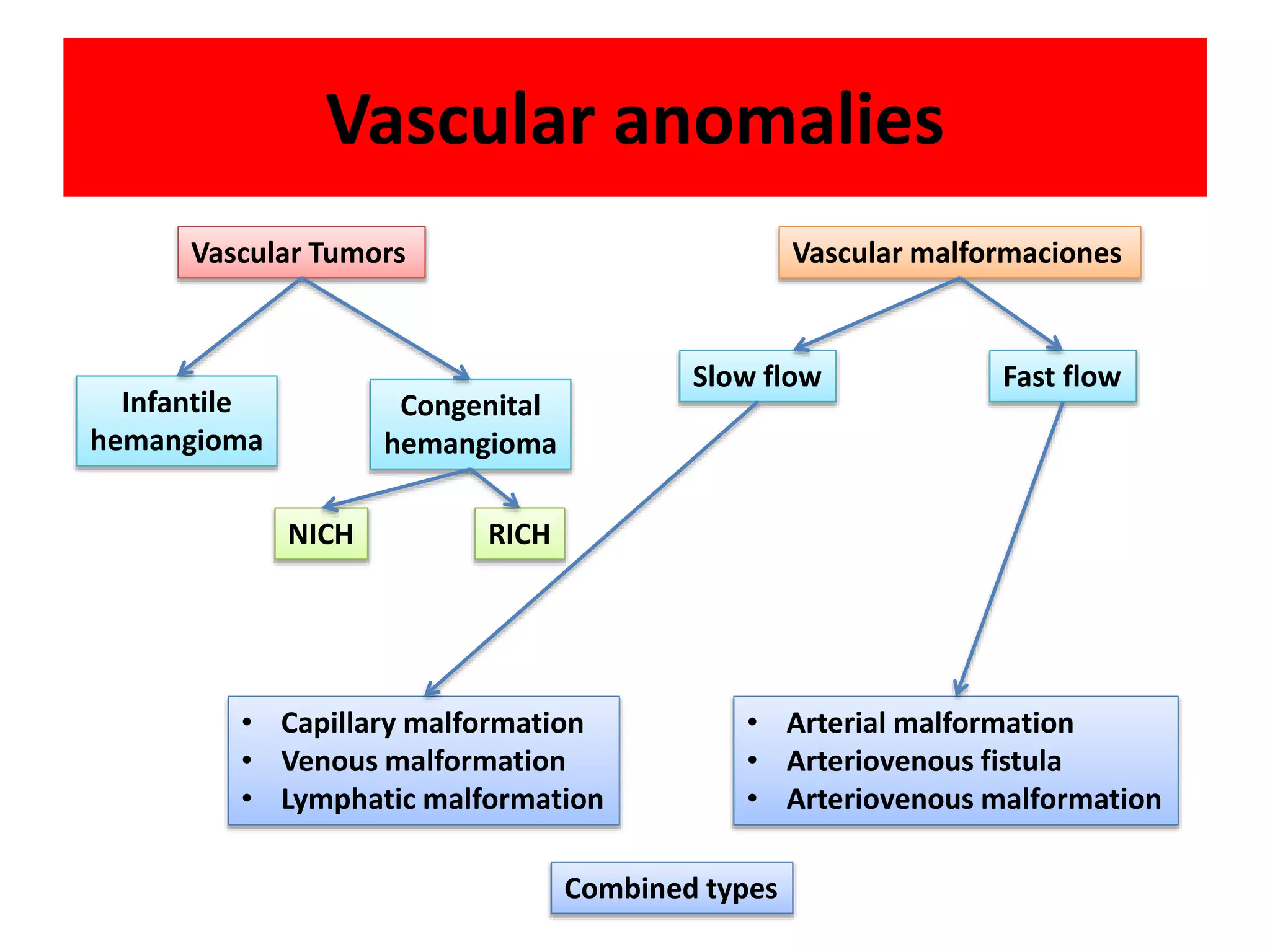
Vascular anomalies 
Vascular Tumors Vascular malformaciones 
Infantile 
hemangioma 
Congenital 
hemangioma 
NICH RICH 
• Capillary malformation 
• Venous malformation 
• Lymphatic malformation 
Slow flow Fast flow 
• Arterial malformation 
• Arteriovenous fistula 
• Arteriovenous malformation 
Combined types
Differentiating Features 
TUMOR 
• True tumors, with 
proliferation of the vascular 
endothelium 
• >3:1 female : male 
• Small or absent at birth 
• Rapid growth during infancy 
• Self-limited 
• Diagnosis: Clinical + 
appearence 
MALFORMATION 
• No tumor, comprised of 
dysplastic vessels 
• 1:1 female : male 
• Present at birth 
• Growth proportional to 
child 
• Never disappear 
• Diagnosis: MRI, Doppler 
ultrasonography, 
angiography
Vascular tumors 
• Infantile Hemangioma 
• Congenital Hemangioma 
• Kaposiform Hemangioendothelioma 
• Pyogenic Granuloma
Infantile Hemangioma (IH) 
• Bening endothelial cell tumor 
• Most common tumor of infancy/childhood 
• Incidence of 4.5% overall 
• It is more frequent in caucasian, premature infants and 
females (3:1 to 5:1) 
• Perinatal characteristics associated with a higher risk of IH 
include preeclampsia, multiple gestation, and low birth 
weight 
Hemangioma Investigator Group, Haggstrom AN, Drolet BA, Baselga E, et al. Prospective study of infan- tile hemangiomas: 
demographic, prenatal, and peri- natal characteristics. J Pediatr 2007;150(3):291–4.
Pathogenesis 
• Despite the frequency of this tumor, 
understanding of the pathogenetic mechanisms 
• Generally believed to be a complex interaction of 
both genetic and environmental factors 
• Histologically, have markedly increased cellularity 
with clusters of plump cells that are positive for 
markers of immature endothelial cells 
Drolet BA, Swanson EA, Frieden IJ, et al. Infantile hemangiomas: an emerging health issue linked to an increased rate of low birth 
weight infants. J Pediatr 2008;153(5):712 No-715.
Pathogenesis 
• Endothelial-like cells of the hemangioma 
expressed GLUT-1, the erythrocyte-type 
glucose transporter protein that has been 
shown to be upregulated in zones of hypoxia 
• GLUT-1 seems to be an exclusive marker for IH 
and is an invaluable tool used to distinguish 
hemangiomas from other vascular lesions. 
NorthPE,WanerM,MizerackiA,etal.GLUT1:anewly discovered immunohistochemical marker for juvenile hemangiomas. Hum Pathol 
2000;31(1):11–22
Diagnosis 
• History and physical 
examination 
• Radiographic imaging 
• Histopathology – GLUT-1
History 
• The diagnosis is typically made clinically based on 
its appearance and characteristic behavior 
• Between 30% and 50% of lesions are visible at 
birth as a small, pale spot, telangiectatic stain or 
ecchymotic area 
• Appears weeks/months afther birth (the median 
age appearance is 2 weeks)
Localitation 
• Most hemangiomas are 
single (80%) 
Head an neck 60% 
Trunk 25% 
Extremities 15%
Natural growth infantile hemangioma 
Age 
(Years) 
1 2 3 4 5 6 7 8 
Growth 
■ Proliferating 
■ Involuting 
■ Involuted
Proliferation stage
Involution stage
Residual changes
classified by their depth of soft tissue 
involvement
Classification based on morphology 
• Localized or 
segmental or 
indeterminate 
• Segmental 
hemangiomas are at 
higher risk of 
complications and 
associated anomalies
Ultrasound 
• Differentiate deep hemangiomas to venous 
malformations 
• To evaluate the response to drug treatment 
• Findings 
 Dense parenchyma rapid flow 
 Minor arterial resistance 
 Increased venous velocity 
 Effect of soft tissue mass 
•Connors III JP, Mulliken JB. Vascular Tumors and Malformations in Childhood. Vascular Surgery 6th ed 2005
Magnetic resonance 
• Test "reference” 
• Findings 
 Intermediate intensity parenchymal tissue (T1), and 
moderate hyperintensity (T2) 
 Empty Flow (arteriovenous shunts) 
 Glasses high flow or low flow 
 Reducing the size and number of vessels irrigating / 
draining 
 lobularity 
 Body fat avascular 
•Connors III JP, Mulliken JB. Vascular Tumors and Malformations in Childhood. Vascular Surgery 6th ed 2005
Complications 
• Although most IHs are uncomplicated and do 
not require treatment 
• 24% of those referred to tertiary institutions 
had complications 
• Size, location, and subtype (localized vs 
segmental) are major factors to consider in 
evaluating an infant’s risk 
Haggstrom AN, Drolet BA, Baselga E, et al. Prospective study of infantile hemangiomas: clinical characteristics predicting 
complications and treat- ment. Pediatrics 2006;118(3):882–7.
Ulceration 
• Is the most common complication and can result 
in pain, infection, bleeding, and permanent 
scarring 
• Larger in size or of the segmental subtype are 
more likely to develop ulceration 
• The cause of ulceration is not well understood, 
but maceration and friction are likely contributing 
factors given the higher frequency in locations 
prone to this 
Chamlin SL, Haggstrom AN, Drolet BA, et al. Multi- center prospective study of ulcerated hemangi- omas. J Pediatr 
2007;151(6):684–9, 689-e1.
Ulceration
Visual compromise 
• Threat to vision is a common reason for 
treatment in the IH population 
• Infants are at particular risk because stimulus 
deprivation for as little as 1 week can interrupt 
visual development and result in permanent 
visual impairment 
• Periocular IH may cause ptosis, strabismus, and 
anisometropia, each of which may result in 
astigmatism, amblyopia, or blindness 
Al Dhaybi R, Superstein R, Milet A, et al. Treatment of periocular infantile hemangiomas with propranolol: case series of 18 
children. Ophthalmology 2011; 118(6):1184–8.
Visceral involvement and 
complications 
• Hemangiomatosis – 30% 
• The lesions are usually less 
than 5 mm in diameter and 
domelike 
• Are recognized to have a 
higher risk of visceral 
hemangiomas, with liver and 
gastrointestinal involvement 
being most common 
• Should be screened with 
ultrasound to rule out lesions 
in internal organs
Anomalies associated with anatomic 
localization of HI 
• The presence of IH in 
particular locations can 
be a marker for 
underlying or 
associated anomalies 
• The “beard” 
distribution has been 
associated with the 
presence of airway 
hemangiomas 
Orlow SJ, Isakoff MS, Blei F. Increased risk of symp- tomatic hemangiomas of the airway in association with cutaneous 
hemangiomas in a “beard” distribution. J Pediatr 1997;131(4):643–6.
Anomalies associated with anatomic 
localization of HI 
In the lumbosacral area 
have also been reported in 
association with occult 
spinal dysraphism 
Girard C, Bigorre M, Guillot B, et al. PELVIS syndrome. Arch Dermatol 2006;142(7):884–8.
PHACE syndrome 
The neurocutaneous 
disorder characterized by 
posterior fossa 
abnormalities [P], large 
facial hemangiomas [H], 
arterial anomalies [A], 
cardiac defects [C], and 
eye anomalies [E] 
Frieden IJ, Reese V, Cohen D. PHACE syndrome. The association of posterior fossa brain malforma- tions, hemangiomas, arterial 
anomalies, coarctation of the aorta and cardiac defects, and eye abnormal- ities. Arch Dermatol 1996;132(3):307–11.
Treatment Objetives 
• Prevent or reverse the life-threatening 
complications or function 
• Prevent or minimize disfigurement 
• Minimize psychosocial stress for the patient and 
family 
• Properly treat ulceration to minimize scarring, 
bleeding, infection and pain
Conservative treatment 
• Observation is the mainstay of management 
because 90% of IHs are small and localized 
and do not involve aesthetically or 
functionally important areas 
• Up to 38% of hemangiomas referred to 
tertiary care specialists require systemic 
treatment because of complications
B-Blockers 
• The use of propranolol for IH quickly gained favor, 
because it has been perceived to have a lower 
side-effect profile than other systemic therapies 
• Its mechanism of action in the treatment of IH is 
unknown 
• Possible mechanisms of action purported include 
vasocon- striction, inhibition of angiogenesis, and 
induction of apoptosis 
Leaute-Labreze C, Dumas de la Roque E, Hubiche T, et al. Propranolol for severe hemangiomas of infancy. N Engl J Med 
2008;358(24):2649–51
Systemic Corticosteroids 
• Response to treatment is variable, regression in one 
third of cases, stabilization of growth in another third 
of cases, and minimal to no response in the final third 
of cases 
• Adverse effects are common and include irritability, 
gastrointestinal upset, sleep disturbance, cushingoid 
facies, adrenal suppression, immunosuppression, 
hypertension, bone demineralization, cardiomyopathy, 
and growth retardation 
• The duration of treatment is variable 
Barrio VR, Drolet BA. Treatment of hemangiomas of infancy. Dermatol Ther 2005;18(2):151–9.
Intralesional and topical 
corticosteroids 
• Reported to decrease the size or slow growth 
• Are most effective for small and localized 
cutaneous hemangiomas 
• The efficacy is limited by the depth of its 
penetration compared with the depth of 
hemangioma involvement 
Barrio VR, Drolet BA. Treatment of hemangiomas of infancy. Dermatol Ther 2005;18(2):151–9.
Vincristine 
• Effective in the treatment of IH and has historically 
been reserved for those IHs resistant to corticosteroids 
or in patients intolerant of corticosteroids 
• Constipation is the most common side effect, but 
neuromyopathy, most commonly presenting as foot 
drop, is a potentially serious side effect 
• Administration of vincristine requires placement of a 
central line; therefore, risks associated with this must 
be considered as well 
Barrio VR, Drolet BA. Treatment of hemangiomas of infancy. Dermatol Ther 2005;18(2):151–9.
Interferon 
• Recombinant interferon-a an inhibitor of 
angiogenesis, administered as a subcutaneous 
injection 
• Side effects include flulike symptoms of fever, 
irritability, and malaise 
• Its use is not recommended in earlier age
Laser therapy 
• The mechanism for this is not well understood 
• Controversy exists surrounding its use for the treatment of 
proliferating IH as adverse outcomes including ulceration 
and scarring have been described 
• Tuse of laser for intact IH is limited by the depth of the 
laser’s penetration (1 mm) 
• A few studies describing its benefit in the treatment of 
ulcerated hemangiomas in terms of both increasing 
reepithelialization and decreasing pain 
Witman PM, Wagner AM, Scherer K, et al. Complica- tions following pulsed dye laser treatment of super- ficial hemangiomas. 
Lasers SurgMed 2006;38(2): 116–23.
Surgery 
• Surgical excision may be an option for 
function- threatening or life-threatening 
hemangiomas when medical therapy fails or is 
not tolerated 
• More commonly its role is for removal of 
residual fibrofatty tissue or correction of 
scarring after involution
Congenital Hemangioma (CH) 
• Unlike IH, CH is fully 
developed at birth and does 
not undergo postnatal 
growth 
• Rare (compared to infantile) 
• Blue/gray hue, pale halo 
(skin) 
• Is more common in the 
extremities and has an 
equal sex distribution 
Vascullarr anomalliies 
Hemangioma
• 2 types 
Non Involuting Congenital Hemangioma 
(NICH) – persistent 
Rapidly Involuting Congenital Hemangioma 
(RICH) – resolved by 1 – 2 years
Growth patterns of hemangiomas 
GROWTH NICH 
RICH 
IH 
BIRTH 1 YR 2 YRS 
AGE 
RICH:rapidly involuting congenital hemangioma; NICH:noninvoluting congenital hemangioma. IH: Infantile Hemangioma
Treatment 
• Most CHs are managed by observation 
• RICHs begin to involute shortly after birth, and 
most have resolved by 12 months of age 
• NICH is a stable lesion that does not involute 
or respond to pharmac logic treatment. Thus, 
NICH causing disfigurement or functional 
problems is treated by excision
Kaposiform Hemangioendothelioma 
• Rare vascular neoplasm that is 
locally aggressive but does not 
metastasize 
• Fifty percent of lesions are 
present at birth and are 
diagnosed during infancy 
(58%), early childhood (1 to 10 
years; 32%), or late child hood 
(10 to 20 years; 10%) 
• Has an equal sex distribution, 
is solitary, and affects the head 
or neck (40%), trunk (30%), or 
extremity (30%)
Kasabach-Merritt phenomenon 
• "Giant Hemangioma” 
• Thrombocytopenia 
(typically <10,000 mm3) 
• Petechiae 
• bleeding
Treatment 
• A localized tumor can be resected, depending on 
its location 
• Patients with KMP require systemic treatment to 
prevent lifethreatening complications 
• Responds best to vincristine (90%), followed by 
IFN (50%) and corticosteroid (10%)
Pyogenic granuloma 
• Is a solitary a small red papule that grows rapidly, forming a stalk 
• The malefemale ratio is 2 : 1 
• It is commonly complicated by bleeding (64.2%) and epidermal ulceration 
(36.3%) 
• The presentation is inversely correlated with age 
• They are distributed on the head or neck (62%), trunk (19%), upper 
extremity (13%), or lower extremity (5%) 
• Twentyfive percent of patients have a history of trauma or an underlying 
cutaneous condition (including capillary malformation, dermatologic 
disorder, viral infection, or insect bite).
Treatment 
• Numerous treatment 
methods have been 
described: curettage, shave 
excision, laser therapy, and 
excision 
• These modalities have a 
recurrence rate of 43.5% 
• Definitive treatment 
requires fullthickness skin 
excision, which has an 
approximately 100% cure 
rate
Clinic case 
• Female 
• 2 weeks after birth 
• Premature antecedent 
INFANTILE HEMANGIOMA
THANKS

Vascular tumors

  • 1.
  • 2.
    DR. LEONARDO BALLESTASMALDONADO GENERAL SURGERY RESIDENT UNIVERSIDAD DEL VALLE DR. RENE TIMARAN VASCULAR SURGERY TEACHER HOSPITAL SAN VICENTE DE PAUL UNIVERSIDAD DE ANTIOQUIA
  • 3.
    Clinic case •Female • 2 weeks after birth • Premature antecedent • GLUT-1 positive DIAGNOSIS
  • 4.
    “Not every skinlesion looking like a strawberry is a hemangioma; not all hemangiomas look like strawberries” J.B. Mulliken, MD
  • 5.
    Evidence • Asearch of the evidence in the database: Medline, Embase, Cohcrane, Tripdatabase, Scielo • Key words: Hemangioma, vascular anomalies, kaposiform hemangioendothelioma, infantile hemangioma, pyogenic granuloma, congenital hemangioma
  • 7.
    Introduction • Vascularanomalies are the most common skin and soft tissue lesions observed in infants and children • Older nomenclature continues to cause confusion, misunderstood diagnoses, and potencial mismagement • In 1982, Milliken and Glowacki proposed a classification system for vascular anomalies based on their clinical behavior and endothelial cell characteristic Kilcline C, Frieden IJ. Infantile hemangiomas: how common are they? A systematic review of the medical literature. Pediatr Dermatol 2008;25(2):168–73.
  • 8.
    ISSVA Classification Societyfor the Study of Vascular Anomalies Vascular tumors Vascular malformation Vascullar anomalliies Hemangioma Vascular malformation
  • 9.
    Vascular anomalies VascularTumors Vascular malformaciones Infantile hemangioma Congenital hemangioma NICH RICH • Capillary malformation • Venous malformation • Lymphatic malformation Slow flow Fast flow • Arterial malformation • Arteriovenous fistula • Arteriovenous malformation Combined types
  • 10.
    Differentiating Features TUMOR • True tumors, with proliferation of the vascular endothelium • >3:1 female : male • Small or absent at birth • Rapid growth during infancy • Self-limited • Diagnosis: Clinical + appearence MALFORMATION • No tumor, comprised of dysplastic vessels • 1:1 female : male • Present at birth • Growth proportional to child • Never disappear • Diagnosis: MRI, Doppler ultrasonography, angiography
  • 11.
    Vascular tumors •Infantile Hemangioma • Congenital Hemangioma • Kaposiform Hemangioendothelioma • Pyogenic Granuloma
  • 12.
    Infantile Hemangioma (IH) • Bening endothelial cell tumor • Most common tumor of infancy/childhood • Incidence of 4.5% overall • It is more frequent in caucasian, premature infants and females (3:1 to 5:1) • Perinatal characteristics associated with a higher risk of IH include preeclampsia, multiple gestation, and low birth weight Hemangioma Investigator Group, Haggstrom AN, Drolet BA, Baselga E, et al. Prospective study of infan- tile hemangiomas: demographic, prenatal, and peri- natal characteristics. J Pediatr 2007;150(3):291–4.
  • 13.
    Pathogenesis • Despitethe frequency of this tumor, understanding of the pathogenetic mechanisms • Generally believed to be a complex interaction of both genetic and environmental factors • Histologically, have markedly increased cellularity with clusters of plump cells that are positive for markers of immature endothelial cells Drolet BA, Swanson EA, Frieden IJ, et al. Infantile hemangiomas: an emerging health issue linked to an increased rate of low birth weight infants. J Pediatr 2008;153(5):712 No-715.
  • 14.
    Pathogenesis • Endothelial-likecells of the hemangioma expressed GLUT-1, the erythrocyte-type glucose transporter protein that has been shown to be upregulated in zones of hypoxia • GLUT-1 seems to be an exclusive marker for IH and is an invaluable tool used to distinguish hemangiomas from other vascular lesions. NorthPE,WanerM,MizerackiA,etal.GLUT1:anewly discovered immunohistochemical marker for juvenile hemangiomas. Hum Pathol 2000;31(1):11–22
  • 15.
    Diagnosis • Historyand physical examination • Radiographic imaging • Histopathology – GLUT-1
  • 16.
    History • Thediagnosis is typically made clinically based on its appearance and characteristic behavior • Between 30% and 50% of lesions are visible at birth as a small, pale spot, telangiectatic stain or ecchymotic area • Appears weeks/months afther birth (the median age appearance is 2 weeks)
  • 17.
    Localitation • Mosthemangiomas are single (80%) Head an neck 60% Trunk 25% Extremities 15%
  • 18.
    Natural growth infantilehemangioma Age (Years) 1 2 3 4 5 6 7 8 Growth ■ Proliferating ■ Involuting ■ Involuted
  • 19.
  • 20.
  • 21.
  • 22.
    classified by theirdepth of soft tissue involvement
  • 23.
    Classification based onmorphology • Localized or segmental or indeterminate • Segmental hemangiomas are at higher risk of complications and associated anomalies
  • 24.
    Ultrasound • Differentiatedeep hemangiomas to venous malformations • To evaluate the response to drug treatment • Findings  Dense parenchyma rapid flow  Minor arterial resistance  Increased venous velocity  Effect of soft tissue mass •Connors III JP, Mulliken JB. Vascular Tumors and Malformations in Childhood. Vascular Surgery 6th ed 2005
  • 25.
    Magnetic resonance •Test "reference” • Findings  Intermediate intensity parenchymal tissue (T1), and moderate hyperintensity (T2)  Empty Flow (arteriovenous shunts)  Glasses high flow or low flow  Reducing the size and number of vessels irrigating / draining  lobularity  Body fat avascular •Connors III JP, Mulliken JB. Vascular Tumors and Malformations in Childhood. Vascular Surgery 6th ed 2005
  • 26.
    Complications • Althoughmost IHs are uncomplicated and do not require treatment • 24% of those referred to tertiary institutions had complications • Size, location, and subtype (localized vs segmental) are major factors to consider in evaluating an infant’s risk Haggstrom AN, Drolet BA, Baselga E, et al. Prospective study of infantile hemangiomas: clinical characteristics predicting complications and treat- ment. Pediatrics 2006;118(3):882–7.
  • 28.
    Ulceration • Isthe most common complication and can result in pain, infection, bleeding, and permanent scarring • Larger in size or of the segmental subtype are more likely to develop ulceration • The cause of ulceration is not well understood, but maceration and friction are likely contributing factors given the higher frequency in locations prone to this Chamlin SL, Haggstrom AN, Drolet BA, et al. Multi- center prospective study of ulcerated hemangi- omas. J Pediatr 2007;151(6):684–9, 689-e1.
  • 29.
  • 30.
    Visual compromise •Threat to vision is a common reason for treatment in the IH population • Infants are at particular risk because stimulus deprivation for as little as 1 week can interrupt visual development and result in permanent visual impairment • Periocular IH may cause ptosis, strabismus, and anisometropia, each of which may result in astigmatism, amblyopia, or blindness Al Dhaybi R, Superstein R, Milet A, et al. Treatment of periocular infantile hemangiomas with propranolol: case series of 18 children. Ophthalmology 2011; 118(6):1184–8.
  • 31.
    Visceral involvement and complications • Hemangiomatosis – 30% • The lesions are usually less than 5 mm in diameter and domelike • Are recognized to have a higher risk of visceral hemangiomas, with liver and gastrointestinal involvement being most common • Should be screened with ultrasound to rule out lesions in internal organs
  • 32.
    Anomalies associated withanatomic localization of HI • The presence of IH in particular locations can be a marker for underlying or associated anomalies • The “beard” distribution has been associated with the presence of airway hemangiomas Orlow SJ, Isakoff MS, Blei F. Increased risk of symp- tomatic hemangiomas of the airway in association with cutaneous hemangiomas in a “beard” distribution. J Pediatr 1997;131(4):643–6.
  • 33.
    Anomalies associated withanatomic localization of HI In the lumbosacral area have also been reported in association with occult spinal dysraphism Girard C, Bigorre M, Guillot B, et al. PELVIS syndrome. Arch Dermatol 2006;142(7):884–8.
  • 34.
    PHACE syndrome Theneurocutaneous disorder characterized by posterior fossa abnormalities [P], large facial hemangiomas [H], arterial anomalies [A], cardiac defects [C], and eye anomalies [E] Frieden IJ, Reese V, Cohen D. PHACE syndrome. The association of posterior fossa brain malforma- tions, hemangiomas, arterial anomalies, coarctation of the aorta and cardiac defects, and eye abnormal- ities. Arch Dermatol 1996;132(3):307–11.
  • 35.
    Treatment Objetives •Prevent or reverse the life-threatening complications or function • Prevent or minimize disfigurement • Minimize psychosocial stress for the patient and family • Properly treat ulceration to minimize scarring, bleeding, infection and pain
  • 36.
    Conservative treatment •Observation is the mainstay of management because 90% of IHs are small and localized and do not involve aesthetically or functionally important areas • Up to 38% of hemangiomas referred to tertiary care specialists require systemic treatment because of complications
  • 37.
    B-Blockers • Theuse of propranolol for IH quickly gained favor, because it has been perceived to have a lower side-effect profile than other systemic therapies • Its mechanism of action in the treatment of IH is unknown • Possible mechanisms of action purported include vasocon- striction, inhibition of angiogenesis, and induction of apoptosis Leaute-Labreze C, Dumas de la Roque E, Hubiche T, et al. Propranolol for severe hemangiomas of infancy. N Engl J Med 2008;358(24):2649–51
  • 38.
    Systemic Corticosteroids •Response to treatment is variable, regression in one third of cases, stabilization of growth in another third of cases, and minimal to no response in the final third of cases • Adverse effects are common and include irritability, gastrointestinal upset, sleep disturbance, cushingoid facies, adrenal suppression, immunosuppression, hypertension, bone demineralization, cardiomyopathy, and growth retardation • The duration of treatment is variable Barrio VR, Drolet BA. Treatment of hemangiomas of infancy. Dermatol Ther 2005;18(2):151–9.
  • 39.
    Intralesional and topical corticosteroids • Reported to decrease the size or slow growth • Are most effective for small and localized cutaneous hemangiomas • The efficacy is limited by the depth of its penetration compared with the depth of hemangioma involvement Barrio VR, Drolet BA. Treatment of hemangiomas of infancy. Dermatol Ther 2005;18(2):151–9.
  • 40.
    Vincristine • Effectivein the treatment of IH and has historically been reserved for those IHs resistant to corticosteroids or in patients intolerant of corticosteroids • Constipation is the most common side effect, but neuromyopathy, most commonly presenting as foot drop, is a potentially serious side effect • Administration of vincristine requires placement of a central line; therefore, risks associated with this must be considered as well Barrio VR, Drolet BA. Treatment of hemangiomas of infancy. Dermatol Ther 2005;18(2):151–9.
  • 41.
    Interferon • Recombinantinterferon-a an inhibitor of angiogenesis, administered as a subcutaneous injection • Side effects include flulike symptoms of fever, irritability, and malaise • Its use is not recommended in earlier age
  • 42.
    Laser therapy •The mechanism for this is not well understood • Controversy exists surrounding its use for the treatment of proliferating IH as adverse outcomes including ulceration and scarring have been described • Tuse of laser for intact IH is limited by the depth of the laser’s penetration (1 mm) • A few studies describing its benefit in the treatment of ulcerated hemangiomas in terms of both increasing reepithelialization and decreasing pain Witman PM, Wagner AM, Scherer K, et al. Complica- tions following pulsed dye laser treatment of super- ficial hemangiomas. Lasers SurgMed 2006;38(2): 116–23.
  • 43.
    Surgery • Surgicalexcision may be an option for function- threatening or life-threatening hemangiomas when medical therapy fails or is not tolerated • More commonly its role is for removal of residual fibrofatty tissue or correction of scarring after involution
  • 45.
    Congenital Hemangioma (CH) • Unlike IH, CH is fully developed at birth and does not undergo postnatal growth • Rare (compared to infantile) • Blue/gray hue, pale halo (skin) • Is more common in the extremities and has an equal sex distribution Vascullarr anomalliies Hemangioma
  • 46.
    • 2 types Non Involuting Congenital Hemangioma (NICH) – persistent Rapidly Involuting Congenital Hemangioma (RICH) – resolved by 1 – 2 years
  • 47.
    Growth patterns ofhemangiomas GROWTH NICH RICH IH BIRTH 1 YR 2 YRS AGE RICH:rapidly involuting congenital hemangioma; NICH:noninvoluting congenital hemangioma. IH: Infantile Hemangioma
  • 48.
    Treatment • MostCHs are managed by observation • RICHs begin to involute shortly after birth, and most have resolved by 12 months of age • NICH is a stable lesion that does not involute or respond to pharmac logic treatment. Thus, NICH causing disfigurement or functional problems is treated by excision
  • 49.
    Kaposiform Hemangioendothelioma •Rare vascular neoplasm that is locally aggressive but does not metastasize • Fifty percent of lesions are present at birth and are diagnosed during infancy (58%), early childhood (1 to 10 years; 32%), or late child hood (10 to 20 years; 10%) • Has an equal sex distribution, is solitary, and affects the head or neck (40%), trunk (30%), or extremity (30%)
  • 50.
    Kasabach-Merritt phenomenon •"Giant Hemangioma” • Thrombocytopenia (typically <10,000 mm3) • Petechiae • bleeding
  • 51.
    Treatment • Alocalized tumor can be resected, depending on its location • Patients with KMP require systemic treatment to prevent lifethreatening complications • Responds best to vincristine (90%), followed by IFN (50%) and corticosteroid (10%)
  • 52.
    Pyogenic granuloma •Is a solitary a small red papule that grows rapidly, forming a stalk • The malefemale ratio is 2 : 1 • It is commonly complicated by bleeding (64.2%) and epidermal ulceration (36.3%) • The presentation is inversely correlated with age • They are distributed on the head or neck (62%), trunk (19%), upper extremity (13%), or lower extremity (5%) • Twentyfive percent of patients have a history of trauma or an underlying cutaneous condition (including capillary malformation, dermatologic disorder, viral infection, or insect bite).
  • 53.
    Treatment • Numeroustreatment methods have been described: curettage, shave excision, laser therapy, and excision • These modalities have a recurrence rate of 43.5% • Definitive treatment requires fullthickness skin excision, which has an approximately 100% cure rate
  • 54.
    Clinic case •Female • 2 weeks after birth • Premature antecedent INFANTILE HEMANGIOMA
  • 55.

Editor's Notes

  • #25 Ecografía Diferenciar los hemangiomas profundos de las malformaciones venosas Evaluar la respuesta al tratamiento farmacológico Hallazgos: Parénquima denso y un flujo rápido Menor resistencia arterial Aumento de la velocidad venosa Efecto de masa de tejido blando
  • #26 Resonancia magnética Prueba “de referencia” Hallazgos: Tejido parenquimatoso de intensidad intermedia (T1), y de hiperintensidad moderada (T2) Vacios de flujo (shunts arteriovenosos) Vasos de alto flujo o bajo flujo Reducción del tamaño y número de vasos irrigantes/drenantes Lobularidad Masa adiposa avascular
  • #43 The pulsed dye laser (PDL) has been successfully used for vascular birthmarks, namely, capillary mal- formations or “port-wine stains” for years, and its efficacy in this setting is well-established