Haemangiomas and
Vascular Malformations
Dr. SUNDARPRAKASH SIVALINGAM
ASSOCIATE PROFESSOR IN SURGERY
 The term hemangioma refers to the common
tumor of infancy that has a proliferative
endothelium, and exhibits rapid postnatal
growth and slow regression during childhood;
this tumor never appears in an adolescent or
adult.
 Whereas vascular malformations are comprised
of abnormally formed channels that are lined by
stable endothelium, present at birth, never
regress and often expand.
Web Site: www.makboul.com Dr. Mohamed Makboul, MD
Vascular anomalies can be classified into two
unique groups:-
Web Site: www.makboul.com Dr. Mohamed Makboul, MD


Hemangiomas
Vascular malformations which subcategories into :
 Slow-flow

 Capillary
 Lymphatic
 Venous
Fast-flow
 Arterial arterial (aneurysm, stenosis, ectasia)
 Arteriovenous fistulae (AVF)
 Arteriovenous malformation (AVM)
Web Site: www.makboul.com Dr. Mohamed Makboul, MD
Haemangioma
Haemangioma
 Hemangioma is the most
common tumor of infancy,
in neonatalhood,
within the first 2
appears
usually
weeks and has a defined
natural history.
Web Site: www.makboul.com Dr. Mohamed Makboul, MD
Clinical Features
Web Site: www.makboul.com Dr. Mohamed Makboul, MD
The natural history of Hemangioma is
characterized by three phases:
 Proliferating Phase
 Involuting Phase
 Involuted Phase
Proliferating Phase
 Hemangioma grows rapidly during the first 6
to 8 months of infancy, the skin becomes
raised, bosselated, and a vivid crimson color.
 Palpation at this stage reveals a tense and
noncompressible mass.
Web Site: www.makboul.com Dr. Mohamed Makboul, MD
Involuting Phase
 Hemangioma reaches its peak before the first year;
and for a time thereafter, growth is proportionate to
that of the child.
 The first signs of the involuting phase appear as the
crimson color fades to a dull purplish color, the skin
gradually pales, and the tumor feels less tense.
 The involuting phase continues until the child is 5 to
10 years of age.
Web Site: www.makboul.com Dr. Mohamed Makboul, MD
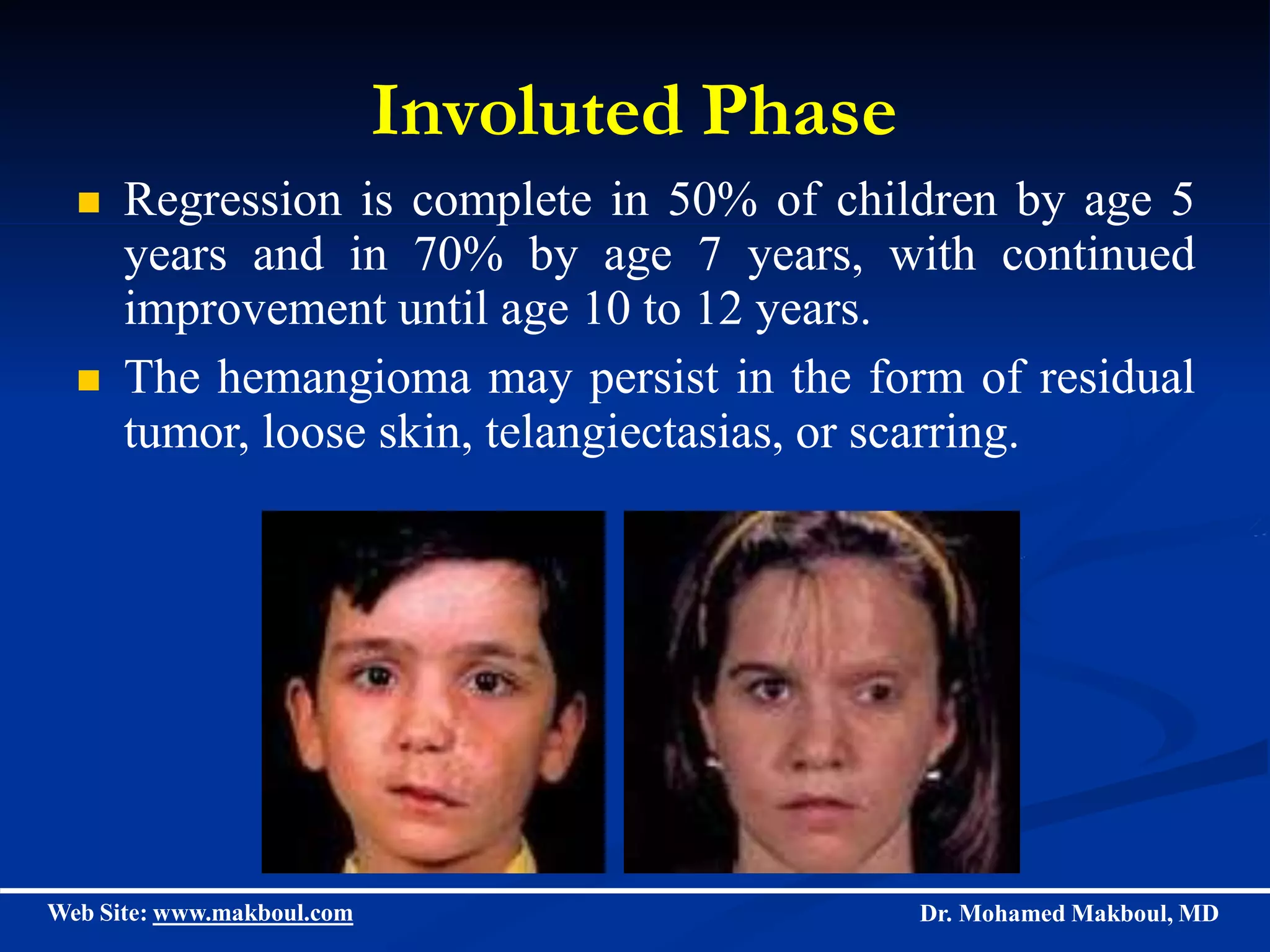
Involuted Phase
 Regression is complete in 50% of children by age 5
years and in 70% by age 7 years, with continued
improvement until age 10 to 12 years.
 The hemangioma may persist in the form of residual
tumor, loose skin, telangiectasias, or scarring.
Web Site: www.makboul.com Dr. Mohamed Makboul, MD
Hemangiomas can be superficial, deep,
or visceral in location
 Superficial lesions: often exhibit the classic crimson
color of the so-called strawberry hemangioma.
 Deep lesions: Are those within the deep dermis
or subcutaneous tissues often present as pale
blue or purple masses that may be confused with
venous
malformations.
Visceral lesions: Are not apparent on physical
examination, and in 50% of cases, there are no
accompanying cutaneous hemangiomas. In this
setting, their presence may only be suggested by
physiologic findings such as hepatomegaly,
congestive heart failure, or stridor.
Web Site: www.makboul.com Dr. Mohamed Makboul, MD
DIAGNOSTIC IMAGING
Web Site: www.makboul.com Dr. Mohamed Makboul, MD
fromHemangiomas are readily distinguished
other tumors by:
 Ultrasonography (US)
 Computerized tomography (CT)
 Magnetic resonance imaging (MRI)
 Arteriography
DIFFERENTIAL DIAGNOSIS
Web Site: www.makboul.com Dr. Mohamed Makboul, MD
Hemangiomas must be differentiated from:
 Macular stains,
 Vascular malformations, and
 Other vascular tumors of infancy.
Macular Stains



The most common type of vascular birthmark is the macular
stain.
These are flat lesions, ranging in color from pink to red, seen
in as many as 40 percent of newborns.
Typically seen in the neck, glabella, eyelid, and forehead,
these probably are physiologic phenomena that will resolve
with time.
Web Site: www.makboul.com Dr. Mohamed Makboul, MD
Vascular Malformations
Web Site: www.makboul.com Dr. Mohamed Makboul, MD
 The natural history of vascular malformations is
distinct from hemangiomas.
 Boys and girls are affected equally.
 All malformations are present at birth.
 The physical appearance of vascular
malformations is dependent on the type of vessels
involved.
 Venous malformations may appear as bluish
masses and be confused with subcutaneous
hemangiomas, but they are distinguished by the
ability to be emptied of blood with compression.
 Malformations grow commensurately with the
child and do not undergo the rapid
proliferative growth phase exhibited by
hemangiomas.
 The greatest distinction between hemangiomas
and malformations is that the former
spontaneously involute and the latter do not.
 Hemangiomas, unlike vascular malformations,
rarely cause bony distortion or hypertrophy.
Web Site: www.makboul.com Dr. Mohamed Makboul, MD
Vascular Malformations (cont.)
Other Vascular Tumors of Infancy
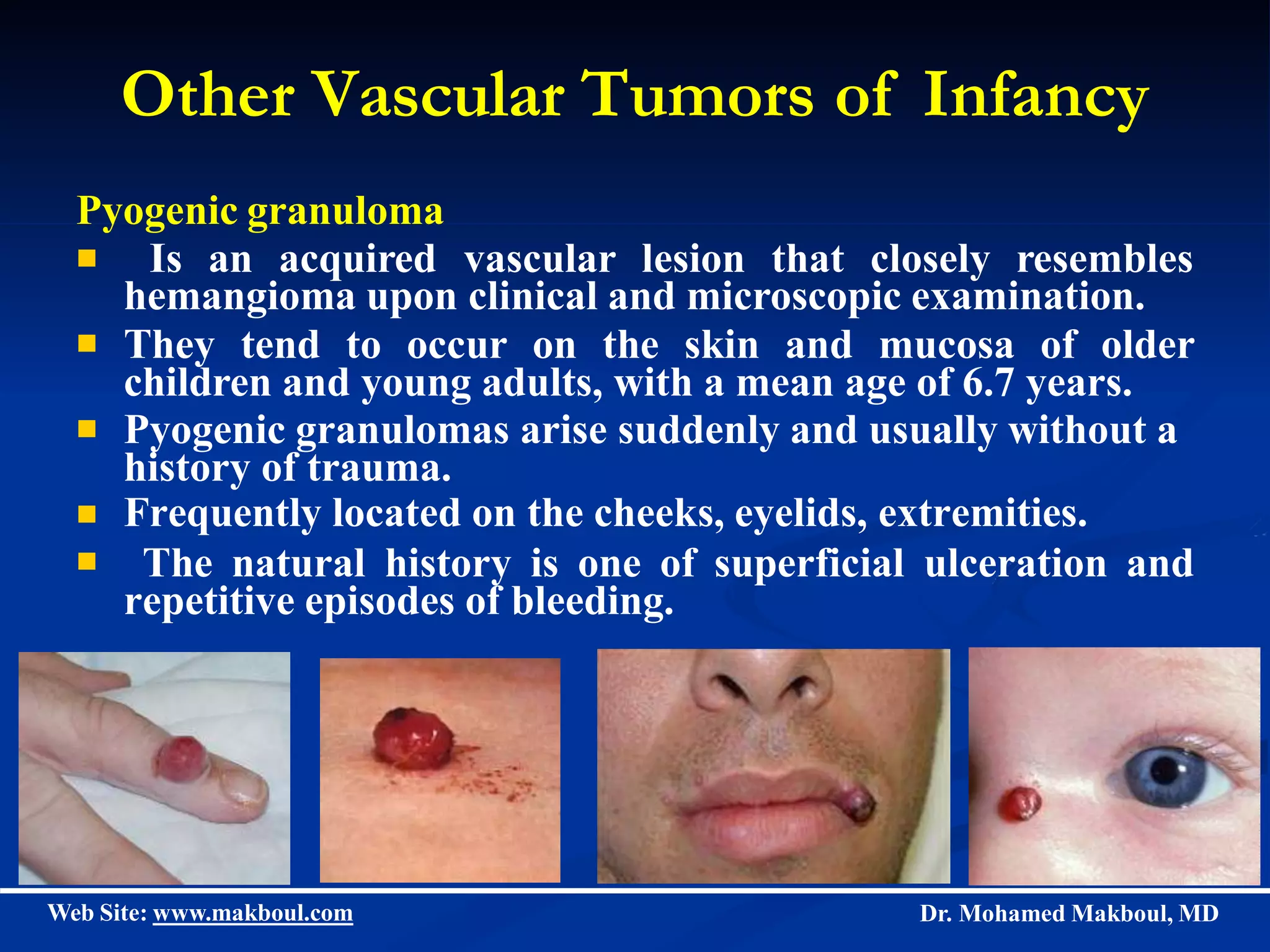
Pyogenic granuloma
 Is an acquired vascular lesion that closely resembles
hemangioma upon clinical and microscopic examination.
 They tend to occur on the skin and mucosa of older
children and young adults, with a mean age of 6.7 years.



Pyogenic granulomas arise suddenly and usually without a
history of trauma.
Frequently located on the cheeks, eyelids, extremities.
The natural history is one of superficial ulceration and
repetitive episodes of bleeding.
Web Site: www.makboul.com Dr. Mohamed Makboul, MD
COMPLICATIONS
Web Site: www.makboul.com Dr. Mohamed Makboul, MD
 Ulceration
 Infection
 Visual Impairment
 Airway Obstruction
 Auditory Canal Obstruction
 Congestive Heart Failure : usually occurs in
one of two settings: diffuse neonatal
hemangiomatosis or large visceral
hemangiomas
MANAGEMENT
Web Site: www.makboul.com Dr. Mohamed Makboul, MD
 In most instances, parental education and reassurance
will suffice.
 Because most hemangiomas undergo spontaneous
involution, treatment may be reserved for those
lesions of functional or psychological concern.
 Hemangiomas obstructing the visual axis, airway, and
auditory canals, or those associated with congestive
heart failure, ulceration, or bleeding, should be
considered for treatment.
 A number of options are available for the
treatment of hemangiomas.
 Effective treatments may be divided into:
 Those that are nonspecific (e.g., excision,
cryotherapy);
 Antiangiogenic (e.g., corticosteroids, interferon);
and
 Antiproliferative (e.g., chemotherapy, radiation).
Web Site: www.makboul.com Dr. Mohamed Makboul, MD
Surgical Excision
Web Site: www.makboul.com Dr. Mohamed Makboul, MD
Surgical excision may be indicated for:
 Infancy for obstructing effect,
 Ulcerating, or
 Large hemangiomas unresponsive to
pharmacologic therapy.
Web Site: www.makboul.com Dr. Mohamed Makboul, MD
Capillary Malformation (CM)
CLINICAL PRESENTATION
 Port wine stains are intradermal capillary or
venular malformations that are present at birth.
Web Site: www.makboul.com Dr. Mohamed Makboul, MD
 CM is a macular, red,
vascular stain that presents
at birth and persists
throughout life.
 CM can be localized or
extensive, on the face,
trunk, or limbs. The
incidence rate in newborns
is 0.3%.
Web Site: www.makboul.com Dr. Mohamed Makboul, MD
 Two-thirds of these lesions darken in color
over time.
 Most CMs are harmless cutaneous birthmarks,
but some are red flags that signal underlying
abnormalities.
 CM in a limb often is associated with axial and
transverse hypertrophy.
Web Site: www.makboul.com Dr. Mohamed Makboul, MD
Treatment
 CM is treated by flashlamp pulsed-dye laser;
the results are better if initiated in infancy and
childhood.
 Soft-tissue and skeletal hypertrophy also can
require surgical therapy.
 Laser therapy cannot correct soft-tissue
overgrowth.
Web Site: www.makboul.com Dr. Mohamed Makboul, MD
Laser treatment
Web Site: www.makboul.com Dr. Mohamed Makboul, MD
Hypertrophy of the upper lip, treated by partial debulking
Web Site: www.makboul.com Dr. Mohamed Makboul, MD
Venous Malformation (VM)
CLINICAL PRESENTATION
 Venous malformations are localized or extensive,
minor or distorting, single or multiple, and located
anywhere on the head, limbs, or trunk.
 Most VMs are sporadic, blue color, soft, compressible
on palpation, a slow refill, and increased size with
dependency are pathognomonic for venous
malformation.
Web Site: www.makboul.com Dr. Mohamed Makboul, MD
DIAGNOSIS
 Clinical picture.
 MRI
Web Site: www.makboul.com Dr. Mohamed Makboul, MD
TREATMENT
 Sclerotherapy is the primary treatment for
VMs, although subsequent surgical resection is
often needed.
VM Upper lip,
Post Sclerotherapy
and excision
Web Site: www.makboul.com Dr. Mohamed Makboul, MD
VM Rt. Cheek, Post Sclerotherapy
Web Site: www.makboul.com Dr. Mohamed Makboul, MD
Extensive venous malformation of the buttock and right thigh.
Staged surgical reduction of the right buttock and thigh
Web Site: www.makboul.com Dr. Mohamed Makboul, MD
Lymphatic Malformation (LM)
CLINICAL PRESENTATION
 LMs can be described as
microcystic, macrocystic, and
combined lymphaticovenous (LVM)
forms.
 Lymphatic anomalies present in a
wide spectrum, from lymphedema
to large cystic malformations.
 LMs are generally detected at birth
or shortly, thereafter LMs grow with
the child.
Web Site: www.makboul.com Dr. Mohamed Makboul, MD
 Lymphatic malformations can affect all areas of the
body, but most are located in the cervicofacial region
and axilla.
 LMs are the most common cause of congenital
tongue enlargement (macroglossia), lip enlargement
(macrocheilia), and ear enlargement (macrotia).
 Skeletal hypertrophy and distortion in 80% of
cervicofacial LMs occur by 10 years of age.
 LM never regresses.
Web Site: www.makboul.com Dr. Mohamed Makboul, MD
TREATMENT
 Sclerotherapy has assumed a major role in the
management of LM.
 Surgical resection is the only way to
potentially cure LM.
Web Site: www.makboul.com Dr. Mohamed Makboul, MD
Large lymphatic malformation of the right lateral forehead and temple region.
After excision.
Web Site: www.makboul.com Dr. Mohamed Makboul, MD
Arteriovenous Malformation (AVM)
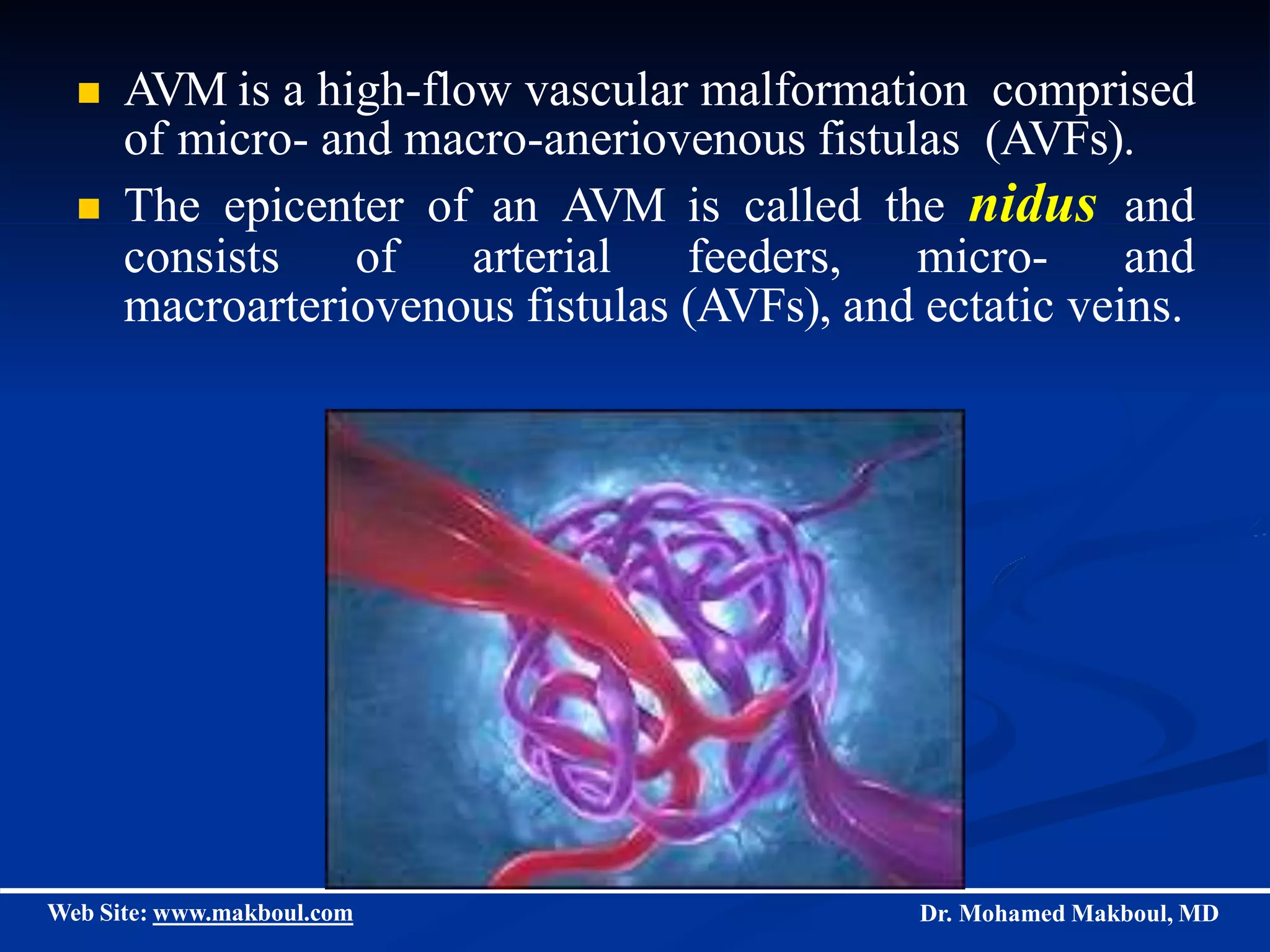
 AVM is a high-flow vascular malformation comprised
of micro- and macro-aneriovenous fistulas (AVFs).
 The epicenter of an AVM is called the nidus and
consists of arterial feeders, micro- and
macroarteriovenous fistulas (AVFs), and ectatic veins.
Web Site: www.makboul.com Dr. Mohamed Makboul, MD
Clinical Staging System
Introduced by Schobinger


 Stage I (Quiescence): Pink-blush stain, warmth, and AV
shunting by Doppler
Stage II (Expansion): Same as stage I, plus enlargement,
pulsations, thrill, bruit, and tortuous/tense veins
Stage III (Destruction): Same as above, plus dystrophic

changes, ulceration, bleeding persistent pain, and expansion/
destruction
Stage IV (Decompensation): Same as stage II, plus cardiac
Failure
Web Site: www.makboul.com Dr. Mohamed Makboul, MD
Diagnosis
 Confirmation of clinical diagnosis is helpful
with Color Doppler examination, Magnetic
Resonance Imaging, andAngiography.
Web Site: www.makboul.com Dr. Mohamed Makboul, MD
Treatment
 Usually AVM is treated whenever endangering
signs and symptoms arise, such as ischemic
pain, ulceration, bleeding, or increased cardiac
output (Stages III and IV).
 Arterial embolization is done to temporarily
occlude the nidus in preparation for resection
24 to 72 hours later.
Web Site: www.makboul.com Dr. Mohamed Makboul, MD
Questions???
Web Site: www.makboul.com Dr. Mohamed Makboul, MD

Haemangiomas and vascular malformations

  • 1.
    Haemangiomas and Vascular Malformations Dr.SUNDARPRAKASH SIVALINGAM ASSOCIATE PROFESSOR IN SURGERY
  • 2.
     The termhemangioma refers to the common tumor of infancy that has a proliferative endothelium, and exhibits rapid postnatal growth and slow regression during childhood; this tumor never appears in an adolescent or adult.  Whereas vascular malformations are comprised of abnormally formed channels that are lined by stable endothelium, present at birth, never regress and often expand. Web Site: www.makboul.com Dr. Mohamed Makboul, MD
  • 3.
    Vascular anomalies canbe classified into two unique groups:- Web Site: www.makboul.com Dr. Mohamed Makboul, MD   Hemangiomas Vascular malformations which subcategories into :  Slow-flow   Capillary  Lymphatic  Venous Fast-flow  Arterial arterial (aneurysm, stenosis, ectasia)  Arteriovenous fistulae (AVF)  Arteriovenous malformation (AVM)
  • 4.
    Web Site: www.makboul.comDr. Mohamed Makboul, MD Haemangioma
  • 5.
    Haemangioma  Hemangioma isthe most common tumor of infancy, in neonatalhood, within the first 2 appears usually weeks and has a defined natural history. Web Site: www.makboul.com Dr. Mohamed Makboul, MD
  • 6.
    Clinical Features Web Site:www.makboul.com Dr. Mohamed Makboul, MD The natural history of Hemangioma is characterized by three phases:  Proliferating Phase  Involuting Phase  Involuted Phase
  • 7.
    Proliferating Phase  Hemangiomagrows rapidly during the first 6 to 8 months of infancy, the skin becomes raised, bosselated, and a vivid crimson color.  Palpation at this stage reveals a tense and noncompressible mass. Web Site: www.makboul.com Dr. Mohamed Makboul, MD
  • 8.
    Web Site: www.makboul.comDr. Mohamed Makboul, MD
  • 9.
    Involuting Phase  Hemangiomareaches its peak before the first year; and for a time thereafter, growth is proportionate to that of the child.  The first signs of the involuting phase appear as the crimson color fades to a dull purplish color, the skin gradually pales, and the tumor feels less tense.  The involuting phase continues until the child is 5 to 10 years of age. Web Site: www.makboul.com Dr. Mohamed Makboul, MD
  • 10.
    Involuted Phase  Regressionis complete in 50% of children by age 5 years and in 70% by age 7 years, with continued improvement until age 10 to 12 years.  The hemangioma may persist in the form of residual tumor, loose skin, telangiectasias, or scarring. Web Site: www.makboul.com Dr. Mohamed Makboul, MD
  • 11.
    Hemangiomas can besuperficial, deep, or visceral in location  Superficial lesions: often exhibit the classic crimson color of the so-called strawberry hemangioma.  Deep lesions: Are those within the deep dermis or subcutaneous tissues often present as pale blue or purple masses that may be confused with venous malformations. Visceral lesions: Are not apparent on physical examination, and in 50% of cases, there are no accompanying cutaneous hemangiomas. In this setting, their presence may only be suggested by physiologic findings such as hepatomegaly, congestive heart failure, or stridor. Web Site: www.makboul.com Dr. Mohamed Makboul, MD
  • 12.
    DIAGNOSTIC IMAGING Web Site:www.makboul.com Dr. Mohamed Makboul, MD fromHemangiomas are readily distinguished other tumors by:  Ultrasonography (US)  Computerized tomography (CT)  Magnetic resonance imaging (MRI)  Arteriography
  • 13.
    DIFFERENTIAL DIAGNOSIS Web Site:www.makboul.com Dr. Mohamed Makboul, MD Hemangiomas must be differentiated from:  Macular stains,  Vascular malformations, and  Other vascular tumors of infancy.
  • 14.
    Macular Stains    The mostcommon type of vascular birthmark is the macular stain. These are flat lesions, ranging in color from pink to red, seen in as many as 40 percent of newborns. Typically seen in the neck, glabella, eyelid, and forehead, these probably are physiologic phenomena that will resolve with time. Web Site: www.makboul.com Dr. Mohamed Makboul, MD
  • 15.
    Vascular Malformations Web Site:www.makboul.com Dr. Mohamed Makboul, MD  The natural history of vascular malformations is distinct from hemangiomas.  Boys and girls are affected equally.  All malformations are present at birth.  The physical appearance of vascular malformations is dependent on the type of vessels involved.  Venous malformations may appear as bluish masses and be confused with subcutaneous hemangiomas, but they are distinguished by the ability to be emptied of blood with compression.
  • 16.
     Malformations growcommensurately with the child and do not undergo the rapid proliferative growth phase exhibited by hemangiomas.  The greatest distinction between hemangiomas and malformations is that the former spontaneously involute and the latter do not.  Hemangiomas, unlike vascular malformations, rarely cause bony distortion or hypertrophy. Web Site: www.makboul.com Dr. Mohamed Makboul, MD Vascular Malformations (cont.)
  • 17.
    Other Vascular Tumorsof Infancy Pyogenic granuloma  Is an acquired vascular lesion that closely resembles hemangioma upon clinical and microscopic examination.  They tend to occur on the skin and mucosa of older children and young adults, with a mean age of 6.7 years.    Pyogenic granulomas arise suddenly and usually without a history of trauma. Frequently located on the cheeks, eyelids, extremities. The natural history is one of superficial ulceration and repetitive episodes of bleeding. Web Site: www.makboul.com Dr. Mohamed Makboul, MD
  • 18.
    COMPLICATIONS Web Site: www.makboul.comDr. Mohamed Makboul, MD  Ulceration  Infection  Visual Impairment  Airway Obstruction  Auditory Canal Obstruction  Congestive Heart Failure : usually occurs in one of two settings: diffuse neonatal hemangiomatosis or large visceral hemangiomas
  • 19.
    MANAGEMENT Web Site: www.makboul.comDr. Mohamed Makboul, MD  In most instances, parental education and reassurance will suffice.  Because most hemangiomas undergo spontaneous involution, treatment may be reserved for those lesions of functional or psychological concern.  Hemangiomas obstructing the visual axis, airway, and auditory canals, or those associated with congestive heart failure, ulceration, or bleeding, should be considered for treatment.
  • 20.
     A numberof options are available for the treatment of hemangiomas.  Effective treatments may be divided into:  Those that are nonspecific (e.g., excision, cryotherapy);  Antiangiogenic (e.g., corticosteroids, interferon); and  Antiproliferative (e.g., chemotherapy, radiation). Web Site: www.makboul.com Dr. Mohamed Makboul, MD
  • 21.
    Surgical Excision Web Site:www.makboul.com Dr. Mohamed Makboul, MD Surgical excision may be indicated for:  Infancy for obstructing effect,  Ulcerating, or  Large hemangiomas unresponsive to pharmacologic therapy.
  • 22.
    Web Site: www.makboul.comDr. Mohamed Makboul, MD Capillary Malformation (CM)
  • 23.
    CLINICAL PRESENTATION  Portwine stains are intradermal capillary or venular malformations that are present at birth. Web Site: www.makboul.com Dr. Mohamed Makboul, MD
  • 24.
     CM isa macular, red, vascular stain that presents at birth and persists throughout life.  CM can be localized or extensive, on the face, trunk, or limbs. The incidence rate in newborns is 0.3%. Web Site: www.makboul.com Dr. Mohamed Makboul, MD
  • 25.
     Two-thirds ofthese lesions darken in color over time.  Most CMs are harmless cutaneous birthmarks, but some are red flags that signal underlying abnormalities.  CM in a limb often is associated with axial and transverse hypertrophy. Web Site: www.makboul.com Dr. Mohamed Makboul, MD
  • 26.
    Treatment  CM istreated by flashlamp pulsed-dye laser; the results are better if initiated in infancy and childhood.  Soft-tissue and skeletal hypertrophy also can require surgical therapy.  Laser therapy cannot correct soft-tissue overgrowth. Web Site: www.makboul.com Dr. Mohamed Makboul, MD
  • 27.
    Laser treatment Web Site:www.makboul.com Dr. Mohamed Makboul, MD
  • 28.
    Hypertrophy of theupper lip, treated by partial debulking Web Site: www.makboul.com Dr. Mohamed Makboul, MD
  • 29.
    Web Site: www.makboul.comDr. Mohamed Makboul, MD Venous Malformation (VM)
  • 30.
    CLINICAL PRESENTATION  Venousmalformations are localized or extensive, minor or distorting, single or multiple, and located anywhere on the head, limbs, or trunk.  Most VMs are sporadic, blue color, soft, compressible on palpation, a slow refill, and increased size with dependency are pathognomonic for venous malformation. Web Site: www.makboul.com Dr. Mohamed Makboul, MD
  • 31.
    DIAGNOSIS  Clinical picture. MRI Web Site: www.makboul.com Dr. Mohamed Makboul, MD
  • 32.
    TREATMENT  Sclerotherapy isthe primary treatment for VMs, although subsequent surgical resection is often needed. VM Upper lip, Post Sclerotherapy and excision Web Site: www.makboul.com Dr. Mohamed Makboul, MD
  • 33.
    VM Rt. Cheek,Post Sclerotherapy Web Site: www.makboul.com Dr. Mohamed Makboul, MD
  • 34.
    Extensive venous malformationof the buttock and right thigh. Staged surgical reduction of the right buttock and thigh Web Site: www.makboul.com Dr. Mohamed Makboul, MD
  • 35.
    Web Site: www.makboul.comDr. Mohamed Makboul, MD Lymphatic Malformation (LM)
  • 36.
    CLINICAL PRESENTATION  LMscan be described as microcystic, macrocystic, and combined lymphaticovenous (LVM) forms.  Lymphatic anomalies present in a wide spectrum, from lymphedema to large cystic malformations.  LMs are generally detected at birth or shortly, thereafter LMs grow with the child. Web Site: www.makboul.com Dr. Mohamed Makboul, MD
  • 37.
     Lymphatic malformationscan affect all areas of the body, but most are located in the cervicofacial region and axilla.  LMs are the most common cause of congenital tongue enlargement (macroglossia), lip enlargement (macrocheilia), and ear enlargement (macrotia).  Skeletal hypertrophy and distortion in 80% of cervicofacial LMs occur by 10 years of age.  LM never regresses. Web Site: www.makboul.com Dr. Mohamed Makboul, MD
  • 38.
    TREATMENT  Sclerotherapy hasassumed a major role in the management of LM.  Surgical resection is the only way to potentially cure LM. Web Site: www.makboul.com Dr. Mohamed Makboul, MD
  • 39.
    Large lymphatic malformationof the right lateral forehead and temple region. After excision. Web Site: www.makboul.com Dr. Mohamed Makboul, MD
  • 40.
    Web Site: www.makboul.comDr. Mohamed Makboul, MD Arteriovenous Malformation (AVM)
  • 41.
     AVM isa high-flow vascular malformation comprised of micro- and macro-aneriovenous fistulas (AVFs).  The epicenter of an AVM is called the nidus and consists of arterial feeders, micro- and macroarteriovenous fistulas (AVFs), and ectatic veins. Web Site: www.makboul.com Dr. Mohamed Makboul, MD
  • 42.
    Clinical Staging System Introducedby Schobinger    Stage I (Quiescence): Pink-blush stain, warmth, and AV shunting by Doppler Stage II (Expansion): Same as stage I, plus enlargement, pulsations, thrill, bruit, and tortuous/tense veins Stage III (Destruction): Same as above, plus dystrophic  changes, ulceration, bleeding persistent pain, and expansion/ destruction Stage IV (Decompensation): Same as stage II, plus cardiac Failure Web Site: www.makboul.com Dr. Mohamed Makboul, MD
  • 43.
    Diagnosis  Confirmation ofclinical diagnosis is helpful with Color Doppler examination, Magnetic Resonance Imaging, andAngiography. Web Site: www.makboul.com Dr. Mohamed Makboul, MD
  • 44.
    Treatment  Usually AVMis treated whenever endangering signs and symptoms arise, such as ischemic pain, ulceration, bleeding, or increased cardiac output (Stages III and IV).  Arterial embolization is done to temporarily occlude the nidus in preparation for resection 24 to 72 hours later. Web Site: www.makboul.com Dr. Mohamed Makboul, MD
  • 45.
  • 46.
    Web Site: www.makboul.comDr. Mohamed Makboul, MD