Various Types of criticism 
Name : Ravi Bhaliya A 
Semester : 01 
Roll No : 26 
Paper No : 03 (Literary Theory and Criticism) 
Enrolment No:14101004 
Year : 2014-16 
Email ID : ravibhaliya5@gmil.com 
Date : 07-10-14 
Submitted To: Department Of English 
Maharaja Krishnakumarsinhji 
Bhavnagar University
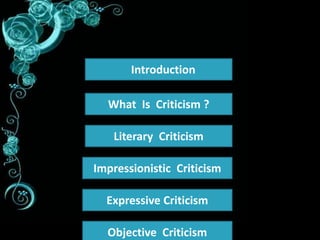
Introduction 
What Is Criticism ? 
Literary Criticism 
Impressionistic Criticism 
Expressive Criticism 
Objective Criticism
Introduction 
The Greek Word Kritikos, which means ‘ Able to 
Discern and Judge. Act Of Judging is called 
Criticism. The earliest , and enduringly important, 
treatise of theoretical criticism was Aristotle’s 
Poetics . Among The most influential theoretical in 
the following centuries were Longinus in Greece; 
Horace in Rome ; Boileau and Sainte –Beuve in 
France .
What is Criticism ? 
Literary Criticism is concerned 
with defining , classifying, 
analyzing ,interpreting, and 
evaluating work of literature.
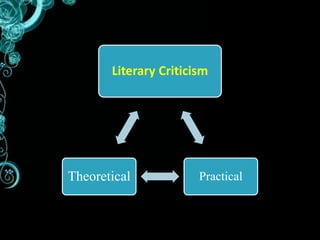
Literary Criticism 
Theoretical Practical
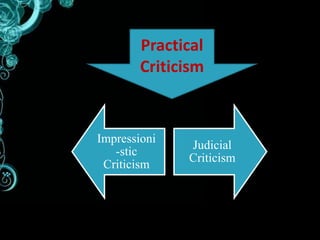
Practical 
Criticism 
Impressioni 
-stic 
Criticism 
Judicial 
Criticism
Impressionistic Criticism 
 Impressionistic Criticism means personal 
Impression. Impressionistic Criticism attempts 
to represent in word the felt qualities of a 
particular passage or work, and to express the 
responses that the work directly evoke from the 
critic.
As William Hazlitt put it in his essay “On Genius and 
Common Sense” (1824): 
“ You decide from feeling not for reason: that is for 
impression of number of thing on the mind…. 
Though you may not be able to analyze or account 
for it in the several particulars ” 
It is what happens a critic is reading a 
piece of work and critiques it on he or 
she is feeling instead using the 
principles.
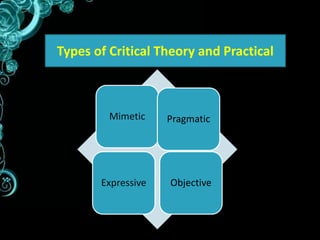
Types of Critical Theory and Practical 
Mimetic Pragmatic 
Expressive Objective
Expressive Criticism 
A definition of term Expressive 
Criticism is Presented. The term 
emphasizes the author as creator of the 
work, stress the artist’s emotions and 
beliefs, and resume that the work 
contains inadvertently or not the 
revelation of the author’s life . 
 The three key concepts associated 
with this movements are …Imagination, 
Genius, Emotion
Objective Criticism 
 Objective Criticism approach the 
work of literature as something which 
stand free from what is often called an 
“extrinsic” relationship to the poet, or 
the audience, or to the environing 
world.
various types of criticism

various types of criticism

  • 1.
    Various Types ofcriticism Name : Ravi Bhaliya A Semester : 01 Roll No : 26 Paper No : 03 (Literary Theory and Criticism) Enrolment No:14101004 Year : 2014-16 Email ID : ravibhaliya5@gmil.com Date : 07-10-14 Submitted To: Department Of English Maharaja Krishnakumarsinhji Bhavnagar University
  • 2.
    Introduction What IsCriticism ? Literary Criticism Impressionistic Criticism Expressive Criticism Objective Criticism
  • 3.
    Introduction The GreekWord Kritikos, which means ‘ Able to Discern and Judge. Act Of Judging is called Criticism. The earliest , and enduringly important, treatise of theoretical criticism was Aristotle’s Poetics . Among The most influential theoretical in the following centuries were Longinus in Greece; Horace in Rome ; Boileau and Sainte –Beuve in France .
  • 4.
    What is Criticism? Literary Criticism is concerned with defining , classifying, analyzing ,interpreting, and evaluating work of literature.
  • 5.
  • 6.
    Practical Criticism Impressioni -stic Criticism Judicial Criticism
  • 7.
    Impressionistic Criticism Impressionistic Criticism means personal Impression. Impressionistic Criticism attempts to represent in word the felt qualities of a particular passage or work, and to express the responses that the work directly evoke from the critic.
  • 8.
    As William Hazlittput it in his essay “On Genius and Common Sense” (1824): “ You decide from feeling not for reason: that is for impression of number of thing on the mind…. Though you may not be able to analyze or account for it in the several particulars ” It is what happens a critic is reading a piece of work and critiques it on he or she is feeling instead using the principles.
  • 9.
    Types of CriticalTheory and Practical Mimetic Pragmatic Expressive Objective
  • 10.
    Expressive Criticism Adefinition of term Expressive Criticism is Presented. The term emphasizes the author as creator of the work, stress the artist’s emotions and beliefs, and resume that the work contains inadvertently or not the revelation of the author’s life .  The three key concepts associated with this movements are …Imagination, Genius, Emotion
  • 11.
    Objective Criticism Objective Criticism approach the work of literature as something which stand free from what is often called an “extrinsic” relationship to the poet, or the audience, or to the environing world.