Looking into ECOCRITCISM
Presented by -Manmeet Kaur
What is Eco-criticism?
• Eco-criticism is environmental advocacy, a literary
tool, a kind of reading which is designed to analyze
the text’s orientation both to the world it imagines
and to the world in which it takes shape in, along
with the conditions and contexts that affect that
orientation, whatever it might be. (Branch 260).
• Eco-criticism is an intentionally broad approach
that is known by a number of other designations,
including “green studies”, “eco-poetics”, and
“environmental literary criticism.”
It was first coined by William Rueckert in 1978
in Literature and Ecology: An Experiment in Eco-
criticism to highlight the relationship in between
ecology and literature.
It seeks to relate literature to the natural
environment, with the hope of action against
climate change and the destruction of natural
habitats. Ecocriticism thus has a strong ethical
aspect, as the reading of literature should ideally
inspire political activism and real change.
Here literature is used as the medium to inspire
changes in the attitude towards nature.
It is an umbrella term including a wide spectrum
where the environmental problems are being
discussed to have a solution for the ongoing crisis
throughout the globe whether it be the receding of
glaciers, rising of sea level, extinction of species,
depletion of ozone layer, deforestation or any
environment related issues.
This approach believes the global crisis faced by
the century is not actually because of the ecological
imbalances, but due to the imbalance in the ethical
systems of the mankind, which are by the way not
so kind anymore!
The thinking
or mindset
associated with
eco-criticism is
appreciated as
ECOCRITICAL
THINKING.
How
nature is
represented in
literature?
What role does
the physical
setting like a
dead tree plays
in a scene?
If Values
represented are in
coherenc
ewith the
eco-critical
thinking ?
 The relation of this theory is deep into the roots of
various facets of human life like social, cultural,
economic, aesthetic, political, ecological, scientific,
psychological, or anthropocentric .
 According to the post modern belief,
“Nature is a social and psychological construct,
because all writing is anthropocentric in that it
must be filtered through a human consciousness”
(Chandra 14)
 This theory allows us to dwell deeper into humans
conception of global community to include non-
human life forms and physical environment as well.
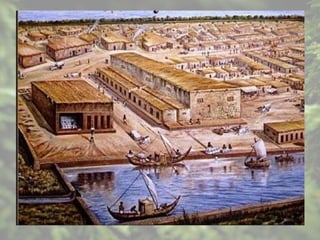
 The traces of human life working in coordination with
the environment can be drawn from the Indus Valley
Civilization.
 The Civilization shows how the people were ecologically
conscious and how they were all equipped to tackle the
disasters like water scarcity and other environmental
disasters.
 The city was developed on the basis of water
management wherein, the rain and the river water was
used for cultivation and drinking purposes which paved
way for their eco-sensitive approach.
People of Ancient Civilization believed that the
alliance of nature with man purifies the souls.
 Eco-criticism traces ecological history as the change
equally impacts human civilization. It is ever-
increasing and ecological habitation is being
encroached, and trespassed.
Pioneers in the development of
theory of
Eco-criticism
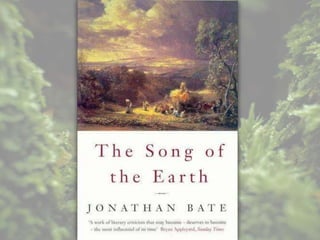
Jonathan Bate is majorly the person who started
and revolutionized eco-criticism. His famous
works like Song of the Earth is based on
environmental consciousness and necessity of
focus on the environment before it damages us.
“To live that is with thoughtfulness and with
attentiveness, an attunement of both the words
and the world, and so to acknowledge that,
although we make sense of things by the way of
words, we do not live apart from the world. For
culture and environment are held together in a
complex and delicate web.”
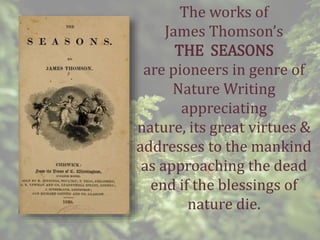
The works of
James Thomson’s
THE SEASONS
are pioneers in genre of
Nature Writing
appreciating
nature, its great virtues &
addresses to the mankind
as approaching the dead
end if the blessings of
nature die.
“Nature! great parent! whose unceasing
hand
Rolls round the seasons of the changeful year,
How mighty, how majestic are thy works!”
“Tis done! Dread Winter spreads his latest glooms,
How dead the vegetable kingdom lies!
How dumb the tuneful! Horror wide extends
His melancholy empire. Here, fond man!
Behold thy pictur’d life; pass some few years,
And pale concluding Winter comes at last
And shuts the scene. ”
Eco-critical thinking in Indian Literature
 Writers such as R. K. Narayan, Manohar Malgonkar, Raja
Rao, Kamala Markandaya, Amitav Ghosh and Anita
Desai have invoked Nature and nature-elements and
have given this theory a special place in their works.
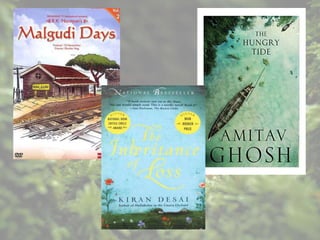
 Malgudi Days, Man Eater of Malgudi, The English
Teacher, and The Guide , the famous works of R.K
Narayan has effective and flawless expressions and
descriptions of their views.
 The Hungry Tide by Amitav Ghosh depicts risky eco-
system and highlights the human-animal relationships.
 Kiran Desai in “The Inheritance of Loss” has focused on
the issue of environment. Her approach is eco-centric
and
eco-critic.
Eco-criticism display in Cinema
The movie “Avatar”
portrays the notion of a
strong pro-
environmentalism linked to
a romanticized picture of
nature and a relentless
criticism of the western
world, if not the whole
human kind.
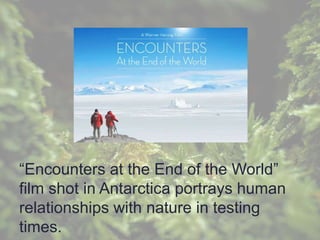
“Encounters at the End of the World”
film shot in Antarctica portrays human
relationships with nature in testing
times.
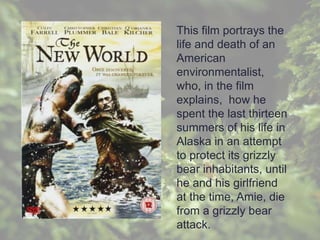
This film portrays the
life and death of an
American
environmentalist,
who, in the film
explains, how he
spent the last thirteen
summers of his life in
Alaska in an attempt
to protect its grizzly
bear inhabitants, until
he and his girlfriend
at the time, Amie, die
from a grizzly bear
attack.
Developments in Eco-Criticism Theory
Deep ecology and eco-feminism were two important
developments. These new ideas questioned the notion of
“development” and modernity, and argued that all
Western approaches in science, politics etc are
“anthropocentric” and “andro-centric.
Technology, medical science with its animal testing, the
cosmetic and fashion industry all came in for scrutiny
from environmentalists. Deep ecology, for instance,
stressed on a “bio-centric” view i.e EARTH FIRST
Various branches of Eco-Criticism
The changing relationship of human beings with the
environment are reciprocated to be understood through the
yardsticks of eco-criticism theory.
Another important concept of Ecocriticism is Eco-
feminism which implies the combination of ecology and
feminism. It is a broad term which includes feminism,
environmentalism, animal liberation, antiracism, and anti-
colonialism.
Social ecology advocates a reconstructive outlook on social
and environmental issues, and promotes a democratic
politics. It describes that the root cause of the present
ecological problems can be traced to hierarchal modes of
social organization.
Present Conclusion
This approach of eco-critical thinking encourages
us to think about relationship of humans with
nature and about the ethical and aesthetic
dilemmas on environmental crisis.
The study of this profound theory should evoke
questions like
•How is nature represented in this text?
•How has the concept of nature changed over time?
•How is the setting of the play/film/text related to the
environment?
•How do we see issues of environmental disaster and crises
reflected in popular culture and literary works?
•How are animals represented in this text and what is their
relationship to humans?
and many more..
Ecocriticism

Ecocriticism

  • 1.
  • 2.
    What is Eco-criticism? •Eco-criticism is environmental advocacy, a literary tool, a kind of reading which is designed to analyze the text’s orientation both to the world it imagines and to the world in which it takes shape in, along with the conditions and contexts that affect that orientation, whatever it might be. (Branch 260). • Eco-criticism is an intentionally broad approach that is known by a number of other designations, including “green studies”, “eco-poetics”, and “environmental literary criticism.”
  • 3.
    It was firstcoined by William Rueckert in 1978 in Literature and Ecology: An Experiment in Eco- criticism to highlight the relationship in between ecology and literature. It seeks to relate literature to the natural environment, with the hope of action against climate change and the destruction of natural habitats. Ecocriticism thus has a strong ethical aspect, as the reading of literature should ideally inspire political activism and real change. Here literature is used as the medium to inspire changes in the attitude towards nature.
  • 4.
    It is anumbrella term including a wide spectrum where the environmental problems are being discussed to have a solution for the ongoing crisis throughout the globe whether it be the receding of glaciers, rising of sea level, extinction of species, depletion of ozone layer, deforestation or any environment related issues. This approach believes the global crisis faced by the century is not actually because of the ecological imbalances, but due to the imbalance in the ethical systems of the mankind, which are by the way not so kind anymore!
  • 5.
    The thinking or mindset associatedwith eco-criticism is appreciated as ECOCRITICAL THINKING.
  • 6.
    How nature is represented in literature? Whatrole does the physical setting like a dead tree plays in a scene? If Values represented are in coherenc ewith the eco-critical thinking ?
  • 7.
     The relationof this theory is deep into the roots of various facets of human life like social, cultural, economic, aesthetic, political, ecological, scientific, psychological, or anthropocentric .  According to the post modern belief, “Nature is a social and psychological construct, because all writing is anthropocentric in that it must be filtered through a human consciousness” (Chandra 14)  This theory allows us to dwell deeper into humans conception of global community to include non- human life forms and physical environment as well.
  • 8.
     The tracesof human life working in coordination with the environment can be drawn from the Indus Valley Civilization.  The Civilization shows how the people were ecologically conscious and how they were all equipped to tackle the disasters like water scarcity and other environmental disasters.  The city was developed on the basis of water management wherein, the rain and the river water was used for cultivation and drinking purposes which paved way for their eco-sensitive approach. People of Ancient Civilization believed that the alliance of nature with man purifies the souls.
  • 10.
     Eco-criticism tracesecological history as the change equally impacts human civilization. It is ever- increasing and ecological habitation is being encroached, and trespassed.
  • 11.
    Pioneers in thedevelopment of theory of Eco-criticism
  • 12.
    Jonathan Bate ismajorly the person who started and revolutionized eco-criticism. His famous works like Song of the Earth is based on environmental consciousness and necessity of focus on the environment before it damages us. “To live that is with thoughtfulness and with attentiveness, an attunement of both the words and the world, and so to acknowledge that, although we make sense of things by the way of words, we do not live apart from the world. For culture and environment are held together in a complex and delicate web.”
  • 14.
    The works of JamesThomson’s THE SEASONS are pioneers in genre of Nature Writing appreciating nature, its great virtues & addresses to the mankind as approaching the dead end if the blessings of nature die.
  • 15.
    “Nature! great parent!whose unceasing hand Rolls round the seasons of the changeful year, How mighty, how majestic are thy works!” “Tis done! Dread Winter spreads his latest glooms, How dead the vegetable kingdom lies! How dumb the tuneful! Horror wide extends His melancholy empire. Here, fond man! Behold thy pictur’d life; pass some few years, And pale concluding Winter comes at last And shuts the scene. ”
  • 16.
    Eco-critical thinking inIndian Literature  Writers such as R. K. Narayan, Manohar Malgonkar, Raja Rao, Kamala Markandaya, Amitav Ghosh and Anita Desai have invoked Nature and nature-elements and have given this theory a special place in their works.  Malgudi Days, Man Eater of Malgudi, The English Teacher, and The Guide , the famous works of R.K Narayan has effective and flawless expressions and descriptions of their views.  The Hungry Tide by Amitav Ghosh depicts risky eco- system and highlights the human-animal relationships.  Kiran Desai in “The Inheritance of Loss” has focused on the issue of environment. Her approach is eco-centric and eco-critic.
  • 18.
    Eco-criticism display inCinema The movie “Avatar” portrays the notion of a strong pro- environmentalism linked to a romanticized picture of nature and a relentless criticism of the western world, if not the whole human kind.
  • 19.
    “Encounters at theEnd of the World” film shot in Antarctica portrays human relationships with nature in testing times.
  • 20.
    This film portraysthe life and death of an American environmentalist, who, in the film explains, how he spent the last thirteen summers of his life in Alaska in an attempt to protect its grizzly bear inhabitants, until he and his girlfriend at the time, Amie, die from a grizzly bear attack.
  • 21.
    Developments in Eco-CriticismTheory Deep ecology and eco-feminism were two important developments. These new ideas questioned the notion of “development” and modernity, and argued that all Western approaches in science, politics etc are “anthropocentric” and “andro-centric. Technology, medical science with its animal testing, the cosmetic and fashion industry all came in for scrutiny from environmentalists. Deep ecology, for instance, stressed on a “bio-centric” view i.e EARTH FIRST
  • 22.
    Various branches ofEco-Criticism The changing relationship of human beings with the environment are reciprocated to be understood through the yardsticks of eco-criticism theory. Another important concept of Ecocriticism is Eco- feminism which implies the combination of ecology and feminism. It is a broad term which includes feminism, environmentalism, animal liberation, antiracism, and anti- colonialism. Social ecology advocates a reconstructive outlook on social and environmental issues, and promotes a democratic politics. It describes that the root cause of the present ecological problems can be traced to hierarchal modes of social organization.
  • 23.
    Present Conclusion This approachof eco-critical thinking encourages us to think about relationship of humans with nature and about the ethical and aesthetic dilemmas on environmental crisis. The study of this profound theory should evoke questions like •How is nature represented in this text? •How has the concept of nature changed over time? •How is the setting of the play/film/text related to the environment? •How do we see issues of environmental disaster and crises reflected in popular culture and literary works? •How are animals represented in this text and what is their relationship to humans? and many more..

Editor's Notes

  • #3 Ecocriticism is the study of literature and environment from an interdisciplinary point of view where all sciences come together to analyze the environment and brainstorm possible solutions for the correction of the contemporary environmental situation.  Ecocriticism is an intentionally broad approach that is known by a number of other designations, including “green studies”, “eco-poetics”, and “environmental literary criticism.”
  • #4 The aim of literature and reading is to inspire change and bring in actual changes in perspectives, actions and way of being of individual.
  • #22 Nature is generally portrayed as feminine. Hence, eco feminism .