Moulay Ismail University Faculty Of Letters And Humanities English Department Master program  Communication in contexts Approaches To Criticism Prof. Kh. Amar Reda Lamtiri [email_address]
Criticism Outline: Criticism, Art,  what are they? Any relations? Functions of  Literary Criticism . The double task of Criticism. New Criticism.
Criticism Criticism, Art,  what are they? Any relations?
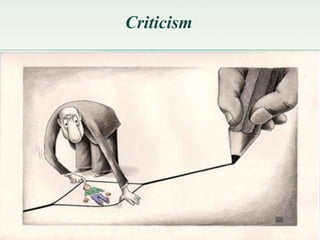
Criticism
 
Criticism Criticism: The word ‘ Criticism ’ is derived from the Greek root ‘ krinei ’ which means to judge and the term ‘ kritikos ’ which means a judge of literature. Criticism is the reasoned consideration of literary works and issues. It applies, as a term, to any argumentation about literature, whether or not specific works are analyzed. Plato’s cautions against the risky consequences of poetic inspiration in general in his  Republic  are thus often taken as the earliest important example of literary criticism.   "literary criticism." Encyclopædia Britannica.  Ultimate Reference Suite .  Chicago: Encyclopædia Britannica, 2010.
Criticism Art: Over the centuries art has been considered to be imitation and expression .  Traditionally the word art has referred to skill in the making of something and the artist is the one who makes it . What the artist makes is considered in some respect imitative of the real world. A painting may mirror some small portion of nature. A statue may imitate a person or animal. A play imitates the human characteristics in real life situations. A shoe both imitates and protects the foot. It was only in the 19th century that art came to be looked upon as expression because it expresses the feelings, ideas, and notions of the artist as well as the skill involved.
Criticism  Literary criticism is an independent field of study .  It justifies the literary work .  It is a systematic study of literature .  It examines the excellencies and defects of a literary work and finally evaluates its artistic worth .
Criticism Functions of  Literary Criticism : People  specialized  in  the field of Criticism are called critics. Critics  may  appreciate  a  work  of  art,  but  their professional  task  is  to  analyze  ,evaluate  ,and describe it according to some standards and relating to some conceptual frameworks. A critic's business is not only  to  appreciate  but  to  know.  Every critic must understand  the  nature  and  quality  of  the  art  being criticized.  A literary  critic,  for  example,  must  have  a thorough knowledge of the work being written .
Criticism The critic’s chief duty is to interpret and expose the taste and value of the targeted literary work. From this regard the main goal of Criticism is : 1-To interpret 2-To evaluate 3-To justify
Criticism 1- Interpretation: Interpretation includes assessment and appreciation. The critic analyses and formulates the meaning he elucidates by direct examination of the artistic and moral principles he encounters in the targeted literary work.
Criticism 2- Evaluation: The critic’s role is to study and examine the literary work carefully and decide how good or bad it is.
Criticism 3- Justification: a critic is an interpreter first and a judge later he should judge it impartially, without personal likes and dislikes, prejudices and predilections . (The notion of objectivity)
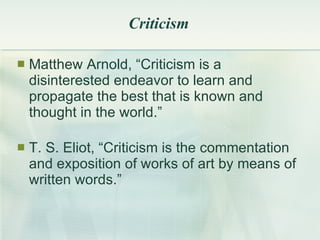
Criticism Matthew Arnold, “Criticism is a disinterested endeavor to learn and propagate the best that is known and thought in the world . ”  T .  S .  Eliot, “Criticism is the commentation and exposition of works of art by means of written words . ”
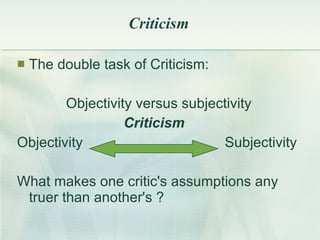
Criticism The double task of Criticism: Objectivity versus subjectivity Criticism Objectivity  Subjectivity What makes one critic's assumptions any truer than another's ?
Criticism  The critic’s job is not as easy as making a simple comment on a literary work, because he has to handle this latter tactfully, bearing in mind and being concsious that he may fail in the trap of subjectivity.
New Criticism: New Criticism is a type of formalist literary criticism that developed in the 1920s-30s and peaked in the 1940s-50s .  New Critics treat a work of literature as if it were self-contained. They do not consider the reader's response, author's intention, or historical and cultural contexts. New Critics perform a close reading of the text, and believe the structure and meaning of the text should not be examined separately. New Critics especially appreciate the use of literary devices in a text. The New Criticism has sometimes been called an objective approach to literature, similar to the approach students in public schools are taught to take.  ( http :// en . wikipedia . org / wiki / New_Criticism)
Criticism New Criticism: New Criticism goes under the general name of  ‘Formalism’. Later it came to be called ‘Modernism’. T.S Eliot is one of the central figures who provided foundational texts for New Criticism. Modernists believe that a work can be read objectively and accurately in light of its actual structure, form, aestheticity and unity.
Criticism

What Is Criticism

  • 1.
    Moulay Ismail UniversityFaculty Of Letters And Humanities English Department Master program Communication in contexts Approaches To Criticism Prof. Kh. Amar Reda Lamtiri [email_address]
  • 2.
    Criticism Outline: Criticism,Art, what are they? Any relations? Functions of Literary Criticism . The double task of Criticism. New Criticism.
  • 3.
    Criticism Criticism, Art, what are they? Any relations?
  • 4.
  • 5.
  • 6.
    Criticism Criticism: Theword ‘ Criticism ’ is derived from the Greek root ‘ krinei ’ which means to judge and the term ‘ kritikos ’ which means a judge of literature. Criticism is the reasoned consideration of literary works and issues. It applies, as a term, to any argumentation about literature, whether or not specific works are analyzed. Plato’s cautions against the risky consequences of poetic inspiration in general in his Republic are thus often taken as the earliest important example of literary criticism. "literary criticism." Encyclopædia Britannica. Ultimate Reference Suite .  Chicago: Encyclopædia Britannica, 2010.
  • 7.
    Criticism Art: Overthe centuries art has been considered to be imitation and expression . Traditionally the word art has referred to skill in the making of something and the artist is the one who makes it . What the artist makes is considered in some respect imitative of the real world. A painting may mirror some small portion of nature. A statue may imitate a person or animal. A play imitates the human characteristics in real life situations. A shoe both imitates and protects the foot. It was only in the 19th century that art came to be looked upon as expression because it expresses the feelings, ideas, and notions of the artist as well as the skill involved.
  • 8.
    Criticism  Literarycriticism is an independent field of study . It justifies the literary work . It is a systematic study of literature . It examines the excellencies and defects of a literary work and finally evaluates its artistic worth .
  • 9.
    Criticism Functions of Literary Criticism : People specialized in the field of Criticism are called critics. Critics may appreciate a work of art, but their professional task is to analyze ,evaluate ,and describe it according to some standards and relating to some conceptual frameworks. A critic's business is not only to appreciate but to know. Every critic must understand the nature and quality of the art being criticized. A literary critic, for example, must have a thorough knowledge of the work being written .
  • 10.
    Criticism The critic’schief duty is to interpret and expose the taste and value of the targeted literary work. From this regard the main goal of Criticism is : 1-To interpret 2-To evaluate 3-To justify
  • 11.
    Criticism 1- Interpretation:Interpretation includes assessment and appreciation. The critic analyses and formulates the meaning he elucidates by direct examination of the artistic and moral principles he encounters in the targeted literary work.
  • 12.
    Criticism 2- Evaluation:The critic’s role is to study and examine the literary work carefully and decide how good or bad it is.
  • 13.
    Criticism 3- Justification:a critic is an interpreter first and a judge later he should judge it impartially, without personal likes and dislikes, prejudices and predilections . (The notion of objectivity)
  • 14.
    Criticism Matthew Arnold,“Criticism is a disinterested endeavor to learn and propagate the best that is known and thought in the world . ” T . S . Eliot, “Criticism is the commentation and exposition of works of art by means of written words . ”
  • 15.
    Criticism The doubletask of Criticism: Objectivity versus subjectivity Criticism Objectivity Subjectivity What makes one critic's assumptions any truer than another's ?
  • 16.
    Criticism  Thecritic’s job is not as easy as making a simple comment on a literary work, because he has to handle this latter tactfully, bearing in mind and being concsious that he may fail in the trap of subjectivity.
  • 17.
    New Criticism: NewCriticism is a type of formalist literary criticism that developed in the 1920s-30s and peaked in the 1940s-50s . New Critics treat a work of literature as if it were self-contained. They do not consider the reader's response, author's intention, or historical and cultural contexts. New Critics perform a close reading of the text, and believe the structure and meaning of the text should not be examined separately. New Critics especially appreciate the use of literary devices in a text. The New Criticism has sometimes been called an objective approach to literature, similar to the approach students in public schools are taught to take. ( http :// en . wikipedia . org / wiki / New_Criticism)
  • 18.
    Criticism New Criticism:New Criticism goes under the general name of ‘Formalism’. Later it came to be called ‘Modernism’. T.S Eliot is one of the central figures who provided foundational texts for New Criticism. Modernists believe that a work can be read objectively and accurately in light of its actual structure, form, aestheticity and unity.
  • 19.