Name : Kubavat Kishan 
Semester: 1 
Paper no: 3 
PG Enrollment no : 14101021 
Paper Name : The Literary theory & 
criticism 
Topic : Types of Criticism 
Submitted to : Department of English 
M.K Bhavnagar University
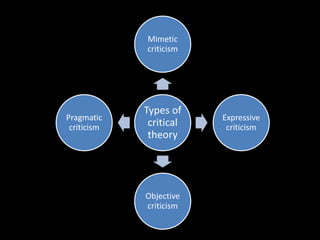
Mimetic 
criticism 
Types of 
critical 
theory 
Expressive 
criticism 
Objective 
criticism 
Pragmatic 
criticism
1) Mimetic criticism 
 Mimesis is the Greek word of imitation. 
 Mimetic Criticism emphasizes a work’s 
relationship to the world it depicts, and judge its 
quality in terms of its verisimilitude, the fidelity 
of its imitation, or the reflection of the world and 
life. 
 This mode of criticism, which first appeared in 
Plato and in Aristotle , remains characteristic of 
modern theories of literary realism.
 Rene Girard is the modern thinker who has 
stretched the mimetic theory of literary 
criticism across time and disciplines. 
 In his 1961 book “Deceit, Desire and the 
Novel” , he argued persuasively that great 
novelists alone in the western world have 
understood the mimetic foundation of human 
interaction.
2) Pragmatic criticism 
 Pragmatic criticism views the as something which is 
constructed in order to achieve certain effects on the 
audience and it tends to judge the value of work 
according to its success in achieve that him. 
 This approach which largely dominated literary 
discussion from the versified Art of poetry by the 
Roman Horace through the eighteenth century, has 
been revived in rhetorical criticism.
Which emphasizes the artistic strategies by 
which an author engages and influences the 
responses of readers to the matters represented 
in a literary work. 
The pragmatic approach has also been 
adopted by some structuralists who analyze 
a literary text as a systematic play of codes that 
produce the interpretative responses of a 
reader.
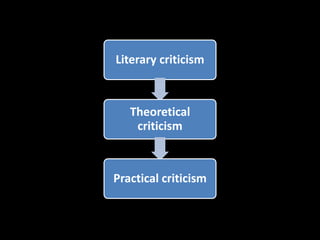
Literary criticism 
Theoretical 
criticism 
Practical criticism
3) Practical criticism or applied criticism 
 The criticism Concerns itself with 
particular works and writers; in an applied 
critique , the theoretical principles 
controlling the analysis, interpretation, and 
evaluation are often left often left implicit, 
or brought in only as the occasion demands.
• The more influential works of applied criticism 
in England and America are the literary essays 
of Dryden in the Restoration, 
Coleridge’s chapters on the poetry of 
Wordsworth in Biographia Literaria (1857), 
Matthew Arnold’s Essays in criticism. 
In practical criticism , a frequent distinction 
is made between impressionistic and judicial 
criticism.
Various Types of Criticism

Various Types of Criticism

  • 1.
    Name : KubavatKishan Semester: 1 Paper no: 3 PG Enrollment no : 14101021 Paper Name : The Literary theory & criticism Topic : Types of Criticism Submitted to : Department of English M.K Bhavnagar University
  • 2.
    Mimetic criticism Typesof critical theory Expressive criticism Objective criticism Pragmatic criticism
  • 3.
    1) Mimetic criticism  Mimesis is the Greek word of imitation.  Mimetic Criticism emphasizes a work’s relationship to the world it depicts, and judge its quality in terms of its verisimilitude, the fidelity of its imitation, or the reflection of the world and life.  This mode of criticism, which first appeared in Plato and in Aristotle , remains characteristic of modern theories of literary realism.
  • 4.
     Rene Girardis the modern thinker who has stretched the mimetic theory of literary criticism across time and disciplines.  In his 1961 book “Deceit, Desire and the Novel” , he argued persuasively that great novelists alone in the western world have understood the mimetic foundation of human interaction.
  • 5.
    2) Pragmatic criticism  Pragmatic criticism views the as something which is constructed in order to achieve certain effects on the audience and it tends to judge the value of work according to its success in achieve that him.  This approach which largely dominated literary discussion from the versified Art of poetry by the Roman Horace through the eighteenth century, has been revived in rhetorical criticism.
  • 6.
    Which emphasizes theartistic strategies by which an author engages and influences the responses of readers to the matters represented in a literary work. The pragmatic approach has also been adopted by some structuralists who analyze a literary text as a systematic play of codes that produce the interpretative responses of a reader.
  • 7.
    Literary criticism Theoretical criticism Practical criticism
  • 8.
    3) Practical criticismor applied criticism  The criticism Concerns itself with particular works and writers; in an applied critique , the theoretical principles controlling the analysis, interpretation, and evaluation are often left often left implicit, or brought in only as the occasion demands.
  • 9.
    • The moreinfluential works of applied criticism in England and America are the literary essays of Dryden in the Restoration, Coleridge’s chapters on the poetry of Wordsworth in Biographia Literaria (1857), Matthew Arnold’s Essays in criticism. In practical criticism , a frequent distinction is made between impressionistic and judicial criticism.