
Time complexity of
 simplex algorithm
             Albi thomas
             M.tech (TM)
             Roll no.11
Introduction

   Time complexity of an algorithm counts the
    number of arithmetic operations sufficient for
    the algorithm to solve the problem
   Understand properties of LP in terms of
    geometry
   Use geometry as aid to solve LP
   Some concepts new
Overview
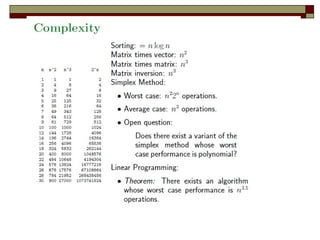
   Polynomial time-complexity(bound)
       Eg.gaussian elimination
   Exponential time complexity
       Eg. Buchberger's algorithm
   Feasibility
   Simplex Method
   Simplex Weaknesses
       Exponential Iterations
   Convex Sets and Hulls
Region of Feasibility
   Graphical region describing all feasible
    solutions to a linear programming problem

   In 2-space: polygon, each edge a constraint

   In 3-space: polyhedron, each face a constraint
Feasibility in 2-Space
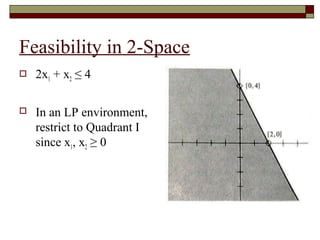
   2x1 + x2 ≤ 4

   In an LP environment,
    restrict to Quadrant I
    since x1, x2 ≥ 0
Simplex Method
   Every time a new dictionary is generated:
       Simplex moves from one vertex to another vertex
        along an edge of polyhedron

       Analogous to increasing value of a non-basic
        variable until bounded by basic constraint
       Each such point is a feasible solution
       Average time taken is linear in 2 space
Feasibility in 3-Space
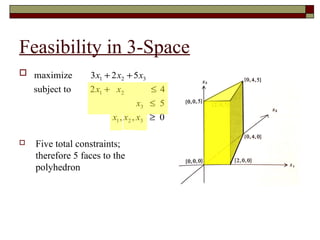
 maximize        3 x1 + 2 x2 + 5 x3
    subject to    2 x1 + x2            ≤4
                                x3 ≤ 5
                         x1 , x2 , x3 ≥ 0

   Five total constraints;
    therefore 5 faces to the
    polyhedron
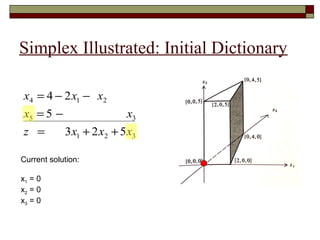
Simplex Illustrated: Initial Dictionary

x4 = 4 − 2 x1 − x2
x5 = 5 −                   x3
z =         3 x1 + 2 x2 + 5 x3

Current solution:

x1 = 0
x2 = 0
x3 = 0
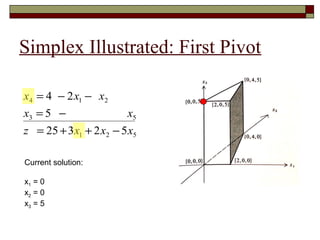
Simplex Illustrated: First Pivot

x4 = 4 − 2 x1 − x2
x3 = 5 −                x5
z = 25 + 3 x1 + 2 x2 − 5 x5

Current solution:

x1 = 0
x2 = 0
x3 = 5
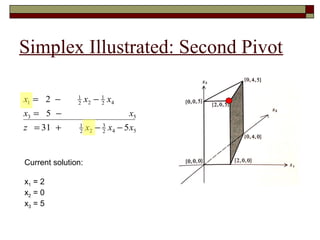
Simplex Illustrated: Second Pivot

x1 = 2 −       1
               2    x 2 − 1 x4
                          2

x3 = 5 −                         x5
z = 31 +        1
                2   x2 − 3 x4 − 5 x5
                         2


Current solution:

x1 = 2
x2 = 0
x3 = 5
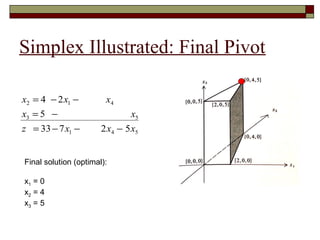
Simplex Illustrated: Final Pivot

x2 = 4 − 2 x1 −         x4
x3 = 5 −                       x5
z = 33 − 7 x1 −        2 x4 − 5 x5


Final solution (optimal):

x1 = 0
x2 = 4
x3 = 5
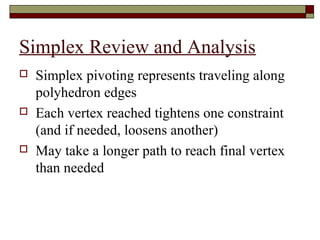
Simplex Review and Analysis
   Simplex pivoting represents traveling along
    polyhedron edges
   Each vertex reached tightens one constraint
    (and if needed, loosens another)
   May take a longer path to reach final vertex
    than needed
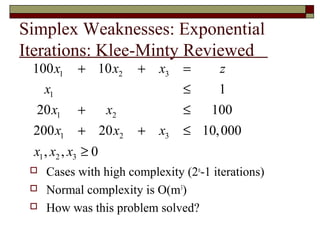
Simplex Weaknesses: Exponential
Iterations: Klee-Minty Reviewed
 100 x1    + 10 x2     +   x3   =    z
   x1                           ≤    1
  20 x1    +  x2                ≤  100
 200 x1    + 20 x2     +   x3   ≤ 10, 000
 x1 , x2 , x3 ≥ 0
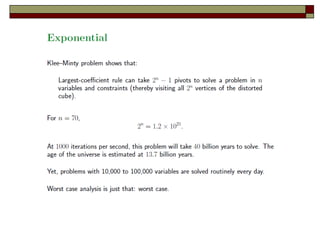
    Cases with high complexity (2n-1 iterations)
    Normal complexity is O(m3)
    How was this problem solved?
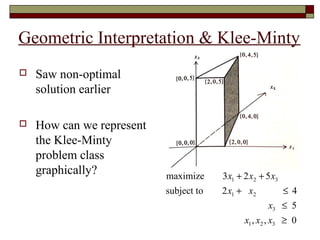
Geometric Interpretation & Klee-Minty
   Saw non-optimal
    solution earlier

   How can we represent
    the Klee-Minty
    problem class
    graphically?           maximize     3 x1 + 2 x2 + 5 x3
                           subject to   2 x1 + x2            ≤ 4
                                                      x3 ≤ 5
                                               x1 , x2 , x3 ≥ 0
Step 1: Constructing a Shape
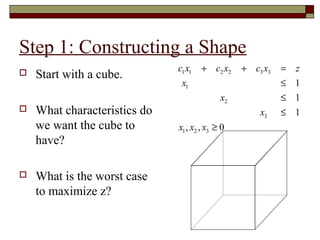
                              c1 x1   + c2 x2    + c3 x3   =   z
   Start with a cube.
                               x1                          ≤   1
                                            x2             ≤   1
   What characteristics do                          x3    ≤   1
    we want the cube to       x1 , x2 , x3 ≥ 0
    have?

   What is the worst case
    to maximize z?
Step 1: Constructing a Shape
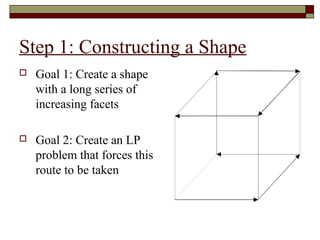
   Goal 1: Create a shape
    with a long series of
    increasing facets

   Goal 2: Create an LP
    problem that forces this
    route to be taken
Step 2: Increasing Objective Function:
Modifying the Cube
                                                                [0, 1, 0.8]               [0, 1, 0.82]
      Squash the cube
100 x1     + 1, 000 x2      + 10, 000 x3   = z
   x1                                      ≤ 1
 0.2 x1    +         x2                    ≤ 1         [0, 0, 1]       [1, 0, 0.98]
0.02 x1    +       0.2 x2   +      x3      ≤ 1
x1 , x2 , x3 ≥ 0

                                                         [0, 1, 0]                    [1, 0.8, 0]
 New dictionary
x4 = 1 −   x1
x5 = 1 − 0.2 x1 −    x2
x6 = 1 − 0.02 x1 − 0.2 x2                  −   x3                         [1, 0, 0]
                                                    [0, 0, 0]
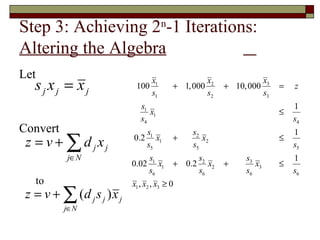
Step 3: Achieving 2n-1 Iterations:
Altering the Algebra
Let
   sjxj = xj                 100
                                   x1
                                   s1
                                           + 1, 000
                                                      x2
                                                      s2
                                                           + 10, 000
                                                                        x3
                                                                        s3
                                                                             =   z

                               s1                                                1
                                  x1                                         ≤
                               s4                                                s4
Convert                        s1               s2                               1
 z = v + ∑ d jxj            0.2 x1
                               s5
                                           +
                                                s5
                                                   x2                        ≤
                                                                                 s5
           j∈N                     s1              s2           s3               1
                            0.02      x1   + 0.2      x2   +       x3        ≤
                                   s6              s6           s6               s6
   to                       x1 , x2 , x3 ≥ 0
 z = v + ∑ (d j s j ) x j
          j∈N
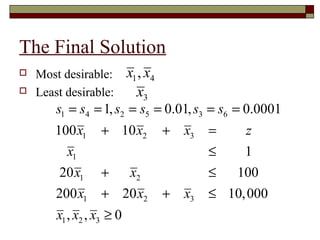
The Final Solution
   Most desirable:        x1 , x4
   Least desirable:         x3
        s1 = s4 = 1, s2 = s5 = 0.01, s3 = s6 = 0.0001
       100 x1     + 10 x2            +   x3   =    z
         x1                                   ≤    1
         20 x1    +  x2                       ≤  100
        200 x1    + 20 x2            +   x3   ≤ 10, 000
        x1 , x2 , x3 ≥ 0
Thank you

Operational research

  • 1.
    Time complexity of simplex algorithm Albi thomas M.tech (TM) Roll no.11
  • 2.
    Introduction  Time complexity of an algorithm counts the number of arithmetic operations sufficient for the algorithm to solve the problem  Understand properties of LP in terms of geometry  Use geometry as aid to solve LP  Some concepts new
  • 3.
    Overview  Polynomial time-complexity(bound) Eg.gaussian elimination  Exponential time complexity Eg. Buchberger's algorithm  Feasibility  Simplex Method  Simplex Weaknesses  Exponential Iterations  Convex Sets and Hulls
  • 4.
    Region of Feasibility  Graphical region describing all feasible solutions to a linear programming problem  In 2-space: polygon, each edge a constraint  In 3-space: polyhedron, each face a constraint
  • 5.
    Feasibility in 2-Space  2x1 + x2 ≤ 4  In an LP environment, restrict to Quadrant I since x1, x2 ≥ 0
  • 6.
    Simplex Method  Every time a new dictionary is generated:  Simplex moves from one vertex to another vertex along an edge of polyhedron  Analogous to increasing value of a non-basic variable until bounded by basic constraint  Each such point is a feasible solution  Average time taken is linear in 2 space
  • 7.
    Feasibility in 3-Space maximize 3 x1 + 2 x2 + 5 x3 subject to 2 x1 + x2 ≤4 x3 ≤ 5 x1 , x2 , x3 ≥ 0  Five total constraints; therefore 5 faces to the polyhedron
  • 8.
    Simplex Illustrated: InitialDictionary x4 = 4 − 2 x1 − x2 x5 = 5 − x3 z = 3 x1 + 2 x2 + 5 x3 Current solution: x1 = 0 x2 = 0 x3 = 0
  • 9.
    Simplex Illustrated: FirstPivot x4 = 4 − 2 x1 − x2 x3 = 5 − x5 z = 25 + 3 x1 + 2 x2 − 5 x5 Current solution: x1 = 0 x2 = 0 x3 = 5
  • 10.
    Simplex Illustrated: SecondPivot x1 = 2 − 1 2 x 2 − 1 x4 2 x3 = 5 − x5 z = 31 + 1 2 x2 − 3 x4 − 5 x5 2 Current solution: x1 = 2 x2 = 0 x3 = 5
  • 11.
    Simplex Illustrated: FinalPivot x2 = 4 − 2 x1 − x4 x3 = 5 − x5 z = 33 − 7 x1 − 2 x4 − 5 x5 Final solution (optimal): x1 = 0 x2 = 4 x3 = 5
  • 12.
    Simplex Review andAnalysis  Simplex pivoting represents traveling along polyhedron edges  Each vertex reached tightens one constraint (and if needed, loosens another)  May take a longer path to reach final vertex than needed
  • 15.
    Simplex Weaknesses: Exponential Iterations:Klee-Minty Reviewed 100 x1 + 10 x2 + x3 = z x1 ≤ 1 20 x1 + x2 ≤ 100 200 x1 + 20 x2 + x3 ≤ 10, 000 x1 , x2 , x3 ≥ 0  Cases with high complexity (2n-1 iterations)  Normal complexity is O(m3)  How was this problem solved?
  • 16.
    Geometric Interpretation &Klee-Minty  Saw non-optimal solution earlier  How can we represent the Klee-Minty problem class graphically? maximize 3 x1 + 2 x2 + 5 x3 subject to 2 x1 + x2 ≤ 4 x3 ≤ 5 x1 , x2 , x3 ≥ 0
  • 17.
    Step 1: Constructinga Shape c1 x1 + c2 x2 + c3 x3 = z  Start with a cube. x1 ≤ 1 x2 ≤ 1  What characteristics do x3 ≤ 1 we want the cube to x1 , x2 , x3 ≥ 0 have?  What is the worst case to maximize z?
  • 18.
    Step 1: Constructinga Shape  Goal 1: Create a shape with a long series of increasing facets  Goal 2: Create an LP problem that forces this route to be taken
  • 19.
    Step 2: IncreasingObjective Function: Modifying the Cube [0, 1, 0.8] [0, 1, 0.82]  Squash the cube 100 x1 + 1, 000 x2 + 10, 000 x3 = z x1 ≤ 1 0.2 x1 + x2 ≤ 1 [0, 0, 1] [1, 0, 0.98] 0.02 x1 + 0.2 x2 + x3 ≤ 1 x1 , x2 , x3 ≥ 0 [0, 1, 0] [1, 0.8, 0]  New dictionary x4 = 1 − x1 x5 = 1 − 0.2 x1 − x2 x6 = 1 − 0.02 x1 − 0.2 x2 − x3 [1, 0, 0] [0, 0, 0]
  • 20.
    Step 3: Achieving2n-1 Iterations: Altering the Algebra Let sjxj = xj 100 x1 s1 + 1, 000 x2 s2 + 10, 000 x3 s3 = z s1 1 x1 ≤ s4 s4 Convert s1 s2 1 z = v + ∑ d jxj 0.2 x1 s5 + s5 x2 ≤ s5 j∈N s1 s2 s3 1 0.02 x1 + 0.2 x2 + x3 ≤ s6 s6 s6 s6 to x1 , x2 , x3 ≥ 0 z = v + ∑ (d j s j ) x j j∈N
  • 21.
    The Final Solution  Most desirable: x1 , x4  Least desirable: x3 s1 = s4 = 1, s2 = s5 = 0.01, s3 = s6 = 0.0001 100 x1 + 10 x2 + x3 = z x1 ≤ 1 20 x1 + x2 ≤ 100 200 x1 + 20 x2 + x3 ≤ 10, 000 x1 , x2 , x3 ≥ 0
  • 22.