1Week© Vocational Training Council, Hong Kong.
│ Lecture 8 │
Sensors, Actuators and Applications of
PLC
EEC3420 Industrial Control
Department of Electrical Engineering
2© Vocational Training Council, Hong Kong.
EEE3420 Industrial Control
Week
Learning Objectives

To know various types of sensors, actuators and typical
applications of PLC in industrial control.
3© Vocational Training Council, Hong Kong.
EEE3420 Industrial Control
Week
Sensors

Sensors allow a PLC to detect the state of a process.
Logical sensors can only detect a state that is either
true or false. Examples of physical phenomena that
are typically detected are listed below.

inductive proximity - is a metal object nearby?

capacitive proximity - is a dielectric object
nearby?

optical presence - is an object breaking a light
beam or reflecting light?

mechanical contact - is an object touching a
switch?
4© Vocational Training Council, Hong Kong.
EEE3420 Industrial Control
Week
SENSOR WIRING

When a sensor detects a logical change it must signal that change
to the PLC.

This is typically done by switching a voltage or current on or off. In
some cases the output of the sensor is used to switch a load
directly, completely eliminating the PLC.

Typical outputs from sensors (and inputs to PLCs) are listed below
in relative popularity.

Sinking/Sourcing - Switches current on or off.

Plain Switches - Switches voltage on or off.

Solid State Relays - These switch AC outputs.

TTL (Transistor Transistor Logic) - Uses 0V and 5V to
indicate logic levels.
5© Vocational Training Council, Hong Kong.
EEE3420 Industrial Control
Week
Switches

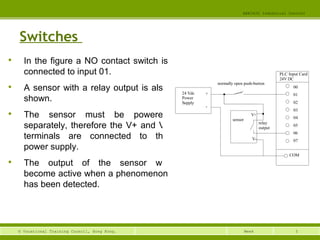
In the figure a NO contact switch is
connected to input 01.

A sensor with a relay output is also
shown.

The sensor must be powered
separately, therefore the V+ and V-
terminals are connected to the
power supply.

The output of the sensor will
become active when a phenomenon
has been detected.
24 Vdc
Power
Supply
normally open push-button
PLC Input Card
24V DC
00
01
02
03
04
05
06
07
COM
+
-
sensor
V+
V-
relay
output
6© Vocational Training Council, Hong Kong.
EEE3420 Industrial Control
Week
Transistor Transistor Logic (TTL)

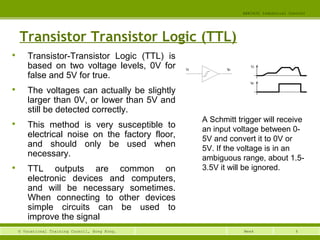
Transistor-Transistor Logic (TTL) is
based on two voltage levels, 0V for
false and 5V for true.

The voltages can actually be slightly
larger than 0V, or lower than 5V and
still be detected correctly.

This method is very susceptible to
electrical noise on the factory floor,
and should only be used when
necessary.

TTL outputs are common on
electronic devices and computers,
and will be necessary sometimes.
When connecting to other devices
simple circuits can be used to
improve the signal
Vi Vo
Vi
Vo
A Schmitt trigger will receive
an input voltage between 0-
5V and convert it to 0V or
5V. If the voltage is in an
ambiguous range, about 1.5-
3.5V it will be ignored.
7© Vocational Training Council, Hong Kong.
EEE3420 Industrial Control
Week
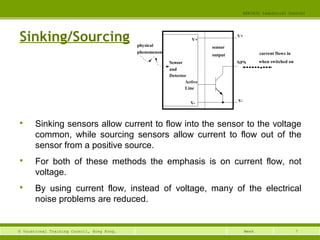
Sinking/Sourcing

Sinking sensors allow current to flow into the sensor to the voltage
common, while sourcing sensors allow current to flow out of the
sensor from a positive source.

For both of these methods the emphasis is on current flow, not
voltage.

By using current flow, instead of voltage, many of the electrical
noise problems are reduced.
Sensor
V+
V-
Active
physical
phenomenon
V+
NPN
V-
sensor
output
and
Detector
Line
current flows in
when switched on
8© Vocational Training Council, Hong Kong.
EEE3420 Industrial Control
Week
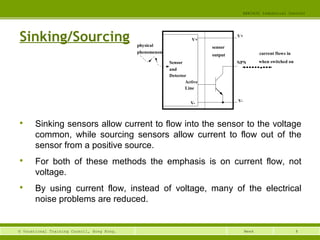
Sinking/Sourcing

Sinking sensors allow current to flow into the sensor to the voltage
common, while sourcing sensors allow current to flow out of the
sensor from a positive source.

For both of these methods the emphasis is on current flow, not
voltage.

By using current flow, instead of voltage, many of the electrical
noise problems are reduced.
Sensor
V+
V-
Active
physical
phenomenon
V+
NPN
V-
sensor
output
and
Detector
Line
current flows in
when switched on
9© Vocational Training Council, Hong Kong.
EEE3420 Industrial Control
Week
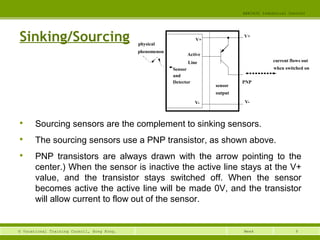
Sinking/Sourcing

Sourcing sensors are the complement to sinking sensors.

The sourcing sensors use a PNP transistor, as shown above.

PNP transistors are always drawn with the arrow pointing to the
center.) When the sensor is inactive the active line stays at the V+
value, and the transistor stays switched off. When the sensor
becomes active the active line will be made 0V, and the transistor
will allow current to flow out of the sensor.
Sensor
V+
V-
Active
physical
phenomenon
V+
PNP
V-
sensor
output
and
Detector
Line current flows out
when switched on
10© Vocational Training Council, Hong Kong.
EEE3420 Industrial Control
Week
Sinking/Sourcing
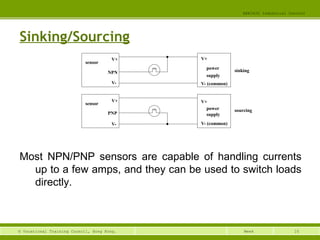
Most NPN/PNP sensors are capable of handling currents
up to a few amps, and they can be used to switch loads
directly.
power
supply
sensor
V+
V- (common)
V+
V-
NPN
power
supply
sensor V+
V- (common)
V+
V-
PNP
sinking
sourcing
11© Vocational Training Council, Hong Kong.
EEE3420 Industrial Control
Week
Sinking/Sourcing
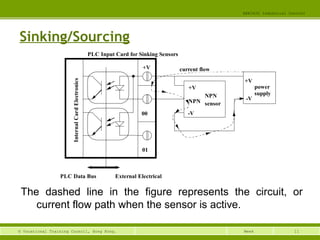
The dashed line in the figure represents the circuit, or
current flow path when the sensor is active.
PLC Input Card for Sinking Sensors
InternalCardElectronics
PLC Data Bus External Electrical
NPN
sensor
power
supply
+V
-V
+V
NPN
-V
current flow+V
00
01
12© Vocational Training Council, Hong Kong.
EEE3420 Industrial Control
Week
Sinking/Sourcing
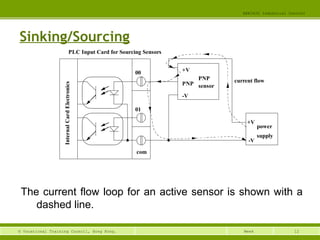
The current flow loop for an active sensor is shown with a
dashed line.
PLC Input Card for Sourcing Sensors
InternalCardElectronics
PNP
sensor
power
supply
+V
-V
+V
PNP
-V
current flow
00
01
com
13© Vocational Training Council, Hong Kong.
EEE3420 Industrial Control
Week
Two Wire Sensors

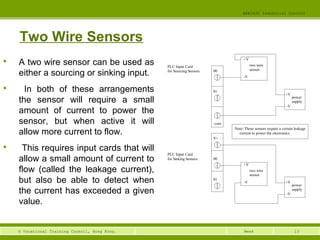
A two wire sensor can be used as
either a sourcing or sinking input.

In both of these arrangements
the sensor will require a small
amount of current to power the
sensor, but when active it will
allow more current to flow.

This requires input cards that will
allow a small amount of current to
flow (called the leakage current),
but also be able to detect when
the current has exceeded a given
value.
PLC Input Card two wire
sensor
power
supply
+V
-V
+V
-V
00
01
com
Note: These sensors require a certain leakage
current to power the electronics.
PLC Input Card
two wire
sensor
power
supply
+V
-V
+V
-V
00
01
V+
for Sourcing Sensors
for Sinking Sensors
14© Vocational Training Council, Hong Kong.
EEE3420 Industrial Control
Week
Contact Switches

Contact switches are available as normally open and
normally closed.

Their housings are reinforced so that they can take
repeated mechanical forces.

These often have rollers and wear pads for the point
of contact. Lightweight contact switches can be
purchased for less than a dollar, but heavy duty
contact switches will have much higher costs.
15© Vocational Training Council, Hong Kong.
EEE3420 Industrial Control
Week
Reed Switches

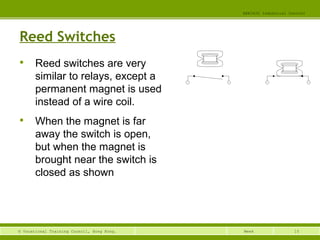
Reed switches are very
similar to relays, except a
permanent magnet is used
instead of a wire coil.

When the magnet is far
away the switch is open,
but when the magnet is
brought near the switch is
closed as shown
16© Vocational Training Council, Hong Kong.
EEE3420 Industrial Control
Week
Optical (Photoelectric) Sensors
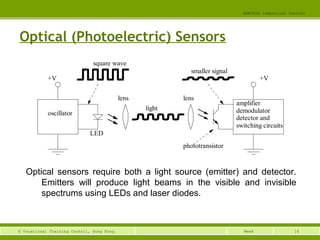
Optical sensors require both a light source (emitter) and detector.
Emitters will produce light beams in the visible and invisible
spectrums using LEDs and laser diodes.
oscillator
+V +V
lens lens
square wave
light
LED
phototransistor
amplifier
demodulator
detector and
switching circuits
smaller signal
17© Vocational Training Council, Hong Kong.
EEE3420 Industrial Control
Week
Capacitive Sensors
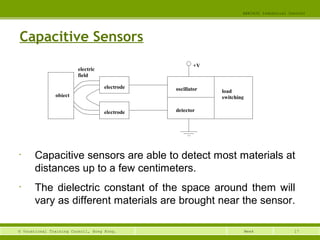
• Capacitive sensors are able to detect most materials at
distances up to a few centimeters.
• The dielectric constant of the space around them will
vary as different materials are brought near the sensor.
electric
field
object
electrode
electrode
oscillator
detector
load
switching
+V
18© Vocational Training Council, Hong Kong.
EEE3420 Industrial Control
Week
Capacitive Sensors
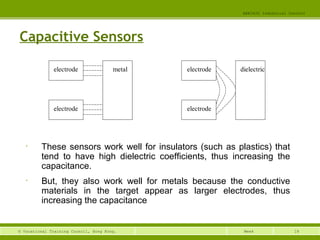
• These sensors work well for insulators (such as plastics) that
tend to have high dielectric coefficients, thus increasing the
capacitance.
• But, they also work well for metals because the conductive
materials in the target appear as larger electrodes, thus
increasing the capacitance
electrode
electrode
electrode
electrode
metal dielectric
19© Vocational Training Council, Hong Kong.
EEE3420 Industrial Control
Week
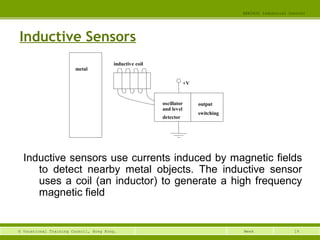
Inductive Sensors
Inductive sensors use currents induced by magnetic fields
to detect nearby metal objects. The inductive sensor
uses a coil (an inductor) to generate a high frequency
magnetic field
oscillator
and level
detector
output
switching
inductive coil
metal
+V
20© Vocational Training Council, Hong Kong.
EEE3420 Industrial Control
Week
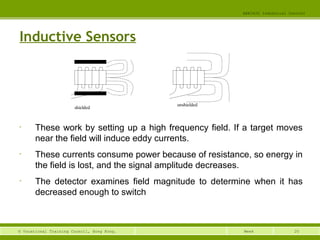
Inductive Sensors
• These work by setting up a high frequency field. If a target moves
near the field will induce eddy currents.
• These currents consume power because of resistance, so energy in
the field is lost, and the signal amplitude decreases.
• The detector examines field magnitude to determine when it has
decreased enough to switch
shielded
unshielded
21© Vocational Training Council, Hong Kong.
EEE3420 Industrial Control
Week
Ultrasonic

An ultrasonic sensor emits a sound above the
normal hearing threshold of 16KHz.

The time that is required for the sound to travel to
the target and reflect back is proportional to the
distance to the target. The two common types of
sensors are;

electrostatic - uses capacitive effects. It has longer
ranges and wider bandwidth, but is more sensitive to
factors such as humidity.

piezoelectric - based on charge displacement during
strain in crystal lattices. These are rugged and
inexpensive.
22© Vocational Training Council, Hong Kong.
EEE3420 Industrial Control
Week
Hall Effect
• Hall effect switches are basically transistors that can be
switched by magnetic fields.
• Their applications are very similar to reed switches, but
because they are solid state they tend to be more
rugged and resist vibration.
• Automated machines often use these to do initial
calibration and detect end stops.
23© Vocational Training Council, Hong Kong.
EEE3420 Industrial Control
Week
Fluid Flow
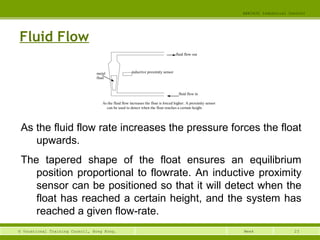
As the fluid flow rate increases the pressure forces the float
upwards.
The tapered shape of the float ensures an equilibrium
position proportional to flowrate. An inductive proximity
sensor can be positioned so that it will detect when the
float has reached a certain height, and the system has
reached a given flow-rate.
fluid flow in
fluid flow out
metal inductive proximity sensor
As the fluid flow increases the float is forced higher. A proximity sensor
can be used to detect when the float reaches a certain height.
float
24© Vocational Training Council, Hong Kong.
EEE3420 Industrial Control
Week
Actuators
Actuators Drive provides motions in mechanical
systems.
Most often this is by converting electrical energy into
some form of mechanical motion
25© Vocational Training Council, Hong Kong.
EEE3420 Industrial Control
Week
SOLENOIDS
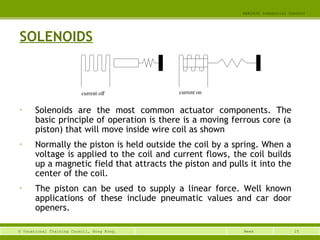
• Solenoids are the most common actuator components. The
basic principle of operation is there is a moving ferrous core (a
piston) that will move inside wire coil as shown
• Normally the piston is held outside the coil by a spring. When a
voltage is applied to the coil and current flows, the coil builds
up a magnetic field that attracts the piston and pulls it into the
center of the coil.
• The piston can be used to supply a linear force. Well known
applications of these include pneumatic values and car door
openers.
current off current on
26© Vocational Training Council, Hong Kong.
EEE3420 Industrial Control
Week
VALVES
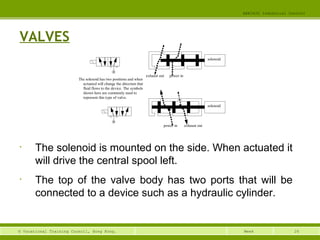
• The solenoid is mounted on the side. When actuated it
will drive the central spool left.
• The top of the valve body has two ports that will be
connected to a device such as a hydraulic cylinder.
solenoid
solenoid
power inexhaust out
power in exhaust out
The solenoid has two positions and when
actuated will change the direction that
fluid flows to the device. The symbols
shown here are commonly used to
represent this type of valve.
27© Vocational Training Council, Hong Kong.
EEE3420 Industrial Control
Week
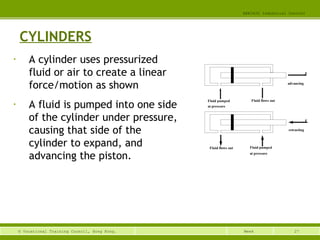
CYLINDERS
• A cylinder uses pressurized
fluid or air to create a linear
force/motion as shown
• A fluid is pumped into one side
of the cylinder under pressure,
causing that side of the
cylinder to expand, and
advancing the piston.
Fluid pumped
in
at pressure
Fluid flows out
F
Fluid pumped
inat pressure
Fluid flows out
F
advancing
retracting
28© Vocational Training Council, Hong Kong.
EEE3420 Industrial Control
Week
HYDRAULICS
• Hydraulics use incompressible fluids to supply very
large forces at slower speeds and limited ranges of
motion.
• If the fluid flow rate is kept low enough, many of the
effects predicted by Bernoulli’s equation can be
avoided.
• The system uses hydraulic fluid (normally an oil)
pressurized by a pump and passed through hoses and
valves to drive cylinders.
29© Vocational Training Council, Hong Kong.
EEE3420 Industrial Control
Week
HYDRAULICS

Hydraulic systems normally contain the following
components;

1. Hydraulic Fluid

2. An Oil Reservoir

3. A Pump to Move Oil, and Apply Pressure

4. Pressure Lines

5. Control Valves - to regulate fluid flow

6. Piston and Cylinder - to actuate external
mechanisms
30© Vocational Training Council, Hong Kong.
EEE3420 Industrial Control
Week
PNEUMATICS
• Pneumatic systems are very common, and have much
in common with hydraulic systems with a few key
differences.
• The reservoir is eliminated as there is no need to
collect and store the air between uses in the system.
• Also because air is a gas it is compressible and
regulators are not needed to re-circulate flow.
• But, the compressibility also means that the systems
are not as stiff or strong.
31© Vocational Training Council, Hong Kong.
EEE3420 Industrial Control
Week
PNEUMATICS

Some basic characteristics of pneumatic systems are,

- stroke from a few millimeters to meters in length (longer
strokes have more springiness

- the actuators will give a bit - they are springy

- pressures are typically up to 85psi above normal
atmosphere

- the weight of cylinders can be quite low

- additional equipment is required for a pressurized air
supply- linear and rotatory actuators are available.

- dampers can be used to cushion impact at ends of
cylinder travel.
32© Vocational Training Council, Hong Kong.
EEE3420 Industrial Control
Week
MOTORS
• Motors are common actuators, but for logical control
applications their properties are not that important.
• Typically logical control of motors consists of
switching low current motors directly with a PLC, or
for more powerful motors using a relay or motor
starter.
33© Vocational Training Council, Hong Kong.
EEE3420 Industrial Control
Week
Other Types of Actuators

Heaters

The are often controlled with a relay and turned on and off
to maintain a temperature within a range.

Lights

Lights are used on almost all machines to indicate the
machine state and provide feedback to the operator. most
lights are low current and are connected directly to the
PLC.

Sirens/Horns

Sirens or horns can be useful for unattended or dangerous
machines to make conditions well known. These can often
be connected directly to the PLC.
34© Vocational Training Council, Hong Kong.
EEE3420 Industrial Control
Week
Application of PLC in Industrial Control
Motor Control
The following example involves a motor start and stop
circuit.
35© Vocational Training Council, Hong Kong.
EEE3420 Industrial Control
Week
Application of PLC in Industrial Control
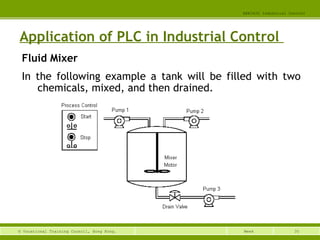
Fluid Mixer
In the following example a tank will be filled with two
chemicals, mixed, and then drained.
36© Vocational Training Council, Hong Kong.
EEE3420 Industrial Control
Week
Application of PLC in Industrial Control
Counter Applications
A bottling machine shown below uses a counter to count
bottles into groups of six for packaging
37© Vocational Training Council, Hong Kong.
EEE3420 Industrial Control
Week
Application of PLC in Industrial Control
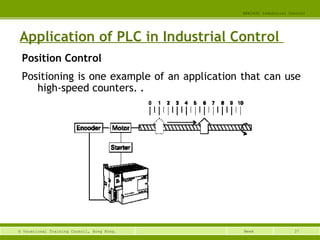
Position Control
Positioning is one example of an application that can use
high-speed counters. .
38© Vocational Training Council, Hong Kong.
EEE3420 Industrial Control
Week
Application of PLC in Industrial Control
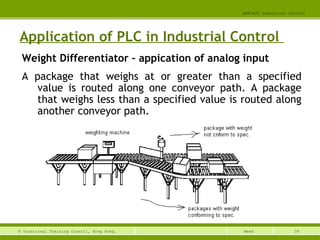
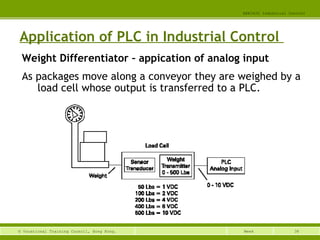
Weight Differentiator – appication of analog input
As packages move along a conveyor they are weighed by a
load cell whose output is transferred to a PLC.
39© Vocational Training Council, Hong Kong.
EEE3420 Industrial Control
Week
Application of PLC in Industrial Control
Weight Differentiator – appication of analog input
A package that weighs at or greater than a specified
value is routed along one conveyor path. A package
that weighs less than a specified value is routed along
another conveyor path.
40© Vocational Training Council, Hong Kong.
EEE3420 Industrial Control
Week
Summary

Sourcing sensors allow current to flow out from the V+
supply.

Sinking sensors allow current to flow in to the V-
supply.

Photo-optical sensors can use reflected beams
(retroreflective), an emitter and detector (opposed
mode) and reflected light (diffuse) to detect a part.

Capacitive sensors can detect metals and other
materials.

Inductive sensors can detect metals.

Hall effect and reed switches can detect magnets.
41© Vocational Training Council, Hong Kong.
EEE3420 Industrial Control
Week
Summary

Ultrasonic sensors use sound waves to detect parts up
to meters away.

Solenoids can be used to convert an electric current to
a limited linear motion.

Hydraulics and pneumatics use cylinders to convert
fluid and gas flows to limited linear motions.

Solenoid valves can be used to redirect fluid and gas
flows.

Pneumatics provides smaller forces at higher speeds,
but is not stiff. Hydraulics provides large forces and is
rigid, but at lower speeds.
42© Vocational Training Council, Hong Kong.
EEE3420 Industrial Control
Week
Sensors, Actuators and Applications of PLC
End of Lecture 8
 Revision

Eee3420 lecture08 rev2011

  • 1.
    1Week© Vocational TrainingCouncil, Hong Kong. │ Lecture 8 │ Sensors, Actuators and Applications of PLC EEC3420 Industrial Control Department of Electrical Engineering
  • 2.
    2© Vocational TrainingCouncil, Hong Kong. EEE3420 Industrial Control Week Learning Objectives  To know various types of sensors, actuators and typical applications of PLC in industrial control.
  • 3.
    3© Vocational TrainingCouncil, Hong Kong. EEE3420 Industrial Control Week Sensors  Sensors allow a PLC to detect the state of a process. Logical sensors can only detect a state that is either true or false. Examples of physical phenomena that are typically detected are listed below.  inductive proximity - is a metal object nearby?  capacitive proximity - is a dielectric object nearby?  optical presence - is an object breaking a light beam or reflecting light?  mechanical contact - is an object touching a switch?
  • 4.
    4© Vocational TrainingCouncil, Hong Kong. EEE3420 Industrial Control Week SENSOR WIRING  When a sensor detects a logical change it must signal that change to the PLC.  This is typically done by switching a voltage or current on or off. In some cases the output of the sensor is used to switch a load directly, completely eliminating the PLC.  Typical outputs from sensors (and inputs to PLCs) are listed below in relative popularity.  Sinking/Sourcing - Switches current on or off.  Plain Switches - Switches voltage on or off.  Solid State Relays - These switch AC outputs.  TTL (Transistor Transistor Logic) - Uses 0V and 5V to indicate logic levels.
  • 5.
    5© Vocational TrainingCouncil, Hong Kong. EEE3420 Industrial Control Week Switches  In the figure a NO contact switch is connected to input 01.  A sensor with a relay output is also shown.  The sensor must be powered separately, therefore the V+ and V- terminals are connected to the power supply.  The output of the sensor will become active when a phenomenon has been detected. 24 Vdc Power Supply normally open push-button PLC Input Card 24V DC 00 01 02 03 04 05 06 07 COM + - sensor V+ V- relay output
  • 6.
    6© Vocational TrainingCouncil, Hong Kong. EEE3420 Industrial Control Week Transistor Transistor Logic (TTL)  Transistor-Transistor Logic (TTL) is based on two voltage levels, 0V for false and 5V for true.  The voltages can actually be slightly larger than 0V, or lower than 5V and still be detected correctly.  This method is very susceptible to electrical noise on the factory floor, and should only be used when necessary.  TTL outputs are common on electronic devices and computers, and will be necessary sometimes. When connecting to other devices simple circuits can be used to improve the signal Vi Vo Vi Vo A Schmitt trigger will receive an input voltage between 0- 5V and convert it to 0V or 5V. If the voltage is in an ambiguous range, about 1.5- 3.5V it will be ignored.
  • 7.
    7© Vocational TrainingCouncil, Hong Kong. EEE3420 Industrial Control Week Sinking/Sourcing  Sinking sensors allow current to flow into the sensor to the voltage common, while sourcing sensors allow current to flow out of the sensor from a positive source.  For both of these methods the emphasis is on current flow, not voltage.  By using current flow, instead of voltage, many of the electrical noise problems are reduced. Sensor V+ V- Active physical phenomenon V+ NPN V- sensor output and Detector Line current flows in when switched on
  • 8.
    8© Vocational TrainingCouncil, Hong Kong. EEE3420 Industrial Control Week Sinking/Sourcing  Sinking sensors allow current to flow into the sensor to the voltage common, while sourcing sensors allow current to flow out of the sensor from a positive source.  For both of these methods the emphasis is on current flow, not voltage.  By using current flow, instead of voltage, many of the electrical noise problems are reduced. Sensor V+ V- Active physical phenomenon V+ NPN V- sensor output and Detector Line current flows in when switched on
  • 9.
    9© Vocational TrainingCouncil, Hong Kong. EEE3420 Industrial Control Week Sinking/Sourcing  Sourcing sensors are the complement to sinking sensors.  The sourcing sensors use a PNP transistor, as shown above.  PNP transistors are always drawn with the arrow pointing to the center.) When the sensor is inactive the active line stays at the V+ value, and the transistor stays switched off. When the sensor becomes active the active line will be made 0V, and the transistor will allow current to flow out of the sensor. Sensor V+ V- Active physical phenomenon V+ PNP V- sensor output and Detector Line current flows out when switched on
  • 10.
    10© Vocational TrainingCouncil, Hong Kong. EEE3420 Industrial Control Week Sinking/Sourcing Most NPN/PNP sensors are capable of handling currents up to a few amps, and they can be used to switch loads directly. power supply sensor V+ V- (common) V+ V- NPN power supply sensor V+ V- (common) V+ V- PNP sinking sourcing
  • 11.
    11© Vocational TrainingCouncil, Hong Kong. EEE3420 Industrial Control Week Sinking/Sourcing The dashed line in the figure represents the circuit, or current flow path when the sensor is active. PLC Input Card for Sinking Sensors InternalCardElectronics PLC Data Bus External Electrical NPN sensor power supply +V -V +V NPN -V current flow+V 00 01
  • 12.
    12© Vocational TrainingCouncil, Hong Kong. EEE3420 Industrial Control Week Sinking/Sourcing The current flow loop for an active sensor is shown with a dashed line. PLC Input Card for Sourcing Sensors InternalCardElectronics PNP sensor power supply +V -V +V PNP -V current flow 00 01 com
  • 13.
    13© Vocational TrainingCouncil, Hong Kong. EEE3420 Industrial Control Week Two Wire Sensors  A two wire sensor can be used as either a sourcing or sinking input.  In both of these arrangements the sensor will require a small amount of current to power the sensor, but when active it will allow more current to flow.  This requires input cards that will allow a small amount of current to flow (called the leakage current), but also be able to detect when the current has exceeded a given value. PLC Input Card two wire sensor power supply +V -V +V -V 00 01 com Note: These sensors require a certain leakage current to power the electronics. PLC Input Card two wire sensor power supply +V -V +V -V 00 01 V+ for Sourcing Sensors for Sinking Sensors
  • 14.
    14© Vocational TrainingCouncil, Hong Kong. EEE3420 Industrial Control Week Contact Switches  Contact switches are available as normally open and normally closed.  Their housings are reinforced so that they can take repeated mechanical forces.  These often have rollers and wear pads for the point of contact. Lightweight contact switches can be purchased for less than a dollar, but heavy duty contact switches will have much higher costs.
  • 15.
    15© Vocational TrainingCouncil, Hong Kong. EEE3420 Industrial Control Week Reed Switches  Reed switches are very similar to relays, except a permanent magnet is used instead of a wire coil.  When the magnet is far away the switch is open, but when the magnet is brought near the switch is closed as shown
  • 16.
    16© Vocational TrainingCouncil, Hong Kong. EEE3420 Industrial Control Week Optical (Photoelectric) Sensors Optical sensors require both a light source (emitter) and detector. Emitters will produce light beams in the visible and invisible spectrums using LEDs and laser diodes. oscillator +V +V lens lens square wave light LED phototransistor amplifier demodulator detector and switching circuits smaller signal
  • 17.
    17© Vocational TrainingCouncil, Hong Kong. EEE3420 Industrial Control Week Capacitive Sensors • Capacitive sensors are able to detect most materials at distances up to a few centimeters. • The dielectric constant of the space around them will vary as different materials are brought near the sensor. electric field object electrode electrode oscillator detector load switching +V
  • 18.
    18© Vocational TrainingCouncil, Hong Kong. EEE3420 Industrial Control Week Capacitive Sensors • These sensors work well for insulators (such as plastics) that tend to have high dielectric coefficients, thus increasing the capacitance. • But, they also work well for metals because the conductive materials in the target appear as larger electrodes, thus increasing the capacitance electrode electrode electrode electrode metal dielectric
  • 19.
    19© Vocational TrainingCouncil, Hong Kong. EEE3420 Industrial Control Week Inductive Sensors Inductive sensors use currents induced by magnetic fields to detect nearby metal objects. The inductive sensor uses a coil (an inductor) to generate a high frequency magnetic field oscillator and level detector output switching inductive coil metal +V
  • 20.
    20© Vocational TrainingCouncil, Hong Kong. EEE3420 Industrial Control Week Inductive Sensors • These work by setting up a high frequency field. If a target moves near the field will induce eddy currents. • These currents consume power because of resistance, so energy in the field is lost, and the signal amplitude decreases. • The detector examines field magnitude to determine when it has decreased enough to switch shielded unshielded
  • 21.
    21© Vocational TrainingCouncil, Hong Kong. EEE3420 Industrial Control Week Ultrasonic  An ultrasonic sensor emits a sound above the normal hearing threshold of 16KHz.  The time that is required for the sound to travel to the target and reflect back is proportional to the distance to the target. The two common types of sensors are;  electrostatic - uses capacitive effects. It has longer ranges and wider bandwidth, but is more sensitive to factors such as humidity.  piezoelectric - based on charge displacement during strain in crystal lattices. These are rugged and inexpensive.
  • 22.
    22© Vocational TrainingCouncil, Hong Kong. EEE3420 Industrial Control Week Hall Effect • Hall effect switches are basically transistors that can be switched by magnetic fields. • Their applications are very similar to reed switches, but because they are solid state they tend to be more rugged and resist vibration. • Automated machines often use these to do initial calibration and detect end stops.
  • 23.
    23© Vocational TrainingCouncil, Hong Kong. EEE3420 Industrial Control Week Fluid Flow As the fluid flow rate increases the pressure forces the float upwards. The tapered shape of the float ensures an equilibrium position proportional to flowrate. An inductive proximity sensor can be positioned so that it will detect when the float has reached a certain height, and the system has reached a given flow-rate. fluid flow in fluid flow out metal inductive proximity sensor As the fluid flow increases the float is forced higher. A proximity sensor can be used to detect when the float reaches a certain height. float
  • 24.
    24© Vocational TrainingCouncil, Hong Kong. EEE3420 Industrial Control Week Actuators Actuators Drive provides motions in mechanical systems. Most often this is by converting electrical energy into some form of mechanical motion
  • 25.
    25© Vocational TrainingCouncil, Hong Kong. EEE3420 Industrial Control Week SOLENOIDS • Solenoids are the most common actuator components. The basic principle of operation is there is a moving ferrous core (a piston) that will move inside wire coil as shown • Normally the piston is held outside the coil by a spring. When a voltage is applied to the coil and current flows, the coil builds up a magnetic field that attracts the piston and pulls it into the center of the coil. • The piston can be used to supply a linear force. Well known applications of these include pneumatic values and car door openers. current off current on
  • 26.
    26© Vocational TrainingCouncil, Hong Kong. EEE3420 Industrial Control Week VALVES • The solenoid is mounted on the side. When actuated it will drive the central spool left. • The top of the valve body has two ports that will be connected to a device such as a hydraulic cylinder. solenoid solenoid power inexhaust out power in exhaust out The solenoid has two positions and when actuated will change the direction that fluid flows to the device. The symbols shown here are commonly used to represent this type of valve.
  • 27.
    27© Vocational TrainingCouncil, Hong Kong. EEE3420 Industrial Control Week CYLINDERS • A cylinder uses pressurized fluid or air to create a linear force/motion as shown • A fluid is pumped into one side of the cylinder under pressure, causing that side of the cylinder to expand, and advancing the piston. Fluid pumped in at pressure Fluid flows out F Fluid pumped inat pressure Fluid flows out F advancing retracting
  • 28.
    28© Vocational TrainingCouncil, Hong Kong. EEE3420 Industrial Control Week HYDRAULICS • Hydraulics use incompressible fluids to supply very large forces at slower speeds and limited ranges of motion. • If the fluid flow rate is kept low enough, many of the effects predicted by Bernoulli’s equation can be avoided. • The system uses hydraulic fluid (normally an oil) pressurized by a pump and passed through hoses and valves to drive cylinders.
  • 29.
    29© Vocational TrainingCouncil, Hong Kong. EEE3420 Industrial Control Week HYDRAULICS  Hydraulic systems normally contain the following components;  1. Hydraulic Fluid  2. An Oil Reservoir  3. A Pump to Move Oil, and Apply Pressure  4. Pressure Lines  5. Control Valves - to regulate fluid flow  6. Piston and Cylinder - to actuate external mechanisms
  • 30.
    30© Vocational TrainingCouncil, Hong Kong. EEE3420 Industrial Control Week PNEUMATICS • Pneumatic systems are very common, and have much in common with hydraulic systems with a few key differences. • The reservoir is eliminated as there is no need to collect and store the air between uses in the system. • Also because air is a gas it is compressible and regulators are not needed to re-circulate flow. • But, the compressibility also means that the systems are not as stiff or strong.
  • 31.
    31© Vocational TrainingCouncil, Hong Kong. EEE3420 Industrial Control Week PNEUMATICS  Some basic characteristics of pneumatic systems are,  - stroke from a few millimeters to meters in length (longer strokes have more springiness  - the actuators will give a bit - they are springy  - pressures are typically up to 85psi above normal atmosphere  - the weight of cylinders can be quite low  - additional equipment is required for a pressurized air supply- linear and rotatory actuators are available.  - dampers can be used to cushion impact at ends of cylinder travel.
  • 32.
    32© Vocational TrainingCouncil, Hong Kong. EEE3420 Industrial Control Week MOTORS • Motors are common actuators, but for logical control applications their properties are not that important. • Typically logical control of motors consists of switching low current motors directly with a PLC, or for more powerful motors using a relay or motor starter.
  • 33.
    33© Vocational TrainingCouncil, Hong Kong. EEE3420 Industrial Control Week Other Types of Actuators  Heaters  The are often controlled with a relay and turned on and off to maintain a temperature within a range.  Lights  Lights are used on almost all machines to indicate the machine state and provide feedback to the operator. most lights are low current and are connected directly to the PLC.  Sirens/Horns  Sirens or horns can be useful for unattended or dangerous machines to make conditions well known. These can often be connected directly to the PLC.
  • 34.
    34© Vocational TrainingCouncil, Hong Kong. EEE3420 Industrial Control Week Application of PLC in Industrial Control Motor Control The following example involves a motor start and stop circuit.
  • 35.
    35© Vocational TrainingCouncil, Hong Kong. EEE3420 Industrial Control Week Application of PLC in Industrial Control Fluid Mixer In the following example a tank will be filled with two chemicals, mixed, and then drained.
  • 36.
    36© Vocational TrainingCouncil, Hong Kong. EEE3420 Industrial Control Week Application of PLC in Industrial Control Counter Applications A bottling machine shown below uses a counter to count bottles into groups of six for packaging
  • 37.
    37© Vocational TrainingCouncil, Hong Kong. EEE3420 Industrial Control Week Application of PLC in Industrial Control Position Control Positioning is one example of an application that can use high-speed counters. .
  • 38.
    38© Vocational TrainingCouncil, Hong Kong. EEE3420 Industrial Control Week Application of PLC in Industrial Control Weight Differentiator – appication of analog input As packages move along a conveyor they are weighed by a load cell whose output is transferred to a PLC.
  • 39.
    39© Vocational TrainingCouncil, Hong Kong. EEE3420 Industrial Control Week Application of PLC in Industrial Control Weight Differentiator – appication of analog input A package that weighs at or greater than a specified value is routed along one conveyor path. A package that weighs less than a specified value is routed along another conveyor path.
  • 40.
    40© Vocational TrainingCouncil, Hong Kong. EEE3420 Industrial Control Week Summary  Sourcing sensors allow current to flow out from the V+ supply.  Sinking sensors allow current to flow in to the V- supply.  Photo-optical sensors can use reflected beams (retroreflective), an emitter and detector (opposed mode) and reflected light (diffuse) to detect a part.  Capacitive sensors can detect metals and other materials.  Inductive sensors can detect metals.  Hall effect and reed switches can detect magnets.
  • 41.
    41© Vocational TrainingCouncil, Hong Kong. EEE3420 Industrial Control Week Summary  Ultrasonic sensors use sound waves to detect parts up to meters away.  Solenoids can be used to convert an electric current to a limited linear motion.  Hydraulics and pneumatics use cylinders to convert fluid and gas flows to limited linear motions.  Solenoid valves can be used to redirect fluid and gas flows.  Pneumatics provides smaller forces at higher speeds, but is not stiff. Hydraulics provides large forces and is rigid, but at lower speeds.
  • 42.
    42© Vocational TrainingCouncil, Hong Kong. EEE3420 Industrial Control Week Sensors, Actuators and Applications of PLC End of Lecture 8  Revision