
Presented by,
 T.SHIVA RAM
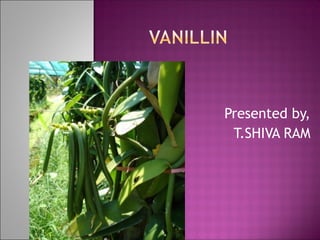
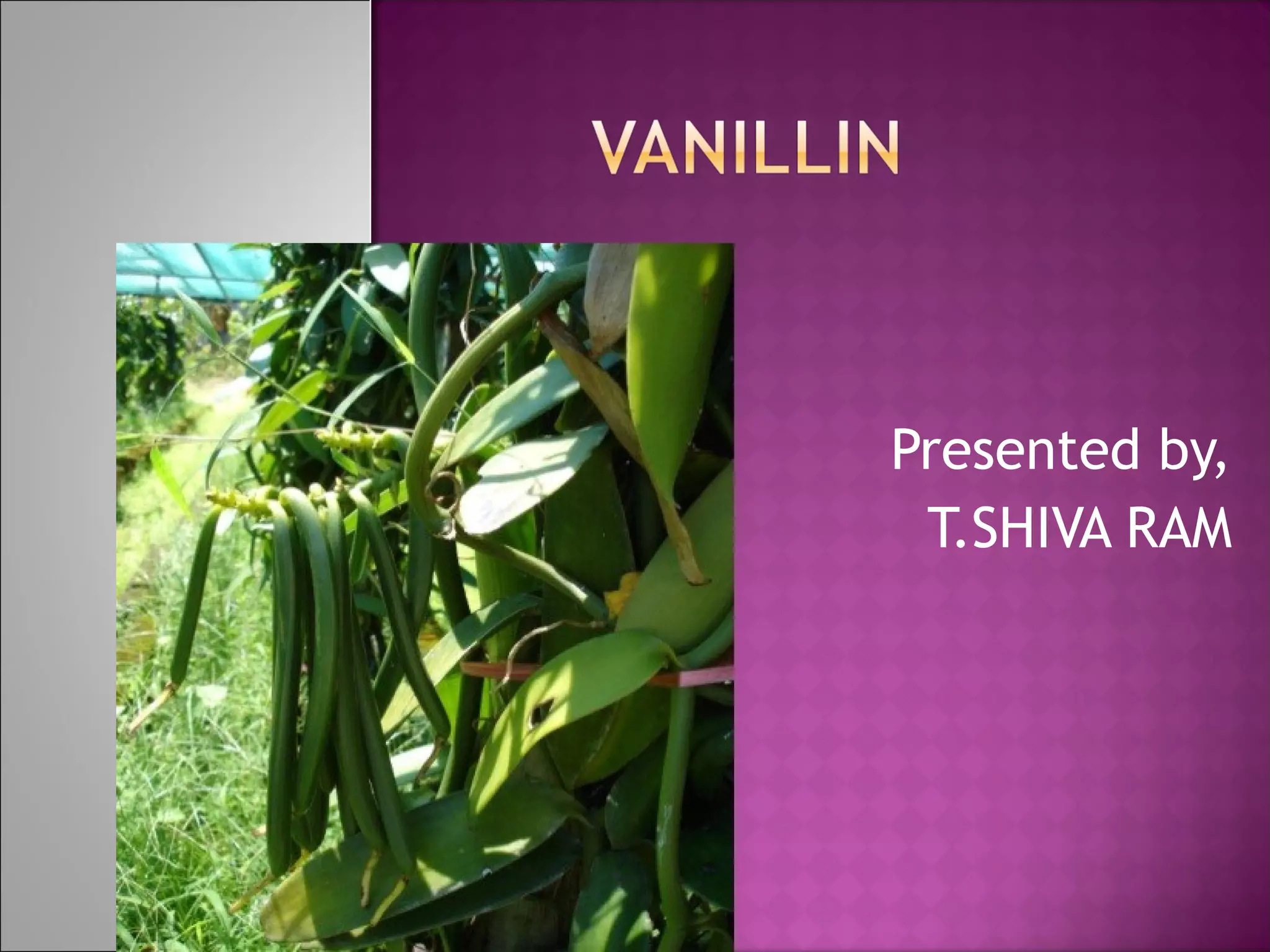
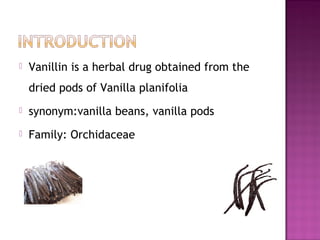
   Vanillin is a herbal drug obtained from the
    dried pods of Vanilla planifolia
   synonym:vanilla beans, vanilla pods
   Family: Orchidaceae
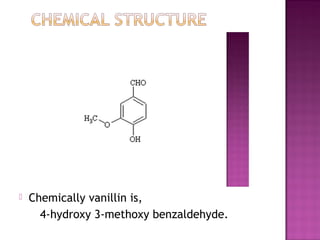
   Chemically vanillin is,
      4-hydroxy 3-methoxy benzaldehyde.
   To synthesise the semisynthetic derivatives
    of vanillin which are used in our daily
    biological activities.
   To optimize the biological activity of the compounds
    selected in the study.
   The compounds selected for the study are volatile in
    nature, formation of non volatile derivative with a
    better activity avoids the wastage through
    vaporization and also increases the potency.
   The compounds to be synthesized in this study are
    very simple derivatives and follow one or two step
    reactions, thus there is very less chance for the
    degradation of the starting compound.
   The compounds synthesized in this study will be
    subjected for TLC, physical and spectral analysis in
    order to identify purity, and to interpret the
    structure of the derivatives synthesized.
   Based on this concept the present work was
    designed to synthesize semisynthetic
    derivatives of some commonly used
    phytoconstituent’s. In the present study
    semisynthetic derivatives of vanilla are
    synthesized. These derivatives are chosen
    due to their wide pharmacological activity
    and are used in our day to day life.
Experimental work
           procedure
   Take about 1 gm of hydrazine
    sulphate, 0.8 gm of sodium
    acetate in little quantity of
    distilled water and shaken well,
    added 2 gm of vanillin and
    shaken well till it becomes clear
    solution, if necessary add
    ethanol to dissolve the contents.
   The thoroughly dried substance
    is to be subjected for analytical
    work
   In this experiment vanillin is
    treated with semicarbazide in the
    presence of sodium acetate.
   The    resulted    product     is
    Hydrazine methylidene vanillin
   The entire mixture warmed on
    water bath continuously for
    about 1 hour under reflux and
    allowed to cool to get the
    compound hydrazine di methyl
    vanillin, which is filtered and
    subjected for recrystallization
    with suitable solvent like
    alcohol.
uses
   The uses of the newly generated product are

   Analgesic

   Antibacterial

   Anti helmenthic
   Flavouring agent
   Perfumary
   Masking agent
   The literature survey reveals that some
    activities like Antibacterial, Antioxidant &
    analgesic activities etc… which are found
    weak, to increase its biological activity,a
    modification of functional groups in the
    structure/ modification of structure, may
    increase their pharmacological actions.
   Satyajit D Sarker, Lutfun Nahar, “Chemistry For
    Pharmacy students General , Organic and natural
    Product Chemistry”, Nat prod chem, John Wiley
    & Sons Ltd, chapter 6,pg no.283-289, 2004.
   Dr. C. K. Kokate, A. P. Purohit, S. B. Gokhale,
    “Pharmacognosy”,Nirali prakashan ; Pune, thirty
    eighth edition, p.no:1-6,2007
   Newman DJ, Cragg GM. “Natural products as
    sources of new drugs over the last 25 years” J
    Nat Prod, 70, 461-477 (2007).
   Dan Bensky, Steven Clavey, Erich Stoger, and
    Andrew Gamble “Chinese Herbal Medicine:
    Materia Medica” Third Edition 2004.
Vanillin

Vanillin

  • 1.
  • 2.
    Vanillin is a herbal drug obtained from the dried pods of Vanilla planifolia  synonym:vanilla beans, vanilla pods  Family: Orchidaceae
  • 3.
    Chemically vanillin is, 4-hydroxy 3-methoxy benzaldehyde.
  • 4.
    To synthesise the semisynthetic derivatives of vanillin which are used in our daily biological activities.
  • 5.
    To optimize the biological activity of the compounds selected in the study.  The compounds selected for the study are volatile in nature, formation of non volatile derivative with a better activity avoids the wastage through vaporization and also increases the potency.  The compounds to be synthesized in this study are very simple derivatives and follow one or two step reactions, thus there is very less chance for the degradation of the starting compound.  The compounds synthesized in this study will be subjected for TLC, physical and spectral analysis in order to identify purity, and to interpret the structure of the derivatives synthesized.
  • 6.
    Based on this concept the present work was designed to synthesize semisynthetic derivatives of some commonly used phytoconstituent’s. In the present study semisynthetic derivatives of vanilla are synthesized. These derivatives are chosen due to their wide pharmacological activity and are used in our day to day life.
  • 7.
    Experimental work procedure  Take about 1 gm of hydrazine sulphate, 0.8 gm of sodium acetate in little quantity of distilled water and shaken well, added 2 gm of vanillin and shaken well till it becomes clear solution, if necessary add ethanol to dissolve the contents.
  • 8.
    The thoroughly dried substance is to be subjected for analytical work  In this experiment vanillin is treated with semicarbazide in the presence of sodium acetate.  The resulted product is Hydrazine methylidene vanillin
  • 9.
    The entire mixture warmed on water bath continuously for about 1 hour under reflux and allowed to cool to get the compound hydrazine di methyl vanillin, which is filtered and subjected for recrystallization with suitable solvent like alcohol.
  • 11.
    uses  The uses of the newly generated product are  Analgesic  Antibacterial  Anti helmenthic
  • 12.
    Flavouring agent  Perfumary  Masking agent
  • 13.
    The literature survey reveals that some activities like Antibacterial, Antioxidant & analgesic activities etc… which are found weak, to increase its biological activity,a modification of functional groups in the structure/ modification of structure, may increase their pharmacological actions.
  • 14.
    Satyajit D Sarker, Lutfun Nahar, “Chemistry For Pharmacy students General , Organic and natural Product Chemistry”, Nat prod chem, John Wiley & Sons Ltd, chapter 6,pg no.283-289, 2004.  Dr. C. K. Kokate, A. P. Purohit, S. B. Gokhale, “Pharmacognosy”,Nirali prakashan ; Pune, thirty eighth edition, p.no:1-6,2007  Newman DJ, Cragg GM. “Natural products as sources of new drugs over the last 25 years” J Nat Prod, 70, 461-477 (2007).  Dan Bensky, Steven Clavey, Erich Stoger, and Andrew Gamble “Chinese Herbal Medicine: Materia Medica” Third Edition 2004.