VALUE ANALYSIS,VALUE
ENGINEERING, BUSINESS
PROCESS REENGINEERING
DEVANSHU SHARMA (417)
SAKASH AGARWAL (419)
SUDHIR KUMAR PADHAN
(421)
HARSHA VARDHAN (429)
T HARI KUMAR (449)
OM TERM PAPER
VALUE ANALYSIS
INTRODUCTION TO VALUE ANALYSIS
Lawrence Miles conceived of Value Analysis (VA) in the 1945 based on the
application of function analysis to the component parts of a product. Component
cost reduction was an effective and popular way to improve "value" when direct
labor and material cost determined the success of a product. The value analysis
technique supported cost reduction activities by relating the cost of components
to their function contributions.
Value analysis defines a "basic function" as anything that makes the product
work or sell. A function that is defined as "basic" cannot change. Secondary
functions, also called "supporting functions", described the manner in which the
basic function(s) were implemented. Secondary functions could be modified or
eliminated to reduce product cost.
As VA progressed to larger and more complex products and systems, emphasis
shifted to "upstream" product development activities where VA can be more
effectively applied to a product before it reaches the production phase.
However, as products have become more complex and sophisticated, the
technique needed to be adapted to the "systems" approach that is involved in
many products today. As a result, value analysis evolved into the "Function
Analysis System Technique" (FAST) which is discussed later.
It is also known as Value engineering and Value management.
OBJECTIVES OF Value Analysis
 The VA / VE objectives is to find and improve on value
mismatches in products, processes and capital projects.
 Find important functions – define necessary versus un - necessary
functions
 Find and improve on low performing functions.
 Define and segregate the necessary functions from the unnecessary
functions and thereby creatively develop alternative means of
accomplishing the necessary functions at lower total (life cycle) cost.
How is Value Analysis different from Value Engineering ?
 Traditionally Value Analysis (VA) is used to describe the application of
the 'techniques to an existing product or services or after the fact.
 Value Engineering (VE) has been used to refer to the design stage or
before the fact. Value Engineering (VE) approach is used for new
products, and applies the same principles and techniques to pre-
manufacturing stages such as concept development, design and
prototyping.
 Value Analysis and Value Engineering (VE) is a powerful Change
Management and Problem Solving' tool with over a century of
worldwide application track record.
 VE is used to create functional breakthroughs by targeting value
mismatches during product, process, and project design.
 VA is also a vital tool to deal with post product release problems and
process improvement innovation.
 Value Analysis (VA) is considered to be a process, as opposed to a
simple technique, because it is both an organized approach to improving
the profitability of product applications and it utilizes many different
techniques in order to achieve this objective.
 The techniques that support VA activities include 'common' techniques
used for all VA exercises and some that are appropriate for the product
under consideration.
 A few other names for VA / VE are - Value Management, Value
Planning, etc.
 VA is also a vital tool to deal with post product release problems and
process improvement innovation.
 Value Analysis (VA) is considered to be a process, as opposed to a
simple technique, because it is both an organized approach to improving
the profitability of product applications and it utilizes many different
techniques in order to achieve this objective.
WHAT IS VALUE ANALYSIS AND VALUE ENGINEERING?
 VA / VE is an orderly and creative method to increase the value of an
item. This "item" can be a product, a system, a process, a procedure, a
plan, a machine, equipment, tool, a service or a method of working.
 Value Analysis / Value Engineering is defined as 'the professionally
applied, team based, function - oriented, systematic application of
recognized techniques (function analysis) which
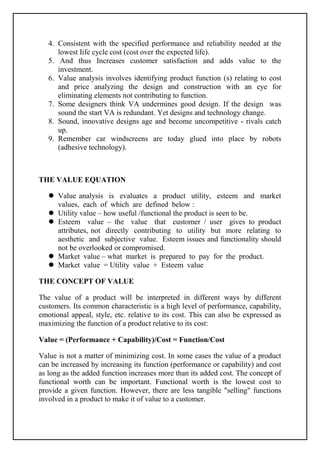
1. Identify the "function of a product, process, project, facility design,
system or service,
2. Establish a monetary value for that function,
3. Provide the necessary function (defined by the customer to meet his / her
requirements),
4. Consistent with the specified performance and reliability needed at the
lowest Iife cycle cost (cost over the expected life).
5. And thus Increases customer satisfaction and adds value to the
investment.
6. Value analysis involves identifying product function (s) relating to cost
and price analyzing the design and construction with an eye for
eliminating elements not contributing to function.
7. Some designers think VA undermines good design. If the design was
sound the start VA is redundant. Yet designs and technology change.
8. Sound, innovative designs age and become uncompetitive - rivals catch
up.
9. Remember car windscreens are today glued into place by robots
(adhesive technology).
THE VALUE EQUATION
 Value analysis is evaluates a product utility, esteem and market
values, each of which are defined below :
 Utility value – how useful /functional the product is seen to be.
 Esteem value – the value that customer / user gives to product
attributes, not directly contributing to utility but more relating to
aesthetic and subjective value. Esteem issues and functionality should
not be overlooked or compromised.
 Market value – what market is prepared to pay for the product.
 Market value = Utility value + Esteem value
THE CONCEPT OF VALUE
The value of a product will be interpreted in different ways by different
customers. Its common characteristic is a high level of performance, capability,
emotional appeal, style, etc. relative to its cost. This can also be expressed as
maximizing the function of a product relative to its cost:
Value = (Performance + Capability)/Cost = Function/Cost
Value is not a matter of minimizing cost. In some cases the value of a product
can be increased by increasing its function (performance or capability) and cost
as long as the added function increases more than its added cost. The concept of
functional worth can be important. Functional worth is the lowest cost to
provide a given function. However, there are less tangible "selling" functions
involved in a product to make it of value to a customer.
THE VALUE ANALYSIS METHOD
In all problem solving techniques, we are trying to change a condition by means
of a solution that is unique and relevant. If we describe in detail what we are
trying to accomplish, we tend to describe a solution and miss the opportunity to
engage in divergent thinking about other alternatives. When trying to describe
problems that affect us, we become locked in to a course of action without
realizing it, because of our own bias. Conversely, the more abstractly we can
define the function of what we are trying to accomplish, the more opportunities
we will have for divergent thinking.
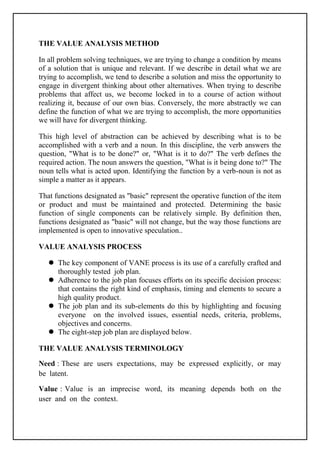
This high level of abstraction can be achieved by describing what is to be
accomplished with a verb and a noun. In this discipline, the verb answers the
question, "What is to be done?" or, "What is it to do?" The verb defines the
required action. The noun answers the question, "What is it being done to?" The
noun tells what is acted upon. Identifying the function by a verb-noun is not as
simple a matter as it appears.
That functions designated as "basic" represent the operative function of the item
or product and must be maintained and protected. Determining the basic
function of single components can be relatively simple. By definition then,
functions designated as "basic" will not change, but the way those functions are
implemented is open to innovative speculation..
VALUE ANALYSIS PROCESS
 The key component of VANE process is its use of a carefully crafted and
thoroughly tested job plan.
 Adherence to the job plan focuses efforts on its specific decision process:
that contains the right kind of emphasis, timing and elements to secure a
high quality product.
 The job plan and its sub-elements do this by highlighting and focusing
everyone on the involved issues, essential needs, criteria, problems,
objectives and concerns.
 The eight-step job plan are displayed below.
THE VALUE ANALYSIS TERMINOLOGY
Need : These are users expectations, may be expressed explicitly, or may
be latent.
Value : Value is an imprecise word, its meaning depends both on the
user and on the context.
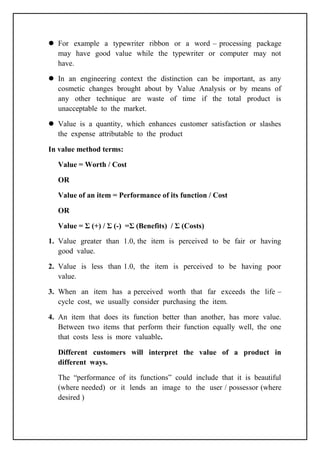
 For example a typewriter ribbon or a word – processing package
may have good value while the typewriter or computer may not
have.
 In an engineering context the distinction can be important, as any
cosmetic changes brought about by Value Analysis or by means of
any other technique are waste of time if the total product is
unacceptable to the market.
 Value is a quantity, which enhances customer satisfaction or slashes
the expense attributable to the product
In value method terms:
Value = Worth / Cost
OR
Value of an item = Performance of its function / Cost
OR
Value = Σ (+) / Σ (-) =Σ (Benefits) / Σ (Costs)
1. Value greater than 1.0, the item is perceived to be fair or having
good value.
2. Value is less than 1.0, the item is perceived to be having poor
value.
3. When an item has a perceived worth that far exceeds the life –
cycle cost, we usually consider purchasing the item.
4. An item that does its function better than another, has more value.
Between two items that perform their function equally well, the one
that costs less is more valuable.
Different customers will interpret the value of a product in
different ways.
The “performance of its functions” could include that it is beautiful
(where needed) or it lends an image to the user / possessor (where
desired )
Its common characteristic is a high level performance, capabilities,
emotional appeal, style, etc. relative to its cost.
This can also be expressed as maximizing the function of product
relative to its cost :
Value = (performance + capability / cost)
= Function / cost
Function:
 The use of functions and a function - logic process to describe needs,
purposes and consequences is at the heart of Value Engineering.
 The use of function - logic helps people realize and overcome many of
the preconceived biases.
 Function allows definition of each task in a process or one of its activities
in terms of end goals and not solutions.
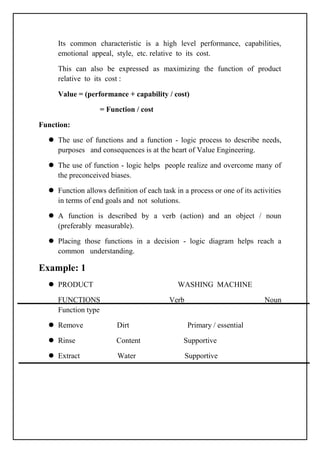
 A function is described by a verb (action) and an object / noun
(preferably measurable).
 Placing those functions in a decision - logic diagram helps reach a
common understanding.
Example: 1
 PRODUCT WASHING MACHINE
FUNCTIONS Verb Noun
Function type
 Remove Dirt Primary / essential
 Rinse Content Supportive
 Extract Water Supportive
VALUE ENGINEERING
What is Value Engineering?
Value Engineering is a fuction oriented, systematic team approach and study to
provide value in a product, system or service. Often, this improvement is
focused on cost reduction; however other important areas such as customer
perceived quality and performance are also of paramount importance in the
value equation.
Value Engineering techniques can be applied to any product process procedure
system or service in any kind of business or economic activity including health
care, governance, construction, industry and in the service sector.
Value Engineering focuses on those value characteristics which are deemed
most important from the customer point of view.
Value Engineering is a powerful methodolgy for solving problems and/or
reducing costs while maintaining or improving performance and quality
requirements.
Value Engineering can achieve impressive savings, much greater than what is
possible through conventional cost reduction exercise even when cost reduction
is the objective of the task.
What are the benefits of Value Engineering ?
Value Engineering helps your organization in :
Lowering O & M costs
Improving quality management
Improving resource efficiecy
Simplifying procedures
Minimizing paperwork
Lowering staff costs
Increasing procedural efficiency
Optimizing construction expenditures
Developing value attitudes in staff
Competing more sucessfully in marketplace
Value Engineering helps you to learn how to :
Improve your career skills
Separate "Symptoms" from "problems"
Solve "root cause" problems and capture opportunities
Become more competitive by improving "benchmarking" process
Take command of a powerful problem solving methodology to use in any
situation
How is Value Engineering Applied ?
The technique of Value Engineering is governed by a structured decision
making process to assess the value of procedures or services. Whenever
unsatisfactory value is found, a Value Management Job plan can be followed.
This procedure involves the following 8 phases :
1. Orientation 2. Information 3. Function 4. Creativity 5. Evaluation 6.
Recommendation 7. Implementation 8. Audit
BUSINESS PROCESS
REENGINEERING
Business Process Reengineering involves changes in structures and in processes
within the business environment. The entire technological, human, and
organizational dimensions may be changed in BPR.
Information Technology plays a major role in BPR as it provides office
automation, it allows the business to be conducted in different locations,
provides flexibility in manufacturing, permits quicker delivery to customers and
supports rapid and paperless transactions.
In general it allows an efficient and effective change in the manner in which
work is performed.
LPG has created instability and intensive competition in the business
environment.
Competition is continuously increasing with respect to
• Price
• Quality and selection
• Service
• Promptness of delivery.
This competition has intensified because of:
 Removal of barriers
 International cooperation
 Technological innovations
All these changes impose the need for organizational
transformation, where the entire processes, organization climate and
organization structure are changed.
Reengineering is the vital rethinking and radical (major/thorough) redesign of
business processes to achieve dramatic improvements in critical modern
measures of performance such as cost, quality, service and speed.
Process is a structured, measured set of activities designed to produce a
specified output for a particular customer or market. It implies a strong
emphasis on how work is done within an organization. “
Business processes are characterized by three elements:
the inputs, (data such customer inquiries or materials),
the processing of the data or materials (which usually go through several
stages and may necessary stops that turns out to be time and money
consuming) and
the outcome (the delivery of the expected result).
The problematic part of the process is processing. BPR mainly intervenes in
the processing part, which is reengineered in order to become less time and
money consuming.
An example of a business process:
Credit card approval in a bank.
An applicant submits an application. The application is reviewed first to make
sure that the form has been completed properly. If not, it is returned for
completion. The complete form goes through a verification of information.
This is done by ordering a report from a credit company and calling references.
Once the information is verified, an evaluation is done. Then, a decision (yes or
no) is made. If the decision is negative, an appropriate rejection letter is
composed. If the decision is positive, an account is opened, and a card is issued
and mailed to the customer.
The process, which may take a few weeks due to workload and waiting time
for the verifications, is usually done by several individuals.

VALUE ANALYSIS,VALUE ENGINEERING, BUSINESS PROCESS REENGINEERING

  • 1.
    VALUE ANALYSIS,VALUE ENGINEERING, BUSINESS PROCESSREENGINEERING DEVANSHU SHARMA (417) SAKASH AGARWAL (419) SUDHIR KUMAR PADHAN (421) HARSHA VARDHAN (429) T HARI KUMAR (449) OM TERM PAPER
  • 2.
    VALUE ANALYSIS INTRODUCTION TOVALUE ANALYSIS Lawrence Miles conceived of Value Analysis (VA) in the 1945 based on the application of function analysis to the component parts of a product. Component cost reduction was an effective and popular way to improve "value" when direct labor and material cost determined the success of a product. The value analysis technique supported cost reduction activities by relating the cost of components to their function contributions. Value analysis defines a "basic function" as anything that makes the product work or sell. A function that is defined as "basic" cannot change. Secondary functions, also called "supporting functions", described the manner in which the basic function(s) were implemented. Secondary functions could be modified or eliminated to reduce product cost. As VA progressed to larger and more complex products and systems, emphasis shifted to "upstream" product development activities where VA can be more effectively applied to a product before it reaches the production phase. However, as products have become more complex and sophisticated, the technique needed to be adapted to the "systems" approach that is involved in many products today. As a result, value analysis evolved into the "Function Analysis System Technique" (FAST) which is discussed later. It is also known as Value engineering and Value management. OBJECTIVES OF Value Analysis  The VA / VE objectives is to find and improve on value mismatches in products, processes and capital projects.  Find important functions – define necessary versus un - necessary functions  Find and improve on low performing functions.  Define and segregate the necessary functions from the unnecessary functions and thereby creatively develop alternative means of accomplishing the necessary functions at lower total (life cycle) cost. How is Value Analysis different from Value Engineering ?  Traditionally Value Analysis (VA) is used to describe the application of the 'techniques to an existing product or services or after the fact.
  • 3.
     Value Engineering(VE) has been used to refer to the design stage or before the fact. Value Engineering (VE) approach is used for new products, and applies the same principles and techniques to pre- manufacturing stages such as concept development, design and prototyping.  Value Analysis and Value Engineering (VE) is a powerful Change Management and Problem Solving' tool with over a century of worldwide application track record.  VE is used to create functional breakthroughs by targeting value mismatches during product, process, and project design.  VA is also a vital tool to deal with post product release problems and process improvement innovation.  Value Analysis (VA) is considered to be a process, as opposed to a simple technique, because it is both an organized approach to improving the profitability of product applications and it utilizes many different techniques in order to achieve this objective.  The techniques that support VA activities include 'common' techniques used for all VA exercises and some that are appropriate for the product under consideration.  A few other names for VA / VE are - Value Management, Value Planning, etc.  VA is also a vital tool to deal with post product release problems and process improvement innovation.  Value Analysis (VA) is considered to be a process, as opposed to a simple technique, because it is both an organized approach to improving the profitability of product applications and it utilizes many different techniques in order to achieve this objective. WHAT IS VALUE ANALYSIS AND VALUE ENGINEERING?  VA / VE is an orderly and creative method to increase the value of an item. This "item" can be a product, a system, a process, a procedure, a plan, a machine, equipment, tool, a service or a method of working.  Value Analysis / Value Engineering is defined as 'the professionally applied, team based, function - oriented, systematic application of recognized techniques (function analysis) which 1. Identify the "function of a product, process, project, facility design, system or service, 2. Establish a monetary value for that function, 3. Provide the necessary function (defined by the customer to meet his / her requirements),
  • 4.
    4. Consistent withthe specified performance and reliability needed at the lowest Iife cycle cost (cost over the expected life). 5. And thus Increases customer satisfaction and adds value to the investment. 6. Value analysis involves identifying product function (s) relating to cost and price analyzing the design and construction with an eye for eliminating elements not contributing to function. 7. Some designers think VA undermines good design. If the design was sound the start VA is redundant. Yet designs and technology change. 8. Sound, innovative designs age and become uncompetitive - rivals catch up. 9. Remember car windscreens are today glued into place by robots (adhesive technology). THE VALUE EQUATION  Value analysis is evaluates a product utility, esteem and market values, each of which are defined below :  Utility value – how useful /functional the product is seen to be.  Esteem value – the value that customer / user gives to product attributes, not directly contributing to utility but more relating to aesthetic and subjective value. Esteem issues and functionality should not be overlooked or compromised.  Market value – what market is prepared to pay for the product.  Market value = Utility value + Esteem value THE CONCEPT OF VALUE The value of a product will be interpreted in different ways by different customers. Its common characteristic is a high level of performance, capability, emotional appeal, style, etc. relative to its cost. This can also be expressed as maximizing the function of a product relative to its cost: Value = (Performance + Capability)/Cost = Function/Cost Value is not a matter of minimizing cost. In some cases the value of a product can be increased by increasing its function (performance or capability) and cost as long as the added function increases more than its added cost. The concept of functional worth can be important. Functional worth is the lowest cost to provide a given function. However, there are less tangible "selling" functions involved in a product to make it of value to a customer.
  • 5.
    THE VALUE ANALYSISMETHOD In all problem solving techniques, we are trying to change a condition by means of a solution that is unique and relevant. If we describe in detail what we are trying to accomplish, we tend to describe a solution and miss the opportunity to engage in divergent thinking about other alternatives. When trying to describe problems that affect us, we become locked in to a course of action without realizing it, because of our own bias. Conversely, the more abstractly we can define the function of what we are trying to accomplish, the more opportunities we will have for divergent thinking. This high level of abstraction can be achieved by describing what is to be accomplished with a verb and a noun. In this discipline, the verb answers the question, "What is to be done?" or, "What is it to do?" The verb defines the required action. The noun answers the question, "What is it being done to?" The noun tells what is acted upon. Identifying the function by a verb-noun is not as simple a matter as it appears. That functions designated as "basic" represent the operative function of the item or product and must be maintained and protected. Determining the basic function of single components can be relatively simple. By definition then, functions designated as "basic" will not change, but the way those functions are implemented is open to innovative speculation.. VALUE ANALYSIS PROCESS  The key component of VANE process is its use of a carefully crafted and thoroughly tested job plan.  Adherence to the job plan focuses efforts on its specific decision process: that contains the right kind of emphasis, timing and elements to secure a high quality product.  The job plan and its sub-elements do this by highlighting and focusing everyone on the involved issues, essential needs, criteria, problems, objectives and concerns.  The eight-step job plan are displayed below. THE VALUE ANALYSIS TERMINOLOGY Need : These are users expectations, may be expressed explicitly, or may be latent. Value : Value is an imprecise word, its meaning depends both on the user and on the context.
  • 6.
     For examplea typewriter ribbon or a word – processing package may have good value while the typewriter or computer may not have.  In an engineering context the distinction can be important, as any cosmetic changes brought about by Value Analysis or by means of any other technique are waste of time if the total product is unacceptable to the market.  Value is a quantity, which enhances customer satisfaction or slashes the expense attributable to the product In value method terms: Value = Worth / Cost OR Value of an item = Performance of its function / Cost OR Value = Σ (+) / Σ (-) =Σ (Benefits) / Σ (Costs) 1. Value greater than 1.0, the item is perceived to be fair or having good value. 2. Value is less than 1.0, the item is perceived to be having poor value. 3. When an item has a perceived worth that far exceeds the life – cycle cost, we usually consider purchasing the item. 4. An item that does its function better than another, has more value. Between two items that perform their function equally well, the one that costs less is more valuable. Different customers will interpret the value of a product in different ways. The “performance of its functions” could include that it is beautiful (where needed) or it lends an image to the user / possessor (where desired )
  • 7.
    Its common characteristicis a high level performance, capabilities, emotional appeal, style, etc. relative to its cost. This can also be expressed as maximizing the function of product relative to its cost : Value = (performance + capability / cost) = Function / cost Function:  The use of functions and a function - logic process to describe needs, purposes and consequences is at the heart of Value Engineering.  The use of function - logic helps people realize and overcome many of the preconceived biases.  Function allows definition of each task in a process or one of its activities in terms of end goals and not solutions.  A function is described by a verb (action) and an object / noun (preferably measurable).  Placing those functions in a decision - logic diagram helps reach a common understanding. Example: 1  PRODUCT WASHING MACHINE FUNCTIONS Verb Noun Function type  Remove Dirt Primary / essential  Rinse Content Supportive  Extract Water Supportive
  • 8.
    VALUE ENGINEERING What isValue Engineering? Value Engineering is a fuction oriented, systematic team approach and study to provide value in a product, system or service. Often, this improvement is focused on cost reduction; however other important areas such as customer perceived quality and performance are also of paramount importance in the value equation. Value Engineering techniques can be applied to any product process procedure system or service in any kind of business or economic activity including health care, governance, construction, industry and in the service sector. Value Engineering focuses on those value characteristics which are deemed most important from the customer point of view. Value Engineering is a powerful methodolgy for solving problems and/or reducing costs while maintaining or improving performance and quality requirements. Value Engineering can achieve impressive savings, much greater than what is possible through conventional cost reduction exercise even when cost reduction is the objective of the task. What are the benefits of Value Engineering ? Value Engineering helps your organization in : Lowering O & M costs Improving quality management Improving resource efficiecy Simplifying procedures Minimizing paperwork Lowering staff costs Increasing procedural efficiency Optimizing construction expenditures Developing value attitudes in staff
  • 9.
    Competing more sucessfullyin marketplace Value Engineering helps you to learn how to : Improve your career skills Separate "Symptoms" from "problems" Solve "root cause" problems and capture opportunities Become more competitive by improving "benchmarking" process Take command of a powerful problem solving methodology to use in any situation How is Value Engineering Applied ? The technique of Value Engineering is governed by a structured decision making process to assess the value of procedures or services. Whenever unsatisfactory value is found, a Value Management Job plan can be followed. This procedure involves the following 8 phases : 1. Orientation 2. Information 3. Function 4. Creativity 5. Evaluation 6. Recommendation 7. Implementation 8. Audit BUSINESS PROCESS REENGINEERING Business Process Reengineering involves changes in structures and in processes within the business environment. The entire technological, human, and organizational dimensions may be changed in BPR. Information Technology plays a major role in BPR as it provides office automation, it allows the business to be conducted in different locations,
  • 10.
    provides flexibility inmanufacturing, permits quicker delivery to customers and supports rapid and paperless transactions. In general it allows an efficient and effective change in the manner in which work is performed. LPG has created instability and intensive competition in the business environment. Competition is continuously increasing with respect to • Price • Quality and selection • Service • Promptness of delivery. This competition has intensified because of:  Removal of barriers  International cooperation  Technological innovations All these changes impose the need for organizational transformation, where the entire processes, organization climate and organization structure are changed. Reengineering is the vital rethinking and radical (major/thorough) redesign of business processes to achieve dramatic improvements in critical modern measures of performance such as cost, quality, service and speed. Process is a structured, measured set of activities designed to produce a specified output for a particular customer or market. It implies a strong emphasis on how work is done within an organization. “ Business processes are characterized by three elements:
  • 11.
    the inputs, (datasuch customer inquiries or materials), the processing of the data or materials (which usually go through several stages and may necessary stops that turns out to be time and money consuming) and the outcome (the delivery of the expected result). The problematic part of the process is processing. BPR mainly intervenes in the processing part, which is reengineered in order to become less time and money consuming. An example of a business process: Credit card approval in a bank. An applicant submits an application. The application is reviewed first to make sure that the form has been completed properly. If not, it is returned for completion. The complete form goes through a verification of information. This is done by ordering a report from a credit company and calling references. Once the information is verified, an evaluation is done. Then, a decision (yes or no) is made. If the decision is negative, an appropriate rejection letter is composed. If the decision is positive, an account is opened, and a card is issued and mailed to the customer. The process, which may take a few weeks due to workload and waiting time for the verifications, is usually done by several individuals.