ICH Q3 Guidelines (Impurities)
Presented By:- Ms. Naveli K. Patil.
Class:- F. Y. M. Pharm
Department:- Pharmaceutical Quality Assurance
Batch: 2024 - 25
K K Wagh College Of Pharmacy, Nashik. .
2
ICH Guidelines : Q3 Impurities
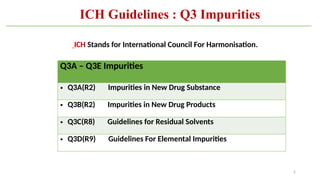
Q3A – Q3E Impurities
• Q3A(R2) Impurities in New Drug Substance
• Q3B(R2) Impurities in New Drug Products
• Q3C(R8) Guidelines for Residual Solvents
• Q3D(R9) Guidelines For Elemental Impurities
ICH Stands for International Council For Harmonisation.
3
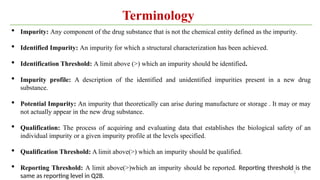
Terminology
 Impurity: Any component of the drug substance that is not the chemical entity defined as the impurity.
 Identified Impurity: An impurity for which a structural characterization has been achieved.
 Identification Threshold: A limit above (>) which an impurity should be identified.
 Impurity profile: A description of the identified and unidentified impurities present in a new drug
substance.
 Potential Impurity: An impurity that theoretically can arise during manufacture or storage . It may or may
not actually appear in the new drug substance.
 Qualification: The process of acquiring and evaluating data that establishes the biological safety of an
individual impurity or a given impurity profile at the levels specified.
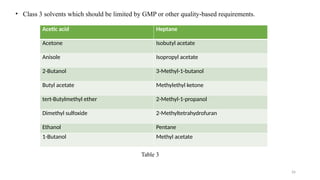
 Qualification Threshold: A limit above(>) which an impurity should be qualified.
 Reporting Threshold: A limit above(>)which an impurity should be reported. Reporting threshold is the
same as reporting level in Q2B.
4
Q3A(R2) IMPURITIES IN NEW DRUG SUBSTANCES
5
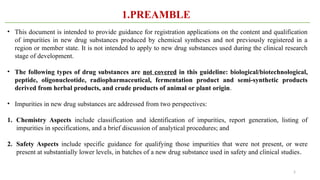
1.PREAMBLE
• This document is intended to provide guidance for registration applications on the content and qualification
of impurities in new drug substances produced by chemical syntheses and not previously registered in a
region or member state. It is not intended to apply to new drug substances used during the clinical research
stage of development.
• The following types of drug substances are not covered in this guideline: biological/biotechnological,
peptide, oligonucleotide, radiopharmaceutical, fermentation product and semi-synthetic products
derived from herbal products, and crude products of animal or plant origin.
• Impurities in new drug substances are addressed from two perspectives:
1. Chemistry Aspects include classification and identification of impurities, report generation, listing of
impurities in specifications, and a brief discussion of analytical procedures; and
2. Safety Aspects include specific guidance for qualifying those impurities that were not present, or were
present at substantially lower levels, in batches of a new drug substance used in safety and clinical studies.
6
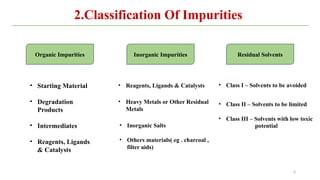
2.Classification Of Impurities
Organic Impurities Inorganic Impurities Residual Solvents
• Starting Material
• Degradation
Products
• Intermediates
• Reagents, Ligands
& Catalysts
• Reagents, Ligands & Catalysts
• Heavy Metals or Other Residual
Metals
• Inorganic Salts
• Others materials( eg . charcoal ,
filter aids)
• Class I – Solvents to be avoided
• Class II – Solvents to be limited
• Class III – Solvents with low toxic
potential
7
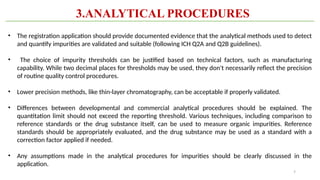
• The registration application should provide documented evidence that the analytical methods used to detect
and quantify impurities are validated and suitable (following ICH Q2A and Q2B guidelines).
• The choice of impurity thresholds can be justified based on technical factors, such as manufacturing
capability. While two decimal places for thresholds may be used, they don't necessarily reflect the precision
of routine quality control procedures.
• Lower precision methods, like thin-layer chromatography, can be acceptable if properly validated.
• Differences between developmental and commercial analytical procedures should be explained. The
quantitation limit should not exceed the reporting threshold. Various techniques, including comparison to
reference standards or the drug substance itself, can be used to measure organic impurities. Reference
standards should be appropriately evaluated, and the drug substance may be used as a standard with a
correction factor applied if needed.
• Any assumptions made in the analytical procedures for impurities should be clearly discussed in the
application.
3.ANALYTICAL PROCEDURES
8
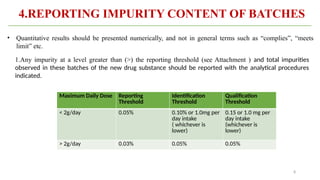
4.REPORTING IMPURITY CONTENT OF BATCHES
• Quantitative results should be presented numerically, and not in general terms such as “complies”, “meets
limit” etc.
1.Any impurity at a level greater than (>) the reporting threshold (see Attachment ) and total impurities
observed in these batches of the new drug substance should be reported with the analytical procedures
indicated.
Maximum Daily Dose Reporting
Threshold
Identification
Threshold
Qualification
Threshold
< 2g/day 0.05% 0.10% or 1.0mg per
day intake
( whichever is
lower)
0.15 or 1.0 mg per
day intake
(whichever is
lower)
> 2g/day 0.03% 0.05% 0.05%
9
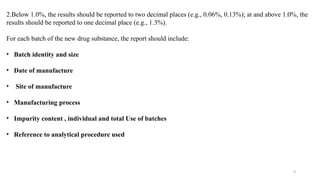
2.Below 1.0%, the results should be reported to two decimal places (e.g., 0.06%, 0.13%); at and above 1.0%, the
results should be reported to one decimal place (e.g., 1.3%).
For each batch of the new drug substance, the report should include:
• Batch identity and size
• Date of manufacture
• Site of manufacture
• Manufacturing process
• Impurity content , individual and total Use of batches
• Reference to analytical procedure used
10
5.LISTING OF IMPURITIES IN SPECIFICATIONS
The new drug substance specification should include, where applicable, the following list of impurities:
1.Organic Impurities:
• Each specified identified impurity
• Each specified unidentified impurity
• Any unspecified impurity with an acceptance criterion of not more than (<) the identification threshold
• Total impurities
2.Residual Solvents
3.Inorganic Impurities
11
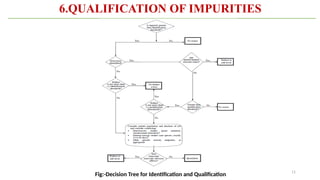
6.QUALIFICATION OF IMPURITIES
Fig:-Decision Tree for Identification and Qualification
12
Q3B(R2) IMPURITIES IN NEW DRUG PRODUCTS
13
For each batch of the new drug product described in the registration application, the documentation should
include:
 Batch identity, strength, and size
 Date of manufacture
 Site of manufacture
 Manufacturing process
 Immediate container closure
 Degradation product content, individual and total
 Use of batch (e.g., clinical studies, stability studies)
 Reference to analytical procedure used
 Batch number of the drug substance used in the new drug product
 Storage conditions for stability studies
• REPORTING DEGRADATION PRODUCTS CONTENT OF
BATCHES:-
14
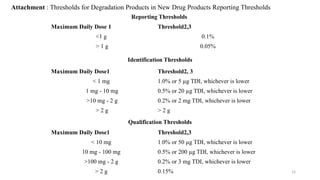
Attachment : Thresholds for Degradation Products in New Drug Products Reporting Thresholds
Maximum Daily Dose 1 Threshold2,3
<1 g 0.1%
> 1 g 0.05%
Reporting Thresholds
Identification Thresholds
Maximum Daily Dose1 Threshold2, 3
< 1 mg 1.0% or 5 µg TDI, whichever is lower
1 mg - 10 mg 0.5% or 20 µg TDI, whichever is lower
>10 mg - 2 g 0.2% or 2 mg TDI, whichever is lower
> 2 g > 2 g
Qualification Thresholds
Maximum Daily Dose1 Threshold2,3
< 10 mg 1.0% or 50 µg TDI, whichever is lower
10 mg - 100 mg 0.5% or 200 µg TDI, whichever is lower
>100 mg - 2 g 0.2% or 3 mg TDI, whichever is lower
> 2 g 0.15%
15
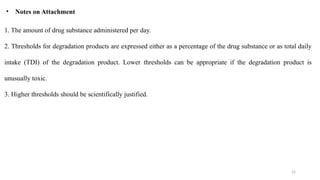
1. The amount of drug substance administered per day.
2. Thresholds for degradation products are expressed either as a percentage of the drug substance or as total daily
intake (TDI) of the degradation product. Lower thresholds can be appropriate if the degradation product is
unusually toxic.
3. Higher thresholds should be scientifically justified.
• Notes on Attachment
16
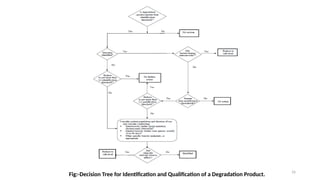
Fig:-Decision Tree for Identification and Qualification of a Degradation Product.
17
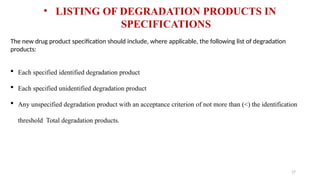
The new drug product specification should include, where applicable, the following list of degradation
products:
 Each specified identified degradation product
 Each specified unidentified degradation product
 Any unspecified degradation product with an acceptance criterion of not more than (<) the identification
threshold Total degradation products.
• LISTING OF DEGRADATION PRODUCTS IN
SPECIFICATIONS
18
Q3C(8) GUIDELINE FOR RESIDUAL SOLVENTS
19
• Definition:-
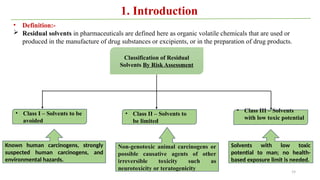
 Residual solvents in pharmaceuticals are defined here as organic volatile chemicals that are used or
produced in the manufacture of drug substances or excipients, or in the preparation of drug products.
1. Introduction
Classification of Residual
Solvents By Risk Assessment
• Class I – Solvents to be
avoided
• Class II – Solvents to
be limited
• Class III – Solvents
with low toxic potential
Known human carcinogens, strongly
suspected human carcinogens, and
environmental hazards.
Non-genotoxic animal carcinogens or
possible causative agents of other
irreversible toxicity such as
neurotoxicity or teratogenicity
Solvents with low toxic
potential to man; no health-
based exposure limit is needed.
20
2. SCOPE OF THE GUIDELINE
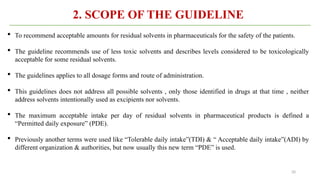
 To recommend acceptable amounts for residual solvents in pharmaceuticals for the safety of the patients.
 The guideline recommends use of less toxic solvents and describes levels considered to be toxicologically
acceptable for some residual solvents.
 The guidelines applies to all dosage forms and route of administration.
 This guidelines does not address all possible solvents , only those identified in drugs at that time , neither
address solvents intentionally used as excipients nor solvents.
 The maximum acceptable intake per day of residual solvents in pharmaceutical products is defined a
“Permitted daily exposure” (PDE).
 Previously another terms were used like “Tolerable daily intake”(TDI) & “ Acceptable daily intake”(ADI) by
different organization & authorities, but now usually this new term “PDE” is used.
21
3.Options for Describing Limits of Class 2 Solvents
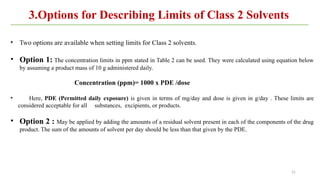
• Two options are available when setting limits for Class 2 solvents.
• Option 1: The concentration limits in ppm stated in Table 2 can be used. They were calculated using equation below
by assuming a product mass of 10 g administered daily.
Concentration (ppm)= 1000 x PDE /dose
• Here, PDE (Permitted daily exposure) is given in terms of mg/day and dose is given in g/day . These limits are
considered acceptable for all substances, excipients, or products.
• Option 2 : May be applied by adding the amounts of a residual solvent present in each of the components of the drug
product. The sum of the amounts of solvent per day should be less than that given by the PDE.
22
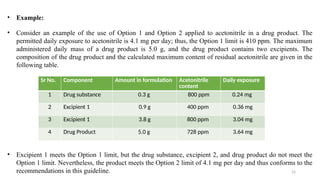
Sr No. Component Amount in formulation Acetonitrile
content
Daily exposure
1 Drug substance 0.3 g 800 ppm 0.24 mg
2 Excipient 1 0.9 g 400 ppm 0.36 mg
3 Excipient 1 3.8 g 800 ppm 3.04 mg
4 Drug Product 5.0 g 728 ppm 3.64 mg
• Excipient 1 meets the Option 1 limit, but the drug substance, excipient 2, and drug product do not meet the
Option 1 limit. Nevertheless, the product meets the Option 2 limit of 4.1 mg per day and thus conforms to the
recommendations in this guideline.
• Example:
• Consider an example of the use of Option 1 and Option 2 applied to acetonitrile in a drug product. The
permitted daily exposure to acetonitrile is 4.1 mg per day; thus, the Option 1 limit is 410 ppm. The maximum
administered daily mass of a drug product is 5.0 g, and the drug product contains two excipients. The
composition of the drug product and the calculated maximum content of residual acetonitrile are given in the
following table.
23
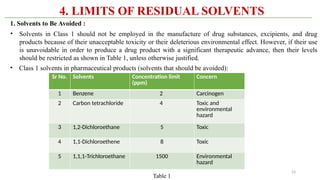
• Solvents in Class 1 should not be employed in the manufacture of drug substances, excipients, and drug
products because of their unacceptable toxicity or their deleterious environmental effect. However, if their use
is unavoidable in order to produce a drug product with a significant therapeutic advance, then their levels
should be restricted as shown in Table 1, unless otherwise justified.
4. LIMITS OF RESIDUAL SOLVENTS
1. Solvents to Be Avoided :
• Class 1 solvents in pharmaceutical products (solvents that should be avoided):
Sr No. Solvents Concentration limit
(ppm)
Concern
1 Benzene 2 Carcinogen
2 Carbon tetrachloride 4 Toxic and
environmental
hazard
3 1,2-Dichloroethane 5 Toxic
4 1,1-Dichloroethene 8 Toxic
5 1,1,1-Trichloroethane 1500 Environmental
hazard
Table 1
24
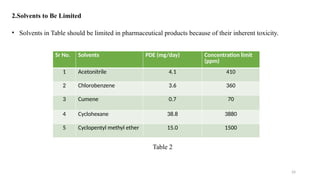
• Solvents in Table should be limited in pharmaceutical products because of their inherent toxicity.
2.Solvents to Be Limited
Sr No. Solvents PDE (mg/day) Concentration limit
(ppm)
1 Acetonitrile 4.1 410
2 Chlorobenzene 3.6 360
3 Cumene 0.7 70
4 Cyclohexane 38.8 3880
5 Cyclopentyl methyl ether 15.0 1500
Table 2
25
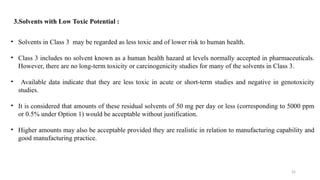
3.Solvents with Low Toxic Potential :
• Solvents in Class 3 may be regarded as less toxic and of lower risk to human health.
• Class 3 includes no solvent known as a human health hazard at levels normally accepted in pharmaceuticals.
However, there are no long-term toxicity or carcinogenicity studies for many of the solvents in Class 3.
• Available data indicate that they are less toxic in acute or short-term studies and negative in genotoxicity
studies.
• It is considered that amounts of these residual solvents of 50 mg per day or less (corresponding to 5000 ppm
or 0.5% under Option 1) would be acceptable without justification.
• Higher amounts may also be acceptable provided they are realistic in relation to manufacturing capability and
good manufacturing practice.
26
• Class 3 solvents which should be limited by GMP or other quality-based requirements.
Acetic acid Heptane
Acetone Isobutyl acetate
Anisole Isopropyl acetate
2-Butanol 3-Methyl-1-butanol
Butyl acetate Methylethyl ketone
tert-Butylmethyl ether 2-Methyl-1-propanol
Dimethyl sulfoxide 2-Methyltetrahydrofuran
Ethanol Pentane
1-Butanol Methyl acetate
Table 3
27
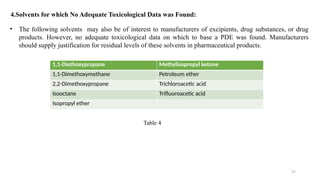
4.Solvents for which No Adequate Toxicological Data was Found:
• The following solvents may also be of interest to manufacturers of excipients, drug substances, or drug
products. However, no adequate toxicological data on which to base a PDE was found. Manufacturers
should supply justification for residual levels of these solvents in pharmaceutical products.
1,1-Diethoxypropane Methylisopropyl ketone
1,1-Dimethoxymethane Petroleum ether
2,2-Dimethoxypropane Trichloroacetic acid
Isooctane Trifluoroacetic acid
Isopropyl ether
Table 4
28
Q3D (R2) GUIDELINE FOR ELEMENTAL IMPURITIES
29
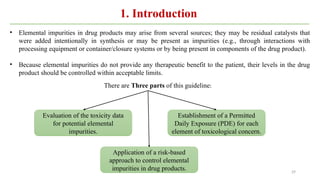
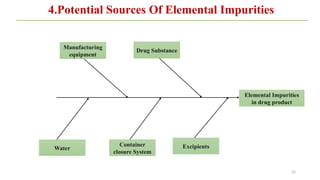
• Elemental impurities in drug products may arise from several sources; they may be residual catalysts that
were added intentionally in synthesis or may be present as impurities (e.g., through interactions with
processing equipment or container/closure systems or by being present in components of the drug product).
• Because elemental impurities do not provide any therapeutic benefit to the patient, their levels in the drug
product should be controlled within acceptable limits.
Establishment of a Permitted
Daily Exposure (PDE) for each
element of toxicological concern.
Application of a risk-based
approach to control elemental
impurities in drug products.
Evaluation of the toxicity data
for potential elemental
impurities.
There are Three parts of this guideline:
1. Introduction
30
2. SCOPE
• The guideline applies to new finished drug products (as defined in ICH Q6A and Q6B) and new drug
products containing existing drug substances.
• The drug products containing purified proteins and polypeptides (including proteins and polypeptides
produced from recombinant or non-recombinant origins), their derivatives, and products of which they are
components.
• This guideline does not apply to herbal products, radiopharmaceuticals, vaccines, cell metabolites, DNA
products, allergenic extracts, cells, whole blood, cellular blood components or blood derivatives including
plasma and plasma derivatives, dialysate solutions not intended for systemic circulation, and elements that are
intentionally included in the drug product for therapeutic benefit.
• This guideline does not apply to products based on genes (gene therapy), cells (cell therapy) and tissue (tissue
engineering). In some regions, these products are known as advanced therapy medicinal products.
• This guideline does not apply to drug products used during clinical research stages of development.
• Application of Q3D to existing products is not expected prior to 36 months after publication of the guideline
by ICH.
31
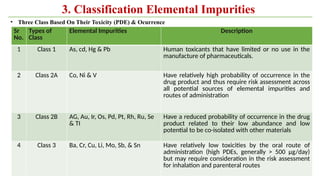
3. Classification Elemental Impurities
• Three Class Based On Their Toxicity (PDE) & Ocurrence
Occurrence
Sr
No.
Types of
Class
Elemental Impurities Description
1 Class 1 As, cd, Hg & Pb Human toxicants that have limited or no use in the
manufacture of pharmaceuticals.
2 Class 2A Co, Ni & V Have relatively high probability of occurrence in the
drug product and thus require risk assessment across
all potential sources of elemental impurities and
routes of administration
3 Class 2B AG, Au, Ir, Os, Pd, Pt, Rh, Ru, Se
& TI
Have a reduced probability of occurrence in the drug
product related to their low abundance and low
potential to be co-isolated with other materials
4 Class 3 Ba, Cr, Cu, Li, Mo, Sb, & Sn Have relatively low toxicities by the oral route of
administration (high PDEs, generally > 500 µg/day)
but may require consideration in the risk assessment
for inhalation and parenteral routes
32
Manufacturing
equipment
Drug Substance
Water
Container
closure System
Excipients
Elemental Impurities
in drug product
4.Potential Sources Of Elemental Impurities
33
Conclusion
• The ICH Q3 guidelines play a crucial role in ensuring the quality, safety, and efficacy of pharmaceutical
and biotechnological products.
• ICH Q3 focuses on impurity control in raw materials, finished products, and packaging materials,
covering organic impurities, residual solvents, and elemental impurities.
• It establishes acceptable limits and analytical methods to prevent harmful contaminants from affecting
drug safety.
• Packaging materials are integral to Q3 guidelines, as they can introduce impurities (leachables and
extractables) and affect drug stability. Proper testing and regulatory compliance are essential to
minimize risks.
• ICH Q3A focuses on the classification of impurities and establishes thresholds for control of impurities
in API. The ICH Q3C guideline addresses the control of residual solvents in drug substances and
provides a list of solvents with their acceptable limits classified according to their toxicological
properties.
34
References
• ICHQ3A (R2): Impurities in New Drug Substances ICH Official web site : ICH
• ICH Q3B (R2): Impurities in New Drug Products ICH Official web site : ICH
• ICH Q3C (R8): Guideline for Residual Solvents ICH Official web site : ICH
• ICH Q3D (R2): Guideline for Elemental Impurities ICH Official web site : ICH

ICH Q3 Guidelines - Impurities (Q3A - Q3E)

  • 1.
    ICH Q3 Guidelines(Impurities) Presented By:- Ms. Naveli K. Patil. Class:- F. Y. M. Pharm Department:- Pharmaceutical Quality Assurance Batch: 2024 - 25 K K Wagh College Of Pharmacy, Nashik. .
  • 2.
    2 ICH Guidelines :Q3 Impurities Q3A – Q3E Impurities • Q3A(R2) Impurities in New Drug Substance • Q3B(R2) Impurities in New Drug Products • Q3C(R8) Guidelines for Residual Solvents • Q3D(R9) Guidelines For Elemental Impurities ICH Stands for International Council For Harmonisation.
  • 3.
    3 Terminology  Impurity: Anycomponent of the drug substance that is not the chemical entity defined as the impurity.  Identified Impurity: An impurity for which a structural characterization has been achieved.  Identification Threshold: A limit above (>) which an impurity should be identified.  Impurity profile: A description of the identified and unidentified impurities present in a new drug substance.  Potential Impurity: An impurity that theoretically can arise during manufacture or storage . It may or may not actually appear in the new drug substance.  Qualification: The process of acquiring and evaluating data that establishes the biological safety of an individual impurity or a given impurity profile at the levels specified.  Qualification Threshold: A limit above(>) which an impurity should be qualified.  Reporting Threshold: A limit above(>)which an impurity should be reported. Reporting threshold is the same as reporting level in Q2B.
  • 4.
    4 Q3A(R2) IMPURITIES INNEW DRUG SUBSTANCES
  • 5.
    5 1.PREAMBLE • This documentis intended to provide guidance for registration applications on the content and qualification of impurities in new drug substances produced by chemical syntheses and not previously registered in a region or member state. It is not intended to apply to new drug substances used during the clinical research stage of development. • The following types of drug substances are not covered in this guideline: biological/biotechnological, peptide, oligonucleotide, radiopharmaceutical, fermentation product and semi-synthetic products derived from herbal products, and crude products of animal or plant origin. • Impurities in new drug substances are addressed from two perspectives: 1. Chemistry Aspects include classification and identification of impurities, report generation, listing of impurities in specifications, and a brief discussion of analytical procedures; and 2. Safety Aspects include specific guidance for qualifying those impurities that were not present, or were present at substantially lower levels, in batches of a new drug substance used in safety and clinical studies.
  • 6.
    6 2.Classification Of Impurities OrganicImpurities Inorganic Impurities Residual Solvents • Starting Material • Degradation Products • Intermediates • Reagents, Ligands & Catalysts • Reagents, Ligands & Catalysts • Heavy Metals or Other Residual Metals • Inorganic Salts • Others materials( eg . charcoal , filter aids) • Class I – Solvents to be avoided • Class II – Solvents to be limited • Class III – Solvents with low toxic potential
  • 7.
    7 • The registrationapplication should provide documented evidence that the analytical methods used to detect and quantify impurities are validated and suitable (following ICH Q2A and Q2B guidelines). • The choice of impurity thresholds can be justified based on technical factors, such as manufacturing capability. While two decimal places for thresholds may be used, they don't necessarily reflect the precision of routine quality control procedures. • Lower precision methods, like thin-layer chromatography, can be acceptable if properly validated. • Differences between developmental and commercial analytical procedures should be explained. The quantitation limit should not exceed the reporting threshold. Various techniques, including comparison to reference standards or the drug substance itself, can be used to measure organic impurities. Reference standards should be appropriately evaluated, and the drug substance may be used as a standard with a correction factor applied if needed. • Any assumptions made in the analytical procedures for impurities should be clearly discussed in the application. 3.ANALYTICAL PROCEDURES
  • 8.
    8 4.REPORTING IMPURITY CONTENTOF BATCHES • Quantitative results should be presented numerically, and not in general terms such as “complies”, “meets limit” etc. 1.Any impurity at a level greater than (>) the reporting threshold (see Attachment ) and total impurities observed in these batches of the new drug substance should be reported with the analytical procedures indicated. Maximum Daily Dose Reporting Threshold Identification Threshold Qualification Threshold < 2g/day 0.05% 0.10% or 1.0mg per day intake ( whichever is lower) 0.15 or 1.0 mg per day intake (whichever is lower) > 2g/day 0.03% 0.05% 0.05%
  • 9.
    9 2.Below 1.0%, theresults should be reported to two decimal places (e.g., 0.06%, 0.13%); at and above 1.0%, the results should be reported to one decimal place (e.g., 1.3%). For each batch of the new drug substance, the report should include: • Batch identity and size • Date of manufacture • Site of manufacture • Manufacturing process • Impurity content , individual and total Use of batches • Reference to analytical procedure used
  • 10.
    10 5.LISTING OF IMPURITIESIN SPECIFICATIONS The new drug substance specification should include, where applicable, the following list of impurities: 1.Organic Impurities: • Each specified identified impurity • Each specified unidentified impurity • Any unspecified impurity with an acceptance criterion of not more than (<) the identification threshold • Total impurities 2.Residual Solvents 3.Inorganic Impurities
  • 11.
    11 6.QUALIFICATION OF IMPURITIES Fig:-DecisionTree for Identification and Qualification
  • 12.
    12 Q3B(R2) IMPURITIES INNEW DRUG PRODUCTS
  • 13.
    13 For each batchof the new drug product described in the registration application, the documentation should include:  Batch identity, strength, and size  Date of manufacture  Site of manufacture  Manufacturing process  Immediate container closure  Degradation product content, individual and total  Use of batch (e.g., clinical studies, stability studies)  Reference to analytical procedure used  Batch number of the drug substance used in the new drug product  Storage conditions for stability studies • REPORTING DEGRADATION PRODUCTS CONTENT OF BATCHES:-
  • 14.
    14 Attachment : Thresholdsfor Degradation Products in New Drug Products Reporting Thresholds Maximum Daily Dose 1 Threshold2,3 <1 g 0.1% > 1 g 0.05% Reporting Thresholds Identification Thresholds Maximum Daily Dose1 Threshold2, 3 < 1 mg 1.0% or 5 µg TDI, whichever is lower 1 mg - 10 mg 0.5% or 20 µg TDI, whichever is lower >10 mg - 2 g 0.2% or 2 mg TDI, whichever is lower > 2 g > 2 g Qualification Thresholds Maximum Daily Dose1 Threshold2,3 < 10 mg 1.0% or 50 µg TDI, whichever is lower 10 mg - 100 mg 0.5% or 200 µg TDI, whichever is lower >100 mg - 2 g 0.2% or 3 mg TDI, whichever is lower > 2 g 0.15%
  • 15.
    15 1. The amountof drug substance administered per day. 2. Thresholds for degradation products are expressed either as a percentage of the drug substance or as total daily intake (TDI) of the degradation product. Lower thresholds can be appropriate if the degradation product is unusually toxic. 3. Higher thresholds should be scientifically justified. • Notes on Attachment
  • 16.
    16 Fig:-Decision Tree forIdentification and Qualification of a Degradation Product.
  • 17.
    17 The new drugproduct specification should include, where applicable, the following list of degradation products:  Each specified identified degradation product  Each specified unidentified degradation product  Any unspecified degradation product with an acceptance criterion of not more than (<) the identification threshold Total degradation products. • LISTING OF DEGRADATION PRODUCTS IN SPECIFICATIONS
  • 18.
    18 Q3C(8) GUIDELINE FORRESIDUAL SOLVENTS
  • 19.
    19 • Definition:-  Residualsolvents in pharmaceuticals are defined here as organic volatile chemicals that are used or produced in the manufacture of drug substances or excipients, or in the preparation of drug products. 1. Introduction Classification of Residual Solvents By Risk Assessment • Class I – Solvents to be avoided • Class II – Solvents to be limited • Class III – Solvents with low toxic potential Known human carcinogens, strongly suspected human carcinogens, and environmental hazards. Non-genotoxic animal carcinogens or possible causative agents of other irreversible toxicity such as neurotoxicity or teratogenicity Solvents with low toxic potential to man; no health- based exposure limit is needed.
  • 20.
    20 2. SCOPE OFTHE GUIDELINE  To recommend acceptable amounts for residual solvents in pharmaceuticals for the safety of the patients.  The guideline recommends use of less toxic solvents and describes levels considered to be toxicologically acceptable for some residual solvents.  The guidelines applies to all dosage forms and route of administration.  This guidelines does not address all possible solvents , only those identified in drugs at that time , neither address solvents intentionally used as excipients nor solvents.  The maximum acceptable intake per day of residual solvents in pharmaceutical products is defined a “Permitted daily exposure” (PDE).  Previously another terms were used like “Tolerable daily intake”(TDI) & “ Acceptable daily intake”(ADI) by different organization & authorities, but now usually this new term “PDE” is used.
  • 21.
    21 3.Options for DescribingLimits of Class 2 Solvents • Two options are available when setting limits for Class 2 solvents. • Option 1: The concentration limits in ppm stated in Table 2 can be used. They were calculated using equation below by assuming a product mass of 10 g administered daily. Concentration (ppm)= 1000 x PDE /dose • Here, PDE (Permitted daily exposure) is given in terms of mg/day and dose is given in g/day . These limits are considered acceptable for all substances, excipients, or products. • Option 2 : May be applied by adding the amounts of a residual solvent present in each of the components of the drug product. The sum of the amounts of solvent per day should be less than that given by the PDE.
  • 22.
    22 Sr No. ComponentAmount in formulation Acetonitrile content Daily exposure 1 Drug substance 0.3 g 800 ppm 0.24 mg 2 Excipient 1 0.9 g 400 ppm 0.36 mg 3 Excipient 1 3.8 g 800 ppm 3.04 mg 4 Drug Product 5.0 g 728 ppm 3.64 mg • Excipient 1 meets the Option 1 limit, but the drug substance, excipient 2, and drug product do not meet the Option 1 limit. Nevertheless, the product meets the Option 2 limit of 4.1 mg per day and thus conforms to the recommendations in this guideline. • Example: • Consider an example of the use of Option 1 and Option 2 applied to acetonitrile in a drug product. The permitted daily exposure to acetonitrile is 4.1 mg per day; thus, the Option 1 limit is 410 ppm. The maximum administered daily mass of a drug product is 5.0 g, and the drug product contains two excipients. The composition of the drug product and the calculated maximum content of residual acetonitrile are given in the following table.
  • 23.
    23 • Solvents inClass 1 should not be employed in the manufacture of drug substances, excipients, and drug products because of their unacceptable toxicity or their deleterious environmental effect. However, if their use is unavoidable in order to produce a drug product with a significant therapeutic advance, then their levels should be restricted as shown in Table 1, unless otherwise justified. 4. LIMITS OF RESIDUAL SOLVENTS 1. Solvents to Be Avoided : • Class 1 solvents in pharmaceutical products (solvents that should be avoided): Sr No. Solvents Concentration limit (ppm) Concern 1 Benzene 2 Carcinogen 2 Carbon tetrachloride 4 Toxic and environmental hazard 3 1,2-Dichloroethane 5 Toxic 4 1,1-Dichloroethene 8 Toxic 5 1,1,1-Trichloroethane 1500 Environmental hazard Table 1
  • 24.
    24 • Solvents inTable should be limited in pharmaceutical products because of their inherent toxicity. 2.Solvents to Be Limited Sr No. Solvents PDE (mg/day) Concentration limit (ppm) 1 Acetonitrile 4.1 410 2 Chlorobenzene 3.6 360 3 Cumene 0.7 70 4 Cyclohexane 38.8 3880 5 Cyclopentyl methyl ether 15.0 1500 Table 2
  • 25.
    25 3.Solvents with LowToxic Potential : • Solvents in Class 3 may be regarded as less toxic and of lower risk to human health. • Class 3 includes no solvent known as a human health hazard at levels normally accepted in pharmaceuticals. However, there are no long-term toxicity or carcinogenicity studies for many of the solvents in Class 3. • Available data indicate that they are less toxic in acute or short-term studies and negative in genotoxicity studies. • It is considered that amounts of these residual solvents of 50 mg per day or less (corresponding to 5000 ppm or 0.5% under Option 1) would be acceptable without justification. • Higher amounts may also be acceptable provided they are realistic in relation to manufacturing capability and good manufacturing practice.
  • 26.
    26 • Class 3solvents which should be limited by GMP or other quality-based requirements. Acetic acid Heptane Acetone Isobutyl acetate Anisole Isopropyl acetate 2-Butanol 3-Methyl-1-butanol Butyl acetate Methylethyl ketone tert-Butylmethyl ether 2-Methyl-1-propanol Dimethyl sulfoxide 2-Methyltetrahydrofuran Ethanol Pentane 1-Butanol Methyl acetate Table 3
  • 27.
    27 4.Solvents for whichNo Adequate Toxicological Data was Found: • The following solvents may also be of interest to manufacturers of excipients, drug substances, or drug products. However, no adequate toxicological data on which to base a PDE was found. Manufacturers should supply justification for residual levels of these solvents in pharmaceutical products. 1,1-Diethoxypropane Methylisopropyl ketone 1,1-Dimethoxymethane Petroleum ether 2,2-Dimethoxypropane Trichloroacetic acid Isooctane Trifluoroacetic acid Isopropyl ether Table 4
  • 28.
    28 Q3D (R2) GUIDELINEFOR ELEMENTAL IMPURITIES
  • 29.
    29 • Elemental impuritiesin drug products may arise from several sources; they may be residual catalysts that were added intentionally in synthesis or may be present as impurities (e.g., through interactions with processing equipment or container/closure systems or by being present in components of the drug product). • Because elemental impurities do not provide any therapeutic benefit to the patient, their levels in the drug product should be controlled within acceptable limits. Establishment of a Permitted Daily Exposure (PDE) for each element of toxicological concern. Application of a risk-based approach to control elemental impurities in drug products. Evaluation of the toxicity data for potential elemental impurities. There are Three parts of this guideline: 1. Introduction
  • 30.
    30 2. SCOPE • Theguideline applies to new finished drug products (as defined in ICH Q6A and Q6B) and new drug products containing existing drug substances. • The drug products containing purified proteins and polypeptides (including proteins and polypeptides produced from recombinant or non-recombinant origins), their derivatives, and products of which they are components. • This guideline does not apply to herbal products, radiopharmaceuticals, vaccines, cell metabolites, DNA products, allergenic extracts, cells, whole blood, cellular blood components or blood derivatives including plasma and plasma derivatives, dialysate solutions not intended for systemic circulation, and elements that are intentionally included in the drug product for therapeutic benefit. • This guideline does not apply to products based on genes (gene therapy), cells (cell therapy) and tissue (tissue engineering). In some regions, these products are known as advanced therapy medicinal products. • This guideline does not apply to drug products used during clinical research stages of development. • Application of Q3D to existing products is not expected prior to 36 months after publication of the guideline by ICH.
  • 31.
    31 3. Classification ElementalImpurities • Three Class Based On Their Toxicity (PDE) & Ocurrence Occurrence Sr No. Types of Class Elemental Impurities Description 1 Class 1 As, cd, Hg & Pb Human toxicants that have limited or no use in the manufacture of pharmaceuticals. 2 Class 2A Co, Ni & V Have relatively high probability of occurrence in the drug product and thus require risk assessment across all potential sources of elemental impurities and routes of administration 3 Class 2B AG, Au, Ir, Os, Pd, Pt, Rh, Ru, Se & TI Have a reduced probability of occurrence in the drug product related to their low abundance and low potential to be co-isolated with other materials 4 Class 3 Ba, Cr, Cu, Li, Mo, Sb, & Sn Have relatively low toxicities by the oral route of administration (high PDEs, generally > 500 µg/day) but may require consideration in the risk assessment for inhalation and parenteral routes
  • 32.
    32 Manufacturing equipment Drug Substance Water Container closure System Excipients ElementalImpurities in drug product 4.Potential Sources Of Elemental Impurities
  • 33.
    33 Conclusion • The ICHQ3 guidelines play a crucial role in ensuring the quality, safety, and efficacy of pharmaceutical and biotechnological products. • ICH Q3 focuses on impurity control in raw materials, finished products, and packaging materials, covering organic impurities, residual solvents, and elemental impurities. • It establishes acceptable limits and analytical methods to prevent harmful contaminants from affecting drug safety. • Packaging materials are integral to Q3 guidelines, as they can introduce impurities (leachables and extractables) and affect drug stability. Proper testing and regulatory compliance are essential to minimize risks. • ICH Q3A focuses on the classification of impurities and establishes thresholds for control of impurities in API. The ICH Q3C guideline addresses the control of residual solvents in drug substances and provides a list of solvents with their acceptable limits classified according to their toxicological properties.
  • 34.
    34 References • ICHQ3A (R2):Impurities in New Drug Substances ICH Official web site : ICH • ICH Q3B (R2): Impurities in New Drug Products ICH Official web site : ICH • ICH Q3C (R8): Guideline for Residual Solvents ICH Official web site : ICH • ICH Q3D (R2): Guideline for Elemental Impurities ICH Official web site : ICH