



Genital fistulae
SUSMITA HALDAR
SISTER TUTOR
SCHOOL OF NURSING ASIA FOUNDATION
Introduction
A fistula is an abnormal communication between two
or more epithelial surfaces.
There several types of genital fistulae are genitourinary
fistula, rectovaginal fistula etc
Related anatomy and
physiology of uterus
The uterus is a hollow pyriform muscular organ situated in the pelvis
between the bladder in front and the rectum in behind
 The normal position is one of anteversion and anteflexion the uterus,
usually inclines to the right (dextrorotation) so that the cervix is directed
to the left (levorotation)and comes in close to relation with the left
ureter.
 The uterus measures about 8 cm long 5 cm wide at the fundus and its
walls are 1.25 CM thick
 It waits around 50 to 80 grams.
Parts of
uterus
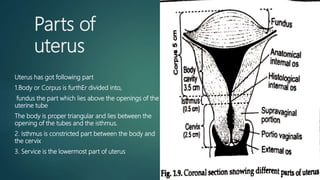
Uterus has got following part
1.Body or Corpus is furthEr divided into,
fundus the part which lies above the openings of the
uterine tube
The body is proper triangular and lies between the
opening of the tubes and the isthmus.
2. Isthmus is constricted part between the body and
the cervix
3. Service is the lowermost part of uterus
Genitourinary
fistula
GENITOURINARY FISTULA IS AN ABNORMAL COMMUNICATION
BETWEEN THE URINARY AND GENITAL TRACT EITHER
REQUIRED FOR CONGENITAL WITH INVOLUNTARY ESCAPE OF
URINE INTO THE VAGINA
Incidence
The incidence is estimated to be approximately 0. 2 -1 percent
amongst gynaecological admissions in referral hospitals of
developing countries. The incidence is however much less in
the affluent countries.
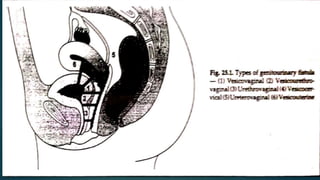
Types
Bladder
Vesicovaginal
Vesico
urethrovaginal
Vesico uterine
Vesicocervical
Urethra
Urethrovaginal
Ureter
Ureterovaginal
Ureterouterine
ureterocervical
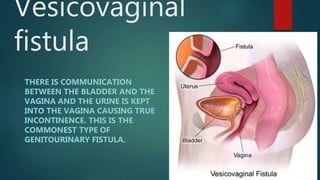
Vesicovaginal
fistula
THERE IS COMMUNICATION
BETWEEN THE BLADDER AND THE
VAGINA AND THE URINE IS KEPT
INTO THE VAGINA CAUSING TRUE
INCONTINENCE. THIS IS THE
COMMONEST TYPE OF
GENITOURINARY FISTULA.
Types of vesico vaginal fistula
Simple
Healthy tissues
with good access
Complicated
Tissue loss
Scaring
Difficult access
Associated with
recto vaginal
fistula.
Types depending on site of
fistula
1. Juxtacervical – close to cervix- the communication is between the
Supra trigonal region of bladder and the vagina also known as vault
fistula.
2. Midvaginal – the communication is between the base of bladder and
vagina
3. Juxtaurethral – the communication is between the neck of the bladder
and vagina may involve the upper uretra as well
4. Subsymphysial – circumferential loss of tissues in the region of
bladder neck and urethra. The fistula margin is fixed to the bone
Causes
Obstetrical – in the developing countries the commonest cause is Obstetrical and constitutes about
80 to 90% of cases as opposed to only 5 to 15% cases in the developing countries.
 Ischemic- results from prolong compression effect on the bladder base between the head and symphysis
pubis in obstructed labour ➡️ ischemic necrosis ➡️ infection ➡️ sloughing ➡️ fistula. Does it takes 3-5Days
following delivery to produce such type of fistula.
 Traumatic
1. Instrumental vaginal delivery search as destructive operations of forceps delivery. Also can be
inflicted by the Bony spicule of the fetal skull in craniotomy operations.
2. Abdominal operation such as hysterectomy for ruptured uterus or cesarean section specially are
repeat one leads to to direct injury following a part of bladder wall being caught in the suture
Causes
 Gynaecological
1. Operative injury likely to produce fistula includes operations like anterior colporrhaphy
abdominal hysterectomy for benign or malignant patients or removal of Gartner cyst
2. Traumatic injury takes place following fall on a pointed object by stick used for criminal
abortion following fracture of pelvic bones are due to retained and forgotten pessary
3. Malignancy like advanced carcinoma of cervix vagina or bladder mein produce fistula by
direct spread
4. Radiation may lead to ischemic necrosis by endarteritis due to radiation effect when the
carcinoma cervix is treated by radiation.
5. Infective- chronic granulomatous relation such as vaginal tuberculosis lymphogranuloma
and actinomyces may produce fissula
Clinical presentation
Patient profile- in the developing countries
of statical fistula being common the
patients are usually young primiparous
with history of difficult labour Or
instrumental delivery in recent past. In
others it is related with relevant events
Symptoms
 Continuous escape of urine per vagina known as True incontinence Is the classic symptom. Patient has
got no ask to pass urine however the fissula is small the escape of urine occurs in certain portion
positions and the patient can also pass urine normally.
 Leakage of urinefollowing surgery offers from the first postoperative day whereas in obstetric fistula
symptoms may take 7 or 14 days to appear
 Ureteral fistula that are situated high up often an presence with features of stress incontinence.
 Women with vesicocervical or basic uterine fistula main hold the urine at the level of uterine isthmus
may remain continent. Birthday complain of cyclical hematuria at the time of menstruation.
 Some women may complain of intermittent leakage of urine.
 This is associated pruritus vulvae
Signs
 Valval inspection
1. Escape of watery discharge per vaginum of ammonia smell is characteristic
2. Evidences of sudden and excoriation of skin of vulva
3. Wearing degrees of perineal tear may be present
 Internal examination reveals if the official is big enough its position size and tissues are at margin are to be noted. There may
be vaginal appreciate to make the fistula inaccessible.
 speculum examinationin Sims position gives a good view of anterior vaginal wall when the vagina becomes balloon up by ai
because of negative suction
1. The size site and number of fistula
2. Often bladder mucosa may be visible prolapsed through a big fissula
3. A tiny fistula is evidence by puckered area of vaginal mucosa.
 Secondary amenorrhea of hypothalamic origin
 Foot drop due to prolonged compression of the sacral nerve roots by the fetal head during labour
Investigations
 A complete composite examination includes inspection and palpation of
vagina rectum after vaginal or even under anaesthesia may be required to
arrive a correct diagnosis
 General examination details including BMI signs of myopathy on
neuropathy features of chronic airway disease or any abdominal mass
should be done
 Pelvic examination in both dorsal and standing positions
 Bimanual examination
 Speculum examination
 Rectal examination
Investigations
 Examination under anaesthesia is done in Sims on a chest position while examine in anterior
vaginal wall bubbles of air are seen through the small tiny fistula when the women coughs
 Dye test- speculum is introduced and the anterior vaginal wall is swabbed dry. When the
methylene blue solution is introduced into the bladder by a catheter the dye will be seen coming
out through the opening. Metal catheter passed through the external urethral mages into the
bladder when comes out through the fistula not only confirms vesicovaginal fistula but patency of
urethra.
 Three swab test not only confirms vesicovaginal fistula but also differentiate Eid from the utero
vaginal and urethrerovaginal fistula. In this procedure three cotton swabs are placed in the vagina
one in vault, one at the middle and one just above the introitus. The methylene blueis installed
into the blood through a catheter and the patient is asked to walk about five minutes she is then
ask to lie down and the sperms are removed for inspection.
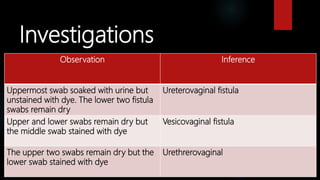
Investigations
Observation Inference
Uppermost swab soaked with urine but
unstained with dye. The lower two fistula
swabs remain dry
Ureterovaginal fistula
Upper and lower swabs remain dry but
the middle swab stained with dye
Vesicovaginal fistula
The upper two swabs remain dry but the
lower swab stained with dye
Urethrerovaginal
Investigations
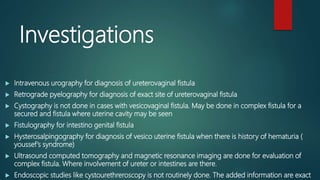
 Intravenous urography for diagnosis of ureterovaginal fistula
 Retrograde pyelography for diagnosis of exact site of ureterovaginal fistula
 Cystography is not done in cases with vesicovaginal fistula. May be done in complex fistula for a
secured and fistula where uterine cavity may be seen
 Fistulography for intestino genital fistula
 Hysterosalpingography for diagnosis of vesico uterine fistula when there is history of hematuria (
youssef’s syndrome)
 Ultrasound computed tomography and magnetic resonance imaging are done for evaluation of
complex fistula. Where involvement of ureter or intestines are there.
 Endoscopic studies like cystourethreroscopy is not routinely done. The added information are exact
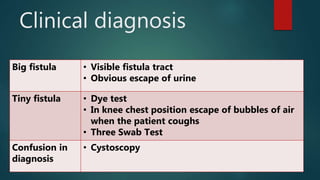
Clinical diagnosis
Big fistula • Visible fistula tract
• Obvious escape of urine
Tiny fistula • Dye test
• In knee chest position escape of bubbles of air
when the patient coughs
• Three Swab Test
Confusion in
diagnosis
• Cystoscopy
Treatment of old vesicovaginal
fistula
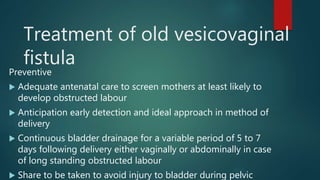
Preventive
 Adequate antenatal care to screen mothers at least likely to
develop obstructed labour
 Anticipation early detection and ideal approach in method of
delivery
 Continuous bladder drainage for a variable period of 5 to 7
days following delivery either vaginally or abdominally in case
of long standing obstructed labour
 Share to be taken to avoid injury to bladder during pelvic
Treatment of old
vesicovaginal fistula
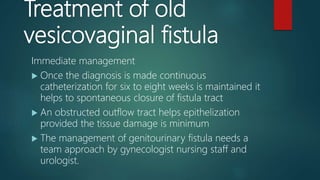
Immediate management
 Once the diagnosis is made continuous
catheterization for six to eight weeks is maintained it
helps to spontaneous closure of fistula tract
 An obstructed outflow tract helps epithelization
provided the tissue damage is minimum
 The management of genitourinary fistula needs a
team approach by gynecologist nursing staff and
urologist.
Treatment of old
vesicovaginal fistula
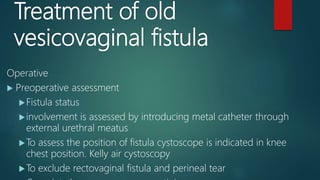
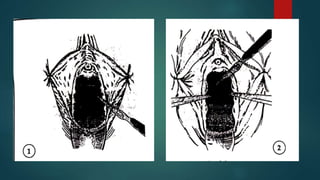
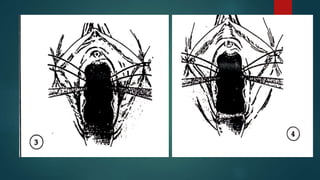
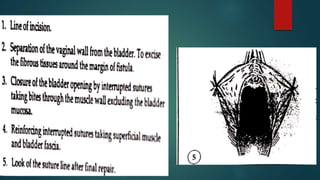
Operative
 Preoperative assessment
Fistula status
involvement is assessed by introducing metal catheter through
external urethral meatus
To assess the position of fistula cystoscope is indicated in knee
chest position. Kelly air cystoscopy
To exclude rectovaginal fistula and perineal tear
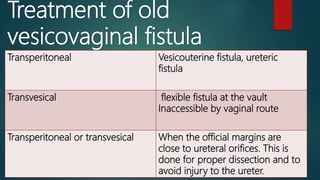
Transperitoneal Vesicouterine fistula, ureteric
fistula
Transvesical flexible fistula at the vault
Inaccessible by vaginal route
Transperitoneal or transvesical When the official margins are
close to ureteral orifices. This is
done for proper dissection and to
avoid injury to the ureter.
Treatment of old
vesicovaginal fistula
Treatment of old
vesicovaginal fistula
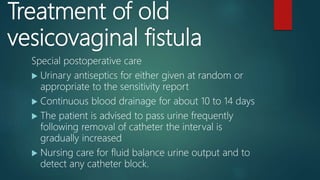
Special postoperative care
 Urinary antiseptics for either given at random or
appropriate to the sensitivity report
 Continuous blood drainage for about 10 to 14 days
 The patient is advised to pass urine frequently
following removal of catheter the interval is
gradually increased
 Nursing care for fluid balance urine output and to
detect any catheter block.
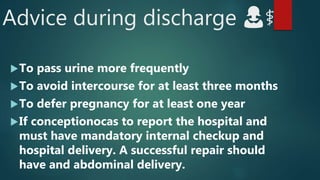
Advice during discharge 👩⚕️
To pass urine more frequently
To avoid intercourse for at least three months
To defer pregnancy for at least one year
If conceptionocas to report the hospital and
must have mandatory internal checkup and
hospital delivery. A successful repair should
have and abdominal delivery.
Urethrerovaginal
Fistula
ABNORMAL COMMUNICATION WITH
URETHRA ALONG WITH BLADDER WITH
VAGINA
Causes
Injury inflicted during anterior
colporrhaphy urethroplasty suspension or
sling operation for incontinence
Resident evil fish you left behind
following repair of basico ureteral fistula.
Treatment
 Surgical repair in two layers followed by
continuous bladder drainage as outlined in
repair of vvf.
 Prior suprapubic or vaginal hysterectomy
insurance better success in cases of complete
destruction of urethra reconstruction of
urethra is also performed.
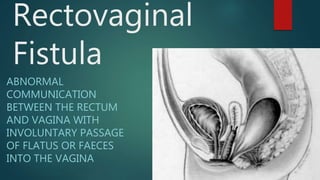
Rectovaginal
Fistula
ABNORMAL
COMMUNICATION
BETWEEN THE RECTUM
AND VAGINA WITH
INVOLUNTARY PASSAGE
OF FLATUS OR FAECES
INTO THE VAGINA
Causes
Acquired
Obstetrical
1. Incomplete healing for impaired complete perineal tear
2. Obstructed labour- the rectum isprotected by pouch of Douglas in its upper third and by
perineal body in the lower third and by car sacrum in the middle third. During obstructed
labour compression effect produces pressure necrosis infections and fistula
3. Instrumental delivery during destructive operation
Gynaecological
1. Incomplete healing or repair of complete perineal tear
2. Trauma during surgery
3. Fall on a sharp pointed object
4. Malignancy of vagina and radiation
5. Diverticulitis and inflammatory bowel disease, crohns disease
Investigations
 Rectovaginal examination
 Colonoscopy
 Dye test
 Barium enema and barium meal follow through may
be needed to confirm the Site of intestinal fistula
 Sigmoid scorpion proctoscopy is helpful in detection
of inflammatory bowel disease
 Biopsy from fistula edge
Treatment
 Preventive care by early detection
 Definitely surgery includes
1. Situated lowdown to make it complete
perennial tear and repair it
2. Situated in the middle third repaired by flap
method
Questions ✍️
1. Fill in the blanks with suitable words. 7
1. An abnormal opening between bladder and vagina Is called ____________
2. Vesicovaginal fistula is best revealed in _______ position
3. Abnormal communication between rectum and vagina with involuntary
passage of faeces or flatus through vagina is called ____________
4. To confirm ureteric openings in big fistula __________ is done
5. ___________ Solution is used for Dye test
6. ______________& ___________ is helpful for detection of inflammatory bowel
disease.
2. Write full form of. 8
VVF, UVF, RVF, EUA,IVP, POP, CPT, MRI
3. Short notes on Vesicovaginal fistula. 5
Thank you 👩⚕️

Uterine Fistula

  • 1.
    Genital fistulae SUSMITA HALDAR SISTERTUTOR SCHOOL OF NURSING ASIA FOUNDATION
  • 2.
    Introduction A fistula isan abnormal communication between two or more epithelial surfaces. There several types of genital fistulae are genitourinary fistula, rectovaginal fistula etc
  • 3.
    Related anatomy and physiologyof uterus The uterus is a hollow pyriform muscular organ situated in the pelvis between the bladder in front and the rectum in behind  The normal position is one of anteversion and anteflexion the uterus, usually inclines to the right (dextrorotation) so that the cervix is directed to the left (levorotation)and comes in close to relation with the left ureter.  The uterus measures about 8 cm long 5 cm wide at the fundus and its walls are 1.25 CM thick  It waits around 50 to 80 grams.
  • 4.
    Parts of uterus Uterus hasgot following part 1.Body or Corpus is furthEr divided into, fundus the part which lies above the openings of the uterine tube The body is proper triangular and lies between the opening of the tubes and the isthmus. 2. Isthmus is constricted part between the body and the cervix 3. Service is the lowermost part of uterus
  • 5.
    Genitourinary fistula GENITOURINARY FISTULA ISAN ABNORMAL COMMUNICATION BETWEEN THE URINARY AND GENITAL TRACT EITHER REQUIRED FOR CONGENITAL WITH INVOLUNTARY ESCAPE OF URINE INTO THE VAGINA
  • 6.
    Incidence The incidence isestimated to be approximately 0. 2 -1 percent amongst gynaecological admissions in referral hospitals of developing countries. The incidence is however much less in the affluent countries.
  • 7.
  • 9.
    Vesicovaginal fistula THERE IS COMMUNICATION BETWEENTHE BLADDER AND THE VAGINA AND THE URINE IS KEPT INTO THE VAGINA CAUSING TRUE INCONTINENCE. THIS IS THE COMMONEST TYPE OF GENITOURINARY FISTULA.
  • 10.
    Types of vesicovaginal fistula Simple Healthy tissues with good access Complicated Tissue loss Scaring Difficult access Associated with recto vaginal fistula.
  • 11.
    Types depending onsite of fistula 1. Juxtacervical – close to cervix- the communication is between the Supra trigonal region of bladder and the vagina also known as vault fistula. 2. Midvaginal – the communication is between the base of bladder and vagina 3. Juxtaurethral – the communication is between the neck of the bladder and vagina may involve the upper uretra as well 4. Subsymphysial – circumferential loss of tissues in the region of bladder neck and urethra. The fistula margin is fixed to the bone
  • 12.
    Causes Obstetrical – inthe developing countries the commonest cause is Obstetrical and constitutes about 80 to 90% of cases as opposed to only 5 to 15% cases in the developing countries.  Ischemic- results from prolong compression effect on the bladder base between the head and symphysis pubis in obstructed labour ➡️ ischemic necrosis ➡️ infection ➡️ sloughing ➡️ fistula. Does it takes 3-5Days following delivery to produce such type of fistula.  Traumatic 1. Instrumental vaginal delivery search as destructive operations of forceps delivery. Also can be inflicted by the Bony spicule of the fetal skull in craniotomy operations. 2. Abdominal operation such as hysterectomy for ruptured uterus or cesarean section specially are repeat one leads to to direct injury following a part of bladder wall being caught in the suture
  • 13.
    Causes  Gynaecological 1. Operativeinjury likely to produce fistula includes operations like anterior colporrhaphy abdominal hysterectomy for benign or malignant patients or removal of Gartner cyst 2. Traumatic injury takes place following fall on a pointed object by stick used for criminal abortion following fracture of pelvic bones are due to retained and forgotten pessary 3. Malignancy like advanced carcinoma of cervix vagina or bladder mein produce fistula by direct spread 4. Radiation may lead to ischemic necrosis by endarteritis due to radiation effect when the carcinoma cervix is treated by radiation. 5. Infective- chronic granulomatous relation such as vaginal tuberculosis lymphogranuloma and actinomyces may produce fissula
  • 14.
    Clinical presentation Patient profile-in the developing countries of statical fistula being common the patients are usually young primiparous with history of difficult labour Or instrumental delivery in recent past. In others it is related with relevant events
  • 15.
    Symptoms  Continuous escapeof urine per vagina known as True incontinence Is the classic symptom. Patient has got no ask to pass urine however the fissula is small the escape of urine occurs in certain portion positions and the patient can also pass urine normally.  Leakage of urinefollowing surgery offers from the first postoperative day whereas in obstetric fistula symptoms may take 7 or 14 days to appear  Ureteral fistula that are situated high up often an presence with features of stress incontinence.  Women with vesicocervical or basic uterine fistula main hold the urine at the level of uterine isthmus may remain continent. Birthday complain of cyclical hematuria at the time of menstruation.  Some women may complain of intermittent leakage of urine.  This is associated pruritus vulvae
  • 16.
    Signs  Valval inspection 1.Escape of watery discharge per vaginum of ammonia smell is characteristic 2. Evidences of sudden and excoriation of skin of vulva 3. Wearing degrees of perineal tear may be present  Internal examination reveals if the official is big enough its position size and tissues are at margin are to be noted. There may be vaginal appreciate to make the fistula inaccessible.  speculum examinationin Sims position gives a good view of anterior vaginal wall when the vagina becomes balloon up by ai because of negative suction 1. The size site and number of fistula 2. Often bladder mucosa may be visible prolapsed through a big fissula 3. A tiny fistula is evidence by puckered area of vaginal mucosa.  Secondary amenorrhea of hypothalamic origin  Foot drop due to prolonged compression of the sacral nerve roots by the fetal head during labour
  • 17.
    Investigations  A completecomposite examination includes inspection and palpation of vagina rectum after vaginal or even under anaesthesia may be required to arrive a correct diagnosis  General examination details including BMI signs of myopathy on neuropathy features of chronic airway disease or any abdominal mass should be done  Pelvic examination in both dorsal and standing positions  Bimanual examination  Speculum examination  Rectal examination
  • 18.
    Investigations  Examination underanaesthesia is done in Sims on a chest position while examine in anterior vaginal wall bubbles of air are seen through the small tiny fistula when the women coughs  Dye test- speculum is introduced and the anterior vaginal wall is swabbed dry. When the methylene blue solution is introduced into the bladder by a catheter the dye will be seen coming out through the opening. Metal catheter passed through the external urethral mages into the bladder when comes out through the fistula not only confirms vesicovaginal fistula but patency of urethra.  Three swab test not only confirms vesicovaginal fistula but also differentiate Eid from the utero vaginal and urethrerovaginal fistula. In this procedure three cotton swabs are placed in the vagina one in vault, one at the middle and one just above the introitus. The methylene blueis installed into the blood through a catheter and the patient is asked to walk about five minutes she is then ask to lie down and the sperms are removed for inspection.
  • 19.
    Investigations Observation Inference Uppermost swabsoaked with urine but unstained with dye. The lower two fistula swabs remain dry Ureterovaginal fistula Upper and lower swabs remain dry but the middle swab stained with dye Vesicovaginal fistula The upper two swabs remain dry but the lower swab stained with dye Urethrerovaginal
  • 20.
    Investigations  Intravenous urographyfor diagnosis of ureterovaginal fistula  Retrograde pyelography for diagnosis of exact site of ureterovaginal fistula  Cystography is not done in cases with vesicovaginal fistula. May be done in complex fistula for a secured and fistula where uterine cavity may be seen  Fistulography for intestino genital fistula  Hysterosalpingography for diagnosis of vesico uterine fistula when there is history of hematuria ( youssef’s syndrome)  Ultrasound computed tomography and magnetic resonance imaging are done for evaluation of complex fistula. Where involvement of ureter or intestines are there.  Endoscopic studies like cystourethreroscopy is not routinely done. The added information are exact
  • 21.
    Clinical diagnosis Big fistula• Visible fistula tract • Obvious escape of urine Tiny fistula • Dye test • In knee chest position escape of bubbles of air when the patient coughs • Three Swab Test Confusion in diagnosis • Cystoscopy
  • 22.
    Treatment of oldvesicovaginal fistula Preventive  Adequate antenatal care to screen mothers at least likely to develop obstructed labour  Anticipation early detection and ideal approach in method of delivery  Continuous bladder drainage for a variable period of 5 to 7 days following delivery either vaginally or abdominally in case of long standing obstructed labour  Share to be taken to avoid injury to bladder during pelvic
  • 23.
    Treatment of old vesicovaginalfistula Immediate management  Once the diagnosis is made continuous catheterization for six to eight weeks is maintained it helps to spontaneous closure of fistula tract  An obstructed outflow tract helps epithelization provided the tissue damage is minimum  The management of genitourinary fistula needs a team approach by gynecologist nursing staff and urologist.
  • 24.
    Treatment of old vesicovaginalfistula Operative  Preoperative assessment Fistula status involvement is assessed by introducing metal catheter through external urethral meatus To assess the position of fistula cystoscope is indicated in knee chest position. Kelly air cystoscopy To exclude rectovaginal fistula and perineal tear
  • 28.
    Transperitoneal Vesicouterine fistula,ureteric fistula Transvesical flexible fistula at the vault Inaccessible by vaginal route Transperitoneal or transvesical When the official margins are close to ureteral orifices. This is done for proper dissection and to avoid injury to the ureter. Treatment of old vesicovaginal fistula
  • 29.
    Treatment of old vesicovaginalfistula Special postoperative care  Urinary antiseptics for either given at random or appropriate to the sensitivity report  Continuous blood drainage for about 10 to 14 days  The patient is advised to pass urine frequently following removal of catheter the interval is gradually increased  Nursing care for fluid balance urine output and to detect any catheter block.
  • 30.
    Advice during discharge👩⚕️ To pass urine more frequently To avoid intercourse for at least three months To defer pregnancy for at least one year If conceptionocas to report the hospital and must have mandatory internal checkup and hospital delivery. A successful repair should have and abdominal delivery.
  • 31.
  • 32.
    Causes Injury inflicted duringanterior colporrhaphy urethroplasty suspension or sling operation for incontinence Resident evil fish you left behind following repair of basico ureteral fistula.
  • 33.
    Treatment  Surgical repairin two layers followed by continuous bladder drainage as outlined in repair of vvf.  Prior suprapubic or vaginal hysterectomy insurance better success in cases of complete destruction of urethra reconstruction of urethra is also performed.
  • 34.
    Rectovaginal Fistula ABNORMAL COMMUNICATION BETWEEN THE RECTUM ANDVAGINA WITH INVOLUNTARY PASSAGE OF FLATUS OR FAECES INTO THE VAGINA
  • 35.
    Causes Acquired Obstetrical 1. Incomplete healingfor impaired complete perineal tear 2. Obstructed labour- the rectum isprotected by pouch of Douglas in its upper third and by perineal body in the lower third and by car sacrum in the middle third. During obstructed labour compression effect produces pressure necrosis infections and fistula 3. Instrumental delivery during destructive operation Gynaecological 1. Incomplete healing or repair of complete perineal tear 2. Trauma during surgery 3. Fall on a sharp pointed object 4. Malignancy of vagina and radiation 5. Diverticulitis and inflammatory bowel disease, crohns disease
  • 36.
    Investigations  Rectovaginal examination Colonoscopy  Dye test  Barium enema and barium meal follow through may be needed to confirm the Site of intestinal fistula  Sigmoid scorpion proctoscopy is helpful in detection of inflammatory bowel disease  Biopsy from fistula edge
  • 37.
    Treatment  Preventive careby early detection  Definitely surgery includes 1. Situated lowdown to make it complete perennial tear and repair it 2. Situated in the middle third repaired by flap method
  • 38.
    Questions ✍️ 1. Fillin the blanks with suitable words. 7 1. An abnormal opening between bladder and vagina Is called ____________ 2. Vesicovaginal fistula is best revealed in _______ position 3. Abnormal communication between rectum and vagina with involuntary passage of faeces or flatus through vagina is called ____________ 4. To confirm ureteric openings in big fistula __________ is done 5. ___________ Solution is used for Dye test 6. ______________& ___________ is helpful for detection of inflammatory bowel disease. 2. Write full form of. 8 VVF, UVF, RVF, EUA,IVP, POP, CPT, MRI 3. Short notes on Vesicovaginal fistula. 5
  • 39.