V A S E C T O M Y F O R M E N
T U B A L L I G A T I O N I N W O M E N
Permanent contraception
Introduction to Permanent Family Planning
 Surgical procedure to permanently and intentionally
terminate male and female reproductive function
 Appropriate for men and women who made a fully
informed and well considered decision
 Most are not reversible
• Vasectomy for men
• Tubal ligation in women
Permanent
Family
Planning
Vasectomy
 For men who do not want more children
 Transection and occlusion of the vas deferens
 Also called male sterilization, male surgical
contraception
 No interference with sexual performance
 Outpatient procedure by local anesthesia
Facts about vasectomy
 It is simple, safe and effective method of permanent
contraception.
 Can be done on OPD basis under local anesthesia.
 No effect on sexual activity, semen volume and general
physical health.
 Sterility doesn't occur immediately. It requires approx 20
ejaculation to completely evacuate vas, which takes
3month. Absence of sperm should be confirmed by
microscopic examination(HSA).
 Reversal is possible but sperm recovery rate after
procedure declines with time particularly after 7 years.
Procedure should be delayed if…
Patient has
 scrotal skin infection
 Active STDs
 Epididymitis or orchitis
 Filariasis
 Intrascrotal mass
 Coagulation disorders
 Psychosexual disorder
Techniques of Vasectomy
 Scalpel (conventional) and Non-scalpel
 Palpate the vas through the scrotum
 Grasp the vas with fingers or forceps
 Pull loop of vas and remove segment
 Ligate both ends of the vas
 Bury the proximal stump
 Skin stitch and dressing
Vasectomy (cont’d)
Post surgery care
 Painkiller SOS
 Antibiotics not required.
 Dry dressing only, avoid bath for 24 hours.
 Avoid cycling and moderate exercise for 1 weeks.
 Scrotal support for initial few days.
 Take contraceptive measures for next 3 months or
confirm sperm free ejaculate by 2 separate
microscopic examinations.

Benefits of Vasectomy
 Failure is less than 1%
 Reason for failure can be:
 Unprotected intercourse soon
 Failure to occlude the vas
 Recanalization
 Safer and more effective than tubal ligation
 0.5 deaths per 100,000 vasectomies
Complications of Vasectomy
 Side effects are uncommon to very rare
 Testicular and scrotal pain lasting for months
 Surgical site infection
 Hematoma
 Sperm granuloma
Female sterilization
 For women who do not want more children.
 Also called tubal sterilization, tubal ligation or
tubectomy.
 Most widely used procedure globally.
counselling
 About permanent procedure.
 Its failure rate.
 Alternative methods of long term contraception.
 complications
Different types
 According to time
post partum
Interval
Postabortal
 According to approach
Abdominal
conventional 3-4 cm
Minilaparotomy2.5 to 3cm
laparoscopic
Vaginal
hysteroscopic
Procedure
 1. Before operations: confirm patient's last menstrual period, exclude pregnancy and take
 necessary consents
 2. Ensure empty urinary bladder
 3. After proper gowning and scrubbing, the operative area is cleaned and draped.
 4. Determine the incision site and size - 2 fingers from the symphysis pubis superiorly.
 5. Make the skin incision about 3 to 4 cm long.
 6. Open the abdomen in layers until the rectus sheath.
 7. Open the rectus sheath using the scissors and push the muscle laterally.
 8. Proceed to open the peritoneal cavity with two artery forcep and the maximburm
 scissors.
 9. By using 2 fingers - identify the uterine body and move laterally to identify the fallopian
 tube.
 10. Grasps the tube using the babcock. The tube can be determined by identifying the
 fimbriae end of the tube.
 11. Lift the tube gently and clamp the area for incision using the artery forceps.
 12. Make a knot on one side and subsequently on the opposite site. Be sure to relief the
 artery forceps temporally when making the knot.
 13. Any absorbable suture size 2/0 can be used - eg. Vicryl or catgut
 14. The tube can then be excised using the scissors.
 15. The stump is then inspected for any residual bleeding.
 16. The same procedure is employed for the contralateral tube.
 18. Finally close the abdomen and skin
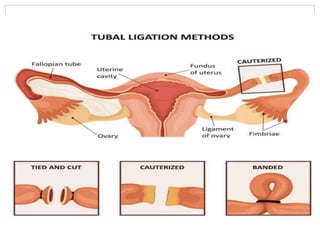
Occlusion methods
 Partial salpingectomy
 Tubal clip
 Tubal rings/fallopes rings
 Fimbriectomy
 Electrocoagulation or cautrization
Pomeroy Method
Minilaparotomy for Tubal Ligation
 Ligation of the fallopian tubes through 3-4cm incision
on the abdomen, can be done:
 As an outpatient procedure
 By local anesthesia and sedation
 Minilaparotomy following vaginal delivery:
 Enlarged uterus, tubes in the mid abdomen, 3-4 cm sub
umbilical incision
 Interval minilaparotomy:
 Short transverse suprapubic incision
 Uterine elevator used through the vagina
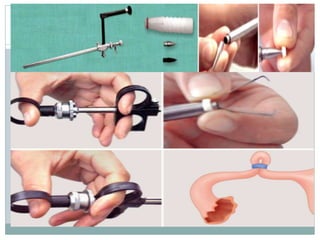
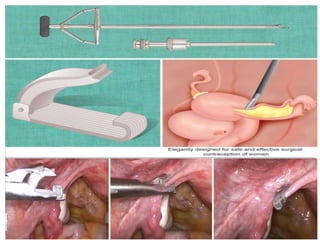
Laparoscopic sterilization
 Simple and effective procedure.
 Can be done single port or two port technique,
under local anesthesia.
 Position modified lithotomy.
 LA infiltrated.
 Pneumoperitoneum is created.
 Small stab incision given, trocar inserted followed
by loaded laprocater.
 Fallope rings or filshie clips are applied bilaterally
Indications to Delaying lap Tubal Ligation
 Current pregnancy
 Less than 6 weeks postpartum
 Severe postpartum or post abortion complications
 Unexplained vaginal bleeding
 Pelvic inflammatory disease and STIs
 Pelvic malignancies
Benefits of Female Sterilization
 No known side effect
 Helps to protect against unwanted pregnancy
 Nothing to remember and no worries about
contraceptives again
 Prevents against pelvic inflammatory disease
(PID)
 May protect against ovarian tumor
Risks of Female Sterilization
Few complications
 Related with surgery, anesthesia, previous
surgery, PID, Obesity, and DM
 1-2 deaths /100,000 cases
 2 pregnancies per 100 women over 10 years
 Possibility of future regret
 Young age
 Lost a child
 Few or no children
 Not married/ Marital problems
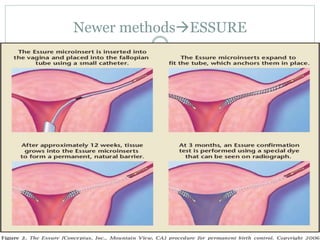
Newer methodsESSURE
Immunocontraceptions /FRV
Fertility regulating vaccines/FRVs
 Anti HCG vaccine
 Anti zona vaccine
 Anti sperm vaccine
Summary
• Permanent methods are irreversible
• Non-scalpel vasectomy in men and
minilaparatomy for women are preferred
• Permanent methods are less popular in Ethiopia
• Detailed counseling is essential
• Rare complications - not related to method

PERMANENT CONTRACEPTION (2).pptx

  • 1.
    V A SE C T O M Y F O R M E N T U B A L L I G A T I O N I N W O M E N Permanent contraception
  • 2.
    Introduction to PermanentFamily Planning  Surgical procedure to permanently and intentionally terminate male and female reproductive function  Appropriate for men and women who made a fully informed and well considered decision  Most are not reversible • Vasectomy for men • Tubal ligation in women Permanent Family Planning
  • 3.
    Vasectomy  For menwho do not want more children  Transection and occlusion of the vas deferens  Also called male sterilization, male surgical contraception  No interference with sexual performance  Outpatient procedure by local anesthesia
  • 4.
    Facts about vasectomy It is simple, safe and effective method of permanent contraception.  Can be done on OPD basis under local anesthesia.  No effect on sexual activity, semen volume and general physical health.  Sterility doesn't occur immediately. It requires approx 20 ejaculation to completely evacuate vas, which takes 3month. Absence of sperm should be confirmed by microscopic examination(HSA).  Reversal is possible but sperm recovery rate after procedure declines with time particularly after 7 years.
  • 5.
    Procedure should bedelayed if… Patient has  scrotal skin infection  Active STDs  Epididymitis or orchitis  Filariasis  Intrascrotal mass  Coagulation disorders  Psychosexual disorder
  • 6.
    Techniques of Vasectomy Scalpel (conventional) and Non-scalpel  Palpate the vas through the scrotum  Grasp the vas with fingers or forceps  Pull loop of vas and remove segment  Ligate both ends of the vas  Bury the proximal stump  Skin stitch and dressing
  • 7.
  • 10.
    Post surgery care Painkiller SOS  Antibiotics not required.  Dry dressing only, avoid bath for 24 hours.  Avoid cycling and moderate exercise for 1 weeks.  Scrotal support for initial few days.  Take contraceptive measures for next 3 months or confirm sperm free ejaculate by 2 separate microscopic examinations. 
  • 11.
    Benefits of Vasectomy Failure is less than 1%  Reason for failure can be:  Unprotected intercourse soon  Failure to occlude the vas  Recanalization  Safer and more effective than tubal ligation  0.5 deaths per 100,000 vasectomies
  • 12.
    Complications of Vasectomy Side effects are uncommon to very rare  Testicular and scrotal pain lasting for months  Surgical site infection  Hematoma  Sperm granuloma
  • 13.
  • 14.
     For womenwho do not want more children.  Also called tubal sterilization, tubal ligation or tubectomy.  Most widely used procedure globally.
  • 15.
    counselling  About permanentprocedure.  Its failure rate.  Alternative methods of long term contraception.  complications
  • 16.
    Different types  Accordingto time post partum Interval Postabortal  According to approach Abdominal conventional 3-4 cm Minilaparotomy2.5 to 3cm laparoscopic Vaginal hysteroscopic
  • 17.
    Procedure  1. Beforeoperations: confirm patient's last menstrual period, exclude pregnancy and take  necessary consents  2. Ensure empty urinary bladder  3. After proper gowning and scrubbing, the operative area is cleaned and draped.  4. Determine the incision site and size - 2 fingers from the symphysis pubis superiorly.  5. Make the skin incision about 3 to 4 cm long.  6. Open the abdomen in layers until the rectus sheath.  7. Open the rectus sheath using the scissors and push the muscle laterally.  8. Proceed to open the peritoneal cavity with two artery forcep and the maximburm  scissors.  9. By using 2 fingers - identify the uterine body and move laterally to identify the fallopian  tube.  10. Grasps the tube using the babcock. The tube can be determined by identifying the  fimbriae end of the tube.  11. Lift the tube gently and clamp the area for incision using the artery forceps.  12. Make a knot on one side and subsequently on the opposite site. Be sure to relief the  artery forceps temporally when making the knot.  13. Any absorbable suture size 2/0 can be used - eg. Vicryl or catgut  14. The tube can then be excised using the scissors.  15. The stump is then inspected for any residual bleeding.  16. The same procedure is employed for the contralateral tube.  18. Finally close the abdomen and skin
  • 18.
    Occlusion methods  Partialsalpingectomy  Tubal clip  Tubal rings/fallopes rings  Fimbriectomy  Electrocoagulation or cautrization
  • 20.
  • 22.
    Minilaparotomy for TubalLigation  Ligation of the fallopian tubes through 3-4cm incision on the abdomen, can be done:  As an outpatient procedure  By local anesthesia and sedation  Minilaparotomy following vaginal delivery:  Enlarged uterus, tubes in the mid abdomen, 3-4 cm sub umbilical incision  Interval minilaparotomy:  Short transverse suprapubic incision  Uterine elevator used through the vagina
  • 24.
    Laparoscopic sterilization  Simpleand effective procedure.  Can be done single port or two port technique, under local anesthesia.  Position modified lithotomy.  LA infiltrated.  Pneumoperitoneum is created.  Small stab incision given, trocar inserted followed by loaded laprocater.  Fallope rings or filshie clips are applied bilaterally
  • 28.
    Indications to Delayinglap Tubal Ligation  Current pregnancy  Less than 6 weeks postpartum  Severe postpartum or post abortion complications  Unexplained vaginal bleeding  Pelvic inflammatory disease and STIs  Pelvic malignancies
  • 29.
    Benefits of FemaleSterilization  No known side effect  Helps to protect against unwanted pregnancy  Nothing to remember and no worries about contraceptives again  Prevents against pelvic inflammatory disease (PID)  May protect against ovarian tumor
  • 30.
    Risks of FemaleSterilization Few complications  Related with surgery, anesthesia, previous surgery, PID, Obesity, and DM  1-2 deaths /100,000 cases  2 pregnancies per 100 women over 10 years  Possibility of future regret  Young age  Lost a child  Few or no children  Not married/ Marital problems
  • 31.
  • 32.
    Immunocontraceptions /FRV Fertility regulatingvaccines/FRVs  Anti HCG vaccine  Anti zona vaccine  Anti sperm vaccine
  • 33.
    Summary • Permanent methodsare irreversible • Non-scalpel vasectomy in men and minilaparatomy for women are preferred • Permanent methods are less popular in Ethiopia • Detailed counseling is essential • Rare complications - not related to method

Editor's Notes

  • #3 Permanent methods are procedures whereby the reproductive function of a man or a woman is intentionally and permanently terminate As these methods are irreversible it needs fully informed and well considered decision, counseling should focus on method reversibility, benefits and risks
  • #4 Procedure involves transection and occlusion of the vas deferens Terminologies used interchangeably include male sterilization and male surgical sterilization
  • #15 Also called tubal sterilization, tubal ligation, voluntary surgical contraception, tubectomy, bi-tubal ligation, tying the tubes, and minilap,
  • #23 Ligation of the fallopian tubes through 3-4cm incision on the abdomen Can be done as an outpatient procedure
  • #29 Postpartum and postabortion complications include infections, severe bleeding, and injury Pelvic malignancies including Cervical, endometrial, ovarian cancers and malignant trophoblastic diseases Treatment for pelvic malignancies can serve as sterilization
  • #30 Complications are extremely rare and often related to surgery and anesthesia Complications may include hemorrhage, infection, incision abscess, Ovarian tumor protection persists for 20 years after surgery
  • #31 Related with surgery, anesthesia, previous surgery, PID, Obesity, and DM