10/8/2014 
1 
NIH Library | http://nihlibrary.nih.gov 
Doug Joubert – MLIS, MS 
Alicia Livinski – MPH, MA 
Using Social Technologies for Public 
Health 
JHU Bloomberg School of Public Health 
June 2014 
Disclaimer 
The views expressed in this 
presentation are those of the speakers 
and do not reflect the official policy or 
position of the National Institutes of 
Health or the Department of Health and 
Human Services.
10/8/2014 
2 
Our roadmap 
The state of social media 
Case study 
Social media and public health 
Examples from the field 
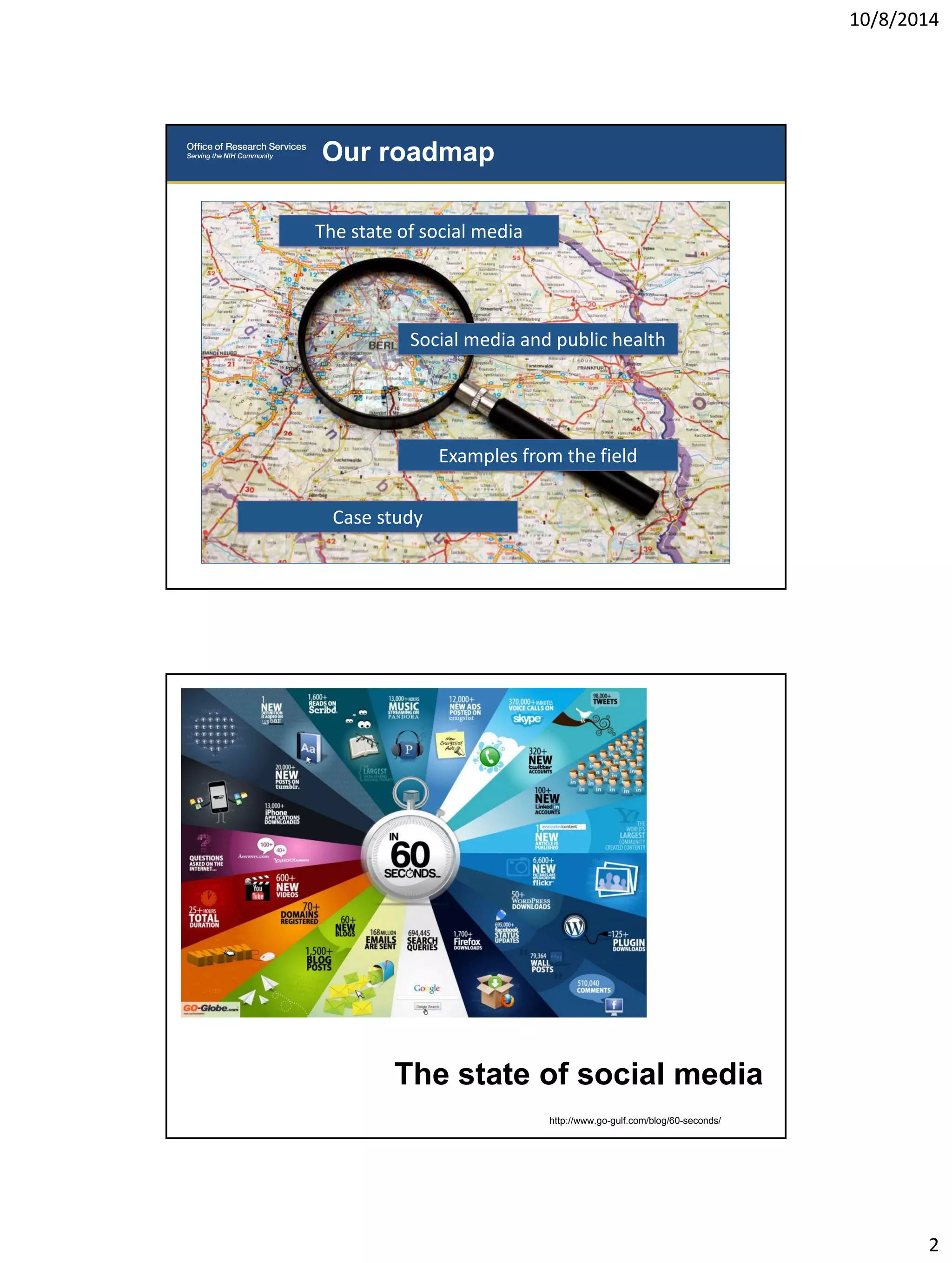
http://www.go-gulf.com/blog/60-seconds/ 
The state of social media
10/8/2014 
3 
What is social media? 
Kaplan Andreas M., Haenlein Michael, (2010). 
A shift from one-way conversations to multi-way conversations in which users 
participate as both creators and consumers of web content. 
Interactive User-generated Multi-directional 
Turnbull A et al., (2009) 
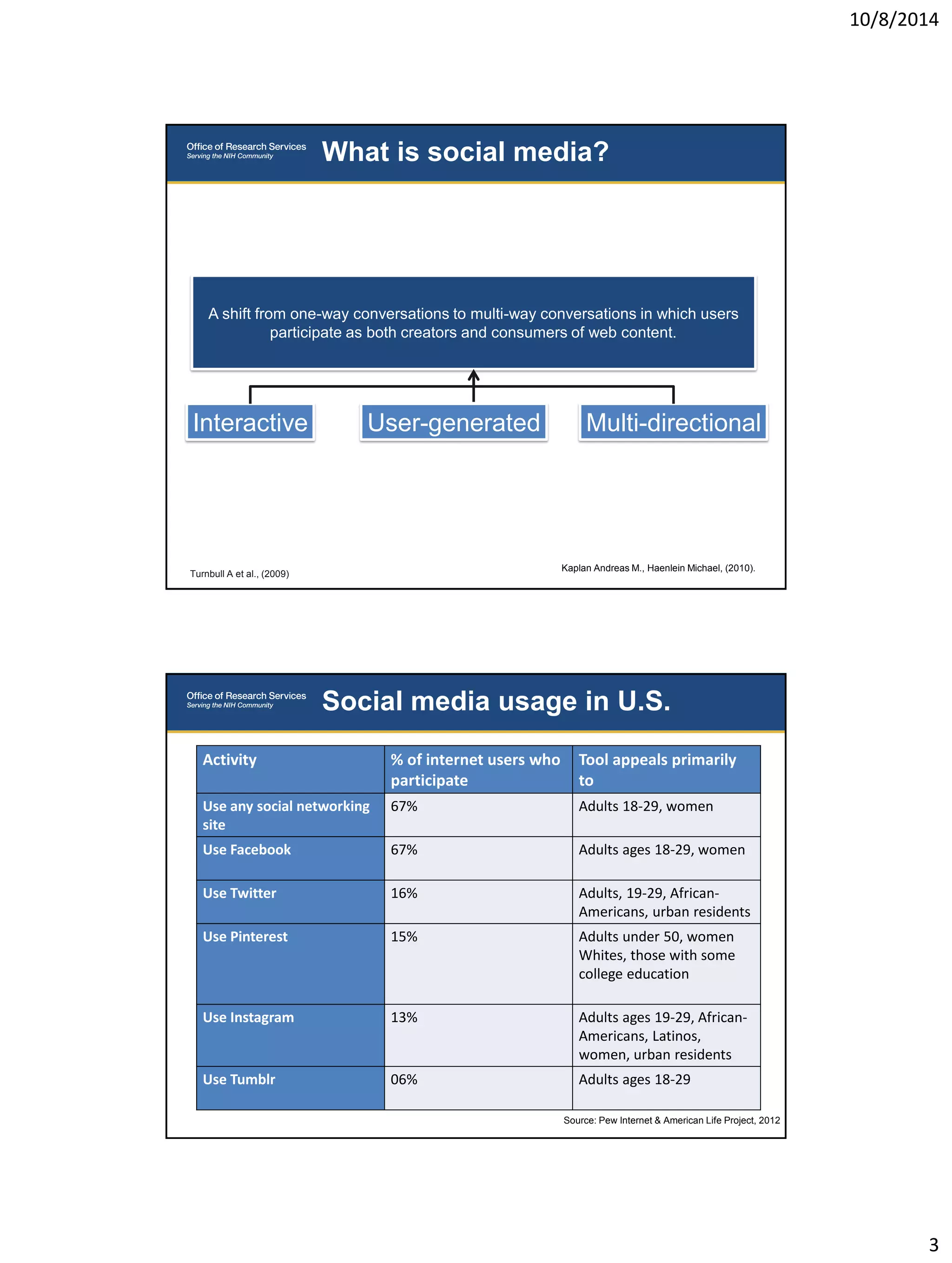
Activity % of internet users who 
participate 
Tool appeals primarily 
to 
Use any social networking 
site 
67% Adults 18-29, women 
Use Facebook 67% Adults ages 18-29, women 
Use Twitter 16% Adults, 19-29, African- 
Americans, urban residents 
Use Pinterest 15% Adults under 50, women 
Whites, those with some 
college education 
Use Instagram 13% Adults ages 19-29, African- 
Americans, Latinos, 
women, urban residents 
Use Tumblr 06% Adults ages 18-29 
Social media usage in U.S. 
Source: Pew Internet & American Life Project, 2012
10/8/2014 
4 
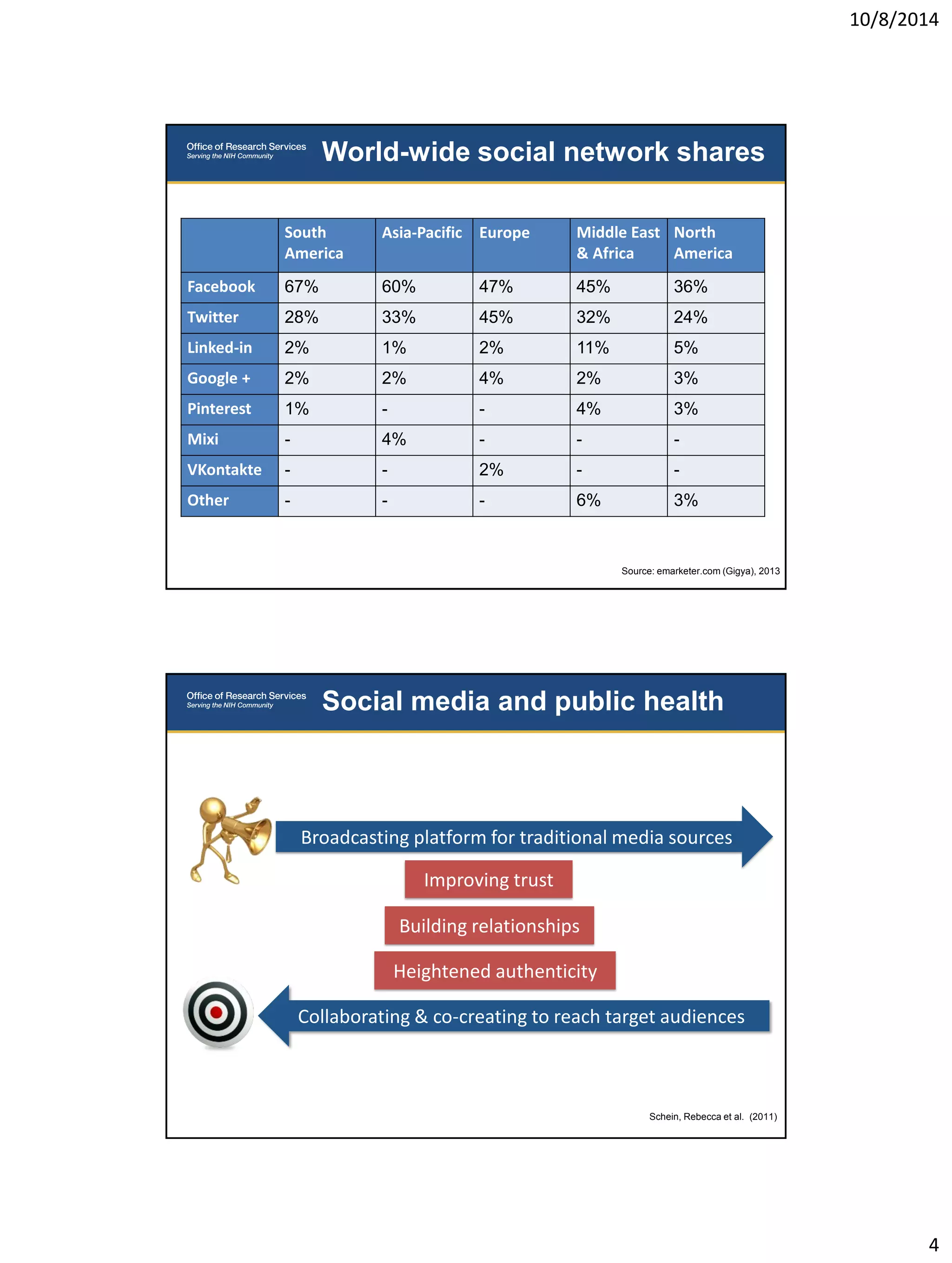
South 
America 
Asia-Pacific Europe Middle East 
& Africa 
North 
America 
Facebook 67% 60% 47% 45% 36% 
Twitter 28% 33% 45% 32% 24% 
Linked-in 2% 1% 2% 11% 5% 
Google + 2% 2% 4% 2% 3% 
Pinterest 1% - - 4% 3% 
Mixi - 4% - - - 
VKontakte - - 2% - - 
Other - - - 6% 3% 
World-wide social network shares 
Source: emarketer.com (Gigya), 2013 
Broadcasting platform for traditional media sources 
Social media and public health 
Schein, Rebecca et al. (2011) 
Collaborating & co-creating to reach target audiences 
Building relationships 
Improving trust 
Heightened authenticity
10/8/2014 
5 
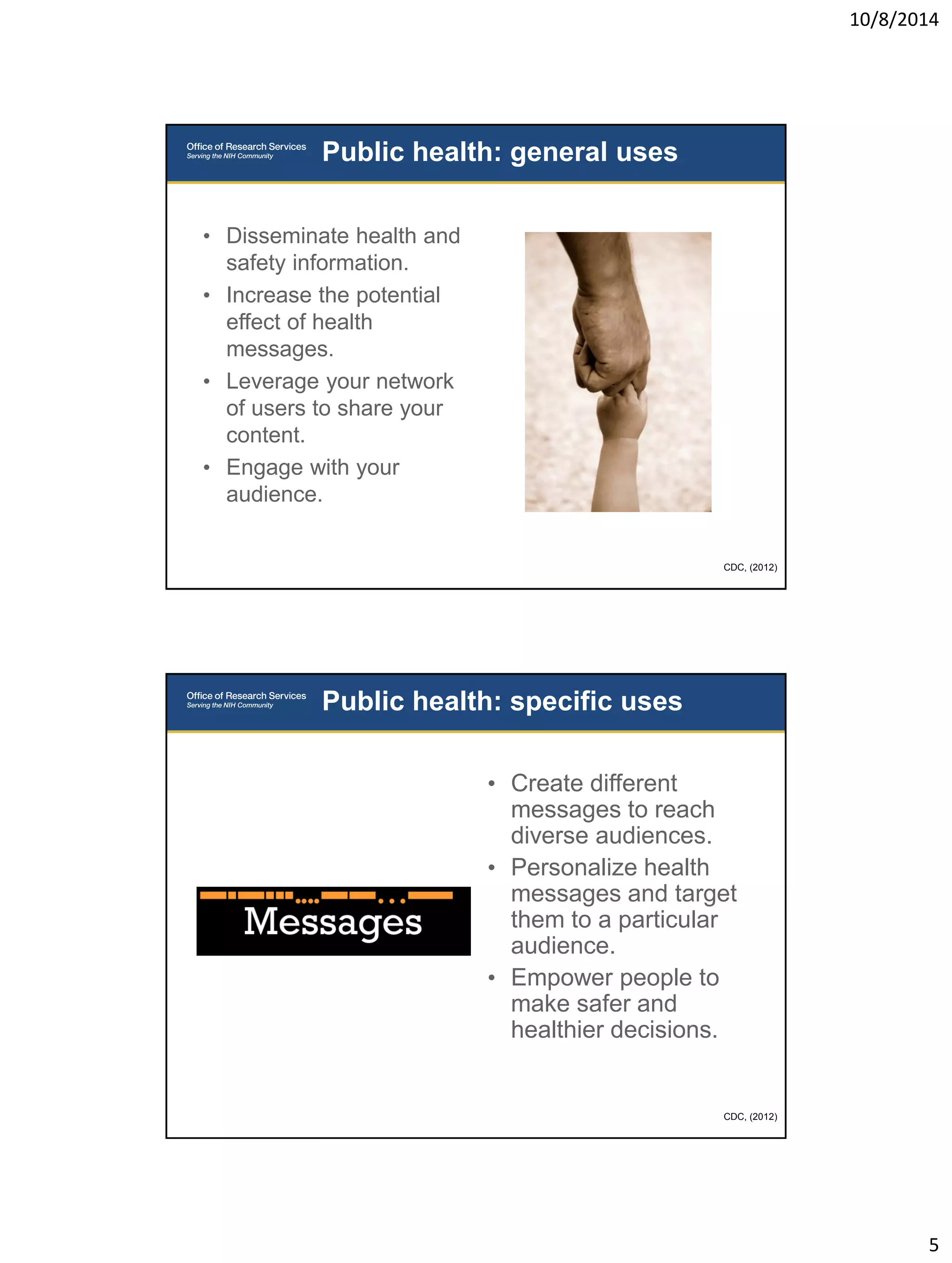
• Disseminate health and 
safety information. 
• Increase the potential 
effect of health 
messages. 
• Leverage your network 
of users to share your 
content. 
• Engage with your 
audience. 
Public health: general uses 
CDC, (2012) 
• Create different 
messages to reach 
diverse audiences. 
• Personalize health 
messages and target 
them to a particular 
audience. 
• Empower people to 
make safer and 
healthier decisions. 
Public health: specific uses 
CDC, (2012)
10/8/2014 
6 
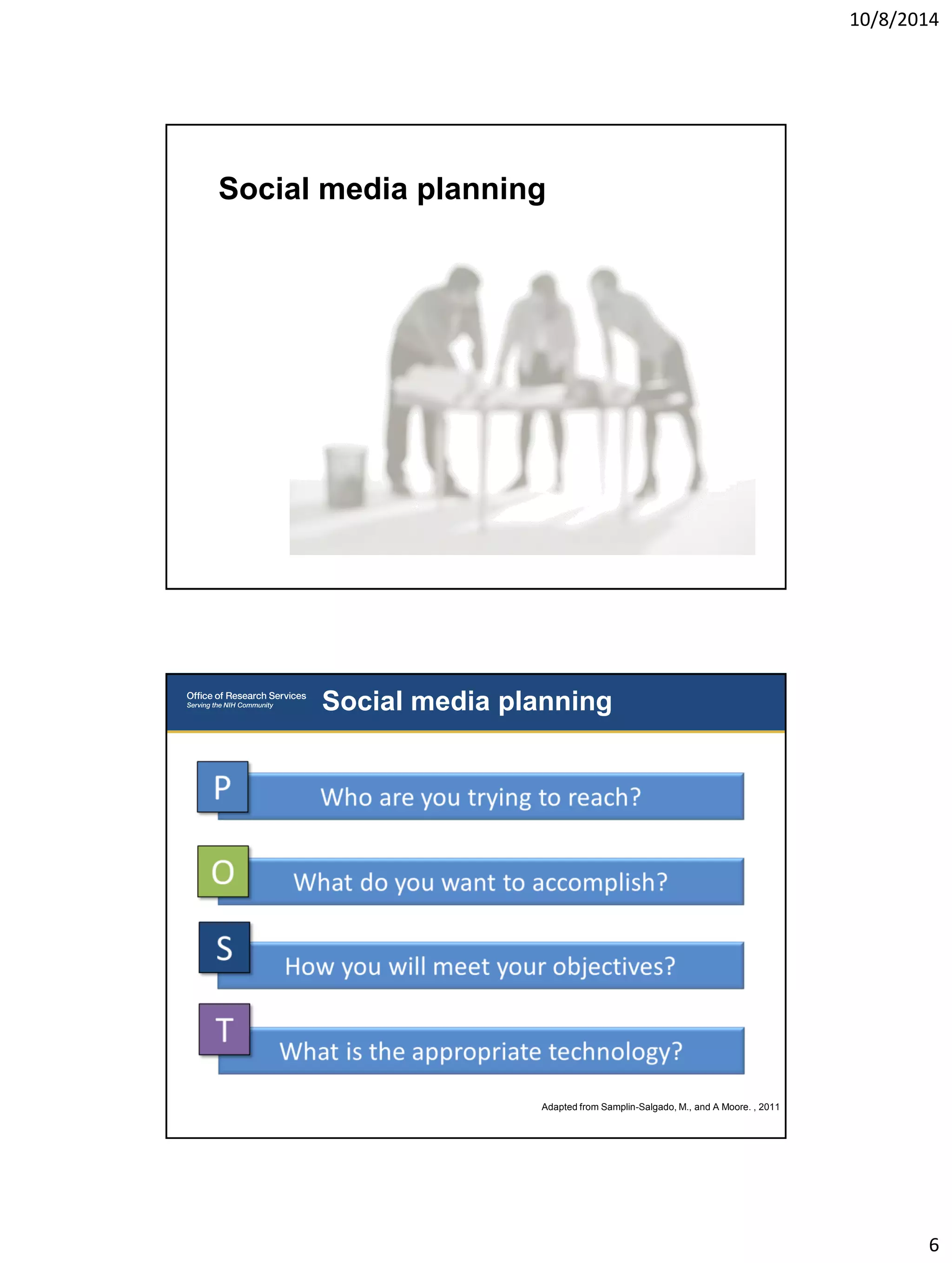
Social media planning 
Adapted from Samplin-Salgado, M., and A Moore. , 2011
10/8/2014 
7 
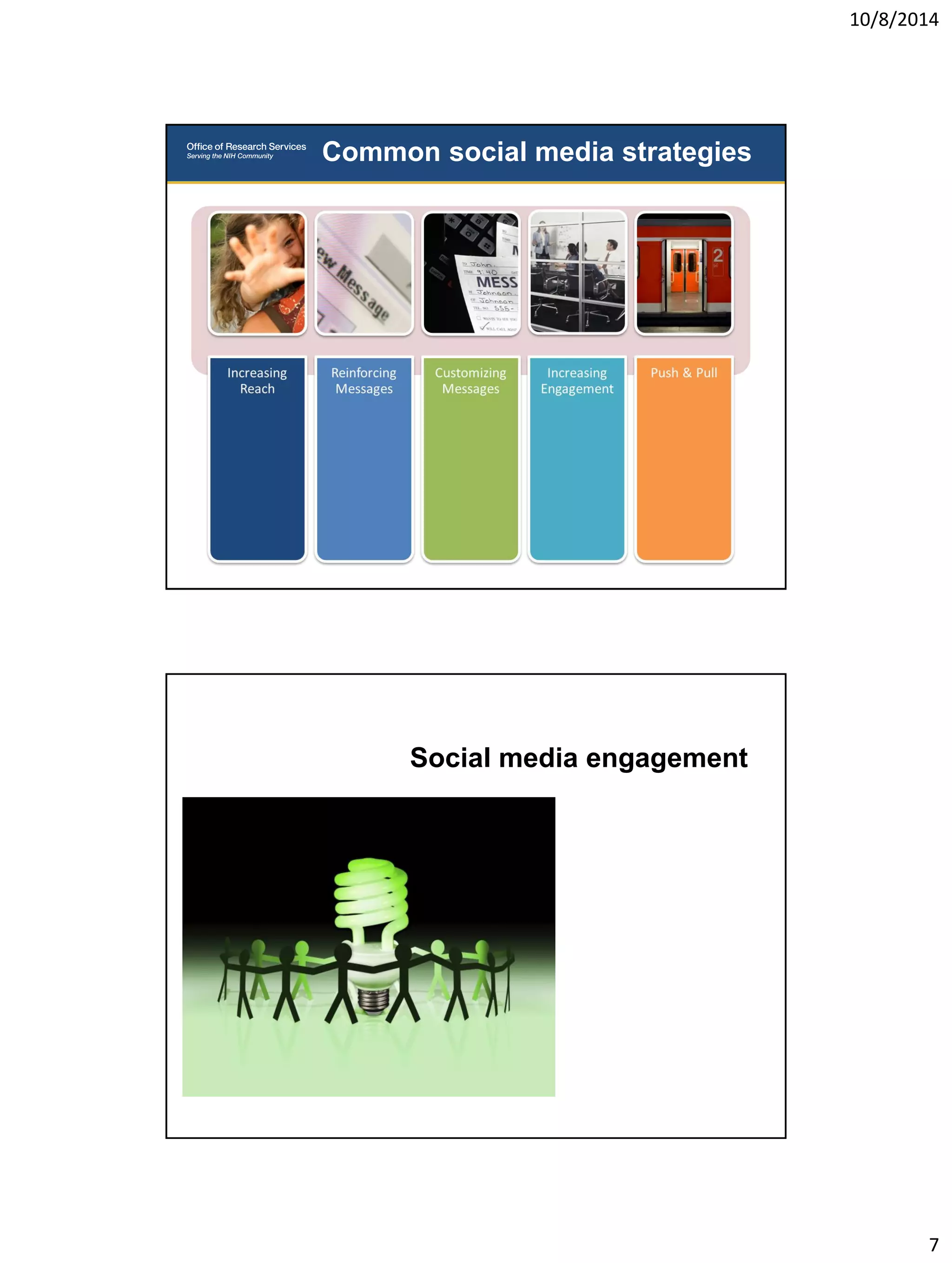
Common social media strategies 
Social media engagement
10/8/2014 
8 
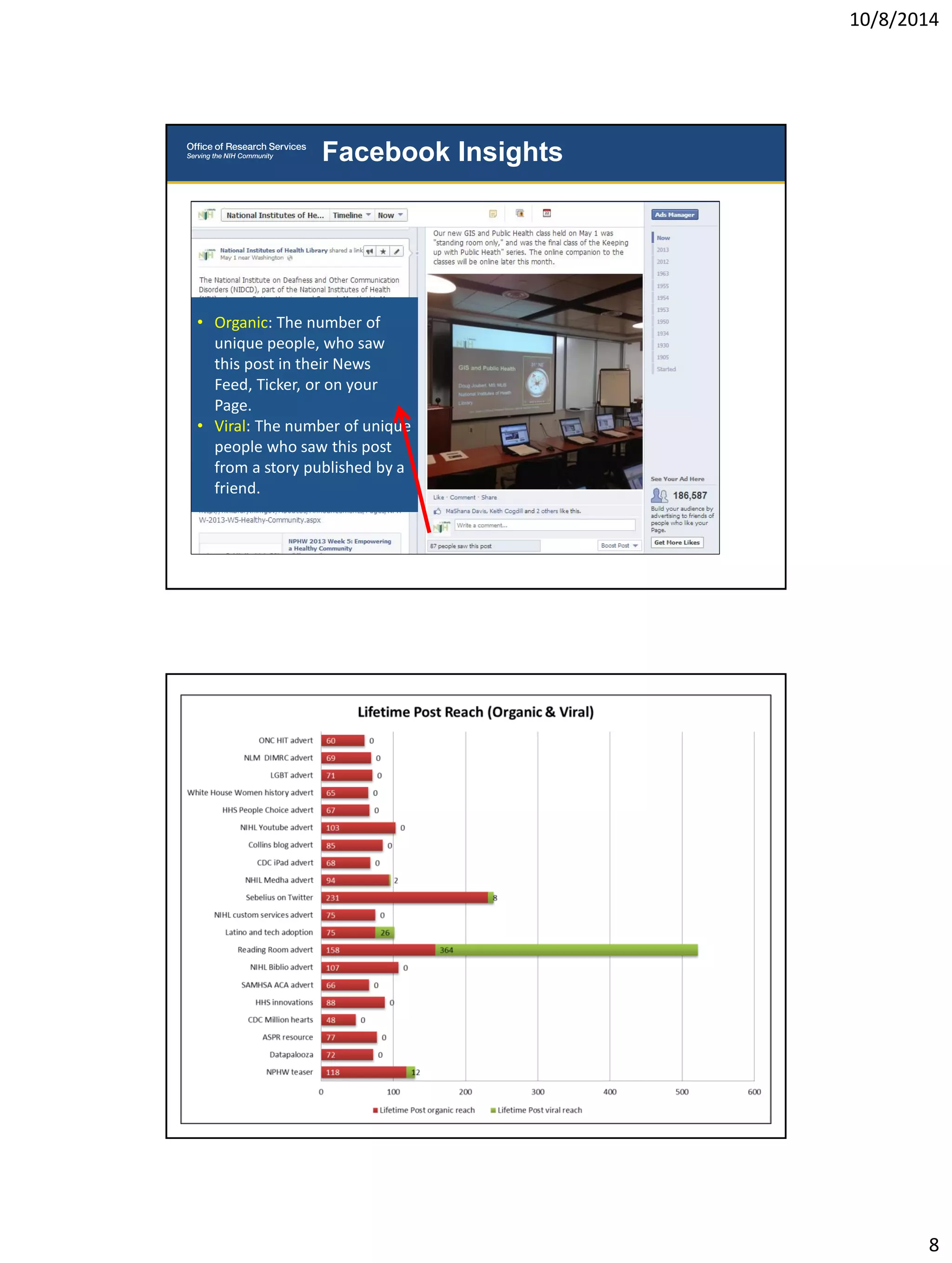
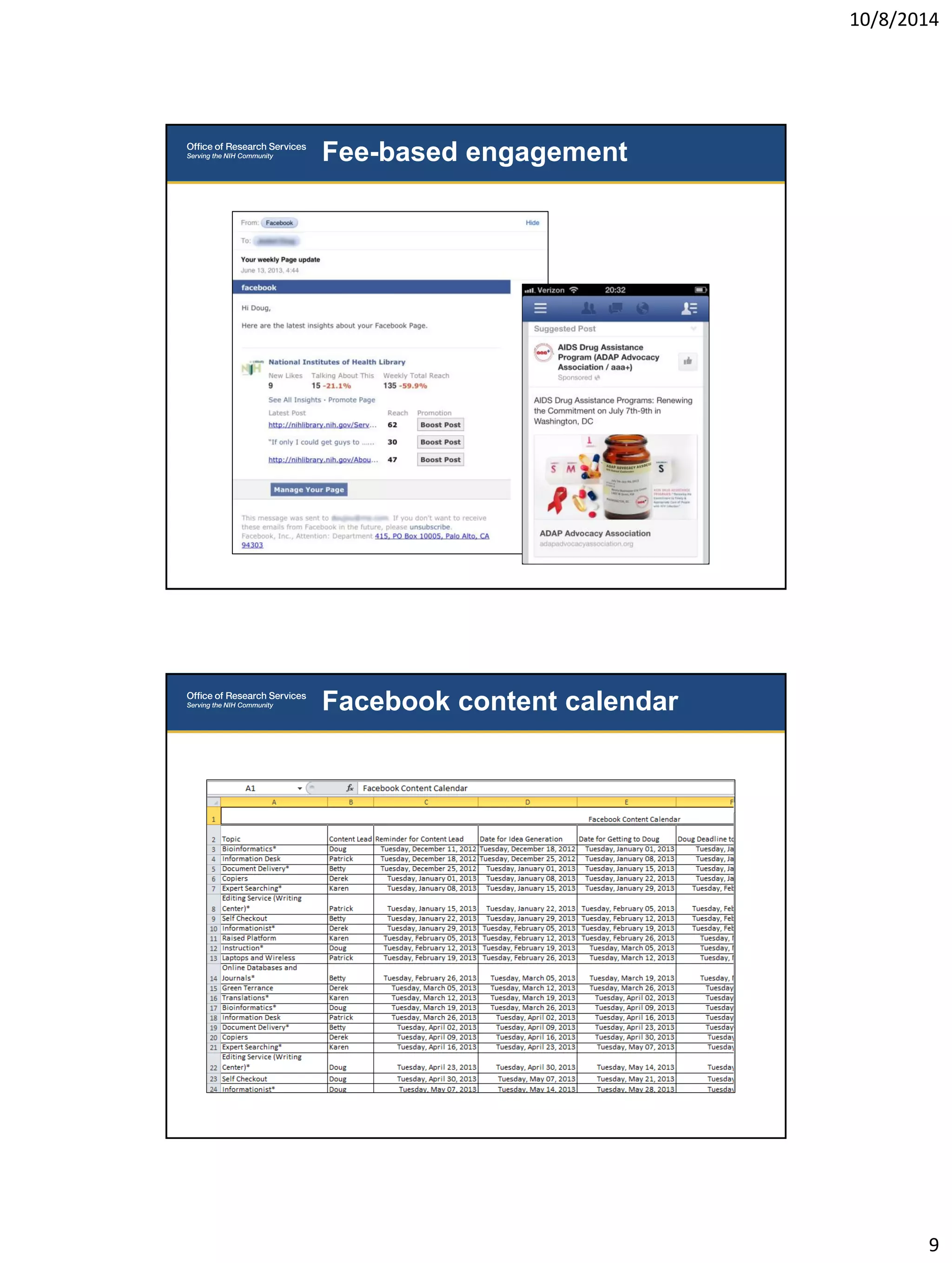
Facebook Insights 
• Organic: The number of 
unique people, who saw 
this post in their News 
Feed, Ticker, or on your 
Page. 
• Viral: The number of unique 
people who saw this post 
from a story published by a 
friend.
10/8/2014 
9 
Fee-based engagement 
Facebook content calendar
10/8/2014 
10 
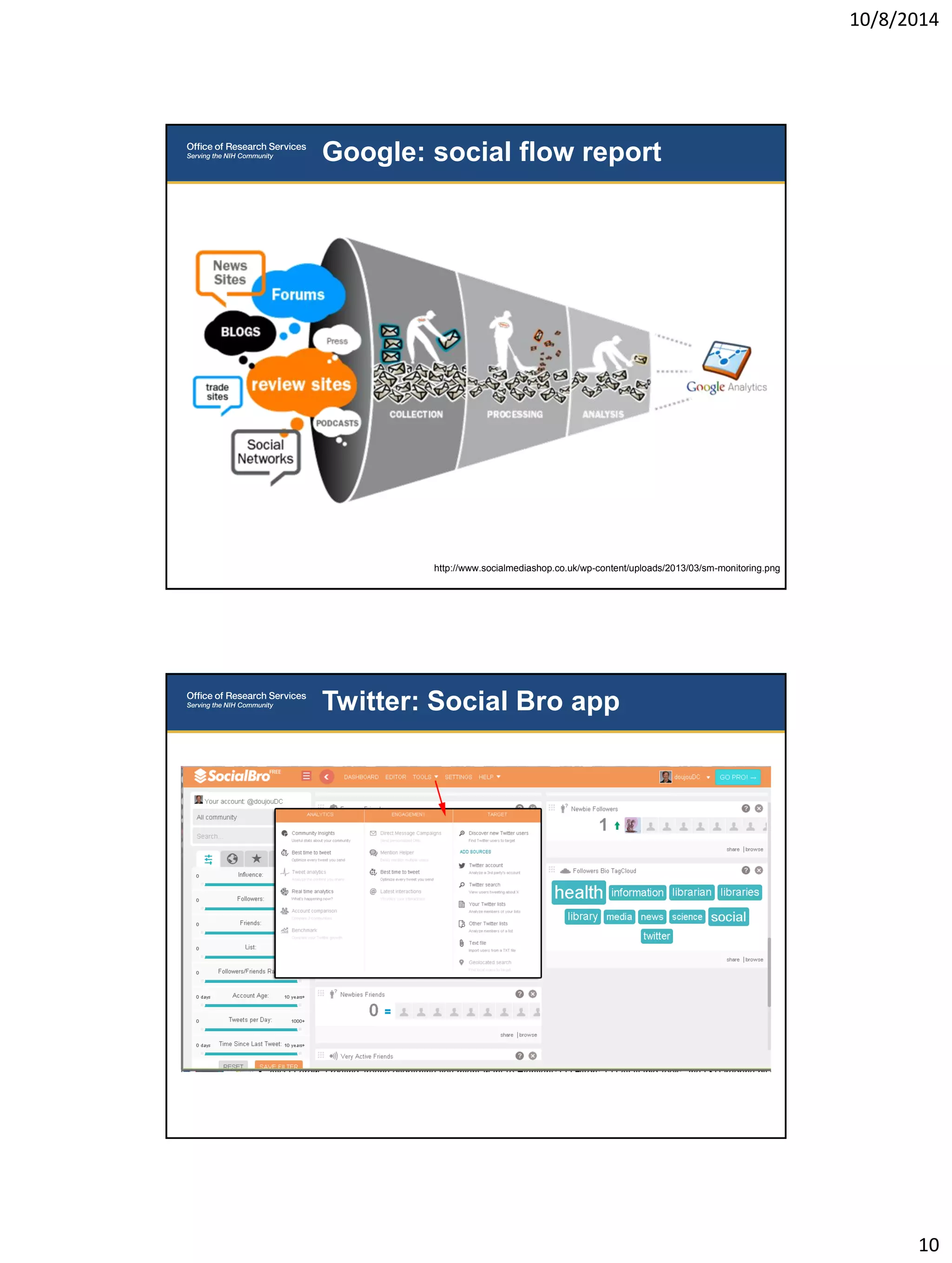
Google: social flow report 
http://www.socialmediashop.co.uk/wp-content/uploads/2013/03/sm-monitoring.png 
Twitter: Social Bro app
10/8/2014 
11 
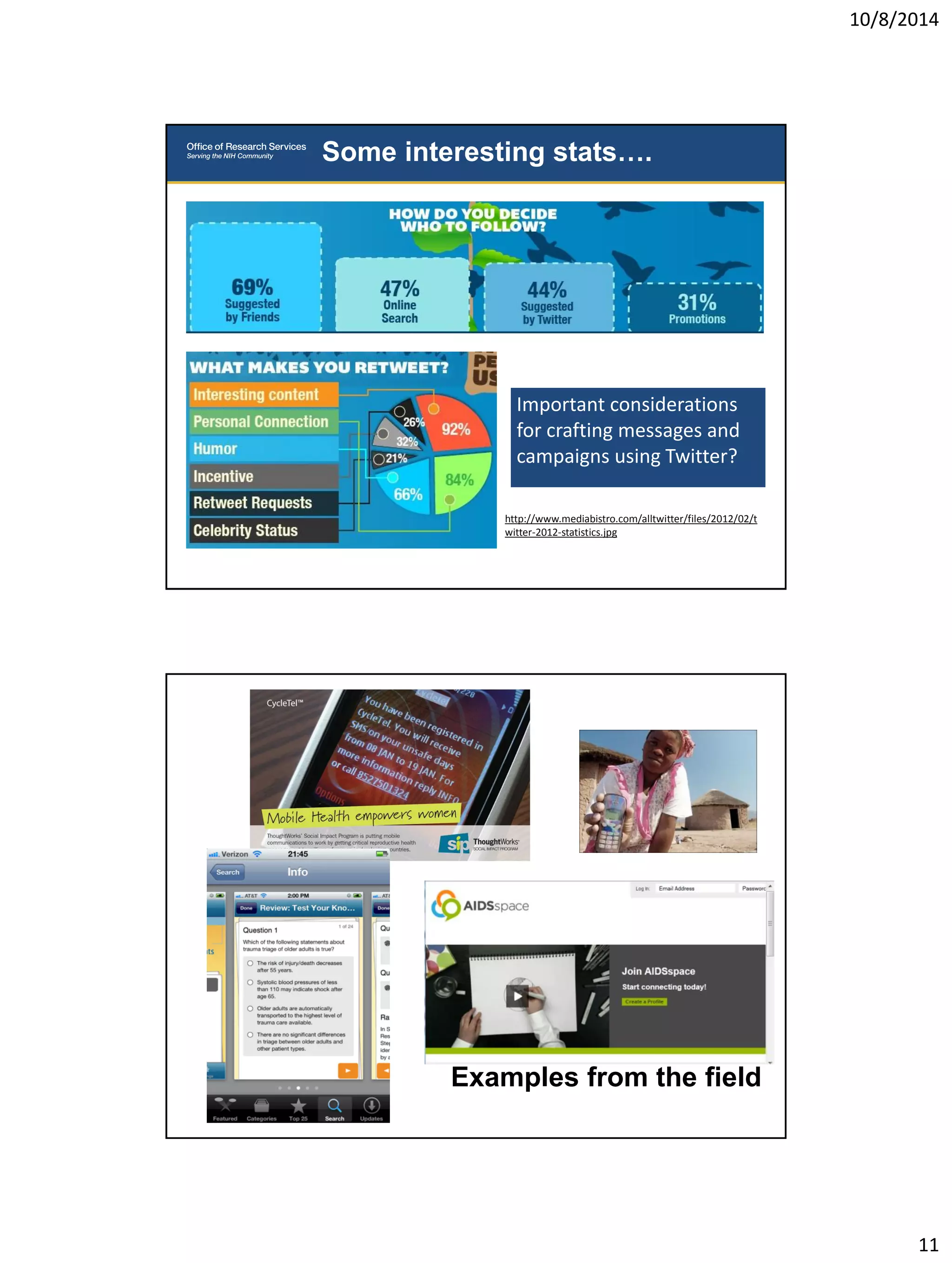
Some interesting stats…. 
http://www.mediabistro.com/alltwitter/files/2012/02/t 
witter-2012-statistics.jpg 
Important considerations 
for crafting messages and 
campaigns using Twitter? 
Examples from the field
10/8/2014 
12 
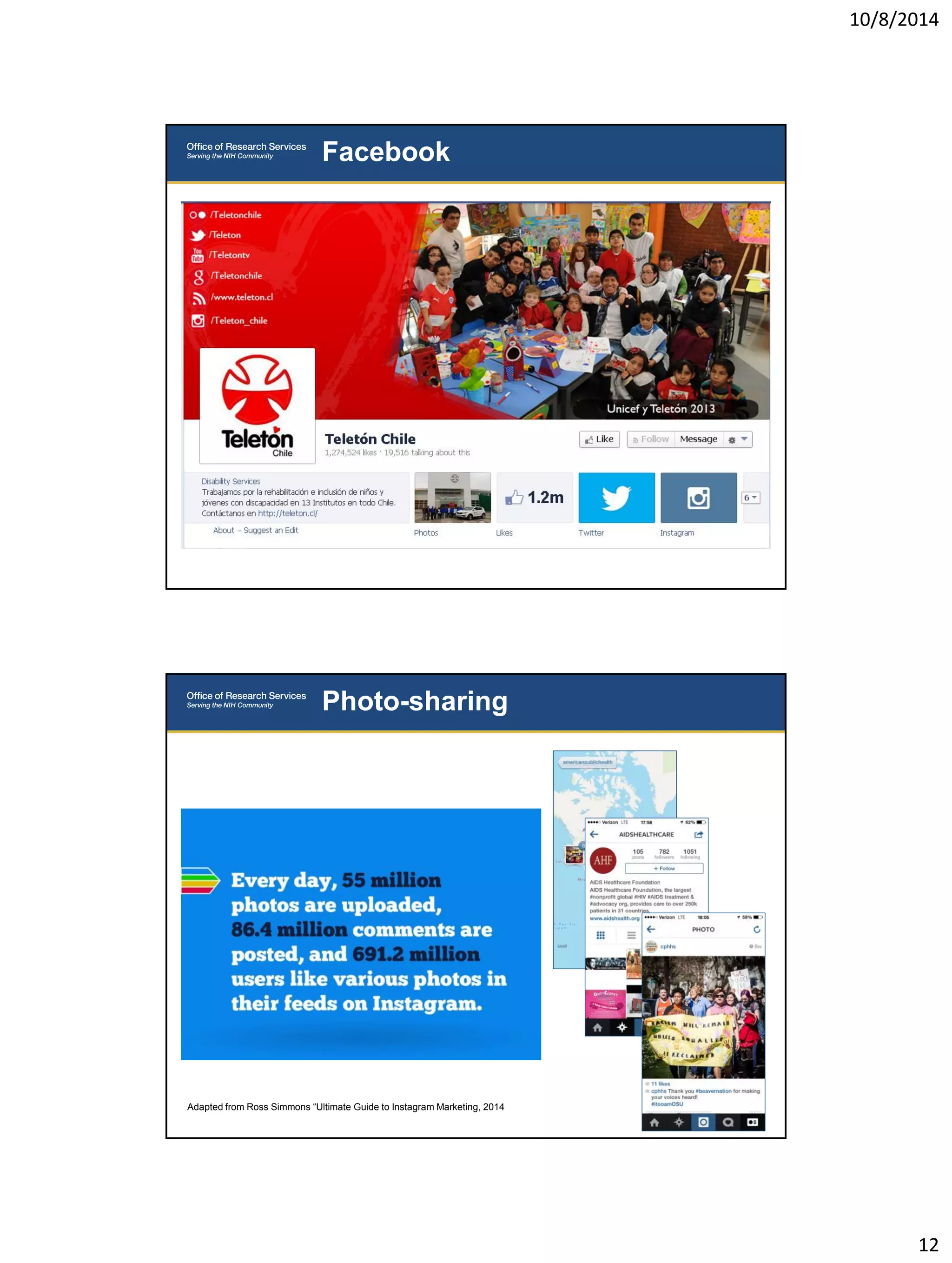
Facebook 
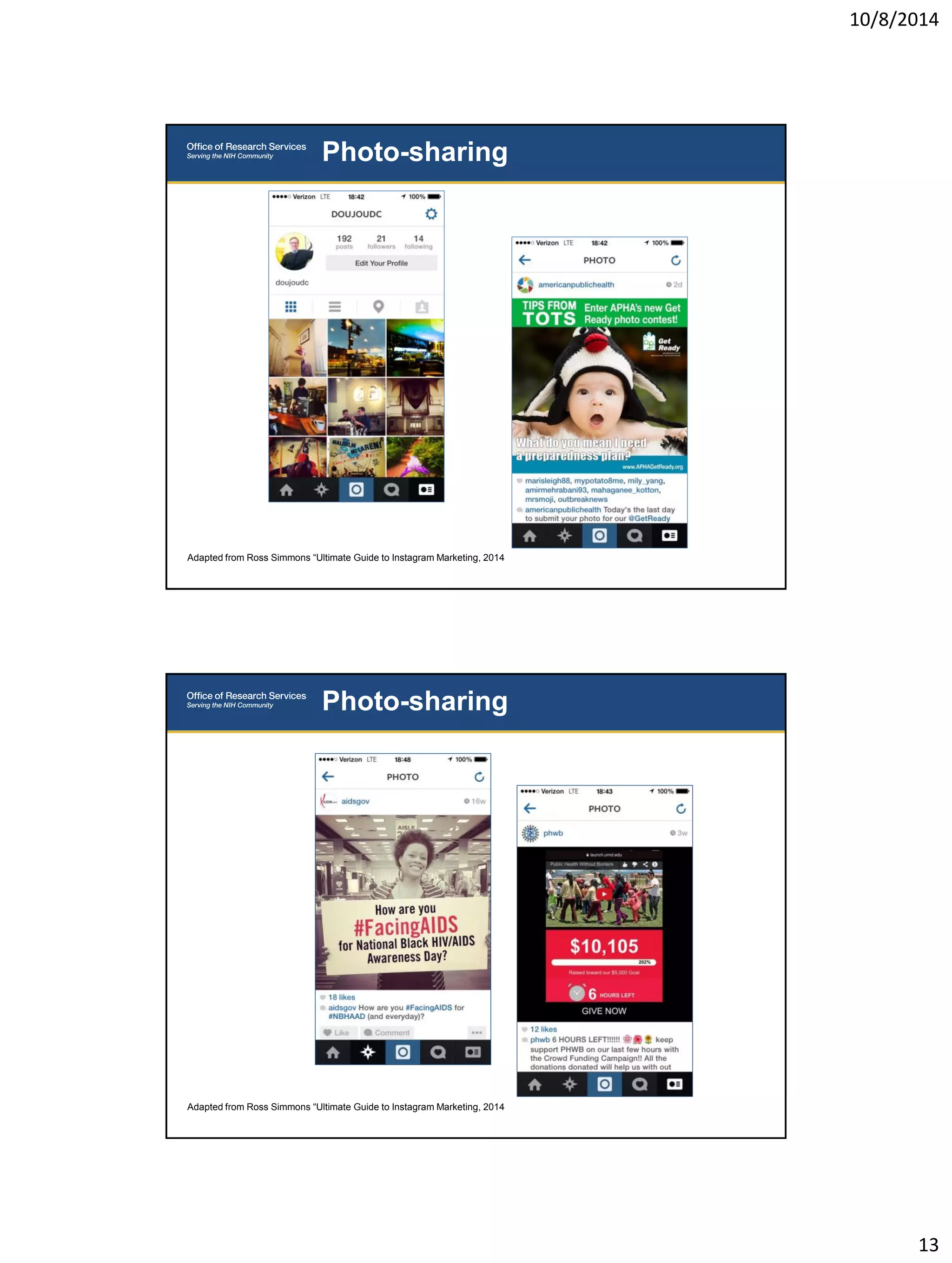
Photo-sharing 
Adapted from Ross Simmons “Ultimate Guide to Instagram Marketing, 2014
10/8/2014 
13 
Photo-sharing 
Adapted from Ross Simmons “Ultimate Guide to Instagram Marketing, 2014 
Photo-sharing 
Adapted from Ross Simmons “Ultimate Guide to Instagram Marketing, 2014
10/8/2014 
14 
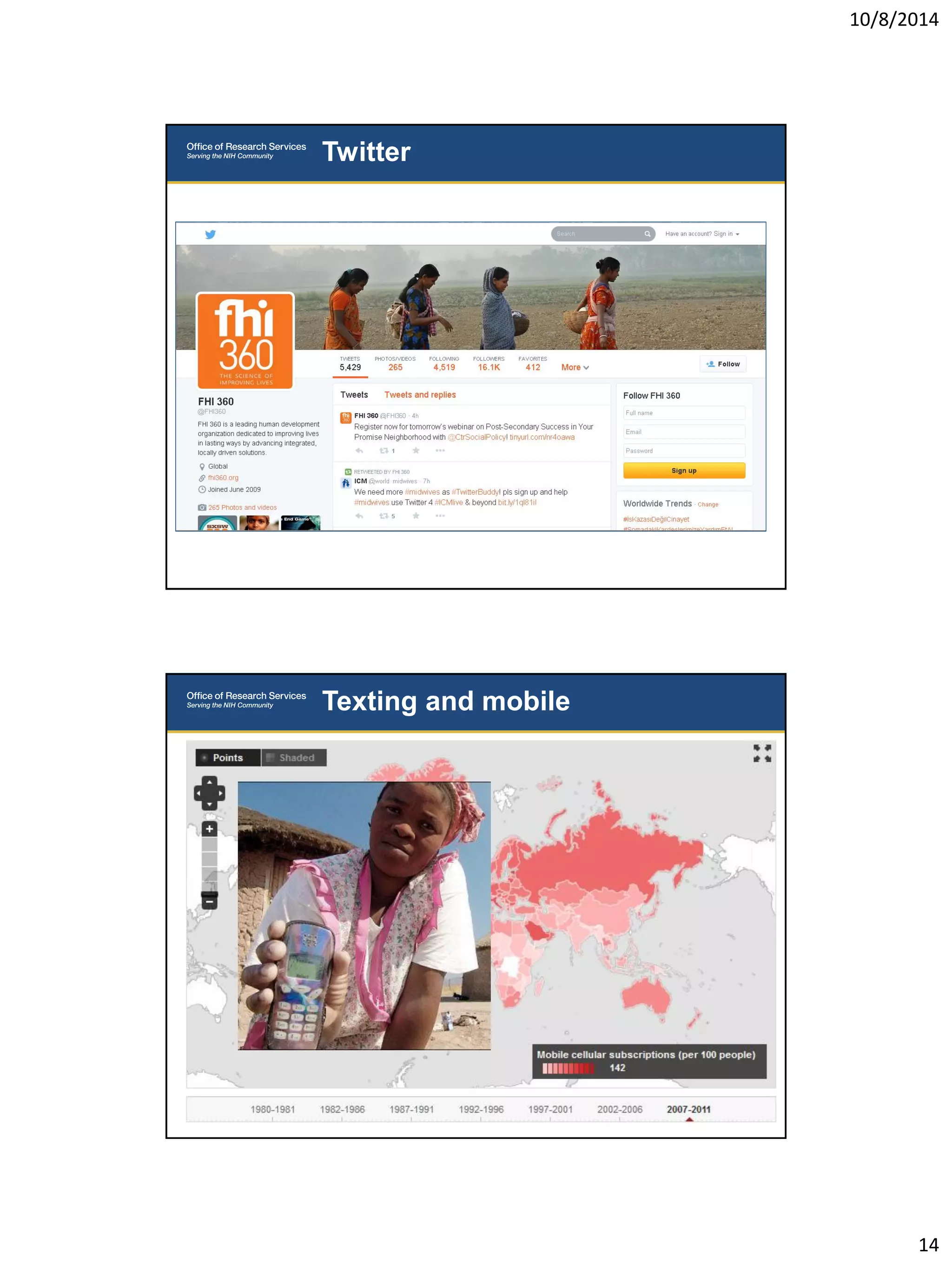
Twitter 
Texting and mobile
10/8/2014 
15 
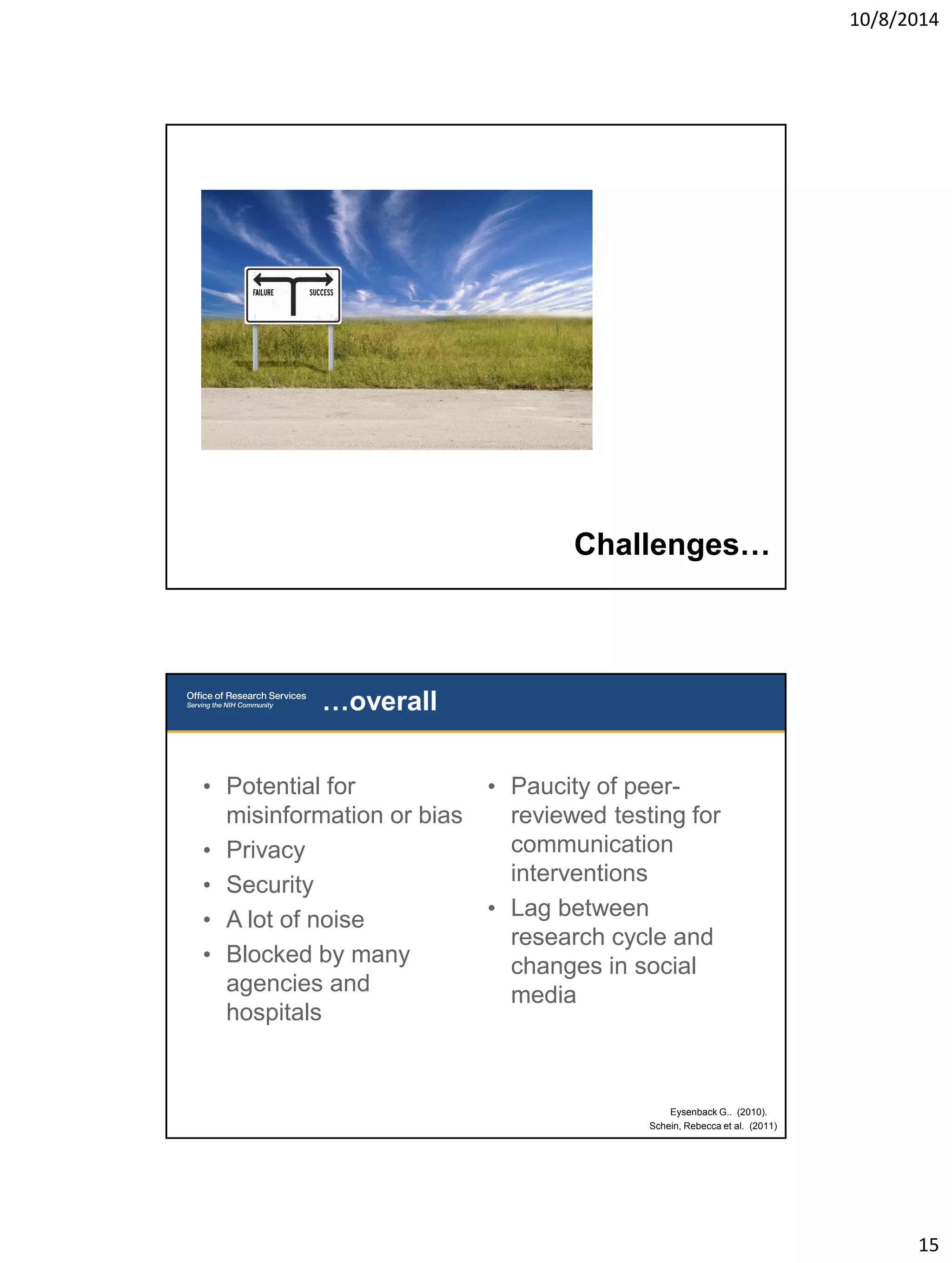
Challenges… 
• Potential for 
misinformation or bias 
• Privacy 
• Security 
• A lot of noise 
• Blocked by many 
agencies and 
hospitals 
• Paucity of peer-reviewed 
testing for 
communication 
interventions 
• Lag between 
research cycle and 
changes in social 
media 
…overall 
Eysenback G.. (2010). 
Schein, Rebecca et al. (2011)
10/8/2014 
16 
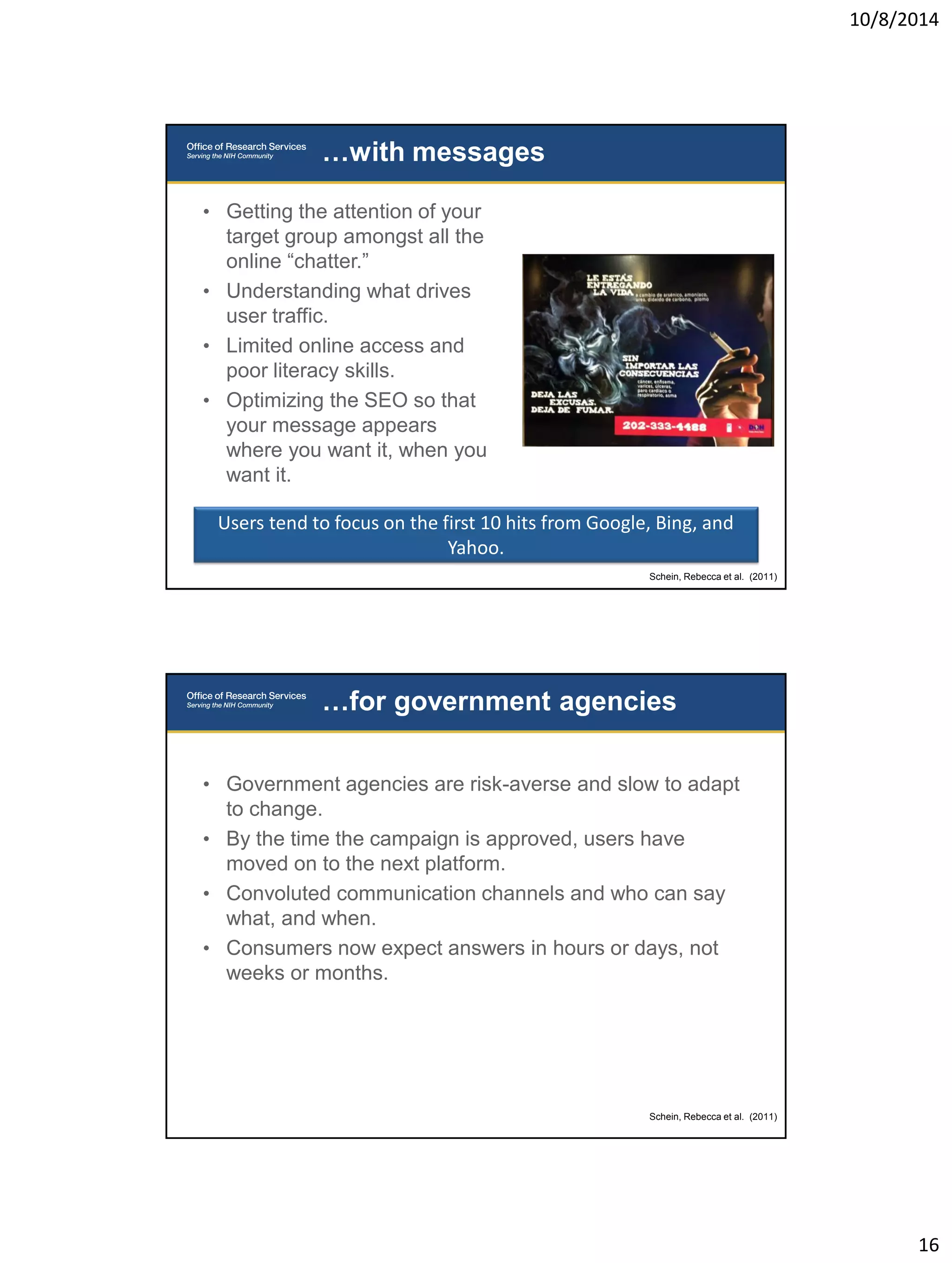
• Getting the attention of your 
target group amongst all the 
online “chatter.” 
• Understanding what drives 
user traffic. 
• Limited online access and 
poor literacy skills. 
• Optimizing the SEO so that 
your message appears 
where you want it, when you 
want it. 
…with messages 
Users tend to focus on the first 10 hits from Google, Bing, and 
Yahoo. 
Schein, Rebecca et al. (2011) 
• Government agencies are risk-averse and slow to adapt 
to change. 
• By the time the campaign is approved, users have 
moved on to the next platform. 
• Convoluted communication channels and who can say 
what, and when. 
• Consumers now expect answers in hours or days, not 
weeks or months. 
…for government agencies 
Schein, Rebecca et al. (2011)
10/8/2014 
17 
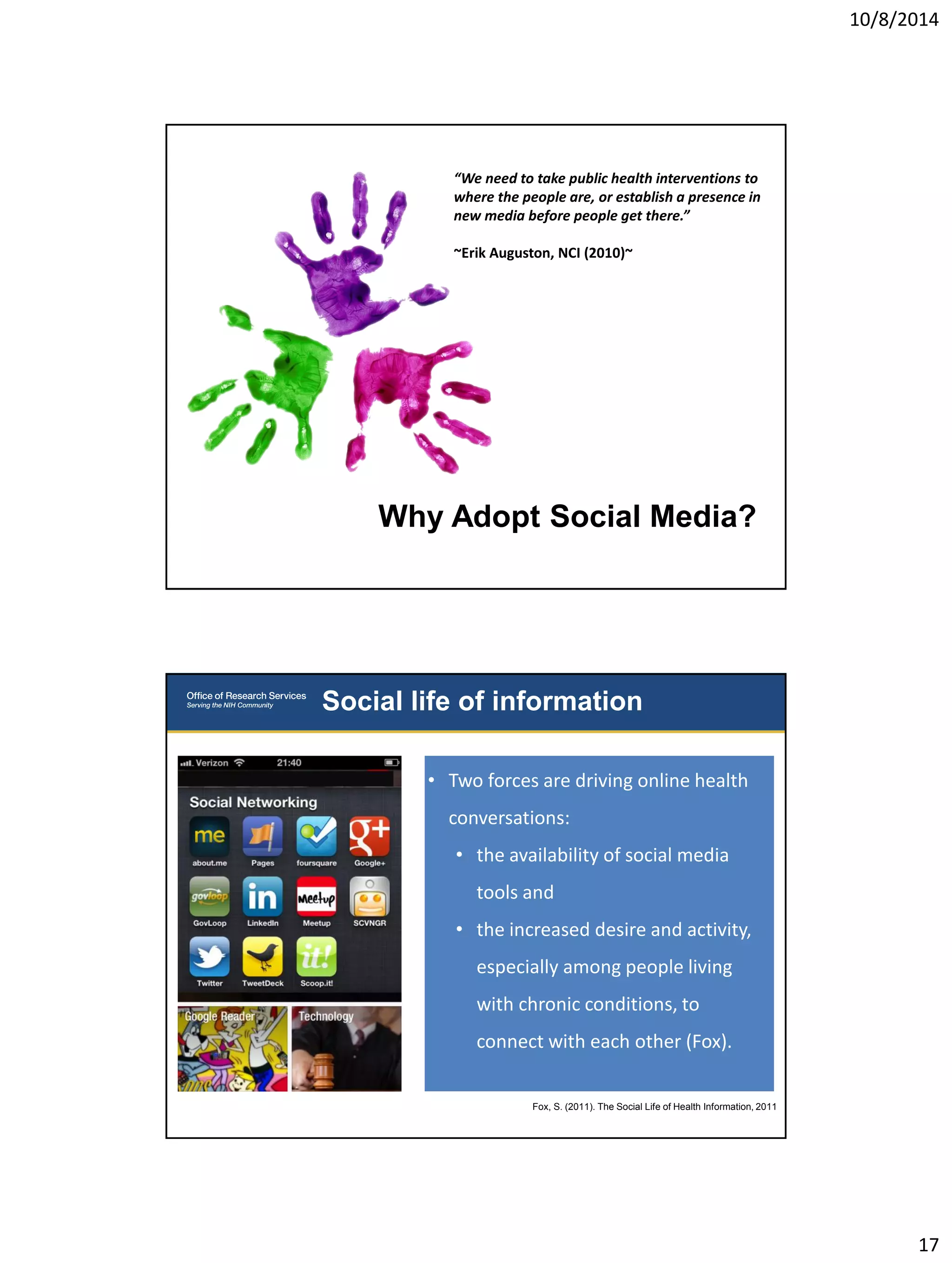
Why Adopt Social Media? 
“We need to take public health interventions to 
where the people are, or establish a presence in 
new media before people get there.” 
~Erik Auguston, NCI (2010)~ 
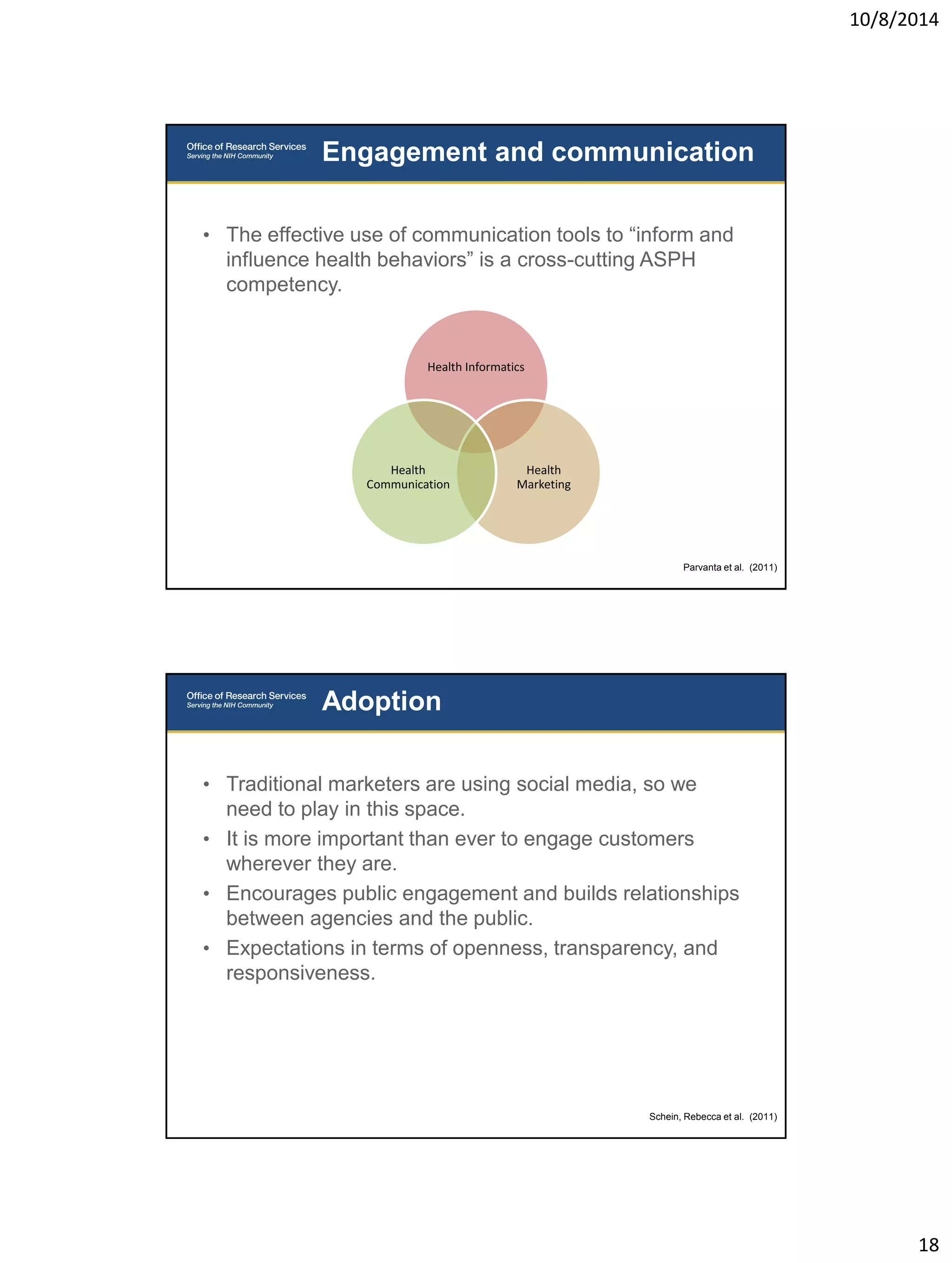
Social life of information 
• Two forces are driving online health 
conversations: 
• the availability of social media 
tools and 
• the increased desire and activity, 
especially among people living 
with chronic conditions, to 
connect with each other (Fox). 
Fox, S. (2011). The Social Life of Health Information, 2011
10/8/2014 
18 
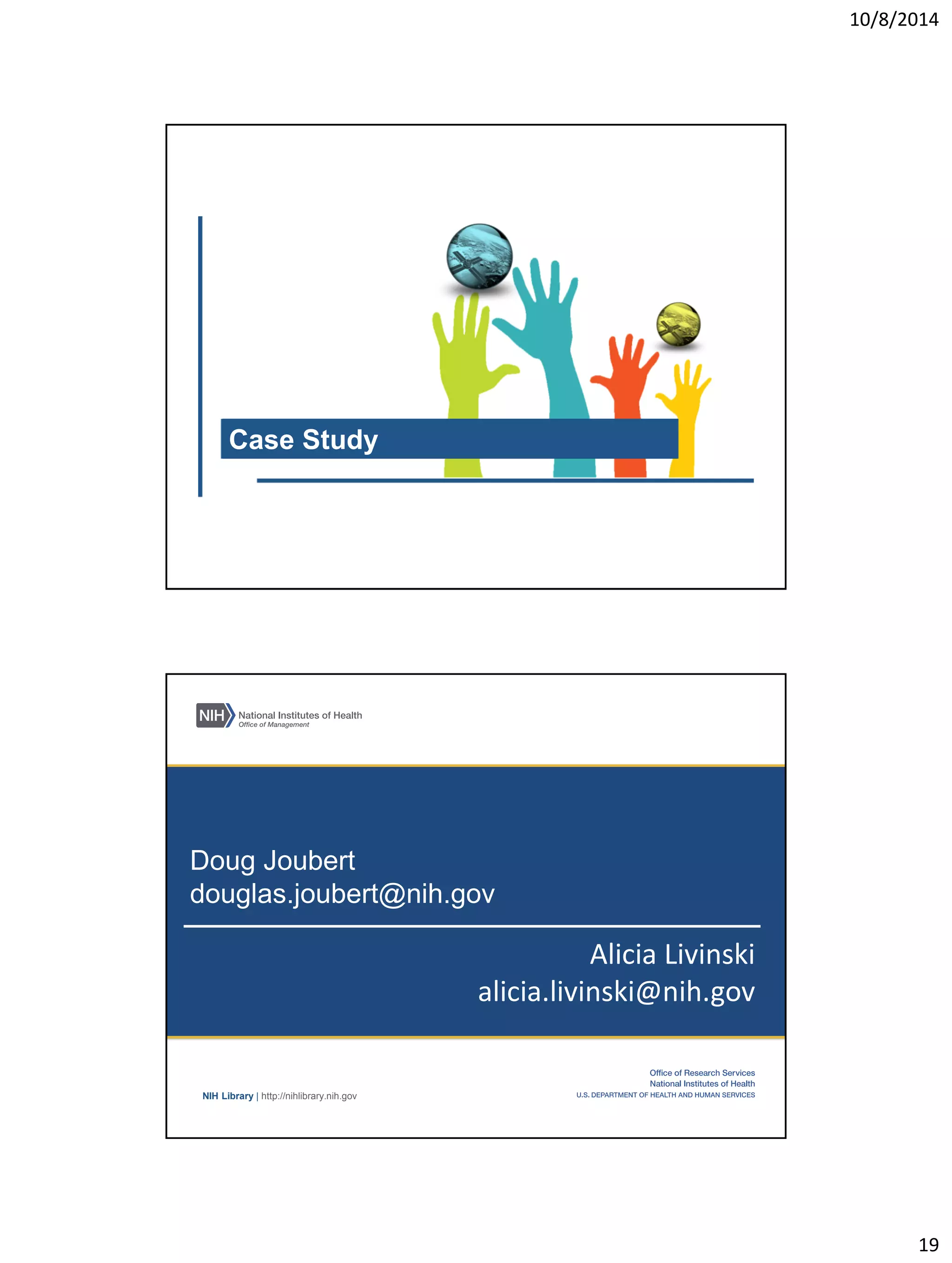
• The effective use of communication tools to “inform and 
influence health behaviors” is a cross-cutting ASPH 
competency. 
Engagement and communication 
Parvanta et al. (2011) 
Health Informatics 
Health 
Marketing 
Health 
Communication 
• Traditional marketers are using social media, so we 
need to play in this space. 
• It is more important than ever to engage customers 
wherever they are. 
• Encourages public engagement and builds relationships 
between agencies and the public. 
• Expectations in terms of openness, transparency, and 
responsiveness. 
Adoption 
Schein, Rebecca et al. (2011)
10/8/2014 
19 
Case Study 
NIH Library | http://nihlibrary.nih.gov 
Doug Joubert 
douglas.joubert@nih.gov 
Alicia Livinski 
alicia.livinski@nih.gov
10/8/2014 
20 
• Calhoun, J. G., Ramiah, K., Weist, E. M., & Shortell, S. 
M. (2008). Development of a core competency model for 
the master of public health degree. American Journal of 
Public Health, 98(9), 1598-1607. 
• Centers for Disease Control and Prevention. (2012). 
CDC’s Guide to writing for social media: CDC Electronic 
Media Branch. 
• Duggan, M., & Brenner, J. (2013). The demographics of 
social media users - 2012: Pew Internet & American Life 
Project. 
References and resources 
• Eysenbach, G. (2011). Can tweets predict citations? 
Metrics of social impact based on Twitter and correlation 
with traditional metrics of scientific impact. J Med 
Internet Res, 13(4). 
• Eysenbach, G., & Group, C.-E. (2011). CONSORT-EHEALTH: 
improving and standardizing evaluation 
reports of Web-based and mobile health interventions. J 
Med Internet Res, 13(4). 
• Facebook. (2013). Best practices guide: Marketing on 
Facebook. 
References and resources
10/8/2014 
21 
• Fordis, M., Street, R. L., Volk, R. J., & Smith, Q. (2011). 
The prospects for web 2.0 technologies for engagement, 
communication, and dissemination in the era of patient-centered 
outcomes research. Eisenberg Conference 
Series 2010 Meeting. Journal of Health Communication, 
16(SUPPL. 1), 3-9. 
• Fox, S. (2012). The social life of health information. Pew 
Research Center's Internet & American Life Project. 
Retrieved from 
http://www.pewinternet.org/Reports/2009/8-The-Social- 
Life-of-Health-Information.aspx 
References and resources 
• Gibbons, M. C., Fleisher, L., Slamon, R. E., Bass, S., 
Kandadai, V., & Beck, J. R. (2011). Exploring the 
Potential of Web 2.0 to Address Health Disparities. 
Journal of Health Communication, 16(sup1), 77-89. 
• Google. (2013). Social media measurement with google 
analytics. 2012, Retrieved from 
http://www.google.com/analytics/features/social.html 
• Hesse, B. W., O'Connell, M., Augustson, E. M., Chou, 
W.-Y. S., Shaikh, A. R., & Finney Rutten, L. J. (2011). 
Realizing the promise of Web 2.0: engaging community 
intelligence. Journal of Health Communication, 16(sup1), 
10-31. 
References and resources
10/8/2014 
22 
• Kanter, B. (2012a). How to create a terrific Facebook 
cover image if you don’t have resources to hire a 
designer. Retrieved from http://www.bethkanter.org/fb-cover- 
images/ 
• Kanter, B. (2012b). Integrated content strategy. Paper 
presented at the New Media for the Networked NGO. 
• Kaplan, A. M., & Haenlein, M. (2010). Users of the world, 
unite! The challenges and opportunities of Social Media. 
Business Horizons, 53(1), 59-68. 
References and resources 
• Parvanta, C. F. (2011). Essentials of public health 
communication. Sudbury, Mass.: Jones & Bartlett 
Learning. 
• Samplin-Salgado, M., & Moore, A. (2011). Doing more 
with less: Efficiently and effectively using new media. 
HHS New Media. AIDS.gov. 
• Schein, R., Wilson, K., & Keelan, J. (2010). Literature 
review on effectiveness of the use of social media: Peel 
Public Health. 
References and resources
10/8/2014 
23 
• The Centers for Disease Control and Prevention. (2011). 
The health communicator’s social media toolkit. 
• Turnbull, A. P., Summers, J. A., Gotto, G., Stowe, M., 
Beauchamp, D., Klein, S., . . . Zuna, N. (2009). Fostering 
wisdom-based action through Web 2.0 communities of 
practice: An example of the early childhood family 
support community of practice. Infants and young 
children, 22(1), 54-62. 
References and resources

Using Social Technologies for Public Health, 2014

  • 1.
    10/8/2014 1 NIHLibrary | http://nihlibrary.nih.gov Doug Joubert – MLIS, MS Alicia Livinski – MPH, MA Using Social Technologies for Public Health JHU Bloomberg School of Public Health June 2014 Disclaimer The views expressed in this presentation are those of the speakers and do not reflect the official policy or position of the National Institutes of Health or the Department of Health and Human Services.
  • 2.
    10/8/2014 2 Ourroadmap The state of social media Case study Social media and public health Examples from the field http://www.go-gulf.com/blog/60-seconds/ The state of social media
  • 3.
    10/8/2014 3 Whatis social media? Kaplan Andreas M., Haenlein Michael, (2010). A shift from one-way conversations to multi-way conversations in which users participate as both creators and consumers of web content. Interactive User-generated Multi-directional Turnbull A et al., (2009) Activity % of internet users who participate Tool appeals primarily to Use any social networking site 67% Adults 18-29, women Use Facebook 67% Adults ages 18-29, women Use Twitter 16% Adults, 19-29, African- Americans, urban residents Use Pinterest 15% Adults under 50, women Whites, those with some college education Use Instagram 13% Adults ages 19-29, African- Americans, Latinos, women, urban residents Use Tumblr 06% Adults ages 18-29 Social media usage in U.S. Source: Pew Internet & American Life Project, 2012
  • 4.
    10/8/2014 4 South America Asia-Pacific Europe Middle East & Africa North America Facebook 67% 60% 47% 45% 36% Twitter 28% 33% 45% 32% 24% Linked-in 2% 1% 2% 11% 5% Google + 2% 2% 4% 2% 3% Pinterest 1% - - 4% 3% Mixi - 4% - - - VKontakte - - 2% - - Other - - - 6% 3% World-wide social network shares Source: emarketer.com (Gigya), 2013 Broadcasting platform for traditional media sources Social media and public health Schein, Rebecca et al. (2011) Collaborating & co-creating to reach target audiences Building relationships Improving trust Heightened authenticity
  • 5.
    10/8/2014 5 •Disseminate health and safety information. • Increase the potential effect of health messages. • Leverage your network of users to share your content. • Engage with your audience. Public health: general uses CDC, (2012) • Create different messages to reach diverse audiences. • Personalize health messages and target them to a particular audience. • Empower people to make safer and healthier decisions. Public health: specific uses CDC, (2012)
  • 6.
    10/8/2014 6 Socialmedia planning Social media planning Adapted from Samplin-Salgado, M., and A Moore. , 2011
  • 7.
    10/8/2014 7 Commonsocial media strategies Social media engagement
  • 8.
    10/8/2014 8 FacebookInsights • Organic: The number of unique people, who saw this post in their News Feed, Ticker, or on your Page. • Viral: The number of unique people who saw this post from a story published by a friend.
  • 9.
    10/8/2014 9 Fee-basedengagement Facebook content calendar
  • 10.
    10/8/2014 10 Google:social flow report http://www.socialmediashop.co.uk/wp-content/uploads/2013/03/sm-monitoring.png Twitter: Social Bro app
  • 11.
    10/8/2014 11 Someinteresting stats…. http://www.mediabistro.com/alltwitter/files/2012/02/t witter-2012-statistics.jpg Important considerations for crafting messages and campaigns using Twitter? Examples from the field
  • 12.
    10/8/2014 12 Facebook Photo-sharing Adapted from Ross Simmons “Ultimate Guide to Instagram Marketing, 2014
  • 13.
    10/8/2014 13 Photo-sharing Adapted from Ross Simmons “Ultimate Guide to Instagram Marketing, 2014 Photo-sharing Adapted from Ross Simmons “Ultimate Guide to Instagram Marketing, 2014
  • 14.
    10/8/2014 14 Twitter Texting and mobile
  • 15.
    10/8/2014 15 Challenges… • Potential for misinformation or bias • Privacy • Security • A lot of noise • Blocked by many agencies and hospitals • Paucity of peer-reviewed testing for communication interventions • Lag between research cycle and changes in social media …overall Eysenback G.. (2010). Schein, Rebecca et al. (2011)
  • 16.
    10/8/2014 16 •Getting the attention of your target group amongst all the online “chatter.” • Understanding what drives user traffic. • Limited online access and poor literacy skills. • Optimizing the SEO so that your message appears where you want it, when you want it. …with messages Users tend to focus on the first 10 hits from Google, Bing, and Yahoo. Schein, Rebecca et al. (2011) • Government agencies are risk-averse and slow to adapt to change. • By the time the campaign is approved, users have moved on to the next platform. • Convoluted communication channels and who can say what, and when. • Consumers now expect answers in hours or days, not weeks or months. …for government agencies Schein, Rebecca et al. (2011)
  • 17.
    10/8/2014 17 WhyAdopt Social Media? “We need to take public health interventions to where the people are, or establish a presence in new media before people get there.” ~Erik Auguston, NCI (2010)~ Social life of information • Two forces are driving online health conversations: • the availability of social media tools and • the increased desire and activity, especially among people living with chronic conditions, to connect with each other (Fox). Fox, S. (2011). The Social Life of Health Information, 2011
  • 18.
    10/8/2014 18 •The effective use of communication tools to “inform and influence health behaviors” is a cross-cutting ASPH competency. Engagement and communication Parvanta et al. (2011) Health Informatics Health Marketing Health Communication • Traditional marketers are using social media, so we need to play in this space. • It is more important than ever to engage customers wherever they are. • Encourages public engagement and builds relationships between agencies and the public. • Expectations in terms of openness, transparency, and responsiveness. Adoption Schein, Rebecca et al. (2011)
  • 19.
    10/8/2014 19 CaseStudy NIH Library | http://nihlibrary.nih.gov Doug Joubert douglas.joubert@nih.gov Alicia Livinski alicia.livinski@nih.gov
  • 20.
    10/8/2014 20 •Calhoun, J. G., Ramiah, K., Weist, E. M., & Shortell, S. M. (2008). Development of a core competency model for the master of public health degree. American Journal of Public Health, 98(9), 1598-1607. • Centers for Disease Control and Prevention. (2012). CDC’s Guide to writing for social media: CDC Electronic Media Branch. • Duggan, M., & Brenner, J. (2013). The demographics of social media users - 2012: Pew Internet & American Life Project. References and resources • Eysenbach, G. (2011). Can tweets predict citations? Metrics of social impact based on Twitter and correlation with traditional metrics of scientific impact. J Med Internet Res, 13(4). • Eysenbach, G., & Group, C.-E. (2011). CONSORT-EHEALTH: improving and standardizing evaluation reports of Web-based and mobile health interventions. J Med Internet Res, 13(4). • Facebook. (2013). Best practices guide: Marketing on Facebook. References and resources
  • 21.
    10/8/2014 21 •Fordis, M., Street, R. L., Volk, R. J., & Smith, Q. (2011). The prospects for web 2.0 technologies for engagement, communication, and dissemination in the era of patient-centered outcomes research. Eisenberg Conference Series 2010 Meeting. Journal of Health Communication, 16(SUPPL. 1), 3-9. • Fox, S. (2012). The social life of health information. Pew Research Center's Internet & American Life Project. Retrieved from http://www.pewinternet.org/Reports/2009/8-The-Social- Life-of-Health-Information.aspx References and resources • Gibbons, M. C., Fleisher, L., Slamon, R. E., Bass, S., Kandadai, V., & Beck, J. R. (2011). Exploring the Potential of Web 2.0 to Address Health Disparities. Journal of Health Communication, 16(sup1), 77-89. • Google. (2013). Social media measurement with google analytics. 2012, Retrieved from http://www.google.com/analytics/features/social.html • Hesse, B. W., O'Connell, M., Augustson, E. M., Chou, W.-Y. S., Shaikh, A. R., & Finney Rutten, L. J. (2011). Realizing the promise of Web 2.0: engaging community intelligence. Journal of Health Communication, 16(sup1), 10-31. References and resources
  • 22.
    10/8/2014 22 •Kanter, B. (2012a). How to create a terrific Facebook cover image if you don’t have resources to hire a designer. Retrieved from http://www.bethkanter.org/fb-cover- images/ • Kanter, B. (2012b). Integrated content strategy. Paper presented at the New Media for the Networked NGO. • Kaplan, A. M., & Haenlein, M. (2010). Users of the world, unite! The challenges and opportunities of Social Media. Business Horizons, 53(1), 59-68. References and resources • Parvanta, C. F. (2011). Essentials of public health communication. Sudbury, Mass.: Jones & Bartlett Learning. • Samplin-Salgado, M., & Moore, A. (2011). Doing more with less: Efficiently and effectively using new media. HHS New Media. AIDS.gov. • Schein, R., Wilson, K., & Keelan, J. (2010). Literature review on effectiveness of the use of social media: Peel Public Health. References and resources
  • 23.
    10/8/2014 23 •The Centers for Disease Control and Prevention. (2011). The health communicator’s social media toolkit. • Turnbull, A. P., Summers, J. A., Gotto, G., Stowe, M., Beauchamp, D., Klein, S., . . . Zuna, N. (2009). Fostering wisdom-based action through Web 2.0 communities of practice: An example of the early childhood family support community of practice. Infants and young children, 22(1), 54-62. References and resources