Social Media in Healthcare Overview and Current Realities Ed Bennett University of Maryland Medical System 21 st  Annual Summer Institute of Nursing Informatics University of Maryland School of Nursing, July 21, 2011
Table of Contents My Background Social Media What it is and what it isn’t  Why it Matters Special Issues for Healthcare Hospitals and Social Media Rapid adoption Current stats Examples Trends Opportunities for Healthcare Professionals
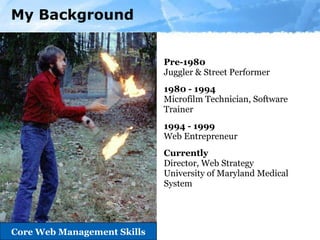
My Background Pre-1980  Juggler & Street Performer  1980 - 1994  Microfilm Technician, Software Trainer 1994 - 1999 Web Entrepreneur  Currently Director, Web Strategy University of Maryland Medical System Page     Core Web Management Skills
Page     La Primavera by Botticelli
What is Social Media? Conversation, not a lecture Extension of everyday interaction Group driven, not top-down  Messy, disorganized, hard to control Tool, not a strategy or end-point Where patients and employees spend time
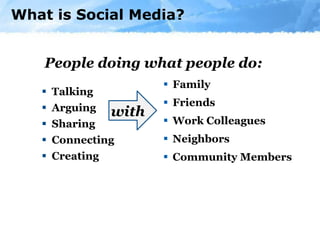
What is Social Media? Talking Arguing Sharing Connecting Creating Family Friends Work Colleagues Neighbors Community Members People doing what people do: with
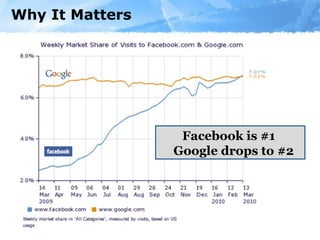
Why It Matters Facebook is #1  Google drops to #2
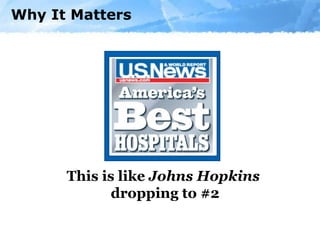
Why It Matters This is like  Johns   Hopkins   dropping to #2
 
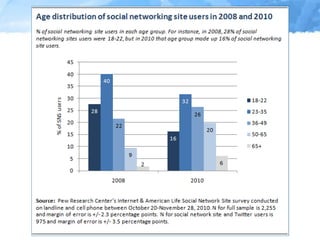
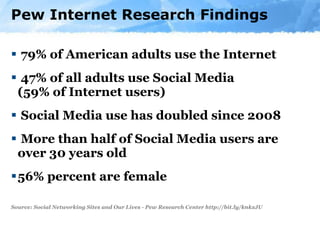
Pew Internet Research Findings 79% of American adults use the Internet 47% of all adults use Social Media  (59% of Internet users) Social Media use has doubled since 2008 More than half of Social Media users are over 30 years old 56% percent are female Source: Social Networking Sites and Our Lives - Pew Research Center http://bit.ly/knkxJU
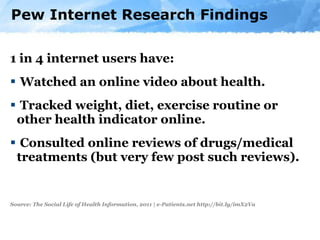
1 in 4 internet users have: Watched an online video about health. Tracked weight, diet, exercise routine or other health indicator online. Consulted online reviews of drugs/medical treatments (but very few post such reviews). Source: The Social Life of Health Information, 2011 | e-Patients.net http://bit.ly/imX2Va Pew Internet Research Findings
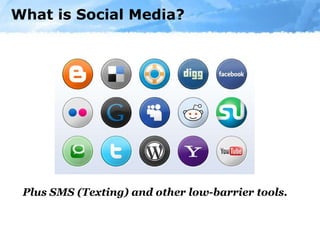
What is Social Media? Plus SMS (Texting) and other low-barrier tools.
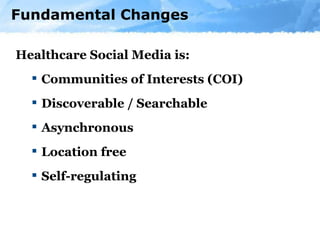
Fundamental Changes Healthcare Social Media is: Communities of Interests (COI) Discoverable / Searchable Asynchronous  Location free  Self-regulating
Fundamental Changes Healthcare Social Media allows for: Low/no cost entry for participation Exploration and discovery at users’ pace Near real-time interactions Redefining work and friendship networks Rapid development and change (3:1)
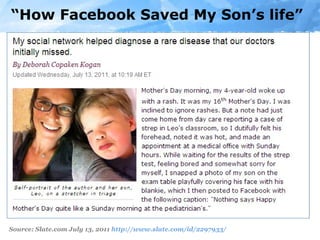
“ How Facebook Saved My Son’s life” Source: Slate.com July 13, 2011  http://www.slate.com/id/2297933/
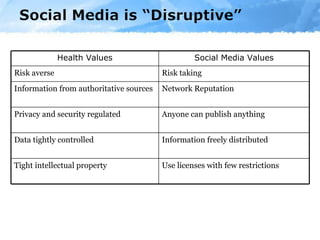
Health Values Social Media Values Risk averse Risk taking Information from authoritative sources Network Reputation  Privacy and security regulated  Anyone can publish anything Data tightly controlled Information freely distributed Tight intellectual property  Use licenses with few restrictions
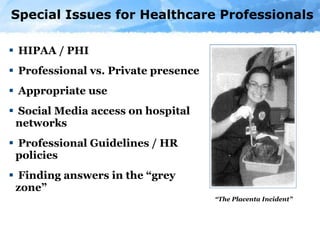
Special Issues for Healthcare Professionals  HIPAA / PHI Professional vs. Private presence Appropriate use Social Media access on hospital  networks Professional Guidelines / HR policies Finding answers in the “grey zone” “ The Placenta Incident”
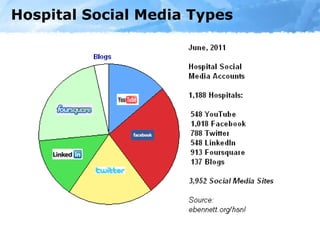
Hospital Social Media Types
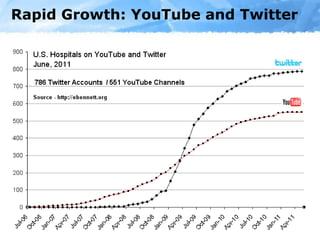
Rapid Growth: YouTube and Twitter
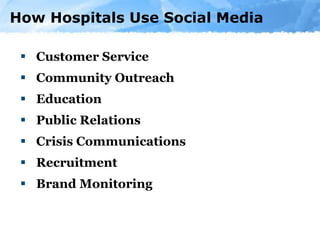
How Hospitals Use Social Media Customer Service  Community Outreach  Education Public Relations  Crisis Communications Recruitment Brand Monitoring
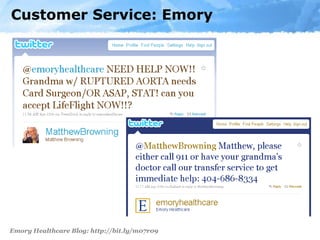
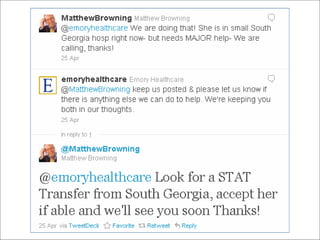
Customer Service: Emory Emory Healthcare Blog: http://bit.ly/m07r09
Emory Healthcare Blog: http://bit.ly/m07r09
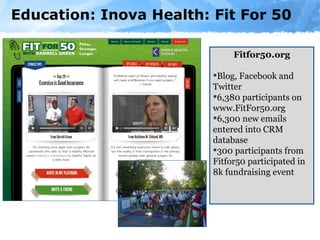
Education: Inova Health: Fit For 50 Fitfor50.org Blog, Facebook and Twitter 6,380 participants on www.FitFor50.org 6,300 new emails entered into CRM database 300 participants from Fitfor50 participated in 8k fundraising event
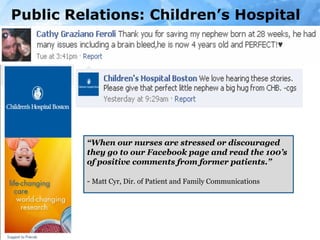
Public Relations: Children’s Hospital “ When our nurses are stressed or discouraged they go to our Facebook page and read the 100’s of positive comments from former patients.”  -  Matt Cyr, Dir. of Patient and Family Communications
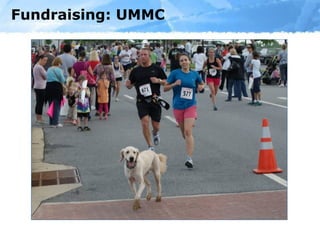
Fundraising: UMMC
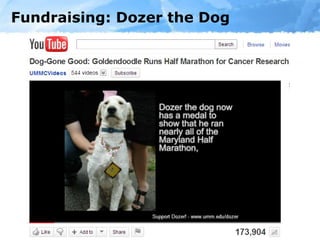
Fundraising: Dozer the Dog
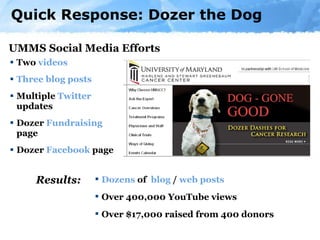
Two  videos Three   blog   posts Multiple  Twitter  updates Dozer  Fundraising  page Dozer  Facebook  page Quick Response: Dozer the Dog Dozens  of  blog  /  web posts Over 400,000 YouTube views Over $17,000 raised from 400 donors UMMS Social Media Efforts Results:
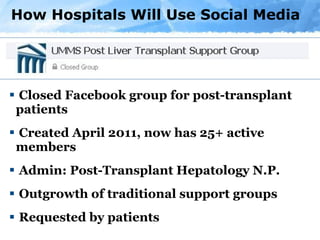
How Hospitals Will Use Social Media Closed Facebook group for post-transplant patients Created April 2011, now has 25+ active members Admin: Post-Transplant Hepatology N.P. Outgrowth of traditional support groups Requested by patients
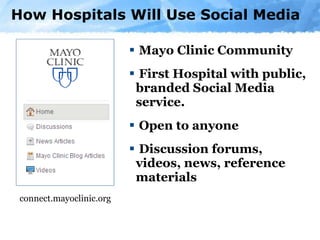
How Hospitals Will Use Social Media Mayo Clinic Community First Hospital with public, branded Social Media service. Open to anyone  Discussion forums, videos, news, reference materials connect.mayoclinic.org
Getting Started – Weekly Twitter Chats #Rnchat: Nurses - Tuesday 9pm #HCSM: General healthcare social media chat - Sunday 9pm #HITsm: Health IT and Social media - Monday 9pm
Q&A Social Media has already become, or must become,  integrated into how we do business. Discuss.
Edward Bennett Director Web / Communications Technologies University of Maryland Medical System Phone: 410-328-0771 Email: ebennett@umm.edu  / ed@ebennett.org  Web: umm.edu - ebennett.org Twitter: @edbennett Presentation and resource links: http://ebennett.org/SINI

Social Media in Healthcare - Overview and Current Realities

  • 1.
    Social Media inHealthcare Overview and Current Realities Ed Bennett University of Maryland Medical System 21 st Annual Summer Institute of Nursing Informatics University of Maryland School of Nursing, July 21, 2011
  • 2.
    Table of ContentsMy Background Social Media What it is and what it isn’t Why it Matters Special Issues for Healthcare Hospitals and Social Media Rapid adoption Current stats Examples Trends Opportunities for Healthcare Professionals
  • 3.
    My Background Pre-1980 Juggler & Street Performer 1980 - 1994 Microfilm Technician, Software Trainer 1994 - 1999 Web Entrepreneur Currently Director, Web Strategy University of Maryland Medical System Page  Core Web Management Skills
  • 4.
    Page  La Primavera by Botticelli
  • 5.
    What is SocialMedia? Conversation, not a lecture Extension of everyday interaction Group driven, not top-down Messy, disorganized, hard to control Tool, not a strategy or end-point Where patients and employees spend time
  • 6.
    What is SocialMedia? Talking Arguing Sharing Connecting Creating Family Friends Work Colleagues Neighbors Community Members People doing what people do: with
  • 7.
    Why It MattersFacebook is #1 Google drops to #2
  • 8.
    Why It MattersThis is like Johns Hopkins dropping to #2
  • 9.
  • 10.
    Pew Internet ResearchFindings 79% of American adults use the Internet 47% of all adults use Social Media (59% of Internet users) Social Media use has doubled since 2008 More than half of Social Media users are over 30 years old 56% percent are female Source: Social Networking Sites and Our Lives - Pew Research Center http://bit.ly/knkxJU
  • 11.
    1 in 4internet users have: Watched an online video about health. Tracked weight, diet, exercise routine or other health indicator online. Consulted online reviews of drugs/medical treatments (but very few post such reviews). Source: The Social Life of Health Information, 2011 | e-Patients.net http://bit.ly/imX2Va Pew Internet Research Findings
  • 12.
    What is SocialMedia? Plus SMS (Texting) and other low-barrier tools.
  • 13.
    Fundamental Changes HealthcareSocial Media is: Communities of Interests (COI) Discoverable / Searchable Asynchronous Location free Self-regulating
  • 14.
    Fundamental Changes HealthcareSocial Media allows for: Low/no cost entry for participation Exploration and discovery at users’ pace Near real-time interactions Redefining work and friendship networks Rapid development and change (3:1)
  • 15.
    “ How FacebookSaved My Son’s life” Source: Slate.com July 13, 2011 http://www.slate.com/id/2297933/
  • 16.
    Health Values SocialMedia Values Risk averse Risk taking Information from authoritative sources Network Reputation Privacy and security regulated Anyone can publish anything Data tightly controlled Information freely distributed Tight intellectual property Use licenses with few restrictions
  • 17.
    Special Issues forHealthcare Professionals HIPAA / PHI Professional vs. Private presence Appropriate use Social Media access on hospital networks Professional Guidelines / HR policies Finding answers in the “grey zone” “ The Placenta Incident”
  • 18.
  • 19.
  • 20.
    How Hospitals UseSocial Media Customer Service Community Outreach Education Public Relations Crisis Communications Recruitment Brand Monitoring
  • 21.
    Customer Service: EmoryEmory Healthcare Blog: http://bit.ly/m07r09
  • 22.
    Emory Healthcare Blog:http://bit.ly/m07r09
  • 23.
    Education: Inova Health:Fit For 50 Fitfor50.org Blog, Facebook and Twitter 6,380 participants on www.FitFor50.org 6,300 new emails entered into CRM database 300 participants from Fitfor50 participated in 8k fundraising event
  • 24.
    Public Relations: Children’sHospital “ When our nurses are stressed or discouraged they go to our Facebook page and read the 100’s of positive comments from former patients.” - Matt Cyr, Dir. of Patient and Family Communications
  • 25.
  • 26.
  • 27.
    Two videosThree blog posts Multiple Twitter updates Dozer Fundraising page Dozer Facebook page Quick Response: Dozer the Dog Dozens of blog / web posts Over 400,000 YouTube views Over $17,000 raised from 400 donors UMMS Social Media Efforts Results:
  • 28.
    How Hospitals WillUse Social Media Closed Facebook group for post-transplant patients Created April 2011, now has 25+ active members Admin: Post-Transplant Hepatology N.P. Outgrowth of traditional support groups Requested by patients
  • 29.
    How Hospitals WillUse Social Media Mayo Clinic Community First Hospital with public, branded Social Media service. Open to anyone Discussion forums, videos, news, reference materials connect.mayoclinic.org
  • 30.
    Getting Started –Weekly Twitter Chats #Rnchat: Nurses - Tuesday 9pm #HCSM: General healthcare social media chat - Sunday 9pm #HITsm: Health IT and Social media - Monday 9pm
  • 31.
    Q&A Social Mediahas already become, or must become, integrated into how we do business. Discuss.
  • 32.
    Edward Bennett DirectorWeb / Communications Technologies University of Maryland Medical System Phone: 410-328-0771 Email: ebennett@umm.edu / ed@ebennett.org Web: umm.edu - ebennett.org Twitter: @edbennett Presentation and resource links: http://ebennett.org/SINI

Editor's Notes

  • #3 It’s fundamentally different than traditional one-to-many models. Models that give complete control to the publisher.
  • #6 It’s fundamentally different than traditional one-to-many models. Models that give complete control to the publisher.
  • #7 It’s fundamentally different than traditional one-to-many models. Models that give complete control to the publisher.
  • #8 It’s fundamentally different than traditional one-to-many models. Models that give complete control to the publisher.
  • #13 It’s fundamentally different than traditional one-to-many models. Models that give complete control to the publisher.
  • #21 Here's are a few of the ways Hospitals are using Social Media right now. (focus on the Patient Ed / Customer Service / Brand monitoring points)
  • #22 It’s fundamentally different than traditional one-to-many models. Models that give complete control to the publisher.
  • #23 It’s fundamentally different than traditional one-to-many models. Models that give complete control to the publisher.