WORKSHOP ON PERINATAL PEDIATRIC STRATEGIES SCOTTSDALE, AZ  APRIL 9-11, 2010 CLARA SONG, MD USC Division of Neonatal Medicine of the  LAC+USC Medical Center and Childrens Hospital Los Angeles Keck School of Medicine University of Southern California Los Angeles, CA The Virtual Team: Social Networking and the NICU
DISCLOSURE I have no relevant financial relationships with the manufacturers of any commercial products and/or provider of commercial services discussed in this CME activity. I do not intend to discuss an unapproved or investigative use of commercial products or devices.
OBJECTIVES To define social media and its evolution To classify the current available web-based tools To utilize web-based tools in an effort to facilitate collaboration between health professionals
 
Social media has taken over porn as the  #1  activity on the web Source: Social Media Revolution from Socialnomics.net
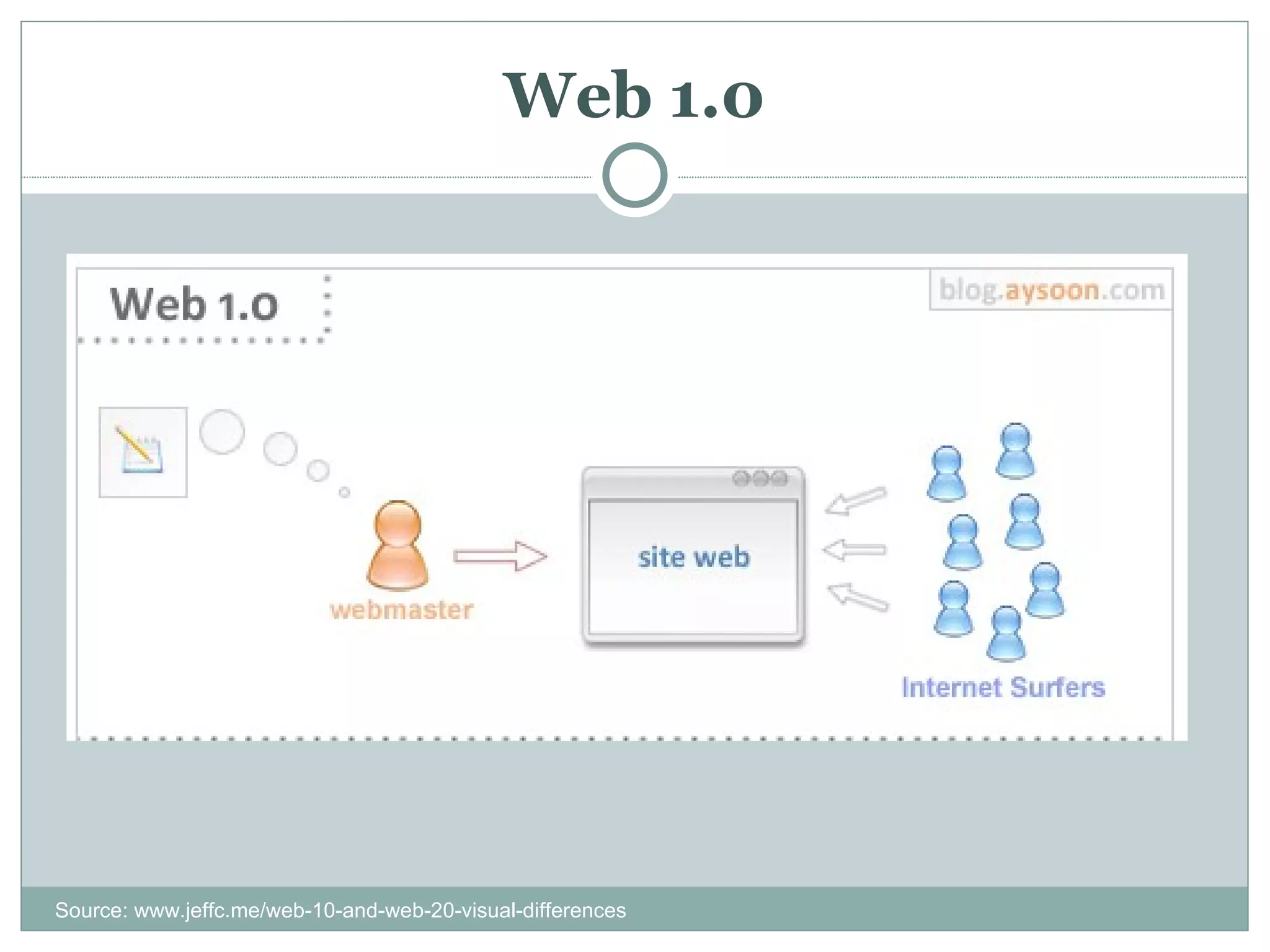
Web 1.0 Source: www.jeffc.me/web-10-and-web-20-visual-differences
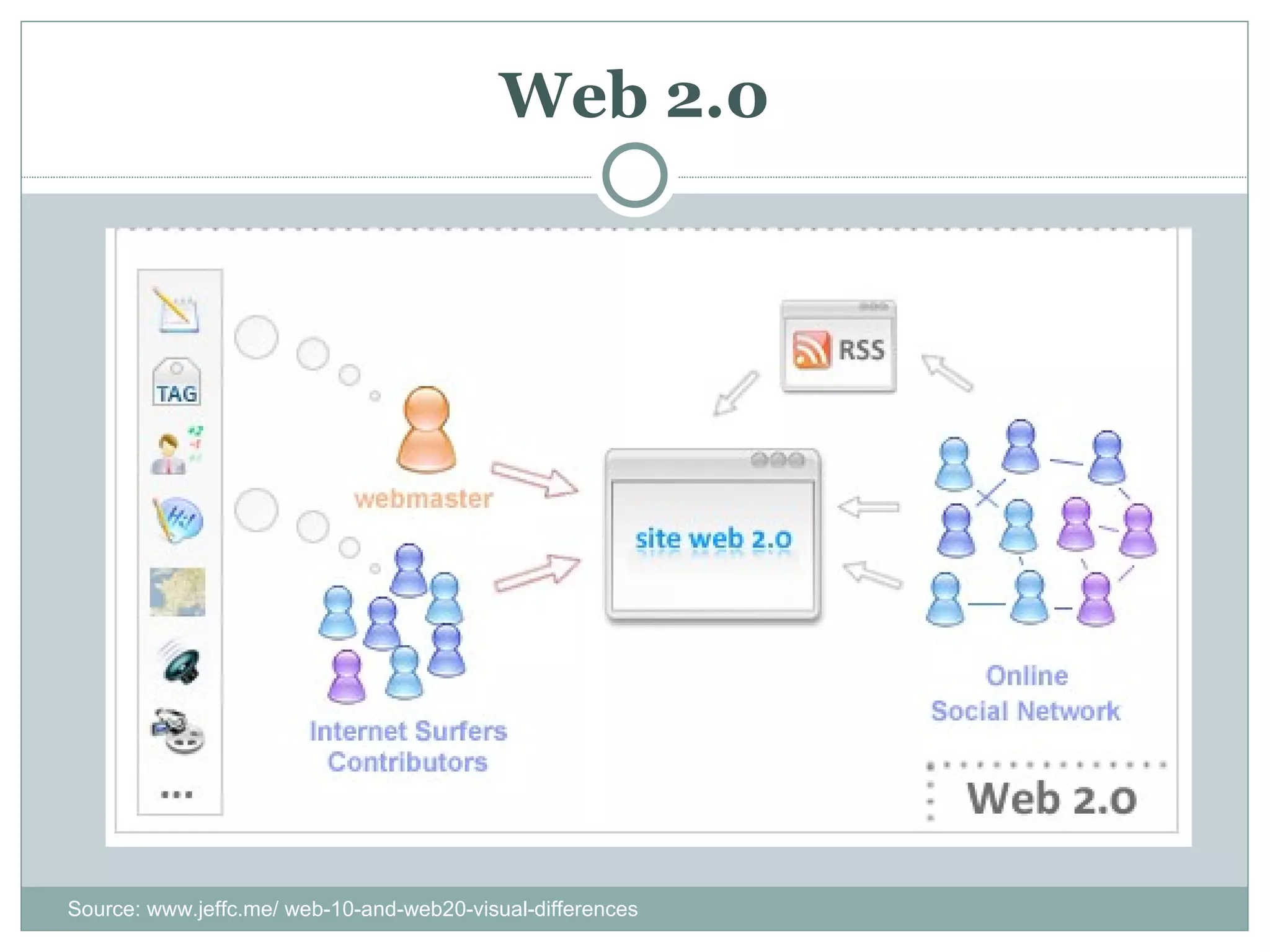
Web 2.0 Source: www.jeffc.me/ web-10-and-web20-visual-differences
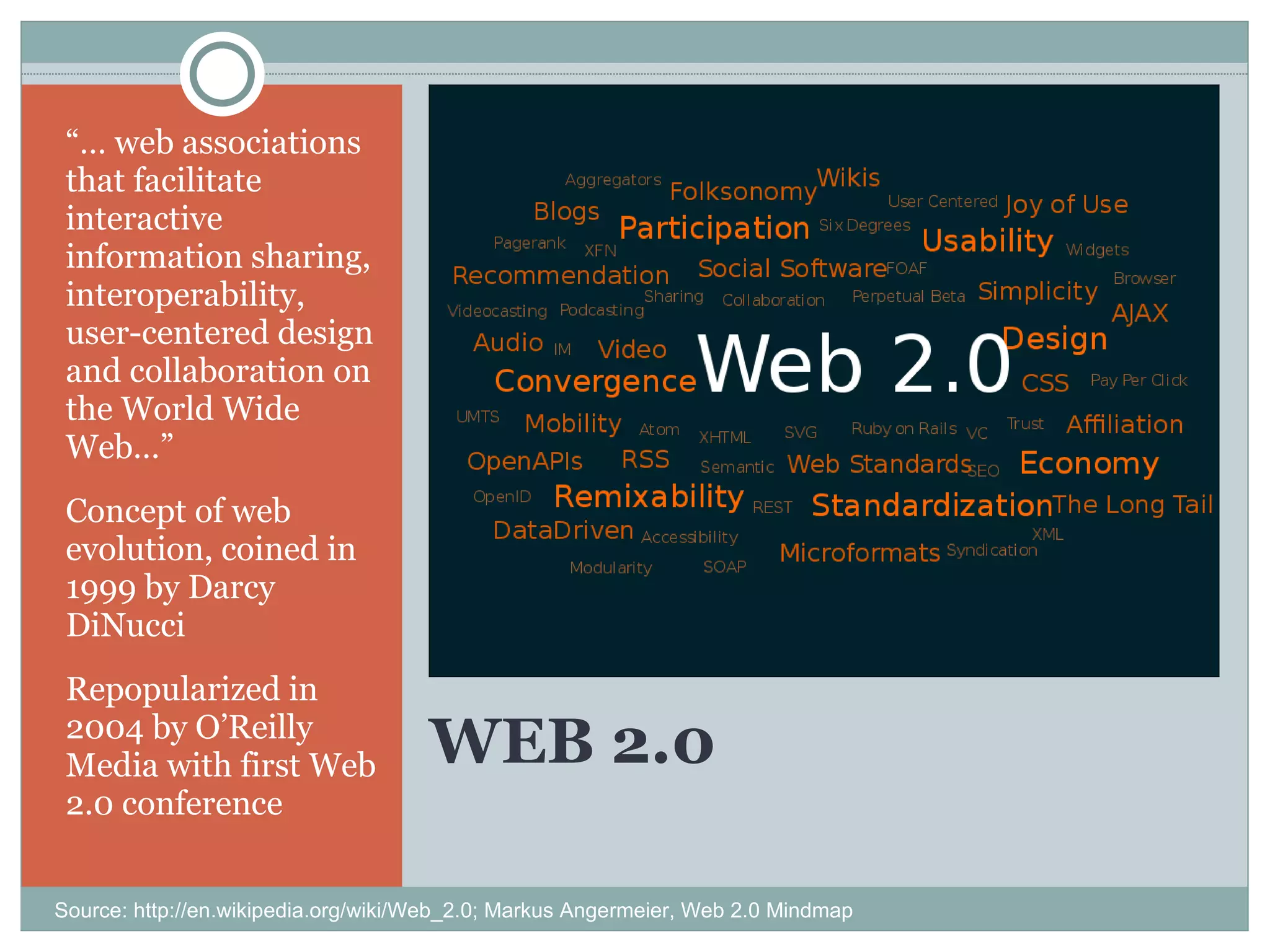
WEB 2.0 “…  web associations that facilitate interactive information sharing, interoperability, user-centered design and collaboration on the World Wide Web…” Concept of web evolution, coined in 1999 by Darcy DiNucci Repopularized in 2004 by O’Reilly Media with first Web 2.0 conference Source: http://en.wikipedia.org/wiki/Web_2.0; Markus Angermeier, Web 2.0 Mindmap
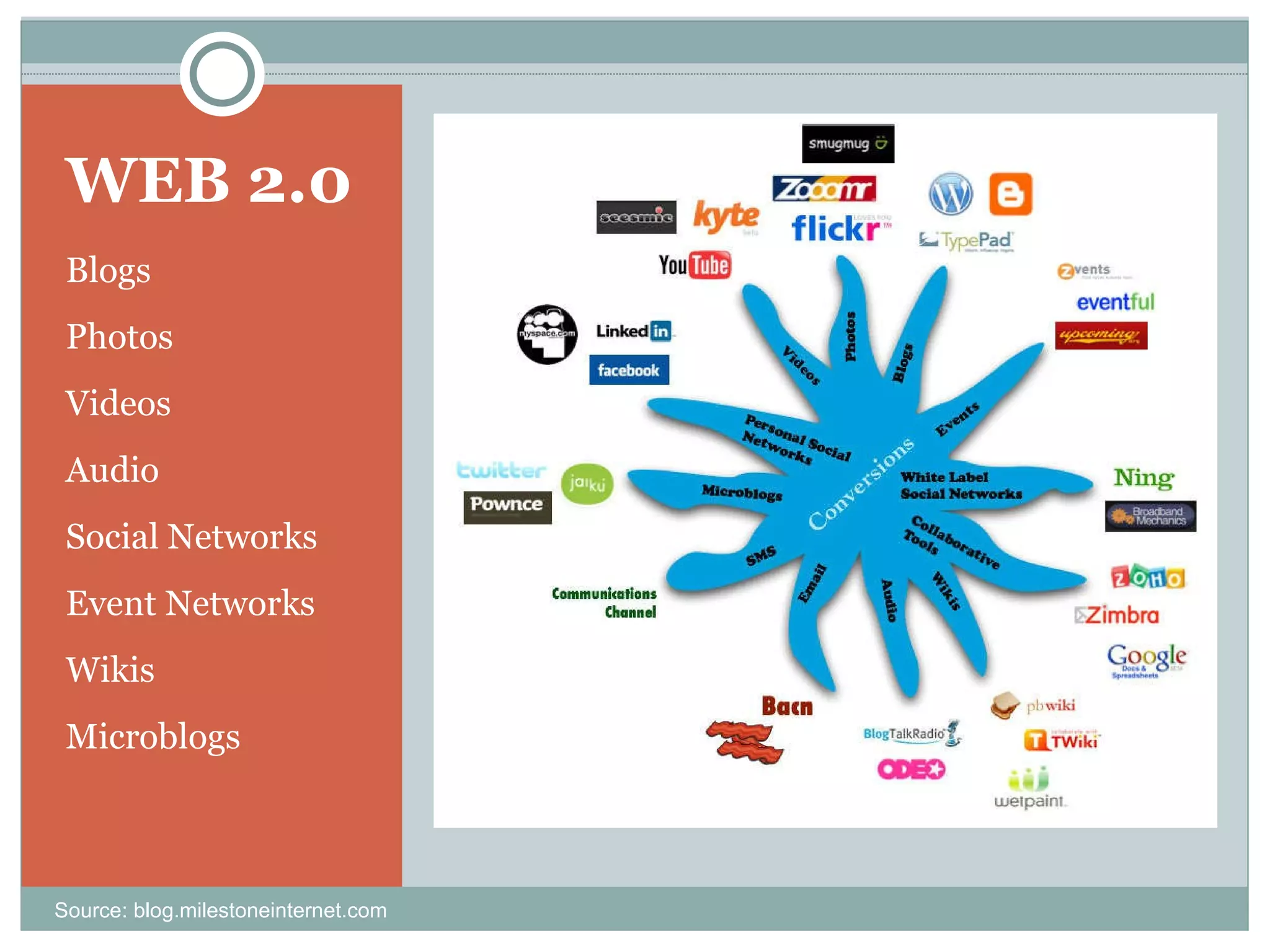
WEB 2.0 Blogs Photos Videos Audio Social Networks Event Networks Wikis Microblogs Source: blog.milestoneinternet.com
Web 2.0 Source: fasticon.com
Social Media Concept Media Social interface Social media is a “group of Internet-based applications…that build on the foundations of Web 2.0, and that allow the creation and exchange user-generated content.”  Social media uses Internet and web-based technologies to transform broadcast media monologues (one to many) into social media dialogues (many to many). It supports the  democratization  of knowledge and information, transforming people from content consumers into content producers. Source: http://en.wikipedia.org/wiki/Social_media
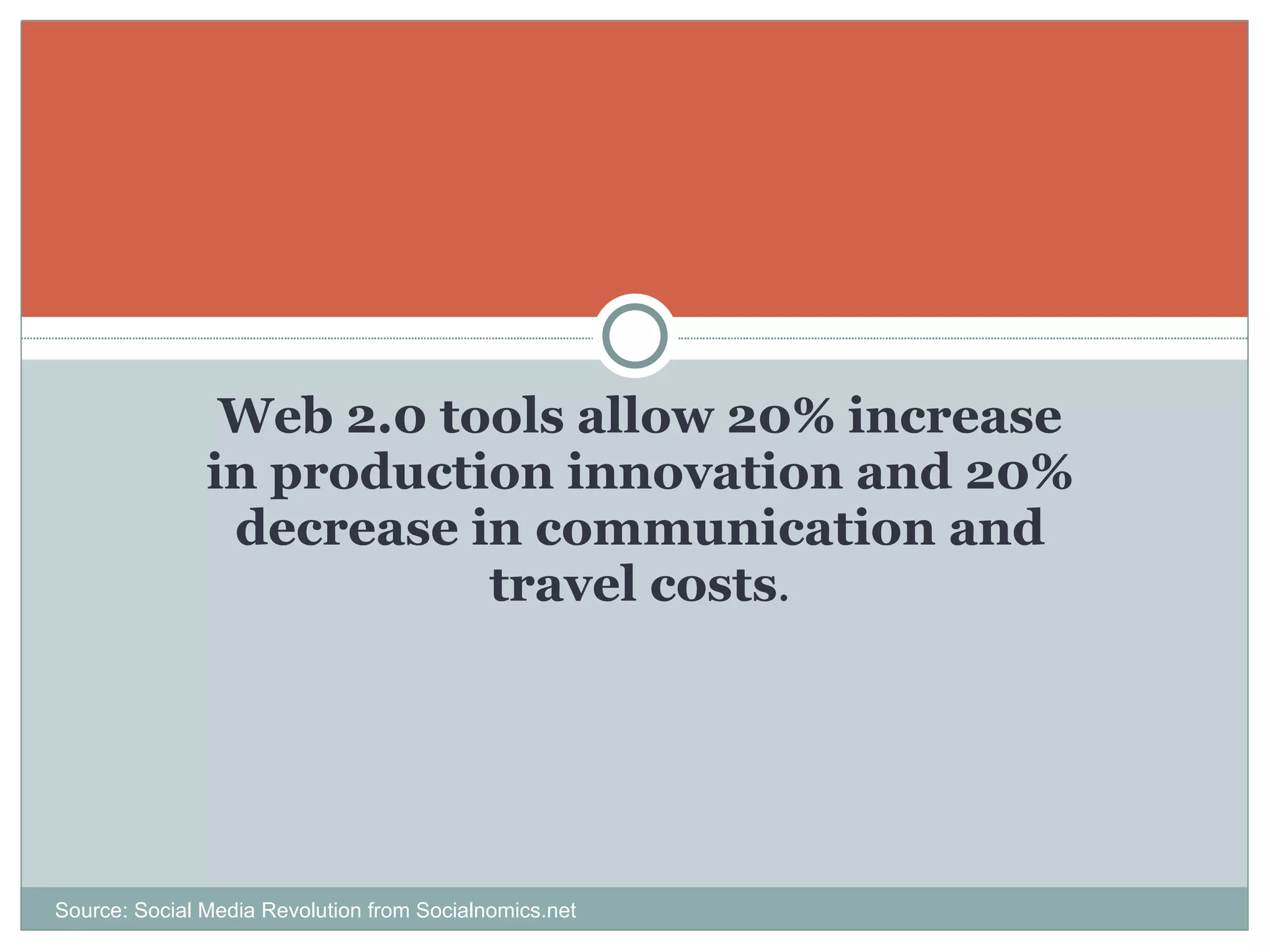
Web 2.0 tools allow 20% increase in production innovation and 20% decrease in communication and travel costs . Source: Social Media Revolution from Socialnomics.net
Social Media is Changing Our Lives Shift in communication to focus on honesty and transparency. Social media sites, like Facebook and Twitter, are becoming trusted sources of information and communication. New relationships are being created and old ones maintained. Average citizens have the opportunity to influence public opinion and policies. New possibilities have been opened for those launching and/or promoting a business. Source: mashable.com/2009/10/16/social-media-changing-lives/
SOCIAL MEDIA Unveiling the truth behind the mystery
“… it’s a fundamental shift in the way we communicate.” “ Social media is NOT a fad…
Social Media: Reaching out and having a conversation. Source: www.telegraph.co.uk
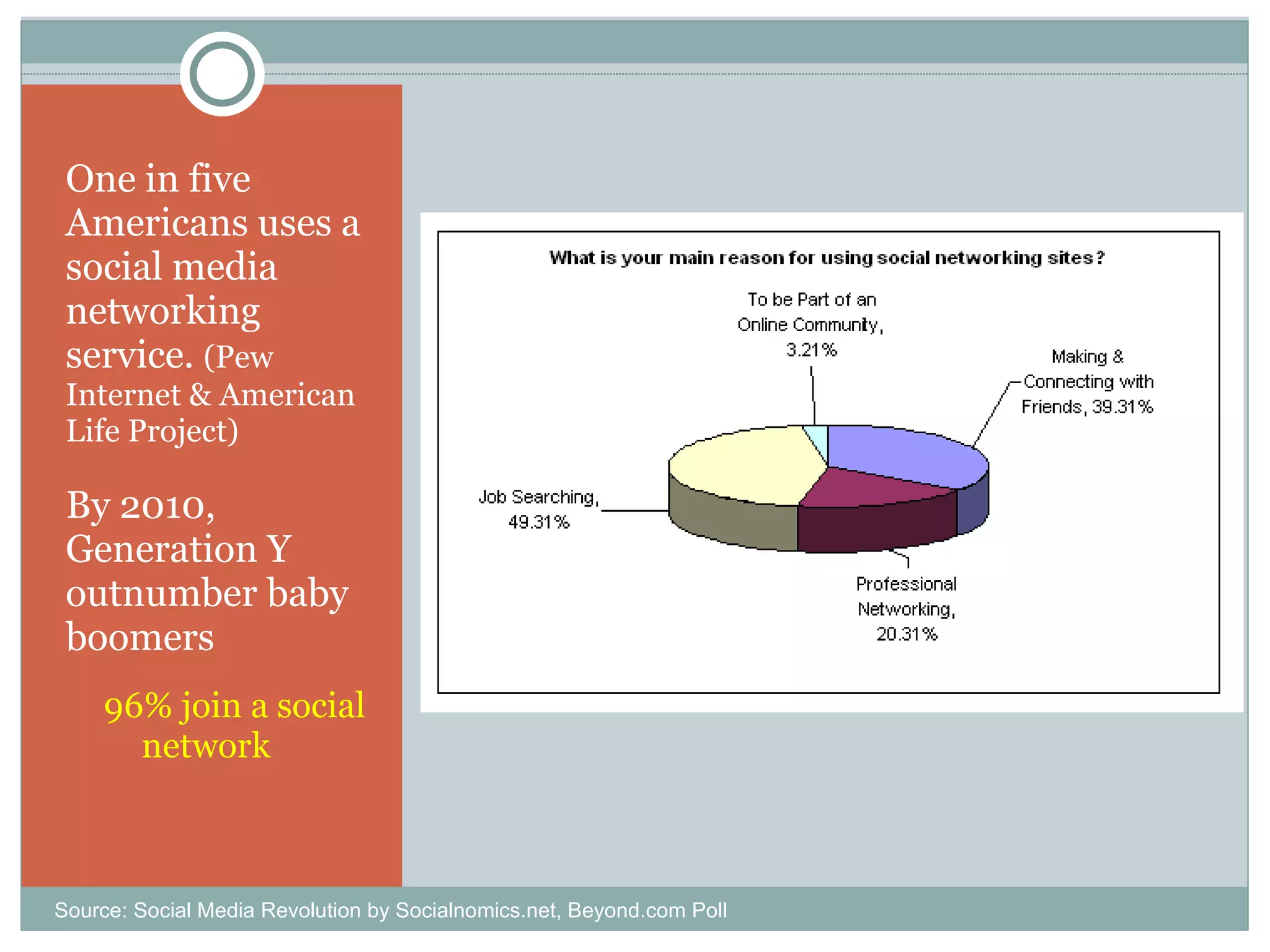
One in five Americans uses a social media networking service.  (Pew Internet & American Life Project) By 2010, Generation Y outnumber baby boomers 96% join a social network Source: Social Media Revolution by Socialnomics.net, Beyond.com Poll
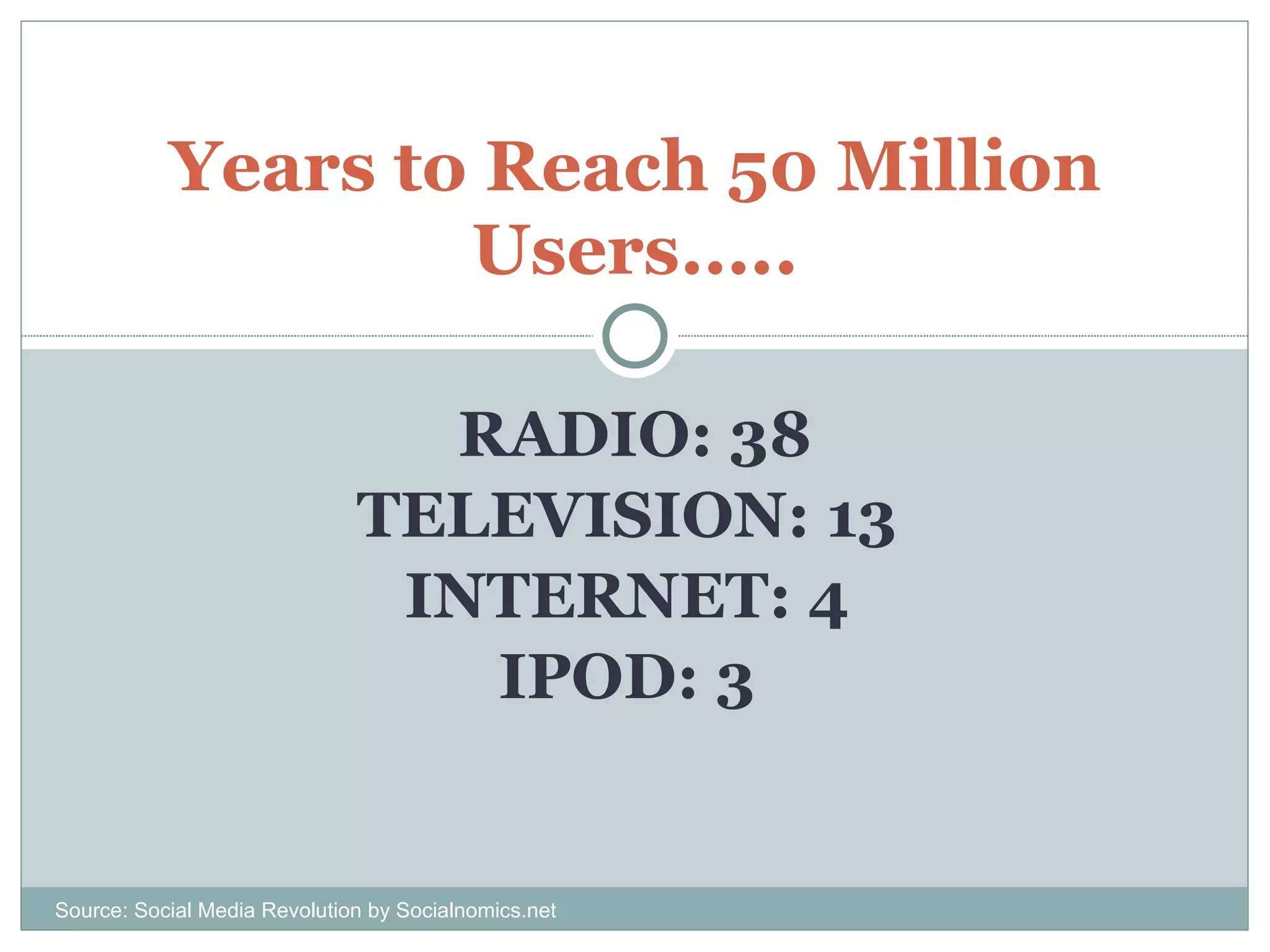
RADIO: 38 TELEVISION: 13  INTERNET: 4  IPOD: 3  Years to Reach 50 Million Users ….. Source: Social Media Revolution by Socialnomics.net
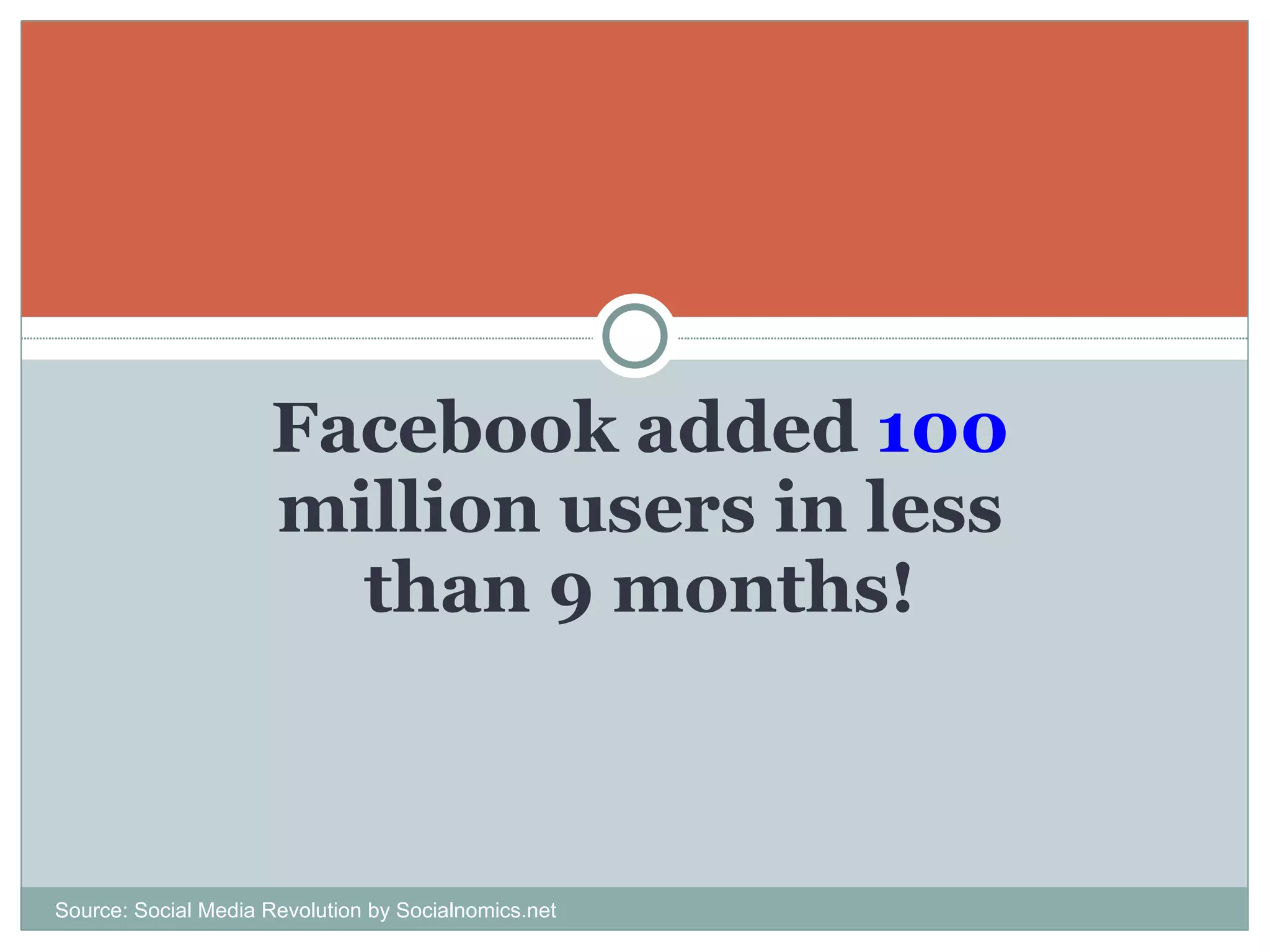
Facebook added  100   million users in less than 9 months! Source: Social Media Revolution by Socialnomics.net
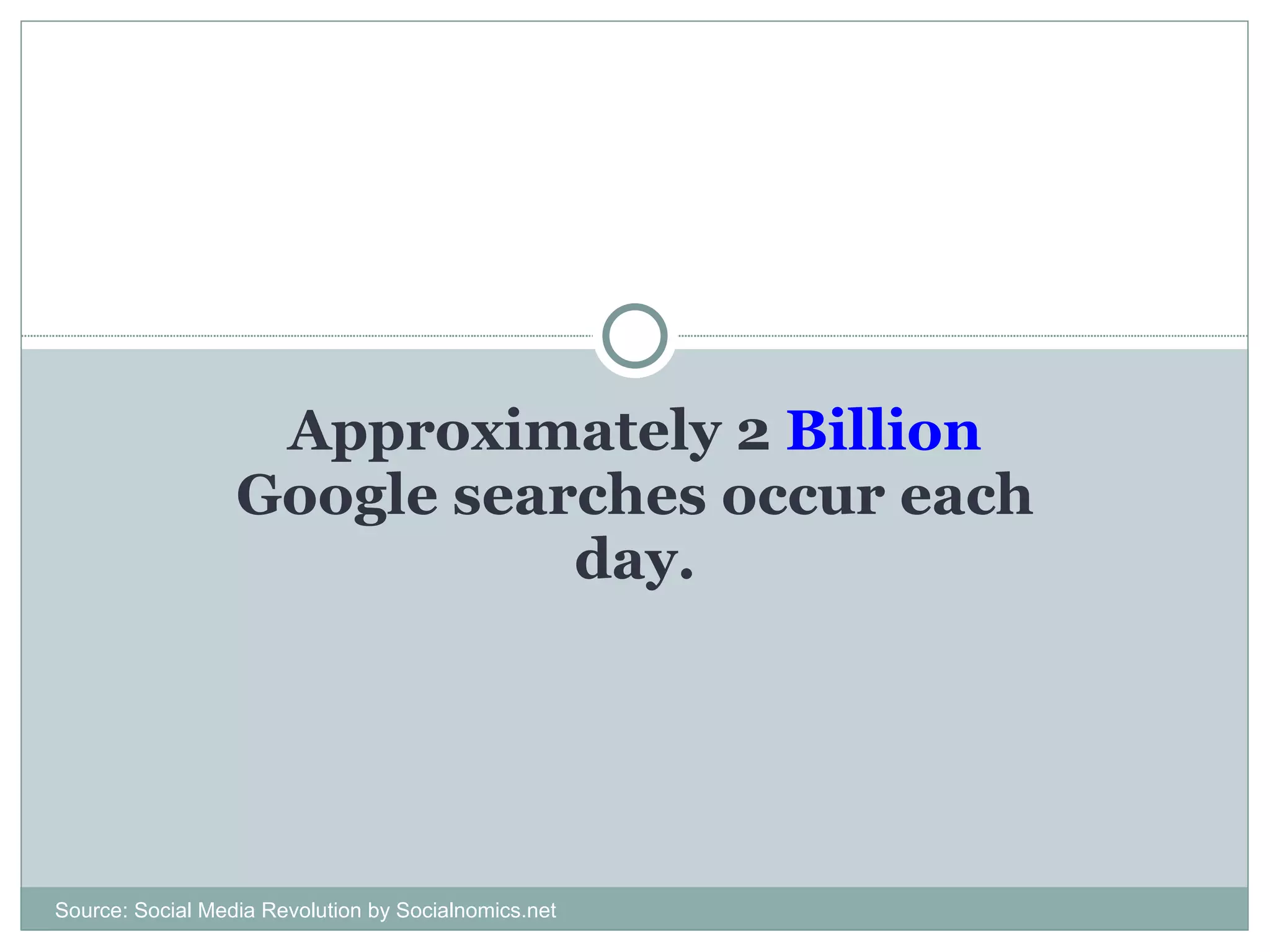
Approximately 2  Billion   Google searches occur each day. Source: Social Media Revolution by Socialnomics.net
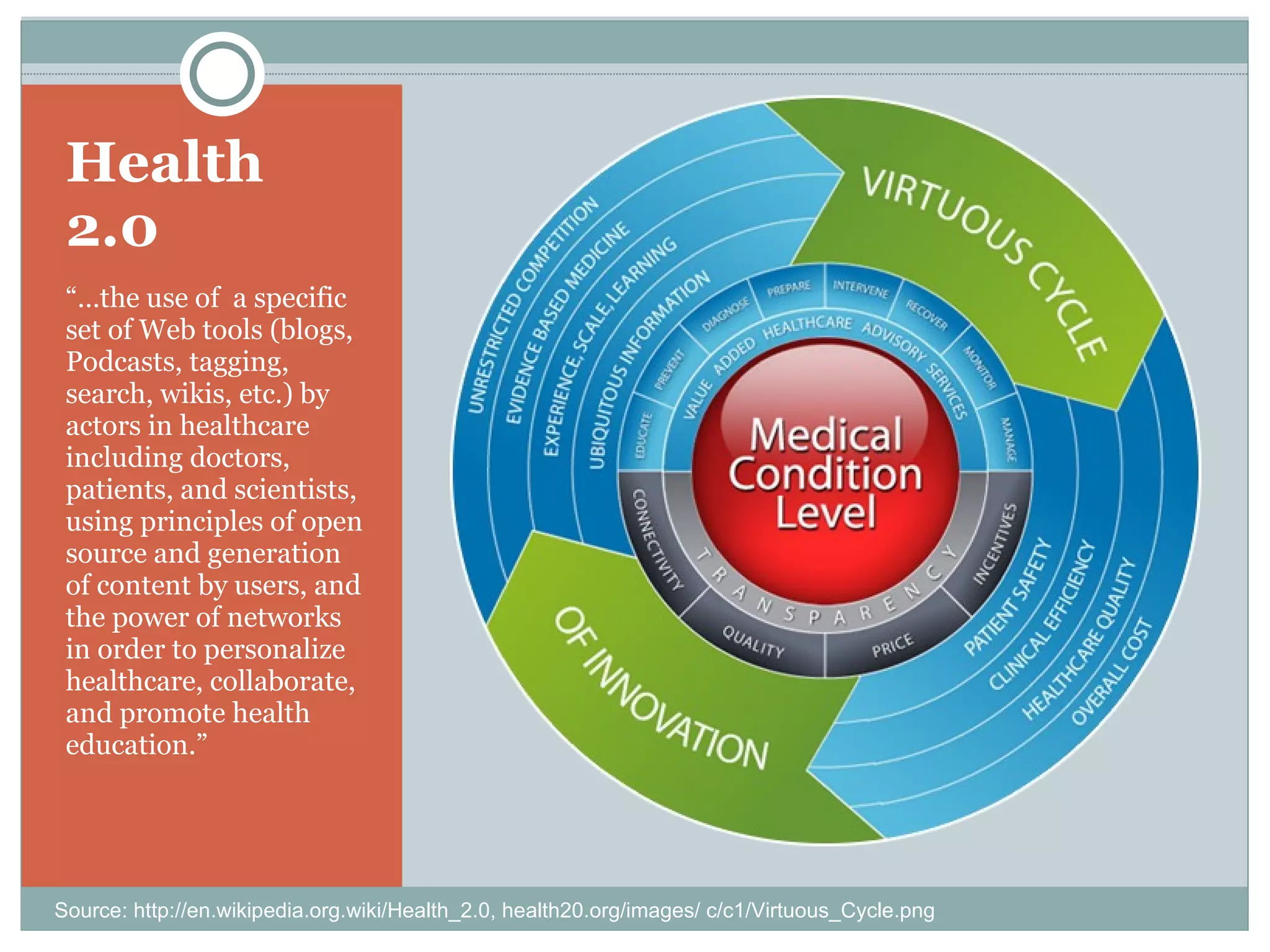
Health 2.0 “… the use of  a specific set of Web tools (blogs, Podcasts, tagging, search, wikis, etc.) by actors in healthcare including doctors, patients, and scientists, using principles of open source and generation of content by users, and the power of networks in order to personalize healthcare, collaborate, and promote health education.” Source: http://en.wikipedia.org.wiki/Health_2.0, health20.org/images/ c/c1/Virtuous_Cycle.png
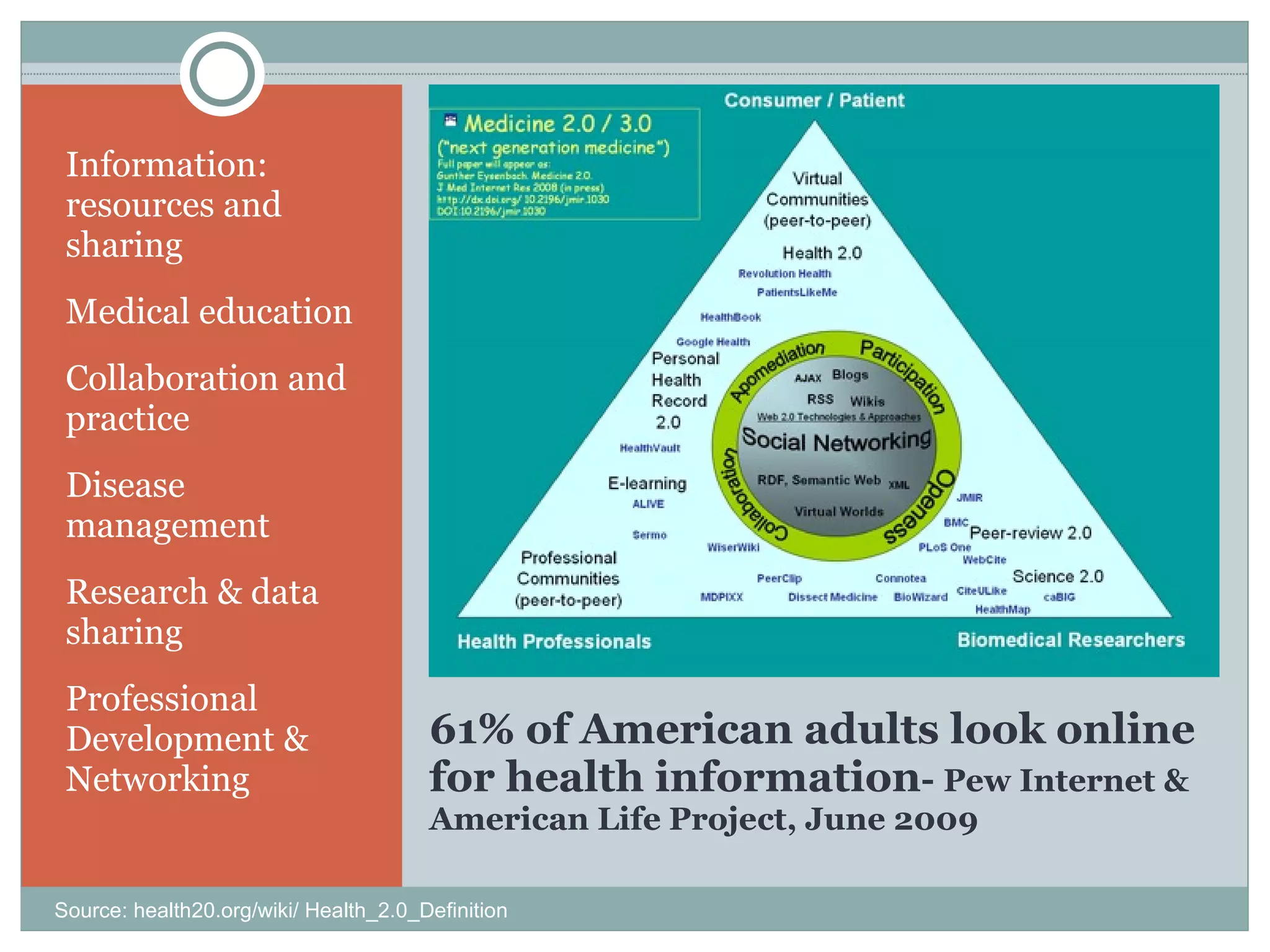
61% of American adults look online for health information -  Pew Internet & American Life Project, June 2009 Information: resources and sharing Medical education Collaboration and practice Disease management Research & data sharing Professional Development & Networking Source: health20.org/wiki/ Health_2.0_Definition
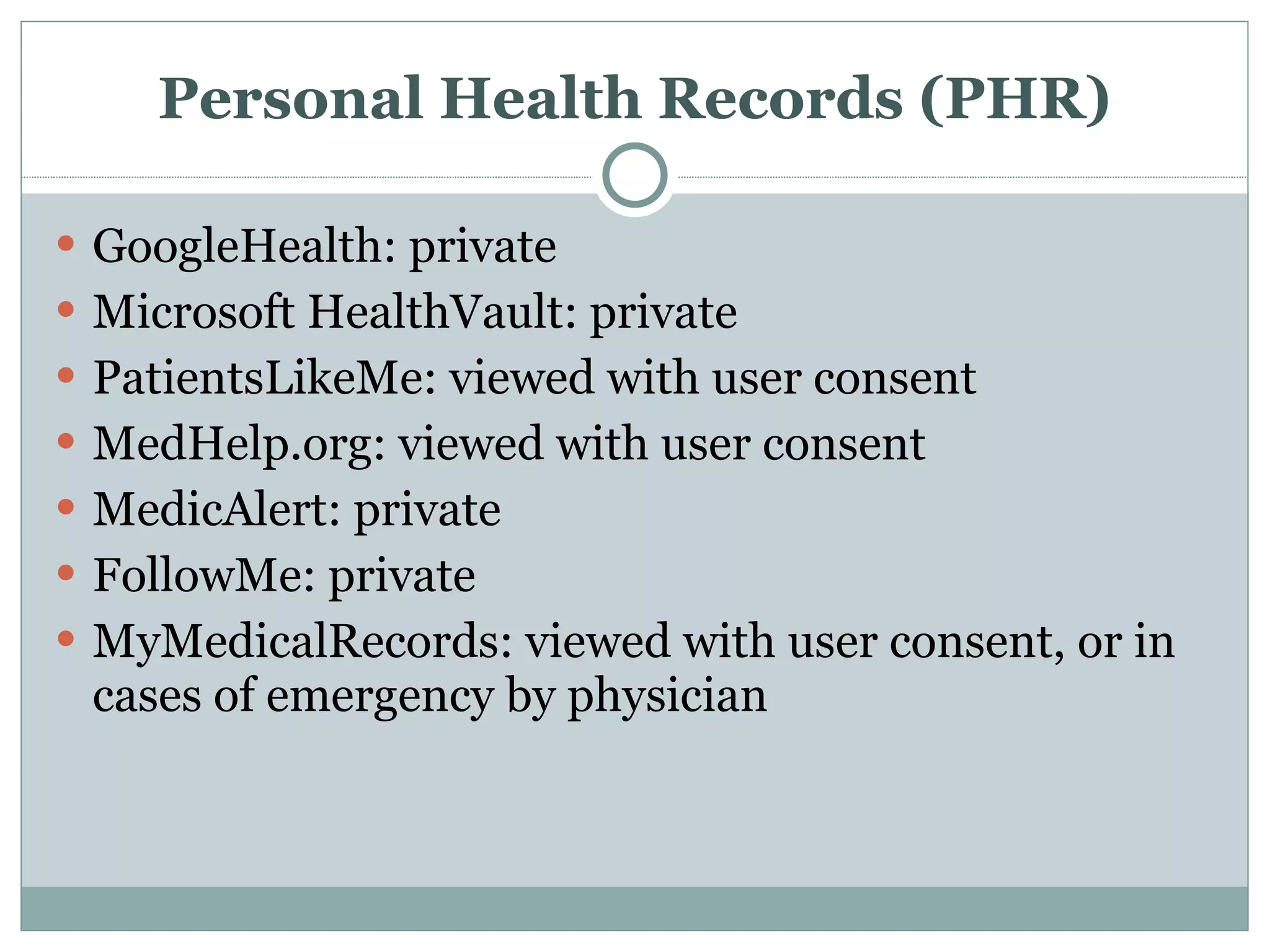
Personal Health Records (PHR) GoogleHealth: private Microsoft HealthVault: private PatientsLikeMe: viewed with user consent MedHelp.org: viewed with user consent MedicAlert: private FollowMe: private MyMedicalRecords: viewed with user consent, or in cases of emergency by physician
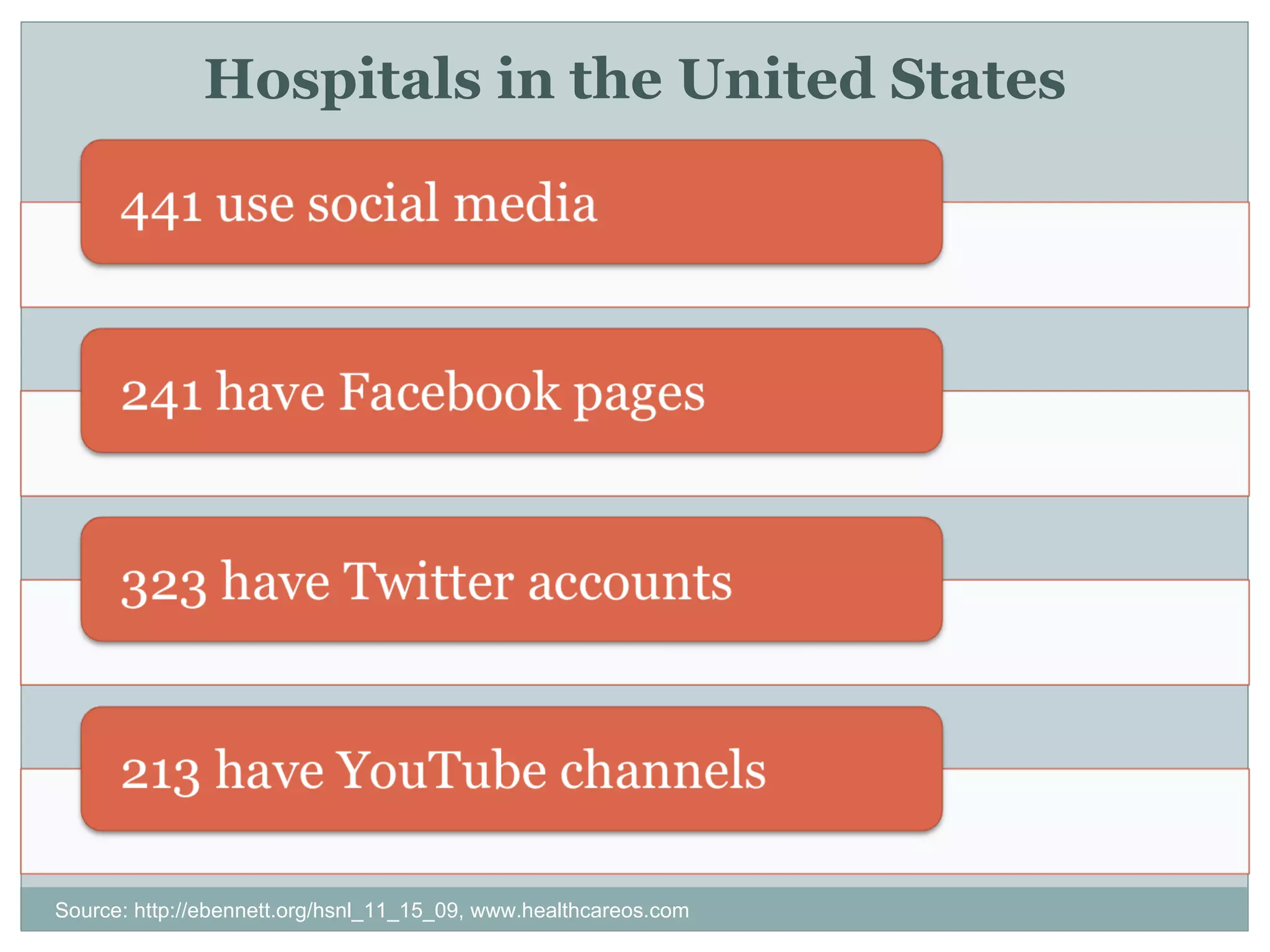
Hospitals in the United States Source: http://ebennett.org/hsnl_11_15_09, www.healthcareos.com
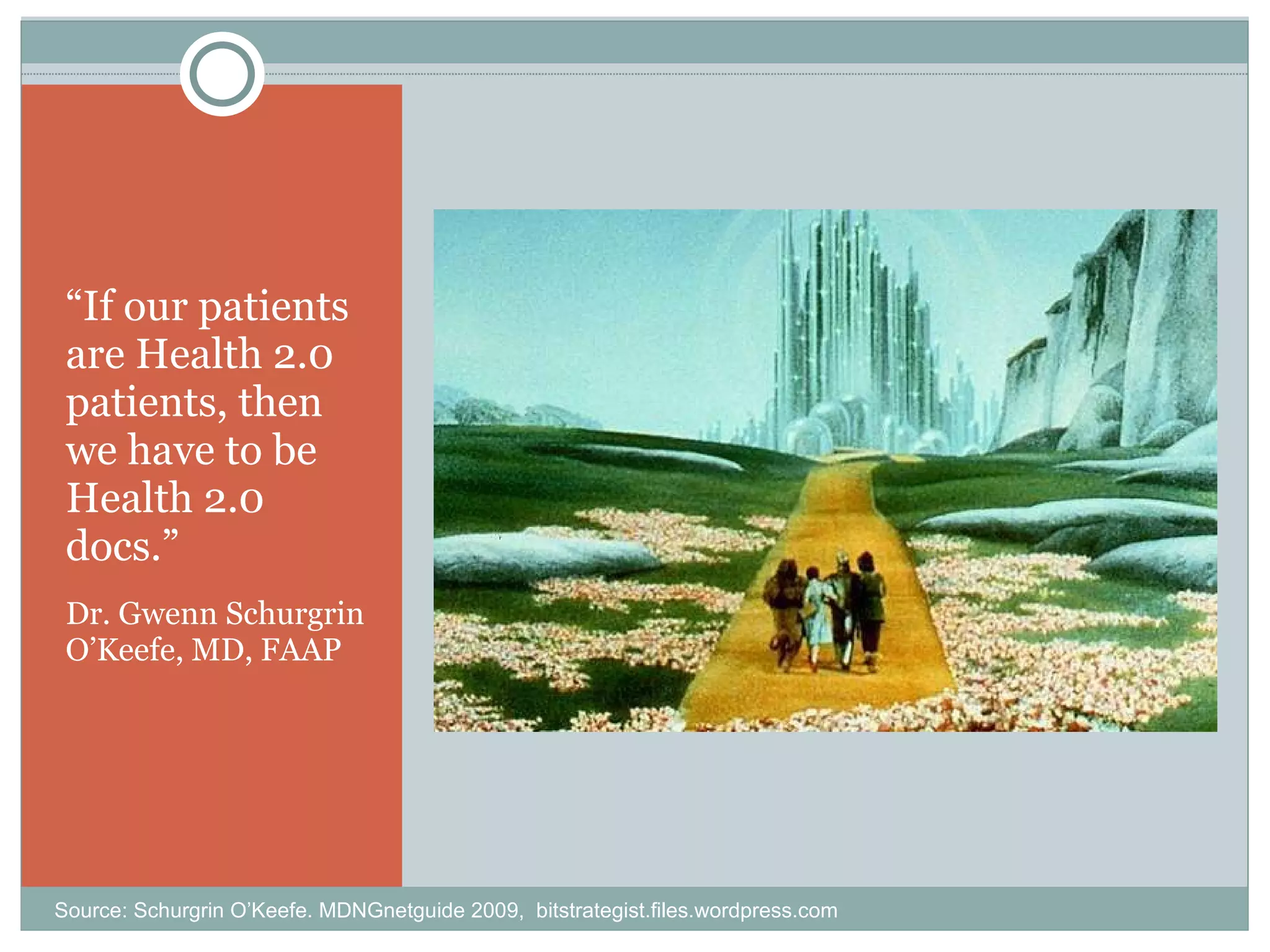
“ If our patients are Health 2.0 patients, then we have to be Health 2.0 docs.” Dr. Gwenn Schurgrin O’Keefe, MD, FAAP Source: Schurgrin O’Keefe. MDNGnetguide 2009,  bitstrategist.files.wordpress.com
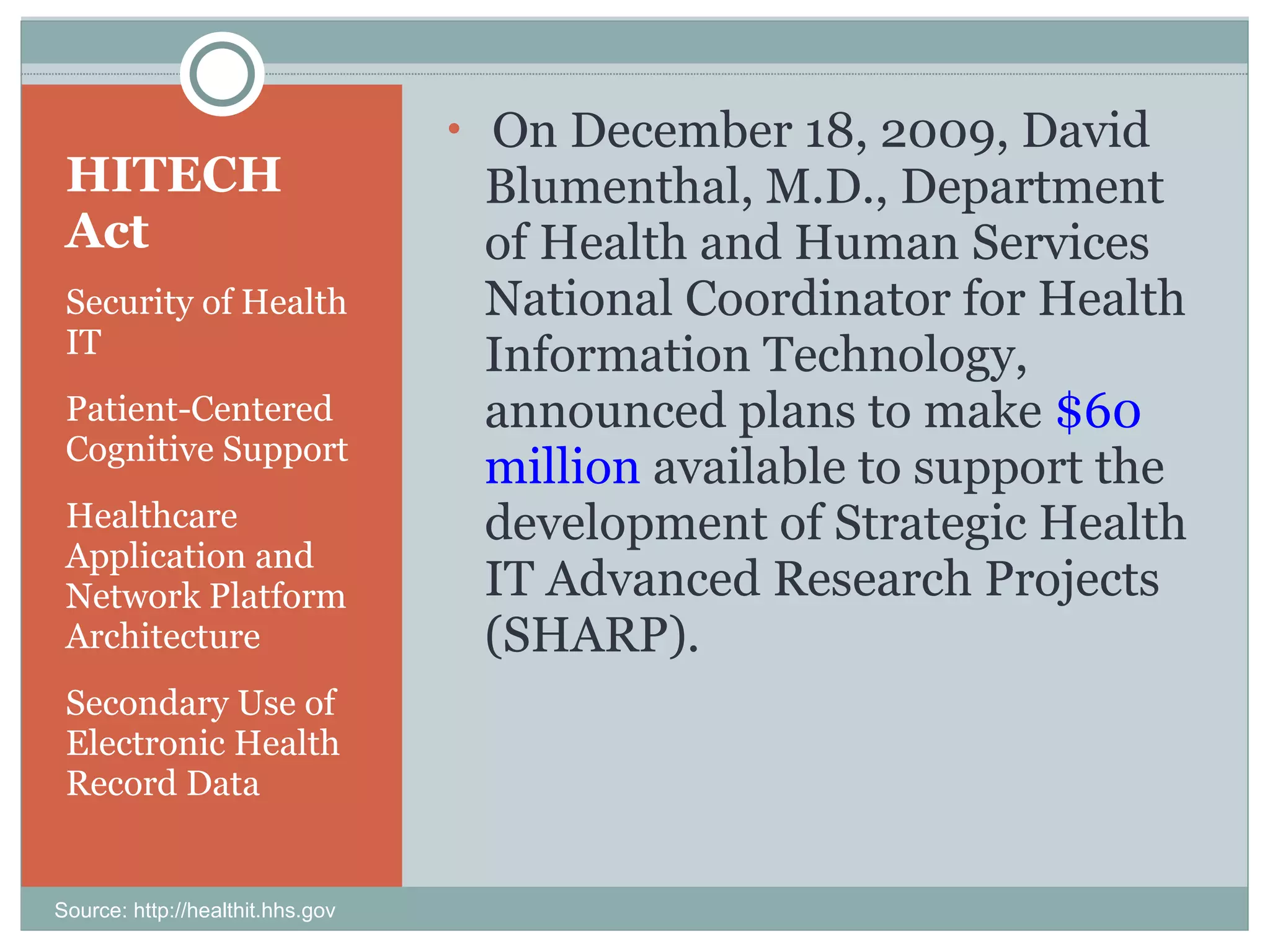
HITECH Act Security of Health IT Patient-Centered Cognitive Support Healthcare Application and Network Platform Architecture Secondary Use of Electronic Health Record Data On December 18, 2009, David Blumenthal, M.D., Department of Health and Human Services National Coordinator for Health Information Technology, announced plans to make  $60 million  available to support the development of Strategic Health IT Advanced Research Projects (SHARP). Source: http://healthit.hhs.gov
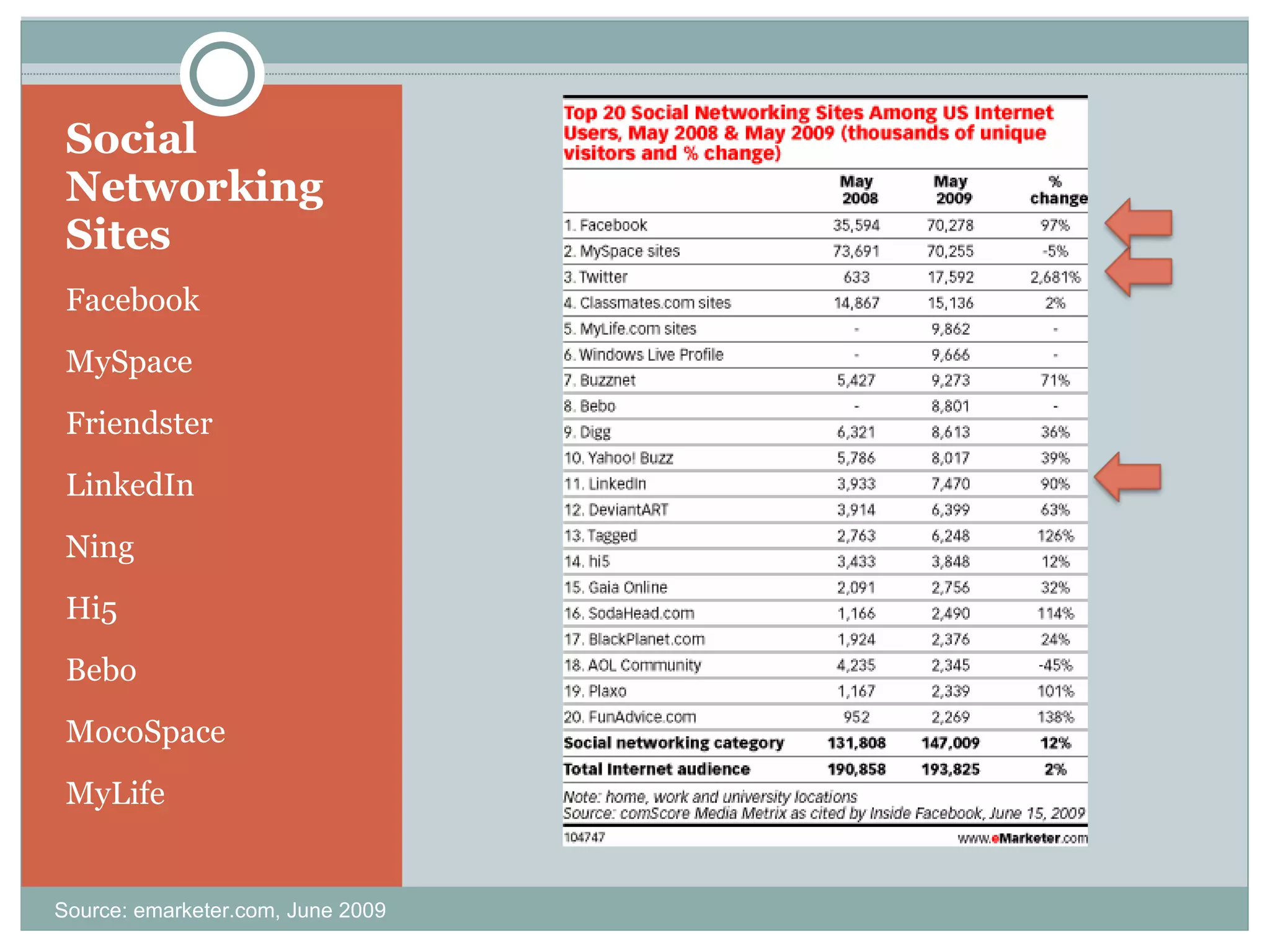
Social Networking Sites Facebook MySpace Friendster LinkedIn Ning Hi5 Bebo MocoSpace MyLife Source: emarketer.com, June 2009
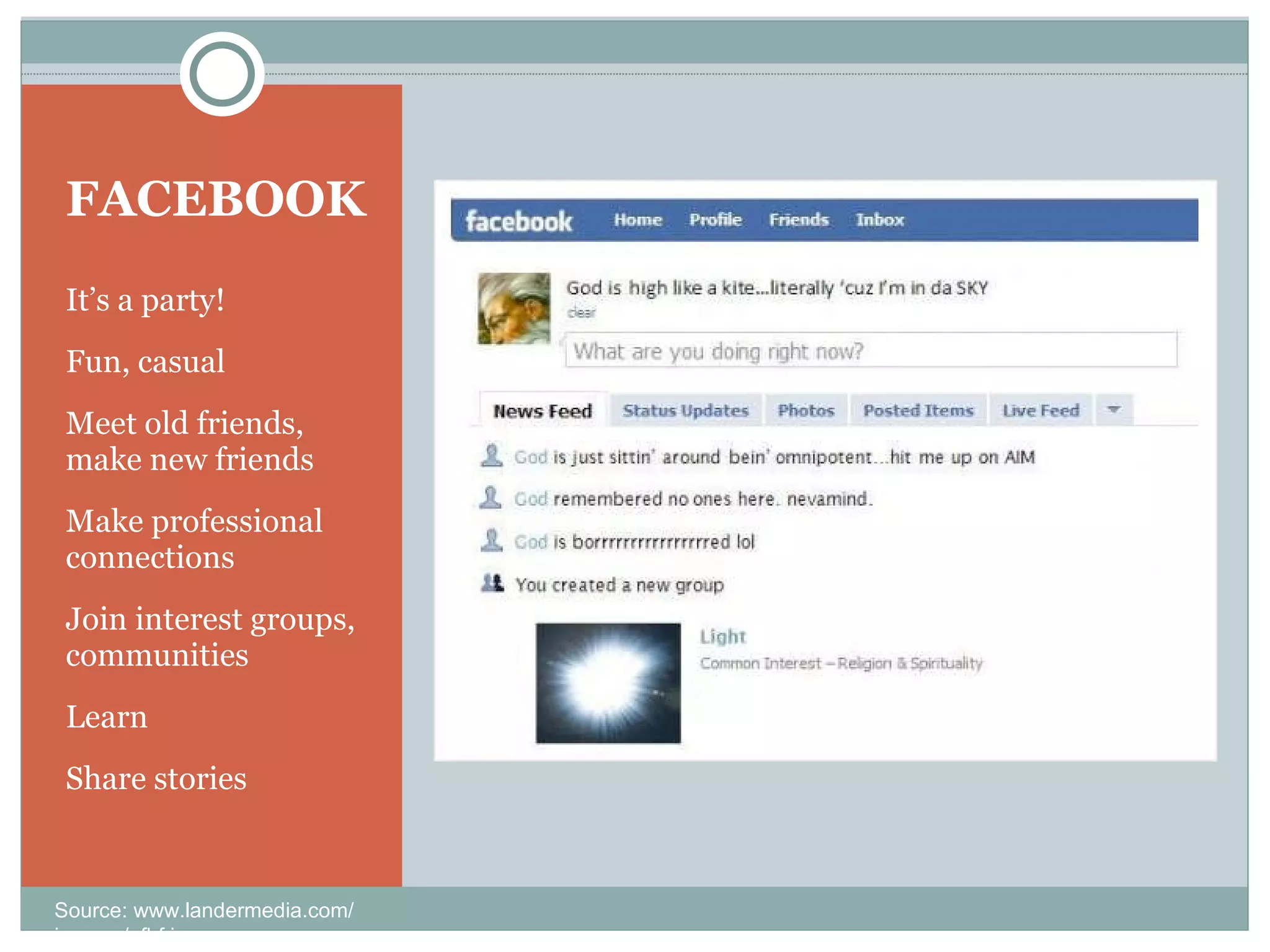
FACEBOOK It’s a party!  Fun, casual Meet old friends, make new friends Make professional connections Join interest groups, communities Learn Share stories Source: www.landermedia.com/ images/gfbf.jpg
More than 350 million active users 50% of active users are logged on in any given day Fastest growing demographic is age 35 and older; second is 55-65 year olds Median user age: 33 Average user has 130 friends Worldwide, more than 8 billion minutes a day spent on Facebook, yielding 45 million status updates each day More than 2 billion pieces of content shared every week Most popular site to share photos  (comScore 2009) 3 rd  most popular site to view online video  (Nielson VideoCensus, Nov 2009) Facebook Source: www.facebook.com/press/info.php?statistics
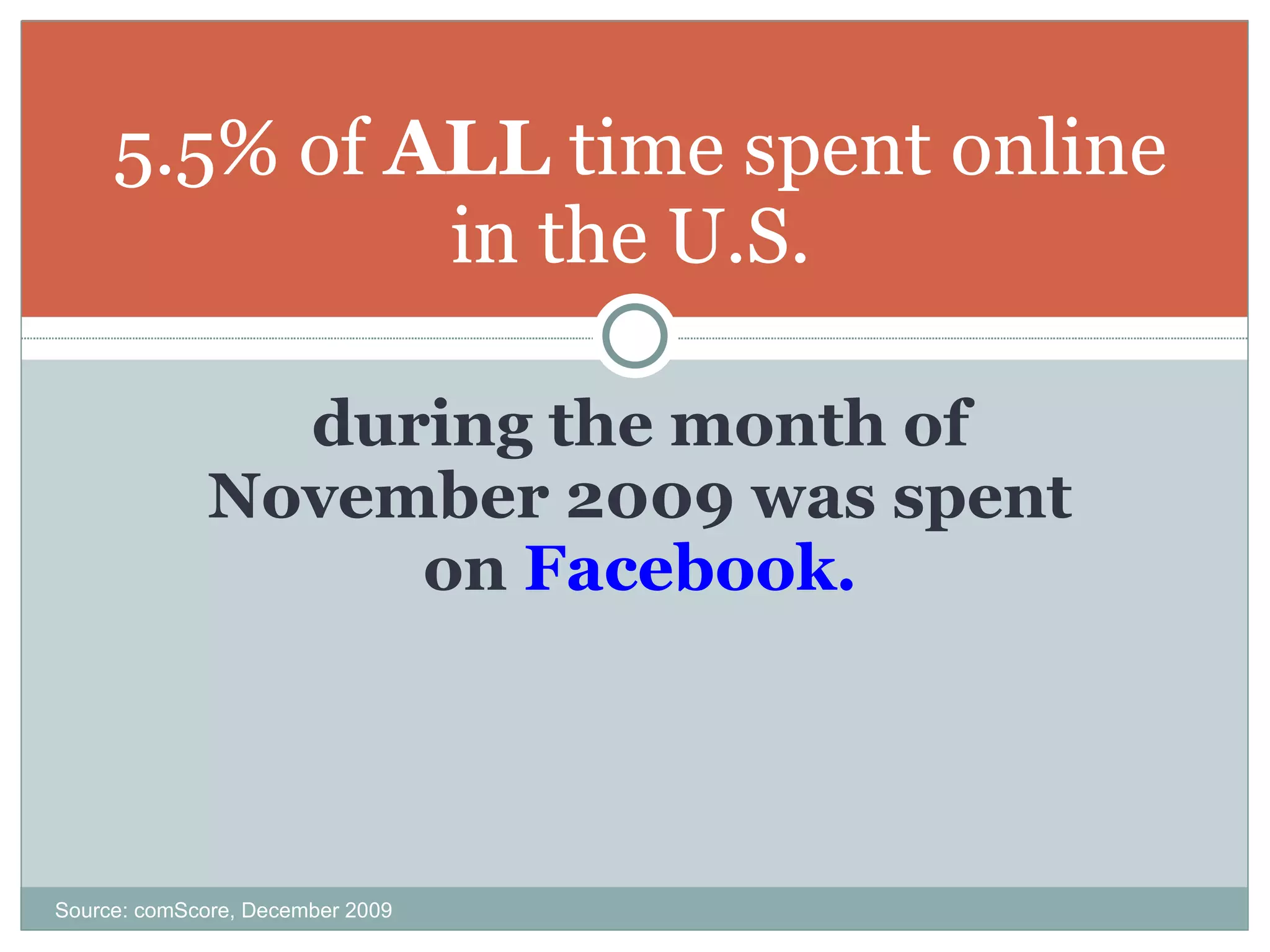
during the month of November 2009 was spent on  Facebook. 5.5% of  ALL  time spent online in the U.S.  Source: comScore, December 2009
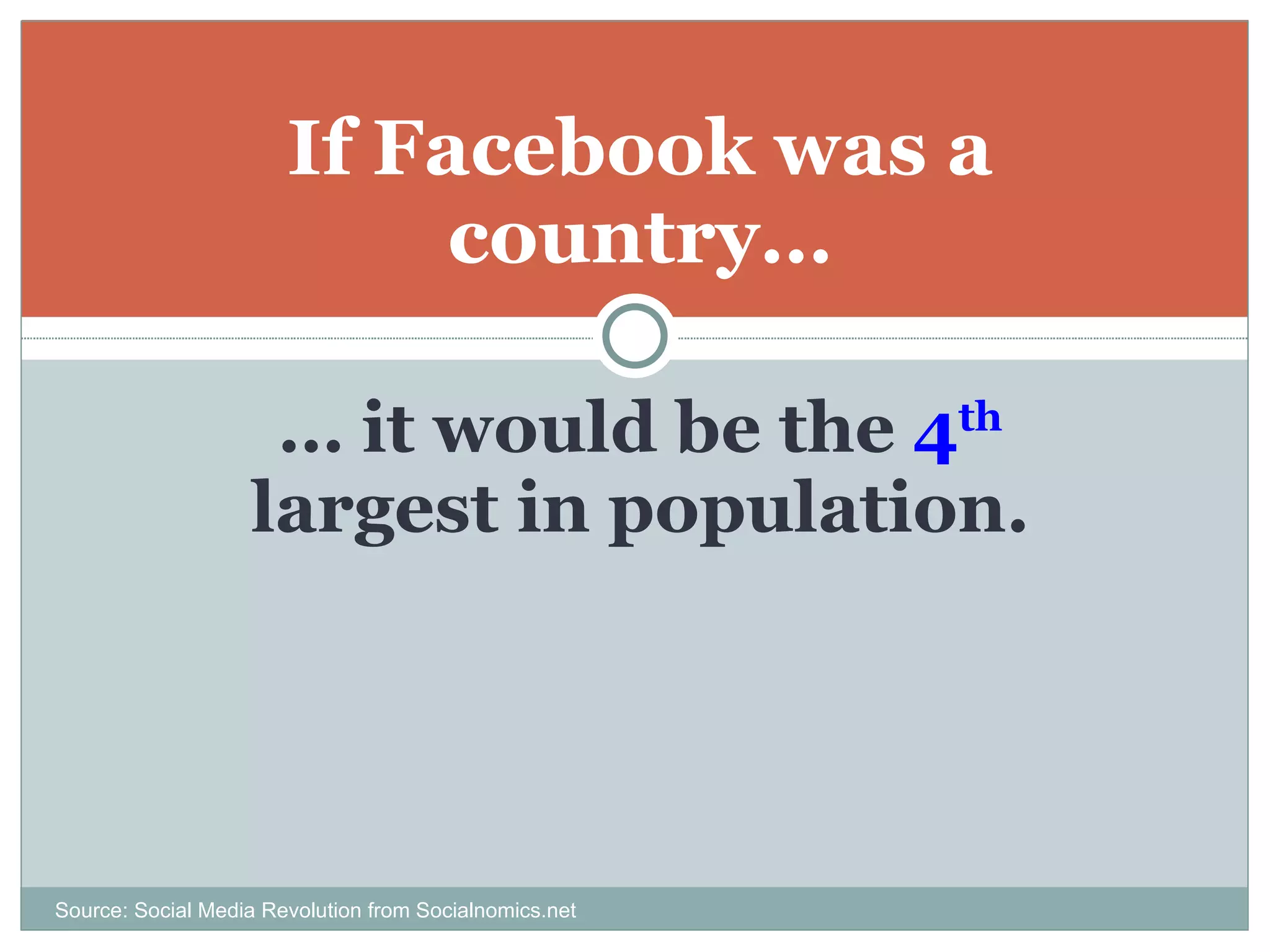
…  it would be the  4 th   largest in population. If Facebook was a country… Source: Social Media Revolution from Socialnomics.net
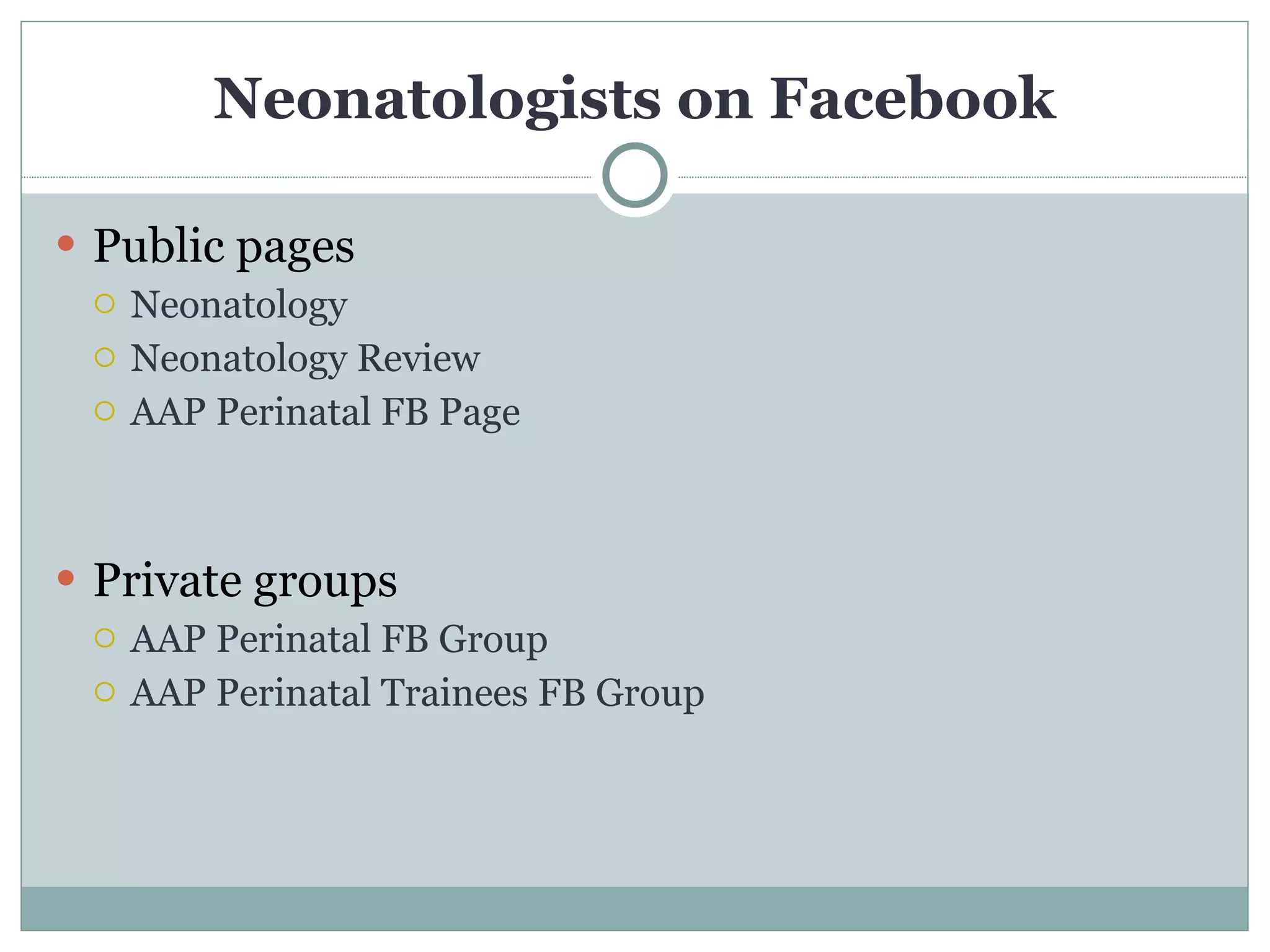
Neonatologists on Facebook Public pages Neonatology Neonatology Review AAP Perinatal FB Page Private groups AAP Perinatal FB Group AAP Perinatal Trainees FB Group
No good deed goes unpunished. Elphaba Thropp, The Wicked Witch of the West
Global network with over 25 million experienced professional in 150 industries Average age is 41 years Over 50% users have income >$100,000 Over-representation of those who attended graduate school, compared to all internet users 64% male 34% own a Smartphone/PDA 80% of companies use LinkedIn as their primary tool to find new employees Searchable by Google LinkedIn Source: www.linkedstrategies.com/blog/tag/linkedin-statistics
“ No one physician is as knowledgeable as physicians working together.” Largest online physician community Over 110,000 community members 68 specialties, 50 states Free to practicing physicians Free of advertising Facebook, Twitter and monthly Sermo Blog Source: www.sermo.com/node/11/
“ The Business Model”: “ For physicians, ..unique online environment in which clinical observations can be exchanged in real-time… build consensus on products and issues, take advantage of financial opportunities, and improve patient care by working directly with colleagues…” For Sermo clients, .. a way to target and engage physicians… capture real-world physician insights into treatments, medications and devices… Source: www.sermo.com/node/11/
Social: Physician-specific Sermo DoctorsHangout StudentDoctor.net Healtheva DoctorNetworking RelaxDoc SocialMD ClinicalVillage Ozmosis 99nicu.org NICU-Net MD Link Medscape Physician Connect eMedicine MedicSpeak iMedExchange: practicing MD only FacebookGroups
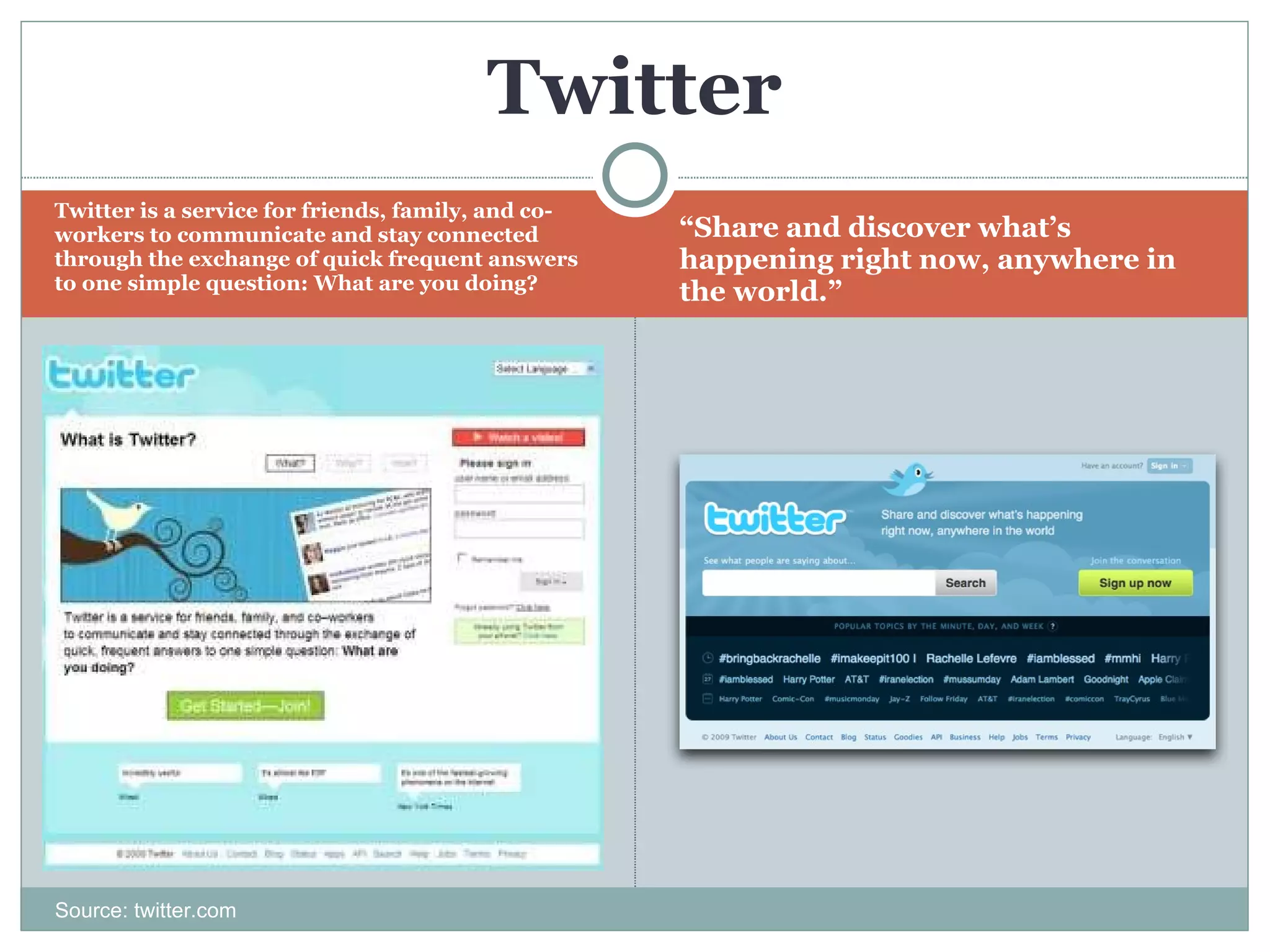
Twitter is a service for friends, family, and co-workers to communicate and stay connected through the exchange of quick frequent answers to one simple question: What are you doing? “ Share and discover what’s happening right now, anywhere in the world.”  Twitter Source: twitter.com
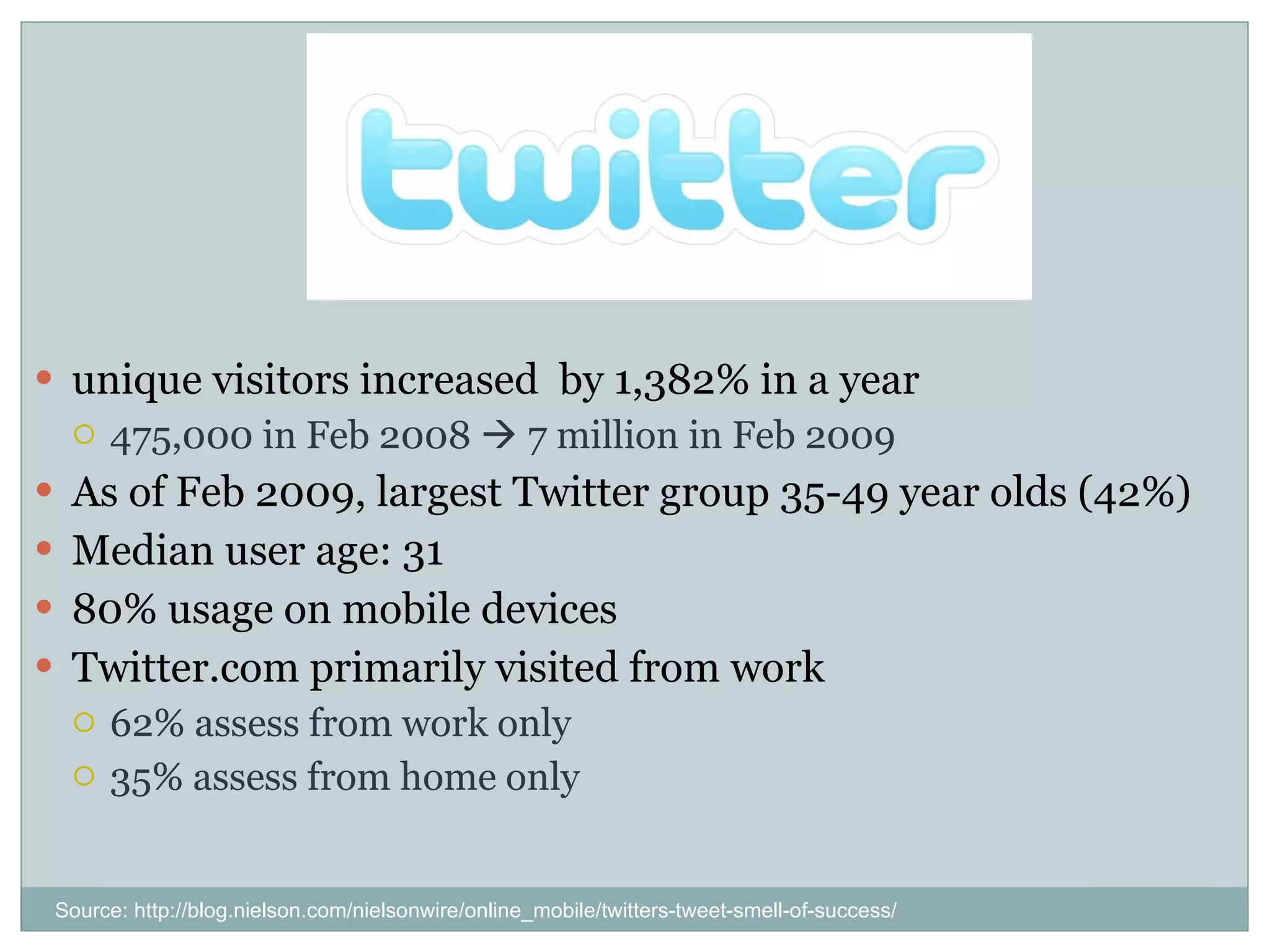
Twitter unique visitors increased  by 1,382% in a year 475,000 in Feb 2008    7 million in Feb 2009 As of Feb 2009, largest Twitter group 35-49 year olds (42%) Median user age: 31 80% usage on mobile devices Twitter.com primarily visited from work 62% assess from work only 35% assess from home only Source: http://blog.nielson.com/nielsonwire/online_mobile/twitters-tweet-smell-of-success/
Ashton Kutcher and Ellen Degeneres…… … .have more followers than the entire population of Ireland, Norway & Panama. Source: Social Media Revolution from Socialnomics.net
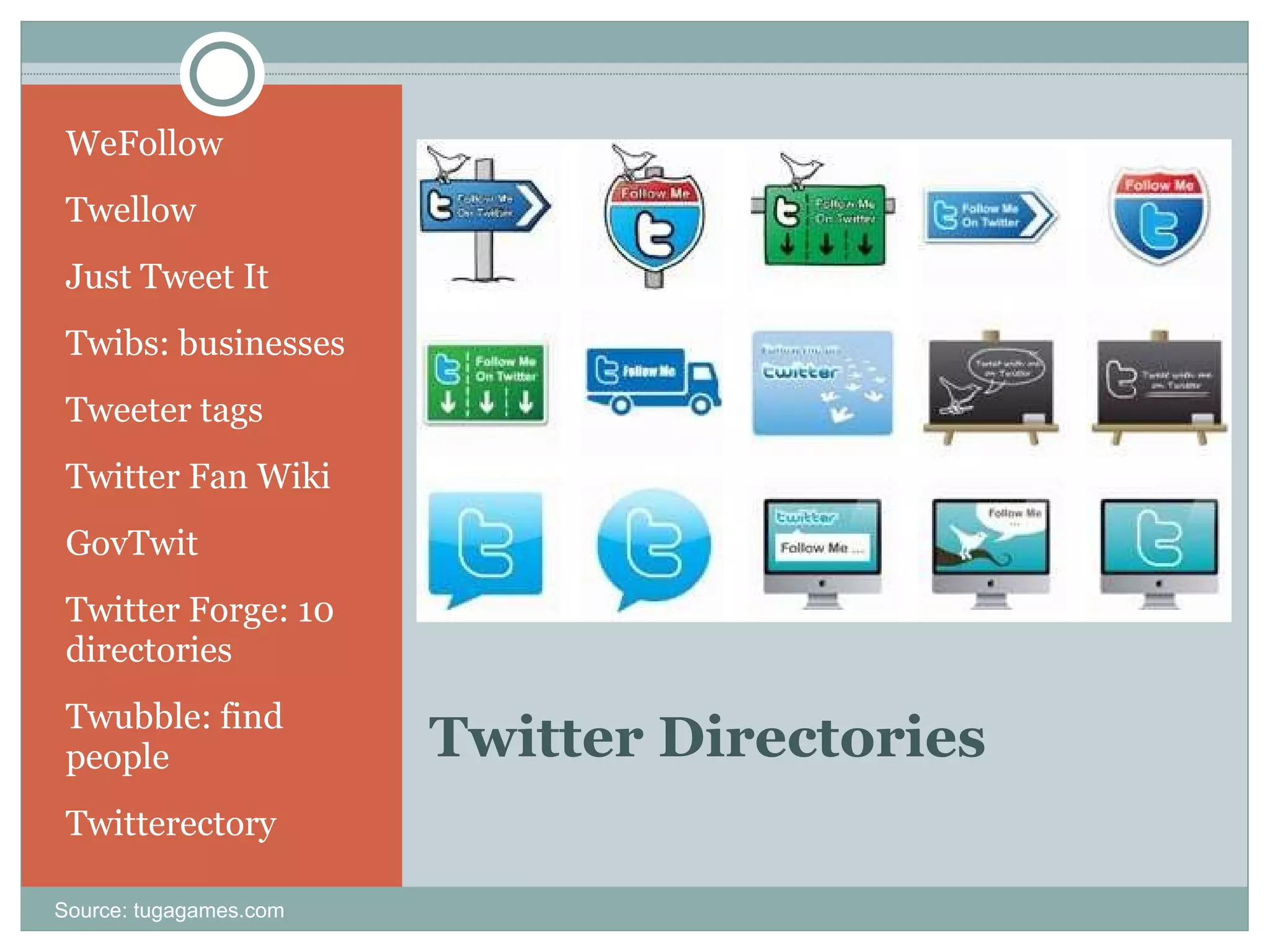
Twitter Directories WeFollow Twellow Just Tweet It Twibs: businesses Tweeter tags Twitter Fan Wiki GovTwit Twitter Forge: 10 directories  Twubble: find people Twitterectory Source: tugagames.com
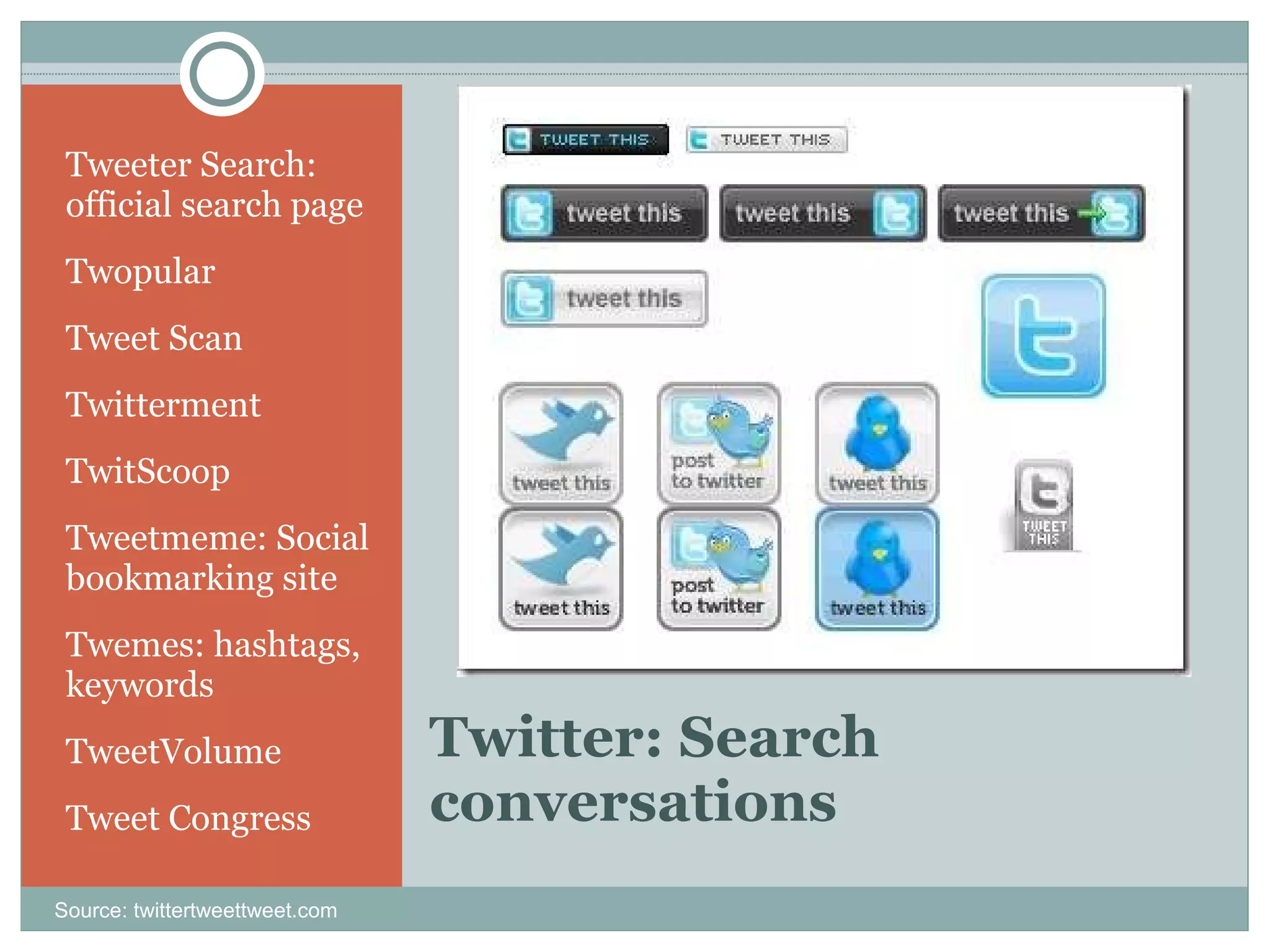
Twitter: Search conversations  Tweeter Search: official search page Twopular Tweet Scan Twitterment TwitScoop Tweetmeme: Social bookmarking site Twemes: hashtags, keywords TweetVolume Tweet Congress Source: twittertweettweet.com
Real-time Updates February 2009: Surgeons at Henry Ford Hospital, Detroit, Michigan, used Twitter  “ To let people know that a tumor can be removed without taking out the entire kidney,”  said Craig Rogers, MD, lead surgeon, to CNN.
140 HEALTHCARE USES FOR TWITTER  BY PHIL BAUMANN BLOG, “HEALTH IS SOCIAL”
Top Twitter Topics of 2009 Iran Election Swine Flu Gaza Iran Tehran Source: http://mashable.com/2009/12/15/twitter-reveals-most-discussed-topics-of-2009/
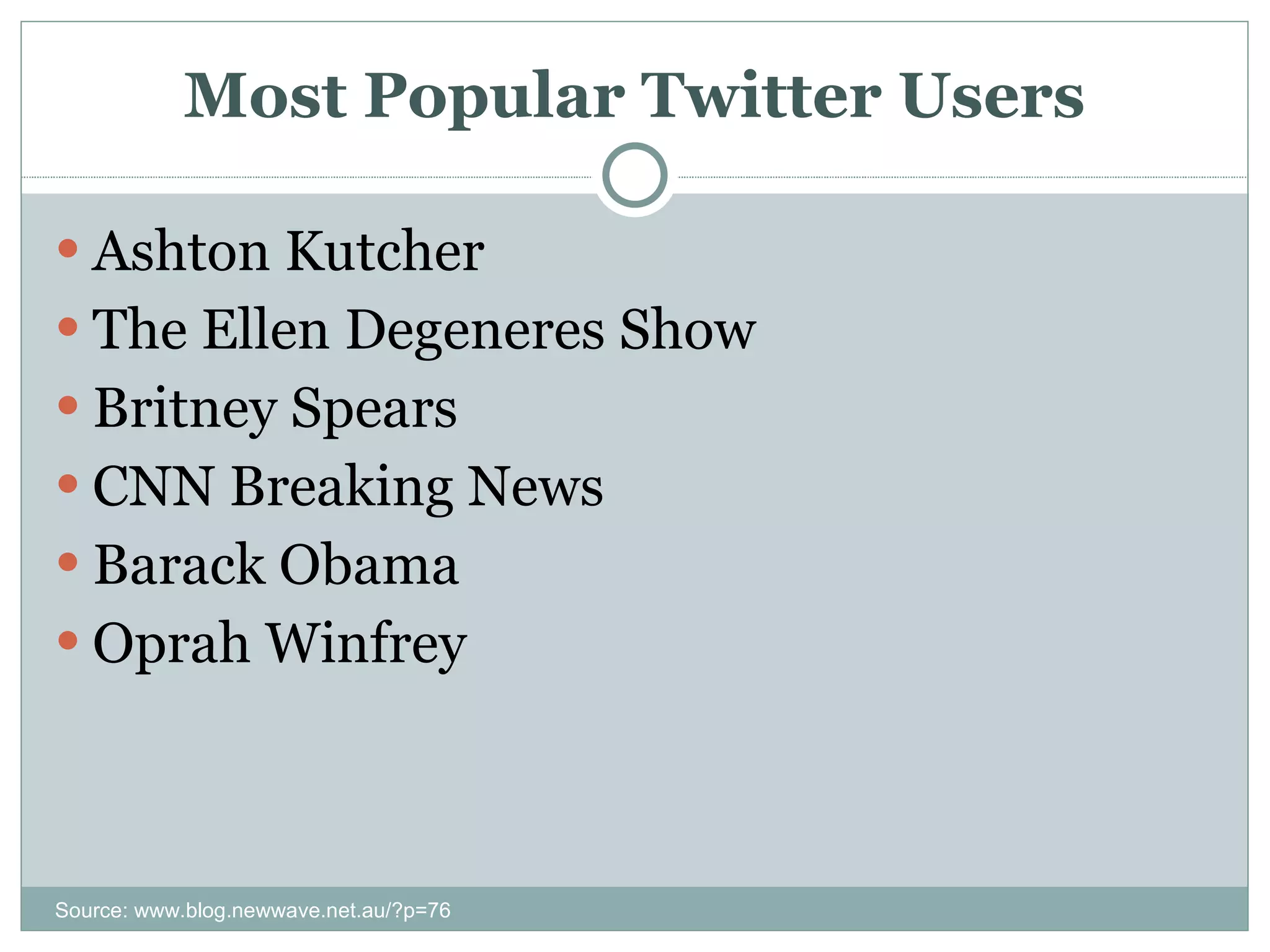
Most Popular Twitter Users Ashton Kutcher The Ellen Degeneres Show Britney Spears CNN Breaking News Barack Obama Oprah Winfrey Source: www.blog.newwave.net.au/?p=76
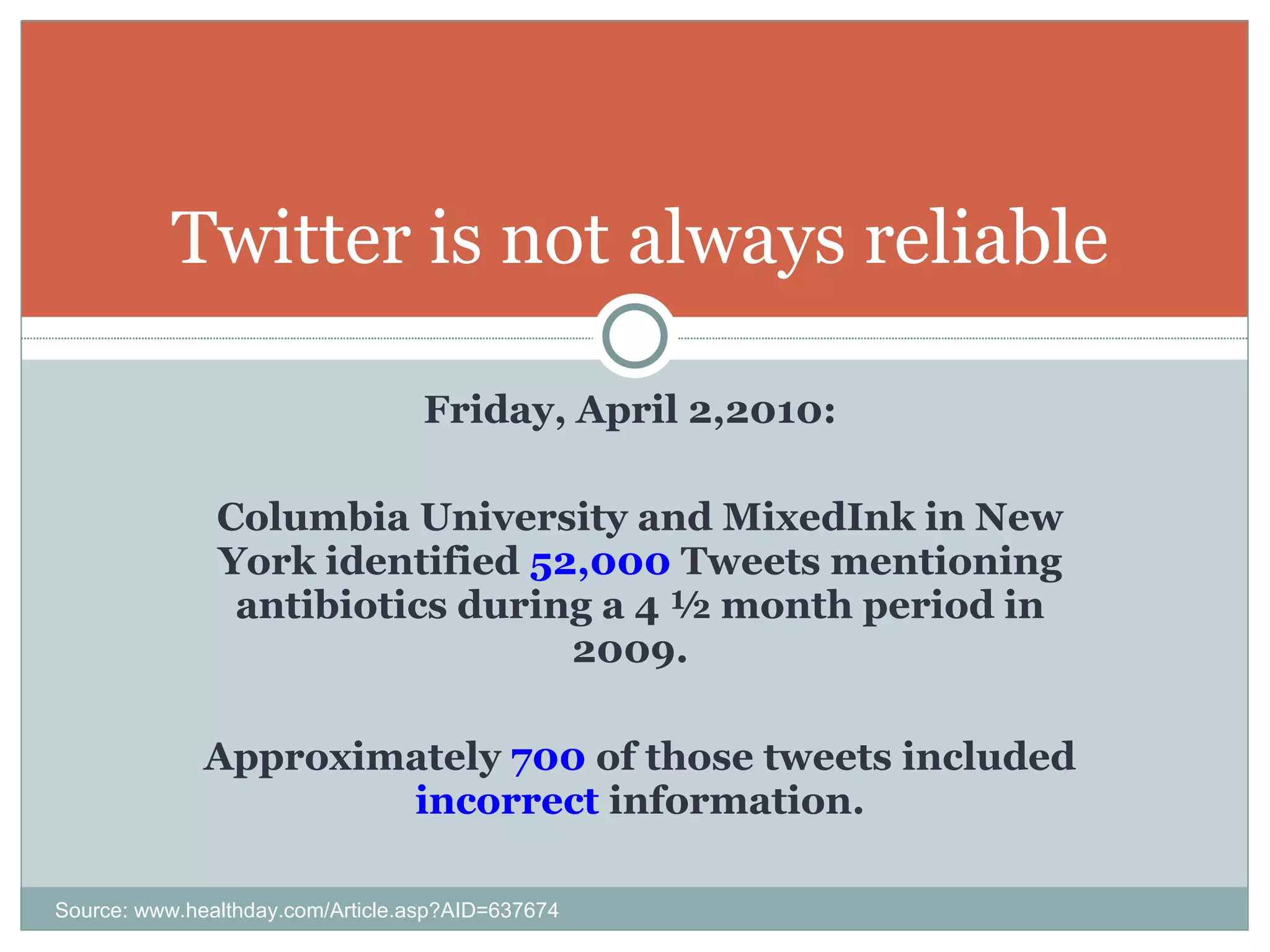
Friday, April 2,2010:  Columbia University and MixedInk in New York identified  52,000  Tweets mentioning antibiotics during a 4 ½ month period in 2009.  Approximately  700  of those tweets included  incorrect  information. Twitter is not always reliable Source: www.healthday.com/Article.asp?AID=637674
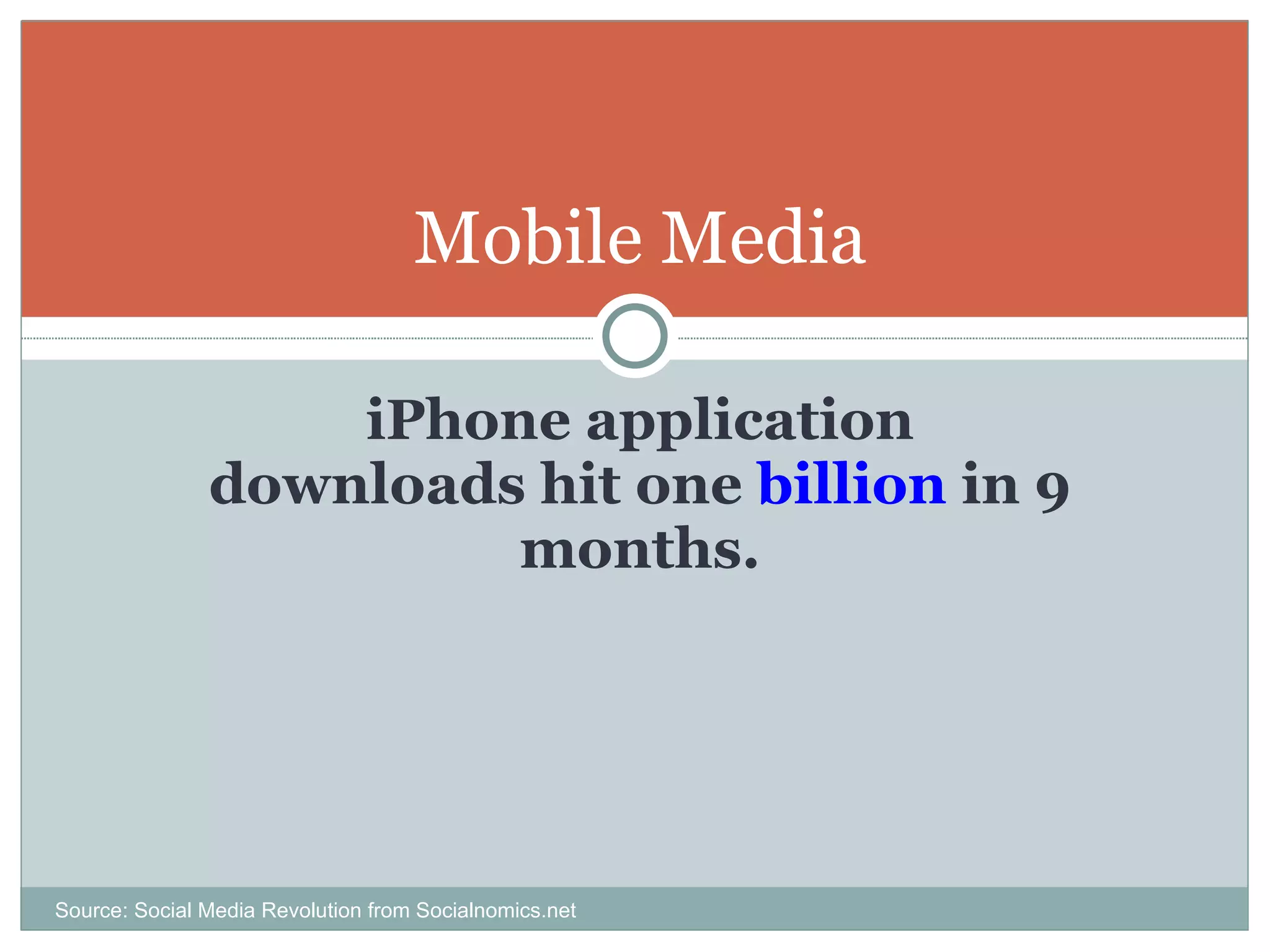
iPhone application downloads hit one  billion  in 9 months. Mobile Media Source: Social Media Revolution from Socialnomics.net
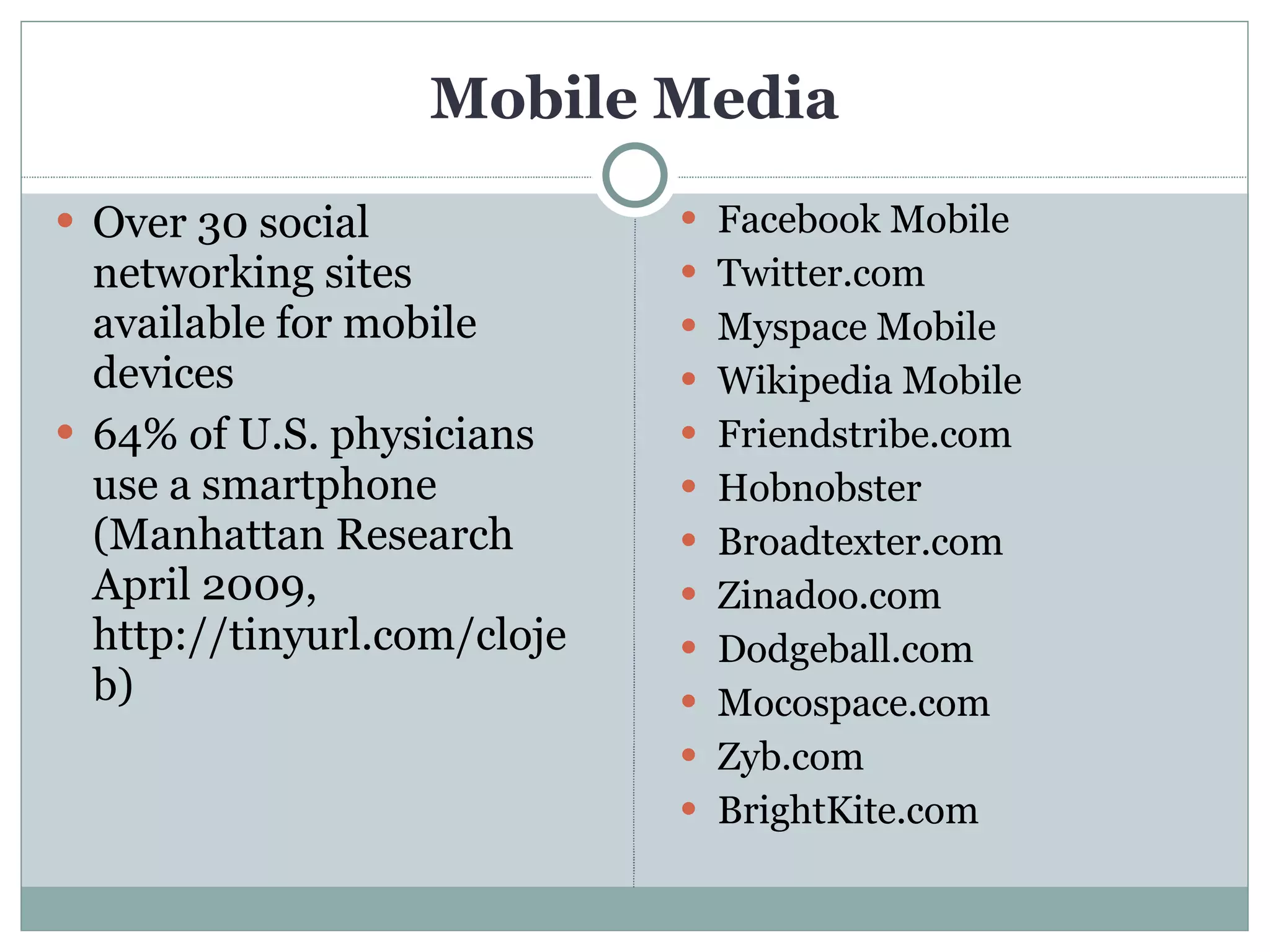
Mobile Media Over 30 social networking sites available for mobile devices 64% of U.S. physicians use a smartphone (Manhattan Research April 2009, http://tinyurl.com/clojeb) Facebook Mobile Twitter.com Myspace Mobile Wikipedia Mobile Friendstribe.com Hobnobster Broadtexter.com Zinadoo.com Dodgeball.com Mocospace.com Zyb.com BrightKite.com
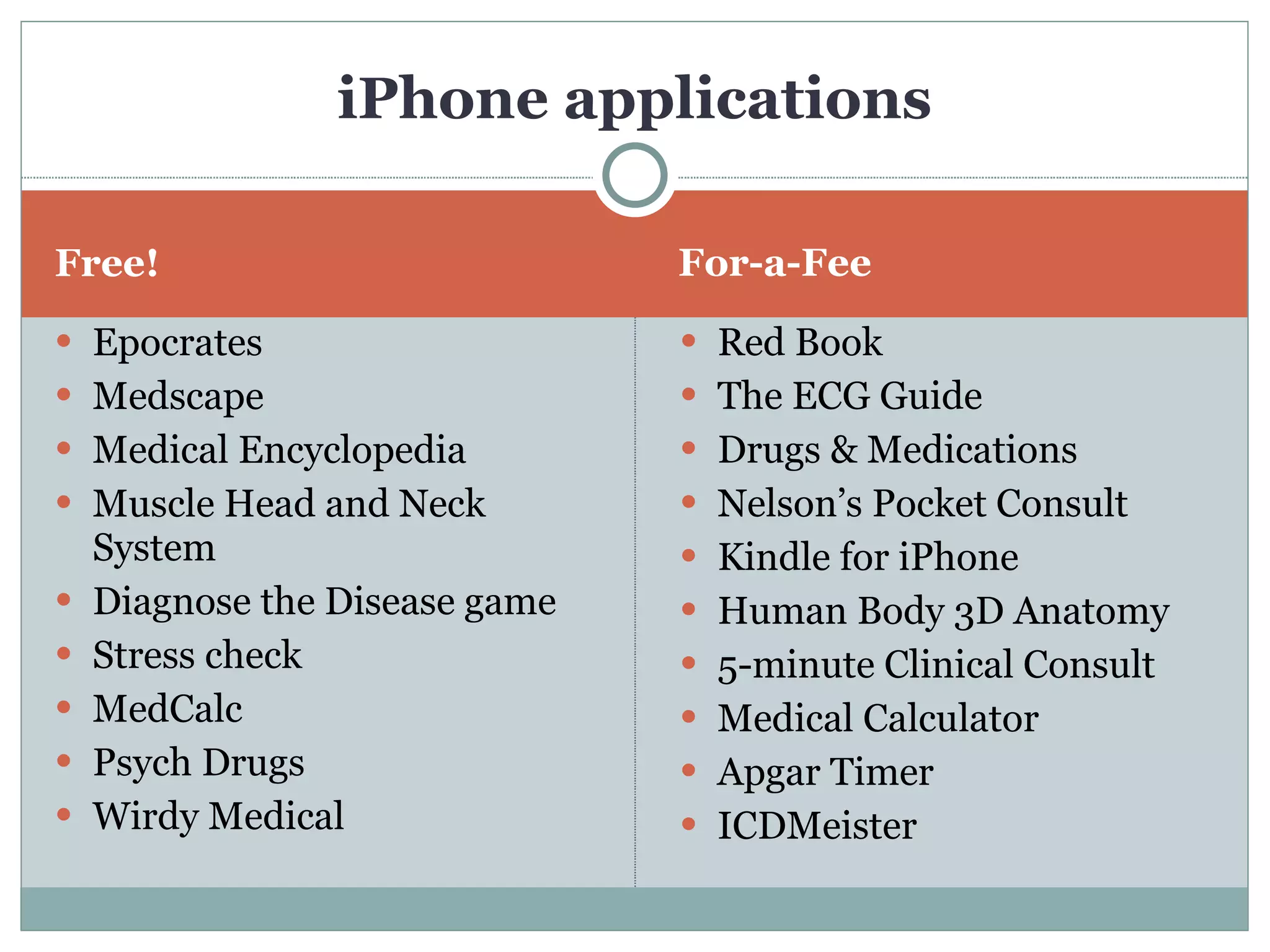
Free! For-a-Fee Epocrates Medscape Medical Encyclopedia Muscle Head and Neck System Diagnose the Disease game Stress check MedCalc Psych Drugs Wirdy Medical Red Book The ECG Guide Drugs & Medications Nelson’s Pocket Consult Kindle for iPhone Human Body 3D Anatomy 5-minute Clinical Consult Medical Calculator Apgar Timer ICDMeister iPhone applications
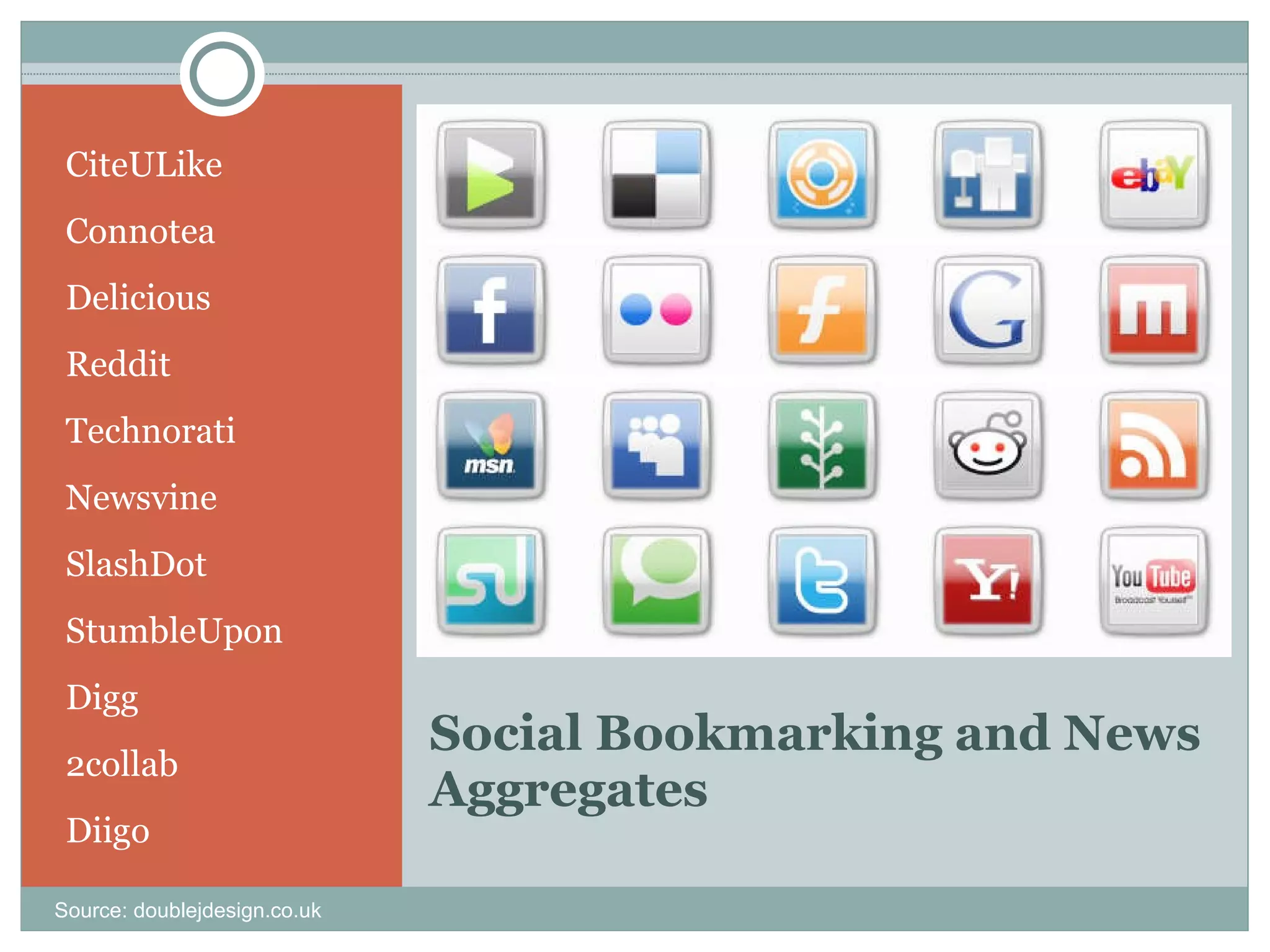
Social Bookmarking and News Aggregates CiteULike Connotea Delicious Reddit Technorati Newsvine SlashDot StumbleUpon Digg 2collab Diigo Source: doublejdesign.co.uk
There are over  175  ways to bookmark and share information! Source: Social Media Revolution from Socialnomics.net
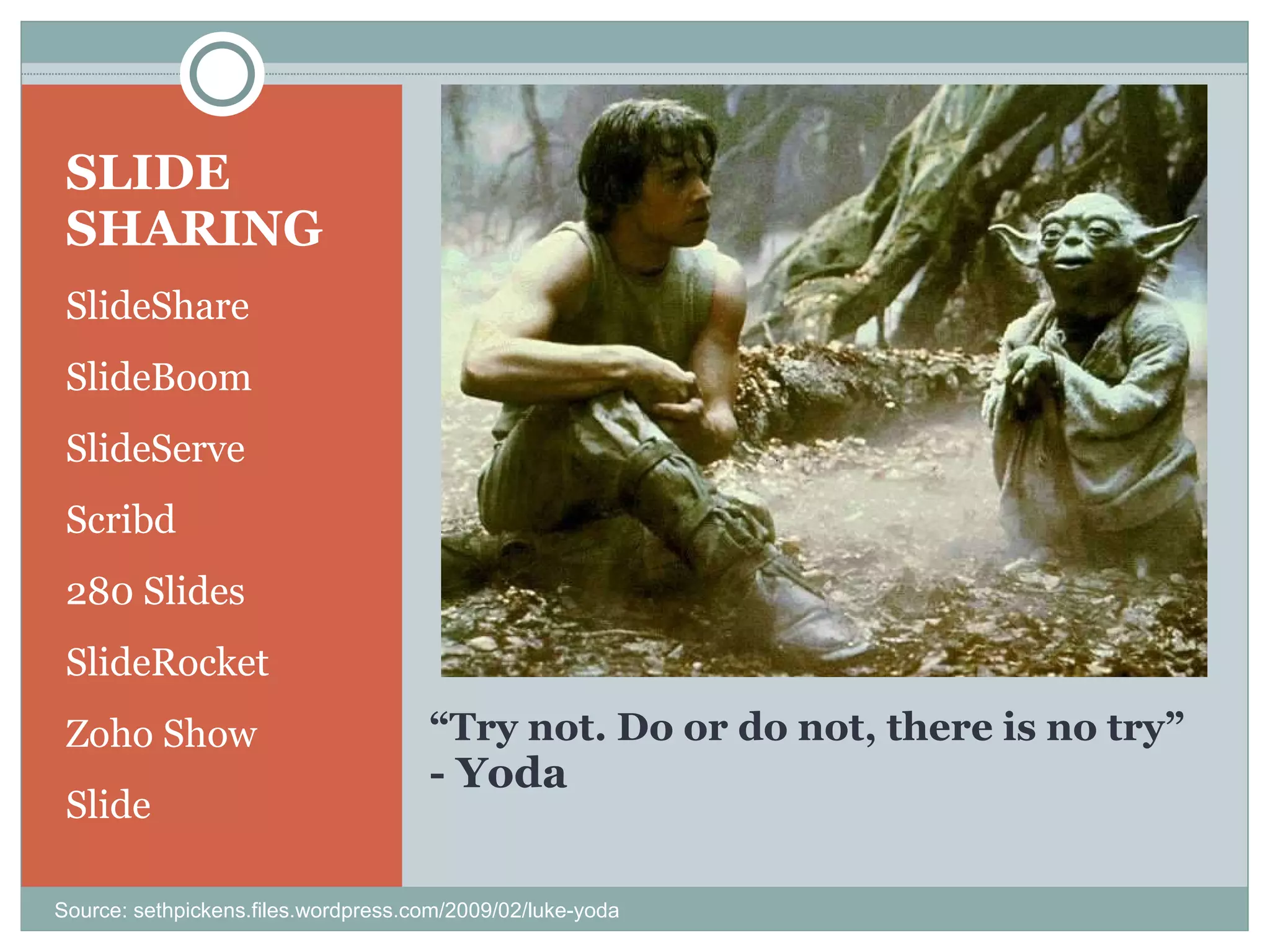
“ Try not. Do or do not, there is no try” - Yoda SLIDE SHARING SlideShare SlideBoom SlideServe Scribd 280 Slides SlideRocket Zoho Show Slide Source: sethpickens.files.wordpress.com/2009/02/luke-yoda
Media Sharing You Tube rrripple Flickr Daily Motion Vimeo Google Video Yahoo Video Source: www.freesocialicons.com
As of October 2009, YouTube reached one  billion  views per day. YouTube: the world’s 2 nd  largest search engine Source: youtube-global.blogspot.com/2009/10/y000000000utube.html
20  hours  of video are uploaded to YouTube every  MINUTE . Source: youtube.com/t/fact_sheet
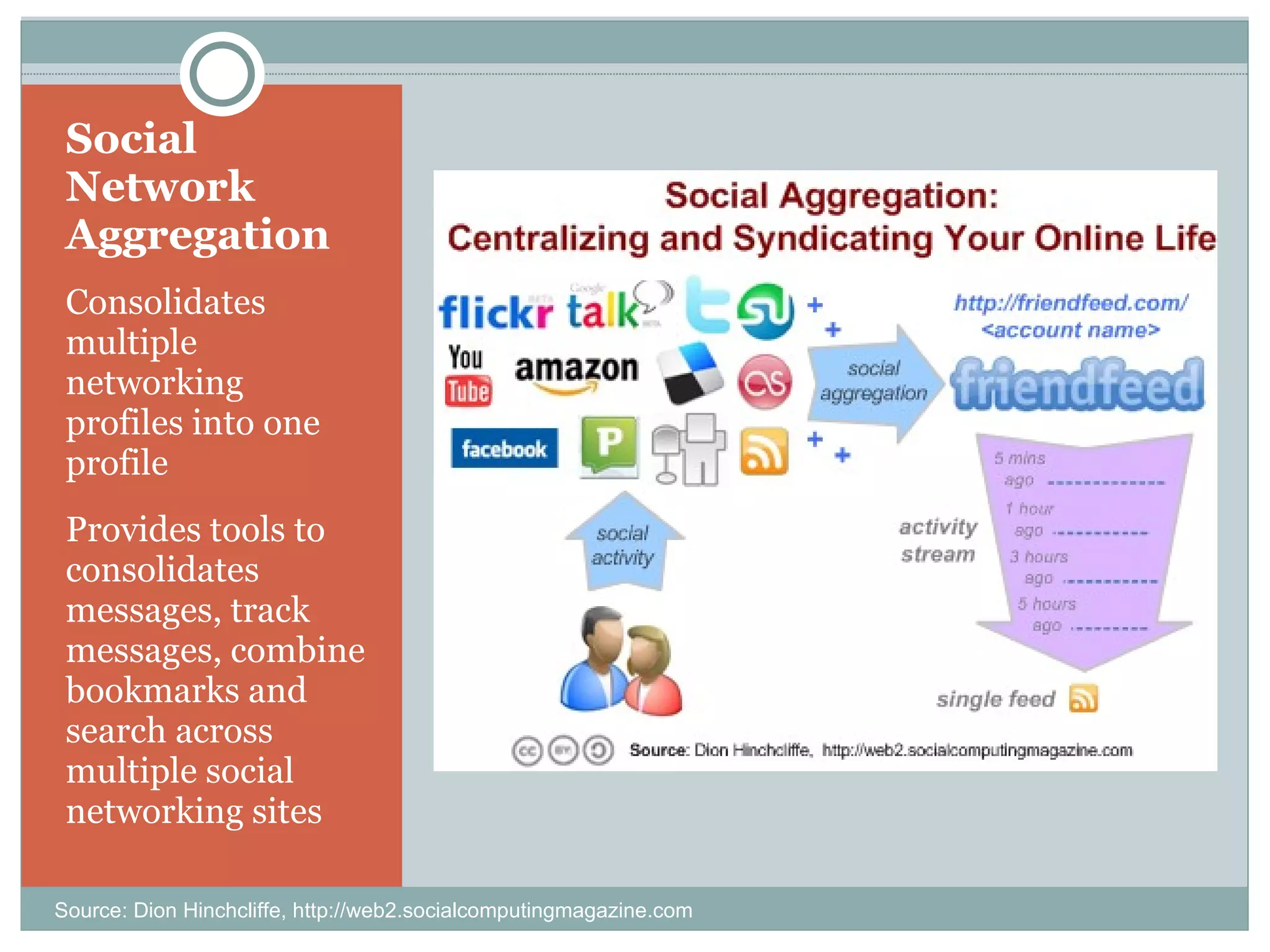
Social Network Aggregation Consolidates multiple networking profiles into one profile Provides tools to consolidates messages, track messages, combine bookmarks and search across multiple social networking sites Source: Dion Hinchcliffe, http://web2.socialcomputingmagazine.com
Individuals, business or organizations “ Real-time feed aggregator that consolidates the updates from social media and social networking websites, social bookmarking websites, blogs, and microblogging updates…” Average of one million visitors/month Source: friendfeed.com
ON AUGUST 10, 2009, FRIENDFEED WAS ACQUIRED BY FACEBOOK, INC. FOR  $15 MILLION  IN CASH  AND  $32.5 MILLION  IN FACEBOOK STOCK. Source: www.businessweek.com/technology/ccontent/aug2009/tc20090810_284380.htm
RSS= “Really Simple Syndication” RSS is “a family of web feed formats used to publish frequently updated works- such as blog entries, news headlines, audio, and video- in a standardized format.” RSS feeds “benefit readers who want to subscribe to timely updates from favored websites or to aggregate feeds from many sites into one place.” Source: http://en.wikipedia.org/wiki/Rss
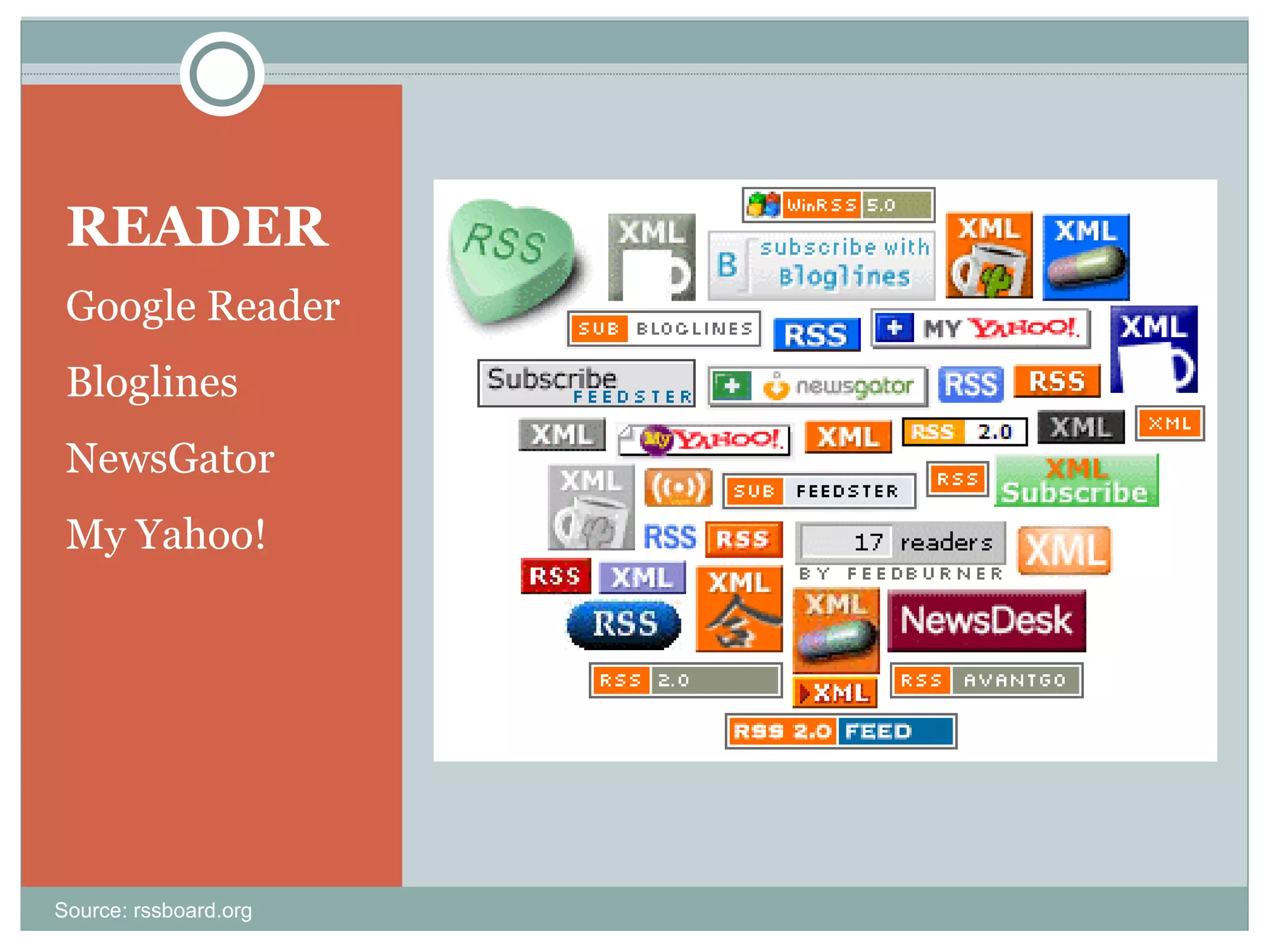
READER Google Reader Bloglines NewsGator My Yahoo! Source: rssboard.org
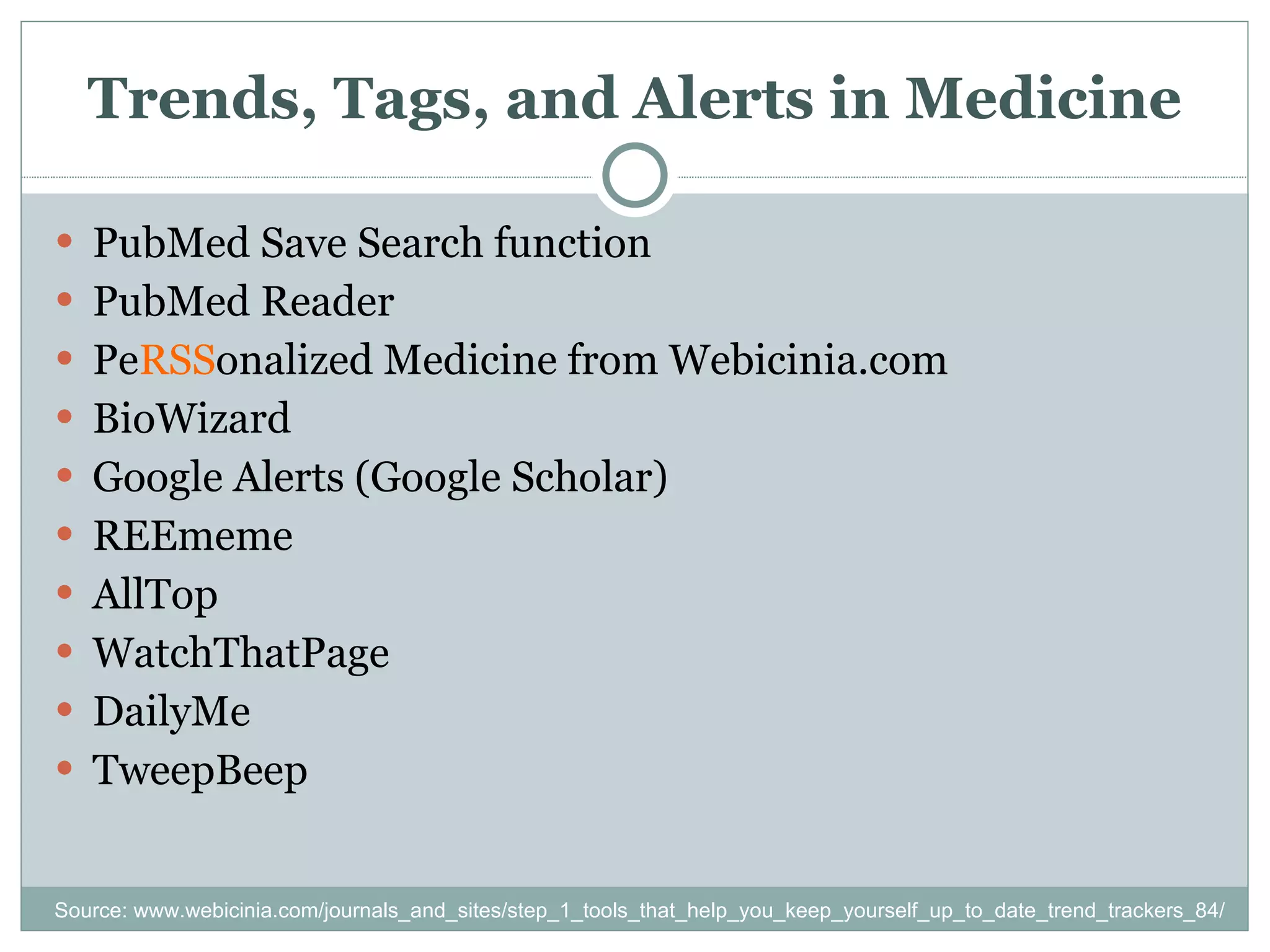
Trends, Tags, and Alerts in Medicine PubMed Save Search function PubMed Reader Pe RSS onalized Medicine from Webicinia.com BioWizard Google Alerts (Google Scholar) REEmeme AllTop WatchThatPage DailyMe TweepBeep Source: www.webicinia.com/journals_and_sites/step_1_tools_that_help_you_keep_yourself_up_to_date_trend_trackers_84/
“ We no longer search for news, the news finds us.”
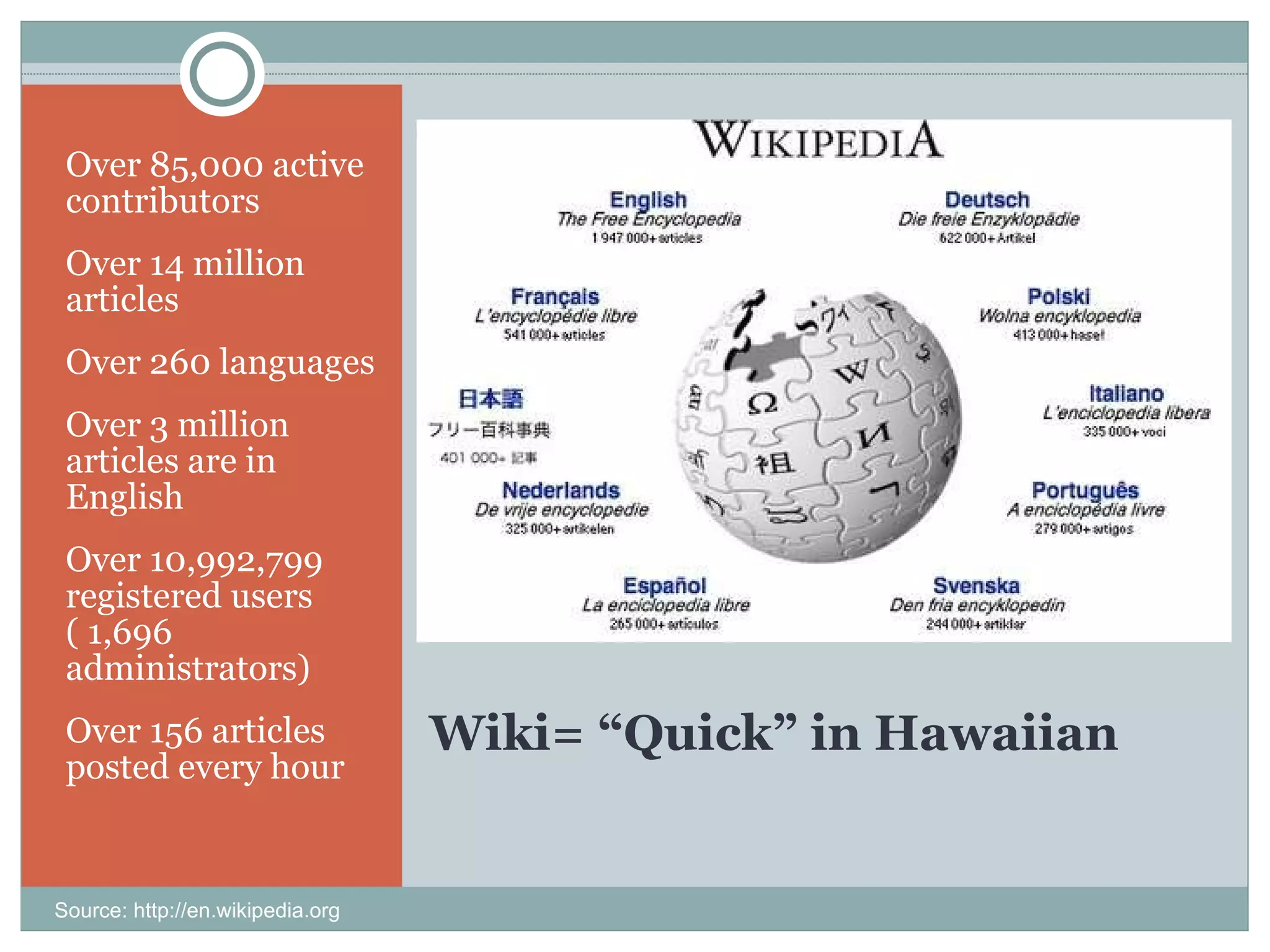
Wiki= “Quick” in Hawaiian Over 85,000 active contributors  Over 14 million articles  Over 260 languages Over 3 million articles are in English Over 10,992,799 registered users ( 1,696 administrators) Over 156 articles posted every hour Source: http://en.wikipedia.org
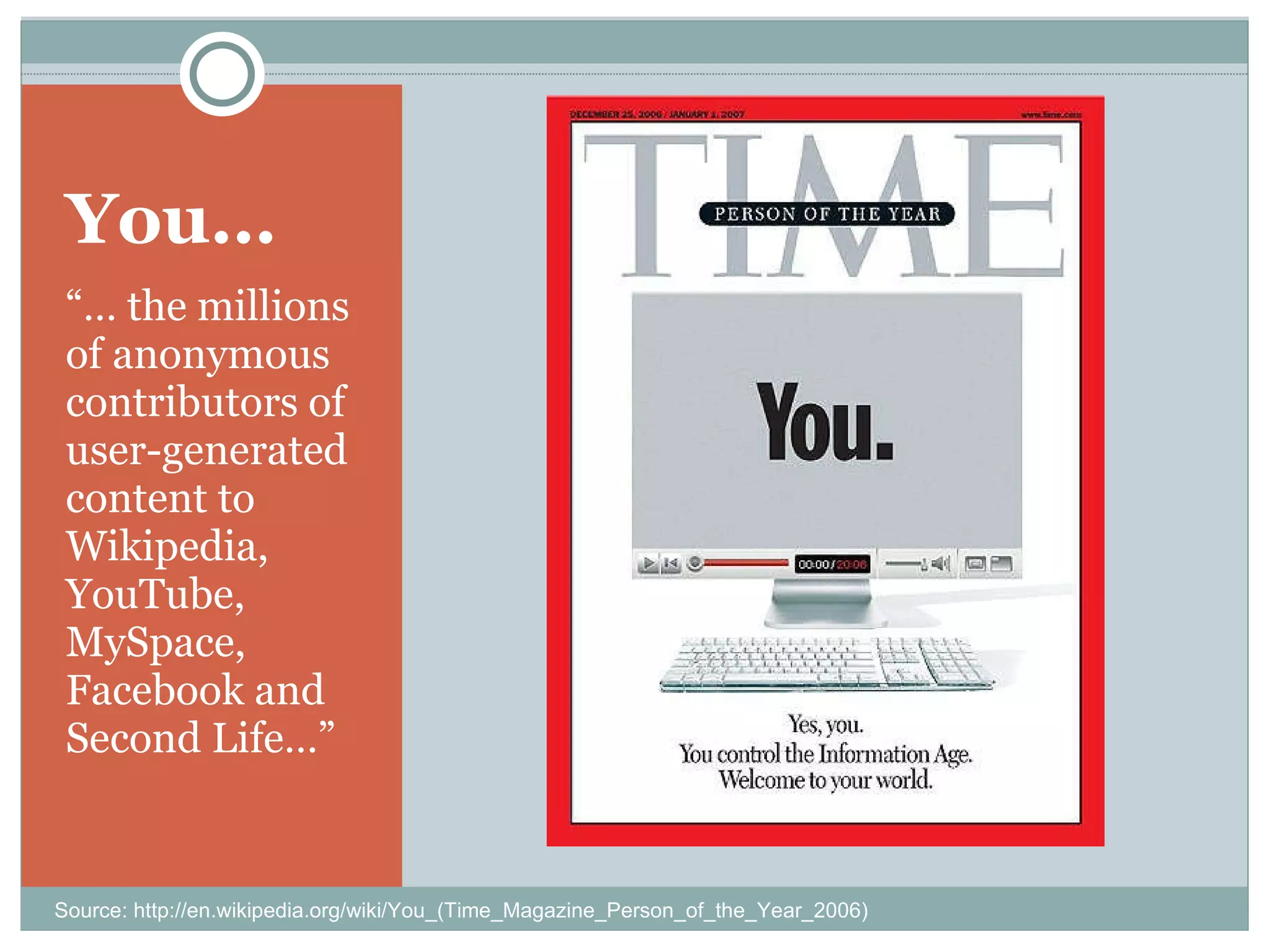
You… “…  the millions of anonymous contributors of user-generated content to Wikipedia, YouTube, MySpace, Facebook and Second Life…” Source: http://en.wikipedia.org/wiki/You_(Time_Magazine_Person_of_the_Year_2006)
AAP in Social Media Section on Perinatal Pediatrics Website Discussion Board YP Connection AAP Perinatal Trainees  Twitter AAPperinatal AAP news NCE Pedialink Facebook groups  AAP Perinatal  AAP Perinatal Trainees Facebook pages AAP Perinatal NeoReviews AAP Pediatrics Blog by AAP President, Judith Palfrey 12/15/09 AAP SmartBrief
January 5, 2010 February 26, 2010 “ Communication and Connection” www.healthychildren.org Child Health Informatics Center “ So What’s Up With HIT?” “ We are in the digital age with all its enormous benefits and many of its complexities.” President’s Blog: Judith S. Palfrey, MD, FAAP
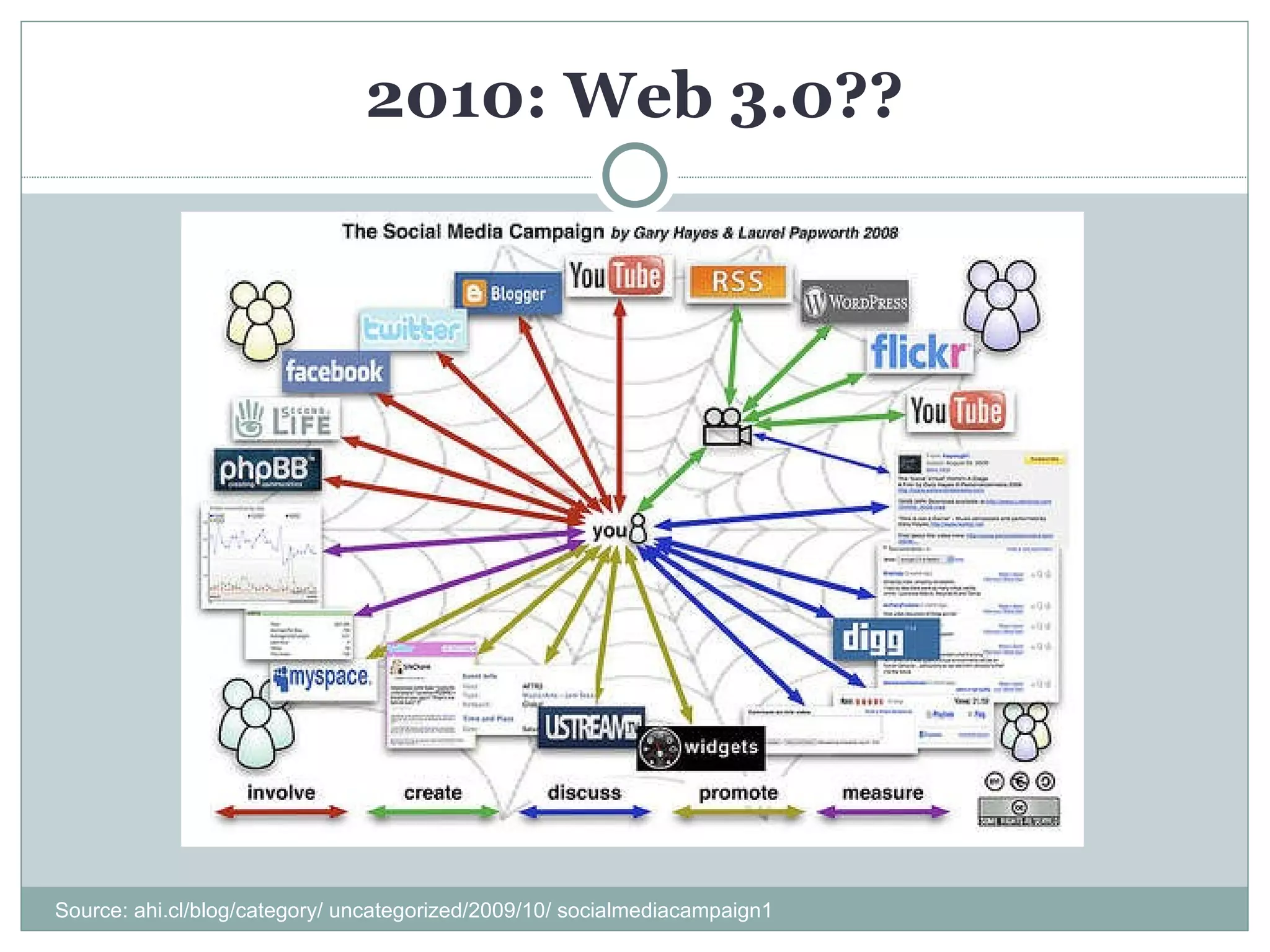
2010: Web 3.0?? Source: ahi.cl/blog/category/ uncategorized/2009/10/ socialmediacampaign1
Potential Risks Social networking is online=  Public  domain, no longer private Posting online is  permanent ; can be deleted, but may be archived Professional  liability risks (violations of medical code of ethics, HIPAA, employer or medical staff policy) Source: Armon, Keller. Who is Dr. Wiki and Why You Need to Know. Unique Opportun. 2009.
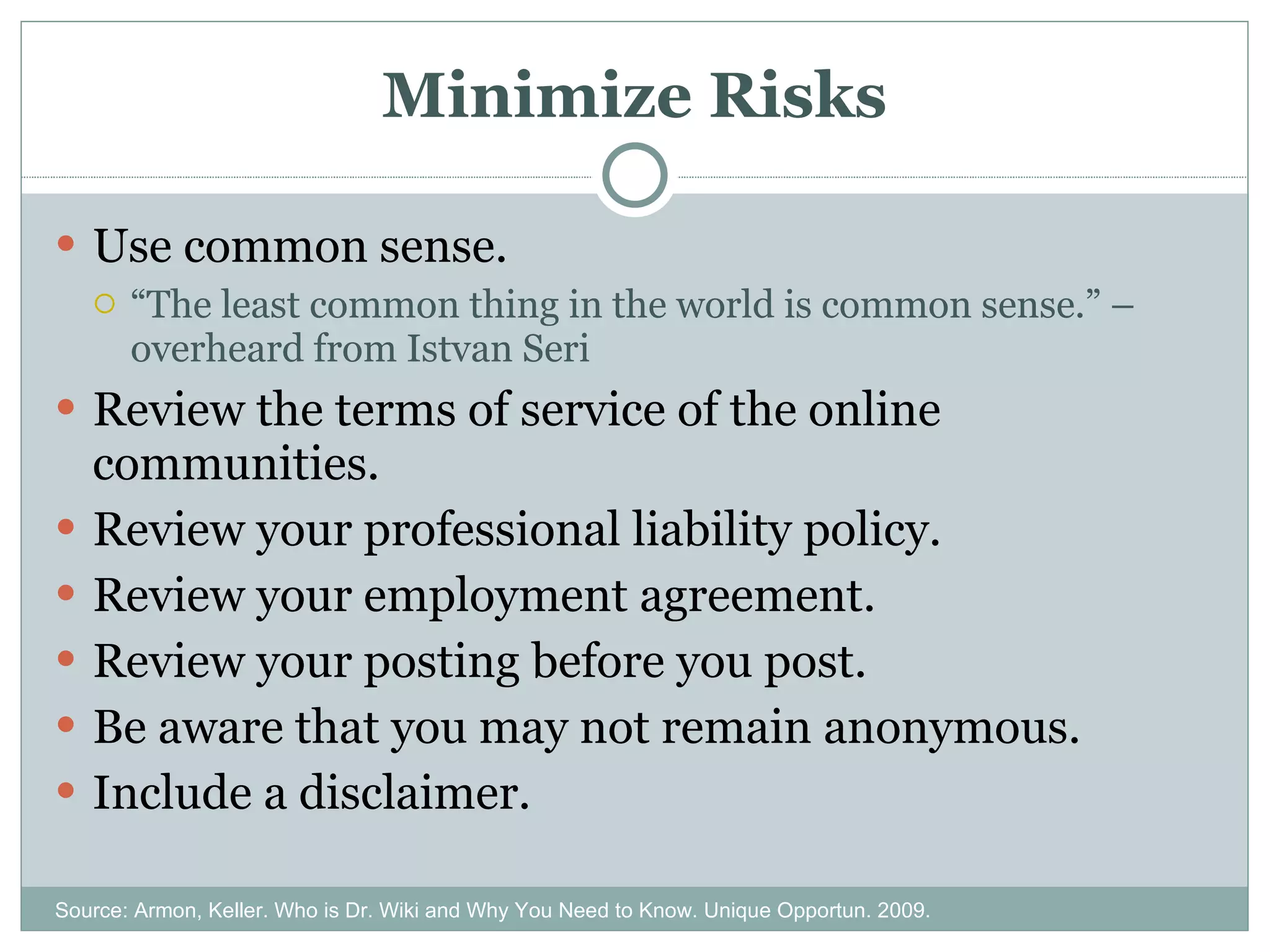
Minimize Risks Use common sense. “ The least common thing in the world is common sense.” – overheard from Istvan Seri Review the terms of service of the online communities. Review your professional liability policy. Review your employment agreement. Review your posting before you post. Be aware that you may not remain anonymous. Include a disclaimer. Source: Armon, Keller. Who is Dr. Wiki and Why You Need to Know. Unique Opportun. 2009.
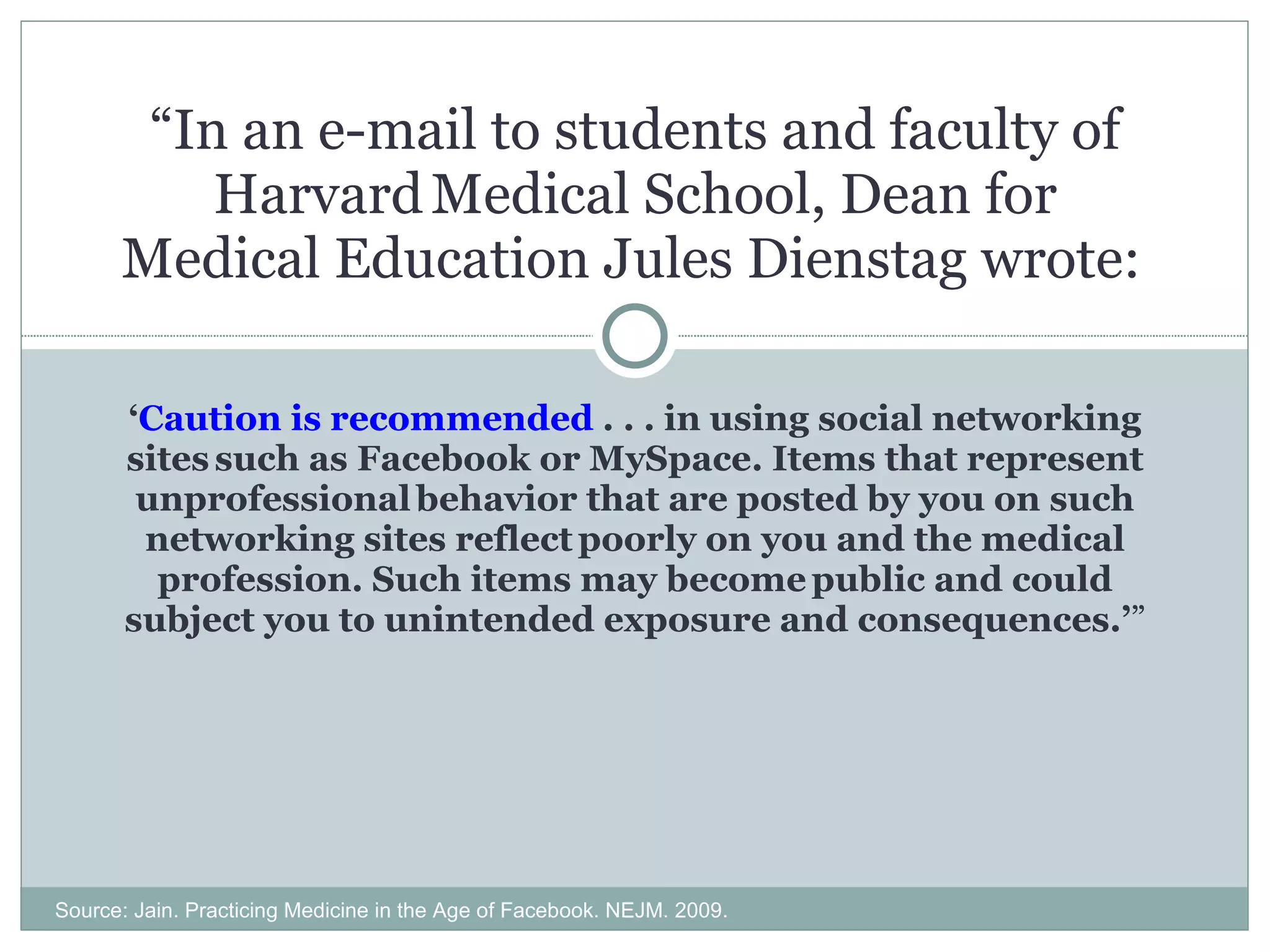
‘ Caution is recommended  . . . in using social networking sites   such as Facebook or MySpace. Items that represent unprofessional   behavior that are posted by you on such networking sites reflect   poorly on you and the medical profession. Such items may become   public and could subject you to unintended exposure and consequences.’ ” “ In an e-mail to students and faculty of Harvard   Medical School, Dean for Medical Education Jules Dienstag wrote:   Source: Jain. Practicing Medicine in the Age of Facebook. NEJM. 2009.
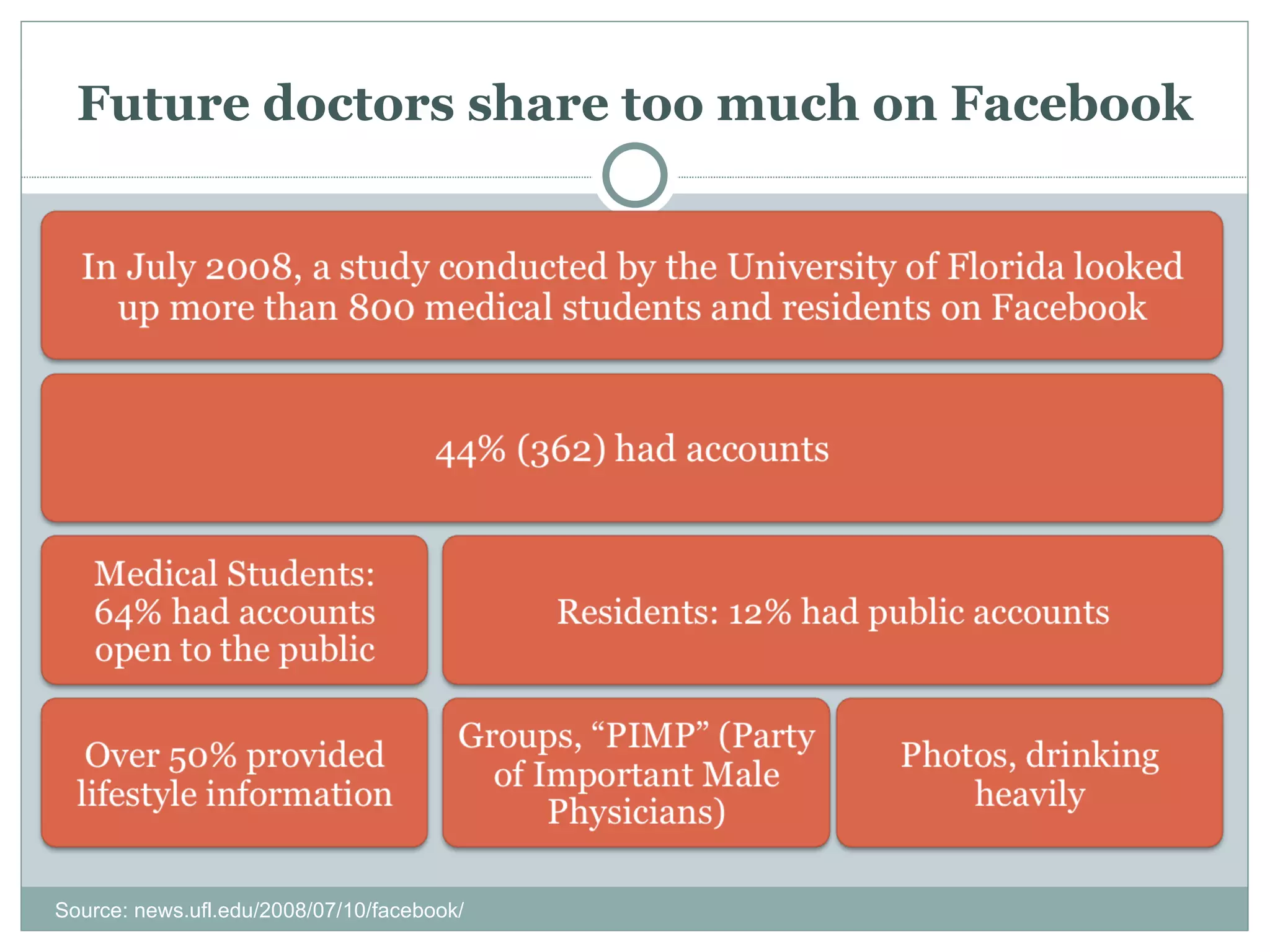
Future doctors share too much on Facebook Source: news.ufl.edu/2008/07/10/facebook/
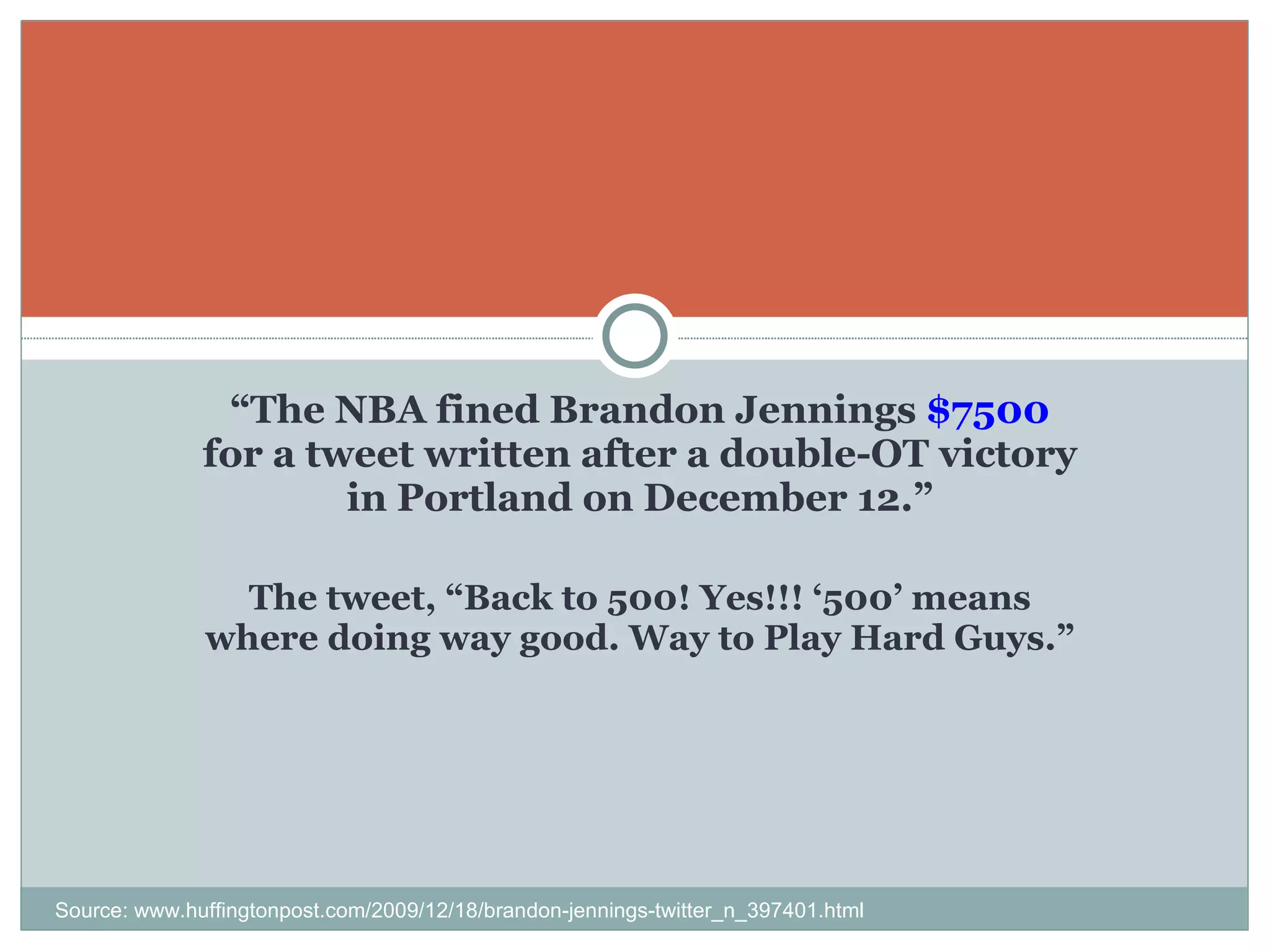
“ The NBA fined Brandon Jennings  $7500  for a tweet written after a double-OT victory in Portland on December 12.” The tweet, “Back to 500! Yes!!! ‘500’ means where doing way good. Way to Play Hard Guys.” Source: www.huffingtonpost.com/2009/12/18/brandon-jennings-twitter_n_397401.html
Life is what happens while you’re busy making other plans JOHN LENNON
Time you enjoy wasting, was not wasted. JOHN LENNON
THANK YOU! [email_address]

The virtual team 1

  • 1.
    WORKSHOP ON PERINATALPEDIATRIC STRATEGIES SCOTTSDALE, AZ APRIL 9-11, 2010 CLARA SONG, MD USC Division of Neonatal Medicine of the LAC+USC Medical Center and Childrens Hospital Los Angeles Keck School of Medicine University of Southern California Los Angeles, CA The Virtual Team: Social Networking and the NICU
  • 2.
    DISCLOSURE I haveno relevant financial relationships with the manufacturers of any commercial products and/or provider of commercial services discussed in this CME activity. I do not intend to discuss an unapproved or investigative use of commercial products or devices.
  • 3.
    OBJECTIVES To definesocial media and its evolution To classify the current available web-based tools To utilize web-based tools in an effort to facilitate collaboration between health professionals
  • 4.
  • 5.
    Social media hastaken over porn as the #1 activity on the web Source: Social Media Revolution from Socialnomics.net
  • 6.
    Web 1.0 Source:www.jeffc.me/web-10-and-web-20-visual-differences
  • 7.
    Web 2.0 Source:www.jeffc.me/ web-10-and-web20-visual-differences
  • 8.
    WEB 2.0 “… web associations that facilitate interactive information sharing, interoperability, user-centered design and collaboration on the World Wide Web…” Concept of web evolution, coined in 1999 by Darcy DiNucci Repopularized in 2004 by O’Reilly Media with first Web 2.0 conference Source: http://en.wikipedia.org/wiki/Web_2.0; Markus Angermeier, Web 2.0 Mindmap
  • 9.
    WEB 2.0 BlogsPhotos Videos Audio Social Networks Event Networks Wikis Microblogs Source: blog.milestoneinternet.com
  • 10.
    Web 2.0 Source:fasticon.com
  • 11.
    Social Media ConceptMedia Social interface Social media is a “group of Internet-based applications…that build on the foundations of Web 2.0, and that allow the creation and exchange user-generated content.” Social media uses Internet and web-based technologies to transform broadcast media monologues (one to many) into social media dialogues (many to many). It supports the democratization of knowledge and information, transforming people from content consumers into content producers. Source: http://en.wikipedia.org/wiki/Social_media
  • 12.
    Web 2.0 toolsallow 20% increase in production innovation and 20% decrease in communication and travel costs . Source: Social Media Revolution from Socialnomics.net
  • 13.
    Social Media isChanging Our Lives Shift in communication to focus on honesty and transparency. Social media sites, like Facebook and Twitter, are becoming trusted sources of information and communication. New relationships are being created and old ones maintained. Average citizens have the opportunity to influence public opinion and policies. New possibilities have been opened for those launching and/or promoting a business. Source: mashable.com/2009/10/16/social-media-changing-lives/
  • 14.
    SOCIAL MEDIA Unveilingthe truth behind the mystery
  • 15.
    “… it’s afundamental shift in the way we communicate.” “ Social media is NOT a fad…
  • 16.
    Social Media: Reachingout and having a conversation. Source: www.telegraph.co.uk
  • 17.
    One in fiveAmericans uses a social media networking service. (Pew Internet & American Life Project) By 2010, Generation Y outnumber baby boomers 96% join a social network Source: Social Media Revolution by Socialnomics.net, Beyond.com Poll
  • 18.
    RADIO: 38 TELEVISION:13 INTERNET: 4 IPOD: 3 Years to Reach 50 Million Users ….. Source: Social Media Revolution by Socialnomics.net
  • 19.
    Facebook added 100 million users in less than 9 months! Source: Social Media Revolution by Socialnomics.net
  • 20.
    Approximately 2 Billion Google searches occur each day. Source: Social Media Revolution by Socialnomics.net
  • 21.
    Health 2.0 “…the use of a specific set of Web tools (blogs, Podcasts, tagging, search, wikis, etc.) by actors in healthcare including doctors, patients, and scientists, using principles of open source and generation of content by users, and the power of networks in order to personalize healthcare, collaborate, and promote health education.” Source: http://en.wikipedia.org.wiki/Health_2.0, health20.org/images/ c/c1/Virtuous_Cycle.png
  • 22.
    61% of Americanadults look online for health information - Pew Internet & American Life Project, June 2009 Information: resources and sharing Medical education Collaboration and practice Disease management Research & data sharing Professional Development & Networking Source: health20.org/wiki/ Health_2.0_Definition
  • 23.
    Personal Health Records(PHR) GoogleHealth: private Microsoft HealthVault: private PatientsLikeMe: viewed with user consent MedHelp.org: viewed with user consent MedicAlert: private FollowMe: private MyMedicalRecords: viewed with user consent, or in cases of emergency by physician
  • 24.
    Hospitals in theUnited States Source: http://ebennett.org/hsnl_11_15_09, www.healthcareos.com
  • 25.
    “ If ourpatients are Health 2.0 patients, then we have to be Health 2.0 docs.” Dr. Gwenn Schurgrin O’Keefe, MD, FAAP Source: Schurgrin O’Keefe. MDNGnetguide 2009, bitstrategist.files.wordpress.com
  • 26.
    HITECH Act Securityof Health IT Patient-Centered Cognitive Support Healthcare Application and Network Platform Architecture Secondary Use of Electronic Health Record Data On December 18, 2009, David Blumenthal, M.D., Department of Health and Human Services National Coordinator for Health Information Technology, announced plans to make $60 million available to support the development of Strategic Health IT Advanced Research Projects (SHARP). Source: http://healthit.hhs.gov
  • 27.
    Social Networking SitesFacebook MySpace Friendster LinkedIn Ning Hi5 Bebo MocoSpace MyLife Source: emarketer.com, June 2009
  • 28.
    FACEBOOK It’s aparty! Fun, casual Meet old friends, make new friends Make professional connections Join interest groups, communities Learn Share stories Source: www.landermedia.com/ images/gfbf.jpg
  • 29.
    More than 350million active users 50% of active users are logged on in any given day Fastest growing demographic is age 35 and older; second is 55-65 year olds Median user age: 33 Average user has 130 friends Worldwide, more than 8 billion minutes a day spent on Facebook, yielding 45 million status updates each day More than 2 billion pieces of content shared every week Most popular site to share photos (comScore 2009) 3 rd most popular site to view online video (Nielson VideoCensus, Nov 2009) Facebook Source: www.facebook.com/press/info.php?statistics
  • 30.
    during the monthof November 2009 was spent on Facebook. 5.5% of ALL time spent online in the U.S. Source: comScore, December 2009
  • 31.
    … itwould be the 4 th largest in population. If Facebook was a country… Source: Social Media Revolution from Socialnomics.net
  • 32.
    Neonatologists on FacebookPublic pages Neonatology Neonatology Review AAP Perinatal FB Page Private groups AAP Perinatal FB Group AAP Perinatal Trainees FB Group
  • 33.
    No good deedgoes unpunished. Elphaba Thropp, The Wicked Witch of the West
  • 34.
    Global network withover 25 million experienced professional in 150 industries Average age is 41 years Over 50% users have income >$100,000 Over-representation of those who attended graduate school, compared to all internet users 64% male 34% own a Smartphone/PDA 80% of companies use LinkedIn as their primary tool to find new employees Searchable by Google LinkedIn Source: www.linkedstrategies.com/blog/tag/linkedin-statistics
  • 35.
    “ No onephysician is as knowledgeable as physicians working together.” Largest online physician community Over 110,000 community members 68 specialties, 50 states Free to practicing physicians Free of advertising Facebook, Twitter and monthly Sermo Blog Source: www.sermo.com/node/11/
  • 36.
    “ The BusinessModel”: “ For physicians, ..unique online environment in which clinical observations can be exchanged in real-time… build consensus on products and issues, take advantage of financial opportunities, and improve patient care by working directly with colleagues…” For Sermo clients, .. a way to target and engage physicians… capture real-world physician insights into treatments, medications and devices… Source: www.sermo.com/node/11/
  • 37.
    Social: Physician-specific SermoDoctorsHangout StudentDoctor.net Healtheva DoctorNetworking RelaxDoc SocialMD ClinicalVillage Ozmosis 99nicu.org NICU-Net MD Link Medscape Physician Connect eMedicine MedicSpeak iMedExchange: practicing MD only FacebookGroups
  • 38.
    Twitter is aservice for friends, family, and co-workers to communicate and stay connected through the exchange of quick frequent answers to one simple question: What are you doing? “ Share and discover what’s happening right now, anywhere in the world.” Twitter Source: twitter.com
  • 39.
    Twitter unique visitorsincreased by 1,382% in a year 475,000 in Feb 2008  7 million in Feb 2009 As of Feb 2009, largest Twitter group 35-49 year olds (42%) Median user age: 31 80% usage on mobile devices Twitter.com primarily visited from work 62% assess from work only 35% assess from home only Source: http://blog.nielson.com/nielsonwire/online_mobile/twitters-tweet-smell-of-success/
  • 40.
    Ashton Kutcher andEllen Degeneres…… … .have more followers than the entire population of Ireland, Norway & Panama. Source: Social Media Revolution from Socialnomics.net
  • 41.
    Twitter Directories WeFollowTwellow Just Tweet It Twibs: businesses Tweeter tags Twitter Fan Wiki GovTwit Twitter Forge: 10 directories Twubble: find people Twitterectory Source: tugagames.com
  • 42.
    Twitter: Search conversations Tweeter Search: official search page Twopular Tweet Scan Twitterment TwitScoop Tweetmeme: Social bookmarking site Twemes: hashtags, keywords TweetVolume Tweet Congress Source: twittertweettweet.com
  • 43.
    Real-time Updates February2009: Surgeons at Henry Ford Hospital, Detroit, Michigan, used Twitter “ To let people know that a tumor can be removed without taking out the entire kidney,” said Craig Rogers, MD, lead surgeon, to CNN.
  • 44.
    140 HEALTHCARE USESFOR TWITTER BY PHIL BAUMANN BLOG, “HEALTH IS SOCIAL”
  • 45.
    Top Twitter Topicsof 2009 Iran Election Swine Flu Gaza Iran Tehran Source: http://mashable.com/2009/12/15/twitter-reveals-most-discussed-topics-of-2009/
  • 46.
    Most Popular TwitterUsers Ashton Kutcher The Ellen Degeneres Show Britney Spears CNN Breaking News Barack Obama Oprah Winfrey Source: www.blog.newwave.net.au/?p=76
  • 47.
    Friday, April 2,2010: Columbia University and MixedInk in New York identified 52,000 Tweets mentioning antibiotics during a 4 ½ month period in 2009. Approximately 700 of those tweets included incorrect information. Twitter is not always reliable Source: www.healthday.com/Article.asp?AID=637674
  • 48.
    iPhone application downloadshit one billion in 9 months. Mobile Media Source: Social Media Revolution from Socialnomics.net
  • 49.
    Mobile Media Over30 social networking sites available for mobile devices 64% of U.S. physicians use a smartphone (Manhattan Research April 2009, http://tinyurl.com/clojeb) Facebook Mobile Twitter.com Myspace Mobile Wikipedia Mobile Friendstribe.com Hobnobster Broadtexter.com Zinadoo.com Dodgeball.com Mocospace.com Zyb.com BrightKite.com
  • 50.
    Free! For-a-Fee EpocratesMedscape Medical Encyclopedia Muscle Head and Neck System Diagnose the Disease game Stress check MedCalc Psych Drugs Wirdy Medical Red Book The ECG Guide Drugs & Medications Nelson’s Pocket Consult Kindle for iPhone Human Body 3D Anatomy 5-minute Clinical Consult Medical Calculator Apgar Timer ICDMeister iPhone applications
  • 51.
    Social Bookmarking andNews Aggregates CiteULike Connotea Delicious Reddit Technorati Newsvine SlashDot StumbleUpon Digg 2collab Diigo Source: doublejdesign.co.uk
  • 52.
    There are over 175 ways to bookmark and share information! Source: Social Media Revolution from Socialnomics.net
  • 53.
    “ Try not.Do or do not, there is no try” - Yoda SLIDE SHARING SlideShare SlideBoom SlideServe Scribd 280 Slides SlideRocket Zoho Show Slide Source: sethpickens.files.wordpress.com/2009/02/luke-yoda
  • 54.
    Media Sharing YouTube rrripple Flickr Daily Motion Vimeo Google Video Yahoo Video Source: www.freesocialicons.com
  • 55.
    As of October2009, YouTube reached one billion views per day. YouTube: the world’s 2 nd largest search engine Source: youtube-global.blogspot.com/2009/10/y000000000utube.html
  • 56.
    20 hours of video are uploaded to YouTube every MINUTE . Source: youtube.com/t/fact_sheet
  • 57.
    Social Network AggregationConsolidates multiple networking profiles into one profile Provides tools to consolidates messages, track messages, combine bookmarks and search across multiple social networking sites Source: Dion Hinchcliffe, http://web2.socialcomputingmagazine.com
  • 58.
    Individuals, business ororganizations “ Real-time feed aggregator that consolidates the updates from social media and social networking websites, social bookmarking websites, blogs, and microblogging updates…” Average of one million visitors/month Source: friendfeed.com
  • 59.
    ON AUGUST 10,2009, FRIENDFEED WAS ACQUIRED BY FACEBOOK, INC. FOR $15 MILLION IN CASH AND $32.5 MILLION IN FACEBOOK STOCK. Source: www.businessweek.com/technology/ccontent/aug2009/tc20090810_284380.htm
  • 60.
    RSS= “Really SimpleSyndication” RSS is “a family of web feed formats used to publish frequently updated works- such as blog entries, news headlines, audio, and video- in a standardized format.” RSS feeds “benefit readers who want to subscribe to timely updates from favored websites or to aggregate feeds from many sites into one place.” Source: http://en.wikipedia.org/wiki/Rss
  • 61.
    READER Google ReaderBloglines NewsGator My Yahoo! Source: rssboard.org
  • 62.
    Trends, Tags, andAlerts in Medicine PubMed Save Search function PubMed Reader Pe RSS onalized Medicine from Webicinia.com BioWizard Google Alerts (Google Scholar) REEmeme AllTop WatchThatPage DailyMe TweepBeep Source: www.webicinia.com/journals_and_sites/step_1_tools_that_help_you_keep_yourself_up_to_date_trend_trackers_84/
  • 63.
    “ We nolonger search for news, the news finds us.”
  • 64.
    Wiki= “Quick” inHawaiian Over 85,000 active contributors Over 14 million articles Over 260 languages Over 3 million articles are in English Over 10,992,799 registered users ( 1,696 administrators) Over 156 articles posted every hour Source: http://en.wikipedia.org
  • 65.
    You… “… the millions of anonymous contributors of user-generated content to Wikipedia, YouTube, MySpace, Facebook and Second Life…” Source: http://en.wikipedia.org/wiki/You_(Time_Magazine_Person_of_the_Year_2006)
  • 66.
    AAP in SocialMedia Section on Perinatal Pediatrics Website Discussion Board YP Connection AAP Perinatal Trainees Twitter AAPperinatal AAP news NCE Pedialink Facebook groups AAP Perinatal AAP Perinatal Trainees Facebook pages AAP Perinatal NeoReviews AAP Pediatrics Blog by AAP President, Judith Palfrey 12/15/09 AAP SmartBrief
  • 67.
    January 5, 2010February 26, 2010 “ Communication and Connection” www.healthychildren.org Child Health Informatics Center “ So What’s Up With HIT?” “ We are in the digital age with all its enormous benefits and many of its complexities.” President’s Blog: Judith S. Palfrey, MD, FAAP
  • 68.
    2010: Web 3.0??Source: ahi.cl/blog/category/ uncategorized/2009/10/ socialmediacampaign1
  • 69.
    Potential Risks Socialnetworking is online= Public domain, no longer private Posting online is permanent ; can be deleted, but may be archived Professional liability risks (violations of medical code of ethics, HIPAA, employer or medical staff policy) Source: Armon, Keller. Who is Dr. Wiki and Why You Need to Know. Unique Opportun. 2009.
  • 70.
    Minimize Risks Usecommon sense. “ The least common thing in the world is common sense.” – overheard from Istvan Seri Review the terms of service of the online communities. Review your professional liability policy. Review your employment agreement. Review your posting before you post. Be aware that you may not remain anonymous. Include a disclaimer. Source: Armon, Keller. Who is Dr. Wiki and Why You Need to Know. Unique Opportun. 2009.
  • 71.
    ‘ Caution isrecommended . . . in using social networking sites such as Facebook or MySpace. Items that represent unprofessional behavior that are posted by you on such networking sites reflect poorly on you and the medical profession. Such items may become public and could subject you to unintended exposure and consequences.’ ” “ In an e-mail to students and faculty of Harvard Medical School, Dean for Medical Education Jules Dienstag wrote: Source: Jain. Practicing Medicine in the Age of Facebook. NEJM. 2009.
  • 72.
    Future doctors sharetoo much on Facebook Source: news.ufl.edu/2008/07/10/facebook/
  • 73.
    “ The NBAfined Brandon Jennings $7500 for a tweet written after a double-OT victory in Portland on December 12.” The tweet, “Back to 500! Yes!!! ‘500’ means where doing way good. Way to Play Hard Guys.” Source: www.huffingtonpost.com/2009/12/18/brandon-jennings-twitter_n_397401.html
  • 74.
    Life is whathappens while you’re busy making other plans JOHN LENNON
  • 75.
    Time you enjoywasting, was not wasted. JOHN LENNON
  • 76.

Editor's Notes

  • #7 Web 1.0 is a term to to define the internet as we understood it as its inception, which became commonplace in the 90’s. This internet at that time was used primarily for email and as a source of information. Web 1.0 users visited internet site and extracted information as if it were a digital library.
  • #8 Web 2.0, the internet as it has evolved this past decade, is no longer only a source of content for passive viewing, but has become an interactive, dynamic arena for idea and information exchange. Now this exchange of ideas occurs, in many applications, in real-time.
  • #9 Web 2.0 is a phrase coined in 1999 by Darcy DiNucci, who a well-known author and editor for information and technology magazines. The term, however, was not widely used until 2004. “O'Reilly Media (formerly O'Reilly & Associates) is an American media company established by Tim O'Reilly that publishes books and web sites and produces conferences on computer technology topics.” “Web 2.0” became the name for the influential Web 2.0 Summit run by O'Reilly Media and TechWeb (formerly CMP Media) in 2004. The company then registered Web 2.0 as a Service Mark "for arranging and conducting live events, namely trade shows, expositions, business conferences and educational conferences in various fields of computers and information technology.” It essentially describes the internet as it has evolved to how we know and use it today….. As a collection of “web associations that facilliate interactive information sharing, interoperability, user-center design and collaboration on the WWW.”
  • #10 The Social Media Starfish is a diagram created by Robert Scroble to illustrate the different channels that people use to interact on the web. This is one great and easy way to visualize the evolving social media landscape.
  • #11 These are some of the Web 2.0 icons with which you may or may not be familiar. Hopefully, by the end of this presentation you will all know what to do with them.
  • #14 Social media, as opposed to mainstream media, is becoming a strong influence of public opinion.
  • #17 Social media is enabling people from various backgrounds on a global level, who previously may not have never had the opportunity, the ability to find a common ground a communicate.
  • #21 … . This indicates that people are searching for information. With social media applications, they are now sharing information more efficiently and effectively.
  • #22 The idea is to utilize these available tools to promote patient-empowered Healthcare and enable patients to make rational decisions by providing them with all available information.
  • #23 Health 2.0, also referred to as Medicine 2.0, emphasizes collaboration, participation, and openess in order to empower consumers to take responsibility for their own health. A major component of this concept is utilizing web tools to strengthen the relationships and communication within the health professional community. Most of the talk will focus on this idea. Finding healthcare, locating physicians, receiving online care, keeping personal health records, electronic charting, support groups
  • #24 One concrete example of Health 2.0 in action in the conception of personal health records or PHR. Currently, online PHR, as is virtually most web content, are user-generated, meaning generated by the patient, then posted online on secure sites. These PHR can accessed at anytime by any physician with web access after user consent; so, it’s usefulness is obvious. Like many other e-patient sites, most of these allow users to share health information after consent. Since 61% of Americans…… this seems like idea that many Americans will soon adopt. In the UK, a universal PHR is currently under construction. One roadblock they are facing, however, is that it is not compatible with the system in France, their very close neighbor.
  • #25 Hospitals across the country have begun to employ web tools to communicate with the public. As of Nov 2009, 441 hospitals in the US use some form of social media.
  • #27 HITECH Act= Health Information Technology for Economic and Clinical Health Act $19.2 billion intended to increase use of EHR by physicians and hospitals. In Feb, the Health and Human Services Department awarded $375.2 million for 32 extension centers. On April 6, the Department awarded $267.6 million to set up regional extension centers to assist healthcare providers utilize electronic health record systems.
  • #28 There are too many social networking sites to mention, and new communities forming everyday. The most popular are…..
  • #29 Cocktails party- meeting friends, making new friends, mixes business with pleasure, making deals
  • #30 Let’s talk about Facebook since it is currently the most popular social networking site. Average # of friends on FB  usually makes people realize how many people they know, or realize how many people they can meet
  • #32 China, India, USA, Facebook
  • #35 Like going to a lunch business meeting
  • #36 Like going to a conference
  • #39 Like going to the water cooler work or stopping by local coffee house- if you are away too long, you’ll miss the conversation.
  • #40 Twitter has created the real time search engine concept. The numbers reflect that people on a global level are obviously taking advantage of this free tool.
  • #42 It’s easy to drown in the huge ocean of information that has become Twitter and decipher between useful facts and mindless commentary. So, there are a number of Twitter Directories to help navigate through all this. For example, you can search Twitter by searching for people by name or using a directory of people categorized by interests (WeFollow ) or a directory of businesses. You may see icons similar to these on various websites; they are used by those individuals or organizations with Twitter accounts. Clicking on the icon will link you to their Twitter account and allow you to follow their Twitter feed.
  • #43 You can also search conversations and subjects by searching for keywords that can be identified by hashtags which are # immediately preceeding keywords that can be searched. Tagging has become one of the most popular and helpful ways to retrieve and share information. You may see these icons on sites at the end of articles or blogs. Clicking on them will allow you post a link back to the site on your Twitter acount to share that interesting bit of information.
  • #46 In 2009, the second most popular topic on Twitter was the “swine flu”. What are people talking about now? Justin Bieber, internet slang and LA Lakers.
  • #47 Currently, the most popular Twitter accounts belong to very high profile celebrities and organizations. These accounts are “verified” by Twitter to indeed belong to these users. However, the majority of Twitter users with large followings are non-celebrities who have opinions and information to share.
  • #49 # of physicians using iPhones doubled in last year.
  • #56 YouTube= #1 most popular site to view videos online #2= Hulu #3 Facebook (Nielson VideoCensus, Nov 2009)
  • #61 Let’s talk now about this useful application, RSS. Blockbuster vs Netflix
  • #62 Going to Blockbuster vs Netflix Sign up for Reader (Google Reader, Bloglines, Newsgator, my Yahoo!) Connect your websites to your Reader by finding icons (RSS) “Subscribe now” or copy URL to add subscriptions/feed onto your Reader.
  • #65 Nature 2005: “Internet encyclopedias go head to head”- accuracy of Wikipedia is close to Encyclopedia Brittanica
  • #66 In Dec 2006, Time magazine named “You” the Person of the Year, “You” being the millions of anonymous contributors of user-generated content to these web tools that we consider reliable sources of information.
  • #67 ****CLARA- UPDATE THIS PAGE****
  • #69 So, now that we have entered a new decade, how will the web evolve from here? Web 1.0- library Web 2.0- conversations and connections Web 3.0- conversations with giant database and memory
  • #70 Remember, also, that anonymity cannot be guaranteed internet, and that privacy can be easily violated.