Web &
Emerging
Technologies
in Health
Promotion
Naomi Hirsch
Research Translation &
Community Outreach
Environmental Health Sciences Center
Superfund Research Program
Overview
 Identify   on-line technologies/tools
 Discuss    example projects
      Why they work?
 Review     what is known on effectiveness
 Share    resources


Digital Age: 1) the spread of broadband; 2) the rise of mobile
connectivity; and 3) the emergence of technological social
networks
Tools
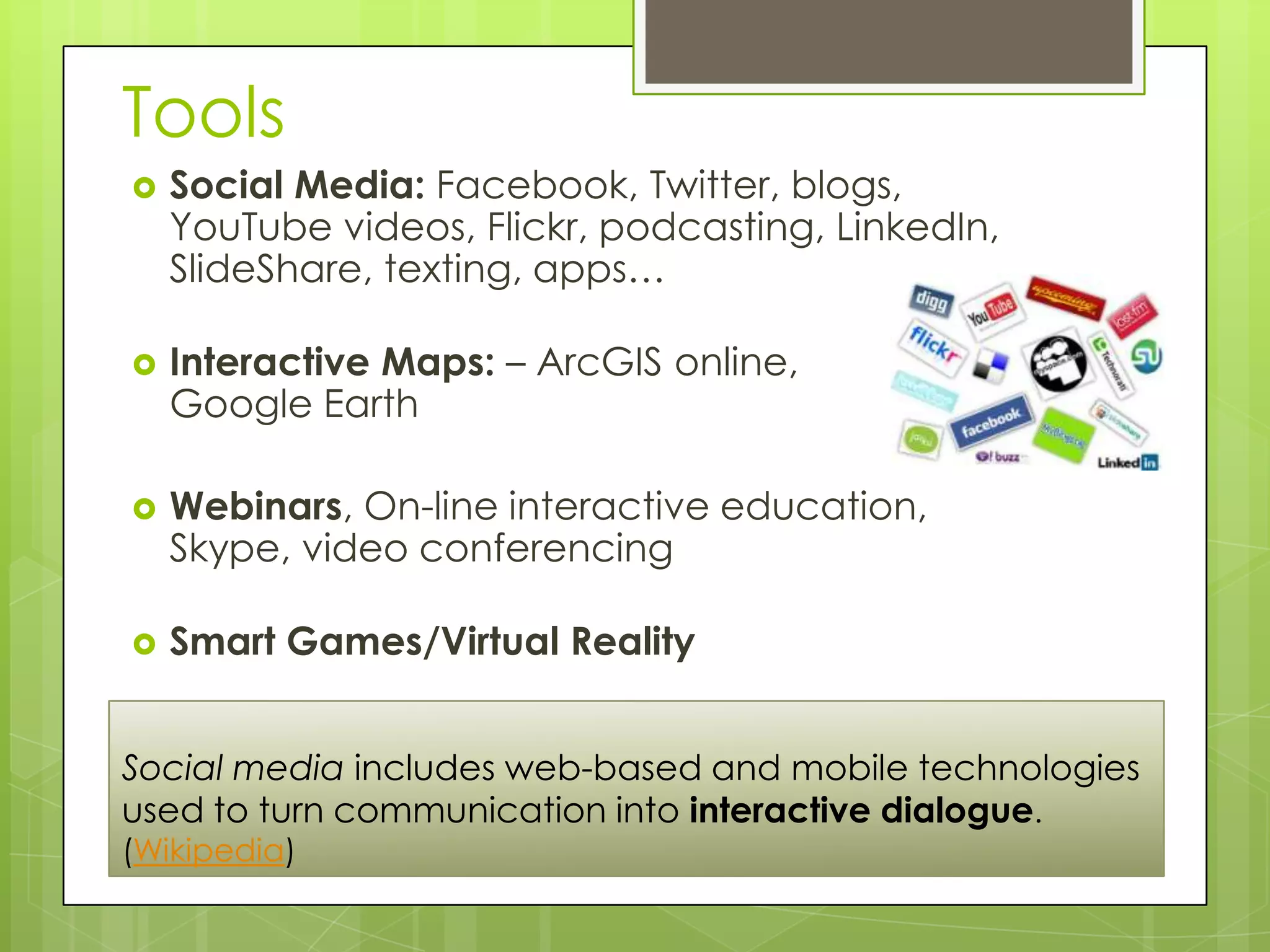
   Social Media: Facebook, Twitter, blogs,
    YouTube videos, Flickr, podcasting, LinkedIn,
    SlideShare, texting, apps…

   Interactive Maps: – ArcGIS online,
    Google Earth

   Webinars, On-line interactive education,
    Skype, video conferencing

   Smart Games/Virtual Reality


Social media includes web-based and mobile technologies
used to turn communication into interactive dialogue.
(Wikipedia)
Health Promotion Examples
   ShotbyShot: digital storytelling, youtube, Facebook -
    www.Shotbyshot.org
   Text2Quit: Texting https://www.text2quit.com/
   DC Takes on HIV: text messages, videos -
    http://www.dctakesonhiv.com/
   Patientslikeme: http://www.patientslikeme.com/
   Pocket Guides: Mobile apps, social networks
    Healthy Child Healthy World
   HealthMap: http://healthmap.org/en/
   UCSF – Committed to the City: maps, video, social
    media http://www.ucsf.edu/news/community
   MDChat: twitter chats http://mdchat.org/
   Right to Know: http://righttoknow.sfsu.edu/
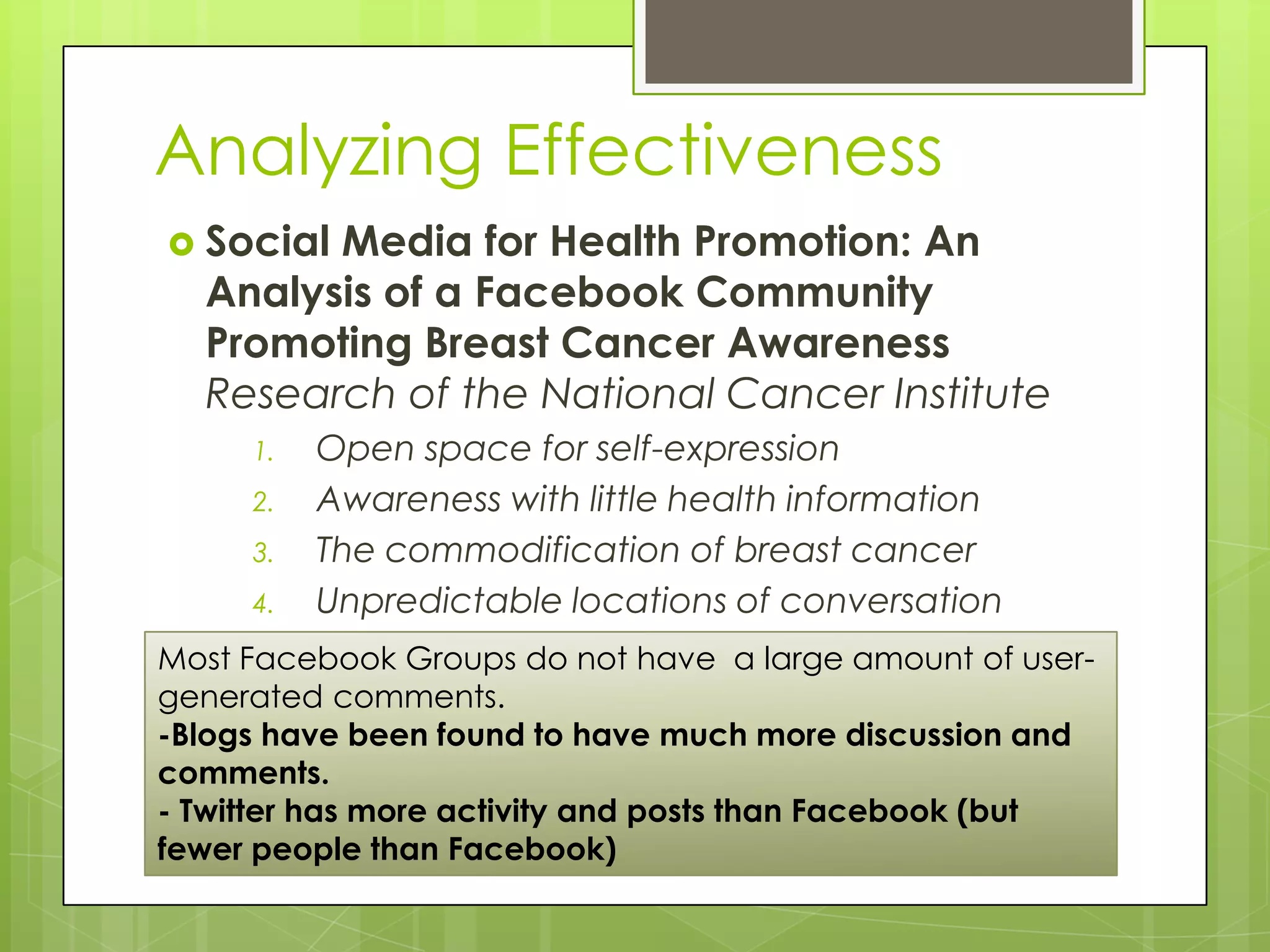
Analyzing Effectiveness
 SocialMedia for Health Promotion: An
  Analysis of a Facebook Community
  Promoting Breast Cancer Awareness
  Research of the National Cancer Institute
     1.   Open space for self-expression
     2.   Awareness with little health information
     3.   The commodification of breast cancer
     4.   Unpredictable locations of conversation
Most Facebook Groups do not have a large amount of user-
generated comments.
-Blogs have been found to have much more discussion and
comments.
- Twitter has more activity and posts than Facebook (but
fewer people than Facebook)
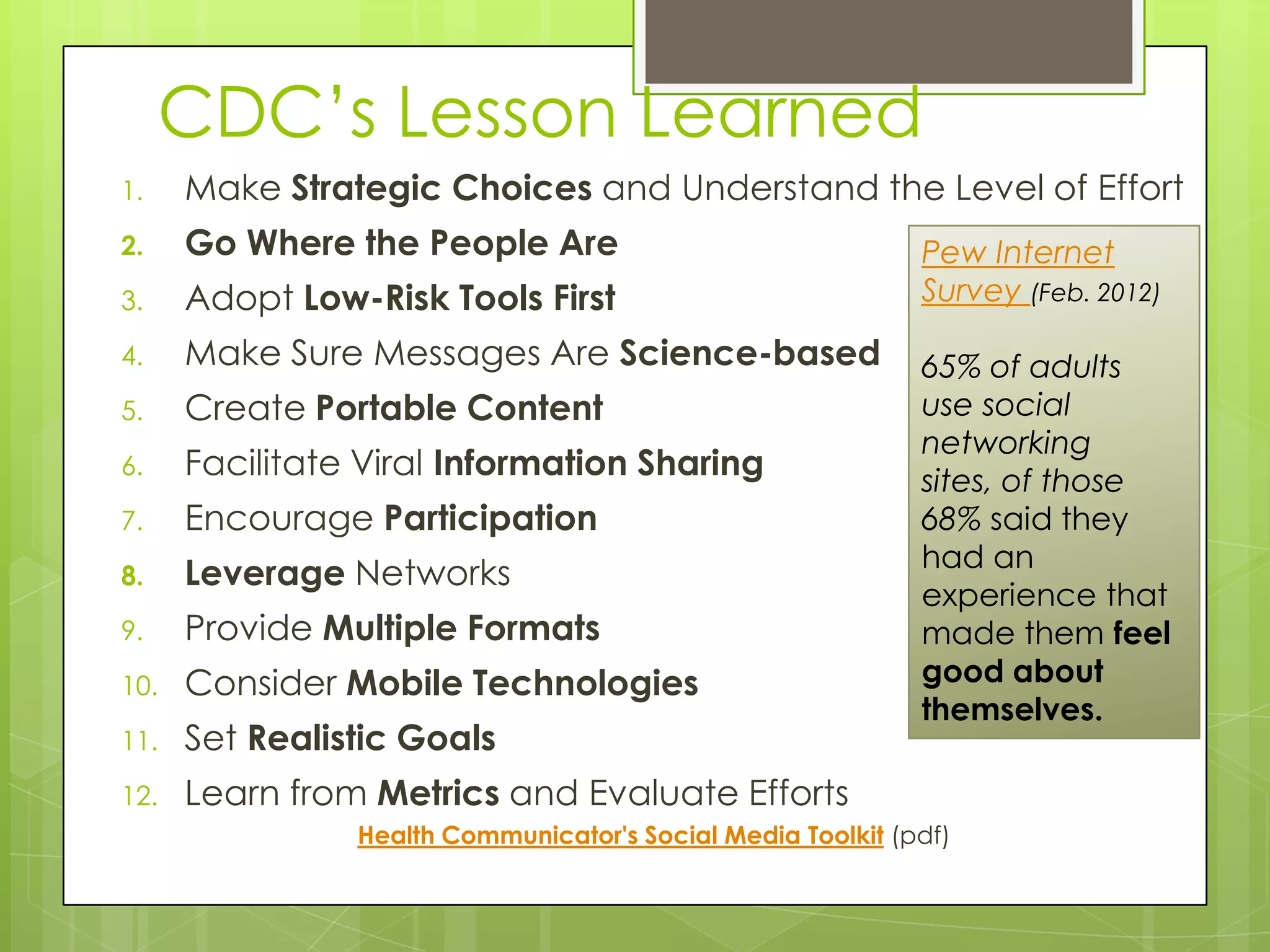
CDC’s Lesson Learned
1.    Make Strategic Choices and Understand the Level of Effort
2.    Go Where the People Are                                Pew Internet
3.    Adopt Low-Risk Tools First                             Survey (Feb. 2012)

4.    Make Sure Messages Are Science-based                   65% of adults
5.    Create Portable Content                                use social
                                                             networking
6.    Facilitate Viral Information Sharing                   sites, of those
7.    Encourage Participation                                68% said they
                                                             had an
8.    Leverage Networks
                                                             experience that
9.    Provide Multiple Formats                               made them feel
10.   Consider Mobile Technologies                           good about
                                                             themselves.
11.   Set Realistic Goals
12.   Learn from Metrics and Evaluate Efforts
                Health Communicator's Social Media Toolkit (pdf)
Resources
 CDC’s  Blogs and Health Communicator's
  Social Media Toolkit (pdf)
 Expert Round Table on Social Media and
  Risk Communication during Times of Crisis
  - A special report from APHA
 Socialmedia increasingly used to gauge
  public health
“medical experts agree that the benefits outweigh the
drawbacks when it comes to the impact of social media on
public health” (Nov. 2011article)

 Naomi’s  Social Media Resources
  (regularly updated)

Web and Emerging Technology in Health Promotion

  • 1.
    Web & Emerging Technologies in Health Promotion NaomiHirsch Research Translation & Community Outreach Environmental Health Sciences Center Superfund Research Program
  • 2.
    Overview  Identify on-line technologies/tools  Discuss example projects  Why they work?  Review what is known on effectiveness  Share resources Digital Age: 1) the spread of broadband; 2) the rise of mobile connectivity; and 3) the emergence of technological social networks
  • 3.
    Tools  Social Media: Facebook, Twitter, blogs, YouTube videos, Flickr, podcasting, LinkedIn, SlideShare, texting, apps…  Interactive Maps: – ArcGIS online, Google Earth  Webinars, On-line interactive education, Skype, video conferencing  Smart Games/Virtual Reality Social media includes web-based and mobile technologies used to turn communication into interactive dialogue. (Wikipedia)
  • 4.
    Health Promotion Examples  ShotbyShot: digital storytelling, youtube, Facebook - www.Shotbyshot.org  Text2Quit: Texting https://www.text2quit.com/  DC Takes on HIV: text messages, videos - http://www.dctakesonhiv.com/  Patientslikeme: http://www.patientslikeme.com/  Pocket Guides: Mobile apps, social networks Healthy Child Healthy World  HealthMap: http://healthmap.org/en/  UCSF – Committed to the City: maps, video, social media http://www.ucsf.edu/news/community  MDChat: twitter chats http://mdchat.org/  Right to Know: http://righttoknow.sfsu.edu/
  • 5.
    Analyzing Effectiveness  SocialMediafor Health Promotion: An Analysis of a Facebook Community Promoting Breast Cancer Awareness Research of the National Cancer Institute 1. Open space for self-expression 2. Awareness with little health information 3. The commodification of breast cancer 4. Unpredictable locations of conversation Most Facebook Groups do not have a large amount of user- generated comments. -Blogs have been found to have much more discussion and comments. - Twitter has more activity and posts than Facebook (but fewer people than Facebook)
  • 6.
    CDC’s Lesson Learned 1. Make Strategic Choices and Understand the Level of Effort 2. Go Where the People Are Pew Internet 3. Adopt Low-Risk Tools First Survey (Feb. 2012) 4. Make Sure Messages Are Science-based 65% of adults 5. Create Portable Content use social networking 6. Facilitate Viral Information Sharing sites, of those 7. Encourage Participation 68% said they had an 8. Leverage Networks experience that 9. Provide Multiple Formats made them feel 10. Consider Mobile Technologies good about themselves. 11. Set Realistic Goals 12. Learn from Metrics and Evaluate Efforts Health Communicator's Social Media Toolkit (pdf)
  • 7.
    Resources  CDC’s Blogs and Health Communicator's Social Media Toolkit (pdf)  Expert Round Table on Social Media and Risk Communication during Times of Crisis - A special report from APHA  Socialmedia increasingly used to gauge public health “medical experts agree that the benefits outweigh the drawbacks when it comes to the impact of social media on public health” (Nov. 2011article)  Naomi’s Social Media Resources (regularly updated)

Editor's Notes

  • #4 What do you have experience with and what is your interest level??Raise your hand if you use Facebook.... Twitter....for work? Others..what are they?What is your interest level in using social media in health promotion? Show a finger from 1-5 Is there something In particular that you use that not up here?
  • #5 Why are they effective?ShotbyShot: digital storytelling, youtube, Facebook - www.Shotbyshot.orgWhat worksText2Quit: Texting https://www.text2quit.com/http://www.voxiva.com/solutions/health_engagement/smokingCessation.htmlMultiple channel approach...web, email, texting.DC Takes on HIV: text messages, videos - http://www.dctakesonhiv.com/Patientslikeme: http://www.patientslikeme.com/Pocket Guides: Mobile apps, social networksHealthy Child Healthy WorldHealthMap: http://healthmap.org/en/MDChat: http://mdchat.org/Exmaple of the way Twitter can be used.
  • #6 http://www.TheBreastCancerSite.com 2.8 million “likes”The Breast Cancer Site was founded to help fund free mammograms for women in need — women for whom early detection would not otherwise be possible. Since its launch in October 2000, the site has established itself as a leader in online activism and in the fight to prevent breast cancer deaths.ProductsIn addition to clicking the pink "Click Here to Give - it's FREE" button, visitors can make early detection and survival of breast cancer possible by shopping in The Breast Cancer Site store. With each item purchased, shoppers generate funds for free mammograms for women in need. The store offers a wide array of items to show your support, including pink ribbon jewelry and apparel.