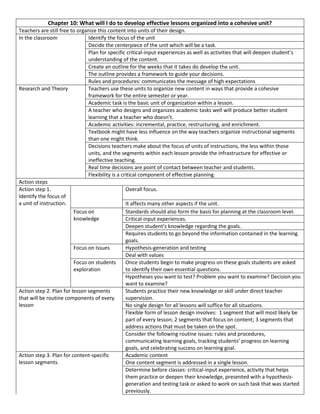
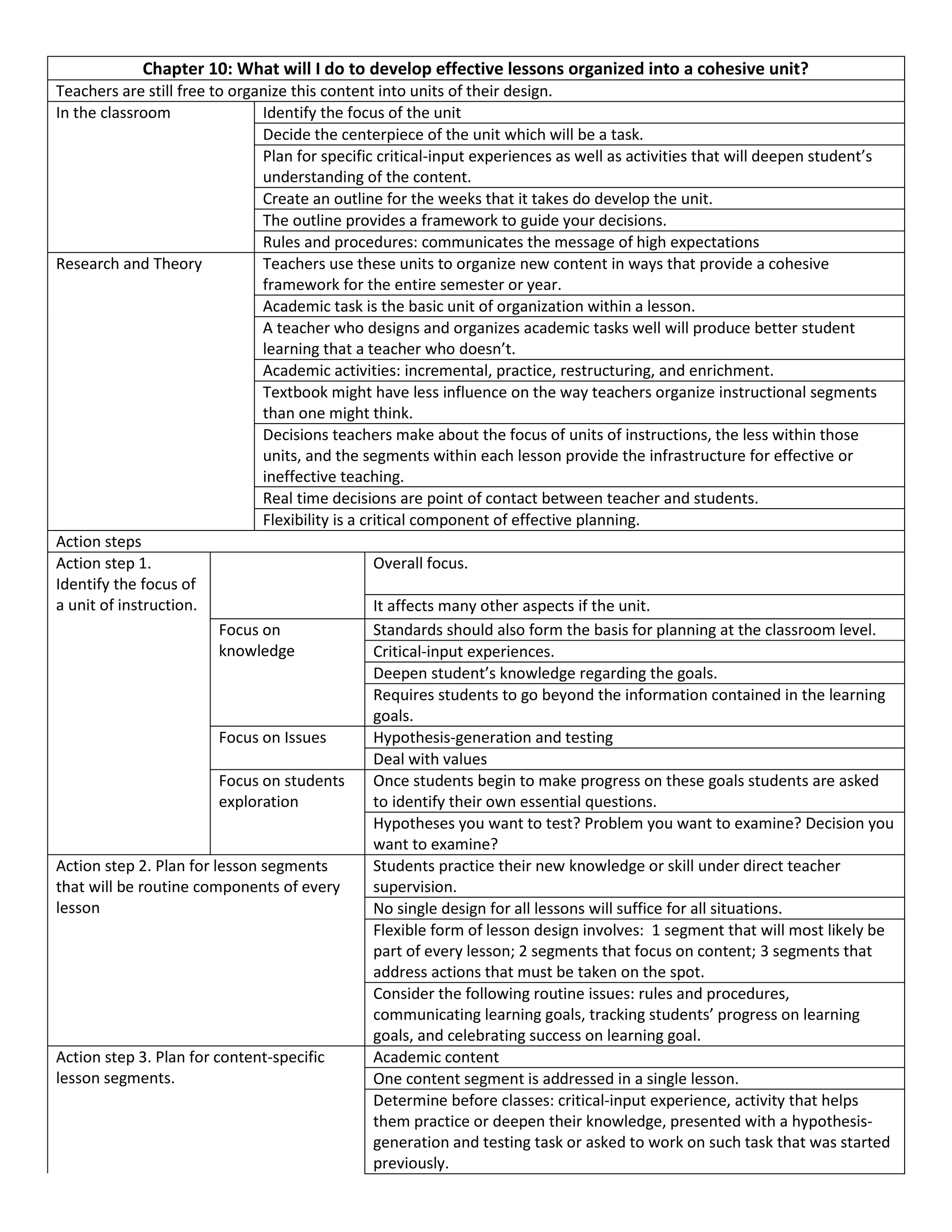
Chapter 10: What will I do to develop effective lessons organized into a cohesive unit?
Teachers are still free to organize this content into units of their design.
In the classroom               Identify the focus of the unit
                               Decide the centerpiece of the unit which will be a task.
                               Plan for specific critical-input experiences as well as activities that will deepen student’s
                               understanding of the content.
                               Create an outline for the weeks that it takes do develop the unit.
                               The outline provides a framework to guide your decisions.
                               Rules and procedures: communicates the message of high expectations
Research and Theory            Teachers use these units to organize new content in ways that provide a cohesive
                               framework for the entire semester or year.
                               Academic task is the basic unit of organization within a lesson.
                               A teacher who designs and organizes academic tasks well will produce better student
                               learning that a teacher who doesn’t.
                               Academic activities: incremental, practice, restructuring, and enrichment.
                               Textbook might have less influence on the way teachers organize instructional segments
                               than one might think.
                               Decisions teachers make about the focus of units of instructions, the less within those
                               units, and the segments within each lesson provide the infrastructure for effective or
                               ineffective teaching.
                               Real time decisions are point of contact between teacher and students.
                               Flexibility is a critical component of effective planning.
Action steps
Action step 1.                                    Overall focus.
Identify the focus of
a unit of instruction.                            It affects many other aspects if the unit.
                         Focus on                 Standards should also form the basis for planning at the classroom level.
                         knowledge                Critical-input experiences.
                                                  Deepen student’s knowledge regarding the goals.
                                                  Requires students to go beyond the information contained in the learning
                                                  goals.
                         Focus on Issues          Hypothesis-generation and testing
                                                  Deal with values
                         Focus on students        Once students begin to make progress on these goals students are asked
                         exploration              to identify their own essential questions.
                                                  Hypotheses you want to test? Problem you want to examine? Decision you
                                                  want to examine?
Action step 2. Plan for lesson segments           Students practice their new knowledge or skill under direct teacher
that will be routine components of every          supervision.
lesson                                            No single design for all lessons will suffice for all situations.
                                                  Flexible form of lesson design involves: 1 segment that will most likely be
                                                  part of every lesson; 2 segments that focus on content; 3 segments that
                                                  address actions that must be taken on the spot.
                                                  Consider the following routine issues: rules and procedures,
                                                  communicating learning goals, tracking students’ progress on learning
                                                  goals, and celebrating success on learning goal.
Action step 3. Plan for content-specific          Academic content
lesson segments.                                  One content segment is addressed in a single lesson.
                                                  Determine before classes: critical-input experience, activity that helps
                                                  them practice or deepen their knowledge, presented with a hypothesis-
                                                  generation and testing task or asked to work on such task that was started
                                                  previously.
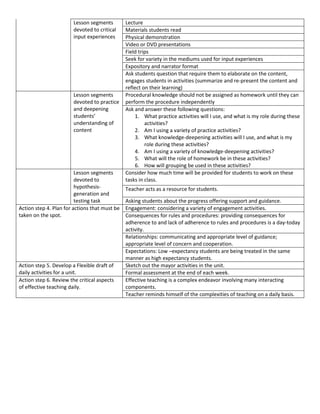
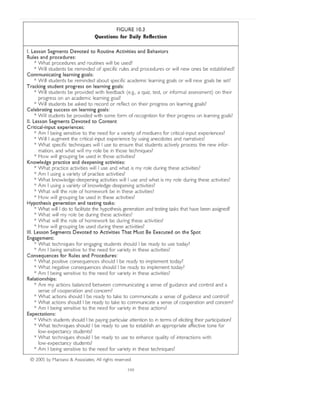
Lesson segments        Lecture
                        devoted to critical    Materials students read
                        input experiences      Physical demonstration
                                               Video or DVD presentations
                                               Field trips
                                               Seek for variety in the mediums used for input experiences
                                               Expository and narrator format
                                               Ask students question that require them to elaborate on the content,
                                               engages students in activities (summarize and re-present the content and
                                               reflect on their learning)
                        Lesson segments        Procedural knowledge should not be assigned as homework until they can
                        devoted to practice    perform the procedure independently
                        and deepening          Ask and answer these following questions:
                        students’                  1. What practice activities will I use, and what is my role during these
                        understanding of                activities?
                        content                    2. Am I using a variety of practice activities?
                                                   3. What knowledge-deepening activities will I use, and what is my
                                                        role during these activities?
                                                   4. Am I using a variety of knowledge-deepening activities?
                                                   5. What will the role of homework be in these activities?
                                                   6. How will grouping be used in these activities?
                         Lesson segments       Consider how much time will be provided for students to work on these
                         devoted to            tasks in class.
                         hypothesis-           Teacher acts as a resource for students.
                         generation and
                         testing task          Asking students about the progress offering support and guidance.
Action step 4. Plan for actions that must be   Engagement: considering a variety of engagement activities.
taken on the spot.                             Consequences for rules and procedures: providing consequences for
                                               adherence to and lack of adherence to rules and procedures is a day-today
                                               activity.
                                               Relationships: communicating and appropriate level of guidance;
                                               appropriate level of concern and cooperation.
                                               Expectations: Low –expectancy students are being treated in the same
                                               manner as high expectancy students.
Action step 5. Develop a Flexible draft of     Sketch out the mayor activities in the unit.
daily activities for a unit.                   Formal assessment at the end of each week.
Action step 6. Review the critical aspects     Effective teaching is a complex endeavor involving many interacting
of effective teaching daily.                   components.
                                               Teacher reminds himself of the complexities of teaching on a daily basis.
Chapter 10 marzano

Chapter 10 marzano

  • 1.
    Chapter 10: Whatwill I do to develop effective lessons organized into a cohesive unit? Teachers are still free to organize this content into units of their design. In the classroom Identify the focus of the unit Decide the centerpiece of the unit which will be a task. Plan for specific critical-input experiences as well as activities that will deepen student’s understanding of the content. Create an outline for the weeks that it takes do develop the unit. The outline provides a framework to guide your decisions. Rules and procedures: communicates the message of high expectations Research and Theory Teachers use these units to organize new content in ways that provide a cohesive framework for the entire semester or year. Academic task is the basic unit of organization within a lesson. A teacher who designs and organizes academic tasks well will produce better student learning that a teacher who doesn’t. Academic activities: incremental, practice, restructuring, and enrichment. Textbook might have less influence on the way teachers organize instructional segments than one might think. Decisions teachers make about the focus of units of instructions, the less within those units, and the segments within each lesson provide the infrastructure for effective or ineffective teaching. Real time decisions are point of contact between teacher and students. Flexibility is a critical component of effective planning. Action steps Action step 1. Overall focus. Identify the focus of a unit of instruction. It affects many other aspects if the unit. Focus on Standards should also form the basis for planning at the classroom level. knowledge Critical-input experiences. Deepen student’s knowledge regarding the goals. Requires students to go beyond the information contained in the learning goals. Focus on Issues Hypothesis-generation and testing Deal with values Focus on students Once students begin to make progress on these goals students are asked exploration to identify their own essential questions. Hypotheses you want to test? Problem you want to examine? Decision you want to examine? Action step 2. Plan for lesson segments Students practice their new knowledge or skill under direct teacher that will be routine components of every supervision. lesson No single design for all lessons will suffice for all situations. Flexible form of lesson design involves: 1 segment that will most likely be part of every lesson; 2 segments that focus on content; 3 segments that address actions that must be taken on the spot. Consider the following routine issues: rules and procedures, communicating learning goals, tracking students’ progress on learning goals, and celebrating success on learning goal. Action step 3. Plan for content-specific Academic content lesson segments. One content segment is addressed in a single lesson. Determine before classes: critical-input experience, activity that helps them practice or deepen their knowledge, presented with a hypothesis- generation and testing task or asked to work on such task that was started previously.
  • 2.
    Lesson segments Lecture devoted to critical Materials students read input experiences Physical demonstration Video or DVD presentations Field trips Seek for variety in the mediums used for input experiences Expository and narrator format Ask students question that require them to elaborate on the content, engages students in activities (summarize and re-present the content and reflect on their learning) Lesson segments Procedural knowledge should not be assigned as homework until they can devoted to practice perform the procedure independently and deepening Ask and answer these following questions: students’ 1. What practice activities will I use, and what is my role during these understanding of activities? content 2. Am I using a variety of practice activities? 3. What knowledge-deepening activities will I use, and what is my role during these activities? 4. Am I using a variety of knowledge-deepening activities? 5. What will the role of homework be in these activities? 6. How will grouping be used in these activities? Lesson segments Consider how much time will be provided for students to work on these devoted to tasks in class. hypothesis- Teacher acts as a resource for students. generation and testing task Asking students about the progress offering support and guidance. Action step 4. Plan for actions that must be Engagement: considering a variety of engagement activities. taken on the spot. Consequences for rules and procedures: providing consequences for adherence to and lack of adherence to rules and procedures is a day-today activity. Relationships: communicating and appropriate level of guidance; appropriate level of concern and cooperation. Expectations: Low –expectancy students are being treated in the same manner as high expectancy students. Action step 5. Develop a Flexible draft of Sketch out the mayor activities in the unit. daily activities for a unit. Formal assessment at the end of each week. Action step 6. Review the critical aspects Effective teaching is a complex endeavor involving many interacting of effective teaching daily. components. Teacher reminds himself of the complexities of teaching on a daily basis.