
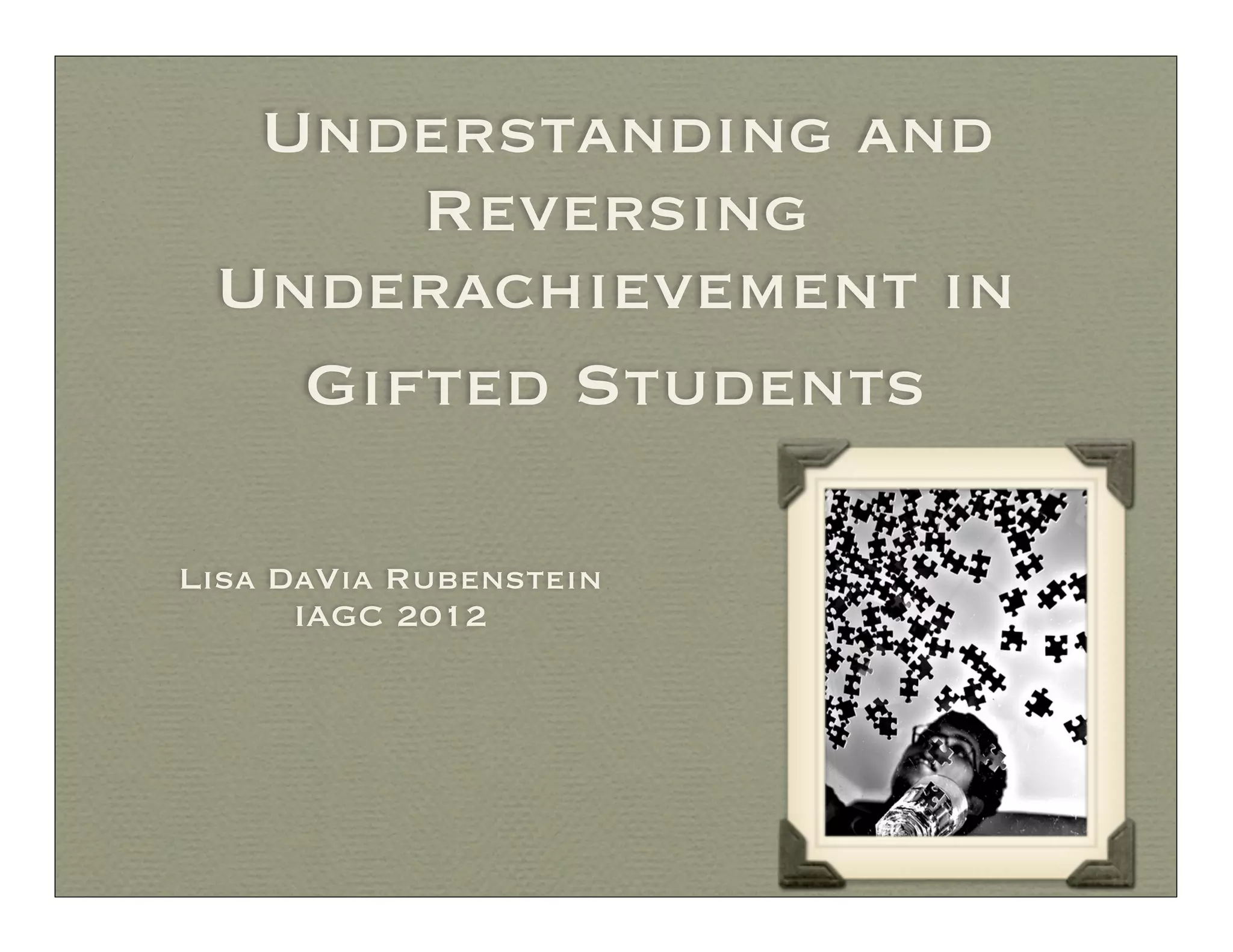











Understanding and
      Reversing
 Underachievement in
   Gifted Students

Lisa DaVia Rubenstein
      IAGC 2012
"It is not impossibilities
which fill us with the deepest
  despair, but possibilities
  which we have failed to
          realize."
                  — Robert Mallet
Importance

• McCall, Evahn, & Kratzer
  (1992): School Achievement
  Matters
• Peterson & Colangelo (1996):
  Persistent Patterns	
  
Problems?

• 18-25% of high school
  dropouts are in the gifted
  range (Solorzano 1983;
  Renzulli & Park, 2000)

• Underachievement becomes a
  pattern - only 26% of high
  school underachievers are able
  to reverse the pattern in
  college (Peterson, 2000)
Identification
Most Popular Definition (Reis & McCoach, 2000)
  “Underachievers are students who exhibit a severe
  discrepancy between expected achievement (as
  measured by standardized achievement test scores or
  cognitive or intellectual ability assessments) and actual
  achievement (as measured by class grades and teacher
  evaluations). To be classified as an underachiever, the
  discrepancy between expected and actual achievement
  must not be the direct result of a diagnosed learning
  disability and must persist over an extended period
  of time. Gifted underachievers are underachievers who
  exhibit superior scores on measures of expected
  achievement (i.e., standardized achievement test scores or
  cognitive or intellectual ability assessments).” (p. 157).
Are we all
underachievers in
   some areas?
Identification
               Problems
• Duration
• Degree
• Different for gifted students and regular students
• Standardized test scores/ IQ test scores
• Twice exceptionality
• Selectivity
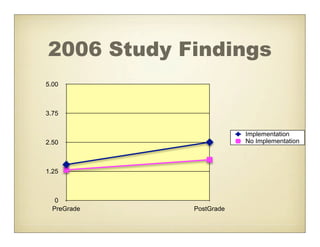
2006 Study Findings
5.00


3.75


                         Implementation
2.50                     No Implementation


1.25


   0
  PreGrade   PostGrade
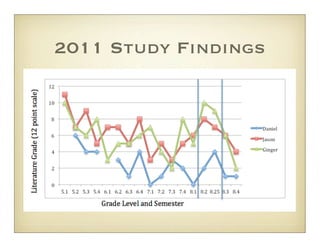
2011 Study Findings
Create an
identification
plan.
Understanding the Underachieving
            Student
Characteristics


• Anecdotal reports from counselors
• Qualitative studies
• Quantitative studies
Possible
  Characteristics of
Gifted Underachievers
          May be dependent
          May develop coping
          mechanisms which
          successfully reduce short term
          stress, but which inhibit long
          term success.
          May be socially immature
          May be antisocial or rebellious
          ..........
Characteristics of
Gifted Underachievers
             The most common
           characteristic is low self-
                   esteem.

           Sometimes these students
             don’t believe they are
           capable of accomplishing
            what their families and
               teachers expect.
But wait...a challenge?

• McCoach & Siegle: academic
  self-perceptions was equal
  between the 2 groups

• Difference between qualitative
  and quantitative

• Largest predictors: Motivation
  and task valuation
A model of motivation:

    Achievement
 Orientation Model
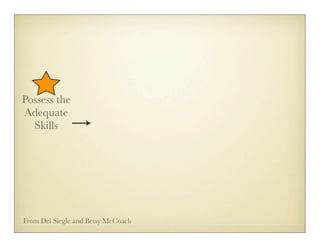
Possess the
Adequate
  Skills


From Del Siegle and Betsy McCoach
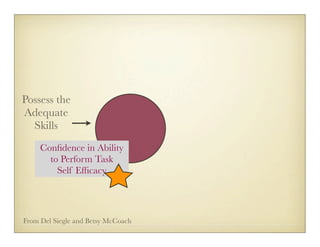
Possess the
Adequate
  Skills
     Confidence in Ability
       to Perform Task
         Self Efficacy


From Del Siegle and Betsy McCoach
Flexible
               OR
Stable/Fixed
Types of Praise
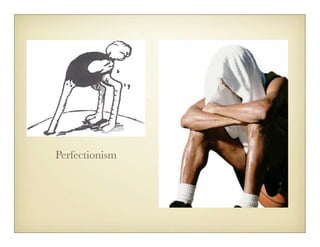
Perfectionism
How to Build Self-
         Efficacy
• Complement of skills they develop
• Practice lack-of-effort explanations for poor
  performance
• Avoid the appearance of unsolicited help
• Recognize progress during a lesson
• Help students to set goals, document their growth
• Peer models and self-model
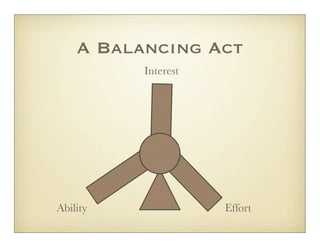
A Balancing Act
          Interest


Ability              Effort
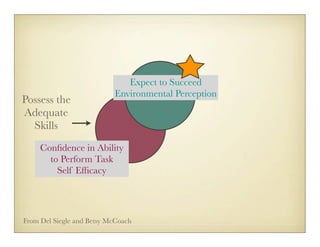
Expect to Succeed
                           Environmental Perception
Possess the
Adequate
  Skills
     Confidence in Ability
       to Perform Task
         Self Efficacy


From Del Siegle and Betsy McCoach
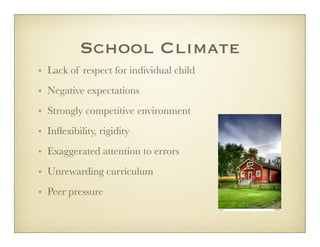
School Climate
• Lack of respect for individual child
• Negative expectations
• Strongly competitive environment
• Inflexibility, rigidity
• Exaggerated attention to errors
• Unrewarding curriculum
• Peer pressure
School Perception
• Identify faulty cognitions
   • I must perform well all the time.
   • Everyone must treat me well all the time.
   • Conditions must be favorable all the time.
• Categories
   • What events occur
   • Attributions about why events occur
   • Expectancies or predictions of what will occur
   • Assumptions about the nature of the world
   • Belief what should be
• Is it valid and/or reasonable to have this thought?
• Are their distortions blocking what is true? (Examples
  include overgeneralizations, minimization,
  catastrophizing, absolute thinking)
School Perception
                       Choice Theory
• All behavior is chosen and the only person whose
  behavior we can control is our own.
• No thing, event, or person makes us to anything.
                          Solutions
• Set good goals that are positive, in the student’s own
  words, current, specific, and in the student’s control.
• Start small, in the present and focus on how to actively
  change it. Point out successes. Follow up.
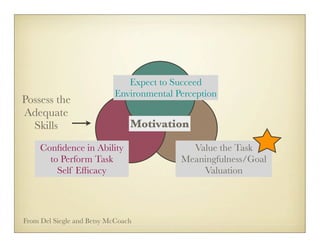
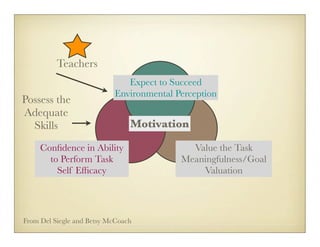
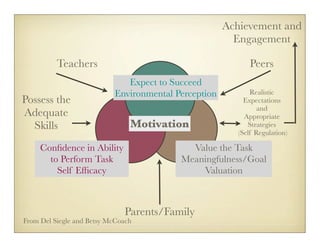
Expect to Succeed
                           Environmental Perception
Possess the
Adequate
  Skills                        Motivation

     Confidence in Ability                   Value the Task
       to Perform Task                    Meaningfulness/Goal
         Self Efficacy                         Valuation


From Del Siegle and Betsy McCoach
Mihaly Csikszentmihalyi


              On Flow
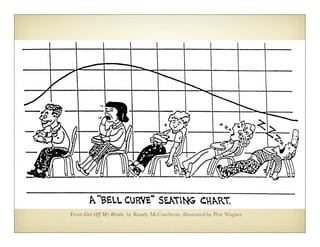
From Get Off My Brain, by Randy McCutcheon, illustrated by Pete Wagner
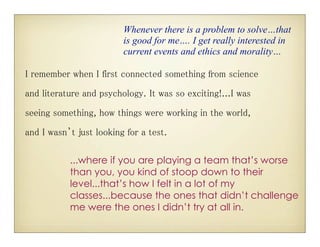
Whenever there is a problem to solve…that
                         is good for me…. I get really interested in
                         current events and ethics and morality…

I remember when I first connected something from science

and literature and psychology. It was so exciting!...I was
seeing something, how things were working in the world,
and I wasn’t just looking for a test.

           ...where if you are playing a team that’s worse
           than you, you kind of stoop down to their
           level...that’s how I felt in a lot of my
           classes...because the ones that didn’t challenge
           me were the ones I didn’t try at all in.
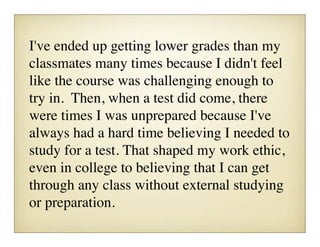
I've ended up getting lower grades than my
classmates many times because I didn't feel
like the course was challenging enough to
try in.  Then, when a test did come, there
were times I was unprepared because I've
always had a hard time believing I needed to
study for a test. That shaped my work ethic,
even in college to believing that I can get
through any class without external studying
or preparation.
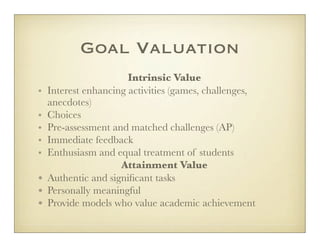
Goal Valuation
                       Intrinsic Value
•   Interest enhancing activities (games, challenges,
    anecdotes)
•   Choices
•   Pre-assessment and matched challenges (AP)
•   Immediate feedback
•   Enthusiasm and equal treatment of students
                     Attainment Value
•   Authentic and significant tasks
•   Personally meaningful
•   Provide models who value academic achievement
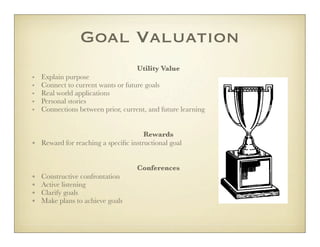
Goal Valuation
                                    Utility Value
•   Explain purpose
•   Connect to current wants or future goals
•   Real world applications
•   Personal stories
•   Connections between prior, current, and future learning


                                       Rewards
•   Reward for reaching a specific instructional goal


                                    Conferences
•   Constructive confrontation
•   Active listening
•   Clarify goals
•   Make plans to achieve goals
Teachers
                              Expect to Succeed
                           Environmental Perception
Possess the
Adequate
  Skills                        Motivation

     Confidence in Ability                   Value the Task
       to Perform Task                    Meaningfulness/Goal
         Self Efficacy                         Valuation


From Del Siegle and Betsy McCoach
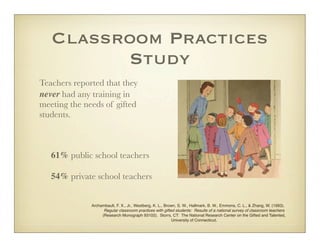
Classroom Practices
          Study
Teachers reported that they
never had any training in
meeting the needs of gifted
students.


	   61% public school teachers

	   54% private school teachers


              Archambault, F. X., Jr., Westberg, K. L., Brown, S. W., Hallmark, B. W., Emmons, C. L., & Zhang, W. (1993).
                    Regular classroom practices with gifted students: Results of a national survey of classroom teachers
                   (Research Monograph 93102). Storrs, CT: The National Research Center on the Gifted and Talented,
                                                           University of Connecticut.
Classroom Practices
     Observational Study
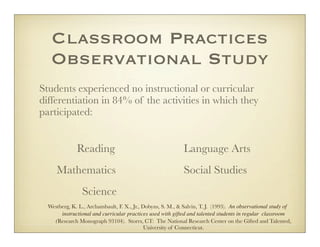
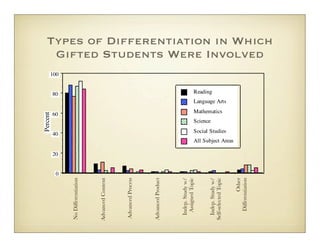
Students experienced no instructional or curricular
differentiation in 84% of the activities in which they
participated:


           	 Reading	                                          Language Arts
	      Mathematics	                                            Social Studies
	                 Science
    Westberg, K. L., Archambault, F. X., Jr., Dobyns, S. M., & Salvin, T. J. (1993). An observational study of
         instructional and curricular practices used with gifted and talented students in regular classroom
      (Research Monograph 93104). Storrs, CT: The National Research Center on the Gifted and Talented,
                                               University of Connecticut.
No Differentiation


Advanced Content


Advanced Process


Advanced Product


  Indep. Study w/
   Assigned Topic


  Indep. Study w/
Self-selected Topic


            Other
    Differentiation
                       Gifted Students Were Involved
                      Types of Differentiation in Which
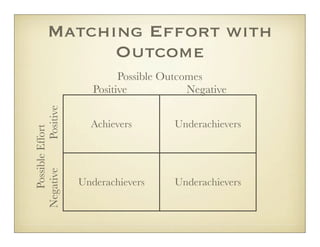
Matching Effort with
                 Outcome
                                  Possible Outcomes
                            Positive            Negative
              Positive


                           Achievers         Underachievers
   Possible Effort
Negative


                         Underachievers      Underachievers
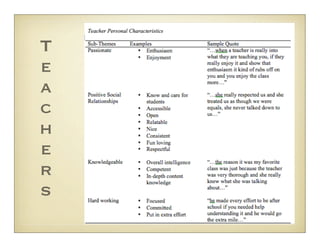
T
e
a
c
h
e
r
s
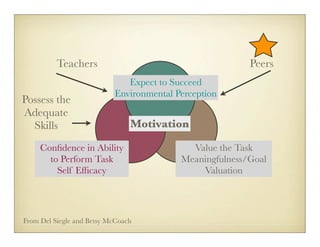
Teachers                                       Peers
                              Expect to Succeed
                           Environmental Perception
Possess the
Adequate
  Skills                        Motivation

     Confidence in Ability                   Value the Task
       to Perform Task                    Meaningfulness/Goal
         Self Efficacy                         Valuation


From Del Siegle and Betsy McCoach
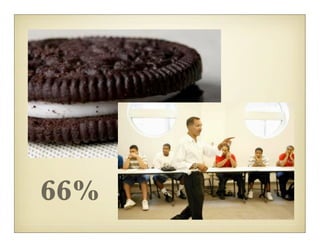
66%
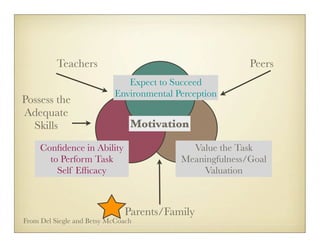
Teachers                                       Peers
                              Expect to Succeed
                           Environmental Perception
Possess the
Adequate
  Skills                        Motivation

     Confidence in Ability                   Value the Task
       to Perform Task                    Meaningfulness/Goal
         Self Efficacy                         Valuation


                              Parents/Family
From Del Siegle and Betsy McCoach
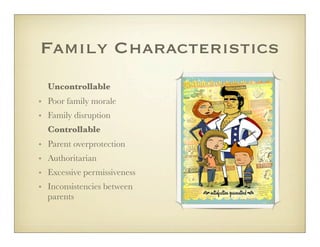
Family Characteristics
  Uncontrollable
• Poor family morale
• Family disruption
  Controllable
• Parent overprotection
• Authoritarian
• Excessive permissiveness
• Inconsistencies between
  parents
Family Issues
     Affecting Academic
     Underachievement
• Family dysfunction/ Power patterns
• Strained relations with family members
• Problems with siblings and sibling rivalry
• Inconsistent role models and value systems in the
  family
• Minimal/Hyper paternal academic monitoring,
  guidance, and expectations
Parental
         Considerations
• DON’Ts: Do not put them in their place or foster
  learned helplessness. Avoid excessive pressure or
  conveying too much power. Don’t use their talent as an
  excuse.
• DOs: Show them attitudes of respect, compromise,
  and working together to solve a problem. Negotiate a
  fair contract and stick to it. Model intrinsic and
  independent learning, positive commitment to career,
  and respect for school and teachers.
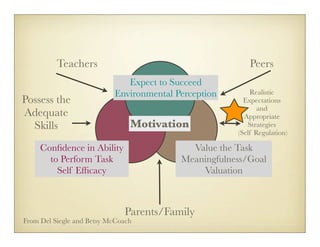
Teachers                                       Peers
                              Expect to Succeed
                           Environmental Perception       Realistic
Possess the                                             Expectations
                                                             and
Adequate                                                Appropriate
  Skills                        Motivation               Strategies
                                                      (Self Regulation)

     Confidence in Ability                   Value the Task
       to Perform Task                    Meaningfulness/Goal
         Self Efficacy                         Valuation


                              Parents/Family
From Del Siegle and Betsy McCoach
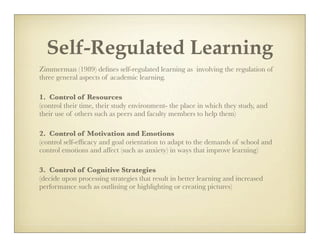
Self-Regulated Learning
Zimmerman (1989) defines self-regulated learning as involving the regulation of
three general aspects of academic learning.

1. Control of Resources
(control their time, their study environment- the place in which they study, and
their use of others such as peers and faculty members to help them)

2. Control of Motivation and Emotions
(control self-efficacy and goal orientation to adapt to the demands of school and
control emotions and affect (such as anxiety) in ways that improve learning)

3. Control of Cognitive Strategies
(decide upon processing strategies that result in better learning and increased
performance such as outlining or highlighting or creating pictures)
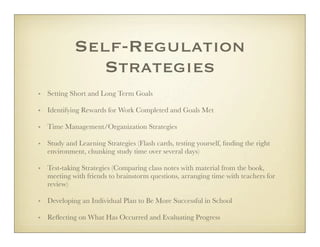
Self-Regulation
              Strategies
• Setting Short and Long Term Goals

• Identifying Rewards for Work Completed and Goals Met

• Time Management/Organization Strategies

• Study and Learning Strategies (Flash cards, testing yourself, finding the right
  environment, chunking study time over several days)

• Test-taking Strategies (Comparing class notes with material from the book,
  meeting with friends to brainstorm questions, arranging time with teachers for
  review)

• Developing an Individual Plan to Be More Successful in School

• Reflecting on What Has Occurred and Evaluating Progress
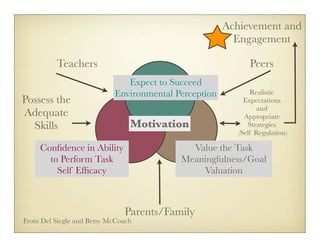
Achievement and
                                                        Engagement

          Teachers                                          Peers
                              Expect to Succeed
                           Environmental Perception          Realistic
Possess the                                                Expectations
                                                                and
Adequate                                                   Appropriate
  Skills                        Motivation                  Strategies
                                                         (Self Regulation)

     Confidence in Ability                   Value the Task
       to Perform Task                    Meaningfulness/Goal
         Self Efficacy                         Valuation


                              Parents/Family
From Del Siegle and Betsy McCoach
Don’t mistake activity
  for achievement.
         John Wooden
Achievement and
                                                        Engagement

          Teachers                                          Peers
                              Expect to Succeed
                           Environmental Perception          Realistic
Possess the                                                Expectations
                                                                and
Adequate                                                   Appropriate
  Skills                        Motivation                  Strategies
                                                         (Self Regulation)

     Confidence in Ability                   Value the Task
       to Perform Task                    Meaningfulness/Goal
         Self Efficacy                         Valuation


                              Parents/Family
From Del Siegle and Betsy McCoach
Researched
Interventions
Students’ Perceptions
               (Linda J. Emerick’s Study)


• Out of School Interests

• Parents

• The Class

• Goals

• Teacher

• Self
Interventions

• Whitmore (1980)

• Supplee (1990)

• Baum, Renzulli, & Hébert (1995)

• Siegle, Reis, & McCoach (2006)

• Rubenstein (2011)
U
                           A  Study  to  Increase  
                          Academic  Achievement  
                                    for
                             nderachieving
                         GIFTED STUDENTS
    from The National Research Center on the Gifted and
                         Talented
                      Principal Investigators: Del Siegle and Sally M. Reis
            Study Development Team: Del Siegle, Sally M. Reis, and D. Betsy McCoach
Intervention Development Team: Del Siegle, Sally M. Reis, Meredith Greene, D. Betsy McCoach, and
                                         Ric Schreiber
                       Field Test Team: D. Betsy McCoach and Del Siegle
       Study Implementation Team: Del Siegle, Sally M. Reis, Becky Mann, and Scott Davie
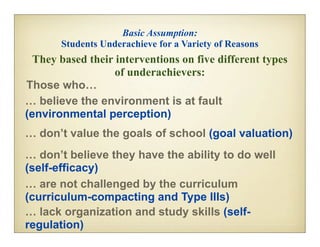
Basic Assumption:
       Students Underachieve for a Variety of Reasons
  They based their interventions on five different types
                   of underachievers:
Those who…
… believe the environment is at fault
(environmental perception)
… don’t value the goals of school (goal valuation)
… don’t believe they have the ability to do well
(self-efficacy)
… are not challenged by the curriculum
(curriculum-compacting and Type IIIs)
… lack organization and study skills (self-
regulation)
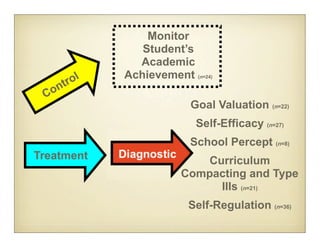
Monitor
               Student’s
              Academic
        l   Achievement (n=24)
   nt ro
 Co
                         Goal Valuation (n=22)
                          Self-Efficacy (n=27)
                         School Percept (n=8)
Treatment                  Curriculum
                       Compacting and Type
                             IIIs (n=21)
                         Self-Regulation (n=36)
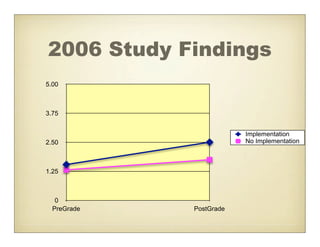
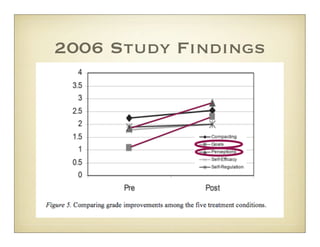
2006 Study Findings
5.00


3.75


                         Implementation
2.50                     No Implementation


1.25


   0
  PreGrade   PostGrade
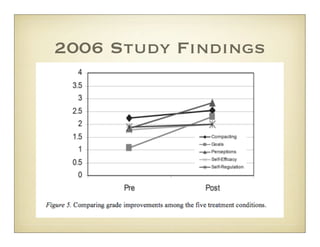
2006 Study Findings
2006 Study Findings
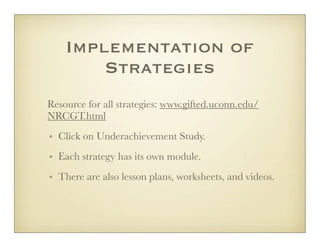
Implementation of
        Strategies
Resource for all strategies: www.gifted.uconn.edu/
NRCGT.html
• Click on Underachievement Study.
• Each strategy has its own module.
• There are also lesson plans, worksheets, and videos.
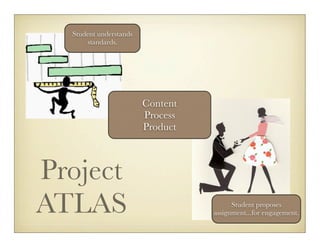
Project ATLAS
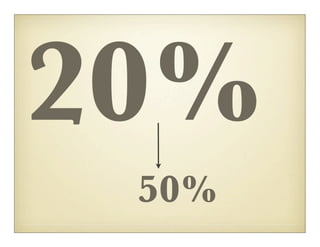
20%
 50%
Student understands
       standards.


                        Content
                        Process
                        Product


Project
ATLAS                                   Student proposes
                                  assignment...for engagement.
Daniel

• Family

• Peers

• Interests

• Expectations
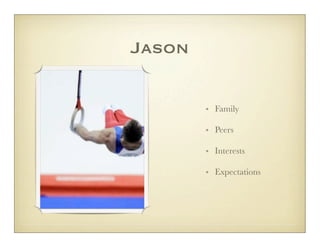
Jason

        • Family

        • Peers

        • Interests

        • Expectations
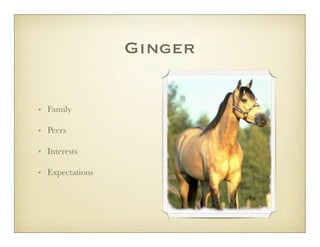
Ginger

• Family

• Peers

• Interests

• Expectations
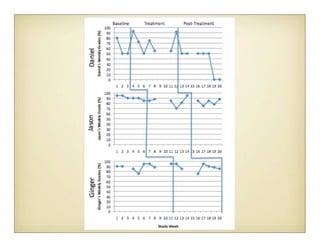
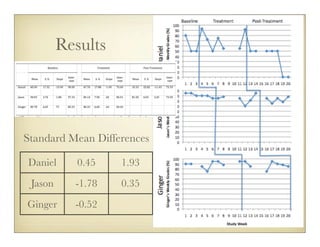
Results


Standard Mean Differences

Daniel      0.45   1.93
 Jason     -1.78   0.35
Ginger     -0.52
Findings
• Students’	
  home	
  lives	
  have	
  a	
  large	
  effect	
  on	
  students’	
  school	
  
  lives.

• A	
  caring	
  individual	
  who	
  takes	
  an	
  interest	
  in	
  a	
  student’s	
  life	
  
  can	
  make	
  a	
  difference	
  for	
  that	
  student.	
  Signing	
  the	
  
  permission	
  form	
  may	
  have	
  affected	
  the	
  students’	
  
  performance.

• Underachievement	
  interventions	
  must	
  be	
  student	
  speci=ic,	
  
  and	
  Project	
  ATLAS	
  may	
  be	
  effective	
  for	
  some	
  students.

• In	
  Mrs.	
  Hemmingway’s	
  class,	
  students	
  rarely	
  had	
  an	
  
  opportunity	
  for	
  active	
  engagement,	
  and	
  when	
  they	
  did,	
  the	
  
  underachieving	
  males	
  in	
  the	
  study,	
  both	
  Jason	
  and	
  Daniel	
  
  found	
  it	
  challenging	
  to	
  use	
  that	
  time	
  appropriately.
Call for Action
Call for Action

                Mentorships
            Community Partnerships
                 Autonomy
  Action         Counseling
              Quality Curriculum
 Research        Technology
                Social Justice
                Acceleration
               Try something...
Thank You.
lmrubenstein@bsu.edu

Iagc 2012 underachievement2_slideshare

  • 1.
    Understanding and Reversing Underachievement in Gifted Students Lisa DaVia Rubenstein IAGC 2012
  • 2.
    "It is notimpossibilities which fill us with the deepest despair, but possibilities which we have failed to realize." — Robert Mallet
  • 3.
    Importance • McCall, Evahn,& Kratzer (1992): School Achievement Matters • Peterson & Colangelo (1996): Persistent Patterns  
  • 4.
    Problems? • 18-25% ofhigh school dropouts are in the gifted range (Solorzano 1983; Renzulli & Park, 2000) • Underachievement becomes a pattern - only 26% of high school underachievers are able to reverse the pattern in college (Peterson, 2000)
  • 5.
  • 6.
    Most Popular Definition(Reis & McCoach, 2000) “Underachievers are students who exhibit a severe discrepancy between expected achievement (as measured by standardized achievement test scores or cognitive or intellectual ability assessments) and actual achievement (as measured by class grades and teacher evaluations). To be classified as an underachiever, the discrepancy between expected and actual achievement must not be the direct result of a diagnosed learning disability and must persist over an extended period of time. Gifted underachievers are underachievers who exhibit superior scores on measures of expected achievement (i.e., standardized achievement test scores or cognitive or intellectual ability assessments).” (p. 157).
  • 7.
  • 8.
    Identification Problems • Duration • Degree • Different for gifted students and regular students • Standardized test scores/ IQ test scores • Twice exceptionality • Selectivity
  • 9.
    2006 Study Findings 5.00 3.75 Implementation 2.50 No Implementation 1.25 0 PreGrade PostGrade
  • 10.
  • 12.
  • 13.
  • 14.
    Characteristics • Anecdotal reportsfrom counselors • Qualitative studies • Quantitative studies
  • 15.
    Possible Characteristicsof Gifted Underachievers May be dependent May develop coping mechanisms which successfully reduce short term stress, but which inhibit long term success. May be socially immature May be antisocial or rebellious ..........
  • 16.
    Characteristics of Gifted Underachievers The most common characteristic is low self- esteem. Sometimes these students don’t believe they are capable of accomplishing what their families and teachers expect.
  • 17.
    But wait...a challenge? •McCoach & Siegle: academic self-perceptions was equal between the 2 groups • Difference between qualitative and quantitative • Largest predictors: Motivation and task valuation
  • 18.
    A model ofmotivation: Achievement Orientation Model
  • 19.
    Possess the Adequate Skills From Del Siegle and Betsy McCoach
  • 20.
    Possess the Adequate Skills Confidence in Ability to Perform Task Self Efficacy From Del Siegle and Betsy McCoach
  • 21.
    Flexible OR Stable/Fixed
  • 22.
  • 23.
  • 24.
    How to BuildSelf- Efficacy • Complement of skills they develop • Practice lack-of-effort explanations for poor performance • Avoid the appearance of unsolicited help • Recognize progress during a lesson • Help students to set goals, document their growth • Peer models and self-model
  • 25.
    A Balancing Act Interest Ability Effort
  • 26.
    Expect to Succeed Environmental Perception Possess the Adequate Skills Confidence in Ability to Perform Task Self Efficacy From Del Siegle and Betsy McCoach
  • 28.
    School Climate • Lackof respect for individual child • Negative expectations • Strongly competitive environment • Inflexibility, rigidity • Exaggerated attention to errors • Unrewarding curriculum • Peer pressure
  • 29.
    School Perception • Identifyfaulty cognitions • I must perform well all the time. • Everyone must treat me well all the time. • Conditions must be favorable all the time. • Categories • What events occur • Attributions about why events occur • Expectancies or predictions of what will occur • Assumptions about the nature of the world • Belief what should be • Is it valid and/or reasonable to have this thought? • Are their distortions blocking what is true? (Examples include overgeneralizations, minimization, catastrophizing, absolute thinking)
  • 30.
    School Perception Choice Theory • All behavior is chosen and the only person whose behavior we can control is our own. • No thing, event, or person makes us to anything. Solutions • Set good goals that are positive, in the student’s own words, current, specific, and in the student’s control. • Start small, in the present and focus on how to actively change it. Point out successes. Follow up.
  • 31.
    Expect to Succeed Environmental Perception Possess the Adequate Skills Motivation Confidence in Ability Value the Task to Perform Task Meaningfulness/Goal Self Efficacy Valuation From Del Siegle and Betsy McCoach
  • 32.
  • 34.
    From Get OffMy Brain, by Randy McCutcheon, illustrated by Pete Wagner
  • 36.
    Whenever there isa problem to solve…that is good for me…. I get really interested in current events and ethics and morality… I remember when I first connected something from science and literature and psychology. It was so exciting!...I was seeing something, how things were working in the world, and I wasn’t just looking for a test. ...where if you are playing a team that’s worse than you, you kind of stoop down to their level...that’s how I felt in a lot of my classes...because the ones that didn’t challenge me were the ones I didn’t try at all in.
  • 37.
    I've ended upgetting lower grades than my classmates many times because I didn't feel like the course was challenging enough to try in.  Then, when a test did come, there were times I was unprepared because I've always had a hard time believing I needed to study for a test. That shaped my work ethic, even in college to believing that I can get through any class without external studying or preparation.
  • 38.
    Goal Valuation Intrinsic Value • Interest enhancing activities (games, challenges, anecdotes) • Choices • Pre-assessment and matched challenges (AP) • Immediate feedback • Enthusiasm and equal treatment of students Attainment Value • Authentic and significant tasks • Personally meaningful • Provide models who value academic achievement
  • 39.
    Goal Valuation Utility Value • Explain purpose • Connect to current wants or future goals • Real world applications • Personal stories • Connections between prior, current, and future learning Rewards • Reward for reaching a specific instructional goal Conferences • Constructive confrontation • Active listening • Clarify goals • Make plans to achieve goals
  • 40.
    Teachers Expect to Succeed Environmental Perception Possess the Adequate Skills Motivation Confidence in Ability Value the Task to Perform Task Meaningfulness/Goal Self Efficacy Valuation From Del Siegle and Betsy McCoach
  • 41.
    Classroom Practices Study Teachers reported that they never had any training in meeting the needs of gifted students. 61% public school teachers 54% private school teachers Archambault, F. X., Jr., Westberg, K. L., Brown, S. W., Hallmark, B. W., Emmons, C. L., & Zhang, W. (1993). Regular classroom practices with gifted students: Results of a national survey of classroom teachers (Research Monograph 93102). Storrs, CT: The National Research Center on the Gifted and Talented, University of Connecticut.
  • 42.
    Classroom Practices Observational Study Students experienced no instructional or curricular differentiation in 84% of the activities in which they participated: Reading Language Arts Mathematics Social Studies Science Westberg, K. L., Archambault, F. X., Jr., Dobyns, S. M., & Salvin, T. J. (1993). An observational study of instructional and curricular practices used with gifted and talented students in regular classroom (Research Monograph 93104). Storrs, CT: The National Research Center on the Gifted and Talented, University of Connecticut.
  • 43.
    No Differentiation Advanced Content AdvancedProcess Advanced Product Indep. Study w/ Assigned Topic Indep. Study w/ Self-selected Topic Other Differentiation Gifted Students Were Involved Types of Differentiation in Which
  • 44.
    Matching Effort with Outcome Possible Outcomes Positive Negative Positive Achievers Underachievers Possible Effort Negative Underachievers Underachievers
  • 45.
  • 46.
    Teachers Peers Expect to Succeed Environmental Perception Possess the Adequate Skills Motivation Confidence in Ability Value the Task to Perform Task Meaningfulness/Goal Self Efficacy Valuation From Del Siegle and Betsy McCoach
  • 47.
  • 48.
    Teachers Peers Expect to Succeed Environmental Perception Possess the Adequate Skills Motivation Confidence in Ability Value the Task to Perform Task Meaningfulness/Goal Self Efficacy Valuation Parents/Family From Del Siegle and Betsy McCoach
  • 49.
    Family Characteristics Uncontrollable • Poor family morale • Family disruption Controllable • Parent overprotection • Authoritarian • Excessive permissiveness • Inconsistencies between parents
  • 50.
    Family Issues Affecting Academic Underachievement • Family dysfunction/ Power patterns • Strained relations with family members • Problems with siblings and sibling rivalry • Inconsistent role models and value systems in the family • Minimal/Hyper paternal academic monitoring, guidance, and expectations
  • 51.
    Parental Considerations • DON’Ts: Do not put them in their place or foster learned helplessness. Avoid excessive pressure or conveying too much power. Don’t use their talent as an excuse. • DOs: Show them attitudes of respect, compromise, and working together to solve a problem. Negotiate a fair contract and stick to it. Model intrinsic and independent learning, positive commitment to career, and respect for school and teachers.
  • 52.
    Teachers Peers Expect to Succeed Environmental Perception Realistic Possess the Expectations and Adequate Appropriate Skills Motivation Strategies (Self Regulation) Confidence in Ability Value the Task to Perform Task Meaningfulness/Goal Self Efficacy Valuation Parents/Family From Del Siegle and Betsy McCoach
  • 54.
    Self-Regulated Learning Zimmerman (1989)defines self-regulated learning as involving the regulation of three general aspects of academic learning. 1. Control of Resources (control their time, their study environment- the place in which they study, and their use of others such as peers and faculty members to help them) 2. Control of Motivation and Emotions (control self-efficacy and goal orientation to adapt to the demands of school and control emotions and affect (such as anxiety) in ways that improve learning) 3. Control of Cognitive Strategies (decide upon processing strategies that result in better learning and increased performance such as outlining or highlighting or creating pictures)
  • 55.
    Self-Regulation Strategies • Setting Short and Long Term Goals • Identifying Rewards for Work Completed and Goals Met • Time Management/Organization Strategies • Study and Learning Strategies (Flash cards, testing yourself, finding the right environment, chunking study time over several days) • Test-taking Strategies (Comparing class notes with material from the book, meeting with friends to brainstorm questions, arranging time with teachers for review) • Developing an Individual Plan to Be More Successful in School • Reflecting on What Has Occurred and Evaluating Progress
  • 56.
    Achievement and Engagement Teachers Peers Expect to Succeed Environmental Perception Realistic Possess the Expectations and Adequate Appropriate Skills Motivation Strategies (Self Regulation) Confidence in Ability Value the Task to Perform Task Meaningfulness/Goal Self Efficacy Valuation Parents/Family From Del Siegle and Betsy McCoach
  • 57.
    Don’t mistake activity for achievement. John Wooden
  • 58.
    Achievement and Engagement Teachers Peers Expect to Succeed Environmental Perception Realistic Possess the Expectations and Adequate Appropriate Skills Motivation Strategies (Self Regulation) Confidence in Ability Value the Task to Perform Task Meaningfulness/Goal Self Efficacy Valuation Parents/Family From Del Siegle and Betsy McCoach
  • 59.
  • 60.
    Students’ Perceptions (Linda J. Emerick’s Study) • Out of School Interests • Parents • The Class • Goals • Teacher • Self
  • 61.
    Interventions • Whitmore (1980) •Supplee (1990) • Baum, Renzulli, & Hébert (1995) • Siegle, Reis, & McCoach (2006) • Rubenstein (2011)
  • 62.
    U A  Study  to  Increase   Academic  Achievement   for nderachieving GIFTED STUDENTS from The National Research Center on the Gifted and Talented Principal Investigators: Del Siegle and Sally M. Reis Study Development Team: Del Siegle, Sally M. Reis, and D. Betsy McCoach Intervention Development Team: Del Siegle, Sally M. Reis, Meredith Greene, D. Betsy McCoach, and Ric Schreiber Field Test Team: D. Betsy McCoach and Del Siegle Study Implementation Team: Del Siegle, Sally M. Reis, Becky Mann, and Scott Davie
  • 63.
    Basic Assumption: Students Underachieve for a Variety of Reasons They based their interventions on five different types of underachievers: Those who… … believe the environment is at fault (environmental perception) … don’t value the goals of school (goal valuation) … don’t believe they have the ability to do well (self-efficacy) … are not challenged by the curriculum (curriculum-compacting and Type IIIs) … lack organization and study skills (self- regulation)
  • 64.
    Monitor Student’s Academic l Achievement (n=24) nt ro Co Goal Valuation (n=22) Self-Efficacy (n=27) School Percept (n=8) Treatment Curriculum Compacting and Type IIIs (n=21) Self-Regulation (n=36)
  • 65.
    2006 Study Findings 5.00 3.75 Implementation 2.50 No Implementation 1.25 0 PreGrade PostGrade
  • 66.
  • 67.
  • 68.
    Implementation of Strategies Resource for all strategies: www.gifted.uconn.edu/ NRCGT.html • Click on Underachievement Study. • Each strategy has its own module. • There are also lesson plans, worksheets, and videos.
  • 69.
  • 70.
  • 71.
    Student understands standards. Content Process Product Project ATLAS Student proposes assignment...for engagement.
  • 72.
    Daniel • Family • Peers •Interests • Expectations
  • 73.
    Jason • Family • Peers • Interests • Expectations
  • 74.
    Ginger • Family • Peers •Interests • Expectations
  • 75.
    Results Standard Mean Differences Daniel 0.45 1.93 Jason -1.78 0.35 Ginger -0.52
  • 76.
    Findings • Students’  home  lives  have  a  large  effect  on  students’  school   lives. • A  caring  individual  who  takes  an  interest  in  a  student’s  life   can  make  a  difference  for  that  student.  Signing  the   permission  form  may  have  affected  the  students’   performance. • Underachievement  interventions  must  be  student  speci=ic,   and  Project  ATLAS  may  be  effective  for  some  students. • In  Mrs.  Hemmingway’s  class,  students  rarely  had  an   opportunity  for  active  engagement,  and  when  they  did,  the   underachieving  males  in  the  study,  both  Jason  and  Daniel   found  it  challenging  to  use  that  time  appropriately.
  • 77.
  • 78.
    Call for Action Mentorships Community Partnerships Autonomy Action Counseling Quality Curriculum Research Technology Social Justice Acceleration Try something...
  • 79.